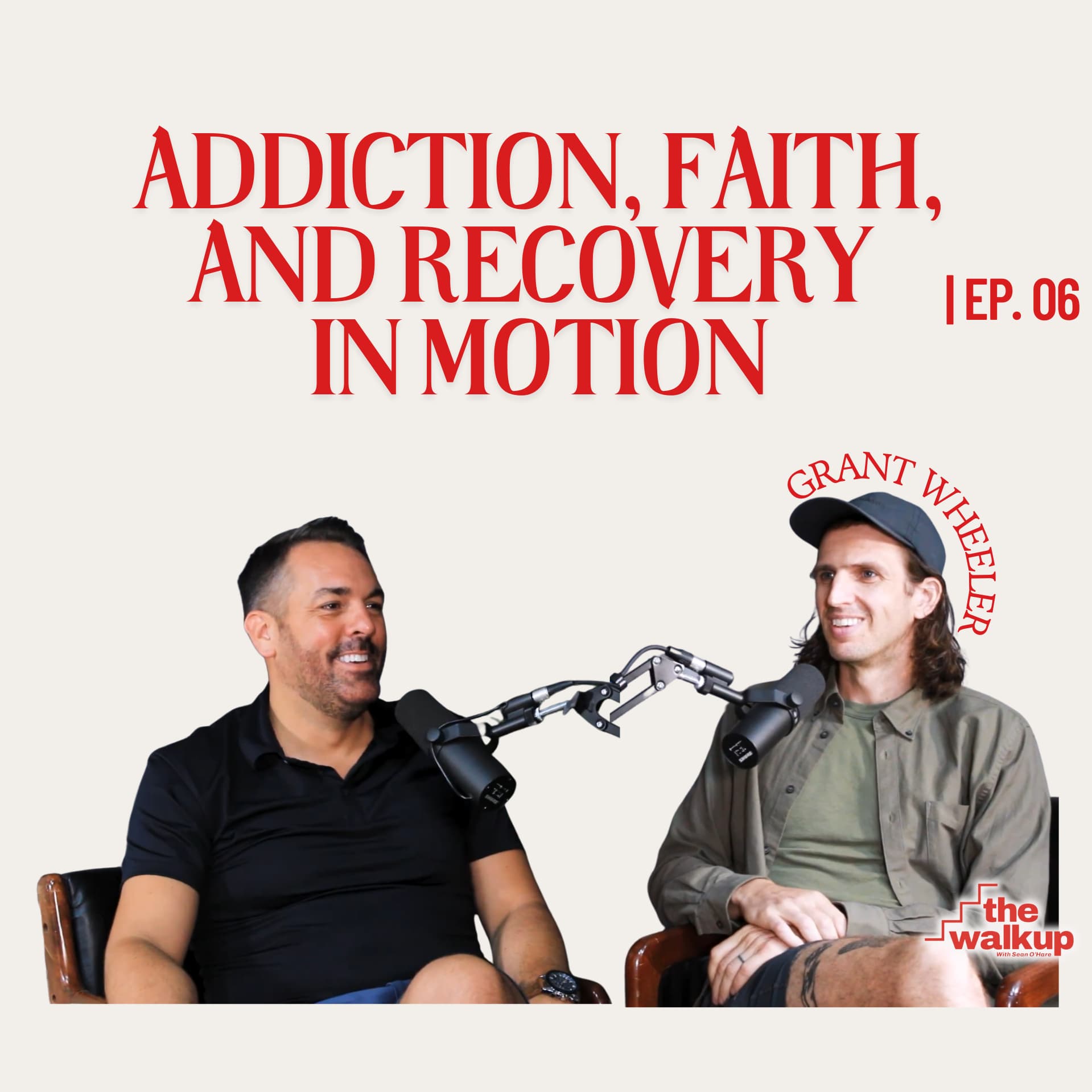
In this episode of The Walkup, Sean O’Hare is joined by Grant Wheeler, Director at The Phoenix—a sober living community using movement and connection to help people rebuild after addiction.
Grant shares his raw and redemptive story of heroin addiction, getting sober, and finding unexpected strength through CrossFit. From panic attacks and family pressure to building sober spaces that are actually fun, this conversation is an honest look at what recovery really requires. Along the way, Sean and Grant contrast church cultures, explore the power of community, and reflect on how physical and spiritual transformation are often more connected than we think.
Subscribe on YouTube: @TheWalkupPodcast Follow on Instagram: @thewalkuppodcast
Transcript
Read the full transcriptAuto-generated · 17,388 words
I always try to let people know how I know the guests that are on the show, so we've gotten to know each other through actually a previous guest. I don't know if I mentioned that Tom Williams has been on the show. Oh, Tom.
And so, we would have met, what, a year or two ago now? Somewhere in between those two, yeah. Yeah. So, as a way of just background, just to give people context, I'd love to just get your story, and also about specifically the Phoenix, what you're doing here in the city, but everyone's got a story, so you tell me where you want to start the story, and then we'll catch up. I think our environs today is sort of shaping where...
My story would start. I grew up in Connecticut. I grew up first in Westchester County, actually. I lived in a town called Chappaqua until I was nine or ten, and then moved to Connecticut to a town called Redding. Went to Catholic school. It is kind of neat to be back in these.
Like, something different about these spaces. You know, the bathrooms all feel the same. It reminds me of playing basketball for, like, my Catholic school team growing up. Right, it has, like, almost, not necessarily that it has a smell, but it does have, like, an essence that doesn't feel like another building for some reason. Yeah. Like, the walls have stories or something. The walls have stories, and, like, there's sort of, like, this perfect, like...
State of disrepair. I don't mean that in a pejorative way. It has a lived-in quality. It has a lived-in quality, yeah, and it's utilitarian in some sort of way. Yeah, which a movie set designer would pay lots of money to get the lived-in look. In fact, when we used to live in that former convent, I mean, we had people that would shoot short films, feature films, commercials, and they're like... It's already got the look I want. Like, this would take me, like, thousands of dollars, and I'd have to treat the walls and do this, and it's already there.
Yeah, it's funny. It's like, my car broke down last week, and I had to bring it to a mechanic, and I, like, had to use the bathroom, and use the mechanic's bathroom, and there's sort of a, like... We all have an image of what that looks like.
The Catholic school bath, it has a different vibe, but like its own vibe that you're like, I know where I am. This makes sense. It's a little bit of grease on the sink. And again, those people who are capable of being like, I see what this is, and I know how to duplicate it for screen or whatever. It's such an extraordinary talent. So, I grew up in Connecticut, went to Catholic school.
So, my mom, Polish-Ukrainian-Catholic, her parents were Polish and Ukrainian. My mom was one of nine. So, she's born in the States. My mom was born in the States, yeah. My mom grew up in Yonkers, went to, they just celebrated like the 100th anniversary of her Catholic girls' school that she went to in Yonkers or something like that. My mom went to that with her sister, maybe her sisters. Yeah. Quick aside, I was actually in Poland and Ukraine last year. I went to go visit Ukraine, but you can't fly into Ukraine directly now because of the war, so I went through Warsaw, so I hung out there for a couple of days, and then somebody drove me to the border.
And then I walked across, because it is quicker, because if you have a driver, if you have a car, like they have to inspect the car, it is like a long line. Yeah. But if you walk across the border. And you get in a car that has already been sort of.
Sort of has the green light. I mean, potentially, but even still, it was like a long, long, long, long line, because their protocols are much deeper to look at a car than just a single person. And you walk up there, and I got through pretty quickly. I mean, they asked me what I was doing there, and I just said...
Yeah, humanitarian, charity work, and they're like, hi, man, if you want to come in, go ahead, knock yourself out. Yeah, thanks for coming. And then I get across the border, and I realize, oh, shoot, I forgot I have a different driver that's picking me up on the other side. I had forgotten I needed to contact him to kind of coordinate, and as I'm pulling out my phone to coordinate with him, he, like, shows up. His name is... I don't know. So, I was talking to Andre, and he's like, you're Sean?
I'm like, oh, yeah, how did you know? He's like, well, you're wearing a sport coat, and you have a pink piece of luggage. I was like, this is rose gold. I'll have you know. But I was like, I guess I do kind of stand out. I don't exactly look like I'm ready to join the Ukrainian army or anything. But I got a lot of history about kind of what was really beautiful is I spent some time with Some guys in Warsaw, and I said, you know, help me understand what is going on with, like, because they were accepting all refugees, which is like, whoever is coming in, because, in fact, a lot of the folks in the service industry were Ukrainian in Warsaw.
Which is tricky, because a lot of them don't speak Polish. They wouldn't have had a reason to learn Polish. It's a tough transition, but he was like, yeah, we're a Christian country, and that's what we do. We're going to accept everybody. And I was like, well, I don't think everyone does that, but it was pretty cool to see that. From my distant relationship, I'm not a big news watcher, but from my understanding of contemporary Polish politics, it's not.
Well, and I asked him, I said, oh, what was the relationship between Poland and Ukraine before? And he's like, eh, it wasn't great. But it's like, I guess the war kind of put things into focus. So, what was that? So, your mom, Polish-Ukrainian Catholic. Yeah, my dad is an only child. My last name is Wheeler.
Old American family. And how did they end up together? My dad was injured from a hockey injury. He was a hockey player, and my mom was a candy striper at the hospital that he was at. Oh, wow, this is getting perfectly picturesque. And it's funny, my dad and his best friend, this guy named Freddy, who I heard a ton of stories about and is sort of relevant to. To the work that I do now, both liked my mom, and they planned a trip to go somewhere, but they had a trip planned, the two of them.
To compete for her? No, they had a trip planned. My dad and his friend, Freddy, had a trip planned to go somewhere, and my dad was like, cool, we're going, we're going, and then... Last minute, he backed out, and Freddy went by himself, and it gave my dad sort of the time and space to be the sole pursuer. To woo her, as it were. Yeah, and it is interesting, because my dad grew up without a lot of family.
Both of my grandparents were people who... I struggled with substance use stuff. My grandmother, on my dad's side, struggled with mental illness. My dad grew up in Scarsdale, and my grandfather was very successful, but my dad grew up kind of by himself. So, he met my mom, and not only was he attracted to my mom, but immediately met this big Polish Catholic.
Ukrainian Catholic family and was like, Oh, here's the family that I never, you know, that I never had. Sure. And sort of fell in there pretty, pretty closely. So yeah, grew up in that scenario, grew up playing sports. I have an older brother, younger sister from a pretty early age. I had, I struggled. With depression, and I found sort of these coping behaviors that helped me, you know, disassociate, detach, feel nothing. I was sort of incapable of feeling okay, so it was like, how can I feel nothing was the adventure that I was on.
First things were food and television. And then, you know, when people started to, you know, explore substances and stuff like that when I was in high school, I, you know, sort of enthusiastically hopped on that train and struggled with various forms of addiction throughout most of my adolescence. First...
Got sober. It is funny. We are on Graham Avenue. I moved to New York, and I lived. We are on Johnson and Graham. First Department of New York was on Graham Avenue. Graham and Powers. Well, and what inspired the move to New York, then? I graduated from, well, I actually didn't graduate from college. I had one class left to finish, which I finished a couple years ago, but I left college. I went to the University of Wisconsin, and it was the middle of a financial crisis, and I didn't really know where to go, and my parents were in a situation where I didn't really have a home to go home to, and it was like, I guess I'm moving to New York.
I didn't know where else, I didn't really know where else to go. Because New York was familiar enough, because you were... New York was familiar enough, yeah. My dad worked for the Rangers growing up, and my mom worked at... Oh, so you were really involved. Hockey, you played it, and your dad worked for the Rangers. Yeah, yeah. My dad was... My dad worked... My dad did a lot of different things.
He did, like, some corporate fixer-type stuff and was a consultant. And he... My dad partied with the Rangers in the 70s, right? Like, he sort of, his hockey career ended, but he was a hockey guy, and... So, he played pro or semi-pro, or what? My dad played semi-pro, and then at some point was like, I am getting married, I have to start, my parents got married at 21, and was like, I need to provide, so sort of got a career, but his social life was still these guys, you know, like...
Roger Bear and Ron Greshner are these famous rangers, and my dad actually played on the ranger alumni team, despite having not been a ranger for a long period of time, and we used to go to those sort of expositions with the ranger alumni team as a kid.
So, yeah, I mean, having lived in Chappaqua, like, that is a 40-minute train ride, went to Broadway shows, went to Ranger Games, went to my dad's office, which was on, like, 64th and Madison, went to my mom's office, which was the Equitable Building, which is right near where I met you, right near Rockefeller Center.
So, the city was kind of familiar, and then I had a lot of friends from college who were also moving here, so I found my way here. Surprisingly, though, I was pretty deep in addiction at that time. What did you study in college, or was it more just like... I always studied English literature. I liked books. I liked reading. I liked that exploration of the human condition.
Um, but as far as stuff that required more sort of rigorous attention and like, uh, professional preparedness, I did a ton of different stuff. Um, so then you moved to New York with the intention of like, I'm just going to figure it out, or there was like a particular job or a particular opportunity? No, I moved to New York with the intention of like, um, I mean, if I had to be.
Yeah, I don't know. It went from, like, getting high in Wisconsin to being like, I'm going to get to New York and figure out how to get high there. You know, it wasn't goal-oriented or particularly structured. But is your family aware of your struggles at this point, or you're keeping it pretty hidden? I grew up in an environment where I was always... Um...
Like, pretty good at school, and pretty good socially, and the structure and expectations that my mom experienced as a child, and that I was sort of raised under a somewhat, like, you know, generationally dimmed version of it, right? Like, things change, but there was still at the heart of it was this, you know, one, like, what do you look like on paper? And then two, How do other people perceive you? And despite a lot of my struggles, I managed to sort of keep those things together.
Okay. And, yeah, I mean, I distinctly remember a few times in college being like, I should come home. Like, you know, I need help. And I grew up in an environment, less so with my parents, but socially. Like, my college girlfriend, when I was like, hey, like, I think I need to get sober, she said, you know, like, I need to get sober. Don't embarrass me, or some version of that. And I'm not at all angry at her for that, but that was the world that I was in.
It was sort of this work kind of hard, play really hard, know the right people sort of nepotistic, opportunistic approach. To life. And, yeah, so I, that was sort of where I came from, and had a lot of, you know, it's interesting, it's like, it's like my addiction was a lot, and caused me a lot of problems, but it got really, really hard when I tried to stop, and I couldn't. Like, that's when things really sort of spiraled.
I started to identify with the fact that like the stuff that I used and to be perfectly honest, my depression was so intense through adolescence that like, I don't know if I'd be here if it wasn't for drugs and alcohol, like drugs and alcohol saved my life. They worked really, really well until they didn't. Um, but I, uh, yeah, I, um, my past getting back to your original question, it was, uh, My parents, yeah, they didn't do a ton of investigation.
They had a lot of their own issues. My dad, in addition to everything he did sort of professionally, was a volunteer firefighter, and he was raised under these sort of like isolated circumstances, which created some pretty catastrophic events for him as a child, and as a volunteer firefighter in our small town in Connecticut, he surprisingly was exposed. Not surprisingly, but like you think about somebody running a...
Yeah, but more so, like, you know, one day we're driving home from, we had dinner at the Inn at Pound Ridge with some family friends, and we're driving home, it's Christmas Eve, like, 1999, and we're, like, driving home, and we pull up on a car accident on the road, and it's, like, five.
17-year-old kids that my dad knew their parents who'd hit a tree going like 100 miles an hour. Wow. You know what I mean? And that sort of thing happened. There was a murder in my town in which my dad was one of the first guys to come in and be like, what's going on here?
And then, he was really connected, as my dad was, with law enforcement and intelligence agencies, and he was in the city on 9-11, and called a guy he knew, and was like, do you need help? And they were like, yeah, we need all the help we can get, and ended up spending a couple weeks there, and has been in some different state of permanent disability, kind of ever since that. And it took us, due to like this sort of, this veneer thing that I was talking about, it took us 10 years to acknowledge that my dad needed treatment, and it took us another three or four years to realize that treatment wasn't like you're seeing the psychiatrist and you went away for a little while.
Do you know what I mean? There was this assumption that... He was all better. I grew up being like, oh, people have a drug problem. They go to rehab. You fix it. And they're fixed, and everything's okay now. And I guess that's sort of a good connection into the work that I do with the Phoenix. I work for a non-profit, a national non-profit. We're in 47 states. My title is I'm a volunteer manager.
And what we do is we build really any sort of event that is sober, safe, and fun. Our bread and butter is fitness, yoga. We do a lot of CrossFit, rock climbing, group runs, stuff like that. That has expanded a lot. We now host all Pathways recovery meetings. We do a bunch of partnerships with other organizations in the space. We started, which is my favorite thing yet, we started a choir last week. We hosted these events that you were kind enough to emcee, and alongside Tom and the Came to Believe folks, and what we do is we provide opportunities for people to show up and be with other people that are sober.
The only requirement or fee to attend any of our events is 48 hours of sobriety, and we try to build safe and inclusive spaces for people to show up, and whether they're sober curious, whether they're... An ally of people who've suffered, whether they're in recovery, whether they're, you know, still struggling and happen to have strung 48 hours together and want to connect with other sober people. We hold that space. And I started as a volunteer with the organization in 2021 after I'd left a career where I had experienced a somewhat significant, significant for me, level of this veneer-oriented success.
Pandemic came around, and I was given some time off due to the mandates, and took a step back and was like, I need to change everything. And my wife at one point was like, you need to do something every day, right? Like, it's nice that you don't have to, but you have to. And I started volunteering for the Phoenix. And then within a few months, they posted a job for somebody to do what I do in New York, and I applied, and I've been doing it ever since.
And because you got your sobriety, how long had you been? So, I got sober. Initially, relapse is a big part of my story. I got sober initially in 2012, under an ultimatum from my then-girlfriend, now-wife, to, in the most compassionate way ever, was like, I can't do this anymore.
And I got sober initially for her, did a lot of that work, joined a 12-step fellowship. Got a sponsor, worked the steps, had service commitments, did all the stuff that people say to do, not necessarily for me, but to maintain the status quo, and then my life got better. Alcohol, drugs, everything? So, at that time, it was the thing that really changed my life.
And I have, like, a ton of gratitude for it, because it allowed me to function through periods of significant pain, was opiates and heroin. Those were sort of the biggest things that sort of broke me, that sort of allowed me to keep going, and then eventually kind of broke me in half. And towards the end of my use, my My now wife knew that I had had a problem with these substances in the past.
But at this particular time, she didn't know that I was using again. We were living in Harlem. Her dad lives in Harlem, and we moved to be close to them, and within a couple days of moving in, I learned my next-door neighbor, because I have a sixth sense for this stuff, was a heroin dealer.
You met him, and you're like, I met this guy. I was like, I know people like you. I've known people like you. We've had a good time. Do you want to hang out? And yeah, so I started using heroin again, and it just... The biggest thing, my experience with heroin was that it made me feel great when I was on it, allowed me to show up and be emotionally available in ways I couldn't be, allowed me to have a good time, allowed me to be in the moment.
But probably the biggest thing that broke me was that I wouldn't really sleep. I would nod off. And would lay in bed sort of like doing what heroin addicts do, like scratching myself and being like, I have to pee, and I can't pee, and like, I have to poop, and I can't poop, like all this like biological stuff. And your wife can tell this was happening or no? Yeah, I mean, like, I'm super sensitive, like I need sleep, and if it's clear that like I haven't actually had a night's sleep in like five days.
I'm a different kind of person. Well, I think most people are. Yeah, yeah. If I don't sleep out, if I don't get my eight hours, my friends. Like, my eyes are raw, and like, I'm just a mess. I'm an eight-hour plus a nap kind of guy. You know, I developed, she was like, it's crazy. Grant, out of nowhere, has developed this, like, incredible car sickness, you know? And I'm, like, throwing up all the time, and it's just like... Never had motion sickness before, but crazy.
Yeah, and I'm like, you know, and I'm there being like, everything's okay. Right, because for me, that state was more okay than not using. So, you try to get sober for her, but then it relapsed. Relapse. I had a few relapses in that early time, and then my life got way better with some sobriety. I had 18 months or something like that. And I didn't really identify alcohol as a problem. I didn't start drinking, again, socially, but the career that I had is me and a couple guys that I worked with in nightclubs started opening bars and restaurants, and things grew, and at some points, I was smoking weed again.
At some points, I was really looking forward to the wine tasting we were going to, even though I didn't drink, and sort of lived in this, like, where am I at with this? Until really like the first week of the pandemic, one thing that really sort of broke me was I went to a wedding in New Orleans right before.
The pandemic started, where everyone was, like, joking about the pandemic, right? It was, like, in that time where people were like, oh, it's Boogeyman, it's out to get, no, it wasn't even there yet. It was, like, the, like, people, like, had heard about this thing, you know, and it was sort of the, it was, like.
It was like Bitcoin in 2016, where everybody was like, COVID was like the new Bitcoin. Except, you know, not a good investment. No, not a good investment. I mean, it depends what industry you're in. Oh, I guess, yeah, that's true.
And so, yeah, so that was where it was at, and I had a buddy there, and these are my friends from college, and I wasn't drinking, but he had this weed tincture, and I took a couple drops of it.
And having no tolerance, having not smoked weed, just wanting to feel different, and got so stoned, and ate all this food, and we get back to our Airbnb in New Orleans, and it was cold in our Airbnb, and I'd seen the thermostat the previous day, and then I couldn't find the thermostat.
And I just like, I had like a 48-hour panic attack, freak out from like this high-intensity cannabis oil, and wandering around the apartment. You know, like I had to wake my partner up at some point. I'm like laying on the kitchen floor being like, make it stop, you know, just like pure, sort of. Terrible weed experience thing, and I sort of got back to New York, and within days, everything was shut down, and I was like, I need to get back on the beam, as they say, and re-embraced recovery stuff, started going to Zoom meetings first, and then...
So, I made the decision to step away from that line of work to find safer pastures for myself. Because you had had multiple bars, nightclubs at this point? Yeah, at that point, we had three bars and a wellness business. My business partner, his wife, they were sort of like a duo.
And she saw us opening the bars and having success and was like, I want something. And we were like, what is it? What do you want? And we opened this nail massage wellness cafe brand concept. So, we had the three bars and that, and then we are doing pop-ups at Art Basel, and concepting another bar, and had opened a nightclub that had recently failed, and doing projects out in Montauk, and just sort of, we had this thing that was happening. And you had a natural talent for that?
I mean, just in terms of like, vis-a-vis your business partners, what was your role distinct from that? You know, I grew up with, like, such... I talked about this depression and coinciding anxiety and this pressure to have this veneer and how you were presenting, so I was a world-class people pleaser and was pretty good at knowing what people wanted and what they needed in certain settings, and I think that gave me a little bit of a natural talent for the hospitality space.
I was also really well-educated and knew a lot of great people. Was kind of built to succeed in that space? And then also in New York, like... This is not an easy... I mean, that's a tough industry. And also in New York, like, a lot of people who work in those industries, right, are, like, fueling some other sort of passion. There's dancers, there's actors, there's artists, there's musicians, right? And, like, I was just a drug addict. So, I was like, oh, here's a place that I'm succeeding.
How can I, you know, make the most of this? And was there a part of you that's like, well, it also funds my... I mean, yeah, the free, like, you know, free drugs, and free alcohol, and then, like, I worked at this nightclub where people who worked at the nightclub sold drugs, you know, and then saw other people came and gave, you know, I'd be like, oh, I have to buy drugs from this guy because the guy with the free drugs will be here at 1 a.m., you know, like that sort of scenario.
So, yeah, that was my work experience. And then, it was funny. I was like, you know, I was an entrepreneur, right? It was me and these three guys. We started all these businesses, and I had this sort of, you know, in re-getting, in like re-embracing sobriety and stepping away from my career, I had sort of this freak out, right? Like, who am I? What does this mean? I got an amazing therapist who I still work with today.
I had all this resentment around the way my business partners conducted their business, and the way that I sort of behaved in those environments, and I thought about who did I know that was like a kind of somebody to look up to, and this was just around, I was also cross-fitting a lot. I was doing a lot of CrossFit at this time. When I first got sober in 2012, I immediately joined a CrossFit gym, and the combination of those two things changed my life.
I was in the CrossFit gym talking to people about my step work. I was in step work talking to people about my back squat, and they were like, what do these two things have to do with each other? And I was like, to me, everything. Right. Right. So, I...
That spring, right, like in June or whatever, there was this Zoom about the state of CrossFit. There was a sale, and the founder was having said some things about George Floyd that were not tasteful, not sensitive. And he was getting sort of like pushed out. And there was this Zoom with some of the most powerful figures in that industry. And one of them is this guy named David Asario who owns CrossFit South Brooklyn. And I went on there and I watched him talk from this like very progressive New York position in this sport of CrossFit, which was like very empathetic to the struggles that were going on.
But didn't, you know, a lot of these guys own CrossFit gyms in these areas that are nothing like, you know, Gowanus. Right, or not racially, culturally, economically diverse like New York City is. And at this point, you know about the Phoenix or no? I don't know about the Phoenix yet. Oh, okay. So, I see this guy talking, and I'm like, oh, I want to join his gym when it reopens.
Gym reopened. They weren't taking new members because everything was cut down, but they were hiring for a front desk position. Huh. So, I went from, you know. Running these businesses and hiring people to mop floors and sweep floors and yelling at people and looking at spreadsheets and being like, what does our future look like as a massive company to being like checking people into class and dusting the keyboard and wiping down barbells and this back-to-service role within this community, one, because I wanted to train there, and two, because I wanted proximity to this guy that I really respected.
But even still, just to pause on that for a second, you were talking before about the veneer of success, of as long as you hit certain checkboxes, your family was like, okay, he gets good grades, or he's got friends, or whatever else.
Granted, pandemic was a weird time for everybody, but that's an act of humility, and then to put yourself in that position. And then, like, what did your wife think about that? Was she like, what the heck's going on here? No, she was really stoked for the whole thing. She's so incredibly supportive.
I mean, yeah, I mean, she's extraordinary. She's my best friend, and she's always been so supportive of me, and we've always had this... I mean, I'm in no way trying to, like, tit-for-tat this, but, like... My business and the work that I did, a lot of which was, in a weird way, like, made possible or, like, existed because of my addiction or whatever, you know, put her through grad school, allowed her to make professional changes when she wanted to. Right, when you had these kind of surges of productivity.
Yeah, and I just had this capacity to allow, to make space for her to grow and learn. She repaid it like a million times, a million times over, and I never had any expectation to. But even so, from an image standpoint, because I think what men, generically speaking, often deal with the posturing and presenting yourself as a certain type of person, right?
I don't know if there's a part of you that, like, if you're working at the front desk at a gym, now, the motivation for you was clear. I want to be around this owner. I want to be around this potential mentor. Yeah, and I also wanted to be in connection with community, right? Because we were coming out of this time where, like, we were not in community that much. But I could imagine there's, like, I'm just maybe more speaking for myself, is like...
People are going to think this is who I am. I'm a guy who's got a fairly humble job. I remember my dad had lost his job at one point when I was in middle school. He struggled for a little while before he found work again, but there were periods of fallowness there, and I remember my mom being like, why don't you just work at wherever?
And it just wasn't something that was ever going to do. Yeah, my dad had that same experience, but with his PTSD and not being able to show up for stuff. And my mom was like, why don't you go do this? And he didn't have the capacity to do that. And certainly a generational thing, I imagine. But it was just like, no, this is who I am. I mean, there was definitely... This is the type of job I'm... My experience was definitely like this.
I packaged both internally and externally that I had sort of retired from this other career, and this was the sort of... So, you had the freedom to... I had the freedom to do it. I did the work dedicatedly, and with a ton of humility, I saw it as this service project for myself.
In a lot of lights, but I also sort of wrapped it in this, which in really exactly what it was, but it felt comfortable to package it in like this, I'm leaving this success behind to explore and be a better version of myself. I definitely leaned into both externally and internally these like... Tropes of optimization that I think are abundant in our society now.
So, then you're getting community and... Yeah, which is the most extraordinary. I mean, like, the community at that gym is everything to me. So, beyond... Okay, so there's... I've not done CrossFit and I know just kind of from the outside looking in, but I mean... It provided for you, obviously, you get the physical side of accomplishing goals, progressing within a community about being healthier, becoming stronger, becoming more fit. Those are all obviously good, but what was it beyond that? I don't go to Planet Fitness and go, I say I have a community.
What is it about CrossFit that makes it different? Um, what is it about CrossFit that makes it different? People are following up with you. Yeah, there's the collective accountability, which is for sure. It's, you know, constantly varied. You're doing different things every day. So, you're all sort of like learning and meeting this challenge you're prepared for. Oh, okay, so you're stretching yourself. Not expecting, right? Like you're prepared for it in having come.
And everyone is doing the same thing. You know, everyone is doing that thing. So, whether you are in the 9 a.m. class, you see the people leaving the 8 a.m. class, and you are like, how was it? And you talk about it. Ah, okay. And then afterwards, the people from the 10 a.m. class are like, what was that like? Tell me about it.
And then also, this gym in particular, you know, like we have an art show every year in October, where all the people from the community come and hang their art up in the gym, and people do live performances.
We do a ton of fundraisers every year. So, we celebrate people having children, which I just recently had the experience to. I have a 10-and-a-half-week-old, almost 11-week-old daughter, whose name is Petra, and it is the most amazing thing. When you are measuring in half-weeks, that is what you know. Yeah, it is so magical. I mean, I could talk about that forever. But CrossFit is...
People have labeled it as a cult, or whatever. I hadn't heard that, but okay. Yeah, people have called it that in the past, and in some way, I think it really appealed to me. People at times are like, are you trading one addiction for another?
I'm like, no, addictions are things that take away from my life, and passions are things that not only contribute to my well-being, but the well-being of the people around me. But yeah, CrossFit, it's inherently community-based. It is about community, and what's amazing about it for me is a person who I might not present as lazy, but I feel lazy just about every day.
Um, basically up until having a child, which totally shifted that. You can't, you can't do that. No, it's not even that I can't be lazy. It's that I used to, you know, I've run a bunch of ultra marathons. I've run marathons. I've done CrossFit for years. I do difficult things, but up until this child arriving, I met so much of that with like resistance. Like I knew it was good for me, and I knew that if I'd go, I'd have a positive experience, but I still.
...lived in this I-don't-want-to, just this permanent I-don't-want-to state, which comes all the way from my childhood, and now the fact that there's this thing that I always want to do, which is to spend time with my daughter and with my wife, has just... Brought this optimism to everything that I do. And clarity, I imagine. And now it's like, I want to do this, and I want to hang out with my daughter.
And I can be okay with not doing this other thing I want, because I'm doing this other thing that I want more. And it allows me to be also so much more present. In those experiences that aren't within the home, or with my daughter.
Yeah, I've heard that from different... I'm like, oh, I left the house to go do this thing. And I'm going to do it. And I'm going to do it, and I'm going to show up, and I'm going to make the most of it. Yeah.
No, as a single guy, I think, or as an unmarried guy, I should say... It does seem that sometimes a lack of, like the difference between socializing after 6 or 7 p.m. and working between normal working hours, kind of the same level of enthusiasm or the same level of like, you know, when we see what I get out of this, whereas I have dozens of close, particularly guy friends, where I see them go through this transition.
Of getting married, or having a partner, and having their child, and the clarity, and the purposefulness of like, yeah, when they're going to hang out with me, it's like, hey, I got this one night. Let's go do something. Let's enjoy each other's company, or like, hey, man, you want to hang out with me? You got to come over to my house, because I'm going to be here with my wife and my kid. And there's just no, there's less, I don't want to say.
There's less ambiguity. There's less hemming and hawing about where the clear lines of motivation are. And I always think it's a great thing. I was just visiting with a friend who's got a... Four-week-old? Yeah. And his wife was like, oh, what do you, you know, what do you... I remember four weeks. Yeah. I remember six weeks, too. Yeah, yeah. My friend's wife was like, well, just like seeing, you know, him as a father now, and I'm like, I guess I've just seen it so many times, I'm not surprised when, like, this whole different...
Part of my guy friend comes out, and they're flourishing in this kind of different way, and being a father, being like, and especially when it's a little girl, I think there's something about having a daughter where he's like this little teddy bear all of a sudden, he just completely melts in front of her, and this like, I will, what I would do for this child, you know, is like, there's no way of measuring it, and it's just like, it's a beautiful, powerful thing, right?
You know, there is like this thing within the 12 steps, you know, a Cliff Notes version is mood follows action. Okay. Right, and a more expanded version would be, it is really hard, it is much easier to act yourself into right thinking than it is to think yourself into right action.
Okay, I get it, yeah. Act as if, not think as if. Yeah, and it is very much... You know, gratitude begets gratitude, and not only, you know, I'm there so grateful with my daughter, and so amazing, and can't wait to be back with her, and then I leave, and I'm like, I'm grateful for this opportunity to, like, you know, like, listen to Stevie Wonder in my car while I'm driving to this treatment center to see this dance performance that one of our volunteers is coordinating.
So, yeah, it's, you know, it's inertia, you know, and momentum, I think, and it also has expanded my capacity for compassion and empathy because I'm having this new experience, and I go to the gym, and, like, half these people are parents.
Right, and now I coach at this gym. Now I coach at this gym, and I'm like, it's amazing that you're here. Thank you for being here. You know what I mean? I didn't have shit to do. I was talking to my sister-in-law last week, and she's like, I don't know what I did before I had kids. What did I do every day? That's a lot of time. For me, I'm like, do I go to the gym in the morning, in the afternoon?
Man. Which of my completely flexible schedule do I want to dedicate 45 minutes to? And yet, I still can't find the time. No, exactly. I can't find the time. Exactly. And that is the other thing. It expands that productivity, because you are like, if I want to do this thing, I have to do this thing, and I have to do it when it is available. Yeah. Right? Yeah. And the other thing is, with work, it will start to, I don't know, intellectually pile up, and I will be so grateful for, oh, the baby is asleep.
I have an hour to respond to these emails and connect with these people. Right, and then, like, I get the opportunity to, like, cook dinner, you know, and feed my wife, who's feeding my daughter, you know, and it's just, it's a whole different, I mean, I don't know if I'm different than other people, but my experience relative to the way that the world is reflected back to me is that I live in these intense sensations, and these are Just so abundantly powerful right now, and the amount of gratitude I have is extraordinary.
But it is funny to be in a church, because you reached out to me about doing this, and I have recently, in therapy and in my practice, being like, I look at my recovery, and I live most of the time in this state of powerlessness, gratitude, hope, surrender.
Right, and all of that is propped up by faith, but let us say the floor is faith. Faith defined as? Belief and trust in something that is unmeasurable and indestructible that is not me, but I am very much a part of. And you name that as God, or name that as a higher power? I name it, in my voice, I name it as God. I am not a practicing Catholic. I still love Catholic churches. I actually went to St. Boniface with a couple of guys last year in downtown Brooklyn.
Um, to see like if, if this was a home for me and I was like, I don't think it exactly is, but I'm the only thing separating that once you, once, once I'd sort of turn it over and get out of the results business and sort of like want to embrace this powerlessness thing, which is the fuel of my recovery. The only thing separating that and like despair and helplessness is faith. Yeah, and I'm fascinated by that. I think when it comes to, from being a, I'm in this unique position of being an outsider to the recovery space, but yet through you and through Tom, being much, much more familiar than most outsiders would be because of interacting and working with you guys over the last few years.
And so, I'm always fascinated by that, that how foundational the idea of a higher being is in a recovery process, that even those that don't find the formalized religion or anything else to be necessary, yet they will, just in the same way you did with that level of, like, Conviction, like what, there has to be this, this has to be, and is it strictly just connected to the need to understand your own powerlessness, or is there something about, like, I need to know that there's an omniscient, like, omnipresent force in the world?
I mean, um... It is interesting. I think the initial impetus for wanting it is safety and security, and understanding the boundaries of my capacity to control. There is a reason why the Serenity Prayer is the foundation of the Twelve Steps.
But then I think secondarily, there's like so inherent within my capacity to feel joy is my capacity to feel awe, and I think that when I am happiest and healthiest and the most on the beam and the most connected, My brain, myself, my grantness is constantly just like, what's going on out here? This is amazing. Having wonder, having... Yeah. I remember I was with a... That curiosity, and I take my daughter now. I used to have a morning routine where I'd journal and meditate and stuff, and that doesn't exist anymore.
But I get up, basically... Uh, between 5 and 5.30, or 4.45 and 5.30, or whatever, because the baby's sort of, like, on her way out of having, like, the bulk of her sleep, and I strap her on, and I grab our dog, and we go for, like, these three, four, five-mile walks throughout the park, because our daughter won't take a bottle, so the only way that I can keep her engaged is, like, she looks around, she's curious about what's happening. And then she falls asleep, and as long as I'm walking with her and she's tight to my body, she'll sleep for basically almost, you know, she'll sleep for three hours.
And in that process, I notice that I am most content when I'm, you know, either in connection or like... Wanting is a wrong word, but living in this curiosity about what this thing that is bigger than me is. I will use podcasts, or I will use books, or I will use music to put me into that state, but that is where I want to be in that time. It is like 85% listening and 15%. Conversation. Yeah. Of me being like, what is this?
But it's interesting when... Watching it through a child's eyes, right? Because they're in that constant mode of like, what is this? How does this work? They're testing physics, they're testing their eyesight, they're testing foods that they like, and it's constant experimentation, and you would think that to some degree, we as adults would be like, this is boring watching you experience it, but instead, we enter into it, and watching their awe and their wonder. I was just going to mention that. I remember I was with this philanthropist one time, and he lived in Jackson, Jackson Hole, Wyoming.
Yeah, nice place. It's a nice place. He had a couple homes. Very generous guy, and he was in his mid-70s at this point, probably, and we were taking a small plane from Jackson to Cody, Wyoming, because he had a horse farm thing there.
But we were flying just a short flight, and he's like, Sean, Sean, come over here. He's like, look at those mountains, man. Isn't that incredible? This is a guy who does this regularly, you know, takes his little plane from, you know, this like 20-minute, 30-minute flight from Jackson to Cody, and yet his wonder was still there, and that's like kind of how he attacked life, was just, he was never not like a... A little kid in that way, you know? So, I am curious about the idea of community and the idea of like, because obviously community is a term that gets often overused, right?
Yeah, and it is really easy to call something a community. I would not say it is not. Right, but it's like that thing that was said at the Larry Flint trial. It's like obscenity, I know it when I see it, sort of thing. Yeah, yeah, yeah. Do you know what I mean? Real community, you know what I mean? Yeah, and I'm not here to poo-poo on whatever anybody's doing in efforts to bring people together. We're part of the podcast community right now.
Yeah, yeah, we are. But what's interesting is that's a really real thing, right? If you get a little bit of traction, or you get connected to the right people, you can be like, how do you do this? How does that work?
And then you can share it with them, and share guests, and all of that. It is true. It has become a little bit of a, yeah, of a part, being part of a club that, like, but I'm, I'm, I, I, one of the things that I've been reflecting on when getting to know the Phoenix, getting to know, came to believe, came to believe recovery is, like, what is it that the church isn't doing that?
That these communities are presenting better, right? And what I mean by that is, like, I was, I was actually, it wasn't something with the Phoenix or with Came to Believe, it was another, this one was actually was a Catholic kind of group that was dealing with addiction, and I was, it was all men. Yeah. And they tended to be, they were, for the most part, older as, you know, 60s, 70s, you know, speaking of 9-11, a guy who had, you know, worked.
There, you know, in the cleanup at the World Trade Center, you know, guys that live some difficult lives, but the vulnerability. To watch these tough men who have scars, like actual scars, but then emotional scars, and my daughter's dealing with this, my son died of that, my wife left me, some real-life experiences, and watching these big, tough guys be, one, I'm broken, I'm going to need healing, I need you guys, I need God. And we all need to be healed. I was like, it was so disarming to see the vulnerability of these guys, and I thought, if when you walked into a church, what you heard was, we're all broken, we all need healing, we all need each other, and we all need...
If that was truly what you felt every single time, I think it would be transformational. Now, it's not that that's not present, it's just that it's not necessarily... ...received that way when you walk into the church. Maybe it is like, okay, here is a beautiful liturgy, or here is physically beautiful space, here is some nice music, and through that form, you get those messages. But, like, I do not know that we are conveying a vulnerable space. Yeah.
Because there are the things you were talking about before, about the veneer, right? There are certain churches where, like, you know, you... Your family buys a pew, and you always get that pew, you know, and it is like, well, that seems kind of counterintuitive to the Christian message, you know, but like, so I am curious, during your various journeys with recovery and relapse and so forth, was there a thought of going into a church?
Was there a sense that that could provide something for you, or was it just like, hey, it never was a thought because it never played a role in my life that I felt it could deal with the healing that I needed in this addiction?
I mean, that is a big sort of question. As far as my personal experience, I... Have always, not always, because definitely didn't feel this way. Like, I went to Catholic middle school, went to Catholic high school, and those were not vulnerable, not like where, you know what I mean? They're like, you're young and sexually developing and insecure and depressed, and it wasn't like, we're here to help you with that. It's like, we're here to turn you into.
People who can, you know, essentially, like, make us look good in some sort of way. And I sort of, I mean, I don't, you know, I listen to a lot of history podcasts, and I read a lot of history. I don't know if the Catholic Church, like, I mean, you look at, like, the Catholic Church, it's a story of immigrants in the United States, and, like, crazy amounts of oppression, not only in the United States, but over abroad, and the levels of Sort of like fortification and proactiveness that it took these communities to overcome that, super virtuous and amazing, but at the same time, it is really hard, I think, to take all of that energy that was then pushed outward and redirect that inward, right?
And I also think that as a society, we walk around with these little glass boxes in our pocket that continue to pull us further away from one another. Yeah, I don't know, but for me, like, I think in my adulthood, or maybe post-sobriety, and maybe it's because I've spent so much time in church basements attending 12-step meetings, I like churches.
Like, I was walking upstairs here, and, you know, the door that opened to the... Oh, to the back of the church, yeah. The back of the church was open, and I was like, I have to look at that, you know? Like, this is incredible.
But yeah, what is the Catholic Church? I mean, I don't know. I'm not a member. I don't see what's going on within these settings, but I don't know. It's interesting that you ask, because the thing that comes up to me most abundantly with that question is that I live in so much community right now, and I live...
In a lot of vulnerability, in 12-step spaces, and in my connection with people through the Phoenix, and just in even my relationship with people at the gym, right? Like, it just, like, the gym doesn't necessarily keep building that higher, but it, like, sustains. Sure. Do you know what I mean? Like, it sustains that level of, like, whatever I got from that harder work that I did, and I listened to recovery podcasts, and I listened to a lot of spiritual podcasts, and just finished listening to Rich Roll's audiobook on my early morning walks.
This is a... I'm a guy in recovery and an ultra marathoner and a podcaster. Got a big podcast. And right now, I have all this stuff and I have this community. And what I'm actually looking for is ritual. Right? Because I'm looking for a way to continue to fortify that relationship between something bigger than me. Like, I've been having this moment where I drive down Atlantic Avenue and I see people praying.
Okay. When you say ritual, why is that the thing that you are seeking specifically? I think, I was talking to my therapist about it yesterday, I think part of it is because I'm a super physical person, right? So, I like the idea of having a physical practice, and again, that thing I said about AA, or 12-step stuff, where mood follows action, and it's hard for me to...
Think myself into right action. It's much easier to act myself into right thinking, and I just want to continue to fortify this feeling of reverence and awe and gratitude that I have, and yeah, I don't know. It's just something that's been searching for me in that, so it's kind of interesting that maybe I am speaking totally off the cuff and kind of have no idea what I am talking about, but I have this space where I have all this community, and now I want some structure and ritual to fortify that faith, to fortify this personal relationship that I have with other people that fuels my personal relationship to, let us call it God, for lack of a better reason.
But I think that that thing, that connection to one another, And that compassion and interacting with people you wouldn't necessarily otherwise interact with, and having a vested interest in what they do for you and what you can do for them, sort of makes the capacity for something like the church and its ritual and its knowledge and its history and its teachings to...
To really help people. But I think the connection is sort of like step one. Do you know what I mean? Like being in community, being honest, being vulnerable, being available to people. And then step two is like, how do we make that bolder and stronger and more consistent and allow it to flourish? What you're articulating, I hadn't really thought about it until...
Just now, but... That's been my experience. I mean, that's sort of like what my experience feels like right now. Yeah, because what you're articulating is that, if you remember this from, I don't know which gospel it is, because as a Catholic, we know the anecdotes, but I can never cite the chapter and verse.
One of the gospels, Jesus encounters a man who says, what do I need to do? Or what are the greatest commandments? And he basically says, love God and love your neighbor. And what you are saying is, I am starting with love your neighbor, and now I am looking at the kind of love God or ritual, right? Yeah, well, it is like I have, I love my neighbor, and I love God. I have all of these tools and practices to continue loving my neighbor.
I am now without a set of. Tools that I feel are truly satisfying for where I'm at to love God. Do you know what I mean? I have it, but I want that to grow, because my capacity and my ability to love my neighbor is expanding every day, and the birth of my child, it's so amazing.
One of the reasons I didn't want to have kids for a long time was I don't want to become that sort of self-centered. Do you know what I mean? Like, I don't want to shut myself off in the world. I don't want to, like, become more conservative. I don't want to be like... Oh, you thought having a child would make you more self-centered? I thought it would make me more self-centered because that child would be an extension of me, and it would be like, I need to care about this thing, and next thing you know, it's harder for me to show up for other people.
And while the amount of time I have to show up for other people has consistently... Has, you know, taken a hit, right? It's taken a couple knocks. My capacity to show up for other people in this limited time, right? I'm like 11 weeks in, has felt unbelievably expansive, you know? And I continue to grow there, and I'm going through this birth. The birth of my daughter has been this amazing period of personal growth and real emotional change, and I was talking to my therapist the other day.
You know, I grew up a depressive, and I'm like, You know, we're just speaking about today, and the last 10 weeks, but I feel like I've forgotten what it's like to be depressed. Wow. Right? Like, I've forgotten what that experience is. Yeah, yeah. As a result of this, I still get anxious, I still get frustrated, I still get scared, but like, this paralyzation.
That I lived with for, in different ways, shapes, and forms. It was helped by a bunch of different things, drugs, and recovery, and fitness, and all these things. You know, I can barely remember what that feels like. Well, I wonder how much of that is that purposefulness, right? The clarity of purpose, right? There's a lot of anxiety, depression, all those sorts of things come from...
There's a, I don't know what I'm here for, I don't know what I do every day, I'm not sure why I exist, and right now, it's like, you don't have to wonder what your job is when you wake up in the morning, right? There's your wife, there's your kid, I don't have any other, I'm not lacking clarity. I wake up alone in my apartment, and I'm like, I could just sleep all day, I could work a lot, I could do this.
That feels much more self-centered, and I think what's interesting about what you're articulating There is this notion that the home is the first church, meaning that is the ritual, the worship, the clarity, and even going further when it comes to the family, a Trinitarian relationship, Father, Son, Holy Spirit.
Husband-wife-child, there's this, when you have this Trinitarian kind of love, it, of course, is a beautiful love between a husband and wife, but then there's, when there's now this third party that you're both willing to, like, completely pour yourself into, somehow makes your marriage or your relationship stronger or different or better or more profound. Yeah, and also, like... Because we love this other being. And also, like, it's, it is...
Stronger and more profound, but also like the other day I was sitting on the couch with my wife, and I was like, I don't think this is a problem yet, but I'm just going to say it. Because of where we're at with this baby, like, I like this baby, like, and I'm more excited about this baby than I am about you. You are a brave man to say that out loud. No, and we, I mean, that's the level of vulnerability that exists within our house, and I'm like, that's the experience I'm having, and like, I'm not asking anything of you, but like, you might be having the same experience, and if you are, let's try to find some ways to.
Balance that Trinitarian relationship that you're talking about, right? But I think that you're experiencing what I think the church... When it's at its best is expressing, right? I mean, that's how, that's, I mean, everyone's, there's always this, like, how do you explain the Trinity? You know, St. Patrick used a shamrock, you know, or whatever. Yeah, I know, yeah. It's like a, it's a magical mystery. But it's like the best. And I don't mean to use the word magic to be pejorative.
No, no, like it's like a beyond, you know. And that Trinitarian element is like when you have this triune, like, expression of love. The idea is that the love between the Father and the Son just becomes so, that the Holy Spirit results from it, that it is just like this bursting forth of love, and it is almost like if you could somehow make tangible the love that you and your wife now have for your child, then it somehow could be captured by others, right?
Which, in some ways, it is, right? Because you are saying, I feel more present with people. I feel more like... When I'm with people, I'm with people, because you're going back to the well of that source of love, and I think that's how I try to explain, because being a practicing Catholic in New York City, people are always a little confused, or, okay, is this just like a ritual thing for you, or is it, you know?
At times, the way I try to explain it is it is going to the well, and it is part of what you have already talked about, which is that element of powerlessness, that element of not being enough, going to the source of love, which I believe is God, and in particular in the Catholic Church, through the sacraments, through these physical, tangible... Not just representations, but we believe the actual embodiment of God is like going back to the well, filling yourself up, so then hopefully the overflow of that love in the form of the Holy Spirit can then be given out to others.
But if you're empty yourself, then this like... You're giving from your own limited supply. If you give it all away, then you become a kind of irritable, not-so-pleasant person. And I've had that experience in the 12 Steps. I've had that experience with fitness, where I was using fitness, and definitely with drugs, using fitness, or using the 12 Steps, or using drugs and alcohol, or people, human beings, whatever.
Um, to just bring me back up to some sort of equilibrium, and as a result, I sort of, like, am bouncing off of empty the whole time. Yeah. Right? Like, it's great this thing is here to, like, sustain me, right? But the idea, I think, is that hopefully I'm, like, existing at a plane of love where, you know, to use a very, like, Gen Z word, like acting out of abundance. Do you know what I mean? I didn't know that was a Gen Z term.
I'm still learning Gen Z terms. Well, it's a term that you hear in the poly community. Okay, acting from abundance. I'm not in the poly community, but I know people that are, right? And it's like, how do you make this work? And they're like, we act out of abundance. Interesting. Do you know what I mean? It's like, oh, there's love to be had here. I'm going to take that love and bring it over here, and then I'm going to take the love that I have with this person and bring it over here, and I'm going to grow and develop as a person.
person who's in these multiple relationships but the way that it works is that is that the more love expands somebody's capacity right and i'm not here to like speak about about what it's like to be ethnically non-monogamous i don't have that experience but it's a term that i hear and um and that's kind of what it means is the idea of being like how do i how do i um you Fill myself up or go back to the world. How do we try to build a perpetual motion machine of compassion and empathy and generosity?
And it's interesting having, I mentioned to you off camera, or that I had just gotten back from India. Yeah. And I think seeing the contrast between... Where we have a, I would say in the States, we have a, from a religious perspective, from a Christian perspective, a very safe, I'm using the broad term suburban, I'm saying like, you know, safe, kind of like, you can go to any church you want, it's available, like, it's not a big deal to be, to kind of find your particular worship that works for you, and so forth.
Then to go to India, where the country's 3% Christian. It is a minority and an oppressed minority. I mean, the reason I was there was because the state where this priest I know was working, the Indian government effectively shut down all Christian schools. And because they are a minority, no one is going to push back at that, right? And what were these schools doing? Educating the poor, right? They were doing it for over 100 years. They were doing it before the Indian government.
I was in a fiscal position to even think about having public schools, right? But the clarity of, like, I think this kind of goes to, like, what we were talking about before, that a lot of immigrant, Catholic immigrant class coming over here, fighting, you know, to some degree, to establish themselves, but then, you know, it got pretty secure and stable and so forth. But then going, being in India and being like...
The sense of community was so much stronger, right? Now, in part, out of safety, Christians live together in community. That is a Christian neighborhood. That's very clear, you know? So, watching the role of the church, the role of the priest, the role of the institutions that we kind of like, I would say take for granted, but are very formalized and institutionalized here in the West, to see that like... Oh, the priesthood in India is not like, hey, you know, I'm like the administrator of a church, and I like celebrate mass on Sundays, and I like science and paperwork.
It's like, I'm in the trenches. I know my people. My people know me. It's like the old school shepherd, you know? Yeah. And Mother Teresa, of course, began her ministry out of Calcutta. And people would ask, like, how do you have the capacity to do this kind of work? Because you're working with the poorest of the poor, and I think oftentimes we kind of like, oh, poverty, and oh, it's people with less.
Where she was in Calcutta, you're talking about people with sores in their body, where they ring a bell when people get near them to let them know, don't come near me because I'm untouchable, right? Yeah. She works with the untouchables, which are below the lowest caste, right? Yeah. That's a capacity beyond human, usually beyond what human capacity can do, and so one time I was talking to her and said, She was praying.
She spent like two hours every morning at adoration and praying, and they're like, Mother, but there's all these people we can help. What are you spending so much time praying? And she's like, if I don't do that, I can't help the people. I've got to put my own life jacket on first.
Exactly. Put your own life jacket on, put the mask on first. Which is like a total recovery trope. Oh, I didn't know that. Yeah, it is funny that you talk about, I mean, what I hear in the talking about Mother Teresa and with the work that she did, it reminds me a lot now of sort of what is going on with the harm reduction movement, which is proximal to the recovery movement, the idea of basically that like alive is best.
And that people, not everyone is ready to get sober. Getting sober is not right for everybody. Okay, I'm not familiar with this, so okay. Yeah, there's this amazing place in Harlem called On Point. There's one in Harlem and one in the Bronx, and they're safe use sites that allow people to use drugs safely and have nurses on staff all day, doctors in a few days a week to deal with things.
like sores and infections have social workers on staff all the time provide acupuncture and at no point does anybody in these places ever bring up the concept of recovery unless somebody asks for it okay so judgment-free yeah entirely and it's um i don't know it's like that's it's just uh Just getting to that place that acknowledging that everyone is worthy of dignity, and that everybody is worthy of compassion, which becomes really, really hard to do in a big system.
And it's this kind of thing where I'm not at all here to qualify Mother Teresa's experience, but in some ways, there is something easier about going to the ocean and knowing that you can't hold back the waves, rather than being like... We are the New York diocese. We have all of these things to do. We have all of these things to care for, all of these administrative capacities. How do we make this work, and how do we make it work for everybody doesn't inherently lead with the, how do we make sure that everybody feels safe and compassionate, and full of compassion, and full of dignity, and respected for where they're at, no matter what.
Yeah, I think the church is always struggling with It's primary call, which is to, I mean, the reason there's a parochial model, right, so that we, that the entire. Geography of the world is portioned into small parish communities. Parishes lead to diocese, diocese to archdiocese, and so forth. The idea is the principle of subsidiarity, that the most local should be the one present.
Naturally, what happens is, over time, institutions get developed. So, okay, we're going to have a school. Well, eventually, we have a school system. Oh, we're going to have a clinic. Oh, now we're going to have a hospital. Now we have a hospital system. And the further, you know, the more institutionalized, the less personalized often we become.
Even in a diocese like the Archdiocese of New York, I mean, there's two million Catholics or something like that. There's no way the cardinal here, Cardinal Dolan, could know his flock. Two million people is impossible. No, no, and then also, you know, the power comes from top down to an extent, and then the agenda starts to get pushed down, and things can become...
People are politicized, and people can start to become hyper-concerned with issues that aren't relevant to their chapter or their particular parish. If there's one thing that's incredible, I think, about the Twelve Steps and relative to that is that it truly has, like, our primary service, our primary purpose is to, I can't believe, it's like escaping me right now, I've heard it 10 million times, but is to, is to, You know, help alcoholics that suffer.
Oh, yeah, because you understand they're suffering. Like, the primary purpose is that person who walks in the door and is like, I need help. Yeah. Like, that is entirely what the 12 steps are for. And through doing that work at the most granule, basic level of being like, let's get this person some phone numbers. Let's make sure they have a seat. Let us help them find a sponsor if they need one. Let us get them a big book. That is entirely what we are all there for as a primary purpose, and then everything else that comes out of that is gravy, and that is all done at this extreme hyper-local level.
There are meetings that have like... For people as members. Yeah. Do you know what I mean? And that is what they are there for. And I think that level of urgency and local community, that is what I would love to see in churches more so, right? So, for example...
Well, it is in churches. Well, yeah, they get to rent the church space for free, hopefully, and they are not renting it. So, yeah, the church is doing its role in terms of like, hey, you can use our basement. But in terms of like, if I knew that my, if I felt the urgency of...
I am a sinner. I am somebody who has failed. I am constantly in need of being healed, constantly in need of forgiveness, constantly in need of trying to get better, and I felt like my mission was to make sure that everybody else felt that same thing, or who was in seeking that, but we do not always have that level of urgency. Like I said, I felt it in India, because sometimes being a minority helps clarify. Speaking of, you mentioned St. Boniface.
My friend, Father Boniface, is over at St. Joe's in Greenwich Village, and he's like, we got to be in this community, not just like people that show up to the church, right? So, we started, we're going into Washington Square Park.
Bring food to the homeless and spend time. Learn, sit down, talk, know who is here in our own community. We are going to do street evangelization in the form of, if you want to talk about what is going on inside this church, we are going to stand on the steps, and if we want to have a conversation, here we are.
And that is, sadly, a radical approach, because for a long time, we just waited for people to come in the doors, and they were always full. No, 100%. More than enough work to do. And, like... This place is full, right? And I am not here to pass judgment, but it is like, the church is full. That is so much capacity to help other people. Yeah, yeah. The people that are there to them. It is like, these people are already here. We already have, even like now, right?
This church downstairs is 25% full on a Sunday. That is still a lot of people, yeah. That is a lot of people. Yep. To be like... You're already here. You kind of know what's going on. Let's put your life jacket on. And let's go. And let's go do something. I agree. And I think we're going through, that's a generational shift or a paradigmatic shift, which is there's a, that we. We are now needing to go back to an apostolic model. We were in a maintenance model for a long time, which was for a hundred plus years here in the States.
People just came in droves. There were so many. We had to build churches to accommodate them, and we were just managing the sacraments of baptism and marriages and school. Yes, it is so much work. That was enough, and we needed...
Tons of priests, and tons of nuns, and tons of dedicated Catholic families to make it work. Now, that is not as much happening, so now we need to be going out again. So, it is almost like rediscovering our apostolic nature. And what I have been really meditating on since I got back from India was like, I feel like...
The urgency I felt in this small community in India, and the clarity of purpose those priests and nuns and church communities have, somehow, they need to infect us with that mentality, because we are just a little too comfortable or a little too institutionally oriented.
It is like, how do we get the best of both worlds, right? Well, it is interesting. There is that book. So, Anna Lemke wrote this book called Dopamine Nation, right? And she talks about how she always thought she was unhappy because her life was too hard. And then she realized the actual reason she was unhappy is that her life was too easy. And I am sort of paraphrasing. Yeah, okay. Right? And it is like, maybe there is this mindset, again, I am not a member of the community, I do not know what is going on, but maybe there is this mindset where it is like...
I'm too busy. I don't have time. Like, I'm here. I'm, like, coming to Mass on Sunday, which is amazing. Like, absolutely no judgment, but, like, I'm too busy. I don't have time. I'm too stressed out. There's too much going on for me to be of service to other people, and it's kind of like, if you want to stop feeling that way, the only way that I know how to stop feeling that way is to be of service to other people. Do you know what I mean?
So, like, the vehicle... For joy and abundance is generosity. Yeah, and it's... And there's this other thing we say in AA, which is like, in the 12 steps, I keep outing myself. So, the way around the anonymous thing is to say, I'm a member of a 12-step fellowship, rather than which fellowship. Okay.
The way... What was I going to say? Oh, there's this thing that you hear people say, which is that it's not service if it's not inconvenient. You know what I mean? And that is where it happens. I mean, that is where it happens for me.
Yeah, and I think of my own... It is like, where am I experiencing resistance? How do I go at that? Yeah, and here I am talking about this experience in India, and I was there to support this priest who's working on anti-human trafficking, really important work, which is a separate conversation. But meanwhile, I have had on my calendar for two years that there's a soup kitchen in Harlem.
That I can go to five days a week to help out, and I have yet to travel the 20 minutes on the subway to get there, because for whatever reason, I can't make it urgent, or I can't make it a thing that I need to do, even though it's the Missionaries of Cherry with Mother Teresa's community, who I know, and yet I can't. Somehow, just, I go to India, but I can't go 20 minutes up the road. Yeah, no, and I think we like to, like, you know, I'm one to, like, want to exoticize or, like, globalize the things that I care about or want to act upon, right?
Like, we were talking before about college, right? Like, I studied English literature. I tried to go pre-med. I tried to go pre-business. I tried to do this and that. Couldn't do it. It was too high on drugs the whole time. Couldn't show up. But the one thing I also got really connected to was sustainability. I ran this undergraduate business sustainability organization and have felt some connection to that ever since.
And I will sit with you and talk about the virtues of doing this, or the virtues of doing that, or global climate crisis stuff, or what's going on. But I'm not like... You know, on my way to the subway, being like, it's too hot for that person to be sleeping right there. Right. Do you know what I mean? Like, I just don't. And we want things to be far away, or insurmountable, or big, or special. Yeah, I think I struggle with the big special thing.
Yeah, like it's got to be a big deal. I struggle with that, too. I walk by a homeless person how many times, and I ask myself, like, he's probably sleeping, but he also could be passed out and in trouble, and yet I'm not even doing the cursory, let me make sure this guy's breathing.
Kind of check. I just kind of go, well, I assume it is what it is. Yeah, and there's like all sorts of things about that in regards to like, you know, access to the shelter system and how many times people have been in and out. I'm reading this incredible book right now called The Best Minds. I highly recommend it. It's written by a guy named Jonathan Rosen, and it's about...
So much of our society, it is about the 20th century, and so much of our society is set up, this is what it is about to me, this is what I am reading, and the incredible role that mental illness creates in our society, and how we try to put it into this sort of corner, or label it this way, and it talks about how, like Allen Ginsberg, the foremost voice of the 20th century, who gave birth to counterculture.
Right, like he... Beatnik generation. His mom, schizophrenic. He had a mental breakdown while being an ad man on Madison Avenue or whatever, and dedicated Howl, the poem that he wrote, which changed the world, to his roommate in the psychiatric hospital that he was in, who was a schizophrenic.
And it's... It's not our fault that we aren't oriented towards how to help these people. It's been an institutional thing with a lot of people thinking that they're making the right decisions. Everyone from John F. Kennedy to the Rajneeshis or whatever, people think they're having the right response to people's suffering. So, it's really complicated, and we're not set up for it. And I am extremely privileged in one way, that I'm somebody who suffered from a substance use disorder, that I have this immediate outlet.
But again, for me, just like you're talking about people in the church, how do I take that abundance that I have within this space that can become cyclical with people in recovery? In my work with the Phoenix, I went for a run this morning, right before. I'm still wearing my running shorts. I went for a run right before this with a woman who...
I met her in treatment, struggled with alcoholism for forever, and she and I started running together, and we run together. She just finished her first triathlon. Her life is beyond her wildest dreams. She has a dog. She's reconnected with her family. She's incredibly stable and has made all these amazing turns through the Phoenix, and that's incredible. Don't get me wrong, but I have this well I can keep going back to.
But it's those spaces and places that we are not oriented to go into. That it becomes really, really hard for us to make change, and to be impactful, and give people the dignity that they deserve, without being like, like, I hear that somebody's schizophrenic, and I'm like, that person's, like, broken. They're, like, beyond repair. Like, that's my internal response. Sure. Yeah, what can I do? Yeah, I see somebody homeless on the street, and I'm like, what am I? He's just going to be back out there tomorrow.
Yep. Right? Not defeatist, but kind of like... Overwhelming. But I think this returns to the idea of gratitude, right? I mean, you running with this woman, I imagine, continues to reinstill a posture of gratitude, right? I think it reinstills a posture of gratitude, and then also it's this amazing opportunity for me to check in with myself. Yeah. Right? Like, it's like, when I'm there, and I'm, like, grumpy, or I don't want to listen to what she has to say, or I, like, want to comment on her training plan, or whatever, then it's like, hey, Grant, like, what's going on here?
Yeah. Do you know what I mean? Like, what's going on? Because it's not a her problem. Yeah. You know, that's a me problem. And I think that's kind of the most powerful thing that I have with these relationships that I've formed in the Phoenix, and not to say that changing people's lives is not extraordinary, but it's just that capacity to be present with myself, and to understand what service looks like, and to understand how to give people grace, and I think more importantly, how to give myself grace.
There's this Thich Nhat Hanh quote that's... To listen is to love. The capacity to love is one's capacity to love oneself. Capacity to listen depends on one's capacity to listen to oneself, and service is the most extraordinary opportunity to, like, live in that state, and when I think of Mother Teresa, like, that is what I think of. You know, it is not like the bandages, right, which she and her people applied, but it is the It is the, like, hey, what is your name?
It is being present. Do you know what I mean? It is like the, yeah, it is like the, what do you need from us? You know, or like, you don't want anything. It is like, why, like, you know, no pressure, but like, why are you resistant to us helping you? Yeah. Do you know what I mean? And really hearing that and understanding that, you know, everyone's experience on this earth.
Yeah, and as you said before, each person has equal dignity. Not just that they have dignity, but they're equal to none of us. There's no hierarchy. There's no caste. Yeah, there's no hierarchy on suffering. There's no hierarchy on human beings. Those things are made up, and they're beautiful illusions. And create this incredible illusion of separation, you know? And like, I love my daughter more than anything. I'm so obsessed with her. And I sit there, and I'm like, I love you so much.
Best. And look at what you're doing with your hands. It's incredible. Right? But it's like, how do I... You're the smartest thing ever. How do I... Yeah, she's the dumbest person on earth. She knows nothing. No, but she knows nothing, and that in some way makes her... She doesn't even know who Allen Ginsberg is. That in some way makes her the smartest person. You know what I mean? There's that duality. But it's like, okay, I feel this way about you. How can I feel this way about other people?
Yeah. No, and that's the paradox or the challenge of, I think, hopefully Christianity lived out completely, which is the same, to love your neighbor as yourself, right? It's a degree you love yourself, or in this case, love your daughter, to then, how do I tap into that level of concern for?
Yeah, more importantly, people you don't agree with, right? Right, that's where it takes me. It's easy to help your friends and even family. And it's also easy to be like, I built up the strength to help that guy who needed this thing, right? But it's like, how do you take that person who you're like, I hate that guy, you know what I mean?
They deserve this just as much as anybody else does. Yeah, and I'm going to put the work in, even if he never thanks me. I remember, speaking of the Mission Angel Charity, I got to volunteer there when I lived in D.C., and again, which is even more confounding that I did that for a long time, and somehow I can't get to the soup kitchen that's in the neighborhood now.
We were working with, these were mainly HIV, AIDS patients, and other life-threatening illnesses, and paradoxically, sometimes the favorite people that you wanted to visit. Or spend time with the ones that hated you the most? Or the ones that didn't want help, that would, like, curse at you. They'd be like, leave me alone. I don't want your, you know, effing help, whatever. And then you're like, I got to break through to this guy, you know? Yeah. Don't get me wrong. That's kind of a messed up control thing, though.
It probably was. That's like a champion, people-pleasing, like, how do I win you over sort of thing. Okay, so you've, okay. I don't know. Ruined that for me. That was my experience. I don't know. That's. That's how I feel when I'm like, why won't this person just like me? Yeah, yeah, yeah. Maybe this is my own issues that I... I don't know. I just identify strongly. I don't mean to pathologize or whatever your experience.
But, yeah, so it was funny that sometimes, like, or even in this case, there were guys that couldn't communicate at all. Yeah. They were completely, you know, non-verbal, catatonic sort of, you know. So, there were... They couldn't say, they couldn't express good or bad. It was just kind of like they're just kind of there, or communicating through touch or through the way they reacted, but yeah, it was, that often was like, that was a way to like.
Test your kind of check-in with yourself to see, like, okay, because I would always be terrified to go there. I didn't want to go every time, because I'm like, this is going to be awful. I don't really, why do I do this? But it's, and this, I think, is kind of the broader question that we were talking about before, of, like, loving your neighbor and loving God, and so what's interesting is that I would say that For most of my Christian friends, Catholic friends, I think it is probably the reverse order.
It is like we are focusing on the ritual, loving God, the sacraments, and then we are trying to get, then you are moving towards loving your neighbor. You are having, all right, I think I am getting a good sense of how to love my neighbor and have community, but now I want this, I want to explore this ritual thing. Just to kind of, because we'll wrap up here shortly, but I'm curious to just kind of, what is that, how are you going about doing that besides like, hey, I'm going to pop into a church every now and then, or are you really?
Yeah, no, I've reached out to some people, people that mostly, like, it's funny, my brother had this. Kind of like, as I was talking about, my dad was unwell, and our family was sort of fracturing, and my brother didn't always look good on paper, so I always felt sort of alienated from the family, my older brother, and he joined a, it's crazy, he like scored a goal in a hockey game, and some guy afterwards slashed his hand, he was playing hockey in Canada, he was playing junior hockey in Canada, and broke his fingers, and he had to come home, and my brother had this incredible trauma response to somebody like, He was a super physical hockey player, but didn't be like, how do I maim this person?
And that was the experience my brother had. And he started walking to this, we lived in rural Connecticut, and the closest thing to us was this Buddhist retreat center. And he started going, and my parents didn't understand it, and sort of pushed him further and further away.
And I, just in an effort to feel okay with it, or to help him or support him, but really help myself. I started reading that stuff, and I have always sort of had this proclivity to Buddhism, sort of, ever since. So, I was actually talking to my wife and Rachel. We were talking about going to go do some stuff at the Brooklyn Zen Center, and do some Zazen stuff, and build some mindful practices. I am interested in having, like, I love cooking.
I would love to sort of bring a mindful spiritual practice, like, into that. Um, and just, like, really exploring other sorts of ritual. I don't think the sacraments are the way for me to go, and partially for that is that I feel like, like, I'm a member of a 12-step organization, and so much of the work that I already do around step work is, like, sacramental. Like, it's a, it is a Christian offsuit, structurally.
So, yeah, that is the thing that I am looking at. I was listening to an Alan Watts thing, and then Googled it and found a therapist in Brooklyn who was blogging about it, so I reached out to that guy to be like, hey, do you want to get coffee? I would love to learn what you are doing. I have got this amazing breathwork teacher who is a really good friend of mine who has helped me with some hip injuries. He also does this bodywork stuff.
Who goes to the kirtans at a Buddhist center in Manhattan, and then also in the Hare Krishna building in downtown Brooklyn. So, maybe trying some of that stuff out. Yeah, starting to, I don't know, go where it is warm to see what works for me. But I don't feel like I am, I think I am not, I wouldn't say I am resistant to Catholic ritual, but...
I'm really interested in, like, expanding that horizon and seeing what else is out there for me, and the other thing is, like, my relationship with God is so extremely personal. Do you know what I mean? Like, it's not a community-based thing, so ways that are a little bit more unfamiliar might be better ways for me to, like, connect with my own personal interpretation of God, rather than, like, I was raised in an environment where, like, I, you know.
For better or for worse, was a believer. Early on in my youth, when I thought I was going to overdose, I prayed to my very Christian institutional understanding of God. I remember sitting in a bathtub with the phone already dialed to 911, and praying to God, and that God having an image and a vision that was Jesus and this father idea that I didn't understand.
Is what it is, to me, through my filters. So, I don't know, I'm interested in trying something. It's shifted a lot for me. So, yeah, that's kind of what I'm looking at. I would love to see if maybe we could make it like a, I do have these very.
We went to church as a family. My dad wasn't a Catholic, but we went to church as a family, and I am interested in being like, how can we bring spirituality into this space? Yeah, I think I am reminded of the, speaking of Catholic school, one of the things I learned in Catholic school was that there are kind of four types of prayer, and that there is a...
I would say a hierarchy to it, but perhaps an order to it, and the acronym was ACTS, so the A was adoration, the C was contrition, the T was thanksgiving, and the S was supplication. So, the idea was that the first was very...
It mirrors what we talked about today. So, adoration was the awe. Yeah. It was first to just recognize your smallness before God. The contrition part is obviously asking forgiveness for failings, for where you've fallen short. The thanksgiving part, obviously, being grateful.
And then, the last one was when you start asking for stuff. The supplication was like, all right, now, by the way, please, I need help with this, or I need help with that. Which I think we tend to kind of do it in reverse. The first thing we do is ask God for stuff, but we have not actually ordered it in the right way. Yeah, that is interesting to apply that to my current situation. In regards to the supplication portion, there is a great another 12-step saying, which maybe we could wrap on or whatever, is that there is only three answers, I guess in this case, to a supplicative prayer, which is yes, yes, but not right now.
And no, but I have something better for you. And that is a wonderful way to look at the act of prayer, because I think God is not a wish-granter, right? The idea is that he knows you, wants what is best for you, and so sometimes, yeah, the answer is, like a good father, like a good mother, it would be like, I know you think you want this, but you really don't. Or, you do want this, and it is a good thing, but you are not ready for it.
Or, to your point, no. But there is something else I have in mind, and then that is where the trust comes in. That is where patience and these other virtues, because, yeah, we all, it is, the joke is like, you know, not thy will be done, but my will be done, right? Like, I know perfectly what God wants. Yeah. I will wrap with this, because like the, I am always fascinated by the lives of the saints. The church says the two greatest apologies or proofs of the truth of the faith is beauty and the saints.
So, beauty in the form of liturgy, of worship, of the art that results from it in painting and architecture and music and everything like that, and then the saints, which are... The beauty of living a life completely like Christ, but often the lives of the saints, they are, for big stretches of their lives, looked at as crazy, because they're like, what are you doing? Like, Mother Teresa was already a nun.
When she decided to do this extra thing of serving the poorest of the poor, and start her own religious order, it's like, you were already a nun, honey. Did you really need to go that much further? Yeah. And the way I describe it is like, when you watch a very saintly person, and you're watching them, kind of observing them, their path looks so ridiculous. Like, if you looked at it on a map, it looks like they're just schizophrenic and crazy and walking all sorts of directions.
But for them... They're so locked in with this relationship with God that they're doing this. And they're following, and to them, it's the perfect path. Now, they might have, to our limited view, it looks like this completely chaotic route, but they're so in the practices of the presence of God that it's the perfect path for them, but that confidence to not care about what it looks like to other people is kind of the challenge of life, right?
It's like the challenge for all of us, too. Yeah, to just be like... I am going to understand myself, understand my purpose, understand my God, and then live it out with confidence. Well, thank you for taking the time, sharing your story. I am so happy to be here. Thanks for having me. I am sure there will be more conversations to come, but enjoy that baby at home.
I will. I will. We are going to go meet my... She has not met her nephews that live uptown today. And then, we are actually after that, at our birthing workshop, we went to a birthing class, and there was a guy there, and we somehow connected that we were both in recovery, and then he is like, where are you from? And I am like, Connecticut. He is like, me too. And I was like, where did you go to college? I was like, I went to Wisconsin.
He is like, where did you go to high school? I was like, I went to boarding school to play hockey. He is like, me too. And we played hockey together for a bunch of years, and I met him in our birthing workshop, and we are going to go meet his baby as well, and he and I have gone to some meetings together and stuff, and it has kind of been this amazing experience. That is awesome, man. Yeah, so that is what the afternoon holds.
That is a good afternoon. And then, like, this. A childhood friend that I don't remember, and his baby. Yeah, the small things. That's awesome. That's amazing. Well, thanks again, and keep the conversation going. I'd love to.
More from The Walkup

Against the Odds: The Samurai Lawyer (Chad Flores) | Ep. 52
Faith, Sexuality, and the Fog of War (Iris Bahr & Father Rick Riccioli) | Ep. 02
E2
Church, Conflict, and Community (Iris Bahr, Father Rick Riccioli & Rob Long) | Ep. 03
E3
Hope, Vocation, and the Global Church (Colm Flynn & Colin Nykaza) | Ep. 04
E4