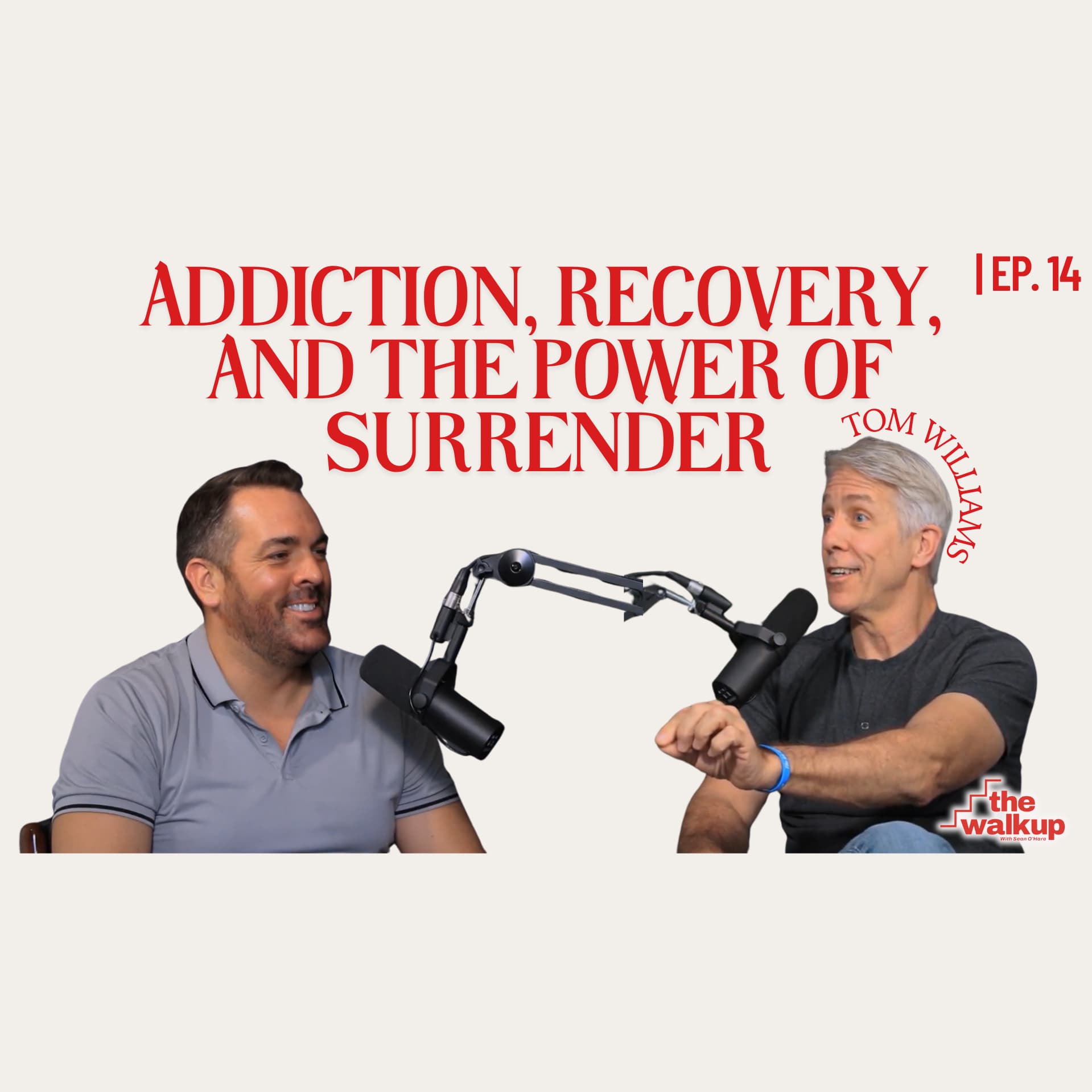
Tom Williams is the CEO of Came to Believe Recovery, a global movement reviving the original spiritual roots of the 12 Steps.
In this episode of The Walkup, Tom shares his path from addiction and Army service to becoming a fitness coach, MBA graduate, and leader in recovery ministry. With over 100 retreats under his belt, Tom talks candidly about grace, trauma, ego, and the misunderstood heart of the 12 Steps. We dive into the stories that shaped him—hidden struggles, personal breakthroughs, and the radical hope that recovery offers to anyone ready to surrender.
Transcript
Read the full transcriptAuto-generated · 14,837 words
All right, well, welcome to the Walk Up Podcast. I have had the pleasure of knowing you now for how many years? I think we met in 2018 or 19, right? Before the pandemic. Yeah, it was definitely before the pandemic, and we met through our good friend, Ralph Fehrman, who Ralph knows all people.
When you're a very kind, well-connected man that wears a bow tie, you tend to know everybody. And so, Ralph connected us, and so I know I've had the privilege of getting to know you and your organization, but I just... I have never really heard your full story about your experience with addiction, and then why you were then inspired through your journey to then get involved with Came to Believe Recovery, and then eventually become its president. So, feel free to share what you are comfortable sharing, but I think for the audience, to understand addiction from a personal perspective, maybe just give us your journey, your experience.
It's... I know we were talking before this, and now with running the recovery organization, I don't tell my story very often anymore, because I'm more involved in the solution than talking about the story. It is an interesting journey that I am a recovered alcoholic addict. I was a full-blown alcoholic drug addict until I was 42 years old. Most of my life, I drank and drugged. Alcoholically, most of it, I did. And it really started, Sean, the first time I drank. I was 15 years old, and somebody bought us some alcohol, and I thought it was a good idea.
You know, they talk today, some circles call addiction a lifestyle choice. Well, the only choice I had was the first drink. After that, I had no choice. The interesting thing that I look at now are the phenomena. That has me different than maybe you and others is, when I took that first drink, there was a physical reaction that I had that some people don't have. I needed more right away. One was not enough. Two was not enough. Ten was not enough, and I drank to a blackout the first time I drank, and I was off to the races at 15 years old and drank and drugged uncontrolled.
Uh, into my late 30s. And were there early signs? I mean, like, you're... In high school, you're in college, I mean, obviously, you're seeing yourself compared to your friends and how much they're drinking, or you're, you know, in whatever parties you're going to, were there early indicators for you that, hey, wait a second, I'm doing more than my friends are doing, or were there early signs of that? Totally. And it was, you know, when you're in high school, everybody, when you went to a party, the drinking looked similar.
It was just that I went to more parties than they would all go to. And do it more often, and I would tend to do it when there were very good reasons in life not to do it, like going to take your SATs. That night before that is the night that you don't drink or go out, but addicts and alcoholics who can't control it will drink on events like that. So, those signs, I was different than everybody else. They'd be like, you, and they'd joke at 17, 18, 19, 20 years old, people weren't really, and this is back in, so this would have been in the, I'm going to date myself now, you know.
The late 70s. The drinking age is still 18 at this point? Yeah. No, I made 19. Okay. So, then they moved it to 21. So, I got under the wire, but this was back when... People weren't recognizing the... There weren't red flags with people around me. We just drank. It was partying. It's what you did. It's what we did. And especially as men, I think, right? There's like a male culture around this, because I think I shared with you, which was kind of surprising that I'd somehow memory hold this, but it wasn't until you started talking to me about your organization and about addiction until I realized, wait, my roommate in college...
I was addicted to alcohol to the point where he ended up going to 30 days of rehab after several car accidents that almost took his life, and yet somehow I had completely forgotten about that, that I would come back from ... I was just busy with my college life, and he was actually on the soccer team with me, so we were on the same team together, and a guy that was much smarter than me was usually Mr. Straight A's, just naturally, just a very ...
Smart guy. And I think he got a .8 one semester. So, he just wasn't going to class. And that just tells you how I could have a roommate who was a very close friend previous to coming to college, and yet somehow I just chalked it up to like, all right, well, he goes out partying or he likes to hang out with the guys on the team and drink. And I was just busy. I didn't really... But every now and then I come home, and there'd be vomit on our dorm room floor, or behavior that was uncharacteristic of him, but I kind of chalked it up to, well, you know, he didn't join himself in college, and he wants to make friends.
And the difference, just to jump ahead, and I'll tell this story at retreats, is that the difference between the hard drinker in the party or in college is that when they graduate and they get their first job, they stop.
And I didn't. I see. They all stop. And a lot of times that behavior goes away. Oh, because it's, what's the word I want to use? It's not circumstantial, but when you remove the opportunity to go out. To party every night, then you just, okay, now I go to work five days a week, and I party on the weekends. The reason is not to do it, they can do it, where I was not ever able to do that.
So, I, you know, during high school... I smoked pot all the time. Big pot smoking back then, which I understand has come back these days, and it's all legal everywhere. Yeah, we got a little bit of this here in Manhattan. Yeah, it's a little. When you walk Times Square, you get a contact eye.
Smoked a lot of pot, and I also had an attention deficit for sure. Now, ADD Bank in the 70s, nobody knew what it was. If anybody did on psychological somewhere, it was not down in the school systems. They were not looking. There was no medication for it. There was nobody doing anything. So, that was wreaking havoc with me in education and in school surroundings and system things. But alcohol and drugs cleared that right up. And so, it helped fuel. I mean, many addicts also have attention deficit.
This co-occurring thing that goes on, and maybe had it been treated like they could today, could it have avoided me going down this serious path? Maybe. I don't know. But were there social factors, too, in terms of, like, did you?
When you were drinking, or did you feel more confident, more free, more... Oh my gosh, absolutely. Okay. I wouldn't dance or sing or do any of these crazy things. Not if I wasn't drinking. Right. You know, and today I...
You know, more apt to do things like that. Well, apt, if I am going to do it, I am going to do it with that. Yeah, yeah. I know you are all about self-esteem, and it is all about being embarrassed, all about childhood trauma. That was certainly part of what I had of getting me in this place where I needed to have a change of psyche in order to be free to do things like that. And was there, with your family, was there much drinking in the home?
Was there any... A history of it in your family? No. That is the thing. Five brothers and sisters, there are six of us, my mother and father. Now, my father and mother come from the world of cocktail hour. Which is a 50s, 60s holdover. So, they had cocktail hour every day. Two drinks. That was it. Never any. Now, my mother would say my father would have more if she'd let him, but I don't think that either of them were addicts. We look back in the family now to say, where did it come from?
Because there is a heredity thing to it. They don't have a gene identified for alcohol and drug addiction, so that's not true. So far, they have not been able to find a specific gene. We could go down that road, but genetically, what does predispose me to have a physical reaction and you not to? There is a coding of the genes they believe that happens in our youth that makes it impossible for me to stop and impossible for you to stop.
Well, if they discover the gene, I think they'll find that the source of it is Ireland, I think. Ireland, right. Certainly Ireland. So, we think one of our grandfathers. One of my grandfathers is up on my mother's side. Now, they look back in the 30s and 40s, was an alcoholic. So, we drew back at one point and said, maybe it came down to the family from someone, but I was the black sheep. What I discovered later in life was you start doing, I'm the youngest in my family, and so a lot of the, I didn't get as much direct experience with my grandparents, because I was fairly young by the time they passed away.
And so I get stories, and it wasn't until I was, I don't know, probably in my teens or 20s that I discovered that both my grandparents on both sides struggled seriously with alcohol. And my dad and his twin brothers, he has fraternal twin brothers, none of them drink.
Now, think about this. These are three Irish Catholic guys growing up in the 60s on Long Island, who are all extroverts, who had a bar in the basement that their dad built. And none of them drink. Wow. And so, I said to them, I said, I asked one of my uncles, I said, you know, it's kind of interesting, you know, you don't drink, and he's like, yeah, I just never have, and they were both in Vietnam, you know, you think, you know, trauma, all these things, right?
And he's like, yeah, you know, I said, do you think that's because Grandpa used to drink a case of beer every time he watched a baseball game? And he was like, it was, it was like. What? I never put two and two together. So, it's like, they instinctually chose not to drink, even though these are very, like, I would imagine the pressure to just fit in would have been there, and yet, somewhere, that trauma of whatever they saw their dad do, and they still don't talk about it, of course, just, they all instinctually decided we're not going to drink.
You know, I have a friend. Who has a son who saw the father drink like that and doesn't drink because he's afraid that he's got it too, and saw it was so terrible what he saw his father doing, he didn't want to be. So, that's not, I mean, that's a good thing if that happened, because if you don't get the switch turned, it doesn't get turned.
Yeah, I mean, I think, I mean, I didn't have alcohol in our home, really. I mean, I think there might have been, it was like one of those, like, somebody gave us a... Bottle of Baileys as like a Christmas present, and it would sit in our closet for years.
I think, you know, like one time my dad had the wrong eggnog, and he didn't know it was spiked, and he was like, oh, this is, I'm feeling very interesting. But anyway, so you take us back to the end of your high school, then you're experiencing, I experience alcohol differently, but then when does it lead from that to... I am getting into a serious problem to drugs, because this is a 20-year journey, right? It is a 20-year journey. So, there are two things.
Step one of the 12-step program is, I admit I am an alcoholic, and my life is unmanageable. So, there are two parts to it. So, I would have told you that I drank alcoholically. I would have been quick to admit to that pretty early on, even these early days in high school. I was drinking differently than everybody else. But was my life unmanageable? No. I did not come to that conclusion.
I, one of the first, you know, big indicators that should have turned the light on, and it turned the light on for family members to start with the red flags, was I did go to college. I ended up going, getting in somewhere, even though my high school, I didn't do well, and it wasn't because I couldn't do it. It was because I didn't do it. I just didn't go to the classes. So, I got in a small Catholic college down in Maryland, and three months into it, Drank around the clock for three days and caused such debauchery in the place that they threw me out, me and one other person.
We could not stop under warnings. We kept drinking anyway, and we went, so does Tom think he has got a problem? No, he just got thrown out of college, right? And I guess what I did in my drunken stupor was so bad, what I said. They would not even talk to me. I tried to do an appeal to get back in, and they thought, you will get back in.
They wouldn't even talk to me, that. And so, there was my first big indicator. And so, you're a freshman? I was two months in. Wow. Yeah, didn't even. Getting through the first semester. Through the first semester. So, I came back home, and I continued that life, and then tried again. My brother was going to University of New Mexico in Arizona, so then it was a classic geography change, which is what addicts try sometimes, is let me go. It is where I am.
It is all the friends I am. The problem is when you go somewhere, you take yourself with you, and I went. I went to the University of New Mexico for a year and drank myself into leaving that school after a year. I just didn't go to classes. I ended up joining the service while I was there and went over to Korea and drank so much over there. I mean, I just, I was going to go into OCS and do the, do the, What do they call it in colleges?
ROTC. Oh, okay. ROTC. And I started that, so I was going to be an officer. But were you doing that, do you think, in part because you thought, oh, this will give me structure? Yeah, and I always had a cant towards the military, but I blew that because that was too academic. You needed to be, you needed to show up for things. The military part of it, the, you know, life of a soldier part, I loved. So, I ended up leaving that and just being an enlisted person, and I never went back to be an officer.
It is a regret, but maybe it is, I do not know that I call it a regret today. I call it, it happened. This just happened, and it is part of the story today that I guess it is part of what I had to go through. I would say God had me doing this so that I could do what I am doing today, because it certainly has equipped me to be able to tell this story today. So, I finished that.
Then I move back here to New Jersey, and probably for the next 15 or 20 years, odd jobs, nothing good, living best I could, girlfriends, living in different situations. I mean, if I could tell you 20 years of sex, drug, and rock and roll is what it was. It was paycheck to paycheck. It was moving in here, living there, trying this thing, this new girlfriend, I mean, you name it.
20 years of just destruction. Nothing happened but that. And some marriages in there, too. Well, the marriages actually came after. That is another part of the story. I assume it was in that 20-year period. They weren't in that part. So, at one point, about when I was 28 years old, I had gotten in, you know... It's been pretty clear that I had a problem, and one of our family friends had gotten sober. The father of my best friend actually got sober, and there was a lot of pressure on me.
I had gotten to where I definitely thought I had a problem, and so I made an attempt to get sober at 28 years old. And during that time, I went through a program, not like the program that got me sober, but I went through a program that was fairly close to it, but it allowed me some freedoms in my recovery that you probably shouldn't be allowed, or it allowed me to retain some of the thinking processes that an alcoholic, a true addict, cannot have, cannot entertain, or eventually it would take you out.
It allowed me to what we call keep character defects. Okay. There were things in my life that weren't working that this program allowed me to keep, things I didn't think I could live without, which were things that eventually led me back. But during that time, I did meet my first wife in my sobriety, and this was in about, this is in the 1990s, late 90s. So, I met her in sobriety.
And here is how we all think, it was a funky thought process in my head today, is I had picked women for all the reasons that you might think men pick women. Their looks, and their partying, and their virtue, and lack of. I am sure that is what you were focused on. Yeah, lack of. I mean, bona fide strippers, my girlfriend was a bona fide stripper. My girlfriend now, if she hears this, she just heard that. She didn't. Okay. Sorry. I may have to have a discussion about this.
We're going to change the name of the podcast to Full Disclosure. Full Disclosure, but that was 30 years ago, I'm going to say. But this is what I did. So, here's this woman that I meet who's straight. She doesn't drink. She's got a professional job. So, on paper, this looked good. Sure. So, I had done everything not on paper that didn't look good, and it was for all the... There's physical and emotional reasons, and they never worked, so I said, Tom, let's try this.
Let's do the complete opposite and go with what looked good on paper, and I had no emotional connection, no chemistry, nothing at all with her at all. So, this was doomed to failure, and it did. Five years, four years plus of marriage to her, and we ended up getting divorced. Now, in the process of this, this is four or five years of me being sober. But really, my addiction was, I do not like this term, but maybe it will make sense.
It is doing push-ups in the parking lot. Okay. So, it is bubbling up inside of me. There are things that were still, it was just on hold. And I also was gaining some confidence. I was changing. I had become into a fitness career. I did get... I was divorced, but I had moved away from partying with the boys. I had gotten into the fitness career. Some things had changed. I had grown up some in my life, and so the thought entered my head that, I wonder if I really was an alcoholic.
Oh, okay. Maybe that was just a little aberration. Right. I was young, and maybe I can. Life is different now. Now I have got a job and a career, fitness level. I have done my service. And things, although we drank a lot there, but now I was out of that, and, you know, maybe things are different now, and maybe I could have a drink. Okay. All right?
But for that four or five-year period, you haven't? I did not have a drink. Never relapsed. Oh, interesting. Not during that period. Wow. Right. So, after the divorce, and now I'm single. And she is going, maybe I am going to just, yes, let us see what we are going to do. So, the decision was, I had some friends that were NASCAR fans, NASCAR big back then. This was the Jeff Gordon, Dale Earnhardt days, which were, and I had liked it. So, we had a friend that was from New York area who knew the owner of the Las Vegas Motor Speedway.
So, we got... Garage passes. Okay. Not pit passes, garage passes, which means we could go to the race and lean on Jeff Gordon's car in the garage, and nobody said anything. Okay. So, we all converged. I was living in Florida at the time. We all converged in Las Vegas, and I said, well, this is where I'm going to try drinking. I'm going to go out there. I'm going to try something. I'm going to reenter. Nobody's going to know me. Nobody knows.
All the guys were the guys from my gang when I was drinking. They wanted me to drink. Sure, sure. So, nobody was going to blow my cover. And I didn't even tell them. So, here's this guy, now think of the thought process, who thinks he's okay, he's not an alcoholic, he's not an addict, goes out with a bunch of people that don't even care that he drinks, don't tell them he drinks, goes to some random bar in the middle of the Venetian casino, Venetian hotel, sits down and orders a Vodka and 7-Up.
And the reason I did it was because it looked like a 7-up. If someone came up to me, I could say it was a 7-up. So, this is a guy who doesn't have a problem. Nobody thinks it through like that, that doesn't have a problem.
So, I had one drink. I had two drinks. I had three drinks, and I went back to my room, and really, nothing happened. Oh, okay. You know, I just, oh, all right. I can handle this. Yeah, no big deal. So, I did it again for that weekend. A couple nights more, three, four drinks, little buzz. Oh, perfect. So, I went home, back to Florida, and didn't drink again. Nothing.
So, that was right before I moved. I moved back to New Jersey, because I didn't like Florida at the time. I still kind of don't like Florida, but moved back to New Jersey. Apologies to any Florida listeners. Apologies, yes. Someday, maybe it will get older, but it's just too hot.
And I came back here to New Jersey, and I had a fairly successful fitness career going at the time. I was a good personal trainer. I got people... To work out with. They liked working out with me. That's great. You're seeing it before and after. You're seeing people accomplish things. And I had a knack for this. I had a personal connection. I had a knack to get people to do it, and I was educated enough in fitness and got more and more and more educated that I became, I was really good at it.
So, I got a job at a local YMCA in New Jersey and started working my way up the ladder there. Right. Now, mind you, I hadn't had another drink since. Only that one test I tried in Las Vegas. Now, this said maybe it was four months, so it wasn't years. Yeah, but still. It was like four months that I didn't have anything. So, I met a girl in the... Jim, who would be my second wife, turns out she was someone that grew up in my town, and she went to high school with my sister.
We went to the same high school. She was a few years older than me. I went to high school with her sister. Family thing, that's more than is needed for the story, but anyway, I met her. So, we ended up going on a date, and she drank, though. She had wine. So, Tom said, well, I could have a glass of wine with you. Sure. It is exactly right. So, I had a glass of wine with her, and then I had two glasses, and then we went home, and nothing happened.
Test two, all good. So, we began dating, and we would go out, and I would have a glass of wine or two with her once or twice a week. Now, the red flag was, I watched her drink wine every night and get a little mean.
And I let that all go. This is foreshadowing part of this story down the road. And we went on for about a year like that. We ended up getting married in less than a year. We got married. We moved into a place down in Baskingford, New Jersey, which is a bougie town out west of here, and I was working my fitness career, and she became a nurse. She had two kids, and we began this life.
Now, had you, in the dating process, had you disclosed, hey, listen, I used to have a problem drinking, and this should be on your radar, or you kind of kept that to yourself? That had all been buried after the first drink. Oh, so you didn't even, you didn't do a disclosure of like, hey, just so you're aware of this. She never knew anything about it. Okay. Ever. Gotcha. And I just had, I was a normal, just had a glass of wine, but didn't know anything about that whole part of my past.
It's just like the sober part of it, didn't it ever happen? I just had grown up from whatever we did in high school and all, which everybody did, right? So, then it went from, you know, a glass of wine here and there, then I thought, well, some of the friends, the guys go out on Friday nights and they get hammered.
That's just a thing they do. Just try that. Sure. So, I went out on a Friday night, we'd go out together and get hammered and come home. And really, nothing happened, right? All right. So, test three, this is good. So, it is all reinforcing the illusion that Tom is okay. He can drink, he can drug, and... But drugs hadn't happened yet. No, they are coming. Okay. Just marijuana and when you are younger. Right. At the moment, the drugs hadn't come back, really.
Not in, but back. So, not to belabor it too much, a couple of more tests and the growth went on from, okay, on Friday night, you can get hammered. Then it went to Friday and Saturday night, you can get hammered. And then it came to, you know, it is hump day. Maybe Wednesdays are good to get hammered. And then you can, all the while our marriage was getting.
In destruction. Because her drinking, she was an angry drunk. There were just arguments. It was going badly. And towards the last year, another four years, towards the last year of our marriage, I wasn't one of these guys that had guys nights and went out with the guys. I'm still not.
And we always did stuff together, but we were very distant with each other, and my friends from New Jersey, the same people that were at the NASCAR race, said, hey, we're having a party up in a town, a local town in New Jersey. Why don't you come up tonight? It seemed like a good idea. I said, listen, I'm going to go out with the boys tonight. So, I drove up to New Jersey, and those guys had cocaine.
And I hadn't had cocaine in a long time. Well, the drink in Las Vegas worked. A couple glasses of wine worked. Drinking fairly regularly. I hadn't lost my job. Meanwhile, I was on the verge of divorce. You tell yourself things are going okay. They weren't going okay. So, let's try this. So, I snorted cocaine.
At that point, I'd been going, if you're listening to this and not seeing this, my hand is doing a slow decline, and when I hit the cocaine, it took a deep dive, and that led to a year of absolute, utter destruction.
What cocaine did to you was different from alcohol because your behavior, like what was the categorical difference between... It unleashed the tiger. It just took it. The drinking went to another level. The cocaine just exacerbated the addiction. Because the cocaine took the government off. Sort of mask.
Because it is an upper. Yeah, well, you drink much more. You can drink more as long as you get enough coke to kind of. And it is very addictive, and it assages all the problems that you have, and it works in your brain, and it makes you feel better, and it helps you hide everything, anything that is bad.
Was there a moment like, because I'm sure when you have it with your friends, right, they've got the coke, you don't, right? But then eventually you have to get the supplier, right? Was there a part of you that was like, this is different now. I'm now contacting a drug dealer.
Well, you don't think about that when you're doing it. You're just getting the guy, everybody, you know, you're going... Get the guy with the hookup. I'm just going to get some coke right now. I guess I always think of it, in my mind, like... Maybe because marijuana to coke would be the, okay, whoa, that is a real drug, but was there like a, so there was not a social stigma in your mind? No. Okay.
Coke was good. Well, maybe because your buddies are doing it, and they are successful, and have families. You surround yourself with people that do what you do, so cocaine was not anything that was a strange thing. I just did not want too many people to take my cocaine. Because it is very expensive, and you need a lot of it. So, sharing it is very... Yeah, I don't have a sense of what... I mean, we are talking the 90s.
How much, I don't know, what do these things cost, and then, like, how long does that last you? Like, to where now it becomes, obviously, a financial issue for you, but, like, I don't have a sense of, like, the cost of per use, so to speak. Well, back then, like, a gram of cocaine, which is a powder, a gram powder, which is like what would be in a sugar packet, maybe, if you want to think about the quantity. But a gram would be, you would get one?
A gram would be $100. A hundred hours. And a gram would last me one night. One night. Yeah. So, a hundred hours a night, and $19.90 something. If you did it every night. Yeah. Sometimes you'd split it with a friend and do a half each. It would be okay for two people, but a gram wouldn't go more than two people. That keeps you flying high for an hour, for ten hours? Oh, no, no. All night. Yeah, you'd be good until the morning, maybe, because it keeps you up.
You can't sleep. And at this point, your wife is at all suspicious? She didn't know anything about it, right, until she did know something about it. So, for about six months, well, it's pretty easy to hide because you can keep it in your pockets. I mean, you can go in the bathroom. It doesn't smell. It doesn't smell. It doesn't, right. I was pretty good at keeping it in your car. She was drinking all the time. Keep it in your... Right. Well, how she caught me was I had an old CD case in the...
In the car, in the console of the car with a rolled up dollar bill. I just didn't unroll the dollar. And so, she wasn't stupid. She found that and she put two and two together. Oh, she saw a rolled up dollar bill and was like, I'm assuming this isn't like, you're keeping a dollar for a case of emergency. So, I had, you know, that was about six months of it where it was going downhill while I was doing drugs there. I mean, I remember leaving her one day.
I mean, this is what addicts do. We were at an event together, and we were going home, and I said, oh, I had to have Coke so bad. I needed it more. I made a phone call to the dealer who was in West Orange. I'm in Basking Ridge. He answered the phone. I'm coming. I said, I'm going over to the Y where I worked. I got to stop in and do something. She knew something was funny.
There aren't a lot of fitness emergencies in the middle of the night. Well, this was in the daytime on a Saturday during the night. She drives over to the Y, and I wasn't there. So, I come back. Well, she might be thinking you're cheating on her. She might be thinking. Maybe that. She didn't think that. Okay. But she was worried. The drug thing was now a thing that she thought I came back. It was on her radar. Yeah. And now I get questions.
So, how was it over there? Why? You know. Now you're like, ugh. Well, it was good. I saw so-and-so, and she said, no, you didn't. I was over there, and that was it. Where'd you go? What'd you do? You know, what were you? I can't believe you're doing it. And it wasn't like she was a prude, obviously. She was a drinker. She just. It wasn't that she philosophically... It was that I lied to her, and I'm doing cocaine, and it costs money, and what are you doing?
Oh, so she wasn't actually opposed to, like, cocaine use. Not necessarily, right, right. Huh. So, that was it, but it was the lying, and it was the... But just kids, I mean, how old are kids? They were in high school. Yeah, I mean, that would, I mean, that didn't concern her, though. It concerned her. Okay, that their stepdad was... This whole level up of me with these drugs, and this thing was going bad. So, a few incidents later, and... She actually was so upset one day, she called the police.
On me, to have me taken out of the house, and they came, and they actually didn't make me leave, because they didn't know what was, she was a wacko more than I was a pretty, I was a happy drunk, if there's such a thing. I was never the fighter. I was never, anyway. They went and looked in her car. She would drive around with open liquor in her car, and they found a bottle of, a glass of wine in her car, and they arrested her for drunk driving.
Okay. Right out of the house. Because you don't have to be actually driving. Oh, I didn't know that. As long as you have an open... You have a parked car with an open container. Yeah, she was. She said, were you just driving? She admitted it. She said, yeah, I was just driving. With that in the car? Yeah.
Arrested. Drunk driving. So, that was... Quite a problem. So, right, it was all of that went on, and I left, and then the divorce was ensued, but that six months then when I left her, she put a little bit of governor on me, because she was around and the kids were around, and now I left her.
Now, I went off to the races even worse with the boys. I went back to live with my parents. It was the only place I could live. We had a mortgage. I had to pay a mortgage. I couldn't pay a mortgage and rent. So, I went back, and I lived at my parents' house. And what are your parents and your family thinking at this point? They don't know anything about the drug stuff. They don't like the drinking. I tried to keep it from them that I went back drinking, because I hadn't been home around, but they knew.
They knew now. But I mean, in terms of like, one failed marriage, now a second one that's... Yeah, not a good thing. They were just like, sad for you, or disappointed, or... Why can't you make this yes? Why didn't you see this coming? And they saw the problems with her, but the problems with me too.
And yeah, no, it wasn't good. Okay. So, then drinking episodes and things, of course, it leads into work eventually, and I eventually did lose the job at the YMCA. I was a senior wellness director. I had 100 people working for me, you know. Things were going good. I ended up having to leave that job. They kind of said, if you resign.
It will be okay, but if you… We won't fire you for cause. Yeah, and not only that, we'll give you a severance. We're going to take care of it. We need you to go. So, I went. So, I got a job at another fitness center up in Mars Plains.
And then, oh, actually, I didn't. I couldn't get, the drinking was so bad, I went back to driving limousines for a friend of mine. I mean, it was, life was going badly, the divorce. Because now you're in your, what, mid to late 30s? Late 30s, yeah. Actually, I was 41. Actually, I was 41.
And I would drink and drug driving limos, people in the cars I would drink and drug. That's what I was just going to ask, is like... I would get coke to be able to get through night rides. I used to go to Dunkin' Donuts, and then this guy, if you're listening to this story, this is what addicts do. This is how little we care about anybody else but ourselves. This is not what normal people do. And I would get that orange Slurpee from Dunkin' Donuts, and the whole reason was it...
It was cherry. It smelled so much like syrupy sugar that you couldn't smell the liquor, or I didn't think you could, and then you put vodka in it. Sure, sure. Which they say you can't smell, but you can. Yeah. And then my boss would wonder, I always wanted to drive the limos. It's not too much today, like stretch limousines anymore.
But there was big back in this day, because the stretch limo had a divider, number one. Yeah, they couldn't see. Or smell me, and it separated me from them, and I could drink. I was drinking while I was driving these people.
And one night, I was so, one time I got so hammered from Kennedy Airport to Newark Airport drinking, that I was too drunk, I drove right by the airport and left a guy there. I didn't pick him up because I said, I can never get away with this, right? The boss is calling me, where are you? Where are you? Dropped the car for another mother and daughter, I picked him up, hammered. I couldn't find the car in the parking lot.
You couldn't find a limousine? I couldn't find the car. I was so drunk. We met them in the airport, came down. They're following me around. I couldn't find the car. These are stories I've been making. Thanks for letting me do this. I couldn't find the car, so we get in the car, and they knew something was wrong. You all right? You all right? And I almost crashed the car like twice. The minute I parked the car, I wasn't near the office.
The boss was calling me. What is wrong with you? What's going on? You're drinking in my car. Now, my boss was a recovered or recovering addict, so he recognized it. They were also a family friend from back in the day, so knew me well, and knew that there probably was, saw me in bars and things, and said, yeah, you probably... So, that was the end of that job. So, even that job, I couldn't keep. And that led to one month of me drinking and drugging around the clock.
And you're living at home. And living at home. At that time, my parents traveled a lot, and this was December of 2006, I remember it. From about December 1 of 2006 to January 9, 2007, I drank and drugged around the clock. The only time I left the house was to go get to the Coke dealer. It was cash advances on credit cards, borrow from somebody, rob Peter to pay Paul any way I could, get a bunch, cut it, sell it. Do a thing.
Literally 24 hours a day. You know how you have water on your nightstand? Yeah, sure. I would have whiskey on my nightstand to drink, so if I woke up in the middle of the night, I would drink that.
20, around the clock, and... I know you're thinking this is just going to be my life, or you're just thinking, ah, screw it, I don't even care. I don't see a future for myself anyways. But I was done. Okay. This was the only life I knew, and everything, I'd lost everything. Were you thinking suicide? Absolutely. Okay. I could kill myself. I'm going to just drink myself to death. Okay. I'd lost all hope.
I couldn't stop, Sean. I couldn't stop. I couldn't have stopped. The first glass of wine, when I look at it. Remember I said I took that first glass or that first drink that I took in Las Vegas, and I did stop, but when I was honest, I didn't want to stop. I didn't stop like normies stop today. They have one or two drinks, and you stop because you just stop. I stopped because I should. I never really wanted to. When I look back on it, I was off to the races with that first drink in Las Vegas.
It was back. It just took some time to really take me out. It took me all the way through, and I couldn't quit during Christmas time, because it's too many parties during Christmas, and you can't. And you got permission to drink, yeah. Yeah, everyone else is, and my parents were traveling a lot, so there was no one holding me accountable. Now, I don't have a job, there's no one around, so you do whatever you want, right?
And then, you have some friends when you're the party person that'll support your cause a little bit, because they want you around. I had other friends that were addicts, and addicts stick together. Come on, we'll go out. I got an eight ball, which is three and a half grams of Coke. So, it's gone from a gram of Coke to now we would buy what they call an eight ball. Why is it called an eight ball? It's an eighth of an ounce.
Oh, an eighth of an ounce. Got it. Why do I know all this nomenclature still? I shouldn't even think about that until today, but it's three and a half grams. So, that's quite a bit. That's enough for a few people. Well, that'll keep one or two people going a couple days, and that's what you did. You just never went to sleep. You just stayed up. I thought an 8-ball, for some reason, was delivered in some sort of circular fashion, so that is why I just thought it was in the shape of a ball.
No, you got good education. Yeah, this is good education. An eighth of an ounce of cocaine. Okay. So, I am doing that, and then, even now, my friends were abandoning me. It was too much, that I was just beyond, even the hard partiers just were like, Tom, you are out of control.
And so, I would mostly just hung in the house. I wouldn't wake up. The shades were down. You get really paranoid on cocaine, too. You think everybody's coming to get you. It's the late stages of this addiction. It's horrible life. And on January...
I didn't care if I died. I didn't know what I was going to do. I lost all hope. There was no chance. Tom, I tried to quit. I couldn't quit drinking. Even some of the contacts I made when I was sober, I can't call them. There's nothing I can do. They're going to tell me I'm a loser. What am I going to be able to do? Right? And the sponsor I had had back then, who did have the answer, I didn't take the answer.
He lived two miles from me. And I was watching this in the town, and he saw me going crazy. Never reached out once, which I learned is one of the... He can't talk anyone into ever getting sober, and he's going to come into the story here in a minute.
And he was a came-to-believe recovery person. He had gone through that. I had not embraced that. And to this point, you had gone to AA at any point? NA at some point? No AA. When I tried to get sober, well, it was the AA of what I am going to call mainstream AA. I had not really gone through the steps and done the program the way it was meant to. Just stopped into a couple of meetings. Yeah, a few meetings, met with some people, right, quit drinking, and then was...
Kind of doing it on my own. I wasn't being told anything else by those, and even the ones that did, like this gentleman who wanted to be my sponsor back then and became my sponsor, I just, I hadn't given in enough to know that I needed to take the, to realize.
In my inner soul, that I was an addict, and if I wanted to quit, I had to quit. I needed help. It was still a, what can I do to get out of trouble? What can I do to just kind of mitigate this thing? And this is not the thinking that a true addict can live with. You'll go out eventually.
One night, I am sitting on the edge of my bed. My parents had come home from some trip, and so they were downstairs. The upstairs was kind of like an apartment, so I had the whole thing to myself. We had six kids in our family. The whole upstairs, there was room. Yeah, sure. You know, in the same family house. And for some reason, I had a fifth of vodka, the big bottle, and I drank half of it. And I just was at this lowest point, and for whatever reason, I picked up my phone, and I texted a friend.
I'm going to drink until I die. And I don't know why today that I sent that message out, but I'm sure it was a cry for help. And he had watched so much of what I was doing, he took it serious. And he set off an intervention, and like 10 minutes later, the doors... Kicked in, and people came in, grabbed the bottle for me. Oh, my God, what's going on? And they settled me all out, because then there was a big brouhaha of antics and drama around drinking, and my life is so bad, and nobody cares about me, and what am I going to do?
And it was na-na-na, and finally, I went to sleep. And I woke up the next day, and the first thing I thought was, oh, no. Everybody knows now. This is so embarrassing. Why did I do this? It's not like everybody didn't know. Everybody knew I was interested to be drunk, but now I feel like I've outed myself, right? And there was a phone number on the counter on my dresser. It was a phone number, and it was, you need to call this number, and it was that guy, the sponsor.
And I thought, well, he's never good. He saw me being a drunk. I didn't want what he had before. Why would I want it now? He's not going to help me. I mean, I'm this loser. I'm no good. There's no way he's going to help me. Well, it's what I didn't understand about recovery and those that have gone through the program like the one I went through is how much compassion they have and how much grace and how much... Well, because they've been there.
They've been there, but you don't know that when you're in it. You just think, he's not going to help me. Well, he answered the phone, and he agreed to help me. And that next day, January 10th, January 9th, 2007, is the last drink I ever had. January 10th, I woke up and haven't drank, and I have not had a drink since January 10th, 2007.
What have we gone on? 19 years. 19 years, okay. And I, at the end of next year, I guess it's 19 years. We are not good at math here. This is not a math podcast. We, and I was taken through then. Now, I knew I was done. I was so done. I went in, I remember sitting in his living room shaking. I probably should have done some detox or something. I was shaking. I did not know what to do. I cannot stop.
I need help, and he immediately Got me through the processes of the program that I now am spread, and yeah, I am the CEO of the organization that spreads this very message around the country and the world, really, and help other suffering and broken people like I was, and I went through the step process, and... So, you went on a... How soon after... Talking with this sponsor who had gone through the Candidly retreat. Six weeks. And then, Joey, you went on a retreat.
The next retreat I could go to, I went to. Okay, so describe the retreat for people. So, like, what is, and maybe give a context of, like, everyone knows what AA is, and people have an idea of what.
You know, rehab when you go to like, you know, a $50,000, you know, for those that can afford it, great. But what is this retreat format? So, the retreat format was, and Sean, going into this, I did not know much about AA at all. So, what they told me, I just thought that is what it was. Which ends up being a format of what the original founders of AA, the guys that wrote what they call the big book, but the big book of Alcoholics Anonymous is the book where the 12-step program is outlined.
This thing that everybody kind of knows about intuitively, and they know AA has a book, and they have this 12-step. You know, by the way, did you know that there was a bar called the 13th Step? Yes. And they renamed it, though, recently. Did they? Yeah, it's like over in East Village or Gramercy area. And it wasn't until I had met you that I was like, wow, that is incredibly insensitive.
I was like, wow, that is really not cool, and I think they realized that is not a good branding thing nowadays. We have to be more aware. Now, in the rooms of alcoholics owners, 13-stepping is guys that go in the rooms just picking up girls, or girls picking up guys. That is the 13-stepping. 13-stepping, huh? We tell people, no 13-stepping. So, I was handed a big book. I was told about the program. I started to take through the steps. The way the founders did it, I didn't know I was doing it, that everyone else wasn't doing it that way.
I had no idea. The first, what I call, mainstream AA meeting I went to, and they're smoking and drinking and telling all these war stories, and nobody had a big book, and nobody knew anything about the steps. I came back to my sponsor. I said, what's going on? What is this? And this is something we're trying to dial back today. So, the original format was done in a concentrated format, because being the normie, as you call me, being somebody who is not familiar.
Quote, surrounded, and italics, you're ignoring me, status. I'm not a normal person, vis-a-vis this topic. And what do I know about AA? Well, I know mainly from pop culture, right? Okay, I see, you know, obviously there's a lot of dramatic TV and film scenes around people that go to AA, and, oh, my name is so-and-so, oh, hi, I'm an alcoholic. I know that, and they're in church basements or community centers, and people go through these tests, but it seems to happen over a long, long period of time, but what you're saying is that this happened in a concentrated format, and that was actually the original program.
Yeah, it's the way they did it, and in fact, Sean, the meetings are not the program. Yes, I think that would surprise a lot of people. If you read the big book of Alcoholics Anonymous and knew nothing about AA, you would not go to a meeting. There is no instructions in the book about meetings. Meetings are the fellowship that grew out of that, and it should be that. Now, I don't want to get to be an AA basher, because the rooms today, there are so many rooms, it's a place where people can come and meet like-minded people who are trying to stop drinking, and what we hope is they show up there, and they get something, and they lead someone to tell them what the steps are, but the simple fact of the matter is, the recovery program of Alcoholics Anonymous is the 12 steps that are outlined in that book.
They had nothing else. If you aren't doing the 12 steps, you're not actually doing alcohol. Alcoholics Anonymous. It is the only thing. That is what got them sober, not going to meetings. So, the question is then how to get people through those 12 steps. How to get there. I remember you told me there was, I forget how many, just to give people a sense of the scale of things, how many AA meetings in New York City? 3,500 a week. Yeah, that is just, I think that would...
Shock people. 3,500 a week. So, 50 people at each meeting, 20 people, think about how many people. Those are just the people trying to stop drinking. There's a whole bunch of people not trying to stop drinking. And so, I'd love to get in there, because in probably 75% of the cases, there are some step meetings, there are some step. We're not the only ones preaching the step method, for sure. But in a large percentage of them, they're not getting the message.
And there's suffering people out there, white-knuckling it, we call it. They put the booze like I did for a few years, still suffering from all of the character defects and all of the stuff that keeps us in failure in life, but not drinking. I'd have been better off drinking, maybe, and come in even sooner.
So, I went to this retreat where they told us how they did the steps. Now, to give you some good context... When the gentleman that wrote the program of Alcoholics Anonymous, and there was a group of guys, this guy named Bill Wilson and Dr. Bob Smith are the two big names in Alcoholics Anonymous, the co-founders, but in fact, there was a group of 20 or 30 guys that saw the manuscript and had input, and this man, Clarence Snyder, was one of them.
Clarence was sponsored by Dr. Bob, and Clarence sponsored our founder. So, I am three steps away from the actual founders of Alcoholics Anonymous, how they were doing it back then. Nobody had more than 18 months sobriety at the beginning.
Many of them did not have a year. They were getting sober and helping each other right away. Where this whole take it a year came from, we do not know. It grew over time, and the psychology got in it, and what happened was the God element got taken out of it. The spiritual element, the element of connecting with your higher power and having a relationship with God, which is a core component of the 12-step program. When you take God out of it, you have just lost AA.
And where were you when you, from a spiritual standpoint, I mean, you are now at this low point, I do not know if... Going to church or having any sort of spiritual life was much part of your marriages and things like that, but how did that strike you when you go to this first retreat and they are leaning into your higher power? Well, I will step back. I am a Catholic, an Irish Catholic. My mother went to church every day.
Every day. She was a Eucharistic minister. Everything. My mother, yep, every day. So, I grew up Catholic, church, went to church, skipped church to go smoke pot with my sister and come back. We did all this stuff like that. Catholic high school, everything, Catholic. So, my dog tags would say I am a Catholic. If I die, I would be buried Catholic.
I've been through all the sacraments, the whole thing. I'm a Catholic, but I was a lapsed Catholic, as we say, you know, a see and ear, you know, Christmas and Easter. We've got a creaster. Creaster, right. But that relationship, and what I took from it, you know, Sean, I know what the Catholic Church represents today, and I know how the theology and what they offer to humanity and to believers, but I didn't get that when I was younger, that's all. I didn't get what they were.
Putting down. And so, today, I appreciate the Catholic Church more than I ever appreciated it back then. I did not take it for what it was in its ability to have an effect on my life, really, spiritually. And because in your marriages, was that a part of... No, no, it was nothing. No church, nothing. Nothing at all. You got married in churches, or no?
The first one, yes. It was a non-denominational church that my ex had gone to. It was kind of freaky. And the second one was a judge, or the mayor of Basking Ridge married us, actually. Okay. But how does it strike you, then? You're going through all this addiction and pain and contemplating suicide. You finally get to this came-to-believe retreat, and now they're talking about a higher power. Are you like, Forget that, man. Or you're like, I don't care, I'm up for whatever.
No, I was up for whatever. Okay. Because this God... God, who I was introduced to, the God of the Bible, in the New Testament, was the God that saved these guys. They kept saying to, and there was something different about them. They had something in their eyes. They had a connection, and they weren't freaky Bible thumpers, and they weren't doing freaky things. They were really stable people with good lives that had come out of destruction like me. I heard their stories.
They were just like me, and it worked for them, and I was so desperate. I needed it. And I think I was being drawn by God, too. It was the right time. So, and also being raised as a Catholic, you know, Christian principles were not foreign to me. It wasn't like I had to have this whole thing introduced. What I needed to do was make another commitment.
And begin to start walking in the principles that I was always being taught my whole life, and grab a hold of this and put God in the driver's seat in my life as far as who I prayed to, who I took direction from, the Holy Spirit and all, and this is what they handed me with a set of tools that were very practical. And it turns out they're just things. I always say we take Jesus on, and then we do what he said.
Which is just what we were being taught anyway. I just needed this process of the 12 steps to really put it into a set of tools that worked for me. And how do you explain to people that are on your retreat that are antithetical or have had bad experiences with religion, and now you're saying, hey, this is kind of an important part of the equation. You can't do it without this. How do you explain to them, like, no, no, you can't skip this step?
Well, it's an essential part. It's part of our secret sauce, Sean. We're a bridge program. We are certainly not a church, and they weren't back then either. We're not associated with any particular church at all, but what we are is we do present Christian principles, honesty, love.
Forgiveness. Forgiveness, right, and selfishness, and everybody can get on board with them, and we invite people to be open in the idea of a supernatural creative intelligence in the universe if they have to start there. We never allow it to be a doorknob. We don't allow it to be inanimate objects. It was never an inanimate object in the beginning, our founders. It was a god, the god. Now, the god of the Bible is the god that they took direction from and took on, but we start one step back if you have to, and that helps people.
We say, forget about it. Take him out of the church. Take the beard off, God. And what we want you to do is engage in the idea that there could be a power. If there was a power, and it was supernatural, if there was a God, a supernatural river, that could help you, would you let him? You see where we go? And is it because the...
The step of understanding your own powerlessness is so foundational? It's so foundational. So, step one, which we talked about before, is I'm an alcoholic addict, and my life is unmanageable, so I'm powerless. So, powerlessness is something we need people to grasp and identify with. Are you powerless? Are you like Tom? When you took one, you couldn't stop. No matter what, did you have thinking that no matter what happened, you drank anyway, when the most important day of your life, the next day, you couldn't stop drinking, you did the different things.
That's powerless. You have no power, no defense against the first drink. Once I have one, I'm done. It doesn't matter. That. And then the idea that if you're powerless, maybe there's a power that's greater than you that could. Bring you back. If we can get you there, then the introduction of a God, at this point, becomes something that people can grasp, especially if they don't have to do anything particular. No rules, no go to church, no kneel and stand, and no go and do whatever it is that Some denominations require.
It has hurt people, Sean. It has not worked for them, so they come to this place where that is the last thing they want to hear they have to do, so we say, you do not have to do it. Many people go back to the church of their origin. I am back at the Catholic church. I go and love the church now. I love going to Father Ignatius when I can in these masses.
But I think it's being presented. What I've been struck by when I've been around those that are recovered, and you should make sure you talk about recovered versus in recovery, but is there's something incredibly disarming about the vulnerability.
Particularly of men, I find it very disarming in a powerful way to see men talk about their own powerlessness, to talk about their own need for others, how they need to submit to a higher power, lean on other people, how other people have helped them get through things.
I think if that is what people experienced when they went to church, it would be radically different, because that vulnerability is not present most of the time when you go to church, right? And that is not necessarily... It's a critique in some ways. Maybe it's required sometimes to have gone through certain suffering to recognize your own powerlessness and your own vulnerability, but when you lead with that, that's incredibly attractive to people because they go, if we start with we're all broken.
And we all need each other, and we all need God. I think everyone can get on board with that, right? But if there's this idea that, oh, you're supposed to be perfect, or we're looking for only a certain behavior or a certain way you comport yourself or come across in life, well, of course, there's going to be a little bit of a rejection of like, well, I'm not there, so I don't know that I'm ready to be that person, so I will just kind of keep my mouth shut, or I won't.
Participate in this fully. So, I guess that is a long way of me saying I think there is an emotive, there is a tonality to what I have experienced being around those that are recovered. That I wish we could infuse more readily into church life.
So do I. Ego and pride has to be smashed, and humility has to be embraced, and it is a tough thing. This idea that we are not perfect, we do not have to be perfect, and you win then, because it is just this release now. I am vulnerable. Yeah, I am not good. And I couldn't do it, and I'm powerless. When you're powerless, you get the power that frees you. And it's ironic. We say we're powerless, and you end up getting more power than you ever had.
Yeah, it's like you're tricking yourself into it somehow. Well, here's a thing that people come in with. They think they have to do something for God to love them. Right? I have got to get to here before God is going to love me. Right? And some churches, whether they mean to preach this or not, kind of preach that. There is a behavior that has to follow, or God will not love you, and a bunch of activities that have to happen. But when we look at it, when Jesus came, nobody had done anything good.
Right? And God sent him anyway. People were murdering, killing, stealing. We meet people like this in our program who don't think they can be forgiven because of the things they've done. I said, I know, but this God that we have as our power came when everyone else was doing that. Nobody did it right. He came to give us grace, so if he forgave them, why wouldn't he forgive you? Nobody's told people this before. This really, Sean, this is a...
you know this really baseline theologic you know uh i don't know simplistic thing it should be the leading doctrine it's the leading right it should be what we lead with which is we're all broken we're all in need of forgiveness we're all needed of being and we can't do it on our own yeah uh and that and and but to your point before the that we're all We have an identity, right, as a child of God that is always deserving of love, despite all the awful things we've done.
Now, we have to own up to them. We're made in His image. It's not, you know, we have to participate. Yeah, yeah, yeah, the consequences. We have to participate. Right. But I think that's... And from a spiritual warfare perspective, this is what I think, for those of us that believe the devil is real, and that Satan is trying to put ideas in our head, I think a lot of those ideas are about your own worthlessness, right? Because that, when it gets dark, is when it's, I forget which...
Priest had mentioned this in a homily one time, was like, that the vice that the devil wants most is not, you would think it would be, you know, I don't know, lust or violence or anger, and it's apathy.
That's the one he wants, because then once apathy sets in, everything else is available. Once I believe I'm worth nothing and it doesn't matter, well, then why not lie? Why not cheat? Why not steal? Why not sleep around? Why not do whatever? Because there's no tomorrow. It doesn't matter.
Apathy is the thing that's, and I think we have a big challenge now with, we're seeing this with children younger and younger because of a lot of influence of social media, their own identity, their own worth is being judged all the time, and we're seeing that there's this kind of checking out, but... They're even being tilted.
Question their identity. Well, that is a whole other topic, yeah. But, you know, when you say that idea of grace, the idea that you can be forgiven and you don't have to be perfect, it is a tough one, especially for men. Women, too, but the men, it is a tough one. But when they hit that human, they realize, no, I am not perfect, and I can do better. A very attractive...
In every category of life, you begin to be successful, and people seek being around you. When you be humble, you are actually more... Yeah, you are more full of yourself, because you are allowing God to work through you, and it is not a denial of you as a human person. Right. It is allowing God to reveal what He wants your life to be.
And I think, well, I think it is important for you to share, when you got on the other side of this, when you were recovered, Then, what did that lead to? Obviously, you are now CEO of Candle Leaf Recovery, but before that, how did your life fundamentally change after that, and what were you able to accomplish?
Just to lead us into that, you get through the 12 steps, and you grasp these principles of humility and honesty and integrity and these ideas that you smash your ego and your pride, and you get a set of tools to help you. There are consequences from your old behavior that have to be taken care of, and you learn that if you are forgiven from them, it does not mean they go away, but they do not have to haunt you and define your identity anymore.
Which step is the one where you ask you? Step nine is making amends to everybody, and that is a freeing thing. That sounds scary to me. And it is scary, but no one does it. There is a reason it is at nine, because they needed that first eight to get them to this place and develop this new relationship and do a really inside look at yourself and determine who you were and who you weren't, and to this place where you can go to someone and say, listen, I was a dirtbag.
I am not anymore, and I don't want to be that anymore, but things have to be smashed. In your ego and all, and if it is, then you get to this place where you now start to move forward, and while I did all this, I don't have to do it anymore, and I'm free Monday after a weekend retreat. This is something that an addict needs, really anybody. If I can see my way to brokenness, it's not that it all goes away.
But can I start on Monday? Do I have to clear this up first before God will help me? Well, no, there's no indications of that in the Bible either. When people turned, they were forgiven. When did Jesus forgive somebody?
When he asked him, he didn't say, well, you know, this is his whole recovered, recovering thing. He didn't say, well, you know, let's see if you're really... You're still in the process of forgiveness. Yeah, we'll see over time. Maybe we'll forgive you, you know. So, he said, no, you're forgiven. Don't do it again. If you do it again, what did he do?
He forgave you again, you know, but you paid the consequence in between, and this is a process of life anyway. So, I left with that process and feeling very positive and hopeful, and I was the only one in my family that didn't go to college. Now, I'm 42 years old, guys.
At this point, and I had nothing, no education. I made some fitness training and all, but it wasn't a career. I had no college. High school was a disaster. I had nothing, no career, no nothing. 42 years old, you come up out of this. This is not a good place to be, because all of a sudden, you come up out of the hole, and you're like, well, this is not a good thing. I got no retirement. I got nothing.
So, this process of the steps had given me a connection with a higher power, which was God, the God of the Bible, who I embraced strongly. I went through the steps. I used the growth steps of 10, 11, and 12 to help me begin to put my life back together, and one of the things I hadn't done was go to college, and all of a sudden, six months later, it seemed like maybe it was a good idea. It's because I was a different person now, and I had a different set of...
Well, you had hope. Characters, and I had hope, right? The idea of a future. There was forgiveness. There was things truly lifted from me that lifted the veil, as it were, broke down strongholds. I thought maybe I could do it, so I went back to college at 42 years old. And the last paper I had written, Sean, I had handwritten. That is how long ago. I did not even know how to open up Microsoft Word. I did not know what it was.
And you go to college, they expect you to not only know how, they do not teach you how to do it, you better know how to do it. So, I quickly, you get up to speed, I had friends and people help me, you know, and I graduated with a 4.0, and then I went on to get a master's degree, which I had a 3.98.
So, I reinvented myself, and at retreats, I will say, now, I do not know if that is what you are going to do, but if I can do it, you can. There is life after this, and you can reinvent yourself. So, it took six years, but I came back and did that, all the while began volunteering for this organization, this retreat system that had saved my life. Right, because you felt this. Desire to give back. And I had a story that only worked with those people.
They needed to hear my story like I needed to hear the story of forgiveness. And each time I tell your own story, it reinforces your own identity. Absolutely, right. And so, I had probably been, over those six years and a few more, you know, a hundred retreats. Wow. Because now I had some money, because I was working and not spending it all, and the retreats weren't super expensive, and I could get airfares, and I was going to all of them all over the country, all the time.
And then I began speaking at them, not teaching the steps, but speaking, telling my story. Retreats were a little different format back then. They were the steps, but they also had some speakers and some people, and I would do that.
So, a couple of years into it, after I got my master's degree, I was hired by the university that I went. I got my master's degree from, I had become really involved in the university and the student government, blah, blah, blah, and they liked me, so they hired me. I did business development, still doing retreats, and the organization came to believe, formed a 501c3 nonprofit. They were able to acquire a small, not so small, grant, and they decided to hire somebody because they said this movement can't go forward.
As grassroots anymore. Needs to be formalized, needs to scale. And we need a couple of paid people, or it'll never go anywhere, and it needed to go somewhere. So, I was offered the job as the first employee who came to Lead Recovery.
And now, because we've got to wrap up here soon, but now there's a new opportunity with Salvation Army, which is such a perfect partnership for you guys, but what are they trying to do when it comes to helping people get through addiction, and then how are you guys partnering with them? So, the Salvation Army, which we all know, is when you donate something, where do you donate? Everybody, Salvation Army. It's this ubiquitous.
Place that everybody goes, and you should see, I've learned more with them. I mean, the stuff they get is, their chief development officer was telling me the other day, who I was with, he just cut a deal with Forever 21 to send 10 tractor trailer loads, 50 forders of brand new clothes, donated to the Salvation Army.
So, their thrift stores have good stuff, donated. They didn't have to buy it, so they sell it, and then they use the people out of their adult rehabilitation centers to staff the places, so they get a great model.
They're billion-dollar, multi-billion-dollar. They help so many people in so many areas, but the Salvation Army runs, they're probably the largest, if not the largest. An organization that offers adult rehabilitation from drugs and life issues in the country, you know, run 120 centers. Yeah, I think about the thrift stores, but I don't think about them as a leading rehab center.
120 of them, and as we've been running retreats, or what we call our regular retreats, which would be open to the public around the country, and we've been working into shelters. The Salvation Army aren't shelters. They're rehabilitation centers. They're not shelters. We'd worked in some shelters. People stay there for how long, usually? Six months. Six months, okay. That's what it is. Somebody that was high up in their system, or close enough to know high up. We came to one of our retreats and saw how wonderful this program was and got the word to them, but what happens in an adult rehabilitation center is if you come, if you're accepted in, it's a six-month program.
And what they were doing is getting you through step five in a very loose format. They didn't have a lot of control over it. They were sending the people, had to get a sponsor. You had to go to AA meetings, but it was not being controlled very well, and they noticed that their success rate also wasn't very good. Now, the Salvation Army is a Christian organization, right? They're Salvationists. They're Wesleyan in theology, which is Just that. It's Wesleyan, if you believe me.
And they actually started doing alcohol rehab in the UK. These rehab centers were... They popped up because of this, the problem that was back in the 1800s, 1900s. They started to do actually something similar to what we do, and then it kind of faded away. So, they have been seeking some way to get back to what they are theologically believe, which is that a relationship with God and a life looking, as they call it, towards holiness or sanctification, and working towards blessings is what they should be preaching and teaching, and that is the answer.
Out of addiction, they just weren't doing it, Sean. Their system wasn't doing it, and along comes us. We are doing that. That is exactly what we are doing. So, it became a natural fit. To have our program overlay what they're doing, and we expect it to become institutional. I mean, I'm talking big talk right now, as I sit here, and we only did one two weeks ago. But it's such a fit for us right now to bring it in, for the opportunity of us to be able to maybe affect 20,000 people a year.
Because give people, just before we wrap up, give people a sense of the scale of addiction in this state, for example. Well, the estimates are that there's 24 million Americans suffering from substance use disorder of some sort, which is like 10%. And that has an impact on... Jobs, on families, on the workplace. It has a ripple effect throughout society. It costs a trillion dollars, the economy, of social costs, economic total costs. They say it's a trillion. Some say $1.4 trillion, and a couple hundred thousand people die.
Three million people die every year just from alcohol use disorder in the world. Three million people just from alcohol die every year in the world. It's a huge problem. The wars altogether don't kill 3 million people a year in over 10 years. Think about that. Just alcohol use disorder. And how much does your retreat cost? A retreat to the public, well, what it costs to an attendee would be... The cost of what the facility is, with a little bit of cover, our overhead, about $300 to $350 a person.
Now, it costs us about $600 a head. The actual cost of taking some, when I lead into, we need some support. This is not what we are on this for, but we are offering it at a cost that… Subsidized. Yeah, but Sean, if you don't have a dollar, you don't have $300. So, we find that we are… Subsidizing.
At some level, in many retreats, most everybody gets some help. We would love to not have to charge anything. We will see someday. Well, hopefully, the work that you have done in your own life, which is now infused into your leadership at Came to Believe, and now partnering with an international organization like Salvation Army, that is going to be a heck of a story to tell. If at the end of this, you are now able to help tens of thousands of people, I mean, you think about the moment you were, you know, From texting people saying, I want to die today, to now you are looking at the cusp of helping tens of thousands of people who are in your exact same situation.
I mean, that is not a story of redemption, and I do not know what it is. It gives me goosebumps, and let me tell you, we will finish on a real positive story that came out of that retreat that we did, the first pilot, right, in their rehabilitation. One of the things they wanted was to increase their... Graduation rates. So, they have 35% graduation rate. They're people that stay the whole six months. Yeah, 35%. Okay. Which, in the rehab world, that's pretty good, even in baseball.
If you do good 35% of the time, you go in the Hall of Fame. Sure. Right, 300. So, they feel like it's really good, but they still have a heart for the other 65% that are leaving for whatever reason, and so part of what they want is to be able to give some people hope. Increase the retention rates. People that stay six months don't come back, do much, much better. There's work therapy. There's a lot. We want people to stay in.
They got to get their lives back in order. So, there was a gentleman that came to the rehab center that we went to in Pasadena on a Thursday before we came on a Friday and had told them now this week that he was thinking of leaving. He wasn't going to stay, and they lose most of them at the beginning. We came through the weekend. He stayed, and he didn't leave.
It's a huge story of success. We said... Because you're taking him through the 12 steps in that weekend. He got hope, and he's staying. It's exactly what we want to do, and we don't know how many others were thinking of leaving that now are not going to think of leaving. It's exactly what we wanted, was to give people hope. They need it quick, Sean, and that's why we do it that way. It was always done that way, is to take people and give them a process that they could live by.
Even if they're not really good at it, they have all the tools right away, and they can start working on it and support it with some others that have done it around it. Success goes way up. And so, the people at the Salvation Army are very happy right now with what happened.
And highly encouraged, and so are we. Well, let us pray that that partnership gets to scale, so anybody that needs to get access to a 12-step program through Can't Believe can find it. Our big, hairy vision is to end addiction, Sean. You know, we have our sweatshirts, and we know it is a big thing, but why not? Yeah, absolutely. Why not look that way? Well, thanks for sharing your story. I know it was maybe more than you wanted to share.
Maybe you have some explaining to do to your girlfriend later, but... I better go tell her before she hears this. Yeah, yeah, yeah. I'll let you know before... Oh, by the way, let me know before it goes public. Before we drop the pod, yeah. Not Memorial Day weekend, which is our anniversary of our one year. Monday was our first date, and Sean was actually there when I met her. I was there.
Indirectly, indirectly responsible. You were part of the... The conspiracy of the meeting. Yeah, so this is not a matchmaking podcast, but occasionally we're able to make that work. It's been influential in my life in many areas. Well, thank you. Well, I appreciate it, man. Thanks for coming on. Yeah, it's been a pleasure.
More from The Walkup

Against the Odds: The Samurai Lawyer (Chad Flores) | Ep. 52
Faith, Sexuality, and the Fog of War (Iris Bahr & Father Rick Riccioli) | Ep. 02
E2
Church, Conflict, and Community (Iris Bahr, Father Rick Riccioli & Rob Long) | Ep. 03
E3
Hope, Vocation, and the Global Church (Colm Flynn & Colin Nykaza) | Ep. 04
E4