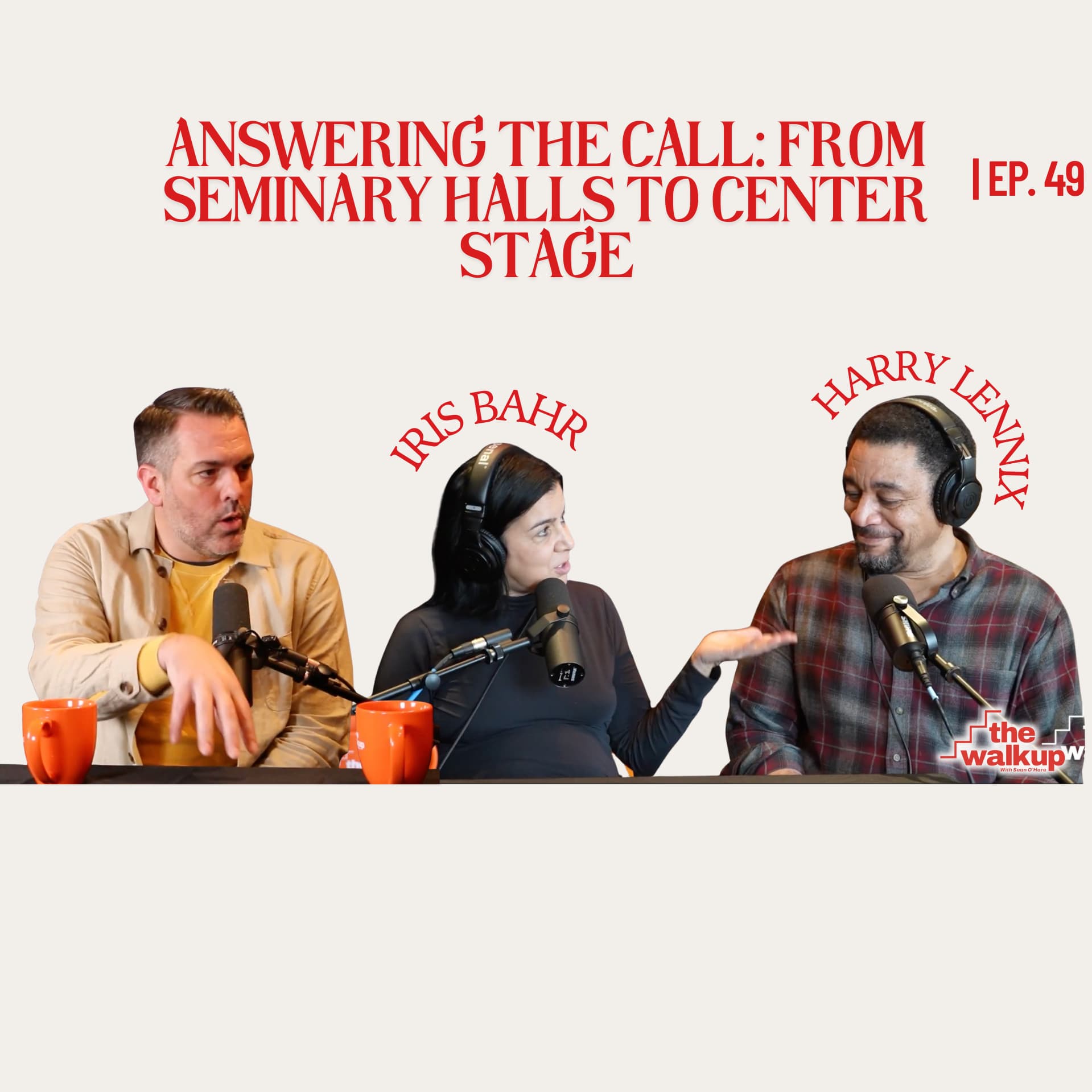
Answering the Call: From Seminary Halls to Center Stage (Iris Bahr & Harry Lennix) | Ep. 49
In this lively conversation, we sit down with Harry Lennix, an actor with a fascinating journey from seminary prep to Broadway, to explore the rich tapestry of Catholic faith, tradition, and ritual.
From the Immaculate Conception and the Eucharist to the symbolism of the Sistine Chapel and the Vatican Library, we dive deep into the intersections of theology, history, and daily practice. Along the way, we discuss the beauty of church architecture, the meaning behind priestly collars, the spiritual significance of marital language in scripture, and even share humorous and heartfelt Passover stories with some unexpected twists.
Transcript
Read the full transcriptAuto-generated · 7,293 words
So, I hijacked Harry here, because we were supposed to have lunch. We are going to have lunch. It still happens. And here I am, the only Jew at the Catholic Convention, and I know that Harry is an avid churchgoer and Christian. Little did I know, also Catholic, so it is a party, and I am happy to have you here. Good to be here. Is there a particular parish you tend to frequent here in the city?
Not really, not one in particular. I usually wait until I get to Chicago, but from time to time, I go to St. Paul the Apostle. Oh, sure. The Columbus Circle, yeah. Yeah, it is a great, great. The Paulist fathers are very interesting to me. How so? I started to be a Dominican priest. Well, you know, I mean, I am not entirely sure about what they are.
A particular call is, you know what I mean? We have different focuses according to whatever order that you join. For example, the Dominicans are the order of preachers, the ordo predicitorum, whereas the Jesuits focus on whatever they do, take vows of poverty, so on. Yeah, I actually read a lot. I was at St. Paul's. And I decided to give myself a little tour, and I learned about the founder, and then, yeah, the Paulists tend to focus on communication, actually. That is like, he was a great preacher, so you will see bookstores, they have some media that they have kind of made communication their thing.
But it is fascinating. So, you were the Dominican, so you had started as a seminary prep, and then started down the seminary track, and then felt God was calling you to the stage? Well, really, it was a girl. If God is a girl, I'm sure he is in the spirit of very many women, of course. But that said, yeah, I left the study of the priesthood to pursue a career in acting, just primarily, really, as a temporary thing, to see if I could.
Get the interest of this young lady. Lady friend? Ah. Did it work? No, not at all. Oh, yeah. But I do think that God pointed me in this direction. Okay. I think. And how do you feel, obviously you're a highly accomplished actor and do work from all, do you feel a calling to do more work that has connection to religion and spirituality, and do you turn down certain things now if they don't align? I certainly do, and I think now more than ever, we need that in this increasingly secular country.
It's an increasingly secular world, but my focus has really been on trying to bridge the gap with my friend who's a coach at the Church of God in Christ member, what she calls Church Without Walls, that is really bringing the ministry to the marketplace of entertainment, and I think it's vitally important. My organization is called...
No, I forget it. Anyway, yeah. But I'm with her thing, which is called, you know, Church Without Walls. Church Without Walls. Marketplace ministry. I've got to tell you, as a Jew... I love everybody. Well, that's not true. But I'm always like, you know, because Judaism is not a visual religion, even the simple, you know, you're not supposed to have too much schmutz and schmaltz around, and the price of that is that synagogues are just okay. And then you go into churches, and you're like, oh, now I get it.
So, you guys definitely have more festive architecture, and more money is put into it, which is also controversial in its own right, but there's something to be said for humble... Right. God can be everywhere, and you do not need a fancy building for it, but it is also nice to have. Most of them are not fancy. Right. Most of the churches are not. Very many people, of course, like to show their faith and their commitment to the faith by... Giving God a great house and a great place, but I would say that I grew up in a poor parish.
There wasn't a lot of what you call schmutz. Schmaltz. Schmaltz? Schmaltz. Schmutz is a whole other thing. That's a whole thing, okay. You don't want schmutz there either. No one wants schmutz. We have the incense. Sometimes things get schmutz. Yeah, we get some schmutz on things because of the incense.
The ash on Ash Wednesday. Yeah, Ash Wednesday had a lot of schmutz. That's true. It's a high schmutz event. It's a high schmutz. Holy day. Which is what Jesus used to call it, right? Well, he was Jewish, so it makes sense. Exactly.
It is a high church. No, I think one way to think, we were talking about the polis being about communications and media. If you think of St. Peter's in Rome, the basilica there, it is a form of media, right? It is communications, right? The paintings. Actually, believe it or not, all of St. Peter's, not one drop of paint in there. That entire thing is mosaic. There are things you think are intricate paintings.
All mosaics. But it's, the other part of it is that we take the skills and abilities. What about the Sistine Chapel show? Sistine Chapel, that's got some pain in it. Just some, just a couple, some, some, yeah. But St. Peter's itself is not. But yeah, St. Peter's, the basilica itself, Sistine Chapel's right around the corner. Actually, I had Cardinal O'Malley on here yesterday. He's Cardinal Boston. I asked him. What it was like to participate in a conclave, because you know this conclave movie has been getting a lot of attention, and he said, you know, you'd be surprised.
It's really like a prayerful retreat. It's very, very spiritual. It's like being on a retreat for several weeks together with your brothers, and he's like, you go in the Sistine Chapel, and when you vote... You put your vote in, in front of the final judgment of Michelangelo, that this is the person you believe God is calling to be the Pope and the Bishop of Rome. So, it's like, we take it very seriously. So, was Michelangelo...
He was commissioned by the church. Pope Julius. He got paid for this stuff. Pope Julius, yeah. Okay, I hope he got paid. And, well, one of the reasons it's called Pope Julius and also Sixtus, the reason it's the Sistine Chapel, it's Pope Sixtus.
So, can I just share a festive tidbit? Sure. I've been to Rome many times, even as a child, and the Sistine Chapel is always insanely crowded with tourists. I don't do well with crowds. I came here to New York Encounter, I'm like, God help me. My God. Our God, but my God. Old Testament God. Yeah, Old Testament. The real God. The only God.
All packed with people, and then I decided to go. I traveled a lot during COVID because no one else wanted to travel, so I went to Italy, peak COVID. Well, Italy was already better off a little bit. People weren't isolated where you could move, and they had just opened the Sistine Chapel, and the church, the basilica, it was just me and the choir. I think they were Armenian or something, and we were five people in the Sistine Chapel, and the guard said, this is insane.
He was shocked, and I'm like, I will never experience it like this. Ever again. And when I went to Rome again with my son, we couldn't even get in. The lines were insane. I was like, I'm glad I... Well, I don't like to one-up you. Oh, God. But I will. You are. So, I got to get a private tour of the Sistine Chapel. So, I used to work with the Vatican Library, which is in the Sistine Hall, because it was also built by Pope Sixtus.
So, I was with the head of the Vatican Secret Archive. Are there secret archives? Secret archives, yes, there are. Are there, like, Freemasons there? I don't know. I didn't see all of it. There are no Freemasons. Freemasons are very anti-Catholic. Is it really? Oh, I didn't know that. You can't be a... They're not... You cannot be a Catholic in good standing and a Mason. Okay.
Is Masonry more like witchcraft? No, it is like, I don't know, how do you describe it? It is like, it started as like a guild, but then it specifically had kind of an anti-Catholic. Oh, I am sorry. I didn't mean to bring the Freemasons in. It is much stronger in Europe. Okay, good. Fine. I feel better now. But, yeah, I got to go into the Tower of the Four Winds, which is where the Gregorian calendar was developed.
There is like a little hole in there that kind of tracks the sun or whatever, and that is how they figured out the amount of days in the calendar, and they made the adjustments, and so forth. But yeah, the Vatican Library is fascinating. Is it all in Latin?
So, it is a collection. The library is actually a library of libraries, meaning... Like, for example, Queen Christina of Sweden, your favorite. Of course. Everyone knows. She's a bitch. Forget her. Jesus. Please. Don't bring her into this. Queen Christina of Sweden. 17th century.
Yeah, whatever. Okay, overrated. She had to flee for whatever reason. I don't know. Yeah, because she's a bitch. She had to flee. We all know. And the most valuable possession you might have had, if you were a royal whatever, was your library. Because it's the one book we got. There's one copy, so they would bring and contribute, so the library is something like 30 or 40 libraries combined. Was this pre-printing press? Oh, yeah. This is manuscripts. It's all handmade.
Papyri. Papyri. Papyri. Papyri. Papyruses. It's fine. Yeah, so the reason I got involved, I was working with this philanthropist who had purchased the oldest copy in the world of the Our Father. What's Our Father? So, the prayer, the Our Father, which is in the Gospel of Matthew. The prayer that Jesus taught us. To pray, is what we believe. Okay. Our Father who art in heaven. So, it is like the main prayer. Yeah, well, the... The OG. It is a big one.
Yeah, it is foundational in the sense that it is an obligatory prayer. You say it at every Mass, you say it at every time, even in the Rosary. We do not say it as often as say the Hail Mary, which is perhaps the most... Oh, I would say in terms of volume. Yes. It has, you know, you do that some 53 times or so. Is this right, Sean? In the rosary, but our Father, we say five times. So, Hail Mary, you're hailing Mary, so it's less about hailing Jesus, it's more about Mary?
Well, we do not pray to Mary. We ask for her intercession and for her special word. We invoke her to pray for us. So, for example, that prayer goes, Hail Mary, full of grace, the Lord is with thee. This is what the Archangel Gabriel said during the Immaculate Conception. The Annunciation. He says, Hail Mary, full of grace, the Lord is with thee. Blessed art thou among women, and blessed is the fruit of thy womb, Jesus. Holy Mary, Mother of God. Pray for us sinners now and at the hour of our death.
Amen. That is what we ask for her to pray for us, as we might ask any friend to pray for us, or any family. Say a prayer for me, we would say, because the power of prayer is great. The effectual, fervent prayer of the righteous man availeth much, we say.
So, there we are. I have a festive Passover story. Oh. So, I used to invite Harry. I used to have big Passover seders in my house. Beautiful. And Passover seders, a bunch of Nebishi Jews reading the Haggadah, right? And my mom would come, and my dad, and we'd all sit there.
And then Harry came one year. And suddenly, he's like, and then the Jews are released from Egypt. I think my mom literally had an orgasm. It was a very uncomfortable moment, where it's just like, oh my God, and he would just keep reading like a dad. We just were all like, oh wow.
Yeah, that's the way it's supposed to be said. It's a beautiful prayer. You know what, your water? Yeah, it's dangling. A question. I always am afraid of my ignorance of the history of Christian faith and Catholicism, so I'm going to ask. So... What is it about this narrative of an immaculate conception, as opposed to, like, as if God inseminated Mary? Is that, like, as opposed to a regular biological conception of man and woman?
Is it really because God is supposed to be the father and Mary the mother, and together they created this being from a heavenly figure and a mortal figure? Is it that confluence? Is that? Kind of break it down. Sean, do you want to go, or do you want me to try my hand out? You take a stab at it first. So, the Immaculate Conception, again, is the conception of Mary by her parents. We believe their names could possibly be Joaquin and Anne, but they were not a couple that never had intercourse.
Okay. They had intercourse, but in her conception. Because she was to be Theotokos, the mother of God, the God-bearer, she herself had to be conceived as a pure, without original sin, that is, being. So, when she was conceived, it was the Holy Spirit himself impregnated.
Her mother, Mary's mother, so that she could therefore be worthy of giving birth to the Christ. Oh, so she was immaculately conceived. Yes, that is what the immaculate conception is. So, how was he conceived? That's a virgin birth, but that was what was announced at the Annunciation, that the Archangel Gabriel came.
Appear to her, made an announcement that you have been chosen and selected. Now, she had to be willing to do this, of course, but yes, in both cases, those conceptions were not through normal human intercourse. So, from a theological standpoint, we have the original man and woman, Adam and Eve, and we believe that Christ is the new Adam, and Mary is the new Eve, the new model of the, as man is reconciled to God.
Since Adam and Eve broke that with the original sin, that it needed to be reconstituted, and in fact, we were talking about the Sistine Chapel, right? Yeah. So, the Sistine Chapel has, call it 500 unique faces, and all look different. The only ones that would look the same are Adam and Christ, and Eve and Mary. The only ones that look the same.
The Immaculate Conception allows for the Christ child to be born, which is then the new Ark of... She becomes the new Ark of the Covenant. It all goes right back to the Jewish roots. So, she becomes the new Ark of the Covenant. The Ark of the Covenant used to hold the Word in the form of the Ten Commandments. She then carries the Word made flesh.
So, she becomes the Ark of the Covenant during her pregnancy, and now, when you go to a Catholic church, you will notice that the tabernacle looks quite similar to the Ark of the Covenant. Gold angels, winged angels on either side, gold, there is the veil to get to the Eucharist. That is the Word made flesh, or Christ is the Word. In the beginning was the Word, and the Word was God, and the Word was with God. We say that.
Christ is the Word made flesh, and so now in the Eucharist, which we believe is the body, blood, soul, and divinity of Christ, which is offered at the Last Supper, which you, your menorah that you got earlier today, he offers himself as that perfect sacrifice to go back to the original Passover. He is the Passover lamb. And so, now that is what was consummated on the cross, is so when he gave his life, that becomes the new Lamb of God. He is the Lamb of God, and so we keep the Word made flesh in the tabernacle.
So, I was actually asking, or someone was asking me this the other day, like, The Ark of the Covenant, like, you know, it would be really cool if we could find that. I'm like, absolutely, that would be amazing. I said, but as a Catholic, I believe the Ark of the Covenant is in every single Catholic parish in the Tabernacle. And, in fact, the Tabernacle, going back to the Holy of Holies in the Temple.
Used to hold both the bread of the presence and wine, which is why we have bread and wine, and of course, Passover as well. So, it is all connected. In fact, even the Exodus story that you were talking about, that hairy red, it is the same journey. So, we have the slavery of the Egyptians, right? The Jews are enslaved. They have a redeemer or somebody that sets them free in the form of Moses. They cross over the Red Sea, which is...
Baptism. And then they wander in the desert, and like we do, we gripe, and we mumble, and we complain. And what sustains us for the journey? Manna, bread from heaven, heavenly bread. And then hopefully to get to the promised land, which is heaven. So, it is the same journey the Jews went through in the Exodus, except the Exodus for us is the Exodus from sin, our own slavery to sin. Is what Christ redeems us from, and it begins with baptism, where we're made new, and then we go on the journey, and we get some Eucharist bread on the way to sustain us for the journey, and hopefully we may make it into heaven.
Wow, this is fascinating. You should be a priest. That's very, that's just beautiful. Very good job. That's good, man. He's good. Yeah, he's good. Well, I told you, my brother's a priest. I had a lot of... You got it. I know, but you missed your call. You just, yeah. That's it. Okay, sorry. There's certain things...
So, obviously, these are all beautiful stories, and I believe, don't believe, whatever. It's interesting to me that the intercourse is the original sin, and it's still seen as... No, no, the original sin is not. It was the tree. It's the eating, and then the tree of knowledge, and the tree of life, right. Like, that's the direct... But you're saying, but in order to have the immaculate conception, she had to be free of original sin, which is not to be conceived through intercourse, which is what I was...
Well, it's that we carry on original sin from our parents, right? Okay. We're born with original sin. And in fact, but the intercourse thing is actually interesting because... Why would that be considered the sin? That's why I was confused. So, it's not the sin, it's just that... It is what we inherit from our parents and grandparents. So, is there a branch, because in Judaism, the mystical side, the Kabbalah, which kind of takes everything as, there is the Pshat, which is the simple understanding of it, and then there is the Drash, which is like the interpretation, and then there is the deeper mystical meaning, which is what it really represents, what it symbolizes.
It is beyond just like, oh, this symbolizes this. So, all these narratives, you know, in the mystical Judaism, you don't take them literally, right? It's all, like, reflective of something deeper, and so I'm just wondering, in all these stories, there's a lot going on in these stories, right? There's this, and there's the lamb, and we go here, and this, and the conception. How do they serve?
How does adapting these narratives, or believing these narratives, serve your practice as a Catholic in daily life and your belief, or is it just the lore, and it just is a mutual narrative to connect everybody, and then there is other stuff?
Well, I would argue that just as you say that there is the language itself, and then somebody to interpret the language, and somebody to codify that language. The process by which we come to believe what we believe. We have the same thing, so we have... Scripture, but in the Catholic Church as opposed to, say, Protestant churches, where they believe in sola scriptura, or that is only the Bible in many cases. We have tradition, we have the magisterium, we have a catechesis, we have a presbyterate, that is the priest who can help us to understand these things so that we know how.
They are both immutable, but how they can be interpreted, in my view, you know, throughout the changing times and ages. Some things do not change, but what is open to interpretation, the Catholic Church has thought through and come to a decision on, to my knowledge, every possible question that you could answer.
So, on the question of abortion, on the question of politics, on the question of the environment, I mean, there is a catechesis, or the magisterium will deal with these questions, and those are the teaching authorities, that is the teaching authority of the church. How do we apply scripture, current events and affairs?
To the faith. Wow. Yeah, so, and the, no, I hear you say that very well, and... Enough with the mutual admiration here, I think. Yeah, no, absolutely. And I think the, what I, you might be pointing towards, because it can seem like, why do we have this marital language, this, you said, even intercourse, is because the...
Everything is about covenant, right? So, we say Old Testament, New Testament. It is really Old Covenant, New Covenant, right? The covenant God makes with man, and we believe that the New Covenant is that new Last Supper, the new Adam, the new relationship that God has with his people. When he departed from Jews, is what you are saying. He had the Old Covenant, and you guys are like, passe, time for a new covenant. Well, it is more like the completion of it.
So, it is the end, the sacramentality, the nature of what Harry was talking about, how we are separate from. Protestant and Judaism to some degree, although Judaism has all of it there. It's just there's a saying that says the Old Testament is revealed in the new. The new is concealed in the old. So you'll find these typography between the old and the new covenant. But the covenantal language throughout Scripture is this complete self-giving, right?
A husband to his wife. Moses to his people, right? Abraham and Isaac, the sacrifice. It is a full giving of self, which we give in marriage, and we also give when Christ on the cross, or Isaac being willing to be sacrificed by Abraham. And the reason it is, is we use marital language. Christ is the bridegroom, and the church is the bride. So, we say Christ gave himself for the church. And it is a full self-giving. It is not sexual in nature, but it is the full giving of self.
And so, that is what the priest offers when he gives his life. He is giving himself to the church, and the nuns you met today, they are brides. They are brides of Christ. And this very beautiful, again, non-sexual way, because what it is, is it bypasses...
The human, we need, on a human level, we need spouses to be able to be our helpmates to get through the journey of life and hopefully get to heaven. When a priest or a nun takes these vows, it is not that they are saying sex is bad or marriage is bad.
We know that, as it says in Scripture, in heaven there is no... Husbands or wives, because we are now in the eternal, the beatific vision with God and heaven and forever. There is no need for the husband or wife anymore, because they were the helpmate to get there. Your husband or wife might be there, hopefully, but it is not necessary anymore. All that the priests and the nuns do is they skip that step. And they're now giving their complete selves to the church without the, quote-unquote, benefit and support of a spouse.
So, everything is spousal language. It's like full giving of self all the time. So interesting. Yeah. Oh, look, it makes... Go ahead, Harry. No, no, no. I was just saying that that's... Yes, perfectly put. There it is again. Should I leave? Give you guys a room? I don't know what to do here. We could have some alone time. That would be good.
It is so interesting how, yeah, I mean, I think that some things make sense to me that if someone really wants to devote their life to God, to put away the distractions, let's say, also of the world of relationship and sexuality and primal desires and all that. I don't know enough about... The Jewish views on how the union and intercourse and all that is, say, how you achieve connection with God through that connection between, you know what I mean, and how procreation is really the epitome of...
It is so interesting, and I would love to, again, when we get some rabbinical scholar here, to really explore, because there is nothing, on the contrary, there is nothing sinful about the intercourse. You know what I mean? No, no. Obviously, in Orthodox, there is a whole other thing where you shouldn't be spilling seed. You're supposed to be doing this or that, and nobody can adhere to that because you tell that person not to masturbate. Good luck.
It's interesting to me that the choice is still marital language, and it's just, yeah, and somehow you still need that to make it relatable, in a way. Do you know what I mean? For people to, because it seems like it's a primal evolutionary urge to mate, to have a partner. We were ordered in that way. I mean, it was in the creation of Eve from Adam. Yeah. God's, you know, ordering of these two people to be in union for the purpose of populating and being fruitful and multiplying and so on.
That is the way that it is ordered. However, we believe that if that is not for you, that God has special, just, I mean, there is, of course, priesthood in Judaism. Yeah. We believe somebody like John the Baptist was this way, you know, who was actually the play that I am doing on Broadway starting next month. Purpose on Broadway. Purpose on Broadway, ladies and gentlemen. There is a figure, there is a character in it, who claims to not be attracted to any person because of sex, who has this...
He has no such desire. So, asexual. Asexual. And we, you know, they're very popular figures. I think Thomas Aquinas is a such person. Augustine became that, even though he did not start out that way, had a son and all of these things. But God makes allowances for a broad, well, for more than one way to fall into his ordering. But we believe that the natural ordering...
sexuality should be for the procreation of life. Right. That's where we co-create with God is that there's three people involved in that act. There's man, the woman, and then only God can create a soul, right? Man and woman can create a human being.
But they can't create a soul, because that's eternal. That's the idea, is that the body is mortal, but the soul is eternal. And so, God has to be involved in that process. And even the church would say that. That sex between married couples is a beautiful sacramental act, because it's, as Harry pointed out, it's the union between man and woman that God made us for, but it's also allowing God into that participation, which is why the church has always been not for contraception, for example, right?
Because we believe that this is an act in which God is the author of life. Therefore, us introducing contra, literally against conception, is us playing God. It's to say, no, no, we'll decide when. Well, that's interesting. I think it's also interesting. I think that, obviously, this is all so beautiful and poetic to me, and then I'm like, so keep all the hellfire and all that stuff away. You don't need it. This should be enough to entice people to. But it's so interesting because...
What were you talking about? I had a point I wanted to make. Contraception. Oh, no, but... Man and woman coming together, union, you were saying... You like the good stuff. Don't give me the hell and fire and brimstone. No, I know, but there was a point that I wanted to make with Judaism. Is that original sin, these kinds of ideas? Yes. No, there was this... Okay, and hopefully it will come to me. Was it the contraception? Oh, thank you. That on the Sabbath, obviously, there's many, many, many rules, right, on observing Sabbath.
And people that are secular, their initial response would be like, back in the day, because you are supposed to not put fire to fire, whatever the term is, right? You are not supposed to, that is considered labor. You are supposed to, the day of rest, right? And the argument from people, well, yeah, but lighting a light switch is not labor. Like, back in the day, you had to make a fire, and you had to carry wood, and that was labor, or work, and now lighting a switch.
And I remember asking a friend of mine who is observant, and I said, so what is up with this? Because the ultra-Orthodox... They won't rip toilet paper on the Sabbath. They won't open a library book, because there's a stamp that you're splitting. They literally would rip toilet paper into squares. There's a square in the bathroom, so you're not ripping. And he explained to me that you are acknowledging that you will not make any changes in the universe.
You will not play God. That you're realizing that the day of rest means that God is the author of all things, and you are not to make any changes to the universe on that day. That is the question. And so, ripping is an act, and lighting a switch is that circuit. So, it's really, really interesting when you get down to that. Obviously, these are generations and hundreds of years of thought and things. So, that idea of, like you said, you're playing God in a way, when you're acknowledging that that's the day of rest, you are not to make those changes.
Now, obviously, it's extreme, and some people take what you want, and some people drive and don't spend money. their own rules but if you talk to someone orthodox they'll be like well you can't do that it's a slippery slope if you start with one thing you know but like i know there's many opinions the fact is that there's catholics and you're saying the protestants believe this i mean that's always the big thing that baffles me you know There are so many ways to skin a cat, many ways to climb a mountain, many ways to reach some sort of enlightenment, and so to lead into that, I am curious what appealed to you in particular about Catholicism versus another avenue sect within the world of Christianity, because Jesus is part of all of them, correct?
Well, very many things appeal to me about... Other denominations. Denominations, yes. I don't really, there's really only one. They could either, you know, get with that or leave it alone. But, for example, I far prefer, generally speaking, the music of the black church. Okay. Far more appealing to me. Spectacle and so on. I mean, the Catholic church in terms of rituals and that sort of thing.
Rules, law, order, sacraments, I think we are the best in the game, to me. But in terms of the music, in particular, and to some extent, in terms of the homiletics, a fire and brimstone, not somebody preaching that, but somebody with that kind of tradition.
You like that. You like that. Yeah, I like a longer homily, you know, which actually is very interesting. In the Catholic Mass, everything is centered around the Eucharist, around communion, this breaking of the bread, the real presence of Christ being in it. In the Protestant Church, it is centered around The lecture. Somebody once described it as a kind of elaborate TED Talk. Right. With all kinds of, you know, sitting around that, and it is very, you know, so I think that when that is well done, I find that quite...
When the lecture is well done? Yes. Or when are you... Oh, okay. When the sermon, as they call it, we call it the homily, I dig frequently. I prefer… Okay. And then the black church, is there usually a particular denomination that is common to the black church, or is it all different kinds? The most popular one right now, though, is Church of God in Christ has the most members of any Catholic denomination, of any black denomination in the United States. Yeah.
It has recently changed. It used to be Baptist, but now it is Church of God in Christ. That Church of God in Christ has the most members of any Catholic denomination in the United States. Is that unique to the United States? You came to the world. Yeah, I did come. It is unique. It is not exclusive to the United States. Do they have them all over Europe and Africa? They have them, for example, in London. I'm sure they have them in Africa and places, but it started in...
I want to say it started in Memphis, Tennessee, but it is a Pentecostal, a so-called Pentecostal religion, the Church of God and Christ. Okay, okay. I know it can get confusing. Yeah, you lost me. You lost me. When he threw in Pentecostal, I'm like, I'm out. Tens of thousands of denominations. I'm done. There are. Actually, there was a black pastor who converted to... Catholicism, and he speaks about, he does apologetics and things like that, and he says when people come to him and say, oh, what denomination are you?
When they find out that he's Christian, he says, there is no denomination. We are the original. They denominated it. We're the original. We're the common denominator. We're the original. That's true. You guys are all having little parties. Yes, you are. Building buildings and mosaics. We don't have time for that. We're not mosaicing. You actually know it's... Interesting, because when I was at the Vatican Library, I also found out that in the Vatican Museums, a lot of the greatest patrons are from the Jewish community, to the Vatican Museums.
Okay. They love art. We have people who love the book. They love good art. And we don't tell you guys that you're appropriating. You're appropriating the art, the covenants, all one big appropriation. We already know. Hidden in the Old Testament. No, no, no, no, no, no. It's in there. Watch out. Nice try. We're not denying it.
She's on her way to the priesthood. She's wearing all black. I'm wearing all black. I'm going to get the little schmagegi. What's the term? Schmagegi. It's a schmagegi. It's just a collar. It's just a collar. You know what that collar means? No. So, and Sean can correct me for his brothers being a priest, but it represents purity. So, it's, you know, the white and the color. Okay, yes. That's the purity. Where did it originate?
Like, you know, the Hasidic, they originated in blah, blah, blah, blah. That I don't know, actually. And I think the black is to be a reminder that they've died to the world. They've given themselves completely over. Oh, interesting. But they're not in mourning.
No, no, it's just like I've given myself. I've died to the world and given myself to the church. And then, of course, as you interviewed different orders today, she talked to some Franciscans. Franciscans, and. So, they were… That tradition came from, okay, St. Francis of Assisi wanted to embrace the poor, so he was from a wealthy family, sold everything he had, put on this very simple habit, is what we call the habit, with a rope for a belt, just wanted simplicity.
At least you're not doing hair shirts anymore. That would be awkward. Those, no, St. Thomas More did that. He was executed by his once very good friend, Henry VIII. That didn't work out so well. Sketch your time. I wonder, I have to look this up, but I don't remember, I think I recall, and I might be wrong, so fact check me, that the certain outfits that are black, like in the Hasidic Jewelry, is that they're in mourning until the Mashiach comes, until the Messiah comes.
So, instead of saying I'm dead to the world, it could also be until the Messiah, you guys also believe the Messiah is going to roll in at some juncture, right? We're waiting for the second coming, yeah, yeah. Oh, right, the second. First one happens. We're still on the first one. We're still waiting on the first one. That's right. So, that's interesting. Which, you know, I'm not in a rush. That's the end of the world when the second coming. You just want to wait until you get a good girlfriend.
Yeah. That's a wrap. I want to... Be fruitful and multiply first, is what I would like to do. Yes, yes. That original sin, kicking in. Amazing. Well, we are going to go eat some good Catholic food. Great. Not that I am familiar with Catholic cuisine. Is there such a thing? It is Italian, that is why. It is Italian. That I am all for. That is good. You guys have a big advantage that you have Italians on your side, because just the fashion, do you know what I mean?
The love of architecture, Rome. Well, I was telling Sean though, at Mundelein Seminary. The nuns were all German, so there is a lot of German, so that is not so good. Not so funny, and I got to tell you, you meet these blessed people. That is why you didn't become a priest. I love you guys. I love that you are a missionary religion, because you guys go to some not great cities. I mean, there is a couple here from Bethlehem who now live in Pittsburgh, and thanks to the grace of God, they are like, we love Pittsburgh.
Nobody loves Pittsburgh, and it is only because they are on a mission. If you guys weren't so missionary-ish, you wouldn't be populating these. Delightful cities. I have never been to Pittsburgh. Maybe it is great. I do not want to say. Bring back all the great cuisine. So, I got to interview the Papal Nuncio earlier today, so Papal Nuncio is like It is like the ambassador, so you have the U.S. ambassador to the Vatican. This is the Vatican's representative to the various countries.
So, this guy, as Papal Nuncio, they actually have a diplomatic school. You go to, like, diplomacy school. He was in Haiti, then he was in Uganda, then he was in somewhere else, and now the United States. Yes, I was just teasing about Pittsburgh. But no, it is interesting, but in his case, giving himself over to the church, he has been doing it for 50 years. He has been in basically the diplomatic corps. Yeah, yeah, yeah. And so, he gets to, his knowledge of...
The question of the human experience is pretty broad, right? Because he's gotten to be in very, very different places, and try to bring what Harry talked about before, this kind of fullness of the church's understanding of the human person, the magisterium, the canon, the doctrine, the liturgy. I always think it's amazing. I was just in Columbia last week, and that was when we still only did the Mass in Latin.
And what these missionaries would often do is, when they came from Spain, primarily, they would learn whatever the local language was, use that language to translate the Bible, but eventually they are like, hey, we are doing this thing in Latin, and yet somehow the entire continent was converted, even though they are preaching a dead language. But it just tells you that, I think what Harry and I both would say that we believe is that. Yes, we have the rules. Yes, we have the do's and don'ts.
Yes, we have the customs, but it is a relationship. It is a relationship between the God-made man and Jesus Christ, who gives us his flesh to eat, which is pretty intense. Yeah, that one flies over my head. Yeah. And we receive it. It is a relationship. So, you can be a mediocre preacher. You can be a mediocre missionary. You can be a mediocre person, but if you are the one bringing these gifts that are… Handed to us by God, liturgy is not something that we make up.
God told us how to worship Him in the Old Testament. Go to the mountain to pray, and we think that the Mass is not ours to change. He gave us the rules. This is my body, do this and remember to me, this is my blood. Which is the fulfillment of the Passover. We don't get to change that. That is not our call.
You should have done it all in Hebrew. That is the thing. Well, I had an Aramaic. Can you imagine if all your missionaries and all the people you converted all spoke Hebrew? It would be great. You know what I mean?
Come on. I'll get the papal nuncio over here. Yeah, get all the papal nuncio in here. I love it. Thank you, Sean. I really feel like you should pursue a career in the priesthood. Right? Isn't he great? He'd be great. You're so charismatic. You've got a nice kind of fashion. Well, I don't know about the color coordination today. It's not great. Well, the yellow, it's too taupey. But we'll work on that.
But thank you so much, Harry. And so, when is the show open? Well, for... Previews, it opens February 25th, so about 10 days, I guess. I don't know what date it is, but then we open officially on St. Patty's Day, March 17th, in order to be all the Irish out there. That's a great day. That's the perfect day to open. That's it. Well, thank you so much for your time. We love having you. Love you, Sean. God bless you. God bless you.
More from The Walkup

Against the Odds: The Samurai Lawyer (Chad Flores) | Ep. 52
Faith, Sexuality, and the Fog of War (Iris Bahr & Father Rick Riccioli) | Ep. 02
E2
Church, Conflict, and Community (Iris Bahr, Father Rick Riccioli & Rob Long) | Ep. 03
E3
Hope, Vocation, and the Global Church (Colm Flynn & Colin Nykaza) | Ep. 04
E4