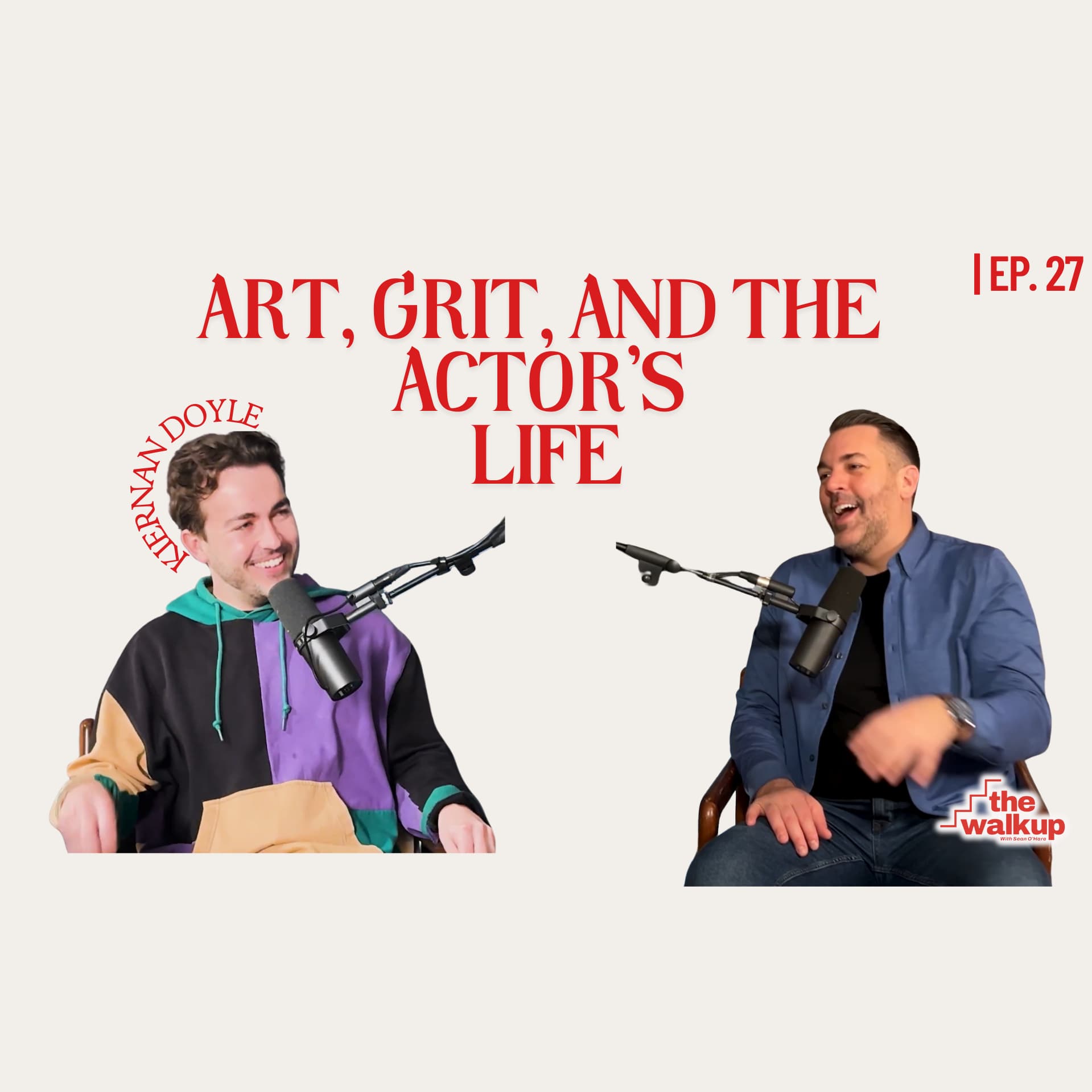
Kiernan Doyle joins The Walkup to share his journey from working the crew side of productions to starring on Netflix and filming opposite Jake Gyllenhaal.
A trained actor and seasoned set veteran, Kiernan reflects on life inside the industry—balancing spontaneity and structure, navigating union strikes, and the magic of collaborative creativity. Whether he's behind the scenes of SNL or stepping into the ring as Conor McGregor, Kiernan brings wit, work ethic, and a whole lot of hustle.
Transcript
Read the full transcriptAuto-generated · 11,194 words
Well, welcome to The Walk Up, Kiernan Doyle. So, we're here to talk about you, and what is it like to be a working actor in the industry? I think a lot of people have these ideas of what, like... What it's like to be in film and TV and to be a working actor, but like, what's your story, man? How did you get here? How did you decide to get into the acting biz? Well, settle in, get comfortable. I, you know, I definitely think it's one of those careers that comes with, you have to have a bit of a cognizance of why am I doing this, so definitely through a bit of...
Prayer and thought just have kind of been reflecting lately on, all right, you know, I'm turning 30, like these, like, what, why am I doing? What am I doing? And, yeah, just trying to find the truth in that. I think what's drawn me to this is, like, a bit of storytelling and a bit of, like, desire to create and control, I guess, like a universe.
And really, that started as a kid. My fondest memories are just running around shenanigans with the other kids in the neighborhood, and having these really... Long, kind of ongoing, like, games and stories and characters. That was, like, very clearly for me the times I felt most alive. So, taking that and just kind of growing up, never really did, like, theater. Oh, really? Yeah, yeah, really interesting. Did your parents notice a kind of, like... Is there a lot of performative quality in you?
Oh, yeah, for sure. But they weren't like, hey, you should try the theater. Yeah, I mean, so my name is Kiernan Doyle, so like super Irish, right? Out the gate, that's there. Sean Patrick O'Hara. Yeah, you get it, yeah. So, big, big family. Loud family. Everyone.
Jumping in, maybe cutting each other off kind of thing, and it's a bit of a sink or swim when it comes to standing out, being present. So, I think from just like a young age, my siblings and I, all my cousins, like... We figured out, oh, we were all performers to an extent, like family dinners, things like that. You get the uncle who has an extra glass of wine and is standing singing the sound of music, and it is just like there is a lot of freedom in our family to kind of be fun, silly.
Yeah, yeah, yeah. So, there was, I think, very intrinsically a bit of a... An artist's touch to my family. I come from, my grandmother owned a ceramic store, was like a painter, just a lot of creative, artistic. Yeah, my namesake is actually my great-grandmother, KK Kiernan, and she was like taking my dad on like Bohemian Freight, Yugoslavian trade thrifts through Bohemia. He has these weird stories of... Being a kid on like a Yugoslavian freight train, I don't know, but just like eccentricity for sure existed, and I think my family has really always wanted someone to kind of gun and go for it, but like just circumstantially maybe that.
I think that's part of the luxury of being a couple generations deep into New York. They kind of foster that in me, and I think, in a way, that was, for them, like, seeing some of their dreams be realized. So, I don't know if that's, like, I'm not trying to get, like, super deep about it. I just think acting is a bit like...
Vulnerable and a bit of authenticity. So, I'd like to start with, yeah, not claiming that I know everything, but just to show this is the honest kind of place that I've been coming from. So, all of that, writing, directing, acting is what I've been passionate about, and my parents just were like, yeah, go for it. Well, to use a very Irish term, chutzpah. Yeah. There is some chutzpah required, or a healthy dose of it, to make that jump, right? Because there is one thing to say, all right, I have got these kind of performative qualities, I like writing, or I like storytelling, but there is another thing to say, I am going to have the audacity to think I can do that.
So, what was the first? What was the first opportunity you got to actually either be on camera or be on stage, or what would that look like? Yeah, yeah, it was interesting. I think the toe-dabbling started maybe with the other side of the camera, feeling very free to be part of it, but there was, I think, the desire to step out there, but I don't think I was quite there in personal confidence or kind of ready yet, but it was exciting.
I saw it, I was close to it, and kind of desired maybe to get there at some point. You know, I do some directing as well. I just, you know, kind of figuring out what my life in this world is. It was recommended to me that, well, you know, if you want to be a good director, you got to know how to act, right? Oh, okay. Yeah, so I was like, all right, there's... So, directing was your initial motivation, and then...
Yeah, yeah, yeah, which, you know, for me, like, all of these things are very interconnected. So, um... That was, like, a very tangible expression of, like, my interest in film and, you know, theatrics, maybe. So, yeah, I just, like, kind of as on a whim was, like, all right, acting classes near me, New York, and this is, like, early 20s. So, you're already living in New York. You say you're from Boston, but then... Oh, sorry, no, New York. I'm from New York.
Oh, okay, but your family, like, originally... We're from New York, yeah. Oh, you're from... Yeah, yeah, yeah. When did I hear Boston before? Did I make that up? Maybe, yeah. Maybe it's just... I just assumed the Irish. Yeah, yeah, yeah. So, where in New York did you guys go? Yeah, yeah. So, I'm from the Rockaways, so New York City. It's this weird little kind of town that it's a community, but like the subway goes there. So, you know, tiny town, New York City.
It was weird, kind of both of those existing. Related to everyone there. Cousins, second cousins. People that I thought were my cousins, but are like friends. You know, it's just, it is a big neighborhood there. We moved to Florida, 9-11 definitely being a big factor in that. My dad's in real estate. We heard the market was popping. Turns out, it was. It was a bubble that was popping. It was popping. Oh, yeah, it was popping. It was popping at first.
We were there for it. So, yeah, that kind of was like a big... You know, Florida just seemed pretty viable for like a family, and just like the times, things felt a little crazy here. So, I was down there for most of my childhood, but all my family's here, so studied, did production in school. So, when you looked up acting classes, where did that lead you? Yeah, exactly. Yeah, so that's kind of the blast. There was like a conservatory that had a lot of actors that I was like, I really like them.
So, it's like, ah, is it gonna kill me to audition for this? It's a free audition. So, uh, you know, audition, it was, nah. You know, looking in retrospect, I was like, how do I prepare for this? But they had like a list of some monologues, and, you know, I picked one and did my best, so what I thought would be preparing for that, and I got in. Oh, so you had to... I had to audition. It was wild, and it was on Zoom.
It was like kind of that weird time of things are on Zoom. So, actually, that, I think, was... Yeah, if it wasn't on Zoom, I don't know if I would have, like, yeah, let me jump into a room and do this. I'd never done it. So, it was a six-week intensive. It was the Neighborhood Playhouse. It's a conservatory in the city. In acting, there's different, like, methods. So, one of the really prominent methods is called the Meisner technique. So, there's this guy, Samford Meisner.
He originated this school. Irishella. Yeah, exactly. Yeah, yeah. And it is a specific style of acting that they teach there, and they have a two-year program, they have a conservatory. It was a six-week thing. I was like, that sounds like a good nosh for me. I will go and at least just get a pulse on this, so I did the six-week program there. Wow, okay. And then you are out into the...
You know, the deep end of the pool, which is, like, you're just going to jump out there, and then will you just start trying to audition wherever you can, or are you trying to work on sets? Like, how are you getting experience? So, when I first moved back to New York after doing, like, production, there was just, yeah, I was like, all right, production assistant, maybe? So, I jumped onto some, like, film sets in the city. Just, you know, going to school for this is, like, a great kind of, like, Roll it.
Someone recommended me for a job, and just a very entry-level production job. I hated it. I mean, it's a great thing, but it wasn't like the glitz and glam that I imagined of Oh, no, yeah. Most people think film sets are so glamorous, and then you get on one and you're like, wow, this is tedious. No, and you know, I had been on sets in school, and I'm a big proponent of art does take work and everything.
I just was, like, so isolated, because I'm the kid that they're hiring. Yeah, kid, you've never been on a set? All right, you go two blocks over there. Here's a walkie-talkie, and if anyone comes this way... And tell them we're shooting a movie. You know, I just... It was around... So, that's, like, what I was doing. Not really loving it. I don't want to sound too disparaging on it, but I had a really cool opportunity after doing this acting program to...
I auditioned for a small part for a Netflix film, and I ended up getting it. It is like a silly little rom-com, and my big line was, hey, pass this to the big guy. I whisper it in school. Pass this to the big guy. And then, like, next thing I know, I am in the union for acting, so the Screen Actors Guild. Yeah, so explain to people who do not understand what that is. You hear about, I am in the union, or in SAG, but what does that mean exactly?
So, the Screen Actors Guild is, basically, it is the union for every major actor, performer in television and film in the United States of America. So... If you're from me to Meryl Streep, and everything in between, that's who's in our union. So, if you're watching a show, anyone who has a speaking part in that, they're working on either being a member of the union or a specialty contract within that union. And then most films, you have to be in the union to be on the...
On the... Yeah, it's, you know, like, what I've come to know about, like, the film industry is every access point, it's like, oh, in order to do it, you have to have done it. It's, okay, so to get into the sag.
You have to have done a SAG part, so it is a bit of a weird barrier to entry, if you will. Right, where you can write and direct your own film that is even distributed on Netflix. Exactly. But it is not SAG because you just did it yourself. Yeah. And you are not going to get SAG status because of that. Exactly, yeah. It is a bit of a, it is a bit, yeah. And then, if it does get picked up by any major distributor.
And it was made independently. A lot of these contracts kind of kick in, in retrospect, like the studios handle that, but basically, if you are watching it, it is being put out by Netflix, it is filmed in the U.S., it is working through the Screen Actors Guild. Gotcha. Yeah. So, you did that, and then you got the acting bug is clearly, you know, been fully absorbed, and now you are doing acting classes. Because you got... You've got a speaking role, you've got a SAG card, and now you're like, all right, I'm in.
This is like... Yeah. So, what is the... And now I'm a millionaire. And now I... You know, I'm doing this favor. My helicopter's on the roof, and I'll be in Fiji in like a half an hour. We appreciate you taking the time. Yeah, exactly. Yeah, I think... It really is. I give such credit to anyone who is in the union, because it is a sizable amount of work. The other end that's maybe not the most glamorous end of that is, you know, nitty-gritty of contracts.
If you're watching a show and there's... The waiters, the people in the background, whatever it is, those are all people in the union as well. It's like the first 25, 50 people contract. So, it's a very large union, and that is a lot of the work that gets people in as well.
Because you meet a lot of talented people that are still trying to figure out ways to viably cut their teeth in this. So, I get health insurance in my union. Oh, okay. Yeah, and that's a huge motivator for me, but that works based off how many days I work, right? Okay. So, it's either days or money. How many days on a SAG shoot or something? So, you can either make, it's something like 20, 25 grand. Or, a certain amount of days.
Okay. So, you know. So, there is a lot of humility, which as a Catholic, I find that post-strike or something, I got to hit my days, you are going to catch me sitting at the table in the background of a scene, because I need my health insurance, you know? So, it has been more reflective than I thought it would be, like of an industry. It is hard not to like... Oh, I haven't booked an audition.
I've been booked apart in like four or five weeks. Is it me? Right. Do I need to lose a little weight? Is my hairline going? You have to figure out things that ground you from that. So, I think the part of me that wants to be like, yeah, man, oh, it's great. Do you want to hear the actors I've met? Do you want to hear the directors I've seen? I'm sure people love that, yeah. Yeah, but I think it's more interesting and honest to be like, yeah, you know.
These are kind of the struggles that are there as well. So, my day-to-day life as an actor is a good bit of auditioning, searching, working with agents, networking, meeting people, just a lot of face time, right? You have to kind of be a presence and be auditioning even when you're not, and then also preparing for auditions, right? So, you have an agent. You have connections, friends, managers, or even just people you know that are working on indie projects, but you believe in them, and you need stuff for your real...
So, it is just a mix of what is going on, who is doing cool stuff in the city. And why New York versus LA? I know a lot of people have that decision to make because a lot of things are shot in LA, although a lot of things are shot all over the place now. I feel like New York has kind of had a resurgence in the last five or ten years. New York has. I think right now, the industry is figuring out, and I mean, we just had these fires in LA that is another real punch on an industry that is already very struggling to figure out.
Where it is going to be, you know, post-strike, these things. I have been fortunate, New York, these last couple of years, was super viable. I mean, Dick Wolf alone, if you are not familiar with him, he does SVU, FBI, LMNOP, like he does all of the like… He was the Law and Order guy. Yeah, yeah. So, Law and Order, SVU, the alphabet soup of like letters and numbers and… Procedural TV, man. You know what? He… Keeps him and producers that are like the TV people, they keep actors that are at my stage, maybe the, here you go, sir, or, oh, thank you.
They're writing stuff that is New York-centric. It's here. It's filming here. It's not the coolest work, but it is. There is work. I don't know. It'll be interesting to see where things are at. Canada has a lot going on. Right. Vancouver, Toronto. Yeah, but taxes play into it. You see places start to have vibrancy, and then like... The tax incentive goes away. It happened in Florida. It was like popping for a minute. Louisiana for a while. Georgia is still big, I think.
Yep, yep. So, everything is in flex. We will see, but for me, I am from New York. I have family here. I do not feel as stretched as if I were in L.A. Sure, you would not be on your own, but you would have to like... Build a life there, as opposed to you've got family and connections and all that. Yeah, yeah.
Yeah, I think a lot of people don't realize all the... All the practical realities in filmmaking is, you know, filmmaking is expensive, so you're going to follow wherever the tax credits go. Yeah, yeah. So, you know, a lot of films, I had a friend of mine who's worked on a number of films, and I don't think she left Georgia for like three years, because it was like, hey, that's where all the, everything was being shot there, because the tax credits were very generous.
Exactly, and I think New York does... In my opinion, I feel like it's going to have a continuance in a lot of ways. It just naturally has just such a history to it, and there's a lot of studios here, too. Well, isn't De Niro building one? I think so, and New Jersey has a lot going, so I don't know. But you hear, it's hard to gauge, right? I can't tell you, you know, the strike ended over a year ago, and you still hear, like, next month, it's really, oh, okay, yeah, no, this summer, it's really, oh, oh.
Survive to 25 was the mantra, right? Yeah, so, I'm hearing it's about to pick up again, but I think, you know, for me... Just figuring out ways that, yeah, this is the focus, and increasingly, obviously, that's where you would want your income to come from. I've been blessed the last few years. It has been.
But you've got to be a bit creative, right? And SAG, beyond acting, has other worlds. So, we're talking stunts, we're talking stand-ins, we're talking doubles. So, that has been my kind of bread and butter for the last few years. You know, I'm going to do what I've got to do to keep my insurance, like I said, but I think it feels a little more artistically inclined or maybe a little more collaborative when you get hired to... Be the double for an actor for some kind of thing.
You're working with them pretty intimately to figure out, how can I match your performance? What does the story call for? It's cool. Yeah, I've not been on that many sets, but I got to be on the set for the Roadhouse remake with Jake Gyllenhaal, and I was sitting next to his double a lot. Because we are both in the, what is that called, where you are watching the playbacks? Video Village. Video Village. So, we are there, and… My friend Doug, who is the director, he was always right there, so he wasn't in Video Village, so I got to take his seat, because he was always with the more mobile playback thing.
So, when I got there, they were like, hey, if you want to take Doug's seat, and I'm like, well, I don't think I should have the director's chair, and they're like, oh, no, he's never there, because he basically stands the entire time. But yeah, so I'm next to Gyllenhaal's double, but... That role called for, obviously, a very particular physique, and then on top of that, they had to put all the fake tattoos on, but it is funny, because he is there, he has got to be ready to go at any point, but also long stretches to just sit around.
He is reading books, he is doing this, he is doing that. I got to know him more than anybody else, because we were both just sitting there. And, you know, so, for myself, with, like, acting... Being parred with, like, my own interest in, like, directing, writing, having made some of my own little films, that's, like, a plus to being on set and being the guy that's, like, at the ready. I can walk around and really get to know and be friends with these other people that are just kind of there at the ready, and, you know, that's the collaboration I love.
Those are the people I want to, you know, maybe work with on our own projects and stuff. But, yeah, there is a bit of discipline. I've been on a couple projects where I had to be there every day for, you know, we're talking 100 plus days or whatever.
Most of those days, we're talking 12 hours to 14 hours. That's a long shoot, man. Yeah, and then I'm getting there at like 5 a.m., and I have to go. You know, it's just, you get a wig on, and it's really tight, and you got it on all day, and then it is kind of jarring, too, right? Because you walk by, and people are like, oh, wait, you're not. I think you're the. Oh, you're just the guy who's, and you're like, wait, what?
You see people get excited, and they're like, oh, it's just you. You're like, oh, all right. That's a weird reality. Yeah, because I don't think people realize, like, we were talking about the cost of filming and why tax credits matter. Like, this film was shot in the Dominican Republic because it was cheaper than shooting in Florida, which is where the movie was set. But...
I don't think people realize why these long shoots, 12 hours, 16 hours, and it's because you get all those people on set, 50, sometimes 100 crew plus, you got to maximize every moment because it's a lot of money to get those cameras, to get the lighting, get the set design, get everybody there, so you're not doing a four-hour shoot. You're going to do a 16-hour, because there's like the, I learned, it's kind of like, There are days that are daytimes, and ones that are nighttimes, and every now and then you have both, but I forget the terminology.
Oh, a split shoot, yeah. That is what it is, yeah. Yeah, so it is, you know, and I think as an actor, I have to be cognizant of that, right? Yeah. Because days are long, and you look at that, you go, really? Like a 16-hour day?
And you want to make it even crazier, we are shooting maybe 30 seconds to a minute of the movie. I know, right? So, you are like, wait, how much are they doing in these days? It takes a while. I mean, if you have all of your cameras set up on the right side of the room, you have all the lighting, and you have all this, and then you have to get the other angle, well, you have to get everything out, reset, and they call it like dressing, the set, to match what it was.
Now, put the new lights up, so that we're talking, just to turn around, that can take an hour, two hours. It's wild, but so as an actor, I have to be cognizant of... I play a huge personal part in how long of a day we're going, right? If I get there and I'm kind of lackadaisical about it, not ready, don't have my lines by memory, or even just it's important as well, I have to match. So, I say this line, I sit here, then we go over there, and I say that line.
If I'm not matching that for camera, it's all over the place. So, you know, if... If you're ready to go, that really speeds it up. Well, it's, and I think that's what, I mean, it sounds relatively, this is not like some profound observation, but.
These really long days, and like you said, it might only end up as 30 seconds in the film, right? Yeah, yeah. But you have to be these long stretches of waiting as sets being put together, and the one I was on was also an action movie, so things get moved around, these fight scenes, so the guy has to fall down, or the table breaks, and they've got to do that all over again, and you just have to be...
Ready to turn it on, right? And that is what is interesting, because I think of, when I had in my mind with acting involved, you think of the stage, right? And then when you are on a set, you realize it is like, oh no, of the 16 hours, you might actually be acting for 30, 40 minutes of it, if you are lucky. Not even lucky, but that is just the reality of it. So, how do you get yourself in a mindset of...
Being ready to turn it on, because, I mean, obviously the set helps, and the design helps, and all that, but it is not like you are, you know, when you are, if it is a play or something, right, the lights go on, the play starts, and you are acting for the next two hours, and you are in character the whole time. Here, it is like you have to flip the switch somehow, right? Yeah, I think it is a balance of method and mode.
So, by mode, I mean, like, what are we doing? So, exactly. A play is widely different from, like, a show. You're doing the entirety over and over and over again. That has its pros and cons. Film, you're doing one action multiple times over a day, but then never again. Right. And those are different things. Oh, right. That's it. That's the one. You have to be aware of it, right? So, if I'm doing a play, and in the play, our table is set, and my character runs across and steals your coffee.
That says a lot, right? That also can say a lot about our relationship. So, each night, maybe I do it a little differently, right? Maybe I am a little quicker, and that is going to naturally inform how you respond. Sure.
With television, I have to, I think, have a bit of… The research and the understanding of what is this scene saying and doing, and once I have an idea of that, I have to have that commitment, and then the director comes in with their notes and stuff, but I think that's the preparation you can bring in when it comes to mode. Yeah, I think what I was so struck by just being the complete outsider on this film set was...
What I found so compelling was the best way I can describe it is kind of like the circus tent of it all, meaning everyone knows what they're supposed to do, and there's 100 plus crew, and everyone's got their job, and they're all like... Have this particular skill set, you know, this person's doing the hair and makeup, that person's doing the stunts, that person's over there rehearsing their scene, or the director's looking at the playback, and it's like this organized chaos that's incredible.
It's like, you know, like I said, it's like the circus, where people just show up at the town, they throw up the tent, and everyone knows what to do to get the show on. And quite frankly, it's a bit intoxicating. I think it's, you know, you ask, why do this, why do that, and there is a There's a thrill, there's a rush. I do just really enjoy that. I mean, the term movies, like, why do we call it movies? It came about from, like, the film industry in Brooklyn, believe it or not.
They were these crews that would move the sets from place to place. Like, oh, those are the movies. No, that's where it came from. Yeah, and I think that is where we have our concept. If you could envision, if you haven't been on a set... Envision that, the chaos of people having to have their little, like, carts filled with all their stuff, and they have to move it to the other. It's just constantly, hey, move over there. Hey, now move over there.
So, you know, I don't know. That's just like kind of a, that is an envisionment of the chaos. And what's interesting is how much it's changed now because of technology, right? I mean, the cameras are getting better and better and better. Or, you know, I mean, before, I mean.
Speaking of movie history, you can maybe correct me if I am wrong, but my understanding is that one of the reasons there were so many Westerns is because it was easier to shoot. It was daylight, you kind of have your set, and you could shoot it near L.A., so a lot of Westerns because they were cheap to make.
You know what lighting is free? The sun. And so, but then now, like, I remember my friend who was in. More documentary filmmaking, and this is at least 15 years ago, and he was telling me, he's like, the cameras, the lenses are getting to the point where you can practically shoot in the dark and still get a really good quality.
While there's one part of the movie industry, which is, or the film business, that's these massive sets, right, to be able to create the production quality that draws in an audience, at the same time, you've made independent films, right? You've made your own shorts and own films, where obviously you don't have, you know.
A $50, $100 million budget. So, what is the difference between doing that, actually, I would try to keep it under the radar. So, what is the difference between, so you are on a big set, where you are one part of a massive machine, versus then making your own film, where it is like, you are writing it, you are directing it, you are acting in it.
Again, the pros and cons. I also have to keep my ego in check a bit. What is my goal? Is it to enshrine myself and how brilliant I am, or is it to make art and make something that's good?
So, if there's a more talented actor, so be it. Or if there's a better director and I'll act, I want to par these things out, balance them. I think... Like, with just, like, the pros and cons of it, sometimes, like, as fun as it can be to be on a really big set, it's a bit too many cooks in the kitchen. Like, just rules of unions. Like, if I'm on a set and a ladder falls, I'm not picking it up. Yeah, and that seems maybe a little silly, but there is just, like...
You have to have a great respect for every aspect of this, because that is someone's intentionality. With independent filmmaking, I think there is a little more like what they call like guerrilla style. You can roll up your sleeves a little more, and you know, everyone has maybe got a couple jobs, and everyone is getting their hands into other people. So, with that, you also, I think, have to make sure...
That you're not being redundant, like there's no redundancies, that there's an efficiency there. So, maybe my hair stylist isn't also going to be doing props. Maybe my set designer, locations person is also doing props, you know? Because they're in proximity to each other, so I think you just have to... I feel like it's like you're cooking a big dinner for a big family, right? And, you know, you open the cabinet, and mom just went shopping, right? It's stacked. It's packed. And you've got all of your siblings there, and they all have their little tasks and jobs.
That's like... Big budget filmmaking. That has its pros and cons, right? Then there's also the version you get there, and no one's ready, and there's nothing in the pantries, no money, and you got to go and knock on a, or text your buddy to come help. That's what independent filmmaking feels like, but that's fun, too, right? Well, that's a different thrill, right? Cook up some spaghetti. Can we actually pull it off, right? Yeah, yeah. Yeah, I've gotten... I had gotten to be around a few of those as well, and I had watched my friends bring something to life.
As I think you know, I lived in this former convent, and so we got to, because it was an extraordinary natural set, in the sense that what it would cost to do set design that would convey a turn-of-the-century New York City brownstone. It was obviously hard to get, and we just had it there.
I've got, like, three, man. You've got to call me. I've got to. No, I mean, in fact, like, one of my housemates when we lived there, they literally wrote something. Just because they had the set. Yeah. It is like, well, we got this amazing set. Yep. Let us write something to match it, because we can shoot there all day long. There is no, you know, we did not charge anybody to shoot there or whatever.
Yeah. And so, I remember being around that and just like watching everyone have their own little role. But to your point, like, it is all hands on deck, right? Oh, yeah. And then going on a big film set, it is like everyone has got, you do this, and that is the only piece you do, because there is a machine.
Yeah. And so, then how do you go about writing, like? You know, like, you get an idea for a story, or you see something, like, I think people, that creative process is a mystery to a lot of people.
Yeah, it's a bit of a mystery to me. I think that's where I've just, to a healthy level, been trying to demystify it. I think the art and the artistic statement is a beautiful place to, like, begin. So, if I know, maybe...
Things that I really feel passionate about, maybe I want to talk about this, and not in like a preachy way, like, oh, I want to save the earth or something. I mean more of like, you know, like, alcoholism is something my family struggled with, and it's important for me to maybe explore stories about that. Those are the things I think you can try to be attuned to. And even to like physically write down are helpful for me. I just have like, A notes app that are things and themes and stories that I like.
Then on, like, maybe a more fun level, like those moments in films that are interesting. I pay attention to those because there's a resonance there. Beyond that, what I've been trying to do the last, like, two years is just be attentive to my day-to-day. Like, those weird little facts that you hear, those character quirks you encounter, the places, the spaces.
I love a good collage, and for me, filmmaking is oftentimes like a reflection of what I've encountered over the last year. Reflexive and reformatted into a story that I find interesting. Now, if I were to write a story, I would recommend go buy a stack of index cards.
40 cards or so, and those are going to be your scenes. That is going to give you a nice outline that you can write on each of those, what you want that scene to be, what you want it to comprise of. When you have all that laid out nice and neat, it is just a lot easier to mix and match. So, I don't know. Start with a scene. Start with an idea. Start with a premise. Write that. Write another. Right, and now they're stringing them along.
Yeah, and so there's the... One part of it is kind of the mechanics of it, right? There are certain things that have to be there, and then there is a certain experimentation to it. For sure. And how much, when you are doing your own films, like shooting something you have created, are you leaving a lot of room for improv? Or is it like, hey, this is the script, and we are sticking to it? Or what is your take? How do you approach improvisation?
I like to, if it is a script that I am writing and directing and... Acting in, like, those are all, I think, that you've got to kind of put on those hats individually. So, I'm writing it, I'm just writing it. Oh, that's going to be hard to shoot. Like, that's Director Kiernan's problem, right? So, I'm writing it, and then I take it, put on the director hat. What the heck? Like, this is ridiculous. And you've got to, like, bring it down to earth a little bit.
So then, if I'm acting in it, you know, I think a bit of it is... I like both. I've done both, like improv and more like, no, it's got to be written like this. I think directors have a bit of their own touches to that. I always like to get it as it's written, make sure we have that in the bag, and then we can kind of have fun with it. I think one of my favorite kind of directing styles is I like to give proposals to my actors.
So, just to give them like a fresh kind of take on a scene, right? It feels exciting in the way that improv can be, and it brings newness in it, but maybe that improv is an action or a physicality rather than a spoken word. If it is a spoken word, so be it, but I think a good acting performance is when you're just free to the moment, right? So, by proposal, I mean, all right, if we're doing a scene where You and this girl are walking, and you're on a first date, right?
We get it, and if I'm like, I want you to be a little more awkward or uncomfortable, it would be really imposing for me to walk in and say, oh, the line, oh, it's so nice to meet you. Can you be more like, it's so nice to meet you, because you're just going to mimic, right? Now, you're just going to do it that way. What if on this one, you have in your back pocket, you bought her a present, and now you're realizing, oh, gosh, that's really awkward.
I shouldn't have done that. Just keep that in your head. Keep that in your consciousness. Like, what does that unlock, I think? And you do it with the sense of, like, great, we got that. Let's mix it up. Let's ramp up a little bit more, X, Y, Z. So, I can't take credit for that. That's like a Scorsese technique, but I guess that's my response. I'm sure he stole it from somebody else, so don't worry. Yeah, so I like to have fun with it.
I like to come at it from a different... Again, what's best for the project? If you said something that is true and good, like, boom, that is great. Yeah, again, I have only been on a few sets, but the same one for Roadhouse, it was an interesting, again, I just got to be kind of a fly on the wall, and in that case, so Conor McGregor, the MMA fighter, this was his first acting role. Yeah.
So, the director was meeting with him to go over a scene, and his acting coach was there, and since I'm just the friend, I was like, oh, listen, I'll get out of the way, I'll leave you guys alone, and they're like, no, you can do whatever, you can sit in. Awesome. And just watching that process of the acting coach trying to take somebody who is a performer in some ways, obviously MMA is a sport.
First and foremost, but there is a performative quality to it, and obviously, the reason Conor McGregor is as famous as he is is because he is a very performative guy, but it was interesting watching. Both the director and the acting coach trying to take his raw energy, his raw performative watchability, and then figure out how to channel it into more of the mechanics of acting.
So, it was interesting just to be there and watch them try to explore a scene together, and how many different ways you can take angles. He is like, I was thinking this, and the acting coach is like, well, no, remember we talked about this, we want to try that, and the director has got another take. And that is why I think it is so fascinating about the creative process, is that, especially in film, right, it is collaborative. Oh, yeah. You are not a painter or a sculptor that, you know, I mean, of course, painters and sculptors have sometimes assistants and mentors and that sort of thing, but generally, it is kind of their vision.
Start to finish. Yeah, yeah. Whereas here, it's like, you got to know that, like, I'm just this part of the puzzle, and I got to let you bring your creativity to it. Yeah, that's part of the deal. I don't get to control what you do, because it's your own, your own art, which I think is the intimacy of like filmmaking and acting and performing is if from speaking from the end of a director, if I'm, I have an idea, I have an execution, and it's my job to The best of my ability, find something that is true to that.
That is where it might change a little bit, not be exactly as I envisioned. I am the kind of guy, I am open to that along the way. What I find is really important is the people I am putting in those positions are people that I trust. I trust...
Because, you know, I've seen their art that they've made, and it really matches the aestheticism that I would like to create. Or they're a near and dear friend, or it's someone who I really feel gets the vision and could execute the job that they have. I think whenever you hear about filmmaking getting messy, it's a loss of trust. That's just really what it is.
Grabs hold of the project in a way they shouldn't, or, you know, someone thought it would be something, and it went another way. It's like trust is the river. I've never heard that before. Okay. Yeah, I guess you're right, because that trust creates a freedom. Yeah, yeah. Right, because if you're not able to be fully yourself, either in whatever role you're playing as, you know, director or actor or, you know, set designer or whatever it may be, that's interesting. So, then...
Is it the director's job to develop that trust? Is it the producer? What would you say? I would say everyone plays a role, but I had never heard that way of approaching. Well, and I think just to kind of maybe even further solidify it just a little bit, as you were saying earlier.
Painting, sculpting, art can be a bit solitary, and there are aspects of filmmaking that are that, but when it gets to being on set, being collaborative, that is a relationship, right? What are relationships built upon, right? A mutual trust. You are finding people that you can say, hey, this is what I want to make, this is how I want to make it, and, you know. Even for me, when you get onto a big set, if it's just like, I trust that you, the van driver, need a job and are committed to being there, that's great.
I'm not saying it has to be, but it's just, I'm trusting you to do this, and it's a bit vulnerable. It's a bit like, here's the baby, hold it. I ascribe to, it really is the producer's job at the end of the day, if we're getting big about it. You know, I was just reading recently, there's this movie that came out, A Real Pain. I haven't seen it yet, but I was reading that one of the main actors wanted to pull out, and the other actor was also directing it.
You could imagine, a couple weeks before production, that would be really deterring for that director. So, the producer, it was actually Emma Stone, she kept him in the dark while she talked to that actor and encouraged him to stay on. That is a level of filmmaking, I do think. So, part of directing is, hey, I need to entrust you to produce this and make this, so that I can focus on what I'm preparing, because when you're directing, we're talking a shot list.
We're talking you're meeting with the producer, like the different department heads. You're meeting with the actors getting ready, so it's kind of silly, I think, with filmmaking and how big it is to hold on to 100% of that control. You have to relinquish it. But then that is where you are just hoping, like, hey, man, I really hope you are not going to oust me from this film, right?
No, I was interested. I was, yeah, again, on this film, there was Joel Silver, who is one of the, like, you know, I mean. Probably one of the more prolific action movie producers out of all the diehards and lethal weapons and all that sort of stuff. So, one moment, he is on the phone yelling at somebody at the studio to get more money for this or that, and the next moment, he has got his arm around one of the actors, coaching him up or whatever.
So, you are almost a little bit like a parent and a coach, and you have got to do what the situation calls for. Well, and then that's even like, so, you know, you're relinquishing when you're directing some of that, like, minutiae of the day-to-day that is happening, but you're still, I think, when you're directing, you're trying to, you're keeping an eye on that. So, you're clocking in with the producers. Right. How is it going? I think it's one thing to say, like, oh, I'm trusting.
Like, it's another thing to say, I'm blindly just like, oh, I didn't know. That's part of management, right? You got to keep... A pulse on every aspect. You're juggling several balls in the air, and I've had moments similarly where I'm directing, and I just was playing like, give us money, like the pitch guy, and it's not my favorite. And then next thing I know, I'm on the phone, I'm playing therapist because an actor is going through personal stuff.
All of that is important, I think, to, like, I'm not that actor's therapist, right? But, like, they have to know that I sincerely am trusting and want to hear, and they can, I'm there to sort through what's going on in their lives, and I don't know. I just, I think whenever I'm trying to recalibrate myself, what am I doing? Like, just, I try to go back to humanity.
If, like, I'm not really sure if this project is going to happen anymore because, you know, like, there was a personal tragedy in our main actor's life. Let's say that happened, right? Well, uh... I care for that person. I would hope, if I was in that position, that I can articulate and speak to that person, and I think when you look at every great performer, director, and retrospect, you hear these stories about how the reason they kept returning and working with these people was because they really liked them, or they believed in their vision.
So, I don't know. Friendship is important to me along the way. Well, and like you said, that trust part, because if you work together... And you have that shared experience. You've seen them execute on something. If on top of that, you also kind of get along on a personal level, all the better. But it's interesting you mentioned trust, because there is this sense of, you said, here's the baby. It's like we're all on this project.
We have the sense of urgency that we're all trying to get this thing that's outside of all of us completed. So, like I said, whether it's the driver picking up the actors and taking them to set, whether it's the hair and makeup team, the stunt team, the producers, the caterers, whatever, everyone's on board to get this thing accomplished, which I think that's part of the rush. I think the bigger it gets to, the more you have to be...
Aware of, yeah, people's vested interests, like we were just saying, right? So, if I'm making something with my five buddies, it's probably going to be because we all really like it, and we all believe in it, and we all believe this would behoove us for our careers. If I were to be part of a team of, like, a hundred people, like, it's silly for me to say that they're all there because they really believe in this, like, because I haven't. It's a job.
It's a job. It's a job. I need health insurance. I need... Uh, to pay my bills. Like, that's, that's, so it's... And that's, I think, a bit of the balance that, as you get bigger, you have to keep in mind. It's a big responsibility.
You've got to show up to work, because that's people's livelihoods now. Yeah, exactly. This isn't like you have a bad day at the office or whatever, and it doesn't really matter. It's like, no, we've got 30 days on this set, and that's it. And I've been on projects where actors have walked off set. Wow. And I...
Like, it really hurts. Like, it's a bit, like, difficult, because, I don't know, it's always awkward, because then, like, all right, everyone, go home. Like, what are we going to do? We can't shoot. And, yeah, I think what...
But people talk, right? Like, people know, and like, best of luck getting future work, and everyone wants, like, amendability to an extent. So, you know, you want to know that you're going to have someone that it's not just all about them. Like, they're going to show up, and I've also worked with, I do some work with, like, SNL every once in a while, and I've seen actors show up. Like, SNL is a blitz. You got a week where you got to prepare, and they haven't, like, they got a couple hours of sleep, and they're there, because it's livelihoods at that point.
Like, you've committed, and so, I don't know. I don't want to be too disparaging, but, like, it's just, it's always. It's fascinating to me when people are that self-centered. You're not thinking about the effects you have on people. Well, SNL, that's a whole other level, because it's both a TV show and a live performance, and that urgency of you can't just write for another week and then come back. It's like, no, the show's on Saturday night. Yeah. There's no, that's...
Yeah, I can understand why there's a lot of interviews. And, like, what I've done with them is, you know, like, I don't, like, fully, I, like, it's just, I'm in New York, I, they're a great resource, and I'm always down to, like, you know, I'm getting, you get a text, like, hey, we need, like, a stun or a thing, and, but it's cool, like, that is, you know, talk about mode, like, those different things, and a lot of times with, like, live shows or theater, it's the show's got to go on.
Yeah. You know, so. That's wild. That's the thrill, too. It's crazy. Yeah, and there's some people, I mean, they've been there for, what, like 30, 40 years, and they're more on the production side. For sure. You know, you can't be writing or acting for that long because you'd burn out. I mean, it's crazy. But they've done a better job, not better job, but they've changed their approach, from what I gather, in the last couple years, where they have a larger cast.
They allow people to work on their own films and stuff. It used to be like, you were on SNL, and then whenever you were ready to make that break... Towards film, you left and that was it, and now they're a little bit more like, all right, you can make your films, we'll accommodate your schedule sort of thing, is what it sounds like. I think it's like a very well-oiled, I mean, I think it's around 50 years now, like it's, you know, you get into these different...
Uh, some projects, like, it is fascinating to me when you really get a film going, or like a show, or like even you, the Today Show, that's a production, like you don't think about it that much, but like, they kind of reach a point where they just, they're going. Like, it's like, it's a, the momentum is there, and everyone knows the routine, everyone has an expectation of what they're doing. They have their world they're focusing on, and once you find that larger rhythm, that's where I think a director who has it firing on all cylinders is able to just kind of...
Walk around and check in and make sure it is happening. It is all going on. It is really fun when you are acting just to surrender to that process and focus on what you got to do. So, what would be lessons learned in terms of like, all right, if I could do it again, I would do it this way, or I would do it that way, or maybe you are like, hey, I learned the way I learned. Are there, if you have got your, you are talking to your.
I don't know, 18-year-old self or something. Yeah, yeah. There are things you would do differently? So much of it. You know, it is, I can't tell you how many times I've really wanted to, like, they just did that, they're filming right now, like a Springsteen-like film, and I was like in talks to do like a lot of stunts and work on that film, and I didn't get it, and I was like super bummed. I was like, ah, man. But. I've had projects like that, then you hear like...
Some of the things that are going on, and then you look, and I'm like, well, I would have to drive out to New Jersey every single day. That's a lot. So, I do think everything happens. You're present to the experience. The things I wish, and I'm kind of trying to apply and learn in my own life. I wish I wasn't as self-conscious, for sure. I think that's what makes a good actor, is being able to...
Trust, like, the decisions you're making, and also know that, like, yeah, if you get a rejection, if you don't get it, it's not because everyone hates you, you know, and it is, you say it out loud, it's, like, silly, but, yeah, it affects you after a while, you know, and, I mean, the terminology that you see is, like, very on the nose, like, you'll, like, Hot, young actor, or like, fit, attractive, and it's like, sorry, you didn't get that. It's like, well, I feel great about myself.
Like, to, I think, not allow that to affect me as much. And also, I think, yeah. Making bold, artistic choices, knowing, like, why I'm making them, and, you know, putting that out into the world without, it's really easy to get self-critical, whether you're writing or acting, like, oh, like, I know what I mean, but will people perceive that I mean that, or, oh, he's like this or that politically, and, oh, I don't want people to perceive that, like.
Like, whatever. I think if I know the intentionality, obviously, my moral is my stance, but if I have really put the thought and the effort into it, to say it, right? Like, I am saying this. So, that is the confidence, I mean. And you mentioned being Catholic. Where does your faith come into play? You mentioned identity. I mean, so much of your self is put into this. This isn't... Like I say, this isn't an office job where your identity is not connected to that quite as much.
This is literally you on camera, your own artistic expression. So, how does your faith play into it? Yeah, for acting, directing, there's so many intricacies I could go on, but I think when it comes to acting, I have to know...
What my limits are, and I think I would encourage that for any actor of any faith. You have to know what your moral center is, because if you don't have those hard no's that you've considered, and every actor has to have those, every agent, it's the first thing they're going to ask. How do you feel about nudity? How do you feel about intimate scenes?
It's just a nightmare to put an actor up for that, and then, whoa, whoa, whoa, I don't want to. You know, doing that and writing that, that's a whole other conversation. The role I can play as an actor is having my kind of moral understanding. Now, like, does that mean I'm never going to play the guy that gets in a fistfight? Like, that's not a good thing to do. Or robs a bank. No, I think what I mean is I believe that there's some visuals that Are important, and like you said, with acting, it is so intertwined to your own person, that I just want to make sure that What I'm participating in is a larger truth, a larger beauty, a larger goodness.
If I believe that we're telling a story about just the brokenness of humanity, you're going to have to show characters that are really broken, messed up people. So, is my depiction of that, me believing that it's okay to, you know... Day drink and beat up children? Like, no, but maybe a character who's doing that as part of a larger story is. So, it's just, it is a bit, it's hard to say hard, like, I would never do X, Y, and Z, but it is, I think.
To know your hard, like, I would never depict myself in certain lights. Sure, sure, sure. That is my larger view. So, there is that part, but then what about the aspects of facing rejection to also the potential of the temptations of pride that come with being on camera? How does faith play a role in kind of how it shapes your identity?
I do think cream rises to an extent, and what I mean by that is, if you're a good writer, if you're a good actor, if you're a good storyteller, and you're really disciplined working on this craft, I don't know the timeline for you, I don't know how it'll work, but I do think people see that and recognize that. So, if you are...
Figuring out ways to be a strong performer, figuring out ways to, if you really believe that you did the work, if you did the preparation, and you walk in, like, So, auditioning is so much a part of what we do as actors. I had a teacher. Her name was Sandy Faison. She is like a really famous teacher at LaGuardia. She was like Timothee Chalamet's acting coach. She was on like the original Annie, and she taught a singing class, which I am not a singer, unless you want me to sing for you really quick.
Yeah, let us get that queued up. We have got a backing track for you. Band, right? How do you feel about My Heart Will Go On? Perfect. Anyways, but it was about acting while singing, and she said, which I thought was really, If you hate auditioning, you've got to figure out a way to start liking it, because you're going to get an audition, and you're going to get a visceral feeling in your gut, like, I have to audition again. Oh, I hate it.
Oh, it's rejection mode. But it's a chance to perform and give a take artistically on, this is what I would do. So, I think if you can figure out a way to refocus it as, rather, please like me.
I did the research, I memorized the lines, I'm making bold decisions, and here they are. And then, if you get a no, pause. I did the work, I was ready, I did a good audition. Like, that was good. Be proud of yourself. And that's what I mean by, like, cream rises. Like, it might not be this one, it might not be the next one, but...
Uh, the director might have a larger idea in mind, and it just isn't a right fit. It's not a, you weren't good. So, it takes time. Acting takes a long time. Some people say you're not a good actor until 10 years into doing it. I don't know if I believe that.
But it does, after time, you get better at it, like anything. Well, it is funny. A friend of mine who is a producer and director, very much a bohemian type. You mentioned your family lineage there. He unfortunately passed away a couple of years ago, but I remember one time he was talking to me about acting, and we were just discussing the idea of different roles, and I said, I don't know if I do. I don't think I could really ever play another...
I don't think I have the capacity, like, I could just play myself, you know? And he goes, do you know how many people in Hollywood, they're just playing themselves in every role? Yeah. He's like, you know, and he started naming actors. He's like, that guy, he's the same guy in every role. He's just dang charming, you know? Yeah. And like, hey, that works. And it wasn't until he had pointed it out, I hadn't really thought, I'm like, I guess that there's a lot of times actors are...
Pretty much the same person. It is so true, and when it is really overt, you hear the term character actor. That is like, think of a Pee Wee Herman. It is like, oh, he is playing that same character, different and different, but I totally agree. I look at Jack Nicholson, and I love, he is a great actor.
Did I say Jack Nicholson or Jack Nicholas? I meant not the golfer. Which one is when? Now, my brain is blabbing. Jack Nicholson. Jack Nicholson, yeah. Nicholas is the golfer. I know, yeah. I went to FSU, and Nicholas is like, kid goes there, so it always, like, my brain freezes. Anyway, he, I'm not discrediting, he does incredibly impressive and complex performances, but if you look, it's like, there's just a coolness and a confidence and an ease, like a self-knowledge to him, that I think that is what makes a good...
Yeah, until you just said it, I hadn't thought about he being one of those actors who just has a certain persona, because I'm thinking about him as Colonel Jessup in A Few Good Men, and then I'm thinking about him as, I forget the name of the character in The Departed, where he plays kind of the mafia boss.
Yeah, and difference in terms, but it is always the, well, you know, it is always that, and there is a charm and a wit there that is undeniable, so I think those are the building blocks, like when you are performing, you start with yourself, you start with your approach, you start with your natural rhythms, pay attention to those throughout the day, like what are your physicalities, and then that is where you can bring character into it.
That's great. Well, listen, I really appreciate it. I think it's been great for people to learn about the art form of acting, so thank you for taking us into your world and understanding what it's like to be a working actor in New York City, so thanks for coming on The Walkout, man. Thanks for having me. Appreciate it. Yeah, thanks, Sean.
More from The Walkup

Against the Odds: The Samurai Lawyer (Chad Flores) | Ep. 52
Faith, Sexuality, and the Fog of War (Iris Bahr & Father Rick Riccioli) | Ep. 02
E2
Church, Conflict, and Community (Iris Bahr, Father Rick Riccioli & Rob Long) | Ep. 03
E3
Hope, Vocation, and the Global Church (Colm Flynn & Colin Nykaza) | Ep. 04
E4