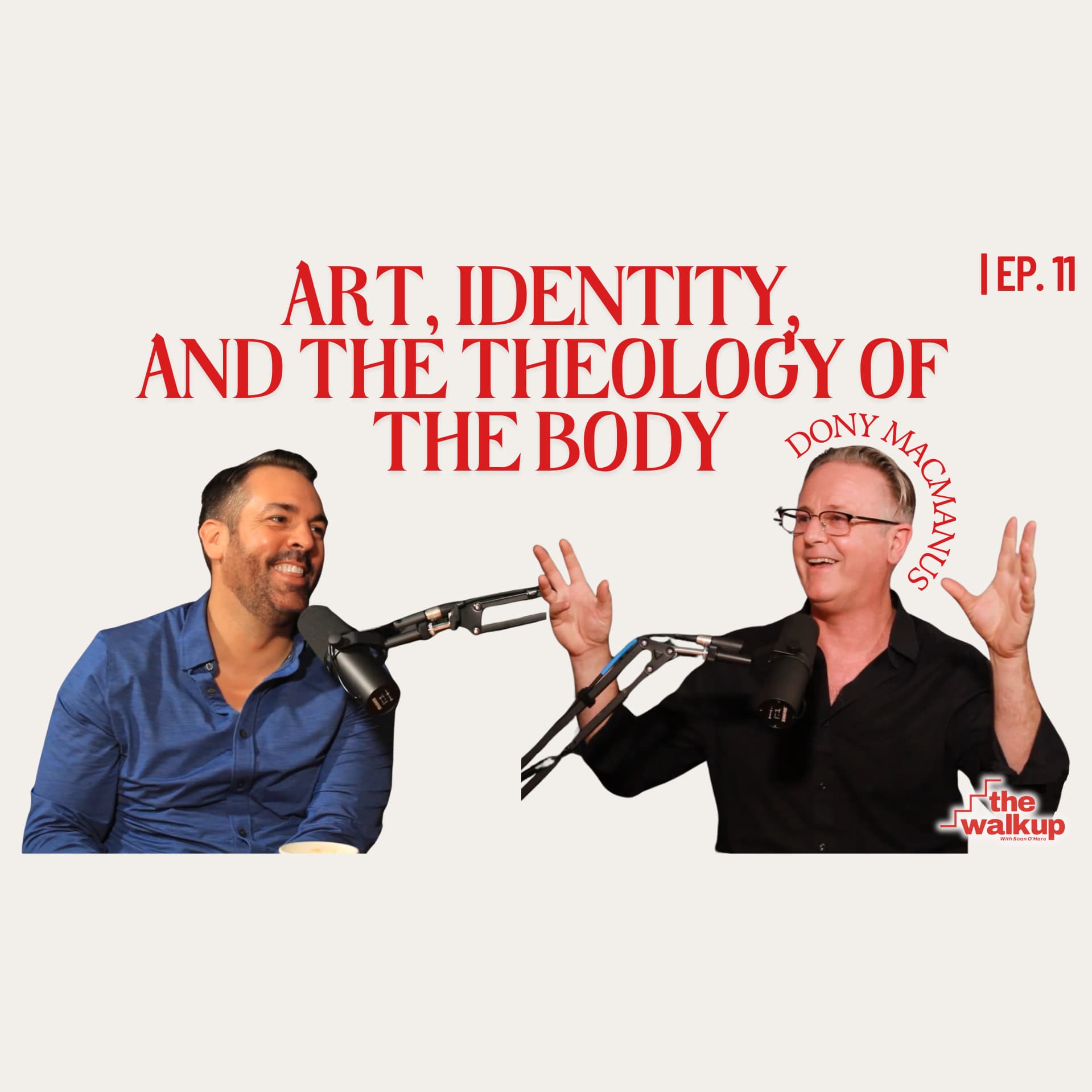
Irish sculptor and educator Dony MacManus returns to The Walkup for a sweeping conversation on artistic calling, faith, and embodiment. He shares how overcoming dyslexia and finding purpose through art transformed his life, and offers reflections on teaching, cultural renewal, and the theological power of the human body. From Pontormo to the crisis of contemporary art, this episode explores how beauty rooted in faith can redeem and reshape the world.
Transcript
Read the full transcriptAuto-generated · 18,650 words
All right, well, Donnie McManus, you are back for a second time already. You're not our first return guest. Actually, you're our first male layperson returning. We have had Friar Rick on several times. We have had my friend Arise Barr, who is a fantastic comedian and actress, but you are our first male layperson to be a return guest. My privilege. Yeah, yeah. We will get you a plaque or something so that you can bring it home and show your lovely wife, who I am sure she needs to be here for the next one.
She needs to be part of our growing audience. That could be dangerous. Do you think you would do better with her in the room? Yeah, it would be a different story, probably. So, that is actually an interesting place to start. So, you are a relatively recently married man, but that is because you had an interesting journey, right? Because you have a narrative that is...
You're complex in lots of different ways. You're an artist, a sculptor, not a lot of sculptors these days, generally speaking, perhaps what it was hundreds of years ago, and then you're a sculptor who works in the sacred arts. You're an Irishman living in the States.
You are a man who lived a celibate life for 23 years, and is now 24 years. So, I do not want to jip you that one. That last one was really good. It is like a marathon, that last one. So, there are a lot of places to start here. So, maybe we will start as kind of your vocation as an artist. So, I think people think of The sculpture and painting, and particularly the sacred art that you do, and it harkens back to a different time in a lot of ways.
So, I think giving people a... What is the purview into the life of a sculptor, and how does one become one? It is not like they are teaching sculpture classes in elementary school, or maybe they are with Play-Doh, they just don't have teachers for it, but where did it start for you? Well, I suppose my mom, she was an artist, so she was a fashion designer.
A model, and then a painter, and then she got married and had us, and then I suppose she kind of... She gave that to me, like, when I was seven, on my birthday, she gave me a bag of clay, which, to me, was a bag of mud for my birthday. I wasn't that impressed.
So, and then she kind of said, oh, she probably saw the disappointment in my face, and she started making, like, an elephant, a car, and said, wow, this is amazing stuff, you know, and I think... This isn't one thing, this is an infinite amount of things. Absolutely, yeah. So, that bag of clay became a whole world for me. So, I just take a lump out and make a different monster each day. So, I have been pretty much playing with that bag of clay for my entire life, and it has just been getting more sophisticated.
Bigger, bigger bags of clay. Were you worried? Because where do you fall in the family? I was the fourth boy, so I got all the hand-me-down clothes, I got all beaten up and bullied, and then, of course, my little sister. So, I just fell between the stools, which was great in one way, because I was kind of invisible, so I really got into a lot of trouble out on the street, but that was a very interesting way of forming myself, because I got to meet people from very different parts of life, and that helped me understand a lot about society.
Really difficult parts of life, like the struggling criminal class to the middle class. So, that was a real insight for me, and that came in very helpful later on when I was working in inner-city projects. And do you think if you were the favored child, or if you remained the youngest and had more attention on you, do you think that would have affected your...
Development as an artist? That is a good question. I suppose I found... Art was a grammar that helped me find my own place, because part of the problem was I was dyslexic, so in the 70s, a dyslexic was a thick idiot.
They didn't have that. They had other words for it, but it wasn't dyslexia. Exactly. It was the same thing. So, some teachers were pretty heavy-handed. That really, I really didn't like school, and I would try to avoid school as much as possible, so that got me involved in truancy and getting in trouble, shoplifting and all sorts of things. Because you're looking for an identity, or you're looking for approval? You want acceptance, you want your own people, and if you don't fit into the system, and everybody else is progressing faster than you, and you're falling behind in school.
Well, you want attention, and I think the main thing is that attention is the measure of love. So, if you can't get positive attention, the only other option you have is negative attention. So, I, I suppose, was just looking for negative attention, because I couldn't get it positively, and that's the trap we have to avoid, and I found out, I only discovered that when I was doing my master's in education, that, that, that's, that's... That connection between attention and love and acceptance.
Yeah. Exactly. So, I presume that is the reason I went that direction, and art actually became my means of gaining that attention, or even just communicating. So, I primarily communicate through form. That is my primary grammar. Before English or before Italian, that is my primary grammar.
So, then it starts with this bag of clay, but then you are… In your wayward youth, was the art consistent throughout, whether it was actually clay and sculpting or drawing, I imagine, was more the basis of it, but was it always there, or were there periods of time where it came and went as a primary focus for you? I suppose it was basically...
I really came back to art. It started at the age of seven, but then all those other distractions came in, and then I suppose when I had this very good teacher in high school who saw my talent and said, okay, if this kid is to be rescued, he needs to recognize his talent, and if he recognizes talent, then he might. I'd be able to focus his attention on achieving that. So when that teacher, Michael Kirk, his name, fantastic man, still alive, he...
I recognized that talent, and he told me, okay, look, if you want to get to art school, you're going to have to get through your leaving certificate examination. That means you're going to have to achieve so many honors in these subjects and so on. So, that gave me a focus. Now, I had a reason to study. And that's really, really important. So, focus. Like, if you have a lot of energy, a lot of creativity, you can be like a grenade and explode and make a mess.
You could channel that like a sniper rifle, and you can hit the point. So, you can hit a target very far away, if you have the right focus, and that is what he gave me, and I have really worked on that trajectory ever since.
So, it is interesting. You have your mom gives you... This bag of clay at seven years old, and then you have this teacher. How old were you when this teacher came into your life? I suppose I was 14, 15.
So, absent those two things, right? Yeah. I think this is, I'm getting into a bigger question about how we introduce the arts to people, right? So, I mean, we know that arts is less and less promoted in primary school, right? I mean, I don't think I was ever...
I'm encouraged to pick up a pencil and draw. I don't think I was ever, certainly wasn't given a bag of clay. I might have gone to a little bit of theater here and there. Sports was my outlet. That was a stage of sorts, but obviously, especially in an American culture, that's an easy thing to jump right into, and honestly, I just did what my older brothers did.
Had they maybe done something different, maybe I would have done that. Although, that is a lie, because my oldest brother is a very talented saxophonist, and I would see him practicing for hours and hours and hours and hours, getting the right fingering down and everything, and I was like, oh, hell no, I am not doing that. That is way too much work. So, I was like, I will just stick with soccer. It is a little simpler.
But you have these two kind of pivot points, right, that gave you an identity and a purpose. Was your mom continuing to encourage you throughout your childhood, or was she, you know, obviously running a household, she had a lot going on, but I mean, that's a, we were talking about, offline, about how The Irish culture is much more literary than it is into the visual arts, and yet here your mom introduces you to the visual arts at a young age, and then this teacher does as well.
So, how did you maintain that? That focus or that interest? Well, I suppose one way of looking at it is that it is the only thing I felt I could do. So, when you don't have that many options, you just keep a focus. So, I was kind of blessed with a limited talent. So, I just kept focusing on it, and then branched out into painting more recently. So, I loved to... I think marriage was a big part of that. Because sculpture, to me, is much more the masculine, and painting is much more feminine.
That is just from myself. And the reason I say that is because with sculpture, it is much more rhetorical, it is much more projecting. You are making a strong statement, you are moving forward with that. And then in painting, it is much more receptive. It is much more, I would just say, it is kind of like you are processing much more with painting. So, you are taking in information, you are processing it slower and more deeply, and then you have a more versatile vocabulary to work with in painting, because you have tone, texture, color, perspective.
So, you create a whole world, and I realized that, actually, when I went to look after my, when my father died, I went to look after my mom. I went back to Dublin, and I spent five years with her, trying to, because she had dementia and Alzheimer's, and so I spent that time.
Trying to help her get back to her primary grammar, which is painting, so that she could rescue her mind. And it took about two years for me to get her to put a brush on canvas, and the only way I could do that was to be painting in her presence, to inspire her. She needed that support. So, eventually, she did get to, and she did some pretty interesting stuff.
But that helped me realize there was something really interesting about that relationship with my mom and painting, and I was processing with my mother life and events, and then when I met Christine here in the States and we got married, I found all the challenges of marrying late.
About 100 years of baggage between us by the time we got married, so it is kind of like a lot of stuff to work through, and I found that painting was actually a really interesting way of doing that, and of course, it was 2020, all the nonsense that was going on. It was a very difficult time to set your… To be an artist, yeah. Yeah, and also set your roots in the United States when the place was burned down. Sure, sure, sure.
I thought it was much better in Ireland. No, no, it is even worse in many ways. So, That is how I navigate life. I navigate life through sculpture, so I am doing this monument of the moment for the Navy. It is like six, seven-foot bronzes. It is a memorial, and that is really interesting for me to work through that, and that is very masculine because it is a very clear rhetorical statement that I am making through the piece. Whereas, the paintings I'm doing at the moment are much more me processing daily life and the bigger picture.
Well, and there's a physicality to sculpture as well. Yeah, of course. There is an actual... You're literally wrestling with seven-foot figures. Yeah, I mean, you can't... there's a certain strength that's... What is required to mold and to shape? And then, obviously, if you are getting into sculpture with a hammer and a chisel, that is a whole other level of strength. Yeah, these are all cast in bronze, so you actually have to chase the bronze as well. So, there is a lot of carving of bronze and finishing.
It is heavy stuff. Yeah. So, then... So, you get this teacher that gives you a little focus and says, all right, listen, if you want to do this, if you want to be an artist, you are going to have to finish up with school to be able to pursue it further. But then, what are the options for you? Born and raised in Dublin, you are now finding a vocation or an interest as an artist, but what are the options in Ireland for you to pursue that?
Very few. I mean, as we were saying earlier on, Ireland is much more... Culturally, it is much more... A country of literature and music, and these are activities you do in a climate which is overcast, or wet, or damp, or cold, so they're kind of like fireside artistic practices, so telling stories, literature, or playing music, and they're beautiful traditions. Unfortunately, I wasn't gifted with those talents. I was more gifted in the visual end of things.
When Ireland came open in 1990, they opened the borders to the rest of Europe, and I realized I did not have to live in Ireland. I moved to the Mediterranean like that. So, had you been born 20 years earlier, you might not have had the opportunity. So, it is funny how those things happen. And then, I lived in Italy for about 12 years, and that was kind of interesting because I often talk to myself, why? Wasn't I born here? This was obviously the right place for me, but then I realized that when I thought about it a little bit more, I probably wouldn't have appreciated it if I was born here, and sometimes you have to come from outside to really recognize the gifts that are there.
Yeah, sure. Yeah, my brother and I talk about that in terms of the... The Irish and storytelling and, you know, how much your physical environment influences culture and the expression of artistic pursuits. I mean, even, you know, the, so yeah, you have the...
You're going to spend a lot of time around a fire, keeping warm, having a pint, and so of course, you're going to become a great storyteller. What else are you going to do sitting around there, right? But also, the landscape of Ireland, because of its topography and whether it has a mystical element to things, there's always been this, you know, there's the Celts, or there's a monasticism, there's a mystical quality because of the terrain itself that kind of imbued into things.
Yeah, you look at the biggest artists today in Ireland, Seamus Heaney and Van Morrison, you know, they're singers and storytellers, poets. So then you get to, but how do you get to Italy, though? You're, I mean, that's a big, this is pre-internet, right? It's not like you can research.
Great programs, you know, overseas, so how do you get yourself to Italy? And then you have to learn Italian, you have to kind of get yourself connected there. Well, first of all, I suppose I went to the Irish Academy, well, I went to the Ballyformer Senior College first out of a high school. That was a prep to get into big boy art school.
And that prep was actually much better than the art school itself. So, it was a year-long course preparing to get into art school, and it was mostly live drawing. It was for animators, mostly. So, these animators were drawing from live models.
Yeah, it is interesting. I would not connect animators with that, but obviously, if they are... When animating figures, they need to know how the body moves. Oh, yeah, super important. So, life drawing was really, really important. So, I did much more life drawing in that year than I did in the five years in art school after that, and that was the main source of formation. Five years of art school? Yeah. And the prep was one year? Yeah. That is because I was kicked out of the fine art department because I wanted to do figurative art, so like working on...
Real, live figures, figures that actually you could recognize. And they wanted to do what? They wanted me to stick Coke cans together and call it art, that kind of like relativist nonsense, and I just wasn't buying it. And that's probably because I was philosophically and theologically much more advanced in my...
The vision of life, so that informs the grammar, the beauty. So, truth, goodness, and beauty, philosophy, theology, and art. My philosophy and theology was very developed in that area, and I saw right through the BS of the art, the kind of deconstructive, you know, it was early woke stuff. So, it was more indoctrination.
...than actual artistic formation. So, it is all kind of women's studies and gender studies and all this kind of stuff. That was the main objective. And this is obviously following post-Vatican II. So, we are after the Second Vatican Council. The liturgy has changed. The visuals have changed of worship.
So, as an artist, that is going to influence things and presumably... Contemporary artistic culture. We haven't yet had the priest scandals quite hit both in Ireland and in the States, so that is before there is this probably retaliatory element towards the church of we are really going to reject everything that came before, but how do you think that influenced?
The art schools that you were a part of in Ireland. Well, unfortunately, art schools tend to be, well, they tend to be very avant-garde. They tend to be ahead of the rest of the culture with regard to its regression.
So, people call it progression, but I call it regression in the kind of C.S. Lewis sense. He talks about, like, if you are walking down the road and you are going the wrong way, if you keep going, that's not progression, that's regression. So, it really depends on the direction of the culture. If the direction of the culture is going in the wrong direction, then to be progressive is actually to be regressive. And that is really where I saw the school was going.
So, I didn't want to participate in that, and because of that, I was causing resistance. So, I was just warned by my tutor, who was actually drunk at the time. I actually had to hold him up during the critique. And he just told me that they would be letting me go. The writing is on the wall, so you want to look for another place to go.
So, I just thought, well, actually, I would be glad not to graduate from this place, because it would be a disaster. It is such a waste of time. So, I would be better off changing department. So, I changed department to the gold and silversmith department.
So, at least that way, I could do bronze casting. So, I became a goldsmith and a silversmith, and that was great because that gave me a discipline which I would never have learned even in the sculpture department. And that stands to me, because the finishing of my bronzes really depended on that craftsmanship, a bit like the work of Cellini, the great Renaissance artist, who was a silversmith and a goldsmith. And most of the Renaissance artists were artisans, artigiano, before they became artists.
So, the artist is essentially an artisan who thinks deeply. So, he takes the grammar of making. And he injects it with philosophy and theology, and that elevates it to art, and that is what the Renaissance is about. The Renaissance is the renaissance, the rebirth, so it is taking Greek and Roman culture and bringing it forward in the context of Christianity.
So, it is Christian humanism is essentially what is the motor that really made the Renaissance happen. In Italy, and that is kind of interesting if you think about it, because the Greeks were more interested in exterior beauty, the Romans, and you can see that in the architecture, and you can see it in the figurative work, but then the Romans were more interested in the interior psychology, so you can see that in the interior emphasis of the basilicas. It was all about the interior beauty, and then the sculptures are actually very psychological.
There are recognizable people with very psychological, you can see the psychological. So, the inner working is going on. You can tell there is something. In the features. There is a mind there. Yeah, so it is really, there is a great difference between the two of them, but when you bring those two cultures together, and you resurrect them in the context of Christian spirituality, you have the exterior beauty, the interior psychology, and the spirituality. Like, the full human condition comes to flourishing in the Renaissance, and that is why it was so impactful.
And that is why it brought us three or four of the greatest masters, like Michelangelo, Raphael, and... Leonardo, and so, of course, Donatello, if you want to do the turtle version, being an 80s guy. That is where I originally heard those names were not from my exploits in Italy. They were from the Ninja Turtles, yes. Exactly. So, that is why I looked to that time, and that is why I went to Florence, because I knew that was really the home of what I wanted to.
It's kind of a renaissance of the renaissance. And what I'm trying to do is address the cultural crisis we're in, because we're really at the end of a culture, as far as I can see, that everything's imploding. And I'm just thinking, right, if everything's imploding and we're in cultural freefall, what's the best thing I can do at my stage?
One thing is I have invested my entire life in my faith and in my culture. That is essentially cult, culture, politics. That is the hierarchy I see. And if you think about it anatomically, the head is cult, culture. Cult is like religion, faith. And what we worship, yeah. Exactly, what we worship. And then the neck is culture, the transition between, and then the body, politics.
That is how I understand the world, anatomically. So, I think what is really needed is, if we want the culture and the politics to be healthy, it has to have a healthy cult. So, what is the cult? If the cult is...
If it is Hollywood, if it is sports, if it is pornography, it is going to bring the culture in a particular direction. But if the cult is love in its fullest sense, which I see as Christ, then that is going to penetrate the culture and the politics in a very powerful way. I think one of the big problems with Western culture is that we have lost... Our orientation towards what is really most important, which is love, which is Christ.
So, the way I wanted to address that, like I did it through, I founded a school in Ireland, the Irish Academy of Figurative Art, to kind of reconstruct the artistic discipline, because it is so deconstructed through post-modernism. And once that was constructed, then I felt the need to put it, to bring it to the next level of understanding. So, what I did was I actually started, I went to Florence, and I was given Beato Angelico's studio, the saint artist, Beato Angelico, Fran Angelico, probably known for art history.
And having his studio for two years, a number of my students actually converted, six of them converted. Catholicism. Because, like one of them, Osamu from Japan, for instance, after he was baptized in the Duomo by the Archbishop, as we were coming out, I asked him, what made you want to be Catholic? And he said, well, it was actually that five-minute demonstration you gave me, analyzing a Pontormo drawing in a scientific reductionist manner. Which revealed the actual... It separated the water from the oil with regard to artistic practice, because Pontormo's drawings are very...
Right. So, you can see this is anatomically correct, but he abstracts them to communicate deeper supernatural realities. And you can see this from, on the page, on my web page, www.donnyrockmanis.com, you see the first page, you'll see my studio and Fra Angelico's studio, and you'll see these drawings on the walls and you'll understand what I'm talking about. Basically, what Pontormo did was, did these mystical images of, the drawing in particular I was studying from The Uffizi, the Cabinet of Designs, I enlarged that drawing of Angel Gabriel to two meters tall, and then I pulled, I put a transparency on top of it and pulled out the bone structure, so as to analyze it in a scientific reductionist way, and by doing that, you could see very clearly how he abstracted the ribcage, so the ribcage is twice.
Yes, exactly. So, what happens next is that we are going to get to the end of the show, and we are going to get to the end of the show, and we are going to get to the end of the The next layer of abstraction was put another transparency on top of that, and then I pulled out the muscle structure, and there you can see how he abstracts the muscle structure to communicate the grace and movement of the figure.
Yes, and it illustrates how the figure is also dancing with joy. There is a beautiful movement and rhythm within the figure. And then the next level, another transparency on top of that, and then pulled out the drapery, and you see how the drapery is not just drooping with gravity, but it is actually billowing with the wind of the Holy Spirit. So, every layer of grammar that Pontormo was using was abstracted with a supernatural intent.
And this all happens subconsciously, and this was mind-blowing to me as a discovery. I was inspired once I got Beato Angelico Studios. The first thing I did, the first two weeks. was to do this because I'd never had a studio space like that before and I was just inspired to do this and this has transformed a whole generation of artists because they've understood through enlightenment, scientific reductionist grammar to actually analyze a sacred image and what you're doing is you're separating the oil from the water and that is something once you see it, it's hard to ignore.
A bit like theology of the body. Once you understand the theology of the body, it is very hard to ignore and deny it, because it is in your body. So, when Osama was coming out of the Duomo, he said, Well, once I heard that five-minute demonstration, I couldn't turn back. I had to become Catholic in order to really penetrate the depths of my humanity, and for that to emerge. And essentially, art is essentially the overflow of the interior life of the artist.
So, if anything was to overflow in his life, he wanted it to be healthy and positive, and bring the culture forward. And that's why he wanted to become Catholic, so he could... Enter into the full mystery of the faith, and to receive Christ in the most intimate way through the Eucharist.
Yes, I mean, there is obviously a lot to unpack there, and I think I am always conscious of How somebody who doesn't come from the language that we share in terms of our faith, in terms of church history, in terms of theology, how they might analyze what you just described there. In terms of how you're pursuing your own art, how you want to use your art form to create cultural artifacts, not as a resistance, but as a contrast to what... The contemporary society is trying to promote or suggest.
But then, to make a statement like, my student from Japan converted because of a five-minute... ...or decided to convert because of five-minute description of a piece of art, and specifically wanted to become Catholic. I can imagine a lot of people looking at that going, whoa, whoa, whoa. I mean, I got these issues with like, okay, they don't allow women to be priests, they're teaching on contraception and abortion, and this guy's going to say a five-minute thing about a piece of art and go, hey, I got to be Catholic.
Like, that's a... It's a heck of a thing, right? And I think we tend to be very... I would say intellectual, but we tend to kind of look at the doctrinal components of something, and then see which thing I disagree with as a reason not to take the whole, right? Yeah. So, I can agree with 80% of the Catholic Church's positions, but if there's 10 or 20% I don't like, then that's my reason not to go in for the whole thing.
Whereas this guy is saying, see something for five minutes, which communicates a much deeper reality, and he's like, I got to go all in. So. How does a non-religious person, a non-Christian person, understand that... What was the student's name? Osamu. Samuel. Osamu. Osamu, sorry. Osamu. Osamu. Yeah. Got it, right. That Irish accent. I was like, this guy's named Samuel? That doesn't seem right.
Yeah, let us try to get to that, because you are communicating a lot by that, that the visual arts, that visual arts done in a certain way, communicate a reality, not just about ourselves, but reveal the nature of God and invite somebody to want to, not just...
Communicate or want to go a step further in that conversation, but then to specifically find themselves in a particular religion. That is a lot going on there. So, why does that, in your mind, not make sense, but why is that something that is plausible? Well, I suppose, in a way, the most important thing is that I... I prefer the concept of an artist who is Catholic than a Catholic artist, and the reason I say that is because I love art. That is why I make art.
I don't make art to propagandize or to convince people of anything. I make art because I love art, and my love of art and my love of my faith, the faith, because it is the deepest love I have, overflows naturally into the art form, and that is what brought me to actually make that experiment with the Pontormo drawing. I had no idea what I was doing. I was taking my New York Academy Scientific reductionist training and bringing it to a sacred artwork, but I had no idea I would discover what I discovered.
There were different layers and coding, almost, in there. Exactly. So, that was just purely experimental, and it shocked me more than it shocked anybody, because it is kind of the same feeling when you are working on a piece and, like...
These beautiful inspirations come through, and you say, wow, or like at the end of the day, you look at the piece and say, oh my God, that came through me, you know? That is a very humbling experience, and this was a bit like that, but it was much more an experimental thing rather than a commissioned artwork. So, I think that is one of the reasons.
Why it affected me so much, but then with Osamu, like Osamu was the first person to say it, like he came to Florence from Japan to study art restoration. And what he wanted to do was restore these great sacred works of art, but he says that it is ironic that it is actually the sacred art that restored him. So, it is this kind of Christian judo that can be very difficult for people to understand, that there are so many contradictions in the faith.
I mean, virgin mother, there is like, you know, transubstantiation, there are so many really challenging... Or just the... The human frailty of the church on a day-to-day basis, right? Oh, just like the craziness of a 2,000-year-old institution that is just impossible to destroy. Like, even when Napoleon said, I will destroy your church, and the bishop of Paris said, well, good luck, we have been trying for years.
So, it is indestructible. So, that is why it is such a mystery, and it can be very frustrating at times. Because there are so many dysfunctions in the church. And you are trying to help people to recognize the necessity for architecture and art as grammar. One of the big problems we are dealing with is this kind of post-modern idea, like everything is so deconstructed and nothing means anything anymore.
And when you bring that to art and architecture, if art and architecture doesn't mean anything, then it is a useless grammar. But the problem is, art and architecture... Architecture does, they are grammars, they do speak, and if you don't understand it, then you very easily speak error, you very easily speak heresies, and those heresies are basically ugliness. So, that is why we have so much ugly art today, and so many ugly buildings, is because there is no belief in the human condition and objective truth.
So, how can there be beauty if there is no truth? Well, what's interesting, though, is that people, in one respect, the art that is funded and celebrated And this kind of postmodernist expression is in contrast or in contradiction to the fact that people vote with their feet, and they go to Paris, and they go to Rome, and they go to Florence, and they go to where the great works are. Those are the ones that are flooded with people. They are not going to see the more postmodern examples of architecture and art.
When there are protests, they are trying to throw paint on the Mona Lisa. They are not trying to throw it on, God bless Andy Warhol, but they are not putting it on a Warhol piece. If you want attention, you attack what is greatest. If you are a lesser being, the best thing is to take down what is great, and that is why they are taking down all these monuments to these great people.
Because people feel... Challenge. That is why, you remember the Taliban, the first thing they did when they got into Afghanistan was blow up the sacred monuments, because they feel threatened by the beauty of these monuments. Beauty scares the daylights out of some people, because it has a power, and that power essentially is truth and goodness. It is the truth and goodness that... That inspires the beauty. The three transcendentals are always together. Truth, goodness, and beauty. Philosophy, theology, and art. They are always manifest together.
So, if you create something beautiful, you will be... A target. And I think one of the reasons I focus on sacred art more than anything is because sacred art is like the synthesis. It is that drop of Indian ink that penetrates the glass of water. It penetrates every part of the culture. So, if you want to understand Aztec culture, Egyptian culture, or any culture, you go to their sacred, and the sacred is that synthesis. So, if I want to resurrect... Western culture, as best I can, the best thing I can do is really penetrate the depths of its sacred art, and teach that to the next generation, so that if you teach them at the highest level of training, then that will affect how they do sacred art, will affect how they do portraits, how they do landscapes, how they do still lifes, all the way down the feeding chain.
Well, what is interesting, too, is you and I have... Both had the privilege, when I was working with the Vatican Library, that we got to visit and go into the Vatican Apostolic Library, and I think what most people found confounding about the collections there is that they naturally would presume, well, it is probably all...
You know, books related to Catholicism. It is going to be theology and philosophy books, but you get in there and there are books on astronomy, astrology even. We saw Aztec manuscripts, you know, and pre-Christian or pre, you know, works that, why would they have these things, right? And it is because there is a, hopefully there are We, as a church, are not intimidated by other expressions trying to reach out and find beauty or find God, even if it is a partial understanding, right?
And we can recognize the goodness in, as we know, with Aquinas. Aquinas was studying Aristotle and Plato and saw where they were going with some of their pursuit of truth. It was not all the way there because it was in... Didn't have the opportunity necessarily to be Christ-centered, right, but there are these expressions that are part of the puzzle, and we should not be intimidated by them, but want to study them and incorporate them, but ultimately elevate it to what you're suggesting is the sacred arts.
So, I wonder, because now we always look at the Renaissance, right, because of this expression of... Christian humanism, right, our response to the Protestant separation, where there was a lot of destruction of images, right, this rejection of visuals, particularly in churches, but how do we understand the artists themselves in that time period? They weren't saints, right? So, or maybe some of them were saintly, but how do we understand the personal sanctity of somebody and their ability to express deep, sacred truths right through their art?
So, like, I think of when I was in Malta, I got to see Caravaggios, and he was in Malta because he was on the run. From having murdered somebody, and yet he creates one of the most profound works of art, communicating these eternal truths. How come this guy was incredibly flawed? So, it is a long way of getting to the question of, did we have this expression of such a prodigious period of time?
In the visual arts, because the culture was there, and they were, even if they themselves were not personally holy or disciplined in their own behavior, but they were imbued with beauty, or they were imbued with liturgy, or they were around things that allowed them to then use their...
Their artistic gifts to then express deeper truths. Does that make sense? Yeah, I suppose the environment is very, very important. I mean, let's say 1600s Rome, where Caravaggio was dominant. But we also had the Borgia Popes around the same time, so we are not talking about some time of perfection at all.
But I suppose there was a certain... Well, just even on the artistic level, this is... It's just 100 years after the Renaissance, so there was this elevation of the artistic discipline and the artistic practice, and there was a lot of competition, healthy competition.
Renaissance Rivals is a very good book on this. It illustrates the conflicts between the artists, but there was a professional competition, so there was a very high level of... So, what I mean by that is, like, if I was to do your portrait, I need to know bone structure, muscle structure, anatomy, and all that. There was an apprenticeship model.
Yeah, so there was a fluidity that was in their grammar. So, that is on the professional level. And then on the spiritual level, we were, like, counter-reformational period. So, you have the... The founding of the Jesuits, the Chiesa Nuova, the Carmelites renewal, so you have a tremendous, tremendous scandals within the church, but also tremendous saints, so every time that there are scandals, there are saints that counteract it, so where evil abounds, grace abounds all the more, and so in the words of St.
Paul. So, that is what is happening there, so there is a lot of drama, there is a lot of carascura, as Caravaggio would. Incorporate into his paintings the dark and light contrast, which enhances the drama of the work. So, that is what is going on there, and of course, Caravaggio reinvented the whole imagery. He takes this kind of classical Renaissance idea.
From the Karachis, who are Bolognese-based artists, and he just... They made the pasta sauce. That is it. They are the guys. So, the unbelievable reinvention of the visual language. So, what Caravaggio does is he basically turns up the contrast of dark and light. He pulls the figures right up to the picture plane, so you are right in the action. You are a participation. You can always smell. The people in the painting. So, visceral. It's really visceral. And that reflects his personality.
He was a very visceral guy. A little violent at times. Actually, most of the records for his autobiography, his biographies, were taken from Carabinieri, the police records. So, that's how we knew where he was. Because he was a comedian. A comedian crime everywhere was. So, essentially, that is the kind of environment that these works were made, and Caravaggio is a fascinating character in that he has this fallen nature, but he is aspiring to the divine. He is always struggling, and that struggle is represented in his paintings very much by making himself, a lot of artists put themselves in their work, and they are usually looking out of the work at the viewer to draw you in.
That is kind of a technique. That artist used. But Caravaggio goes that bit further. He always puts himself in the position of the bad guy in the painting. So, for instance, he is the assassin in the assassination of St. Matthew, while he is saying Mass.
Then he is Goliath in David and Goliath, for instance. It was actually that painting he was bringing, that was his penitential painting he was bringing back to Rome. uh for his part to to accept his pardon for the murder of of that guy so that that's how he died he died on the way back from malta after becoming a knight of malta he got his pardon his papal pardon he was returning to rome and as he was returning to rome he was stopped in naples because they didn't believe that he had been pardoned because they didn't have internet at the time so they had to research and while he was in prison there he got a fever and then when he was released he was walking ...back to Rome along the beaches of the Mediterranean, and he actually died on the way back.
And he was bringing that painting of David and Goliath as his penitential picture. So, it is pretty dramatic, you know? That is right. Nobody has made this into a movie. Oh, actually, I think it might be a movie at this stage. It sounds like it needs to be one. But it is a fascinating story. But that is a complete contrast to what we are dealing with now.
Father Rupnik, I mean, he is a different, he is the guy who does those mosaics, but his work comes from, essentially, demonic activity. Okay, so that is an interesting contrast. So, we have the case of someone like Garbagio, who is not... A complicated man at a moral level, right? Yeah. Flawed, perhaps penitent, sounds like maybe he was trying to make amends, but certainly different periods of his life, committing crimes and so forth, and yet able to produce extraordinary works of beauty that convey a deep metaphysical truth, right?
And then you have Father Repnick, a priest, right? So, already... You know, clergy would have gone through formation, would have gone through seminary, would have gone through all of those things. And so, why is it different that we have this flawed Caravaggio, immoral in some of his own dealings, yet creating beautiful works of art that we now will look at for the rest of time? And then Father Rupnik, who created mosaics.
That are now covered up. Recently, the Knights of Columbus made that decision that at the St. John Paul II Cultural Center in D.C., that his mosaics, which are all throughout that building. will now be covered. So, how do we understand those two? Why is he different than Caravaggio? Well, the John Paul II Secretary of Shrine actually has covered all the figurative work. I was there recently, and thank God for that, because they are admitting there is a problem.
And that is because this priest abused many nuns, sexually, and using There are very scandalous, satanic rites using sacred vessels, and you just don't want to go with it. It is totally satanic. I was approached by the Italians when I founded the Sacred Art School in Florence.
Due to the request of the Cardinal. Of course, the Cardinal requested, so there was a lot of interest that came in. The Chamber of Commerce, the Bank of Florence all flooded in to help us out. And at that stage, I was under a lot of pressure from people in Italy to approach Rupnik to teach. He is already a well-known figure. Oh, yeah. Conasciutti, as the Italians say. Very well known. Where was he based? He was based in Rome, and he had his own...
Operation there still has Aletti Studios, which is basically a mosaic studios, and that is where a lot of this abuse occurred. He had his nuns working for him, and he would take advantage of them in satanic practices. How was it revealed, ultimately?
How it was revealed? I think these nuns came out and had a press conference about it. So, the scandal really is that he still, he was excommunicated, but he was released from that excommunication very shortly afterwards, within a month, by Pope Francis. So, very unusual situation there.
And he is still a priest in good standing. He was expelled from the Jesuits. That is a thing in itself, to be expelled from the Jesuits. And then he returned to his diocese in Slovakia, I think it is, and then he was retained as a priest. And now he is back in Rome, walking around, producing his art, as if nothing happened. And so, this is, I think, this is the greatest. A scandal in the church today that a priest who has committed these atrocities is still a priest in good standing.
So let me ask this. Would I understand, not being an artist, being somebody that appreciates art, but simply as a consumer, as an audience, right? Would I go and see his mosaics and be misled? Would there be untruths that he is communicating in his art itself, or is it the fact that this person who has committed these grave and serious sins, who has been excommunicated and probably should still be, also created these works? Are the works themselves?
Why is Rupnik compromised? Because he is a person, or they compromise in and of themselves? And I am saying that because Caravaggio is a complex guy, yet we have no problem with looking at his art. Why is Rupnik different? Well, essentially, when I was approached by these Italians to have him in the school, I just saw his work, and I just didn't want this guy anywhere near my students.
His work is so ugly. I mean, it is objectively really ugly work, and it has no redeeming quality whatsoever in it, but there is something. I suppose I had a basic faith and art instinct that I could read.
Because I produce sacred art, and I'm very versed in faith and the artistic practice, I just got a really bad vibe from his work, and I just didn't want him to have anything to do with the school. And thank God I didn't, because God knows what he would do.
The students I had. So, it is quite different to Caravaggio. Caravaggio was a fallen artist who was aspiring to the divine, and he was trying, and sometimes very trying. But there was that search and that struggle, whereas in Rupnik's work, his work comes from.
This practice, like, the source of his practice is this, this, say, Well, and also, obviously, the, the, the responsibility of, of, of Of an ordained priest is much higher. Of course. That is just categorically different. And using the seal of confession, abusing that to forgive the sins of those people you just committed sins with. I mean, it is an absolute scandal beyond belief.
Yeah, so then why did he gain traction in the first place? If the art was Middling. Is it because we're just... He was charming? Was it because he was just in search of promoting something that's kind of mediocre these days in the church, in terms of artwork? Well, it doesn't surprise me in the slightest that a guy like him could actually make inroads in the world and in the church, because the contemporary art world is so controlled by the critics and by the galleries.
New York here is a perfect example of it, that there is no power in the hands of the artist. What I mean by that is that is the reason I teach my artists the highest level of grammar, artistic grammar, so that they are empowered, and that their artwork is of great substance, both philosophically, theologically, and artistically, that no one can tell them whether their work is good or bad. It is what it is. It has a power within it. It doesn't need a critique or a gallery to give it a benediction, okay?
So, the problem is that the art world is so corrupt, and it's all under the power of the New York Times and the New York Galleries, for instance, in this context. So, just a quick aside, I remember... I moved to New York 12 years ago, and you go to the art galleries in Chelsea. I think it is usually on Thursday nights or something.
They offer free wine. You can go to all the galleries, and I remember I went there with a number of artistic friends, just New Yorker, not Catholic friends, just artistic New Yorkers, and we went to every gallery, and every gallery would be like, oh, this stuff is terrible. Oh, they hate that, and they critique everything, and I said, we got to the end that I am like.
Did you guys like anything? Yeah. And they're like, no. And I'm like, don't you think that's a problem? I'm like, I'm not an art critic. I'm not an artist. I just respond to what I see, and I'm not responding to anything here. And you guys are in this space. You're artists, and you're all saying, all of this is crap. How is it that we're at the mecca?
Or the center of art and finance in New York City, we walk around the place to be at the Chelsea Art Galleries, and you're all saying, eh, none of this is very good. I understand that completely. How are we there? I did a three-month experiment with the Chelsea art movement. I spent three months going every weekend to those galleries.
Combed every gallery, every weekend for three months, and there were only three pieces of all that time that mildly, like just singular works of art that had maybe a little bit of technique in it that was interesting, but the rest of it was complete and utter junk, and most of it was worse than junk.
Because art is the overflow of the interior life of the artist, and a lot of the artists that are drawn into these galleries, and I am not saying a lot of the artists have this problem, but the ones that are selected tend to be the most corrupt and the most shocking.
So, it is about being transgressive, it is about being… Exactly. So, they are elevating the most transgressive, the most corrupt, the most sick. Because they are the ones that get the attention and get the headlines. That draws media attention. It's much easier to shock, draw in the media than to have a really accomplished artist produce something beautiful. Because it's a bit like, I suppose, you only hear about the planes that crash at JFK, not the ones that land. So, in a way the art gallery works in the same way.
You want a few plane crashes. To draw in the attention into the gallery. And also this notion that we are not supposed to know what these things mean, right? I think that is always, I know it can be very simplistic, but you walk me through a Caravaggio, and you can tell me, well... You know, this posture, they're trying to express this, this expression on the face, the choice of the clothing, the setting is communicating this, and I remember I was at one of these art galleries, and it turned out this wasn't on one of the gallery shows, it was just I popped in, turned out the artist was there, and I said, oh, that's really interesting, so what were you going for here?
She refused to answer. Yeah. No, I'm just trying to understand what you were going for, because clearly I don't get it by what's been depicted here. And she's like, well, what does it mean to you? It's gaslighting. What do you mean?
You painted it. I'm assuming you had something in mind, but you put a $50,000 price tag on that. Everyone goes, oh, I guess it is worth a lot, according to a very particular elite. So, this is the contrast with what we were talking about, about the Renaissance, or shortly after the Renaissance with Caravaggio.
Is the ability for he, being a flawed guy, yet able to create these works that will stand the test of time, versus New York City? They're all the same elements, right? Because if you think of Rome at the time, the other piece, the other components of this that I wanted to point out was, the other piece that was important there was patronage. Yeah. The church was patronizing the arts. They were putting money into it. Obviously, we have the building of St.
Peter's in its current form, and just churches going up left and right, which you can be walking on Rome. In the smallest little cobblestone street, turn the corner, and all of a sudden, you're looking in, and this church that would be the, which would, in a thousand other cities, would be their jewel, is just on a random alley down the street in Rome, right?
So, it's able to create all of that. Here in New York, we have... We have a support of the arts, we have education, we have access to knowledge and training, and certainly patronage. And yet, what we're creating seems as if it won't, it's not unlikely to stand the test of time, is that simply one was imbued with Christian humanism, and today we're imbued with kind of just a... Kind of transgressive culture that is just looking to shock? I mean, is it that simple, or is there more to it?
Yeah, I suppose it brings us back to where we started with the cult, culture, politics. I mean, if our cult is... Pornography, or hedonism, or if that is what motivates the artistic elite, or Hollywood, well, that is what is going to penetrate the culture and transform the culture. I suppose one of the frustrating things for me as an artist.
Coming from Europe and interested in conserving the culture, is to see conservatives over here focus a lot on religion, cult, and on politics, but completely dropping the ball with culture. So, what they are doing is they concentrate on the religion, the cult, and on the body politics, but they completely decapitate themselves by letting the left take over the culture. So, as a Christian conservative artist, I am trying to recreate that neck so that we can get a clear flow of faith through to the politics, through culture.
It is so frustrating to be dealing with contemporary conservatives in the United States. To help them realise that you must engage in culture, and that is what I am here to do, that is what you are doing, that is why what we are doing here is really important, is to help people who are really concerned about the direction of the country to realise that the culture needs to be rescued, because the left control everything. They control the media, they control the academy, the universities, they control entertainment, they control music, they control absolutely everything, and we need to...
Redeem that, and the best way to do that is not through propaganda, and that is what I mean, not by being a Catholic artist, but an artist who is Catholic, a podcaster who is Catholic. You must love your medium. You must love your art form, and that has to be very, very honest, and people can see that because... If you are authentically in love with your medium, people absorb that, and they fall in love with your work, and in the words of Ratzinger, in his funeral to Giussani, he talked about beauty having the power to penetrate the heart, and to bring with it truth and goodness.
Well, it still gives shivers down my spine. Ratzinger has an ability to put in one sentence a whole vocation, and that is the vocation of the artist, is to break people's heart with beauty and bring with it truth and goodness. Yes, and that is the thing that Ratzinger, for those that do not know, Ratzinger referenced Cardinal Ratzinger, who became Pope Benedict XVI.
He's very, he's noted for saying that the two greatest apologies, or the two greatest proofs of our Catholic faith are beauty and the saints. And again, I think people from an outsider perspective going, so the Catholic Church would say the best way that I know this thing has merit is not So, Aquinas, not a list of doctrines, not the fact that it stood 2,000 years despite all of its flaws. It's beauty, which obviously beauty has to take a physical form, right, or a form that we can consume in terms of whether it's music or architecture or the visual arts.
And then the saints. And so, I think it's good to unpack that for... For a broader audience. So, why are those the two greatest expressions of the church? Well, in a way, if you think about it, even through the trajectory of this conversation, I talked about Beato Angelico. Being given Beato Angelico's studio was such a miracle, because he was the first canonized, well, beatified artist. So, officially beatified by John Paul II in 1984. He came to Florence for that. So, to have his studio.
And to practice in that studio, and for these miracles to happen, like there were six converts in his studio alone within two years, and then 14 since then. It is the power of that art that makes it happen. So, the beauty of...
Teaching art in the context of the sacred, in the context of holiness, is really, really important. So, I have been doing this in the Irish Academy of Figurative Art, which I founded in 2004, Sacred Art School of Firenze, which I founded in 2011, and the work I have been doing with the CUA in Catholic University in D.C. was the whole idea of actually bringing this search for holiness.
In tandem with artistic practice. I want to give the artists and empower them with the greatest level of grammar and understanding so that they can actually study the great masters. So, a lot of this I do through the National Gallery in D.C., where I teach them how to draw by drawing the sculptures, get them to analyze the drawings through using those transparencies to pull out the bone structure, pull out the muscle structure, and then go back and draw the same sculpture again with not just a perceptual...
Understanding, but a conceptual understanding, because you perceive much more when you conceive more. So, if you are conscious that, if you are drawing a hand, It's a good example. If you're drawing your hand, and this is a good practice for anybody who's serious about this, draw your hand first, then put a transparency on top of the drawing, and then pull out the bone structure with an anatomical text or a skeleton, if you have one, and then put a transparency on top of that, pull out the muscle structure, and then draw the hand again.
And when you draw the hand again, you will perceive much more because you conceive much more, because you know the bones and muscles are there, so you start to look for them. So, that enhancing of the grammar and really empowering the artists in that way to penetrate their humanity is really, really important. And I do that in the context of art history. So, I will bring them to room one in the National Gallery, because the National Gallery in D.C. is fantastic for this.
You have a great selection of paintings, and it is all in chronological order. So, you start in the 12th century, and you work all the way to the 18th century, 19th century. In the first room, you have one half, they are all icons, the Byzantine icons, and the other half are Giotto and Duccio and the early paintings of the Renaissance. So, you are going from that two-dimensional to three-dimensional? Exactly. It is interesting to say two-dimensional, because it is actually a fourth dimension, because these Byzantine painters look flat to us because of our understanding of the world, because we have enlightenment understanding, inverted commas, and what I mean by that is we think of three dimensions because we are sons of the Renaissance, but what is happening there is what those artists are painting is actually the fourth dimension.
It is the eschatological dimension. It is the They are penetrating the fourth dimension, which is the sacred. But that is to give it its due. We tend to see those artists as naive and not understanding anatomy, but actually, they are way more advanced than they are supernaturally. Now, because they are focusing on the divinity of God, that is why they paint the way they do. So, you have the flat.
...gold background, which actually represents heaven. Then the anatomy is all abstracted to communicate supernatural realities. So, you have a big head, because it is like the sanctity of the person. You have big ears, because they are listening, and big eyes, because they are paying attention, and small mouth, because they are not speaking, they are silent. So, every aspect of their anatomy is communicating supernatural realities.
Also, you notice that the light in these compositions emanate from the body of the sacred person. So, the Madonna and Child, wherever the drapery touches the flesh, it is gold gilt. So, the light is emanating from the sacred figure.
So, the first thing I do in those tours is illustrate this to this question, what do you see? And they see these things, and I unpack them and their significance, and then I introduce them to Giotto across the way. So, okay, look at Giotto. What does he do? Oh, he's got real anatomy. Real anatomy. He's got scientific reductionist anatomy. You can see there's bones and muscles. You can see that there is perspective.
There is a linear perspective. You can see there is also natural light, that the figures are revealed with natural light, and you can also see human intimacy, like the Christ child grabbing the thumb or the finger of the Virgin, for instance, and there is that intimacy there.
What I do there is I illustrate how the transition was made, and that transition is the fundamental difference, and this goes right to your point about sanctity and art. What really transformed Western culture was not an artist, but a saint. St. Francis of Assisi, okay? How so? Because what St. Francis of Assisi did was basically bring Christ's humanity to the fore. He basically gave birth to Western culture. I don't think I've ever heard that said before. I know, it's the Christian context.
So, what Francis did was basically, he changed the... I mean, is this a common understanding among scholars? Not that common, unfortunately. Among Christian scholars, even? Well, Timothy Verdon is very good on this. He is actually an art historian from New Jersey who became a priest, and now a canon in the cathedral in Florence, and he now runs the Opera del Duomo di Firenze. So, he runs the museum there. He did a magnificent job. A priest from New Jersey? A priest from New Jersey.
Well, an art historian who became a priest. He was ordained in the 90s. He runs the Duomo in Florence. He runs the Opera del Duomo, the Museum of the Duomo, and he did a magnificent piece, but what is central to this is that St. Francis of Assisi is ground zero of Western culture. Why? Because he brought our focus from the divinity of God, which is perfectly valid. To the humanity of God, of Christ in particular. So, what he is doing there is that he invents the presepe, the crib figures.
He invents the via crucis, the way of the cross, as devotional practices. He invents Christo sufferens, Christ's suffering on the cross, okay? These are all Franciscan. And if you think about it, he is the first saint to receive the stigmata.
Like, he caused a lot of scandal. He was not the first saint. The very first thing. Until the 12th century? Exactly. And St. Catherine of Siena, very close after that. What was God waiting for? Well, you can see God understood church politics, because once he gave it to the Franciscans, he was on it for the Dominicans, very rapidly. So, St. Catherine of Siena was next, very shortly after. So, because he had such deep devotion to Christ. He actually received the stigmata, and that understanding transformed the church.
He saved the church. He did what Luther could have done in trying to clean up the church. If he did it within the church, it would have worked, like St. Francis, but unfortunately, he destroyed a lot of lives and saints by doing that. So, by being such a witness, he influenced the two greatest starters of his time.
Dante in literature and Giotto in art, okay? They are the fathers of Western literature and Western art. But he influenced them how? By his being. Now, this is the extraordinary thing. This is why being a saint is the most important thing, and this is how I finish my presentations and lecture series with anybody, because everybody is going, oh, the art is really interesting and beautiful. I'd love to be able to participate in that. Okay, I turn the whole conversation and say, look, the most important work of art.
Is the work of art that God wants to make of your soul. Each and every one of us in this room, in this auditorium, We can be the most precious and beautiful saint that ever existed. We can be better than St. Francis of Assisi if we let the Eucharist transform us. So, we have that capacity. We are sitting on absolute dynamite if we really enter into the mystery of our faith.
So, yeah, that connects the two, which is that... The fullest expression of beauty, right, is so God makes us in his own image and likeness, and then by becoming as Christ-like as we can, to be perfect as your Heavenly Father is perfect, is the fullest expression of beauty, although we don't necessarily see it that way, right? I mean, because sometimes saints are not.
The easiest to be around. Yeah. Because they can be very... Abrasive. Abrasive and honest because they're not worried about the approval of the world. They're not necessarily concerned with... Christ was abrasive and honest. Well, this is a good point. Yeah. So, I mean, yeah. And I think these are the examples of...
We think of, and this is part of what I hope to accomplish with this podcast platform, and then even in the original TV series content that I'm developing, is sanctity is not boring. I think there's this notion that to be holy is to be...
To be restricted, to be confined, to be repressed even, right? As opposed to it being the fullest expression of the human experience. So, as you know, I was just in India a few months ago, and I had Father Don Bosco Darcy on our podcast recently talking about his experiences there.
The work that he and his brother priests and the nuns that are really the backbone of that diocese, 900 nuns, only 150 priests, 900 nuns are really the ones keeping things going there in that diocese, they are not boring. I mean, they are dealing with humanity in every facet, and they are not... Afraid of it. They're not afraid of the suffering. They're not afraid of the ugly parts, but there's not this patina of what the good life is or what happiness is.
It's joy, but joy in a way that is realized through the fullness of the human experience that includes suffering. Not one that only wants to enjoy, I don't know, a comfortable living, and nice things, and good friends, and good wine, and whatever else, that somehow that would fulfill us, right? It's a weird experience to be in an orphanage with...
There are nuns who are taking care of orphans who are disabled, who are discarded by their parents, by whomever, maybe by the state. So, severely disabled children who are living with... So, nuns who have given their lives to celibacy, they made vows of poverty, chastity, and obedience, you would think this would be the weirdest environment to walk into, and yet, it was just filled with joy. Yeah, and I can understand that from my own experience.
Well, I was working with the inner city while I was in New York. I was working with the homeless on Friday nights and the kids in the Bronx for Saturdays, and by doing that, it helps keep a check on yourself. You don't get lost in the whole.
Tribeca, Soho, Art World, and everything is so self-indulgent, but you need that anchoring in real suffering to keep you attached, and it helps you get out of yourself, and it is no accident that these nuns, they were nuns that were doing this, because if you can forget about yourself, other people become really, really interesting. Yes, yes. Because you see Christ in them. You see their lives as adventures in which you can participate and you can make it better, and of course, if you can forget yourself, life becomes so much more interesting.
But that is the trick of it, or the drama, and the challenge is that, as we say as Christians, to die to yourself, right? I was at this filmmaker's retreat for Christian filmmakers, which I'm not a filmmaker, but like most things I'm involved in, I'm often the one guy that doesn't actually fit the criteria, but there I am anyways.
And there was a guy who caught up and spoke at the end of the filmmaker's retreat and said, you know, we talk about dying to ourselves, but I feel like we lose our own identity as artists in the process. And I thought.
This guy's missed the point. Dying to yourself is not diminishing yourself. It's to fully realize what Christ wants in you, and that might mean... Being, quote-unquote, being smaller in some ways, right? But like the paintings you talk about, being radiant allows for others to shine, for others to be brought into that glow that is not yours, right? It is not you. It is a received thing that you are pushing out. Exactly, your conduit. Essentially, your conduit of the spirit. That is why humility is really, really important.
And part of that humility is maximizing your grammar, being as articulate as possible. Always creating, always being in the studio, ready to work, 9 to 5, whatever it is, and you don't just sit around and wait for inspiration.
The Holy Spirit is not going to come to you in that way. He wants to see you actually earn that space, to be working so that when you are actually painting or sculpting, that he can work through your hand at that moment. But if you are not painting or sculpting, he has nothing to come through. So, you have to be constantly practicing, constantly investing, constantly dialoguing with him in prayer, dialoguing with your community, involved with the people around you. That is where the Spirit works, but it won't work in isolation.
It won't work when you're closed up, and you're just only thinking of yourself, because we are designed to be in communion. Yeah, and that's the thing that is, like you mentioned, the judo trick before. It's like the way that you fully are connected to people is by...
Diminishing yourself somehow, but in a way that allows the Holy Spirit to work through you and animate you fully, but not in a way that you necessarily would anticipate, because it is not that wisdom that comes through the Holy Spirit. It is not something, you know, we say, thy will be done.
Oftentimes, we want my will to be done, right? I think I know what God wants me to do, and so I go ahead and go forward, and I'm kind of looking for his approval, as opposed to being, first of all, receptive, and then having the willingness to go wherever that... Yeah, well, you are making Christ the center. That is the most important thing. Like, when I went to Florence first, I made friends with the heads of the art schools there.
Two Americans and a Canadian, and I did a documentary. I got people from Italian TV, right, my TV, national TV, to do a documentary on these girls, because I thought it was fascinating what they were doing. They were renewing the figurative art tradition, and they were all foreign. They were all Americans and Canadians. So, I did that documentary, and then I hoped that it would bring them together, because they used to be together. They split up because of a girl. So, I just thought it would be interesting to bring them back together and have a debate about their different schools and what they have to offer, because one would do site size, the other would do comparative measurement.
They would have particular tools that they would specialize in, artistic tools, and I thought it would be really interesting to bring them together and their students for a debate about their... Of course, they all backed out at the end of the documentary, because that was going to be the climax of the documentary, was the debate between the two.
But that was one of the reasons the Cardinal asked me to found the school in Florence, because there was no sacred art school. It was all these foreign artists coming in and interpreting the treasures of Florence in their own way, whereas there is a very clear interpretation of the art of Florence, which was basically Christian humanism. This art was produced to...
Proclaim the faith, and to penetrate deeper aspects of that faith. So, part of the reason of founding the Sacred Art School in Florence was not just to create a school which would teach a new generation the full depths of the art that they were looking at, but also interpret, be an interpretive center of the great art of Florence. And I think that is what Timothy Worden did with, Monsignor Worden did with the With the Museo dell'Opera del Duomo in Florence, in a very successful way.
But that is what I was doing with the Sacred Arts School at the early stages. So, it is not just a school, but also an interpretive center. And what I made as a focus for the school was Christ. I would tell my students, a lot of them are American, I said, this is one thing you need to understand if you are coming to the school, is that this is not a... This is a student-centered school. This is a Christ-centered school. The only reason I set this up...
...was to serve Christ, and I'm interested in helping those artists who want to serve Christ to be able to do it most effectively. Otherwise, I can be doing it myself by producing my own sacred art. So, if I'm going to put that aside to teach, I want it to multiply by having many artists who are engaged in that cultural renewal, which is so desperately needed. So, and one of the aspects, like some of those friends of mine who headed off those other art schools would say, oh.
It is so small-minded just to create a sacred art school. It is so limited. Narrow, yeah. Yeah, but I illustrate some. Look, you ever see a bicycle wheel? Christ is the hub, and we are coming to Christ, which is the fullness of the human condition. Like Paul VI talks about the church being the expert in humanity, because it is the expert in Christ. Christ is both God and man. He is the fullest manifestation. So, if we can understand that and come to it from many different perspectives, I had a Sri Lankan priest, a nun from Chile, lay people from Japan, all over the world coming to this school, coming to this reality, coming to understand the body through the theology of the body, a contemporary Christian vision of the human body by John Paul II.
And drawing the human body, the nude, in the context of the theology of the body, and then in the context of the great art of Florence and the great masters. What you are doing is you are coming to this reality of Christ from many different perspectives, and you can bring many styles to that. You don't have to just use comparative measurement, or you don't just use one site size. You are not just using one tool that the other schools are teaching.
You are using all the tools that are available to see the same truth from many different angles. What could be more enriching? And that is precisely what the world needs. Yeah, and help people understand, because you've said to me often, and as you're describing this, that you use your own art, but also when you're teaching, to teach the theology of the body through art, right?
That is a big statement, right? Because most people do not know what the Theology of the Body is, and that would be, obviously, an entire podcast series in and of itself to try to explain the Theology of the Body. Oh, I spent nine shows. Yeah, that would be a year's worth of content right there. You got Father Mike Schmitz doing the Bible in a year. Maybe you could do Theology of the Body in a year, maybe. But maybe just to synthesize it a bit and then help people understand, okay.
You're somebody who, I presume, could have had a very different career had you chosen to do more secular, not necessarily things that are against your faith, but just, you know, go where the work takes you, right? I mean, you do have a public work in Dublin, right, which is... A few, yeah. Yeah, and so...
Not here, and in Italy, yeah. So, you could have gone that way fully, but yet you put yourself out there. As somebody who is choosing this particular lane, which obviously cuts off certain opportunities, just by the very nature of it.
So, kind of the two parts of the question is, define for us what it means, theology of the body and teaching and communicating through your own art, that reality of the human person. And then also, the trade-off that that created, in terms of...
Opportunities or different paths you could have taken in getting certain different plaudits in the artistic world had you not. Label yourself in such a way. Well, look, life is really, really short, and I had the grace to understand that from a very early age. That is why I invested in my faith and my culture as the most important treasures of my life. From my teens to my 20s, I had that understanding, and that is a great grace. So, that has been my focus from the very start.
Having done that, obviously our culture does not recognize faith and does not recognize culture. At the level that I am talking about. So, I was really swimming against the current. I was investing in something that really had no value to the outside world. So, that helped me to treasure something very special, which cannot be, if you think about it, they are the only two things that cannot be taken from you. You can be locked up in a gulag, and you can still have your faith, and you can still have your culture.
They can never take that from you, okay? But it is very difficult to monetize. So, that has been a frustration, but it has never been a focus of what I do. So, yes, there are sacrifices, but I think when a culture gets to the stage it is at now, when it is plunged so low, and it is very obvious that there is a faith crisis, and there is very obviously a culture crisis, then the currency of what I do raises in value.
To a certain populace who have the culture and faith to recognize that. So, please God that more people do start to recognize it, so that it can be invested in while I'm still alive. So, my biggest concern is passing it on, because I have invested probably 40 years of my life in this artistic practice, and I want to pass it on to the next generation, and that is why when I am working with institutions, if they do not recognize what I am doing, I just move on.
So, I am setting up a studio at the moment in Falls Church, Virginia. My own studio has got a big teaching studio, because I want to have full control of what is going on, because a lot of institutions just don't recognize, even Catholic institutions don't recognize the full package, and they don't have the courage to actually make the cultural decisions that need to be made, because we are going into a very, very dark period in the history of the world, and I want to prepare this generation for that.
And I want to prepare the next generation to be able to be strong enough in their faith and in their artistic practice to be able to bring the culture through that and be able to pass it on to their next generation, who will be able to resurrect this culture again. So, there is a big necessity to invest in the future, in young artists, in faith and culture, so that they can bring this.
Culture through the darkness and into the light. Well, what is interesting about that, considering it is hard for you to get buy-in from institutions, even Catholic institutions, when, if I think about it in the Renaissance comparison, the artists there were imbued and surrounded by a lot of good Catholic culture.
And patrons that would go, oh yeah, this is what we need. We need to support Michelangelo and da Vinci and others and Caravaggios, and they produced the works that they did. Today, we have the benefit of this treasure of the theology of the body that Pope John Paul II gave to us, who wrote more about human sexuality than all popes combined, particularly to...
As a response to what was going on in the culture. So, we have this treasure, right, which hopefully you'll explain kind of for the audience, and then we're in the States with lots of money. We have more institutions, Catholic institutions now than they had in the Renaissance, right? And yet, It is difficult for you to find a Catholic institution that will allow you to fully teach this treasure that we have with the theology of the body to the next generation. That is a confounding reality.
Yeah, well, in the words of St. Escriva, founder of Opus Dei, he talks about these world crises are crises of saints. That is the crisis. But explain that. A crisis of sense meaning what? If I see a problem, I'm pointing the finger, okay, with the three fingers pointing back at me. That's the most important lesson you need to learn in your life. If you see a problem, you're that problem three times fold. So, when I saw ugly art in the church, I say, okay, what am I doing about it?
So, that is my responsibility. I am an artist. I am a Catholic. This is my game. This is my bag. This is what I have to get right. And then, when I found the theology of the body, I reckoned, wow.
This is transformation. And how did you find it? Somebody just mentioned it to you, or you... Very interesting. When I came here in 1999 to the New York Academy of Art, I was doing this crucifix, and I was doing it in bones and muscles, because I wanted to deeply enter into the mystery of the Incarnation through my primary grammar, which is form. So, I sculpted the bones of the Christ crucified, and then I sculpted the muscles from origin to insertion in minute millimeter detail.
So, as to really challenge myself, do I really believe that God became man? And by doing that, a priest, a good friend of mine, Father Bob Connors, he came and visited, and he said, wow, what you are doing is really, really interesting. It is very close to what John Paul II is doing with his Theology of the Body. I said, Theology of the what? He said, yeah, Theology of the Body. He explained to me, and then he put me into contact with Christopher West's material, and then I started.
Really entering into that in my prayer, and then I started sharing it with other artists in Tribeca, and my studio is filled every Friday night from 8 o'clock to... Three o'clock in the morning in the bars of Soho, debating theology of the body, because I was with the most talented artists from all over the world, studying figurative art, and they were learning everything about the body, except what it meant. And here I was, unpacking what it meant.
So, for the person who has never heard of theology of the body, how do you... How do you explain what that is? It is kind of an ample explanation of Humanae Vitae, which Humanae Vitae is the most controversial document to come out of the Catholic Church in the last hundred years. It was basically where Paul VI, Pope St. Paul VI, came out with a very clear document explaining the importance of the Christian understanding of human sexuality. And he was very clear about...
Contraception and the problems of contraception and the contraceptive mentality and how that would destroy the culture. And if you read that document now, it is a very short document, well worth reading because it will show you exactly how prophetic that was. He predicted everything that is happening right now. So, what John Paul II did was basically he created a philosophy, a theology that would...
Would heal the world from this ailment, and help us understand the importance of, like in his previous book, Love and Responsibility, how to reconnect love to responsibility. Because if you disconnect love and responsibility, you deconstruct the human sexuality. And that is the most dangerous thing to do. Because if you deconstruct human sexuality, you destroy human sexuality as an icon of love, and love is the most important thing for us to understand. That is the vocation of the person, is total gift of self.
So, Theology of the Body essentially helps us reconstruct the truth and dignity of human sexuality. The icon of love in a post-contraceptive culture, because essentially contraception has been the most deconstructed element in history. It has absolutely destroyed our culture, because it has destroyed the meaning of sexuality. If you destroy sexuality, you destroy marriage. You destroy marriage, you destroy the family. If you destroy the family, you destroy the nucleus of society. So, that is what we are witnessing right now. Right now, and the only way to reconstruct it is to go to the source.
You have to go to the roots, and you have to heal it from the roots, and the healing of the roots of this is to actually totally have a deep examination of conscience. How do I live my sexuality? Is it a total gift of myself, or is it me using the other? The opposite to love is use, in the words of John Paul II. So, theology of the body. Love is possibly the greatest gift John Paul has brought us. It is the most urgent understanding for anybody in the world today, because it addresses the greatest crisis in human history, which is the crisis of love.
And so, how do you then communicate through your art, then? That is what you just described. It is a very intellectual, philosophical, and obviously theological understanding. And yet, you are trying to then take that into the visual arts and communicate these profound, layered... Well, an artist is not like a printer. It is not like you take this cartridge, this theology of the body cartridge, and you stick it in, and then you can print. The human condition doesn't work that way.
The human person is a very complicated, very sophisticated medium. So, what you have to do, essentially, if art is the overflow of the interior life of the artist, the artist's interior life is the most important thing. So, we need to be transformed in Christ. Essentially, if love is the vocation of the person, where is the greatest source of that love? So, You won't have light in your lamp beside your bed unless you plug it into the wall, okay? Plugging it into the wall is plugging it into the source.
The source is Christ. The source is the Eucharist. That is where we most fully engage in Christ, and Christ engages in us. And even if you think of the sacrifice of... The altar. This is my body given up for you. That's very sexual language. That is God making love to his people. This is Christ making love to his church. We, and this is where it's challenging for guys, we are the feminine in this relationship. We are the bride. We have to receive Christ into us so as to transform us.
Okay? So, that is the source of. The love is a deep relationship with Christ in the word and in the bread, in the scriptures and in the sacraments. That has to fully penetrate us and transform us, and then that will naturally overflow in your work by being artistic production, not propaganda, artistic production. Why is it not propaganda? Because it is an honest overflow of your interior life.
And that is why I think art that is produced in this manner is most impactful, because it hits right to the core, because people can see the authenticity in the work. And the greatest compliment I have got from people who appreciate my work, they say, That piece broke my heart, and when I hear that, that just breaks my heart, because I realize that is exactly where I want to hit. I mean, I have hit the target, which is penetrated the heart with the truth and goodness of Christ.
So, in other words, if art is produced in that way, if art comes from the overflow of the interior life of the artist. Then that artwork becomes a medium of apostolate. So, these artworks that are devotional works across the globe, in Italy, in the United States, in Ireland, and elsewhere, these works are there, and they are breaking people's hearts and bringing Christ into their heart. The truth and goodness of Christ is entering into their heart while I am not even there.
So, these are like spiritual sons and daughters of my studio, and that is a beautiful vocation. So, if an artist can be formed in sanctity, and formed in artistic practice at that level, the change that can happen throughout the world is phenomenal, and that is all within our capacity. That is the scary thing. The scary thing is that we can do this. So, that is what scares us, because we realize we have that potential, and what I want to do is reveal this to artists who are much more intelligent.
I am much more talented than me, much more intelligent than me, and much holier than me, like I know I am very limited in this area, but I can be the Garlandaio from which Michelangelo comes from, or I can be the Perugino where Raphael comes from, or I can be the Verrocchio from which Leonardo comes from. I can be that artist who can create the environment in which a great master can come.
And hence why a studio where you can teach, there's apprenticeship, which, if you could speak to that, like that model that also existed in previous centuries, where we had the ability. Now, granted, like we talked about before, there was the...
The craft or the profession of being an artisan, so there was ways to make a living along the way because there was a need for silversmiths and goldsmiths and things like that that would allow for you to be an artisan and then take it to the next level.
But where do those models exist today? There seems to be this notion of the artist. In the abstract, the artist as the isolated genius, right? Often the hillside or by themselves in some dark corner creating their art, and then they present it to the world and people react or they don't or whatever, as opposed to the artist in community.
With mentorship, with working as an apprentice to become familiar with the language. So, where does that stand today? What are you trying to create at your studio? Well, that romantic idea comes from the Romantic period, post-Enlightenment, all that period.
The artist in isolation. Yeah, and I just don't buy that. It's not my game, because I see very clearly how artistry... I mean, you look at Florence as a really good example, because that is where these botegas, these workshops, these metalsmith workshops became sculptors' workshops, like Cianini, for instance, or Michelangelo, he is a stone carver, becomes a sculptor.
And, for instance, with Michelangelo, he was introduced at the age of 14 into the family of Cosimo e Medici, Cosimo e Vecchio, the first Medici, and then he is dining with these philosophers and theologians, and he becomes very wise, and then that wisdom overflows in his artistic practice, so he becomes a great sculptor. The truth and goodness that he absorbs through the Dominicans and the philosophers and theologians, that manifests itself in the grammar that he produces, that he produces statues like David or the Pietà, which have been breaking hearts ever since.
The thing to be aware of in that context also is that I used to give conferences with a philosopher called Sir Roger Scruton, and he died recently. He was very interesting. In this area, he wrote a book on beauty. He did a great BBC documentary on why beauty matters. If you can get your hands on it, it is really easy to watch and phenomenally revelatory.
But he has a very interesting theory about artistic continuity, because he talks about having statues like the David and the Pietà. That we can have them, and we can think that we have that wealth and that richness, but if we can't interpret it, if we can't enter into it and actually extract its essence, its nectar, then it has very little value. So, we may have objects of art.
But if it doesn't transform us, it's no good. It's like having really great books on your shelf, but if you don't read them, they can't transform you. And if you don't read them again and again and again, different periods of your life, you don't get that enrichment each time you read it, and you enter into those mysteries, and you penetrate deeper aspects of your human condition, whether it's Dostoevsky, Dante, or Shakespeare. They will enrich you again and again every decade of your life.
And it is the same with an art gallery. I mean, you can have the greatest art gallery in the world in your city. It could be the Met. It could be the National Gallery. But if you don't go there frequently, and you don't enter into those mysteries or those works, and you don't enter into it… With your philosophical, your theological, and your artistic practice, like I copy in the National Gallery every Friday. That is my artistic Sunday is Friday, so I am in there religiously every Friday, all day, copying the great masters, so I am making my way through Rembrandt's collection at the moment, doing self-portrait, and I am learning so much about Rembrandt, so much about his technique, so much about his time, so much about his understanding of humanity.
By studying his work, by trying to emulate what he is doing, and in that dialogue, you absorb it. But everybody can do this with drawing. You just go in a sketchbook and draw the sculpture, the paintings, and try and understand it. And if you don't understand it, you can contact me, or you can go on YouTube, and you can get it unpacked with some art historians. But we need to act. Access the work much more. Like there are times when I come out of the gallery, I could be drawing a sculpture for like three or four hours, and it's like I've really absorbed its essence.
There are times when I walk out of the gallery and I feel guilty because I feel like I've stolen the work, because the work is in my heart and in my mind. I possess that work more than anybody in that gallery, more than the director of the gallery.
Because the director is an administrator, and hardly gets a chance to see the work, whereas I am in there absorbing it, and we all have that access to these artworks, and I strongly recommend drawing, even if you are not an artist, because that… It calls you to attention. Remember what we were talking about. Attention is the measure of love, and drawing is that way of paying attention visually, and we have to recognize that art is a grammar, and you were talking about your education as a kid, that you weren't given that opportunity.
It is a really important opportunity to be formed visually, because if you don't realize that art and architecture are grammars that speak, then the danger is that you might design something or you might commission something that is heretical and destructive to your culture and to your person and to your nature.
Because you don't understand the grammar, and that's why there's so much really ugly art around, and really ugly architecture. I mean, Manhattan is full of ugly architecture. Every time I come back here, it's like, it's a real struggle to get through the street. It is so ugly, and it inspires ugliness in the people.
And you can see the degeneracy of the city. Every year you come back, there's more degenerate, more destructive, more dirty, more rats, more graffiti. Because, like as Roger Scruton said, about architecture, he was talking about brutalist architecture. He's saying that, you know, there was complaints that people were spraying graffiti on the architecture. And he says, well, in his opinion, they're only finishing the job.
Who named brutalist? Who came up with it? I don't know who came up with it. Because, like, we're doing it in any favors. There's a lot of branding you could do, calling it brutalist. There wasn't, like, a guy named Brutal, was there? I mean, no. No? Okay, well, just being honest, I guess. Well, that's where the Impressionists came from. That was an insult at first. Impressionism was considered an insult. Yeah, yeah. It was a review of an exhibition of Impressionist paintings.
Yes. And the Ruggier said that these paintings are not real, they are just impressionist. And they said, oh, I like that title, and they used it. Oh, that is funny. So, then in your studio, what are you trying to, what do you try to do with your students that you would think is different than most studios or schools are doing? So, form them in the fundamentals. So, drawing is 90% of any artwork. So, you need to be able to draw. You need to be able to pay attention visually.
You need to be able to contemplate visually, contemplate deeply. So, if I was going to draw your portrait, I need to know bone structure, muscle structure, drapery, texture, all that to get the form, and then I have to put it in perspectival space so that you are an authentic reality, and that is just the initial understanding of The grammar that I need to enter into the mystery of Sean sitting in a chair before me. Then I have to think about paint, I have to think about colour, tone first.
Tone is very important for composition. And then you have to think about chroma, which is colour, and how colours react, and how they mix, and how they emphasise certain elements, so you can draw attention to certain elements. You need to warm, cool relationships within the flesh. So as to really have a live being before you, so it's incredible.
And that is the artistic practice. In a nutshell, what I do is I teach real presence with a small r, small p, so that people can actually acknowledge the physical human existence before them, the natural truth before them, and then once they have grasped that, then you can move from that Aristotelian understanding to that. To a Thomistic understanding, where you have a natural reality, which is... It is built on to penetrate the supernatural reality that's inside that being, that animates that being.
So, your soul is a supernatural reality which animates your body, but you really can't understand the soul, the animated, the supernatural element, unless you understand the natural element first. So, grace is built on nature. So, you need to teach the natural first, and then you build the supernatural. It is a bit like virtues. You learn the natural virtues first. If you do not learn the natural virtues, then you cannot build the supernatural virtues. So, grace is built on nature. That makes sense.
And are you giving them things to read, in addition to kind of form their... The understanding of philosophy, or not just the visuals, but also giving them other things to kind of feed their intellect? Yeah, absolutely. I mean, the great books, Scripture in particular, because Scripture is the primary text of our culture. If you don't understand Scripture, you're in real tricky territory. I mean, you look at the greatest artists, even the greatest artists of our own time, Bob Dylan, Leonard Cohen, Nick Cave, all the best are actually...
Deeply steeped in scripture, because it is the primary text of who we are. Well, Shakespeare probably most of all. Absolutely. But Shakespeare, all that is based on Scripture. Dante is all based on Scripture. So, even the best artists we have go to that source. So, that will be primary. So, familiarity with that, and Bible in the Year can be a very good way of doing that.
So, catechesis is also another element of understanding your faith, but a lot of this can be done in a very informal way. So, for instance, I like to mix teaching with apprenticeship. So, for instance, I have students that I teach in the National Gallery through a certain process. So, I teach them the anatomy and all that, and then I teach them the history of art by going through the collection and unpacking the collection, getting them to draw from the collection.
And the way I do it is not just on a chronological way, but also on an emotional way. So, you might give an hour tour, and then I get them to pick the artwork that really spoke to them the most, because that is the one that has the most to tell them, and just to draw it, and then I help them unpack that drawing and understand why the style is abstracted the way it is. And you used the term abstraction earlier on about abstract art.
and figurative art. One clarification I would like to make, which is really important, is that all art is abstract. There's no such thing as art without abstraction. The clarification I would like to make is that there is informed abstraction and uninformed abstraction.
The informed abstraction comes from the ability of the artist to pay attention, to draw, to paint, to actually absorb reality, and then abstract from that through their understanding, their humanity, and the humanity of the sitter or the subject that they are dealing with.
Uninformed abstraction is what we get a lot today, which is art, in inverted commas, that is produced from ignorance, a lack of understanding. So, most artists today, unfortunately, don't even know how to draw. So, if you can't draw, that means you can't contemplate visually, and if you can't contemplate visually, you have no right to call yourself a visual artist, in my opinion, to be honest with you. So, this is a really big problem. So, that discipline, that understanding of the discipline of art is really, really important to resurrect.
For instance, if you have an accountant or a plumber, You want them to be very well-versed in their profession, so as to abstract from their understanding of plumbing and accountancy to serve your needs, okay? An artist has the exact same responsibility towards you. If you are going to employ an artist to do your portrait, the Sean portrait...
He's got to be competent, because otherwise he can't serve your needs, all right? So, that's a primary level. I'm sure a lot of artists listening love that you just compared them to plumbers, but I thought they'd be lining up to do your portrait. Yeah, I know. I don't think I'm in too much danger of that. Well, I think it's probably a good place to pause. I say pause, because the conversation will continue on future podcasts. Yes, but I know that you are in the process of expanding your studio in Falls Church, and so I am looking forward to visiting and seeing as it is coming along, and then also as you are cultivating these students, because this is, as you have laid out, a fundamentally and foundationally important work that you are engaged in.
I know that you are… You know, seeing yourself as part of a long line of artists, but you're in this position where you feel like, hey, I've been given this gift of faith, I've been given this gift of the understanding of, in this case, the theology of the body, and I've got these skills in sculpture and in painting, and I want to combine those things to be able to hopefully build a generation of artists that can continue this work that you've inherited from the great masters and from...
Well, in that context, anybody who is interested in joining me in this adventure, just contact me through my website, donymcmanus.com. There is a contact area there, and just make contact, and I will see how I can fit you into the plan. Yeah, that would be great, and we will put links on the episode, and we will spell it for people, just in case they do not know how to spell Dony. D-O-N-Y? M-A-C-M-A-N-U-S dot com. Dot com. All right, man. Well, as always, thanks for spending time with me, and this time in a most of our conversations are not recorded, thankfully, but this one at least we'll have for posterity, if nothing else. So, thank you for being on the podcast again. Thanks for having me.
More from The Walkup

Against the Odds: The Samurai Lawyer (Chad Flores) | Ep. 52
Faith, Sexuality, and the Fog of War (Iris Bahr & Father Rick Riccioli) | Ep. 02
E2
Church, Conflict, and Community (Iris Bahr, Father Rick Riccioli & Rob Long) | Ep. 03
E3
Hope, Vocation, and the Global Church (Colm Flynn & Colin Nykaza) | Ep. 04
E4