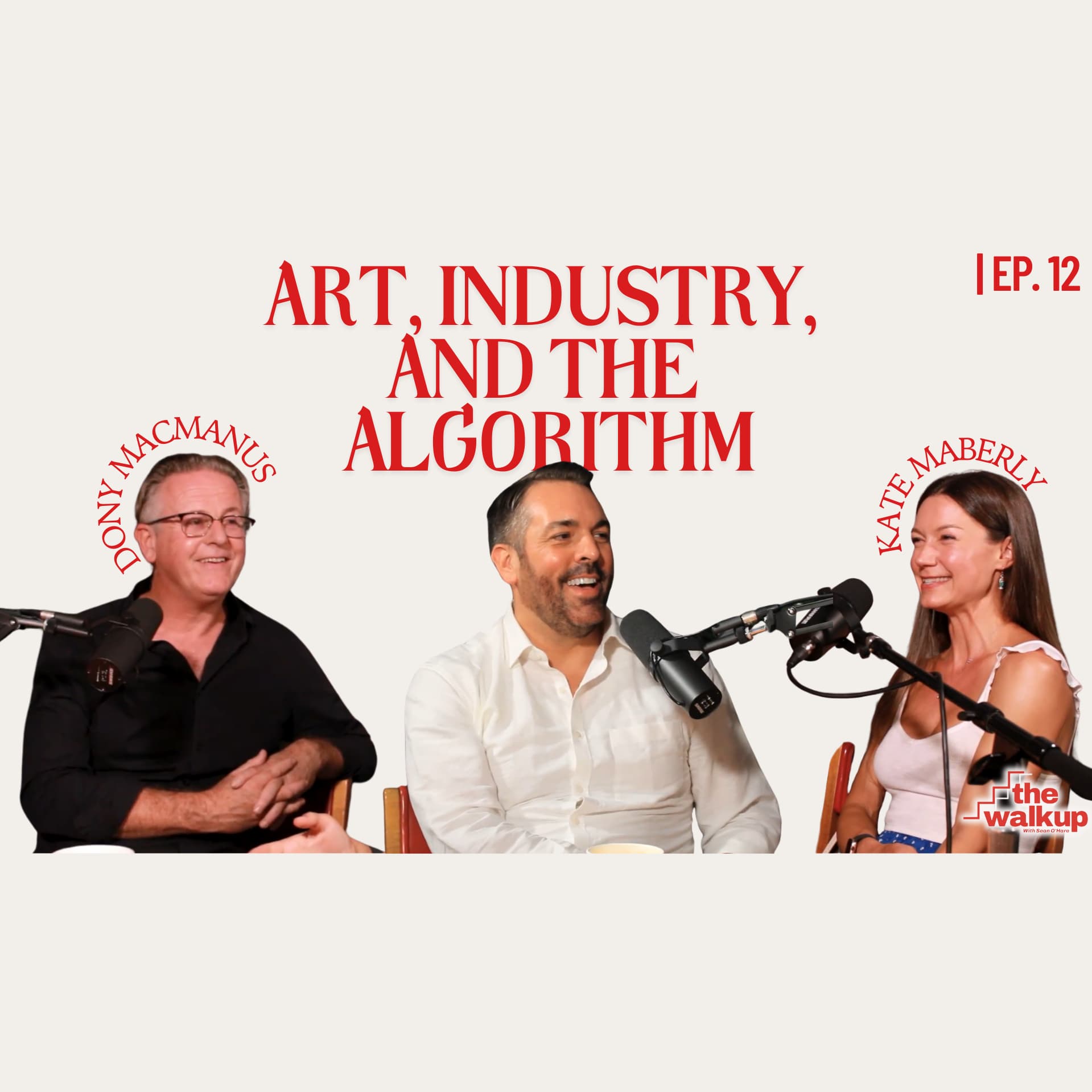
In this episode of The Walkup, actress-producer Kate Maberly and artist Dony MacManus explore the deep roots of creativity—from childhood imagination to classical training, and from faith to futurism.
They discuss the dark underbelly of the film industry, the seductive illusion of social media, and whether AI represents progress or regress. It’s a conversation about beauty, inspiration, and choosing the long road over the fast track.
Transcript
Read the full transcriptAuto-generated · 16,213 words
I'm used to a clapper board. Yeah, I don't have a clapper board. But we're not that posh. Anyway, so celibacy, the topic of the day. Is that what we're starting with? Oh, he's going to love that. You may regret this decision, but did you agree to the format of absolutely no prep?
Not knowing what we're going to talk about, and so you really only have yourself to blame. And by that, you mean a phone call going, come on a podcast in 24 hours. What's it about? Yeah, it is the experience of being my friend, which has already been a painful one for you. So, you have already done the hard work. That is so much to say.
Well, I should introduce our two guests. Sculptor, artist, painter, renaissance man, how else should I describe you? Irish guy. Irish, Donny McManus, originally from Dublin, now in Falls Church. Virginia, and he recently compared Falls Church, Virginia to Florence, I'd just like to point out, mainly from its temperate climate, but also because he's building a studio there, much like, he's basically like the Medici's, is really, he's building the new. model for artists, so. And then, Kate Maberly, who... Don't be cruel. After that intro.
And that's Kate. Hails originally from... Wait, where in the UK? Surrey. Surrey. Which is about 20 miles south of London. I've heard of London. Surrey with a fringe on top. Oh, right. Every period drama you've ever watched is probably filmed in Surrey. I actually just... Rolling Green Hills and things. It's very pretty. I just recently re-watched When Harry Met Sally, when they do the Surrey... They have that famous scene where he's singing karaoke in the department store, and then his ex-wife walks in.
No? Surrey with a fringe on top. I feel like the only famous scene from when... Harry Met Sally is not one to be spoken about on this podcast. I don't remember the one you were talking about. That one's not about celibacy. That particular scene from Katz's Deli in the Lower East Side is where that scene took place, in fact. But yeah, so, Kate, originally from Surrey, but now, I don't know where you live. Do you know where you live? Nor do I.
You live everywhere. I'm a global citizen. Yeah, cosmopolitan. You are global. How would you say you divide your time, continent-wise? New York, well, continent-wise. I would say city-wise or state-wise, New York, L.A., and London are my three residences, or places I move between.
Dwellings. Where you dwell. And how do you rank these? No, let's not rank. Let's not rank. Let's not pit these cities against each other. But what are the... Positives and negatives of each of those when you're visiting or dwelling.
London will always be home, because it's family, and it's where I grew up, and so I still call it home, even though I've officially lived away from there for about 10 years. And then L.A. is what drew me to the States in the first place, because of my work, and it's...
Kind of everything that people do imagine, except that a lot of people, especially from where I grew up, are like, it must be so superficial, because it has that cliche that surrounds it. And there is that element to it, but there's also California sunshine and a beautiful...
Way of life, and the ocean, and the mountains, and everything else. And it is where I have thrived in my work, and so I am very grateful for L.A. And then there is New York, which is loud, and noisy, and dirty, and I love it so much. It is probably my favorite.
All right. Well, I would say we were in agreement, but although Donnie seems to be shifting his opinion on New York of late. It took about 20 years. For about 20 years now. Whereas your cities would be Dublin, Rome, Florence. Oh, I love all of those. Actually, I was going to say I love Dublin, but I also, Rome, I think, is one of my favorite cities in the world. Yeah, I try living there. I lived there for a year and a half.
Well, I was on the periphery, so it was pretty rough. Do you speak Italian? Yeah, but Florence. Florence is by far the most beautiful city in the world. It just can't beat it. And you were there for how many years? Twelve. Twelve years. And now in the states, between New York and D.C.
In the aggregate, how many years? Probably 10. Okay, so you would like to live back in Florence, is what it sounds like. Yeah, I think we are going to retire to Florence. Oh. Yeah, but we are going to do as much damage as we can while we are here. Okay, all right.
Well, tell Kate about the studio you are building. Well, essentially, I started... In Dublin, New York, then Florence, then Rome, and then back to the United States. So, here I am bringing all the things that I developed in the Irish Academy of Figure of Art in Dublin, the Sacred Art School in Florence, which I founded in Florence, and bringing it to here. So, it is basically reconstructing the artistic practice of sculpting, painting, and traditional skills.
Bringing them to the higher service of sacred art, and then bringing that here to the United States. So, working on large commissions. So, at the moment, I am doing actually a secular commission, which is like six, seven-foot bronze figures for the U.S. Navy. So, it is a monument, the first monument they have done since the Vietnam Memorial. So, that is going to be really fun to work on that. But, I prefer to work on sacred work, because it It goes into more deeper aspects of the human condition.
Yeah, and just to give kind of a highlight reel of the commissions you have done over the years, I know there are a couple in Dublin, there are some in the States, some in Florence. Yeah, so most of my work is here in the States, but I have a lot in Rome, large altarpieces, a bronze altarpiece for Rome.
Some in Florence, but mostly in Ireland and in D.C. I have about four bronzes in the Catholic Information Centre. That is on K Street. So, sculpting is your... Yeah, bronze sculpting, mostly. So, I love it because it is a beautiful medium, and it is very strong, and it is very intimate, so you can actually touch it.
So, one thing I love about, especially devotional sculpture, is that you can touch it and you can see it wear down. And it polishes the bronze, so you can see that interaction between your work and the community, so it is really beautiful to leave a piece like that that would be there centuries after you die, and people are still interacting. Or even, and sorry to, you know, go there already, but that actually makes me... What is this expectation you have? So, you said something to leave that will still be there in centuries.
My brother was an artist. Well, he was a sculptor, in many ways, painter, sculptor, and so on, and my brother, who we lost last year, but one of the wonderful things about that is that he did leave behind all these works, and so all of us in our various homes have... I especially loved his sculpture, that was my favorite thing about what he did, and so I have some of those. My parents have a lot of the art. All my other siblings have pieces of him that surround us still, and I think that's one of the really magical things about doing what you do, and bronze was a big thing for him as well.
Oh, fantastic. And how did he discover that? Because we talked on the podcast that Joni and I did just one-on-one, talking about how his mom gave him a bag of clay when he was 70 years old, and that got him started off, but his mom was an artist as well, so that kind of was... Natural for her. How did your brother find... He really found his own way. I mean, he was always just really cool. So, he would do everything creative.
He tried a bunch of instruments. Very different from Donnie. He tried, you know, he was a bass guitarist, and he had a band, and then he was doing basically kind of graffiti stuff, and then he was doing graphic design, and then he was doing... So, he didn't study it intensely anywhere, he just was always doing it in some form, and interestingly, his work became more and more classical, I suppose is the term, as he went on, rather than, I think a lot of people go the other way around, perhaps they study the classic techniques and so on, and then they find their way into their own more modern, whatever it may be, whereas he, over the years, decided...
He wanted to go, you know, into more, he suddenly decided to go and do oil painting a few years ago, and the bronze sculptor that he took classes, and then he created groups where he brought people together to do the same thing, and so it was all just, he had a true love for it, and he had a, you know, he was a...
A very wonderful, sometimes tortured soul, but there was a lot there to express, and so I think that is where he put it. And I relate to that, you know. Yeah, he's looking for a grammar. Like, his life was becoming more interesting, and he needed a grammar to communicate that. So, he reached out for maybe figurative work, drawing and painting and sculpture, so he can communicate that. But if you don't have that grammar, it's very frustrating. That's why there are a lot of frustrated artists around today.
Yeah, I think every artist is frustrated, right? In some way. Otherwise, there's nowhere to go. I think you have to be perpetually a little bit frustrated. Yeah, you have to have a minimum grammar to get there, and I think that's... I identify with that.
And your parents were always encouraging of the arts generally? Was that something that they liked? Yeah, my mom has always been very, very into it, and she studied as well when she was much younger. Not that she still paints or does anything like that, but she is very appreciative and she knows a lot about it. So, I think she, and Guy especially, kind of.
So, then when you, because you should tell the story of how you very, through happenstance, found yourself in the industry at a young age, but they must have been a little bit. Receptive to it, it sounds like, when you did stumble across it. So, tell Domini how you got started, because I think it is a fascinating story about how you were, quote-unquote, discovered.
Yeah, I was, so I grew up in a very small town in Surrey, and... I was very, I was really quite shy and quite studious, and quite serious, and I not doing the school plays would have been my worst nightmare, or the drama clubs, or, you know, that sort of thing, and on the day in question, when...
They were basically auditioning for this film. They were looking at lots and lots of little girls all around the country, and the only reason I ended up being seen that day was because my netball match got rained off, and I was essentially pulled into a room to read in front of people, and I went home that evening and sort of sat around with my family, and we all had a good giggle about it. And then I got called back and back and back again, and that was a big film, and it was Francis Ford Coppola, and it sort of launched me into a world that we knew nothing about, but definitely changed my life.
Oh, fantastic. I had lunch in his garden. Oh, really? Yeah. I gave tours of Italy, and one of the tours we did, the friends of Coppola had us, we had dinner in his garden down in the south of Italy. Gorgeous place. Gorgeous. Oh, so he has, because he has the wine. Well, right? Yeah, yeah. He has a couple of things going on. Oh, wow. Where's the... Where's that drum set? I told you. Oh, my gosh. See, but had you not cued him...
I do not know that that joke would have come out. Now, he is looking for the symbol to play. So, where in Italy? Down, just before the toe. If you can think of it anatomically, it is just near the toe of Italy. Ah, okay. Yeah, beautiful area. And then, of course, you shot a lot of the godfather in that area, and just as you go into Sicily, in the Catania area, there is some really nice setting where they have the... You know, when they're going out hunting, and so you have those early scenes from the films there.
Yeah, the landscape you can really see. Oh, it's fantastic. Well, that's cool. So, then that kicked you off into the industry. So, you were how old when this happened? I was eight when it all began. Eight years old. And your construct of it was, I mean, how do you have a context for what's going on? You know, the first time it became a real tangible thing for me was on about the, I think the eighth callback was the first screen test.
So, there'd been seven auditions, and then there were two full days of screen tests, and they were held at Pinewood Studios. Oh, yeah. Very famous, yeah. It's a very famous studio in London, which has also forever been the home of the Bond movies. And I remember driving onto the lot that first day, and my parents both came with me.
You didn't drive yourself, that's good. I was sick as a dog. I had a really stinking cold, is what we call it in the UK. And so they were there with the tissues and the sniffer. I remember just having one of those sniffer things, because I was just like this. And I was about to go in for the biggest screen test of my life. But anyway, I remember, aside being really ill, driving on and just seeing the 007 sign on the side of this giant hangar, and just going...
Because even at that age, I recognized that symbol, and then I kind of looked around, and it was in this wonder world, and they walked us through, and there were like giant posters of all these great old legendary movies, and then it was the first time I'd really walked onto a giant studio set like that.
And to see that world where you walk through a vast, vast sort of warehouse in the dark, and then in one corner of it, almost, there's just a space about this big, and all the noise is going on around it, and then in this space, there's kind of lights like this, and there's a set and a scene, and it's like, you're gonna stand right there, we're gonna put a little sandbag on the floor, and when your toes touch it, that'll be where you stop.
And I just thought... Wow, at the age of eight. So, you thought, cool, you didn't think overwhelmed, intimidated. No, I just thought the whole thing was so cool, and I think that was really good. I think it really helped that I was not in awe of like, I want to be a star, I want to be an actress, because I really wasn't thinking about that. I was thinking, this is like a wonder world, I want to be part of this world, I want to be part of this adventure.
And so, I was able to genuinely sort of... Forget the camera was there, and that is what I did throughout that movie. And, of course, I was surrounded by incredible filmmakers that helped me do that. And my mum, credit to my mum, who learned every scene with me the night before every day, and was my unspoken acting coach throughout the whole thing. But, essentially, yeah, I just... Every day I showed up to that set, I would attach myself to all the crew.
So, I would attach myself, especially the camera crew, and it was Roger Deakins was shooting that, who, of course, is one of the more legendary DPs ever, and we were still shooting on 35mm, and so he taught me how to load the camera and how to check the gate. So, I was involved in all of that, and then at some point, they'd be like, okay, we're up, and I'd have to go in front and sort of do my bit.
They would cut, and I'd get to go play again, because ironically, and depending how many people have been on a lot of film sets, the amount of time you're actually in front of the camera with cameras rolling is about maybe six or seven percent of the day. The rest of the day is everything else, and everything else was what I loved so much. Well, especially back then with, yeah, without digital and playback as easy. Yeah, I was...
My first real experience getting to, well, first and only, honestly, getting to be on a big movie set was on our friend Doug Liman's movie, Roadhouse, and I got to be there for like a week or two, and I'm like, wow, this is a stamina involved in this that I did not understand. I get why you have to have a nice trailer, because if you're really trying to keep yourself in a certain mindset.
If you're the actor, meanwhile, you know, Doug's there the entire time, and, you know... And actually, visiting a film set can be really boring, depending on the day you go. It's incredibly... Because if it's just, like, two people talking in a room, and there's not even... I mean, at least in a Doug Liman movie, you've got probably a lot of action to watch. But otherwise, you go visit a drama, you're just kind of hanging around, can't see much that's going on, and you're always in the way.
You cannot be anywhere on a film set without being in the way. I've never... Well, I felt... I've felt useless many times in my life, but I've particularly felt useless as when you're the friend of the director, people kind of have to treat you nicely, even though I had... You get offered a lot of cups of tea, or is that England? A lot of cups of coffee. Yeah, we get coffee, and it was like...
And so, they have to be nice to me, but I add no value. There's nothing I'm adding to this whatsoever. I didn't say it. I'm just there. It's like your show. It's really a microcosm of my day-to-day life. Thank you. Donnie is here to keep me humble.
I'm still not sure why I'm here, so at least we all know you are here. He's got his role. I've got a purpose. This is always a manufactured reality. By the way, I keep... This is your fault. I thought it would be a wonderful idea, when I arrived, to give me a tour of the old underside of the church, which is very beautiful, but I think I inhaled about three buckets load of dust, so sorry about the coughing into my coffee.
So, this is... Yeah, I gave you the opportunity to cough there. That's fine. You mentioned, as I was showing you around, that I only discovered this little secret passage on Tuesday. It is Thursday today, so two days ago I found this little secret passage, and I thought it takes you to kind of like the mezzanine level, if you will, kind of a little walkway on the edge of the church on the mezzanine level.
But it's really cool, but it's also very dusty, and then I decided to take you even further into the depths of the church, into the choir loft, which is even more dusty. But I felt like, how can I not make this a part of the experience of the podcast? I would suggest after the recording. No, but look at the great conversation we're getting out of it. Great. Or I'll just offer N95 masks before we go up there. Maybe that's... There's got to be some extra ones from COVID sitting around somewhere.
So, then you finish that, and then you do that first movie, but then that is the filming experience, but then when you are dealing with the machine of a big production, there is the promotional part of it, and so by the time you are promoting the movie, you are at least a year older, I would think? Yeah, the whole thing was essentially two years of my life, and the film... At the time, which is the film called The Secret Garden, it was based on a very beloved book, and it became a very beloved movie, and there was an enormous amount of energy behind it, and it was when they still really got behind and the studios made big release movies.
It was Warner Brothers, and it was Coppola, and it was all these... You know, great elements. And so, yeah, that was... Again, from where I grew up, my first trip out of the country, essentially, was on the Concorde to fly to New York to shoot for the cover of Time magazine. Wow. Now, when you're 10, you don't really know what that means, except that I got to go on the Concorde, which, again, was just really cool. Which I missed that window, because that was gone.
Oh, yeah? Yeah, I missed that chance. That's well-poshed. But yeah, that sort of kicked off this bizarre year of travelling the world, and doing press conferences, and interviews, and premieres, and openings, and film festivals, and for a very shy girl, which I was, oh my goodness, you look back at some of those interviews, and they're even more awkward than they should be, and they don't want to see, like, I'm sitting there, and they're trying to get anything out of me, and I'm going, Yes, no, I had a really good time.
Sure, yeah. But I got a little more, you know, used to it over time. My mother did have to feed me a little swig of brandy once when we were in Tokyo, and I was opening the Fantastic Film Festival to 100,000 people, and I had to walk through, and we're in a green room behind, and all you can hear is like, what? It's the closest I ever got to feeling like a rock star, because you can just hear the noise, and this, and that, and then they walk us through this long corridor to these giant, I mean, I was little, so there was probably a door like that, but what felt like these massive fairytale doors, and I heard, blah, blah, blah, blah, blah, Kate, Mabley, and they went, boom, and the lights went, boom, and I had to walk through all these people that were screaming, and I had bodyguards, and it was all this, and I was just shaking, hence the brandy.
In spite of the writing. Okay, all right. And all the way up onto the stage, and then present the movie. So, it was definitely a fast track beginning into a very strange new world. Well, yeah, because you went from something that was a quiet, relatively quiet, but a...
Even the filming of it was somewhat intimate, and then to go from that to the promotional side of it, which is now the public face of it. How did your siblings react to this? I mean, you'd have to ask them. I'm sure they thought it was nuts. I'm sure it was... Because where do you fall in the family? I'm number four. Okay. I'm number four of five. And, yeah.
It was cool, because they got to count. It was the same for you. Exactly. Four or five. Four or five, yeah. What is the spread in Boys and Girls? Well, I have three brothers, three elder brothers, so I got all the hand-me-downs and the bullying, and then my little sister got all the attention, so I just slipped right between everything. Yeah, okay.
Yeah, so the cool element was that they got to come and join in a lot of the fun. Like, everyone came out for the premiere. Hollywood. And, yeah, it was a huge ride for everybody. It was a huge, it was, actually, my big brother guy, I remember him at the... At the night of the premiere, and we came out of the theatre, and I was standing kind of by the door of the theatre, and people were filtering out, and everyone was just coming up and going, oh, we loved it, we loved it, it was great, great.
And I was just standing there, and I just had this big grin on my face, and I was like overwhelmed, and I remember looking over to my big brother, who was just laughing at me, just going, so dumb, oh my god, it's so ridiculous. It was quite ridiculous, but yeah.
And what was the, after that, then there was consideration of, was this a one-off thing, or is this something that you want to pursue? Was there a discussion about that in the family, or with your parents? There were lots, because, you know, any, at some point you become... Even a miniature commodity, and so there was an awful lot of pressure of, you need to relocate the family to Hollywood, and we're going to get her her own show, and thankfully, probably, you know, the reason for my still somewhat sanity is that they said no, and I went back to school, and everything normalized very quickly, but what was really...
What was exciting was that then films would still come. So, essentially, I had this very sort of lovely situation of I had to go back to school, I had to do the work, but then so long as I behaved and got the grades, I could go off and do the next film. Oh, okay. So, it made it this positive.
So, it was always something to be excited about, and I did some, you know, really beautiful jobs, and then I started to really love the acting as well. It took some time to get to that, where I was really enjoying that part of it too, as opposed to just the adventures.
But I got excited about getting to play different people, and be different people, and do some stuff with special effects, and I remember doing something where I got stabbed, and having the blood pellets, and I thought that was the coolest thing ever, and monster creation, and all the stuff which I now use later, that I was just absorbing as a sponge as a small.
Child. Yeah. And then at what point do you think? This is a career. Like, are you, like, I want to do this, not just... Oh, I still haven't figured out what I'm going to be when I grow up. Okay, all right, well, in that case, join the club.
But I did decide, probably, I think I probably started writing my first movie when I was, like, 12. I mean, I literally knew that I wanted to be, I wanted to be making them. I wanted to be making them.
And I was reading so, so many scripts. Then I was like, I can do this, I can write scripts, and I would also pick up books, because I was a fairly voracious reader, and I would pick up books and just go, I'm going to make this one into a film, not realizing, of course, that you're supposed to ask the author or the publisher or someone permission, so I would just go, I'm adapting this book, and I would come down with a script and go, Mom, I want to make this.
Wow. She'd be like, uh-huh. Right. Let's see who we should talk to. Let's see how much that's going to cost to adapt that IP. No, but I just do it. I do the adaptation anyway, and then go, okay, so I have written it, and who do we, what happens now? How do we green light this thing, people? It is ready. Call my people. That is funny. Whereas, yeah, I am very, it is funny, you guys are both like discovered very early, seven years old, with a bag of clay.
By my mom, not by Hollywood. Yeah, nobody was coming. No one more important than your mother. Exactly, exactly. So, you guys are discovering your... Your artistic vocations early, I... Because I am still intimidated by all things artistic and feel like I am always on the periphery. Actually, one of the times you and I were chatting, you said, oh, you are working with Doug on this project, and I said, yeah. And you said, oh, are you a producer? And I am like, oh, no.
No, no. I am not a producer. And you are like, yeah, but you are working on these projects. And I am like, yeah, but I have not produced it yet. We are just working on it. I do not really understand how this world works.
Also, producer is the most overused term. I was probably just... Messing with you. And I'm like, oh, no, but I haven't actually produced anything. We're talking about some stuff, and I hope it works out, but it's also just my imposter syndrome about like, no, no, I'm not like the people that are in this room, or the people in the community of your friends and Doug's friends. I'm not one of you guys. I'm not like actual, you know, I haven't produced anything that I can point to.
Well, look at you doing it right now. This is an hour. Yeah, because otherwise, you know, I'm not sure, what are we doing here? This is art. The art of conversation. The art of conversation, which I didn't know that was an art form.
Is that going to be your subheading? The gift of gab, I didn't know was an art form. I thought it was just something that people had to endure on the other side of the conversation with me. But if it's an art form, I'll take it, you know.
But yeah, as artistic as we get, it's this little... This little cactus on our orange tablecloth. That is sad. But are there any times between sculpture and acting and now producing and doing other projects, are there any times where you are like, you know what? This is not my thing. I thought it was my thing.
And I am not just saying like you are getting... Like, it's hard, where there's, you know, doubts and all that sort of stuff, but are there any times where you're like, you know, maybe God isn't calling me to be a sculptor. Maybe I need to go into accounting. Sometimes you can be blessed with only one talent.
So, there is no option. For me, that is what it was. It was very clear. Form is my grammar, and just sculpting, drawing, painting, anything that comes from that is an extension of that art form. So, that is a beautiful gift in a way, just to be very... Clear on your direction forward, and that gives you a tremendous focus, and if you are focused, that means you can go a lot further.
So, for me, that is what it was. It takes away a lot of the blank space, if you are like, this is what I am going to do. For you, with acting, was there a... You grew up in, what denomination, I'm sorry, you told me before you were going to church growing up, right?
I'm sorry. You went to church growing up? Church of England was my school. Church of England, okay. So, was there, did you ever think about it in that context, in terms of like, acting as this gift I have, as a talent that I have? Oh, no. No, that never, that's not a language you would use.
I had a good memory. I could always remember lines. I knew I was good at that. Okay. That was about as far as I stretched in terms of thinking that I was good at acting. Okay. Yeah, it always surprised me that people kept asking me to come back and do more, but I always wanted to because it kept me in that world, and I just wanted to be in the world. Yeah.
But no, I never, to this day, have sat back and thought, I'm really good at acting. Well, no, but more so that, like, you're, even just that gift of memorization, right? That's a talent that, you know. God-given, and you have it, and you were able to deploy it to be able to do something that you love, right? I would say, like, more seriously, I definitely, I always felt things very deeply, even as a little kid. I always, and that's what I meant by I was quite serious.
I always, yeah, I don't know a better way to put it. I felt things so deeply, whether it was joy or pain or sadness or, you know, and I think that I was able to infuse into. So, what happens next is that you're going to have to go back into characters, into things, because I think especially when you're doing it as a child, you're really just, they cast.
You, for something that you are, and I try to separate myself from the kid I was then, from something that little child is bringing, they want a piece of that. It is not just for the incredible performance that someone like a Judi Dench can transform into some other thing. I think for me back then, certainly, it was about infusing that part of myself, and that is also what really appealed to me, was that I was very I was very shy, and I was quite introvert, I would say, and I got to express myself in ways, by being someone else, by being a different character, by telling different stories, and that was special.
Yeah, sure. Still is. Still one of the things I love about it. So then, when do you come to the States fully? Or are you always bouncing back and forth? I mean, again, I never made a decision to move. I came out to work, and I was always coming back and forth ever since the first movie, and I had multiple visas over the years that were sponsored by different studios and production companies, and then it was once I graduated, and it was the first time where I didn't have to be back for the next semester or the next.
Whatever. And I came out to LA, and I came out on a three-month ESTA, and then got a gig, and it turned into a six-month 01, and then got another gig, and it turned into a one-year 01, and got an agent, and then three months turned into now.
Ten years. Well, you graduated, this would have been secondary school, or this is college? No, this is college. Okay, so you are now early 20s. Okay, so you are not having to experience Hollywood in your teenage years. I definitely did, but it was coming back and forth. Okay, gotcha. And what was that? I mean, this is pre-internet, right? Pre-social media.
What was... Pre-social media. When you were visiting, you were always with your mom, at least? My mom always came. Okay, so you were shielded from, I imagine there's got to be some environments that normally a teenager shouldn't be in when it comes to Hollywood, right? Yeah, you can't be shielded from everything, but my parents did a phenomenal job of creating certain barriers. But certainly... It's a big education. It's a fast-track education into adulthood. And it's actually, you talk about social media, it is the reason I never began social media, was because of things that I experienced.
And even though I was certainly protected and loved and looked after, there are still some... Some troubled people out in the world that will come at you and come for you, and there were some dark things, and there were some things that... That happened and things that made me realize when everyone suddenly was jumping on Facebook and Instagram that the last thing I wanted was to tell people where I am or what I'm eating or what I'm doing that day. So, I simply didn't start.
And I think, actually, I'm quite grateful for that now because it gave me a certain... The reasons I didn't start were very personal. And once I make a decision like that, it is black and white for me, so I did not waver, but it also gave me a certain objectivity, and so I watched the madness that has ensued, and the thing that social media, the monster that social media has become. And I know there are lots of wonderful things about it, but I think it is terrifying, the way it is taken, especially for young people.
So, I avoided that. So, even though the reasons were a little darker, I think good things come out of those decisions. Well, yeah, it is interesting, because social media is, in some ways, this way to distribute your image, your identity, what you think you want the world to, how you want the world to perceive you.
In some ways, that was already done, not for you, but as part of the film or the project you are a part of, you are... You are being, your image and your identity, which is not fully you, of course, but is being exposed, so to speak, and so therefore you would have had a sensitivity to the idea that you'd already had that, okay, now I've already had my image out there, I don't have this. I know what happens when your image is out there.
I can see the, you know. You must have learned an awful lot about the human condition coming from such a distant... What did you learn about the human person in that experience? How dark are we going to go today? That is a phenomenal opportunity. Not many people have that perspective in life. Yeah.
What did I learn? That is a big question. We only ask the big questions here. Shauna asks the small questions. I do the big ones. I think... I don't know how to... I think I was certainly... I certainly had some...
Innocent. Innocent truths crushed. Sounds like a dramatic word, but I can't think of a better one. And I think I just learned that you have to really listen. To people, really, I learned to be very, very aware, and you have to be burned to learn, I would say, and so I learned probably too young, or younger than, not too young, younger than most, that...
I can't speak. I'm sorry. I don't know how to say it. Just to be very aware, to recognize danger zones, and that there are, like I said, plenty of troubled people, plenty of wonderful people, that people will not always have best intentions, to recognize when people do, when people don't. I'm trying to be very...
Politically correct here or something, because I don't want to go down the rabbit hole. I mean, jump on in. The rabbit hole is there. I definitely learned a lot of life lessons younger than I would have otherwise, I would say.
But I think it hopefully makes me a more interesting storyteller. And it definitely infuses my writing, which I do an awful lot of now. Back then, I didn't really keep journals, but I would write loads and loads of music, and it definitely all came into that, and I write songs.
And so, I found ways to express a lot of these confusing things that were coming my way through art. Did you like what I did there? Oh, yeah. It's not about together. And I think all of that, yeah, is really important. You know, my favorite artists in all realms tend to be the ones that are shrouded in tragedy. Like, I always loved that. I studied classical music really intensely, a long way. It's what I did my degree in, and my favorites were always the romantics.
I recommend enough, and... Brahms, and even Beethoven, who was on the edge. He was really the first romantic. There was so much tragedy in their lives, but they came up with some of the more beautiful melodies that we'll all ever hear, and I think there's magic in that, and obviously, you know this through art and sculpture. So, I think any little things you can take from learning about humans to then flood into the work and the art that you create just makes it more interesting.
I actually got out of that one. You navigated quite deftly there, I think. No, I think there's, you know, so one of the things that Donini does in his art is, as he's mentioned, he focuses on sacred art. He's decided that's where he wants to make his focus, and particularly what's called the theology of the body, which is a kind of a whole.
A series of teachings that was developed by Poet John Paul II about sexuality, and the human person, and identity, and all these sorts of things, right? And I think one of the things that, from a cliche perspective, whether it is Hollywood or somewhere else, when people want something from you, they are not seeing the whole, right? They are seeing what you can do for them, and they want a piece of you.
Whether that's, well, you can be in my movie, and that helps me for my own project, or I can use your image for this, or if it's more deviant, you know, that obviously has a whole other connotation about what piece that they're seeing that's not the whole, and, you know, generally through your art, you're particularly focused on the wholeness of the body and soul.
Interconnected, not able to be divisible, that we, in our contemporary culture, often try to take pieces, right, and see only the body, and maybe the body is... I can treat it as a material object, or I can use somebody else, but your art is focused on fully connecting the body and the soul and the whole person. Yeah, I mean, I suppose John Paul's whole thesis was understanding the human body.
And sexuality and the contrast between love and use. So, use is the opposite to love in this context. So, you can see how that can be abused in the artistic practice, and especially vulnerable children actors and actresses. That is like a very vulnerable situation. So, having really good parents guiding you through that must have been a phenomenal gift for you to... To have, because I'm sure a lot of people have suffered in that area, but that's something that I found very, very valuable about the theology of the body.
It helps to bring figurative art into a contemporary context and orient it towards love rather than use, because essentially, The difference between great art and pornography is use. Pornography objectifies the person, and so it becomes used, and so that is a real degenerate aspect of our culture, because it reduces the dignity of the person, and the only way to relate to a person is with love. Yes, and that is why I like to use the theology of the body as a contemporary interpretation of human sexuality and its dignity.
It has been very, very helpful for me and for my students. But it is not a prudishness, and I think that is one of the things that, when you and I have spoken about... Art and your study of the human body, that it is not, well, we can only have models that are covered from head to toe, or that are, you know, wearing, you know, you paint from the nude, right? Well, John Paul II, in his Theology of the Body, he very, like, there is a beautiful quote, he talks about, the problem with pornography is not that it shows too much of the body, but it shows too little of the person.
And that is really interesting. Yeah, that helps you get into, that's like exactly what Theology of the Body is, and it's just, it's an amplified version of that. It's a very deep theology and philosophy that helps us enter into that, especially in a contemporary setting. Well, there is a lot of confusion about human sexuality, because it has been deconstructed in our contemporary culture, and for that reason, people don't understand the truth and meaning of human sexuality, and it needs to be reconstructed in the context of love, as opposed to use.
Yeah, I think we have talked a lot about how, even with Catholic institutions, they have had, if we want to call it, a fear for resistance to when you say, no, we have to learn from the human form, which means having nude models, and there is like a, especially like an American puritanical… Or Jansenist. Yeah. Or whatever. Jansenist. That is the Catholic version of the Puritan. Yeah, it is a big problem, and I think it is important to not be shy of sexuality, but actually to embrace it and to redeem it.
The only way to do it is to actually fully embrace it, because it is so attractive. Everybody wants to talk about sex, but the challenge is to talk about it in the right context, is to elevate it to its true dignity.
And that takes a lot of bravery, and at some institutions... Some people are up to it, others shy away from it because it is too controversial for a lot of people. But I think it is the only way to really turn things around. Because we were talking about if you deconstruct human sexuality, what you are doing is you are deconstructing... The relationship between a man and a woman. You're just deconstructing the icon of love, which is the most important thing that a human person can bring to the world.
You deconstruct marriage, you deconstruct the family, you deconstruct society. I think that is what we are looking at, a complete meltdown of our society. So, in order to reconstruct it, you have to reconstruct the truth and meaning of human sexuality. Well, we know that any time we have a...
Conversation about sex. We tend to fill the seats. We have this series on theology of the body in New York. The book that John Paul II wrote was called Love and Responsibility, which led to this Theology of the Body canon, if you will, and so we have a series called Love and Responsibility, which from a branding perspective, terrible name, because who wants responsibility in the title?
You're having conversations about sex. But the topics always drive, you know, we always get a couple hundred people to these events, but yeah, so I think there's a lot of... A lot of confusion about these things, and where the role of art and the artist is to be played, right? And it's interesting where you're donating your work. Obviously, you have to work with patrons, or there are institutions involved, but a lot of your artistic process is... Not yours alone, but ultimately, when you sculpt something, this was sculpted by Tony McManus, not by a committee, not by a production team, whereas the nature of film has to be collaborative, right?
There are writers, and producers, and gaffers, and electricians. It is, by nature, an incredibly collaborative process, right? It is. So, then you are part of the machinery, so you do not have complete autonomy. On how you are. But, it is a beautifully collaborative medium, but I would say the one moment where you can still be insular is at the butt of it, the butt of the idea.
It's why I love what I'm doing right now, which is screenwriting, because you get to play with all of those ideas and thoughts and feelings, and you are creating something, which of course will then grow and... And other people will hopefully make it so much better, and more beautiful, and more interesting, but that is when the writer, at the beginning, gets to put on paper their vision, their story, paint these characters, paint the world. I write very visually, so I try to, yeah, literally write the world as the audience will see it.
And so, that moment at the very, very beginning can be very solitary, and then the beauty of it, it's kind of like music. You'll have, you know, you'll write, I write songs. You write a song, you'll write the melody and the lyrics, and then you'll bring in a bassist, and they'll be like, yeah, we do a little riff here, and then you'll add guitars, and every musician and every person will come in and just do something else, and you'll be like, oh my god, that's so great, and it just makes it more and more and more.
And that's kind of like film. You bring in a production designer, and you've tried to give them guidance on the page, but then their brilliance, their vision goes, oh, I see kind of where you're going, but what if we went and did this? And you go, yes, this is amazing. And every person comes in and does that, and I love it. It's like an orchestra. Yes.
And do you find that the screenwriting role more foundational? Given a role, and here's my script, you can enter into, like, hey, that's the part that I can do all the way. I can own this piece of it, right? Or for you, you're like, hey, I really would like to be the one that kind of lays the foundation of this production through.
There's no, I don't have one rule or one preference, I think, if... Someone comes along with a phenomenal role that is written. I mean, I played Juliet, and I don't think I ever, ever appreciated how much it is Juliet's play, and I say that because I played Juliet, until I played Juliet, and I got to go completely, to completely, and I had to study Romeo and Juliet in school, and it is sort of a textbook thing, and you make notes, and you...
Look at the way it's written and the language and stuff, and it's kind of boring, is the truth, is how I felt about it in school. But then I got to become Juliet and play that role. And again, you're adding something of yourself to it, and the artist, the writer, the playwright has created something stunning, but hopefully you can add some other element of your own. So, I think at every level, you can bring your own piece to it, but it's all those things that come together to create the orchestra.
That's the magic. No, and I've always, like I said, I've always felt kind of... Art adjacent, honestly, really, only since I moved to New York did I really get the opportunity to be surrounded and close to artists, and because I lived in this former convent, which allowed us to do a lot of, we had a music studio, and people would do plays and short films, I got to be just kind of, you know, a little bit, one kind of arm's length removed from it, but I've always just been I had just an awe of the creative process, and more often than not, I play the role of like, well, let me find you a venue, let me get you a place to perform.
You're a producer. Yeah, I'm a producer, yeah. I guess you're right. But I was just, it was like, it's a mystery to me. I remember one time I was at... Our friend Doug's apartment for some gathering, and somebody came up to me and said, you know, I was a little bit confused by you, and I was like, oh, is that, I didn't know, is that true?
He said everyone's a bit confused? Yeah, yeah. Oh, okay, that's amazing. Like, well, you're not an actor, so you're not trying to get into one of Doug or their friend's movies, and I'm like, that's true, I'm not an actor.
They're like, you're not a... Producer, or a DP, or something where you're wanting to work on film. You don't seem to be trying to date anyone here, so what is it you're doing here, exactly? I was like, oh, I guess I hadn't really thought about it that way. I was like, I just find you all fascinating. I was like, to me, you all joined the circus, right? You're the Andy Warhol. You're the Boyer. Yeah, I just watch. I'm like...
Talking to people about their creative process, the thing they're involved in, and I just feel like it's like you get to see all the people that found their little niche in the world and their way to contribute cultural artifacts, and I'm like, I can't do that, but I'd love to be around it to kind of like understand a little bit more of what that process is like. So, I've always just been in awe of it, because I remember when I was in high school, Doni and I were talking about how the arts weren't really anything that was really presented to me or promoted, and so I remember when I was in high school, one of the teachers was like, oh, you should try out for the audition for the play, and I'm like, but I play soccer.
Pretty much my story. It's slightly different, you know. I'm like, no, I play sports. I don't. I can't be in a theater. These things don't mix. You have to choose one or the other. I had no idea. This was obviously before High School Musical and things like that that made it cool. But yeah, you kind of got put into that world. I was going to be playing a netball match, and instead I ended up in a movie. But my reaction was the netball.
It's Little English Girl's version of basketball. I thought we were talking about Nepal, and I was very confused. I was like, there's a Nepalese influence in Surrey? But this thing where you're saying how you observe people and so on, that's how I spend my life. I cannot help, and maybe it's because my whole life at this point really has been about movies and making them and dreaming them up. And so wherever I go now, I find myself...
Picturing it in a scene, or just, sometimes I just kind of want to sit back a little bit and observe and go, this is, you know, this character is someone I want to write somewhere, or this, I mean.
This is really mean, but he'll probably never listen to this. Like, I went on a date last week, and all I could think the whole time was, I just want to be making notes, because this is so bizarre, this whole situation. He's the guy who's going to make a great character. And I really was at some point. He went to the loo, and I was like, I have to put this in my book of things to write into a rom-com one day.
Not enough rom-coms, by the way. We need more rom-coms. We do need more rom-coms. What is going on? We need some more uplift. Now, of course, I'm desperate to ask what his little peccadilloes were, but I don't know if we're... We just won't put a time stamp on this one, so they won't know. They won't be able to backfill what the date was of the... I'll write it into a movie, and then it'll be a little more anonymous.
Yeah, so, all right, well, we won't, we're not, we'll make a rom-com later. I think we, I mean, between the two of us, I feel like we have plenty of stories. He was celibate for 24 years, doesn't have a lot of stories from dating. He has a handful, but not as many as maybe you and I have accumulated over the years. But, so now, what are you working on now, or what's the thing you're passionate about? I'm writing a love story right now, but it's a very, it's a very, it's a, it's a...
Movie that I sold on a pitch to Sony, and they brought me in to write this, to turn it into a movie, and it is a very, very, it's kind of a rom-com, but in a very... Dark and twisted and contemporary way. It's kind of what it's like to be dating, sort of what it's like to be really dating now in this world, and it's not very rom-com-y in that sense. Well, not a lot of com, or actually not a lot of rom.
Yeah, I'm under all sorts of NDAs, so I can't really give you the scoops in there, because I actually spoke to one of my execs last week. He was like, can I just tell people what this is about now? And he was like, yeah, yeah, you can tell people, just... Don't tell the press, and I don't know if you're exactly the press, but to put it on a podcast, it's like, oh, you didn't mean... There is a distribution element to this, that's for sure.
But it's going to be amazing. Oh, you know, I was telling, and I was trying to remember, maybe you remember his name, but I couldn't recall it. Remember when we went to that homeless shelter? Yes. And we met, I can't remember his name, though. Well, tell Donovan the story, because I don't remember... Can you remember? Tommy? Johnny? Jimmy? It might have been Tommy or Jimmy or Johnny. It was definitely one of those. I feel like Jimmy is where I'm at. I feel like Jimmy.
Yeah, so... Because you called me because you were working on another project. That's something I'm very excited about, and that's something that's all mine, so I can talk about it until the cows come home. It's... Essentially, what happened is I wrote a script for a film during COVID, and it was a really long story, but it is a good one.
It was when, right in the middle of the pandemic, where every day you would watch the news, I would tune into the BBC, and I would watch the news, and it was like this many hundreds of people got sick, this many people in hospitals, this many deaths. It was really scary and sad and awful. And then the last five minutes of BBC Six O'Clock News would always be dedicated to something a bit special.
Whether it was Captain Tom, who was walking 100 laps of his garden, or whether it was the little boy that didn't have any legs, but was trying to follow his lead and do something, or just someone who... You know, a stranger who saw someone struggling and had lost their mask and helped them across the road. You know, these sorts of random little stories of the beauty of humans in the world. And I wanted to tap into that and write a story that was set during...
A worldwide pandemic, but that was focused on those little things that people were doing to sort of light up the world amidst all that. Because I think while it was a really scary time, one of the beautiful things that came out of that time was it showed...
The goodness is inherent in most people, we hope, and I really believe, and that would come out in these really beautiful ways. So, I wrote a story, a fictional story, inspired by all those things, set in places around the world, and as I was writing it and researching it and kind of coming up with it...
I started to think, but there's so many true stories, why am I making this fiction? And so that was the birth of the idea for this podcast that I'm still writing, which was to find those people and talk to those people, and who are just, nobody's in the sense of nobody knows who they are or where they are in the world, but who are doing incredible small things that have a big ripple effect.
And that was where I reached out to Sean, because I feel like he surrounds himself by interesting, special people, and said, I know you'll know some people I should speak to, and he introduced me to Jimmy, Johnny, Bobby, it's awful, we can't remember his name, because he was so interesting.
Who had been through a life of, he was running the big clubs and, you know, huge clubs and scenes in New York City. Restaurants, nightclubs. Restaurants, but like the hottest, seniors, you know, all of that glamour and sex, drugs, and rock and roll, and money, and so on.
And one day... Gave it up and moved into this, tell me the place that we were at. It was in the Bronx, and it's called, oh my gosh, I just lost the name. I think it was called the St. Joseph's Residence, yeah. And he'd gone to stay there first, isn't that what happened? So, what happened was, if I recall, so he was, so the other twist of the story is that he was a restaurateur, nightclub owner, with a mob.
Like, the mob funded them, or at least had some influence over their operation. Like, you got to give them their piece, otherwise they're going to have some problems. And what had happened was these Franciscans, so we know the CFRs. The CFRs are the confraternity of the Franciscans of the renewal.
Franciscans. So, followers of St. Francis, and they wear their interesting, very simple habits of basically like burlap, you know, very rough material. It is gray as well. Yeah, basically gray habits with a rope belt, and they have a number of homeless shelters, but one of them is in the Bronx.
Jimmy, we'll call him Jimmy, was, his mother was in the late stages of life and was in the hospital, you know, lived a long life, and she was getting towards her final days, but the hospital room next to his, there was also a Franciscan priest who was there, who was sick, and so the, there was the Franciscan who was A patient, but then there would always be one other Franciscan with him to keep him company.
So, over time, Jimmy got to know these Franciscans. And they were like, he just thought, there's something different about these guys. I don't know what it is. I mean, besides the, you know, they look like Jedi warriors with their gray outfits and rope belts.
But there was like, there was just like a different vibe. And so, he eventually starts going to the homeless shelter. Where they've got, I think, 30 guys in residence. Now, really, a residence where they stay for usually a minimum of six months. So, it's really about rehabilitation as opposed to… But also there's a maximum, right? Isn't there like a minimum of… I think it was a six-month maximum, actually. Yeah, yeah. So, it was… The idea is to… Really give people an opportunity to rehabilitate, not just one night.
And so they were maxed out at whatever, 30 beds or whatever they have. But Jimmy started going there, was really just impressed by the witness of these Franciscans, and over time decided to... Basically, sell everything you had, and move in. And bring all of his restaurateur skills and background to this place, and start cooking for him. That is how it began, right? Yeah, well, yeah.
So, you have got the guy that has been running the biggest, hottest, mission star, whatever, who just decides, you know what? I like these guys. I am interested in this. I think this is where I am going to take my skills. Fantastic.
Well, what was interesting, too, is that you may know this about the Franciscans, is they don't... They don't do any fundraising. They don't ask for money. It's just whatever people voluntarily give. So, from a food perspective, that means whatever is donated. It might be the leftovers from a restaurant. It might be a grocery store that gives them bread and vegetables and fruit. So, he has to get creative about whatever comes in. It's not like he's got a menu laid out for the next week.
It's whatever comes in. So, the reason this conversation started... Or I learned about Jimmy was because I was having dinner with the Franciscans, with the priests, and I was like, no offense, guys, but like, this dinner is way better than I've normally had here.
And they were like, oh, yeah, that's because we have Jimmy. And I'm like, who's Jimmy? And they're like, oh, we didn't tell you about him? And then they told me his story. And so then when you called me, looking at him, I'm like. I got a guy.
I got a guy for you. So, yeah, we need to, actually, we need to get him on the podcast. We should, yeah. That's quite a talent. So, where does that stand now? Are you still hoping to develop, or you're in the process of developing?
I've been meeting lots of people like that, and formulating, putting all the pieces together. But, yeah, it's an ongoing thing, I would say, while I've been under very strict writing deadlines from other places. So that's the thing I love, and that's the thing I'm, well, not that I don't love the other way. What I mean is that's the thing I'm doing when I'm not fully plugged into writing deadlines. Well, if it doesn't mess up your story that you're working on, maybe we can bring Jimmy on here.
God, I hope his name is Jimmy at this point, because we referenced it so many times. You're going to do the episode before I do the episode? What the heck? Well, I'm saying you and I do it together. Then you can use it. I can do that. It can be a little teaser. Repurpose it. There you go. A little pilot. A little proof of concept. I'm learning the business. I understand how this works. You've got to give people a little sizzle.
A little sizzle reel. That's actually a technical term. I didn't just make that up. At first time I heard it, I was like, sizzle? Is that really a thing? So, yeah, I appreciate the fact that you assumed I would know these kind of strange characters in the world.
Wonderful characters. Yes, they are very lovely people. I am very fortunate to know lots of them. And one of the things actually Doni and I were talking about the other day was that this... Medium, this platform of podcast, allows someone like me, who does get, has the fortunate situation of getting to meet a lot of fascinating and beautiful people with great stories, instead of them just being like... You know, anecdotes and stories I tell to people, you know, at dinner parties, it's like, oh, I could actually document that and create an opportunity for more people to hear about these things instead of just selfishly just consuming them myself.
I can actually share them with the world. So, it's... And as we were saying earlier, now you kind of have a job title. Yeah, I don't really, I just kind of shy away from those generally. You know, this is an ongoing joke amongst all of my friends, is nobody really knows what Sean does for a living. Yeah.
What does he do? Well, him, it was more like he had a boring corporate job that nobody wanted to remember the name of the thing. In my case, I've never really had a job. I just do various things, and then people find out.
Oh, you were... Podcaster. Podcasting, sure, yeah. Where's that drum kit? Oh, look, that was like, see the magic that happens when we all get together. So, how long are you in town? What else are going to be interesting things you'll be doing while you're in the city?
Tennis. I'm writing. I'm writing every day. So, at the moment, my routine is, my sort of windows when I write well is between three to four hours, where I can just dial in. Then I need to take a break, where I'll go run, and then I can come back and I can do another three hours, and then I need to take a break and go do something else active. That's kind of how I keep the juices flowing, and so it's a lot of, it's pretty.
I'm regimented, but it's good. I enjoy that routine. Yeah, you've talked to me a little bit about your creative. That process, Tony, that like... Yes, the three-hour formula really, really works. Oh, really? Oh, yeah, yeah. I suppose it is something I picked up in the New York Academy. All the lessons were three hours, but you tend to go backwards after three hours. Do you notice that? Yeah. So, you just have to get back, do something different, do something physical, and then come back into the studio and work away.
Because, yeah, things start going reverse. You think you are producing, but you are actually reducing. And I don't know how it is in... When you're sculpting and so on, but certainly when you're in final draft software, you literally, I will literally find myself going back with the bat space and sort of rewriting scenes that I'd just written an hour earlier, which I think are quite good, but then you overthink them and you start, so that's when you need to step away.
Yeah, and I think even people like, you know, Nick Cave, Nick Cave and the Bat Season, you think he's a punk rocker, he'd be all over the place, but actually he's super disciplined. He'd do a nine to five, and he would. No matter what the day is, he will do that 9 to 5, and I think it is really important to have that structure, because otherwise things will not happen, and certainly with inspiration, you just cannot sit around and wait for inspiration.
So, for me, I do not know what it is like, you have got to cross there. For me, it is like I have to be there for the spirit to come through. I mean, he is not going to come to me if I am not actually putting in the work. So, the problem is a lot of... A lot of artists just sit around and wait for inspiration, but I think it is really important to put in the work so that you are running, and you are open to that.
For you, it might be writing, it might be reading to get the right inspiration. For me, it might be working from old master paintings and sculptures and getting inspiration, and then working with contemporary sources like models. And it is in that mix that the spirit can come in and inspire you. Otherwise, it is not going to happen. So, you have to be moving for it to happen. But you have a, I get up at the same time, I do this, or is it more days of the week have certain functions?
Yeah, well, I get up at six and work the whole day. Personally, I like to pray, I like to get mass in the morning, because the Eucharist is the center of everything I do. And then once, like for me, an hour of exercise, an hour of physical exercise, an hour of spiritual exercise, breakfast, and boom. Straight in. Like, if you get that prep in the morning, you get that regularly, you've got your, it's like the table, you know, you have to have the certain parts of your person have to be looked after.
You have to look after yourself physically, spiritually, psychologically, mentally, and if you've got those legs in the right order, and they're all the same strength and same length, then you've got a stable platform to work from. But unfortunately, a lot of people kind of leave, they don't even recognize their space. Spiritual aspect, or the physical aspect, and that leaves a lopsided table. It creates instability in your life. So, that is how I work. So, we were talking before, almost in a jovial manner, about the tortured artist, and obviously, a lot of times, artistry and the creation of...
Artistic pursuit also often comes with, you know, I need to, I'm going to use drugs or something to get outside of myself, right? Yeah. Do you think that's like a... A replacement of a spiritual time? Yeah, ecstasy is what you are looking for.
Ecstasy is to get out of yourself, and in a religion, that happens through prayer. Other people use other means, maybe hallucinogenics or drugs, to get outside themselves. But I think it is much better to work from what you are given.
I think it is the difference between fantasy and imagination. Fantasy is escape from reality. Imagination is escape from reality. Penetration of reality. So, I think great art comes from the imagination. Great art comes from entering deeply into the human condition and projecting that. So, you were talking about the imagery that you use, and even in your writing, there is a lot of imagery. Dante is a really good example of that, like really intense imagery in his work.
But what gave us Dante was that deep penetration of the human condition. What gave us Shakespeare was that deep penetration of the human condition. You see that also in Dostoevsky and other great writers. They penetrate deeply into the human person, and then that is released in their work. So, I think that is where great art comes from.
So, you can... So, there is a fallacy, essentially, which is saying that the idea that you have to be somewhat… tortured or there's suffering that needs to be involved it's more about oh you don't worry that's going to come you're going to get that no matter what that's just part of the human condition um but that's interesting because i think yeah there's i don't think it's a requirement yeah like what i was saying earlier is i i was just fascinated as i started to look more into the i was very you know very specifically the composers and musicians that i really loved Then I would discover how tortured their souls really were, you know?
And that was interesting to me, because very often, the ones that I loved the most, the melodies that I loved the most, the songs, the artists, turned out to be people who, when you look a little deeper, had a lot of pain, or a lot of...
Something they were pulling from, but I'm sure there's a lot of beautiful art out there that came from very happy, glorious places. You know, it's funny, Mahler's Fifth Symphony, the slow movement that was made very, very famous in Death in Venice, and people always think of it as one of the most sad and poignant and beautiful pieces, was actually written as a love song for his wife.
And so, I suppose you... You will take from something, and that is because that music became connected to that film, which is a devastatingly sad film, and so people associated it with that. So, you never know. We, on the outside, will never know what that person was thinking or feeling when they created something.
What makes it more interesting, I suppose? I think reality comes to the surface through suffering. It's one thing you just can't avoid. Reality just hits you in the face, and I think that's why it's so important in the creative process, to have that tension.
It's your fallen nature and your aspiration for the divine. It's that tension that makes a really interesting human being. In culture, it's kind of like that going forward, but in the tradition, there's that tension. Of carrying the weight of the great masters before us, great actors, great artists before us, and really internalizing that, and bringing that forward by being a contemporary person and relating to the world with that great literature, with that great acting, with those great artists. It demands a tremendous humility to engage with.
I think it is a question of how we move forward with the greats of the past, and then have the courage to move forward with that grammar and with that understanding, and try and engage with a contemporary audience. That is what makes art really great, really great contemporary art. I think there is a problem with the culture of repudiation, which we are living through right now, where a lot of people reject the past, reject the artists of the past. And reconstruct in ideological ways.
A lot of this is happening in the universities with kind of a neo-Marxist interpretation of Shakespeare or whatever, and what that does is that it just, the student studies what... Foucault or Derrida's interpretation of Shakespeare, but not the actual primary text itself. So, I think there is a real importance to enter into the primary text, to really appreciate, and then to bring that forward. But that takes a lot of investment, and you are saying you read a lot. That is the investment that she is making that makes her art sing, and I think that is what a lot of artists need to do.
Today, is to actually have the courage to engage with the primary texts of their discipline. Yeah, and I imagine, I will put you in a whole separate class of writers, but I imagine that it is probably not the norm that people are listening to Brahms and classical music as part of their inspiration to write contemporary screenplay, right? These are, at least from my Perception of, or what I'm projecting. Yeah, this movie ain't very Brahms. I would not say that's my soundtrack to the writing of this highly hot and sexy and spicy little love story.
But it doesn't have to be. It informs you. It gives you the grammar. Like, she can't produce. I speak from an artistic perspective. I can't produce the art I produce without steeping myself in the great masters. Because that's where you develop your grammar. And so, it would be a bit of Rubens, a bit of Velazquez, whereas you might have a bit of Brahms, a bit of Shakespeare. You can mix the literature with the music, but that is all processed through your person, and that overflows in your work.
Well, and even story structure, right? I mean... These go back to the Greeks. These are not new ideas, necessarily, but the foundations are there. I think of a silly example, but one that is more recent. What was the... Clueless, that film with Alicia Silverstone, was based off of Jane Austen, right? And there's a number of modern takes on Jane Austen, because the same elements are there. Okay, it needs to be translated for a modern audience, because I certainly was happy to watch Alicia Silverstone, but I might not have been as interested in watching a BBC Jane Austen from the 80s or something.
But these things get reinterpreted, but the masters are those that... If you have studied the form or produced works before that are worthy of contemplation, you can then kind of riff on them. And I don't only think that Brahms is the only type of master. I'll listen to the Beatles, I'll listen to Joni Mitchell, I'll listen to the Killers. I'll listen to a whole lot of people that I think will inspire me in different ways.
Picasso is very good on that. He talks about good artists borrow, great artists steal. And what he's talking about there is that if you're a good artist, you'll be able to take bits and pieces of these other artists, but you'll still recognize the original artists in your work. But a great artist is able to steal. It means he takes those great masters and makes them their own, processes them in their own work, and then...
...releases it, but when they release it, it's completely unique. It's original because it comes from the originals. So, what you're saying is that that off-to-use quote is actually misinterpreted. When they say steal, what you're suggesting is that what Picasso meant was to absorb and to take ownership over, but then... Not repurpose it, but then make it your own. That is how I understand it from the artistic perspective, is that if you are stealing it, it becomes completely yours. So, that is why I have no problem spending every Friday in the National Gallery copying from the master's oil on canvas in the gallery, because what I am doing there is I am absorbing, I am making studies of these works, and really entering into the, like I am doing Rembrandt's self-portrait in the National Gallery at the moment, I am just entering into his humanity.
A bit like reading Shakespeare. You enter into his humanity through the magnificent primary grammar that he's using, and you try and extract from that as much as you can, and then that informs the work I do. So, I've done Velasquez, I've done Turner. Turner was a real tricky one. He was really, really difficult.
Turner, Rembrandt, and Ribera, probably the most difficult artists to work from, and by studying them, you realize how... Masterful, these geniuses were, because you are confronting all the issues that they went through to create those works. So, it gives you a tremendous humility as well to realize your relationship with these great masters, but in doing that, you are developing a grammar that is unique. Joyce could never have written Ulysses without Shakespeare, Dante, Homer. It just wouldn't have worked. So, you have to put in the work.
So, now, when I plagiarized all my term papers in high school, and I said, good artist borrow, great artist steal. My teachers didn't really appreciate it. You were ahead of your time. Well, it is really interesting, because we are in a copy-and-paste culture. That is one of the big problems, and with AI, it is even more difficult. AI is wild, man. Yeah, yeah. So, because if you deal with a, if you are a copy-and-paste person, you never really enter into the great works.
It is like photocopying a great work. You never really enter into it. So, I have done a couple of book adaptations from book to script. And, and, uh... Similar but different, my process is to read the book, and then read the book again, and then read it as many times as I need to read it to understand what it is about, and then I put the book away. Because if you sit there with the book next to you going, and then this happens, and then this happens, and then this happens, you are going to have a really boring film, because they are two incredibly different mediums.
So, for me, I want to absorb the essence of it. I want to remember what those characters felt like and looked like to me, and which bits stuck out in my memory having put the book away. And then you create a movie, and they are two separate pieces, but I think it is in keeping with what you are talking about. Yeah, especially since you need to understand the medium difference that we are going from a book. Because in a book, you can literally, the audience, the reader, gets to read the inner thoughts of the character.
You remember watching that on screen? Right now, I am feeling sad. Right now, Kate is feeling regret about being on this podcast. I mean, dude, you said it would be fun, but you're going into my deepest, darkest childhood.
It's now rising to anger. Well, this is a big topic to just randomly bring up since we've only got a few minutes left, but do you have thoughts on AI in terms of... Because, like, I... I don't know.
The first time I actually even looked at ChatGPT was, strangely enough, I was in Haiti, of all places, and my friend who came with me to work on this NGO project brought it up, and he's like, no, bring it up on your phone real quick. And I put in, how do we solve, you know, the The crisis in Haiti, and it spat out this like 10-part thing, and I had been studying Haiti, and I was like, this is pretty good. I was like, that's scary.
Like, I came here to meet the people who are working on projects to try to improve the economic situation, blah, blah, blah, and this thing just spat out a thing that I'm like, that's about 90% accurate. So, I've been recently, and I kind of put it away then, and I forgot about it, and then recently as I've been kind of brainstorming ideas, it's like having a brainstorming partner.
I throw some ideas there. I'm like, you know, so what if I combine this, and it spits out some stuff, and that gets me thinking. Now, I still need to be a part of that, obviously. You can't replace the person, but it is helping.
Well, it's reducing the amount of friends I have to, you know, dragoon into a conversation where I'm like, let me just try out some ideas with you real quick. So, I'm sure there's a lot of people, including Doni, that are happy that I'm using ChatGBT.
So, I know this is something that's been very big in Hollywood, and especially with the writer's strike. What has been your experience with it? So, I'm not... Actively using any... I do not have chat GBT on my... Is it an app? I mean, I'm really... It is an app. I'm not actively using AI in that way. I'm not seeking it or trying to use it, but we're all using AI all the time, obviously, and I also love technology, and I believe in progress, and I believe that you can't fight it.
You should embrace it, and you should use it the right way. I think in terms of the writing thing, right now, the scripts that AI chants out are really bad. But they are going to learn more, and they are going to get better, and actually what you were just talking about is what AI is going to do. It is going to keep absorbing from the Christopher Nolans of this world, and absorbing the brilliance, and absorbing more and more of it, and it will become better and better, and that is daunting for sure, but I think there is no point in trying to...
Ban it, in a sense, or sort of, it's just, it's gonna happen, so I think we have to find ways to embrace it and use it to help us. I do not think it will ever replace that extra human element. I believe that humans will, you know, have something just that little bit beyond robots. This is another movie.
It's called The Brave New World. So, I think we're okay there. I don't think... I don't think an AI is going to ever be able to paint the water lilies, or write Romeo and Juliet, but I think it's a tool that no doubt I will, probably if I come back in a year, I'll be like, oh yeah, it was really helpful when I was trying to research this, and it helped me research it quicker. I will go down that path at some point, I expect, but at the moment, I'm not.
I'm just sort of... Waiting to see what happens, you know. Yeah, and then you've actually, from a technology or techniques, you're using an innovative approach towards the large pieces you're doing for the Naval Academy now, right? You're doing something in miniature, and then the ability to... Yeah, the trick is to get the balance. Technology needs to be in its place, so you have to understand. I suppose the most important thing about... Being human is understanding what it means to be human, and once you understand what the human condition is, and our responsibility and our ability to give ourselves, once you understand that, then you can utilize everything as a tool.
So, AI is a tool to understand things a little bit better. So, I would use, for instance, digital technology in my creative process. But I would keep it out of the creative element, and I would keep it very strictly to the technical, artisanal aspect. So, for instance, when I am composing this monument, I am doing every figure two feet tall, and I am doing it all by hand. So, that way, my full humanity is involved in the work.
And then, it is a purely technical... The process of enlarging that two-foot clay into a seven-foot styrofoam, so the piece is scanned and then enlarged to a seven-foot styrofoam. And then that styrofoam, you cover that with clay, and then you work on the final details of that. So, it is very much just like what Bernini did with his workshop in Rome. He would basically do the first, the modello, and all fine detail, and then that would be enlarged by his technicians, and then he would come in and do the final details.
So, we are not losing any of the humanity, any of the real artistic creativity. The problem is when technology... Interferes. An artist lets technology take too much of that creative element, and then it becomes less human. And that is an impoverishment of the culture. So, you were talking about progress. I think... I think it's important to understand that we are progressing if we're going in the right direction. So, for instance, for me, the most important thing for the human condition is to enhance love in the world.
So, we are progressing if we are respecting and loving the other person, and enhancing the content of love and service in the world. Unfortunately, a lot of things in contemporary culture are more... Towards that use end of things, which we were talking about earlier on, and if a technology leads us down that direction, to me, that is not progressive, like your C.S. Lewis, your compatriot.
He talks about this, that the difference between progressive and regressive is that, like he said, you are only progressing if you are going in the right direction. If the culture is going in the wrong direction, towards more abuse and use of the person, then to keep going in that direction is not progressive, it is actually regressive.
So, you need to turn around, and the most important, the most progressive thing you can do is turn against the orientation of the culture. And I think the way the world is going at the moment, I think it is probably more important to actually question what is going on, and maybe turn.
So, if something like AI is taking over and becoming more intrusive in the creative process and threatens the human condition, then it has to be questioned. So, it has to be a tool at the service of humanity. And how does one control that? It's very difficult, but the first thing, I think one of the big problems with contemporary culture is that we have much more ability... To do, we have a very technical culture. It can move very fast, technically.
Doing and being are two different things. We have the ability to do things very fast, but we need to understand what it means to be. So, the question of how has become much more important than the question why. So, why are we human beings? What does it mean to be a human being is much more important, because we need to have that clear in our heads in order to use the technology appropriately. If a culture loses sight of what it means to be a human being, and it...
It enhances its ability to do, then we're moving very fast without much control. So, it's like a two-year-old in a Ferrari. It's a very dangerous situation. I mean, even starting off as an actress at your age, you realize how dangerous that was, and your parents realized how dangerous that was. That's kind of similar to a culture which has tremendous… Where every ten-year-old has a phone in their hand. Absolutely. No, those things are so dangerous. I agree. Yeah. So, that's what I'm concerned about.
So, when people say, oh, I'm progressive, no, that's not progress if it's actually threatening these children, and it's causing problems if you're addicted to screens and so on, because you're becoming less human. Your interrelational abilities are reduced. That is not progress. That's regress.
Yeah, and we're seeing it now. I mean, it takes a while before you have that data, right? And obviously, COVID. Increase that because of the amount of screen time and isolation and everything else, and we are starting to see the impact that it has had on children and adults, for that matter, and how we relate to one another. Well, we are going to have to pause there. I am sorry, because we will pick this up on episode two of the Kate and Doni show.
That is the screen that... Yeah, the Kate and Doni show. Take down that. I have already been replaced. This is... Well, that is fine. Well, no, it was fun to explore the artistic process from writing and acting on the film side to the visual arts and sculpting and painting. So, hopefully, our audience has learned something. I think we both know that I don't really learn very much, but I'm hopefully an avatar for the audience. You created the platform. I came with the orange tablecloth, man.
Producer, right there. So, well, thank you both for being on, and hopefully we'll have another conversation with Jimmy here next time. Jimmy, let's hope his name is Jimmy. I really hope. We'll find someone called Jimmy. No, no, what we'll do is we'll say, listen.
Your name is Jimmy. I will explain, but I don't know what your given name is, but for the purposes of this podcast, your name is Jimmy. Or maybe he wouldn't mind, given his experience with the mob, to be a little incognito. There you go. There's a reason behind it. It's all about creativity, you see? I'm part of the creative process now. Well, thank you both. Thanks for having us. Thank you.
More from The Walkup

Against the Odds: The Samurai Lawyer (Chad Flores) | Ep. 52
Faith, Sexuality, and the Fog of War (Iris Bahr & Father Rick Riccioli) | Ep. 02
E2
Church, Conflict, and Community (Iris Bahr, Father Rick Riccioli & Rob Long) | Ep. 03
E3
Hope, Vocation, and the Global Church (Colm Flynn & Colin Nykaza) | Ep. 04
E4