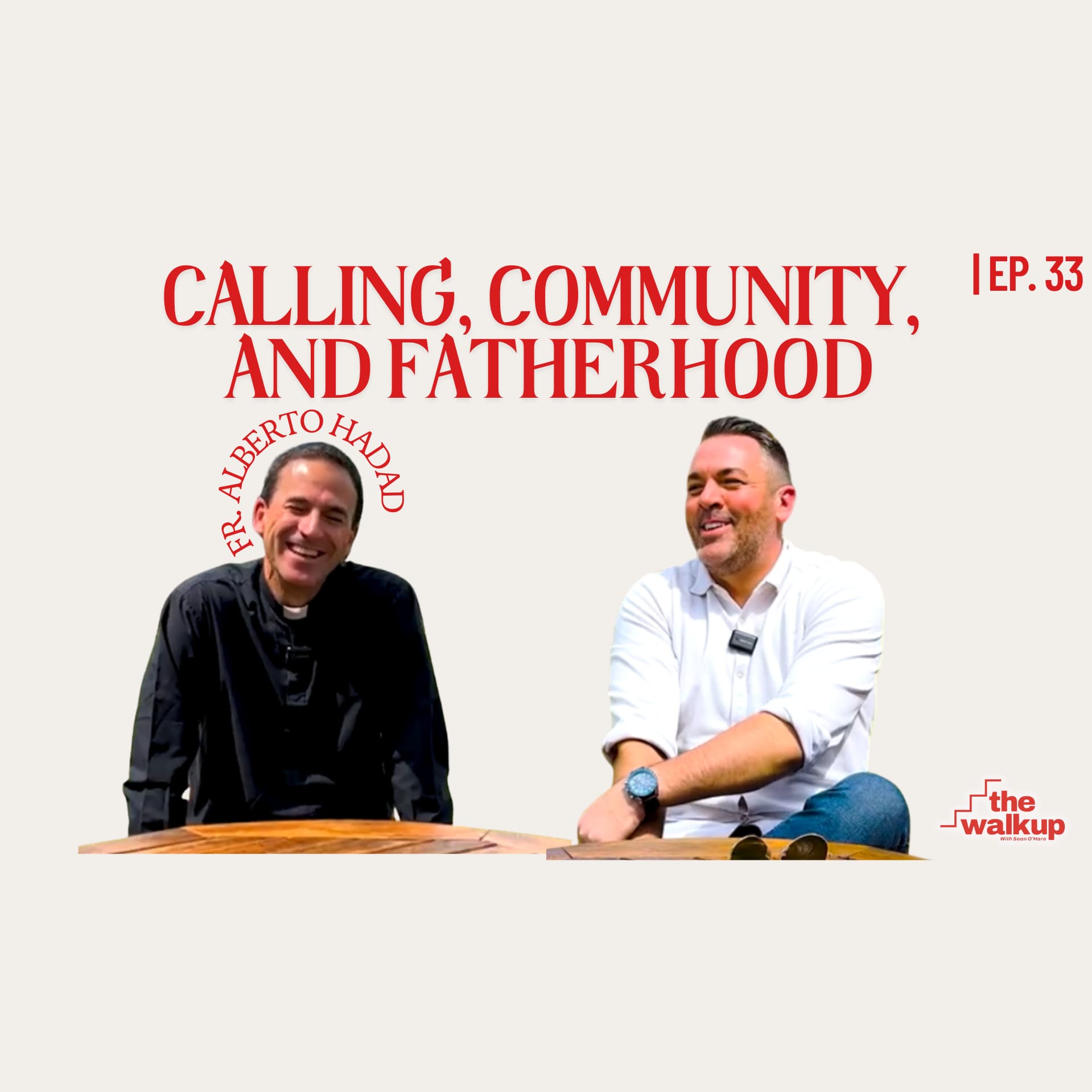
In this episode, we sit down with Fr. Alberto Hadad, priest and director of San José School in Cajicá, Colombia.
Speaking from a country shaped by both beauty and struggle, Fr. Alberto shares his personal journey of discerning vocation, the questions that drive spiritual purpose, and the call to lead through education. We recorded this conversation on-site in Colombia, where his mission continues to inspire a new generation of students to live with clarity, service, and joy.
Transcript
Read the full transcriptAuto-generated · 6,616 words
So, thank you for agreeing to be on the podcast, Father Alberto. I think, as appropriate, we should begin in prayer, if you would kick us off. Absolutely. In the name of the Father, and of the Son, and of the Holy Spirit. Amen.
Heavenly Father, thank you for the gift of your love, for the gift of your Son, Jesus Christ, who gave his life for us in the cross. Help us to bear our daily crosses, to be faithful in our faith, to be open, especially to those in most need, to be sincere testimonies of your love among the world.
We ask for the intercession. In the name of the Father, and of the Son, and of the Holy Spirit. Amen. Amen. Well, here we are at this beautiful school. San Jose, you have been here how many years now?
I've been here since 2008, so that's, how much, 18 years? 18 years? Yeah. And the founding of the school was when? 2008. It was your time. Okay, yeah, because I was confused, because when I spoke with one of your students, you're going to get your students right, because she mentioned, I think she was thinking director versus founder. Yeah, yeah. I'm a director since 2017. Okay. So, when we started this school in 2008, I was involved in... In the border, and I was a theology teacher.
I was not yet a priest. So, I was ordained in 2012, then I became the chaplain of the school and continued also teaching and being part of the board, and then they asked me to be the director in 2017 until now.
For those that don't know, they don't know Colombia, they don't know Bogota, and the Catholic schooling system, and that includes myself, I'm not going to pretend I'm an expert, but in the States, we have kind of the parochial schools, we have some private, independent Catholic schools. I know in Latin America, sometimes there can be support from the States, sometimes there's not. What is kind of the... The educational structure when it comes to Catholic schooling in Colombia.
Well, in general, I would say there is maybe There are three types of Catholic schools. One of those being part of a diocese or a parish and being privately funded for, well, the families paying for tuition. Then there's some kind of charter schools that are public schools, but which are ...administered by specific, either diocese or Catholic communities, and there's also private Catholic schools that have been founded either by religious orders or by a group of lay people that, well, are supported or part of the Catholic Church, and...
For private education. And San Jose would fit into that last category. Yes. So, it started by a religious order, and so you guys, there was a, why was there a need? Was it the growth of this area of outside Bogota? Was it, there was a gap that wasn't being served educationally? Like, what was the impetus behind finding the school?
I'd say mainly it was back in 2016, we had a general assembly of our community, and in 2017, we had a regional assembly for Columbia, and at that assembly, we went through a process of discernment, and we decided that it would be a good idea.
To have a school in Colombia during the next six years. You said 2017. Maybe further back, no? It would have been like 2007. Sorry, sorry. I missed the date. In 2006, then 2007, and that year, at that assembly, we said we want to have a school in one of the three main cities in Colombia, either Bogota, Medellin, or Cali, where the community is present in Colombia, because we thought it was a good place for the development of our charism, and although we're not a strictly educational community, It is part of our mission.
We said it would be a good idea, and so because of the works of this period, next year, we had the first school, and the following year, we had a second school in Medellin, so things worked out pretty quick, and we wanted to serve.
Something that happens in Colombia is that many times, because of the reality of South America and us being Catholic countries in our roots, something that happened along the 21st century, and especially along after the Second Vatican Council, is that the church became like very Related to the poor classes, so many times, like, the upper classes thought, like, well, you know, my children don't need to go to a Catholic school, although I am Catholic. They need to go to an international bilingual school very late, and we thought it was important to serve, like, the churches called it to serve all the people.
Culture, all the different classes, and we thought it's so important to be part of it, or to be a voice in that place where a lot of leaders are formed, and many families that think they don't have a Catholic, bilingual, very faithful school, so we thought it's a good idea to think about a school that serves, and the reality is this school serves mostly People of maybe middle, upper class, because of the cost of our tuition, but definitely with the purpose of, we say we want to form leaders to serve, and to serve as Christ, to be the last ones, to understand that their faith is not for their own, and not only for...
The poor, but for their friends, when they go out and work at a big company, and really transforming their culture. So, that is maybe the goal of being in this, I don't know, segment of society and educating good, strong Catholic leaders. Well, I think you in part answer by...
My next question, which is, I always try to give context for those that might not be as familiar with all of the structures we have in the church or different institutions. Why do we take education, Catholic education, so seriously? And in part, you answer that by saying we are looking to create leaders that are going to be impactful, not just allow them to, okay, read and write and do good in all of the subjects, but to To form the entire person, but maybe you probably could elaborate more on that.
Why is it that the Church has always emphasized education and formation amongst youth? I mean, the Catholic school system is probably the largest non-governmental school system in the world. That's a very big question. Yeah, yeah. But I'm gonna... Maybe like two sentences? No.
I'm not gonna be able to answer in two sentences, but I'm gonna try to be very short and summarize it. The main thing is that the Catholic Church, since its founding, understood that education was important. Because since we have been harmed by sin, the human person needs to...
Let's frame it this way, or say it this way, like refocus, or understand the roots. Where do I come from? What is my calling? What is my purpose in life? Like the essential questions. And so, since the first Catholics and the catechesis, it was about telling them and educating them on what is life.
What is cosmos? What is the whole of reality? And what is your place in reality? And this was progressively understood more deeply. In the 4th century, up until the 4th century with Augustine and maybe Boethius, and they embraced the tradition of the education of the Greeks and Romans, and they said, well, these guys have a good educational system. They were searching for truth, beauty, and goodness, and we have the truth, the beauty, the goodness in Jesus Christ. So, we have to educate the whole person and help the person use all their physical and intellectual and spiritual faculties to be able to understand who they are and what is their place in reality.
So, I would say that Catholic or authentic education is centered maybe in two questions. What is reality? What is everything that surrounds me, not only what I can touch and see and feel and perceive and measure, but the whole of reality, including the spiritual reality, and what is my place in reality? What is God calling me to do?
And many times in the modern times, and unfortunately, a lot of Catholic schools have ended up being very much like a secular school, and they're like, okay, we have to offer... An academic program that is very progressive and very much like any other school, but our children go to Mass and receive the sacraments.
Well, I don't believe that, and well, the church doesn't believe that is a Catholic school, because a Catholic school needs to develop in the children and our students a way of understanding reality, a worldview, and that is what we do in this school, trying to remain very faithful to the educational tradition of the Catholic church. It's funny.
You're going to be surprised, because I'm surprised that I was involved with a, there was a commission on higher education through the Secretary of Education in the States, and I was asked to participate in a study on the post-secondary education.
And I was the, you know, everyone else in there was like educators or PhDs or, you know, officials, and so I didn't really know what role I was supposed to play exactly, but I read all the materials, and it's funny you mentioned this idea of like what is reality and what is our place in reality. I said, listen, I read all your... All the materials and all the statistics, and you did this big, long study, and I said, I noticed nowhere in here does it define what an education is.
So, I really can't tell you whether we're getting closer or further away. I said, is an education to be a good citizen of the states? If it is, that's fine. If this is all about socioeconomic advancement. That's fine. Let's just call it that. But it seems like we haven't actually defined what an education is, so I don't know if we're actually getting closer or further away from the goal. You can imagine I got a lot of confused looks, but I probably have my Catholic education to thank for even coming up with that sort of question.
But I think that's an interesting, this relationship between knowledge of the world, knowledge of self, and knowledge of God. I know I got to work as an advisor a little bit to the projects involved with the Vatican Apostolic Library, you know, and of course, you say Vatican Library and Vatican Secret Archives and, you know, the Da Vinci Code and all these things go into people's minds, but I think one of the things that people were often surprised by was that the Vatican Library had They had manuscripts from all sorts of sources of knowledge.
They had everything they could get their hands on. It wasn't this, well, we're only going to have everything that's a religious book or a Catholic or a catechesis. They had astronomy. They had astrology. They had Aztec hieroglyphs. They had everything. They had the largest collection of 19th century photography. In the world. So, maybe, like, why is it that the church understands that its mission is to understand the world, not simply deliver its, quote-unquote, kind of version of how you should live your life?
That is a very good, deep question. That is all we ask here. We are only deep questions. My very short answer would be, if everything the human person does is culture, if we understand or define culture of all the works of the human person, and if the human person has its Origin and God, being an image of likeness of God, therefore, although there is or there isn't conscience of being deeply or essentially connected to God, to the Trinity, everything the human person does is part of God's plan.
And either very deeply connected or unconsciously connected, if what the human person does is good, or is it searching for the good and the truth, we can understand that there is a participation in the absolute. truth of God or goodness of God therefore the church is constantly seeking for what is authentically human in culture and what are the the seeds of the word, of the incarnated word And that is present not only within the Catholic Church and the faithful Christians, but along all the cultures, and therefore, the Church is not only interested as, okay, I want to, this is something that is cool to understand or to look from a side or from far away, but I want to understand, in that culture, what is authentically human, and what can come in dialogue with the gospel and with the good news that was given us or commended us by Jesus Christ.
Therefore, and... The true cultural evangelization is trying to be in dialogue with everything that is authentically human, which in the end would be authentically Christian or in community with Christ and His Word and His mission. When I have these conversations with people that don't have a faith background or are skeptical of Christianity or Catholicism as an institution, I've often heard their critique.
I mean, you guys are coming in, you're pushing your ideology, especially if you're coming into maybe a poor country or a poor region. I had a friend on the podcast in dialogue with a Haitian priest friend of mine, so it was the three of us, and he was asking, like, so how much of the, when you're... You know, educate, because he said, oh, no, we set up these schools, you know, for the children, and I run one school, then we have this one, the nuns run that one.
He's like, oh, that sounds, you know, good, but how much does that, like, I'll give you an education, but then you got to convert, you know, or like it's, like it's a, you know, a transaction. How do we answer that?
That claim that we're forcing our view of the world on others, why isn't their view of the world equal to ours? Why is it that we feel that we have to catechize or evangelize? Again, another small question. Thank you for those small questions.
Well, the foundation of why we want to preach the gospel and help everyone encounter Christ and His church is not because we desire to do it. It's because we really believe in the words of Jesus Christ, who said, I am the truth, the light, the way. So, he said it. We believe he is God, and him that said, I am the truth, want you, who are my apostles, to go out to the world and preach the gospel.
This good news for every person, because I came to save all the world. So, that's it. And therefore... We could go into a very long conversation about history. Has it been done well? We're here in South American grounds, so we could have the conversation about, was it good that the Spaniards came? And I'll tell you, definitely. It is the biggest gift that we've had.
In our history, because they brought us the Gospel. Was it perfect? No, it wasn't. Therefore, do we have to go back and say, like, okay, we have to withdraw from our faith because there were mean Spaniards that came and took away our gold, which is a very... Simplistic. Yeah, simplistic. Simplistic story that we've maybe heard at school or wherever, but there was a true desire to share their biggest treasure, which was faith.
Were there people who just wanted to make a transaction and take away things from them? Yes. Is everyone perfect in the church? No. Does that make the church not true or not founded by God? No. And that is things that we have to understand, and I think that a good process of guiding a culture which hasn't been evangelized needs to be a process of understanding, of, okay, let me understand who you are as a human person, because if you're a human person, There is good in you, because you are a son of God.
And therefore, I want to understand what things are authentically human, and what things are part of the culture of death, like St. John Paul II said. And, well, those things have to be taken away from your culture. And maybe there is where the gospel needs to come in, which will elevate not only your spirit, but you as a person, the structure of a society, and the culture as a whole. And that is our calling as Christians and as Catholics. Yeah, the response to my priest friend from Haiti.
One way to think about it is, let us say you have an area that is always suffering drought. There is just never quite enough water. They can get by, but it is difficult, and you find a source of water. You find a spring. You want to share it. That is not forcing. That is saying, look, I found this source of water, this source of nourishment, and not only would you want to share it, you would feel an obligation.
Not to keep it to yourself, right? Now, it is obviously more layered than that, but it was a helpful analogy for me, and I am not sure if you know that my oldest brother is a priest. He is a diocesan priest, but he spent nine years in the Dominican Republic. So, I have seen through his experiences these elements of...
There is an economic need, there is a spiritual need, and where the priest plays such an interesting role, especially the celibacy of the priest, right? Which I know is, to a lot of people, very confounding. And I see you, and I see my brother, and I was, after Mass, when I was seeing you greet some of the children and the families, and watching these young kids run up to you and hug you, you know, and it just really, just, it was endearing for, of course, natural reasons, just seeing that beauty and that trust that you have with.
With those in this community, but also seeing the paternity, the paternal nature of the priesthood lived out, and what in this case celibacy can allow you to be a father to many. So, I would just love to hear your perspective on that paternal role.
Of the priesthood, but particularly in being an educator, you are getting to see in a different way than most priests do. When you are out of parish, you see, of course, the children over the years, but you are really seeing a select group just grow year over year over year like your own children. And I see the way that you look at these kids, and I see the way that they look at you. It is very much a spiritual fatherhood and childhood, so I would just love to hear you speak to that.
That is a beautiful mystery, and you really touched my heart with the question, because it is something I reflect upon, and I am very grateful about my vocation. First of all, because I am a man, and... I've been called by the Heavenly Father to develop my being as a man, and be fruitful, and there's many people that come up to you and say, like, well, your life must be, like, so hard, so miserable, because since you don't have a wife, and you don't have children, and I'm like, You don't understand what priesthood is, and right now I have 500 children here at school, and there is a spiritual eternity, because fatherhood is about nurturing life.
I am responsible for, well, together with their parents as primary educators, but I do have an essential role in the development or nourishing of their spiritual life. And therefore, you're seeing children, human persons, be born to... In their spirituality, in their spiritual life, and become sons and daughters of God, in the end, we're educating them. You mentioned being citizens, and I am educating citizens, not only for this world, but for eternity. We are educating citizens of heaven.
And therefore, my relationship with them, it is, in a good sense, what I'm going to say, a heavy burden, a beautiful burden, because I am an example for them, and I am also the presence, and especially in the Eucharist, in persona Christi.
Being Christ, I am Christ for them. I am their pastor. I am the good shepherd. Not because who I am, but because Christ, in His mercy, has made me a participant of His priesthood. And what children see in me is not only Father Alberto, they do see me because... God loves me, but through me, they love Christ and their Heavenly Father in the Holy Spirit, and that is a beautiful mystery and a very big responsibility. No, but I like the way you say the beautiful mystery because, yeah, there's this tenderness that I get to witness.
I'm very lucky. I joke that I have more friendships with priests than anyone who is not a priest. So, it has been a great privilege of my life to travel and see expressions of the priesthood in diocesan, to missionary, to educator.
Different religious orders, the intellectual side, being more service-oriented, being in big cities to small towns, and I experienced that in Peru. The first Nights of Shine that we did internationally was in Piura, which you would know that community. Well, I think that is the question. I think it is the same thing there. Father Eugen is this father to, well, because at his age, maybe now a grandfather, to so many. I mean, and he, as you know, he is a very tall fellow, so he really stands out there in Peru, and just watching, it really just, almost like giving this group.
That is the embrace of his parish. And then, of course, in his case, he's extended that to multiple ministries in that region. But it is a beautiful mystery because it's hard to convey what that tenderness is. And that's really what it is, this beautiful trust in this paternal role that...
these children have in you that the parents have in you and spiritually we have the there's you know the the the order of priorities right we take care of our families than our communities then maybe the you know things beyond us in the state or the country or whatever but it's the the the priest is through his celibacy is then available completely To his flock, right? But to your point, it is a responsibility and can be a burden, because I have seen the other side of the priesthood, too.
I mean, I see the loneliness. I see the stress, sometimes isolation. So, I wonder maybe talking about how community plays a role in your life, because Yeah, those comments that you get, oh, it must be so difficult, you don't have a life, and your own natural children. Where does community play a role in undergirding your role as a priest? In my particular case, I think I was called to be a priest in community.
And that was part of my calling, and it was very clear right from the beginning. Since the beginning, when I encountered Christ, I said, well, if I've been called to live according to His teachings, I need to live this in community. And part of my process of...
Of discernment, of finding what was the path that I was called to. There was a very big question about community, and therefore, I joined a community of brothers. Well, you know, Monsignor Eguren, or Jose Antonio, or Alejandro, or so many brothers that you know, and they are my brothers. And for us, living the joy of the Gospel, Within our household, our family, and being together in a mission, that is so essential. And one other aspect is, well, I'm part of a community that is, most of its members are consecrated laymen.
Right. And so, I haven't perceived that. Burden of isolation, because of my community, because of all the movement around us, our spiritual family, you say, well, most of my friends are priests. In my case, most of my friends are laymen, and for me, it is so natural to be around brothers in Christ.
Yeah, that brings up something that I'm curious to get your take on, is I looked at my experience with having so many friendships with priests as more circumstantial, just in the sense that Okay, my oldest brother is a priest. My parents were always very involved in the church, so we had an ease with, we would invite priests over for dinner and things like that. So, I had a comfort level, and then that is just, I think, naturally extended, but it also caused me just to think more and more about the season of the laity, that there is an opportunity for, you know, maybe for in previous...
For generations, there was clericalism, right? There was too much reliance that, well, the priest will do everything for me, or he does everything for the parish, and one, there was a sense that the laity were kind of handing off responsibility, and then on the other side, there was a temptation of the priest to then think they have too much authority and power and so forth, and you have, clericalism can really backfire. So, what I've been privileged to witness is this co-responsibility, this collaboration between the laity and the priesthood, and here you in a very defined way that you have, in your case, consecrated lay brothers with you.
I'm not a consecrated person of a community, but I have this There is this beautiful community of priesthood, which I am friends with, and we have collaborated on countless projects, and I get the sense there is this, in a post-Vatican II kind of arc of salvation history, if you will, probably losing all the audiences, I use all these insider terms, but I am just curious as to, do you feel that That happening to, I mean, you're having it in a very formal way, but I mean, even broader, this collaboration more and more between the priesthood and the laity, as opposed to perhaps clericalism that existed before.
Well, I understand this sense of collaboration, or this, in theological terms, this... Ecclesiology of communion, which is... You're trying to one-up me on the terminology. Well, this is maybe the big gift of Second Vatican Council, which has been so poorly understood and lived, but in essence, what... St. John Paul the Great, and then Benedict XVI, and well, their predecessors, they wanted to guide the flock, the church, the world to this understanding that if you are baptized, you are called to holiness.
And being a saint is not only for a consecrated person, or for a priest, or for these first-class Christians, but for all the members of the church. And therefore, when you understand and you have this theological understanding, it is very clear. That there's no hierarchy or some first class or second class or third class members of the church, but we all are sons and daughters of Christ called to develop ourselves in our vocation, in our specific calling, and to be and to serve each other.
Because every Christian is called to serve as Christ came to serve us. Yeah, and I think of it as you have a tool set that's specific to the priesthood, and then, of course, to your own charism, your own gifts, right? So, I can't celebrate Mass, right? So, that's a tool that only the priest can provide, or a gift that only the priest can provide.
But it is not for me to then reduce my own responsibility or to hand it over to some sort of sacramentalism of, I say in the, sometimes in New York City where we can have, you know, daily mass can be like 22 minutes, or like even a Sunday mass can be like 45 minutes.
We're very lucky to have so many churches in New York, and also opportunities for confession all the time, but it can feel a little bit like, I say, a sacramental dispensary, like, okay, here you go, you're forgiven, here's some, you know. Part of that is just the busyness of the city, right? But there can be this over, not reliance on the sacraments, but a sense that I'm just going to get in and get out, and that's all I need, right? So, I wanted to ask you also, because of the reason that I've been here, is because of San Jose's adoption of the Night to Shine program from the Tim Tebow Foundation, and I can't remember if it was Alejandro or Enrique that connected me with you originally.
It was Alejandro. It was Alejandro, okay. And I was saying on a previous interview, I don't think I finished pitching the idea before you had said yes. And so, you fully embraced it here, hosting the Night to Shine.
Right here on campus, two out of the three years. The only time we did it, we did it in different locations because Tim himself was coming, and we wanted to really have as big a celebration as we could.
Hi. Hola. Hola. ¿Cómo están? Vea cómo está su hermano. What about yours? What about Agustín? How is Agustín's brother doing? Really? Hey, but you guys got disorganized. Wow! I turned 4 years old. I was hospitalized in Germany, and they operated on me, so now I'm in my little house. You're in your little house? Oh, that's good. But look at that, look at that. And you know what? I turned 4 years old, Father. Hello. Congratulations. I turned 4 years old, Father. I'm already here.
What? And I'm already 10 years old. What's your name? I don't know you yet. Hello. Hello, Father. María Ángel. Wow, what a beautiful name! And this is Salvador's birthday tomorrow. Well, there you go. And what about this little thing? And what about this little thing? It's almost your birthday! Congratulations! Yesterday, my brother's birthday. Wow! And what about this little thing? This little thing is because they say that I am a priest, so that they realize. This is the priest's neck. No, this is from here.
The hard white one. No, this is from here. This is from here. Can you do me a favor? Can you tell Andrés that he is going to the parking lot? It takes me a little bit of time, because I have to get there at 11 o'clock. This is my little thing.
Ah, this is a microphone, because we are here in an interview. Well, bye. No, it's okay. Uli. No, it's perfect. Hello, Uli. Well, you met Juliana. Yeah, I think I might have the answer to my question. Which is? As to why you wanted to be involved with Knights of Shand. So, yeah, Luciana was saying...
Yeah, Luciana was saying that you have made an intentional effort to be... I think it is very inclusive in the squad, and again, almost like we scripted it, the Juliana, who... Just in case we didn't script it. It was not planned. We didn't plan this, everybody. That Juliana there, who is down syndrome, just comes right in, and she is clearly 100% a part of the community.
So, maybe let's talk about that, like your desire to make this school inclusive, and then how you saw that kind of exemplified, or an opportunity to demonstrate that in a different way with Nights to Shine. Well, when Alejandro first called me and told me about you, and we had our first meeting.
I think I said, I'm in. I usually need to sell it a little harder. I think there was no resistance, or tell me if I'm wrong, but we had no resistance at all. We had some questions, but it's like this really fits our mission, or is in communion with our mission. And why are we inclusive?
Because education is about the dignity of the human person, and a person with special needs has the same dignity as any other person, and we want to make it palpable, like you can touch it, see it. And we would, children, not tell them about, well, you've got to respect children or people with special needs, and they've got to, you've got to take care for them, but Juli is your sister, period.
So, how are you going to teach about human dignity before birth? Why is she... Why does she have the same, exact same right to be born, different to a person who doesn't have the same number of chromosomes, because it goes down to that. And so, when you say, when you have like a discussion about is abortion okay, or in what cases, When you take the conversation down to, is it okay to take away the life of Julia? No, no, no. She's my sister, period.
So, then any person that even before birth, we know is going to have special needs, a disability. Well, they have a dignity, and it is so beautiful because it is, many times I feel like it's not we're serving them, but they are serving us, and helping us to understand what reality is because of their heart and because of their perseverance.
Well, yesterday, we have one of our students who is part of our inclusion program. His name is Juan Felipe. He is a 10th grader, and two days ago, we were talking about him, and it is like when you see him, he is so good. He is such a… A good, solid young man, very childlike, and very pure in his heart, that we say, like, it seems like he doesn't have original sin. He's too good.
An angel, yeah. And they help us so much. So, I think that's part of it. What do you say to people that would, they'd be like, well, what? Okay, fine, we should embrace and be part of the community, but doesn't it slow down the other children here? They are trying to learn, and some of these kids are not at the same level.
Aren't you depriving them of a better educational environment? Yeah, that is a big question. That is always a question that pops up once and again. I really believe that children, you're not going to water down what you're doing.
There's a big effort on having an inclusive classroom, because it's not just, okay, all of you 19 children, you're going to study, and well, you can draw, and you can be, you're okay there, as long as you don't bother us. No, it's not that way. Well, you can learn what we're learning at your pace. You're going to have to have more help, and maybe even the children that are smarter or have less difficulty with a specific subject can go and explain, and many times when you go back and have to categorize what you've learned and teach it to others and help others, That doesn't stop you from learning.
It even helps more. So, I think that's a total mistake to believe that an inclusive school is a school where smarter children will be slowed down. I definitely don't think that is true. And then, with the Knights of Shine being a… It is a public event in the sense that, obviously, your school community here is, you know everybody, but you are inviting people from all over to participate in the Nights of Shine, and on your campus. So, how did you see, I mean, in some ways you, well, not in some ways, you have been preparing.
So, what was the experience like for you watching them then be in a public environment in which they're welcoming not just those that are included in their own school, but even beyond into the wider community? That's a matter of great joy and being very proud of our students and what we've done.
Because you can only measure the quality of your education when you see your students being who they are, not performing, not following a script, but being who they are, and I think you have been a witness of our students. They're on fire for serving, and they're like, hey, man, and when we open the spots for volunteering for Night to Shine, it's like, one day, period, it's over. You didn't sign up, there's, sorry, like, there's no more spots, because, and that's a very big joy, and I see that they do it very.
On one hand, naturally, and sincerely. Yeah, very sincerely. Well, I think this kind of encapsulates a lot of what we discussed today, which is the education of the whole person, right? Inclusivity, and then you as a spiritual father getting to see the fruits of...
Of your paternal instinct and the education and formation you provide. Because like I said, you can be accomplished and smart and know how to do a lot of things in the world, but there is a different type of wisdom that you are instilling here about compassion for all. For people in every stage of life. And that's a gift that, you know, hopefully people get in their homes, but when they get in their homes, and in their school, and in the church, it really, that's, I find, is the magic formula, because now you're really getting it reinforced.
It's not one person telling you, it's not just my parents telling me to be this type of person, or it's... It's the friends, it's the parents of the friends, it's the educators, and this consistent message, and then hopefully, by the time they leave the nest, right, they've taken ownership over it. You're not drilling into them, they have to eventually take ownership over it. Well, it's been a beautiful gift to be a part of the San Jose community, even if… From a distance.
You are part of our community. You are. I am the New York campus, but I am just excited for the Night to Shine again here in just two days. I am sorry, I will be in Medellin to see the continued expansion. The Night to Shine is now 800 locations, 60 countries, over 400,000 people. It just keeps growing. I am only a small part of it. I get very lucky to be able to travel and see the different flowering of this desire to serve others and to bring those with disabilities into full community with us.
So, thank you for your witness. Thank you for this beautiful community here, and I wish you all the best going forward. Thank you. Thank you, Sean, very much. God bless you. God bless you for your mission, for your service, and we truly believe that you're part of our community, and so thank you very much. Thank you.
More from The Walkup

Against the Odds: The Samurai Lawyer (Chad Flores) | Ep. 52
Faith, Sexuality, and the Fog of War (Iris Bahr & Father Rick Riccioli) | Ep. 02
E2
Church, Conflict, and Community (Iris Bahr, Father Rick Riccioli & Rob Long) | Ep. 03
E3
Hope, Vocation, and the Global Church (Colm Flynn & Colin Nykaza) | Ep. 04
E4