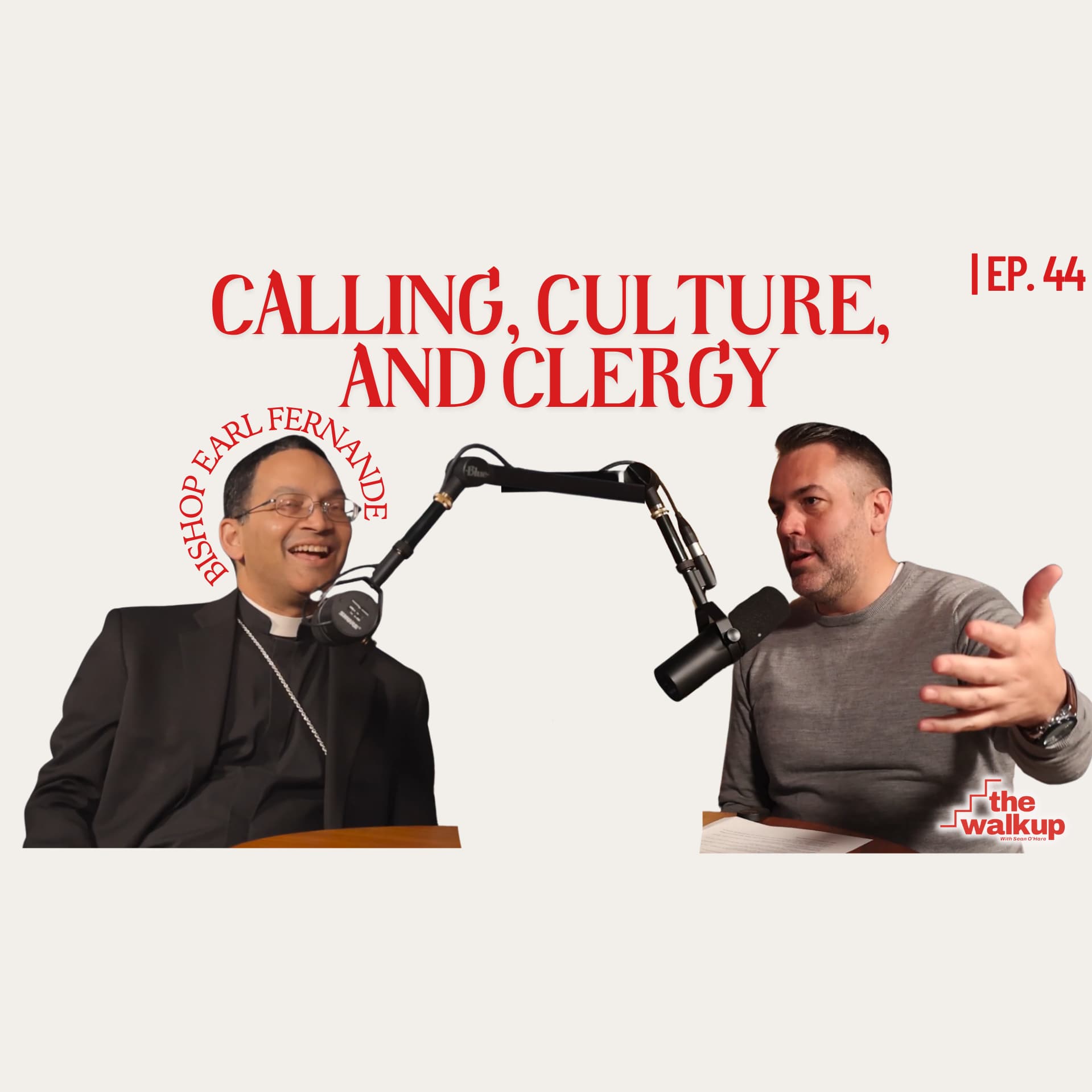
Bishop Earl Fernandes of the Diocese of Columbus joins The Walkup for a candid conversation on the future of the Church and its mission in the digital age.
We explore the Church’s unique opportunity in a world dominated by social media, the rise of young Catholic leadership, and the vocation crisis reshaped by innovative outreach. With both pastoral depth and cultural awareness, Bishop Fernandes reflects on faith, family, and the spiritual hunger of a restless generation.
Transcript
Read the full transcriptAuto-generated · 10,333 words
Bishop Earl Fernandez, welcome to the Walkout Podcast for the second time. You were here a month ago, but in a different location. Same sign, though. Same sign, different location. It is not quite the Batman sign-off, but yeah, so very honored to have you again, and I know we were very fortunate that you happened to be visiting Fordham University, or I guess the law school, because the proper university is up in the Bronx. Right. But they have a conference nearby, which... It tends to be, or it happens to be only a couple blocks away, so this is the magic of New York City, is that I always tell people that one of the wonderful things about New York is that you just stay in one place, and everyone just eventually comes to New York at some point.
So, Bishop of Columbus, Ohio, I think I want to start, I was going to start with kind of bio and how you became a priest and what the process is of becoming a bishop, but you... We stumbled across this phrase in leading up to beginning of the recording, which is spiritual entrepreneur, and I am fascinated by that. So, why don't we define that and get into what that means.
When I first became Bishop of Columbus, I met with a guy. He unfortunately passed away about a month ago. His name was Don DiPero. He was the head of the Columbus Chamber of Commerce, and I wanted to just get to know people in the city, people who can make things happen, people who know other people. And so, when I had been a seminary professor and academic dean of a seminary in Cincinnati, we used to tell our seminarians, look, You need to be spiritual entrepreneurs.
I said, Don, here is the thing. No one ever actually asked us, what does that mean? If I were to ask you, what does it mean to be an entrepreneur, a spiritual entrepreneur? And you say, well, look, the first thing is an entrepreneur has to have a vision.
Where is it that you want to go? And for us as Catholics, the vision is given to us principally by Jesus in the New Testament. What is your vision? And for me as a bishop, what is the vision for the Diocese of Columbus? But sometimes you have people who are visionaries, but they're not really good at detail. I happen to be a micromanager. But most times you have the big picture people, and then you have the people who help make that vision a reality.
They know how to surround themselves. With people whom they can get to buy into the vision and who can make things happen, people who are detail-oriented, people who can plan and do strategic planning, those sorts of things, to make the vision a reality. So, you need the vision, then you need the personnel surrounding you because you cannot do everything, and oftentimes, having other perspectives and other gifts and talents are great, and the entrepreneur has to help those people develop their gifts and talents.
So, the third thing is an entrepreneur has to have initiative. Right, you know that there are other people out there in the market who are competing against you. You have to have a great idea. You have to be able to sell it to people. You have to be able to be on the edge and to be willing to take some risks. Pope Francis talks about taking the first step, showing initiative, being a church that goes forth out of your comfort zone with respect to evangelization.
We need to do that. So, I use the example of… What would it be like if priest salaries were contingent upon the number of converts they made, the number of baptisms, the number of confessions they heard, weddings, and so on? Performance-based. Yeah, priests would be knocking on doors all the time, right? We need to have some initiative. We can't just sit back and wait for people to come to us. We have to go out to find them. In addition to this, then, initiative, right?
A spiritual entrepreneur has to be a person of integrity. People don't want to work for the slave driver, the people who treat them like dirt, who just makes more and more demands, and who doesn't develop their gifts and talents, or who's dishonest. Right? They want to work for someone who's virtuous, who's a true leader, a person of integrity, who's not hypocritical, who can appreciate the work they do, who says thank you from time to time, and affirms them, and helps them develop their gifts to help them go to the next level.
And finally, Don said, well, an entrepreneur is someone who's a servant leader, and I kind of rolled my eyes. You know, I was in the seminary in the 90s, and when I heard servant leadership, I thought, ah, that sounds like something from the 70s. And if I said it to my seminarian, he says, hell, Bishop, that sounds like something from the 90s. He said, basically, Bishop, what it means is you're willing to sacrifice yourself before your employees. This is what Jesus did.
He laid down his life for us. And I thought about my best priest friend back in Cincinnati, Fr. Jamie Weber. Father had a machine tool part company called Positrol, very poorly named. Anyway, but during the Carter Ford years, they struggled to make payroll. Right. But what his dad did is he took out his family savings, and he had eight kids or nine kids, and took out his family savings to pay his workers because he knew that they had families. And so, it was a sense of sacrifice in order to make the whole enterprise happen.
So, Don gave me these kind of his ideas about what an entrepreneur is, and then we can apply those same ideas spiritually. And so, I... Preached about this at SEEK 23, so January of 2023. Maybe just describe for people what SEEK is, because it is a pretty amazing event. Yeah, so SEEK is put on by the Fellowship of Catholic University students. It is an annual gathering.
The last year was in Salt Lake City. The two previous years, it was in St. Louis, in the Dome. So, you had 20,000 young people there at Mass, on fire with the faith, and I preached about that. Most people would be shocked that there are 20,000 young people. Much less 20,000 that are all willing to travel to St. Louis and are just completely... They travel to St. Louis, they raise the money for the conference and their hotel and accommodation, and they're there and they're committed, and it really is, because we tend to think of the Catholic Church as being a church of the elderly, empty churches, empty pews, closers, mergers, consolidations, but here you see people on fire with the faith, and it offers us hope.
And it does for me as a bishop. So, I preach about being a spiritual entrepreneur, and people stop me in the airport. Hey, aren't you that bishop from Sikh? Didn't you talk about this? Because it resonated with young people, like they're looking for...
Leadership, they're hungering for it. They want to be led, and they want to be challenged, and they want someone who will take them to the next level, because they buy into the vision, and they think, I have these talents, I have these gifts. I think about one of my frustrations, one of the reasons maybe I became a priest, was I think about the potential of the Catholic Church for great good in the world, and what we simply do not do, because we are lazy.
The bane of the church is lazy and ignorant priests, my old canon law professor used to say, and we sit back because we're part of an organization that has a structure that's moved through history when we could be showing real initiative and making a concrete difference in people's lives. Well, from your lips to God's ears, I mean, to hear a bishop say that the problem and one of the challenges of the church is that we're lazy.
Thank you for saying that. I mean, that is a bold thing to say, and to be someone in the office that you hold. So, but what is that, when you mean that, like, so one of the things that I try to explain to people, because I think they see the institutional nature of the church, right? And part of that is because the church was very, has been entrepreneurial throughout the centuries in various ways, right? Developing the university system, the hospital systems, ministries, but then eventually over time there has become...
And then we think, oh, well, the institution will take care of it. And then, almost inevitably, those institutions become less and less Catholic in mission. Not only various apostolates in the church, but even what people call the institutional church, the structure, the bureaucracy.
You know, which in the United States is damaged because of the clerical sexual abuse scandal, so let us name that, but also because of mismanagement of funds or diocese, whatever, and mergers and closures of parishes, which people need a focal point for the anger, and very often it is the institutional church. You close my church, you close my school, bishop, you do not know us, all those sorts of things. Okay, but that is not the church. The church is a mystery.
The church is the mystical body of Christ. The church is all those people in the pews. Mm-hmm. And all those people, religious sisters, laymen and women, who are doing great things every single day. Feeding the poor, housing, giving housing to those who are homeless or migrants, and welcoming them, who are running the hospitals, who are ministering to the sick. I mean, this is the church that I know and that I love, but also the church of the saints who have gone before us, whose model of holiness serves us even now, and whose prayers help us even now.
So, we're a church of sinners, not saints. I'm not for a perfectly pure church, right, because we are a church of sinners, but we're on a pilgrim journey. Yeah, I can say, okay, well, people are lazy, but they're not. I mean, there are many people doing great work. People do what they can for a time, but people should think about, what is it that I have to offer? And the priests, for their part, for their leadership, should invite the gifts.
of others to assist them in the work. Someone once asked Cardinal Newman, what do you think about the laity? He says, well, I think we'd look rather foolish without them, and it's true. Preaching to no one. Right, it's true. So, we, and this is what Pope Francis and Pope Benedict and Pope John Paul II talked about, co-responsibility. Right. And we think about the institutional church, and so often we're focused on maintaining what we have, but the Pope calls us, Pope Francis calls us to move from maintenance to mission.
The mission of evangelization, or what he often speaks of, and you see this in the Aparecida document, which is the document that the Latin American bishops put together after the Aparecida conference in 2007, of which our current Holy Father was the ghost writer for, principal author of, pastoral conversion of structures for the sake of mission. There are certain pastoral conversion of structures for the sake of mission.
It is why we do not necessarily have a dialysis and TV station anymore, but we do podcasts. Right, right. The culture around us at times, we have to adapt and be attentive to the signs of the times. And what about, so what do you think has, when this, Say, a spirit of laziness or a lack of entrepreneurial vision seeps in. Is that a problem formation? Is that a problem of just kind of institutional mission creep?
Or do these things just occasionally need a revival or a resuscitation? They occasionally need a revival, and that sometimes happens through the power of the Holy Spirit, whose first work, Catechism tells us, is conversion. But priests are very busy. You used to have four or five priests in a parish. Now you have one for the same flock. So, that is one thing. Then you have to get a lay staff, but you have to be willing to pay a professional staff to get some things done, or have very, very committed volunteers.
So, I think... Who also have the skill set necessary to make the vision a reality? So, sometimes it's that, but sometimes you're so busy, or you're just doing what you've been doing every single year, and people come up with great ideas. Well, we've never done it that way before, and that is the death knell of every parish and every institution. We've never done it that way. Well, could you think about how you might do it a different way? Because what you're doing is not working, right?
If you're still printing, people are still printing hard copies of diocese and newspapers. But all the young people get their information on the phone. What are you really doing? You are printing, oh, well, we are printing, the information is in the bulletin. Nobody picks up the bulletin. Right, or I was in a big parish in Cincinnati before I became a bishop. We had 1,160 kids in the elementary school. We had 3,000 families. People there didn't believe in using email. They didn't believe in, you know, we got them to use a QR code.
We got them to use email, QR code. They had no social media presence. I was doing things on my own private Facebook page until we could get a... You know, YouTube channel and things, and this was very primitive, but even to pay tuition, you had to write a check. Wow. You could not do direct deposit from your bank. You couldn't use a credit card. None of that. I mean, it was just crazy to me. Like, you can't take a little step to make things easier, and I don't want to make an indictment of there were good people working there, but from a completely different generation.
Who didn't understand how life has changed? And Pope Francis says, we live not so much in an epoch of change, but in a change of epoch, or change of era. And what does he mean by that? It's like every 500 years or so, you... We experience epochal change. For example, when Columbus discovers the new world, and there is all this development, trade, and all these sorts of things, or the industrial revolution. Well, we are experiencing, we have experienced, a true technological revolution.
People are more mobile, they are more connected, and it is affecting the way we live, it is affecting the culture. So, we have to be aware. It is not just that it is changing, it has changed. And if you do not understand the environment in which you have evangelized, Then the things that you've been doing for years and years, when they're not working, you don't have the perspective to see they're not working, or you haven't really thought about where do we really need to be 5, 10, 15 years from now.
Yeah, and we were talking about a friend in common, Father Bob Steck, who was mentioning to me his desire for... How do I reach people between Sundays? Is there some sort of virtual pastoring that can be done? Now, in a meaningful way, not just in a, well, I send you text messages or to my parishioners, but if between Sundays, the average parishioner is consuming... Dozens, maybe even 100 hours of content in various forms through that, and we're not present. So, one first thing is, there are a lot of places where this type of podcast or what Word on Fire is doing, Busted Hail, all those groups, they can reach a wide audience.
It is happening to some extent, but other people are looking for this, and in the Synod on Youth, young people said, we don't just want to meet the church in the church building. We want the church. Come out to us where we are, and some of that is in the virtual world. Now, we can't be virtual forever. We hope that that then leads to a fundamentally human encounter. Reincarnational, yeah. Right, but can we go where they are? And you see this in charismatic groups.
You see this amongst Hispanics, especially, Spanish speakers. But, so we have to be savvy as to how we, but we also have to be attentive and vigilant. Not everything that's out there in the virtual world is actually. Good theology, good pastoral, spiritual practices, and so we have to have well-formed people who are the evangelists and who are willing to go into this kind of new, the new media.
Yeah, and I think what the opportunity that could present itself is that As you mentioned, it has already shifted in terms of the way in which people consume and interact with technology and communicate with one another. But the parochial model, I think its wisdom, right, is that ultimately we are meant to be in local community, that principle of subsidiarity, right? We're not meant to live in a digital environment, but to be in person. Yeah, so some years ago, and she actually presented at the New York Encounter about a month ago, there was a woman, Sherry Turkle, at MIT.
She wrote this book, Reclaiming the Conversation, and she had written a book before that called Alone Together. And she talks about, like, for instance, The overuse of technology. That is, people within families, they can't control their emotions, so they text each other, so they don't lose control of their emotions. Young people, they go to parties, but they don't actually experience the party because of FOMO. If you're missing out, they're looking for the next best gig to go to. Because people are so much in the virtual world, they're not used to dealing with others in real time, which has great implications for job interviews, but even for courtship and dating.
And so... Well, technology can be a good tool, but we need to recover something of our own humanity, which we are incarnational. We do need to be connected, and I think young people are looking for human connection, particularly following the pandemic, so that the virtual cannot go on forever. And the Holy Father said something like that, you know, these virtual encounters are good, but watching Mass online or on TV is not the same as being together with the worshiping community. And receiving the Lord in the Eucharist, making a spiritual communion is not the same as receiving the body and blood of the Lord.
So, technology can be a tool to facilitate, then, a human encounter, which can also facilitate the encounter between the human and the divine. And that is how we maybe can begin to look at the use of technology. What is interesting to me, and terrifying at the same time, yet it also represents an opportunity, is AI. And the Holy See, in January, released a document called Nova et Antiqua, or maybe it is Antiqua et Nova.
Old and new about the uses and positive uses of AI, but it warns in many fields about AI essentially replacing human relationships, AI in the field of education, thinking that somehow a screen or a virtual teacher is better than the... Teacher-student relationship and educating the humanity in that way. AI in the field of healthcare, because sometimes you can look at things only in terms of finite resources rather than a patient who needs to be accompanied. All of these sorts of things.
So, artificial intelligence is here, and it is going to expand, but people being unable to distinguish, and this is truly even in relation between some... Humans who experience things, and a machine, a linguistic algorithm that mimics real conversation, real emotional empathy, and so on and so forth. Turkle, in her book, talks about that, like with, at that time, likes and dislikes on Facebook, trolling people.
We don't see how the other person reacts at a human level, how we've hurt them, or we tend to get our affirmation only from how many likes we get or how many followers we have, and so she makes the claim that it's diminished our ability to empathize, and people are looking for empathy and compassion, yet we live in what is seemingly a more and more judgmental society.
Yeah, and I think that therein lies the opportunity of the church, I think, because the parochial model, we've built the brick and mortar, so to speak. We have these places to gather. Okay, we should use the tool sets to be able to engage communication-wise, like you say, just the practical example of, hey, listen, people aren't picking up a bulletin anymore. They want to receive it on their smartphones or whatever. But ultimately, there could be... We were talking before about spiritual entrepreneurship.
There could be a competitive advantage that the church has, which is that we know how to do this. Absolutely, and so this is actually one of the reasons why I believe a lot of young people are falling away, is because, you know, Jesus says, he who hears you hears me, or my sheep know me, you know, they hear my voice and they follow me, right? But there are other voices out there now through the use of social media.
To whom people listen to on a variety of social and moral issues, but even on religious, you know, fundamentally religious matters also, and that's what our young people are filling their minds with rather than the word, capital W. And so, there is a tremendous opportunity, but if we don't seize the opportunity... Seize the day now. It will be far too late. That train will have left the station, and it will be long gone, and that is really what is happening. When Bishop Barron speaks about the so-called nuns or the religiously unaffiliated, 50% of those baptized Catholics under age 30 practice no religion, but half of those by age 13.
So, we need to reach them at a younger and younger age in our formation, our parishes, and our Catholic schools through the use of this media where they are before they start, you know, I use a phrase, drinking the Kool-Aid.
No, it is a big challenge. I think, how is the, so these kind of spiritual entrepreneurial ideas that you have, you have a very, you know. A vision for, I imagine, for your diocese. How are you received when you're going around? We talk about the institutional nature of the church at times. How is it received when you come in with like, hey, we got to do more, we got to do this, we have to have a fresh approach? Or is it received with, oh, thank you, finally?
Or is it, hey, I'm not really looking to change here, Bishop. Change is difficult for everyone, so I'll say that. And some of the changes I have made, for example, at the Ohio State Newman Center, were met with great resistance and anger and so on and so forth.
So, change is difficult, and I understand, and we talked about this at this conference here at Fordham in Fratelli Tutti about the need to be rooted, and many people feel uprooted because everything is changing all around them. Their communities, their neighborhoods, they feel uprooted from any sense of a tradition or belonging anywhere. So, we have to acknowledge that.
Before I arrived, Bishop Brennan, Robert Brennan, who is now Bishop of Brooklyn, he had engaged Catholic Leadership Institute, which led us in pastoral planning, what was known as Real Presence, Real Future, and basically, they were looking at the number of parishes we had. There were 115 when I arrived in Columbus two and a half years ago. We have 90 parishes today. The number of parishes that needed to close, and CLI recommended 32 parishes actually be closed. They looked at the number of priests and their ages and so on.
Right. And there was going to be a huge, huge retirement thing. My first year, then, at the end of my first year, I made decisions about which parish I had to take a decision. After listening to the lay people, the recommendations that I listened for a year, I had priests and lay people advising me, and then I made a decision, got a little lucky here or there, we only had to close 16 or something. So, we, at that time, That same year, at the end of the year, I accepted the retirement of all my priests who were over age 70, but I had 13 of them, the oldest of whom was 86 and still a pastor.
Wow. So, that let us know where the lines are on the playing field, but when I became bishop in May 31st, 2022, after the ordination, I made remarks at the end. I said, look, this year in the Diocese of Columbus, there are more bishops being ordained than priests because there were no priestly ordinations that year, and everybody sort of chuckled. Well, then I said, no, I am serious. Right? Mother Teresa says, the priest brings us Jesus. And so, I said, I have two priorities, vocations and evangelization.
Well, in two and a half years time, we have gone from zero ordinations. Last year, I had five ordinations. We have gone from 17 seminarians to 40. Whoa. In two and a half years, how do we do it? By making it a priority, by telling people about it. I have a great vocation director who went out and got younger priests in different regions, because we have 23 counties in north central Ohio, to kind of be mentors and to run these discernment groups called the Melchizedek Project, where it is sort of like a book study every week about discernment and priesthood, and they get together with young men who are discerning, and people are coming.
Getting priests and religious back in the high schools as chaplains, teaching, so they have the day-to-day presence of the church. ...accompanying them, making the change at the Ohio State Newman Center in order to have diocesan priests there who might encourage people to consider vocation as a priest in religious life, and we have gotten five guys into the seminary already. Wow. So, there is tremendous potential. There, we have even had one young woman who made a religious profession with the Bridgetine sisters.
Is that what we've seen, this impact in vocation? But then I have to go out and say, okay, now I've got 40 guys I need to pay for a tuition room and board, so that's added more than a million dollars to our vocation budget annually, so I have to go out and raise money for that. But that's a good problem. Sure. To have the same thing with evangelization efforts. If I have the priests who are boots on the ground, Part of the role of the priest is not just to bring us Jesus through the sacraments, but to animate the lay vocation so that we create new evangelists.
So, within the diocese, then, we also have a lot of Catholic lay apostles. What do I mean by that? Well, we have the Catholic Youth Summer Camp, Camp Damascus, which fills 10 weeks in the summer. Oh, I've heard about Damascus, yeah. You know, fills up right away. We have...
Urban encounter ministries, which goes and embeds themselves with the poor, and they pray with the poor in the air, trying to bring them to baptism. We have hard-as-nails evangelization, which used to be in the Diocese of Syracuse. Now, they're headquartered in Columbus. They're basically like pre-evangelization. Right now, they run an apostolate to our high school sports teams, like chaplaincies, trying to keep them engaged with faith, not just sports, mind and body, and soul. But also, they want to build a gym, and then go work out with people and approach...
about faith, about spiritual things, to bring them toward baptism. Then we have FOCUS, Fellowship of Catholic University students. We have eight FOCUS missionaries on the campus of Ohio State, which is a huge university, but a smaller university, Ohio Northern University. We put four up there.
At Ohio State this year, there are 49 people coming into the church at the campus ministry. Ohio North, in the previous five years, they hadn't had any converts. This year, they have 13. So, peer-to-peer evangelization, young people. So, I just had Ash Wednesday Mass. At the one Mass I had, there were 1,000 at the Ohio State Student Union. We couldn't even hold it at the Newman Center. But they average now 1,100 students coming to Sunday Mass, but 400 of them are engaged in some type of Bible study or evangelization, faith formation.
So, the members are being engaged, and then they engage others and bring others to the Lord. I can't do all the work, nor can the priest do all the work, nor are we meant to do all the work. There has to be a co-responsibility. So, we see the impact amongst the Spanish speakers. We have the Misioneros Sabedores de la Palabra, and our Spanish-speaking population grew 20% in just one year. In the diocese? In the diocese. In one year? In one year.
This year in the diocese, I have done as many Masses in Spanish as I have in English. There is a small town, Dover, Ohio. It is closer to Akron and Canton than it is to Columbus, actually, but it is in my diocese. There are 19,000 Guatemalans in Dover. My goodness. 19,000. So, I went there for the Feast of the Baptism of the Lord, had Mass for 700 Guatemalans. I met with their leadership, their lay leaders. They have this house of prayer.
They told me there are 19,000 of us. We have a priest up there who speaks Spanish. Then, and there are no other Spanish services in any denomination in that whole county. And then I went back to do confirmation, 61 Guatemalans I confirmed. At the neighboring parish, I also confirmed 26 Anglos, you know, but still, they're in our parish after parish after parish.
But in Ohio, we're blessed, too, because we have these lay apostolates, but we also have our Catholic school system. So, Cincinnati is the fifth-largest Catholic school system in the United States. Cleveland is the sixth-largest. In Columbus, we're smaller. We only have 19,000 in our Catholic schools. We have 50 Catholic schools, 10 high schools. In the late 60s, the Catholic Church worked with the state leaders, so we have state-funded busing to our Catholic schools, but also, we have universal vouchers. Okay. It is on a sliding scale according to income, but we are able to get the Spanish-speaking immigrants, but also, we have a lot of African immigrants coming, and they are Catholic, and they have large families, so we are able to get them into our Catholic schools and evangelize them that way.
So, we are doing all these sorts of things. We have good superintendents and assistant superintendents. We're getting our financial picture in line for our Catholic schools to make all these things possible and more possible to increase, you know, the Pope wants an inclusive church, and we're now being able to give opportunities to these young people so that they stay Catholic and so that they, we journey with them and they journey with us because they're the future. And I keep telling people because When I became bishop, we reported 278,000 Catholics.
After one year as bishop, we reported 344,000 Catholics. After two years, we reported 505,000 Catholics in Columbus. And I wish I could say, oh, that is all a function of our evangelization. Is that a reporting issue? No, no. It is really a couple of things. One is migration, but that is only a small part of it. Columbus is the fastest growing city in the United States, even faster than Austin, until Biden came to New Albany to sign the chip bill just north of Columbus.
Well, Intel is building its big new plant then there, and Meta is there, Microsoft is there, Amazon is there, Eli Lilly is going to expand, and the governor just announced a big arms manufacturer is going to build a big plant just south of Columbus. So, people are coming there for work, plus you have the… The Ohio State University and all the research going on there, but then you also have the state government. The Capitol is there, and we have good relations with our legislators, our governors are practicing Catholic, our senators, we have good relations with them, and our representatives.
So, we work with the politicians for a constructive politics to try to get some things done, but the people in the community Columbus One Group, a New Albany group, they have been very entrepreneurial, and they've worked with the state legislatures and the governor to lure businesses to Columbus. So, people are coming, and I don't want to be reactive and overwhelmed. I want to be proactive. So, while I said, yeah, we have closed or merged 16 parishes now, all right, Part of that was for the sake of the mission of evangelization, right, to streamline the efforts, and are some people hurt?
Do some people leave? Do they not find a new church to go to? Yes, and so that weighs on me heavily, but on the other hand, I can't kill my priests either, right? I can't keep asking them to drive to four or five parishes to say mass for 20 and 30 people.
So, how can we better use our resources? Again, for the sake of the mission of evangelization. So, even as I am closing those, I am right on the verge of building a new high school and two or three new elementary schools. Fantastic. And my Catholic school enrollment is 90% of capacity, and 30 out of 50 of our schools have waiting lists.
So, again, we have a tremendous opportunity. It's not all loss. It was called Real Presence, Real Future, and now I want to talk to people about what our future is. Where are we going? What is the vision? How do we minister to all these people who need God in their lives and who need Jesus Christ in particular and who need the sacraments? How can we prepare for them? How can we welcome them and include them in the life of our church, even with the immigrant communities, right?
So, I have a Swahili-speaking community, a Ghanaian community, a Nigerian community, an Eritrean Catholic community. Right. And Anglophone Cameroonian community and Francophone Cameroonian community, how can we integrate them into the life of our diocese, be enriched by their cultural heritage, help them to hold on to what they have, but also say, you enrich us, you are part of our family here in Columbus, as well as we have, in addition to the Eritrean Catholics, we have the Syro-Malabars, the Byzantine-Ruthenian Catholics, the… The Maronites and the Melkites, so these Eastern Catholic churches, also enrich the life of our local church.
So, we are trying to welcome them and give people an experience of the Catholicity of the church. Well, I think that is one thing that people sometimes miss about the Catholicity of the faith, the universality of it, the embrace of all the benefits of so many different cultures. And here you are, I think, articulating that.
In a very simplistic way, people would not think of Columbus, Ohio as having this much diversity, as having this many languages, and yet, you have to, as bishop, as shepherd, right, you have to incorporate all of those, embrace all of those. Right, and so we have a lot of rural parts of our diocese that are losing population, aging, and so we minister to them, but as well as the growth in the state, so it is hard to kind of find the right.
The right balance, because sometimes those communities that are dying, they need accompaniment, they need God's mercy, they need the sacraments, and the people do have faith, there's just not that many. People in those regions, so we want to account for them, but at the same time, what I am trying to do is change the mindset of both the priests and the people. I say we are not small, and we are not an Anglo-Irish-German diocese anymore. Again, it is to understand that the situation has changed.
In addition to all those people who are highly secularized, unlike Cincinnati, and Cleveland, and Youngstown, and Toledo, which had ethnic Eastern Europeans. Coming, or in this case, since they're Germans, and as strict Catholic, you know, deep roots of Catholicism, Columbus wasn't that way. It was largely non-Catholic and Protestant, which became secularized, and so the Catholic roots are not as deep, even though it's an older diocese founded in 1868, older by American standards, that is. Sure. But one of the things that I think I bring, as a priest of the Archdiocese of Cincinnati for 20 years.
But I studied in Rome for four years, plus I lived in Rome in between medical school and seminary for a year, discerning my vocation. So, you have the experience of the universal church there. I spent eight years as a seminary academic dean, but then I spent four years working at the Apostolic Nunciature in Washington. So, I got the experience of the church in the United States, but more broadly. Sure. How do you help the papal nuncio in his mission of representing the Holy Father to the bishops and the people of the United States?
It is how do you assist the Holy Father, because the nuncio has to help find the candidates for the office of bishop and so on. Maybe just define what a papal nuncio is. I do not think people know what that is. So, a papal nuncio is an ambassador. He is the Holy Father's personal representative to the American people and the Church in the United States, but he is at the same time the official representative of the Holy See to the United States government.
Yeah, because the Holy See is not just, because the Vatican being both a country and a… Religious entity, yeah. It is a complicated thing. It is an official state. So then, how is, with these extraordinary, I mean, you have this mix of challenges in your diocese, you're attacking it with this spiritual entrepreneurial fervor, without speaking ill of your brother bishops, how are these kind of things received at the USCCB, the United States Conference of Catholic Bishops? So, I mean, are you noticing other bishops who are doing similar things?
Are you sharing best practices? You know, we do, and we, some of our younger bishops, we talk about some of these things. Like, I am very good friends with Bishop Sean McKnight of Jefferson City, and I think he has a lot of ideas about, good ideas about finance, about stewardship, about how to, but also about vocations. He worked at the Bishop's Conference on Clergy, Consecrated Life, and Vocations. He understands how the new media works. He is willing to cooperate with lay people and leadership groups.
So, he would be one. The new Archbishop of Boston, Rich Henning, is another guy. Whose mind I pick regularly, he's really attentive to evangelization. He was a seminary professor also. He's a biblical scholar, but he has ideas. Sometimes, when you're a young bishop, it can be frustrating because you have to deal with bureaucracy. On the other hand, I see the younger bishops, and I think that they're good men with great ideas who are really committed to the new evangelization, and so I'm heartened.
I think about Bishop Ed Lozzi in Kalamazoo. I think about Bishop Eric Pohlmeier down in St. Augustine, Florida. Kevin Sweeney is a Brooklyn priest, but who's now in Camden. Well, the young bishops, I think, are great. It will take us time to get our legs under us. We learn sometimes from our mistakes, but we deal with different things.
In different parts of the country. So, Columbus is an exception for the Midwest. The Northeast and the Midwest, we have the infrastructure, but we are losing population. It is an aging population, and there are real struggles. How do we maintain our schools? How do we focus on the mission of evangelization? We are struggling with the priest shortage. Morale is low amongst the clergy.
When you go to the southeast and southwestern parts of the United States... They're building new schools, new churches. Yeah, or they don't have the resources yet because they have huge migrant communities. There are tons and tons of people going, but where's the money to actually build this infrastructure? How do you evangelize? How, when people come to the United States, how do you keep them from losing the faith and giving in to secularization? So, there's a lot of excitement happening in Austin, Galveston, Houston, Brownsville, but lots of challenges in Brownsville and El Paso with people at the border.
Los Angeles is a zone, sort of, but you become aware, and like, okay, what do our people need locally? What is it that they need? How do we make Jesus present? Jesus is always looking. What do people need? And so, the church has to be able to respond to the needs of the people, which means we need to listen. The Pope says we need to be a synodal church, a church that walks together, but part of a synodality is not just walking together, but listening.
Listening to what the people have to say, and listening to what the Spirit has to say. And then, we bishops, we have to be willing. To actually make difficult choices. It is not that I can just sit there with a stroke of a pen and move priests and close parishes and things. I mean, I have to do that, follow the procedures and so on. But, at the same time, I have to be willing to say, okay, I know it is not popular, but I am going to have to make this change.
Well, and that is, I think, one of the things that people find... What is fascinating about the role of a bishop or a cardinal, or even at the papal level, is that you have this... This responsibility as shepherd, as a spiritual father, but also an administrative and a logistical one, and I can imagine our non-Catholic, non-Christian audience listening to you and thinking, this guy could have been a corporate CEO. I mean, look at the vision he's laying out. So, maybe speak to what compelled you to become first to attend to the seminary and then the priesthood and led to being a bishop.
I know you were in medical school. You've discerned other paths, to be sure. So, let me tell you this story, because it is the American dream. You know, my father was a physician, married in India, had two boys. He wanted a better life for his children. India was becoming overcrowded, polluted. He couldn't really practice the art of medicine. He didn't have good access to medicines and things. Vietnam War was on. There was a shortage of doctors in the United States. The American government was granting green cards to people from India, Pakistan, Philippines, who could pass their U.S.
medical licensure exam there. My dad passed on the first try. He was granted his green card. He went to Toledo, Iowa, rode his motorcycle to the airport, sold it there, came to the United States with very little money in his pocket. The Sisters of Mercy ran a hospital. They gave him a place to stay. They loaned him money for food. He could work for a few months, and then he could bring my mom and brothers over to the United States. My oldest brother had already started school in India, but encountered prejudice in the public schools.
My dad went to the parish. And, you know, my dad would give physicals to the students at the school so they could be certified for sports, and so even though we were a poor family, everybody did everything, and everyone was poor, and, you know, we went to a poor church right near an oil refinery and things, but life was good, and people worked hard.
But my mother learned from that, look, you boys, we're on our own in this country. We don't have any family here except each other in the church, so you boys are going to have to work hard and study hard and pray hard, and we prayed the rosary every night as a family. We went to church like clockwork, but we studied. My mother had been an English and French and history teacher in India, so kids went to the zoo. We went to the zoo, wrote essays about the animals we saw at the zoo, and she would teach us our prayers, but she'd also say, pray that you be a good boy, a tall boy, and a doctor.
And three of my four brothers are physicians, one of whom also has a doctorate in philosophy from Georgetown. My other brother is a magistrate in Toledo still, and so we say a doctor, a lawyer, and a priest walk into a bar, but you have three physicians, a magistrate, and a Catholic bishop because of Catholic schools, and so strong emphasis on education growing up, but that pressure. I was always very good at school, as were my brothers.
When I got to be eighth grade, my classmates, we had to predict what we would be in 50 years. Mine predicted I would be the first American pope. No. So, they must have seen something in me because I like to come to church. I like to serve Mass. I like to read at Mass. They must have seen something in me. I was taught by the oblige of St. Francis de Sales. So, we had priests and religious brothers teaching us, not just religion, but they were teaching us chemistry and physics and calculus, and they pushed us to be better.
But the idea of being a priest or a brother was normal because they were around. I went to college and university. University of Toledo. I had gotten a presidential scholarship to Xavier University in Cincinnati for their HAB program, which was Latin and Greek. I thought, well, that would be useful. I am going to become a priest, but I am not going to become a priest. So, I went to the University of Toledo as a pre-med biology major. My mother worked at the university, so I did not have to pay any tuition.
I got my scholarship money in cash, but my third year, pre-med biology, my third year, I studied abroad in England, and there I met an Irish priest, Father Ian Kelly, who was the chaplain. I thought, well, I am not under my parents' roof. Maybe I will start skipping mass or doing something like that, but actually, mass was what was familiar. And I got to know the students who were coming every day and built community. And so, one day I said, I'm going to talk to that Father Kelly about my vocation.
So, I made an appointment to see him. I was sitting outside his office kind of like this. He said, Earl, come into my office. You're sitting there looking like a bishop. And I laughed. I said, funny that you say that, Father, because I'm thinking about becoming a priest. I want to talk to you. We talked about some things. And I was traveling around Europe at Christmastime. How does one look like a bishop? You just had a… I was sitting like that.
You know, and maybe I wasn't smiling then. I don't know. But… He gave me two quotes as I traveled around Europe on one of those Euro-Royal passes to think about every single day. One was by Hansel John Balthasar that said, it is not for us to find a secure place to stand, but to stand precisely at the foot of the cross. Right, and the other was by Romano Guardini. The cross is a symbol above every other symbol. Anyone who defiles or impugns it renders the world to unintelligibility.
So, these two quotes I was reading every day, praying as I journeyed around Europe with my friends, and I came to St. Peter's Basilica just before Christmastime. And I walked into St. Peter's, and I saw the stained glass window of the Holy Spirit. My heart began to beat quickly. I looked over to my right. There is Michelangelo's Pieta. I walked around the basilica and saw where the saints and the popes were buried. I came to the tomb of St. Peter himself, and I dropped to my knees, and I knew God is calling me to be a priest.
But what did I do? I ran from my vocation. So, I came back to the United States, took my MCATs, got back together with my old girlfriend, got into the University of Cincinnati College of Medicine, went to the University of Cincinnati. And went to medical school, and I did two years of medical school. While I was in medical school, I tried to go to daily mass, and the church was just up the road from where I live, so I would go on foot.
And one day, I got in a fight with the priest. He said some horrific things, and my faith was shaken. But I remember what Father Kelly had said, Earl, if an Irishman doesn't Like the bartender, does he give up drinking? I said, no. He goes to the next pub. As an Irishman, I know that. He says, no, he goes to the next pub up the road, which was Sacred Heart Italian Church in Cincinnati, and I went there, and there were two elderly Scalabrini fathers, Father Angelo and Father Mario.
Father Angelo must have been 85. Father Mario was 75 at the time, and he lived to be 97 years old. But they came, they said Mass, no homily, just a weekday Mass, and they looked happy. I thought, I could be a priest and be that old.
And be happy. And so, I set about to... So, I finished my first two years of medical school, took a leave, and went to the Casa Balthazar in Rome, which was a house of spiritual discernment, and after that, I entered the seminary in 97, was ordained in 2002. I was 90 miles, I would say I was so bad when I was ordained, I got sent 90 miles north of Cincinnati to a town of Sydney, Ohio. I was a parochial vicar at Holy Angels Church, but teaching at Lehman Catholic High School, and I loved it.
Teaching. I love the enthusiasm of young people, but I was so bad at that, that after two years there, they sent me all across the other side of the Atlantic. So, I was in Rome for four years to do a licentiate and doctoral degree in moral theology, and I was so bad after that, they sent me back across the Atlantic, but they wouldn't let me be a parish, so I became a seminary professor. I taught moral theology, so sexual and biomedical and bioethics, but I was also the academic dean of the seminary, and I did that for eight years, the last two of which...
I was administrator of Sacred Heart Italian Church. The Scalabrini Fathers had to retire. Father Mario was 93 when he retired, and so they needed a priest who knew English, Italian, and Latin, so I went there and I did that. While maintaining, I was doing three dean's jobs, teaching part-time, two-thirds time at the seminary, had formation people, advisees, plus doing all the visa paperwork for our foreign-born seminarians and faculty members.
Writing for the Diocesan Newspaper, a judge for the Marriage Tribunal, and administrating the parish, and then out of the blue, nine years ago, I got a call saying that the Papal Nuncio wanted me to come and work as a secretary. So, I picked up in three weeks later, moved, finished teaching my class, some of my classes, handed off the dean's job, the classes to other people, the parish to other people, and moved to Washington to go work at the Apostolic Nunciature.
So, then I worked for Cardinal Pierre, now Cardinal Pierre, for four years there, but then I was called back to Cincinnati in 2019 to take over as pastor of St. Ignatius of Loyola Church on the west side of Cincinnati. 3,000 families, 1,160 children in the elementary school. The largest Catholic elementary school in Ohio, and I had to replace a priest who had been accused of seven counts of sexual abuse of minors. The auxiliary bishop apparently had some knowledge of the priest's proclivities, but didn't tell the archbishop of the priest's personnel board.
The whole thing kind of blew up, and I got called in to be pastor, and I got through November of 2019, December. I said, if I could just get through Christmas, and I did, and then January, February 2020, at 25 funerals. And then March of 2020 was the pandemic. So, to try to bring healing to that community, but I could return to Cincinnati on the condition that I would work remotely for the Papal Nuncio.
In all my free time, right? But I did, and I learned a lot over the years from Cardinal Pierre, and one March of 2022, I was way behind on the work I had, and it was Lent. I was hearing little kids' confessions. Things were going back to normal after the pandemic. The school was going on. I was about to do a capital campaign. We'd done master planning. We were going to renovate our church. We were going to build lots of things for the school.
I was going to print up the literature, and I got a call. I saw Christophe Pierre, and I almost said to voice it. I was going to check it out, but I said, no, I will take the call. Hi, Excellency. I was just thinking about you today. I have a day off, my first day off in weeks. I have some thoughts. I have some ideas. It is very, very good. Where are you? I said, I am in the hallway walking to my office.
So, he said, well, are you alone? I said, yeah, I just closed the door behind me. Are you sitting down? Are you alone and are you sitting down is how he told people the Holy Fathers appointed you. He said, the Holy Fathers appointed you as the next Bishop of Columbus, and there was silence. I got this burning sensation in my gut. I swiveled my chair. I looked up at the picture of my parents. My father had died. My mother was dying of Parkinson-like syndrome, and then I looked at the crucifix, and I said, Okay.
I say, yes. He said, you'll be excellent. You know the mind of the Holy Father. It's a big diocese, important diocese. We talked about setting the date. We talked to Bishop Brennan, talked to Archbishop Schnur. And then I said, excellency, I'm going to tell you something that I've never told anyone. It was the last conversation I had with my father. I had said to my father, because he died of cancer, there was an inoperable tumor. I said, Dodd, is there anything you want to tell your grandchildren, anything more you want to teach them?
He said, yeah. First of all, teach them that they need to pray every day, and they don't just need to pray every day. They need to go to Mass. They need the grace of the sacrament. Secondly, tell them to be humble. There is always going to be someone smarter than you, more handsome or beautiful than you, more athletic.
But he quoted St. Francis of Sales, be who you are and be that well in honor of the master craftsman whose handiwork you are. He said, third, tell my grandchildren that they cannot settle. They cannot settle for mediocrity. Quote Benedict XVI, you are made for greatness, not for mediocrity, but for greatness. He said, fourth, tell them, and my father was a physician, tell them they need to protect, defend, nurture, and cherish human life in all its stages. No question about that, and he said, finally tell them never to humiliate another person, and he told me a story which he had not told me before about.
He was from a poor family, and they had a well-to-do cousin, and it was Christmas, and they had nothing to offer, so my grandmother used to make these Indian sweets, biscuits called cul-culs, and hers were the best, and so she made a tray for my father to take over to this well-to-do cousin for the birthday, and he knocked on the door. She said, And he presented her with the tray, and she took the cold coals and threw them on the floor to the dog and said, whose birthday is it anyway, and handed my dad the tray back.
And he said, she did that just to humiliate me because we were poor. He says, my grandchildren can never do that. And then I took his blessing, and he took my blessing, and I was about to leave, and he grabbed my hand, and he said, Earl?
I don't know what the Holy Father will do in your regard, if anything, he said, but if he does, you say yes. We have problems in the church. We need good shepherds, but you remember your faith, you remember your family, and you remember, above all, Jesus Christ. That was the last conversation I had with my father, and I said to Archbishop Pierre, the Excellency, I've never told anyone that, but my father, in some ways, was prophetic, and so I got the call.
And it's been a great life. Two and a half years, not without its challenges, not without its difficulties, but I'm a young bishop. I've got energy. I've got ideas, and I've got, you know. The, I've got Jesus in my life, which means our problems don't go away, but we confront them differently because of his presence. I was recently in Rome, and I met with the secretary of the Dicastery for Clergy, Archbishop Ferrada, and at a certain point, he gave a little fervorino to me, words of encouragement, but he said, you know, you as a bishop, you have to believe in your consecration as a bishop.
You have to believe it, and our priests need to believe in their consecration as priests. And I have been reflecting upon that, you know, and kind of reviewing the ordination, the prayers for the consecration of bishops and priests, and really thinking about that, and wondering, do I believe that I have been given this gift for the service of the people? You know, Jesus is... Goes into the temple with the Spirit. The Spirit of the Lord has anointed me, has sent me to bring glad tidings to the poor, to liberty, to captives, to help the blind, to see, to set the oppressed free, and to proclaim a year of favor from the Lord.
And so, we are in this Jubilee year, the year of favor from the Lord, and we're called to be pilgrims of hope. And the Holy Father, Pope Francis, says sometimes a bishop has to walk in front of the people leading the flock, sometimes amongst them to get the smell of the sheep, and sometimes behind. To make sure no one gets left behind, but we are on the road journeying together, but our destination is heaven.
Well, I cannot think of a better way to wrap up. I have many more questions, but I know you are going to get back to this conference at Fordham. I cannot thank you enough for spending time with us here and sharing your spiritual entrepreneurial vision and your vocation story, and all the best to you and to the Diocese of Columbus. Thank you for having me on. It's been a great ride, and you're doing wonderful work here of bringing good news to people all over the world. So, God bless you. Thank you, Bishop.
More from The Walkup

Against the Odds: The Samurai Lawyer (Chad Flores) | Ep. 52
Faith, Sexuality, and the Fog of War (Iris Bahr & Father Rick Riccioli) | Ep. 02
E2
Church, Conflict, and Community (Iris Bahr, Father Rick Riccioli & Rob Long) | Ep. 03
E3
Hope, Vocation, and the Global Church (Colm Flynn & Colin Nykaza) | Ep. 04
E4