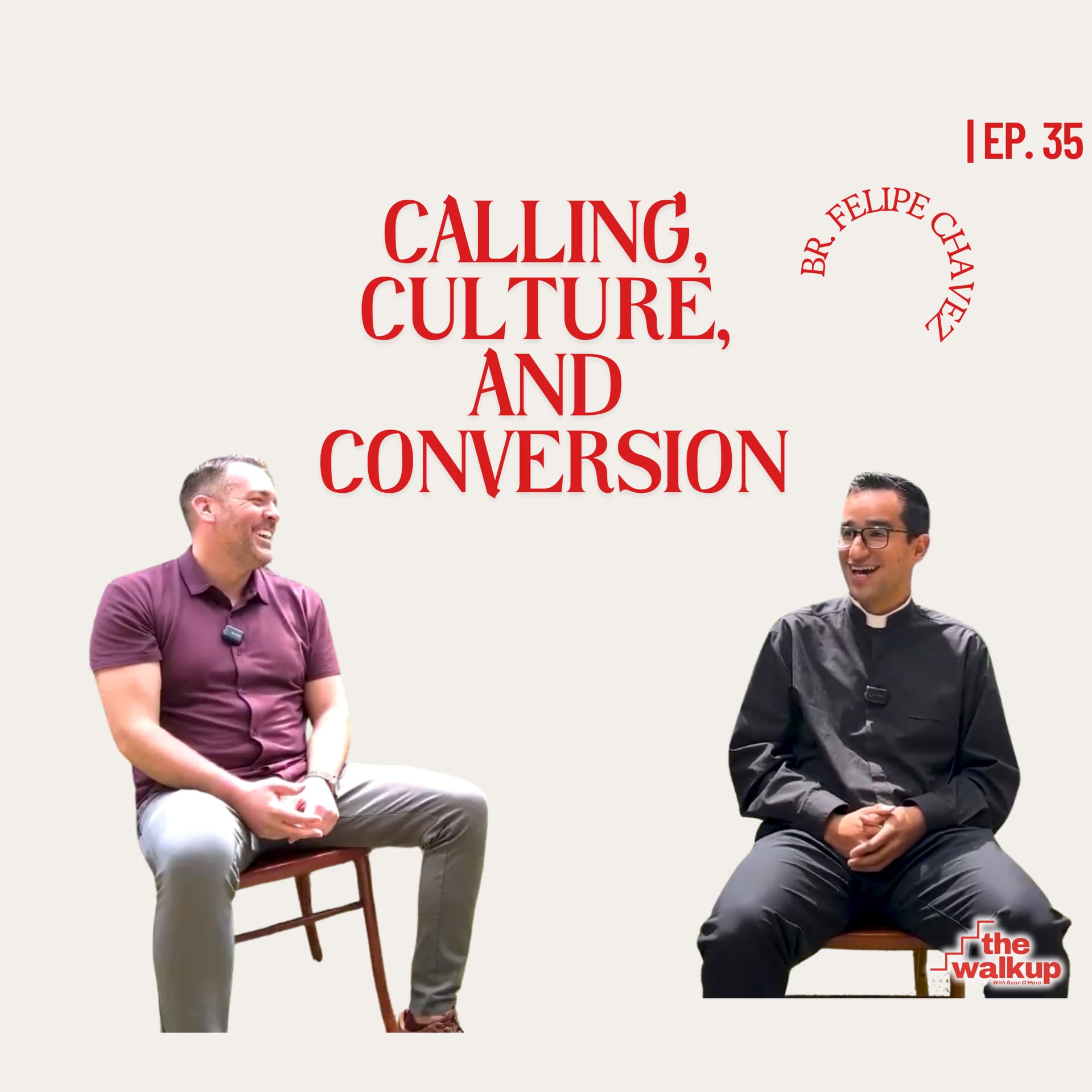
Brother Felipe Chavez is a seminarian with the Legionaries of Christ, currently studying for the priesthood.
In this conversation, he reflects on growing up between Colombia and the United States, his early dreams of playing in the NBA, and the surprising journey that led him to religious life. From powerful retreats to painful goodbyes, Br. Felipe opens up about how he learned to listen for God's voice—and why he ultimately said yes.
Transcript
Read the full transcriptAuto-generated · 13,625 words
Well, we're rolling, so this is the podcast today, is in beautiful Medellin. Are we technically in Medellin, or are we on the outskirts? We're like almost on the border between Oriente, which is, I guess, the next part once you get out of Medellin, and Medellin. Correct. Like this. Where we're at right now, it belongs to the diocese in Oriente, but it's closer to Medellin, and all the priests who live here, they work in Medellin. Sure, it's an easy commute into the city.
Well, I think giving people some framework around your vocation, the Legionaries of Christ, what are they, how do we understand what this is, and I think the first one is people, of course, assume they see the collar, and they assume you are already a priest, that you are in. Formation. You are brother Felipe Chavez. You are not yet father Felipe Chavez. So, maybe just tell us first, like, where you are in your formation process to becoming a priest. Awesome. And why do non-priests wear a collar?
Everybody asks me that. Everyone wants to know. It is funny. Here in Medellin, people have a very beautiful respect towards the faith, towards the priesthood, and when I arrived, when I first arrived, You are not from here. You are from? I am from California. From California, from a Mexican culture, so I sort of understand the Latin American culture, but it is very different. When I arrived and I got out of the airport, three taxi drivers told me, will you please bless me, Father?
And at first, I was amazed because… Well, one, they called me father, and two, they wanted a blessing. When I told them, no, don't worry, somebody is coming to pick me up. So, okay, he is not going to jump in my car, but at least give me your blessing. And I thought that was precious. I don't get a fairer. I thought that was beautiful. But it is because of the color, because they see this, and they say, you are a father.
And I have tried millions of times when people tell me. Father, can you please help me? No, I'm not a father yet. I'm a brother, and then they'll say, oh, I'm sorry, Father. I'm sorry. So, I just gave up. I said, all right. Your first name is Father, whether you like it or not. You can call me Father, because you're not going to call me brother if I explain it to you. I am Brother Felipe Chavez. What does that mean? I'm a religious.
I have three vows, the three religious vows that every religious takes, poverty, chastity, and obedience. We wear the collar because that is already a form of our habit, our religious habit. Our religious habit is the cassock, which is a typical black robe that you see in exorcist movies, that priest who is doing this crazy blessing and just driving out this demon in the movie, and then all of a sudden that jump scene comes out and you get scared.
That habit is our habit. Black robe, a black sash, and the white collar. And the black robe represents the vow of poverty, that we've died to the world, that we've died to the riches of the world, and our wealth, our pockets are for Christ. White, chastity, which is the color of purity. Which is why St. Joseph, in his statues, he always carries a white lily, because it is the color of purity, the color of being completely for the Lord, and because purity has to do more with your eyes than with what impurity normally does.
It has to do more with what you see, how you see, rather than impure acts itself. And obedience, the sash. Jesus, when he forgives Peter, and he says, feed my sheep, feed my lambs, feed my sheep again, he says, when you were younger, you used to dress yourself and go where you went, but when you are older, somebody will bind you and lead you where you don't want to go. So, that binding is represented in our sash, in the vow of obedience, in that.
God is going to ask of us, through a human being, our superior, things that we don't want, and it's God's will manifested in this person, and through our vow of obedience, we bind ourselves to that will. As a brother, a legionary of Christ, in formation, Our formation lasts about 12 years. Two years of novitiate, which is almost monastic.
Two years of humanities. After those two years of novitiate, you make your first profession. Two years of humanities, where you study Latin, Greek, art history, world history, a ton of like normal things that you would learn in a high school, but with A taste or a point of view that is seen from a priest, and it makes you a lot more, I guess, relatable when it comes down to a cultural discussion. In humanities, for example, I fell in love with Shakespeare, and I love poetry ever since humanities, and I think it combines well with the spiritual life, you know, because the Psalms, for example, poetry.
After that, you make your second profession of vows, and then you study philosophy in Rome for three years. After those three years, you make your last temporal profession, and then you go out on internship, which is what I am doing right now. Here in Colombia, I work with vocations, accompanying young men, adolescents who are thinking about the priesthood. who have some sort of curiosity, who are open to it, and they want to know how to listen to God, how to go about in that process, and I sort of accompany them with that.
And on top of that, it's just working with young people in the Redmond Christie section of young adults, and I work specifically with high school seniors. Freshmen, students, and universities. And how do you define the difference between Legionnaires of Christ and Regnum Christi, just for those that don't know? So, Regnum Christi is the movement that the Legionnaires of Christ belong to.
Regnum Christi is a movement just like other movements. Maybe some are familiar with Opus Dei, maybe some are familiar... With Focolare, maybe some are familiar, with some sort of movement that is pretty well known in the church. And what is a movement in the church? It is basically identifying with the sort of Catholic that you want to be in the church.
We are all Catholic. A Red and Christy person is Catholic, but they found a specific way to be Catholic. And what is that specific way to be Catholic? There is a great desire to extend Christ's kingdom. There is a great desire to do that through forming other apostles. So, for example, yesterday, there was a Eucharistic hour with the young people, and recently, I have been doing this course on how to preach in a Eucharistic hour, and some high school seniors were in this course, and yesterday, The Red and Christy Way was the first time one of those high school seniors preached during the Eucharistic Hour.
The Red and Christy Way is sort of that. Instead of seeing a priest going up to preach at the pulpit during a Eucharistic Hour, it is a lay person. It is a normal person. Yeah, this is what we saw. I went last night in Bogota, and I realized, oh, this is probably a testimony.
Or preaching. But it was a young person. It was not a priest. Exactly, and that is very Redmond Christie in that sense. I took the time, for example, to form this guy so that he can form others. In Redmond Christie, the layperson is the one who has the power, so to speak.
And Legionaries of Christ, as priests, we dedicate ourselves to form them, to make sure that they have all the requirements they need to evangelize this day the way the world needs to be evangelized. In other words, if you think about what St. Paul did in his time, going to Corinth, preaching to the Corinthians, writing his letters to the Colossians. Constantly urging others, going to different places, forming these people so that they can form their local churches. It is what Red Room Christi does.
It is what Legionaries of Christ do. They go to different parts of the world, and they form the lay people so that they can form other lay people. It is much more effective to hear a young man speak to you about holiness.
Then to hear this person speak about holiness, because this is what he's supposed to say, but if a young person starts talking to you about his great desires to be a saint, and how much it's worth being a saint today, and going against the current, that has a lot more impact, because he's a normal guy. Well, and I got to witness that in Bogota, in the Suenios de la Calle, the homeless outreach. Which is a lay-led project. It was started by those that were formed by Regnum Christi, who might have gone out into communities to serve the homeless, but then also helped to bring them out of addiction, since a lot of them, of course, are suffering from that.
And so, we got to go there just, I guess, two days ago, and see some of the Of those that have been impacted from that, who were once homeless, who are now, you know, in a stable place, and able to go back into those areas and try to encourage others to take that step to seek, you know, recovery from their addictions.
Yeah, I've been very impressed by that. I think... It's part of, you know, for those that wouldn't know this kind of terminology, but kind of a post-Vatican II movement, right? There's a lot of these charisms that are more, there's a lot more involvement of the laity than we might think about in, although the Franciscans have third orders and the Dominicans have third orders, which is kind of almost like their version of that. But maybe speak to that. I'm curious.
How the legionaries and Regnum Christi see themselves within the context of this post-Sacrobatic Council, where the laity need to take a more active role in sanctification. And, Mayagin, they've asked me before, what's the difference between my parish priest and you?
Or, what's the difference between this legion priest at my school and you legionaries? And, uh... I like to give them the image of sort of the U.S. military. You have soldiers who fight out at sea, up in the air, infantry soldiers who fight all terrain, and they are all going against the same enemy. It is the same guy, but it is from different angles. They depend on each other, but they don't depend on each other. But it's the same war. It's the same battle, and I think the way we see it and how it really is, the church is against hell.
The church is attacking everything that Satan is trying to destroy, and the church is against that, and every congregation that exists, every diocesan priest that exists, every Catholic that exists is in the same war. We're all going against the same enemy, but when you find a Salesian, when you find a Franciscan, when you find a Jesuit, when you find a Diocesan, when you find a Legionary, they're different, and it's not because there's a division in the Church. It's because there's a specific gift given to them, in the same sense that maybe a Marine finds himself fully flourished as a soldier.
But only as a Marine, and he can't find that as a Navy SEAL, only as a Marine. There's a gift within these divisions, and because there's a gift, when the Holy Spirit gives a charism, which is what this is, a charism is a gift that the Holy Spirit gives to a congregation.
When there's a gift, it's because there's a specific need in the world. There's a specific need that the Holy Spirit has said. I am going to give you this gift for this one particular need in the battle, and you are the legionaries of Christ, and that is your gift. And what is our gift? Our gift, every gift that the Holy Spirit gives, is an imitation of some sort of aspect of Jesus in the Gospel. So, take, for example, the Franciscans. I am not a Franciscan.
I may not get this word for word, but I understand that their gift, their charism. I will have them fact-check you. Exactly. A Franciscan fact-checkers. Feel free to insult me in the comments. Their gift is to imitate Jesus in his poverty, and Jesus in his full poverty, and that is a gift for the church because there is a big problem of greed. There is a big problem of Or just comfort. Yeah, comfort, and hedonism, and all that creeps into your spiritual life, and that egoism, and Christ and his poverty.
He lives for others, and Christ and his poverty. You know, it is funny. I am very close with the CFR Franciscans in the Bronx, and I have had several spiritual directors that were CFRs, and at one point, they gave me a tour. They usually do not bring people into the residence, right? But I had known this guy for years and years and years, and I know the Franciscan spirituality is taking on poverty, right?
And it wasn't until I got to his room when I was like, oh, you sleep on the floor. Wow. I was like, oh, you are, there is not a bed here. Okay. I already respected you a lot. I just, you know, because I don't think about, you know, what happens when you go back, you know, when you go to rest for the evening, I just, I'm like, man, that's another level. Even that simple thing, right? I mean, let's say simple, but I mean, that's not that simple.
But that speaks a lot. It says a lot. What that would do, I would imagine, for your soul over time, but if you're really always, even in your sleep, you're... Embracing simplicity. Yeah. Wow. But continue, I am sorry. No, no.
It actually helped me a lot. Yeah. When I think about sleeping on the floor. Yeah, yeah. Cold showers, you know. No snacks between meals. Yeah, exactly. No, I think the, so this idea of, because of course what you just described of us all being on the same team, but having kind of different. Different methods of contributing to the fight, so to speak, is what we refer to as the church militant, which I think, you know, contemporary culture, that can feel a little like, whoa, what are these guys?
And we have the church militant, we have the... There are those here on earth. There is the church triumphant, which are those in heaven, and then the church suffering, those that are in purgatory, right? And so, the military analogy is quite apt, right? Because it is really, and I would guess that for those that are listening or watching this that are not necessarily practicing, you know, Christians or Catholics.
We sound pretty crazy. Yeah, which I am not saying they are wrong, but at least they are not wrong for this particular point, but is that we actually believe that the devil is real. We believe that there is a spiritual warfare that we are actively engaged with, and I think everyone feels that in their own soul, and even in their own conscience, even if they do not name it that, right? I mean, you have the kind of… It is a colloquial idea of like the good angel and the bad angel, you know, trying to whisper different things, but we fight every day with decisions or being pulled this way or being pulled that way, and I think we would agree that in warfare, the first thing is to define the enemy.
Exactly. So, the phrase is like, the greatest trick the devil ever… ever pulled was to convince people he didn't exist yeah um and i think our he's doing really good job in contemporary culture doing that so yeah so how do you make that sound really like how do you put that in context for people that might think that the idea that we're battling some you know evil force that's out there i think that's a problem that we face as americans because I say this because I've stepped out of America for, I don't know, seven years, I think, six years, and as Americans, we're very rational.
That's beautiful. That's a gift. That's a huge gift. We're very rational, and when you get rational, everything centers around your reason. I guess the spotlight in your heart is your reason. That's fine. It's totally fine. What I've learned here in Colombia, Colombia that's more about what you feel. People are very much concerned with feelings and sentiments. For example, something very superficial, a very simple detail that says it all. When you speak to someone here in Colombia, it's bad education if you don't say, how are you, at the beginning.
Oh. It's very disrespectful, and it's very disrespectful. If you arrive to a party, for example, or, I don't know, maybe a restaurant, and your friend invited you, but it happens that your friend has ten other friends there, it is very disrespectful to not go around to each one of them and say, hi, nice to meet you. And it is very disrespectful when you leave if you don't Go to each one and say... You can't just wave. You can't do it. Exactly.
Wow, so the Irish exit doesn't work here. Nope. Oh, man, that's my move. When I arrived... But I'm Irish. I'm allowed to. When I arrived, to this day... By the way, if we disappear slowly, it's because we're on soft ground, and it's not because I'm losing my moral center. Well, maybe not for that reason. No, because I remember that my... As I mentioned to you, my oldest brother is a priest, and he is very close with a Latin American family, and they have some Colombian roots, and I went to their house for, was it for Christmas or for New Year's?
I think it was Christmas, but yeah, if I didn't, and there was like 40, 50 people there, I had to say. Hello to every single one. Exactly. And then when it was, when we, I think maybe it was New Year's, because then when it was New Year's, we had to go around and kiss every single person. Uh-huh. Then, and then when I left, I was like, oh, we're doing this again? Yeah. Like, I just, it almost seemed like, oh, this is like a bit.
Exactly. You guys are doing a bit. Exactly. There's no way we're going to go one by one by one by one by one, but sure enough. Exactly. And that's more physical contact than an Irish Catholic has had in my lifetime, in that one evening. As an American, that just sort of breaks your way of thinking. To this day, it is something that bothers me. It is something that I do, and I have to do, but every time… I get up, and I say goodbye, and I say hi to people I don't know.
It is like, why do I have to do this? This is so inefficient. Exactly. I can't just say hi, and hey, all right, see you guys, whatever. Oh, man. I am just thinking now how many people I have offended that I am not aware of. So many people. What do I mean to say with all this? Colombian people are very much about making another person feel good.
Feelings have a lot to do with Colombians. What implications does this have in the spiritual life, and how does this differ in America and Colombia? In America, because we are rational, when we start our spiritual life, it doesn't mean that we are ignorant, or we don't pay attention to our feelings.
But, exactly, we tend to think that the devil is... Right, he's real, but he's not, in the sense that, I mean, I'm not going to get possessed, and I'm not going to see some guy in the middle of Mass, I don't know, start bubbling foam from his mouth during the words of consecration, and the devil, if he's going to deal with me, it's got to be in my mind, which, that's true, the devil does put a lot of hurtful thoughts in our minds.
But in Colombia, what I've come to see is that the people know that the devil is real, and there's a lot of cases of people who play with the devil, and there's a lot of cases of people who experience spiritual, I guess, mishappenings.
And it is way too common here, and in most of these cases, I am not the main guy to talk about this. There is another priest in my community who works specifically with minor exorcisms and exorcism ministries, but in most cases, it is because of the feelings. It is because of a terrible heartbreak after a relationship, and they go to… These spiritual practices that seem superficial, but underneath have a lot of... For example, something interesting here is... But they're not going there because they...
You're saying they go there because they don't necessarily acknowledge the power that might be there, or they do think there's some power to... They do think, but it has to do with their feelings. Okay. To overcome this heartbreak, to maybe have some sort of vengeance with their ex.
So, they do some voodoo stuff, and they do some New Age practices that invite other spirits in, and it is funny because you can come across a Colombian guy who is atheist, and he will tell you he does not believe in God, but he will love to talk about exorcisms, and he will love to talk to you about how people have been possessed.
And that fascinates them, and they admit it. They admit it openly. That is real, but rationally, they will say, no, but I do not believe in God personally, and it is funny, because you do not find that in America. I have never really found that in the U.S., somebody who admits that the devil is real, but who does not believe in God, and if you want to use your reason and be rational.
If you are going to admit the devil exists, admit that God exists, because if there is a very evil force that exists, there must be an opposing good force that does exist, and that is a huge difference that I have seen here, and it is funny, because on Halloween, Growing up as a kid in America, maybe this is the experience of most people, Halloween is fun. I mean, you put on your costume, you go get candy, and you have a good time with your friends.
Pretty tame. Yeah. Here, Halloween, if you are Catholic, you do not do that. Because you are playing with... Because you are playing with the devil, and it is frowned upon, and people have a lot of skepticism towards Halloween. Why? Because Columbia, if I am not mistaken, is... The country where the satanic church first started. There are actual satanic churches here in Colombia.
I remember one time I went to visit a school, and there was this car parked outside. It sort of looked like a black Need for Speed Mitsubishi sort of car. On the rims, it had spikes all around the rims, and then on the back, It said, 666, all for Satan. And I remember I walked past that car. I was like, whoa, you don't see that too often here. And I went to another school one day where I spoke about my vocation testimony, and at the beginning, I asked everyone, because it was a public school, raise your hand if you're Catholic, all right?
The majority raised their hand. Raise your hand if you're Christian. A few. Raise your hand if you're something else, and this one girl raises her hand, and I asked her, like, what are you? I'm satanic, and I was like, whoa, okay. I said, well, I mean, listen to my story, and consider it as a possible reason that God exists, and there's a satanic church here in Colombia, and so When you're Catholic in Colombia, October 31st, it's pretty well known, I think, among Colombians who are Catholic and non-Catholic, that that's a day where the satanic church does a lot of stuff to hurt people.
The reason why Catholics frown upon Halloween a lot here. So, when I first arrived, I was like, my parents got married on Halloween. What are you talking about? And I had a great time growing up, and hey, look, I am going to become a priest. It is not like it really got to me. But you cannot say that sort of stuff. You could, but they will not believe you. And it is because here people do a lot of...
I have always thought a kind of a curious thing that, you know, a potential, it is a weird thing to say that, you know, a point in the Catholic column is the fact that satanic worship usually almost always involves desecration of Catholic traditions or the Eucharist, and it is like, In some ways, they believe more in the power of the Eucharist than we as a Catholic Church do sometimes. They understand there is power there, and therefore, they are inverting it and desecrating and recognizing that they are trying to be the inverse of that.
So, then how does a California kid end up in Columbia, wearing a collar, taking... Vows of poverty, chastity, and obedience, and now in Colombia, fighting spiritual warfare. How does that happen? It is a long story. It is beautiful, though.
Let us see. Growing up as a kid, my typical Mexican family, my parents, they immigrated from Mexico. My dad, he left the States. This is an interesting, fun fact I realized two years ago. My dad left his home at the age of 16, and he crossed the border, and he just started working to send money to my grandmother, his mom, and his 10 siblings. Wow. And where in Mexico? In Guadalajara, Jalisco. So, my dad crossed the border and did that when he was 16, and I left home at the age of 16.
My dad told me this two years ago. I was 16, and then I was like, wow. It all makes sense. When I was 16, it was just like, all right, well, I know this is like a tough fact for a lot of people to leave their home, but it was not that hard for me in the sense that, like, I just, I do not know, it was just kind of natural. I like to think that that comes from my dad. If he left his home when he was 16 and was brave enough to do it, maybe I had the guts to do that because my dad did the same thing.
Anyway, my parents, they immigrated to this day. They are still in California. Proud U.S. citizens. And where in California? Hemet, California. Nobody knows where that is. Don't worry. It is northeast, outside of L.A., going towards Arizona, the Inland Empire, which is a lot of dry land.
Hemet. It's like two hours outside of L.A. It's near Death Valley Desert. Okay. Two hours in L.A. in traffic can only get you sometimes five miles, so it depends. Yeah, exactly. With traffic, it could be six hours. Anyway, so they immigrated to the U.S., and then they grew the family there. So, I have two sisters, an older one and a younger one.
My dad, growing up, was, I guess, Catholic by name, and my mom was the pillar of our faith in the family, and like a good Mexican mother, she put her kids in First Communion classes when they were four or five, and by the time I was seven, I did my First Communion, and I was sick of church. I never liked going to Mass. I couldn't stand going to a A Spanish-speaking Mass, where there's a ton of people, and it's just body heat, and like, it's kind of funny, because when you're a Mexican-American first-generation kid, you're learning English, and English is your academic language, and because it's become your academic language, it's the language by which you understand things and know things.
So, when I go to Mass, and I'm seven, And I hear these religious terms being tossed up. I have no idea what that is, because in my house, we don't say those things. This is the only Spanish I know. It is the Spanish we speak in my house.
My parents, from the day we were born up until this day, they only speak to us in Spanish, and we only speak to them in Spanish. So, as a kid, I hated going to Mass, because I didn't understand the language, and it was just hot.
And when I was 10 or so... I was 10 or so, and I didn't understand the language, and it was just hot. I stepped away from the church a lot because my younger sister was born, and she was born with a kidney problem. My dad worked really far away, two hours away. He would drive two hours every day, go work. So, we stopped going to Mass for like three years, just because my little sister was sick, and my mom was alone most of the day.
My dad would come home every day, but really late, 7 p.m., and then go to work at 4 a.m. So, I took advantage of this time to sort of like, all right, I am going to go full rebellion mode here.
I step away from the faith, hit rock bottom as hard as a 7th grader could go, 8th grader too, and then I joined the youth group at my parish. After two years of being in the youth group, I realized, this is like 8th grade, I am about to go into 9th grade.
I'm a hypocrite. A hardcore hypocrite. Monday to Saturday, people know me as a bully. People know me as a jerk. A lot of teachers hate me because I'm the class clown. I've done a lot of damage to some girls in some relationships. And Sundays, everybody loves me at church because I'm acolyting, because I'm with the youth group, and I'm clapping during the Gloria.
And because I'm passing around the collection basket, I'm a hypocrite, and it really hit me, and that was the first time I prayed, like, sincerely to God, and I asked Him to change me, and I was like, I was waiting for this angel to come down and, like, smack me or something.
Two months later, our youth group goes on this retreat, a Steubenville retreat. Steubenville Franciscan University in Steubenville, Ohio. So, there was a Steubenville retreat in San Diego, and it was huge. Basically, every youth group from California and the neighboring states went to that Steubenville retreat. There were 5,000 young people there, and I had my conversion there during a Eucharistic adoration, and I had my conversion there during a Eucharistic adoration. I looked at Jesus in the Eucharist. Honestly, I didn't know that Jesus was present in the Most Blessed Sacrament.
I didn't know. Isn't that wild? You can go to Mass your whole life, and not understand. Because you just go to Mass, and you just think, whatever. Exactly. That's what we do. Yeah. But continue. It's just amazing that we can just... Crazy. It is funny, because there, I felt it.
And I remember when I was looking at the Blessed Sacrament, I felt hugged, and I couldn't see, but I just felt hugged, and nobody was hugging me, but I felt strongly embraced, sort of the sort of hug that your mom or dad would give you if you were to leave home for five years and then come back. And I knew it was him. I just knew it. And with that one embrace, he got me, totally. After that, I started praying every day.
I had this sort of understanding of what discipline is, because I love basketball. Ever since I was five, I played basketball. So, when I had this experience, I thought, all right, well, if this is anything like basketball, I know I have got to take time and dedicate time to this every day.
So, I said, all right, well, I am going to pray every day for 15 minutes in the morning, read a little bit of scripture, and then at night, do the same thing. And then you have to be at least 6'6". Exactly. So, you have to pray to get really tall. Yeah.
Spiritually speaking, you want to be 6'6". Exactly. So, I started praying every day, and I started going to Mass more often. And there was an adoration chapel in my parish every day, open from 8 a.m. to 4 p.m., and once I found that, I was like, I am going to go to adoration every day, because that is where I had my moment. What happens when a 14-year-old starts doing that? People say, oh, this guy is going to be a priest. Of course, yeah.
So, everybody in my parish was like, hey, you are going to be a priest, huh? No, you are funny. I do not want to be a priest at all. And then, there was this one old lady who was the, I guess, the custodian, the guardian of the Adoration Chapel. She would lock it up and open. She saw me, and she would see that I would go in almost every day after school, and she said, have you ever thought about being a priest?
Same answer, had it ready, no, I don't want to be a priest, thank you. And then she said, okay. Well, if you want to know what God wants, you just got to ask Him. And I was like, what do you mean? Like, is that a thing? I just, like, in my prayer, I just ask Him, and He tells me. And she's like, yeah, that's all you got to do. All right. Well, I pray every day in the morning and in the evening, so I'll do it.
Nobody taught me, but every morning, every night, this is like at the beginning of my freshman year, I would say, Lord, if you want to call me to be a priest, call me. Or if you want me to be a married man, call me. A monk, call me. A single man who is uncle to everybody, call me.
Whatever you want. Whatever you want, that is what I want. I would repeat that every morning, every night, and after a month, I had this curiosity. What do you have to study to be a priest? What does a 14-year-old kid do when he has a question and he does not know who to ask? Google. What do you have to study to be a priest?
First answer pops up. You study theology and philosophy. It lasts about 10 years, and at the end, you become a parish priest, and you go to the parish, and you dedicate your life to serving the Lord, and I saw that, and I was like, I could do that. That was like my first thought. I could do that. 10 years. Okay. 10 years, and here I have 12 years in the oven. I saw that, and I thought I could do that, and then I was like, no, no, no, but I want to do that.
I mean, I want to be an NBA basketball player, and if that doesn't work out, I want to be a journalist. All right, well, I keep praying this prayer every day. Another month passes, and it is like, all right, well, you know what, I could do that.
And plan Z. Plan A, I will be an NBA basketball player. Plan B, journalist. And if zombies are going to take over the world or something, I will be a priest. Plan Z. Another month passes. I am praying this prayer every day, and then it is like, no, I do not want to be a basketball player anymore. All right, journalist, and if that does not work, I will be a priest. Another month passes. I do not think there are a lot of journalists out there that also wanted to be priests, but that is a different podcast.
So, another month passes, and I had this super strong desire. It just grew. It was like, I do not want to be a journalist anymore. I just want to be a priest. I told my parents, and it shocked them, because they knew the idiot I was when I was in 6th grade, and 7th grade, and 8th grade, and how much I hated going to Mass as a kid.
They knew that I had this experience of God's love, and that I was really delving into my faith, but it shocked them, and they were like, alright, well, I will support you, 100%, but... They weren't like, hey, you're the only son. We've got to carry on the family name. So, recently, my parents came and visited in October, and my dad, he told me a little bit more how he felt about it. And he said, when you left, I turned to your mom, and I was like, wait till tomorrow.
He's going to come up with something else. Oh, he really did. He didn't have a lot of confidence, huh? Yeah. Wow. And so, they waited, and they waited. Then I entered the seminary, and my dad was like, well, we will keep waiting. Maybe he will come back. He is going to miss us or something, but it took him a lot of years to finally see.
He is really in this. Anyway. You did this to prove them wrong, even though you didn't know. You weren't doing it out of spite. My brother, I wouldn't necessarily assign my dad with a spiritually insightful kind of guy, necessarily. Not necessarily a spiritually reflective guy, but we found out years later, after my brother had become a priest, that there was something my brother did one day.
And my dad wrote, he put everything on post-it notes that were ever-present in his pocket, and he put, Keith has a vocation, and he put the date, and he put it in his, like, little, what did you call it, like, on top of his dresser. What? And years later, when he became a priest, I don't know if he did it at his ordination, or if he... Yeah, it was just something. And it wasn't like my brother, but I've been on that path.
My brother had been away from the church for a couple years as an adult, not as a teenager. So, you know, it's funny how the parents have different, you know. And my mom was on the, like, all right, yeah, if you want to, okay. It wasn't like, yay, we have a priest in the family. A lot of people assume that, right, with a Catholic family. Yeah, yeah. Yay, we got a priest. Instead, it was like, all right, we'll see. So, how did you find the Legionnaires and Reginald Kersey?
So, after that, I get really doubtful myself. So, I thought, well, this one lady told me I just had to ask, and here it is. But, all right, God, I am going to keep asking you, but I am going to change the question a little bit. If you are really calling me, show me. Any way you want. I mean, I will be open. Trust me. If it is a fish that flies down from the sky, I will take it. But you have to tell me, whatever way you want.
So, I'm on Facebook. So, if a fish falls from the sky, which religious order is that? Jesuit. Okay. I was trying to think of the right, what goes with the fish and which religious order, but... If a falcon falls from the sky, it means Dominican. I don't know. You're a fisherman, right? A fish falls in my hands.
So, I'm on Facebook, and I see this ad on the side. It says, do you want to be a priest? There is this young seminarian in a collar. I was like, heck yeah. So, I click on it, and it takes me to this website. Facebook algorithm, man. That is great. I know, right? God used Facebook algorithms. So, I go to this website called vocationplacements.org, and it was kind of funny. It was like a... A survey that you take to see if it measures your potential of becoming a priest or not.
So, I saw this information, and I was like, all right, well, let me not do that. I put my information in, my number, my email, whatever. Take the survey, and then at the end, it says you have a very strong potential. I think the max you could get was like 1,800 or something like that. I got like 1,750.
And I saw that, and I was like, whoa, maybe this is God, you know? Maybe this is God telling me something. Or maybe every vocation placement test, they always put you. Exactly. Anybody who's wanting to click on the ad is already at 1,700.
It's like, you know, in the old SAT days, and like, just filling out your name, got 400 points. For you, just clicking on the ad got you to like 1,000 points. I'm not trying to get you to like, reconsider your vocation. I'm just throwing out some... The devil's advocate, if you will, since we believe in the devil.
So, I finished that, and I was like, all right, well, maybe this is God. I didn't realize, I didn't read correctly before I took the thing, but it was going to take my information and give it to a ton of congregations.
It's like a really bizarre dating profile. Exactly. It's a matchmaking. Match your congregation. Honestly, this is really cool. I've always, like, you know, you mentioned before that great analogy with, you know, kind of like different military branches and everything else. I've always felt like when I describe different religious orders, I say it's like finding your charism is like matching your personality type with the gifts God gave you.
Little did I know there was an assessment, you know, you could take. I see it like dating a lot. Wow. It's like finding the girl that's for you. But also, like, I mean, in some ways, that could be applied to a layperson and finding their spirituality, no? Yeah. Right? Like, if I took that, and then it said, oh, you have a Franciscan spirituality, or a Dominican spirituality, or you need spirituality, whatever, you know, it might say.
Lacking altogether, but you have your own spirituality. So, then they match you with all these groups, and then they reach out to you? Exactly. So, I checked my email a week later. It is actually more like fraternity rush, is what it is. Yeah, exactly. I checked my email a week later, and I had 50 emails. Oh, man. And I was just amazed. Hashtag, crisis invocations.
I was just amazed, because it was like, all these titles. I got mail from the Trinitarians, from another order, the Divine Word. I think it was called Verbum Dei, something like that. And you were always hoping to get recruitment letters to play college basketball. Exactly. So, here I am getting recruitment letters to my vocation, and check this out. I go to my public school, because I never went to a Catholic school. I have been to public schools my whole life, and I was in this program called AVID, which is supposed to help you with entering university after high school.
Okay. So, here is this ninth grader coming in to his AVID teacher. And pulling up these recruitment letters, you know? Like, hey, I know where I'm going already. I'm getting recruited. So, I thought that was really fun. And it was funny because in a public school, you can't talk about your faith. Yeah, yeah, yeah. But it was like the only way to instill it. And I was like, all right, well, hey, look, I'm looking for my, like what I'm going to do after high school.
And hey, check this out. I'm really interested, you know? So, it would open up a lot of interesting debates with my teachers. Anyway, so, I get mail, but the only people who call me, they actually took my number and called me, were the Legionnaires.
Okay, so we are learning a lot about the church. One, there is a shortage of vocations. Two, we are terrible at follow-up and marketing and execution. Well, there is a lot of truisms here, I think we are stumbling across. Well, that is great. And then, the one most local to you is where? San Diego? Where are you guys out there?
There is a community in San Jose, but the seminary isn't in California. It is pretty far. It is in Connecticut. Oh, the seminary is, yeah. But in terms of anybody you can meet with locally, I don't know. I think the most...
So, the nearby Legionary community that was present in the moment was the community of San Jose, which is like four hours, three hours away from my house. So, anyway, this brother starts calling me over the phone, and he starts inviting me to these vocational retreats, and I would answer the phone and be like, no, I've got to go play. I've got basketball practice right now. All right, see you later.
I have got to go to confirmation class right now. Lying to a priest. Exactly, yeah. It was like semi-lying, semi-true, like I was on my way out. Until one day, I was sitting in my room and doing nothing, and my mom comes and she is like, hey, it is Brother N again. Okay, take the phone. And he is like, all right, well, there is this vocational retreat coming up for Holy Week. This was 2013.
It was like January, and I was like, well, I don't know, brother, look, you guys are in Connecticut, I'm here in California, I don't know if my parents have enough money to pay a flight for me to go back and forth, and yeah, sorry. And he's like, I'll call you back in five minutes. Hangs up. And I was like, alright, well, that's weird. Calls me back in five minutes, and then he's like, what if you only pay half of the ticket?
We'll pay the other half. And then I was like, that sounds interesting. So, I hang up, and I was like, all right, let me talk to my dad. So, I go to my dad, and I'm like thinking, no, he's not going to let me go. I've never traveled alone. I've never flown on a plane by myself. I go up to my dad, and I was like, hey, dad, this brother's invited me to this vocation retreat. They'll pay half of it. What do you say?
Oh, yeah, they'll pay half of it. Go. Exactly. So, I was like, all right. Now, he let me go. All right. I convinced this brother to let a friend of mine go, too, if they have his ticket. So, I went with this friend of mine, and as soon as I got to the seminary, two brothers picked us up, and when we arrived, I just had this deep sensation.
That was home, and I was trying to push it down a lot, because I was like, no, I mean, this is like looking for a college, right? If you're looking for a college, you got to go to a lot. Yeah, and you got to figure out which one's it at the end, and so I'm there during Holy Week, and as the days go by, like this desire just keeps like growing. Like, I see how fervent the brothers are in adoration, and how much they love Jesus and the Eucharist, and how much...
They really take time to devote themselves to Mary, and how they pray the rosary together, and how they live charity, and I was just seeing all that, and I was like falling in love with it, and I didn't want to admit it, and it is Holy Wednesday, and I turned over to my friend, and I was like, hey, what if God called me to be a legionary?
No, you are crazy, man. You are like a woman. It is just emotional. We just got here, and you are already on fire. He is like, dude, we have got to stay here five more days, and you have got to look for the seminaries. I do not like this place.
And then I was like, maybe you are right. Maybe I am like a little on an emotional high right now, and just calm down. So, this was like Holy Wednesday night, and we go to bed, and the next day I wake up, and this thing just comes back stronger.
Holy Thursday, the priest who is directing the whole vocational retreat, that night after the Mass, he starts talking about his story, and he gives his whole story, his whole testimony, and there was this guy from El Salvador who didn't speak English at all, only spoke Spanish, so I thought, poor guy, I am going to try to translate for him. So, sitting next to this guy who doesn't speak English, listening to this priest talk about his story, and I'm translating, so I'm super attentive to everything he says, and two things that he says just smack me right across the face.
Don't be an idiot if God's calling you to say yes. Second, you know it's true when you say yes, you feel a great peace overwhelming. And as I'm saying those things to him in Spanish, I'm like, oof. Like, I just felt like something hit home here. So, I finished the translation. He finished his talking, and I was like, I just got to go to the chapel right now, like right now. I go to the chapel, and then I said, I was like, all right, Lord, if this is where you're calling me right here, the legionaries of Christ, then I give you my yes, and it was just like he said.
I said yes, and I felt this amazing peace. I felt so happy. And, luckily, not luckily, obviously, providentially, the minor seminarians were also there in this vocational retreat, and the rector was there. So, I tell this, the priest who was directing the whole retreat, look, this is what happened to me, blah, blah, blah.
He said, let me get you to talk to the rector. So, we speak, and I am holding this 60-page application into the minor seminary. I call my mom. Hey. Yeah, so, funny story. Yeah, so, I want to enter the minor seminary, and my mom was like, we'll talk when you get home. Okay. So, I get home, and I give this packet to my dad, and he was like, all right, well, I mean, you can stand.
Living on your own, without your mom, and without me, I'll let you go. So, let's do this. Let's start signing this. So, we started signing the papers. I don't remember. My dad told me that he remembers that I said, if you don't sign this, I will.
Which, I mean, I don't deny that I could have said that, because I maybe, possibly did say that. So, we start signing this thing, and I was like, super excited, and I would pray about it a lot, go to the Adoration Chapel, where it all started, and I would say, are you really calling me to this? Like, is this really what you want me to do? I wouldn't feel anything, and it was just silence, and after a while, I was reflecting, like, why don't you say anything?
Is this a no? Are you trying to say no? But I realized that that silence was more like Jesus saying, I have told you so much, man. Think. Reflect. Just remember. I do not need to tell you anything. I have told you a lot already. You do not need to be on a spiritual high every moment. Exactly. So, that is what I did. Just remember.
Every single step of the story? Of course, it is the next step. The day comes when I leave, and I did not realize how much it hurts until I said goodbye to my parents when I was in the airport. I hugged them, and in that hug, everything came. Holy smokes! I am leaving my friends. I am leaving my family. I don't know where I'm going. I've never been to this minor seminary. I don't even know who's going to pick me up.
I know somebody's going to pick me up, and it wasn't like I'm backing down, but it just all came together, and I bawled my eyes out. I've never sobbed so hard in my life, but I didn't do it in front of them. I hugged them, and I turned around, and as soon as I turned around, just let it all out, and I was like, I think I cried all the way until I sat on the plane. So, I arrived, a 16-year-old kid, California kid, to the minor seminary.
It took me a while to sort of get over my crisis. I mean, I don't know if I had a crisis, but I missed a lot of stuff. What saved me, so to speak, was just remembering how God called me, just remembering, and to this day, it keeps, it keeps saving me, just remembering how God called me, and when I, when I got to the novitiate, later on, when I was 18, 19, and I was about to make my first profession, out of this doubt, and I thought, what if God never called me?
Like, what if I called myself? What if it was just me and my feelings, and it was really never God? And, during one adoration, that doubt came up, and I started remembering everything again, and I thought, all right, well, is Felipe Chavez able to do that? No way. Nope, that one either. No way I could have done that. No way I could produce that in myself. It has got to be him. And, yeah, here I am, ever since.
There is a lot more. 12 years later. Exactly. There is a lot more in the story. It is always great hearing vocation stories, and you can tell when you hear them, it is not that dissimilar to finding your spouse, right? Because it is a spousal relationship, giving yourself to the church.
It is falling in love, but then maybe reminding yourself when things get a little, you know, because relationships aren't perfect, you know, to remind yourself of why you fell in love or remind yourself of that desire and that commitment.
You know, to keep yourself focused doesn't mean we should blind ourselves to, you know, real doubts, right? Right. So, I don't know if I mentioned to you, I think I did when I was here before, that I had gone to the seminary in Rome on a pilgrimage, a retreat. So, I don't even remember how I found it, but I had gotten to some Bible study somehow when I was like… In 2018, and there was this wonderful woman who ran the Bible study, and then we would go over to adoration afterwards, and she just handed me a flyer one day and said, oh, you know, doing this trip to Rome, but it was for those considering the priesthood, and I was not, and so I didn't think I would.
So, I called whoever was organizing, and I said, listen, I would love to go on this. This trip, it sounds amazing, but I want to be honest with you. I don't think I'm called to the priesthood, so I don't want to be taking this under false pretenses, basically.
And he said, well, do you have a girlfriend? I said, no. He's like, are you open to God's call? Yeah, I know. And my brother's a priest, so I guess I'm not that far from it. But the funny story, I can't remember if I mentioned it before, but I think there were seven of us on this retreat. It was wonderful. We stayed at the seminary, my first time in Rome, my first time ever outside of the States. I mean, if your first experience outside of the States is Rome, at the seminary, and you're getting mass in the catacombs.
A side chapel of St. Peter's. A thousand years old. Yeah, I mean, of course, in the States, we think something like 100 years old, and you're seeing the Colosseum, and the Roman Forum, and all those things, and you're just like, your sense of self, you realize how small you are, because of the history, and then, of course, the church, and all of that, and seeing all the... The priests and brothers in the seminary, and there were seven of us, and we were from all over the place.
That was the other thing, too. I just went on my own. I didn't get one of my friends to come with me, but I just went by myself, and we had people from Canada, people from Chicago, I remember.
I know there is one guy from Malta. I remember that. Oh, well. Because I didn't know what Malta was at the time. I have now since been there, so now I definitely know where it is. And at the end of the retreat, or end of the eight or nine days, which was just, I remember calling my mom, because I somehow had to convey all the stuff that was happening, in terms of how my mind had been blown about. You know, the church and the, like, scale of history and, like, art and culture.
I was just, my mind had just expanded. I don't know what, it was probably gibberish, but I just called my mom because I remember her just being like, okay. I don't think I was making much sense. I was like, then we went to this, and then we went to this. I just didn't know how to, like, express that I was, like, really just. My mind had been just broken into, like, expanded so much, but at the end of the retreat, like, the guys were all hanging out, and they're like, hey, how was your conversation with the priest?
How was your conversation with the priest? And I said, what conversation with the priest? They're like, you know, where he sits you down and asks you where you are in considering the priesthood, and like, you know, where you're at in the process, or whether you can, I said, he hasn't talked to me. They're like, what do you mean? There's only seven of us. I don't think he lost my name on the list. I was the loudest one on there, for sure.
So, I take that a little bit as a sign. Also, there was a priest that I was my spiritual director in high school for a little while, who was like, he might have, honestly, every year, he probably sponsored.
Half the seminarians, because he just had this gift for recognizing vocations, never once talked to me about it. So, I feel like I give it a good shot, but it has been a great privilege in my life to spend so much time. I have so many dear friendships with priests.
I've been in seminaries and monasteries all over the world, and some of the best times I've had have been in religious communities and seminaries, because there's this freedom, right? There's this, I don't want to say carefree is the right word, but there's this...
I know why I'm here. I think that God's called me to this vocation. There's a freedom, and I can just be myself. I got the most important thing figured out, hopefully, and then the rest. There's a lot of details. Don't get me wrong, but maybe that's what it is. That's why I've always just loved having so many priest friendships, but I also think that part of it is, too, I see the I see the challenge of the priesthood, you know, the stress, and sometimes isolation, and so I think that is just, you know, made me always want to form friendships with priests, and also so I have people on call for confession whenever I want it.
Yeah, exactly. But, talk to me more about the... Church here in Columbia, because you're coming at it from, it's interesting to have this outside perspective, right? So, because a lot of the guys that you're forming here are, the majority are Colombians, I would imagine.
And so, you're coming from a Mexican-American background, coming here. How do you contextualize the, I mean, you mentioned, we mentioned before already about this. Believing in the devil, that is a real thing, that there is maybe a more emotional, sometimes, approach towards spirituality. What are the other differentiators or distinctions you would make about the Church in Columbia versus the States or even other Latin American countries?
There are a lot of similarities in the sense that in the U.S., you can find in a parish, for example. Daily Mass is full of elderly women, full of women, and very few men. That is very common here as well, super common.
You almost find the same sense of the impulse among the youth as well, because in the U.S., you can find a parish like that. And at the same time, find a parish that has a youth group that is very vibrant, a youth group that is doing something, a youth group that is very active.
You can find that here, too, in Colombia. There are a lot of youth groups that are super energetic, and they are doing a lot of beautiful things in society. And what I found here in Medellin, That I didn't see that much in the U.S., that there's a lot of movements, there's a lot of diversity in the church, which is like the beautiful diversity, you know?
There's a lot of Catholics who are super on fire for their faith that belong to a specific spirituality, like, I don't know what it's called in English because I've been here for so long. I don't know how to say it in Spanish, but the Camino. The neocatacumens? Oh, the neocats. The neocatacumens, yeah, sure. The neocatacuminal way. Exactly, the neocatacuminal way. I have got to relearn English. I was with them in the Holy Land. Yeah? Yeah, I stayed in their home there in Galilee.
Wow, that was nice. It was a really beautiful experience, but that is for another podcast. I get around, man. I am hanging out with the Neocats. I am hanging out with legionaries. I got Franciscans. You know, I like to diversify myself. You probably have Pope Francis in your contacts, too.
Yeah, I put him under Pontifex. I am probably like his original name. Under his Twitter handle. Papa Jorge, as I call him. Oh, you mean, oh, you mean Borgorio. Guto George. It just says George Argentina. I don't remember. I was like, yeah, I don't remember this guy. Some guy I met once. Archbishop, I don't know. The Neocats, they are really present here, and you find a lot of Catholics who are really on fire for their faith, and you talk to them, and you ask them, hey, why is that?
They will tell you, I belong to the Neocatechumenal Way. Opus Dei is really alive here as well. Random Christi is pretty alive here as well. Here in Colombia, there is another sort of spirituality that is rising, and takes a lot of shape in the way the Catholic Church is in Colombia.
About 20-30 years ago, there was this movement, it is not officially a movement yet, they are in the process, called... Lasos de amor mariano, the ropes, yeah, the ropes of Mary's love. And it's almost 100% lay. Very few priests. Very few priests.
And these people, they're on fire for their faith. And they do so much good. In Medellin, offering these spiritual retreats, these conversion retreats that are really powerful, and a lot of the people that come into these conversion retreats, they come with a lot of baggage, and what I was saying earlier about the reality of the devil and playing with the devil's tricks, these people who do that, they go to these retreats, these conversion retreats.
and they have powerful conversions during these retreats and they become these amazing apostles afterward and what what does that imply when you have a group of religious people that's 100 lady and you have very few priests you have very few formators people to form you so one of the the I guess peculiarities here in the church, in Columbia, is that there is like a good percentage of Catholics who are in love with their faith and are living it, but they are overly radical, in the sense of moralists.
Oh, interesting. I have come across a lot of young people who do not practice their faith anymore. I don't really want anything to do with the church anymore, because they've come across some people who belong to this group, who don't have much formation, and it's understandable because they don't have many priests, or just many people who are formed in this, and what it is to be Catholic, and the catechism, and the church's teachings. I've come across a lot of young people who are scarred, because they've come across some of these people who have told them, for example, You cannot pray the rosary with that tattoo on.
You have to, and they will come up to that person and like scrub with soap. You see what I mean? Symbolically, because it is not going to come up with soap, I am pretty sure. So, there is a lot of radicalism among faithful Catholics, people who really live their faith. So, there is a beauty in that, that there is a strong desire, but we need to form the intellect and the will, right? Exactly. Right now, their current situation, the bishop here in Medellin has prohibited them to do anything in parishes, or to do any of the retreats in parishes.
They are still doing the retreats on the outskirts, because Medellin is like a valley. It is a valley. And Medellin is, if we are talking about a bowl here, Medellin is down here. And the Oriente, which is already another diocese, the rim of the bowl, that is something else, you know? And that is where they are doing a lot of their work right now, and their work is beautiful, it is precious.
But among their leaders, they need to form a lot of people. Sadly, among Catholics here in the church, they are... They're either not looked well upon, or they're welcomed, specifically for this moralist stuff. Yeah, I mean, it makes sense. It's a strong reaction. It's a strong reaction, because if you choose a layperson to take charge of, I don't know, the youth in your Ropes of Mary work in this one region, and this guy's not formed.
Or he needs to understand what mercy is, and compassion is. Yeah, it is definitely going to do a lot more damage than good, right? So, in the church here, you find that desire to live the faith, and a lot of people who are living it.
These people distinguish themselves, actually, with the miraculous metal. And they wear it proudly, and it is beautiful, because it is their way of evangelizing, and they speak about Mary. Amazing. They say beautiful, beautiful things about Mary. But that has had its effects on the church in general, here in, at least in Medellin, and I think in Colombia as well, in general.
Some people are scarred because of them, but they do a lot of good. I have a lot of good friends who belong to this group, and not all of them are like that. The ones that I know, they are very Catholic. They are very orthodox. They are very aware of, just like rationally speaking, what is right and what is wrong, and how far to go.
Yeah, you need to be understanding with people and be compassionate. But would you say that the church, like, so when, if we were to give a snapshot of the church in the States, we would have this kind of narrative of, well, the church attendance has steadily declined since the 60s, the priestly vocations have steadily declined, where some dioceses are declaring bankruptcy, we have to merge churches, so we're kind of, in some ways, there is a sense that the church is Overbuilt, relative to the amount of practicing Catholics, is that, how does that, demographically, or trends, like, has it been stable?
Is it? Here, it's sort of the opposite. You need more priests to go further. Because, Colombia is a very Catholic country, in general. So, there's a lot of parishes, but there's still a lot of places that. That need perishes. For example, in Medellin, which is, like I said, it is like a bowl, right?
All the bottom is Medellin, and going upwards, too. And the higher you get, the poorer it is. The higher the level of poverty, so to speak. And here is where a lot of people... Our terrible life circumstances, drugs, trafficking, human trafficking, it's not, it's not a good lifestyle. There are some parishes up here, but there's a lot, there's a lot of need. I was speaking to somebody the other day who told me that in one of these places, there isn't a church.
There's no Catholic church. That is a need. That is a need for priests, for more priests to extend. Whereas, exactly in the church in the U.S., what happened in recent years was we have too many churches, and we need to consolidate, and we need to just sort of like bind forces together again, instead of having one priest.
In a parish that could fit 3,000, and really only 500 go, you bring him to the parish that can fit 3,000, and there are 1,500, and he can help the other priest. That way, he doesn't have to burn himself out. Here, it is like the contrary. There is a lot of need, and a lot of people need to be reached, and there is a lot of need for vocations. Unfortunately, There was a huge scandal in the seminary here, in Medellin specifically, homosexual scandals in the seminary and everything, and that caused a huge clean-out, which is necessary and good, but with a clean-out, there is criticism, there is skepticism.
Sure, sure. So, among the formators and outside... There is like a stronger filter for men to join the seminary, which is good and necessary. With a stronger filter, that means that you won't get that many vocations, but the ones that do enter, they are the ones that should be there.
And would you say that is also why you are seeing some of these lay-led communities grow, because they are filling that gap, so to speak, because there are not as many priests as you would like there to be, but there is this desire. Exactly. It makes sense that lay movements would move in. Exactly. Not in a predatory way, but in an organic kind of supply and demand sort of way. Yes. It is interesting.
And how does it compare to the immediate neighbors in South America? That, I probably wouldn't be able to say much, just because everything that I see, I see here. We're present, our territory, our province, so to speak, is between three countries, Ecuador, Colombia, and Venezuela.
We have communities in Venezuela, in Bogotá, in Medellín, in Colombia, and then Quito, Ecuador. We meet up, as legionaries, we meet up every two, three months, just to have a weekend together, and sort of rest together, and combining forces, we could rest and get back to the mission, and get a good sense of who we are, right?
And every time we meet, we sort of talk about the mission, and we sort of don't, just because it is not the circumstance to do that. Nobody wants to talk about work when they are on vacation. So, I don't know much to say. All I do know is that, I mean, if politics in the U.S. play a huge role in the church.
Politics in these countries, they play a huge role in the church. You think about the priests that we have in Venezuela. There is Maduro, the president there right now, who serves on a dictatorial reign, and that has a huge role among the citizens, because the citizens of that country are your parishioners, are your youth leaders, are your Red and Christy people.
And that plays a huge role, because everybody is sort of sick and tired of the way the government has been being run in the past years, and years, and years, and that affects the poverty, that affects, you think about the currency in Venezuela, that they have to use U.S. dollars because their own currency.
It has inflated so much because of the way the government is being run. All of that plays a role. Here as well, with the president, Petro, who is openly communist, and the people know about that, and there are a lot of things that leak from that.
So, the politics in these countries, they play a huge role as well in the church. That is as far as I can say. I don't know much about how it affects. No, I think it is always fascinating to see the universality of the church, and these ebbs and flows, and of course, you always get hyper-focused on your own.
Part of the world that you're in, and I'm in New York City, where we have two, in the Archdiocese of New York, we have 296 parishes, which is actually down. They've merged or closed some. Well, we could probably fill 75 of them full, but they are spread out throughout those almost 300 parishes. And they are gorgeous churches, I mean, by U.S. standards, gorgeous churches. Not Rome, but we are very lucky. But, you know, there are demographic realities with that.
Immigrants from various countries with large Catholic populations, whether it be, you know, obviously Ireland, Italy, southern Germany, parts of the UK, and they came, they built churches, and there was like the German Catholic Church, the Irish Catholic Church, the Italian Catholic Church, the Polish Catholic Church, and they're all right near each other, and they built these beautiful churches. Then they made a little bit of money, and the next generation moved to the suburbs, and they built more churches. And then... But then, by the next generation or two, those weren't going to church quite as much, and so now you've kind of overbuilt.
It was a lot of growth for a long time, and I think we as a church, and this isn't just the States, but there's a readjustment, because I think our entire model How we train seminarians, how we administer the diocesan parochial model was set around this consistent growth, or at least a maintenance model, where Catholic people go to Catholic school, and they meet other Catholics, they get married, and have Catholic babies, and go to Catholic schools, and then it just repeats.
Eventually, it stopped repeating, and I think we are navigating that adjustment, but as you mentioned here, that you have these charisms, these movements, we have the same. We have all these things that respond to the need. The Franciscans, the CFRs, the Confraternity of the Franciscans of the Renewal, I think is the... They are born out of the Bronx, you know, and Sisters of Life were born out of Manhattan, and so there is a way the Holy Spirit responds to the need with different, and you are seeing lots of vocations there, lots of vocations with the Dominicans, lots of vocations in different pockets, and we have Legionaries of Christ as well that are helping out a lot of parishes.
So, I think it is always, you know, beautiful. The symphony of it all, to see how it all, you know, God is trying to conduct and keep things in balance, you know, obviously respecting our free will and our ability to fail. But, no, I think this is a good, it's given us a good glimpse of, if you're a priest, the kid from California ends up in Connecticut, then down to... To Medellin, then to Rome, and then to wherever you get assigned, right?
You don't know where that will be. And how many more years until Ordination? Four years. Four more years? Yeah. Goodness gracious. All right. Well, we will pray for that. I've got theology. That's the only thing left. The only thing I need. Okay. Just that small thing. Just that small thing. Three years of theology. Once you've done 12 years, it's like, all right, whatever. Three years, four years is nothing. I would never have had a commitment of any sort.
Again, that is another podcast. That is another podcast. I think this is all the more reason we should close in prayer. Would you mind leading us? In the name of the Father, and the Son, and the Holy Spirit. Amen.
Lord, thank you for the gift of your friendship. Thank you for the gift of your mercy. Thank you for the gift of your faithfulness, your patience, and your hope. In us, in your creatures, in your sons, that even though we constantly fail, even though we constantly fall, even though we're not faithful to you, you still are.
And not only are you still faithful, you still believe, you still hope, and you still have great dreams to extend your kingdom through us, and you still have a great excitement. To see the saint that you see us as actually happen. That dream that you have for us as saints, you are day by day, constantly doing everything you can to make that happen, constantly reminding us of your love, with your blessings and with your gifts. You are just spoiling us, and you love it.
And we thank you. We thank you for that. We pray to you in this moment for all of those people who are suffering from lack of food, from a lack of shelter, from a lack of love, a lack of attention, who are suffering some terrible things that they are not able to express and put in words that they may find in you a healing embrace, consolation, strength. That they may find you and the people who are reaching out to them, offering them food, offering them shelter, offering them their presence and their words of love and consolation.
We ask all of this to you through your mother, our mother, through her intercession, saying, Hail Mary, full of grace, the Lord is with thee. Blessed art thou among women, and blessed is the fruit of thy womb, Jesus. Holy Mary, Mother of God, pray for us sinners, now and at the hour of our death. Amen.
Christ, our King, Thy kingdom come. Queen of Apostles, pray for us. In the name of the Father, and the Son, and the Holy Spirit. Amen. Well, thank you, Brother Felipe. This is going to be the top one. I know it.
More from The Walkup

Against the Odds: The Samurai Lawyer (Chad Flores) | Ep. 52
Faith, Sexuality, and the Fog of War (Iris Bahr & Father Rick Riccioli) | Ep. 02
E2
Church, Conflict, and Community (Iris Bahr, Father Rick Riccioli & Rob Long) | Ep. 03
E3
Hope, Vocation, and the Global Church (Colm Flynn & Colin Nykaza) | Ep. 04
E4