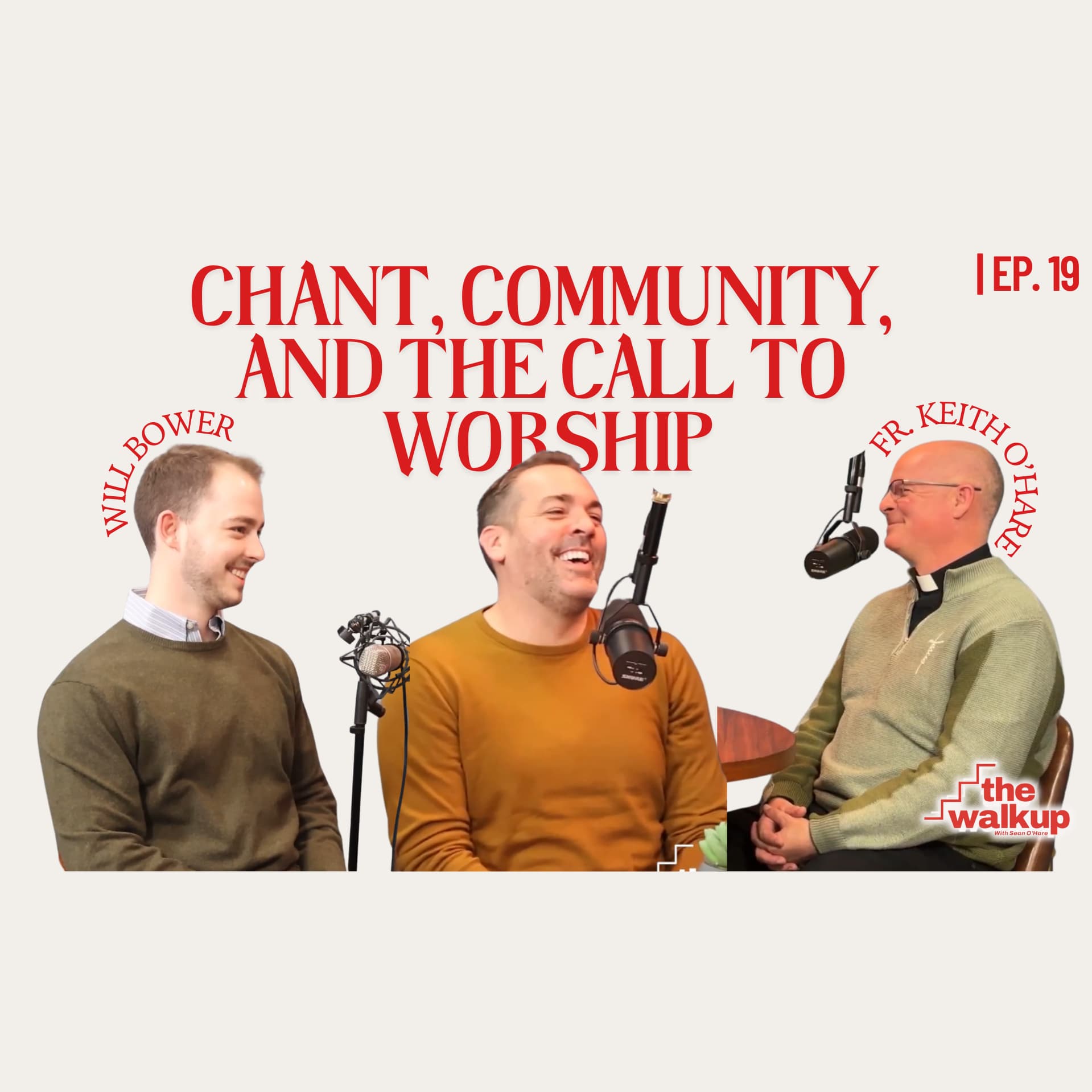
In this episode of The Walkup, guest host Will Bower sits down with Father Keith O’Hare, pastor of St. Louis Catholic Church in Alexandria, VA.
From the haunting beauty of Gregorian chant to the challenges and triumphs of building a thriving parish community, Fr. O’Hare reflects on his journey through music, mission, and ministry—from the streets of Queens to the Dominican Republic to suburban Virginia. Together, they explore how spiritual hunger, sacred tradition, and creative expression can come together to renew worship and unify a diverse Church.
Transcript
Read the full transcriptAuto-generated · 19,097 words
Welcome to the Walkout Podcast. I hope you enjoy our merch, our branding. This is before we upgrade to the LED sign, so enjoy it while it's here. But this is a big day in the history of the Walkout Podcast. First family member to agree to be on camera.
It's a risky venture. ...formally associate themselves with the walk-up. So, Father Keith O'Hare, for our audience, probably figured out that that's my brother, and I apologize in advance for trying to distinguish our voices. Since he came first, I did have to admit that I copied his vocal tones, and not the other way around. But we're here to explore... Jazz and theology, and since I'm a big fan of outsourcing expertise, I thought I have Will, my unfortunate intern, as I refer to him.
Very unfortunate. So, Will is an accomplished musician himself, so I thought he could help us navigate this particular topic, but before we do that, maybe tell people about your... Current assignment, and then also, you are actually the first into the podcast world before the walk-up. Maybe tell people about your podcast as well.
Sure. Well, good to be with you, Brother Sean. If I'm Father Keith, you must be Brother Sean. Sure, sure. With the same last name over here. Brother Sean, Sister Moon. I'm sorry, your question was about my assignments, you said? Well, yeah, just kind of get some background on your current assignment at St. Louis, but then also how you got into starting your own podcast, too.
So, I'm assigned currently in the Diocese of Arlington, Virginia. Very blessed diocese in the suburbs of D.C. So, St. Louis Parish is in the suburbs of D.C., about 20 minutes south of Reagan National Airport. People know that airport, I am sure.
Nicely diverse economically and culturally as well. A lot of military as well. We are always in that world, the military culture in Northern Virginia. Suburban, busy life. People spend a lot of time in their cars, so a lot of commuting going on there.
When I have to drive anywhere, I feel compassion for the people who live in traffic day after day, right? So, Northern Virginia people, like people in many parts of the country, are commuting, and what a great space for...
Good news, to say it that way, right? So, you know, you're in your car, and you look over, you're at a red light, you look over, and somebody's kind of got their hands in the air, and they're praising, and they're having a good time, or maybe they're just dancing, I don't know what they're listening to. But we spend so much time in the car, and why not include in that space of listening the spiritual topics? So, the podcast, it's called, just very simple, St.
Louis Parish Podcast, not about me personally, it's about the parish, is... An opportunity for the things that are happening in the life of the parish to become more visible, more known. There are so many good things happening in your church, and who can know all of it? I am blessed in my perch to be able to pretty much see everything, all the good things that are happening. So, whether it is service, whether it is teaching the faith, whether it is evangelization, whether it is sacramental, whether it is something in the school, youth ministry, whatever is going on.
There are always neat topics to discuss. So, my Director of Communications, Andrew Lane, we just have simple conversations about a couple of topics, and we always conclude with a question from the kids. So, I have questions submitted from the children in our parish school.
I will answer that question at a kid level. These are second graders mostly, but then also maybe at an adult level as well. So, try to put a little teaching nugget in there along with just sort of what is going on in parish life.
So, I think people are enjoying that. It just adds to their appreciation, and I am also looking forward. We just started this a couple of months ago. I am also looking forward to interviewing members of the parish who are doing interesting things, kind of shining a spotlight.
So, there is, what a gift. It is a podcasting world, to say it that way. So, what a gift podcasts are, it is essentially creating your own radio station, right? So, people in their cars can be connected, not just in their cars, when they are doing their chores in the house throughout the day.
So, that is a description, we could say, of what is going on there. Yeah, no, it is interesting. You know, the church is always... Sometimes, being on, has been on the front, leading edge of technologies, right? Sometimes, I think Vatican Radio, Vatican was one of the first to actually have radio back in like the, I mean, shortly after the invention of it, I think, with Marconi? I thought you were going to talk about the invention of beer. Invention of beer. We've been on the, that's a technology, which leads to talking, which then leads to confession, which is good for cash flow.
Which then leads to needing graces and indulgences. So, sometimes we have been on the front edge of things, sometimes we are a little bit behind. But being able to incorporate these different things into the parochial model, which in some ways is not unchanging, because it is always looking for ways to innovate, but using that as a different medium, because the parish life is meant to be... It's localized, but as you pointed out, people commute, they're busy. It's not as if it's the town square with the local church on Main Street, and everyone's getting the chance to know every other person in the parish.
I might offer this metaphor that the church is a city. It's an entity with all different kinds of moving human parts, and isn't it kind of... Customary in our concept that a city has radio stations that are really based in the life of that city.
So, yeah, a podcast is almost like the radio station for the city of your parish. Yeah, because, I mean, it's really, if you're defining a city as just a collection of people who have some sort of shared interest, right, especially in a suburban life that can be a little disconnected.
Absolutely, a lot of isolation. You know, there's not... I mean, what connects you ends up being your areas of interest, your kids, their schools, their programs, maybe whatever hobbies you might have if you're a military or retired person or a single person. So, a lot of times, parish life, and I think you've talked to me about this, is that it's not one monolithic, it's not one parish, it's probably five or six different. Sub-communities, right? You already mentioned some of them. Military, obviously you've got families, you've got some recent immigrants, you've got the Spanish-speaking community, you've got retired persons, and we'd love for them all to hang out and get to know each other, but realistically, they're going to stay.
Hang out most with people they have the most in common with. So, how do you, as a pastor, try to navigate those different subgroups? I will just say this, first of all. What a beautiful gift the unity, the true unity and diversity that the church is.
It is such a graced moment in the Mass on Sunday to distribute Holy Communion, and we use kind of an altar rail system there. And, you know, a body of Christ, and I see a person who is... I happen to know is a janitor. That is what they do for a living. Body of Christ. Oh, high-ranking government official, like literally on the same kneeler. Just so beautiful, right? Or someone who is from the Philippines, and then the next person, they are from Nigeria, and the next person is from Russia.
Okay. Next person is grew up here in Northern Virginia, right? There is just a beautiful, true unity and diversity in sacramental life or liturgical life, to say it that way. We're made for horizontal, and I'm sorry, we're made for vertical and the horizontal. So, in the vertical, you know, God himself assembles us, no matter where we come from. But then, right, the horizontal, that connectedness, socially speaking, requires a little bit of engineering, right? So, great organizations like Knights of Columbus, they bring people together.
Parish schools bring people together. Something else that we've been gifted with, I would say, it's... A gift we received, we actively received it, is having a parish cafe. So, I would say right now, where we are in our corner of the world, two things that really distinguish our parish life are having a podcast, which again is connecting and all that, and then having a cafe, which likewise connects people.
Everyone loves coffee. It kind of doesn't matter how much money you make or what country you're from. Everyone wants coffee. Yeah, and what's interesting about that is you're talking about ways to connect people, so the podcast is obviously a digital format, where people consume it alone. I mean, I guess you could listen to it.
You know, on a Bluetooth speaker, or in your car, more than one person is listening, but for the most part, you're going to consume individually, whereas the cafe is, by nature, in-person. Perhaps we would say incarnational, something that is happening in person where people are not forced to interact, but have the opportunity to interact in person in a way that… So, you are kind of meeting two different needs there, right? And so, what have you seen? Like, if you were to look back at the… Cafe has been a couple of years now, right?
Two and a half years. Have there been, when you look back and you go, these are the things that have… Change, or the opportunities that have, for people to connect, or what impact has it had on the parish, kind of on a tangible level?
It's been multi-dimensional in its impact, really, really beautiful, even beyond what you might have been intending, engineering, sort of social connectedness. So, first, I have to say this, that I believe that, you know, in the old European town, you'd have your church, and then outside the church, like a plaza. Yep, yep. That's your typical town life. We're going through Rome. Piazza del Lude, and I've gotten lost in every piazza in Rome, because there are no streets that go in a straight line in all of Rome.
The church is providing the vertical, to say it that way. We encounter with the transcendental, the divine, the mystical, but when you walk outside those church doors, we are not just made for the vertical. We are made for communion, right? Union with each other. Well, think about it that way. We come into the building for holy communion.
And then we walk out of the building for, can I say, more communion, right? The communion of our fellow man. So, in a European town, you've got the church building and the piazza, as you say. In suburbia... And maybe in cities, too, actually, because where is the plaza in New York City, right? Well, there are, right? But as far as like a church version of that. So, I think in the suburban world, walking out of the church building, you want to walk into a cafe.
That is where it is okay to talk to strangers. And so, that sense of we are made for that more human communion. Yeah, it's okay. I can walk in the cafe, and there is something, I'm not sure I can describe myself, but there is something just sort of calming and relaxing, and it just, I'll almost say, there's almost sort of a Sabbath spirit to coffee. Right? You walk in a cafe, or you sit down with your coffee, whether it's at home or some other place, doesn't it just sort of, and maybe there's a physical element to this, I don't know.
Like, it just sort of calms you? I don't know if this is merely association, or if it's cultural, or even physiological. But in any case, you're... You're entering into a different mode of the day, just to say it that way, for sure. Absolutely.
And how many people literally begin their day with ... Coffee is fascinating, right? On the one hand, it gives you sort of a lift, energy-wise, but it also is this calming element, too. It's very interesting. I think, for me, it's just avoiding withdrawals. It's that caffeine withdrawals kick in, and I smell the coffee, and all of a sudden, I'm at ease. Yeah, that's the coffee.
Well, I guess this would be good. With an intro, intro will. So, besides being my unfortunate intern from Baylor University, I also come from a Protestant background, so I'd be curious about this kind of element of socializing and community and all that. But before we get to that, maybe just give people a background on you, how you got to New York, and, you know, try to... You know, speak glowingly of your current internship.
Absolutely. Yeah, that won't be difficult at all. Yeah, so I got here kind of through a miraculous answer to prayer. I was praying for direction for a couple months, nearing graduation, didn't really know what I was going to do with my life. And I was in a wintermester course with a professor who is actually the… Wintermester? Wintermester. So, class over the winter break. Oh, wow. Okay. And the professor happened to be the director of the program that I am currently in, which is Film and Digital Media Program through Baylor, and he said, well, I think you would make a great candidate.
And even though you didn't have a major, I had no background in film, digital media, as far as, you know, being someone in my generation who interacts with this stuff a lot. And I said, Okay, God, I think that's you decided to delay graduation, come out here. And I, I didn't know what internship I was going to get. I didn't know what I was going to do. I started praying, God, can you give me a Introduce me to a man, a strong man who is entrepreneurial, self-starter, someone who is business savvy, just a great mentor, and someone who is spiritually strong.
We are still looking for that guy. Well, I think I got him. That is quite a prayer intention, because I know who that is. Right. It is very specific. This is why the first day of the internship that I walked in, I was so overwhelmed, because I was...
I didn't think God answered prayers like that. Right. Maybe I just hadn't experienced. Wow. And it was mostly because I had been writing them down that I was able to be like, I took this kind of objective approach and saw, wow, this prayer has been fulfilled, this prayer has been fulfilled, and throughout that, you know, the next month, I had been writing down my prayers. Sometimes, by the end of the day, it had been answered, and not always.
Yes, here you go. Sometimes it was a big, fat no, but it was amazing to see God interacting with my life in such a tangible way. And I've seen, I don't know, maybe this is too simplistic of a contrast, but I feel like with my Protestant evangelical friends, they tend to ask for more specific. Prayers? Yes. And we take it too far sometimes. Okay.
A lot of people will just, hey, God, give me this, give me this. But I also feel like, and this may be just my own lack of boldness sometimes, but I feel like oftentimes my evangelical friends are very bold in the things that they'll ask for and their belief that we believe in a big God that can grant. Not Grant, or, well, you know, can discern, obviously, in his wisdom, what's best for us, but to ask for those bold things, I think, I don't know.
If it's a Catholic thing or an Irish Catholic thing, but we're like, you know, I mean, if it's generally, you know, if good stuff could happen, that'd be awesome, but, you know, I wouldn't bother you. Just, you know, if I could stay healthy, that'd be awesome.
Yeah, maybe a little bit too much humility and a little bit too much expectation that life's going to be crosses, that we don't. Pray boldly, and sometimes just, Lord, just bless me. Like, I really desire this. You're right. I think our Catholic ethos can sometimes lack, yeah.
And I don't know all the reasons that is, because it's funny when these, because, well, coming from that background has asked a lot of questions, and it's allowed me to kind of clarify or wonder, okay, why do we do this, or why do we do that? And I think there's these kind of... incremental things that happen over time that just become part of the culture of whatever community there is, whether it's ethnic or religious or whatever else, and you sometimes don't know why it developed that way.
But, I mean, I remember, as both of you know, I get to work with Tim Tebow and their Night to Shine program. For a prom for special needs folks all over the world, and when he was first presented with the idea of, hey, maybe the Tim Tebow Foundation could get behind this concept of a prom for those with disabilities, his response was, yes, absolutely, we should do it, but...
I want it to be all over the world. Like, this kind of bold confidence of like, believe in a big God, and I think this is a beautiful idea, and if it's going to happen, I want it to happen all over the world. I don't think I would ever have that kind of gumption, I guess. I don't know what the right word is, but sure enough, it started just in the States, and now it's in almost 60 countries and almost 400,000 people, so.
You know, if you don't ask. You know who tends to have that boldness are religious sisters. Is that true? They tend not to be shy about their prayer petitions. Mother Teresa, Mother Cabrini. They go big, and they tend to get big. It's pretty amazing. I hadn't thought about that. Because, yeah, even Mother Angelica, the founder of EWTN. There you go.
I don't think I've shared this story in the podcast before, but in her biography, and I can't remember if I shared this with you, Will, but that, you know, speaking of Christians embracing technology, she founded a cable... I guess you would just call it cable channel. I'm sorry. Broadcast network. Broadcast network. It was radio first, and then became cable network. Cable network. I think that's the right term. But she founded EWTN before Ted Turner founded CNN. I mean, that's how early.
She's in the late 70s, basically. And when she finds out, oh, you know, for you to broadcast, you need a satellite dish, and she's like, oh, okay. Where do I get one of those? And they say, well, RCA is the only one who sells.
What you need to broadcast. She says, okay, I'll go ahead and order one. And they're like, okay. So, she calls up RCAA people, but she does this by looking through the executives at RCAA and looking for the Italian last names, assuming they're Catholic. Wow.
And says, because I guess getting a side of the dish at that point, you know, these are not like they were like off the shelf, right? So, you need to order it, and they need to probably manufacture it for you. And she says, I want, she finds the right Italian who says, all right, you know, mother, we can send you one.
You know, but it'll be, you know... Cash on delivery. Cash on delivery, and it's like $1.2 million or something. So, it's some crazy number. She's like, oh, okay, great, bye. Because she just figures God will figure it out. She forgets about it. Not forgets about it, but just, you know, goes on, moves on, and then a couple months later, this flatbed truck with a satellite just shows up, and she's got a... In Alabama. In Alabama, and she's like, uh, right. Let me go to the chapel real quick.
So, she says, keep the delivery guy busy. So, they keep him busy, giving him a tour of the monastery, and he's like, I got deliveries, man. I need the cash. And then, she's in the chapel, and one of the sisters comes and says, oh, there's a phone call, and she's like, Yeah, but I'm trying to get the money from God. Don't you understand? Like, she's waiting for the money to fall from heaven, but that's the level of confidence she has, right?
But this person keeps calling, and she says, fine, I'll take the phone call. And this guy says, oh, you know, mother, you know, you're... Your talks and your teachings... He had read one of her booklets. Oh, it was a booklet? I thought it was one of the talks. I believe it was a booklet that he had been inspired by, yeah. So, he reads, speaking of media, printed media, and he says, oh, it really helped me transform my life. And she's like, oh, that's great, dear.
And kind of like moving on, and he's like, no, no, no, like it really transformed my life. And I kind of turn myself around, and I've done quite well. And she's like, oh, that's great, dear. And he says, no, no, I made a lot of money, and I want to donate it to you. And she's like, oh, well, how much? And it's the exact amount that she needs. And she's like, great, could you wire that right now, please? So, that level of confidence, it's like there's the prudent entrepreneur that's like, I've got to have a plan, and then there's this level of boldness, because you could certainly look at that story and say, You know, you're too old to know about cash-on-delivery.
COD used to be a thing, because credit cards and mailing in checks was just not an easy thing to do, so you had to do cash-on-delivery. I don't know what would happen. I guess they would have sent the salad dish back or something, but if it was, like, custom-made, I don't know how that would have worked.
Anyway, so you asked for big things, and you are now in New York, and thinking about staying, which is another bold move, but to connect it to our topic, so maybe give some background on your ... Both of you guys give some background on your ... Um, musical, um, background, I guess. Um, so maybe start with yours and then, and then to fathers. Yeah. So growing up, my parents really inspired us to pursue.
Everything musical. We grew up listening to classical music. I think my mom had probably read somewhere in a book that listening to Mozart as a baby makes you smarter, or something like that. I'm not going to mess on that one. Yeah. So, we listened to that a lot, and it spoke to me specifically, classical music, for whatever reason that's always been what I've loved, the beauty and the stillness, and I think almost the scientific nature of it. That is always fascinated me.
I ended up going to a classical Christian school throughout early elementary school, logic, and rhetoric school. I guess middle school and high school is what that is really called. Oh, they don't say middle school or high school. They say… It is grammar, logic, and rhetoric.
Huh. Interesting. And when does one… Grammar is up until 6th or 7th? Until 5th, the end of 5th, and then 6th through 8th is logic. That's funny, because just an aside, dad, our dad, would refer to going to grammar school. Yeah. That phrase. Elementary school, grammar school. Yeah, that's really interesting. That's a holdover from that. Yeah. Yeah, it was... Middle school is kind of a newer phenomenon. Yeah, it's a newer term.
Yeah, it was... I guess. Some people called it middle school at the school, but it was called. Logic School at Geneva School of Bernie, which is what it was called. It was very much an emphasis on the arts. The whole goal was to produce well-rounded students, and so you were kind of involved in everything from athletics to the arts. It wasn't like you were a band kid if you were in the band. Half the football team was in the band. It was a very cohesive environment.
Not everyone cared about the arts, but you were required to. At least participate in some way. And so, that led me to joining the band, and Logic School played, I think, percussion to start out. Really didn't like it, and our band director said, well, you can choose between clarinet or tuba.
That is a big difference. I was like, wow. That is about a 20-pound difference. I know. And at the time, I was probably 120 pounds, skin and bones. And I said, okay, I'll take the clarinet. You know, it seems fitting for my physique. And I loved it. From the moment I had played it, the sound was so rich, and it added a color to the rest of the band that I really enjoyed. And, you know, I was willing to take kind of the social.
Cred hit for playing the clarinet. It wasn't as macho as the tuba. Yeah, exactly. It wasn't as macho as, say, the people on the drum line or whatever, but I enjoyed it enough to be like, yeah, I'm going to sit up here with all the girls playing the clarinet. And, yeah, I ended up practicing, competing, playing a lot on my own, and just loved it.
And you said you were all-state in Texas. That's no small achievement. Yeah, it was a very, very fun time competing. Yeah, my experience of music was hearing him practice all the time. Nine years apart, yeah. Yeah, so I... You found that discouraging, the hard work ethic?
Yeah, no, I wasn't a fan. I wasn't a fan. You were very observant, though. Like, I know I don't want that. That, yeah, it's unfortunate that it was presented to me at the, like... At the level of, like, this is the, I'm seeing the, how the sausage is made, so to speak, and as opposed to being drawn in by, like, perhaps, you know, the beauty of the instrument, or seeing kind of the fun finished product of, like, performance or something, I was seeing the, like, drudgery that's required, and I was like, yeah, I'll just stick with things that don't require hard work.
And I'm, you know what, I've stuck by that, because I think that's very important to be consistent. Stick to your principles. Don't let anybody change you. So then, I don't know, I'm sure we've talked about this at some point, but like what, did mom and dad promote you getting involved with music, or just something you... No, nothing at all. It was just the standard, you know, the band director does a little expose, here are the different instruments if you want to join the band.
So I actually started with clarinet for a year. I wanted to start with saxophone right away, but we did one year of clarinet, kind of a warm-up. No, just my own interest, and the band director, he is an excellent band director, recently retired. He really, I was very blessed to have him. His name is Barry Ward.
To my knowledge, I never got this expose, even though we went to... Well, you could avoid it. It was not a required, you know... So, there we go. ...presentation. Yes, you knew what to avoid. So, then you are like, all right, but this is what?
Fifth grade, yeah, or fifth grade, yeah. Yeah, no, and then I just had an aptitude, and then when I finished high school. I discerned that I wanted to major in jazz saxophone. You can actually major in that. There are not a lot of books involved, and I was also playing guitar, and my guitar teacher actually let me know that the University of Miami has a really good jazz school, and it is true. It was beautiful. Pat Matheny studied there for a time.
Some other amazing musicians have spent time there. So, I was little fish in a big pond down there in Miami. Learned a lot. It was great. I only did it for two years. Two years was full immersion in the subculture of jazz school, and then I just earned.
Not stay with it. I didn't think I had the talent or the passion that these other musicians had, because I think, as we all understand, to be a professional jazz musician is a very sacrificial lifestyle. You are very unlikely to make a lot of money without going into other ways of providing for yourself.
I specifically remember seeing one of my jazz saxophone professors performing. In the lobby of a hotel, I was like, oh my gosh, people are just walking by. They have no idea. This guy is amazing. His talent, he's amazing. But this is what he has to do to literally pay the bills, right? So, I don't think I have that. You have to have a real, real passion to live that lifestyle, as opposed to having it as your extra hobby along with whatever else you might be called to, right?
I've mentioned this to... So, I should mention that he is our film and TV intern through Baylor for our company, which is called Ponder Media, of which The Walk Up is one of our productions, but we are also interacting with some other producers and screenwriters and performers and actors and things like that, and my experience of New York in particular.
...has kind of really helped me understand that element of passion that I've said to Will that, like, you know, sometimes we're working with a performer, and, you know, we can't maybe pay a lot right out of the gate, and hopefully we'll pay more as, you know, more opportunities to monetize whatever the production is. And I'll say that, you know, my experience of that is... I mean this not in a derogatory way or a pejorative way. It is like a sickness. It is like they are infected with the desire, the passion of that art form, whether it is to perform as a musician or as an actor or as a comedian, and they love to get paid as much as possible like anybody else would.
But in lieu of that, they still need to perform. It is like, I got to get this out. I have to exercise this talent. It is like burning inside of them. And so, at times, I will admit that I have at times felt a bit exploitative almost. To your point before, you are like, do you guys realize how talented this person is?
Do you realize how much they should be getting paid? Do you know how much work this takes to have this level? And I say that, you know, again, having seen you practice for hours and hours, and then also knowing that kind of like the 10,000 hour rule as kind of like a general guiding principle of like the amount of time it takes to get to this level of being a jazz performer in New York City, you're one percenter in terms of talent and capability and wherewithal.
And yet they'll be, you know, playing at a simple gig. But it does take a certain passion, but a humility that I think is underappreciated. Maybe you're not intending it, Sean, but this is a really, really good segue to the... Spiritual parallels of jazz and theology, because St. Paul says, woe to me if I do not preach the gospel. So, I think you are saying that your jazz friends would say something like, woe to me if I do not play the music.
It is an art. There are styles of music which are both art and... Commercial product. Commerce, yeah. And there's nothing wrong with that. Yeah. You can join those two. Jazz, at least traditional jazz, as we're talking about, that word is so widely meaningful, but jazz in its traditional sense is not a super commercial product. In fact, I'll say this for myself, that I understand jazz from the inside as a trained jazz musician.
But I do not understand exactly, and I have always kind of wondered about this. I do not understand exactly how people who are not musically trained at all, how they come to appreciate the traditional improvisational jazz. I really do not know. I am guessing it is sort of the energy and the improvisational creativity that just kind of feel the creativity of it. But I can understand, well, wow, that is interesting what he is doing with that chord progression. Oh, wow, yeah, he wrote, oh.
That's a lot of talent, or that's kind of cheesy, that's kind of weak, you know, things like that. So, it doesn't have that sort of sing-along ability that other styles of music have. Probably similar to classical music, I would say, as well. There are people who appreciate it without much training. I guess they just have a...
With a simple heart, with a simple ear, you might say, just an appreciation for the beauty without the training. So, maybe I may answer my own question that people can do the same with the craft and the art of jazz.
But we'll try to keep it spiritual, right? So, there is a language of the heart in jazz, and that's where we get into this sort of, you know. Even transcendental, mystical, spiritual kind of quality of this kind of a music, and there's lots of parallels between Christianity and jazz, just to say it that way. So, that's a whole topic on its own. What are those parallels? You say that like that's a, well, everyone knows that. Everyone knows the...
Time memoriam. Everyone knows the parallels between these worlds. I mean, just as a quick kind of, where I come at it from more of a consumer standpoint, but also someone who's been more of the facilitating and producing, I guess, jazz performances. So, since you guys come out from the performance side and from knowing the instruments and knowing the, like, I can't. I can't read music, I can't read a corporate, I don't know what a corporate progression is, necessarily.
I had a young lady I was dating that was a jazz singer based in Paris. Everyone should have a Parisian jazz singing girlfriend at some point. And in a blatant effort to impress her, I told her that I was going to start a jazz night in New York. I hadn't done that yet, but I felt like it was good.
I had enough time before she could get there from Paris to figure it out. So, what happened was, I was in Paris visiting her, went to a jazz club, I think it was Le Caveau de la Huchette, which is like one of the main, in the cave, like lower level of a bar, very close to Notre Dame, there in the center of Paris.
And it was kind of a rainy night. It was like a Monday or Tuesday. It wasn't a huge crowd, but the performer that night was a guitarist, and he was from Australia. And so, I knew that he would speak English. And so, I thought in between sets, I wouldn't talk to him. I'm like, hey, man, I'm trying to start this like jazz night in New York. Have you gotten any ideas? I don't know what made me think the Australian guy in Paris would have ideas on how to start a jazz night in New York, but he said, oh, well, you should connect with my friend, Nick.
He's in New York. Like, we grew up together. I came. I came to Paris, you went to New York, and he's a great saxophonist, and I said, sure, okay, great. So, I connected with Nick, and we emailed, and he said, why don't you come to one of my shows, and then we'll talk afterwards.
And this is why I love New York, because only in New York can you have a business meeting after somebody's jazz gig that goes from 10 p.m. to midnight, and then you hang out from midnight to 2 a.m. on a Wednesday, and we have a...
Business meeting. My dear friend Jeff came with me, and we talked with him, like, hey, here's our vision, here's what we're trying to do, and he's like, all right, I'll check out the space, and so we did that every Friday night for about three years. We've done over 300 shows. We do it a little less frequently now, but actually, I haven't told you this, actually. Nick reached out to me about a month or two ago and said, hey, I You've mentioned to me in the past, like, doing a jazz festival.
What do you think about doing that? And I said, I'd love to do it. I can't be quite as involved as I used to, just because I have a lot of projects, but let me connect you with our friend Kyle, who is the producer of this podcast, actually.
Because he's a very talented musician, but also has a venue in Brooklyn that we can use. So, we're going to do one in Brooklyn. I don't remember what date they set up, but it's happening. The church is going to help sponsor, because they have a cool kind of courtyard area that we can do.
I forget the particulars, but it's going to be... I think like an afternoon, into an evening, on like a Saturday sort of thing. So, you are speaking of Nick Hempton? Yes. For anybody listening, he is a great musician. He does great, great jazz. I was very impressed when I heard him. So, what is the name of this jazz festival? Do you know? I do not know if we have a name for it. It is a good question. It is probably something Brooklyn-y sounding, because it will give a little.
A little hip edge to it. But actually, Nick's going to be on the podcast next week. So, I come at it from this kind of like, so for those who are listening, kind of like, well, I can't understand it as an instrumentalist. I mean, I did it, as we already discussed, to impress a girl. But also, but obviously, continuing on after our relationship didn't last.
Right. And for me, it was because there's an accessibility to jazz, there's a social element to jazz. I know that there's places where you go to listen to jazz at the highest levels in terms of performance, where you're there to kind of be quiet and almost close your eyes and really drink it in. But there's also this versatility that jazz has, because it allows for... Like, entry level, if you will. Like, you can't just pop into a classical concert, right? You're either going all in or you're not.
You can't pop into an opera, for the most part. And then even as you were talking about before with, like, vocalists or pop music, that might connect with people, but it tends to be very... Preferential, right? You like the particular type, the particular musicians or performers you like, not necessarily accessible to everybody, right? Because, like, I like this pop musician, you like that pop musician. I'm probably not going to go to your, unless I just love all, you know, like all performances, you tend to stay in your lane.
Whereas, like, I don't know anybody who's like, well, you're hosting a jazz night? I just don't really like jazz. I almost, that's, it's... Open to everybody, there's an accessibility, and certainly a cool factor. Everyone thinks jazz is cool. Especially in New York. Yeah, but I don't know that I've ever had a reaction of anything other than, that's pretty cool that you host jazz, or that you do these jazz nights. Yes, I'll offer this. I think we can picture this.
Say a jazz lounge, and there would be three ways of being there. One way of being there, this jazz lounge with, you know, a jazz quartet on the stage. Typically, you're talking about a saxophone or a trumpet, and then piano-based drums, right? So, that's kind of your standard quartet, maybe quintet. Not always a vocalist. That seems to be... An added feature, for sure, but in any case, picture that on the stage, kind of low lighting.
The one group is the people who want to sit closest to the stage, and they might even be there by themselves, like, I'm just here because I love this music, and I'm just here, and they're kind of like nodding their heads to the music, and just really just kind of might even close their eyes sometimes. It's just them and a drink, and just enjoying this art.
Then a few tables away from them are people who are listening but having conversations, kind of paying attention, having conversation, clapping when there's a nice solo or when the song ends. And then there's the people maybe at the bar who aren't really listening at all, but the energy in the room created by jazz is part of the pleasure.
So, I think, as you say, Sean, that it is hard to find someone who has a distaste for, and again, when we are talking about jazz, for this conversation anyway, we are talking about the style that became so well-known through the 40s and the 50s, like John Coltrane and Miles Davis and Charlie Parker, and just kind of classic jazz, classic small group jazz. I am going to say it that way. There's big band jazz, right? There's other styles that have developed over time, more modern forms, which that's the wonderful thing about jazz, so adaptable, kind of blends with other genres.
But in any case, when we talk about that topic today, we're using that as our example, I think. So, what is it about the genre of jazz, for those who would want to know just like the definition? So, typical small group quartet jazz, you play a melody at the beginning. It might be a show tune, by the way. That is kind of a neat thing. Jazz takes sort of simple, popular melodies and songs and then plays with them. So, playing that melody at the beginning, and then each musician would take a turn improvising on the given structure of that song.
Every song has a structure based on the rhythm. And the chord progression, the harmonies, and then the melody. So, each musician would take a turn, improvising, playing with it. That does require a lot of rehearsal. Individually, you have to be a master of your instrument to be able to sort of converse musically and invent in the moment. So, there is a spontaneity in the very genre itself. What I find so meaningful, and you established this with these jazz nights, right? People are having conversations at their tables.
Maybe it is in a group of three or four. Like a quartet, can we say. So, there is a quartet of conversation happening over here, and 35 feet away, there is a quartet of musical conversation, because what happens when a musician improvises, takes his turn doing a solo, there is a lot of interplay, and if you are attuned to it, you catch it. Like, the saxophone player is playing a little thing here, and the drummer is playing off it, kind of mimicking it, or the bass player is kind of responding to it.
There is this constant musical. It's gorgeous. It's really gorgeous when you're able to catch it all. So, musical conversation, so beautifully imaging, can I say, human conversation, which again brings us back to the... Communion in the church, and then more communion among our fellow man, right? That conversation is such an experience of union, communion, one with another. So, the musical communion on the stage, and then the interpersonal communion through conversation at the tables were made for that. So, I think whether people have any awareness of what is going on, Why do you like jazz?
Why do you hear jazz everywhere? Why do you hear jazz in an Italian restaurant? Why do you hear jazz in the elevator? Why do you hear jazz when you are on hold on the phone? It is because it is a genre which is literally being created in the moment when we speak of these taking solos and improvising, and that is life. Life is that way. We are improvising all the time, right? I just thought about this comparison.
I would say one of the great things about being part of the Catholic Church, because the Church is universal in every country in the world, that I can feel at home almost anywhere in the world. I go to Mass, even if the Mass is in a local language. If it is in Latin, I really feel like at home, because I am familiar with that liturgy. But it is funny, when I go out, I look for a jazz club.
So, I've gone to jazz clubs in Istanbul, Lima, Rio de Janeiro, Israel, so there's a universality to it as well, because I feel like, all right, well, I don't know this city. Like, when I went to Istanbul, it was a...
We were only there for a brief period of time, and it is a pretty big city, and some cities are easier to navigate than others in terms of like, oh, this is kind of like the cool cultural area of town, this is the business sector. I was not quite able to navigate it, but you look for the jazz club, that kind of tells you where to go in the city.
I mean, every now and then, you could have a jazz club in a non-cultural area. Same thing happened when I was in... In Poland, same thing. I found the two or three jazz clubs in the same neighborhood. I am like, yeah, that is probably the cool place to be.
So, when you travel, Sean, you have to check masstimes.org and jazztimes.org. The essentials. So, yeah, there is kind of an accessibility and universality to it, I guess, but what is your sense of, like, his analysis, what is your take as somebody who is learning?
Learning more about the Catholic Church through our conversations, but also somebody who comes at it from a musical perspective. Yeah, I really, really love this idea of universal community through jazz and through music as a whole, but I think jazz specifically because there is almost a harmony created through discord, and I think… I think that is what distinguishes it from almost every other genre, where normally a melody will lead you somewhere that is predictable, satisfying, but oftentimes in jazz, there's almost a dissatisfying element to it that I think speaks to the fallenness of human nature, and it's almost these two contradicting ideas that ultimately form a broader...
More substantial narrative that, like, you can't have harmony without discord, just as you can't have light without darkness. You can't have sanctification without sin. You need these juxtaposing forces to ultimately create something that is wholly good and lead us toward the good.
Yeah, so there is, it's a great, great connection with, like, the fallenness of man and the sort of... Built-in imperfection and sort of rawness of jazz, right? We love classical music, and you have great love for it. And if we can say, classical music is an image of heaven. Right? Yes, yes. Things are perfect, and we're going to give you a taste of what it is. The goal is to perfection. Yeah, yeah. Perfect a piece. Yeah, and I don't want to dismiss that there are some sort of creative elements in the moment, in the way someone might conduct.
There are, right? But it's a smaller portion, for sure, of the genre. Yo-Yo Ma is that. He's improvising up there when he's doing a Bach concerto or something. Right, so he has prepared to perfection this piece, right? Now, he might do it his own way, right? That's where there's some creativity there, right?
But whereas classical music is imaging heaven. Jazz is not. It's not. It's imaging life on earth and our brokenness and the sort of tension of life, our suffering, too. Like, American jazz, and there's, as you mentioned, John, there's jazz all around the world. And by the way, search Persian jazz. Really cool stuff, right? Because if the principles are simply play a melody and then improvise on it and come back and play it again.
That opens the door wide, right, to all sorts of styles of music that can be made into jazz, or given a jazz form. But, for speaking of American jazz, traditionally speaking, it is certainly preceded by the blues and gospel music, right? So, very, very rich in terms of...
What is the meaning of suffering? Like, suffering is real, right? You also cannot ignore the element of American history and the experience of slavery. Sure. So, these real, real suffering and real brokenness of the human person, all thrown together and...
What you mentioned, Will, about the sort of tension, and not everything gets resolved. And I got a quick story just about that. It is a really neat story. You may have heard of this. So, Wynton Marcel is a very amazing jazz trumpet player, who is also a great teacher of the art. If I have the story right, he was playing in a certain venue, and someone's cell phone. He went off and played a certain tone. And it was just like, that could have been so interrupting and so disrespectful and so rude.
He started to play off of the melody of the cell phone ring. That's amazing. So, he took what should have been just... We might say in Christian terms, like, pure sin. Like, what a terrible thing this person did. They didn't turn their phone off, let it ring, and it was ruining the experience.
We might say, oh, happy fault. So, instead, went and took it and literally played with it, made it part of the music. So, that is a great, just a kind of dramatic example of what God has done for us, right? Oh, happy fault. Oh, necessary sin of Adam. So, grace abounds the more, right? So, he can transform what is so broken in us, and there is something so redemption-oriented and transformation-oriented and salvation-oriented, you could say, in the very genre, whether the musicians are aware of it or not.
It is just in the music, and certainly, if you do some searching, you will find... Sometimes there are theologians who have an appreciation for jazz, Christian theologians who have an appreciation for jazz, who then start to write about it and sort of delve into this sort of relationship, we'll say, between jazz and Christian theology. And sometimes you have jazz musicians who come to reflect theologically to the best of their ability from that side about, wow, this is so neat what this music expresses.
In regards to the Christian faith. I will just start getting the conversation going. So, one very simple thing to recognize about the genre of jazz and Christianity. The truth is one, the Savior is one, the faith is one, one Lord, one faith, one baptism.
But the many ways that the Christian faith is going to take flesh in the believer, infinite, right? Someone asked Pope Benedict one time, when he was Cardinal Ratzinger, how many ways are there to God? And this person expecting the German Rottweiler to have some sort of restrictive answer, he said, as many as there are people. That was his answer. That was the answer of Pope Benedict to the question, how many ways are there to God? As many ways as there are people, which is to say that while the truth and the faith and the Savior is one, the saving is uniquely to be lived out, to say it that way, right?
So, the way that Christianity, Catholicism is lived out in the life of a believer in the countryside of Nigeria is going to look a little different than Hell's Kitchen. It's going to look a little different than suburban Northern Virginia. It's going to look a little different than the Philippines. It's going to look a little different than, pick the country, pick the place, pick the socioeconomic, cultural.
So, think about this. This is why I love this analogy, right? So, at the beginning, the four musicians play, we call it the head, by the way, play the head, the melody of that given song, and then each one takes a turn improvising.
And then at the end, we all play it together again. So metaphorical for the Christian life, where the faith is one. There is one song with one melody. We are going to play it all together as one, but then each one takes a turn living that faith.
So, when I have done jazz nights at the parish, get some musicians together and have a little social event with live jazz, I will throw some nuggets out there, and I will mention something like that. And one lady... Kind of raise your hand. Say, well, Father, that is kind of like we all go to Mass together on Sunday, and then Monday through Saturday, we live out our faith our own unique ways, and then we come back again on Sunday. It is like, play that again.
And it is the same song, Jesus is Savior, Father, Son, and Spirit. God bless you. Mass is ended. Go forth to glorify the Lord by your life. So, you see that kind of, again, this theme of unity and diversity, like the true unity and the true diversity of living the faith, improvising it uniquely, one might say. It is not chaos. There is order to it, but there is creativity in it. It is just going to look different.
Yeah, and that... The universality of it, or the, I think of it from a liturgical perspective, that when you're, you know, Will's commented on this, learning more about the Catholic liturgy, that how dense it is, how much is going on, that you, you know, you can't, it takes a long time to start to understand all the different elements that are happening, right? And the same thing is just like, I don't, so you don't need to understand it all to be able to...
Participate in the Mass, right? Even fully as a baptized Christian. And the same thing with jazz. I don't understand completely what's going on, right? But even as you mentioned before, there's kind of these three... Ways people participate. Three levels of engagement, you might say. Yeah, and you kind of see that in the church, too, right? I mean, there are people that are really in, they're getting there early, maybe they're really focusing on their prayer life, they've got their, bringing a rosary or bringing some other, you know, intentions, and they're ready for Mass, you know, and there's kind of the...
The normal, you know, kind of everyday churchgoer that's like, yeah, pretty engaged, but now their kid's misbehaving, and they're a little distracted, or whatever. And then you've got people on the edges, either they're new, or maybe, you know. Like, they're maybe not in a great place in their life, and they're having a little lack of peace about, they probably should be at Mass, but they're kind of feeling like they've got to be in the back. Maybe only a sense of duty and not deeper than that.
Yeah, and just kind of like, and maybe they, and we can all be different parts of that progression, so to speak. So, there's, so yeah, I know I've... I've mocked you several times about this thesis on theology and jazz, but now here I am adding my own little piece to it. So, what are your sense of this? The element of community, do you see similarities in Protestant tradition as well, or is there a unique nature, you think, to a Catholic tradition?
Oh, well, I think, as far as music goes, music brings Protestants together like no other. I mean, in many ways, the very central part of Protestant service is the worship, the music. You start off at some churches with a massive rock concert, and everyone's got their hands in the air, they're glorifying God. And it's a community. Everyone is connected in that experience, and oftentimes that is much more meaningful than the sermon or the message or the reading for that day.
It draws you out of yourself, yeah? It does, yeah, and into the body of Christ, into the community. But what I've noticed in the Catholic Church is the Eucharist is doing that. Because Christ can do that, and there is music, but that music is not the central part, and it is in the background almost guiding you toward Christ. It is pointing you towards Christ, pointing you towards the heavens, and it is directing your mind to a certain...
State, where there's less distraction, but it's not the central piece of it, which I've really actually come to love. Well, and even my brother is a priest. Having a brother as a priest, you get to participate in private masses often, because...
You need to celebrate Mass, and it ends up just being the two of us. Well, there might be a little singing at the end, but that is about it, right? Otherwise, it is a quiet Mass. And oftentimes, the private Masses can be the most reverent, because it is really just focused on, right, you are just the two of you there, or maybe just a few people when we have, when Father O'Hare celebrates Mass for our family, right? That is a very intimate experience, even though there is not.
We do not have the bells and whistles, so to speak, but there is a beauty that simplicity, and maybe even, I would be curious as to your experience, having been a mission priest in the Dominican Republic, because where you do have these more simple scenarios, where you are celebrating Masses in humble villages, and even the chapels you did have are fairly simple. How did those experiences influence your musicality or your experience of community and inform of this jazz thesis? There is a really rich tradition in the rural western Dominican Republic called the toque de palos, the playing of the drums.
It's three, like, congas, as we might call them, right, of three different pitches. So, obviously, that's drawing from an African tradition. There's a lot of African heritage, especially from the Congo, owing to slave trade going back hundreds of years. So, the people...
In their customs, even in their food, I'm going to talk about that another day, and their music, for sure, owes a lot to African traditions and customs. So, I'm going to throw together, it's a really neat confluence of Catholicism and missionaries and language and music.
So, there's singing that goes along with playing the three drums. And what has developed amidst all that is the singing of the Salve Regina. Just check this out, right? So, in this rural western area of the Dominican Republic, they're speaking Spanish today because of Spanish missionaries from centuries ago.
They are playing a style of music which is clearly from the Congo. By the way, I have talked to people from the Congo, and they have seen videos, and they are like, that is our music. That is our dancing. That is our drum. And then, that is our food.
So, there is a really amazing direct continuity over centuries. So, in any case, an African style drumming and singing, very heartfelt, kind of guttural and from the belly. But insert into that the Salve Regina, Latin chant from about a thousand years ago, right, but sung in Spanish because of Spanish missionaries, and they have composed over the centuries of evangelization there different melodies and tones.
So, let us say, lift up a salve. Sing one. Kind of like, you know, you go to an Irish bar. Hey, sing a, sing a, sing, I think that is the bard who gets up there. Yeah, very good. Right. So, a song tradition. Just lift another one up. Sing another one. So, on these sort of special feast days.
That people will assemble, and add to that, there's some dancing as well. This is all not liturgical. We don't do the dancing part. Only from the hips down, right? There's a white man overbite, occasionally. So, when you asked me about the experience of jazz, faith, in a missionary kind of context, I just... I didn't contribute to that. I just got to witness this, but it was just, what another example of this creativity, and I would call it a work of the Holy Spirit, because the Holy Spirit has that sort of generativity in the life of faith, in the life of the faith of a church community.
So, there is... The Salve Regina, so they're praying to the Blessed Mother, playing drums from an African tradition, and dancing along with that as well, and it's all timed with Christian feast days. Feast of St. Anthony, there's going to be a big party at Jose's house. And the drummers will be there, and there'll be music and all that. They'll go to Mass in the morning at the church for St. Anthony's Feast Day, and then the evening or the rest of the day, that family hosts a party.
That is just one vignette I would like to offer, that it is just amazing what the Holy Spirit can do in a creative way with our customs and our culture, with music, with dance, and prayer. You can interweave them all in these really, really beautiful ways, and I will say this, that faith is transmitted and has stability over time because of those things.
Faith is not just an intellectual thing passed on by teaching. It's passed on by liturgy, but it's also passed on by devotions, that we have two forms of prayer, ritual prayer, liturgy, and devotional prayer, and the faith is handed on powerfully through both.
Well, our friend Spencer started this thing called Higher Word, which is focused on, I want to say reintroducing, but... But allowing people to experience classical music within the context of which it was created for, which was liturgy. So, we're not necessarily participating in mass or in liturgy, but he is hosting these classical concerts in churches, but then also doing a little bit of a, the conductor walks you through what this piece, you know, that.
I mean, you guys would know more than me, so maybe you can speak to it, but I think a lot of, I assume, a lot of people nowadays would be surprised to learn that some of the greatest classical compositions were written for liturgy. For the Mass, right.
So, maybe just speak to that as to, like, why? Why that would make sense, first of all, and then, and I guess, why are we not doing it today? I don't know. Don't get me wrong, we all love guitars, but maybe not always at church. But, I don't know, I mean, well, maybe you can speak to it. First of all, were you aware of that, that a lot of pieces have been made for kind of Catholic liturgy, so to speak? Yes, I was aware of it, but I think going to Hire a Word and seeing that in action, a whole new depth of understanding was unlocked there.
I realized, oh my word, this is how these pieces were originally presented to the public. It was in a sacred setting, and the power there was evident. Everyone there could feel something, and there were so many young people.
They're enjoying that experience, and I think we all realized the power that this has in a sacred context, and when you kind of extract it, and not that you can't listen to sacred classical music in your car or going on a walk, but listening to it in a cathedral, seeing the altar and the tabernacle and the different icons.
It is like the music is speaking to each of those different aspects of the building, of the heavens, and I could see everyone's faces making a little bit of these connections, whether it was intellectual or emotional. These feelings were there.
Can you describe this higher word event I have never experienced? So, he has got friends that are coming. Juilliard-level performers or musicians, and so it is a 30-piece orchestra. And so, they'll perform a certain amount of pieces, but the conductor will kind of introduce each piece and then also kind of give you the context in which it was written for, who the composer might have been, and so forth. And then there's kind of reception afterwards, but I was 400 plus people at the last one, kind of packed house.
I will say it is kind of like the trendy place to be. It was definitely like a cool spot. It was a Thursday night, and we could have been anywhere else, but hundreds of young people were there. And these aren't necessarily the people that would have, it's not like these are people that normally go to the Met, or go to the Philharmonic or whatever, and just, all right, well, there's another, these people have probably never been to those, or very few have, so speaking of accessibility, it made an art form that might not necessarily have an opportunity, or people wouldn't get the opportunity to be exposed to it.
And so, I hadn't really thought about I didn't think about that until you just said that, and I don't want to overstate the case that, like, all music was made for the Mass, and now it's orphaned in the, you know, but it is interesting that, like, if that, because it almost seems that musically, right, like, what the, what it evokes, right, is a spiritual experience, right? It is, 100%. And so, as opposed to this...
High art feeling out of place inside of a church that actually kind of feels in its right home, right? Just like when the church is at its best, the best architecture, and the best music, and the best, even investments, right? I mean, and the altar itself, you're using the most beautiful materials, the greatest artisans. I mean, it's like a sad commentary to some degree, but... My brother and I have been to the Cloisters Museum.
The museum? Yeah, it is called the Cloisters because it was a cloister monastery or convent from Europe that was kind of disassembled and reassembled by the Rockefellers. At that time, the Rockefellers, Morgan, they kind of saw themselves as the new Medicis. They saw themselves as kind of like that. That level of supporting the arts and culture and all that. So, since we did not have a ton of our own culture here, they were bringing a lot over from Europe. Or even you think of the Met, you see the structures from Egypt.
You know, glorious civilizations and kind of rebuilding them over here, but when you go to the Cloisters, it's like, it's effectively kind of a Catholic art museum. It's like a weird thing. It's like, wait, the Rockefellers had this thing, it's a cloister, still called the Cloisters, and you go there, and what's behind glass are chalices.
And sacred vestments, and it's like, well, why? Because they were, in a lot of ways, the most excellent representation of that art form. What's the, I can't think of the word, the tapestries, all those sorts of things. No, not all of them were. For religious purposes, but as beautiful as it is to see some of these vestments and chalices and things like that, I am like, they are out of context. They should not be here. They should not be behind glass in a museum.
They should be in worship. They should be in liturgy. So, kind of like these things that are kind of out of place, right? And you have the classical music that maybe some of it should belong in a church, but it is in a... It is at a performance venue or something, but I do not know. It is an interesting kind of juxtaposition there. Well, I said earlier in our conversation, we were talking about that classical music, which of course is such a broad term, but classical music, in contrast to jazz, classical is, generally speaking, we might say, presenting an experience of perfection.
You prepare to perform it to perfection. Well, perfection is ultimately experienced in heaven. So, whether intended or not, classical music, by way of its design, is meant to be a taste of heaven in its perfection. So, yeah, and some pieces, for sure, have been composed specifically for performance within the sacred liturgy, within the Holy Mass.
And Mass itself, of course, is meant to be some taste of heaven as well, right, in its proper way. So, let us begin. So, there's these natural parallels, natural relationships there. And then, more broadly speaking, we know that there are three ways to God, right? Truth, and goodness, and beauty. And truth engages the intellect, goodness engages the will, but beauty somehow engages both. So, it seems like beauty is the most accessible pathway to God for those who are seeking or are not aware that they are seeking, right?
So, it just speaks so immediately, the beauty, especially of music. There is such a power to music. It even impacts your very physiology, right? That it can make your heartbeat faster or slower and things like that, so it has this immense power. Music is such an immensely powerful experience of beauty.
So, here is the key question. We have been waiting for this for about an hour. Why isn't there jazz in the liturgy? Where are my saxophones? That is the question? I do not know. You really set that up. I do not know, but we are talking about the spirituality of jazz, and we are talking about how great music and art forms, whether it is architecture or music, belong in liturgy.
Well, I would say— Where's my jazz band in mass? I think it's too human. Well, I would say—yeah, exactly. I would say that the understanding of Catholic liturgy—now, other traditions have utilized jazz in their worship. So, this is—we're speaking specifically about the Catholic tradition right now, that the Catholic tradition of the liturgy understands the liturgy to— More like classical music, to be seeking perfection, to image heaven. You know what I mean? So, of course, the pathway to heaven is the cross.
So, of course, it is going to include elements of the passion, right? The passion, the suffering, all that. Yeah, it's meant to take our eyes off ourselves. It is our worship offered to God in union with Jesus' sacrifice to the Father, which is perfect. His sacrifice is perfect.
So, whereas jazz, I think you said it well, Will, it's just too human. Well said. You know the jazz part? It's the homily. Okay, yeah. Well, oddly enough, before I made the decision to become Catholic, I went to Redeemer here in the city, a Presbyterian church, and they played jazz.
And describe that experience then, yeah. I really enjoyed it as far as entertainment goes, but the focus was on me. It was on how entertained am I right now. Do I enjoy this music? Do other people enjoy this music? I'm enjoying this performance. I'm watching them perform.
My mind wasn't pointed towards heaven, necessarily. Of course, it was beautiful, and the beauty was of God, but... It was just too many steps removed from God himself. It was, yeah. It was, okay, there's a jazz concert in a church building. That's about how it felt. There wasn't really...
A heavenliness to it. It didn't seem integrated. It didn't seem sort of... Yeah, it was removed, yeah. And I'll just say this, too, that jazz, by its nature also, is meant to engage the senses and make you want to nod your head and kind of tap your foot. Yes, sure. You move more. That is earthly. That is very earthly, right? That's very bodily, literally, right? But what the Catholic liturgy is trying to do is actually transcend all that, right?
Devotional music. It's totally fitting to engage this kind of thing. It's like, you can have devotional music, which makes you want to dance. Awesome. That's great. Like, that's what it's for, right? There's not just one kind of prayer.
Liturgical prayer is not the only form of prayer, but it is a form of prayer which is meant to transcend human particulars, to say it that way. So, I think that's why it's not fit for liturgy jazz, right?
Yeah, there are other spaces for a variety of genres of music to have their place in a spiritual manner, but liturgy is not one of them. I think you could find broad agreement about that among liturgists and musicians as well. Yeah, and I think, I mean, I... I like singing. I like singing along, too, especially, you know, we grew up in a much more contemporary, but where we're certainly singing along with a lady is very encouraged, right? We had excellent hymnody and some glory and praise kind of thing.
Yeah. So, I always have a soft spot for that, but I think the... You know, when Will and I have gotten the chance to take him to liturgies that also involve chant, it almost sneaks up on you, right? And because liturgically, because there is that stability of the liturgy, you can really, I would say time, but... Layer in things based off of what you know is happening in the liturgy, right, as we're getting towards, you know, the, you know, towards the consecration.
It's a big crescendo, almost. Yeah, like, so you can kind of. When you know that is the rhythm of things, then I imagine you can compose things to have that sort of... There are all these metaphors. You talk about a crescendo, something like rhythm.
That is great. So, I will offer this. Maybe we are trying too hard. I think you are not trying at all. It is just so natural. There we are. But I will say this, that there is music at worship, music for worship, and then there is music of worship.
So, music at worship could be maybe like hymnody, maybe even contemporary styles. Music for worship, you might consider classical music. It certainly is worship in its spirit, for sure. But the most integrated music is the music that is of worship, and that is why the Catholic tradition considers Gregorian chant the first option, the most natural choice, because it is taken from sacred texts, mostly from the Psalms, and the chants are, even timing-wise, meant to...
Match up with what's happening liturgically, if it's a procession, if it's the incensing of the altar, if it's prior to the reading of the gospel, all these kind of things. The chants are really of the very ceremony itself. And I would also add this, that You know, there is another style of music called palestrina, which is polyphony. I am sorry, the genre is called polyphony and palestrina, one of the most famous composers of that genre of music. It is like four-part or more vocal harmony.
It is just gorgeous. I find it personally just so musically engaging. The harmonies are rich and really dramatic, to say it that way. Powerful. But what's different, what distinguishes polyphony from Gregorian chant, which, of course, is not polyphony. There's no poly. There's only one note. There's only one voice, una voce.
It is not really trying to engage your emotions really that much. It's a rather gentle engagement with your emotions. Even physiologically speaking, like polyphony, you could measure how it affects people's heartbeats. It could impact you. You're powerless by that music. Whereas Gregorian chant is really just, it's maybe a tap on the shoulder. It's really not trying to use your humanity so much to draw you into prayer.
It's almost expecting or relies on you being already disposed for prayer, to say it that way, and it really remains, we might say, like at the mystical and the stillness, right? Be still and know that I am God. It wants to keep you still.
Or if I can say it this way, it wants to go beyond the emotions, or deeper than the emotions. Emotions have a place in the spiritual life, absolutely, in the life of faith, and different genres of music are engaging with the emotions in different ways. So, I think what really distinguishes Gregorian chant, and which makes it that first choice for music of the liturgy, is that it is doing, if I can say it this way, like...
Engage with your emotions only as much as it sort of needs to to do what it does, which is draw you into prayer, which is, at the deepest level, meditative and mystical, you might say, because God is so far beyond, right? His ways are not our ways, his thoughts are not our thoughts, that we have to sort of surrender to the mystery of God.
And if I can say it this way, that Gregorian chant is certainly... It's intended to help you do that. It's intended to help you surrender before the mystery of God, who is so far beyond. Other genres of music might say, well, no, but I know this about God, and I feel this about God. You know, that's great. They're doing something different. But Gregorian Chan is especially celebrating, can I say, or articulating, expressing, assisting us to enter into the reality of God, which is mystery.
It doesn't, not that this is an accurate measure of things necessarily, but I get the sense that that's what has a timelessness to it, that it doesn't seem to get old, even though you know it's coming, certain hymns or certain chant, right? But because it's in the rhythm, it's almost like a heartbeat, you know, like you're not, somehow that doesn't get old. Whereas they...
A song that you and I might have grown up with can now feel dated, and even though I know all the words, and I know, I've explored all those emotions, and I, oh, here's the part when, yeah, I can sing along, and I know how to sing along to that part. It somehow feels limiting, right? Sean, well, I've got to share this one little amazing experience I had years ago, and this is going to speak to how Gregorian chant is. So universal.
We keep talking about these themes of universality. I am in the seminary, walking down the hallway with, and it is just a gorgeous sort of museum kind of hallway, you know, all marble, and so you can just, you can sing in the hallway. You can sing Gregorian chant. It sounds great. It has got that reverberation. So, I am walking down the hallway on my way to the church, the chapel of the seminary.
And I just started singing this chant from Holy Week, so I started singing, Hosanna, filio David. And 25 feet behind me, I did not know he was there, a guy named Cletus from Nigeria, Benedictus. I was like, wow. How cool is that? Like, a guy who grew up in suburban Fairfax, Virginia.
...loves to pray with Gregorian chant, and a guy who is literally a refugee from Nigeria because of persecution of the church, and for that reason, emigrates to the United States and studying in the seminary, is singing the same chant and praying.
We have such different life experiences, but our prayer is so one. Wow, that was just ... it is a moment I will never forget. That experience of oneness in prayer that transcends any human differences. Have you had much experience with chants?
Not much. I have recently only tried to experiment by going on Apple Music, looking up Gregorian chants. I found it a little bit distracting trying to pray the rosary while listening to Gregorian chants. I've heard so many people talk about how valuable and how beautiful they are, but I don't have much experience. Yeah, one comment I'll say for anybody listening is that many people chant too slow. It's painful.
So, it's not meant to be like a dirge. What happens is the acoustics impact this. So, Gregorian Chan, if it's recorded in a certain acoustical environment, it slows it down a bit. But it's not meant to be. So, as I've been taught it anyway, Gregorian chant is, ordinarily speaking, meant to be chanted, roughly speaking, at the pace of the human heartbeat.
So, you'll hear, for example, this most commonly used song to us, holy, holy, song to us. Oh my gosh, it makes me sad already. So, it's meant to be, song to us. Song to, song to, I mean, that is actually what I was taught. My point simply being that anybody who is trying to learn and get exposed to Gregorian chant, I would encourage you not to, try to avoid the ones that are really just going so slow, you know. I think it is a...
Oh, and that is where it can be distracting, because you are, it is a beat behind you, so to speak. Because again, remember, a lot of chant is meant to accompany processions. So, the pace of the human heart, the pace of normal liturgical movement, it is just more natural, actually.
So, just my own two cents on the topic here. Are you supposed to pray along with the chant? Say, if I pull up a Gregorian chant, am I supposed to sing along, or do I pray another prayer alongside it? Great question. Yeah, it is a great question. So, some chants of the Mass are more intricate than others, and so the scola, like the choir, the school of singers, that is where the phrase comes from, the school of singers, the scola. They have spent a lot of time learning how to chant this as one voice, but there are chants of the Mass, especially the ordinary, like the Sanctus, the Agnus Dei, the Pater Noster, the Our Father, which are meant to be, you know.
More congregational. So, it is going to depend on the skill of the congregation. It is going to depend on a variety of factors, how much is meant to be listened to, and how much is meant to be chanted with, chanted as an assembly. I think in most parishes, you are going to find that the Sanctus, the Agnus Dei, are the most commonly sort of congregational ones.
The Gloria, there is a little bit more work to learn how to sing the Gloria, but that is also congregational. The Alleluia, right? That is the most simple of the, so Gregorian chant, mode six. Alleluia, Alleluia, Alleluia. You don't always hear it sung that way. You hear it, Alleluia. Like a beer-drinking song.
So, but when Chan is, that is a chant. So, the Alleluia is a chant, right? The Kyrie is a chant. So, some of the more familiar ones. The Amen. Amen. I love how familiar these things are becoming. As we have gone to St. Pat's, I am hearing these things over and over. I will go to another cathedral.
Chapel or whatever. We only have one cathedral. Okay, yeah. Yeah, totally I'm not familiar with all the churches. We have so many nice, big, beautiful churches here in New York that can all feel like a cathedral. But yeah, only one per diocese, but you're saying you're starting to find kind of the familiarity. Yeah, well, and even when you sing that, I'm like, oh, I've heard that before. And each time I go and do a different mass, I'm like, oh, I've heard this before.
I can start to participate, and it kind of draws me in. I feel that community. I feel like I am a part of this. Yes, think about it. St. Patrick's here in New York City, a mass, like a Sunday mass, that is using some of these chants that are familiar, Agnus Dei, Sanctus. How beautiful, right, that tourists or pilgrims from all sorts of walks of life, cultures, languages, like little people who do not even speak English, might speak some other language, visiting New York, can pray, and pray together.
With Gregorian chant. So, it really is that music of the people and of the liturgy. I don't know if you've noticed, and I don't know, it's not all the time, but, well, because normally when we're going there, we're going there because we're going to be attending Mass, but I think they've been playing Gregorian chant kind of softly.
Now, and I think that is in part because it is meditative. For me, it does help focus my prayer. It might be that you guys are too musically knowledgeable, you are listening too closely. I am not. I think it is also because it is a practical thing of like you have a lot of people coming in through the church or through the cathedral to have a little bit of background music that kind of helps even out so you are not distracted by.
You know, maybe people's conversations or what have you. And I've, you know, when we've gone to, I've gone for adoration, and they'll have gentle, and it's always like, not at a high volume. It's usually just enough to kind of like, again, it kind of calms you. Yeah, there is a, it's a different type. I noticed a different focus of my prayer when that.
When there's chant in the background. So, musically speaking, and, Will, you would appreciate this, I am sure. You can try, Sean. I am a musician. I appreciate this. An attempt, that is it. Teasing. But chant itself, like as we are talking about genres of music and spirituality today, so chant itself, there is not just Christian chant, right? So, other religious traditions, there is Muslim chant, there is Hindu chant, right? There is all different. So, non-Christian religions.
Have an appreciation for the impact of chanting, however that might be done. I remember reading a book, I can't remember the name of it right now, and it was not by a Christian author. It was somebody just... Writing about chant in all the different traditions, and the author, when speaking about what was sort of unique about each tradition's version of chant, said, you know, what's distinguishing about Christian chant, Gregorian chant, Catholic chant, is that it's based on the words.
The words, the text, kind of determines how the chant is composed. So, it is not just, just to be clear, it is not that there is some given melody of chant, and then you sort of, well, let us fit some words to that. It is the other way around.
So, for example, what I was just saying, Hosanna, filio David. Hosanna, the Son of David. Praise God, the Son of David. So, it is what the words mean that creates a melody that tries to express it, not the other way around. And it is not just sort of, you said that chant has this sort of calming sort of sound to it. That is a byproduct, to say it that way. In other traditions, like that is the Purpose is just to calm, just to sort of quiet the senses.
So, other traditions, I think, for example, Muslim traditions or Hindu traditions, they are just going to sort of be repetitive, which is chanting, but you see how the word does not have the prominence. So, Jesus is the word, the word made flesh, the beginning was the word.
Obviously, our Jewish heritage is all at work here, so there is something really neat to understand how much depth there is to Gregorian Chan. It is not just a beautiful kind of music that helps us feel peaceful. Yeah, I do notice, and granted, it is a quick observation, but I had found that other types of chants seemed a little… It was repetitive, or, yeah, there wasn't as much variation, but I hadn't thought about it. I wasn't aware of the word leading things, as opposed to the, I guess, the music?
I don't know what you would say. Yeah, yeah. So, and what's also neat is that Gregorian chant, there's really no authors. It's not like, hey, this chant was written by, you know. How does it come to be? It just, it developed organically through the monasteries. Wow. And the monasteries, you don't need to, you know.
Brother Joe, who wrote, no, it just kind of develops over time. Who has intellectual property they're worried about? That's what I'm saying, right. Yeah, just that humility of just being a part of the tradition being handed on, you know, over centuries, literally, right? And there is some theory, I don't know a lot about this, but there is some theory that Jewish chant, because they certainly were singing the word of God in the Old Testament, right? That Jewish... Chant and musical forms prepared the way or even relate directly to the way Gregorian chant, you know, chanting in Latin, developed musically speaking, but that is a kind of musicologist music history question.
Yeah. Well, before we wrap up, any other questions, comments? I am kind of curious about, this might stray off topic, but about y'all's relationship growing up, where, you know, you eventually become a priest. How did you experience that draw in him? Was that a process growing up that you witnessed? I think...
The substantial portion of it happened kind of away from the home to some degree, because it was... And he obviously can speak to it, but... Is your question like, what was his view of the vocation happening? Yes, and also, was there some sort of spiritual evidence of your ultimate... Oh, do we know? In childhood.
I am very curious. I find every priest I meet, I would ask, why did you become a priest? How did that happen? And I am curious if, as a child or as a young man, you see hints of this. Well, I am going to have fun with this. Okay.
I am going to tell you what I... It is going to be fun. Get ready. It's going to be super fun. They call me Father Fun. I'm sure. It's just, you know. Okay. I'm going to give you what, I'm going to propose what Sean, who's nine years my junior, what he perceived. Great. Tell me how I think.
Tell me about me. Go ahead. That is what the show is about. It is really just... The walk-up was Sean O'Hare, not Father Keter O'Hare, but for this, you can... So, I am going to speculate that being nine years my junior, you would think your oldest brother is really cool and great. We will stipulate. That is where it starts, because we drive and we... We do things, and we teach you how to play soccer and baseball. So, I think you have that sort of childlike perspective.
Then, you probably saw me do some rebelling in late high school, early college, you know, the long hair, the earrings, the rock band, whatever, right? So, I think you were old enough to... Something is going on up there in young adult world, and then my reversion happened through the gift of very devout people and friends and holy priests. So, then you see me going to church a lot and praying a lot and talking to you about faith a lot, and I mean, I wasn't shy about that.
And in that moment, when I was in that reversion and very devout chapter of young adult life, I was your soccer coach. So, that is where I got to contribute, I think, to your spiritual formation, being your soccer coach, and being in a devout stage of life, and then discerning, entering the seminary, which was at the age of 25, which for you is age 16.
So, that might give you a picture. So, from age 16 on, he thinks I am really holy. We will not try to fix that image there. Are we talking about the soccer theology? The soccer theology. Theology of soccer.
How far off am I in those, like, I think you thought, like, this age, this age, this age, there it is. Yeah, I don't know that I was really conscious of any of the rebellious part of things, because it's just kind of like, it's the status quo.
You just kind of go, I guess this is, I have nothing to compare it to. You thought that was normal. That's just, I don't know, this is what happened. I didn't really think of it as, like, well, this was the norm, and now he's somehow going astray from that. I mean, and since our family is, shall we say, not particularly emotive, it wasn't like, you know... There were no big fights in the home. It wasn't like... Everything was very calm. Like, big reactions to anything.
There was very little drama. And so, I think, yeah, very, very fortunately, your reversion happened just about the same time that I ended up going to a very... Strong, devout Catholic high school. So I was getting the formation at school from like learning the faith and having great witness of the teachers and even fellow students and families kind of living, seeing an authentic faith lived out, and then getting to have discussions with you about it. And so that I kind of got a double dose.
Yeah, which is very fortunate. I mean, because a lot of people don't get that. reinforcement of things you're hearing at one place do I really believe this or does this really make sense and then you're kind of fact checking it or testing out these ideas and I remember I knew I guess my catechesis was not so strong before high school because I think you were driving me somewhere and I remember at one point I was like so Jesus was Jewish And then, how did we go from being, and then there was, it became Christian, right?
This was like a very big, like a new... When you ask questions, that's good. Whoa. And for whatever reason, you were like, yeah, I mean, you should really look into that. That's a lot. It wasn't like, you didn't try to answer. I think you realized that that's a really big one. This is not something I'm going to be able to give you a quick, you know, anecdote for. But, um... No, I mean, very famously in our own family, not famous outside of the O'Hare family, is that our dad had written down, he was very notable for always having a little post-it notepad in his pocket at all times, and that he had written down, Keith has a vocation.
Meaning, a vocation to the priesthood. But what year did he write that? A year and a half before I entered. So, you were getting close. He saw me reading all these spiritual books, going to holy hours, and just becoming real devout, and it was his sense. And he wasn't the most intuitive individual. I would not. So, for him to have caught that was the Holy Spirit in him. We'll say it that way.
Yeah. And people ask, just because, like. And I know this question comes a lot as like, oh, yeah, was your family like, you know, promoting one of the sons becoming a priest, and that was not really a, like, I don't know what you could speak to, obviously, what mom and dad's reaction was when you told them he went on into the seminary, but my general sense is kind of like, oh, okay, is that really, is that what you want? Yeah, they kept me humble.
It was just like, okay. Yeah, it wasn't like, we got one, and they didn't call up all their Catholic friends like, ha ha, I already got a son going to the seminary. Is that something people brag about? I mean, I think like in the, you know, a hundred years ago, it was considered like a normal thing in a larger Catholic family that you would hope to have one of your sons become a priest and one of your daughters enter the convent.
It was kind of like a, maybe a... Evidence of your raising a good family, maybe? Sure. In certain historical moments, it was prestigious to have a priest's son or a daughter as a religious. But the range is now all over the place. Some are proud of it, some are opposed to it, so it depends on the family.
Yeah, I forget who I was talking to about this. I can't remember if you were part of this conversation. A priest friend of mine, or of ours, I don't know, whoever it was, said, I know families that are praying for priests, but please, not in our own family.
They know that the church needs more priests, always, but just not our son? Yeah. Okay, so you're really in, just as long as it doesn't affect your, you know. I mean, it is a sacrifice, right? It comes with, especially if we're having...
You know, smaller families, there might only be one son, right? So, that means not carrying on the family name, and maybe it might, if there are fewer children, it might mean no grandchildren. It is a sacrifice, to be sure. And as you were telling us last night at dinner, that... That it's the poor Clare Monastery is within your parish, and it's a sacrifice for even these big Catholic families to give, to offer for one of their daughters to leave, to become, especially a cloistered nun, where they're going to...
Only see their family. Limited contact, yeah. So, I don't know if that answers your question or not, but... Yeah, yeah. I am also curious, the sacrifice of celibacy, was that a big sacrifice for you, or was it something you were like, yeah, I am good without ever having children?
Well, the healthy man is certainly aware that it is a sacrifice. Right, right. So, that is the first thing to say. That it should be sacrificial, and it should be a question that you have to pray with, and so the gift of celibacy is something you discern in the seminary. So, some men enter the seminary really sure this is my calling. Some men enter kind of sure. Some are like, I'm just not sure, but I've got to enter the seminary to see if, almost like, test my calling.
And I think men could, broadly speaking, say the same when it comes to the specific element of celibacy, right? So, I can just say for myself that God blessed me with the first scenario where I just entered with a very peaceful heart, never a sense of worthiness. I wouldn't say that. I wasn't thinking I was worthy of this. In fact, quite the opposite. I really had to be convinced that I could be accepted because I thought I was not.
A worthy candidate for this calling, but I really never had any doubts about desiring it, and I think one of the things that happens with your discernment and understanding of celibacy is, I think from the outside, we can see celibacy as almost like this badge of toughness or, wow, that is impressive.
And to the world, it is. It's like, what? It's crazy, right? So, I think you might enter the seminar with some sort of perception like that, and it matures to being something of, no, this is about Total gift, and total availability, and really just love. It's just pure love. So, you want to be all in for your people. You want to be all there for your people, and it starts to fit into that perspective, and that is... The way it is in Jesus' life, too.
It's part and parcel of who he is as a total gift to his bride, the church. The humanity of the priest never leaves him, right? He doesn't lose his personality, he doesn't lose his God-given desires, which includes the desire for wife and family. That should always be an element of his sacrificial heart.
And I'll offer it, actually, on the other side. I would say that a holy husband and father should sometimes wish he could be up there giving a homily today. Like, man, I know what these people need to hear. I wish I was the one preaching their name. Or to care so much passionately about his parish that... Like, he wants to sit down and talk, go, hey, Father, like, I got some ideas for you. Like, really, you know, my point being that the sort of spiritual drive of a holy husband and father should sometimes make him desire, like, I wish I was a pastor here.
You know, like, so you see what I'm saying? Like, so for a priest, he on his side. With love, wishes he could be the father of all these families, because he loves these kids out there, and cares about his people. But that is not his calling, right? But to have such an identification with his people. See what I am saying? So, the desire for natural fatherhood, natural marriage, is a good thing that a man brings into the priesthood, if I can say it that way.
Okay. Don't make it sound too cool, because his girlfriend might not be happy about it. That's fine. She gets a phone call right after this. Sorry. At least we'll be able to timestamp exactly when you're interested in the priesthood began, if it works that way.
No, I mean, it's something you, you know. As I was saying before, when it's your older brother, I mean, I just think, you just kind of go, this is normal, you know. So, even him entering the seminary didn't feel, like, strange to me. I wasn't, like, shocked or, I don't know. I was like, oh, okay. And I actually, I mean, had, because I know at some point, you know, missionary life did.
Did it appeal to you? Obviously, you lived in a missionary assignment for nine years in the Dominican Republic, so I had almost assumed he was going to be, that was it. I thought at some point he would be off. They didn't explain that to you? That's funny. No, not necessarily, because I think you had talked about it, and I think in my head I had already gotten comfortable with the idea that, all right, well, he'll probably be in some other part of the world, and that's...
That is the way it goes. Not that I, you know, wouldn't miss him or wouldn't want to, you know, spend time with him, but I would understand, like, all right, man, it is kind of like being a part of, like, you know, a Navy SEAL or something. Like, hey, if you are called to it, you got to go where the mission is, you know. That is very Irish. I think so. No, I really, I am sure there are books about this, that there is just a deep missionary spirit in the Irish culture.
Yeah, we talked about this before, that there are various purposes, but there are various reasons. One of them might be the island, that you have to leave to get anywhere. So, there is kind of an expectation of an adventure of, well, if you are going to go anywhere, you are going to have to leave the island, and we will probably never see you again.
Yeah, that is a good point. And they always talk about the Irish Wake was leaving for America. I was like, all right, well. We'll get some letters, but that's about it. That's it. And then in our home, we were very fortunate with parents that set an example of service, and we took in children that were awaiting adoption, so they'd stay with us sometimes a week, sometimes six months, while the adoption was being kind of...
The administrative part, I guess, was being worked out. And then women who were, nowadays, we would say in a crisis pregnancy, stayed with us for all sorts of reasons. Might have been an unsafe environment at home, might have been new to the country, or whatever it may be. So, you know, everything just seems normal to you, right? Same thing?
You don't have a pregnant lady live in your house? That's weird. I get one all the time. So, how does a pregnant lady live in my house? So, I got used to that idea of service that you just help out where you can. And so, I imagine somewhere in my psyche the idea of... Serving the church in a more formal context is like, sure, I guess that makes sense, right? We were already doing it in the home, in the ways that we could.
But I wouldn't necessarily, it wasn't like our, I wouldn't call our childhood a strict Catholic religious upbringing. It wasn't like we were being handed a rosary, you know. I might offer this, we were cultural Catholics in the good sense.
See what I'm saying? Like, it wasn't proposed as something extraordinary. Go to Mass, pray, serve people. Yeah, I mean, it just, I mean, it was kind of just ordinary. Yeah, ordinary and not, I mean, compulsory in the sense that, like, we would never miss Mass, but not in the...
Yeah, I guess I'm just using my mind, the idea, the kind of strict household, it was just kind of like... A self-righteous motivation compared to yours, maybe for the right reasons? I think just like, I think when you see joyful people...
It doesn't seem like a chore. I don't think I ever, maybe I did at some point, like, I don't want to go to mass or something. It never felt like a chore, because I think it was seeing happy, joyful, normal people. I think that probably, maybe because I'm the youngest in the family, what choice did I have, so to speak? But I remember, and to our parents' credit, I mean, once I was able to drive, And I was starting to take more ownership over my faith by learning, you know, by having the conversations Keith and I were having, which are also the ones I was getting a great formation at this high school.
I wanted to go to Mass on my own. I wanted to, like, do it for my own, kind of take ownership over it. I'm going to go do this. Yeah, to mom and dad's credit, it wasn't like they were concerned I wasn't going, or I was telling them one thing and doing something else, but it became more, yeah, something I took more ownership over, and so that by the time I got to college, I was like.
Going to convert the entire campus. And I fell a little short on that, but I specifically did not want to go to a Catholic school. I wanted to go to a secular school. Like, send me into the, again, mission mentality, right? So, yeah, we were very fortunate. Good parish, good diocese, you know, lots of good Catholic families as well that seemed. Normal and happy and healthy. So, I know that's not everyone's experience, and, you know, we were talking about this with, at that lunch we were at the other day, about the, unfortunately, the...
epidemic or rise in fatherlessness and divorce and so forth. I mean, in my grammar school, elementary school, I remember one, there was one person that was divorced, or one family that had divorced parents. That was it. It was like so, not that we didn't treat them differently, but it was just like, you were aware of it because there was only one, right?
So, I think about with my brother's priesthood. More and more, the need for that spiritual fatherhood, right? You have so many people in need of a model of a father, even if it is a spiritual father or a priestly father, that model of the priesthood or a model of fatherhood, because as men were called to a paternal role always, whether it takes on the formal.
Or a father and husband, but we're called to a paternal kind of role in wherever we are in our lives. So, I think that's one of the things that I can't remember if you and I were talking about, but that one of the challenges in the seminary is that so more and more.
Pre- or seminaries are coming from fatherless homes, or from divorced households, or whatever, and it's like, well, they need, there's a little, not remedial work is not the right word, but like a- Healing. Get that healing first, so they can then- Be a model for, or be a present spiritual father to others, so there is a ... Well, for that and other reasons, there is now an additional year in seminary formation. This is something that the church has decided universally, what they call the propodutic year, which is meant to, among other things, bring healing, because the world is ...
It is a wounding kind of world, and that does not spare men called to the priesthood either. We have our wounds. So, yes, the church takes seriously that men need healing in order to be good, healthy spiritual fathers.
Yes, and we are seeing this as a separate podcast, I think, or separate episode. I am seeing this rise in… Different ministries that are focusing on healing, healing retreats, deliverance ministries, things that we certainly didn't grow up with that, or at least I don't recall any of that.
And I think we would say in the wisdom of the Holy Spirit that there's this response to need. The focus on divine mercy, the focus on healing ministries, on healing retreats, that a lot more of psychology and psychiatry being blended, not blended, but integrated.
So, there is, as the church should do, responding to the overall spiritual needs that are out there. But as we were talking about at dinner last night, I think there is something going on. There is a shift, I am noticing, in openness towards faith, and as the world has become less and less stable, I think I am seeing this openness to the structured environment of the church in a way that...
There was a lot more skepticism before, and I think now there's a ... Tell me something's real, man. Tell me something that I can anchor onto. All right, I don't necessarily ... I have to learn a lot about these mystical things, or this doctrine, and so forth, but first and foremost, just tell me something that's ... True. Something true, and you're going to ...
Anchor yourself to it and say it with confidence. There's not the one more place for relativism. Give me something to... To hold on to. So, perhaps that is a good place to end, because my next appointment is here. So, my next podcast is... That is not a convenience.
But thank you guys both for being on the podcast, and we will see if other family members follow you. You might be one and done. God's will be done. All right. Thanks, guys.
More from The Walkup

Against the Odds: The Samurai Lawyer (Chad Flores) | Ep. 52
Faith, Sexuality, and the Fog of War (Iris Bahr & Father Rick Riccioli) | Ep. 02
E2
Church, Conflict, and Community (Iris Bahr, Father Rick Riccioli & Rob Long) | Ep. 03
E3
Hope, Vocation, and the Global Church (Colm Flynn & Colin Nykaza) | Ep. 04
E4