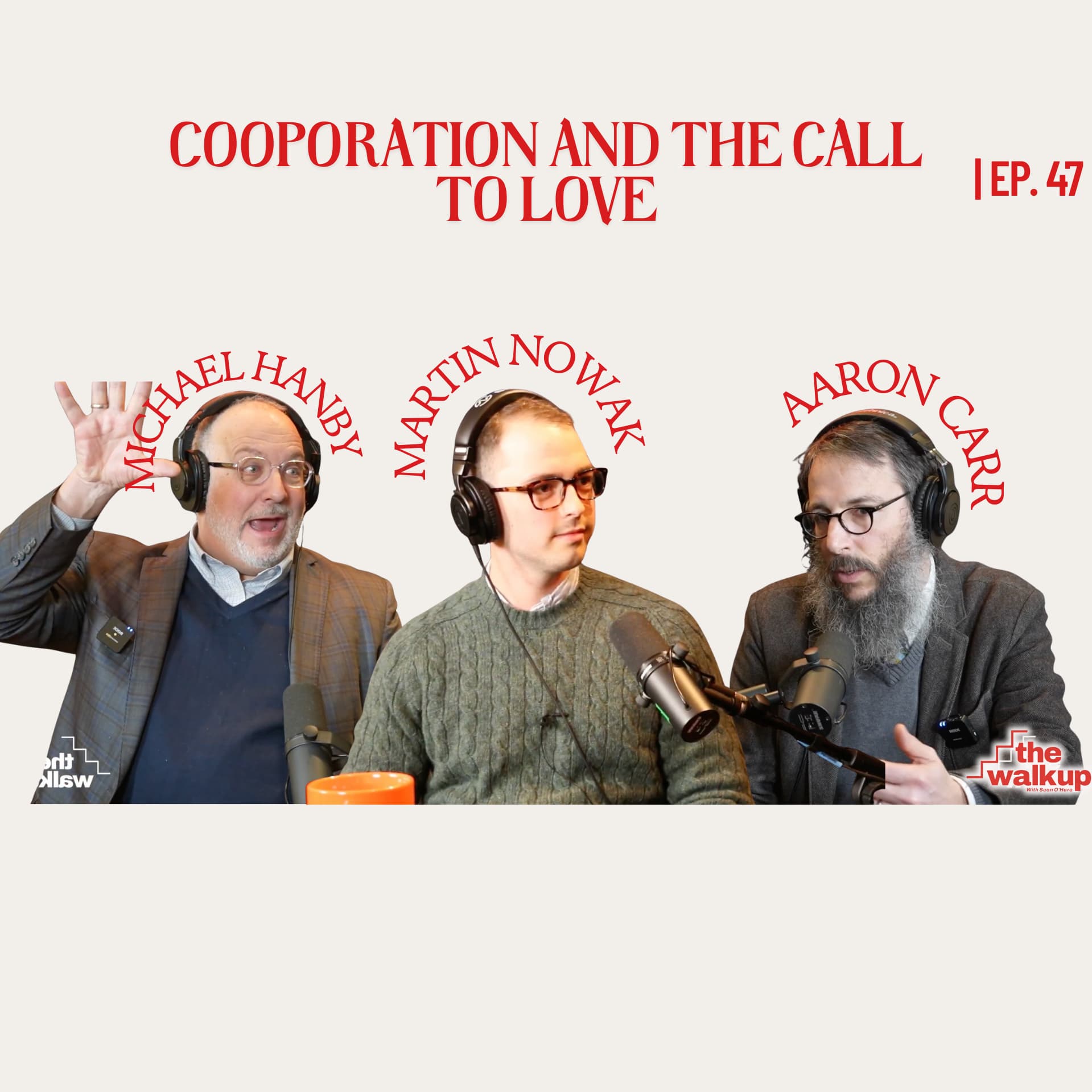
Cooperation and the Call to Love (Michael Hanby, Aaron Carr, & Martin Nowak) | Ep. 47
In this episode of The Walkup, recorded live at the New York Encounter, we explore what it means to live deeply in today’s fast-paced, distracted world. Professor Michael Hanby reflects on cultivating depth through education, art, and attention to the beauty of life. Aaron Richard Carr shares his personal journey of conversion, discovering Christ through encounter, love, and grace. And Harvard biologist Martin Nowak reveals how cooperation — not competition — is the hidden engine of evolution, preparing humanity for love and community. Join us for a conversation that bridges philosophy, faith, and science — and offers hope for a world searching for meaning.
Transcript
Read the full transcriptAuto-generated · 6,307 words
Well, Dr. Hanby, it is an absolute pleasure to have you on the Walk Up podcast here at the New York Encounter. It is great to be here. So glad to have you on. So, I am curious about what is your initial impression of the New York Encounter? How did you get involved? Do you know Father Giussani?
I didn't know Fr. Giussani. I've known numerous people from the Movement for years. I've actually done a New York encounter before in the other location, maybe about 10 years ago. It's been a while. Wow, okay. But I have many friends in the Movement, many students who are in the Movement, and done Crossroads events and other CL events.
This is a little bit old hat, though it has been a while, and it is wonderful. It has grown since I was here last. I only got in this morning, so I have not yet had the chance to go up and look at the exhibit, but it is an exhilarating environment, and there were a couple of presentations this morning that I really wanted to see, but unfortunately missed because I was on the train, but it is a wonderful event, and it is great to see so many people from all over the country and all over the city.
All over the church. Yes. Turning out for it. Yeah, this really, there are so many people here, the energy is incredible, and your discussion especially, I thought, was very interesting. So, I would love to talk about what you had to say. Sure, sure. If you do not mind. I know you have talked a lot. You are probably tired from your day of travel. No, I mean, you know. Well, Aaron and John made it pretty easy. So, yeah, what would you like to know?
Yeah, I think one thing I heard in particular, and I might bring this up with Aaron as well, is you mentioned this lack of discernment for depth in our modern Americans today, and I think that is a big issue. How do you think Americans can cultivate this pursuit of depth in our modern Americans today? Oh, gosh. That is an enormous question because it is an enormous cultural difficulty. It is a difficulty that is inscribed into the very form and manner of our thinking.
It is a difficulty that is… Cultivated and exacerbated by being in a thoroughly technological society and offloading so many of our human capabilities onto our devices and so forth. I think there are no shortcuts. There are no shortcuts. So, renewing education through the arts.
Reading, learning, habits of silence, and being still, and attending to things, which we are all, you know. It's well known that the difficulty people have nowadays, even just getting through a book, is kind of unprecedented. You know, we have to be mindful of the ways in which our capacity to recognize depths are being taken from us and try and do things both individually and collectively to counteract those. And, of course, Restoring ever more deeply beauty to the life of the church, to the celebration of the sacraments, to the creation of, to the renewal of Christian art.
I mean, the task is multifaceted because it is really bottomless. Right, and it is so true. I myself was trained early on in a classical education, and I think it was the best education I ever received. Yeah, I've been involved in trying to help in that movement, in the movement of Catholic education renewal, and I'm hopeful. I see my children certainly have received a better education, a deeper education than I did.
You know, there are little experiments going on all over the country that are hopeful. And, you know, it is also one of the themes that we talked about was… In the discussion up there was the way in which even sin can have a pedagogical dimension. Yes. Well, cultural disintegration can also have a pedagogical dimension.
I mean, things that we perhaps could, that my generation at least, could take for granted and assume quite comfortably, you know, 10, 15, 20 years ago, are no longer foregone conclusions, just about whether it is on the moral front or with respect to cultural and social institutions and their authority. And, you know, when...
A culture is as divided and as fragmented and fragmenting as ours seems to be. There's an opportunity, and there are occasions there for looking at things anew and looking at them more deeply. So, you don't want to be a party or a witness to civilizational disintegration, but there are things that are possible now that perhaps 10 or 15 years ago.
We wouldn't have imagined. Yes, absolutely. There's a curious kind of hope in that also. I completely agree. In discussing some of these issues with my friends, I've always come to the conclusion that I think we live in one of the coolest times to be alive. There's so much opportunity for growth, for change, for beauty, and how do you think we're going to see that in the future? Well, I mean, it's fascinating. I don't know. I mean... Well, I write a fair bit about, you know, I try and think about contemporary events in somewhat timeless terms.
I guess would be one way to describe what I try to do. One of the things that I've discovered, or one of the things that's really been impressed upon me of late, is that history is a fast-moving target.
Things that I saw, or thought I saw, or thought, you know, 10 or 15 years ago, which seemed like they might have been cutting edge, or radical, or what have you, are either obvious now, or things have changed so much that they're obsolete now.
And so, it's really hard to predict what... And no one has a real crystal ball into the future, but there seems to be a pervasive sense that we're living in some kind of historical paradigm shift, that we're living through times that are weightier, maybe, that have more gravitas than...
Recent generations have done it. Time will tell, as they say, whether that is true or not, but there are people who disagree about a lot of different kinds of things, seem to agree on that sense, maybe not able to pinpoint what the issue is, but if that is true.
Then, all kinds of opportunities for rethinking, revisiting, looking once again at how we organize our society, looking again at our politics, looking again at what institutions have authority, looking again at things we have come to take for granted about justice. All of those are potentially on the table.
So, I think it's obvious here at the New York Encounter that there are so many young people, and there's clearly a hunger for truth in today's world. What advice do you have for the younger generation? That's a great question. I'm not sure I have a pithy answer to that.
One would be simply to remain hungry, you know, keep searching, discover the value of, I mean, there's value in understanding. One of the curious things that... I would have said just a few years ago, and maybe the sort of social and political upheaval that we're experiencing at the moment would cause me to reassess this, I don't know. But one of the things that I've noticed is that there seems to be this coincidence on the one hand of, you know, we possess as a people, you know, the power to do things that...
No previous generations have had it. The things that the Internet have made possible, for example, the things that our technology has made possible, give us the developments in medicine, give us enormous powers that preceding generations have not possessed. And yet, on the other hand, there seems to be a somewhat pervasive sense of powerlessness, oftentimes, among...
People who have been atomized and individualized by our culture, and confront this great power exercised corporately, and think my own contribution really doesn't avail for much. Yes. And I think a certain kind of despair or hopelessness can sometimes come from that.
And what I would want to say, by way of advice, is don't undervalue. The value of understanding, of coming to see more deeply, even when you, you know, as long as you can see the truth, you're free, even though you might be powerless to affect, you know, enormous change immediately. Yes. And so, one of the things I would like to see is a recovery of... The value of thinking and the value of understanding, and to realize that understanding the truth is doing something, even if you can't do much else.
So, advice? Read books. Read good books. Do you have any book recommendations to close us out? Oh, gosh. I mean... We just finished discussing a wonderful book that has just been translated into English by Father Giussani. I mean, that might not be a bad place to start.
Searching for the Human Face, I think, is close to the title of it, exactly. But, I mean, it is hard to... I have a list, but it is hard to isolate one or two. One of the... The principles of the movement here in the United States, Carlo Lancelotti has translated three and soon to be four volumes of the Italian philosopher, Augusto Del Noce, who seems to have had real prescience writing in the 1980s about the shape of our own present. I have recommended and benefited a lot myself from Del Noce's work, and then, you know, read something beautiful.
Absolutely. Well, thank you so much for your time. You're welcome. This was an incredible discussion. Enjoyed it. Thank you. Enjoyed it tremendously. Okay. Well, Aaron, thank you so, so much for being here. On the Walk Up podcast at the New York Encounter, I mean, it is an incredible energy. So much is happening. I want to talk about your discussion you just had, an incredibly insightful discussion, and I think there are so many implications for not just cultivating depth in our society, but for a younger generation.
It's about discerning truth, finding truth and meaning in this secular world. So, I think one pertinent question that I just asked Dr. Hanby is there seems to be this lack of discernment of depth in modern Americans, especially our youth. How can Americans cultivate a search for depth and meaning in a world full of short-term gratification and technology?
I think that Father Karan said something like... Either a heart attack or an education. Sooner or later, reality imposes itself. You cannot avoid it. It is either in a real crisis of life, or it is in a real commitment to an education. That is what the movement is all about. The mission of the movement is to educate the heart. You know, and beyond that, I mean, in terms of books, I mean, they should go and get Theology and Social Theory, and of course, In Search of the Human Face.
I think that, you know, I mean, it was great for me, it was an honor for me to be able to talk with Michael Hamby about John, with John Milbank, you know, because for both. For both Michael and I, you know, the encounter with John Milbank's work was also a decisive step in that search for the human face, and theology and social theory, like Michael Hemby said in the panel, was really...
For him, a decisive event. For me, too. And so, I would commend it to another generation of young people coming up that are trying to orientate themselves in this world, in a secular world, and to ask themselves what a world without God means. And one of the key points that John Milbank sort of proposes over and over again is that Every claim about the nature of reality is in itself a theological claim, and so there is no way outside the theological.
And I think that this is incredible because it connects so much with what Fr. Giussani is doing here now in a more existential and more as a personal work in search of the human face, where I am really asked to look at the supposedly banal...
I want to look at those experiences in my life, the limits in my life, my sins, doing the dishes, whatever it is, to look at them with a new gaze because those moments, too, are determined by a theological decision. The depth that I see in them is determined by my theological decision of how much I want to see. And I think that is the important thing, that is one aspect of our freedom at play, is the way that God proposes himself to us in this world, is it is like we can only see as much of God as we really desire to see.
And so, if you desire to see nothing of God, it will not look like there is anything of God there. But if you really start to pay attention, this is, I mean, another thing which, try to see if I can get the quotation right from the Giussani book, he says that Christianity is...
It is a search for a miracle in history, and that search for moments that happen in which the evidence of Christ's presence cannot be denied. I think the education is that. The education is not in reading the books, but in paying attention again to my life, to those moments that I cannot explain away, and then, as Father Michael says, accusing Christ of what he has done.
Oh, what an incredible answer. I love what you had to say about the book, because I think there is just so much depth and importance there, and it leads me to one quote that I think you brought up in the book.
You were talking about Abraham and discovering the self, the I. Holiness is not reflecting how much we give to God, but rather how much God takes from us. Could you explain that? Forgive me if I got the quote off a little bit. That is it. I mean, that quotation is taken from Adrienne von Speyer, who was Hans-Joseph Balthasar's collaborator, and a woman that... Right, and I think that should be read, too. And Fr. Giussani quotes her because this really shows that the first protagonist in my life is not me, so the way that I become holy is not by doing Exodus 90.
The way that I become holy is by looking at the things. That happened to me, right? Another way of putting it is, this is something that Hans Urs von Balthasar says elsewhere. He says, the kenosis of Christ, the self-extinguishing of his, the giving away of himself, that happens. This is Philippians 2, you know, that Christ there was in the form of God, didn't consider equality with God a thing to be grasped, emptied himself. The self-emptying of Christ is that That to which we need to be conformed, and this cannot be a project that we initiate.
It has to be something that happens to us. And the place where our freedom comes in is that we say, yes, and we accept it, and we offer it back to God. So, that is like another statement of Fr. Giussani. You either greet reality with clenched fists and up against reality like this. Or you accept reality, and acceptance is really the... Acceptance in love, I guess, is the great attitude of the saint. Yes.
So, to give you a little bit of background on me, I am actually converting to Catholicism right now. Oh, great. And Lord willing, I will enter the Church this Easter. How old are you? I am 23. 23, okay. Three years younger than I was when I was baptized. Okay. Yeah, so I wanted to talk about your conversion. What did that look like? What inspired you to seek these deep questions, to seek God in such a profound way?
Well, I mean, like everything, it is something that happens to you in the first place. But for me, I think I had more religious questions that were coming up in my life, in my studies, and the interests I had in art and stuff like that, politics. And then I was in Russia in 1996. I was in Russia. It happened to be the Easter Vigil, but there were people walking through the streets with candles, and so I was with a friend of mine who was also a Canadian who was there.
She was there studying English, or teaching English. I was there studying Russian language, and we followed these people, sort of half knowing that it was Easter, and this is probably some kind of Easter thing, but neither of us were Orthodox, neither of us were churchgoing.
And we went into this little tiny church, and we saw the liturgy unfold. The Easter Vigil Liturgy in the Russian Orthodox Church is spectacular. And what I really was able to see very, very clearly was that if there is a mystery at the heart of reality, if there is a God, it is certain that these people...
are in contact with that God, right? What led you to that conclusion? It was just obvious. I mean, it's like... I felt the same way. Yeah, I mean, Giussani quotes Aristotle in the religious sense and says, you know, there's nothing more irrational than denying what is in evidence. Yes. And I mean, it's like, because. Well, I mean, but I can say, in fact, a little bit more. I mean, there's something about the solemnity and beauty of the liturgy, also the radiance of the little tiny church filled with incense, And then the popular piety of these little old Russian ladies coming in, kissing the icons, lighting the candles.
It was like, man, this is something I've never seen before. There's something different here. I didn't convert to Christianity in that moment. It just opened a door. And I kind of knew from that moment on that if, I remember feeling conscious that if I ever become religious or... Take a spiritual journey. It is going to have to be Christian, right? And I think before that, I thought, like, if I was ever going to do that, the last thing I would do would be Christian.
I would maybe be a Buddhist or something. But after that, I knew that if I was going to really try to take a step in this direction, I would go down that road. But I wasn't at the point of conversion completely then, or maybe that's what was just in co-ed hadn't yet become explicit, but it was the beginning of something. And then a few years later, I had a personal crisis in my life, and I realized that I was going to have to learn how to love.
And learn how to be connected to a greater love. And I knew that the figure of Jesus Christ was the heart of that. And so, that was then, then I went in pursuit of. Getting baptized. So powerful. Yeah. If you don't mind, could we briefly dig into that crisis and what that experience was? You don't have to get into specifics at all, but... Yeah, I mean, it was just, I mean, the simple thing is that someone who I really loved told me, I always knew that you loved me, but you didn't love me well because you were selfish.
It was always really about you, and what that person said was absolutely, unequivocally true. I mean, that accusation was not in any way violent. It was charitable, because it really spoke the truth, and it was incredibly wounding to me, but I realized that I had lived a life really run on self-will. In an extreme sense. And so, I really wanted to learn how to love and learn how to be embraced by something greater than circumstances in life. And so, that's what happened.
That began my journey. Wow. And have you since discovered that love through Christ? Absolutely, but that too is a journey. There are many steps along the way. I was baptized an Anglican a couple of years later. I was married shortly after I was baptized, and then a couple of years later, my wife and I both became Catholic. Then a couple of years after that, we met the movement, Comedian Liberation, and that was...
I mean, that was the, that was the decisive, for me, the decisive event of being able to really say you to Christ in a concrete way. Yeah. That's incredible. And these stories always just stir something up in me.
Just to see Christ's love infect someone's life, and then now you are here in front of thousands of people, and spreading that love, that joy, the truth, this wisdom. I cannot thank you enough for being here. Well, it is a pleasure for me. It has been a pleasure talking to you. Okay, great. Thank you so much. Thank you.
Okay, Dr. Novak, thank you so much for coming on the Walk Up Podcast here at the New York Encounter. I am so curious, how did you hear about the New York Encounter? What have been your first impressions? I love the New York Encounter. I was here already about 10 years ago, so this is my second time at the New York Encounter, and I have stayed in touch with people from Memories Domini, from Communion and Liberation, and I was very, very happy when they invited me to come back a second time to talk here.
Okay. Well, I'm so glad to have you here, and usually we try and listen to the guest talks before. We've experienced some technical difficulties here, so unfortunately, I didn't get to hear yours. Could you give us some background into what you're discussing? Yes. So, I'm a professor of mathematics and biology at Harvard University. I work on mathematics of biology, on mathematics of evolution. Wow. And my research has been in the last 20 years to study the foundation of evolution, and the foundation of evolution in the classical sense recognizes two fundamental forces.
They are mutation and selection. This is Darwinian evolution in the classical sense, but it leaves us somewhere in a domain of great... Great competitiveness and great competition. And therefore, it is somewhat a pessimistic view of the world, because it seems like everybody is fighting against everybody else. And also, in the human realm, it has given rise to terrible world views, where nations are fighting against each other in two world wars, to have more space and only the stronger ones will survive, and things like that.
And so, my work in the last 20 years has really emphasized a third fundamental principle of evolution. And this third fundamental principle of evolution is... Cooperation. So, it is, and I have shown that cooperation is not something that happens just on the side. It is absolutely central to the whole history of life unfolding on Earth. So, without cooperation, you don't have an origin of life. Without cooperation, you do not have the first cell. You don't have the first higher cells. So, you don't go anywhere in evolution without cooperation, and ultimately, cooperation then leads to the human realm, and that's the discovery of human language.
Oh, wow. Okay, fascinating. So, you're... The focus is more on the organism's symbiotic relationships, leading them towards a more advanced state? Yes, in a sense. I look at what I call the master architect of evolution is cooperation and not competition. And cooperation for me, then, if we come to the spiritual or Christian worldview, is really a preparation for love. This cooperation means that we help others, we sacrifice. And so, this is a preparation for agape, for philia, but also for eros, it's love.
And also, for many years, I have been working on the interaction between evolution and Christianity. So, this is in the science and religion, and I'm writing books in this area, and my recent books, I'm very enthusiastic about them. They're called Beyond, and the other book is called Within. Okay. And in Beyond, I describe a world. It is a poet. In my artistic exploration of sort of human interaction and interaction with God, I describe a world that is beyond the confusion of selfishness, and this is a world that looks very differently, and where suddenly some beauty arises that is unimaginable before, and that's the book Beyond, and Within is the sequel, and Within is the idea that if we turn within, we find God as a teacher.
God is our teacher within. Wow, fascinating. So, You mentioned earlier how Christian narratives fit into this, and when I think cooperation, I think a sort of transactional relationship. How does true selfless love fit into that? It's very good that you make that point. I'm very impressed, because it is true that in the normal mathematical analysis of game theory and cooperation, there is this kind of transaction. So, game theory is always about calculating the payoff, and yes, I might... I will not cooperate with you, but ultimately only because I will win in the long run, because you will cooperate with me.
So therefore, in this work that we have been doing for 20 years, I had this interaction with philosophers, with theologians, and a very good friend of mine, Sarah Coakley, a theologian, has always asked me, but is this real altruism, is this real love, if ultimately it is only like a payoff? And if you talk about games, which game is won by a saint? And so, these questions have very much led me to work on those books that I just mentioned, and these topics are discussed in there, in Beyond and Within.
So, Beyond and Within are the names. So, just for our listeners, go check those out. They seem very interesting, and I am sure Dr. Novak would appreciate you reading them. Regarding the rest of your discussion here, and how it fits into the broader New York Encounter narrative, why do you think what you are discussing today is so relevant for the audience here? I think the audience here is a very concerned audience. It wants to ask, what can be done to make the world a better place?
What can be done to help people? What are the challenges? So, as an evolutionary biologist, for example, I have a very long time scale. So, I look at a time scale that is four billion years ago of life on Earth. And then there is this tiny, tiny line where intelligent life comes about, you know, maybe 200,000, 300,000, 500,000 years ago.
And now we have this human species on Earth, and this human species is in a precarious state, because it is undermining its own ecosystem, it is destroying the global environment. So the question for me as an evolutionary biologist is, how long will the human species actually survive? Are we talking of maybe a few more thousand years, or is it longer? And why is intelligent life so unstable?
And here cooperation again comes in, because cooperation on a global scale, and with future generations, is needed to save the human species, to extend the life of the human species. And in my opinion, the only way how this can be achieved is by turning to God.
To actually, to build a society that is not based on secularism, not based on atheism, but that is based on true love, and that is committed to a universal love. Yes, and that's a very bold hope and dream. We're heading… Towards a world of secularism, and I think our country is certainly making a pivot back towards religion and to Christianity in general.
Where do you think the culture is shifting? Do you have hope for the future that we will ultimately put God at the forefront of our desires and our purpose as human beings? I think I definitely have hope in the future because I believe in a world that ultimately the primary cause for what we are looking at in the world is God, the final cause of what we are looking at. God is God. The purpose of human life is to find God by love.
Whatever we will experience in the future, in some sense, it will not be outside of God's providence. I mean, God wants us to behave in a way where we are the guardians, we are the stewards of this beautiful creation. It is our responsibility to work together with God.
To make the world and the planet a beautiful place and habitat. Oh, that is beautiful, and I am so thankful that you, as such a pragmatic mathematician and biologist, can even still have hope for the future. So, I thank you so much for your time, Dr. Novak. You had some incredible thoughts here. Thank you very much. Thank you very much.
Well, thank you so much for being here, Dr. Emanuel, on the Walk Up podcast here at the New York Encounter. You just gave a discussion out there, and I'm very curious to hear about it and hear what you have to say and a little bit about your background, but first, I want to hear what your first impressions are of the New York Encounter. Oh, it's very good. I think they've got an amazing array of talent they brought in on all kinds of different subjects, a very engaged audience.
What's there not to like? Yeah, absolutely. I think the energy here is unmatched. Yes. So many young people who are so curious. It is an incredible thing to see. It is incredible. So, I want to get into your discussion a bit, and maybe let us start with some background about yourself and who you are, what you believe. Well, I am an atmospheric scientist, also a climate scientist. I have spent most of my career, 42 years at MIT, a few years before that at UCLA.
I initially started out studying weather phenomena, and still do for most of my career. I specialize in the physics of hurricanes, but I have taught climate science at MIT for several decades, actually, and got very interested in that as well. So, I am recently retired, in quotes. Which means I don't teach anymore, but I'm still very active in research. Okay.
And what was your discussion today? Well, the discussion started out as, how do we know the climate's changing? How do we know it's because of us? And David and I presented evidence that's pretty conclusive that we are, in fact, changing the climate. There's very little, I would say, at this point in history, no doubt, among the professional climate scientists that that's the case. So, if you could highlight maybe your Your top three warrants for the claims you presented, could you do that?
Some of the evidence? Well, so, we only spent part of the time talking about that, but there's no question that the carbon dioxide content and the methane content of the atmosphere has gone up. We know that going back hundreds of thousands of years from examining bubbles of air trapped in ice cores in Greenland and Antarctica, and we've been measuring it from Hawaii since 1958. There's no question. That is the question. Looking at the chemical composition, the particular molecules of CO2, there is also no doubt that they arose from fossil fuel combustion, the particular chemical content.
So, we know that we put the CO2 there. The CO2 is way out of bounds for how it is varied. It is more than it has been for about three million years, at least, on the planet. So, we are really pushing the atmosphere hard. Basic physics, and I don't mean big fancy computer models, just basic physics.
It tells us that putting greenhouse gas in the atmosphere will warm the climate by a certain amount. It has been warming pretty much exactly along the rate that was predicted 120 years ago. Wow. Svante Arrhenius in Sweden made that prediction. And so, this isn't new science. There is a lot of new science, but there is no doubt that we are warming the climate. And to the extent that there is anything that has no doubt in science, this is one of them.
Wow. So, that is not where the interesting questions lie at this point. It is, what are the consequences of that? Exactly. What does it mean that the climate is going to warm three degrees when we succeed in doubling the amount of CO2 from pre-industrial time? Okay, three degrees, what does that translate to? What we are worried about is not three degrees per se, but changes in the incidence of wildfires, of hurricanes, tornadoes, hailstorms, heatwaves, droughts, all of which affect... It does affect the economy.
So, all the action on the science side at this point is trying to figure out how those phenomena change. How will it actually change civilization in other words? And so, what are the implications of this? And how can we prepare?
So, the implications depend on the phenomena. So, let us take hurricanes, which are my specialty. The science is fairly clear on some points and not clear on other points. It is clear that the intensity of hurricanes will go up. Recently, we have been able to measure from space that they actually are getting more intense. They will produce a lot more rain, and the big killer in hurricanes globally, and in the United States, is water. Rainwater producing flooding, as we saw in Asheville.
Yeah, I'm curious what your thoughts are about that. Was there anything peculiar about that specific hurricane? Well, certainly, it's been a long time since they've had something like that in that part of the world. Climate change undoubtedly increased the probability of having rainfall of that magnitude. You can't say it caused that. Right. Something would have happened that might not have been that intense. There is some correlation there, though. It is not just correlation, it is physics. Okay. Right. Physics is really important.
It is harder to explain to people, but it is really, really important. When you warm up air, it can hold and does hold more water vapor. That is not that difficult, if that is the source of these rains.
But also, the stronger winds cause more storm surge on the coast, like a tsunami caused by wind. It is what flooded this city, New York, in 2012 with Sandy, and that was a big storm surge caused by a lot of fetch of wind across the water. We don't know, on the other hand, whether the frequency of those storms will go up or go down, or maybe not change at all. That is an unsolved problem we are working on.
Something we have great confidence in is that the incidence of drought and, ironically, floods will go up. That is also very simple physics. We think that the incidence of severe convective storms that produce phenomena like hail, which is terrifically damaging, we don't hear a lot about it, and tornadoes. We'll probably go up, but we don't know that for sure. That's something that we need to do a lot more work on. The incidence of wildfires, that's kind of a no-brainer. You have more drought, you have more susceptibility.
You could have more rain in the winter and more drought in the summer, as in Southern California. That's a terrible combination, because you get more vegetation, and then it dries out. It's a tinderbox. So, it is dealing with these risks, quantifying the risks, quantifying the uncertainty around that. It is our job. What is everyone's job in a democracy is to try to choose or figure out what to do about that, and I am interested in that, too, but that is a problem for everybody.
Well, very interesting, and I think amidst all of this uncertainty… Where do you see God in this? This is a Catholic event, and obviously a question that is pertinent, and I think on a lot of these people's minds. What do you think? Well, my feeling about that, and I'm not a theologian, is that among many other things, what I take away from the Bible is that we are stewards of our environment. We're stewards of the physical environment, of animals.
It doesn't mean we shouldn't eat, right? Right. It just means we should take care. Absolutely. And I think it is our job to take care of the planet, and it's certainly, we owe a lot to future generations. Everybody with children.
You know, whether they're religious or not, even, is going to pay a lot of attention to what happens to their kids. Yes. And I have a kid. I'm very worried about that. I want to pass on a planet that they can comfortably inhabit. I think we should do what's in our power to do to bring that about. Okay. Oh, great answer. Well, thank you so much for your time, Dr. Emanuel. I really appreciate you coming on the podcast. Thank you. It's been my pleasure.
More from The Walkup

Against the Odds: The Samurai Lawyer (Chad Flores) | Ep. 52
Faith, Sexuality, and the Fog of War (Iris Bahr & Father Rick Riccioli) | Ep. 02
E2
Church, Conflict, and Community (Iris Bahr, Father Rick Riccioli & Rob Long) | Ep. 03
E3
Hope, Vocation, and the Global Church (Colm Flynn & Colin Nykaza) | Ep. 04
E4