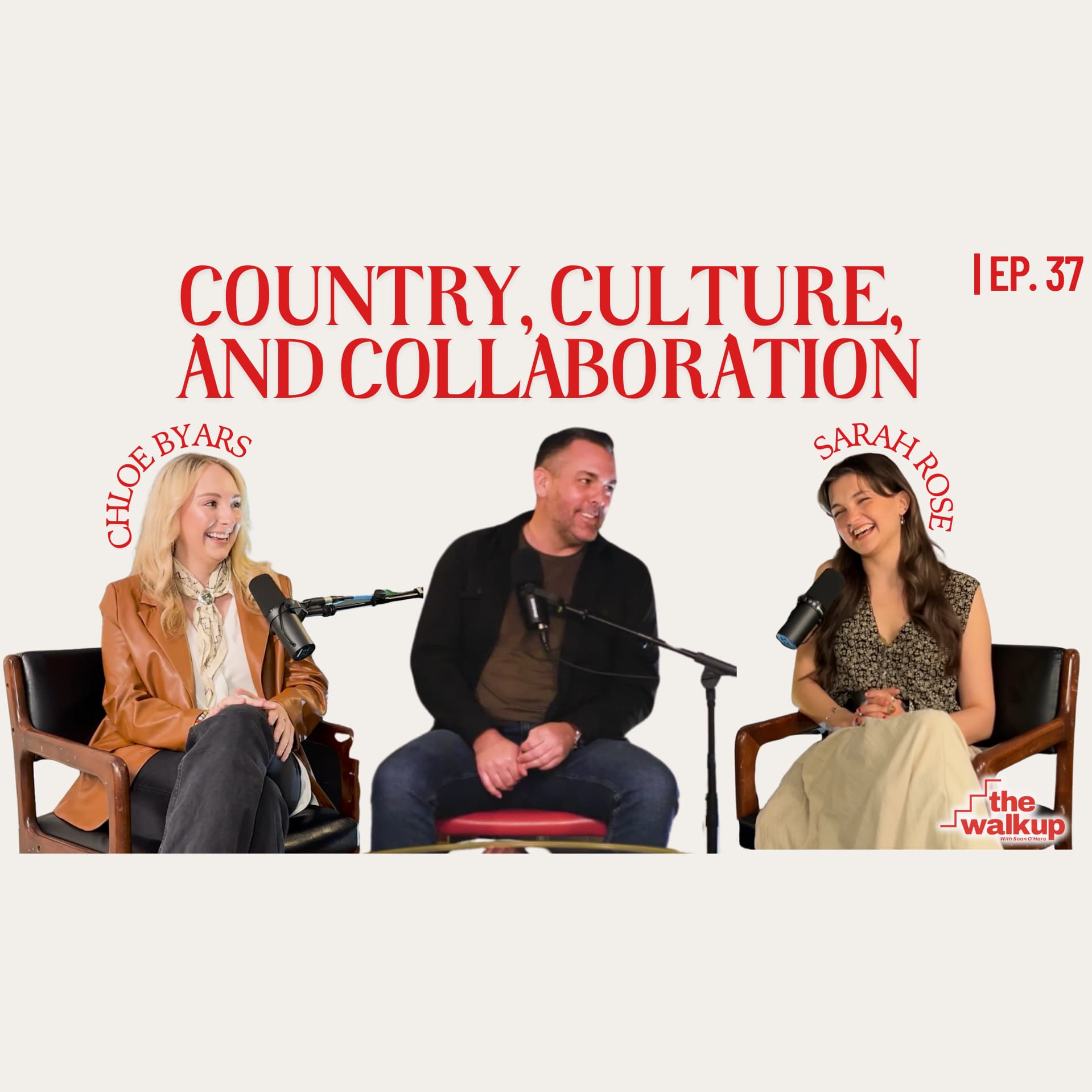
In this episode of The Walkup, Sean O’Hare sits down with Sarah Royce and Chloe Byers, two Oklahoma-born musicians carving out a unique country music scene in New York City.
From childhoods steeped in music to the serendipity of meeting while working at a restaurant, they share how their passion for performance brought them to the Big Apple. Together, they explore the challenges of pursuing music in a city far from Nashville, the camaraderie of the local country scene, and how New York’s diversity fuels their songwriting. The conversation blends storytelling, insight, and the relentless pursuit of musical dreams.
Transcript
Read the full transcriptAuto-generated · 11,565 words
Sarah Royce. Hello. Chloe Byers. Hi. Welcome to the Walkout Podcast. Very excited to have you here. It is always a challenge when I have people on either side. It is a little bit like a ping-pong tennis match sort of situation, but yeah, very excited to have you guys here. You are going to perform for us as well, which we are very excited about, but I wanted to first just get to know you. So, how did you guys meet? Where are you from?
How did you decide to Come to New York, form a band. This is a lot. Yeah, it all ties together in a beautiful story. It does. I'm from Oklahoma. I'm from Austin, Texas, but Chloe went to school in Oklahoma. I also went to school in Oklahoma, and then we worked at a restaurant together, but we were both studying music at different schools.
Okay, so you guys were both studying music in school. So, you at UT Austin? No, so I went to school in Oklahoma City. Oh, okay. You're from Austin, but went to, okay. I went to school in Oklahoma City, Oklahoma City University for musical theater, and Sarah went to University of Central Oklahoma. Right? Yeah. And for musical theater as well, and we both were there at the same time, and we got a summer job after we graduated at a Mexican restaurant in Oklahoma City, and that is how we met.
Well, that is where all great country music bands are formed, are at Mexican restaurants. Shout out Mexico. That is exclusively what we write about. You have three songs about chips and guac, which I think is... Right, and margaritas, of course. Yeah, a dip trio.
Right. So, are you guys both the, like, my entire life, I just knew I wanted to perform or sing, or was this something you discovered at a certain age? Pretty much. I feel like you, I'll let you speak about yourself. I was more of, like, the shy but super active kid, so I was always kind of running around and doing stuff, but I always loved music, and then my older sister is a force, and she... Forced me to do a musical, and I was in love with it, just loved performing.
And what age was this? I was seven years old, I think, seven or eight, and that kind of started the track. So, I guess that was a long time ago. When else would it start? But my dad's a musician, so it was always around. Oh, okay. So, it's in the blood. Yeah, yeah, yeah, for sure. You were around, and what kind of music does he play, or what instruments? He does like...
Singer, songwriter, rock, like... I guess rock. Guitar. Alternative rock. He plays, like, every instrument and sings and songwrites. He's one of those super talented people. He does it all, yeah. It's annoying. I know, right? Yeah. No, it's actually really good for me. No, my brother's the same way.
I have no musical talent, but he can play guitar, piano, you know, sing, write, all that tour stuff, and it just made me never want to try, because I'm like, why would I do that? That's a common human experience. If there's one that's like really good, you're like, I'll just let him have it. Yeah. And I was also extraordinarily lazy. Things haven't changed so much. But yeah, I saw how much hard work he put in. He started to saxophonize. I mean, he went to College on a saxophone scholarship.
Like, so he was that good at saxophone, and I would see hours and hours and hours of practicing. I'm like, oh, hell no. I'll skip that altogether. So, you, was it seven years old? Were you even younger? I mean, I always was singing from, like, a young age. I don't even know, like, when, but I was always around music as well, because my dad also is a musician, but more for hobbies. My dad is, like, an environmental engineer, but He plays, like, mandolin and guitar on the side, and he, whenever we were little, my dad would go to these little bluegrass jams, like, every weekend, and my mom was really happy about that, because she was left at home with us, but as I got, as I started getting older...
And all those adoring bluegrass female fans, I'm sure. Yeah, no, I'm sure, yeah, sitting in the circle, and she was really happy about that, but my dad would always play the mandolin around us when we were kids, and so I was just, like, constantly around music. In my... My mom's dad, so my grandpa, he was actually an aspiring country writer and singer as well.
And so, I think, just like Sarah, it was just in my genes to be into music. And when I was probably seven or eight, I started playing the fiddle. And that was like, you know, other kids are in soccer and playing basketball, and I'm like, I want to play the fiddle. So, I started playing the fiddle around town in Austin with my teacher. She was like, this looks... A centric, crazy woman, but she was awesome, and she would bring me to her gigs at different restaurants, and I would hop up and be the little toe-headed blonde girl.
Yeah, and then from there, I kind of got, you know, in school, extracurriculars, I think theater made the most sense because I didn't want to do orchestra, and I didn't want to do really anything else, so I started doing theater and got into musical theater, so.
That's kind of how I got into the theatrical realm, but I've always written songs, even from, like, a very, very young age. Like, I have journals and diaries from when I was... In elementary school, just writing away songs. So, it makes sense for where I am today, but it is kind of crazy, because I didn't think I would move to NYC and do country music. Yeah, so that's a great segue, because I think, obviously, most people would think, you guys are in Oklahoma, you want to do country music, everyone assumes Nashville, right?
Right. So, how did you end up in New York, or was that an intentional decision because of musical theater? Yes. I think that's just kind of what... Everyone does. I mean, we have bachelors in music. A lot of musical theater programs are BFAs, but ours was like a true music degree. But yeah, everybody just moves to New York, so we just moved to New York. It's kind of just like set in your degree. But there's not like a Nashville versus New York?
For country music, I mean, absolutely. Nashville is huge. Okay, yeah. I think it is... Our journey is a little bit different, because when I graduated school, like... When I was in school, I was always, we did musical theater, but I was also always the person that would sing country music on the side. Like, that was my thing. It was like, she's an actor, but she also does this country thing really well, and I was like, okay, that makes me like a versatile actor, because I can also play the guitar, and I can also write songs.
And so, when we graduated, it was just, everybody moves to New York. So, it's like, in my head, I'm like, okay, so I went to school for musical theater, so I want to be on Broadway. So, I'm going to move to NYC.
And so, that is what you do. You pack up your bags, you move to NYC, and… Then I just went right back to country music, and I started working at the Wayland, and I was like, wait, this is what I did, like, originally. Like, I'm sorry for the thousands of dollars that was spent for, like, dancing and, like, all that stuff, but I just went, like, right back to, like, my roots, which is pretty cool. We talk about that a lot, how it was, like, once we started, like, really putting everything into this, we were like, oh.
This makes so much sense, because I was showing her, too, a little postcard of a song that I wrote when I was ... I don't even know how well every word was spelled wrong, but it's just ... You think about it, and you're like, oh, duh. Why did I ever even do anything else? You mean in terms of getting away from country music? Yeah. It was always going to end up there. So, does it give you ...
Being in New York, is this like a way to kind of give you your own niche, right? Because, I mean, because in Nashville, I mean, all you ever hear is just like, there's just every night at all these incredible venues. There's, you know, performers all hoping to kind of find their, you know, record deal. So, is there something to be said about being the, it's weird to say the small fish, or the big fish in a small pond in New York, because you're rarely about.
I know, but it is. It kind of turned into like a little blessing in disguise. Because we are, like, the smallest little fish here. But it's also, like, there is a country music scene here. It's just small. It's bigger than you would think. And, like, everybody knows everybody immediately, and, like, everybody works together. It's really cool in that way, but... It is kind of like a different, it's just a different pipeline, you know? I don't know.
So, yeah, so tell me about that from the country music scene in New York. I think that's a really cool thing for people to hear about, just even that, even that frame country music scene in New York. Right. I know, it's crazy. I think it's been interesting to watch it grow, too, because it's been growing, like, since I've moved here. So, like, my first job in the city was bartending at The Waylon.
You should make the reference. Why is it called The Waylon? For Waylon Jennings. Yeah. Not everyone in our audience knows. Yeah, Waylon Jennings, Willie Waylon, you know. Welcome up. Very famous country musician. Very famous country musician. It was my first job in the city. I didn't even want to work there because it was specifically a country bar. I just needed a job and just moved from Texas. I was like, I bet they'll hire me if I walk in with my cowboy boots and say, I just moved from Texas.
Can you hire me? With no bartending experience? And they did. Working there is what introduced me to the country music scene in New York City, seeing all these bands come through, and I was like, and they were amazing. And I was like, what are these bands doing playing in this small bar? Like, they could be on a huge stage. Like, these musicians are insane. And once I started playing with a lot of the bands there and getting involved in that scene, I started getting introduced to a bunch of other different bars in New York that are also country music.
And that is where the whole scene lies, and over time... In the past year, there's had to be three or four new country music venues that have popped up, just because they're trying to... Country music is really popular right now, so I think people are trying to capitalize off the popularity, and especially in New York, it's like, you can put on your boots and be a cowboy for the night. For the night. You don't have to do it every day, but I think it's kind of cool for people here to have a taste of that in the city.
Sure, sure. Just because it's different. So, why do you think... Why do you think there is a resurgence or a popularity in country music right now? What would be your guess? I think about that. You might have a better answer.
Beyonce. I don't know. No, she has a huge part as to why country music is popular. She does, but I also think it was happening. A little. Like, it was starting to happen with, like, the bachelorette parties, and, like, the, like, Pink Pony Club, Chapel Rome stuff, and, like, Sabrina Carpenter is, like, doing her thing, which, it's, like, country adjacent. There were, like, country musicals coming out at the time. I don't know why. I think we're kind of in, like, an era of reaching for Like, very specific things.
Like, there's, like, the Y2K 90s kid thing, and then there's, like, the 80s people, and then there's, like, country. That's, like, super specific, and we can, like, make that kind of fun, and, like, I'm going to buy cowboy boots, because that's so, like...
I don't know. Does that make sense? Yeah. I think a lot of artists are coming out with their version of country music that don't necessarily do it, and that is what's bringing it to people, other genres, and people who wouldn't necessarily ever listen to country music are now like, oh, wait, if this person is doing it, then maybe I can listen to country music, too. Because country music, for the longest time, didn't have the reputation of being the most welcoming genre to people.
Different backgrounds, and like different races, and different sexualities, and now it's just being, it's almost like every artist that is super popular right now is having like a country single or a country album. Yeah, they like busted the doors down, and in that way, I do think, yeah, obviously, Beyonce, like.
You're right on that. Well, yeah, that's just, like, the biggest example. Like, her winning country album at the Grammys was, like, huge. Like, nobody would ever think that Beyonce would have a country album, but her having a country album, a lot of her fans aren't typically country music listeners, but bringing attention to that genre has, like, made it a lot more popular, just, like, in popular culture right now, which is pretty cool. Yeah, I think there's been a lot of crossovers.
I mean, I think of... Darius Rucker. Yeah, Darius Rucker, for sure. That was a big deal when he first came over from Hootie the Blowfish, where obviously their music wasn't like... Like, completely on the other side of country music, because it was more kind of acoustic and guitar-driven and things like that, but then, for him, it was like, wait, when a black guy is going to be like a lead singer, this is weird, you know, we're not used to it, and obviously, his voice is extraordinary.
Yeah, he's great. But, you know, I remember, I'm old enough to remember when it was like, wait, Shania Swain, that's not country music, and Faith Hill, that's not country music, because it was too pop. Yeah, that's so funny. That was a big deal that...
Because I remember Shania came out with, there was one time, one of her albums had three versions. Oh, really? There was a country version, a pop version, and a dance version. But she could do whatever she wanted. I mean, she just, like, crushed it. Yeah, she's crazy.
But I wonder, I mean, this is my thesis off the top of my head. I wonder if part of it is that... Country music is people playing their own instruments. Things have become so digitized and intangible, and I sound like the old guy that I'm like, I don't know. Honestly, you were mentioning 80s music before. 80s and into the 90s, and even early 2000s, you can play the first couple chords, and I'm like, I know that artist. Now, I can hear an entire song, and I'm like, that could be one of 10 artists.
They sound all the same. That's real. So, I think there's something about the tangibility of like, wait, that person wrote a song, is playing the song, is singing the song, and then even as you mentioned, like the Cowboy Booth thing, it's like, but it's tangible. It's like an experiential thing we do together, or you can do in person, as opposed to something that's a purely kind of consumed digitally, created digitally. I think people are craving like Like, tangible, like, things that can hang, that can actually, yeah.
Like the sitting around the bonfire, and someone's playing the guitar, and everybody's singing the song, or like, those jams that we talk about, where you just, like, you tell them the chords, and then everybody's playing together, and it's like, it's like when the pandemic happened, and you couldn't go to a restaurant anymore, and people were like.
Well, there are robots now that can be servers or whatever, but people still want that, like, physical, like, connection and that experience of it all, and so I totally agree. I think that's one of, like, the best parts of country music, is that it's, like, very, I don't know, down to, like, the basics, almost.
Yeah, and I think when you mentioned, I don't know if you guys watched that. There was a PBS documentary about country music. It was like, I don't know, eight or ten episodes or something, but, you know, we often think of jazz as kind of the one true American art form, but country music really, I mean, like Americana.
And that is really, and I think perhaps what you're saying in terms of the diversity of it now, it's really just, it's just Americana kind of updated, so to speak, right? And so, there's something about the storytelling behind, around the bonfire that's just a natural, that's what we do as humans. We just, we sit around, and we want to, like, entertain each other, and, you know, what I found fascinating about that country music documentary was Folks have been living on the frontier, in small communities, and playing songs with one another for years and years and years, and then this music producer who had a very early, rudimentary way of recording songs, I forget, some sort of engraving where it records the musical sounds or whatever, but then he could just go out to these places that had been Perfecting, in some ways, this form of storytelling for decades or maybe even longer than that, it had such richness to it because it was just, this is what we did.
To survive or to keep ourselves, you know, in community or to tell our own stories to one another, right? Right. So, then how has it been trying to navigate, like, I think people are always fascinated by the life of an artist, of a musician, you know, what that's like. It's like, it's very romantic, you know? Oh, yeah. In the movies.
It's just like it happened with Lady Gaga in A Star is Born, right? Right, exactly. You perform once. Well, there is a lot of drama in there. Yeah. That shows the downsides of being a musician. Yeah, this is where we get into the revealing stories, where you are like, well, this is what it is really like.
Yeah, so I would give people a glimpse into what it is like, you know, trying to balance like working and living and trying to find opportunities to perform. I mean, I think to put it simply, you just do not stop.
Yeah. Ever. I mean, like, when's the last day you had a day off, Chloe? I always talk about, we have this conversation daily. I'm like, I don't remember the last day I, like, fully had a day off. Like, it's been months. But I'm, like, happy. But we're happy. I'm happy to do it. I think, no, I'm happy. But I'm happy to, like, obviously have the opportunity to perform so much and do so much music, but it is 100% hard when you also are a bartender.
And you're also, like, trying to make ends meet and pay rent and do all the things, and then, also, you want to take every opportunity that you can grasp in front of you, even if you're not making any money, you know? Like, right now, we're not at the luxury of being like, well, that doesn't pay enough, because we're just trying to get our name out there, and most places in New York, even, like, the really cool clubs that, like, people are like, oh, my God, I wish I could play there, you're making, like, $100.
Yeah, I think a lot of people don't realize. Yeah. Yeah. It's crazy. It's like, not. Yeah. Like, and the musicians, like, the ones that are behind us that are professional musicians and are, like, pedal steel, like, literally masterminds and play all over the country. They're making the same as us, and it's like, I'm paying out these musicians, like, 75 bucks for three hours, and I'm like, that feels so wrong. Like, I want to pay them more. Like, I wish that there was, you know, obviously, this is, like, at the bar level, right?
Like, these are, like, the cool bars in New York. Yeah, we're not playing stadiums yet, but that's, yeah. That is what it is. It's a humble living. It's a humble living. It's a humble living. Well, I mean, it has to be a passion, right? I mean, if it's not a passion. Oh, yeah, exactly. It's not for the money, and I always, like, tell the musicians that we play with, I'm like, I'm sorry, like, I wish I could pay you more, and they're like, we don't do it for the money.
No, and they all know, too. Everybody knows. That's just how it is. Yeah. Yeah. And they're like, until you make it big, you know? Like, then we'll cut you a check. Yeah, I've, as you know, I've hosted lots of... Primary jazz programs over the last 10 years, I guess. And we've done some other stuff, too. I've worked with our friend Kyle, who's the producer here, with his band, John the Martyr, and we've done some funk nights and some 80s cover bands kind of stuff.
And I'm more of a business guy, but I'm more sensitive to those things. And because I don't have the talent you guys have, I just think it's frustrating for me to be on the other side of it. To be the one that is maybe producing the event, to want the performers to be, you know, fairly compensated. Because I remember when we did our first jazz night, I talked to the band leader, and he told me the numbers, and I was like, per person?
No, right? He was like, I was like, I am confused. I do not understand. That is not for the, that is just, that is it. I was like, okay. I mean, I can make that, I guess I can make that work. But we were, and we were very fortunate during COVID, we had this outdoor venue, and so we were able to host, or to put on like, I think like once or twice a week. And because people were starved for. For live music, we were selling out, and it was so satisfying to actually pay these musicians pretty close to what they were worth, because we were able to charge a pretty hefty amount, because there was so much demand, and we could max out what we could do with the COVID restrictions or whatever, but we might have been one of the largest.
venue in New York during COVID. We were kind of under the radar, though. Yeah, it was safe. It was safe, it was safe. It was all outdoors, but it was an enclosed kind of courtyard area. So then, how do you go about getting your name out there?
You happen to be working at a country music bar, so at some point you said to them, hey, by the way, I'd love to perform sometime. I mean, that's been huge, because that is where everybody... It has been everything. I would be hard-pressed to find a country band that has not played at the Wayland in New York. Yeah.
So, I think just being there, and you just meet people, and they will have you hop up for a song, and then you make connections with them, and Chloe has made really strong connections with them. She has been there for three years. I have been there.
Three times a month for a year or so, so yeah, you've met a lot of people through that. Yeah, it's been crazy. I mean, I've found, too, that people who are from Nashville or just interested in the country music industry seek out these bars in New York because they want to check them out, and they're like, oh, I want to see what the country music scene is like in New York City. So, being a bartender there has been literally everything to networking, and even just meeting, like...
We did a gig up at the United Palace in Washington Heights, and I met the presidents of that theater through the Weyland as well. They just came down to the Weyland, and they were like, we want to bring country music up to Washington Heights. And that was a whole thing, too, bringing country music up to a place that traditionally doesn't use it. Yeah, I mean, Washington Heights is next to Harlem. It's no more for jazz, no more for the Apollo. And that was just because they were trying to scope out the scene and see what's around.
I'm not saying, like, you have to be a bartender to be a musician, but a lot of people behind the bar are musicians. There's going to be a lot of applications for the whaling. Yeah, I know. Don't come for my job. You just have to meet people. Yeah, just meeting people and talking to people, yeah. Going to other people's gigs.
When you're collabing with people, there's a lot of collaboration, especially in our cover band. We try and play with as many different musicians as we can, which is partially just because people aren't available all the time, so you want to be able to be like, well, this person can hop up. But in doing that, you meet this person who's in a band with these people, so then you meet their band, and then you grab their bass player who also plays with this other band, and there's a lot of...
It's just like a... A web. So, like, once you're in it, it's kind of like, just starts to all unravel, in a way. No, no, and you say that, because I, when some people are... When you're intimidated by New York City or wonder why people like us choose to live here, it's like, couldn't you live in a quieter area, have more space and everything like that? Because they think of New York as this crushing amount of people, always crowded, but really, it's all these little communities, right?
That's amazing. Country music community, you have, like, I've gotten to know a lot of the folks in the jazz community, and it's really just a... There are thousands of communities that happen to be within close proximity of each other, so that is why, to me, it is cozy. I find New York City cozy.
That is a good word. Things are familiar to me. Like, I was just walking here to the studio, and I'm like, oh, that's new. I haven't seen that before. Or, like, these are places I've gone, and I meet people there. Or, there's an actual, like, I have a connection to neighborhoods and streets, whereas I was just down in South Carolina visiting family. And, you know, there's nothing wrong with that, but just, like, I'm in a car, then I'm in a house, and then I'm in a restaurant, and I'm back into a car, and I'm back into...
I don't know anything about, my family lives in Greenville, I don't know anything about Greenville, because I have no experience of Greenville. My entire experience of Greenville is coming from a house to a car to a restaurant to a house to a car to, you know, whatever. So, I think that is usually a... That is a misconception people have. Now, let us not over-glamorize it, because the reality is, like, maybe we talk about that. What are the hard parts about, like, being a working musician in New York City trying to, like, grind it out?
I mean, I think it is just the same as... What we said, the cost of living is super high, you don't get paid a lot, so it's like having to find the time to practice and network and do all of those things that you want to do and take every opportunity, but you also are like, well, my rent is due, and the rent here is very high. So, it's like living in Oklahoma, I could probably work half as much and do the same thing.
But, here you gotta, it's just everything's a little harder, like packing up your music gear. Yeah, you're getting in a car, you're getting in a subway. Like, getting in an Uber, or do you want to cram on a subway with a bunch of people and have your guitar smashed up against your back?
You know, just things like that. It's just everything that you would expect to be harder here. I would say it is. And was that your expectation? Was it like, you're like, I'm going to move to New York, but were there any things that were better or worse or different than you expected as to what your, I don't know what you anticipated New York would be like? Honestly, I think it was exactly what I expected. I was going to say, that's pretty much what I expected.
I felt like I knew. I knew the problems I was signing up for, but the payoff was so much higher. I mean, you can't get New York anywhere else. I think it was honestly better than I expected. That's good to know. I think that the different kinds of people that I've gotten to meet, and different stories that I've gotten to hear from different perspectives, has been one of the best things about New York to me. It's just how many different kinds of people live here, and how many different perspectives there are.
I'm like, I don't... Remember living in, I mean, Austin's a great place, too, but, like, you're not going to sit at a bar in Austin and, like, talk to, like, two completely different people from two completely different places. From Ireland. From Ireland, and, like, you know. Yeah.
From, you know, New Zealand, you just don't, that doesn't happen anywhere else, and so for New York, and that's the cool thing about country music, too, like doing country music here. It's like so many different kinds of people are, like, interested in it. I was talking to a bartender the other day, and he was like, oh, I have to bring my friend. He's like a Saudi prince, but he's really into country music.
And, like, he, like, wears a cowboy hat, and, like, he's, like, the most interesting person I've ever met, and, like, he would totally come to one of your gigs. I'm like, come on, let's go. Like, that's the cool, that's, like, what makes New York special. Yeah, it gives a lot of fuel for, like, songwriting, too, specifically, because you are meeting, like, so many people. You're hearing insane stories all the time. You're seeing insane things all the time. Oh, yeah. Makes for songwriting real easy.
Yeah. Like, I saw this on the subway last night. All right. Yeah, no one will ever believe this. What I write, you need storytelling, you need Inputs, right? You need data, and you're going to get crushed with inputs. You just need to live to have things to put out, and so many details. Yeah, and people will share their stories. They will tell you. Oh, yeah. There's being a bartender, and there's being a bartender in New York. Oh, yeah. You're going to hear...
Especially over country music and whiskey. I'm like, all right. I'd probably share a few things at the bar. I've heard a story or two. Well, that's not for this podcast. So, let us talk about that. Let us talk about the songwriting process. I think that is a fascinating thing to a lot of people. I know that, I am sure there are lots of different ways that people go about it. You guys, you write separately, you write together, you have ideas, you then sit down in a room, and then you wait for the magic to happen.
Who does the music side? Who does the melodies? Who is doing the... We go into a trance-like state, and then we wake up 30 minutes later and we're like, what just happened? But we have a song. I don't know, it's super collaborative, and that's something that has been really fun working with Chloe, because we both would send each other our songs that we were writing separately, and then the first time we ever started writing together, we were like, whoa, this is awesome.
It's just like... I don't even know. You talk. I mean, just like what you're saying, I feel we both have been writing songs for so long, and we have always had our own processes for writing our own music, and when we came together and started writing stuff together, it was almost just like a flow. It's so weird. You don't know until you try, obviously, how you're going to collaborate with another person, but for us, it's just kind of like, Our brains work so well together, and we can just sit down and, like, start playing chords, and I'm like, okay.
I mean, recently, we've kind of been doing a thing where it's like, we have an idea, so we'll say, okay, I envision this. I'm very visual when it comes to songwriting. I think I see it, and I know what I want the song to sound like or be about. It's almost like a movie in my head. They say how sometimes people, I've had this conversation before, sometimes people think, like, their inside thoughts. Our words.
Apparently, everybody is either one or the other. Your constant inner monologue, the thought process, like, oh, that amp is cool, or whatever. Sometimes people... See the words. Yeah, they see the words. Or some people have a voice in their head that is saying the words. I've always been almost like a movie. It's just a constant reel. My thoughts are kind of like, if I'm writing this song, I'm already envisioning what. The movie would look like if this song was underscoring it, or the music video.
Who's the actor? What are they doing? What emotion are they feeling? So, when we're going through songs, I always tell Sarah, I'm like, okay, this is what I see. Yeah, for the music video, it'll be like, blah, blah, blah, blah, blah. We're driving in a car. Yeah, and what do we see, and how can we explain what we want the feeling to be? Which I know some people just kind of go down and do the poetry route. They just write the poem.
We're not like that as much. What's cool, I think, because I hear that question. To songwriters, and I used to kind of ask myself that, like, when I was really getting into songwriting, I would go watch interviews and stuff with songwriters and be like, what is their process? Like, how do you do it? And I think it's literally different for every single song. Like, there have been songs, I wrote a song on my way to Chloe's house one time, just like on my phone, like as a poem, and then we sat down and put it to music in like 10 minutes.
But I've also like, been like, oh, I really like this chord progression. And then I'll, like, think of one lyric and go off of that, and, like, and then it'll change, and then I'll bring it to you, and we'll, like, completely change the whole thing, but it's just so, there's not, like, a way, you know. We both do the music, we both do the lyrics, we both do the melodies, and... And how does it get difficult, like, are there times where you have strong feelings on a certain...
Is there a portion of the song, or on a lyric, and then you have to kind of compromise, or there's arm wrestling? How does one decide who wins? I think we really trust each other. Yeah, and so if I'm like...
There's never been a time where we're both super passionately opposed, so if one of us feels pretty strongly about something, we'll usually just kind of be like, okay, I trust your judgment. Or we'll ask somebody else, like, what do you like better?
Yeah, we've done that. We've done that a few times of like, we're trying it both ways, what do you think? And then they'll tell us, and we'll be like, okay, well, if that's what they're hearing, then that's probably what it should be. But I think we really just trust each other's judgment a lot, and it kind of just comes down to if one of us is like, No, I, like, really, really think that it should be this way, then we're not gonna fight that.
Yeah. I would never. No. I mean, we're obviously, like, passionate artists and musicians, but we're also, like, people pleasers. So, like, if we're, like, I have an idea, and I'm, like, do you like this, though? Like, if you don't like it, then we can, like, totally change it. Yeah. And she's, like, no, I really like it. I really like it.
There is a lot of songwriting about being polite. Yeah. Oh, we have a song in the works. We actually really do. About being people pleasers? Yes. Oh, that is funny. No, I am the youngest in my family. I was always very much the people pleaser. Yeah.
So, it takes a while to fight that instinct. Yeah. Where you are like, no, I am going to stand my ground a little bit more. Yeah. But my siblings are a lot older, so I just was like, whatever they want, I just want them to like me. So, the same way, yeah. I'm like, I think they like me now, I'm not sure. I bet they do, I bet they do. It's still unclear.
But, okay, so then, and then, okay, you have the magic songwriting process, and then you're bringing in other musicians to do percussion and then other instruments, or how does that part work? Yeah, so it's kind of funny, I think, like...
What you were saying before we even started rolling about how the podcast hasn't launched yet, so it's like you're getting all of this stuff ready. That's kind of the point that we're at with our duo, in that we're trying to crank out as much music as we can so that we can then go to that process. We've put a few things on their feet with some people we play with, but we're getting ready.
Almost to the point where we're going to start orchestrating everything and recording. And that comes down to actual sheet music? What does that look like? No, I wouldn't say sheet music. We have to organize all of our songs into chord charts. So, that's just more like having the lyrics and then what chords are playing.
Here, I mean, I don't even know if we would ever even need specific sheet music, but somebody's playing the violin. I feel like that's the thing about country music, too. Yeah, exactly. It's kind of like a jam, so it's like, if somebody's going to play the violin, then I'm just going to be like, okay, here's the song, here's the instrumental. Here's the vibe. Do whatever you want. Okay. Because that's kind of what would happen on stage, you know? And jazz, too.
I feel like jazz has a lot of jamming. Oh, yeah. sheet music i don't know i did go to music school for four years and have a degree i couldn't tell you how to sheet music even i can't read it so i scraped my i scraped my i scraped my music theory with like a c minus so let's just get that really hard yeah it's really hard so i learned everything by ear so that's how i always was like When I was playing the violin, I would have the sheet music in front of me, and my violin teacher was so mad, because I was just copying what he did, like by muscle memory and learning by ear, and I was always like that, and when I got to university, I was like, oh my god, this is horrible.
This is the hardest thing I've ever done, but it's still good to have the basic knowledge, you know? Sure, sure. Yeah, I mean, we're not fiddle players, and we also don't play the drums. Or the bass. So, it is going to be very collaborative, and we have a vision and a vibe that we want, but it will be really fun, I think, to hear what other people think and kind of work together on it with these people that we trust and get the vibe.
Okay. Yeah. So, then what is the kind of... What does progression look like, so to speak? Meaning, okay, you found one another as a great kind of duo in songwriting and performing. That is rare to find, right? Yeah. And you seem to like each other. Yeah, you are right.
So, you get along. That is good. So, then, okay, now you are building content, basically, building your own intellectual property through your songs, right? And now, you get to a point where you are like, we have got enough for… A demo, for an album, for, and then, and how does, I know a little bit about it, but for people that are curious, like, what does that process look like? Yeah. How do we go from here to, you know, selling out arenas?
Right, right. So, it is a very easy path, and there are three big steps. Get famous. Get famous. Get viral. People really like you, and then, yeah, have a lot of money. I think that is how it works.
Yeah, so basically, demos is like the next step that we are looking at, and that is Will be pretty easy for us. I mean, we have like a huge roster of musicians. It's just kind of like deciding who we want to play with, or at least who we want like on the demos, and then booking out a recording studio, or I mean, you could even do something like this.
Yeah, the studio here. Yeah, yeah. A house. A house, depending on just, like, how professional you want to be about it, and how much money you want to spend. And then from there, I mean, if that's just the demos, then once you have the demos and everything, then that would be more going into, like, actually booking. Sending it out, and, like, doing gigs with it, and, like, really trying to get it out there, and, like, posting it, and... Yeah. So, you are going on like band camp, that sort of stuff, and then eventually, so then, and how are you selecting?
You have got two, six, eight, how many are you right now where you are like, these are the canon, these are the ones where we feel most confident in? The songs or the musicians? The songs. How do you decide which ones you are going to go with?
We are like, we don't know. We have so many right now. We have two albums worth. Oh, so that is a good problem to have. Yeah, and we keep writing them and replacing. Right now, I think we have probably, I would say, five or six ones that we could probably release as, what do you call it, singles? I was going to say singles.
And I think that, apparently, that's, like, the way to do it, is you have, like, an album's worth of songs that you've recorded and produced, right? Then you start releasing songs from that album as singles to get people's, piques people's interest, and also it's not, like, oversaturated all at once. Like, it's too much as, like, a new artist to be, like, okay, I'm here on the scene, and here's 15 songs that are all by me, and you should listen to them right now.
So, it's, like, easier to release things slowly as singles, and then release. The album would be like, okay, now that we kind of have a little bit of a fan base, a little bit of a following, and you want more music, here is the full album. Got it. So, that is kind of like how people do things now. Like EPs, too. A lot of artists' first thing is like a five-song EP. Yeah, that is also, yeah, which we could do that, too.
We could. We have talked about it. We have not really figured out exactly how we want to release things yet. Let us figure out what an EP stands for. What does it stand for? Exciting project. I was getting confused about an album, a single. I've never even thought about that. I've never just thought about an EP.
I don't know. Kyle wouldn't know, but... What does it stand for? Excellent production. What does an EP stand for? Extended Play. Yeah, okay. He's probably laughing, and they're like, they don't know. He's like, wow, they have no idea. No, no, you don't need to know all the terms, okay?
So then, how would you say the music industry, I mean, it's so different now because the ability to effectively self-publish and distribute through YouTube and Spotify or Bandcamp or whatever else, which is great in some ways. I would imagine the downside is, I mean, this is completely...
You know, from an outsider's perspective, I would imagine the investment in what used to be called A&R, right? Yeah. Which was Developing Artists. Called A&R. And we probably don't know what A&R stands for either. It's, oh shoot, I literally was talking to someone the other day that does A&R, and we were talking about it.
Should we phone a friend? A&R, it's like artist... Rehabilitation. Not that. Well, that is after they become famous. Yeah, right. That is why so many musicians don't drink. But yeah, there used to be an investment in like, alright, your first album didn't quite hit the way we were hoping, but we really still see potential in you, and that, it seems like those days are... More or less over. It's like, did Justin Bieber screw everybody? Because he was, like, just, like, made himself famous on YouTube.
And now it's like, oh, good. We don't have to do anything. We'll just wait for people to pop. I mean, it's a lot. It's a lot of, like, social media. Like, social media is king when it comes to, like, rising artists. It's almost like, there's a whole, like, TikTok is huge for rising artists. Like, if you somehow get your song, like, In a trend or dance that goes viral, then, like, your life could change overnight, but it's just about, like, how do you get there, and a lot of it is money, like, people will pay big.
Big creators to, like, use their songs in one of their videos to, like, get it more views and stuff like that. That's a huge thing that people do. Hey, I'll pay you, like, a thousand bucks if you do a dance video to my new song, and, like, you have millions of followers, and people, and then people will be, like, oh, I want to do that dance, too. Like, that's fun. I'm going to do that dance, and then soon enough, like, millions and millions and millions of people now have heard your song, and now it's, like, number one.
So, it's, like, that is, like, almost. That happens. A lot. It happens, like, on the weekly, yeah. So, what does the music industry do for artists now? I mean, if they're kind of just picking winners, is they, like, back in the day, you needed them for developing artists, they don't seem to be helping a lot with that, and you needed them before to, like, actually, like, get the deals, get you on radio. I think that still exists. It still exists. Is it?
Okay. And, like, when you're signed to a label, to my understanding, you, they... Pay for you to write and, like, live. So that you give them that output, and that is kind of like the trade-off, so that we would not have to bartend. They would pay for us to just stay home and write songs, and do that kind of thing. And that definitely still exists, and I know that there are producers that want to find the next big thing. Oh, absolutely.
I mean, there is as much credit as the TikTok musicians get. There is also a whole world of people on the other side that are like, that is garbage. That think it is like, well, you did not really make it. The right way. Right. Like, you didn't do the... Pulling up your bootstraps and going to... Well, the downside of a lot of the TikTok stuff, too, is that a lot of the artists that go viral have just one song, because it's like...
Oh, they don't have a... They don't have a whole repertoire or even careers worth of stuff to back it up, so a lot of times, they end up being the one-hit-wonder kind of situation. Which is also kind of why we're trying to do it in a way of having our stuff... Done and ready so that... When someone hears a song of ours at an open mic, we can be like, yes, and this is all of our other stuff, and it doesn't have to be like a, oh, shoot, this song went viral, now we have to write an album in a week.
Yeah. Yeah, there's this trope you would hear sometimes. You have these bands or artists that have spent their entire lives writing that first album. It goes really well, and then they have to write the second album in a year. Like, super fast. Yeah.
20 years making this first album. Yeah. And now I've got to somehow, you know, recreate that or expand that by double, you know, in a short period of time. So, all right. That makes a lot of sense that you want to build a library effectively that you've already got, that you've really worked through. And that's the benefit of performing, right, on a regular basis is that you're working it out and seeing how people respond. Oh, yeah. Going back and tweaking things, I imagine.
Of course, yeah. Yeah. Also, I host an open mic as well. And that's been, like, really beneficial to us. Like. And, like, kind of a motivator, because every two weeks, people come in with, like, new material and new songs, and it's always like, okay, well, we need to, like, get on, you know.
We've already sung this one here two or three times, so we should probably do one of our newer ones, and then that forces you to perform something you haven't, that maybe isn't, like, completely ready, but you can get the vibes of, like, how people are responding to you, and if it's something that you want to, like, keep going with.
Yeah, that has been a really valuable resource. Sure, I mean, we need a stage. Yeah, exactly. And with, like, original stuff, too, it's like, how often do you get to, like, just go and try something out before you even have, like, it ready or a reputation at all? So, like, open mics are huge for that. Because that's another thing, too, with our cover band. It's, like, so awesome and has been so great, and we're... Thankfully, gigging all the time, but almost all of the places that we're gigging want cover bands.
They don't want people to come in and do their original stuff. So, that's like a whole different... You can maybe sneak one in there, but... Yeah. Well, it's just because the venues in New York, I don't know what it's like now compared to where it maybe was five, ten years ago, but my sense of things is that...
I think people need to always keep in mind that this is a business, right? So, if you own a bar or a restaurant or whatever, of course, I mean, who doesn't love live music? But the live music is there to drive customers to then buy more food or drink or whatever. So, I mean, we'd love for there to be purists about these things, but then there are venues, like you mentioned before.
We didn't mention specific names, but places, I don't know, like Mercury Lounge, and Rockwood used to be a great place, and now it's scaled down. No, it's gone. It's completely gone now. Yeah, it's gone. Okay, because I was there maybe two months ago, and that was the last stage, I guess. Yeah, it literally, it closed like right before, like the holidays.
Wow, so it was, because they had three stages. And that was like the one venue in Manhattan, at least. That was, like, for aspiring artists to, like, get up and do their original stuff, and people would show up, and so now it's, like, without Rockwood, it is, I hope they, I hope maybe somebody opens, like, another thing. Certainly they will. Certainly. They have to. Like, there's, like, Arlene's Grocery, too, which does a lot of stuff, but Rockwood was, like, the one.
And Rockwood closed just because, was it just the rent went up or something? Yeah, I think, yeah, that's what I heard. It's usually what happens is the... It was, like, the rent went up, and I think... It had been, like, an issue for a while, and so I think they were, like, slowly kind of just, like, whoever owned it, like, pulling out, maybe, and it needed probably more people to, like, throw some money into it, but... Yeah, I've probably, I mean, I've probably been there 50 times over the years.
Oh, yeah, it's amazing. I mean, I love that it was a different artist every hour, and I didn't know what was going to go on, and... Different vibes. Completely different genres. Oh, completely different genres. And they had that grand piano that they could just bring, that was like... Literally up on a shelf, and they had this little crane thing that would drop the freaking crane. No, it's so cool. How amazing is that? I need that in my apartment. Yeah.
Just lower it down. There's no floor space. No, just have it hanging above your bed. Yeah, that would be really peaceful. Just hope that it doesn't. Yeah. Really good sleep. Yeah. The good thing is, if it snapped, it's going to be a quick death. Yeah. True.
That'll be worse for other people than it is for me. Yeah, maybe the floor below. Yeah. I got morbid. I apologize. So, yeah. So, I mean, in terms of, like, there's the Whalen, there's a handful of places, but, like, where do you get, I mean, I guess that would be the advantage of Nashville, I guess, right? Because the hunger for country music is such that so many bars are looking for, they need to have live music every night.
So, I guess that's, would you say that's kind of the one drawback of being in New York, is that gigging is, because if you didn't have the Whalen and connections there, it would be hard, no? If I didn't have, if I didn't work there and got the connections that I did, I don't even know, like, what I would be doing, because it obviously pushed me to, like. Go back to country music in general, but yeah, it was interesting moving from Austin to here, too, because Austin is like a live music capital, and I truly did think, like, moving to New York, that it was going to be just like that.
It really, I mean, there is live music, but not as much, and not as frequently, like. Skinny Dennis in Williamsburg is a big one. They have live music every night, but it is really one of the only ones, and we play at every place that literally, we have already played at every place that has the need for that. It is like six or seven different places, and now that we have played there, it is like, okay.
We either keep going back there, like, you know. Yeah, which is also good, because you get to see the same people and, like, build relationships with people. Yeah, but it is, like, it's not like, yeah, it's not like Nashville, every single bar on Broadway, you're like, oh, I can play here, I can play here, yeah. So, Nashville, yeah, definitely, completely.
Different than the New York market. Yeah, and New York's tricky because the rent is so high for these retail establishments, for these restaurants and bars and things, and space is limited, right? So, I mean, even the Wayland, right? You're walking past the band as you come in the front door. It's not like there's a full-on stage, usually, and space is limited. Yeah, and there's also apartments above all of these bars with people in them. Calling the police. Yeah, yeah, where you'll get noise complaints, and you're like, well, it's a live music bar, and you...
Oh, yeah. You don't know how many times I've been gigging, and I've seen police walk in, and I'm like, all right, turn down my mic. All right. It was like, Chloe, it's always you. Live in New York, people. Come on. That's invasive. I know. Now, we're doing a jazz festival here at this venue outside, just on the other side of this building, I think in April. I think May, maybe. And, yeah, we have to stop by like 9 p.m. because I'm like, you're living in Brooklyn.
Enjoy the free music, people. Come on. Yeah, open up your window. Come on. You're welcome. That's what I, that's my. I'm like, you live in New York. This is, like, one of the perks, right? Like, it's, like, the point. I had a violinist live below me for, like, a little while. I don't know what happened, but they're not there anymore, I guess, or they stopped playing. They stopped playing. Yeah, it's getting morbid again, but it was, like, so beautiful. I would just, like, sit back, and I was like, I don't know why people would...
You're not like, 9-1-1, turn it down. No, I think that's one of the good things, but that's, like, another added element, because there's so many regulations. Like, we have, like... At the Weyland, there is a decibel that they actually keep track of, and if you open the doors and it goes above that, then that is like... They can shut you down. Oh, gosh. Yeah. Oh, gosh. Come on, guys. Lighten up. Relax, people. Relax.
I know. I just want to be like, come on down. I will get you a free drink. Yeah, literally. No, it is sad because I have seen so many places. I have been in New York going on 13 years. The amount of places I have seen close. I know. I have heard, and during COVID and after COVID, too, I have heard that it was a lot. Yeah, COVID was kind of for a lot of places that were... We are struggling. That was kind of the nail in the coffin for them.
And then, I don't know if I've ever told this, but my friend and I almost, when we had a deal in place to not buy, but take over a live music venue in West Village, it was, they were live music, I think, yeah, six nights a week because they were closed Mondays. But it was more singer-songwriter, and I loved it. I was there like three, four nights a week. I loved it. I met so many interesting people. These folks were looking to move.
I would say it just wasn't their vibe, but we were supposed to take it over, had the deal in place, and speaking of kind of the corporate interests or whatever else, the landlord knew that if they let the lease expire, Oh. They could relist it for like... Way more. And so, even though legally he couldn't... Legally, they were able to hand me the lease and I could take over the lease. That's perfectly legal. And in fact, illegal for him to stop that from happening.
But basically, I went to talk to my lawyer friend and he's like, listen, man, you can fight this thing, but they have a lot of financial motivation here to... Yeah, it's not worth it. And that place is no joke. That was 10 years ago, maybe more. It's probably changed five different times. I mean, it was like five different venues. Dang. Just keeps changing, keeps changing. It's probably a sweet green now.
And this is a small venue. It was like 1,000 square feet, maybe a little bit more. Oh, wow. It was small, but I had a whole floor plan. A tiny little, yeah. I had to redo the whole floor plan and figure it out.
So, yeah, and then there used to be the Cornelius Street Cafe. This was on Cornelius Street. There was a Cornelius Street Cafe that had live music. 25 years. Yeah. Rent went up significantly. That ended, I mean, I can go like one after another after another. That has happened. So, sounds like we need to.
We need to figure out our way. We need to invent a new, invent our own venue. Yes. So, maybe you're going to perform a few songs for us today, so maybe tell us the songs you're going to perform, and maybe about the songwriting process, or what they're about, or bring us into the creative world. Our most recent song, we're going to be performing. I guess it's not our most recent anymore. Gosh, we've got to pump the brakes.
No, we actually went to a cabin upstate a few weeks ago just to get away and write songs, not with people screaming out the window, you know, like have a little peaceful moment. Songwriter's retreat. Yes, and this song happened. It's about a breakup.
I envisioned it being in the cabin. Yeah. I don't know about you, but I don't want to give away the meaning of it. Okay, all right. But basically, it turned into us writing about our friend who I had just gotten broken up with, and he...
liked it, but he said his ex did not. He showed it to her? Yes. Oh my god. Because for a while, he was like, why would he show that to her? That's so bad. We're like, she doesn't love you anymore.
She did on you too. No, I'm kidding. That's songwriting. Yeah, so we were like trying to, we had a chord progression, and we really liked it. It was giving, you know, like And so, we started thinking, envisioning, like, okay, it's, like, the end of a relationship, and then we kept writing, and we were, like, should we just, like, base it on his life? And then we did, and so it was easy. It just, like, turned into that. But we were thinking, like, the...
The beginning of it, we were like, we want it to be like the morning after a fight was kind of like where we started, and then we were like, no, it's more like, it's sadder than that. It's like the morning after a breakup. So, that's like the scene is waking up, and like, you're like, what just happened?
And kind of mourning what the relationship could have been, sort of thing. Yeah. Yeah. Okay. All right, well, that is nice and sad. Thanks. Do we have a happy one? Oh, no. They are like, actually, the other one is sad. Well, actually, the next one is also about, no. So, this one is about a breakup. I am just kidding.
No, you can talk about this one. Southern Howl is more like, so the second one we have is Southern Howl, and it is kind of like based on the feeling of walking through an old western bar, and the double doors.
What do you call those, like the saloon doors, or that's like envisioning like a cowboy, wee, walking through the saloon doors, and like you're sitting at the bar, and you like turn your head, and it's like this cowboy from the past that, yeah, sorry, I just totally cut you off. No, no, I'm just saying just like just somebody from the past that.
Has been a part of your life, and maybe you kind of had a fling with them in the past, and they're kind of a player, and you're like... Don't come around here anymore. You're hearing rumors that there's a new guy in town, and you're like, ooh, I wonder what he's all about, and then he comes in, and you're like, oh, I know you.
So, that's not sad as much as it is suspicious? Yeah. No, it's not sad. It's not sad. It's just not happy. It's not like, I love you so much. My sunshine. Well, good. Well, we're looking forward to that. Thanks. So, we'll... We'll switch the set here so you guys can perform. Awesome, yeah. Is there anything else you wanted to talk about? Well, first of all, I'll tell everyone about the name of the band and where the name came from, I guess.
It might be a little self-explanatory, I don't know. So, my... Boyfriend Sam is going to be playing the guitar when we do this. He actually came up with the name because Chloe came over to write music one day, and she was wearing a trucker hat that said Darlin' on it, and he was like, you guys should call yourselves Darlin'. Yeah, and then we cooked on it for a little bit, let it simmer, and we were like...
Yeah, I wear the hat all the time, and every time I wear the hat, somebody comments on it. Like, they're like, I love that hat, and also, they're like, nobody calls anybody darling anymore. Like, it's such a cute, you know, thing to say, and they're like, that's kind of like more of like a thing in the past, be like, hey, darling, how you doing? So, we just kind of liked it, and it's kind of cute, because, like, you know, we're two girls.
We're darling. We're darling. So, that's kind of what it comes from, and then our other band is the Wildflowers, and that's on Instagram. You can follow. Yeah. At the Wildflowers NYC. Yeah, we're all over the place. And we play all over, so. And then the Darlan Instagram is wearedarlan. Yeah. Yeah. But we haven't really launched it yet, so. All right. It'll probably be launched by the time this comes out. Yeah. I know the feeling, don't worry. Well, good. Well, thank you for sharing your musical journey here with us, and we're looking forward to hearing some originals from... Darling. Yes. Yes. Thank you for having us. Thank you. I'm going to give you seven.
More from The Walkup

Against the Odds: The Samurai Lawyer (Chad Flores) | Ep. 52
Faith, Sexuality, and the Fog of War (Iris Bahr & Father Rick Riccioli) | Ep. 02
E2
Church, Conflict, and Community (Iris Bahr, Father Rick Riccioli & Rob Long) | Ep. 03
E3
Hope, Vocation, and the Global Church (Colm Flynn & Colin Nykaza) | Ep. 04
E4