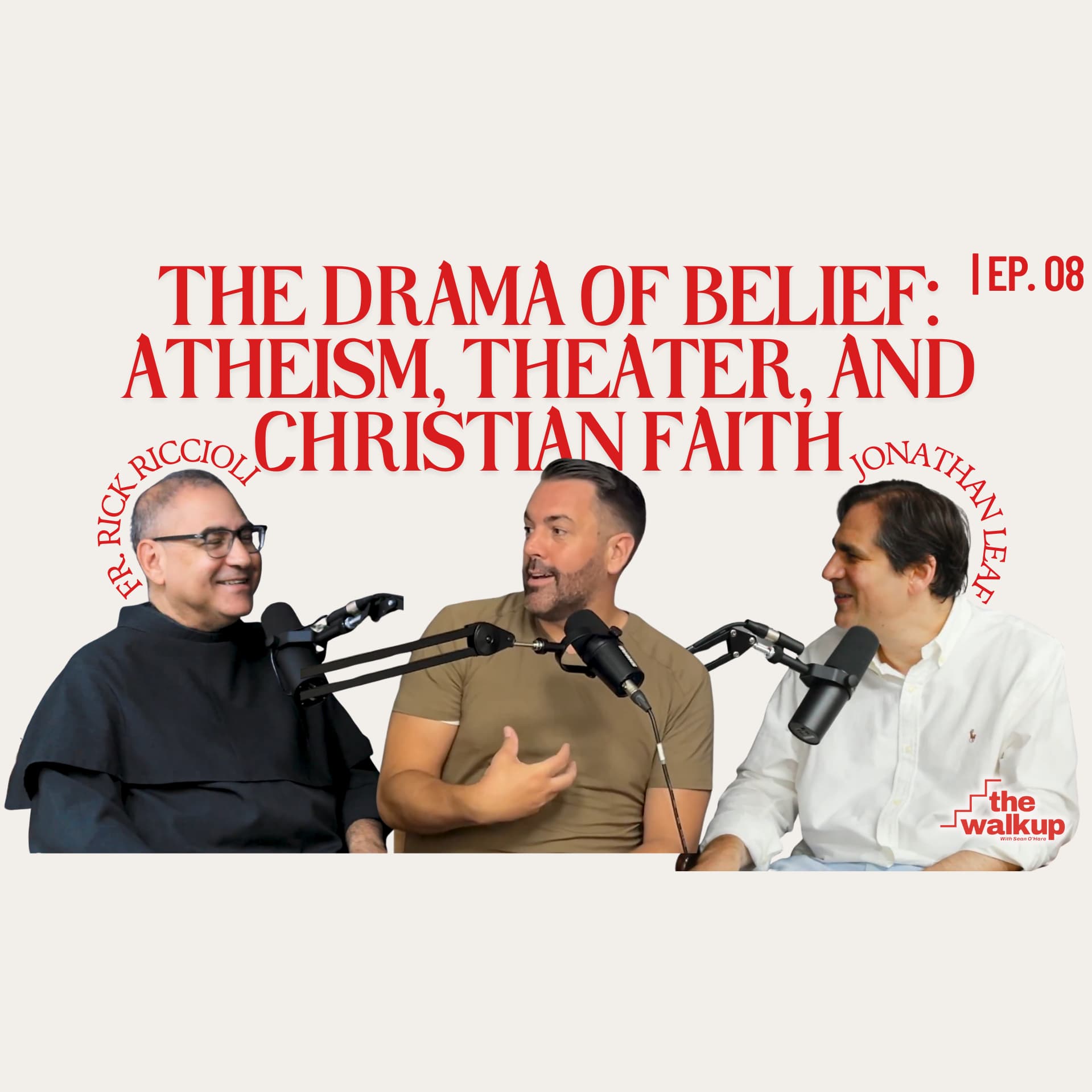
Drama of Belief: Atheism, Theater, and Christian Faith (Jonathan Leaf & Fr. Rick Riccioli) | Ep. 08
Can an atheist and a priest find common ground? In this episode of The Walkup, playwright and author Jonathan Leaf joins returning guest Fr. Rick Riccioli, pastor at Most Holy Trinity–St. Mary Church in Brooklyn.
Together they explore the boundaries between faith and secularism, the surprising depth of spiritual questions in art, and why Christianity still matters in a post-Christian age. From Pushkin to priests, belief to disbelief, this is a lively conversation about doubt, culture, and conviction.
Subscribe on YouTube: @TheWalkupPodcast Follow on Instagram: @thewalkuppodcast
Transcript
Read the full transcriptAuto-generated · 16,542 words
All right, well, thank you for joining the Walk Up podcast, Friar Rick and Jonathan Leaf, and we're... Excited to talk about Jonathan's book, City of Angles, but being a podcast that tries to bring different perspectives from skeptics and believers, I think it's always helpful for the audience to kind of get a sense of where people are coming from, from a kind of worldview, faith perspective. I think we know where Friar Rick is coming from.
Franciscan, Catholic, Canadian. Well, the outfit gives it away. The outfit gives it away where you're coming from. I am really leaning into being the... This is my attempt at Franciscan today. It is not quite a brown tunic, but... I am not wearing gray or brown either. Oh, that is true. You are on the gray. But, yeah, maybe, Jonathan, just before, to kind of give some context, like, did you grow up with a certain faith background? Where does that stand today? How has that shaped kind of your approach towards being a writer?
Yeah, unfortunately, it really didn't have much religious upbringing. Of my grandparents, the only one who was religious was my father's father, who was a Missouri Synod Lutheran, and the rest of the family is Jewish, but they were secular Jews.
And how did the one become a Lutheran? How did that happen? Well, his father was a Swedish Lutheran. I do not know how he got into Missouri Synod Lutheran, which is actually quite different. Well, that is a very strict denomination. They do not believe in women wearing pants, and they do not believe in dancing, and they are quite different, actually, than Swedish Lutherans. Not that I have a vast knowledge of the subject.
So, it was basically Footloose. It was the plot to Footloose. I guess so. Though I lived in Chicago, so it must have been a little weird. But, yeah, no, I did not have too much one, and then at some point, I did start going to Temple.
And my ignorance of Judaism is somewhat profound. I went to a high school that had required Bible study, and actually, for a long time, knew vastly more about Christianity than I knew about Judaism. And I guess, you know, it is interesting, I am friends with, you know, John Zmirak? Oh, yeah, sure. And John is one of my favorite people, and just recently, John put online, he did not say this to me, he said that the thing he was most of all was anti-communist.
Even more than he was religious. And I kind of feel that way. I'm very anti-communist, and I'm increasingly anti-atheist. I think atheism is really bad. But, you know, I wish I had more conviction in my own beliefs, religious beliefs. But, you know, there's a lot of doubt and uncertainty. Well, and wasn't there like a notable atheist recently that stated, while I'm atheist, I'm glad that... Christianity exists, or I am glad that we live in a society in which Western civilization was shaped by it.
I am trying to remember who it was, but it was almost like it was a weird conceit for a person who was known for their atheism to say, well, but I am kind of glad that this thing exists. I had a friend who had a similar situation. I had a friend who had a similar situation, that he was... Very pro-life guy, but that was the only thing he was convicted in, and it was because he had, unfortunately, experienced his girlfriend being kind of forced by her father to have an abortion when he was like 18 years old, and it just made him like, wait, I didn't even know, but abortion's a thing?
I didn't even know that was a thing. This is like in the early 80s, because when he found out she got pregnant, he was like, oh, all right. I guess I got to, like, provide, so I will go join the military. So, he joined the military and was in basic training when he got the phone call. And the worst part was, it was a prominent, I will just leave it at that, prominent Catholic priest that had kind of okayed the father to kind of...
I don't want anyone to go through this trauma that I went through, but he was certain he hated all Christianity. He was certain of that. He was like a militant atheist and a very pro-life guy. Eventually, it came to Catholicism, but he was like an Ayn Rand guy, and libertarianism. It was a whole sequence of things, but it's interesting where you find this, I'm not certain of a particular overall worldview, but I'm fairly certain this thing isn't good. But expand upon that.
When you say, I'm pretty sure atheism isn't good, or I'm anti-atheist, what does that mean? Well, I mean, I think if you look at societies in which the state has encouraged atheism, they've been disastrous. And I don't think the two things are entirely unrelated. And I don't think it's in human nature for people to not believe in… Organized religion, and specifically what you were talking about, the rise of Western civilization, there is no question it is very connected to Christianity.
So, I think it is altogether bad, and in fact, if you look at around the world rates of suicide, they do correlate with the degree of secularism. And the most atheistic countries, like Russia and China, traditionally atheistic. I mean, it sounds strange to say traditionally, but, you know, communism was the ruling ideology in the Soviet Union and Russia for... What was it? Over 70 years, and it remains so in China. They have high rates of suicide. They have very high rates of suicide.
You know, people can't live without faith. It seems to be very difficult. Now, are you equating atheism with secularity? I think, you know, we were talking about earlier, kind of my being a proud Canadian and loving Canada, I am a little distressed by the rise in secularism versus secularity, right? So, the secularism is kind of this staunch anti-religion feeling and denial of religion and almost forcing people to be atheists versus a desire for a society that is unaligned. With any religion, kind of French secularity, you know, very clean and division, which I think the U.S.
pretends it has with the, you know, separation of church and state, except it's not real. But is that what you think, or are you talking about really just people who don't believe? Well, you know, in both Russia and China, they actively have promoted, for very long periods of time, the idea that organized religion is bad. And I guess they've taken a step back in Russia, but the damage has been done. And, you know, a lot of young people are not. They're faithful, and they're despairing.
They're unhappy, and I think you can also observe. I have a friend from college, a woman named Lisa Miller. Well, I have a friend who is a professor at Columbia, and she wrote a book called The Spiritual Child, which became best-known. Do you know this book? It is an interesting book, but it is about research on young people who have faith and do not have faith.
And the overwhelming finding, which sociology professors largely ignore, is that young people with faith have fewer problems. They are less likely to commit suicide. They are less likely to get pregnant and have an abortion. They're less likely to self-harm.
They seem to be happier and better adjusted, and I think you can see that just through ordinary observation. Well, but it has also been clinically proven. Like, when I was studying counseling at Loyola in Maryland, in those days, there was an institute of research, and they found that people who had others praying for them or had an active prayer life healed better after surgery and different procedures. They had better outcomes in a variety of stressful situations, right? So, the faith actually had a tangible, measurable impact on their life.
Now, how that works out, I don't know. We know that working with young adults, when I did Francis Corps, The Kara Institute in Washington did a study about young people who do a year of service, right, and live in community, try to live the gospel service. Their long-term outcomes are spectacular, like their divorce rate plummets, their engagement in civic life rises, their overall contentment with life is much higher, and part of that is just living in community. Learning to put other people ahead of yourself.
Learning how to negotiate things like, I know we had some young kids living in the house together, and they were like, one of the guys wanted freshly squeezed orange juice. That is what my mother got me every day.
And the other kids were like, okay, we can do that, but that means we have no meat for the rest of the week. So, you decide, right? So, that kind of stuff that most of us don't deal with until we're adults and maybe in marriage or we have to compromise with our spouse, learning how to do that early puts you in a good position. So, that faith, yeah, for sure has real, real impact on people. Yeah, just to finish, a couple other points I'd make.
One is that atheism is a form of faith. Right, I think that's always a misconception, that somehow atheism is the absence of some worldview. It's actually quite a specific worldview. Yeah, and it's based on no evidence. I mean, and they will defend themselves by saying, well, you can't prove a negative. But that's acknowledging that it's simply a form of faith. But it seems to be a very destructive form of faith. And it's destructive not only that the individual lacks any sense of purpose and direction.
But also, in that, you know, people, you know, of course, there is that comment of Chesterton's, it is not that when people lose faith in God that they believe in nothing, but they believe in anything. And we have seen that. You know, both Hitler and Lenin are examples of people who adopted their own ethical system and, you know, then killed millions of people.
I am going to push back a little bit on that, about atheism being a faith. I think it is quite the opposite. Because faith is not an ideology. Faith is not a philosophy or a series of beliefs. For me, faith is in a person, Jesus Christ. So, the rest of it is almost like icing on the cake, right? If you don't have Jesus, if you don't have the person of Jesus, then the rest doesn't make sense, versus an atheist who has kind of an ideology that they can kind of manipulate into.
Do what they want to do. It is not a living, breathing reality, versus a relationship with Jesus, which I think is true faith, is something that evolves and changes. That is why our understanding of how to be a Christian, a Catholic in the world today can evolve and change. It is an important distinction, I think, because I think sometimes, particularly in Catholicism, because we do have a robust... Institutional nature to things, because over time, you build institutions around memory, theology, and philosophy, and education, and even the corporal works of mercy, and all those things, which are wonderful things, but sometimes we can just...
Share that kind of institutional knowledge, but not the source of it. I think you will find this interesting that when Fry Rick and I were on a previous podcast with my friend, Arise Barr, who is a Jewish comedian and actress, she said, well, what if Christianity, what if you found out that the first century really was just this collection of wise teachers, and they put together the Bible, you know, would it really matter that there wasn't a Jesus? If it... You know, but this is a great way to live your life, and you are basically making that point, which is, what if it is just an ideology?
And thankfully, Fry Rick and I both responded with what a good Christian should say, which is, well, then the whole thing is BS. It is nonsense. Game over. It is game over. And she was like, really? Like, she was shocked by that, because I think the world...
From the outside, it often just looks at Christianity or Catholicism as just like a really nice ideology, and it tells you to love your neighbor, and that is a nice thing. And who would be against that? But for Eric's point, which is I think we have lost sometimes the central focus, is this is...
About a relationship with a person, if the incarnation didn't happen, if the resurrection didn't happen, then the whole thing is bunk. And that is, I think, how does that strike you from an outsider's perspective? I think that makes a lot of sense, and in fact, I am not trying to oppose ecumenical...
Philosophy. But, you know, this idea that people get very—Jews, I'm Jewish—they get very upset when they hear people say, well, you know, if you don't accept Jesus, then you're not going to go to heaven. But that's clear in the New Testament. I mean, that's very clear. Getting back, though, to the subject of— But it is not Catholic Church teaching. But he does say, I am the way, the light, the truth, right? Absolutely. Yeah, I mean, that seems to be a pretty clear statement.
But God also says in the covenant that he will be faithful to Israel forever, and God does not renege his covenant. Okay, but in any event, I mean, he is obviously very central. You cannot be a Christian unless you believe in Jesus. I mean, that is definitional. But what I was just saying about atheism being a faith is, there is no proof.
They're making this assertion. They're claiming that there's no God, and you're like, where's your proof? And they say, well, we can't prove it. Okay, then you were assuming something for which you have no evidence. Yes. Well, that's peculiar, but they don't want people to see it that way, but that's what it is. And then, they're arriving at some system of ethics, which is usually personally motivated, which is very dangerous.
So, that I think is what I find. I find fascinating. When you see these things lived out, whether it is the secular or the explicitly communist or socialist or particular political ideology, is oftentimes in the absence of Christianity, which Christianity... When we say lived out in ideology, believes in the dignity of each human person, right? And that's hard to live out. I mean, that's not easy, because I think left to our own devices, which is what I think you see oftentimes in these kind of opposite examples, is...
Human nature is going to human nature, and it is going to be the powerful versus the powerless. Now, how that gets divided, and who is powerful and who is powerless, gets worked out in maybe different ways, but I think ultimately, that is often what you see in these political ideologies, is at the end of the day, you are going to kind of make yourself the God, and there is going to be haves and have-nots, because to continually live out the Christian ethic and the Christian call to serve, To serve others and to truly believe in the dignity of all people, that takes a lot of work.
A demand that is really beyond our own natural grace, so often to live out. Well, I think that is what makes Pope Francis so uncomfortable for so many people, because I think he is seeing that he is coming at it from both perspectives. He is a freaking Jesuit. I mean, he has got a mind like a steel trap. He is a very smart man. He knows the Church's tradition in theology. He is also a person of deep faith and simplicity, and he knows the heart of Jesus.
So, he can be talking about the ideology of a gender and trans people, and the political and whatever, and he can question certain things, but in the end, when he is coming face-to-face with a human being, he has to recognize the face of Christ in them, right? So, that is the difference between the theology and the praxis, you know? You have got a real living human being in front of you. You treat him as if it is Christ's presence in your midst.
And people are like, well, no, I'd rather things be much neater, you know? They're bad, we're good. You know, let's keep it simple. That's not Christianity. Yeah, but I just returned from being in India, where it's less than 3% of the population is Christian, and maybe 1.5% or a little bit more is Catholic.
But I was working with a Catholic priest who was trying to... ...combat human trafficking in his region, which is extraordinary. 30 million people are in some form of slavery in India, either being trafficked outside of India or within. And I didn't really think about it because I'm always just usually connecting in these different regions of the world through my relationships with the church. But at some point, I started realizing that this is a guy who is...
You know, a rare entity in being a low-caste Catholic priest, right? So, these were Italian missionaries who came to India, who learned not just Hindi, but also Telugu, the local dialect, translated the Bible into Telugu, made it accessible, then ordained from the low-caste, which was considered, like, radical. So, dignifying what What that culture would look at as a lower caste, and it is now that priest and his brother priests and their religious sisters that are now working night and day to try to protect these vulnerable women, of which 90 plus percent of them are not Christian.
They're Hindu and Muslim. It's not like they're only helping Christian girls from trafficking. To me, I understand it intuitively, but when you actually step back and look at it, that's an extraordinary thing that nobody's asking themselves, well, why are you putting in all this effort? How does it benefit you? In fact, it's not benefiting him.
He gave a talk here, which is how I met him. The talk was put on YouTube, like all the talks at that conference. He was pulled aside by state officials. Because they, I guess they were searching for his name, found that he had talked about human trafficking, and the realities of it in India, and they're like, you know, you can't be talking about this stuff. And so he had to go and ask to get the video taken down. So he's, you know, under threat.
But it's just like, that is a... It is something that you do not necessarily recognize as extraordinary until you are in a place where the Christian population is by far the minority. Yeah, I wanted to say something which neither of you will really find satisfying, but it is someone who is not Christian that could be construed as Christian apologetics.
You are referring to this comedian who is saying, well, you know, what if there was not a Jesus? I think there is no question there was a Jesus. You know, the accounts we have from Synoptic Gospels were provided relatively soon after Jesus' death. And, you know, I mean, some people have dated Mark to as a 65 or 60 or something. AD. They were reasonably, and they match each other very closely. That is why we call them synoptic gospels, right? There is absolutely no question that Jesus lived.
I mean, that is beyond any dispute. Whether he was divine, you know, people may question that, but there is absolutely no question. I mean, if you are going to question that, you might as well question the coronation of Charlemagne, for which we have only maybe one account. We have multiple. We have many matching accounts, some of which are canonical, some of which are not canonical, of Jesus' life. So, there is no question that Jesus lived.
So, I am curious, and then I want to get into your work and your writing. As you are circling around these ideas, obviously very articulate about Scripture, even talking about the historical proofs of Christ, when you are trying to attack, like, I cannot quite bring myself to believe, how have you tried to approach it?
I want to say, what are the obstacles? Because that is your own journey of faith, right? That is for everyone to go through. But I am just curious, for people who are watching this, going like, Well, I'm kind of in that place, too. I'm trying to, like, attack it. Is it talking to guys like Friar Rick? Is it reading books? Is it, I mean, the hard part is how to go from no faith to faith. That's the tricky part. When Doug Lyman and I were in shooting the TV pilot for our show that we're working on.
We're at World Youth Day with Pope Francis. Well, he was there. We weren't like hanging with Pope Francis, just to be clear. Us and 500,000 other people. But Doug would walk up to people and be like, so you believe in Jesus or believe in God? Oh, yeah, we do. And he's like, I'm an atheist. How do I believe in God? And he's waiting for them to give him like a formula. And they're all like.
I don't know. It's your own process. I can't tell you how to believe. So, it's like an amazing, like here he is, he's thinking, I'm going to this epicenter of all these people that have traveled from all over the world to be here in Portugal with the Pope. They must have the answer, and the consistent answer he got was, It is your own journey, so I am curious as to your... I think I am probably the wrong... You should be asking Father Rick.
He is someone... Before we started... You don't use the term shooting anymore, right? What is the term that is now correct? I mean, I think it would be... Yeah, shooting, recording. Recording, recording. I was asking about hearing confession, and maybe that is a little bit of an entry point. So, maybe I think you should be asking him, not me. Well, I am just curious, just because of the outsider perspective of being like, I am trying to understand. So, you would call yourself deist, then, I guess?
Someone who is uncertain, and I would like to have more faith than I do. You know, I think that a lot of people are like that. You know, they are not sure, as there are people who are very devout who go through periods of doubt, too. So, you know, I do not know the answers.
For sure, the doubt. I mean, I say that at Mass often. People look at me like I am crazy, but doubt and critical thinking are essential to at least the Catholic mind, if not the Christian mind. If you do not do that, then I do not think your faith is solid, right?
I have doubts all the time. I mean, not existential doubts, but there's moments where I'm confronted by evil or by pain that makes me think. Okay, what are we doing here? Just recently, a friend of mine found out her husband passed away in a car accident. They've got a two-year-old child, and she's 33 weeks pregnant.
Where's God, yeah. Where's God, right? And we all hear those things, and I don't have to go to my friend, even in the parish, you know, you hear of, when I was at, people hearing about people being on the bestia, the train that comes up from Central America, and the things they've experienced, or people on the border, why they're leaving the border, you know, the pain they've experienced. And one lady talked to me, and this was like live, firsthand.
Her son wouldn't participate in the cartels in Mexico, so they showed up, grabbed her son, threw him in a tree mulcher right in front of her. Oh, my gosh. So, she just took the rest of her kids and ran for the border.
Like, I'd run for the U.S., too. I'd be the first thing. I'm getting the hell out of Mexico, right? Like, as a priest, and you think, okay, where's my faith? You know, where's Jesus in this? It doesn't change it. But it makes me wonder. But if I can just offer one thought. I think traditionally as Catholics, and that is one of the things I am learning with this program, Divine Renovation, kind of a change of the paradigm where we have invited people to become Christians, to become Catholics, come believe what we believe, behave this way, and then you will have a belonging.
And I think that if you want to have a more evangelical perspective, it is to invite people to belong, come be with us. Being with us, you may come to belief, which may lead to certain behaviors, but welcome people as they are first. I think that is the first step of faith, is just to say, okay, I do not have faith, but I would like to. That is the number one step, and to, I think, hang around with people who do, and sort of get some of that juice.
See what is happening. Let the spirit move. Yeah, it was one of the guys on the Podcast recently runs a community for those that are struggling with addiction or are now in recovery, and so he has his own story, of course, of having been through addiction, and I shared with him that when I had gone to a couple of these meetings, I thought, If the church felt like I felt when I went into these rooms with these men and women who have been through some stuff, right?
I mean, they've been through some serious suffering, sometimes because of their own addiction, sometimes because of really bad family situations they came from, but now they were... The vulnerability they had and the willingness to want to help others because they understood the pain, right? They understood suffering, and the thing that you felt when you walked in there was, we are all broken, we are all in need of healing, we are all in need of God or your higher power in the way they phrase it, and we need one another to be compassionate.
And I was like thinking to myself, if that's what you actually felt when you walked into the church every time, I think we'd have a much higher acceptance rate because I'm starting to really like... Focus in on this idea that everything is about needing healing. I think that's a lot of times what's blocking ourselves and our own spiritual lives if we happen to have access to the sacraments of the Catholic Church or be outside of it or have our own faith journey is the willingness to forgive yourself, the willingness to forgive others, and the willingness to try to know that the Wounds that you have in your life can actually be healed, and you can move forward.
That, I think, is like the scar tissue that is around everything in our interactions. And I think that is why the church has been focusing a lot on divine mercy recently. There is this kind of famous painting, which has an amazing story behind it, because it was painted.
I was inspired by this Catholic nun in Poland, and she couldn't paint, but she just had a vision, and she told this artist, this is what I want, painted. And he kept, I think he went through like 100 versions before she was like, yeah, that's the one. And it's just a simple image of Christ, and there's kind of the... uh beams which write blood and water coming out of his heart but that's just forgiveness like he wants to just give us divine mercy but then during world war ii they the germans are coming in they had to hide that painting up in like the rafters of some church fortunately it's such a simple painting it's not for the hundred versions that they went through it's not like So, when the Germans were taking all the nice art, they saw it and were like, eh, and they moved on.
So, it stayed in their rafters, and they found it like 50, I don't know how many years later. But anyways, just to say that I feel like one of the things that the church really needs to communicate to people is like, The inexhaustible desire for Christ's mercy, and not judgment. And I'd be curious, Jonathan, about, because I see the connection, right? I think between what I'm experiencing in the, I want to say the lack of faith, and the rise of secularity and atheism, right?
And we talked a little bit about this earlier, that across the street from the church, kitty quarter from us, is this restaurant, Winsun. Run by two wonderful guys, Josh and Trig. On Sunday mornings at 9 a.m., there is a long, long lineup of young adults who want to go for their breakfast sandwiches.
And my thing is, okay, they are up, young adults, up at 9 a.m. on a Sunday morning because there is something there they want. Why aren't they coming for the breakfast sandwich I have to offer at the church? So, I am not blaming them, right? Because they are smart people. Obviously, there is something that they don't see that they need. What has happened to society where we don't feel like we need redemption? Have we lost the sense of sin? Is that what atheism has done to us?
What do you think? I don't know, but I think it's a big problem. I mean, I used to, before my knees got as bad as they are now, I used to run around the reservoir in Central Park, and I remember several years going out on Sunday morning, Easter morning, and there were a lot of people, maybe more people than a typical Sunday morning running, and you're thinking, you're not in church? I mean, it really struck me. It is odd, and I mean, obviously, New York City, you know, it has a reputation of being a godless, sinful city, and there is obviously something to that.
I don't know. It is hard for me to give advice. Actually, it is interesting you are talking about addiction. I had been a teacher, and I used to tell students, I only give one piece of advice, and that is to stay away from drugs, and my rationale was, I have never met anyone who said, I am really glad that drugs became a big part of my life. I'm really glad I got mixed up with drugs. You know, I've never heard anyone say, thank God I started using heroin.
You know, I've never. So, I thought that was, I said, you know, that's a pretty clear indicator. Stay away from drugs. You know, I don't know that I'm qualified. I have the professional training and experience to give advice, and I don't know that I do. In fact, I know I don't. Yeah, but I think your insights are important, because that's usually the key to figuring out what to do next, right? Like, most of my family doesn't go to church. They don't see the relevance of it.
They're baptized Christians, but they're like... I'm not getting anything out of it. I mean, I just live my life. But I do see, as you have said, among people, especially back home in Canada and Quebec, a rise in anxiety, depression, feeling of what's the purpose of my life, kind of floating aimlessly.
And at times, I've said to people, well, like Pope Francis said, when you're feeling depressed about yourself, why don't you lift your head and look at somebody else? Maybe do something with someone else. Stop thinking just of yourself, you know? See yourself as part of a network of relationships.
Yeah, when I was in, I got to be in Russia, this was 10, 11 years ago. It was part of this, like, program that we were supposed to be kind of like. American younger leaders getting to learn more about Russia and vice versa, and one of the questions that kept coming up in the meetings we were having was... How do we build civil society? They were so fascinated by the volunteerism of American culture, like the desire to just, the people just like kind of self-organize, and like if somebody's house was damaged, everyone just like, eh, let's just all get together and help out, right?
And this notion that we're kind of always looking to build community, right? And I think maybe because, you know, the... The communism made you say, well, you are just an agent of the state, so you are just waiting for the state to kind of take care of things for you. But I thought that was fascinating. Of all the questions they could ask was, what is this civil society thing? And I was like, honestly, I was like, I do not even know what you mean by that.
But when they explained, you guys have all these volunteer groups and organizations and churches and, you know, community centers, I was like, oh, I guess that is strange for you. But, yeah, I mean. I would love to get more into your book, or do you want to, other... No, I'm just, I'm still, you know, that's kind of my big question, and, you know, how do we help people, or are we deceiving ourselves, but I don't think we are, how do we help people find that, the hole in their heart that only God can fill?
Yeah, and I think, I mean, I think maybe the question that you're asking to some degree is like... We obviously have a strong belief in our faith. We're saying that there's a wounded world out there. You know, you're seeing this long line for breakfast sandwiches down the street from the church, yet they're not coming into the church. I'm sure you're asking, like, well, if you guys don't have the answers, then who does, right? And part of it, I do think, is what you talked about before, which is the belong, believe, behave, not the other way around, which is something that we've taken for granted.
I think part of the answer to the question is that And I think we have talked about this before a little bit, is that for a long time, things were just humming along well. In the case of American Catholicism, a lot of Catholic immigrants coming over from different traditionally Catholic countries. They came here, they built churches, they went to Catholic schools.
Married, other Catholics had Catholic babies who went to Catholic schools, and they just kind of kept perpetuating, and that is not happening anymore. So, now the approach towards things is not. A maintenance model, but now one where we have to do outreach, and as most things on the church, it takes a couple decades is not a long time of shifting, the church thinks in centuries. So, I think part of the answer to your question, maybe, of how does the church think about this is, we are still figuring it out.
I mean, I think Vatican II is only 15 years, which is... Blink of an eye. Well, more now, I guess. I think it's 60-60 this year, right? But I am getting to what you're talking about, Catholic schools. I mean, as an outsider, that's a sea change. My understanding is in the early 60s, about half of all American... Catholic kids were in Catholic school. I think it is now like 12% or something. Is that right? I don't know the percentage, but yes, it is minimal comparatively.
It is a tremendous, tremendous change, and as an outsider, you can see that is a potential issue, and a huge potential issue, and it is an issue for society. It is part of the overall trend. Hospitals, social services, universities, a lot of that was Catholic run. So, you know, the church can't... The church can't do everything all the time, and the resources aren't there, but the grade school kind of education, that is having a great impact, for sure. You know, I was talking with somebody last night, and I was saying to him, one of the things we were talking about was...
It's now 30 years ago, but 30 years ago, I wound up in St. Vincent's Hospital. I had a broken jaw, and they didn't have the doctor to repair it, and I wound up spending a week in St. Vincent's, and St. Vincent's, I don't know if people know, was a wonderful, wonderful hospital that was in the village and went bankrupt, and it was really, unfortunately, I've been in hospitals a number of times in my life.
It was a really special place, and the reason, by all accounts, was that it was run by nuns, and they were really committed to treating people with a level of generosity and kindness and concern that was remarkable. It wasn't an institutional hospital in the traditional sense, and I wound up sharing a room with a guy who was dying of AIDS.
And they really cared for him. He was six feet tall and 105 pounds, at the point at which we were sharing this room, and they really cared for him, and he didn't have a lot of friends visiting him. I had lots of family coming to see me for something that was reasonably easy to correct. He was dying, and he didn't have a lot of people coming to see him, and people were there for him, and unfortunately, the hospital doesn't exist anymore.
And, you know, yeah, these are real issues for society. Yeah, and I think that it's that last mile or whatever you want to call it. Like, there's kind of the doing the minimal amount to care for somebody versus the compassion that goes. And a lot of times, it's vocational. That's, I think, the distinction between a teacher who sees it as their vocation, whether they're...
You know, a religious sister or a married man, it does not matter, versus seeing it just as a job, and hey, I am going to clock out when I have to clock out. When I was, one of the experiences I had in India was we went to this, first of all, tons of nuns in this diocese. So, there is something like 200 or so parishes in that diocese, and about... 300 or so priests, 900 nuns, just extraordinary. And so, they are the backbone of that diocese.
Everywhere we went, we were greeted by a different religious community of nuns, and welcoming us, and singing a song, and offering us lunch, and we get to see their various ministries. They're running schools, they're running orphanages, they're running hospitals, and I think the thing that's always confounding is the joy, the level of joy that's going on there.
And we were at this one orphanage for children with disabilities, because these are kids that have been... Discarded, right? I mean, so there were, you know, kids with... With Down syndrome, severe physical disabilities, a few that had such deformed legs that they're walking on their hands, that sort of thing, but you would think that would be a depressing situation, and my girlfriend joined me in India, and we couldn't wait to go back. The way the nuns had created a loving atmosphere, and watching these children go up to these nuns, that was...
That's mom, you know? I mean, they're hugging on their leg, and just this beautiful environment that was actually addictive for me. I'm like, can we go back tomorrow? And there was this really beautiful moment where my girlfriend's name was Alejandra, and there was a blind girl. um who you know obviously listens and uses touch to kind of get around and so she could tell there was you know some visitors and so she's coming up towards Alejandra and a lot of people couldn't say her name because it's a long name and and it's also like a tricky one for uh those from India to say so she's been she would tell people just Ale just say Ale and so the uh this blind girl was like going up to her and kind of like You know, like hugging her leg, and she goes, Ale, Aleluia, and so she gave her a new name when we were there, and it was just like this beautiful, touching moment of like, hey, we don't speak the same language, you know, there's a person with a, in this case, a disability of blindness, and yet, what the environment that these nuns had created because of just Love.
And you could tell for none of them was this a burden to be caring for. I mean, there were probably eight nuns there, and 40 kids, you know, 50 kids, something like that. And just, I mean, you could tell that the... They just were fully in on this vocation of being a mother to these forgotten children.
So, there is a lot to be said for the difference between a job and a vocation, and I think that is certainly something we are missing lately. Well, yes and no. I think last week, or two weeks ago, was the 25th anniversary of this organization that was involved with Francis Corps, where we have these... People do a year of service, right? And I am meeting some of the first ones, you know, the Francis Corps I group, and II, and III, and listening to their lives, and it is like, well, yeah, maybe there are not as many friars and sisters around to do this, but I think part of it is our success story in that through the Catholic school system, through the preaching, through the vision of Vatican II, which is, you know, the vocation of the baptized is the central vocation, that these baptized Christians and Catholics, and I would say others too, because it is not just Christians who are doing it, But they're embodying the values that they've been taught, right?
And so, you see people who, they're in real estate, but they do it with ethics, and with kindness, and with compassion. They're bankers that are aware of, you know, that we don't do just gentrification, we want to have development, so that everybody's included in the growth of a community. You have teachers who are attentive, not just to the...
Transmitting knowledge to a child, but helping the child be formed as a good person. So, I find it very comforting and very hopeful that I see, yeah, they live, for us, the Franciscan charism in their daily lives, and that is happening more and more. You go on the subway. You know, if you're on the subway from Manhattan to Brooklyn on a Friday night, everybody is coming to Brooklyn, right? And this... Every bit of the treason is so diverse.
And young people are staunchly defending one another and respecting one another and loving one another despite what they look like, body shape, size, gender, orientation, hair color, whatever. Kids today are just so... For the most part, respectful and affirming of one another. Maybe a time is excessive, but I find a lot of hope in that. I think there is something good happening in society that we cannot discount.
Yeah, I think there is certainly a sense of hope, and I think the question is for we in the Catholic Church trying to figure out, okay, we've got, I think a lot of times when... Guys like my friend Doug Lyman, when they meet somebody like me who actually goes to church, he's like, there's like churches everywhere in the city. He's like, I've been passing by these things, I didn't even know they were open. These are, on every couple blocks, there's another church, and so there's this incredible infrastructure to be able to be accessible, and yet we haven't quite figured out how to make them, make those...
Places where people feel like that's an option for when I'm struggling. That's an option for when I think I need to go and have some time for reflection. So, there's this kind of... Cognitive dissonance between a lot of people that are hurting and a place that should be available for healing, and we are not. Why is that?
You know, one of my complaints about Judaism, I don't know if the microphone picked that up because I'm practically mumbling, but one of my complaints is that so few of the synagogues in New York City and in the United States are attractive places.
And I think I may have mentioned this to you in the past. Years ago, I was working at a non-existent, now non-existent newspaper called New York Press, and I wanted to do a photographic essay, have someone to get a photographer. We finally did get a photographer, and then we all wound up quitting. That is another story. But there are so many beautiful churches in the city. I think it is safe to say there are as many beautiful churches in New York as almost any city in the world.
You know, we hear about these beautiful churches in, you know, Siena or Rome, but New York is full of beautiful churches, and that is a story that, again, talking about the secular hostility towards religion, the media does not tell, and, you know, Vincent de Paul is a beautiful church. There is one, I forget the name of it, on 94th and Lex, that is a beautiful church. There are a lot of beautiful Episcopal churches.
You know, there are all these beautiful churches, and people should feel, one would hope that people would feel, oh, this is a place I'd like to go because it's a beautiful place. I can sit down, and I'm in a place of worship that's actually a beautiful place. Unfortunately, most of the synagogues in the city are not.
Yeah, one frustration I've had recently, and I imagine you don't fall into this category with this parish, but is... How often the churches themselves are not even open during the day? It is like, what are we doing here?
Like, there is one parish I know in Midtown that used to be open from 7 a.m. till midnight, and people throughout the day just popping in, saying a prayer, and now they are basically closed by like 2 or 3 p.m., and it is like, and they are in a safe part of Midtown. This is not a security issue. Oh, if they are closed at 2 or 3 p.m., that is actually not bad, because some of them just close after Mass. Right?
We're open from 6.30 to about 5, unless we have liturgy in the evening, and then it's until 8. And I've heard of guys who leave their churches open all the time. Like, I think that should be the case, but it is kind of scary, right? Because we do have a lot of people come by the church to pray. I talk about sometimes this lady comes in for a lunch with Jesus, you know, she brings her lunch and sits there in the quiet.
We have some rudimentary air conditioning now, so they can be at peace. So, it would be great, but there is always a fear if somebody is going to do something crazy or, you know. Yeah, I mean, you've got to be prudent, but I think of a church that's, I don't think it's closed yet. It might be soon.
In Chelsea, well, yeah, I think you've been there, but when I did those events up in the kind of like that courtyard area, so it's literally on the High Line, like the High Line's here, and the steeple of the church is right next to it, and they would open for daily Mass. Mass was at 12 p.m., and so they'd open the doors at 11.55, have Mass, and close the doors. Mass only lasting a half hour, if that. It was a quick one.
And then the doors were closed by 1230, and I remember telling the pastor, I said, and he was a good guy. He had a lot on his plate. He was trying to manage multiple parishes. I said, you know, you are next to the High Line, which is outside of Times Square, the second most visited attraction in New York City.
Something like 8 or 10 million people walk the High Line every year, and I was like, and you have prime real estate on the corner at Chelsea. Can you imagine if I said, I've got this incredible prime retail location. Oh, that's amazing. How often do you keep it open? About 26 minutes a day. Like, wait, what? And then you're surprised that nobody's coming to church, right? It's like, I understand the security concerns. I understand maybe there's a financial element to it, but I can guarantee if you just put a sign on the high line that just said, hey, pop in for a prayer, or this church is open, or sit down from the hot weather, or whatever.
You would end up getting that money back in donations in no time. Absolutely. But it is just the mentality of being like, well, we only open for liturgical activities, and that is it. Well, what are we doing? Are we just taking care of ourselves and nurturing ourselves, or is our focus missionary?
In a respectful way, not going to proselytize people, but just to create, as Pope Francis says, to create, to propose. Benedict said the same thing, to propose. An opportunity, an environment in which people can experience faith. Don't force it, but give them a beautiful, sacred space where they can just be quiet for a moment. I think we're all hungering for that. But there are dangerous, I mean, again, I'm an outsider, but there are dangerous people in the city, and unfortunately, often because they're mentally ill.
And, you know, you can understand that people are concerned about leaving their churches open. Yeah, we had, I was living next door to this church in Midtown, and yeah, every now and then we'd have that issue, and, you know, I'd say once a month we'd have to, you know, there was somebody who was passed out or, you know, struggling with addiction who would just not leave or whatever.
But we never had a full-time security person, just kind of occasionally would have to, and the police, we had a good relationship with them, so I could just call them up, like, hey, we got another. All right, no problem. We will be over there in the next 20 minutes or whatever. So, I want to pivot to kind of your, speaking of vocation, an artistic vocation as a writer. So, I mean, one of the things I, I mean, you and I have been friends for a number of years now, and so I have gotten to see and Experience multiple different genres, really, because whether it's playwright or author or screenplays, and then you're talking about writing in a paper.
So, kind of help us understand how you discovered your vocation as a writer, and then how it's taken different forms over the years. Well, I guess I'm mostly known as a playwright, and I got into that late in life, which were in my 30s, which is really not the way you should go about it.
I had been in some plays in high school and then at the beginning of college, and I didn't have any great desire to act. It turned out that I was able to make people laugh. So, you know, I was cast in one show, and then I was asked to be in another show, and then I was asked to be in another show, and then my brother came to visit me at college, and he said, why don't you try out for the show, and I tried out for the show, and the director was someone I just couldn't stand.
She was just the typical entertainment phony. You know, you're so amazing. You're, you know, just total phony, and so I really didn't want to have anything to do with the theater, especially the theater, the theater. And I swore I would never have anything to do with it again, and I went on a TV game show when I was in my 20s, and I won some money, and I quit work, and I tried to read some of the books I had in redaction college.
That seems like a whole interesting story right there, but okay. So, and it turned out, actually, and one day I got an idea for a play, and I started writing, and it wasn't a great play, but it was suspenseful, and it was somewhat funny, and I showed it to friends, and they said, you seem to have some talent for this, and over a period of years, it... It finally dawned on me that maybe I should be doing this, and so, you know, anyway, that is how I got involved.
But, I mean, were there other, I mean, you mentioned being a teacher, were there other? Half starts and other career paths, or? No, not really. I've worked at a variety of different jobs. I guess it's common if writers have gone through a period of not consistently earning a living, but I've worked for banks, I've worked on different things, but sold shoes.
No, not really. So, what is it about the theater? Because, I mean, you have a, and just in our own, in our, you know, conversations, I noticed this, but you're a keen observer of human nature. Like, you seem like you've got, it's like you're in the room, but you're also observing as if you're an outsider at the same time, because you're certainly very much a part of the conversation, but you're also, I notice, you'll make observations that I'm like, oh. Yeah, you're right.
I didn't actually notice that, or maybe even observations about me or my friends that I hadn't thought about. So, I imagine that helps inform theater and how you write, but I mean, those two things seem to be pretty well interconnected.
I guess. I mean, I don't think, I mean, this is a disaster from the point of you doing a podcast, but, you know, it's famous that writers are not necessarily good judges of themselves or their own work, so.
Well, we've got to judge of your work, because Fry Rick's had the chance to read most of your book here, A City of Angles, so, I don't know, maybe, what are your... Angles. Angles, Angles, yeah. I know, you go back a little bit. It was the last, it was one of the podcasts.
The host was calling it City of Angels, and I was like, I was squirming watching it on YouTube. Oh, God. So, what are your impressions of his race? Well, I was expecting it to be a little bit more sexy. Because it is Los Angeles, and it is the Hollywood scene, and I do not want to give too much away, but this woman finds a surprise in her trunk, and it is like how it all kind of unfolds. So, it is very entertaining.
It is always the priest on our podcast that says, I wish things were a little more sexy. Well, you know, it is like, you know, you got to look for entertainment somewhere, you know, but what, what, what? Because from Pushkin to this, it seems like a big jump.
You know, obviously, there are a lot of writers who just write for money. To me, you write because something interests you. So, at one point, I guess it was in 2011, I moved out to Los Angeles. At that point, I did have something of a reputation as a playwright, and most of the playwrights I knew were writing for TV. So, I moved out to LA, and I tried to get work writing for TV. And I did have contacts, including Rob Long, as an example.
And I did a terrible job interviewing for jobs and didn't get jobs. And I had already started dating my wife, and I came back to New York soon after we got engaged. Right. But one of the things that struck me when I was out there was I was observing the lives of struggling actors and, to a lesser extent, struggling writers, and it seemed to me that novels set in L.A. didn't really capture their experiences, that writers fell back on clichés. Also, there's such an instinct to write about...
Movie stars, rather than the typical actor, actress, who's going to auditions and not getting work, and that kind of thing, and working in a hair salon. One of the characters in this book works at a marijuana dispensary. I actually know a very beautiful actress, pretty talented too, who did that for years and years, and she told me some stories about working at this marijuana dispensary.
You know, I wanted to write that kind of book. On the other hand, I wanted to write a suspenseful and entertaining book, so it is a murder mystery, but it is really about these people who are struggling. One of them gets mixed up, a couple of them get mixed up with the cult, and the kinds of things that happen in Los Angeles. Very interesting cults. I was wondering if you had a lot of experience with that when you were there in Los Angeles.
Did you see the prevalence of certain churches or cult-like churches? Is that a thing? A little bit, a little bit. I mean, it did not involve me, but I did see it a little bit with other people. Well, strangely enough, for various reasons, it has consistently intersected with my life. I mentioned I went to this high school where we had required Christian Bible study. One of the things about that high school, this is really getting off topic, but I grew up in Trenton, New Jersey, which is one of the poorest cities on the East Coast, but I went to a prep school in Princeton, New Jersey, which is a very rich town, and the school was full of kids who came from a lot of money, and kids who come from a lot of money often have problems.
You know, it is a cliché, isn't it, that the problems of the poor and the rich are often the same, you know, and a lot of the kids in the high school and their parents joined one particular cult, a notorious one that they did a Netflix series about a few years ago called Rajneesh Param.
Right. And then, again, I met multiple times, I met people who joined cults, so it has always been a subject of interest to me. Why do people join cults? Why do they have a power over them? And in Los Angeles, it is everywhere. And not just cults, but people don't know this, but the Pentecostal faith was actually founded in Los Angeles, founded right near Skid Row, I guess the beginning of the 20th century. It was also one of the first Churches found in the United States that accepted both blacks and whites together, but, you know, I don't want to demean anyone's faith, but, you know, Pentecostalism is very unusual.
...set of beliefs, but it is quite natural that it was founded in Los Angeles. Interesting. Yeah, in the book, it is very...the cult-like church that is kind of all over the place is very... We put that in quotation marks, church. Yeah, yeah. It is very ominous, right? Yeah. Because it is freaking me out a little bit, because the part where I am actually seeing these people in cars and people following her and stuff, and it is like...it is building, right? And it is like...
What's going to happen next? Actually, let me take that back. There's a particular cult-like church, and I won't mention its name because I don't want to be sued, but I do know someone quite famous who was in the church and then left, and they've tried to destroy him.
So, yeah, no, I guess I hadn't thought of that, but I mean, I was thinking in terms of actors and actresses, but I do know a somewhat famous movie director who, they've tried to ruin his life, and maybe to some extent, succeeded.
Yeah, I think it was funny when we were shooting the pilot in Portugal, Doug, at some point was like, everyone seems to have the same answer to all the questions. It's like a cult. And I said, yeah, but Doug, cults happen.
Often in privacy, there are controls. You cannot leave. That is one of the defining aspects of the cult. You cannot leave. The reason people have the same answers in Catholicism is because there is catechism, correct? Well, hopefully good catechism. Yes, but no. I think one of the defining aspects of the cult is that it is very hard, if not impossible, to leave.
Maybe I will mention, and I am not saying this was a model for the book, but Scientology, they keep files on everybody. People go in, they tell them their most personal things, have they engaged in gay sex, have they done this, have they done that, and they are keeping files, which they have sometimes used, by most accounts, to blackmail people. And then, if you try to leave the church, You cannot associate with other people involved. It could be your family members.
So, you know, they use a variety of techniques to make it very hard for people to leave. Yeah, and that is an interesting business model. I do not know what the right word is for it. I mean, yeah, because we are putting the term church around it mainly because it has a non-profit status, but that is about it.
But, I mean, yeah, the control element of things, I remember watching that, I think it was HBO, the one on Nixxiom? Nixxiom? The one that was upstate New York somewhere? Same thing. We need to know everything you've ever done, things you're embarrassed about. We'll keep that knowledge, so that way we've got blackmail material, and it's just like, how is this something that's looking to cultivate my better self, right? But do you get the sense with cult atmospheres that there's a transaction of sorts in terms of like, well, if I join this cult, especially perhaps in L.A.
or places like that, I'll get... You know, I'll move up in my career. Yeah, and actually, it comes up in the book, but I think that the two primary reasons that cults appeal to actors, and I say this as someone who, you know, spent much of my adult life working with actors and has great affection for actors, and look, I did some acting myself.
Cults really work on two levels on people. They appeal to people's vanity, which I think a lot of people miss. They appeal to a certain kind of lost, desperate person. They also appeal to vanity. It is like you are the only ones.
Who know the truth, and are going to be selected to go to this other planet, or whatever it is. And, you know, most actors who are successful, they have often had very difficult childhoods. They have a variety of issues. They are looking for answers. They are looking to be led. But they are also often very egotistical and vain. So, it is working on two levels, and in the particular case of Scientology, which is not, I just want to say, because the book is not, Necessarily about Scientology.
You know, they give people a test when they come in, a test. It is a fake test. And whatever you say, usually the answer comes out the same, which is, man, you know. You've got a lot of problems. And then they say, but the funny thing is, you have so much potential here. You could be such an amazing person. And this is what most actors are waiting to hear. They're waiting to hear someone tell them, they know they're messed up. You see your potential, though.
But at the same time, you, you are going to be amazing. So, it's working on two levels. One is, they're confronting them with the fact that the person is troubled, and they want to hear the truth. And then the second is, but you are so amazing. So, they are appealing to their vanity as well. So, it has a tremendous lure when people first appear at their doorstep, or when they grab them on the street.
And Los Angeles is a place that's, you know, in fact, it's even physically very diffuse. You know, people forget Los Angeles County is 4,500 square miles. You know, I grew up in New Jersey. New Jersey is like 7,500. It's three-fifths the size of New Jersey. So, it has 10 million people, but it's huge. It's just enormous. So, people have limited contact with other people. And, you know, they go out there with all sorts of ambitions. They are actually not having a lot of contact with other people.
And then the church says, quote, unquote, church, because it is a self-described church, and this is a lot of cults. What was the one? Synanon was another one that emerged in California. There are a whole bunch of them. This is how they work. They start out by saying, yeah, you have to have us, because otherwise you are just.
Forget it. Your life is a mess. But there is something about L.A. that seems to draw people, right? It is like the last frontier of hope, and I will give it a try there. I think of so many actors and comedians. One guy who popped up on my TikTok and has become quite successful, he is very crude, but he is funny, Matt Rife, who was like 11 years a comedian. And he went to L.A. to make it big, and it just really, really struggled.
I mean, he was ready to give up, and poof, all of a sudden, he is famous through TikTok. But it seems like a lot of people are, in a way, it is preying on the vulnerable when you prey on people in L.A., especially with actors and comedians and artists. They have got a passion. They want to follow something that is That dear to them in their soul, and people are just manipulating that for their own advantage. It is pretty sick, actually.
Yeah, no, no question about it. And then they are often taking away their money. Yeah, they are often even putting them in debt. They will say, you know, why don't you borrow money to give us money, you know?
And then, outside of the financial motivation, When we are talking about what attracts people to join a cult-like atmosphere, what do you think motivates the cult leader, or the one who creates the cult to begin with? Is it a God complex? Is it strictly just taking advantage of a non-profit loophole to be able to protect assets?
I mean, because that takes an extraordinary amount of focus and discipline or self-delusion, I would imagine, right? Fully believe in the thing that you are then selling, right, that you are always… Well, in the case of L. Ron Hubbard, the guy who founded Scientology, supposedly he didn't believe any of it. I mean, he sounds like he was a psychopath, a classic psychopath, but according to, I think it was his son, left the church. His son said, you know, he wasn't really making a good living.
He had written this bestseller, Dianetics, and his son said, you know, he just decided, hey, why don't I found a religion? And try to make money off of it, and we'll just use this book that I wrote, plus my science fiction, as the basis for the religion. So, yeah, I think some of these people are just straight con artists. That's a long con. That's a lot of work. It is, and I think, you know, I'm not the most, I don't know how to describe it.
I think a lot of it has to do with evil. I mean, I don't believe people are evil. I mean, people are people, and they're God's gift to the world, each one of us, but I think sometimes we give in to evil, and it really is very tangible in the darkness of people's hearts sometimes, and their desire to have power over others, and to dominate, and to crush people.
It hurts me to see that, because I believe in the goodness of humanity, but it is pretty astounding how evil we can be if we allow ourselves to be duped, and there are a lot of people who enjoy taking advantage of people. I would also say, though, this is true of some cult leaders and also of some demagogic politicians, sometimes the reason people respond to them is because they are actually in tune. With the mob, their anger and their rage and all these emotions that they feel actually correspond to a lot of what the crowd that's listening to them feel, and they may be deceptive.
They're wily, cunning, manipulative, etc., etc., but actually, a lot, you know, you think of someone like Hitler or Mussolini, they, you know, some part of the time, they were speaking from the heart, and the audience responds to that. The audience responds to all these intense emotions that they're getting from them. Then, other times, they're just like, you know, I don't care that all these people got killed or, you know, whatever, but... Connected to be healed, to address these wounds. Now, it may take the form of, well, I feel like I belong to this exclusive thing or this secret knowledge or whatever else, but it still connects back to this desire to want to be heard and to be listened to and to be healed.
And I think the question is, like, who's... Where the vulnerability of that person, then, you know, who they're engaging with, and whether that person chooses to manipulate or not, right? I mean, because, obviously, we've seen that with scenarios of, obviously, those in the Christian world as well. They've taken that position of...
Where they can be seen as the healer and manipulated, right? And it is because the person in that situation is vulnerable, and our job as Christians is to, you know... Reinforce their dignity, not to then exploit the kind of... I feel like we are dancing around the elephant in the room. I think that defines the Catholic sexual abuse scandal.
Preying on the vulnerable by men who are tremendously broken, who have an arrested development, and have perhaps given in to some evil in their hearts. And praying people, recently in my home country of Canada, there was some settlements were made in Newfoundland for some of the most horrific, horrific abuse scandals, you know, and you read them, and it is like the parents were, I mean, I am not going to judge the parents, don't blame the victim, but.
The priest would call for an altar server to come help him in the rectory at 10 a.m. on a Wednesday night, and the parents were like, okay, go. Just complete trust, yeah. Yeah, and it is like, why would the priest need a kid at 10 a.m.? 10 p.m., yeah.
Just being very gullible, you know, and just trusting, but when you see how, and the grooming that takes place, and the manipulation of the person that takes place, and I think what is true of the church is true of society. I mean, unless we address some of the underlying issues and encourage people to be authentic to themselves, to... To grow as persons, right? I think that is one of the biggest challenges with clergy today is that, you know, the psychosexual human development is not really encouraged anymore.
For a while, in the 80s and 90s, there was a big push for that, and now we have kind of like, no, no, just conform, have the same haircut, look the same, wear the long cassock, more laces better, just look the part, it is all going to be okay.
Guess what? What we have experienced as a scandal now is going to come back and bite us in the ass in 20 years. You heard it here. Okay, I heard it here first. Well, let us talk a little bit about the Pushkin play, because that, I mean, to contrast it with, here you are taking kind of your observations of contemporary life in Los Angeles, and then you are flipping to a play in which you are talking about a historical figure, and...
Creating kind of historical fiction around it. Two completely different processes, I imagine, but kind of help me understand how the process of writing Pushkin differs from writing a novel. Well, I mean, yeah, obviously, they are totally different. Gee, that is a big question. Well, I mean, part of the reason, I actually wrote two novels at the same time. I wrote them during the pandemic.
You know, there was no way of getting a play produced at that time, and I was stuck at home, so I wrote this book and another book. Anyway, the publisher was interested in this book, and it got published. Pushkin was somebody I worked on for many, many years.
Produced it, I probably worked on it for 20 years, close to 20 years, and a lot of other plays were produced before that that were actually written after it. And it was a difficult play to get produced. I turned down opportunities to get it produced a couple of times, because I wanted a slightly bigger production. I wanted off-Broadway, not off-off-Broadway.
But it was difficult, because it calls for a big cast, and a period costume, and then we had to find a good black actor. And, you know, Pushkin was part black, but we felt in the current political media, it would have been really hard to do with a white actor. Yes, but you also have to find an actor who, you have to have an actor who has sort of the right look, and you believe is really smart, the smartest person in the room a lot of the time, insofar as that concept makes any sense.
So, it was a hard play to get done, it was a hard play to write, and then to get done, and we went through many, many... Readings, workshops, etc. I guess that wasn't a very good answer. I'm sorry. Well, no, but that's a very different end result, too, because here you write something and it gets published.
It goes out into the world. In this case, you happen to meet Fryer Rick, who has been reading your book, but generally, you are not necessarily having too many opportunities to then engage with the audience. Then, in the case of the play, you are just tweaking it and figuring out how it takes shape, and then you are seeing an audience experience it. Yeah, yeah, it is totally different. Yeah, actually, you are making the smart point I should have been making. I am friends with, I don't know if you know the historian Rick Brookhiser.
Oh, yeah, of course. I know that man. He's really good. Yeah, he's fantastic. Yeah, he's fantastic. I was a big fan of his before I ever met him. But anyway, Rick and I have talked about this. Rick says, you know, one of the difficult things about writing a book, he writes nonfiction, is that you really don't get any feedback until it's out. You know, you've got an editor, you've got an agent, but...
A play, you know, you do a series of readings. You get reactions from people, and in fact, when you start the first, you do the first performances, you are still making changes. You may be cutting scenes. You may be adding scenes, and you are finding out very quickly what people like and they do not like.
I always try to get written feedback after we do readings. I found that is better than oral responses. Did you have any surprises when you did that? What do you mean? Well, as you were, you know, preparing Pushkin, did you, were you surprised by what people liked, didn't like, or did you have to make any changes? I don't know. You know, I mean, I guess I've had eight plays produced, so, you know, that was one of many, but I don't know you ever really are surprised.
It's just like, and what you're, and it's not. Sometimes you get really useful comments like, you need another scene, or I don't understand this, whatever. But a lot of times, it is just you sit in the back. You always should sit in the back. Sit as far back as you can. Sit behind other people, and just see whether they are paying attention.
Just watch the audience. Don't pay any attention. Pay as little attention as you can to the actors. Watch the audience. See what the audience is doing, and try to learn from that. So, I don't know if... Surprise is the right word. You are just trying to get data, so to speak.
It is funny, not to distract us too much, but I have happened to do that at church when I was pastor somewhere else. And I would go to the back of the church and sit in the last pew and just watch what was happening in the pews. And then when you see people collapsing from boredom, you know, okay, something needs to change.
It is interesting in terms of like the... I think, I don't know if I mentioned this on one of our episodes or not, but the four parties to art, that there's the artist, the audience, the critic, and the patron. Yeah. But in more recent times, these should work in concert with one another and getting feedback, and it's not, nowadays, we're a little bit, maybe too much, it's like, well, you get money from the patron and the artist goes off.
Isolation, and create something, and then they finish it, and then they give it to the audience, and the critics all at the same time, when really, it is a more healthy way to kind of be getting feedback the whole time, and I have been learning this. As you guys know, this unscripted TV show that I've been working on, I have no experience in that previously, and so unscripted is a weird beast in the sense that, like, you obviously it's unscripted, so you don't know what's going to come out, and you end up having.
Hours and hours and hours and hours of footage. I mean, for the pilot episode, it ended up being 42 minutes with close to 40 hours of content, right? So, it is really made in the edit a lot of ways, right? And, of course, I am watching stuff, and I am like, oh, I have a way funnier line for that now, but I cannot really go back and do it again, right?
And then, even in this podcast, too, we are experimenting going, does this work? Should we have a table here? You know, two people, three people, four people, what works, but we are really excited to start getting the feedback from an audience, and that is what is fascinating about podcasts, is that you can put it out very quickly, get some responses, and see what is working and what is not. So, how have you seen that role in those kind of four parties to art?
Particularly when it comes to the critic and the audience. I mean, the patron, hopefully, is always a tricky thing to get, but I mean, I am curious how that shapes your process. Well, I think with plays, you are getting feedback really from, I mean, you may hear something from your producer, you probably should just ignore it, because they... I shouldn't have said that.
Edit that out. For all future producers, you'd love to take your money. You mostly get feedback from three groups. You get feedback from the audience. You get feedback from a critic or director. Later, you're going to get it from the critics, but that's a very late stage. The director and the actors. And actually, the best feedback usually comes from the actors.
You know, actors... Acting is a very, it's very different than, it is very different than writing, because writing is an analytical process. Like, you write sermons, right? You write homilies. It's analytical, right? You think about, what am I trying to say, and you kind of break it down, and you make changes. It's analytical, correct? Yeah, yeah, for sure. Yeah, acting is not like that. Acting is an intuitive process. Yeah, they have to feel it, they have to do it, and they tend to be, the best actors tend to be people, they often have, if you give them an IQ test, they score very high.
But they're not primarily analytical people, they're intuitive people. They're very, very good, partly through training and partly through nature, at asking themselves the question, would my character do this? Would my character say this? Does the scene seem real or truthful? And hence, they give you really good feedback, and you should listen to everything they say. I would tell other playwrights, listen to everything they say. It doesn't mean you do everything they say, but you should probably do a lot. But, you know, just to give an example, we were talking earlier about a director you and I both know, Peter Dobbins.
So, we did a play, and his wife played a character loosely based on a real person who is a feminist leader, and she is considering having an abortion. And in the scene, and I had written it that she starts crying, and it was his wife who was playing the role, and it was a very good actress. And she said, I don't think this woman has any instinct to cry. I think she is actually… She may be confused. I don't think she has the instinct to cry.
And we talked about it, and I realized what she was saying was true. I think she really understood the character, and I have had many experiences like that where actors say, no, this is not what is going on in the scene. I think this is what is going on in the scene, or I would like to say this. And, you know, if you are smart, you listen to them. They are really smart. They really understand their own parts often, and, you know, that is where I think you get the bit.
But, you know, obviously, you should listen to everybody. Well, and that is what I find fascinating about these kind of collaborative creative processes, right, is that You have originated the content with the idea of you have to enter into each character to some degree to be able to create the whole, but then the actor's job is to fully engross themselves in their own character, relative to the other characters, of course, and then the producer, the director has their role. Like, I got to be...
On set for this major motion picture for a couple weeks last year, and what was amazing was like a $100 million movie. And you're watching, everyone knows their little piece, right? Like, the makeup artist knows exactly what to do, and the fight choreographer knows exactly what to do, but there's not really one person telling them what to do. I mean, the director's job is really more just, like, executing each scene, but it's like the circus, you know, where, like, the circus shows up to town, and everyone just knows, all right, here's the guys putting up the tents, and here's the guys, you know, setting up the vendors and whatever else.
I just think that Just from my own personal ignorance of it, I've always just been befuddled by that. I always just felt like we're talking about cults and secret knowledge. I just always felt like artists had a secret knowledge I wasn't aware of, that they just knew how to do that.
Be kind of in awe of the finished product, which has been some of my hesitancy to even remotely get involved in artistic pursuits because I'm like, well, I don't really know how. I didn't put in the work to develop that skill, but I'm learning now. It's like.
It is so much about just trying it, and tweaking it, and getting feedback, and getting a little bit better at it, and hopefully finding what piece do you play in the overall collaboration. Now, it is interesting, from a pastor and a priest perspective, I think you are in a position where you are addressing an audience every week, but very rarely getting feedback.
You get feedback, but I don't know, is it like, are you only here, it's either like, it's almost like you have the judges' scores, and they always throw out the high one, and they throw out the low one, because they're like, well, this is the real score. It feels like you only hear like, everything was great, or that was terrible, Father. So, I don't count that feedback. Okay, so you do throw out the high and the low, okay. I throw out most of that, because you'll be at a church, somebody else preaching, you're at the door, and they're like, Father, thank you, that was a great homily.
I wasn't preaching. That wasn't me. Now, whether they're just saying it in general, just to let me know. Yeah, you know, people have similar feedback sometimes. Oh, it really spoke to me, whatever. I mean, there is an analytical component, but there is also an intuitive component, because it's an act of prayer, and so you're like saying, okay, God, work through me. What do I need to hear from the Scriptures? What are you saying to me? You know, we talk about the Scriptures as having a dinoetic and dialectic Component.
In other words, there is the content, there is the information that it is conveying, but it is also a living reality. God is speaking to us in this moment as it is being proclaimed. So, what is God trying to say to us?
And it starts with me. It has got to be about me first. How am I being called to conversion? And perhaps, using what is happening around us, you know, is it Barth who says that? I do not know who said that. The preacher must always have the gospel in one hand and the newspaper in the other. You have got to connect the two, right? So, newspaper, I extrapolate. It is film, media, art, culture, TV. So, what I am preaching… I am looking at the people's faces, right?
And so, you get this, or you get people falling asleep, but you will have a sense of, I think, with anybody who has acted, you can tell if you have connected, and if they are with you, and they are staying with you. And if you start going on too long, they will make it clear, you know? Jonathan, I think you know that my oldest brother is a priest, and so I... He encourages it, and I also try to play that role, because I feel like priests don't often get a lot of...
Detailed, honest feedback. So, anytime I'm at his parish, he's like, so what do you think? How was the homily? How are people reacting? How's the bulletin look? You know, all those sorts of things. And so, I'll always, like, I'm probably overly critical, which may be good or bad, I don't know. But it's like, I think that there's certain times where I think there's, I think priests and sometimes politicians are, they kind of like, once they get into...
Public office, so to speak, or in public space, I wonder how much they improve over time. It feels like they hit a point, and they kind of just stay there, because they are not getting necessarily the feedback loop. Well, rarely do you get the truth from people, like as a pastor.
People will talk about me behind my back, they will complain behind my back, and even if I go and say, is this okay? Well, great, great, yeah, whatever. That is not helpful. I would think, as someone who is neither a politician nor a priest, I would, instinctively, I disagree with what you are saying, because I certainly can see with politicians, they develop a skill throughout their career as politicians, which they gradually learn to calibrate, which is.
Tommy Seven now? You're kidding. They develop all these skills, and I assume as a priest, you have to develop the same skills. And then, you know, I was asking you before we went on camera or on podcast about...
About doing confession, I would assume the same thing, that you can get to be better and better at it, more and more in tune with the person who is, and having better judgment about what to tell them and how to respond. I think you have to get better at it over time, correct?
Absolutely, but you have to put the work into it. So, you have to go to confession yourself. You have to be developing your prayer life. But like in any kind of ministry, what people respond to is authenticity. If you are real. If you are just parroting words, it is not going to work. So, I think there is a sense of growing in that, and as Sean was saying, being open to feedback. And that is, again, one of the things with clergy that we do not get a lot of honest feedback.
We do performance evaluations for everybody else. Nobody does performance evaluation. As a priest, really, if I slept all day and Joe showed up for Mass, I am not going to get fired. Right, in terms of those incentive structures, yeah. There's very little incentive to do better. Insofar as he's, or with reference to his, Father Rick's, Fr. Rick's job as a person who gives sermons, who gives homilies, there's no question that performing... It's something you get better at, and I don't mean in the sense of misleading people, but developing a presence behind the pulpit that you get better and better at that, correct?
You can. You can. Hopefully, you can. You can work at it, and you have the right training. Again, sometimes you have some old guys who are just used to reading their homilies, and they are just up there reading, but you have a sense that they are being genuine, they are real, and it is not phony.
But you can also see when the priest is just a blank slate and is just saying words. But also, I am referring to just the ability to have a presence that you command people's attention. When you are standing behind the pulpit, because you can see that with actors. There are actors who have spent their whole lives on stage. And the odd thing is, offstage, they may be very awkward and uncomfortable with other people, but they've spent so many years on stage that they know how to go out, walk out on stage, and not only do they have everybody's attention, the people are riveted, but you can actually physically feel their presence in a way that's very palpable.
It's literally palpable. I'm not being figurative. Priests develop that over time, too, correct? I would say, I mean, I think it is different when you are talking about where, so in the Catholic tradition, the sermon, the homily is not the bulk of the liturgy, right? It is usually 5, 10, 15 minutes, maybe a little bit longer, and so for us, the sacrifice of the Mass, the Eucharist is the... That is the high point. I think my sense would be that as you get into Christian traditions where the preaching is more the bulk of what people are there for, I would imagine you are There is a little bit more of the focus on the performative, I would think, no?
Yeah, perhaps, but I think there is that sense of your ability as a presider of worship to gather the community emotionally. So, my job is to, that is what we call the opening prayer of the collect, is to gather the community in prayer, and to offer up that opening prayer that lifts up all of who we are. So, if you do not have that... That dynamic presence, that engagement with people, you know, that they connect with you, they're not going to...
Give you their prayers to offer up. So, that, hopefully, with maturity, you get better at doing that, and not everybody does it. I am more of an extrovert in those places. I could also be an introvert at times, but I have my style of doing it. Somebody could be very quiet and still do it effectively, right? We do not have to be the clones of each other. I am just not sure everybody grows in that. Some people get a little stale sometimes.
You also have an extraordinary, I mean, I just met you today, but you have an extraordinary quality of warmth and geniality. And I assume... Though, that in terms of presenting yourself when people come to you for confession, even that you develop to some extent, right? Yes, but I am not always nice. I mean, the staff here… We can talk off camera about that. It is funny. You know, I have been fostering a leadership team where we have honest conversations, and one of the team members was like, we are going to work on our hospitality, and they are like, yeah, and we cannot put you anywhere near that.
I am like, why not? Because you're kind of mean sometimes when people first meet you. You're kind of gruff. Like, once they get to know you, you're very kind, and you'll go out of their way to be there for them. But maybe not initially the first person they meet. Like, oh, thanks.
We're not going to put you on the front end. Yeah. So, yeah, again, I think a lot of it has to do with an honest living of your life. Honestly, the other thing is also living in community. As a Franciscan friar, I live with, well, at times, lately with fewer men, but normally our community is six of us, right? So, there is a reality check that happens in the house, and if you are full of yourself, you are going to get knocked off.
Just knock it off. You are being an asshole, you know, and that kind of helps keep you grounded in the ministry you do, hopefully. Well, I think this has been a great conversation. I'm going to kind of round it up, and I think that we found an interesting through-line with the need for feedback, you know, from whether it's an audience, whether it's from actors, whether it's from your fellow... Priests or friars in the community or the congregation, we are kind of all in need of healing, all in need of that feedback to be able to hopefully keep growing.
So, I encourage everyone to buy City of Angles. And to get it autographed. Oh, yes. We are going to get a signed copy. Can I shamelessly mention Father Rick, he developed, I only read about this online, but. He developed a tremendous reputation for running his parish in Syracuse for outreach, for getting people vaccinated during the pandemic who were at risk, and now, if you could talk briefly about St. Mary's.
Oh, this community, yeah. Yeah, it's, you know, like I said, we're in hipster Williamsburg, and we're really trying to refocus our efforts on being, encountering and engaging our community. So, using culture, arts, media, any kind of... way of encountering our neighbors and creating an opportunity for relationship, and then it is God's responsibility to do the rest. And you have this huge, beautiful church on Montrose? We do, yeah, Montrose in Williamsburg. It is the fourth oldest church in Brooklyn. Wow. In a neo-Gothic style.
The windows are astounding, actually. It is worth seeing. Well, again, thank you for being on the podcast and for Eric, again. You might be our most regular at this point, so the audience is demanding it, so we have to keep doing it. Thanks, everyone.
More from The Walkup

Against the Odds: The Samurai Lawyer (Chad Flores) | Ep. 52
Faith, Sexuality, and the Fog of War (Iris Bahr & Father Rick Riccioli) | Ep. 02
E2
Church, Conflict, and Community (Iris Bahr, Father Rick Riccioli & Rob Long) | Ep. 03
E3
Hope, Vocation, and the Global Church (Colm Flynn & Colin Nykaza) | Ep. 04
E4