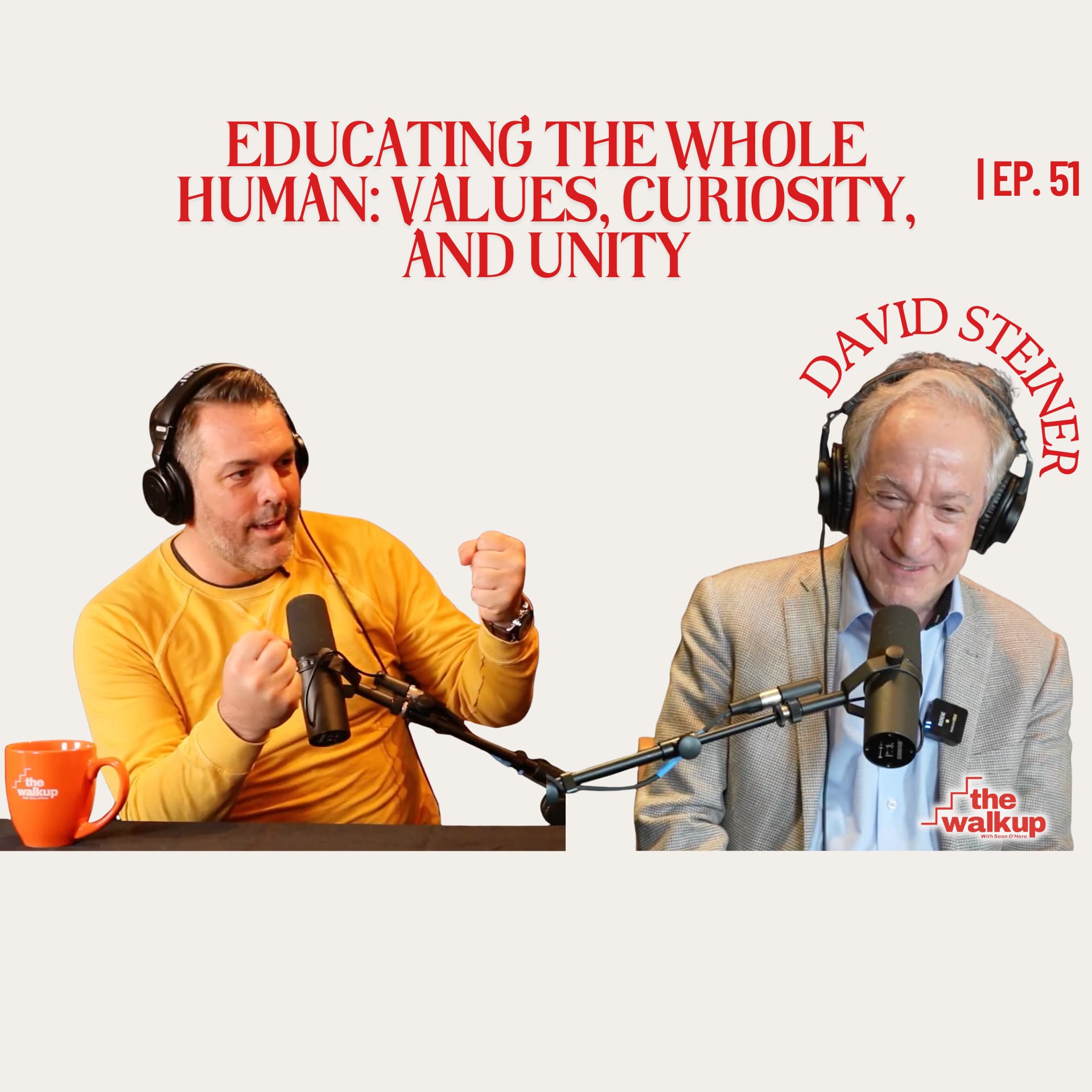
In this episode of The Walkup from the New York Encounter, we explore the transformative power of education and human connection.
David & Sean discuss the true purpose of teaching—not just transmitting skills, but nurturing wisdom, judgment, and moral responsibility. From the challenges of the U.S. education system to practical steps fostering unity between Christians and Muslims in the Holy Land, we examine how curiosity, values, and community can shape lives and societies.
A conversation about hope, mission-driven schools, and the enduring impact of human engagement in learning and coexistence.
Transcript
Read the full transcriptAuto-generated · 7,060 words
And we're rolling. So, David Steiner, thank you for joining us. My pleasure. And Awakening Curiosity. I hope that I can reciprocate your curiosity that you've instilled in this crowd here tonight. I just got the chance to talk with Bishop Fernandez, who is on the panel with you. So, how did you come to the encounter? How did this opportunity present itself? Yes, I was privileged to give a speech in Bergamo, in Italy, at a conference for folks who teach teachers, who prepare teachers.
Thank you. And I think there were folks there who are connected to this event. They heard me speak there and thought it might be provocative to have me speak here. Well, I'm sure it was. Sadly, I was interviewing other people as you were speaking. This is one of the challenges of having so many extraordinary speakers. I think we have 65, something like this. I haven't interviewed every single one, but a number of them. You haven't lived until you hear the phrase.
The people Nuncio is waiting for you. Yes, I was privileged to have lunch with him, and no one had told me, of course. So, there he was, and there I was. Fortunately, we had some background connections, because he is French by origin, and my father is French, and he had been Nuncio in multiple countries. Fascinating, fascinating life story. So, a privilege. Well, for those that will see, they'll get access to the entire panel discussion that just happened, but maybe just give us a...
A quick summary of your remarks today. Sure. So, we were focusing on what it means to, first of all, to be a teacher, an educator, and I was making the case that, above all else, you have to take responsibility for what you're going to say to your students. After all, you could choose almost anything. So, it is an act of judgment and censorship. It is an act of passion, of saying, this is worth passing on, versus everything else that I could say to you that is not.
But that in this society, we have lost our nerve. We have lost our sense that a teacher should have that capacity to judge. Hannah Arendt, a great philosopher, once said that the authority of a teacher comes from taking responsibility for the world you want to bring to you. For the stories about that world. And once you abrogate that responsibility, you actually lose your authority, the authority of a teacher. And in the deep sense, you cease to be a teacher. You simply are a transmitter of skills, right?
How to do this. The Greeks called it techne, as opposed to phrosene or sophia, which is wisdom. And for them, that was the lowest form of teaching, right? It was just to say, you know, Put the peg in the hole like this, and do it again. And we, in the United States, have become, I think, more and more obsessed with skills.
And the irony is, the more we narrow education to just find the main idea, which is how our exams test English language arts, the less well we do on finding the main idea. It is very strange. It is like, if we have stopped being passionate about... Telling stories to our children, about having them read, about watching really important movies, listening to good music, looking at art, then the act of teaching becomes very, very sterile.
Well, it is interesting. You reminded me that, so I was in college. Chaplin was a Benedictine, and a very learned man, spoke multiple languages, and I remember when he first asked, oh, what are you majoring in? Yes. And I said, business management. He goes, it is a trade school. Right. I had no idea what he meant at the time. Yes. And he said, you want to be taught how to think and how to approach things, not some narrow trade. Right. I now...
I desperately wish I had gone back and done something more in the liberal arts arena, but yeah, I think it is. Something about our focus on what? Socioeconomic advancement, right? Yes. You have put really your foot into the key arena, which is, if you look at the Department of Labor statistics, and they are not very sentimental, that group of people. They say, what does the American economy today actually need out of education? Well, we need about 20% to be graduates, to be really very highly educated.
We need about 40% to have some kind of education at the college level, right? Community college, right, AA, BA, and we need about 40% to have an eighth grade education. That is what the economy needs. That is almost exactly what the United States produces. So, from an economic point of view, we have a very efficient education system. Whether it will remain that way for the future, we cannot tell, because no one has a crystal ball. But for the individual child who's...
Put into that bottom 40%, it's soul-crushing, right? I mean, you'd never get the opportunity that that top 20% gets. And unfortunately, because of the way our politics works, our economics works, that 40% almost always tend to be the worse off 40%, right? They don't get the chance of the higher quality education, right? And so, it's a vicious cycle. It keeps on going, and we keep producing this division, which works. We are among the most efficient.
We're the highest producing GDPs of any country in the world, right? We're very productive. So, at that level, you could say the education system is a great success. At the level of the quality of what's in the mind of the average American 18-year-old… Yeah, I mean, better not to look, right? Not exactly a great conversation. Not a beautiful picture, right? I mean, not, so I think about an adolescent's room, and that is my metaphor for the space up here in the head, but you have got this strange dichotomy, right, between the economic need and the human need.
Well, it is funny. Believe it or not, even though I am not in the education field myself, I was asked to participate in a commission on higher education. Yes. It was focused on post-secondary ed, and they... They had done this two, three-year study of some sort. They handed us the summary of that, which we were supposed to read and absorb before we participated in this commission, and I had read through the whole thing, and we get to the first kind of breakout session, and I said, you know, I am not in the education field.
I am just an entrepreneur, and I am not vocationally in education, but I read through your entire book. I notice that nowhere does it tell me what the definition is. Of an education. Right. So, I don't know, actually, if we're getting better, closer or further away from it. I said, is it socioeconomic advancement? Fine, let's admit it. Let's call it that. Right. Is it about creating a good citizenry? Right. Is it a moral person? Right. I don't know what the definition of education is.
And I think the uncertainty you saw in that text is the uncertainty of this country, right? That without a vision of what it means to be an educated human being, beyond somebody who can make a living, right, at some level or other, you know, If that's all it's about, then by all means, let's have better career and technical education, which we need, right? That's really bad, too. That's another story. But why would you go to Middle Tennessee State University to study the humanities, right?
There's no model anymore for making that mean something. So, I think we are in a kind of schizophrenic situation. It is worth remembering that... You know, we don't do the career in technical education well either, right? Because for so many years, that was looked down on. That's woodwork, right? It's hairdressing, right? Blue collar. Blue collar. Whereas in countries like Switzerland, which is, again, highly productive, 65% of students at 10th grade choose to go into career in technical. They could go into the collegiate track.
They prefer, because the... Career and technical is so well designed, and the careers are so meaningful, that they prefer it. And I think that's an excellent choice. I mean, the idea that everyone should be interested in reading Plato, right, is the invention of professors with tweed jackets, right? It's a very odd idea. I love hearing an educator say that. Oh, I think it's crazy. I mean, I think we... What we end up with is hundreds of thousands of students who really don't know why they're in university, and of course, a majority of them in community colleges never graduate, and a very high percentage in four-year colleges never graduate, because they're adrift.
There's even a book about this called Adrift in Academia, where it points out that in many colleges, we're not really teaching them very much. So, I think that... We really have to sort of take a deep breath and say... We need to answer your question, right? What are we educating for? And is that the same for everyone for a certain number of years? Should we be really working to give all students from whatever background the chance to make a choice the way the Swiss do?
Because right now, it is forced on you by your economic background. Well, I think a lot of times, what we are great at, American culture is great at, is picking something in. And, and kind of doing it to scale. Yes. The problem is we don't, we don't continue to reflect on it. Right. I was reminded recently that Pizza Hut and Domino's, which are wildly successful, you know, businesses, they're not exactly the center of the culinary arts. Right. And how do I know this?
I'm an Irishman by background, Sean Patrick O'Hare. Two Irishmen started Domino's and Pizza Hut. I didn't know that. These guys are not, look, they weren't like studying in Italy for the best recipes. They were like, we can manufacture this cheapest and highest profit margin possible, and I wonder if that's happened with our obsession with, everyone goes to college. Yeah. Everyone should own a house. Remember that? Yeah. That led to an economic bust. Now, it's potentially the college. No, you're absolutely right.
The problem is the lies we tell ourselves. So, in Germany, there are three. There are three kinds of high schools. They're very open about it, right? One track goes to college, right, the gymnasium, and then there's a Hauptschule, and so forth, and so on. And in this country, we say, no, no, no, no, we don't want to have three kinds of high schools. Everyone deserves to go to college. So, what happens? We track inside the high school, right? It's open tracking, and once you put in the non-college track, you never get out of it.
What tiny percentage have we got out? And so, it's a myth. Right, it's all a myth. Of course, there are a few amazing kids who, by lack of, you know, whatever, nature and nurture, overcome their background. But I can predict to an 80% degree of certainty what your educational outcome will be if I know your zip code in the United States. Oh, yeah, absolutely. And the people that I feel for are those that have done what the system told them to do.
Yes. I have someone who... An immigrant from South America came here, learned English, finished high school. Okay, I'm going to go to college. Wow, the American dream, I'm going to college. Oh my, wait, they're going to let me go to grad school? Oh, that's amazing. Now, $100,000 plus in debt, working a job they don't like, to pay back a loan that they shouldn't have taken out in the first place. Right, and if they had been attracted, for example, to being an electrician?
They could support a family. They would have a trade they enjoyed, right? And, you know, it's just, it's a very pernicious story because it forces failure. That is, again and again and again, you know, it forces failure. And the dichotomy of, I've done this laudable, esteemable thing of, I have a degree, and that was the prize, and yet it's the thing that effectively enslaves you, and prevents you from having the freedom to... I mean, some of the topics here this weekend have been about, you know, people aren't having families.
Well, you talk to most people in their 20s and early 30s, they're still saying, I've got to pay off my debt. I have a family, are you kidding me? And what do they say? How am I going to put kids through college? Yeah. Forget about that, man. Right, right. Just put a roof over your head. No, and why, if you look at the data, the percentage of 25-year-olds coming back to live with their parents, it's up, up, up, up. I mean, there's no more growth in intergenerational wealth for a large percentage of this population.
But I think this all trickles down to the schools, where, as you know, we have a great crisis trying to find teachers. Because there is just a sense of dispiritedness, right? Everything seems to be getting worse. We just had our worst ever English language arts results on the NAEP, the National Assessment of Educational Progress, and what was even more distressing is that the gap between the well-off and the worst-off is continuing to grow. The well-off have basically, COVID barely touched their results.
The worst-off have fallen off a cliff, and they are still falling. Right, and so we really have a fundamental challenge that the society in its education structure is bifurcating at an accelerated rate. Well, I want to try to give us a little bit of hope. Good, good, yes, I've been too. The New York Encounter is a place of hope, so what is it that you feel like a place like this?
A forum of ideas like this is providing. What is it that the Encounter is providing in kind of addressing these topics? I think above all, and I was privileged to hear a little bit of the panel with Putnam, that we have to reconnect at a human level, right? We have to be able to speak to each other, not to the social media or the avatar. We have to be unafraid of communication and conversation. We have to be unafraid of our own values that we'd like to bring to our children, right?
We need to be thoughtful about those values, not robotic. But we have to, and often that begins with building smaller communities, right? So, the homeschooling movement is growing. It is the fastest growing element of any educational segment in the United States, and homeschooling now is at a size where there are good curriculum available, where there are resources, where communication can take place, where parents are beginning to say, you know, my values matter, but I want. them to come with a good education, not instead of, right?
We're seeing, you know, these Classic, classical schools, which are, right, often charter schools, so they're public, but they are also mission-driven. They have a belief about the values and the content, above all else, that they want to transmit, and so the teachers can be really enthusiastic again about being part of a mission, not just a conveyor belt. Not subjugating that. Exactly, and not just reading off a list of find the main idea. But, no, this idea matters, and I'm going to tell you about it.
So, it may be that the best answer to your question is, it's not going to be at some huge scale. Yeah, we can get better at teaching reading. Mississippi's result showed us that, and that's very important, right? We have no excuse for not teaching kids how to read. But when it comes to middle school, high school, that's where things just disintegrate, and it seems to me we've got to start again at some level. We've got to start with schools. Well, there are schools that have a mission, that have a set of values.
You know, we did something very brave. We tried to create secular schools open to everyone from all over the world, but when you have a school that doesn't have a core belief, it doesn't have to be religious. It could be aesthetic. It could be moral, right? It is very hard. And it seems to have collapsed in on itself as a project.
Well, I'll leave you with this. Watching some YouTube clip of a behind-the-scenes of what had happened on the movie Gladiator, the most recent one, and if you recall in that, Russell Crowe, who plays Maximus, he goes to his soldiers, and what they said, their greeting to one another is strength and honor, and it was because... The director, Ridley Scott, there was no, they weren't really greeting any, there was like a hello or something, and he's like, I don't feel like they would do that.
And where did he get that motto? It was Russell Crowe. That was his high school motto was strength and honor, and so he had that at the ready. Yeah, it's got to be about something, right? The very successful charter schools. You know, you may not agree with their philosophy or whatever, but they created an extraordinary set of results for underprivileged, often African-American kids whose siblings went on to school in jail. Let us be frank about it. And these kids had a shot at a really good education.
And yes, it is strict. And yes, it can be very regimented, but the feeling is we're on a mission, right? We didn't invent the inequalities of society, you gave them to us. We've got to do something extraordinary to create a learning space for our kids, and it's not going to be fun all the time. But we believe, right? We believe in what we're doing, and that sense of belief is really crucial to any successful educational enterprise. Well, your belief and your passion come across, and it's certainly awakening my curiosity.
So, thank you for your contributions to New York Encounter. Thank you for bringing your skills and abilities, and may we find our way out of this. Hear, hear. Thank you so much. Thank you. Okay, Father Ramsey, we're so glad to have you on the Walk Up podcast here at the New York Encounter. Thank you. Yes, I'm very curious. How did you hear about the New York Encounter? What have been your first impressions? What are your thoughts? This is my first time to come to the Encounter, yes.
I heard about it through our commissariat, our monastery, and one of the organizers, Mr. Angelo. And he invited us. Last year, one of our friars was here, and this year he invited me, and the other friars are here present, too. Oh, great. And what's been your experience? Do you like it? Very beautiful, yeah. A lot of life, a lot of people, and that's very beautiful, yeah. Yes, the energy here is very vibrant. Yes.
So, I had a great conversation with your colleague, Father David, yesterday. Exactly. I would love to hear a little bit of your story, and what you are doing in the Holy Land, and how you are bringing unity between Christians and Muslims specifically. Myself, I was born in Jerusalem, so I am from the Holy Land, and I grew up in Jerusalem. And I went to a Christian school where in the classroom we were students, Christians and Muslims, and we were always classmates and friends and playing all together.
The only moment that we were separated was only the class of religion. So, the Muslims had to go with their own teacher. We had to go with our own teacher. Otherwise, everything we did all together. Wow. And this is one that still the Catholic Church and all the Christian schools, not only the Catholic Church, but other churches have. Some schools, and this is one of our major work, how we can really put together Muslims and Christians, when they come and study all together.
Like this, growing up, they come to know each other, and this direct knowledge is very important, because we discover many times that they have different ideas, and because they don't know us. They didn't have a direct contact with Christian many times, so they just know what they hear or what they see on the TV, but they do not have a direct contact. But in this way, they have the direct contact. But many times, we have even some employees who are Muslims.
And we are very happy to have that. Oh, that's great. And so, have you noticed, despite the clashing worldview differences, growing up in school together... Is that what brings the sense of unity, that these two different people know each other, and they grow up together, or what's allowing them to exist in harmony?
Now, it's very important to precise that we are not talking about two people. We are one people. Oh, I love that. And we share the same land, we share the same history, we share the same... Faith, we have two different religions.
And this is very important. We are not separated. And that's what the schools and when we stay together, this is something very important because there we learn that we are only one people and not two people. Like this, the Muslims who do not have direct contact with us Christians, they think that we are a different people. But then when they discover that we eat the same food.
We dress the same clothes, we have the same things, we study the same things in our schools, so there they learn, no, Christians are members of the society. They are not different people. And how do the cultural and political norms of the area influence that?
Now, for cultural norms, let us say that we respect each other. When it is a Muslim feast, a religious feast, everybody is at home, everybody closes. It's the same time when we have our religious Christian feasts, there is the respect, and our schools, of course, are closed, and the Muslims would respect that. And in many places where Christians are minority, Muslims would come and greet them for the holidays and vice versa. Wow, that's incredible. Yeah, this is... There is an exchange in the greetings and in the visits, official visits, on, let us say, the religious leadership, and there is always that respect that is always present on, let us say, the social level.
For political levels, this is something interesting, that according to the statutes of some cities that are of Christian majority, The places are assigned according to religion in the city council, and even the mayor has to be a Christian by law, by definition. So, in Bethlehem and the other two small sister cities, Beit Zahour and Beit Jala, the mayor is always a Christian. Even if now Bethlehem, the Christians in Bethlehem are a minority, but still, by definition, because this is the definition of the law, of the statutes of the city, the mayor has to always be a to be elected among the Christian community.
Wow, I didn't know that. Yeah, the same thing for the parliaments. Let us say the parliament of the Palestinian Authority, they assign a number of seats only for Christians. Like this, we are a small minority, and maybe the 2% or less, like this in this way. The Christians are sure to be represented on all the political levels.
And have you ever experienced any opposition to this? This cohesion, this harmony that you seem to have cultivated within the communities? Sometimes you can feel that the relationships are becoming a little bit more difficult because of the influence coming from outside, and some, let us say, in the last decade, this fanatism, religious fanatism, from the Muslim part, grew up a lot. So, many times you can feel this. And being Christians, a minority, sometimes they don't feel that we are the same people, and they consider us as if we are strangers or foreigners.
Sometimes you can feel this. But again, because they do not know us directly. Right, and you gave a talk here, correct? Yes. About this harmony that you seem to cultivate, or rather our Father has helped cultivate in the Holy Land. How have you seen, what are the practical steps that you have taken to help add to this, I guess, this co-existent nature of the Holy Land?
Practical steps beside the schools is other social works, like hospitals, for example, or houses for the elderly. Wherever we can have some humanitarian work, humanitarian aid, this is something that is very important. Okay, so service and charity. Service and charity, and even sometimes we arrive to, for example, during the holy month of Ramadan, as a church, we offer some food. Yes, and this is something that for me is very important. Like this, they really feel that we are one family, and since we live because of the charity of the Christian fellows all over the world, we are happy to share with what we receive, even with those who are not Christians.
And it's a special moment, for example, during this month of Ramadan, where they fast, and the poor, many times, they don't have enough food. Why not to share with them some of the food that we can provide? Yes.
So, if you could summarize the discussion you led here at the New York Encounter, could you give us a brief summary just for our listeners back home? Yes. My talk was about our presence that is there since 800 years. And we are present there in the Holy Land thanks to our founder, Saint Francis, who came only with his faith, with his simplicity, and being humble, without... Any kind of weapons in his hands. And with this, he managed by himself, with his friars then, to obtain much more than six crusader strikes to obtain in 200 years.
So, six crusaders, six military campaigns did not succeed. One man succeeded much more than that. So, we have always the opportunity to have a different approach to problems, different approach towards the violence that we are living now, and if we really go with our Christian faith, with the love that we have. We can do miracles, even if sometimes they are not really seen, but they are true miracles. Yes. Well, it sounds like you are just doing incredible work over there, and may God bless you in all your endeavors.
Thank God, and thank you. Yes. Thank you for your time, Father Ramsey. You're welcome. Thank you. All right, Oussam, welcome to the Walk Up podcast here at the New York Encounter. Thank you. We're very grateful to have you here today. Thank you. So, I wanted to just get your first impressions of New York Encounter. How did you hear about it, and what do you like about it? I heard about the New York Encounter from many friends that live here, New York Italian friends, that invited me to the Encounter.
And it impressed me, the quantity of volunteers. The beauty of the events, that there is an event once an hour. Yes. It's so beautiful, yes. And yeah, there's so much energy, there's so much joy. It's just been a spectacular weekend overall. It's spectacular, yes. So, I want to get into a little bit about your talk that you gave. Yes. If you could just, for our listeners here, give us a summary of what you... Yes. I talked about my experience this year in my place.
I'm from Israel. We have the war. We had the war. We have the war already. Right. And I talk about my experience in the war as Christian. So, what has been your experience? Could you elaborate a little bit more on that, and how do you think we could? Potentially cultivate peace in the region. No, because I told that because I'm Arab in Israel, I grew up with the sentence that we were in Israel before the Jewish, we must stay. But as Christians, I understood that we stay there for a task.
To communicate to the other people that that is a hope in the life. Yes. A hope in the life that this is someone that loves us forever. Yes. And have you experienced that mission, that calling, bear its fruits in the region? Yes, yes. I talked about my experience in the hospital with a patient. I am an oncologist, and most of my patients died. One patient died in April.
You told me, thank you, because standing with you, I saw the disease from another side. Yes. And your patient was Christian? No, Jewish. Jewish, wow. Okay, so clearly you're spreading a light over there with your work. I hope so, yes. I'm sure it's a dark work. But the most important thing is that I'm not alone. I'm with other friends in Israel, in Palestine, in Italy. That helps me a lot. Yes.
And, I mean, you've seen so much destruction, I'm sure, just this past year. What do you make of that? What are you doing to... No, I call a friend, I ask a lot, a friend, my wife, a friend a lot. As I told, the most important thing, the most beautiful thing, that I'm not alone. Yes. In the task I told... Well, not being alone is important.
So, you found some solace in your community? Yes. In your family, in your friends? My friend, my community, my friend in Italy, my friend in Israel. Okay. And so, what initially drew you to come all the way out here? Was it just your friends telling you about the New York Encounter? Yes, it's my friend, and they invited me to talk about my experience. Okay. It was important. It's important for them that I talk, I bring my experience to the New York Encounter.
Yes. For the people who came to New York Encounter. And how do you think it was received here this weekend? No, I received a lot of things. Good. Beauty, I saw many friends that I don't see them from many years.
And it was so, so beautiful, so cultural. This really is. I mean, it is such a cultural event. There is an exhibit upstairs. There are so many beautiful people sharing incredibly thoughtful ideas that I think will change our current landscape and politics and culture and history. Of course. What is next for you? What is your mission? No, my mission now is to turn to home. Okay, right. I have the flight at 9 o'clock, and because on Tuesday, I must be in the hospital.
Okay. You have got a busy life ahead of you, it sounds like. Yes, in the work, yes. Yes. It is a demanding job, oncology. Yes. Now, I am the director of the Oncologic Emergency Room. Oh, wow. Okay. That is a big job. Yes, yes, yes. I love this. Well, may God bless you in your journey. Thank you. And in your work, and in the region as a whole, and we will continue praying for peace. Thank you, thank you. Well, thank you, Mark.
Have a good day. Okay. Hello, Dr. Olson. Hello. Thank you so much for being on the Walk Up podcast here at the New York Encounter. We're incredibly grateful to have you. So, I want to hear about what are your first impressions of the New York Encounter? How did you hear about it, and what are your overall general thoughts about it? Well, I didn't know much about it until I was invited to come speak, and I was delighted to learn more about it in preparation for it.
I'm so pleased and impressed, not only by the number of people who have come here, but the whole spirit of the event has been just delightful. Yes. You know, the warmth and positivity, it has been like a sort of oasis here this weekend. It has, certainly it is. Yeah.
On top of all that, you came here to discuss some very important topics that I can only assume are incredibly relevant to this event and the energy that you're feeling here. Yes. Could you give us some background about what you came here to talk about? Absolutely. So, I came to talk about hope in J.R.R. Tolkien. J.R.R. Tolkien is my specialty, and talking about hope, of course, hope is... A particularly important thing right now, but one of the main things that we were discussing in the talk, you know, in the panel discussion, was Tolkien's ideas about hope are really rich and really complicated.
You know, often people think about hope as merely a sort of optimism, right? Like, thinking that things are going to turn out well, and when people talk about clinging to hope, they often mean... I want to think that things are going to be okay, right? That things are going to not be horrible.
And Tolkien's concept of hope goes way beyond that. Hope even when, even though things are horrible. He has two words for hope. Amdir, elvish words. Amdir, which means that kind of optimism hope that I was talking about. And estel, which means high hope, which is more like faith, which is more like trust.
In the end, it doesn't matter. If things, for me, are awful right now, I can trust that What should be, shall be. And so, thinking about hope, and how Tolkien works hope through, and how he is so conscious of his stories, are so involved with, are always remembering loss, and suffering, and grief, even in the ending. Even in the happy, the story has a happy ending, but it does not have the kind of happy ending where everything just kind of works out, right?
There's a funny moment in The Lord of the Rings When Frodo and Sam take the ring to Mordor, and then they're rescued, and they're unconscious for days, and he wakes up. Sam wakes up, and sees Gandalf. Last time he saw Gandalf, Gandalf was dead. He fell down. Sam hasn't seen him since. And Sam says, is everything sad going to come untrue? Right? You know, that moment, and that, it's almost like some people wish that hope were like that, right? That I could hope that everything sad is going to be, that everything's going to be great, and everything sad is going to be untrue.
Tolkien provides hope. For a world in which that is not how it works, which is the world we live in, right? And that is, I do think it is a really, really important topic, and Tolkien's writings are so enduring and so powerful because he really confronts these kinds of realities and helps us to… It helps to give us vocabulary for how we can encounter these realities and live through these things. It is so interesting how great classic literature can... It can remind us of the true virtues that we are supposed to be pursuing, and I think it is very interesting that you compare this high hope to faith.
Could you maybe differentiate those two? Those are two very classic virtues that us Catholics are pursuing. Well, it is hard, just as faith and hope. In the Catholic tradition are very closely bound together, right? The kind of hope that Paul describes in Romans chapter 8, the, you know, creation groaning in anticipation, right, of what is to come. That kind of hope is the sort of hope that Tolkien talks about. This knowledge that We are all taking part in a story, but that there is a storyteller that you can trust, right?
You can trust that the story is going to turn out well. Your part in it might not, might not be a happy part. One of the most evocative moments in The Lord of the Rings, again, this is another Sam Gamgee moment. Can you tell Sam Gamgee is my favorite character? Is when he and Frodo are going into Mordor. And they're on the stairs of Kirith Ungol, so they're about to go into the spider's lair, but they haven't yet, and they have this conversation in which Sam imagines their story being written down in a book, and, you know, Hobbit parents reading the story to their Hobbit children in future generations, and he realizes, he's like, we are in a story.
We are in a great story, and he says, He talks about not knowing whether the story they're in is a happy ending story or a sad ending story, and he admits, he says, you know, sometimes the happy ending stories aren't always the best kind of stories to hear, though he's like, they're probably the best ones to get landed in, but they're not necessarily the best ones to hear. That is, even stories which may seem tragic, even when horrible, like it... In order for hope to be justified, in order for faith to be confirmed, you don't have to have, like, everything doesn't have to work out for you.
Yes. Like, that's not what it means. Instead, it's about trust. It's about trust that God knows what he's doing, and that what God is doing is good. Even if we can't see it, and even if we don't personally benefit from it, right? And Tolkien is very, very strong on that. So, as far as, like, differentiating faith, hope, the difference, again, I think the difference in Tolkien, like the difference in, you know, like the traditional understanding of the three theological virtues, right, is hope is future oriented right faith um faith is a a present reality right um hope is that faith projected forward into the future um and in tolkien That hope, Estelle, that high hope, is explicitly founded on faith in God, trust that God is in control, and that therefore, what is happening and what is going to come out is going to be good.
And, again, even though it might not look like it, and it might not be fun, you know, along the way, in your experience. Oh, I love that. I mean, it's so powerful to hear that, yes, our stories might be tragedies, but we can hope for the greater good, and I just love that you are pursuing such a noble...
A noble pursuit of this knowledge that Tolkien brings, and what an incredible thing to study, and that is your life work. Yeah, it is a fun privilege to get to talk about Tolkien all the time, and I do think that Tolkien speaks about these things with a voice that people hear, and that impacts people's lives.
Even the lives of people who are not walking lives of faith, even people who have rejected faith. There are so many people that I have met who have turned away from or reject Christianity, but Tolkien still speaks to them, and that, I think, is such a... Such a testament, such a victory by Tolkien, you know, in what he accomplished, is that he, you know, there are times when I have heard Christians be a little frustrated that Tolkien...
Doesn't, like, fly his flag a little bit more, right? Like, he doesn't mention God in the Lord of the Rings, right? You can, many people do, in fact, read the Lord of the Rings without any idea that, you know, that about the sort of the structure of faith, the foundation of faith upon which it's built in Tolkien's own life and experience. And so, again, I've met Christians who are like, He should talk about it more, you know, he should share that more, and I always think, you know, no, what he did, what he created, what he shared is so powerful and has impacted so many, because it's, he has taken these realities of faith and made them universal, and it's remarkable.
Yes, it instantly reminds me of Lewis, I'm a big C.S. Lewis fan. Yes, yeah. I think Narnia is... It's much more obvious in its Christian symbolism, and it's so interesting that you said that about Tolkien, because I do think it's much more subversive, and it's so cool that you've been able to unpack that. Yeah, yeah. No, I'm a big Lewis fan as well, but see, it's actually a marvelous illustration. Lewis's writings have impacted very many, but the people who are resistant to Christianity...
Hate Lewis, because you can't, it's right there, right? You know, you can't avoid it, right? Whereas, many of those people who are most violently opposed to Lewis, and don't, you know, don't like, feel betrayed by the Chronicles of Narnia, because they liked him as a kid, and then discovered that they were, you know, Christian books, and are like. I was deceived. Still love Tolkien, you know. And that's, I think, again, I, Lewis was more of a, Lewis had the heart of a teacher, you know.
He wanted to show things to people. He wanted to. Examine ideas and work them out. Tolkien has the heart of a poet. He just wants to get at these ideas. He just wants to share this stuff and just put it out there and leave it for people to discover. Absolutely. Well, thank you so much for your time, Dr. Olson. Incredible thoughts there, and thanks again. No problem. Thanks for having me. Of course.
More from The Walkup

Against the Odds: The Samurai Lawyer (Chad Flores) | Ep. 52
Faith, Sexuality, and the Fog of War (Iris Bahr & Father Rick Riccioli) | Ep. 02
E2
Church, Conflict, and Community (Iris Bahr, Father Rick Riccioli & Rob Long) | Ep. 03
E3
Hope, Vocation, and the Global Church (Colm Flynn & Colin Nykaza) | Ep. 04
E4