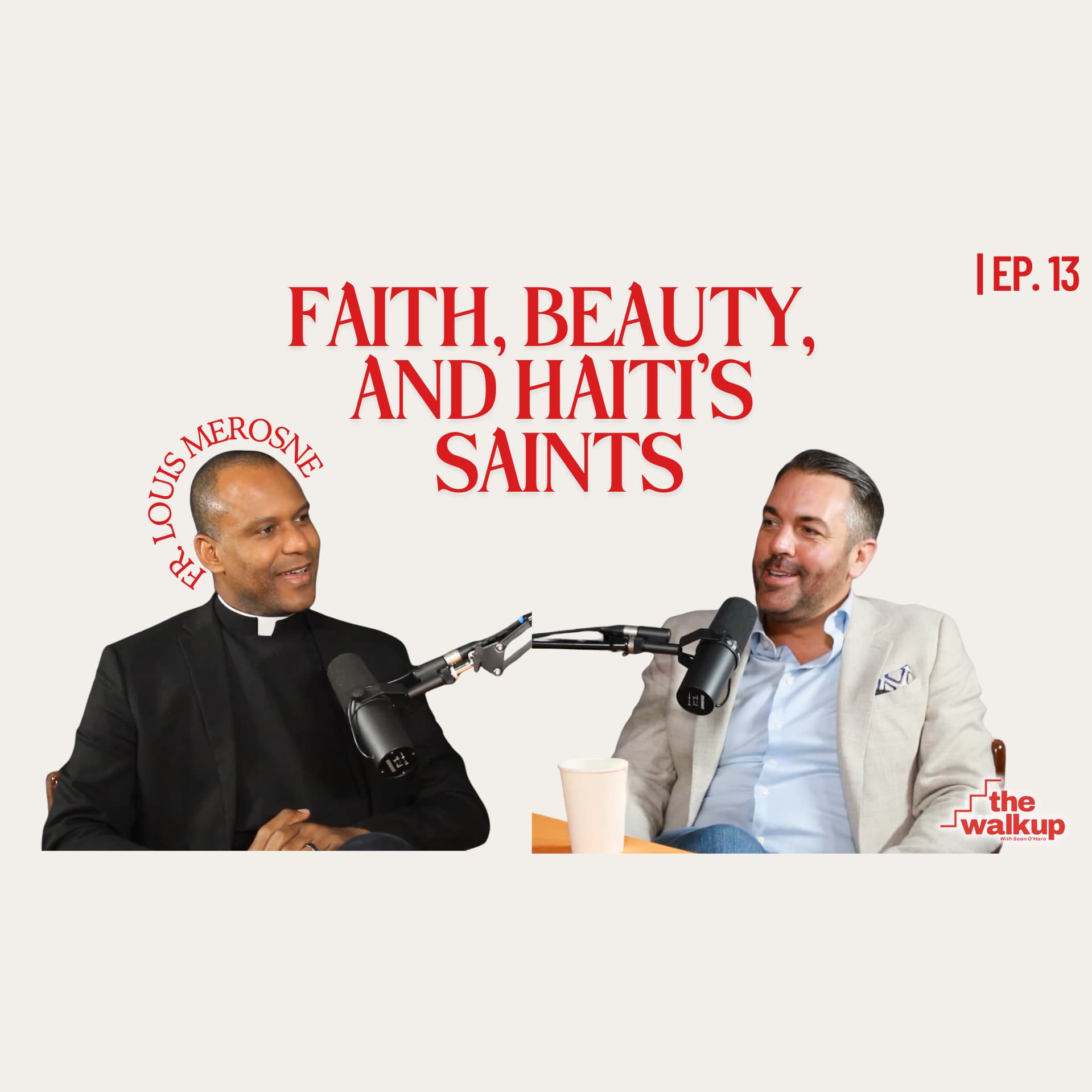
In this stirring return to The Walkup, Father Louis Merosne shares stories from the frontlines of spiritual and social renewal in Haiti.
From surviving natural disasters and rebuilding faith communities, to his encounters with Mother Teresa and moments of profound humility, Fr. Louis speaks candidly about the soul of his nation and the mission that drives him. This conversation explores the intersection of Catholic theology, beauty, and embodied faith—offering a rare glimpse into a life shaped by radical love and purpose.
Transcript
Read the full transcriptAuto-generated · 14,125 words
So, we're rolling, so you're on the podcast, and a returning guest. I am a returning guest, and I'm pleased at the renovations in the studio, the newness, and the logo, the name. It's official now. The staircase, it is official, and I noticed you even tried to have the tablecloth match the logo. I mean, not quite there, but I can see the... Well, yeah, we tried, and I had an artist friend on the podcast recently, and he immediately pointed out how it's not matching at all.
I'm like, well, thank you. I was hoping that the audience wouldn't notice, since it's this far apart, but... You know, Amazon only has so many types of tablecloths. We're on a budget, man. This isn't the Joe Rogan show just quite yet. I love it. Give it a little time.
All right, so tell us what happened to Bishop Dumas, because some people don't know the story. Right. So, in February, I think it was the 18th, Bishop was in Port-au-Prince in a little apartment where he usually stays when he goes for meetings in Port-au-Prince, the capital of Haiti. His residence is in Ansavo, which is where the cathedral is of our diocese, and I have to say that because people usually think of Haiti as having one diocese. We have 10 dioceses, 10 Catholic dioceses.
I've been there. I've been to a couple of dioceses. That's right. That's true. Yes, you have, but in that apartment in Port-au-Prince, in the evening, So, first, there was no fire, and then there was a lot of fire, because there was a big explosion that happened, and we still don't know the cause of that big explosion, but basically, it was a ton of flames, and so... But he was the only one injured. He was the only one inside, and the only one injured.
He was, I think, in the bedroom, and so he tried to go out, but the only way out is through the flames, and... So, he was burnt up completely. Within a week, he had two surgeries in Haiti, but then we realized that we needed to get him to Miami quickly. So, we did a lot to coordinate getting him medevaced, so he was at Jackson Memorial for a while, for a few months. And doing, you know, intensive care stuff, did three surgeries there, and then rehab, and then more rehab, and now he is doing outpatient services.
This is mainly with skin graft? Is that the main thing? Skin graft, we did that. They did that at the very end. No, the first surgeries was to remove dead flesh and burnt flesh, and make sure everything was, you know. But towards the end, to get the healing, to go faster, they did some skin grafts. Well, I guess they actually did a couple of skin grafts. In the third and fourth surgery, but it was artificial skin graft. The last one, they realized, okay, it is going to go faster if we do his own skin, and they did that, and it is good.
In fact, last week, they removed the last light. Dressing that was on his arm. He had legs and arms dressed up, and so they removed those. Finally, it was like, yes! You can see the skin all over now, and so he's recovering. He did a big mass on the 15th of August. It was a big milestone for him, because it was his first major public mass, or mass with the public. Every mass is public. But that was really good for him.
It was like a two-hour Mass, though, at least two hours, maybe even more. This was in Miami? In Miami. So, there was the Haitian community, the Latino community, and the American community, all in one, at the cathedral. So, it was crazy and awesome at the same time. And it was Bishop Duma, and it was his first public Mass. And he got to preach, and he still got the same energy and the same force behind his words. So, it was great.
So, then you have been spending time in Miami, kind of assisting him. Yes, sir. Okay, so, and that has been since February, and then, because right now, you are kind of in like a, kind of a between position sort of thing right now, or how did you describe your current? Well, I would say my primary duty is pastor of the Cathedral of St. Anne in Ossevo, and I also come up back and forth to help bishop. We alternate. There are a couple of the priests that are on the team that help.
I care for him, and I also had been helping for a special assignment in Miami at St. Augustine's, an amazing parish down there. They are doing amazing work with their college students and RCIA. They have got an amazing team, a great pastor, a great director of evangelization, Michelle Dacalopez and her husband. They do men's group, women's group. They have got everything, but it has been an honor to be with them. Oh, you know what? I know a... Priestess, just moving down there, is a younger brother, one of my very good friends, from the fraternity of St.
Peter. Nice. I mentioned to him, I said, I bet I know some people in Miami. I always know somebody somewhere, and I forgot. You know everyone everywhere. So, I'll have to connect you with him. But, sorry, you're doing that, and then going back and forth between Haiti. Correct, yep. So, that's usually where I spend more of my time. As you know, in the past couple of years, I had been in Manhattan. We still have an office there for the foundation. The Francis Foundation for the Integral Development, Human Development of Haiti, that foundation or that work has been put on pause for some time as they figure out all the crisis in Haiti and trying to get money for the foundation.
But, you know, we are hoping, we had conversations with the pastor at St. Pat's, and we are hoping to get back up. Soon. Oh, good. With the work of the foundation, and so we'll see. I might be spending more time in New York at that point, and then we can hang out more. Well, I would like that. Same. So, I think, you know, speaking of New York and Being, in your case, a Catholic priest, in my case, I don't know what I am exactly.
Not a Catholic priest, but you are a ministerial, excuse me, a world priest, baptismal priest. That's true. I don't know that this is a competition many people really enter into, but I feel like if I take out my phone and I put F-R dot...
I will win on how many priests I have on my phone. While I am not a priest, as you know, my brother is a priest. I have spent a lot of time with him, but very close to the church my whole life. And I think a lot of times when people meet people like you and me in New York City or in Miami or on our travels, they are always a little bit like, how did you guys get here exactly? Right.
Because, obviously... For most people, from an outsider's perspective, they think… Strange enough to believe in God, strange enough to have a particular religion that you follow, and then, in your case, to become a member of the clergy of that, and in my case, to spend a lot of my time and effort supporting the church, charitable activities related to it. So, it might be worth kind of doing a little bit of a how did we get here. I agree. I think that would be a great, great idea, because I want to definitely hear about you and how the heck you've gotten here.
We have slightly different uniforms. I got a linen jacket and a pocket square, but yeah, so I think when we were on the show last time with Hollywood director Doug Liman, which, by the way, I was at the premiere of their last movie, The Instigators, with Matt Damon, that came out on Apple, so I got to go to the premiere, which was cool, and I I said, oh, this is the most LA I've ever felt in New York, because you know that, I don't know if you've been around much of these scenes, sometimes this happens in kind of political circles, but certainly in Hollywood circles where everyone's like talking to you, but they're actually like, uh-huh, I'm looking for something more important, and I will ditch you as soon as that becomes available.
So, they're kind of looking through you or around you. That is awful. Yeah, I didn't really dig the, I mean, it was cool to see a lot of And Doug's friends, because he's very good about inviting his friends to these sort of things, but I was kind of like, I don't know, everyone's looking for their little 30 seconds with Matt Damon, or Casey Affleck, or whoever, which I can understand why, but I'm always one of those people, like, I'll just wait until there's a real opportunity for a meaningful engagement, because he's not going to remember that 30 seconds with me.
No, no. And he's going to be annoyed, in fact. One more person. One more person that wants a piece of you. So, anyway, how did you get here? That is a good question. Yeah, I think the Lord took me here, and I am grateful for that. I was born in a small village in Haiti, in the southern part of Haiti. It was beautiful. I think back to that village with fondness.
So innocent, so pure, so disconnected from the crazy world out there. Very simple, primitive living, if you will. We lived on the side of the mountain, and had neighbors, you know, not too close, not too far. We could call out to each other. In fact, that was the mode of communication, to call out your neighbor as you would scream.
And then be like, yes! From across the stream. That is funny. Any salt? Actually, no. For salt, they would probably send a kid, hey, go ask the neighbor for some salt, or something like that. And brothers and sisters, how many? I have four brothers, and I have one sister. Gotcha. Yes, sir. And you follow where? I am number one on my mother's side, and number two on my dad's side. Gotcha. My dad had my older brother before he married my mom, and so that is why I am number one on mom's side.
And number two, so I can claim to have the privileges of, you know, the first, but also the privileges of being a younger brother, of having an older brother. Sure. He's got responsibilities, you know, got to take care of the little brother, and he does it well. My big brother, he loves me, and I love him, and, but yeah, so grew up in that small village, and then Catholic.
I was blessed to grow up in a Catholic family. We lived, the funny thing is... My parents' house were right next to, or right across from my grandparents' house, my dad's parents, so paternal grandparents. I grew up with them. I did not know my maternal grandparents. I think I met them when I was a baby, but then I did not know them, but I grew up with my paternal grandparents, my grandpa and grandma, and beautiful, beautiful souls. So, I was blessed with a beautiful family environment.
Again, simple and pure. During the day, we have our errands that we run, and at night, we have laku. Laku means courtyard, I guess, or front yard or yard in general. And the kids just play around. As the adults, they typically sit back, and they're sewing or smoking their little homemade cigars or pipe. My grandma would have a pipe. Right. Like that, living the life, you know what I mean? And we grew our own tobacco. We had a little tobacco field on the side of my grandparents' house, and, you know, go cut me a leaf, and they'd grab the leaf, and they'd roll it up, and then, you know, and then have a small cigar.
Nice. And, yeah. And so, that was a beautiful life, and the kids are playing around, playing, you know, hide-and-seek, or whatever, go around. The adults are there watching the kids, and thinking back at that, I'm like, what an amazing privilege that was for me to grow up in such an environment. I also like to remember that religious tolerance, actually, was part of my upbringing, and before it was like a cool thing to discuss in universities, because though we were staunchly Catholic, Right.
But one of our next-door neighbors was an Uga, like a Voodoo priest kind of thing, and so we know that was a Voodoo family, and so we don't have the same faith, but there was respect for one another. They respected us. We respected them, and it was awesome to be able to understand that, okay, you'll have differences with people, but people are people.
And respect people and their dignity. So, yeah. The Catholic faith was passed down to me both from my grandparents and my parents, if you will, and the greater community. We would go to chapel together every Sunday because the parish was too far away in the mountains, and so my paternal grandpa was the chapel director, or sort of the lay coordinator, if you will. And we had the missal, and he would read the Sunday readings and would sing the songs, basically have acceleration of the word, Mass without the Eucharist.
And that was every Sunday, and then… So, how often was a priest coming to you? Every now and then, or you would go to the… A priest was coming. You would only go to the parish for like, maybe like if there was a major event or something like that, but yeah. But for maybe like the parish feast, you would go to that, which is a huge deal in Haiti, and I do not understand for the life of me why it is not a huge deal in America.
Well, we are not going to feast days here in the States. Our puritanical origins remain. You know what? That might explain it. But in Haiti, there is a priest friend of mine who says it this way. If a pastor forgets Christmas, the people will forgive him. If he forgets Easter, they will be mad.
But eventually, they will forgive him. But if he forgets the Paginal Feast Day, he is out. Because the Paginal Feast is a feast for the whole community, for everybody. And it is a huge solemnity. Example, my personal feast of my parish, St. Anne's, we prepare for a whole month. So, like from July 1st to the 26th, we are preparing for St. Anne's Feast, and then it blows up on the Feast of St. Anne, on the 26th, which is the Feast of St.
George and St. Anne. And there, we had almost 50 priests at the celebration, and that is normal. That is normal, and typically, the bishop would be the one to say the Mass, because it is the cathedral, or if not him, then he would invite another bishop, like we did this year. And again, it is just major to celebrate Eucharist, celebrate the Lord. So, yeah. So, in chapel, though, the priest would come once a year for the feast of the chapel.
For us, it was St. Isidore, who was the laborer, St. Isidore, the worker, the farmer, which I think is very apropos. We have farmland, and we have a farmer patron. And so, the idea is to imitate him. The scripture says in Hebrews 13, 7, to remember those who have gone before us and to imitate their faith. And so, that is what patron feasts do. That is what patrons, parochial patrons, that is what they are. That is the purpose, is to be a model.
So, the priesthood only comes once a year? Once a year. Once a year? That is how often we have Mass. Wow. Yes, sir. And thank God, I am now a priest. I can have Mass every day. And I can provide Mass every day for God's people, and I also... But this was not uncommon in the history of the Church. Correct. For a long time, and frequent reception of the Eucharist is a relatively new phenomenon. Exactly. And that is why the Church teaching is receiving once, at least once during Easter.
Yes. So, if you timed it right, you could just do it once, but I think the thing that would concern me more is a lack of access. Confession, I think, as somebody who is in need of reconciliation on a regular basis. Yes, well, all of us are. And anyone who says no, they are lying to themselves. The greatest saints, like St. John Paul II, would go every week to confession. The holier you are, the more you realize that you need confession.
So, are you saying that you are very holy, because you just said you need confession very often? That is exactly what I am saying, yeah. I think that... And humble as well, right? Yeah, the humility, really, it is... It is too much. Yes. I tell my gods that I have a black belt in humility. That is how good I am at it. He is like, that does not mean that you are humble. That means you are being proud about it. That is the joke.
There is a joke in there. So, then you are there, and then eventually you come to the States. Correct. And what precipitated coming to the States? Oh, looking for a better life. Looking for a better life. Because Haiti, this was during the time with Aristide, former president of Haiti. He was the first democratically elected president, but there was a lot of political issues going on. But he was deposed.
Yes, yes. So, he was run out, correct, after his first term, and then he came back for a second term. He came back to finish the first term, and then have the second term, and then he was ousted again.
To South Africa. South Africa. Central African Republic, and then South Africa. I think he had to pull a pit stop. Oh, yeah, I forgot about that central part. Yeah, I think he ended up in South Africa. Some of us speculate that our CIA had something to do with that. I'm sure they did.
That's a different podcast. That is a different podcast. Yes, sir. And he was a Salesian priest. That is right. You might be interested in knowing that. He is back in Haiti. Is he? And he is running a university, like a medical school, actually. How old is he? I have no idea. He is probably somewhere in the 70s, I imagine.
All right, so you come to the States, and then where does the, and the faith remained strong the whole time, or were there? There was a time of transition, of questioning, of doubts, both internally and also externally. Externally, because Boston will work you, which is where we moved to, to Boston, Massachusetts.
And so, that is where I was exposed to different. Faiths or lack thereof, and had to, you know, face, you know, what is atheism? Why am I Catholic? And, yeah, borrowed faith versus... My own faith, I mentioned borrowed faith, that which I received from my parents, the tradition that we receive, and I am so eternally grateful for that, that my parents passed down the faith to me. It works. It does work for parents to do so. I think it is the stupidest thing when parents, some modern parents are like, no, just wait for him to choose himself.
So stupid. It is like saying, we are not going to teach them writing and reading. Exactly. Because how do I know he wants to learn that? That is on him. Nobody says that. And, you know, and we don't know if it's going to be a vegan or not, so we just wait for him to choose that. No, you feed the kid. That's part of the role of parents. And I think that, you know, some people are uncomfortable to recognize that how much we can be dependent on others, and for love, for guidance.
So, yeah. So, my parents' faith was received, scrutinized in Boston, shaken in Boston, the faith that they gave me, and then from that. It was built up and strengthened, purified, I think, as well as I learned more about the faith.
I found Catholic answers, and they were so, so helpful to me. I would print out these articles, loads of them, because I found a place at Northeastern University. Northeastern, if you are listening, I was that kid that printed. A ton, hundreds of pages of articles in your computer lab, because they gave us, I attended BLS, Boston Latin School, which is a very good school, first public school of America, by the way. Right, right. 1635, it was founded. One year before Harvard.
I'd like to stick it to them. That other Boston school. Exactly. Which is actually in Cambridge, but, you know. Well, the medical school is in Boston. So, that was in Boston, and found Catholic Answers. That is also how I found Jason Everett, who worked at Catholic Answers, who introduced me to Franciscan University, unbeknownst to him, because I asked him, where did you learn this stuff?
He said he studied theology at Franciscan University. I was like, I am going there, and I ended up going to Franciscan University. I spent five years there. I love it, and I am still connected to them with their conferences, youth conferences, adult conferences. I still keep in touch with some of my professors, Bob Rice, Dr. Scott Hahn, John Bergsma, and really good people there. Just amazing people at Franciscan University, and so I go there at least once a year because I have got a godson there, too.
And so, I've got to go visit the gods. And I sponsored a young man for confirmation. So, I've got some spiritual responsibility in Steubenville. Yes, sir. And I loved those years in Steubenville, which is also where I sort of discerned my vocation.
Because at that point, you're... Professionally, you are thinking what? You want to get a basis? You want to go to Franciscan because of the grounding of the faith, but was there a professional path you saw yourself on at that point? The priesthood. Already you were there? Oh, yeah. Before I went to Franciscan, I felt that God is calling me to be a priest. I did not know where and how. I knew I had a desire to be a missionary priest, and I could see myself in Africa.
Even back home in Haiti, and so at Franciscan, it was a good time of discerning that role, and I ended up, I fell in love with the Dominicans, because I love St. Dominic and his story, and I love Thomas Aquinas, and I love their charism.
They are the order of preachers, and I think it was pretty awesome to have a whole community built around preaching the word. And for me, that was like, yes, that's it. But I never got to visit, even though I tried different things, and it wasn't their fault or any fault. It just didn't work out. I checked out the Franciscans, the CFRs. So, even the Franciscan University is run by the TORs, the Third Order Regular Priests.
I felt attracted to the CFRs, the Franciscan Friars of the Renewal. They started in New York. Now, I think they are in different countries as well, England, Nicaragua, I forget where else. But after doing a vocation retreat with them, I thought, you know, I love you guys, I love all that you do, but I don't feel called to this, and I feel called to follow Mother Teresa, but she doesn't have priests, so too bad. That is when the vocation director said, actually, yes, there are missionary of charity priests.
I was like, what? Where? Most people don't know that, but they are headquartered in Mexico. They have got priests in Rome as well, and a couple of other countries as well. So, I went to visit, and loved it, and applied. And they told me I had to pay off my student loans first. So, I was like, dang it. So, I went back to Boston after I finished at Franciscan. And I worked as a taxi driver. I also worked as a restaurant host first, and then a taxi driver in Boston.
It was fun. This was pre-Uber. Pre-Uber. That's right. So, yeah. And then? Through prayer and listening to the wisdom of friends and people who didn't know each other, that kept insisting that it sounds like the Lord is not calling me to Mexico, which is where I would go for formation with the MC Fathers.
And so I took that to prayer and asked the Lord where he wanted me. The Lord told me to fall in love with Him all over again, and that was the most important and the only indispensable thing in my life. So, for people that don't come at this from a Christian or Catholic perspective, or from a perspective where their faith is central to their lives, how do you... How do you describe that relationship, or how do you explain to people that this becomes the central relationship of my life?
Right. Falling in love with the person of Jesus Christ is a... Yeah, it sounds... Rolls off the tongue for you, but for most people sounds like, so there is a man in the sky, and you are in love with a man. That is very complicated.
Also, separate podcast. Yes. And how is it that you have this relationship? And you feel it, or convicted of it, in such a way that not only does it shape your quote-unquote professional life, or what you do in your professional vocation, but in fact, animates everything throughout your existence, right? It's your identity. Yes. That's, I think, a wild thing for most people to even... It is pretty wild. Yeah. I mean, like...
After getting my master's at Franciscan University, I could have. Gone on to get a doctorate, and I could have studied anything else. I studied theology. I could have studied anything else, and I could have made a ton of money, and I like money. Money is very good. A good servant is very useful to get things done. I like money is going to be the clip from this that we are going to use. I like money. I like money. I am good.
I am good. I also like beer when I use that. And rum. Well, that I have had some rum with you in Haiti with With Bishop Dumont, right? Yes, yes. And then every now and then, you are nice enough to share some rum that you brought back from Haiti. Absolutely.
So, I have, yeah. It is good stuff. It is good stuff. Right, but you are right, though. I think sometimes we can do religious talk, and we should stop and be like, stop, you sound crazy. Go back. That is the end of the equation. Exactly. So, let me get to that in a second, but what I just say is that. What I wanted to say is that in prayer, after people are telling me, I don't think you're going to Mexico, I think you should go to Haiti, etc., and I took that to prayer and realized, first, the Lord wanted me to be detached.
From the attachment I had to Haiti, so that I could better serve him more freely, so I felt the Lord tell me, you know, fall in love with him, become a priest, and then go to Haiti, which is, and I took that to my spiritual director, and I felt that it was confirmed. I spoke to the bishop in Haiti in my diocese. He confirmed that, and then I went back to Haiti. I got ordained, and I am serving as a missionary priest back home in Haiti.
But, yeah, to fall in love with Jesus, first of all, I think Jesus, of course, is the most interesting person that has ever walked this earth. And he is an historical person, and I think it is crazy. The people that say Jesus didn't exist, for example, it's so crazy that even in the academy, like real historians of antiquity and people who study Palestine and the time frame of where Jesus was born and lived, like, it's so, like, Out there, marginalized, they don't even debate that question anymore at the university level, because it's not worth it.
It's like, you know, and I don't mean any disrespect, but, you know, the academy, for example, would treat the theory that Earth is flat as, eh? Like, it's not a debate in the academy, in the world of science. They don't debate that. They just say, okay, but on the internet, you'll find a lot of people claiming that. Same thing with the Jesus mythicist movement, those few people that are on the margin that say, he never even existed, or he's just made up after, you know, these Greek deities, etc.
That's just complete, complete fabrication. Jesus was an historical person, historically. Speaking, and these historians don't have to agree that he's the son of God, right? I do believe he's the son of God, and I think there are good reasons to believe that he's the son of God, but I had a relationship with Jesus before I had an intellectual understanding of what it means for the historical Jesus to exist, and as I'm told about him, and as I sing about him, and as I see people whose lives are geared towards him, and I see the kind of life that they live, the kind of sacrifice that they're willing to make to go beyond their self-interest, which is weird, because people are built to protect the self and the self-interest, but then for people to go above and beyond that seems weird, and Jesus seems to be one who calls that out of people, and he calls people out of that, and I look up the lives of the saints, and I look up the lives of the saints, and I look up the lives of the saints, The Mother Teresa's, like, the way she can be so heroic, and she attributes it, of course, to her faith in Christ Jesus, and so to have a relationship with Jesus, who is a person who I don't see in front of me today, what makes that possible, first of all, of course, is his divinity, and the fact that he is the Son of God, but let's wait for that.
When I look at the person of Jesus in the Gospels, I am enamored by him. I was like, I love this person and his teachings and his attitude and what he calls me to, what he calls the world to. And I realized that if I follow his teachings and if I follow his model, I'll be a much better human being, and the world will be a much better place. I just imagine, like, if we followed this guy's teachings, We would be amazing as a world, and so I am in love with the idea of Jesus and with that person that lived back then, 2,000 years ago, just like you could, in a sense, fall in love with another historical person, Martin Luther King, Jr., for example, or whatever, but then beyond that is, well, can I have a...
Right now, a personal relationship with that person, and how would I know that I'm not just making it up in my head? And yes, I do believe I can have a relationship with him. To have a relationship with him is really to give myself unto him, and to say, okay, you can do with me as you wish. Having received him, not just his teachings, not just his words of a person who has lived 2,000 years ago, but one which I find to be alive today in the ways that he works in my life and around me, in the church, in the Eucharist, which is a central key theme.
To be in relationship with Jesus, because relationship is really the outpouring of selves. That is what it is, at different levels. Marriage is sort of the total outpouring of two selves into one another, out of love. It is a self-gift.
Because Jesus promised 2,000 years ago that he would give himself to us in the Eucharist, and for 2,000 years, the church has been holding on to that tradition and passing it down, saying, yes, we do have Jesus, body, soul, divinity, blood, soul, and... Body, blood, soul, and divinity. Thank you, of this Jesus, and many miracles have happened in history where Jesus didn't have to do that, but showed... This really is me, guys. He said it, and then he gives us an example of it in miracles, that coupled with the scriptures, which he said to be the Word of God, and I said, okay, well, how are they the Word of God?
And when I look at the scriptures with the eyes of faith, with some understanding, some opening, some open mind, I realize that they open my eyes. Way more. They help me grow wiser. They help me grow in wisdom and in understanding, and they help me approach that thing called the Eucharist, or communion, which is claimed to be Jesus Christ, and which, again, seems to have had so many miracles to back it up. So, when I, in hearing those words, which, again, Bring light, and in receiving that Eucharist, not just gazing upon it in adoration, but receiving it, consuming it, and I am told that I am actually consuming God without killing and destroying God, because in fact, by consuming Him, God is more present in my heart, literally, physically, than, or I should say, really.
That is part of the relationship. So, that is God giving himself to me. Jesus giving himself to me, and how I give myself to him is by giving myself over to, in obedience to the teachings that he gave. And that's, and that is that.
So, how does that then lead to the priesthood specifically? Is that because once you made that decision, I am giving myself over to the will of God, and you think he made you to be a priest? So, I guess the practical question would be like... Why do you need to be a priest? Why can't you just live out and have a family and whatever else? Like, why make this radical decision? I could. I could have. Yeah, I could have.
I mean, black is slimming. Everybody wants to wear black, so I mean, that is great. But, remember, the outfits are great. This is why you can't join the Dominicans, right? They wear white, man. It's like, it stains easily.
And the thing that offends me the most is they have to wear white socks. Like, usually, often, like tube socks, because even though they wear black shoes, I am like, it just offends me from a fashion perspective that they do that. So, that is why I got in once you be a Dominican, man. Yeah, of course. It is not flattering at all. You know what? I have never known, I have never been able to close that episode in my life. I am happy to.
You have just helped me at closure. Wow. That is why I was not called to be a Dominican. It is a sartorial issue, a fashion issue. Correct. Correct. With the whole priesthood thing is. In relating to Jesus, giving myself over to his teachings, aligning myself to his life, to say, yes, I love who you are, I love what you teach me, and I love that you give yourself to me in such a vulnerable way. So, here I am to do your will, kind of thing.
And I talk to him in prayer. Because I believe he's alive. To be alive, of course, is more than to walk around, because one can be alive spiritually, and Jesus certainly is, because he is the Son of God.
And, of course, I believe the saints are also alive in God, because God holds them to be alive, because there's more to life than just the physical. As important as the physical is, as essential as it is to humanity, because as a human person, we don't just become angels in heaven. Our souls go to heaven. We wait for the resurrection, so that also is going to be reunited to our bodies, because we are meant to be embodied people. We are essentially body and soul.
Anyway, so to the priesthood then, some of us are called to the ministerial priesthood. And I think in responding to Jesus, he might say, and will you do this for me? And so when I look back and see, and he held nothing back. Of himself. He gave himself completely to the lowest point, which is to become a slave unto us and unto death. So, I said, okay, Jesus will literally stop at nothing for me. So, what can I stop at?
I felt he called me to be a priest, and so I responded yes. Now, people might, well, how the heck, you know, he called you to be a priest? Through different means, through a constant desire that keeps growing, but that is not sufficient. You could desire to be a priest, but you are not called to the priesthood. Through the wisdom of others around me, because we all have blind spots, we do not know ourselves as well as we think we do, but other people help us to know ourselves better.
And so, as other people who are wiser, And who are, you know, spiritual guides, or just friends and family. You know, they tell you, I see in you, that you could be a priest, but that's not sufficient either. So, the desire grows, others say it, I take it to prayer, and the fact that it remains constant, and then finally, it is tested by the church that Jesus left behind. And I say, hey, I desire this because I would like to be one.
To multiply Jesus for people, to that word that brings wisdom, I want to share that with people in a ministerial manner. We are all called to share it, but that Eucharist that I talked about earlier, where Jesus gives himself fully body, blood, soul, and divinity, I want to be able to provide that to people, and only a priest can do that. But to do that, that requires certain sacrifices as well. And so, that is the point where it is like, well, can you make the sacrifices for me?
Well, I can't, but since you asked, you are going to have to give me the grace to do it. And so, I took it to the church, like I said, and through the voice of the bishop, who will say, I have called you. The Holy Spirit and we have chosen you to go on, and so when I was ordained, that was the confirmation that, okay, you are really called to be a priest.
Well, what sometimes I find interesting about our faith is that, you know, we have, there is a depth and a richness in terms of philosophy and theology and doctrine and everything else, and to the degree you can spend. Decades studying, right, in the history of the church, getting into different expressions of spirituality, understanding the person of God, understanding how those teachings are applied into the world, right? So, there is that level of complexity, and yet, Catholicism is the largest religion in the world, so by nature, it is not restricted to the...
There's intellectual class, and obviously there's lots of poverty and less education than you'd like in Haiti, right? Yes. And so, how does Catholicism appeal to both? The well-educated end to the simple, at the same time, because that seems almost like confounding. Correct, because Catholicism is true, good, and beautiful.
And truth, goodness, and beauty will appeal to human beings because we are made that way. We are made by a beautiful God who is true and good. And so, because he creates our heart to search for him, as St. Augustine said, whom we celebrated recently, you know.
You made us for you, O Lord. Our heart is for you. Our heart is restless until it rests in you. And so, that is the beauty of Catholicism. You are right. And it is not just sort of like a lowering or watering down of Catholicism that will appeal to the poor. No, it is the beauty and the truth, to the degree that they can understand it, to know that they are loved by God, that God has mercy on them. Because it so happens that we're all sinners, and that's another aspect that's appealing to people, is that there is mercy.
There is mercy. I have a place I can go to where I can be told that, yes, your sins have been forgiven by the Lord Jesus Christ, and so that's why. It's because it's human. I believe Catholicism is very humanizing, to the point where, because of the grace of the Lord in it, it repairs our humanity. Perfects our humanity and elevates our humanity by grace and being one with God. And so, one could literally... How can Mother Teresa be so good?
How can John Paul II be so good? How can all these saints, these martyrs, how can they be so good? Like, what is it about them? You could just keep plumbing that depth, and you will never get to the end. Same thing with her beauty. And some people come in through the path of beauty, some through the path of goodness, because people were so good to them, and they're like, no, this is supernatural goodness. Some, through the ministry of truth, and that can appeal more to the intellect, and that's the beauty of it.
Your craziest and smartest person in the world will be quite satisfied if they... Apply their brain power to Catholicism. They'll find truth that blows them away, because that's the nature of truth. And also, the simplest person who has not gone to school, who, by the way, because their intellect is made for truth, sometimes they can actually see truth more clearly and more quickly than those who are considered to be intellectuals.
And Peter Kreeft, I think, is one who said that there are some ideas that are so stupid that it takes a PhD to believe in them, whereas a simple, you might have seen this, and you can cut this out if this is not the kind of podcast for it, if this is a different podcast, like you said, but I remember telling some of our Haitian brothers and sisters what's going on.
And culture in the world, and how sometimes there are people who really believe that they are cats, for example. And to a Haitian mind, that is like, what the heck are you talking about? Or where, you know, a man will claim to be a woman. And, again, to a Haitian mind, that's like, but that's not true. It's so simple. However, you know, you'll go to school and get a PhD to be like, well, actually, you know, because of fluidity, there's... Yeah, gender is a social construct.
Correct. But that's stupid. That's untrue. And so... Truth is not just for the intellectually sophisticated. Truth is for the human mind. But I like what you are saying, that the avenues into the faith are truth, beauty, and goodness. Yes. And I think one of the things that we need to make sure we are always aware of is that usually beauty comes first. Right. Then goodness, then truth, right? Yes. There is a...
Kind of a saying about when it comes to church communities, belong, believe, then behave. Right, right, right. Sometimes we leave with the behave thing, and that turns people off, right? Yes, I love that. And to your point before, is that the goodness part of this, the witness, obviously we have the expressions of living a life completely devoted to loving your neighbor in the form of Mother Teresa and others. We have these extraordinary...
Examples of what you and I would say is supernatural grace. The capacity to do what Mother Teresa had done is not within her human capacity. It is only through supernatural grace. Now, that is an easy thing for you and I to say. From the outside, from a non-religious perspective, I think you could say, I do not get that. I am in awe of it. I appreciated it, but I don't necessarily, I couldn't do it myself, but I'm not ready to say that comes from God, right?
Sure. And I think there's, one of the things that I think sometimes the institutional nature of the church, we can get a little focused on our, you know, the kind of like Christian speak or the doctrines and whatever else, but at a core level, I was at this.
The group that's, those that are in recovery from drugs and alcohol, and the tone of the meeting and the interaction of this community of guys that have been through some serious stuff in life. Family tragedies, their own self-harm, children that have committed suicide, loss of job, loss of divorce, losing their spouses, that sort of stuff. But these guys were able to have this posture of...
I'm broken, I need God, and I need others. Yes. And it's just that simple. Yeah. Sometimes we get over-intellectualized, but at a core level, I think if people felt that when they walk into a church, we'd have a different experience and things. If they felt like, we're all broken, we all need each other, and we all need God. Yeah. That is it at a core level. Now, we can get into, okay, what are the sacraments? How do we go about doing that?
What does our liturgy express? Where does that come from in terms of the Bible and our faith tradition? But at the base level, we are all broken, we all need healing, and we all need each other. And I think our friend Colin Akaza, who is...
Often reminding me about divine mercy, right? That there is this, where sin abounds, or where wounds abound, grace abounds even more. So, divine mercy is just available more and more and more, and God wants to heal the wounds that are out there.
And so, I think that there is a, especially in this time where... There can be some apprehension or even confusion about what it is the church believes, because we have lost a couple of generations of formation. Somebody told me recently that 50 years ago, there was 40 million.
Yeah, people in, or young people in Catholic schools. Now, there's 10 million, something like that, and I don't get me, I don't know if the statistics are exactly right, but okay, so that, there's lots of reasons for that. Now, in that time period, we probably increased our overall population of the country by, I don't know, 20, 30 percent in that same time period, and yet the amount of Catholic students has dropped. Yeah. Why does that matter? Well, it's just what you said before, which is about, like, handing on this faith is, well, What we would refer to from a spiritual standpoint is teaching the basics of life, knowing right from wrong, and how to treat your neighbor.
These are things that need to be inherited, right? Yeah. So, we have multiple generations of people that have not had that benefit that you and I had. Correct. And so, there is a lot more confusion. You add to it the divorce rates, the abuse, pornography, all those sorts of things that draw us away.
It seems like there is a, for lack of a better term, a market opportunity where the church has the product and service that people need, which is healing and forgiveness, compassion, and a unity despite wherever they are. Are in their lives, despite whatever brokenness that they've come from, we've got it, but we're not necessarily giving that message.
Correct. So, if you could explain why that is in the solutions, that would be great. Yeah, no. Get it into a soundbite. But what I do think is interesting is you're right. Sometimes we do think the solution is just to, well, let's just speak more, because we need truth, so we just need to teach more.
But we're built different as human beings, and I love how you talked about belonging, believing, and then behaving kind of thing. When people feel loved, they are way more. ...willing to listen to what you've got to say, and people are broken, and so... Well, yeah, and especially in times of...
I think this came up a little bit in our conversation with Doug Lyman last time, was he was challenging you about, how do you go about educating the poor? Is this just a transaction to get their souls, so to speak, as if you as a priest or we as Christians get some sort of merit badges or something?
But you made the point, I think, which was, when somebody is hungry, you feed them. You don't necessarily, okay, here is the food, but, so you have to love them first. Correct. And then... As we build that trust, it's not a bait and switch, which is what I think.
Those that, maybe we can call them cynical, but at least are skeptical about the intentions, can say, well, is this just like, you're helping people out, but it's really just to eventually get them to believe what you believe.
I think what we would say is, we want you to know the source of where my desire to love you comes from. Amen. Right, and that, I think, is the transformational element of Christianity, because Christianity is the only...
Only religion that ever posited the idea that every human being has equal dignity. Yes. And once that is accepted, the amount of transformational, the way that affects every facet of society, it's a challenging call, right? Because I have to believe in the equal dignity of the guy shooting up. On the street. Yes, sir. And I can't judge him, and I have to want to treat him the same that I treat my friends. I'm not saying I do, because it's really freaking hard to make that jump.
The saints do that, because they're able to. Have the grace working through them in such a way that allows them to see the soul first and and and have compassion and and treat that person as if they would treat Jesus or as if they would treat their best friend. Absolutely. But but that is the radical understanding is once you accept that every every person is equal. Yes. And dignity.
The amount of obligation that comes with. When I was just in India, Back in June, and this is a country that still, the caste system is very much a reality, and that if you are of a lower caste, or a caste below the one that you're in, there's not really an expectation that you would ever help somebody below you, because you would mess up their karma.
You're in this caste for a reason, and there's... We don't have an obligation to the poor, in the same way that we would understand it. Wow. And so, there I am in India with, and this is a wild idea to think about, a Catholic priest educated, a lower caste Indian priest, educated by Italians, who is now helping to save Hindu women from being trafficked to Muslim countries.
Wow. If that is not a cosmopolitan idea. Of the radical notion of the equal dignity of each human person. I don't know what it is, right? The Italians came to the poor village in India and educated it and provided formation sufficient enough to create a generation of priests who then, seeing the situation in front of them, serve not their own tribe. Not fellow Christians. They didn't go back to Italy or something like that. They helped these women who may never become Christian.
That's not necessarily the transaction. So, it's these kind of things that always gets me fired up in terms of, like, I don't think we tell this story. Right. I don't think we tell that. To be called to Christianity is to be called to a great adventure, and not a safe and suburban and sanitized experience, which is probably too often what we get in the States. Absolutely. It is nice to go to a comfortable parish and hear good preaching and go home to a comfortable home, and those are not bad things.
But to be called on... To be called to a life following Christ is to be called into a life of the unknown. Yes. You did not expect to go back to Haiti. Right. Through my experiences with trying to serve the church in my capacity, I have been... You know, gone all over the world and seen more expressions of the human condition, more expressions of humanity than I ever would. And even if I was, like, working for a foundation or something, maybe I would see it that way.
But because, like, when I went to India, I'm not welcomed in as, like, an NGO. I'm welcomed in as a friend of the parish community, of the diocese. Nice. We know the most local, right, because the parochial model calls us to serve the most local, and so you know the community in a way that an NGO never can. Right. Because they're welcome, you know, the priests and the nuns, which, by the way, the nuns, they are the backbone of that diocese.
There's 105 parishes. 150 priests, 900 nuns. Wow. 900 nuns. So, I mean, these beautiful women are the ones keeping everything together. But it is not just that they are local in every community. It is that they are called to be in tune with... All of the suffering that is going on, right? So, there is, you know, when I visited the Mission Angel Charity in India, we visited a home for disabled orphans, right? I mean, this is, in a caste system society, children with disabilities that are orphans, I mean, you are talking, this is, they are just going to be left on the streets, right?
And you would think this was going to be a really Traumatic or sad situation to observe, and it is hard to tell you when I felt more joy being in that environment. I mean, the way that these nuns are truly mothers to these orphaned children, and it is just like that kind of expression of love. I think once, maybe this is part of what... What motivates you and I in our respective calls within the church is like, once you experience that, you get a taste of that, and you go, are there something more that I can't understand?
I can't intellectualize why I felt more joy in an orphanage for disabled children. Southeast India, than I do at the Metropolitan Opera House, or the film premiere I went to. Where people are looking through you. Yeah, exactly. Exactly, that is perfect.
People are looking through you at the pinnacle of cultural elite. Meanwhile, like holding the hand of a child who doesn't even speak my language, right? Very few get the opportunity to speak English in the lower caste in India, but when we left there, I was like, you know, my girlfriend who came with me, we were like, can we come back tomorrow?
You know? And it's just like, once you get a glimpse of that, it's like a, it's almost like a... It's like a high. Yeah, you're right. You're like, I want more of that. Amen. But the thing is, it's not a consumption, right? Yeah. It's not a product you can use. It's not a drug. I can't just buy something to escape reality. Yeah. That gives me that euphoria.
I have to enter fully into reality. But that requires a belief, a detachment. Sometimes you can get struck by it very quickly, but I know that it took me a while to get comfortable around people with disabilities, because we're naturally thrown off by that, and you want to have pity, or you want to fix the problem, or whatever, and the call of the Christian is to see that person.
With equal dignity, even if, as I was in India, girls walking on their hands because their legs are too deformed, right? And there's an understanding of... Of how we see ourselves in those moments, right? I think you get to a deeper understanding of yourself by entering into the fullest expression of the human condition. So, I guess, why aren't we good at expressing, or why is that not when people think about Christianity? Why don't they think of that?
Why do they think of judgment or of being old-fashioned and boring? And that is the thing, honestly. Pisses me off the most. Like, this isn't boring, man. Not at all. Not one bit. This is not boring. It's not. I think they think of it because those who think of it are the ones, that's what they've experienced. And so, part of the fault is ours. If they have experience, call Christians who, you know, go to church, but then they don't really see them.
They look through them when they're on the street, or they see them, and they'll be like, you know, look at how they're dressing. And then they have this attitude towards them of judgment, because maybe there is a person who experiences same-sex attraction, and they've been treated.
...awfully by others who are Christian, and so they internalize that, and we're probably not good marketers either in the church to show people these different amazing things going on, because maybe, I guess we just assume, we're pretty timid. I was a little ticked at the Haitian Conference of Bishops when we were getting accused of having smuggled guns into the country, when I'm like, um...
Uh, we didn't. Righteous anger is probably. So, can we go ahead and make a big deal out of it to show people that we didn't? Because the world believes that we did, and that was like four or five years ago, I think, maybe, when that happened.
Some people still believe that it was the Catholic Church that did that. It wasn't. And not to throw our Episcopalian brothers under the bus, and I think that is one reason, too. They didn't make a big deal out of it. The Catholics didn't make a big deal out of it. They didn't want to throw our Episcopalian brothers under the bus.
Because they are smaller. They have one diocese. We have 10. And it was not the whole Episcopal Church. It was a couple of bad apples. A few priests that were in the executive committee leading the church. The other ones are smuggled, and the guns are in a container. But they are called Father, and they are called the Episcopal Church. And our conference of bishops is called the Episcopal Conference of Bishops. It is like, oh, come on. So, it is like people think it is the exact same thing.
And they have priests, they have bishops. We have priests, we have bishops. And they are like, what is the difference? Lithic is the exact same thing, and so we're awful at communicating the good things, and I think part of it, too, is we might be a bit timid about telling the people all of the good things that we do, because, you know, what the right hand does, you don't want the left hand to know at all. Yeah, so that's a really important point.
So, like, I was thinking about... As I'm now doing this podcast, as you know, I've been developing this TV show with Doug Lyman for... For the last year, I am now entering into this idea of storytelling more and more, whereas as opposed to you and I having these conversations in just our own friendship, we are now having it with the ability to share this and push out this conversation to others and have an interaction around it. So, I was thinking, okay, so I go to India, I meet...
I had already met Father Bosco, who is the kind of entrepreneurial, amazing priest that is doing all this work against human trafficking, and I think, well, why doesn't anybody know this guy's story? Okay, so there are practical implications. Sure. India.
The capabilities from a production standpoint, maybe it is hard to get the cameras and whatever else and tell those stories or what have you, and then I realized the biggest problem is, because he is plagued with humility, which I have learned I am not plagued with such a problem.
He's the last person who wants to tell his own story, right? So, the very thing that makes somebody the best example of Christianity is the very quality that makes them the least likely to tell their own story. So, like Mother Teresa, you know the only reason we know about her is because a UK journalist just kind of stumbled upon her.
Malcolm Muggeridge, who was a big deal UK kind of journalist back in the 70s, I think, finds out about this story about this nun. In Calcutta, and he is curious enough to find out, he goes and meets her, is transformed into converting to Catholicism, and the whole bit, but he had access to media. So, without that, she is never speaking at the UN, she is never a kind of a world leader, and that is what she would have preferred. Right. That is the extraordinary part.
It is like, how do we solve for this problem of like, the church is as... Pope Benedict was regularly reminding us, the two greatest proofs of the Church, or advertisements for the Church, or he would say, apologies of the Church, are the saints and beauty. So, the saints, I think we get, and beauty, I like to get into afterwards, but obviously, pointing to Mother Teresa is a great example of like, hey, look at what this can lead to, right? But as you know, living the life of Mother Teresa ain't glamorous.
I mean, you are going literally into the slums, literally into the, I mean, I remember when I volunteered with the Missionaries of Charity, you have to recalibrate your sense of smell. Absolutely. Because you are engaging in people that are dying, right? It's a completely different thing. Oh, yeah.
So, on that point of like... Or, like, another example, I just found out, a friend of mine said, oh, do you know about Father Al Schwartz? And I was like, no, I've never heard of this guy. He's probably created more outreach to the poor, started communities with more nuns than the Salesians, than St. John Bosco. Never heard of him. I've never heard of him. He went to Korea after the Korean War, when Korea is just... Just destroyed after, you know, with orphans and poverty and everything else, decides to live there, lives in like a hut, you know, near the poor.
He was a priest from D.C. Wow. He's a D.C. priest, and was like, I'm called to go to the other side of the world and be with these people, but I'm like, man, how come nobody knows this guy's story? I'm reading his biography, his letters. I hope I die and nobody knows my name. I hope that when they bury me, there's just like a little gravestone that says, you know, he gave it all for Jesus and Mary. I'm like, this is the problem.
We have a marketing issue. So, I don't know. I mean, like, what? Is it just that, hey, sorry, that is the deal. Like, if you want to completely do the most extraordinary, saintly things, it comes with humility, and therefore, promotion is not necessarily something you think about. Yeah. Right?
Does that mean it is incumbent upon people like me or others that have access to microphones and cameras to tell those stories, or how do we get it out there that this is what it means to live out a life for Christ? It is not some sort of policy position. It is a forgiving of self that leads to these extraordinary adventures.
I think those saints, those good people, they probably adopt the Nike saying, just do it. Like, it's not for the show, it's not for the whatever, it's just, I'm just going to love. Jesus has meant to love the poor, I'm going to love the poor. It's not for me to go up and tell everybody, hey, look, I love the poor. And so, I think it is incumbent upon people like you.
Who have the power of the media to say, look what is going on. And those same people would say, by the way, that, okay, that is nice that you are telling that, and that can sometimes amplify the work that we do. That is great, but that is not the primary thing. It is not to tell about me, it is to tell about Jesus. And we tell about Jesus in many different ways, and one of the ways is actually doing the thing that this person is doing.
So, one solution is actually to multiply the people that do those good things. Multiply the people that do good. And so, that means every single one of us should be out there doing that. If we were all loving, like Mother Teresa loves. Then, it would almost eliminate the need for the media to have to tell people what it is that's going on, because there's more people doing it. People would experience it more. People would experience these sisters more. They would experience their love for the poor more, because either the beneficiaries or they see it being done next to them.
So, the fact that it's being done in pockets says that we haven't done our job, and the problem is not the media. The problem is… Not enough love going on, and I think that is what we need to, rather than trying to market it to the others, what we are doing, even as good as it is, and I benefit from that, from the mission that I do, because I am like, I don't have time for all this stuff anymore, but there is good going on.
And I would love to bring people into it for the sake of loving the poor more, of multiplying the good work that is being done, but it looks like the solution is more to encourage Catholics, to encourage Christians to walk the walk and not just talk the talk more, and the more they do that, the more they expose Christ as well. And I think part of this is a...
I don't want to say a numbers game. That is the wrong way of putting it, but there is, like any organization, like any practice, like any style of life, there is going to be people that live it all the way out. You go to the gym, right? Some people that show up for the first time. The guy who only comes right after his New Year's resolution, and then the guy who is there five days a week, who is really trying to figure out everything that his body can do to be as healthy or as strong as possible.
I have said this to you before. There is often the 80-20 principle in business, that 80% of your sales come from 20% of your customers. 80% of your productivity comes from 20% of your employees. And I'll reserve myself to be the one who's a little bit more critical of the church, since I don't wear a collar, but I think it's more like 95-5, and maybe that's always the case. Maybe it's always that it's the 5%, and this is not about the 1%, this is not about elitism, this is about saying the 5% that are really trying their best to live it all out are doing...
95% of the good that the world should see, but the 5% that you and I both know are also, like I said, the least likely to promote themselves and let people know what is going on. I guess, when I think about the early church, how did they do it? First of all, they went to population centers.
They went to places where the preaching would reach the masses, and by masses, we also mean all social strata, because that was the other radical nature besides the... The fact that every human being has equal dignity is that this isn't something for a particular section of society, right? Right. It was for everybody from whatever the elites were in the Roman Empire at that point to the poor, slave or free, Jew or Greek. And so, they're going to population centers, they're preaching, and then they're performing miracles, right?
Maybe we just need some more miracles. Or maybe there are miracles happening where we're not telling the story. Yeah. Because I think you and I know of miraculous things. When Doug and I were in, when we were filming in Fatima, we had met this very...
This child with severe disabilities, there's like cerebral palsy, but something a little bit even more severe than that, and Doug was talking to his mom, and I was spending time with this boy, his name was Mishi. They had come from Scotland to be there in Fatima, and Doug's like, What, you can't pray in Scotland? You've got to come to Portugal? That's a great question. Like, you can't. So, of course, because the idea of pilgrimage is just kind of like wild, right?
And then as we were walking around Fatima, after the Pope had just been there for World Youth Day, Doug's like, you know... So, this woman came all the way here to visit with a place where the Virgin Mary appeared 100 years ago? How does this make any sense?
And I am like, that is a fair question, man. He is like, can we just agree that Mary is not going to help Mishi? Can we just agree to that? And I said, I can't agree to that. I was like, I've seen too much. It's too late for me. I'm already in, because I've seen too many miracles. And he's like, oh, okay, sure. And I don't know if you know this, but from World Youth Day at Fatima, there was a woman who was healed of blindness, received communion.
At that Mass, that Doug and I were at, and was healed. So, there are miracles happening, and maybe we need another Marian apparition or something, but I get frustrated with the knowledge of these extraordinary examples of the faith, and not enough people knowing about them, and also the idea that we are not engaging.
The culture. I just feel like the last, I don't know how many decades, we're just... We're just scared, and we're like, please don't. We are scared. Please don't hurt us. Yeah. We'll just be quiet. Yep. You know, don't. We know we don't have a right to be, you know, getting on the rooftops, talk about us, sorry. We know we did some really awful things. Our priest did some really awful things. Yeah, and we deserve to be called to account for that.
Yes, yes, and the way we do it is to start over from scratch by loving, preaching the gospel, loving the poor. I think that I usually say that our goal, our work as christians is to is to um uh to preach and uh excuse me communion and mission communion is the heart of who we are communion with god with one another and that shows itself in community So, in Acts 2, 42, gives us an amazing recipe for communion with one another and the Lord, and that is to be at the feet of the apostles and their teaching, the teaching of the apostles, so the scripture, catechism, the word, that we break open together.
It is the breaking of the bread, so the Eucharist. It is fellowship. It's the prayers. And so, when we do that well, we create a true community. We're not just Go and do a quick one-hour mass, and then we out. But if we actually were intentional about creating community and communion, knowing that that is what we are called to, I think our local parish would look different, and we would send a different message to people around. Because people would look at us and say, look how they love one another.
Look how there is none of them in need, because we are able to bring our energies together, our resources together, and for the sake of the Lord. Caring for one another, just like it happened in the Acts of the Apostles. That was the recipe with the power of the Holy Spirit that brought thousands immediately to the church. They're like, oh, they're getting converted by the word and by the example of that word being lived out in community, because Christianity is meant to be lived out in church, as church, as community, not just as the individual.
The individual, you can only do so much, you can only show so much, but when you live it out as the organism that we're called to be, as the body that we're called to be, then people are like, oh!
Well, I want to belong to that. Okay, so that is communion, which should lead to mission, and mission for me is proclamation and service. As we proclaim Jesus and proclaim the good news that He made us in His image and that we have equal dignity, we show that in the service that we bring to the others as we care for the poor, the brokenhearted, and everything. So, when we have communion and mission, communion, which has the four pillars of the word, the Eucharist, fellowship, and prayers, and mission, which has the two pillars of proclamation and service, I think that is the best recipe that the early church used, and that we ought to be using.
I think we are doing the communion badly, and we are doing the mission badly. And it is like, that is what the parochial model is intended to do. Right, foundationally, right? And I think, perhaps, this is maybe a separate conversation, but I think this is maybe where we're losing the thread a little bit, is that the wealth that the United States have been able to create is wonderful in a lot of ways, but we live very... Isolated existence. Yes. Whether it is a suburban community or even in cities, we are not really in community.
We do not belong to a parish in the same way that I experienced when I visited you in Haiti, right? I mean, part of that is just physical proximity. People are close to the parish, right? Yes. And when we see this even in European towns, they were built with the... The church in the middle, and the market, and people's homes, and whatever else, and so there was this sense of community, whereas... I go to church here in the city. Most places don't even have places for an aftermath social.
Exactly. And it becomes what I refer to as a sacramental dispensary. Like, here you go. Go to the vending machine. Receive the Eucharist. May I get some confession? And I am out. Now, we create these communities on our own through our friendships or whatever else, but does it compel us to then serve? I don't know that we are making that connection point. And, you know, your average priest feels like, man, I'm barely... I got barely hanging on here. I got, like, an aging infrastructure.
I got to try to pay the bills. I used to have four priests in this parish. I got one or two now. So, it is not like this is not without the logistical hurdles. Right. But, I mean, and I can see why people are doing this. You see this Benedict Option, where, for those that do not know, St. Benedict, having built the monastic model, kind of reclaims culture by... Not retreating, but building these monasteries, copying down all of the great works, preserving knowledge, and then also modeling how to live in a community, which then spread back out.
So, there is this idea of the Benedict Option today. Let us get out of the craziness of the secular world, and let us build these communities. And I get why, because that does at least model it well. What I worry about, though, is this retreating from the world, right? And my general consensus on that is that some people are called to be in the world. It is not like there is one option, but I think we have been. We are retreating from the world a little bit too much.
Yeah, the contemplators are the active. That has always been the tradition of the church. The contemplators can be contemplative because we have the actives. The actives can be actives because we have the contemplatives. We rely on each other. We need each other.
And we are called to be in the world, most of us at least. Some of us are called to go out there, and you are right, to remind us of what it is we are seeking. It is like, oh yeah.
Union with God. Yes, yes. Thank you for that reminder. The monastics, we need them. We need them to remind us of that vocation, of that final vocation. But they need us to be in the world. To proclaim the gospel, to serve the poor, because without that, people are looking at them as escapists. Like, you guys, do you not see the fire? We need your, yeah. Yeah, you know? Hello, help us put it out. It is just going to get comfortable in the mountains and bring it all day and all night, and all that jazz.
So, you are right. I do not think most parishes realize. Let us have communion, true communion. That leads to mission, which is proclamation and service. If every parish did that, It would be, we wouldn't need a marketing team. Right. That is the marketing. Look how, that phrase, look how they love one another, is that Jesus said, that's why he's like, guys, that's the greatest commandment. I will leave you a new commandment, excuse me, the greatest is to love God, but the second is to love neighbor.
And he says, that's the new commandment I will leave you, is to love one another. And as we do that, By being united to Christ, then we show the world. In fact, Kiko Aguayo, he is the founder of the Neo-Catechism of Norway, but he is big on that, which is why he thinks community is so important, and he builds his... model on communities of no more than 50 people is because he's like, that was the miracle in Acts. There are other miracles of raising the dead, etc.
Those are nice, but those go for a time, but the miracle of community is long-lasting. To see people live with one another, and actually love one another, and that's the other thing. Most of our parishes are not even communities, communities. Because to be in community...
Presupposes true relationships, human relationships, which is a pouring out of selves, self-giving love, but we don't have time for each other. Like, I see you, I wave. Even an aftermath social, for example, is nice. But it should lead to relationships, to know, like, I am your brother, you are my sister, we are in this parish together, and we're serving God together. Like, how much true relationships, deeper relationships are built within the communion of the parish? And I think that's why, too, the parish needs small groups or small communities, however you call them, because it might be hard for like 2,000 people to all for themselves.
Well, we need accountability. Exactly. We're not made to be, it's hard to be accountable to 2,000 people. What kind of accountability? Before the accountability, if you will, is the belonging. You are like, well, you care about me. Exactly. You care about me. I care about your soul, and I love you. I want to have coffee together, and I am also going to slap you when you do not pray, and you slap me when I do not pray. When we build that communion together, again, around the teaching of the apostles, the scripture, the word, Eucharist, fellowship, and prayers, you know, that, okay, and it is a true sharing of hearts and of cells.
And I don't think we have that expectation, so we don't even do it. Community to us is one hour. A week. We have mass, and then we are out. And so, it is like, oh, okay, I think that Jesus wants more of us. And then from that communion, it leads to the, guys, how are we serving our community, the greater community out there? How are we bringing what we are experiencing in Christ, which is heavenly, how are we bringing that then to the outside community so that the outside community can come into the inside community?
It has to overflow. Well, speaking of being... Active. We are going to put you on the hot seat. All right. So, we are going to wrap up this discussion. We are going to try something new, which is I have an unfortunate intern, because he has to deal with me all the time, but he is not Catholic, but he is curious about Catholicism. So, I thought we will put you on the Ask the Priests forum. So, Will, the intern, is going to sit where I am sitting, and he is going to, he is going to...
To give you rapid-fire questions about the crazy thing we called your life as a priest. All right. Sounds good. Let's do it. All right, man. Well, thank you for the discussion, and we'll get Will in here. Thank you, brother. Thanks for the work that you do. And it's the walk-up. The walk-up. Yes, sir. All right.
More from The Walkup

Against the Odds: The Samurai Lawyer (Chad Flores) | Ep. 52
Faith, Sexuality, and the Fog of War (Iris Bahr & Father Rick Riccioli) | Ep. 02
E2
Church, Conflict, and Community (Iris Bahr, Father Rick Riccioli & Rob Long) | Ep. 03
E3
Hope, Vocation, and the Global Church (Colm Flynn & Colin Nykaza) | Ep. 04
E4