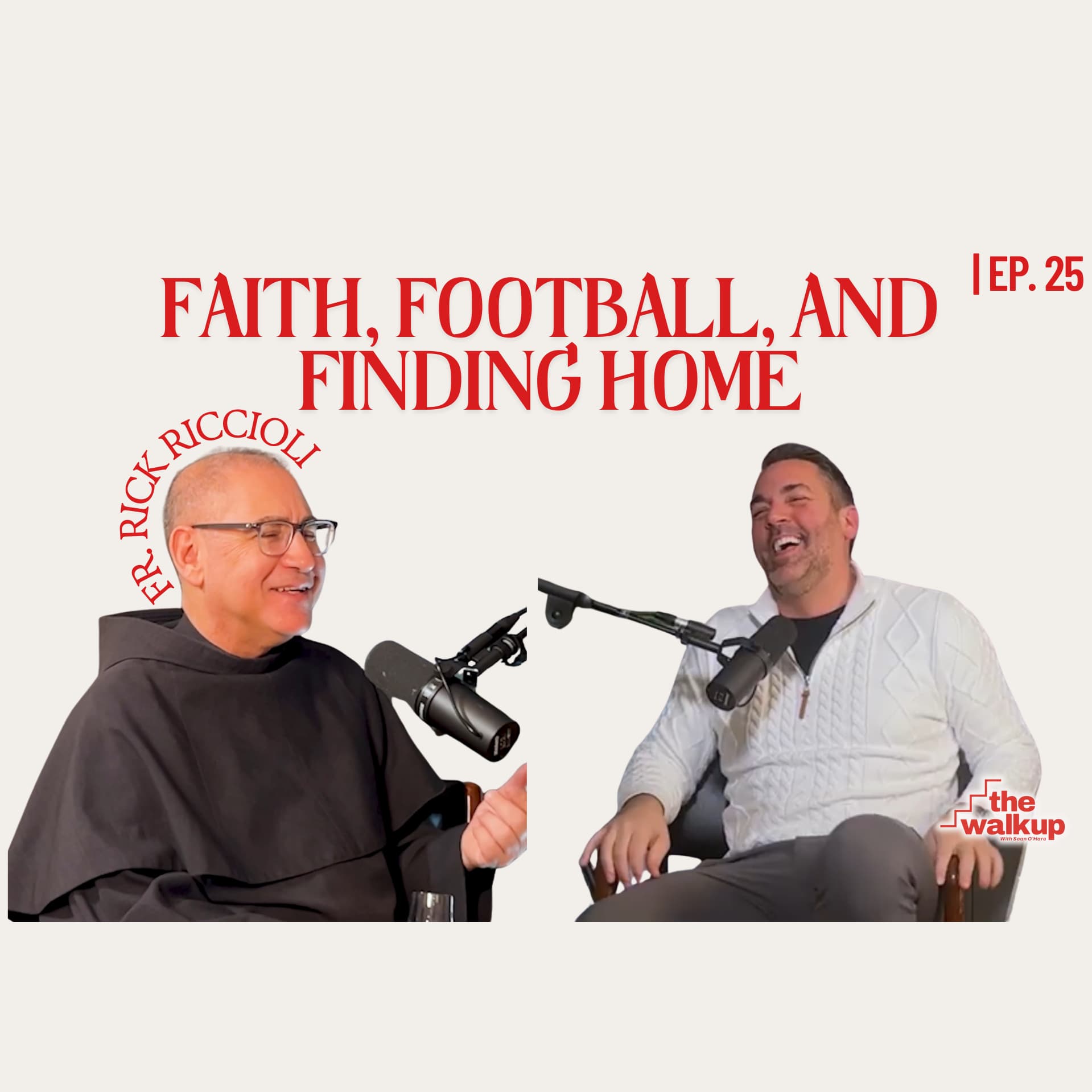
Fr. Rick Riccioli returns to The Walkup with stories that move from the sacred to the hilarious.
He opens up about his experience with spiritual direction and adoration, and reflects on how churches can reimagine community. Along the way, we get tales of high school football dreams, quick rapport-building tips, and even advice on buying a house at 23. It’s a soulful, grounded conversation about confidence, calling, and making a new home in New York.
Transcript
Read the full transcriptAuto-generated · 17,488 words
Welcome back to The Walk Up with Sean O'Hara. I'm not wrong. I don't know that you've, we've never done one-on-one. Well, not here. Well, this is true. We've had many a long conversation at the rectory or at a restaurant or... Or at the friary. The friary, sorry, not the rectory. I've already made my first mistake. Oh, my God. Yeah, no, I was thinking about that. We've talked with other guests, and we've talked informally, and...
As I said to you when we had dinner the last time we were over at the Friary, you're actually a nice person. You're more interesting than I thought. Yeah, I give off uninteresting vibes. No, but it was the complexity.
Oh, there's layers, baby. There's a lot of layers here. Did you have a topic for this conversation? Because I know I have some topics. So, one thing I wanted to do for, sometimes I worry that... Our audience sometimes can feel like, man, these guys are kind of talking inside baseball, like I haven't gotten contextualized what this thing is, and the reason this came up was I was at lunch the other day with a very successful, interesting friend of mine who actually happens to be Greek Orthodox, and he said, so Cardinal Dolan, he's like the Cardinal of America?
And I was like, wow, even this guy, who's pretty knowledgeable, is the whole parochial structure. How is it we go about the operations of the church? And one of the things I've very quickly admired about you was your administrative abilities, your organizational skills, which are, as we know, not always...
Primary, or not always the best amongst the priesthood sometimes, because they're trained for one thing, and find out later on, oh, it turns out there's a whole administrative role I didn't know about. My brother, who you know is a priest, and who has actually been on the podcast as well, has learned to embrace the administrative aspects of things. But I thought it might be helpful to kind of frame for people what is...
On a practical level, what the church does in the world, and also the overarching question is, how is the church relevant to the world? I mean, you and I have a keen awareness of why it is relevant to us. I mean, I know that I, on a spiritual level, on a... Social level on a sociological, lots of, I continue to go back to the church as this anchor, and I'm very privileged to do so, but I know that a lot of my friends here in the city walk by churches every day, and they don't really.
What is it you do here? What is this? And then I also wanted to also frame within the broader context of the challenges we are facing. We have dioceses that are going bankrupt. We have mergers and closures of parishes.
Mergers and acquisitions. Mergers, M&A. It is a different M&A. So, maybe I thought we would start with kind of your... How you approach coming to this parish here in Brooklyn. So, you are trying to evaluate. Before we get into it too deep, because I have a whole different approach.
Maybe we can go halfsies. I am very willing to compromise. Because I have been on a couple of your podcasts so far, and I think there is something else that people are going to want to know about. He has got a file. I have a file.
Well, now. Oh, yeah. I want the audience to know that I have no pre-knowledge of what is about to happen. Who is this guy? That is, you know, so I want to dig deep into this guy, because, you know, here you are doing this podcast, but first of all, do you have this tux? Is it like a rental, or did you buy it?
We are going to get Kyle to do a close-up of this. So, when we... So, when I moved to the city 12 years ago, 2012, I knew that I would need a tux because there were just lots of black tie events, because I used to come to the city and rent a tux, because there were maybe two or three events a year that I might have an opportunity to go to a black tie event, and it was, at that time, living in suburban D.C., even though there were opportunities to go to Black Tie events in D.C., there was something about coming to New York.
Don't mind me. I brought props, too. Oh, is this a carrot top? What are we... No, don't worry. Don't worry. Listen, we had such a good time at the friary that I just... I'm trying to recreate as much of that as possible. Okay.
So that we can... So this could be a good conversation. This is great. I'm very excited. So then... So, one of the first things I did before I moved to the city was, or when I moved to the city, was to buy a tux. So, I will have you know, I still fit in that tux. That is wonderful. It does not button. I can't button it anymore, but it does fit. Tell me you're not doing dry January. I think it's sacrilegious.
Okay. Well, it's, you know, it's not... It is 5 o'clock somewhere, but I just thought maybe... Let the audience wonder what time it is here. That is right, because they are not watching. So, I have not really tried this scotch yet, but I know you will drink almost anything. Just a little touch.
I like that my reputation precedes me. Well, thank you. Well, cheers. Sláinte. First of all, this glass is excellent. Yeah, like, don't you like it for traveling? So, where did you, this is scotch, yeah? Yeah, and the glasses, they're scotch glasses, and they come in this thing.
But, I don't know, I have not heard of this brand. Me neither, but it was at the airport in Montreal when I was coming home. If you can pronounce it, that would be amazing. Yeah. Well, it's definitely Gaelic.
I am going to guess. Yes, or Scottish, or some kind of a... Yeah, it says, Bona Habon something. I am sure it is pronounced, you know, like Max, or something. Cheers. Cheers. No, but seriously, a couple of things I wanted to talk to you about. You know, we will do what you were saying, too, but I am curious because, and we covered it a little bit. About your high school experience. You were at the Seton, right? Seton School. And I remember we talked about it, and I have read about it, that that was a turning point for you in sort of coming to an appreciation of faith and sacraments and whatever.
Because the reason it struck me is because that, for me, was the kind of impetus for my vocation. A teacher showed a movie about St. Francis. I got involved in the campus ministry of the high school. It made me think about, well, what am I chasing after? Like, what is the point of my life, and what do I want to do with my life? So, I thought, hmm, what was it about the high school particularly that, I know that the parents' and teachers' involvement was important for you.
What was it like? How did it affect you? Yeah, on multiple levels. So, I think in retrospect, not that I was at a crossroads, but there was definitely a... There could have been different trajectories. So, I had gone to Catholic elementary school up until sixth grade, and, you know, my influences were all positive. You know, good families, good school, and then, but then, you know, puberty starts to hit, and all these other... Are you the youngest of the four? I'm the youngest by a good bit.
Okay. My brother's... The closest in age to me is almost seven years, so I am very much the happy accident of the family. You probably could be considered an only child, almost. No, and in fact, in a lot of ways, it is funny you mention that, because in a lot of ways, I kind of had five parents, not in a controlling way at all, but in a...
By the time I was 10, everyone was out of the house, so that does create kind of like an only child element of things, where friendships take on a much greater need for you, because I didn't really have siblings around that I could relate to. Of course, I looked up to all my siblings and still do, but they weren't really peers, and so I always noticed that I took my friendships very... Seriously, and they were more like brotherhoods, and sports always provided that.
I was very lucky that I was always very engaged with soccer and basketball primarily, but I was one of those kids where you'd have to get me to come back home because I was outside. Well, I think that was also the culture of the time. I was telling somebody else, in the summer times, we were out in the fields around the house and playing until our mothers called us. You could sign and come home. You never were at home in your bedroom.
No, and even when I did get some video games, the only video games I wanted to play were more sports video games. It was just another way to compete. So, playing by yourself. You know, the play in the season or whatever, like, not having an in-person competitor felt kind of weird to me.
But the other thing I wanted to mention is, because I don't know if your listeners and viewers know that you're from Virginia. Mm-hmm. Okay. And so, Seton was which town? Manassas. Manassas, okay. So, known for Civil War history. Yeah, yeah, yeah.
And at that point, Manassas... Not so much now at all, but it was the middle of nowhere. I mean, two-lane roads to get out there. So, what had happened was my dad had lost his job, and now going to Catholic school, as much as it was a priority for my parents, was becoming hard to afford. Even though we didn't go to incredibly expensive parochial schools, it was a way.
Believe it or not, I was not the social butterfly I am now. I used to get very embarrassed. I liked my little, my sports teams and my close friends, but I was not. Particularly gregarious. And so, my sister had gone to the public school for middle school that's within walking distance. And it was a good experience for her. She really kind of, like, grew into, like, her social self. So, I think it was part they needed to save money and part they thought, oh, maybe this would be good for him.
Well, it was good. I learned how to socialize. But then I also learned how to get in trouble because of the... All of a sudden, the social motivators were there, right? This is Seton? No, no, this is the public school, which caused the reason to go to Seton. Okay. So, in seventh and eighth grade, I was kind of the, a little bit of an, I didn't own a pair of jeans.
Why would I? I went to school in my Catholic school uniform, and then I was just playing sports all the time, so I owned sweatpants and... Soccer shorts. I never dressed to be cool in my life. And so, very quickly, I learned the social strata. Okay, I'm like, how do you become cool? Cool is really important here. How do I do that? Okay. Oh, I'm now attracted. Wanted to attract girls. How do I do that? And so, I just kind of tried to figure it out.
But a lot of that being cool also requires being a little... Dangerous or doing dangerous things or trying to be cool and smoke cigarettes or do this or do that. And so I did a lot of that. I didn't take my studies very seriously. I had figured out how to manipulate the report card. So my D's looked like A's, but that... It sounds like you were bored.
I was just being reckless. I was just kind of enjoying being reckless, I think. And it was really like, once I concentrated on how to succeed in the social environment, that just became paramount to me. Everything else was secondary.
So, I was getting into trouble. I was like, you know, sneaking out of the house, and meeting up with friends, and drinking on the roof of the school, and not during the school day, but in the nights and weekends, and so they were like, all right, this is, as much as we were hoping you could stay in the public school, because it was right down the street, and all I wanted to do, like, all I wanted to do in life was play football, because when you're When you're young, you know, unless you're really into football, you're not playing at like 8, 9, 10, 12 years old, and my older brothers hadn't played, but high school is where it usually begins, and all I wanted to do was be quarterback, and the high school coach had already called my dad, said, hey, you know, we want him on the team, and credit to my parents, they resisted that.
But, they wanted to send me to a different Catholic school. So, I went to a different Catholic school than the rest of my siblings. So, my siblings had all gone to the local, there was kind of two main parochial schools, and my brother, who then became a priest later on, at that point was still figuring out his place in the world, had coached at that local Catholic high school.
He coached JV Soccer, and he said, listen, things have changed. It is more like a private school that happens to be Catholic than a Catholic school that happens to be private. And he knew about this school, Seton. And that was a big sacrifice, because it was 45 minutes away, not glamorous, no heating, no football team.
There's really no amenities whatsoever. When I got there, they finally got a basketball court. They had just gotten a basketball court, which was also the cafeteria and the assembly hall. So, was this kind of like a homeschooling situation, where they just turned it into a school? They do have a homeschooling program, but no, it started in 1975, I believe.
Educator, very much in the mold of St. Elizabeth of Ann Seton, started with like 15, 20 kids in an old, beat-up old firehouse, I think, and then they eventually slowly added more square footage, and it was just taught the faith authentically. I mean, they made sure that... The most important thing of the teachers was that they were authentic witnesses of the faith.
Secondarily, it was like, oh, by the way, do you know how to teach? But we had some of the highest scores in the state in terms of performance and stuff like that. We did not have a computer lab. We did not have a science lab. We did not have everything handwritten.
So, from your perspective as a student, So, reflecting it back as an adult, you see all those pieces, but as a student, A, you probably don't know about that stuff, and you, secondly, don't care. At the user level, what was different about it for you?
Yeah, so I had never really seen the full, I don't know that I ever got a full experience of the faith. We went to a... It is a very Irish Catholic approach to things in a very beautiful way. My parents are very service-oriented, so I got the service part of things. We volunteered, and my mom ran the baptism classes at the parish, and we helped out with the pancake breakfasts, but the spiritual side of it was more just we went to Mass on Sundays just because that is what we did.
I had never gone to adoration in my life. I do not think I had ever prayed the rosary in my life, and this was a place really focused on... The devotional side of things. Every class started with prayer. We prayed the rosary together once a week in your own class. We went to adoration, holy hour, and it was the first retreat, which was actually, was it Youth 2000? Is that what it was called? The Franciscans. Oh, there was something like that, yeah.
Mount 2000, U2000? Well, that is the TORs, yeah. Out of Steubenville? Was that a Steubenville thing? I think so. So, they came and did, they would do these kind of youth retreats, and so this tells you the type of school I am at.
They give you two days of school was retreat a year. So, it wasn't like they were, well, we were offered on the weekends, and it's optional. It was like, I mean. It's central. You're doing that. And so, I remember they built this, or they had this kind of stair-step looking, almost pyramid shape.
Where they had the ledges around it that had candles. And then on the top, eventually, was the monstrance and adoration. And I was like, what is this? I had never... I've never experienced anything like that before. And I remember I'm kneeling there and they're processing around with the monstrance. And they had said, you know, you can touch the cloak of the, just like, just like in the gospel when the woman's healed by touching Jesus' cloak, we were encouraged to kind of touch the, the, the.
The vestments of the priest as you walk by, and I just remember my heart just pounding out of my chest, and I was like, this is something different altogether. And what I was getting was that experience of the spiritual side, then getting great formation in my religion classes, then getting great witness from teachers, from parents of my friends. And at the same time, my brother was discovering his vocation, independent of all of this. So, I was getting it in like 360 degree, and seeing the authenticity of it, the consistency of it, it was almost like, well, I'm screwed now, because now I've been given too many...
I've seen it in its, glimpsed the fullness of it, and so now I'm like, there's kind of no going back. Not that I became some perfect child for that. No, but it sounds like it tapped into, and developmentally too, it probably was a good time, to your...
The aesthetic sense and the quest for the transcendent, right? So, you saw something that was like beyond you, right? And it was like you had a good, faithful family, but this was taking it up a notch and experiencing something like that. Like a Transfiguration Mount Tabor kind of moment, like, wow, this is kind of special and affects you in the long term. Yeah, no, absolutely. And credit to that school where...
They really maintained a small environment. It really eliminated, for the most part, there were clicks like any other, but very minimal. I mean, we were friends with everybody. There wasn't really a... Cool kids and not cool kids, everyone knows each other. And so, that kind of broke down a lot of barriers. And so, by the time I, you know, by junior, senior year, I was like, like really pursuing my faith. And then by the time I got to college, I wanted specifically to go to a Non-Catholic or a secular, so to speak, university.
Is that Ryder? Yeah, because I was like, I want to convert everybody. Don't send me to a Catholic school, which turned out a lot of Catholic schools could use some conversion, too. Stop. I didn't know that. But yeah, so I went to Ryder.
I was open to the idea of, of course, playing soccer in college would be great, but it wasn't. This is, nowadays, you know, the recruitment process is very well developed, and there's, you know, because of how you can record things on your phone, you could send people highlight reels. That wasn't really, that was, I was before all of that. So, there was a few recruiting tournaments you could play in, and so, for whatever reason, most, all the schools that were interested in me were in Philadelphia, New Jersey, so it was like St.
Joseph's, Drexel. Well, St. Joseph's is Catholic. Yeah. I didn't want to go there, even though it was down the street from my brother. My brother was now in the seminary. Oh, yeah, yeah. At St. Charles Seminary in Philadelphia.
And that would have been amazing to go only 10 minutes down the road from him, but the two reasons that didn't appeal to me was, well, a couple reasons. One was, I wasn't ready for a city. I grew up in a very...
You were not ready for a city? I was not ready for a city. Oh, my goodness. I think you are underestimating yourself. I was not. So, did you end up playing soccer? Yeah, all four years, yeah, which was fantastic, and, you know, scholarship and all that, and so that helped pay for school. And involved in campus ministry. Yeah, from day one. I mean, when I visited the campus, it happened to be the Feast of the Immaculate Conception.
So, there is a chapel, kind of non-denominational chapel, although it looks Catholic, and there happened to be Mass offered on campus, and I met the chaplain, who is a Benedictine, and kind of an old school guy, Bruno. Bruno Uliano, and he had done, he spoke four or five languages, he studied Greek, he did all that, but he was, you know, towards the tail end of his... But an interesting person. Oh, fascinating person. Yeah. But, and we just, we hit it off right away, and I was like, yeah, I am supposed to come here.
So, you are playing football, you keep saying football, you know, it is the European side of it. I know. Playing soccer, you are involved in campus ministry. Are you having a good time? So, I was having a great time, because it was my first time trying.
I had never tried in school before. I had never tried to be a really, like, public Catholic leader, so it was really like trying out these new leadership skills, but I wasn't necessarily the cool kid, because I wasn't really seeking that, and I didn't drink at all. I didn't... I don't think I went on like two dates in college. I was just very focused, and then my freshman year, I started my first business. SPO. SPO Enterprises.
In college? Yeah, so what happened was I... And you had no experience in painting and plumbing and all that stuff? Still don't really. That is all people skills, right? That is what I learned, is that it is basically like I am good at talking to people, and I can find other people that are great at the craft, at the trade, and we make a good team.
So, yeah, what happened was my, so I used to work at, my older brother and sister had worked at this kind of small corporate office environment, and they got me a job there, but I just worked there in the summers, and then winter break, but I had worked there a couple summers, and so by my winter break of my freshman year of college, I realized, oh, they're never going to give me more responsibility, because I'm only here for brief windows of time, and to your, The notion before, boredom is a big problem.
So, I was like, well, this is boring. And a friend of mine was interviewing to become a franchisee of a contracting business, a painting business, and I was like, they let you own your own business when you're in college? That doesn't seem legal. I didn't know that you were allowed to own your own business. That seems like something you had to have more experience in the world to do. And so, I went and interviewed for it, and they said, oh, we don't really hire freshmen.
But, the guy who interviewed me played soccer in college, and so that got me, I think that's what cinched it for me. And, yeah, I spent my life savings buying a paint trailer. It's just a funny story. What's a paint trailer? So, basically, something you can, you're supposed to hook it onto the back of a pickup truck. Yeah. And it will have...
You store all your paint supplies. It can also, the ladders go on top. Oh, okay, okay. So, it is basically one stock, all your materials there, right? Can you attach yours to your tricycle? So, I previously spent my life savings on a 1993 Ford Probe. Which, yeah, for those that don't know, it's a pretty sexy automobile. It had flip lights, but it says this is a two-door coupe. This is a 93 Ford Probe.
Terrible, terrible name. I think they meant like, you know, like satellite probe. I don't think they meant other types. So, this is the only, I... I find a guy who's willing to sell me his paint trailer, and he says, well, you have to get a hitch put on the back of your vehicle so I can attach to it. I say, all right, well, okay. So, I go to a U-Haul place where you can get this done, and I roll up in my 93 Ford Probe sports coupe, and I say, I need a hitch on this thing, and he's like, on this?
We don't put hitches on, you know, sports coupes. We put them on... Sure. Pickup trucks, and I said, listen, I don't have another car. This is the one car I got, so just do what you got to do. He's like, okay. So, he puts it on there. I drive about two hours to buy this paint trailer, and he called it custom. I would call it homemade.
It was kind of put together by wood. Some, there was some aluminum involved, I think. So, I'm like, all right, here's my, I think it was like a thousand bucks or something, maybe two thousand bucks. Gave him that, and he gave me also all of his ladders, so I had the whole bit, and I'm driving from Maryland back to Virginia. And it's a Sunday, but there's more traffic than normal, because it was Mother's Day, so more people visiting their mothers.
And for those, if you've ever had that experience the first time you drive with having something behind you, it's very disorienting. So, I'm driving. And I don't even put the radio on, because I'm so nervous, and I'm constantly checking, is it there, is everything fine?
So, an hour into the trip, I'm starting to relax, right? I'm like, I got this, okay. So, I turn the music on. Well, yeah, maybe I got one hand on the steering wheel instead of two. I start bopping my head. I'm like, all right, I got this. Starting a business. There we go. And I'm like, going along, and I'm looking at my rear view, and I'm like...
Where's my trailer? No! Like, uh-oh. And it is now going across four lanes of I-95, and it's two wheels with the hitch in the front, so it's just sparking, like that's all leaning forward, and all I can do is watch it. There's nothing I can do. And I'm seeing all these people slam on their brakes as it kind of slowly goes up four lanes of traffic, and we were kind of on an incline, and it went up four lanes of traffic, and then down four lanes of traffic, and then crashed into the kind of like, not median, but like the retaining wall.
And I kind of was just waiting for, I'm like, well, clearly I'm going to jail. I've violated many laws. I don't know what they all are, but I'm clearly, this is it. That's it. I'm going to jail. I'm 18 years old. I spent my life savings on this paint trailer and starting this business. That's what happened. And so, I'm like, I tried calling a couple tow trucks, and they said, we don't tow trailers. It has to be a full vehicle. So, I tried, and I was like, this is where the reckless part of me comes in.
I'm like, you know what? I could just reattach it and hope it doesn't fall off. So, that is what I did. So, you went back? I went back, I reattached it, and I got off the highway. So, I thought maybe the problem is the speed, and I took side roads all the way home, and it never came off. Oh, my goodness. Now, in fairness, my first business, I ran in one zip code, so I did not really travel very far.
But yeah, you want to learn a lot about human nature? You walk into a couple hundred homes and try to sell them your paint services, you will learn a lot about how human nature works. You're watching a husband and a wife, or maybe a single person, or maybe a multi-generational family, because painting is not like a... So expensive that you are only sailing with a certain strata. You know, sometimes you just get a $500 paint job or something to repaint the shutters or something.
And you watch people make a $500 to $5,000 financial decision, you will learn about human nature. Because I am seeing their home, too. And they are not showing off for me, right? So, I'm seeing their kids running around, misbehaving. I'm seeing, sometimes, if I was doing an interior paint estimate, I'm seeing their bedroom, their bathrooms, their closets, and they don't, who cares about impressing the paint guy, right? So, I learned, so I started to try to figure out, I wonder how well I can read people.
I wonder if Based off of how they interacted with me on the phone, how I think they're going to be when I meet them, or when I walk into their home, that first 30 seconds, how do I build rapport as quickly as possible? Oh, you went to Virginia Tech? Oh, my sister goes to Virginia Tech.
So, you got the, I mean, what I said earlier about being bored, I could see that, because, you know, even though you may have been a bit more shy and not as socially forward, there is something about you, your charisma, your magnetism, you connect with people very quickly, and I think you get a sense of people, and that is when I saw the story about your entrepreneurship.
I'm like, of course, that makes sense, right? Because you're not painting. You're connecting with people and helping them express their need, and you're telling them how you can fulfill their need and do it in a way that's affordable for them. Well, and that became kind of not an addiction, but a pattern in terms of not having a fear of trying things I have no expertise in. Yeah.
Oh, wonderful. You know, I mean, God bless my dad. May he rest in peace. He's going on two years now, but he's not what we would call a handyman. I mean, changing a light bulb was kind of like, you know, maybe call mom. Like, Kathy, what are we going to do here? Like, he did not, that was not his gift. He was more gifted in communication and writing and things like that. So, I did not. You don't grow up with any knowledge of contracting or home improvement.
No, but you know people. Yeah, and I think that came from, so we mentioned before being the youngest. So, I said this to my brother before that I think one of the gifts of being the youngest is that you have to observe a lot.
Because you don't really have anything to contribute, right? I mean, I can like do something cute or funny, and maybe my older siblings would laugh, right? But generally, I don't really have a lot to offer. I can't keep up with the conversation, so I'm just observing. So, years and years of just how do I fit in, and how do I connect with this?
With this social group that I want to be a part of so desperately. But was the humor part of it? Because you are very humorous. So, was that something that you used in your family, with your friends, at work, kind of the fun guy, the funny guy? That got honed more and more later. I did have it a little bit here and there. I remember my brother...
My oldest brother, Keith, the one who is now a priest, he had a band in high school. He was a very talented musician. Of course he did. Of course he did. So, like, this is the coolest thing of all time, man. It is a very cool family, yeah. My oldest brother and all of his friends are in a band in our basement, and I get to hang out with them. I am like, this is like the dream, right, if you are like the youngest.
So, I learned very quickly. Don't be annoying, because then you'll be asked to leave. So, I just wanted to stay in the room. I just want to be in the room, man. This is such a cool place to be. So, how do I add value?
And so, you know what? If I get them, hey, do you guys need a drink? Would you like something to eat? I was going to say that, yeah. I can bake. You know, so I come down with nachos, and they're like, man, your brother's so cool. I'm like, yes! I get to stay.
I would play them a Nintendo. But I make sure they always won, even though I'm like, I can beat this guy, but I'll just let him win. And I remember one time, this feels like something that if I had ever become a late-night TV host, this would have been my moment of learning how to connect with an audience, but it was like...
All my, you know, like sometimes when the band's rehearsing, or they're playing a song, and they sometimes kind of jam out at the end, but it's kind of like a cacophony. It's not really like meant to be. It's kind of like, you know, and then they kind of just, you know, finish it off with the drums. And it was very loud and obnoxious, not obnoxious, but meant to be not beautiful sounding. And when they finished, I said, now that's what I call music.
And they all laughed, and I was like, yes! Yes, and that was it. And so, that whole time, it sounds like you were very successful. You were moving forward in high school. You graduated high school, the university, I mean, and did you just keep going with the franchise?
Yeah, I never gave a thought to getting a normal job. And it sounds like you were doing quite well with it. I was, and then... The recession. And then the real estate market crashed, because I had... Gotten bored. So, I could have stayed with the painting business, which is, I have friends that still run that same exact franchise business 20 years later, and are very successful, because it's a business never going anywhere. There's always going to be a need for it.
And yeah, unfortunately, my boredom would not allow me to stick with one thing. I was like, well, I can't keep doing this, right? I've got to do something else. So, I moved into design-built construction. I moved into smart home technology.
Buying real estate properties, renting them out, which sounds great, but when all of your businesses were real estate related, and then the real estate crash happened, I was like, oh man. It was a slow bleed, but it was devastating.
So, between 2008 and 2012, when you moved to New York, where were you? What were you doing? So, my parents have moved in with me. My dad had been... Excuse me, run that by me again? Yeah, my parents, well, they moved in next door, so I bought a home that had a separate residence, like an in-law suite. Granny suite, yeah.
They weren't my in-laws, they were actually my parents. But my dad had been diagnosed with dementia at that point, and we didn't really know what was going to happen, and so I... Found this house, and it just felt like this is what I am supposed to do, but I took on way too much responsibility, financially. I was basically 23 years old when I bought this house. So, at 23 years old, you buy a house that your parents can come in and move in with you.
Yeah, and nobody tried to talk me out of it, which I look back on now. I don't blame my family, but at the same time, I am like, really? None of you thought this was maybe a little too much for a 23-year-old? So, having worked with a lot of 22, 23-year-olds through Francis Corp, my thing I always tell people is that they look like adults, but they're not fully formed yet. It's still very gentle. You've got to be gentle, gentle, because it's a, yeah.
In some ways, our hearts are still young. Well, and also, I'd experienced nothing but success, and that's a problem. Yeah, but also carrying that weight, responsibility. Oh, it was crushing. I mean, I had no idea what I was doing. I didn't know how to run a household and property, and I'm like, oh, wait, who's going to mow the lawn? How does that get done?
I lived in... Lived with my parents, then I lived in a condo that I bought, and then I lived in this, like, big house with us, with, you know, two properties there. I had no clue what I was doing. And where was this? In Virginia? In, yeah, Fairfax Station. So, I grew up in Fairfax. Fairfax Station is just a little bit southwest. So, yeah, no, it was, looking back, it's one of those, like, just, if it weren't for...
You ever watch the Big Short, and they explain these mortgage-backed securities, now they've bundled all these things, and stated income loans, and this, that, and the other. I'm like, oh, I was a victim of that. There's no reason a 23-year-old, even if they had some early success, should ever be able to have bought the property that I did. But it was because it was just... Whatever you want, man. I got a loan like that when I had enough for the down payment and stuff, because I sold another property.
But, I mean, within five years, I'd lost everything. It was gone. Just, you know, and I was devastated. I mean, it was like, I mean, there were days, I mean, I wouldn't get out of bed for days sometimes. Just like, I'm worthless, like, because I was all performance-oriented, I thought.
I'm only lovable if I'm performing. Well, you still are. I'm still not lovable? You're very much a performer. No, I'm not trying to be mean, but you are very much a performer, and that's why, you know, when I first met you, I was like, oh, he's a cool guy, performer, you know, and then that's what I meant when we had dinner and drinks at the time. I was like, oh, yeah, okay, no, but there was... Strata, right? There's the outward kind of shiny, glossy.
This guy, right? But then, you know, when you start sharing your heart, there's like, oh, crap, this guy's for real. This is genuine. And it's beautiful to see that in you, but I could see that, you know, with the sense of responsibility for your parents, you know, not knowing what's going to come with your father, where that's going to go, having to carry that, and like as you said, and not being accustomed to failing.
Well, that must have been pretty tough. A little bit of depression would not be unusual. No, so I used to, you're familiar with Legatus? Yeah. So, for those that don't know, Legatus is kind of like a Catholic CEO network. Yes.
By chapters and things like that. To my knowledge, I think, if not the youngest, one of the youngest ever to get into Legatus, and so it is like I am like 25, and everybody else is 50 plus, which I love. I love being around. So, you were in Legatus at 25? Mm-hmm. Okay, so I served in Toronto as a pastor there, and was quite involved with Legatus in Toronto, and yeah, you don't join, they invite you, you know?
Yeah, I knew, actually, the guy that I mentioned, that company I worked at, that my older brother and sister worked at, he had founded that company, so he had become a little bit of a mentor to me, and he had said, hey, you should consider this, and so for me, it was just like, sure, another thing to try to accomplish, and so speaking of the chaplain of Legatus.
The chaplain at my Legatus chapter became a very good friend. He had known my dad, knew my brother. Keith? He knew both my brothers as students, then knew my brother as a priest, and knew my dad, because my dad was in fundraising a lot of times for the church.
So, he had interacted with my dad kind of professionally, if you will. So, he knew O'Hare men, so to speak. And so, he could tell something was wrong. Like, I am just showing up, but I am not myself. Like, I was probably dragging myself still to show up to Legatus, because I probably didn't feel too great about myself. And so, I remember one time, he says, why don't you come see me? You know, and I am like, no, I am good.
Thanks. Next month, because there are monthly meetings, why don't you come see me? Like, no, I am good. Thanks. And eventually, I said yes. So, we visited for spiritual direction, and he was like, I think we should do this once a month. I'm like, oh, once a month, all right.
Then he was like, you know, how about every two weeks? Eventually, how about every week? So, he saw me every week, and like, built me back up, and I was just... Yeah, just like basically, you know, like just a skeleton of what I've been before, but working really hard at the optics.
And meanwhile, I'm doubling down on everything, because I'm like, I can solve this, man. I can solve it. I mean, just double down, and that's what I did, and got very close. Without getting into all the details, I scrounged together.
I'd moved into private equity, eventually through a manufacturing distribution company that I started, and we got this close, and I'm saying like 11th hour, the deal falls apart, and I would have paid my house off in cash. Just narrowly missed out, and I'm like, all right, I've got to hit the reset button, and I guess I'm coming to New York.
Because I couldn't face it anymore. I couldn't be in Virginia anymore. That was 2012, right? Yeah. So, why New York? So, the business that I had in the manufacturing space was based in Princeton, because my business partner was in Princeton.
And he had, at the time, six kids. He now has nine. So, when you have six kids, you win. I come to you. Right, yeah. And he was really like a step up for me. My business partners have all been great, but he was really the next level in terms of his finance background and legal background and corporate.
But he was always like, yeah, you have this thing where you can get in the room. You somehow know how to say the thing in the room. And I remember we were, so we would take meetings in New York a lot to raise money, and we were going, you know, the GM building? It is no longer the GM building. It is where the glass Apple store that is next to the center park. Oh, yeah, yeah, yeah. That was the VGM building.
I do not know what. Which companies are in there now? But we're going there to meet with some friends of his that were in private equity that could help sponsor us to buy some manufacturing businesses. And we're in the elevator, and I said, I know this is bad timing.
But, like, real quick, could you explain what private equity is? Oh, Jesus. And to his credit, he didn't freak out, because he knew that I just kind of needed the gist, and so he told me what it was, and I'm like, oh, okay. So, they have a lot of money.
They pick a particular kind of industry in which they have expertise, and they need guys like us to spot which companies are the right ones to buy. He's like, yeah. I'm like, all right, I got it. It's fine.
And we ended up getting... $100 million in committed capital. Not that they didn't give it to us, they were willing to sponsor it for that deal that we're trying to put together. So, I remember, this is kind of the pivot point of my life. So, I'm 2011, probably, I guess. Yeah, probably 2011.
This deal is going to close. I'm going to pay off my house, everything. I'm dating a wonderful girl in D.C. And I was waiting, as I'm waiting for the deal to close, there's this thing called due diligence, where the accountants and the lawyers come in to make sure the numbers are what they say they are. Everything's fair, yeah. Before you sign on the, you know, for tens of millions of dollars, change of hands, you know.
And so, a friend of mine said, well, if you're just sitting around, there's this project in Rome with the Pontifical Council for Social Communications. I go, cool, man. I'll do that. So, I am like, I am helping the church. This is, oh my gosh. And I am on, I am at the airport, about to leave for Rome, and my business partner calls me and says, deal looks like it is done, man. Like, I think we are home free. I am like, oh my gosh, this is great.
I get to Rome, this project under the Pontifical Council was. Shall we say less than efficient? I had an idyllic view of Rome in the Vatican, I think, and I was like, man, this is a lot more complicated than I thought. It was my first time doing kind of international relations. Yeah, and...
Because meetings in Italy, Italian meetings and meetings, church meetings and Vatican meetings are, it is a whole other world, right? There is a lot of talking. There is always 20 more people than there should be. Like, why are there so many people here? Why are we having our fourth espresso break?
Like, why couldn't we actually talk about the agenda? And then I realized how they view Americans, just because like we all have different viewpoints and whatever. So, I was, I wish they... I'm disappointed in this project. I don't want to use the word money laundering, but money was being said to be used for one thing, and it was going to be used for something else. I'm like, I don't think this is illegal, but it's certainly misleading. I come home, the deal falls apart, my girlfriend breaks up with me, and this Vatican project was just not really anything.
And I'm like... All right. Okay, I guess I got nothing now. And so, my best friend, Jeff, when I lived in Princeton, I would come and visit him in New York. And he just, he had a way of kind of like opening up New York for me in a way that didn't feel, I always felt New York felt impersonal, it felt intimidating, it felt just something I couldn't. Wrap my arms around. Yeah. And he was very, very good at contextualizing and said that New York is not this, like, millions of people rushing past each other.
It's villages. It's a bunch of small villages, very close together in close proximity, but it's villages, and you can get anything you want here, any community, any culture, and this is where you influence the world. So, going back to my... I've actually never actually put this together, but in the same way that I went to college with the, like, don't, well, send me to a secular place, because I want to evangelize, I want to convert.
He said, man, if you want to evangelize the world, New York City is where it's at, because the rest of the world follows what happens here. That's right. And he even had, literally, like a 10-page thesis on it. But how Lower Manhattan specifically sets the tone for the rest of the world in finance, culture, arts... Real estate. Everything. So, I mean, in large part, I was sold by that, and I was looking for a way out. I was looking for a fresh start.
So, one of the things I am sensing, this theme of really great mentors in your life, who were able to help you, like whether it is the priest helping you, basically through depression, this guy, other people, you have been very blessed that way.
Yes, absolutely, and I always sought them out. So, I will say that I wish I... I listened. Well, I'll put it this way. I didn't have the humility at all to ask for what I really needed, because I wasn't good at showing weakness. So, what I should have done when things were falling apart financially in my 20s, is I should have gone to one of those mentors who cared about me, who wanted to help me, and opened myself up and said, I'm failing.
Help me. I wouldn't, I refuse to do that. I felt like, no, you have to project strength, and so I never, the priest, I told him everything. But the people, the kind of business mentors I could have gone to and said, listen, man, they probably could have been like, oh. You could restructure your loan, you could do this and this and this, you could probably, you know, they probably could have come up with 20 ways that I could have mitigated the damage, but I just walled it off and compartmentalized it, and I remember when it was clear that we were going to lose the house, I had to call my mom.
I was out of town, because I was hiding. I was in, a friend of mine had a beach house in Bethany Beach in Delaware. That is not supposed to happen. So, she would let me stay there even when she was not there, because I was just hiding.
So, you had to call your mother and tell her? We were going to lose the house, yeah. And my brother said, I think you should call her. And I said, all right. I assume this was an in-person conversation. I was like, but if you're giving me a way to do this over the phone, I will take you up on it. He's like, I think you should just do it. So, I called, and I remember I drank a bunch of coffee, and I was all like, all right, I'm ready.
I was very almost like... Matter of fact. So, here I have some news for you. But then I just broke down, and I just said I failed. I'm sorry. And she goes, okay. How much time do we have? That was it. And I said, I projected the best I could at that point. We ended up stretching it out much longer, because there was some, I found out later, mortgage shenanigans that these mortgage companies were using, so that bought us an extra six months or a year or something.
You know, it's funny, in the political climate of today, you know, we're... There is so much talk about we need to have less government and less big government and less regulation and stuff, which I could see. I mean, you come face-to-face with so much government bureaucracy sometimes and the oppressiveness of institutional kind of weight, but sometimes you think… I wish there were some rules against the way some of these loans were made, or the way mortgages were given out, and maybe there should be some regulation to protect people.
Yeah, I've honestly only somewhat recently started to reflect on like, wait a second, I was kind of a victim of a very brief window of this kind of like... This push towards everyone should own a home, and we are going to make loans really easy to get.
In other words, had I not been in the real estate acquisition phase of my life during that five to seven year period, I probably would never have been kind of caught up in it, but it is what it is. Well, in one way or another...
You're going to experience failure. I mean, you're not the best mother in the Lord Jesus. You know, you're going to experience failure. You're going to experience things that don't go well. So, whether it was real estate or some other aspect of your life, I think the character comes through in how you overcome that, right, and how you deal with that. And I think, you know, you've shown that you're, yeah, maybe you didn't do, I mean, when you're growing, you don't want, as you say, you don't want to show that you're...
Lacking power to people who that you find inspiring. You want to show them that you're the same. Yeah, you know, well, and I think, you know, that the my this may this may this may surprise you that I struggle with humility. And yeah, take it. I don't believe for a second.
I don't need another drink. And I remember my brother said, you know, sometimes to learn humility, you have to be humiliated. Like, that is the only way you are going to learn. And for me, it is definitely the case. I would never have eased into learning humility. I had to be utterly humiliated in a very public way and in a lot of respects. And that opened me up to vulnerability, which was completely...
Unknown to me at that point. I mean, when I called my mom to tell her we were losing the house, I think that was the first time I cried. Maybe I cried a little bit at my grandmother's funeral, I think, because I think I thought I was supposed to cry, but we did not cry in our family. But I remember when I told my mom, like, that's it, I'm sorry, I lost, I, I, I failed. And I cried like in a, like.
In a way that, like, afterwards, it felt like I had been through a heavyweight fight. Like, my entire, like, everything hurt, because it was, like, physical, emotional. My God, you told your mother you failed her. Yeah, it was, uh... That's... Yeah, and all you want to do is obviously make your parents proud, and then on top of that, she was dealing with the stress of taking care of my dad, and she didn't really have a husband in the full way because he wasn't able to do that, but we're good Irish Catholics.
We just compartmentalize and suppress everything. We don't talk about these things. We're talking about it a little bit now, after my dad's passed, and I think there's like, we can... What's the use? We might as well talk about, not everything, but let's talk about more.
Well, also, you impact your family, right? I mean, the family is a system, right? Right. And with everything that you've experienced and how you've matured, you bring that to the table. And so, maybe you help your family, maybe talk a little bit more about some of the stuff that's actually...
Important. Yeah, and my brother, Father O'Hare, he had started to engage, too, with his more vulnerable side, and I remember the first time he said, I love you, I was like, what is that? Why are you saying that? It's very uncomfortable. Still slightly uncomfortable, because we didn't say that.
I do not think I have ever said it to my other siblings. There is no lack of love, it is just that we do not say it. But, you know, when a parent dies, that opens up different things. Maybe I would have eventually learned vulnerability or tapped into that and started to develop the... The tool set to be for intimacy and that sort of thing. Because I know, I realized that in my past relationships before this kind of epic failure, I'm very privileged to meet some wonderful young women who all would be great spouses, but they were all trying to get to know me.
At a vulnerable, intimate level, and I was like, I don't think I understand the question. So, I remember I was dating this girl one time, and I was on a business trip, and she said, we're on the phone, and she just said, hey, how are you doing? And I just listed off all the things I had done today, and she goes, no, how are you doing? And I'm like, I don't understand the question. I thought it was just performative.
Oh, you're asking about how I feel? Oh, I don't know that. I'm unfamiliar with that particular line of reasoning. So, yeah, New York just opened up. Part of my brain that had never been... I love that image of multiple villages. I mean, when I moved to Brooklyn, people were like, you know, have you figured out the restaurant scene in Brooklyn? I'm like, the restaurant scene in Brooklyn? No, New York. I said, New York? I said, not even Brooklyn, not even my neighborhood.
I said, it's a lot of small communities, and they're very vibrant, and they're very mixed, and you get to see a little bit of other places, but it's... It is a lot of small communities that are jammed in together. It is a pretty amazing place. You know, I love it because of that smashing together of humanity and the proximity you have to people, and the access you have to stretch yourself constantly. Like, you can constantly put yourself in uncomfortable situations. Oh, yeah.
Just go on the subway. And I love it. Yeah, I mean, you can feel, you know. Physically uncomfortable, you can feel socially, you can feel artistic. So, when I first moved to the city, I was working, I had an opportunity to be an advisor to like a philanthropist, and that was kind of my safe haven after all the businesses had fallen apart, and I said, do you need me to... I live where you, and he's like, no, you can live wherever you want.
You can do all this stuff remote. I was like, great. I was like, that really gives me the opportunity to move to New York. And he had said, I really want you to write this business plan for me for this new idea that I have. I said, okay. So, I wrote it in a week. He gave me the summer to write it, but I wrote it in a week, and I just didn't tell him it took me a week. And I spent the summer just exploring New York and being like, I'm going to go to a different neighborhood.
I'm going to get on the subway and just go. Let's see what happens. I'm going to just kind of try to stretch myself, and I would like, oh, here's this poetry reader. I'm going to go to that. Here's this improv theater. I'm going to go to that. I didn't grow up going to artistic things necessarily. My mom would take us to theater every now and then, but we weren't necessarily deeply involved in the arts, and I just loved seeing people's passion.
So, here is my little thing that I am really, really into, and I am so passionate about it, and there is this community around us that also, I just love that, even if I don't get it. So, how were you supporting yourself at that time? Like, doing contracts? Yeah, so now I am like an advisor to this, you know, on contract for him. Yeah. Did you do Firehouse subs at some point? Yeah, so I still own one of those, yeah. My business partner, God love him, is still there running them.
So, yeah, that was another, in the flurry of starting things I didn't understand, I was like, sure. How hard can the restaurant business be? And then when we were getting started with that, I think we were the youngest franchisees, too, at Firehouse Subs.
I was 26 or 27 at the time, I think. Are they everywhere? They're getting everywhere. 2,000 of them now? Some of your listeners haven't had them. They are pretty awesome. They are fantastic. There aren't any in the city. Newark Airport has one.
Syracuse has it. I think New York is obviously its own restaurant scene, so we are kind of inundated with... Subway, and Pop LA, and a bunch of other options. But yeah, some in Jersey, Connecticut, upstate New York. So, you would do that kind of stuff. So, you're in New York, you're basically... Opening yourself to what New York has to offer, you are doing some consulting and advising and got this stuff. This is also a time where you seem to have gotten more involved in evangelization in the young adult scene.
How did that happen? That was Jeff as well. My friend Jeff had been very involved. He helped found the young adult office at the Archdiocese. He was not a diocesan employee, but he... He had made the case, like, guys, half this island is young adults.
You know, you have to have, and that was really a pioneering thing, because a lot of dioceses did not think of young adults, or I think a better way sometimes of saying it is just unmarried, right, is a large population, and that population is getting bigger and bigger and bigger because people are delaying marriage for all sorts of reasons. So, there is this demographic that the church has had a tough time.
In the last 20 years, there are schools in your youth, then you go to high school, then maybe go to a Catholic college, and then you either become a priest, a nun, or you get married, and then we have all sorts of services for that, for marriage and family.
But in between, it was always considered this brief window of time when you are single. Well, now, for a lot of people, that is 5, 10, 15, 20 years, and especially in urban environments where it is hard to live here with a family, you are going to have a lot of young professionals. And so, he built that program, and then at the same time...
Colin Nakazu ended up running the Young Adult Office for 10 years, 11 years, and became one of my best friends as well, so the three of us were really just engaged in, like, how do we go about this project? And so, we were just incubating ideas constantly, you know, starting different programs. So, we started this jazz night.
At the cathedral. Well, no, this was, we had them all over. It started... 2014, I want to say, ish. So, I was dating a young lady who I met in Paris, who was a A model. I met this model in Paris. I need another drink. That is a whole other story. It would be great if it worked out. It was very meet-cute, as they say.
But she is a jazz singer, and she was in the Jazz Conservatory in Paris. And so, in an effort to impress her, I started a jazz night. And I had never hosted an artistic thing. In my life. I mean, I had helped Jeff with some things. He used to do the East Village Arts Festival. I just thought that was so cool. But I'm like, how do you go about doing this, right? And there was a restaurant across the street from where I was living.
I was living in a church, because this has become a, or a rectory, this has become a regular theme of my life. And I have to say, it was a no longer functioning rectory, right? So, that was later. This is before. This is different. So, you're actually living in a rectory? Correct, yeah. With a priest? Correct. Okay. This is why I understand the priesthood in a way that most lay people don't. Yeah.
And. And the restaurant across the street had a bar, but it also had a lower level that they only used before the theaters, before the theater performances. So, after 8 p.m., it was basically empty. Yeah. And so, I said, hey, would you let me start something here?
And they were like, sure. So, every Friday night for three years, we had jazz, and people met their future spouses there, friendships. I met more people staying in one place every Friday night than I would ever meet if I went to a different place every night. Well, you were hosting, yeah. Yeah, it was great. But this was not a faith-based thing. It was meant to be, not outwardly, but our idea was, you've got to give people what they're craving. Yeah. What they're craving is connection, in this case, a little bit of art, a little bit of culture, a place where they can feel welcomed.
Because in New York, it is too expensive to have people over to your home. Nobody has space, so that became our living room, and so I would say probably a third of the room was probably practicing Catholic, a third were kind of nominal Christian, and the third were everything, and that mix.
So, you were drawing the people. I mean, this is particularly interesting to me, because that is kind of my mission here, right, in Brooklyn. And I tell the friars, because we have to think about what we are going to do here, because back to your original, original thought about our conversation.
Trying to do evangelization while running an operating parish, you don't shut the parish down to do evangelization, but if you don't change your mindset to say, I also have to be, and maybe prioritize, thinking the people who aren't in the pew, right? This neighborhood in Williamsburg is just jam-packed with young adults. There's a lot of families here. I sometimes, I hope Kyle's listening really carefully.
People raise families here in Williamsburg. You know, there are parks, there are swimming pools, there are great schools. You can live here. But we do have a lot of young adults, right? And I tell the Friars all the time about this wonderful pair of restaurants owned by Winsun. Jeff and Trig own those restaurants. And it astounds me that the bakery, which is just really close to the church.
At 9 o'clock in the morning, on a Saturday morning, or a Sunday morning, there's a line-up of young adults, and I'm like, Young adults will come from all over New York City to line up on a cold December morning outside of this bakery, and I cannot get them to come to church, right? So, what is going on there? First, they are there. There are enough young adults. They are willing to come out and do what it takes if I am meeting their needs.
And maybe that is shallow, but as you said, being able to connect with... What do people need? What are they looking for? And that sense of belonging, maybe, and connection and community. And even if it is temporary, right, because they are not necessarily staying here forever, but can the church offer something like that where they feel at home, and they can develop their spirituality while they are here?
I think that is a critical question. What I think, yeah, I mean, it is tricky because, not tricky, but the challenge is that so much of the parochial model has been set up to support family life, and then...
We presume that that family life will kind of repeat itself in the generations to come, and that is obviously not happening quite as much anymore, and so now you have this new demographic, and I am like, wait, our entire model was built around families and schools, and even later on in life, and helping seniors and things like that, but we do not really have this, we are not set up to handle.
Young professionals. And so, it has been a constant adventure, I will say, and try in learning which parishes and which pastors are open to saying, yeah, absolutely, I agree with you. This approach, and we've got some space you can use, or we can use some of the resources here to be able to facilitate that. So, it started as simple as like, you know, having a young adult mass, right? So, a young adult mass, usually on a Sunday night, but then lend itself to socializing afterwards.
Okay, fine. That is for the people that are already showing up. To your point, how do you get the people that are going to the bakery? Yeah, but even the ones that are showing up, one of my frustrations thus far has been... Like, we have an 8 a.m. Polish Mass, a 9.30 English Mass, 11 o'clock Spanish Mass, and a 12.30 English Mass. When I first came, and that is a lot, I mean, from many of our partners. Well, but it is the diversity of language.
Yeah, but, you know, the 8 o'clock Polish Mass has maybe 75 to 100 people. The 9.30 has 100 to 150 people. The Spanish has 250 to 300. When I first came here, the 12 o'clock... 1230 had like 10 people, and I was like, oh, we're not keeping this, right? But over the two years, two and a half years I've been here, that is the one that's been growing, and mostly with young adults. Like, we have some families, but like individual men, women, some couples, and they're standing there, and I'm like...
I am like hopping all over the place, doing a song and dance to try to get them, do you want to come for wine and cheese? Do you want to come for... And it is not clicking. It is like they are not looking for their social life at the church. They want to come to church and go. The only time we have had success thus far has been... When we have had people cooking for the local shelter, young adults will come out of the woodwork to do that.
It seems like something very service-oriented they will do. Do you think Catholic young adults in New York City, for example, want the church to be a place where they belong, or do they just want to come in and do their thing? So, I think it is how we… Feel free to have some more, because now you are helping me.
No, I think, so a lot of it depends on the state that they are at, right? So, I think there are those, as you described there, that I would call kind of the sacramental dispensary. I do not mean that necessarily in a negative way. Well, they are faithful Catholics, and they want to get their sacraments. Okay, and I fit into that category.
For some reason, particularly on Sundays, on Sundays I really just want to get in and get out. I feel more devotional sometimes when I am getting to daily mass or I am getting to adoration or something. Part of it is, I don't want to say optics, but it's perception, is that we see the church as institutional, and so we go to that institution, which is a... Institutional just means stable and recurring and present. Those are all good things, but they don't necessarily see it as their social life.
Why? Well, because it needs to be not softened, I don't know if that's the right word, but made accessible. So... I think, so you mentioned before that I lived in this former convent. People were not, they thought it was eminently cool that they were hanging out in this former convent, because there's this fascination and curiosity, but it wasn't churchy when they were there, because we were having concerts and dinner parties and whatever else. So, I think we, the way to leverage The opportunity of the church is.
So, my thesis has been, along with Jeff, has been art and beauty is what draws people, right? Everyone's seeking beauty and an experience of the transcendent, whether it's in art. Or music, or, you know, formally in the church. Or in high school, touching the cape of a, the cope of a priest going by with a monstrance and feeling that electrical feeling, right? So, it is that connection, something transcended, beautiful, inspiring. Yeah, and I think they do not know that is possible yet, right?
So, how do we get them to experience a piece of that? I think that is what God made us. Creative, right? That's why artists are so important. So, my simple thesis is that art draws people in, and it often draws, oftentimes, young women are drawn to beautiful, to art and to culture. The women draw the men, and then now you've got something going on. Well, what do artists need?
They need space. They need space to curate. They need space to develop their art, to showcase their art, to exhibit it, to put on performances. And this is an example of what you've done. I mean, we are in this studio because you have decided as a pastor, we have some space that can be utilized for artistic purposes. There are podcasts going on here. This is a music studio. This would be...
The barrier to entry for an artist is extraordinary, because if we had to rent a studio every time, forget about it. If we had to move, you know, if the musicians had to bring the instruments in, I remember, in fact, when Kyle Before we had that space at that former combat, he developed a music studio there. The amount of artists that had the opportunity to develop their music there, I mean, that would never have had the chance, is, I don't know, I mean, probably in the hundreds.
I remember when he has to have to go to like a local, I forget the name of the music stores where they have like a little studio you can rent. Oh, yeah, yeah, yeah. You know, and it is just, yeah, it is doable, but when you, this is the role that the church can play, is say, hey, we have got this, we can welcome you in, and then moving from that to, okay, you have now softened or changed my view of what the church could be, and then I think there is the in-between that and...
The sacramental life is where the opportunity is. I think we talked about this before, that the four-category system, as we called it with the archdiocese, was seeker, acquaintance, friend, disciple, and that people are in different parts of that journey, and so Jazz Nights, that is a seeker event. You can invite anybody to that. And not feel like you're going to be making them uncomfortable.
Now, maybe a dinner party at a former convent, maybe that's more of an acquaintance thing. You've got to know these people a little bit before they walk into that space. But what I would do, I don't know if I told you this, but when we would have those dinner parties at the former convent, the convent was connected to the main church, but through the kitchen, so you wouldn't really see it coming.
So, after people had had this wonderful meal, they're connecting with each other, so you're meeting that desire for just social connection. Even everyone was a stranger before they walked in. I'd say, oh, we have one more surprise. Meet me in the kitchen, and they're like, okay. And they had no idea that when I opened the door, we were going to be walking into this gorgeous church, and I would sometimes have a friend sing a cappella, only candles, people were weeping, because they haven't had a taste of the transcendent.
Now, here's the interesting part, which kind of gets to your point before, which is, would they have... Would they have felt that if they just walked into a church on their own? No, it is the way it was presented. They had had community, they had had a meal, a few drinks helps, and then the church is presented in this majestic, transcendent, mystical way, and I remember a couple of people, many experiences, but... One guy's like, you know, I'm an atheist. I'm like, yeah, it's okay.
You're allowed. You know, and it just broke down those barriers, but what we were leading with was beauty. The beauty of the architecture, the beauty of the silence, the beauty of the acapella voice. I mean, I don't care who you are, you can't not love that. Absolutely.
That's disarming. Maybe that's what it is, to be disarming. And I think... For lots of reasons, good and bad. The church feels intimidating to people, whether they project their own maybe negative experiences they have had, or they have their own, you know, difficulties that they are projecting, and they think, oh, I cannot be forgiven, or I am sure you hear it all the time. Oh, if I walked into a church, I would catch on fire. Oh, my gosh, you know. Believe me, I am a lot of our episcopacy.
Not to interrupt you, but we, yeah, exactly. You know, that is part of kind of what you were describing, what we have been doing with this Chiara Media Lounge Studio, blah, blah, blah, and one of the spin-offs is Music in the Yard, right? So, this past summer, we had concerts in this little yard that is left of our parking, secular music, like just nice bands playing really good music to draw people in. Now… It's been really frustrating, because most times it's rained, or it's been extremely cold, or all the trains coming into this part of Williamsburg were shut down.
The L train is shut, the G train is shut. I know one night, just before we were going to start, I went up to my room, put my habit on, and I was like, okay, Francis, Claire, Anthony, all of you guys, do something, because I'm trying, and it's very frustrating. But anyways, we had one of those concerts, and it was, I think it was John the Martyr that was playing, and we had a nice attendance, and it was great, and this...
A woman came in, kind of obviously trans, and maybe on something, but was dancing around, whatever, and one of my parishioners... I recognized her and said that she is a very important influencer from Washington, D.C., a big activist in the trans community, blah, blah, blah, blah, blah, and I was like, oh, wow, and I do not think she had caught on that this was a church-sponsored thing, and when she did, she was a little bit taken aback. So, I went to talk to her a little bit, and we had a nice conversation, but when I researched her, she was like, oh, my gosh, she is a very important person, and I was like, oh, my gosh, she is a very important person, and I was She has some strong feelings about the Catholic Church, and has done some things in Catholic churches to spark a little bit of outrage.
Sacrilegious stuff, dancing on the altars and stuff at Our Lady of the Angels Cathedral in Los Angeles. So, I saw the video, and I was repulsed, right? And then I thought to myself, okay. I cannot just evangelize the people that I like. I expect people to respect us back, but what kind of anger? I would love to once again talk to her a little bit deeper, but she would never have come if we had not had the concert, and that would have given me an opportunity.
So, listening to you, It kind of confirms for me that, I agree, the arts are, and all the arts, music, literature, visual arts, theater, there are opportunities that transcend the differences that people may feel, and it gives us a doorway to, first of all, just to have a relationship and say, we both like this, you know? Let's start there, and can you come and give us a fair shake as well? Don't prejudge who we are as a church, just based on perhaps prior experiences of what you heard.
I think that is the best way to move from seeker to acquaintance, to friend and then disciple. Yeah, and I think sometimes our job is just to help facilitate from one... Phase to the next. Maybe it is to go all the way through, but at the least, again, remove the religious nature of the church for a second.
If I said to you, there's 17,000 Catholic parishes in the United States. If I said to you that you were trying to create community or engage with young people or whatever, and I've got 17,000 retail centers, you'd be like, what? Man, you could do a lot with that, right? And I think the greatest point of leverage we have...
In urban environments is gathering space, and I get very frustrated when I talk with a priest or a pastor and say, hey, listen, you've got this church basement, or you've got this empty space you're not using. Can we do X? And yeah, whether they, it might make more work for them or this, for whatever reason, they say no, and I'm like, it's like.
To your point before, it is like, they tend to be only interested in the people that self-select to walk through their doors. Yes. Canonically, that is not your responsibility. Canonically, you are responsible for every soul in your parish boundaries, regardless of whether they are Catholic or not. That is right. It is not just for people that walk in the door. And so, I think there is an incredible opportunity for partnership. This, I believe.
I believe sincerely that this is the season of the laity. The laity need to be in a co-partnership with the clergy, in part because it is not up to you to evangelize everybody. You do things that I cannot do. I cannot celebrate the sacraments. I cannot provide the sacraments.
And so, that needs to be, that is a specialization you have. But you know what? What I might be really good at is... is reaching out and developing these artistic events. We're partners in that, and so, I mean, I've more than regularly run up against...
And resistance, you know, getting called in for emergency meetings with auxiliary bishops, because, well, you seem to be getting too many people coming to church because of your, you know, because of these concerts and stuff. I am like, well, is that, I am sorry, we do not want more people to come to church? No, but sometimes people get uncomfortable. I mean, I know we had some, I do not want to get into the details of the location, because it is sensitive, but We have done some, as friars, some work around evangelization, and I think it made some of the local clergy nervous, right, because we were letting into church people who were not Catholic, and we were having concerts and stuff, and just connecting.
And I remember being at one concert, and it was a little weird, and the sacrament was out of the church, and the music was kind of bizarre, not my cup of tea. But afterwards, I was there with some Franciscan sisters, and these... Young adults were like, you guys are really interesting. Tell us about yourselves, and who are you?
I remember these, I think they were Swedish. There were young women, they were wearing flowers like crowns. It was kind of a St. Bridget thing, or one of the saints. So, for me, it was like, wow, these are really beautiful women, and they want to talk to us. Like, what's going on? Like, that doesn't normally happen. Strangers don't come up and initiate these conversations. Here, a little bit, right, we have so many young adults who stop in during the week for Mass, not for Mass, for prayer in the church.
Like, I am so grateful that my predecessor opened the church up and has kept it open, and I have continued that. It is like a cathedral, and people come in and just sit to pray, you know? So, they are longing for something. So, having opportunities where we can talk to each other, I think that would be amazing. Well, I think too often, I don't want to project, but I think, why aren't we doing… Why aren't we doing that? And what I mean by that is, I think it's a lack of confidence.
I don't think we have confidence in what we have to offer. I remember when I went to college, I had confidence in the fact that I was blessed to be in possession of excellent formation. And what that meant was I could, there was a whole part of the world that I could not reject, but go, that's not for me, and I don't need to go investigate it to find out because I've been given good formation, or I can know that I can spend my time here, and that's like having like Navy SEAL training.
It's like having like a secret weapon the whole time, or at least a tool set that others aren't yet fortunate to have. If we don't believe that we have something incredible to offer, That I think that is a lack of confidence, and so, however we can get people in to just begin that dialogue, we should be confident that we have something categorically different to offer, and what I think I was encouraged by through my 12 plus years here in the city, people are craving God so desperately.
Oh, for sure. Oh my gosh, I mean, the... The things that people are suffering from, that they have confusion about, that they're... I mean, we all have, of course, but we have something unique to offer, and we've got these places we can gather people. So, it's almost like the wounded are out there, and we've got the clinics, and yet we're not sure if we want to... Let people in the door. Yeah, Pope Francis says we're supposed to be field hospitals, right?
Yeah. So, it means that whoever comes in off the battleground, you've got to take them in. You can't start saying, well, you're not part of my clan, and you don't fit here. So, we do need to start wrapping up.
This is something that I know the church is grappling with. I know we friars are grappling with this. We serve in a lot of different places. We serve in campus ministry. We serve in high schools. We serve in parishes. Some are urban. Some are suburban. Some are rural. We serve in different languages. Friars do all sorts of stuff. There is no one thing we do, right? But in all of these places, we are noticing that Okay, there's a disconnect, like there's a separation happening.
We're not having the same, as you said, the renewal of the families and the traditional constituency that you had. So, if you could tell the friars, let's say, what is something practical? That we could do to make our campus ministries, our parishes, or any ministry more open to evangelization. What would it be? So, I think that the one is the first is the disposition to say, we are going to open ourselves up to, because the institutional part, again, is the beauty of it, is the consistency that is there.
But I think we can, sometimes the church has gotten... In too many institutions, it is like we forget that because we have an institution for schools and for hospitals and for senior care, we kind of think there is another department that deals with that. I was surprised when I hosted the first special needs prom for the Tim Tebow Foundation. I thought, oh man, I am going to have to really rely on… You know, the church community to really step up, because I needed like 200 volunteers, some crazy number.
It was people that had never been to church, or don't go to church, or their desire to want to participate in something was so great, and that was an opportunity for them to step into a church. So, my initial sense is that experimentation, being willing to try, because you don't really know what's going to connect. Yeah. It is not always going to be, and like we were talking about, the dynamism and diversity of New York City. It might be one thing in this part of Brooklyn, and I think in another part of Brooklyn, right?
I think there is... The first step is an openness to saying we should be willing to try to welcome people in as much as possible and use the available spaces that we have, and have a commitment to experimentation. Go, okay, this thing didn't work, or it worked a little bit, let's stick with it. I mean, my Friday Night Jazz, the first one had 20 people, and it was all my close friends, right? By the end of it, I didn't have to even put out an email.
People just showed up because it just spread through word of mouth, and even that, we stopped doing that. When COVID started, because that restaurant closed down, and I still, people are still asking, where's the gas? And I would bet consistency is also part of that. Consistency is very key.
Yeah, because just from a basic marketing perspective, if you do something every third Thursday, people are like, oh wait, but this month we don't have it because it falls on the same day as Christmas or whatever, and now you've got to...
I remember when we started, and Jeff and Colin and I did the jazz, they were thinking like once a month, maybe twice a month. I don't know where that inspiration came from for me, but I'm like, it's got to be every Friday. If it's not every Friday, people can't remember. And that was a big commitment. I mean, one of us having to be there, if not all of us, every Friday night. But like I said, I miss it, because now I'm like, man, I've met more people, connected with more people doing that than anything else.
So, consistency means a lot, because otherwise, you might as well be marketing it from scratch every single time. Every now and then, monthly events work. People look forward to those things. And I think there's a bashfulness in New York. We think we can't ask that much of people. Oh, they're so busy. Once a month is probably a lot for them. People are lonely. People are desperate for community, and one of the things I noticed about the Friday Night Jazz was they needed a place they could go that, like, It is just enough to get them not to just go home at the end of maybe a difficult week, or a busy week, or a stressful week.
They did not necessarily want to go out for the night, but they did not want to just go home. A lot of people live alone, or they have a roommate. It is lonely. It is a really lonely city. And so, even though you are surrounded by people, it is really, really lonely. So, the thought that we struggled with that here, and we are like, well, we cannot possibly do something on a Friday night because people have plans.
That is confidence. Just own it. Be like, we are going to do this. Even if it only serves 20, 30, 40 people consistently, but that is where you get your base, because they become your champions, and they are the ones telling other people about it. The other thing I did with the dinner party was, and this was a suggestion from a friend of mine, which was a really good idea, was So, let us say I had 10 people at the first dinner party, and four of them were really a big fan of it.
I would tell those four, you bring two people, but it cannot be anybody I know, and it cannot be anybody who has already shown up. So, basically, they are evangelizing for me. They are telling their friends, this thing is awesome, trust me. And now I have got a pod of... Four groups of three that are now already on board, so anybody else I bring, now there's this momentum. Everyone already believes in this little experience, right? And now, I'm not preaching. They're doing the preaching for me, so to speak, right?
And so, you never know who your advocates are going to be. But it ends up connecting with somebody, and they are like, man, this is the thing I look forward to every Friday. So, you would say, be bold, experiment, try things. And consistency. Be consistent.
It sounds like the dinner thing brings it a notch closer. They are not just seekers, they become acquaintances, people you are sharing a meal with. So, I think for us as friars and as the diocese and the church, it sounds like also taking that relationship a little bit deeper with people, like more intimate relationship and sharing a meal with them and helping them get to know you so that that door gets opened a little bit more. Yeah, I think the dinner, I mean, depending on the size of it, is the best bang for your buck in terms of...
Creating intimacy. What's interesting is that I would host, I would have 20, 25, sometimes 35 people at dinner. I never had more than five minutes of conversation with anybody because I'm running around being the host, yet everybody had this kinship and this kind of, they really felt, not to make it a networking thing, but If any of those 35 people, even though I could only get a few minutes with any of them, because they had such a wonderful experience, if I called up any of them and said, hey, could you do me a favor?
Because you facilitate something that brought value to them. And so, I mean, I could see an ecosystem where you're using the outdoor spaces, when weather is right and all that, to draw people in. And then maybe you're using the indoor space, the gym. It's a gym, right? Yeah. What is the space that is not a gym? Cafeteria. Cafeteria.
And that is what I noticed, too, is once people are bought into it, they are less concerned about how pretty the space is, because when I did not have the nicest space, they were already bought into the brand, so when I had a less ideal space, they did not care, because now they knew the value of the community, and then you could say, well, you know, and You know, on Saturdays or whatever, Tuesdays or something, we do a potluck dinner. Everyone throw in 10 bucks, and it does not have to be expensive.
I had everyone contribute. I did not go in the hole for these dinner parties because that would be very expensive, hosting a 35-person dinner party, and then that is the way to go to the next level deeper, and then those become your leaders, and then now, all of a sudden, they are hosting things, but then the confidence again, the boldness to say, hey, Hello, young person. Whoever the constituency is, giving them a leadership role and saying, hey, by the way, would you mind kind of taking over the organization of the food and activating them?
Because too often, hardworking priests like yourself are doing too much. You need to distribute the responsibility, and I think people are eager to want to be a part of something. And even if it's as simple as, like, my role is, like, you know, getting all the wine, or, you know, coordinating the food before the event, or, you know, working with the, or finding you three new musicians to perform, or whatever, I think getting caught up on, like, whether it's perfectly run or not, it's not important.
One of the things I was surprised by, and we can wrap up, but... I was very obsessed with, like, the food being perfect, and then this. And don't get me wrong, the presentation value was great. Every now and then, I'd try to really, like, amp it up and have, you know, candlelit dinner and this, and people love that. I noticed...
I could almost serve anything, because people are being fed with what they are really craving, right? They can have a great meal in New York anytime you want. That is available to everybody. You know what is not available? It is an amazing, intimate 20-person dinner party where they hear a musician, and they connect with new people, and they can hang out. The other thing that we have with our venues, so let us say you go out to a really nice dinner.
Yeah, one, it costs a lot of money. Two, you don't really have privacy, so you can't really have intimate conversations. And three, they've got to turn the table. Maybe you get two hours, maybe two and a half hours. Here, people could stay for three, four, five hours and just talking in these little groups, staying until the wee hours, talking about whatever, you know? And that comfort level of having that intimacy in that private environment where they can feel... You can feel comfortable, and good wine.
Actually, you know what? Even the wine wasn't very good, frankly. But, you know, you make a key point, and I think that is, we have talked about this with our community, how we need to be the ones who feed the laity to nurture them so that they can be the missionary disciples, right? If we try to be the ones doing it and using the laity as just tools for that, But we are the one propelling all the energy. It is not going to work, right?
And I see that in myself, because I am a control freak, so I am trying to do everything. And part of it with me is always, I do not want to bother so-and-so, and they have got other things to do. Whereas, as you said, if I just said, hey, do you want to do some of this? People might respond and say, yeah, I would mind it. Yeah, I remember my chaplain in college.
So, that was one of his many gifts, was he was just going to go on, hey, you, I need you to do this thing for me, and they'd be like, oh, okay. And just his confidence, now he'd worked with, in this case, college students for... For decades, and he knew that they were just kind of aimless, and he needed a little push, and they were fine, right? Well, I don't know that we're that much more mature from our college days. We still need to push, and again, the confidence of, like, we know we have, I mean, ultimately, salvation to offer, right?
Not we personally, but the church has that to offer. If we don't have confidence in that, what are we doing? Like, hi, if it's not too much trouble, I'd like to... Help you with the most important thing in your life, which is your identity and purpose and meaning and vocation and direction of your life, but not only if you have time.
Well said. I think we should feel very confident, and I have come to realize that a lot of what my motivation comes from is I have been so incredibly blessed. With an extraordinary experience with the church. I mean, I grew up around it. I have seen how it helped my family. I have seen my brother find his vocation, my go-through schooling, my nieces and nephews who have gotten great formation in their Catholic schools, and then I have gotten the beauty of witnessing the church globally.
I mean, I am in Haiti where all the NGOs are gone. They left. The church is still there. The heroism I've seen, I'm visiting this priest in India who's formed by Italian missionaries from the low caste system, who now spends his days helping Hindu women from being trafficked. It's like, that's extraordinary. So, I think my passion comes from like, I would, if people got to see what I know about the church, they would fall in love with it. I've been blessed, so the question is, how do I tell that story?
How do I present what I've experienced? Well, you are doing a great job, and I have been privileged to be part of some of your podcasts, and just your whole endeavor to connect with people through their lived experience, but help them to see that sparkle, that little bit of light that God has placed in their lives, and maybe help that spread. I hope it is successful, and I hope you are... You're...
You're philanthropic, you're entrepreneurial, but especially you're spiritual never bears much fruit. So, thank you so much for inviting me to be part of your podcast. Part of my podcast on your campus. Yeah, but I was hoping we'd have a chance to talk about this on camera, because I saw a glimpse of this stuff when we shared the scotch at dinner the other night. So, thank you. Thank you so much for the conversation. It has been really, really wonderful for me. Well, thank you.
More from The Walkup

Against the Odds: The Samurai Lawyer (Chad Flores) | Ep. 52
Faith, Sexuality, and the Fog of War (Iris Bahr & Father Rick Riccioli) | Ep. 02
E2
Church, Conflict, and Community (Iris Bahr, Father Rick Riccioli & Rob Long) | Ep. 03
E3
Hope, Vocation, and the Global Church (Colm Flynn & Colin Nykaza) | Ep. 04
E4