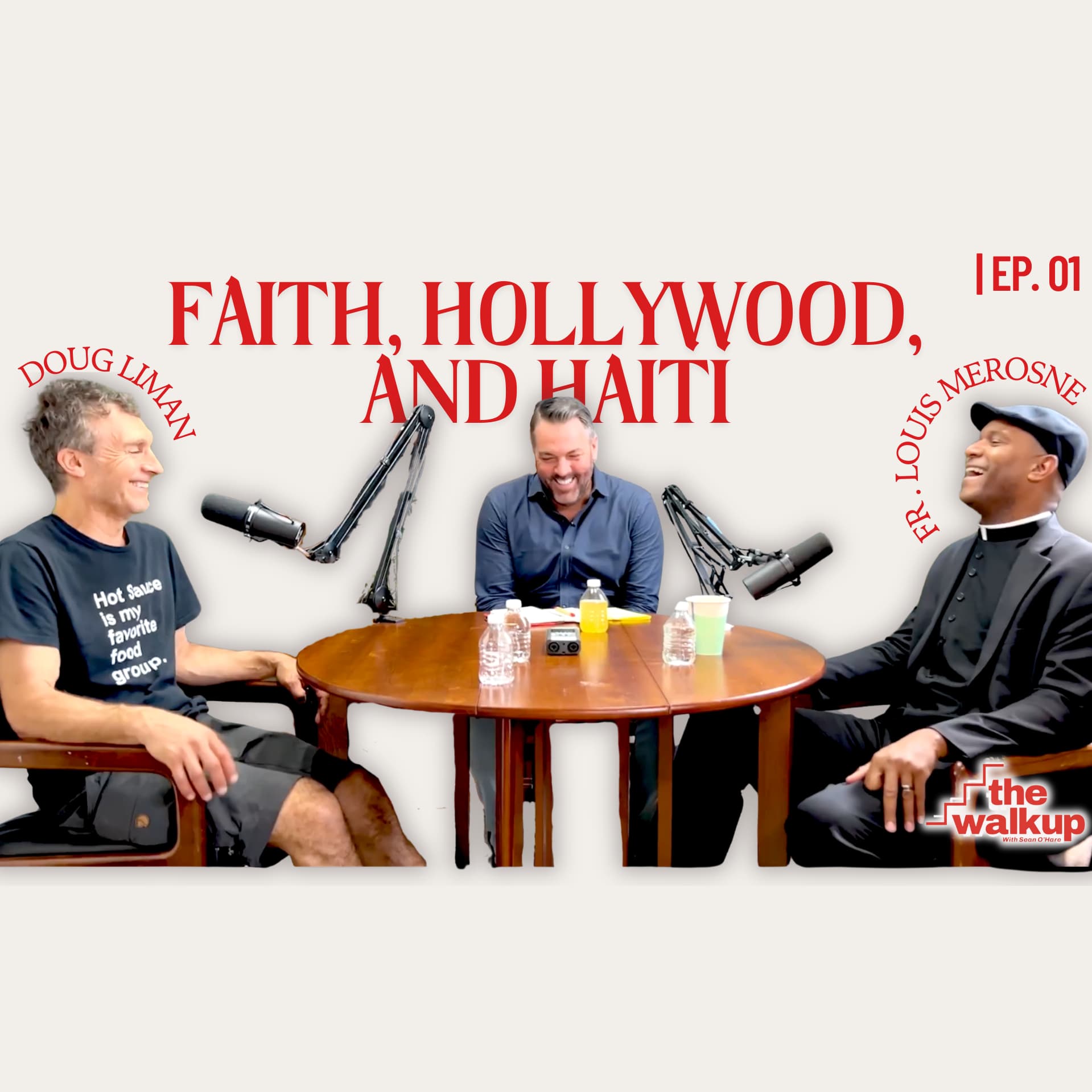
In this premiere episode of The Walkup, host Sean O’Hare brings together two fascinating guests from very different worlds: Hollywood director Doug Liman (Mr. & Mrs. Smith, Road House) and Haitian Catholic priest Father Louis Merosne.
The conversation spans faith, filmmaking, and personal transformation—from Liman’s journey to Haiti after the 2010 earthquake to Father Louis’ mission to bring hope to his community. Can we find objective truth? What role does faith play in arguments and love? And what do Jesus, Muhammad, and… Trump have in common?
Subscribe on YouTube: @TheWalkupPodcast Follow on Instagram: @thewalkuppodcast
Transcript
Read the full transcriptAuto-generated · 18,180 words
So, there is like, you know, just giving them an education, and then there is sort of indoctrinating them into the church. Right. So, where is the needle on that in terms of the schooling for these kids? I love that question. You have got to give me a moment to answer that.
Two things. One, I noticed there is an underlying presupposition, which is... What life is really about is succeeding here on Earth as everyone else sees it, and so that presupposes a secularistic worldview, which has so many good things in it, and which we can include in our own worldview. We just go a bit further to realize, yes, we want those kids to succeed in tech. We want them to make a ton of money. We want to make them the best students.
That's why we pride ourselves on making our schools. The best schools, so if they go compete against the other state schools, we want our students to come out on top, because they have the skills to succeed in the world. Welcome to the Walkout Podcast, where we explore the intersection of faith and culture. My name is Sean O'Hare. On today's episode, we talk with acclaimed Hollywood director Doug Liman, and Father Louis Morosnay, the pastor of the Cathedral of St. Anne. We talk about everything from faith and atheism to Hollywood and Haiti.
I hope you enjoy. Bonjour. Oh, that's right, you both speak a little French. Well, he speaks a lot of French. Moi, je parle français aussi. Vraiment? Oui. Vous êtes? Mais comment ça? Oui, mais je suis américain, mais j'habitais à Paris.
For years? Yes. That's good. Twice. Twice. Did you study there? No, but just after university. That's good. That's great. I went to Paris. Yes. And we can talk about Sean. He won't understand anything. Exactly. Yes. And he likes young girls. I can say that maybe he should give her a little bit of Ozempic. Yes, that's it.
Because we have a series of TV shows that we hope to do together, and… I think you're going to come and say French all of a sudden. You guys, if you want, you guys can just… I can leave if you want to conduct this entire thing. Wait, what? I'm talking about you in your face. We've objectified you enough. Well, if I had a nickel for every time I was objectified by a filmmaker and a priest at the same time. I now have five cents.
Let alone a poor single woman in New York who doesn't understand exactly how Catholic you are. No, the young lady I'm dating now knows exactly how Catholic I am. Well, I'm assuming anyone who's actually dating you learns that pretty quickly.
Well, I find out one way or the other, and this one actually finds it as a benefit, not a liability that I'm super Catholic. We met at church, even. Like, it's meant to be. At church. At the, well, at the social, after the... Oh, my God. At the... Oh, I'm not supposed to say that. No, I mean, well, baby steps. Baby steps, yeah. Well, I already got outed on the way up by, because it's a four-floor walk-up, and I was like, Jesus Christ, and some dude came out of the office and was like, I heard you calling a Jesus Christ.
But at the end of it, you just said… Is that not okay? Well, it would be considered using the Lord's name in vain, because it's sort of like throwing it out there without care. It depends, though, on your intention. My intention was, I ran 10 miles this morning because I'm training for a half marathon, and then I've just been told the studio's on the fourth floor.
Right. Jesus Christ. So, I'm understanding there's a part of you that's frustrated about the steps. But the question is, how do we best express that frustration? Is it to spit out the name of the Lord, or a Lord in which you might not believe, right? But to those who do believe in that Lord, it would seem a bit... I mean, I just would have thought that the people in the church office, whose door was open as I was going by, would be here, Jesus Christ's name being said out loud, and be happy.
Like, if you're working for, like, Robert Kennedy's campaign... I imagine if you just heard his name being said out loud in any way, you'd be pretty happy. Not in any way, because they could also be like, stupid Robert. There's no such thing as bad press.
Oh! There's always just bad press, right? I would argue it's good for the church, for the brand. Well, in a way, actually, there is a level at which you are right, is that there's a level at which you are right. Whether or not you intend it, the name of the Lord is being spread. Now, it is being spread not because it is said respectfully, but despite the fact that it might not be the most respectful thing. I mean, imagine you are that person in the church office downstairs who hears me coming by going, Jesus Christ, four flights up?
Or he could hear, Muhammad, it is four flights up. Which do you think he would prefer? Neither, actually. And the reason he would prefer neither, or he should prefer neither, is like, there are people who have got great respect for Muhammad, and they would prefer, and in fact, they have such respect for that name, I forget the Arabic phrase that they say, but like, peace be upon him, or something like that, the prophet, because they have such respect for him, because they don't want to just say his name out of respect.
Maybe you can find a new replacement, like. Yeah. Four flights of stairs, Alex Trebek, you know, I don't know, something that doesn't, kind of a neutral guy. I mean, it is odd that, like, I don't believe in any of this, and yet the first thing that came to mind when I heard I was going to have to walk up four flights of stairs was your lord and savior. Yes, and that, you're right, that's what I said, there is a way in which this is, in a sense, good, because his name...
Despite us, is being spread. It's a household name. It's a household name. Yeah, he's got a good brain. Actually, I think Trump was very proud when he eclipsed Jesus as the most recognized name. I certainly hope that's not true. Is that true? Yeah, there's something like that. You can fact check me. His Q rating is... Somehow, there were more people on the planet that recognized the name Trump than Jesus. Wow. Well, we've got some work to do then. We do have work to do.
So, as just a way of intro, how do I know these very similarly minded people? Well, so Father Lewis and I have known each other, I guess... Going on three years, we met on the steps of the Basilica at Old St. Pat's in Soho, and then I had the privilege of going down with you to Haiti, on one time, but I went on another time without you.
Yeah, that wasn't cool. Well, you know, you were a busy guy. And then a lot of people... People are confused as to how Doug and I are friends, and then they are even more confused when they find out that we are actually making a TV show together, and that is a little confusing for people, and people ask, how did that happen? I will let you explain how that happened. I am interested to know, too. Well, I live in New York City.
You don't meet too many devout Catholics. In fact, I don't think I've met any, until Sean, who I actually thought, he was living in this convent right by Hudson Yards, you know, this massive building, it was just like four or five single guys living there with like, you know, 40 room house, paying like no rent, and I'm like, okay, this is obviously a scam.
And then, over the course of a number of years, you know, and a number of parties at his house, it was like, you know, and really feeling him out and being like, okay, he's got to, like, he's got to act the Catholic so he gets the free rent, but, like, it's like, oh, he really believes. Yeah. And then I found myself just asking a million questions about his beliefs, about the church, and then realized that, like... I'm probably not the only one with these questions.
Well, that's your version as to why we decided to do a TV show. My version is you sat me down and said, Sean, I've worked with the most interesting talent in the world and the most interesting projects, Tom Cruise and time travel, Matt Damon and CIA-trained killer.
Brad Pitt and Angelina Jolie, spy versus spy, and now my magnum opus is to work with somebody nobody has ever heard of on a topic that nobody finds interesting, me and a 2,000-year-old institution. That is my version, so is that okay if I go out with that to market? Absolutely, yeah.
You are a very good-looking Catholic, objectively. Well, we've been trying to remain humble. That's the other thing that I was sort of just always interested in was, you know, he's like this siren calling these single women in New York onto these rocky shoals, because there's just not a lot of great single guys in New York.
And, you know, they usually come with some kind of baggage, or they seem great, but then there's like, you know, Sean's like legitimately like a great guy, and is like, spends his free time organizing, you know, these shows for people with disabilities, I mean, and it's, he's in a soccer league, so he's athletic, and, you know, like, smart and funny, good looking, like, what more do you want?
So, these poor women, you know, just glom onto him. Yeah. Is there a number they can call to get a hold of him? Well, then they discover that he's pretty damn Catholic. Have you had conversations with these disappointed women, or are you just imagining the cycle that they're going through here?
It's that these relationships, like, take off and then fizzle out after, like, two weeks when they discover how Catholic you are. This is true. So, yeah, I've not actually had a conversation with them, but I'm... Well, unless those ladies are pretty Catholic, too, I imagine. Say again? Unless those ladies are pretty Catholic. Well, yeah, usually, and I know Doug always wants to make every piece of content about my dating life.
Thank you for bearing us off course. I don't know how we even ended up there. Yeah, yeah, clearly it wasn't me. So, the challenge for me is I'm always a little too adventurous for the Catholic girls, and I'm too Catholic for the adventurous girls. But I'm... adventurous I'm actually going to India in a couple weeks for that's the other yeah he's adventurous I mean like he's got he like he hit all like the check boxes of like you know what you want and like a guy and a partner like yeah a lot of those boxes turns out a lot of Catholic girls want this thing called stability which I'm generally not in it not exactly projecting the like picket fence and the you know for kids and yeah really not really my vibe But yeah, speaking of being adventurous, so when Father and I met, because he was helping out at the church in Soho, where we shot with that guy with the Shred of Turin.
I don't know if I told you that. You did, yeah. And I was bummed I couldn't be there. Oh, yeah, that's right. So, we met there. That's like the old St. Patrick's or whatever. Correct, yeah. You were right across from my office, I think.
We shot the interview with Father Andrew. Dalton, the Strat of Turin expert, we shot it in the office. Is that your church? I help out at that church while I stay there for the sake of the office of this foundation. Where do you live? Where is your actual base?
Haiti. Oh, it is? I live in Haiti. I have a church in Haiti. Yes. She has a cathedral in Haiti. Yes. One of the cathedrals. Where? We have 10. A town called Ansavo, southern peninsula of the country, northern coast of the southern peninsula. Yes. So, maybe, yeah, maybe tell Doug a little bit about... Your current balance, why you're going back and forth oftentimes between the States and Haiti. And I've actually spent a little time in Haiti. I heard that. Sean mentioned that earlier, and I think that's pretty awesome.
I love Haiti, obviously. I was born there, but when I was 11-ish, I moved to the States and grew up in Boston. But anyway, so the reason, I went back to Haiti, I moved back in 2010, right after the big earthquake there. And I felt a call to go back, though I had my natural love for Haiti, but I also felt a missionary call to go back and serve God's people, the poor especially, all of Haiti, but especially the poor. I have a special love for them, and I see Christ in them.
I see their dignity as a human person. I also see the face of Christ in them. So, I left everything here. People thought it was crazy to go back, especially after everything was destroyed in the capital. Not everything, but a lot of things were destroyed.
And I think even my bishop, actually, when I told him I was going to go back, that I wanted to join the church there, to be ordained there as a priest, I think he was a bit suspicious as to, what are you really running from in the States? What did you do? Are you getting deported? Is that why you are running back here?
So, I went back, got ordained there, and a priest incarnated, or belonging to, the Diocese of Fontaineville-Méro-Gouin in Haiti. Now, a couple of years ago... Actually, a few years ago, when the Haitian bishops went to the Vatican, the Holy Father had encouraged them to start a strategic plan, to develop a strategic plan to help the entire country, and using all the energies of the Church, and so the bishops, especially my bishop, got together with a pretty awesome firm to develop the strategic plan of integral human development.
A ton of projects, multi-million dollar projects that cover the whole country, 11 different sectors, and it's meant to help really lift up the people and the economy. So, they started a foundation in New York, which is why then they sent me to direct that foundation in New York. So, that's why I was living in Manhattan when I met Sean, and actually did some awesome work with us and for us to help us understand the layout. You know, because I also went to Haiti right after the earthquake.
That is awesome. Under, well, slightly different circumstances that may not warrant you, that is awesome, but I had a crush on a woman who was in medical school. And she wanted to go volunteer down there. Yes. I don't say anything wrong so far. Yeah. And I was like, I will fly you down there, because I'm a pilot.
Nice. I didn't know that. That's awesome. And I was like, this will be so romantic. We'll be living in a tent together, you know, and... So, you're adventurous, too. This will be like the fantastic first date. Yeah. So, that's how I ended up in here. Did it work out?
Well, I mean, it probably worked out the way you guys would want to, where there was no sex. No. We want to get married first, and then you have all the... Yes, we want sex in its fullness. We don't want sex that is fractured. Okay, well, there was no sex of any kind, full or not full. Okay, all right.
So, it was... No partial credit at all was given. But you brought medical supplies. Sean Penn was there, and he was the block. Oh, that's right. I mean, she may not have been interested in me, other than as a pilot, but we'll never know, because Sean Penn got in the way. He got in the way romantically? Yeah. Oh, my gosh. That's awful. Is this something that you want to share with the world?
No, that's enough. Okay, all right. I think you've said enough already. Yes. But I did, that is how I ended up in Haiti right after the earthquake. Very nice. But I didn't have any, but you were there with Avram, right? No, no. What happened was, so I put together this trip to go with Nicole to Haiti, and then right on the eve of leaving, so it was like maybe like a week after the earthquake. It took like a week to sort of organize stuff.
I got a call from Quincy Jones, who said he was redoing We Are the World, which was the song he had done, I think, for Hunger in Africa? Yeah, in the 80s. I can't remember where. It was from a long time ago. Yeah, in the 80s. They were going to redo it to raise money for Haiti. Yeah. It was going to be called, like, We Are the World, Haiti. He said, I heard you're going down to Haiti. Could you film for us down there for this?
The redo of the video. And I said, sure. I said, I'm going down on a date, so I'd like to have like a week, just to sort of, you know, because Nicole's going to be, you know, she was going to try to find a clinic to volunteer in, and then I would be like her sous chef. Like, I'm a little squeamish, but I would, you know, I'd be there to like help with whatever needed, you know, I don't have any abilities in the medical world, but I'd be there to sort of help.
So, I'd like a romantic week in a tent. Helping out, and then I'll do whatever production you need, and Quincy said, no, we need you to start shooting as soon as you get down there, because we're going to try to put this on the Olympics and raise $100 million.
So, he wasn't interested in your romantic life, is what you're saying. If I go into production, it's going to kill the romance of the whole thing. I've seen you in production. It's not sexy. No. And I'm like, oh, shit. What do I do?
But obviously, I had to prioritize, you know, raising money for Haiti, so suddenly, instead of it just being Nicole and I going, now my buddy Avram is going, and a whole production crew, and, like, as soon as we landed, like, Nicole went off, you know, she was going to go volunteer, and I was suddenly in production, shooting down there.
So, what I'm hearing is that you put your self-interests... Second to the good of others. That's pretty sacrificial. That's very Christian. Very Jesus. Yeah, no, I mean, it's just hard to argue with, like, this is going to go in the Olympics and raise a ton of money, and like, you know, like, in terms of, like, making sacrifices, like, that's...
You'd have to be a real a-hole to not do that sacrifice. Yeah, that's amazing. You could have turned it down. You could have said, no, that wasn't my intent. First of all, I did push back initially. I said, can we delay it a week? Right.
And then I'll shoot. Yeah. So, you know, my first instinct was, oh my God, yes, hell. My first instinct was, you know, can I have my cake and eat it too? Sure. Then I was told you can't, so then I did the, then I shot the.
We are the world. I think all of us have a part of us in us that goes through the same process of trying to have the cake and eating it, too. I go through that all the time. I'm sure Sean does as well.
No, I'm actually always just selfish. Even my selfless things are just a way to attract more women into the chaos. I'm curious about Louis. Yeah. You know, just because we went to Lisbon last summer, and we met a nun, and I sort of asked her what she does for fun, and she was like, oh, I work in a food kitchen, soup kitchen. Right. And I was like, no, no, I asked you what you do for fun.
She was like, you know, I work in the soup kitchen. I answered your question. When you say, when you're like, cake and eat it too, I'm curious, what pulls at you? So, there are two different questions. What I do for fun, and trying to have my cake and eating it too. I do a lot of things for fun. I love watching good movies. There's a few that are my favorites that you might know of. And I love going on YouTube. I love playing.
With kids, I love... At my church, we have several different programs. This is your church in Haiti? In Haiti, correct. Several different programs in several different villages, and we have kindergartens. We try to open schools in each village to try to help so that those kids don't have to get on a motorcycle in the dust, in the rain, to get to another school somewhere else. So, we start slow.
And just being with them is amazing, and joking around, playing sports. I just ask you, and then I want to get back to that, but so you open this church to help the kids, which is incredibly, incredibly noble, especially in Haiti, where the infrastructure is so collapsed. Right, right. But like, you know, the suspicions part of me is like...
How much is it about educating these kids so they can just have a vibrant life and get a job in tech or whatever, compete? We're in an international world now with the internet and stuff. They could easily be coding for Google. You don't need to live in California to code for Google. You could be in the south of Haiti.
So, there's just giving them an education. Yes. And then there's sort of indoctrinating them. Into the church. Right. So, where is the needle on that in terms of the schooling for these kids? I love that question. You got to give me a moment to answer that. Two things. One, I noticed there was an underlying presupposition, which is...
What life is really about is succeeding here on Earth as everyone else sees it, and so that presupposes a secularistic worldview, which has so many good things in it, and which we can include in our own worldview. We just go a bit further to realize, yes, we want those kids to succeed in tech. We want them to make a ton of money. We want to make them the best students. That is why we pride ourselves on making our schools. The best schools, so if they go compete against the other state schools, we want our students to come out on top, because they have the skills to succeed in the world.
And, also, to help them realize this world is not all that there is. In fact, it's a pretty sad state of affairs if this were all that there is. And so, we have good reasons to believe that there is a God who calls us to more than just material things, which I think you believe in, too. You do believe that there's way more than just the material things. That's why you do these noble things that you do. And so, we don't force anything.
There's a girl involved. There's a girl involved, of course. No, I understand. But remember, he gave up that. I gave it up. It was not to impress. It was the opposite. Exactly. Having Avram show up in Haiti. There's nothing sexy about that. I've also seen him with his shirt off. And especially not sexy.
He's a very, he's a cuddly. He unfortunately didn't live long enough for his epic. Yeah, that's true. He could have really benefited. What do you think, he would have used it? I don't know. I don't know if he was into medication. Okay, so there's training these kids for what's here on earth that we can see, like getting a good job coding for Google.
And then there's, like, training them for, like, what might come after. Correct. We invite them to it. There's no imposition, and you know how we know that. It's because we don't impose Catholicism on the kids that come to the school. But which is more important, what's here on earth or the long term? Oh, definitely the long term is more important, if you will. However, we don't get there without going through what's here on earth. That's why, in the Catholic worldview, our feet must be planted squarely on the ground.
That's why we have... Why not do it the other way, like prioritize what is here on earth, and treat what is after as sort of like dessert. If it exists, great, but you can have your meal and skip it too. Sure. There is only one good reason why we couldn't. It is because what is after is not just dessert. It is eternity. Yes.
That would be like, you just ran 10 miles this morning because you are training for a marathon. That would be like, well, instead of slowly building up to 26.2 miles, you just kind of like, you know. Ran around the track every couple months. You are not going to be ready for the ultimate reward, right? So, the spiritual battle is a lifelong one. It is one that is… So, how do you respond to people like me who worry that religion is the opiate of the masses?
Oh, to get them to accept horrible conditions here on earth, because don't worry, later on it will be good. Right. I embrace people like you, because I think you have a right to not only believe, but… Express what you believe. I think it's coming from a deep part of you, and it's my responsibility to think about that, not just push back, but to take it in and to say, well, is religion just an opiate for me, for example, and has it just been used that way in the past?
I am sure that religion can be used that way. I mean, I really worry about it in terms of Haiti, because it is, I've just... Those poor people are living… Under some of the harshest conditions on the planet. The income disparity in the United States is one thing, but when you start traveling in the world, and you're like, I can't believe we all live on the same planet, and some people get to live here in New York City, and you're actually living this because you're going back and forth.
The level of abundance in a place like New York City, and then what I was seeing in Haiti. Yeah. And you're like, how is this the same planet? Yes. Even more scandalously, within the same church, we have those same realities, and it's a scandal. It is scandalous. How are we the same church? The early Christians, you know, they put everything together and said, you know what, let us help one another so that there was no one in need. We do not quite do it that way.
What do you mean? Well, in the beginning, yeah, they would really just take out the resources from the local community, and it was kind of distributed based off of needs. So, there was almost trying to take Money out of the equation, right? To some degree. To some degree, yeah. And what happens now? It is also, well, what happens, I think a lot of people are greedy. Not everyone. I think a lot of people just see themselves. They do not realize the Catholicity of faith.
You are saying a Catholic church in New York is rich, and a Catholic church in Haiti is poor, and the rich one is not sending any resources to the poor one? So, not specifically those, but in general, I think there is something like that. They are trying to bridge that gap, for example, through... There are twinning parishes, whereas a parish here might have like a sister parish. By parish, I mean a local church community.
Yeah, my brother did that. My brother lived on the border of Haiti for nine years. And I have a parish in the U.S., for example, in Florida, that said, you know what, let's be a sister parish to you. They came after the earthquake a couple of years ago, no, after Hurricane Matthew. They came down, and you know what was cool with that relationship is that after a hurricane, that... Really, that killed them. We didn't have much money to give them, but because we're sister parishes, we flew up with coffee.
With rum, good Haitian rum, with candles, the little things that we do have as a sharing of ourselves, we flew up and helped clean up. And again, so it was a true mutual relationship, and I think that is one way of doing it. I do not think we do it enough. I think we get comfortable in our comfort, and we forget about the others. Now, of course, I say within the Catholic Church that is this, but I think one of the cool things about the Catholic Church is that We tend to not look at your religion to help you.
We see you as a human person, and so we want to help you. Going back to the whole school idea, we see a student, and we say, you don't have to be Catholic to come to our school. We have Protestants, we have voodoo practitioners, and we invite them into something, but we left them up with their freedom. We don't force them to come to church every Sunday. So, how much of the curriculum is secular, and how much is religious? Oh, I would say the great majority of it is secular, if you will.
But if I quote rather. But the reason I put quotes of it is because everything, every knowledge we believe comes from God. And so, when we're learning algebra, we believe that's a truth that comes from God. When they're learning about, you know, the fossils, we believe that's science. Everything, that's why there's no contradiction between science and faith, between reason and belief in God.
If God really exists, then he is the source of all reality, and so all reality comes from him and leads to him. So, that is why I put the quotes. It is seen as secular, but even in a public school, for example, teaching literature or teaching biology, in the most secular school possible, I still think it is a sacred thing in the sense that it comes from God and it leads back to God.
Maybe just give like a current state of heat. Do you see Darwin as secular, coming from God? It depends. If Darwinism, if it claims that there is no God, then that would be definitely secular, because that came from God. Yeah, but the evolution, survival of... Yeah, evolution is actually a theory that can be embraced by Catholics. In fact, even up to the popes, they have written about this saying, no, it is compatible. With Catholic theology. Including that humans are part of evolution.
Correct, correct. That we share DNA with apes, and that we've evolved from them. That's a possible theory that a Catholic can embrace. But at some point, there's an effusion of the soul, I would think. Correct, and that's why we make the distinction, is that at some point in that... Either God created the earth in six days, and like...
Humans just existed, or they evolved. No, the Catholic Church does not. We promote that the six days of creation were literal 24-hour days. We have a rich history. It is not just a modern thing, like, you know, after evolution theories came out. By the way, evolution doesn't talk about the origins of the universe. It talks about how life got to where we are with the starting point, but it presupposes a starting point.
And the Big Bang Theory was developed by a Catholic priest. You know, the Big Bang Theory? Father George Lumet is the one who discovered the Big Bang Theory. It's beautiful. So, what I was saying with the six-day creation thing, there are some Christians who believe that creation was done only in six days. The Catholic Church has never really embraced that. We've always seen that part of Genesis as poetic theology, if you will, as God making a point that the scriptures making a point that God is the source of everything, but not the number of days it actually took for all things to come about.
We know that, for example, because Even though from the very beginning, light was separated from darkness, but the sun, or we start counting days, the sun didn't come about until, I believe, the fourth day. But sun is the source of light. So, it is clear that the authors were using symbol to describe something deeper, which is, he is the one, God is the source of all things, and is for him and for us, for his glory, but is given to us.
Mankind, this wonderful gift of creation. Yeah, I was just going to ask, try to give us a sense of the current state of Haiti, and then maybe talk about, if you are comfortable talking about what had recently happened with your bishop, Bishop Dumas, who I traveled with, Father Lewis and Bishop Dumas, down to his diocese last year. But yeah, I was just going to give us an overview of where things are at.
Yeah, so Haiti is always a beautiful topic, complex topic to discuss. I always don't want to start with, we were not always where we are today in Haiti. Haiti, of course, made history. By being the first black republic in the whole world, the only nation, the first and only nation to be formed by slave rebellion, were the second country in the Western Hemisphere to declare independence. The first was the U.S. in 1776, and Haiti in 1804. Very soon after. And not only do we have an impact on us, but also on the whole world, even on the U.S., because the Louisiana Purchase happened as a direct result of the Haitian Revolution, because Napoleon realized he had an undefeated army and then was defeated by these poor Haitian slaves, and so he sold Louisiana to the then U.S.
For pocket change, which more than doubled the size of the U.S. at the time. So, Haiti had a huge impact on the development of the U.S., and also such a great people. Pay money to ship captains that would go to South America, for example, where slavery was still active. Any runaway slaves that they got and brought back to the land of Haiti, no matter where they came from, the moment they touched our soil, they would gain not only independence, but citizenship, and money would be paid to the ship captains.
That is how great a nation that we have. They fought for that freedom, and we have dignity. They didn't care. Liberty or death, that was it. Now, of course, 1825, France came back with warships and said, hey, buddies, remember how we enslaved you? Remember how you beat us? Well, now you're going to have to pay reparations to the slave owners for their losses. What?
What the heck do you mean by that? Haiti was forced to pay. We couldn't go back to war. We were on our knees. We were forced to pay up to 150 million francs, which today would be about $22 billion, with interest up to $150 billion. They just took that money. How can we develop?
When we have to... Oh, by the way, we didn't have enough money, so we had to borrow from what? French banks. I love France, and I love French people. The double debt. Yeah, absolutely. That history, though, is very important to understand how, from the beginning, it's like you're punished for your freedom, and now there's a movement to ask France, could you pay that back? We're not asking for reparations.
We're asking that you give us back the reparations you took from us. Yeah. That would be just and necessary, I believe, morally necessary. But getting up to today, we had some awful politicians, some awful leaders who... Love to take things for themselves, understandably. People like to survive, right? And so, they figure, let me just grab all this, put it in my pocket, and give it to my family so we make sure that we survive. So, a lot of corruption, including international pressures, etc., that lead to the chaos that we have today, where we have a ton of gangs that literally are controlling the capital.
They say that 80% of the capital is under the control of gangs. That is why I I can't go there. I can't just drive through Port-au-Prince, for example. When I was there, it was just like City Soleil was the only place that was sort of under gang control. Right. Yeah, but now, it's everywhere. Yeah, when we went to Neap... Of course, Adam got lost and drove us into City Soleil. Did he really? At night.
How'd that work out? Yeah. I mean, we're still here. Amen. Jesus, I'm sorry. Of all the places to get us lost. Yeah. Yeah, I know, right? GPS was not really as much a thing, or what? GPS, yeah. Oh, GPS, yeah. Yeah, because when I went down there...
My father was explaining to me, you know, oh, well, his diocese of Neeps is not that far. Maybe, what, an hour and a half, two hour drive from Port-au-Prince? Yes, about two hour drive from Port-au-Prince. But, because the gangs control the capital, you can't drive from Port-au-Prince to Neeps. Instead, we have to fly to Lakai, and then drive back, which is like saying, it's like being in New York City and saying, I want to go to Connecticut, but I need to fly to Boston first and drive back.
Exactly. Because it would be too dangerous. You wouldn't get out of Port-au-Prince. To get from the airport to the outskirts, that's the danger. Well, they would stop you, and then they could then... That's right. But how about you? Ransom.
Me, personally? Yeah, I mean, they're not going to screw with you. Oh, yeah, they will. How do I know? Because they've kidnapped other priests and nuns. They don't care who you are, and brothers. I mean, in some ways, you could argue they're more of a target because they know there's an institution behind that collar. A lot of it is for money. Again, undistinguishable. I hate what they do, but I love the people. I think they too are victims. I'm not letting them off the hook at all, but I do believe they are victims too, and that's why those who make them victims should also pay these politicians that used them, that gave them those guns in the first place to sort of do their own dirty business.
Those people also need to be held accountable. But meanwhile, you also love them. Of course, because they're human beings. Is there anyone you don't love? I don't think so. Anyone on this table? Hitler? No, I don't think I hate Hitler.
Obviously, I love living in his time. I absolutely abhor what he did. Vladimir Putin. Do you love Vladimir Putin? I do. I do. What is love? Kim Jong-un. Yes. Yes. My goal is to love every single person, because every single person is meant to be loved, not used. That is John Paul II's personalistic norm, which is that tools are meant to be used, but persons are meant to be loved. Every person is made in the image and likeness of God. People can do some horrible things.
Which we should condemn. And, by the way, though I love them, but if someone were to come in here and they pull a gun and they're about to shoot you, if I had one on me, I'd shoot him first.
And I wouldn't be like, oh no. I mean, it's too bad that he had to die. It's not my intention that he dies, but it's my intention to save you. And if my stopping him... Also leads to his death as a secondary effect. Well, then, so be it. But I will protect you, the innocent.
Even though I've shot him, I still love him. What is love? It's to will the good of the other. And that's expressed... To what of the good of the other? To will the good of the other. Will the good of the other? Yes, I want what's good for you. And work out. However I can to give you that good, or to make sure that you get that good, to facilitate it. So, that's love. Love is not just, and it's not just for my sake.
To love you is for your sake. That's what true love is, but unfortunately, I think the world doesn't quite understand that. Jesus showed that love to us by willing our good, even when we were the ones persecuting him.
And then, if you would share, just on a personal level, what has been going on with Bishop Dumas? My bishop, yeah, he is the one who also loves people. It is funny. Well, first of all, I have to share a story about Bishop Dumas. So, we were at the cathedral when I went down to visit, and the bishop has dinner, and it is like 15, 20 people, this long table, and everybody together for dinner, and we are all having a great time.
And then, at some point… Bishop Dumas says, okay, and now we play Jenga. And I said, wait, what? This is the Jenga portion of the evening? And so, we have the Jenga puzzle, and even though it was like 20 people, we came around one by one, you know, and then he's like, okay, and now we dance.
And so, we're dancing. Put on the music. Yeah, I mean, I was like, I mean, the rum helps. And by the way, are you dancing with the bishop? I was dancing with one of the nuns, actually. It's just, the Haitian people, I mean, the joy, I mean, it's infectious. So, all that to set up who Bishop Dumas is, just a personality that just radiates joy. 100%. And he doesn't go back and forth. He just lives down there. He lives down there.
He travels a lot to his Haitian. He travels a lot, too, because people love him. He speaks the truth, he's authentic, and he doesn't care who you are, even politicians, if there is something that needs to be corrected, he'll say it. And that's why some people believe that his recent burn... He got burnt in an explosion. About almost 40% of his body was burnt. First, second, and third degree burns because there was an explosion in his apartment in Port-au-Prince, and people are scratching their heads wondering, is this accidental or is this criminal?
The investigations are still ongoing, but... Unfortunately. So, he is the bishop for all of Haiti? No, he is the bishop of the diocese of Assavo in Maraguan. We have 10 dioceses, so he is the bishop of one of those. So, why did he have an apartment in Port-au-Prince? Because Port-au-Prince is the capital, and so everybody goes to Port-au-Prince. All the meetings where the archbishop is. But it is not his home. His home is... In Nips, in Assavo. Correct, yes. But because he stays there regularly, it becomes his home in that sense.
But yeah, so he got real burned in that explosion. We had to airlift him to Miami to get care. He's still getting care in Miami out there. This happened in February. Was he the only one injured in the explosion? Correct, yeah. He was the only one at the apartment. Like a gas explosion leak? Well, some people have that theory. We just don't know fully. Some people think there was a bomb.
You think it would be pretty easy to figure out if it was gas or a bomb. Well, the authorities haven't said. Unfortunately, and they're investigating. So, is he still recovering in Miami? Here's the beautiful thing. He's still recovering. Bishop goes... Whatever. You know, if it was criminal or not, the good thing is I am alive, and I will continue my mission. He will continue to announce the good news of Jesus, of the beauty of creation, of the human person, of loving people.
What is the good news of Jesus? The good news of Jesus is that God made us out of love, out of an over-outpouring of his love, that we are good. So, he is in his church down there, and he is like, hey guys, I got some good news. Well... Sometimes he says it like that. Other times, he expresses that through different works that he does in showing that, no, God loves us that much that even though we are sinners, he sent his son to save us so that we can be reconciled to him.
Have you heard this phrase before, right? Have you heard the good news, or here to share the good news? Is that a phrase? No, I think it is new to me. Oh, okay. He said gospel, I am sure. Gospel just means good news from the Greek, and the good news is that even though we are sinners, and all this craziness is going on, God loves us, and God wishes to save us, so that he can both transform this world, and give us eternal life in him.
Is there a bad news? Because the kingdom of God. Yeah, the bad news is we are separate from God in our sins, and we can't save ourselves. That's bad news. There's nothing we can do to save ourselves because we have chosen, because God gave us free will, we could say yes to God or no to God. And in saying no to God, we separate ourselves from the source of life and joy and happiness. Yet, God wants happiness for us. We're made for happiness.
And so, the good news is we can still have this happiness. Through his son, Jesus Christ, who came to die for us and rose from the dead for our... But you can also be pretty happy without Jesus and God. You will never be happy without Jesus. I mean, I am pretty happy. Yes, you have good feelings, I am sure, and happiness, let us define our words. By happiness, I mean the total satisfaction of all desires.
This can only be had... With what's called the beatific vision. Yes, the beatific vision in having all in all. You see, you have desires that will never be completely satiated on this earth. I guarantee you. They can only be satiated by an infinite being. That's why when you're having a good time, you just want more good time. More good time. And that's good.
Your desire is telling you that you are made for more. What is the more that you are made for? It is God. And only he, who is infinite goodness, can satisfy you completely. So, I am happy, too, here. St. Thomas Aquinas made a distinction between the perfect happiness that we will have in God and imperfect, the real happiness we can have here, which he calls felicitas in Latin, or felicity. But we have this especially through the virtues. The virtuous man is a happy man, and the non-virtuous man, who has vices, will be unhappy.
The virtuous man is the one in whom you see prudence, justice, fortitude, temperance. When you see those lived out and all the other virtues that come under those umbrellas, you will see happiness in the person. But the one who lives by vice or vices will be enslaved to those vices, and they can't be happy. Even their free will is a bit compromised, in chains, if you will.
Even hot sauce can't save you. Though it's a gift from God. It's a great gift. I love hot sauce. Hot sauce makes everything better. Absolutely. Thank you. Yes. I wish everyone knew that. What was the ultimate takeaway for you when you, after, okay, so you went with certain motivations to Haiti, back to the earthquake, but then you ended up going there. So, what was your takeaway when you ended up engaging with? The Haitian people understanding this obviously terrible natural disaster that happened.
Looking back on it, did you have a takeaway besides don't bring girls around Sean Penn? I mean, that's... That's the main takeaway. That was a primary takeaway. Or maybe it's all guys named Sean. We're just... No, no. Sean?
No, I mean... I mean, the takeaway was, you know, I mean, the devastation was horrific. And I was thinking like, okay, you know, the international community is here, and they're going to help try to rebuild, but it's like, you know, we were living at the Port-au-Prince Country Club, you know, we pitched our tent on a tennis court, and there was like the... 82nd Airborne had another tennis court where they were stationed, and they had their tents, and then the actual golf course had maybe about 70,000 people living on it, in tents, and, you know, there was, because nobody, you know, the buildings either had collapsed or they were completely unsafe, and you're like, how is this, how is this ever going to get fixed?
And then I was thinking, like, even if you could fix this, You know, like rebuild, you know, rebuild the structure so it's safe for people to move out of the tents and the golf course and back into wherever they were living before that. Like, it was bad before this. Yes. Like, trying to fix what happened during the earthquake and get back to what it was before? Yep.
I was like, it was horrible before, and now it's... So, I'm like... Exactly. You're just like, oh my God, this is... Sorry. No. This is a... This is just not solvable, and the level of suffering, and again, that sort of... When I look at that, and I'm like... Where's God? Is that part of what you're... Believe it or not, I wasn't actually thinking about God. Okay. But I was thinking about just how unfair the planet is that, like, we get to live in the United States, and like, you know, on like a beautiful winter day when the snow is coming down, and you're like, this is, they don't get that in Haiti.
Right. They don't get, you know, like, and... So, just the profound unfairness of it, but also just the, this can never be solved. Like, in a best-case scenario where you fix the destruction from the earthquake, which in and of itself seemed unsolvable, even if a miracle happened and you could get them back to where they were the week before the earthquake, that was not a good place. Right.
So, you know, just, and this is just like one little slice of the planet. You could go to Somalia and find, you know, you could go all over the planet and find different places where you're like, and you don't need to leave the United States, by the way, to find places where you're like, how do we?
It is so unfair that these people have to live under these conditions. I agree. Thank you for sharing that. As a Haitian person, I feel supported, seen, if you will. Sort of empty words, though. No, I don't think it's just empty words. It's up to you, though, whether or not they'll be empty. But I feel authenticity in your words.
No, fair enough, but it's not, there's no action associated. I call it empty because, like, where's the... What did it lead to? What did it... I mean, obviously, the video raised a lot of money, but still, it's... Yeah.
By the way, I looked it up, the We Are The World. Well, I have a Haiti video with 325 million views. I'll have to look up how much it raised, but you played a small part in it, and I'm assuming you didn't get paid for it, so that's an act of charity, right? But that's why I get a little suspicious, because there's a version of telling these people, like, What's happening here and now, we can never fix this, but just tough it out, and later on, it'll be good.
Don't worry, Jesus loves you. There's a couple things I'd like to say to that. First... Earlier, you had asked about the opioid thing, whether religion is just that. In a particular case like this, so I said, I think people can use religion as an opioid, and I think maybe some religions are used that way. And where Catholicism stands, and Christianity in general, The reason I don't think that's just an opioid is because I believe it's a true one, and secondly, Catholicism encourages us not to escape from reality, which is what opioids do, but rather to plant a square in reality, take it all in.
It would be a slap to God's face to escape from reality. We're not called to that. Catholicism is a very incarnational religion. We get in the stuff, in the dirt. Like the Mother Teresa says, we don't just stand back and look at the dirty person on the streets. No, she goes up to, embraces, and when that person says, why? People, I have to ring a bell. People have to run away from me when they see me. I'm dirty. I've got worms coming out of my body.
Mother Teresa says, I see Jesus in you. You are beautiful. I embrace you because we get in the dirt. We get with the people in the midst of things, and so that's why it cannot be an opioid because if it is an opioid, it does the opposite, but it does help me understand the meaning of this reality. Again, it's not an opioid for you, but for the person you're hugging.
You know, who really needs running water so they can clean up, and instead you're saying, I see Jesus in you, I love you. And I give you water. Well, that's the, I'm worried about the latter, you know. Perfect. Faith and works. And that's what the church has been doing for 2,000 years. Some cultures have been converted because they're like, we don't treat our sick people like those Christians do.
Like, they actually love those people, and love is an action word. It's not just empty words. It's, can we get down to this? The Catholic Church is considered to be the biggest charitable organization in the entire world because of all the charities, all the hospitals, all the soup kitchens, and all the religious communities where people literally just give their lives for the sake of others. That's what we do. Yeah, like the nun that you left, or that you met.
Her fun activity is hanging out at the soup kitchen. Exactly. She's like, we got pretty crazy. We got 500 meals last week. There are cases where I'll see somebody, I have nothing to give physically, and I'll be with them, but that's not nothing.
Being with someone in their suffering is a huge gift. I can do at least that. And it is true that this world is not all there is. And so... And that does make it good news, too, to be like, that unfairness, I know it'll be solved. It doesn't excuse me from doing work here and now, but it does comfort me to know that truth, and I want you to know that truth, too.
I struggle with it, too. I mean, I struggle with, like, even the... Philanthropic and charitable, things I have been fortunate to be a part of, it still feels a little bit like tourism. There is a part of me that is like, okay, I went to Haiti twice, going to India in a few weeks, and you can get some pats on the back, but it is like, yeah, but I am not doing what that nun is doing. I am not doing what our friend Father Augustino, who you have met, is doing in the Bronx, things like that.
We are living, and so that gets the idea of like, It's a vocational call, right? Right. I know, Doug, you're always fascinated by, like, why did, when you meet a priest, why did they choose this, right? You could have, meeting Father Lewis, you're like, oh, this guy probably could have started a successful business, made a lot of money, and given away that money, right? And maybe that would have, in a very... Or not given it away. Or kept it for himself, yeah.
So maybe... Maybe give us a kind of an insight as to why did you choose this particular way of following God? I chose this particular way because I think I've been chosen for this particular way, and the way I feel that I've been chosen. I have no infallible way of knowing this.
I didn't sit there and hear God say, Lois, you will become a priest. I didn't hear that at all. However, in my daily relations with people, with my family, with my culture, with the church, And with others who saw in me, you know, this guy might.
Be a good fit for the priesthood, but also, that wouldn't be enough, though. Internally, I had a desire, an attraction, too. Sort of like you. At what age? Early on, but I know at 14, it was very clear. And you were still in Haiti at 14? You were here? I was here in the U.S. Came back at 11, you said. Yes. So, I know it was earlier, because I had written in my, I had an ESL class. I don't think they call it that anymore.
English as a second language. And I remember writing that in my little journal, Learning English, that I want to be a priest in the future. This was before 14, and the teacher laughed at me, and I thought, oh, why is she laughing? I thought this was a good thing, but I was not discouraged. It is funny. I went back afterwards, after I became a priest, and said hello to her. But this was... In elementary school. But unfortunately, I do remember seeing a priest and thinking, wow, I could see myself doing this.
And there is this passion in me to do this. And so, I had a passion both to share the good news, to proclaim the gospel of Jesus, the person of Jesus, and to serve the poor. ...felt an attraction to the priesthood. And the attractions are important. They're not all there is, but you put it all together, being attracted to it, the consistency of it throughout the years, other people seeing it, and then you submit that to the church, and the church will help you discern, are you really called?
Because it has to be a two-way street, just like when you are dating a girl. Just because you think you should marry her, doesn't mean she has to marry you. She also must think it, so to when you are... Thinking about becoming a priest, for example, both you and the church have to discern, you have to discern each other, and eventually that might come to fruition in ordination to the priesthood, and that is how it was for me. That is a good thing you had not met Sean Penn.
He might have... He might have stolen the church. Surrailed you. It is 1230. So, maybe give Father a little bit, like... You're expressing a little bit of your worldview through your questions, and the dynamic of our TV show as a skeptic and a believer, but you do have some religious background. Maybe help Father explain what did you grow up with, or at least what exposure? I celebrated Passover, so I grew up Jewish. I am Jewish. I'm an atheist, but I believe in the tradition of it.
And I just see these stories as like parables or fables or, you know, and that there's a... And in general, like, my view of Judaism is it doesn't require an act of God. What doesn't require an act of God? Judaism. Okay. You know, like we... You know, when my father died, and we were, there's a mourner's Kaddish that Jews say, and it's a prayer I've heard, I'd heard my whole life. Sure.
And, you know, it's in Hebrew, so I don't know, I can read Hebrew, so I can turn words on the page into sounds. Sure. But I can't turn those sounds into words I understand. Right. So, you're just uttering these sounds. Yeah. Yeah. And the way you, you know, if you don't speak a language, but it uses our alphabet, you could read the words, but you don't know what you're saying. Right. So, I'm, you know, so when my father died, and it was, you know, it was, you know, a really, really tough time for me, and I was, you know, you say the Mourner's Kaddish, like, a lot around the time someone dies, and then...
And then it becomes something that you say, like, you know, once or twice a year, but, you know, in the days after someone dies, it's being said a number of times. Can you recite it still? Yeah. Okay. In Hebrew?
Yeah. I just don't know what I'm saying. I mean, I don't know. But at the time when, you know, I was in so much pain, I was like... I'm going to look up a translation of this to see, like, what am I actually saying, because maybe that will help me. Right. And I found a translation of it into English, and you're basically saying, over and over again, God is great.
Over and over and over again. And I'm like, like the whole prayer is basically, God is great, God is great, God is great. I'm like, what the hell is this? What's so great? My dad had just died, yeah. Am I allowed to say what the hell is this, or am I allowed to say what the hell is this? I think H-E double hockey sticks is what we go with.
So, I'm like, but it sort of hit me right in that moment. I was like, oh, at the moment when you're sort of at your most down and most likely to sort of think the world is unfair and bad.
This prayer wants you to say the opposite, and so in that moment, I was like, oh, I am supposed to appreciate all the years I had, as opposed to resent all the years I am not going to have, where it is a glass half full versus half empty. Sure.
So, I was like, oh, there is a lot of wisdom to that prayer, and it really helped me in that moment. To go from being so upset to suddenly at least appreciating what I had had, because there's a million people out there, millions of people out there, who never had a father like I had. Wow.
And I thought, you know, nowhere in any of what I just talked about. Right. Is there actually a God? Right. Like, you are saying God is great. Right, right. But what you are really saying is, like, the world is great. Like, I am appreciative of what the world has given me. Because I would have thought that Mordor's Kaddish would have been, like, talk about an afterlife, and please look after the person after they die, and there is none of that. Right.
It was just, so that is what I am saying, like, I was like, Judaism for me. It's, you could just substitute the word, for the word God, like, the world. Right. You know, because you're never actually asking, like, a sentient being to do something.
Like, nowhere in the Mourner's Kaddish, which is like, really, the most sacred prayer in our religion. Nowhere are you actually asking a sentient God to do something on behalf of. There are other prayers that are said, you know, once a year on the anniversary of someone's death, where you commit to do acts of kindness in someone's memory.
Like, nowhere in the prayer is it like, oh God, please, you know, make sure that my father up in heaven, you know, has plenty to eat. Like, there's no God, it's just in the memory of the person you love, do good things here on earth. Yes. So, that's my relationship to religion. It's why I can be an atheist, but also believe that the...
The traditions, not just the traditions, but the rabbis and the Jewish scholars over, you know, it is a very old religion, over thousands of years, have thought of ways to help humans deal with the things that are almost insurmountable, like coping with death. Yeah, absolutely.
Thank you. Thanks for sharing about your dad. When did he pass? That is a long time ago now. 1997. But it seems that his memory is still very real for you. As you were talking about it, I was looking at you, and I could tell you were connecting, because he was that important to you. I appreciate that. I feel like I have met him through you.
Yeah. I would love to learn that prayer, too. I think it would be awesome. I might not be able to recite it in Hebrew, though. I don't have much. Well, you already speak three languages, I'm sure. Is there only three? Three. Three, yes. I would love to learn Spanish, too, but not yet. English, French, and Creole.
Yes. In fact, I don't know if that would mean much to you, but... We do believe that we can pray even for the dead, and so, actually, that is actually a part Jewish, we got it from our Jewish brothers and sisters, the idea, it was passed down to us, to be able to pray for the dead, and so, I would love to pray for your father, and so, in fact, I will offer mass for your father, which is the greatest prayer we can do.
So, after this, if you do not mind, give me your dad's name, and I promise to pray for him. But to be honest, That doesn't bring me any comfort. Certainly. I understand. But I appreciate the affection. You here and now, and us having this connection means something to me. It means to me, too. It means something to me, too. And I only expressed it, one, because I'll do it, and two, as a way also to show you that I am connecting with you.
And it's like saying, you know, like a child wants to show you that they love you. They don't have much, but they get their favorite teddy bear, like, I want you to have this. Yeah, no, that is how we see it. You might not care about the teddy bear. No, it is the tool you have. Right, exactly. And it is the best I have, which I want to offer to you. Do you make a distinction between an agnostic and an atheist?
Yes. Okay, but you would say you are not an agnostic, you are an atheist. Yeah, I think agnostics are kind of wimpy. They're like, God doesn't exist, but in case I'm wrong, I don't want to get struck down, so I'll just say I'm an atheist. So, traditionally... I'm like, just commit. Right, I agree. If you don't believe he exists or she exists, just commit. We have that in common. So, to the question, does God exist, it seems there are three answers.
Yes, which would make you a theist. No, which would make you an atheist. And I don't know, which would make you an agnostic. So, you would choose... The no. No, God does not exist. Yes. What would you say? I don't know. Okay. I would say he does not. Sure, she does not. I understand. So, you seem to be very thoughtful. Man, do you feel like you have some reasons to put forth for the fact of that statement that God does not exist?
Yeah. Like, we started talking about evolution. Right. And so, if you believe in evolution, as I do, and it sounds like you do. Yes. So, we evolved, you know, from much simpler creatures. Yes. As did your pet dog, you know. So.
Does that mean everything has a soul? Because it is sort of hard for me to imagine we evolved and then suddenly there was like a light switch and a soul came, so then you are like, okay, so everything has a soul. Yes. And then everything that has ever lived on earth has a soul, and you are like, you get awfully crowded in heaven for all that stuff. Oh, I see where you are going. Yeah. Especially since it seems to be that you, Catholicism.
Doesn't ascribe a soul to... To a dog. Not a rational soul, but we'd say dogs have souls. A soul is the principle of life in any particular thing, or it's the form that connects with the matter, if you will.
So, like a plant would have a plant soul, if you will, but that's not an immortal and rational soul. We believe only humans have, in terms of God's creatures on earth, humans have rational And immortal souls, and so... They can make moral decisions. Correct. We would go to heaven. So, heavens could have pets. God could make pets in heaven as well. But we don't necessarily commit to the idea that, you know, all pets will have to go to heaven. Doug's mainly concerned about his goat.
Is pet code Ruby? This is really more about that. Well, all I know is this. If you would need Ruby to be happy in heaven, you will have Ruby in heaven. So, that is... I am just going to try to make her as happy as possible here on earth, and then, you know... Yeah, that is good. Recognize that her future is probably in a hole that we are going to dig on the property. Yeah, I think that is probably the case, that she is probably not going to have an immortal soul to go to heaven.
But, yes, if you were to need him in heaven, God could do something to make it happen. You know, because I like to, I am like, where is the proof there is God? I think there are good reasons to believe in God, which is why I was asking… Well, it depends on what you want as proof. For example, this world, you talked about evolution, which presupposes something. It presupposes stuff, presupposes a world. An origin. When you mentioned that you can replace the word God with world, you presuppose world, a world.
But also, even the whole argument for heaven being too crowded, I don't… That is not a good argument. Let us go back to where is the proof. Okay, so we are saying that we do not have good reasons yet that you have posited for the non-existence of God. But for God, though, let us use this.
My strongest argument is just like, you could say, you know, wizards and warlocks exist. Yes. Like Harry Potter. Yes. You know, and then I would be like, okay. I mean, a 10-year-old kid who believes in wizards, or a 5-year-old who believes in Santa Claus.
Where is the proof? Right. So, you are saying God exists. You have not yet seen the proof of God. I am just going to, I would ask you the same thing I would ask. I would love to answer that, but I want to make it clear, though, that that position is not yet classical atheism. Classical atheism does not just say, I have not seen proof, because not having seen proof does not mean the thing does not exist.
For example, the Europeans did not have any proof that there was in America. It didn't exist. Eventually, they found the proof, but it didn't start existing at the moment they found the proof. It was always there. You should be a lawyer.
No, I see exactly in the cross-examination where you're headed, and you're just going to get me to go, okay, well. I can't prove he doesn't exist, so I guess I don't know. You don't know. So, again, and I respect that.
But now, let's... And then you're like, okay, so you're an agnostic, but I am not an agnostic. I'm an atheist, because, like... I mean, do you believe that wizards and warlocks exist? I do not. You do not? Correct. You're sure they don't exist?
Uh, no. Or is it that you are agnostic about it? Yes, you could say that. I don't have good reasons to believe. But you just started with no, no, no, and now you're going, well, I don't believe. You asked me if I believe they exist. Okay, do they exist? I don't know.
That's going to be, by the way, the headline of this podcast. I would say, do wizards exist? Filmmaker and priest talk about war, what are they? Warlords and warlocks. Warlocks and wizards. Wizards, warlocks, and... Yes, but let's get back to the proof.
We mentioned this universe. This universe... It's limited in age. I think that's pretty much scientific. It started at some point, yeah. And so, we know this universe didn't always exist. It's about 13 billion years ago. So, that's the age of the universe. Why 13.8 billion? So, this argument, which I love very much, is shared by many different theists, called the Kalam Cosmological Argument, which goes like this. Everything that begins to exist has a cause.
The universe began to exist, therefore the universe has a cause. Seems pretty simple. It's certainly a valid argument. We could debate whether or not it's sound, in other words, whether the premises are actually true, but in order for the conclusion not to keep, we'd have to attack one of the premises, the first one or the second one. The first premise says that everything that begins to exist has a cause. That seems to be a common understanding. We don't have any evidence, for example, that anything that begins to exist, in fact, it couldn't, anything that begins to exist could not not have a cause.
Because if it begins, it can't cause itself, because it was not there to cause itself. Right? It seems like a little stretch that I'm asking you to show me proof of God existing, and you have to go back 13 billion years to find some proof?
No, I'm saying, I don't have to go 13 billion, I'm starting from today, but I'm saying that given all of reality in this universe, so you heard my argument, you agree that there must be a cause for the universe.
Right? Everything that begins to exist has a cause. The universe began to exist. Which of those two premises would you disagree with? Neither. Okay, so the conclusion must follow. Therefore, the universe has a cause. Question is, so you and I... Like the Big Bang caused this universe that we're in right now to exist. Oh, the Big Bang caused it. Okay, so... You can ask what came before the Big Bang.
Well, that is the interesting thing. It has to eventually. There was a universe before that. Well, it can't be before that. Well, it was before that universe. You said it is only as old as 13.8 billion years, but here is the thing, though. No, this universe that we are in right now. Do we have any evidence of any other universes?
I don't think so. No. Precisely. So, this universe that we have 13.8 billion years ago has a cause. But what kind of cause must it be? Because when we say universe, we mean matter, time, and space. That's what the cosmology describes. All matter, all time, all space, that's why we can't speak of a before this universe, because before presupposes time, but time started.
13.8 billion years ago. That's the weird part in thinking about this. So, the universe is the sum of matter, time, and space, and energy. So, whatever is the cause of this universe, it's not matter, it's not material, it's not timed, it's not spatial, it is immaterial, it is outside of space, outside of time.
Which we call eternal, and I would argue that this cause must also be personal, in the sense of when an effect must be there, if the cause is impersonal, then the effect I mean, I'm asking you for proof of God. There's a lot of words coming out, and I'm getting a little confused.
He wants to say, like, one plus one equals... I'm getting more convinced God doesn't exist. The more words that come out, the more I feel like I'm being played versus, like... No, but if I respect your intellect, which I do... And I respect yours. Thank you. Especially because you maneuvered me into the agnostic. My father was a lawyer, so I am, you know. I appreciate that. Just to be clear, it seems like nobody respects my intellect. You guys seem to respect each other, really.
So, you just, you're the sex and humor of the show. That's true. That's how you describe yourself, actually. Yeah, that's actually, I've got to start thinking about my outfits from now on. So, let me summarize. Let me finish with this one last line. We've agreed that the universe must have a cause. What I was describing is what the cause is. It's immaterial, it is timeless, and it is personal. That's exactly what we mean by God. God is an immaterial, timeless, therefore eternal, personal being.
That has caused this universe. We mean by that caused God. And so, if I can get you to at least think about that possibility, like, oh, okay. So, maybe that could be. That seems to describe the reality. So, that is just one, by the way.
One of many different arguments that have convinced, by the way, atheists who've taken the time to look through it. Anthony Flew, for example, is considered to be the father of the new atheism. Because he had written this paper on falsification, etc., and the new atheism, they call it the new atheism because of how aggressive it was with Richard Dawkins and the late, what is his name, Christopher Hitchens. Oh, my gosh, he was a funny character. He actually had a great debate with one of our best, William Lane Craig.
How many notches do you have in your belt? And by that, I mean like atheists you've convinced or converted. I don't think I've converted any atheists. But I thought you said you've convinced some that. No, no, not I. I said this argument. This argument, okay. Right, and there are many arguments that have been persuasive for atheists, including like this Anthony Flew, who is a very well-known atheist, who came to belief in this God. He didn't become necessarily a Christian, but he realized, no, actually the evidence is overwhelming in terms of there must be a God.
Now, the next step would be, well, what kind of God is this? That is what we would begin to talk about. The person of Jesus, who claims to be the revelation of this God, and I believe that. I believe Jesus is an historical figure who came, who made some claims that he was the Son of God, and whose claims were vindicated. By his resurrection from the dead, and it is something that can actually be studied from an historical perspective about the different facts surrounding the resurrection of Jesus to see, well, could he have been the one who said he was?
And I believe that we have enough reasons to believe that, yes, he is who he said he was. He is truly the Lord. Because his body went missing. Not just missing, because there are people who saw him post-death, and we know he died. Right. But he was seen post-death, so we know that he was killed. We know that he was buried, and we know in what tomb he was buried, of Joseph of Arimathea. We know that three days later, the tomb was empty, and if it stopped there, then yes, you would have had a point.
An empty tomb doesn't mean anything. It could mean they have stolen the body. But then, he was seen and experienced, and by the way, the post-mortem appearances, they're not just admitted to by Christian researchers and scholars. You've got your skeptics who go, yep, this actually, historically, is attested to. Does that mean he was raised from the dead? Well, we can't commit to that because we're Christians.
It would be called hearsay. In a court, in a legal court here. Sure. Well, I am not sure if the legal court is necessarily the bar that we should use to look at... If that is the case, then you would not know anything about ancient history. If the trial were happening, yeah. What about ancient history would be allowed? I don't know. If someone was like, I saw a UFO, you know, I am not sure I believe. It is not just someone, though.
Wouldn't you think it would be a little funny when skeptics begin to say, I saw the guy. When his friend saying it is one thing, but also not just his friend saying it, going to their death because of it.
People. You can lie, but dying for the lie is a different thing, and I think that is pretty incredible. And at one point, even... Like, if I am God, you know, and presumably it would be God's... It is a different podcast, but yeah. It would be God's goal to save as many people as possible, for them to get baptized and to convert, right? That would be... That would be God's wish, right? Without squashing their freedom. Yeah, but we would agree that...
So, if I'm God, and I want to save as many people, I would appear in the sky like the moon is there, and I would just be floating up there 24-7, and then you would have no problem converting me or anyone else.
I might not have any problems converting you. You know yourself. You do not know everyone else. I think it would be pretty hard to argue God does not exist if God were floating up there going, hello. Right. So, you know what? Here is a funny thing. In a debate with an atheist about this, someone posed that same thing, and they said, wouldn't you just think?
That you were hallucinating? Or is it like, actually, probably, yeah, I'd probably just say I'm probably hallucinating. Well, not if all, if everyone was seeing him. Then it would say, some people could still say, well, we're all hallucinating. Now, God can have reasons for not doing that. I mean, we all went and watched the eclipse, and like, no one thought we were hallucinating.
You can have stuff appear up in the sky. Some people did actually believe that it was demonic or something like that. People are weird. I think you would get more people to convert to Catholicism if God appeared in the sky. Oh, I think so. Certainly. If I were God, I think I would do that too.
So, why isn't God doing it? We have our checkmark of like, he exists, he doesn't exist. Right. I would put on my side of the equation, he doesn't exist. Right. The fact that he's done nothing to make your job easier. But here's something, though. There's a presupposition that he can't have a good reason for not doing that. And I don't think he can bear that burden of proof. You can't know that. If it's true, so imagine a YouTube video I just saw.
A little girl, I think she was like two years old. She's sitting next to her dad in the car, and he's got this beard, probably because the beard keeps... Poking her. She goes, Daddy, I don't like this. Yeah, I don't like this. And he goes, well, what do you want me to do? He's like, take it off. So, to her, at that moment, the best thing to do is to take off the dang beard. So, he goes, he shaves, and the next day he comes back, he's got a mask on, and then she's like, what you got there?
So, he takes off the mask. The girl goes, hey, what'd you do? He goes, I took off my beard. Why? Because you told me. She didn't really go through all the effects and the impact that this would have. She couldn't. She's just a two-year-old little girl. She couldn't have thought that far down, but that makes us laugh.
I know I am limited in my thinking. I know that sometimes I think, if I do this, it is going to solve all these problems. Then I do it, and it solves a lot of problems, and I realize it creates this other problem.
Another one is, again, freedom. The freedom that God gives us is so important to him. I forget which philosopher said this, God is known enough. That those who seek him will find him, and those who wish to reject him will be able to reject him. You are sounding… So that not to overwhelm his freedom. I had dinner with Shirley MacLaine a number of years ago, and she believes in UFOs and, you know, flying saucers and whatnot, and I am a little skeptical, to say the least.
Sure. And… But she mentioned that she was going to, like, Mexico the next week to go on a UFO safari, and I was like, what's a UFO safari? It's like, we go there, and we find, we see UFOs, and I'm like, well, can I come? I'd like to see a UFO, and she was like, no. You have to believe first, and you're skeptical. You're not invited.
Yeah. Only the believers, yeah. And that would be the opposite. So, you're sounding a little bit like Shirley MacLaine. I understand how you could think I sound like her, but I guarantee you that's not the position that we have at all, because we respect reason a lot. We respect philosophy a lot. That's why I haven't even quoted any scripture to you, any verse of the Bible. I'm appealing to your reason. I appreciate that. Thank you. You're welcome. Well, because I respect where you're coming from.
I am appealing to your reason, to philosophy, the very thing that she does not want you to use. I want you to use that, and that is why it sounded complicated to you, because I was using philosophy to go back to, well, what does beginning mean, what does cause mean, etc., to try to get up to something that would be worthy of your intellectual prowess.
Yeah, we wouldn't say you have to believe first so that you can, because here's the thing. There are things that are obstacles to faith, and we believe that they should be addressed. There should be arguments for them, okay? Now, having faith indeed does help you understand better. I know that. So, but theology is faith-seeking understanding. There are things that could look contradictory to faith, and we can't just... You know, wave them off as if, no, don't think about them. If you have enough faith, it's not going to look contradictory.
That's not true. We have a whole field in respect for the skeptics. It's called apologetics. It's called, okay, yeah, tell me what your argument is. Tell me what stops you from believing. Oh, that sounds like a great argument. Let me think about it. Now, what do you think of this answer? Does this remove your obstacle? And if not, that's okay. We can keep dialoguing, etc., until we help. I do believe arguments can lead people to believing in God. There are other things in God that I do not think reason alone can tell us.
I think we need a revelation for that, but the existence of God, I believe fully that we can prove with philosophy and reason alone. So, on a practical level, when you look at the… We would say the vocation of the priesthood, but the job of a priest. If there is no God, or if you're coming from the perspective of there is no God, how do you view his life? Well, I'm incredibly grateful, because especially that you're in Haiti, and there's so much suffering, and I'm like...
The fact that, you know, there's people who have committed themselves to help others, I think is extraordinary, and I'm, you know, from where I come from, you know, you might do that, you know, in loving memory of a father or grandfather, you know, someone, you know, I'm going to commit myself to selfless acts, so I...
Whatever gets you there, the end result is something that I'm extremely appreciative of, that, you know, that we have people who, you know, you obviously, like, because I know what it's like in Haiti, and you could easily be like, I'm not going back. I'm going to stay here.
Right. But you're not. You're going back, and God knows they need the help. So, you're saying there's an intrinsic value in helping others, and I guess as what would be your atheist reason for that? What is my reason to help somebody who can't help me back? Because it makes me feel good? Because there's a social pressure to do it? You know what I'm saying?
Giving your life to helping the poor gets you no material, there's no transaction, right? In fact, it takes away from you. Often, yeah. Your time, maybe your money, resources. So, why is that a valuable thing if there's no benefit to you?
Well, because I think you do get benefit helping others. Okay, but it doesn't make... Wait, what's, like what though? You know, you feel good. You feel connected to other people. I mean, I'm very much about the here and now, and community, and feeling connected to people, and that I just view that at a very high level. You know, that that's, you know, if I look back on my life, you know, it's not going to be How much money did I make, but it will be how many friends did I make, and love that got shared, and laughter that got shared between people, and making people feel good.
There is no God in any of that equation, but I do view that as the highest currency, and I think probably a lot of people. There are probably more people like me than there are people like Gordon Gekko who are just like, I just want to go to Wall Street and make as much money as possible and fuck everybody. But when I look at Father Lewis, I just see a commitment to that.
I appreciate that, and I want to let you know, too, first, there is this deep... Transparency and authenticity to you. That is such a breath of fresh air. Is that how we say it? A breath of fresh air. And I wish more Christians would be as authentic as you are. To not hide behind the jargon. Be real, even in your brokenness and your doubts. Be real in them. You're real, and I love that, and that's a gift, and I connect with you there.
Now, when it comes to the good of, for example, of feeling connected, what do you say to someone who says, that is your good, that is your highest currency, it is not mine. Mine is to try to get as much pleasure as I can. I am here for myself, and you cannot tell me otherwise.
Yeah, there is nothing after this I might as well enjoy, quote-unquote, indulge as much as possible. As much as possible. I guess that brings us back to the question, do you think there's objective morality, objective right and wrong, rather than just subjective or relative? No, I just, because I'm just, I would look at that person who's just like, I'm just about the here and the now in this exact moment, and I'm like, when you're in your deathbed, you might regret it.
Whereas you're going like, you know, when you're in the afterlife, you're going to regret it or something. Like, I'm, I, my, you know, I kind of like, it all starts at birth and ends at death, and that's, we, we had just that, that's all we got to work with.
Yeah. And, but I'm like, when you get to the, the last pages of that, of your life story, you might regret those decisions you made earlier. But I don't, that's not. Let's not be trying to necessarily impose a morality on them. You'd prefer they act differently, right?
I think they would be better off. Right. You would act differently, but, you know, like, you know, I'm glad that the planet has all kinds of different people. Yes, but not Hitler's. No, right? Or a planet of selfish people, or a planet of... Yeah, and so the reason I went back to the whole objective or subjective absolute versus relative morality is because someone like Hitler could argue, you know, no, I am just trying to do what is best. What is... Well, what is his good.
Horrible. Yeah, what is his good. Though, like I said earlier, if I were in that time, and I was able to, I could have access, I would have shot Hitler, and I would have felt no regrets about it, because it is so evil to an off degree that some of us think it's even diabolical. That's a different podcast, right? The devil. But subjective morality, though?
We can't condemn the people that do these evil things. We can just say, it's just not my cup of tea. Relative morality just says, well, hey, if it fits you, it fits you. That's your truth, not mine. I think that's one danger in relative and subjective morality. I think we need objective morality. There are some things that are wrong. What happened to...
The Haitian slaves, what happened to my Jewish brothers and sisters is objectively wrong, no matter what time you're living in, no matter what culture you're in, no matter what people think about it. It's wrong, period. That's what makes it, because it's an objective standard that doesn't, that's not relative to me or you or time. Yeah, slavery is objectively wrong. Yes, 100%. And so, but then the question would be, it seems, what?
Where is that objective morality grounded? How do we know that that is objectively true? Yeah, I think we need to ground it somewhere. It cannot be grounded in the culture, because those change. It is not grounded in the individual, because they change. I think it is grounded in God, in his perfect nature, and he is the standard bearer. And that is where I think morality, I think is, objective morality, I think is also an indication for the existence of a good God, and it would go something like this.
But your perfect God could just be a fictional creation that, you know, we aspire to, and that, you know, the slaveholders fall far short of, and that is our objective morality could be just this. Need to believe that there's something more, and that we, you know, like the strongest argument for there being a God is just how many different people on this planet have created religions, and that, you know, throughout almost the moment man could think.
Every culture has pretty much come up with, it can't just be us, there's got to be something bigger out there, and that's both an argument why there must be a God, but also a good argument of why there is no God, because it could just be like it's the human condition that we need to believe there's something more, but we're both in agreement that there is an objective.
There's a lot of subjective morality, but there are some things that are objective morality. I agree. I agree. But if... And the source of it is an interesting question that you pose. Yeah, but if objective morality is... I've got to be careful around you, because you really could be a trial lawyer.
No, I appreciate that. I take it as a compliment. It is a compliment. That's what my dad was. But if objective morality... Is simply just the need for us to believe something. That then seems to devalue the gravity of the evils that we know are objectively wrong. You know, for example, earlier you had said, I don't believe in a God, but that prayer, I say it, it just makes me feel better.
At the same time, somebody could say, I mean, it's not really, like, objectively evil to enslave people, but it just feels better not to enslave people. That seems to be a very weak thing against it. And it could be. No, no, you're right. It could be reality. I totally agree with you there. And what you were talking about before, which is the willingness to then offer your life.
Right. Either in the, what we call the, what do we call that? There's the martyrdom, and there's the martyrdom that's every day, as opposed to the red martyrdom, white martyrdom. White. Martyrdom, I think. Like, red-colored martyrdom is like... You die of blood, yeah, because of dying every day to yourself, is a willingness to die for. There's this historian, Tom Holland, not to be confused with Spider-Man, different guy, who talks about, he's like, I was so, I loved history, and I thought, oh man, I was always cheering for the wrong side.
I thought I was on the side of... Pontius Pilate, and I was on the side of the Romans, and he's like, but you look through Roman history, he's like, when they went into Gaul, they killed a million, enslaved a million, and the other million said, you can stick around, but here's the deal, right? But that was considered a kind of conventional morality, right? Right. And then what he's fascinated by is that.
And yet, what succeeded, if you will, the Roman Empire was effectively Christianity, right? Christianity kind of subsumes the Roman Empire, but not by conquering, but by willingly offering yourself up to die. The opposite, right? They are not killing.
I got to go back to my secular life, but if I could sum it up with your best argument. As I see it, for this whole ecosystem of Catholicism being real, is, you know, where does objective morality come from?
What would you say? My best argument that you've heard this morning about there being no God was... I love that, because if I can't answer that, that means I wasn't listening to you. That's good. I'm glad you didn't ask me, because I wasn't listening.
I had this notebook, but I didn't actually write anything down. I think there's a couple things. One is... I want the one, the best. The best is... You didn't go there, actually, but I was hoping you would, which is the argument from evil, from the essence of evil itself. I didn't go there. No, you didn't go there, which is cool. I think it's the fact that almost all of humanity has seemed to believe in this thing. And you're saying, okay, maybe it's just an innate human thing.
That's just like, you know, we all have hands, generally speaking. Some of us are born without, but most people are born with that. I mean, it really would be that death, humans need a way to cope with death, and religion and the belief in God is like a... Could we deal with that? I mean, it is something that humans have been turning to. So, if I could steel man your argument, in other words, to make it as strong as possible, it would seem that humans often err whenever they invent something to use as a crutch, and they use religion as a crutch, therefore, it seems that it is most likely that they have erred in that invention as well.
Okay, that is how I would put it. Well, we will call it a tie right now. I love it, I love it. Well, it is two to one. I am completely neutral here. I don't know what you are talking about. If we have it next time. It is actually, by the way, there are other people in this studio. It is like five to one. Yeah, because they're looking at you, and they're probably praying for you, too, which means, oh, yeah, yeah.
Well, we were trying to decide whether to put a crucifix up here or not. Well, Father, you gave me, I'm staring right at Jesus behind you. I don't know if you saw what's right behind your head. St. Francis, actually. Oh, that's not Jesus? No, that's not Jesus. I know they kind of all look the same, but no, that St. Francis has a really bad hairstyle, so you can always point him out. Jesus, he had long, flowing hair. It looked like he has a halo around him, which I thought was Jesus.
Yeah, no, they did that, the Franciscans did that to model the crucifix. The Crown of Thorns, yeah? The Tauncher? St. Francis? Yeah, that is what I believe. It is supposed to look like the Crown of Thorns. That is why they cut their... Can I propose we each give each other a homework or something to think about? Oh, okay. Great.
Did you call him teacher? I did. I said, like, teacher, please meet the king. Because he just kept on talking. Maybe we can think about this question if we meet next time. It is, you know, for example, a lot of people go to help people. They go to Haiti, they go to Africa, and it seems to me that if, and I didn't come up with this, Frank Sheed, there's this author called Frank Sheed who articulated this.
To help someone reach their fullest potential, it seems that, you know, or humanity, if you will, it seems that we have an idea already what that fullest potential is. How do we know that? And if we don't know that, aren't we only imposing on a whole group of people our belief of what they should be doing? And I say that because I remember having a debate with this lady in Haiti.
She came from America, and she was so frustrated that, and she thought, It seemed that when she was expressing herself, it seems that she thought of the Haitian women and men as a bit inferior to her because they wouldn't take her box of condoms that they brought down because they said, no, we don't want to use that. And it was like, but you need to. That's how you ought to do sex. That's how you ought to do society. They're like, no, that's not us.
But it seemed that she was imposing. What she thinks it means to be fulfilled on them. But if you don't know what the human person is and is for, I don't know how you can help them get to what they're supposed to be living for. You see what I mean? I'm kind of stuck there in terms of… The homework assignment is… To think about how we can best help people to actually flourish in what they're called to be, and how do we know that?
What their destiny is, or vocation, or meaning, or reason of life. Yeah, I do think about that a lot already. Thank you. What would you like me to take home as a homework? I mean, to be honest, I guess as you're looking at these students in Haiti that you're serving, like, where...
Where is the balance? What should we be, what would best serve them, was the question, in terms of balancing the focus on the here and now, or focus on the afterlife? What really would serve, as you look at these kids, what would serve them? Okay.
Thank you. What would serve them best? I appreciate that. I will take that to heart. But, you know, I feel crazy saying any of that, because... Whatever you're doing down there is way more than, for instance, I'm doing, and, you know, so I hope it's taken with a level of respect that, like... 100%. I don't believe you mean any harm at all, and I think you really want good for the people, and I think you really want good in this world, and I respect that.
I do. Rightly, and I see beauty and goodness and truth in you. And I love you. Love you too. Thank you very much. Well, thanks for having me. And you, Sean. Oh, wow. We love you, Sean. I assumed. Even in all your flaws.
I was just going to let you guys just exchange the love, and I was going to just be a third party, but I'd say for an inaugural podcast, this is pretty good. This is good. Thanks to both of you, and especially for putting up with the lack of air conditioning in the room. Yes, thanks for mentioning that, because I'm like, he said we're going to get toasty. He said just joking. I thought he was joking, but he wasn't joking. Oh, they're too loud.
We're barely the temperature of Haiti right now. That's true. That's true. Although, to be fair, I mean, I've got way more on me, though. Well, I am going to India in June. Everyone has been preparing me like, you chose the worst time to go. The absolute worst time. All right. God bless. Thank you.
More from The Walkup

Against the Odds: The Samurai Lawyer (Chad Flores) | Ep. 52
Faith, Sexuality, and the Fog of War (Iris Bahr & Father Rick Riccioli) | Ep. 02
E2
Church, Conflict, and Community (Iris Bahr, Father Rick Riccioli & Rob Long) | Ep. 03
E3
Hope, Vocation, and the Global Church (Colm Flynn & Colin Nykaza) | Ep. 04
E4