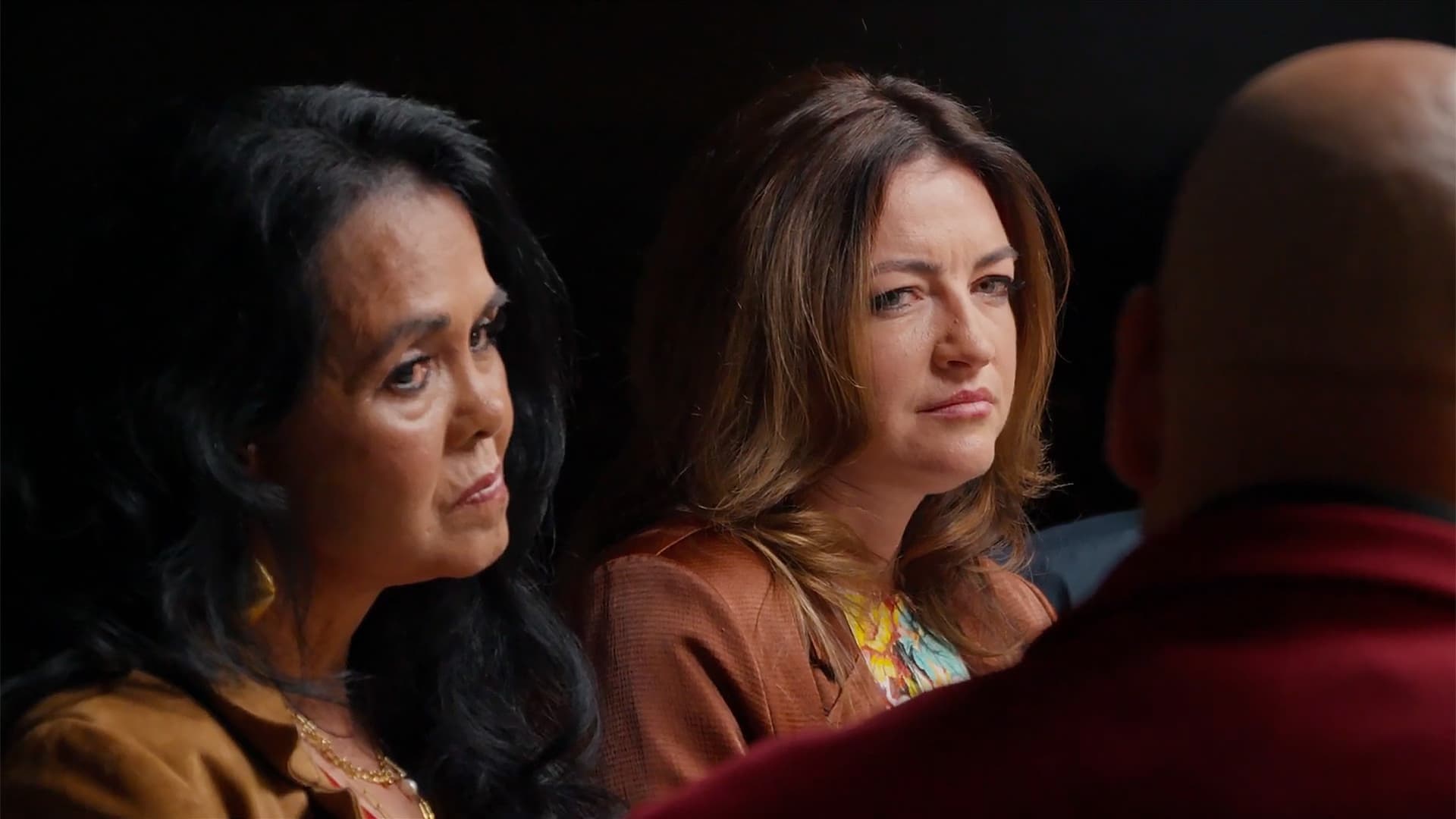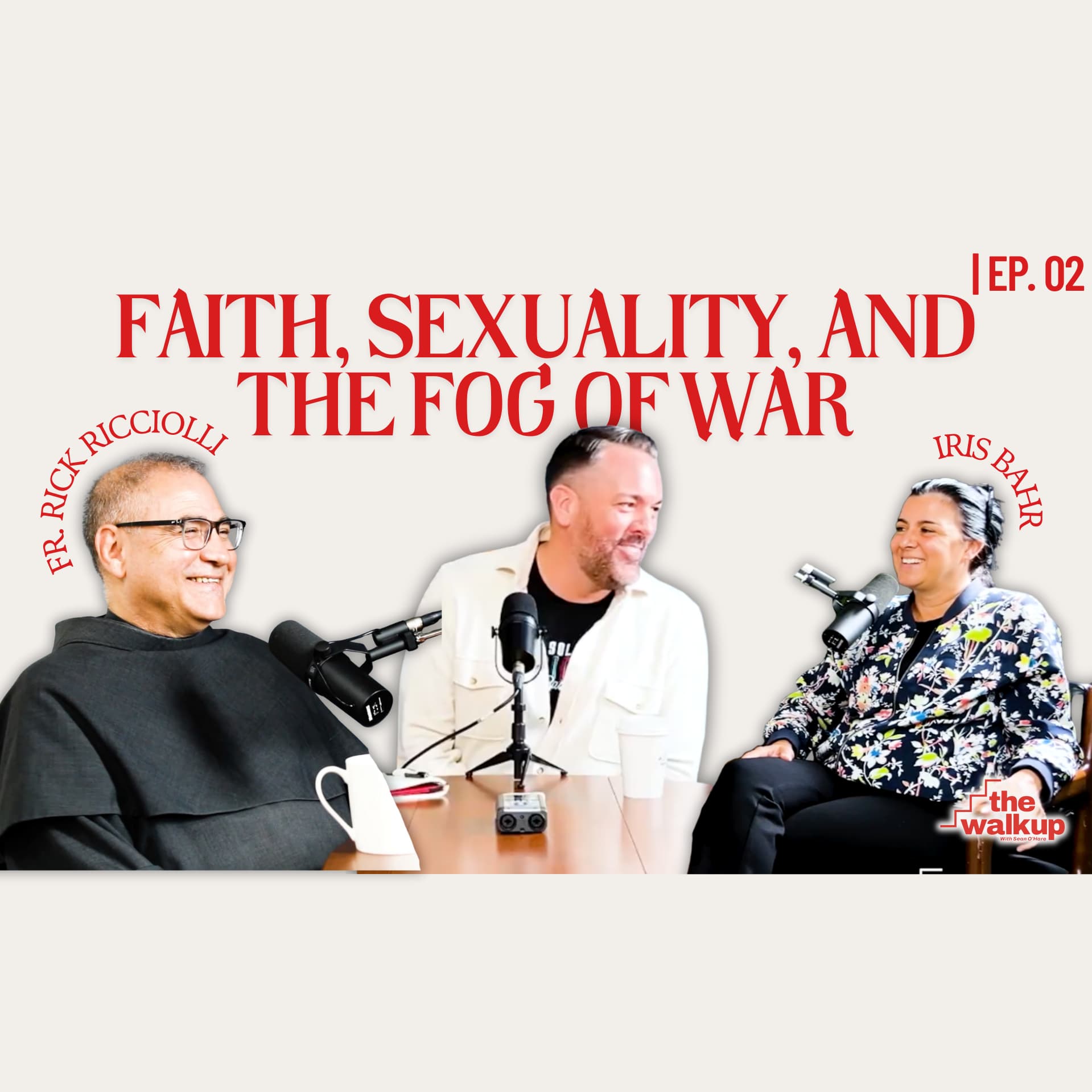
In this episode of The Walkup, Sean O’Hare sits down with two deeply thoughtful voices—comedian, writer, and cultural critic Iris Bahr (Curb Your Enthusiasm, X-Rae) and Father Rick Riccioli, a Franciscian friar and pastor serving in Brooklyn.
The conversation weaves through a wide tapestry: from Iris’s time in the Israeli Defense Forces and the emotional toll of war, to Friar Rick’s reflections on priesthood, purpose, and navigating faith in today’s world. Together, they explore the complexities of sexuality, the fear of God, trauma, the role of sacrifice, and the power of choosing love in broken systems.
Subscribe on YouTube: @TheWalkupPodcast Follow on Instagram: @thewalkuppodcast
Transcript
Read the full transcriptAuto-generated · 17,519 words
As Franciscans, when we're together, whether it's the Franciscan Friars or the Sisters, we're like family. Is that where the Friars Club comes from? See, I don't actually know where it comes from, but I kind of want to go in the building. Yeah, I feel like you should. And I feel like, why am I not invited to the dinner? Yeah, I don't know. I'm the Friar, right? Can I ask some ignorant questions? Absolutely. This is where the ignorance comes in. Okay. First of all, there's too many questions, because I can't even wrap my head around, like, let's get Presbyterian.
Like, I don't even go to Lutheran. So, we're sticking in the Catholic world. Okay. Welcome to the Walkout Podcast, where we explore the intersection of faith and culture. My name is Sean O'Hare. On today's episode, we speak with Friar Rick Riccioli, a Franciscan priest and the pastor of Most Holy Trinity Parish in Brooklyn.
And with Aris Bar, a comedian and actress, we explore his life as a Franciscan priest in Brooklyn, and her life as a Jewish actress in Israel. I hope you enjoy. So, Met Gala, winners and losers, is that what we're doing? Oh, yeah, we're doing a review of the Met.
Well, the one that was interesting, though, did you watch the... When it was Heavenly Bodies, do you remember that? Yes. That was like five, six years ago when the Met did this whole thing on. Oh, yes. I haven't kept up with the gala as much as I should. And who was it? Who came as like a pope or something? I think Lady Gaga. Oh, like Lil Nas X.
Yeah. Oh, that would have been hysterical. I don't know if he was, was he famous yet? Five years ago? I think so. You're getting old. Well, that's a separate podcast about how I'm getting old. So, I like to start out with how I happen to know people from very, you know, diverse backgrounds. So, I was actually trying to remember when we first met. Was it at... It was at a thing you had at one of your churchy habitats. Okay. You were living there, right?
Midtown? This was at the convent. And then Allison had an event. It was like a big event. Was it a post-Avram thing? I don't know, but there was like food. There were a couple other dudes that were living there, too, right? Yeah, we had a lot of dudes at a convent. It was a lot of, which tracks. It's kind of weird.
Which tracks, and then, yeah, then we met, briefly. But then only later again, I think, did I meet you on a more personal level. Substantive way. Yeah, exactly. And we became fast friends. We did. Fasties. We did. I'm one of thousands for Sean. Sean's special to me, but I'm one of a large group of people that Sean is close with. I have a lot of infidelity in my friendships.
But, and then, we have to tell that story, though, when we were on the, when you were in Midtown, and you came by my office, and you were like, yeah, really, my son really wants to play soccer. Do you have a place where you can play soccer? Oh, yes.
Okay, I thought you were launching into it. Yes, I went into the office, which was kind of a surreal environment. It still feels a little COVID-y. You know, not a lot of people are in the office or the building, but it's still cool to be in that building. And we went up to the roof, and there was this weird little grassy patch, and you guys start playing soccer, and out of the blue, these Rockettes.
Come bursting into frame, because I'm shooting my son and you playing soccer. They're coming into frame rehearsing some number, kicking up their legs and doing little TikTok-y dances, and they rehearse their all, what is it, the whole time? Yeah. Wow. It was fascinating. It was like, this could not get more New York than this. Yeah. It's like, yeah, only in New York are you on the, so we're on the roof of Radio City Music Hall.
And there's like a patch of grass where Idan, her son, and I are playing soccer, and meanwhile, the Rockettes are just kicking away. And I'm trying to say that in a clear but not too obnoxious way. Boy, I love playing with this friend of mine who's not my son, and I'm single to the Rockettes.
I love kids. Boy, I'm good with children. I'm a great dad figure. But it was on a secure date. And then we... Just to kind of, like, I like the story in the sense that, like, there are creatives, right, and there are people that are just creative all the time. I'm selectively creative, and, but when we were in my office, and Your son was behind my desk. Yes. And I walked in, and I just as a joke, because he's, you know, like at that point, 10 years old.
Yes, yes. And so, of course, he looks small on this, you know, big corporate office desk, and I was like, oh, I'm sorry, sir, I didn't mean to interrupt you in your important meeting. And then I'm like, let's shoot a movie, and then we shot that little skit.
Yeah, so tell us. And he played along. Oh, my son loves acting, so no, it was fun. I don't remember, it was like me barging in, or he was yelling at me. He was able to let out all his rage. He lets it out anyway on me, but he was able to unleash the rage, and you were great, too. You're like the receptionist, and I stormed past you. Ma'am, ma'am, he's not. Yeah, it was like... Yeah, but it was just incredible to see, like, real quickly, but you and Edan were both like, oh, let's shoot it this way, let's edit it this way, and so the skit was that I'm sitting at the front desk, I'm Edan's assistant, and she's coming in to talk to her son, and I'm like, I'm sorry, he's very busy.
Maybe we can put that in there. Maybe we can insert the video in there. I think we could. That could be cool. Let's do it. So, that is how we know each other, and then Briar Rick and I got to know each other soon after you became pastor, because you became pastor at Most Holy Trinity.
A year and a half ago. Okay, so it is that recent. Yeah. A newbie. Newbie. And then, so you were getting, how did you get assigned here, and then what has been the experience so far of this parish? So, I am an immigrant. I am from Montreal, Canadian.
I worked in Montreal, Toronto, and ended up in Syracuse, New York, running a young adult program called Francis Corps, and then I was a parish priest there. In a place that is kind of re-emerging, we still think I am in Syracuse, we have a great mayor and a great community of young adults who are really rebuilding that city. It is pretty phenomenal what is going on there. I was enjoying it very much, and then the friars, we usually every four, five, six years have some changes.
So, they said, would you go to Brooklyn and try to do the same thing here at Most Holy Trinity to help kind of... Change some of the outlook of the church community from being more inwardly focused to outwardly focused. That is kind of my gig here. I have so many questions. I know. I imagine you do. So, as they always say, what works in Syracuse works in Brooklyn. That is right. As the adage goes. You know, it is all about, well, I think of your son doing that skit, right?
It requires a certain amount of chutzpah. Yes. A certain amount of fire, right? I can insert a little. So, you got to have that, and I think if you have the chutzpah, it could work in Toronto, it could work in Montreal. That is where I have a lot of my Jewish friends. I need them, because I am going to Montreal to perform in a month. Really? Yes. So, we will segue into that in a minute. And, yeah, New York is unique, but it just requires a bit of fire.
You got to have fire in your belly. Well, what I can say as an Irish Catholic, But whose mom grew up in Flatbush, across from a Jewish temple, you do have a lot of chutzpah, even though I normally wouldn't have a leg to stand on on that. But before you jump in with questions, maybe just to give people context.
Assume people know nothing about what a Franciscan is. Yeah, that is what I was going to ask you. What is this? Why are you wearing this? This weird robe? Yes. Take it off if you do not like it.
No, no, this is a family show. It is a family show. There is clothes underneath. That is a new category. So, Franciscans, we are part of the Catholic Church. We are a group. Kind of think of it like... Monks, but not monks, or male nuns kind of thing, were a community of men that were founded by St. Francis of Assisi in Italy in 1209, were a part of the Catholic Church. And St. Francis of Assisi was very much about, A, being simple, becoming holy, and loving all people, and having a sense of brotherhood among all people.
And he would, by today's standards, say, brotherhood, sisterhood, for all humanity, to be kin, right? And so, for 800 years, men and women have followed his vision, his charism. And traditionally, so he ended up, he wanted to not be identified with the rich and famous of his time, so he put on the clothes of peasants.
So, he said a simple gray garb, or brown, depending on what was available, and no belt, because the belt was animal product for the rich, so a rope, a simple rope. By today's standards, it looks a little odd, although in Brooklyn… It looks trendy as hell, yeah. Well, you know, when I first came here, I was like, can I wear my habit in Brooklyn? And I was driving a car, and this guy across the street, young man in stiletto heels, fishnet stockings, and a red bikini, and nothing else but a necklace.
I thought, I am not the weirdest thing people will see in Brooklyn. It would take a little more for you to stand out. No, he was great. He rocked it. I mean, he was great, but it is like, this is a very inclusive community, a very diverse community. So, yeah, I wear it sometimes when I go out to the restaurants. I wear it to Winsun and some other places, but oftentimes, we do not wear it. This was supposed to be, for Francis, he wanted to identify with ordinary people.
I think if he was alive today, he'd be wearing jeans and a t-shirt. Right, or a stiletto and a necklace. Who knows? Well, you know, he was Italian, a little bit crazy. He's more of a kitten heel guy, yeah. Well, his name was actually, I think it was Giovanni originally. His father, who used to go to France a lot, was kind of bougie, and he was like, I want him to be called Francesco. Yeah, yeah, yeah.
So, he had a bit of that tinge of, like, Francis liked to party, but he gave it all up to be close to people and very down-to-earth. That is kind of our shtick. We are very down-to-earth. There are a million types of Franciscans. Some of us wear brown, some of us wear gray, some wear black, some wear dark brown, light brown. Is there, like, Franciscan rivalry? Like, oh, the brown robes are just dicks? There is. Huge, huge. Even the Pope is like, okay, already.
Enough with this. Yeah. He was like. No, I serve the poor better than you. No, I serve the poor better than you. Well, we're probably the OGs, right? Yeah, yeah, of course. We're the ones everybody reformed, because we were very bad. Oh, okay. Because after Francis died, we're like, you know, guys, there's 10,000 of us. We can't just be walking around the streets begging. It's not fair to the people here. Let's build houses, find ways to support ourselves, yada, yada, yada.
Others are like, no, no, that's not the original vision. We need to be simple and poor. Well, okay, well, there's 10,000 of us. So, it evolved, but, you know, in some parts of the world, like in Italy, sometimes there is still a little bit of rivalry.
But for the most part, a friar is a friar, especially Franciscans. There's other types of friars, too. There's Dominican friars. I won't talk about them. Augustinian friars, Trinitarian friars. I don't want to talk about the Augustinians. Yeah, I know. But Franciscans, when we're together, whether it's the Franciscan friars or the sisters, we're like family. Is that where the Friars Club comes from?
See, I don't actually know where it comes from, but I kind of want to go in the building. Yeah, I feel like you should. And I feel like, why am I not invited to the dinner? Yeah, I don't know. Like, really, I'm the friar, right? So, can I ask some ignorant questions? Absolutely. This is where the ignorance comes in. Okay. First of all, there's too many questions, because I can't even wrap my head around, like, let's get Presbyterian. Like, I don't even go to the Lutheran.
So, we're sticking in the Catholic world. Okay. Well, for me. So, Catholic priests, friars, never marriage, no marriage. There's no... Some do. Some do. Okay. So, the Catholic Church is very broad. Yes. And it has Eastern parts of the Church, which is, like... In Ukraine, Russia, a lot of those countries, the Catholic clergy are married.
Okay. So, it is the Latin, right, the guys who are more affiliated with Rome and the West, where we stopped having married clergy. We used to have married clergy, and we still have married deacons who are clergy. Okay. Married. Okay, deacon. I'm not even going to go to the deacon. There's so many titles. Good Lord. But for most people, priests do not marry. And then, okay, and so I know your status, but had you, we're just going to dive in. You entered priesthood, but ever intimate with anyone, or this has been something since birth that you've been like, you know, are you like a gold, you know what I mean, like the gold friar?
I was not hatched a friar. I had a life before being a friar. Okay, you had a life. Okay. And we won't get into the details of it, but I did join young. I mean, I was very much involved in politics in Montreal.
Referendums that we used to have for the cessation of Quebec from the rest of Canada. Okay. So, you were living life as a dude, and then you are like, I am going to fryer it up. Well, you know what? A high school teacher showed me a movie once about St. Francis of Assisi. It is a movie that you have to see, and I did not do this, but my friends tell me, you have to see it when you are high. That is what I was thinking.
Because it is by Franco Zeffirelli, Brother Sun, Sister Moon, and it is like… What is it called? Brother Sun, Sister Moon. Brother Sun, Sister Moon. Okay. It is The Life of Francis and Clara Assisi, but it… It is like Vaseline on the lens, right? Everything is very poetic. Got very sensual and poetic, yeah. Who is that photographer who used to do pictures of young women, Hamilton?
And everything was kind of very sensual, and that is the way it is. Okay. So, I saw it, and I thought, what a cool guy. Right. And that is it. Then in college, it restarted again, and I know my parents were opposed to it, and this and that, but...
I reposed why, because they had plans for you, or because they were like… Oh, my parents had plans. Yeah, I was going to live next door to them. Were your parents Catholic? Oh, yeah. Okay, okay. So, my parents are of Italian origin, but my family has been 100 years in Istanbul and Turkey. Okay. So, we have that whole Mediterranean side. Yes. And they knew the friars in Turkey. And they liked them, and they knew Pope John the 23rd when he was bishop there and stuff.
My parents were immigrants to Canada, and they left a lot to come and reestablish the family. And to have a son who is not going to be part of the family, in their mind, they expect me to have 6.5 children, to be living in their backyard, with my wife and my whole family. So, it is a shift, right? These people came, they sacrificed a lot for a vision, and I was saying… Right. Are you the only child? No, I have two wonderful sisters.
Okay, so they covered the whole grandkids. They got the grandkids, yes. Okay, so they covered for you. It was nice. They did, and I… I was able to be my parents' vacation partner, so I ended up doing a lot of fun stuff with them. Okay, and have you ever felt, so you are living amongst the people, you are not in some secluded So, that is how friars are different than monks. We are not secluded. We do not stay in one place.
We do move around. There are six of us who live together here in Brooklyn in this friary. In Europe, they call them a convent still, but in North America, a convent sounds more for women. So, it is a friary, and there are six of us, and we live in a community of six grown men who share everything in common. We pool all our resources. We don't have our own money. Everything is shared.
And who manages that, so there's no altercations between the group? There's no altercations. Okay, great. So, who manages the altercations? Like, how are disputes settled? So, our highest, St. Francis was very much a democratic person. Okay, it's a vote.
Sometimes it is a vote. I mean, we are part of the Catholic Church, right? So, there is a hierarchy, but for Francis, it was very much about not hierarchy. He came from a town called Assisi in north of Rome, in the region of Umbria, that kept falling between being a papal state and being part of the Roman Empire. And whoever was in charge at the time would take over the castle on the top. It is called the Rocco Maggiore, this little castle.
And everybody else was basically servants to either the papal rule or the Roman emperor. And at one point, between the fights, the people got fed up, and they went up and tore down the Rocamontura and said, enough, we are going to rule ourselves.
So, Francis was part, he saw that, that this sense of democracy and participation could lead to something better. So, and that is the magic of Francis. He respects the church, he loves the church, always faithful to the church.
But he is a proponent of a more democratic, more collegial, paternal approach to governance. So, we work things out. We tend to have very long meetings and hash things out and build intimacy. You have to have, for six grown men to live together, you have to be vulnerable to each other and speak your truth. Yeah, and I have come to dinner here, and there is something I have been very privileged, I think, in my life to have spent a lot of time with.
With priests, in community, with religious orders, and you see this idea of fraternity in a way that you just don't experience. And like you just said, the vulnerability, it's disarming. I mean, when everyone's serving each other at table, and there's not... There's not this sense of hierarchy, and you have to make yourself subject to the wider community, which is family in a sense, a different way, of course, but it's something that I think a lot of people don't get to see outside of...
No, you don't see it. Like, when I was in Syracuse, we had some of our elderly friars were there who had been there completely. Some of them, one of them especially, the cranky, miserable son of a b****. I mean, he really was just an ornery, ornery person. God rest his soul. Yeah, God bless him. Pain in the butt. But he was, you know, he was a product of his generation, of his family. We all are. Anyways, towards the end of his life, I remember he was getting sick, and he had these moments in the bathroom.
He shit everywhere and everything. It was like, okay, I've got to clean him up, clean the bathroom, and it's like, I'm his brother, but I didn't expect to be doing this in community, but you do. I've cleaned quite a few messes. There's no, God, there's so many questions, I could just interview you for hours. Okay, so, question for you. Sure.
Is God your therapist? Like, when you guys are having doubts, not you in particular, but if you're having doubts. And you want to talk to someone. You're saying to yourself, I'm having doubts. I wish I had built a family. I want to leave. I'm having doubts even in faith, whatever. Is God your first stop, and then the dudes in the convent, in the friary, and then Dr. Goldberg on the Upper West Side, like an actual therapist? Who do you talk to, or do you sometimes wish you had different people to talk to from the outside?
Tell me about your therapeutic journey. Or is there like a standard, or is people you're not supposed to talk to? There's no standard, but I just want to say thank you for acknowledging that we do have doubts. Well, yeah. Some people think like a priest or religious or like, you know, automatons. No, we do have doubts, and there have been times where I've never regretted my choices. Okay. I'm very much in love with my life, and I'm very privileged in my life, but there's moments where I just want to throttle some people that I live with, or...
People in the church, or sometimes parishioners, you know, it's like, or more existential questions, you know, when faced with the death of a child, or the death of a young person, and you think, where are you, God? Yeah.
Or worldwide tragedies. So, it is a bit of mix, a bit of all of what you said. Prayer, talking to God, like, where are you, you know? Yeah. As friars, as religious, we pray the Psalms every day. Okay. The morning, noon, and night. The Psalms, like the Hebrew Psalms? The Hebrew Psalms. Okay.
So, I would say Catholics are very much… Can't improve on a classic. Yes, you are right. In a respectful way, Catholics, and especially religious, we're very much imbued with Judaism, right? My boss is Jewish, right? So, that's where we come from. So, the Psalms are very much a part of our daily life. So, you have a lot of lamentation there, like, you know, why, oh God, did you do this to us? Where are you in this? And then in community, in brotherhood, yeah, you talk to each other, but then also friends, and it's super important to have friends outside the community to talk to, like normal people.
Give you a perspective, you know, like, oh my God, my life is so hard, and then, I tell people the story about when I first came to New York, I was at 14th Street Union Square, and I'm like, this is crazy subway station, I can't find my way, and there's this guy blaring at a guitar and singing so loud, I said, could you please all just shut up, because I'm trying to figure out which train to take, and this guy goes by me with a white cane, and I'm like.
I have nothing to complain about. The guy's blind and he's doing this, right? So, talking to lay people, especially to people who are parents, to people who are struggling with other issues, kind of helps you put perspective on your life. That's helpful. And for sure, professionals. Okay. I've had lots of counselors. Okay. Are they usually also Catholic? Some have been, some have not. Okay.
So, my most famous counselor was this guy named Bob Wicks. He was out of Baltimore. I ended up going and studying with him, and his whole thing was he really helped me learn perspective in life, and gratitude in life, and living it more out of gratitude, and that has helped me tremendously.
But yeah, I will talk to anybody who can help me. Well, and also, we have like a, there is a... Built into the structure of the church, I mean, confession is one of those things that allows for you, I mean, a lot of times people ask me, like, the trope is, oh, you can do whatever you want, and then you just go into a confessional, and it goes all the way, and it's like, well, that would be like saying, I make the same mistakes, and I apologize to the same person I made the mistakes to over and over.
Eventually, Just the act, simply the act of going into a space and saying out loud the things you're ashamed of, that in itself is cathartic, but it's also a little bit embarrassing, right? So, it helps kind of just get what's troubling you out, and then hopefully you've got a good Confess or this, giving you advice. But I've had these examples. I have a lot of friendships with priests, and I think they sometimes need that third party. I kind of know their industry, so to speak, but I'm not one of them, so they can unload just over a beer or whatever else.
But I've also had, we have a thing called spiritual directors. So, you get a, it's like having a therapist in the sense that like, You have the same person you see every time, right? Okay. And so, but just to say that we're very open to therapy is that, professional therapy is that my spiritual director... At one, this is like a year or so ago, he was like, listen, I think you need more help than I can give you right now, and so I'm going to refer you to a grief counselor after my dad died.
Yeah, yeah, yeah. And so, he was kind of saying, listen, I can't do all this. I can help you a certain amount, but part of it was just he only has so many hours in the day. Right. It's also, I'm assuming, and correct me if I'm wrong, just like therapists, there's probably a lot of crappy confessors out there that don't have a lot to give and say, do this and you're done. But also… There are people that are trained in different fields, and someone who is in mental health has a different way of approaching, and obviously, there are many modalities, as opposed to someone from the faith that has a different particular avenue and guidance through the faith, right?
As Catholics, I think we embrace all of it. And just to tweak a little bit what you are saying about confession, I mean, confessions is an act of worship, right? So, it is about God. It is not about us. It is about remembering God's mercy, because we always are going to be sinners. So, we name the sins, but it is in order to remind ourselves of God's mercy, that no matter what happens, God will always love us. So, the focus is a little bit different.
There is some advice, but you are not going there for therapy. Oh, correct. Yeah. Okay. Even if you get no advice, it is still about it. So, it is a sacramental. It is an act of worship. Spiritual direction is another form as we were talking about, but I think integrating in that, so I do have, I got a degree in counseling. It is called pastoral counseling, which is Being able to attend to the spiritual issues within a holistic human worldview, right?
So, it's not like this is my spiritual side and this is my human side, and the two don't meet. They have to be integrated. Yes. But in a way that also respects the human dimension. Do you find... And again, I don't know how much details the dudes divulged. I'm fascinated by the dudes, the friary dudes, the roomies. You had a life where you were living life to a certain extent right until you started young, but you experienced the full spectrum of- And you still do as a friar.
Right. Well, in particular, I'm talking, let's say, sexuality and stuff like that, which I don't know if we can talk about this too, Sean. Do you find, and I don't know, this is kind of, I guess it depends on the person. On the one hand, someone who's coming into this after having had sexual experiences and had this, there's almost like, okay, been there, done that, now I can enter and focus, versus people that have come in that have never had that and are constantly, not constantly, but the curiosity or the kind of ruminations of like, What is it?
What is it? Or, you know, I'll never experience that, and I don't know. Can you speak to that a bit? I don't know, Sean, if you can speak to that, too. I'm just... Curious, in your interactions with people, have you found, you know? Well, especially in the climate today with the sexual abuse scandal, people have questioned a lot of that, right? Yes. And religious are a little bit different than regular priests, diocesan priests. We have a, our formation, our preparation for this life is different.
Okay. And our focus on community makes it a little bit different, whereas regular priests live mostly on their own. Oh, okay. We live together. Part of our formation is that we need to be sexual person. So, to be a sexual person does not mean that you are involved sexually with somebody else, but you, first of all, know who you are sexually, that you are aware of yourself as a sexual person. In terms of your affinities and attractions? Yeah, your orientation, your gender identity, your sex.
Your desires and where your heart is and your desire for generativity. When you are in your 40s, 50s, you should be having children, right? Right. So, our lifestyle is very much countercultural. When you are 20, you should be going out making babies. When you are at my age, you should have grandkids, right? So, being attentive to, well, this part of my life, how do I live that out as a… So, friars are both celibate, which means we do not marry, but we are called to what is called the vow of chastity, which is what everybody is supposed to be doing, which means to, in your state in life, to be loving.
And Pope Francis tells us, you know, If you are going to be a nun, or a brother, or a priest, and look like a dried old prune, and be miserable, do not bother. If you have not integrated your sexuality, your desires, who you are as a person, and made that joyful and life-giving, then it is a waste. No matter what you do in life, religious, clergy, married, single person, you need to give life to the world. And if you are not doing that, something is missing.
And so you find, is masturbation allowed? Nope. So, no. Well, I feel like he said no, and he said maybe. Well, it is not a question of maybe. It is considered a sin, right? Okay. I think people sometimes get a little bit weird about it. Okay. You know, when you are 16 years old, and you are discovering your sexuality, I think it is a little bit different than...
A 40-year-old man who doesn't want to talk to his wife and does it in the shower, so as not to deal with the issue that's between him and his wife. Okay. Those are two different things. Is it sinful to some degree? Yes, because it is basically… Spilling a seed. Well, no, it is more about the sexuality is a form of communication of love to another person. Coming inward. Okay. And it is focusing it on myself as opposed to outward. It is not communicating love to somebody else.
It is just satisfying myself. Okay. But again, people get so mechanical about it, like, oh my God, it's a horrible sin. Well, it can be. But it also can be just a natural part of growth for a child.
Well, not even child. I am assuming, and again, in terms of human psychology and as sexual beings, I guess that, of course, I love that what you said before about this energy that we cannot give it this way, we will give it in a different way. But sexual energy is a very specific energy. It is. It is not just a loving energy or familial or caregiving or nurturing, right? It is a different, it is a purely primal. You know, so my question is, in terms of a sin, and maybe this is something that's discussed.
You know, in Judaism, there's always discussion and argument, right? Like, this is the law. What's the deal here? Why is this law here? Why is not? So, it's also an outlet. So, I imagine... That if that outlet is not exercised, it causes other issues and turmoil. Do you know what I mean? So, how is that handled? And I'm assuming that, yeah, a lot of people, they don't know. That's obviously probably has to do with the sexual, I mean, let's put it out there, right?
Like with the sexual abuse scam. Like there's outlets that are not being recognized or acknowledged. Or something, so it ends up coming out in some, I do not know, I am curious. I would challenge that. No, please challenge, because I do not know, I am just curious to hear your thoughts. There is some of that, right? Okay. So, the distinction that is made, or at least in my formation, was between suppression and sublimation. Okay. So, suppression is when you deny those feelings and you push them away, and sublimation is when you use that energy for something else.
Okay. So, whether it is art, whether it is science, whether it is some other aspect of your passion. Or your life, just your sacrifice of your life for somebody else. So, putting all that energy into what you do and who you are. That is the idea. Okay.
And some of our guys, in some of the cases of abuse stem from generations past, were guys, like you said, came in without any kind of really... They joined the seminary when they were teenagers. Right. So, they never had their first kiss, their first date, their prom, their this and that. And they ended up with a lot of questions. A lot of those guys ended up leaving the priesthood, because they rediscovered, oh, I am missing a part of my life. Yeah, and I definitely don't want to adjust to anyone who is abusive, saying, oh, it is just because they didn't have an opportunity.
No, no. Like, we are talking about a whole other level of illness. Yeah, and if you look, you know… Being in Canada, our bishops did a lot of study around this in Canada and came up with a document called From Pain to Hope, had a lot of experts come in and look at that, and a lot of that has to do with an arrested psychosexual development. Yes. Right, and abuse is very much an issue of power rather than an expression of sexuality necessarily.
So, people tend to abuse whoever happens to be available. Most sexual abuse happens by heterosexual men with family members. Catholic priests do not have a higher rate of abuse than other denominations. It should be zero. Let us be clear. It should be absolutely zero. It is not, but it is not higher than other clergy or other professionals or clergy who are married.
So, it is not necessary, and I think… It is not the celibacy itself. What is the school here, the John Jay School of Criminology or something? Yes. They did a lot of work for the Catholic Church, and they were studying that.
And the thing was, it is not necessarily celibacy that does it, not the lack of sex. Yeah, I can't imagine. Yeah, I didn't mean to make that correlation, because I, you know, whatever I say. You know what I mean? Because I want to be very clear, because it is like such a sensitive subject. A lot of people do. I don't want to be like, oh, yeah, they are not able to masturbate. That is when it comes in. No, like, I know that that is not the correlation.
Yeah, there is a sense that there is this. Sexual energy that, if it's not somehow exercised- Someone's going to explode. It's going to explode. I think it does. Make us seem as if we're animalistic purely. I mean, we have these kind of instincts. When you're younger, obviously, your ability to regulate is, you know, yeah. I mean, you have all these incels, right, and what's happening there, and an inability to interact with another human being, right? Intimacy. I mean, I think that that's, and withdrawing into yourself, which I think ties into what you said, when it becomes this purely You know, yeah, or almost compulsive, you know, that's not really kind of outward, then it becomes dysregulated and dysfunctional and problematic.
I mean, I think we see this, I hate to sound like, you know, the concerned mom, but... With kids today and not interacting, you know, not having interaction. Even on the dating sites that I'm on, people want to be pen pals for six months. I'm like, what? Can we meet in person? They're like, whoa. Hey, easy there. What did you think this was? Are you a bot? And I'm like, if I was a bot, I wouldn't want to meet in person.
I would keep this purely. Take it easy there. Interesting. Well, maybe just give Father a little background on where you're coming from. You mentioned Jewish background, but just kind of give a sense of your kind of. Perspective of where you come at from a faith perspective. Oh, sure. Yeah. I mean, well, I was born in New York, in Manhattan, one of the few people born in Manhattan, to Bulgarian Jews, my parents, World War II Holocaust survivors. Holocaust in Bulgaria was a little different.
The Nazis didn't ship. I don't know if the clergy had something to do with it, also the king, but they didn't ship the Jews to the camps. The Nazis came in, but they was... Read a book. Anyway, I don't know the details.
The point is, Bulgarians are very secular Jews compared to other Eastern European Jews, you know, compared to whatever Polish German. And for some reason, when my parents moved to New York, they put me in a yeshiva. Okay. And I commenced to live a double life, because it was an Orthodox yeshiva in Riverdale, and I wanted to be accepted by my peers, who all went to shul, right, to the temple, but they call it shul, or they know shul on Saturday. We were the only, I think, one of the few secular families in the whole school.
The yeshiva is a school, right? Yeah, it's a school, but it's like, you know, everyone is long skirts, turtlenecks, like Orthodox, like you're seeing here in Brooklyn, right? You're praying. Three times a day, you know, and on Saturday, everybody would go to shul. Nobody drove on Saturday. Everybody was very observant, so they'd be like, why aren't you coming to shul? We never see you, and I'm like, what am I going to say? We're eating bacon and going to the Guggenheim? Like, I couldn't reveal what we were really doing on Saturdays.
I'd be like, no, we go to a super, super secret shul, like a super shul, you know, a super shul. And I live this life, and it was very, very stressful, and at the time, I did believe in God. And, you know, again, with Judaism, it's different, right? There's the tradition, and it's a monotheistic, but...
It's cultural, and I don't know if my parents believed in God or didn't, but it didn't translate into their lifestyle. You can still believe in God and not do anything, and in the Jewish God, not do anything outwardly to accept the holidays. But again, it's this weird dance that the Jews do anyway, right? About community and affirming your Jewish identity, not necessarily like, if I do this or not.
And it is interesting. A lot of kids that went to Yeshiva with me back then, as they get older, some of them become more secular, and some of them become more, you know, something happens at some juncture. They rarely stay at the same place as their previous. I do not know if that is true. A lot of them are actually still living right now. Some of them are in the West Bank. Anyway, so from a faith perspective, as a kid, I believed in God, and I was constantly tortured by this.
I'm sinning. I'm sinning. What my parents are doing is wrong, and my parents would be like, just be okay with who you are. I'm like, but why did you put me then somewhere that I'm not like everybody else? So, it was very, very stressful, and I write about that in my books, and I talk about it in my show that I'm taking to Montreal, so we'll talk about that in a minute. When I moved to Israel, my parents got divorced, and I moved to Israel with my mom.
I had no idea. I went to a regular public school. And it was the antithesis of this yeshiva in the sense that the average Israeli is very anti-religion and extremely secular. I mean, there's so much tension, and it stems from a lot of other things, but A, I think...
There's a lot of tension between the Orthodox Jews and the regular Israeli, because they don't serve in the army and the government. There's a whole thing. The government support they get, a lot of it will work. It's a whole thing. I think the biggest thing is also the military, but they live in very secluded communities and aren't as integrated members of society as much as... I've been to Israel a few times. Yeah, so you know. I've noticed it. Okay, so it's a very different thing.
Two different worlds. Two different worlds. And also, I think that the Zionist movement was a very secular movement. And it was about building a country and values, and it wasn't necessarily rooted in a religious aspect. And when you're in Israel, you feel like being a Jew in Israel is enough. You know what I mean? You don't have to keep affirming. You've got nothing to prove. Yeah, and there's a lot of people, again, are big on holidays and family. It's more about the value system than it is so much about God, but kids would make fun of me.
So, when I was living in Riverdale, I had to lie that I was going to shul, and then when I was in Israel, I lied that I didn't go. It was a whole thing. Yom Kippur, the Day of Atonement, would roll around, and we lived right by a synagogue where I lived in Israel, and the synagogue, there was like four people there. You know what I mean? Barely anybody goes. It's a very small community, and I would go, and I wouldn't tell my friends that I was going to shul, which is the exact opposite of what I was dealing with in New York.
It's interesting. And over the years, I've had a, I don't want to say complicated relationship, but certain things stick with me, and certain things I don't do. I mean, I did eat bacon for a stretch, and then I stopped. And of course, in times of crisis, you tap in, but it makes me sad in a way that I don't have, because I don't think you can force faith. I think it's there, or it's not, and it fades, and it comes.
As you get older and you explore other religions and faiths, you realize it is just many ways to climb the mountain, and sometimes I am on the kind of like, it is just stories and narratives that you all know a Harari kind of thing. We are just writing stories, you know what I mean, to kind of make sense of our life, which can feel very meaningless at times, and I find meaning actually in people, and those things make caregiving for my mom, or kindness, the values that should be the...
The guiding light for people, and again, you know, and other times, I wish I had more faith, and I look at people that have a lot of faith, even Orthodox Jews, that explain away what you were saying, the tragedies of the world, and there is a peace to them, in a way, a calm of like, no matter what happens, I know God will take care of it, or I know that, you know, you talk now with what is going on since October 7th, and a lot of loss.
All sides, and I don't have to keep saying that. I'm going to say it now out front, because I feel like no matter anyone talks, it's like, yes, you know, but I watch a lot of interviews, and I'm watching the news, and you have certain people that have a lot of faith, and they're like, yes, God took him when he was meant to be. And other people that, there's a belief, right, that this was meant to happen, or we can't understand the ways of the Lord.
But I really struggle with that. I really struggle with a sense of faith that says, oh, yeah, it's all meant to be. And it's like, well, no, because then that discounts sin. Well, I don't think it's meant to be like, I don't think it's about free will. I just think that it's, yeah, I guess. Because some stuff is just horrible, and it's not, I don't think it's God's will, and it's like, what happened on October 7th, that massacre of those people, could never be part of God's plan.
And I don't believe God wanted that or accepted that or willed it. I mean, that's horrible what happened to those kids. The same thing was happening to the children in Gaza, you know? I don't think it's that. I think it's a sense of... And again, I don't know in terms of belief. I feel what I've discovered is everyone creates their own personal narrative, and whatever works for you, right? Different strokes for different folks. And even people that are devout in the faith, not loopholes, but they'll find a way to cater to what makes sense to them.
Like, take what you have and leave the rest, so to speak. But sometimes it's... I mean, if you look at Judaism, right, and the archetypal stories of creation, of salvation, I mean, so many of the stories come from Assyrian or other histories, Gilgamesh, and all this stuff. Yes, it is a human narrative, but I think it is expressing an inner reality, right? I think that God has… Within each of us has told his story, and we are trying to uncover it.
I mean, to me, that is the quest of religion, is to uncover the truth of who we are, and whether you are in China, in Beijing, or in Tel Aviv, or here in New York, we are all trying to find that story and connect to it. And over thousands of years, we have created a narrative that expresses that. Is it always perfect? No. Right, well, I think there are different ways to… Without community, we can basically talk ourselves into anything.
Yeah, 100%, but I also think that... When I look at people that have, again, how faith helps them, right? So, there's ways to go about it, where you're saying, God didn't will it, but I think that there's different ways to look at that, even that line, right? We have this faith where we're up to our own devices, and God created us, and it's our problem that we're killing and helping, and God has nothing to do with it, right? Then there's the other side of that, which says, well, God has a plan, and we don't understand it, right?
So, how could we comprehend that even we think this is horrible? Maybe in God's bigger plan, we don't understand, you know, how this works in the grand scheme of things, or even, you know, looking at the Bible and the stories of punishment, like, maybe this was a lesson. Then it gets a little darker, right? God forbid, like, I don't think anybody deserved, like, that makes it trickier, right? And when you have people say that stuff, that's when people that get triggered by religion and general faith are like, are you f****** kidding me?
Do you know what I mean? Like, oh, they were sinning. This was my time. So, that stuff gets to the point where, but again. You know, nobody knows, right? And I think that we create this narrative, people that are going through a lot of suffering in general, in life, illness, whatever, loss. Yes, we do have to, I think it's that coping mechanism. We have to tell ourselves these stories of like, this was meant to be, or now they're in a better place, or we don't understand the grand scheme of things, because otherwise, it is overwhelming.
Even if you don't believe in God, is that more painful or less? I don't know, but I think that the purpose of religion in that sense is really to take these, I don't want to say platitudes, but just like these things to kind of help us going, I'm better off without him. It's that usual kind of cognitive dissonance, I didn't want him anyway. But when dealing with big grief and tragedy, How can you live with those two thoughts at the same time of God loves us and is here to protect, and how does he let that happen?
And then you have to start going down this intellectual route. Well, it's not that he let that happen. You know what I mean? He didn't control it. He's letting us up, but why wouldn't he stop? So, you get into this kind of... You exercise, you can lose your mind at some juncture, and for me, I am like, ugh. The problem of suffering is always… Yeah, and I totally agree with you. I think, and when I am preaching at a funeral, and I tell people, I can go down that road and talk about how God sees the big picture, He is outside of space and time, He sees our whole story, and He sees how this moment… Can be a moment of grace, even though it's painful, whatever, whatever, whatever.
You know, what if October 7th, horrible as it is, leads us to a revolution in the Middle East that leads to peace? What if it unleashes something positive in the world? It doesn't make October 7th any better. It doesn't make the pain any less, but it could be a moment of grace in a way. Even the most horrible moment can change the world. So, for me, there's always hope, you know, and for Christians, it's all about the resurrection, that what was a complete, utter defeat because of love was transformed into life.
That is the only thing I can sink my teeth into, and that is the only thing I can offer to people, is that Jesus Christ rose from the dead, that life is not pointless, that sacrifice is not pointless, that there is life no matter what, if we are open to love, if we remain faithful to love. The logistics of it, you can talk all you want, you can be sophisticated, whatever. I mean, it is all bullshit. Ultimately, it has to come down to a leap of faith.
Right. You know? I mean, it's tricky to say, like, what you're saying, it can be so triggering because it's like, October 7th, if it leads, like, yeah, there are other ways, obviously, to lead to, you know, yes, a lot of times peace agreements come out of war, but this slaughter that was such an epitome of evil and psychopathy and at other levels that, you know what I mean? I feel like even putting that in the same sentence, well, if something, you know, grace comes out of it, I'm like, mm.
I can't even put that sentence together. Does that make sense? Absolutely, and you can never intend it that way, right? Because that's not the way to build peace. Yes. All I'm saying is that we don't know where it will lead. Right.
One would hope that, you know, if it already happened, how can... How can we hopefully lead to more peaceful days? I think that is different than looking at a horrible event and going, well, you know, but look, look what happened after. It is like, okay. No, not that way. No, no, but to be a people of hope is to say that despite human flaws, despite sin, there is grace, there are opportunities to transform the bad into the good, as opposed to, well, we are all screwed.
There is no hope in human nature. It is to say that… There are ways to grow from even the worst of experiences. It is, and you have to be careful not to jump too quickly to facile solutions. Part of Catholicism, Christianity, I'd say, part of spirituality, is to sit in silence with the pain, like October 7th, period, stop, horrible pain. And just to sit with that, and not quickly move into, oh, well, maybe it'll lead to something. No, no, no. Two different steps.
It might, but... It is important to acknowledge. It is like Yad Vashem, right? You go there to grieve and to feel the pain. If you do not feel the pain, you cannot move on eventually, if you do not acknowledge the pain. But too quickly, it is like the way people are doing funerals now, right? Like, a person dies, cremate, cremate, fast, fast, fast, let us go, let us get it done with. Speed funeral. Right? Because… You know, they are not sitting Shiva anymore.
They are not saying, let us sit. I tell that to every divorcee I go out with. Men have a hard time being alone. I am just going to put it out there. And especially men after their divorce, I think it takes them 30 seconds to get on a dating site because they are unable to sit with the pain. And I tell them, because I go on these dates, and I can say, how long have you been divorced? And they will be like, well, we are still separated, or we are finalizing, or it has been three months or six months.
And I'm like, you can't skip a step. You got to grieve, you got to sit in the pain of the loss, it's like a death, and then will you be able to be open as opposed to kind of filling the void? Which I think, look, we all fill the void. That's what we do all day, right? We're filling the void until we die. So, we're just trying to like, how do we just fill the void until we're gone, right? Let's just make this as attractive and fun as possible.
I had a Jesus question. Okay. I have a question for you. Okay, go ahead, you first. So, you were in the IDF? I was. Tell me about it. Oh, well, not as exciting or as interesting as it sounds. Well, no, it just… Yes. I find it fascinating, and I guess I said when a few times I've been to Israel… So, twice we were followed by a troop of soldiers who were going through, I mean, we were not being followed, but we were going from sacred site to sacred site, and they were being introduced as officers to the Christian site, so they would know what they were about.
Oh, interesting. It was kind of cool that they were following us wherever we went. Yes, yes. And then you'd come out of like a shrine, and there'd be like a stack of guns, you know? Right, right, right. Because they didn't leave them before going into the church, you know? Rarely do we get a Jesus question. No, just kidding. I have an IDF question.
Go ahead. It doesn't happen very often. I mean, I'll tell you in brief. I would say IDF before Jesus. Yeah, yeah, always. Always IDF before Jesus. Especially in the morning. It pains me. Just on a note, I want to connect the two here. I was in the IDF. I was in intelligence. Can't wait to see this. I was in intelligence. I had a pretty boring job about six minutes from my house. My mom didn't want me. I was supposed to go and serve in a base near Lebanon, but she wanted me near, and I stayed near the house.
I ended up bartending also at night on when I didn't have night shifts. It was not an interesting- Where was this? Intellivision. Intellivision, okay. Yeah, it was the big intelligence business. So, it was not interesting. It was two years of my life, and it was like, I wish I had a more interesting job. What I struggle with now amidst the- And I don't want to get too far in the weeds of this operation in Gaza, because it pains me, and there's a lot of turmoil in Israel about how we lost the war on October 7th.
You don't win a war. Do you know what I mean? And I have friends who lost people and soldiers, and my friend's nephew died. There's a demonization of Israel, period, but of the soldiers. It pains me from the outside. I mean, again, I get it's the cliche, right, oppressor, oppressor. We can go into the whole thing, but these are kids that, they're kids, and they're drafted.
It's the ultimate sacrifice, really, for the existential future of a country. I don't think people in America can really relate to that. America's never really been attacked on its soil. Ever, as Americans, I mean, in modern times. 9-11, yeah. 9-11, but I mean, yes, sorry. But I mean like ground troops fighting on soil. That's what I meant. So, nobody wants to, there's no bloodthirst, you know what I mean? They're coming in the mission, and you hear these kids being interviewed, and they become adults very quickly.
I look at 18-year-olds in this country, you know, or college freshmen, and it's like, it's such a world apart of the responsibility you're given and life and what you're willing to sacrifice and meaning and something bigger than yourself. And I'm not saying it's a good thing. It's sad that this is the state of affairs that kids have to be in, but it's still. You hear them talk, and they're really, at this point, they were hoping to, they really, you know, believe that they're trying to save the hostages, which has obviously not been successful, unfortunately, and it's an impossible battleground, and it's an urban warfare.
It's like on so many levels, and I'm not an expert, so I don't want to go down that road, but these are kids that That are trying to do good. They don't have this desire, you know what I mean? They really are trying to protect and retrieve and fight for the safety of families and to prevent another October 7th. And I don't think the world sees it that way. You know, they just see the devastation, which again has been horrific. And the saddest part for me is that this polarization has gotten so bad.
That people are scared or unable to express compassion for the suffering of the other, because then it seems like you are abandoning your camp. And that's the biggest tragedy to me. It's tribal. Yeah, but it's like, how can you not see these images of what's happening in Gaza and not be like, oh my God, how can you not? Like I said, you believe in human life and the value of human life. You believe in human life. That's it. You can't pick or choose.
Right. But it just saddens me, because they see it as like these, almost like what you see in movies, right? We're coming in, and they're, like, no one is taking joy at all. At all. Well, I think, as you said, you know, human life is human life, but I think you also have to be honest about what our reaction would be, right? If my kin were killed on October 7th. The world would know my rage. Yeah, yeah. And I don't condone it necessarily, but geez, man.
Yeah, of course. That's why I'm saying no skin in the game. All these people that are commenting and judging with zero skin in the game. And I think about my friends whose kids are serving now. I have one friend, her daughter's in Lebanon, and her son is in Gaza, and she doesn't sleep at night. You know what I mean? This is not like we're going in. But the grace that a lot of these people have given me, and I think that's why I'm saying no skin in the game.
And I think A lot of the hostages and people that were killed on October 7th lived right near Gaza and were very active, very left-wing, active in helping the Gazan community. One woman who was kidnapped would go and drive Palestinians from Gaza to their medical appointments in Israel, and she said in an interview, she is an older woman, in her 80s, I think she said, when she met, I think she met Sinoir, I think she met one of the Hamas guys when they were in the tunnels, and she is like...
Not, I'm paraphrasing, like, are you f****** kidding me? After all I do? You know what I mean? Like, yeah, it's just, it's very tragic and dark, and... Well, and personal to you, because your son was... Yes, yeah, my son was camping right there on the beach, right near Gaza, yes, and dodging the rockets, and I feared that they wouldn't come. I was, it was complete panic, and now the tragedy of... A, the world not seeing the pain, and that kind of Jews don't count, you know what I mean?
And the sexual assault and abuse, and people in Israel are still in trauma. They're still living October 7th. You just look at the news and the news cycle, and the world doesn't see that. That's a long gone history, and the world just sees what's happening in Gaza, and that's become the narrative. But the anti-Semitism that's coming out, this is what's so dark and tragic and makes me sad, and the dehumanization. It's like, so what do you stand for? And all these Kids that are like intelligent, we're talking about Ivy League educated children, and you know what I mean?
People that have a minute, they're not, you know, you'd think that they have a minute to step back, and I get that they want to, you know, fight for... Like, for the right, but you can't be select, like, let's fight for the rights. Like, yeah, ceasefire, now release the hostages. Can we say that in the same sentence? Can we say ceasefire and release the hostages? You know, I think that... Or maybe release the hostages, you might get a ceasefire. Exactly. Like, you know, I mean...
Yes. It makes me insane. Yes, thank you. As a Christian, whatever... Because like we said, there was no war on October 6th, and so, yeah. Well, it's not complete, right? I mean, there is the reality of... The plight of the people of Palestine, and that has been an ongoing, and having been to Bethlehem, and having to cross the wall. And seeing how the settlers are acting. Oh, I'm not. The settlers are a whole other ball of wax. Because, you know, when I was in Israel, I met Jews, Christians, Muslims.
Yes. Everybody got along, and they're like, we just want to have a good life. Leave us alone. Yes. Stop interfering. You saw there's a lot of interference from other countries, evangelical Christians who are really fomenting trouble there. Because they want Armageddon. They want Jesus to come again. It's also something that can't be turned around. It's freaking crazy. It's like, let's wrap it up. Let's get this shit, hit the fan, let's do this. Let's go. It's nuts, right? I'm on the clock here.
But then I saw the extremists. Yeah, of course, of course. I think it goes without saying. Extremists and the settlements, it goes without saying. But, again, when you hear... So, it wasn't like it was total peace, like nirvana... No, no, no. I'm talking about the lack of accountability the world is giving towards Hamas, and the fact that these people voted for a terrorist organization to rule. You know what I mean? That's the tragedy of it. I think that that's... But, again, it's also tragic when people make bad decisions for themselves.
That's also tragic, because it's not... I feel like it's coming from a disturbed place. It's like being in an abusive relationship. You're not going to say to the person, you know, well, it's your fault. You don't say that, but it's sad that they're in that. You know what I mean? I don't want to cause you to lose a lot of listeners, but isn't that what we're facing in the United States? Right. Like, when you're voting for Trump?
What are you saying? When you have, Van Jones on CNN said this, when you got families who voted twice for Obama, very excitedly and very hopefully, who then go and vote for Trump, what is going on in our society? Why would somebody feel so desperate they would have to vote for Trump? That is what I am saying. It is like people making bad decisions, and the tragedy of that. Can I ask my Jesus question? Oh, yes. Okay, good. Sorry. Always. I want to, okay.
All right, so. She is rolling up the sleeves. Well, I know, I know, because I really want to wrap my head around this. I really want to do it. So, okay, I know. Okay, we got it. Okay. So, God, right? Amorphous God. You know, in Jewish mysticism, you have the creator God and the. And the infinite God, right? In Suf, in the Kabbalah, they talk about that, how the infinite God, we cannot comprehend, we cannot access. The creator God, same God, right?
But two parts of one God, created that we can access, we can talk to, we can pray to. Um, but obviously Judaism is challenging because it's not a visual religion. There's no, you know what I mean? We can't look at anything. It's all out there in the ether. The synagogues are usually kind of depressing. It's not like the churches where you go and you're like, okay, I get it. There's something bigger going on here. I mean, look at this structure. Um, when you pray, so God and Jesus, two, right, two.
Two separate entities, yes? No. Okay, so then that is my first question, and when you pray, is Jesus meant to be the human manifestation of God that can make it more relatable to people to talk to, because talking to God is too vague, but then you have a dude that has a flesh that you can relate to? That is heresy. Is it? Oh. Yeah, it is. Okay, tell me what part of that is heresy. Explain the trinity, if you would. Thank you.
Sorry. Please explain to me. I took an entire semester course on just the Trinity, and I went from knowing something about the Trinity to just having a massive migraine at the end. And this is only Catholicism, or is this for Christianity in general? What are you going to tell me? Christianity in general, Orthodox Christianity more so, have a more developed understanding. Are you familiar with the Trinity, or no? I mean, break it down for me, please. So, there is one God.
God is God. Yes. I'm going to say something that's heretical, but I think it will help us understand. Okay, well, I already did, apparently, so please. There's one God. And God is manifested in three ways, as the creator, as the one who becomes flesh and lives among us, with us, and as the animating spirit, that ruach, that breathes life into us. Ruach. Ruach. Get the guttural in there. Ruach. Ruach. Ruach. So, and so, ruach was there at the beginning, you know, in Genesis, you know, at the creation of the world.
The spirit, Ruach, was hovering over the waters and brought life into the waters. That is what God breathed into the nostril of Adam, right? Gave life to him. So, Ruach is the animating spirit. Okay. And so, when God breathed into it, the Ruach is God, right? And it is also feminine, which is interesting. Okay.
Is that God, or is that an attribute of God? Is that an aspect of God? So, we believe in a God that has three persons. The problem with that language is, in a modern sense, a person is an individual.
It is more like a persona. Okay, alter ego. Face. Okay. God shows three faces. When Abraham and Sarah, in the Hebrew scriptures, are in the desert, and visitors come, there are three of them that come, and they are like angels, right? And they are like... And Abraham shows them hospitality, and he's so gracious to them that they say, by the time we come back next year, you guys will have a child. You can hear Sarah laughing in the kitchen, like, yeah, right, I'm 90 years old and I have a child.
Traditionally, those three angels are seen as the presence of God. Yes. God reveals, well, in the Hebrew scriptures, not for the Trinity, but a manifestation of God. Okay. When Moses speaks from the bush, you know, he encounters, and who is it? Who are you? Who should I say you are? Tell them it is me, in Greek, egoime, but it is me. I did not study Hebrew, unfortunately. God shows God's self in a variety of ways. And so, for Christians, the preeminent ways are as Father, Son, and Holy Spirit.
Okay. There is just one God. So, when you pray to God, this is the thing. So, Jesus is God? Jesus is God, fully God. Jesus is not a prophet that… No, fully human and fully God, which is like… So, it is kind of… So, and especially with Franciscans, God created the world.
Out of love, because God is triune. God is very much community-oriented. We talk about God, the Trinity is always dancing. It is a relationship. So, there is no top God and low God. God the Father is not above the Son or the Holy Spirit. They are totally equal. Oh. Different. Okay.
It is a model for, it is really a model for society, right? And the family, too. And for the family. They each have their different aspect or role, let's say, but they are not better or bigger or stronger or more than the other. They are all co-equal.
So, in terms of the belief… In terms of the Old Testament, where God manifests, again, right even before Jesus was born, so what is the idea in the sense that if God always had these three faces, right, and was manifesting again to Moses, you know, had the faces come out, what...
What's the story behind, like, okay, now at this point in history, it's time I come through this guy? If you ask most Christians, they'll say to save the world. Jesus was born in the world. Christmas happened to save the world, because we had fallen, and so many times, and you've seen the scriptures, you know, so many times, and you have, you know, God gets fed up, and he has the flood, like, I'm going to reboot the whole planet. Right, right. And he said, I'm not going to do it again.
I'll have the rainbow in the sky to remind you of that. Different times that, you know, he sent prophets to repent. They ripped their shirts open, whatever, whatever. I'm like, okay. And finally, they sent their son. God sends his son, right?
His son. So, again, that is what is confusing to me, right? You know, Modi, the comedian? Yeah, of course. Of course. He is a friend. Is he? Yeah. Oh, my God. I love him. Yeah, he is great. He is hysterical. Maybe I can get him on here. Oh, my God. So, you know, one of his great jokes is, you know, the guy goes to see his rabbi. Rabbi, rabbi. You never imagine what happened to me.
My son left home. He went and he became a Christian. The rabbi is like. Oh, my God, you wouldn't believe what happened to me. My son left home, and then he became a Christian, and they go together to pray to God, and God says, you wouldn't believe what happened to me. My son left home.
So, yeah. So, I know we've gotten to Modi, but… All roads lead to Modi. Yeah, exactly. But this sense of… Why now? Salvation, why now? Franciscans, our branch of Christianity and Catholicism, we have a tradition that says it wasn't because of sin. That was always the plan.
God wanted to not only create the world, but he wanted to be a part of it. He wanted to connect with it at a physical level. So, being born into the world, being born into his creation was always part of the plan. It was not just a rescue mission. Why at that time in history, I don't know. Well, we have almost a foreshadowing, too, from a genealogical standpoint. X amount of generations leading up to Christ and the line of David. So, you could, when looking backwards, go, oh yeah, we can see this coming, of course, with hindsight.
I guess, yeah, I mean, what makes me sad, in terms of, the world obviously is so fragmented, and religion has always been usurped by certain people that, you know, say this is the right way, this isn't the right way, is that if Jesus is God, And just another way of communicating God's messages, the actual manifestation of Jesus is not important. It's just a representation, right? I mean, it's creating a face, like you said, putting a face to the name who's just conveying these messages, I get it, in a way that's more, I think, in a more accessible, relatable way for people, right?
When there's a human figure that you believe has been through, you know, corporeal, I don't know if I pronounced that correctly, but... Well, it's more... It is a little bit more than that. I would tweak what you are saying just a little bit. It is not just about conveying a message, but it is also embodying a sacrifice. So, God made flesh in Jesus, offers his life. He shows us the way to union with God by self-sacrifice, in love. So, basically, he's the atonement for all the sins of the world in all of time.
God says, you don't have to atone for this. I will do it for you. Which is also, not problematic, but I think when you think of this, again, because... Well, you said before, I think is beautiful, but this idea of sacrificing your life is a recipe for misinterpretation. It can be. I mean, you know, and also this idea of accountability of like, what is sacrifice and the meaning of sacrifice is, you know, putting your ego aside and taking someone else's pain on, things like that.
But there's something about that part of the narrative that... The fact that so many people have resonated with it surprises me. A, it feels like accountability in a way that takes off the accountability for you, that this is the epitome of God's love and message in the world is that I will sacrifice my life for your sins. I don't know what that means on a daily practice and manifestation of religion in life in order to really live God's message.
You know what I mean? I understand all the other messages of being kind to others, you know, all that stuff, but this idea of sacrificing your life for the sins of others, I would have tweaked it a bit. You know what I mean? I'm just saying, for my feedback, if you want my feedback, I'm just saying, I would change the story a little bit, because I feel like, what do I do with that? And I think that that has been the recipe for a lot of...
Probably. I think that they miscalculate a little bit with that one. Well, there is going to be a misinterpretation. I think, so I am using a big word, but like that we are incarnational, right? So, God incarnates, or God becoming flesh, entering into the world, right? So.
Throughout history, and still we have this in various forms, right, that normally, or not normally, but often, societies are offering a sacrifice to appease the God, right? To make, in this case, it's inverted, that God offers, he himself becomes the sacrifice, and then as... Catholics, particularly, this is where we believe that Christ becomes the manna from heaven. He is, just like in the Old Testament, we had Moses redeeming us from slavery and bondage, going through the Red Sea, and then what happens?
We're in the desert wandering. What do we need? We need manna from heaven sustaining us to get. To the promised land, which we believe would be the metaphor for heaven, right? Same thing. In this case, Christ redeems us from the bondage of sin.
We feed on the manna from heaven, which I know is strange. We believe this is body and blood, soul and divinity of Christ. When we go to Mass, we are not receiving a symbol, we are receiving the actual body of Christ. In order to get through the desert... Which is life, and the journey to hopefully get to heaven. Right. So, the inversion of it is that the God-man offers himself as the sacrifice, as opposed to looking for appeasement as the sacrifice.
Got it. Okay, that makes sense to me, and I think that obviously it's- I'd like to point out that the- You didn't like the priest's answer. I mean, yeah, I'm just saying, I'm leaning towards more Sean's answer on this one. But I get that in terms of the appeal, again, because again, at the end of the day, this is all to make our lives more, you know, tolerable, live the best life we can, one would hope, and make the world a better place, and et cetera, et cetera.
But this idea of, and I like what you said, is that. The God sacrifice, right? Here I am. I told you, Isaac, you know, I'm messing with you guys for eons, you know what I mean? And floods, and sacrifice this, and the goats, and the temple, and the sacrifice, and it was a different time. But that someone has your back, right? That's the idea. So, I think that... Why Christianity is so widespread, besides the missionary aspect of it, which you guys have down pat, and I wish Jews were missionaries, but we never got that memo.
Do you know what I mean? And that's why we're like the subject of whatever. You always see a security guard outside a synagogue. You don't see so many security guards outside the churches. You know what I'm saying? So, it's a visceral reaction, right? I do not understand it. I know. A lot of my friends ask me that, too. Yeah, I mean, Barry Weiss talks about this. There's a whole idea of the Jews representing, like, anything that's wrong with society, the Jews have been this group that can be attributed, back from the bubonic plague.
I mean, you know, Elon Gold has a funny bit on the game show. It's the Jews, you know what I mean? And it's like, no, it actually was a rat, you know what I mean, with the plagues. But that's a whole other issue. But I think that religion is challenging, and I guess Christianity, in terms of being amenable and palatable.
Is that, A, you have a human figure that you're like, okay, right, that you can visualize and see and relate, you know, and also this idea of, yes, what he's done for me, because, again, even if it's, again, it's hard to be tangible, because what has he done for you, like? You know, did you pay my rent? You know, like, what has he done back in the day, the body, the human sacrifice? But as a narrative, as a story, it is dawning on me how it is like, oh, the ultimate, he made the ultimate sacrifice, and now let me at least live through, you know.
Again, we do not have time for this today, but it is interesting to me. And this is where different traditions in Christianity take that on. Like, you know, I am justified by Jesus, I am saved by Jesus, okay, good, you know. Catholics would say, oh, okay, it is more than that. Right. Yes, you are saved by Jesus. His sacrifice is the only sacrifice. So, when we celebrate Mass, which is basically a Seder meal, Passover, when he says, when he takes the bread, and he says, this is me, and he takes the wine, this is all of me, and I'm off.
He breaks it. He breaks the bread, and then he washes his feet, right? The guy knows he's only got a few hours to live. Okay. And what does he choose to do? He doesn't go on a cruise. He gets a petty. No, he gives a petty. He gives a penny, okay. He washes other people's feet. Oh, right, right, he's giving pennies, okay. Which is like, well, what are you doing? Yeah, yeah, yeah. And he breaks open his life, because he's explaining what's going to happen the next day on the cross.
It's breaking open your life with someone else. So, his is the one sacrifice, it's done, the price has been paid, but then how do we live our life? Yeah, exactly, it's like, yeah. So, what it does for me is it tells me that, and this is, again.
With the caveat of health, you know? Okay. I need to sacrifice my life for others. Right. In a healthy way. Yes. And I always preface this with people like- And it's not really sacrifice, because it actually brings you joy. Well, it is sacrifice. You know, when people say, like I said, when I went to take care of my mom, I guess it's, you can't be sacrificed, but when I went to take care of my mom for three years, I left everything here, and I went, and my mom had a stroke, and I- That's not a sacrifice?
Well, I'm saying, but for me, it's like when you're doing something- For love, it doesn't feel like a sacrifice. That's the point. So, that's what I'm saying. I can't say sacrifice, but yeah, I sacrificed my career, but people say I sacrificed stuff to raise my kids. I'm like, yeah, but that word always rubs me the wrong way. Sacrifice rubs me the wrong way, because it's like, with all due respect, if that didn't bring any meaning to you, then I would call it a sacrifice.
It's interesting, and I take this to the world of adoption. Segway, I look at parental love towards a child. And then I look at parental love towards a biological child versus an adopted child, and I believe this is, again, you know, being general, is that when you have a kid that's biologically yours, and it kind of looks like you, it's like a narcissistic component, and you made it, you know what I mean? Look what I made, and there's a genetic thing that's happening, you know what I mean?
Like, primal, it came out, and all the oxytocin, all that stuff. Easy. Not always, but easy. When you adopt a child, the love that you give for the child taps in. Not that I adopted a child, but this is what I imagined. Comes from such a different place. That's coming, and I don't want to say deeper, pure, but a different place that you are loving. Does that make sense? Yes. So, you know, I had a makeup artist once on a TV show.
I had a makeup artist, that sounds like Meryl Streep, that adopted not one, but I think two intellectually disabled kids from India. Now, this is a man who already had biological kids of his own. That, to me, and I don't want to say sacrifice, that's what it sounds like, but that's... A level of giving that transcends to me, you know what I mean? Taking that on... I think you're hitting upon a pretty deep theological notion, which is we have the natural instinct, right, which are familial, and the deeper call is to somehow apply that same standard.
To all people, right? To say, regardless of whether you're my son or my brother, I have the same obligations to you, or I can serve you the same way. It kind of also models or follows the types of love, so you have the most basic eros, the erotic love, which is good, good love, but that pulls us out of ourselves. Philia, which is a family love, a friendship, and then there is agape, which is kind of like an altruistic love that lifts us beyond ourselves.
Which we would say is this Holy Spirit that you wouldn't believe you would be able to do, to love a stranger's child as if it was your own. That, to me, is like, that's where we transcend ourselves. Yes. And you know what? I don't care if you're Jewish or Buddhist or whatever, when you adopt a child and love that child as if it's your own, that is God's.
God working through you. That is powerful love. Yeah, yeah. Yeah, I think all love is powerful, but I think the love that is not… You see that. That is not, I don't want to say programmed. No, but in terms of our biological… Again… Certain things, you know, you can, I don't know, it's like people saying altruism, but if it brings you joy, then how altruistic? Is the real giving only the kind where you're suffering? Do you know what I mean? Or is giving that brings you joy less of a giving?
That's a whole other philosophical, but I think at the end of the day, as long as you're giving, great. If you're giving 10 million to charity, but you get a tax write-off, fine, just give the 10 million to charity. I don't want to minimize, whatever, that's a whole other. Next thing. Adopt a child is the message for today, folks. That is all I am saying. That is our takeaway from today.
No, I think, you know, I have friends that have adopted. I was, worked very close to the family with a single mom, adopted two children with Down syndrome. And she just adores these kids. Of course. And I don't think she would say sacrifice. No, exactly. The word sacrifice, I was like, eh. She was like, I knew from a young age. You're Jewish. It's part of your- No, I don't kvetch. I'm not a hypochondriac. I don't do other people's taxes. We can do all the tricks.
We can just get all the stereotypes in here today. Let's just map it out. It's interesting, because I- Religion is tricky. It's tricky. Also because, A, I think most people live beneath the veil of consciousness. Do you know what I mean? I think that we're coming from survival mode, right? I think most people on Earth. And when you have these messages, they get misinterpreted because not everybody is the sharpest tool in the shed, right? Not everybody is intellectually analyzing and going in.
Because I feel like, and tell me, I want to touch on this a little bit. Maybe we could come again and do another episode, because I'm just fascinated by this stuff. But fear, yes? I don't know in terms of damnation and hell and things like that. To the point where, apparently... Fear of God. Fear of God and fear of ramifications, because apparently, it seems, correct me if I'm wrong, because there's a lot of shit going on. Not everybody's living according to the, you know, tenets of God and Jesus, of anything, really.
You had to go one step beyond. It wasn't enough to have this belief or story that Jesus suffered, and because of this sacrifice, which is also tricky, because do you want to do good because Jesus said you should do good, or do you want to do good because... It's just the right thing. What is, where's morality coming from, and because God believes it's good, or you believe it's good, so there's a whole other shtick there, but in terms of, it wasn't enough to have this narrative, we had to add fear to it.
So, let me do the right thing, otherwise I will be punished, which is a very selfish narcissistic. Gehenna, you know? Yeah, Gehenna, exactly, and it's, and I don't know in terms of, that's why I want to bring another rabbi on, in terms of hell and eternal damage, I don't know in terms of Judaism how. Or next life, or Lama Bauer going to heaven. These are purely self-serving motivations for doing good, right? It's like, I don't want to suffer in hell, I don't want to go to hell, and I want to go to heaven.
So, how much more powerful would it be to do good without? Those factors. I'm doing good, and there is zero, or I'm not going to do bad, not because I'm going to get punished or found out. I'm not going to cheat in Vegas, even though my wife will never find out, or I'm not going to cheat in Vegas because it's the wrong thing to do. Can you talk to that a little bit? I totally agree with you.
Over time, it's been a simplification of that dichotomy. It's like, I want to go to heaven, I don't want to go to hell. It's basically observing the law, observing the rules. If I follow the rules, and it's more, but there is a first mover.
And that is part of Judaism and part of Christianity. God loves us first. First of all, God creates us, and God loves us. So, everything that we owe is just our response to God. He loved us first. So, who breathed life into us?
King David, in the Hebrew Scriptures, the point where he is like, oh, I have got the cedar house, I have got to build God a palace, and God is like, really? You are going to build me a palace? Who the hell gave you the cedars to make your house with? I gave you everything you have, you are not going to build me anything. So, we are not there to please God in the sense that we are going to do God a favor, it is all a response of thanksgiving to God who has given us.
So, my acting righteously? Is my obligation, it's who God made me to be. I'm not doing God any favor, and I'm not doing it just to avoid hell or to get into heaven. It's really intrinsically who I am. And Vatican II, one of the pivotal moments in the Church's history, when it talked about other religions, talked about, you know, God is at work in other religions as well. We have to acknowledge that. And even in the person who does not know God, but responds to what is most true and beautiful within themselves, they're responding to God.
So, I think you're right. Ultimately, it should be devoid of fear or a compunction about rewards or punishment. It should be just following our true nature. Which, unfortunately, has been affected by sin, but if we follow what is most noble in us, that will lead us to God.
And isn't that just part of the maturation process, right? So, just like the relationship between a parent and a child, you originally do the thing so you don't want to get punished, and eventually realize, no, I want to do this because I love my mom and respect my mom. You know what I'm saying? It's not part of the maturation process of fear is what you understand most primally, and then later on, as you mature, you go, no, I want to do this for the right reason, not because I just fear the punishment.
I still fear my mom. I think I'm going to go super deep right now. It might be too profound. The room, but let me dive in. No, but I feel like in a perfect world where we're all as one, I believe that maybe because I look at... Okay, I'm going to rephrase it. Edit. Cut. Because Christianity, people have taken it in bad direction, wrong direction, violent direction, say direction, whatever direction it's... You know what I mean? I wonder if that is related to the anthropomorphization of God as a man to defend and to fight and honor and all these things, and if maybe this ruach you talk about, the spirit, was the dominant motivator in Christian lives that also makes more sense in terms of practical life.
That would serve Christianity, the religion, and humanity at large more, because I feel like when we can connect on it, we all have that spirit in common. We don't all have Jesus in common, and Jesus as, and again, because it was a bloody sect, the violent aspect of it, and the blame, and the slaughter, and the narratives, the Jew life, all that stuff. I feel like if we can all tap into the Ruach, which I think is universal, then. All will be better.
That is my message for the day. Yeah. And Christianity, or Catholicism, or more conservative Christianity, developed a whole feminine persona in the mother of Jesus, who is, because Jesus is God, she becomes the mother of God. We call her the mother of God. Miriam, Mary. Yes.
This great Franciscan theologian, Leonardo Boff, talks about the maternal face of God. He makes God a bit more accessible through Mary, a more tender, gentle, accessible person, fully human, but who embodies what we should be striving for. So, it kind of completes the picture of the Trinity. That might be, I think that's been traditionally, or might be a way of connecting with God in a way that's more universal. People, especially very, very simple people, have a connection to the maternity of God through Mary that is very, very simple.
I want to say visceral, but it is more organic. Okay. They can always go to their mom. Right. Whereas the Trinity, it is kind of complicated. I do not understand the whole thing. Jesus sacrificed God, the Father, the Holy Spirit. Yeah, yeah, yeah. But go to mom. Mom will take care of you. And Jesus says, in the Scriptures, when he is dying, this is my mom, is your mom now. You go to her, take care of her, and she will take care of you.
So, Catholics have a great devotion to Mary for that reason. And I think... I see in this church here, you know, people coming, and it breaks my heart sometimes, like, young people coming and just kneeling in front of a statue, not worshiping the statue. They know that. It is an image. It represents Mary. Right. But they kneel there, and they weep. They weep. They pour out their heart. And I am like, they are looking for that maternal love, you know? Yeah.
And it is, it is, yeah. We are all just lost souls. That is all. Looking to be seen. That is it. No, I struggled with the... The maternal, with the notion, the relationship with Mary for a while, like, I understood it intellectually, that I knew that we had this devotion to Our Lady, to Mary as the Mother of God, but I just had never really tapped into it, and then I was in Paris, and I had an opportunity.
I was like, well, let me just go down to Lord's. I've never gone. I'll just shoot down there. I didn't know that there was an off-season. You may be familiar with Lourdes, but Lourdes is where people go for physical healing, usually, is the most profound thing, because there was a miraculous spring that appeared there with Saint Bernadette many years ago, but people go to that water, and they bathe in the water, and there's been many reported miracles, but you don't have to go there just for physical healing.
So, I went there. I was going through some stuff in my life, and it turned out it was the off-season. I didn't know they had an off-season. Apparently, miracles take some time off. But no, it's like 10, 20 million people go there every year, so they have to repair, and it also gets cold. It's closer to the mountains. So, I ended up being there, and it ended up being amazing, even though I didn't get to experience when they bring the sick up to the baths.
I didn't get to see that experience, but the quiet, and I go to the grotto where there's this simple statue of Mary where she appeared many years ago. The experience that I had, it was just me and like five nuns at this grotto. I'm praying there, and the specific experience was being wrapped in the arms of my mother.
I'm not saying, like, I felt warm and fuzzy. I pray a lot. I've had a lot of beautiful experiences in prayer, but the experience I felt was, let go, I have you, just let go. And I'm like, okay, I get it now. This is a different, to your point, this maternal The love of God that I just had never really tapped into, maybe because I was focused on the Trinitarian nature, maybe it was because I just hadn't really made myself vulnerable, but I think it's a thing we don't utilize nearly enough.
But to your point, I mean, the... What she said is something we know, we certainly can all tap into. So, I think the next conversation needs to happen with your communion friend. There we go. And with a rabbi, all at once. Yeah, let's do it. Let's get a roundtable. I hope we can hear each other and be talking over each other for two hours. It'll be great.
Two hours, that would be on the low side. Thank you so much. Thank you. It was wonderful to meet you. Thank you, you too. And I look forward to maybe coming to one of your shows. Oh, so I will tell you about Montreal. We are going to do this on air, or can we? I don't know whether this is going to air, but I have a new, I have two solo shows that I am touring with right now. The first one is a world premiere in Montreal at a church.
It is going to be the Cité des Hospitallers. It is like some big, and it is La Grande Chapelle, so this is where I am premiering it. Um, June 8th through the 17th, and it's called Stories from the Brink, My Near-Death Adventures.
And I'll be talking about all that, my childhood and other October 7th, I'll be talking about a bunch of other stuff, and so I definitely need you to plug into your Montreal community, because it's a big theater, and I know no one there. So, if I get more than six people, I'll be thrilled. It must be a new theater. I've never heard of it. It is. They're building it for the Fringe Festival. Oh, it's for the Fringe Festival. Okay, okay, okay.
So, just get a lot of Catholics. Please, just bring the Catholics in, a couple of them. If you want to get some Armageddon types, just funnel them. I'm kidding. Funnel in. And then in July, I'm going to Toronto. With my other show called See You Tomorrow, which is about my mom and caregiving for my mom with dementia. And where are you doing that? That I'm doing in Toronto at Tarragon Mainspace, which is- Oh, yeah, yeah. Okay, so you know that theater, too.
Okay, so, and I know nobody in Toronto, so there it is. So, definitely, but, you know, if I can forward you- Yeah, please connect us. I can send you the materials, because it would be really great to get some tickets. And tickets are cheap. It's like 15 bucks a ticket. It's cheap.
So, please come and support. Oh, yeah. Tell everybody you know, and if this airs before that, then great. Perfect. Follow me on Instagram. Well, we'll link to you. Okay, good. Link to me, link to me. Well, to be continued, but this is a great first discussion. Yay, Jesus. Congratulations.