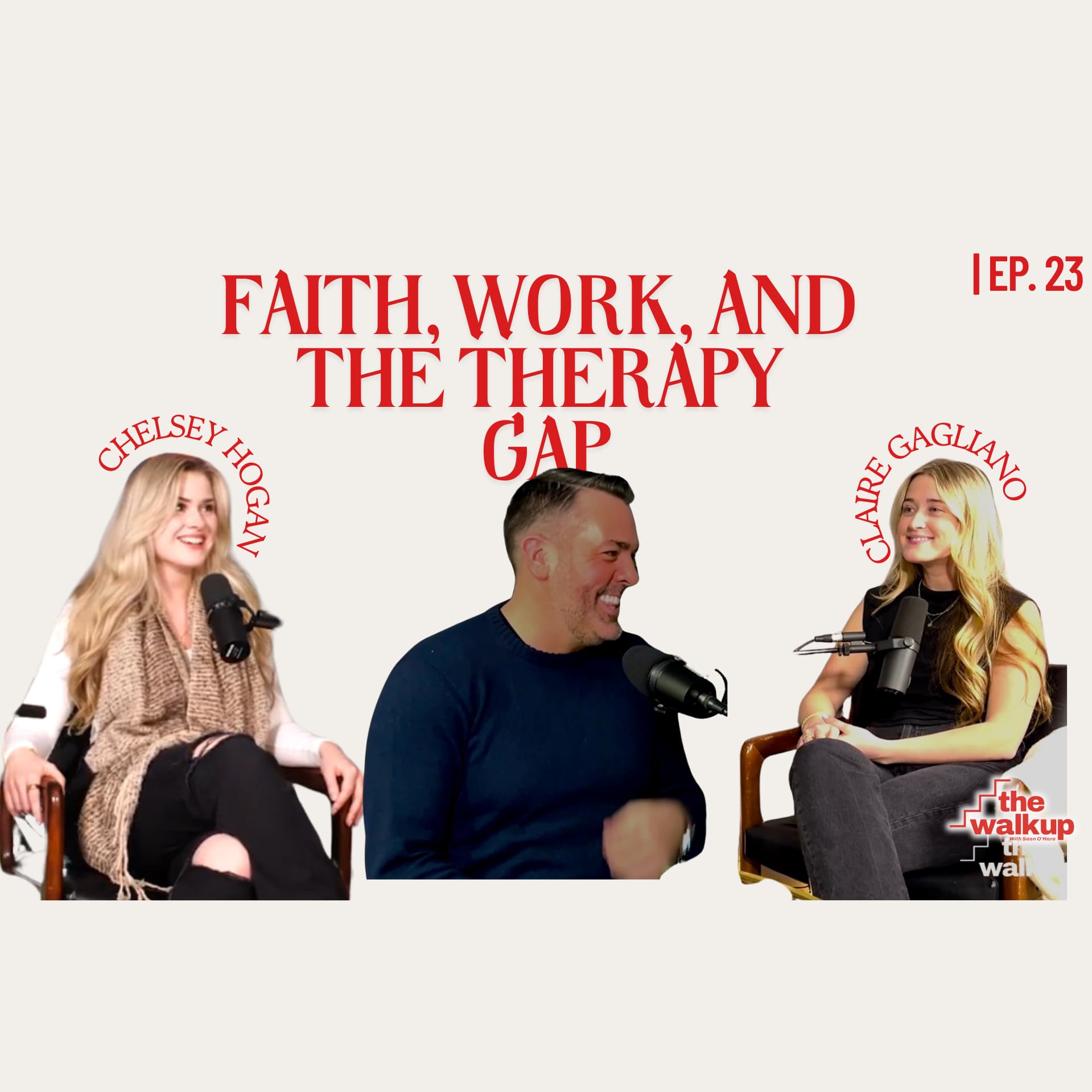
In this episode of The Walkup, Chelsey Hogan and Claire Gagliano tackle everything from the crisis of communication to the psychology of modern marriage.
Together, they explore faith-informed counseling, college hookup culture, socioeconomic pairing, and how our 12-move average reflects something deeper about the American soul. A conversation about what we long for—and how we speak to it.
Transcript
Read the full transcriptAuto-generated · 14,018 words
All right, well, welcome to the walk-up. For those that don't already know me, hopefully they know me. I'm Sean O'Hare. I even have it on the sign and everything, just so people know. And today, we have Claire Gagliano, not Gagliano. Gagliano. Gagliano. Shocked me.
Which apparently was news to her very long-term friend, Chelsea Hogan. Who knows her as Claire Gags. Yeah, everyone in college would call me Claire Gags, so. And so then, you know, phonetically, they just stuck with it. And now, the whole world knows you as Galeano. Galeano. And our friendship is shaken to the core. Yes. But is there a Galeano spirit? Yes, a liqueur. A liqueur. Yeah. I'm not sure if it's like Adige Estivo, but that's spelled G-A-L-L-I-A-N-O, as is the designer.
I do not know why we have the G, and some have the two Ls. I am not sure why that is. Well, because you held on to your Italian roots, and these other people... They pivoted to embrace, yeah, I guess, maybe. They did not ruin you at Ellis Island. They kicked the G. Is that too confusing? Or, you know, they are like, listen, we are Italian. We do not care if you cannot pronounce it. So, there is like a thing with O'Hare, actually, that I am going to get the exact...
Historical reference of this wrong, but I think the story we tell ourselves is that for those that kept the O apostrophe, so there's a lot of those like, it would have been O'Connor or O'Hare or O'Loughlin or whatever back in Ireland, but when they came here, there was, but maybe the original idea was like, oh, it must have gotten kind of weeded out at Ellis Island, but a lot of it was more the British influence in Ireland, like, hey, we're going to get rid of anything that looks Gaelic.
And so, the theory is that those that held on to the O apostrophe were like, hey, sorry man, we don't care if we get oppressed. Inactive rebellion. Yeah. So, obviously, I'm incentivized to believe that. Do you have any interesting stories about your name?
Yeah, I mean, many. You're related to Hulk Hogan? Many. Oh, Uncle Terry. Uncle Terry. That's great. Paul Hogan? There are so many Hogans. That is funny that you do not know Paul Hogan. This is demonstrating our age difference, which we will not articulate for the audience. We will refrain.
But Paul Hogan was Crocodile Dundee. Oh! Yes, a very... I actually recently re-watched this. I love the 80s for so many reasons, because there are so many... TV shows and movies, that the premises are just absurd, and yet it worked, and when you look at the box office, and then you adjust for inflation, it's like this absurd premise. Made $200 million in today's dollars. We're like three men and a baby, which when you look at the details of that movie, you're like, this makes no sense at all.
A woman just dropped her baby off with these three men, and then there's like a drug deal involved at some point. It's like a hangover. Yeah, it's like, yeah. It probably inspired that, honestly. Yeah. That had more, I hate to say this, but the hangover had more narrative. I am sure this is what people want to know about, but they want to know about you.
So, Claire, you and I met not so long ago. Yeah, pretty recently, like a month. It has unfolded fast. At a gala. Speaking of many ways to pronounce the same thing. So true. Actually, I know about Galeano, the liqueur, because there is a, for our audience who might be interested in Prosecco Punch, there is an excellent Prosecco Punch that requires Galeano, and it really does make a difference, and I remember I was hosting this party, and I was like, you know, sometimes you are hosting something, and you are like, I just don't have time to do these certain tasks, I am just going to.
When you deputize somebody and say, I'm sorry, I really have to ask you to go run this errand for me. I know that's annoying. So, a friend of mine was like, can you pick up Galeano? And I sent her a picture of the, she was like, yeah, no problem. There's like three liquor stores in all of Manhattan that carry Galeano. So, this poor girl had to go to like four different liquor stores to get it. MVP. So, now you have so much more context.
There are so many more stories around your name, and you have more for the Hogan. Yeah, the Crocodile Dundee. Crocodile Dundee. Hulk Hogan. Maybe that should be, she's, Claire Gag's in your Chelsea Croc. Also Hogan's Heroes. Don't love that. Chelsea Dundee, that's pretty good. Chelsea Dundee's better. I'm going to push up against that one.
No, that is how nicknames work. You don't get a choice. That is true. The more you push against, the more it finds a foothold, I think. I have had nicknames, but usually it is Shawnee, because that is the easiest one. Shawnee Boy. Shawnee Boy, the other one. The O in front of the last name, News, to me, did not know that.
I thought that we lost that at Ellis Island, more of what you were saying was the common idea. But my brothers and my father are... Quaking, when I tell them that. They're going to be freaking out. Oh, that they didn't... That they didn't stand their ground. Wait, wait, wait. Their foregrip. Oh Hogan?
Yeah. Really? I've never heard of Hogan before. Well, that's what the root is, I think. Well, because O just means son of. Yeah. Like Mac is the same thing, son of. I know that we dropped... I'm almost positive we dropped the O. So, the whole family has to go to the duty. Lack of courage.
Really sad. Really sad. I remember when I was in Ireland, the first time I did the, oh, let me go, like, this is pre 23andMe and all that jazz. In Dublin, you would go to a place, because they know that the Americans want to look up their Irish roots. So, they charge you a hundred bucks, and come back tomorrow and we'll have your...
Lenny and Joel figure it out for me, and they give me this nice little certificate with, like, we didn't have a family crest or anything, but I think they just put something on there, and they're like, ah, the O'Hare's, they derive from County Clare and from County Kerry, and I'm like, they're saying every way they can to be like, Y'all were some farmers. We don't, there's nothing else. There was no, like, tribal warrior, no, like, Celtic kings in your lineage. You know, you guys were, like, yeah, like, raising goats.
So, sorry about that. They romanticized it for you. Yeah, and certainly, you know, lots of potatoes were in our past, but... But anyway, so Claire and I, we met, you and I met about a month ago at a gala, gala, gala, and I mentioned to you that we started some podcasts, and I said, you know, I think, I think, you know, you're meant, you're meant for the microphone. You got to get, you got to get up there. Aw, that's so sweet.
And then you said, well, I want to bring my friend Chelsea along. Yeah, Chelsea's very wise. She's one of those people that if you go, you have like an actual person, because I feel like so many times if you're like feeling contention about a topic. And some people just feel like the more people they talk about it to, the more information they get, but then I realize they just kind of like hearing themselves talk, but Chelsea is one of those people that is like, if you have an actual problem, you talk to Chelsea, you get amazing feedback that actually informs your decisions.
Wow. We are kind of like an anti-wisdom podcast. So, I should just leave. I apologize for that. Since I have had a lot of priests on my podcast, I guess I should probably concede that there is... He's backpedaling. Oh, yeah. And actually, my brother, who is a priest, has been on the podcast, so that makes it even worse. I'm like, oh, sorry, man. Yeah. But wisdom, it's an interesting thing.
You may not believe this, having only just met me, but I actually talk significantly less than I used to. Okay. And I speak significantly slower than I used to. Oh, that's good. As I've gotten older, I realize. To your point, sometimes you're just talking to hear yourself talk, or I think part of it is you're finding what you want to say as you're going, and you're not comfortable with silence, whereas now I'm comfortable way more with, like, let me take a beat.
And the game for me is, like, can I be precise with my words and use as few words as possible? Just because, so I had to make it a game in my own head. It's like, that's the challenge, whereas before it might have been, let me just kind of like, you know, just start talking and I'll find something along the way that somehow filling the space was the objective, but what say you about wisdom? I was thinking about the comment that I would have about the preciseness of what you were speaking of, because when I was in undergrad, that was something that our thesis director always got on us about, was economy of expression.
And using it as little words as we could, possibly. Oh, interesting. I like that term, economy of expression. That is going to be the title of this one. Yeah, he would write EOE. He would mark up all of our, we would get it back with all the red all over it. EOE, all over it. EOE. You know, there is a famous anecdote about Lincoln.
That one time, he wrote a letter. He said, I'm sorry this letter is so long, I didn't have time to write a shorter one. Yeah, yeah. Because I don't know if you've ever worked on a project where you have to get it down to, like, give me the essence.
What's the mission statement? What's the one sentence that really encapsulates that? Now, that's obviously in a very particular business context, but there is something about if you can find... A way to encapsulate something that demonstrates that you've reflected on it, as opposed to just... Because you're asking the receiver to interpret a lot, right? If you give them two paragraphs, and there's really two sentences of value in there, or one sentence, you're asking them to kind of sift through, whereas if you do the work, and you deliver the one or two sentences, then you're giving them a lot more precision.
So, being the loquacious one, I feel like you should... Super loquacious. Why? Because I was talking really fast, really? Give us the theories of why it is good on your side. Super loquacious. That should be in your Insta bio. Yeah. Well, I feel like, what is it, like stream of consciousness, like writing and communicating, it is not that it is lazy, but as someone who does it and says, this is my art, it is.
It takes discipline to go back and shorten something, but it is also interesting talking to someone for the first time about a topic that maybe you have ruminated about before, but then when you speak it aloud, it is your first time articulating what you actually mean by it. Some people just walk around with these narratives in their head that they never have to articulate, but I feel like there is value to actually saying it out loud and watching someone respond positively, negatively, or to hear their feedback, too.
As you know, I've been working on this TV project where me as a believer, being Catholic, and I'm talking to a lot of non-believers, skeptics, atheists, and I think I noticed that there's a lot of people who have ruminated about, obviously everyone does, about the universe and your meaning and purpose and identity and does God exist, but they don't really talk to anybody about it. So, sometimes when these ideas come out, I'm like... That's batshit crazy. Let's unpack that, actually. I don't know if you're aware of what you just said.
No, I mean that with complete compassion, of course. But I think there's like, to your point, you've gotten so used to like, oh no, this is how the world works, but they've never had a dialogue about it, and when you put it out there, and you're like, that doesn't really make any sense at all. Or it... Could use a little printing. Yeah. So now, Chelsea, I have only just met you today, so how do you think things are going so far?
Swimmingly. Great. Well, you are, there is no pressure at all when you are on camera to say that you are enjoying your time with me. Blink twice if you need help. Oh, yes. But you are, I think the audience would love to know, your professional background as a counselor? Yes, yes, yes. And a faith-based counselor, as I learned, so maybe define that for people. Okay. So, I am a licensed professional counselor. I started out practicing probably, like, within, like, five, eight years ago, including grad school, and it's been a journey, and I have found a lot of useful knowledge along the way.
I am... A faith-based counselor, and what that looks like is finding people in their humanity and approaching it with humility, how they see the world through their faith. A lot of people have questions about what the difference between a faith-based counselor and a biblical counselor is. A biblical counselor is more rooted in an ideology.
More of, like, a specific theology. Or doctrinal, so to speak. Yeah, like a religious sect, like a denomination. Like, you can be, like, informed by, like, it's kind of like... Like, I have a Catholic therapist. I'm specifically seeking a... Catholic wealthy, yeah. Yeah, yeah. Or you can find, like, more biblical counselors and, like, pastoral counseling and, like, things like that.
Faith-based is... Where you kind of like take a step back and welcome faith into the therapeutic space, and in that, I defer to the client and how they are in their journey and their relationship with their higher power. So, it is a really cool way to see therapy, and a way to connect with clients and help them to connect to...
Well, I have lots of questions about that, but I'll try to stage our way into it. But first, I guess I'm curious about choosing that professional and vocational path. It is a vocation, I think, to be a counselor to other people. You either have that sort of... Hard for that. It is a ministry of sort, I would say. So, one, kind of what made you, why do you think you had interest in that, and then when did it become clear to you you wanted to be a faith-based counselor?
Well, we've been counseling Claire for a while. Is that why? I'm her number one client. Yeah, that's what all my friends are like. That's so true. All my friends are always like, I'm your pro bono client, right? And I'm like, why would I want to be your therapist when I can be your friend? That's like so much, there's such a gift in that. But why I wanted to be a therapist, or how I found myself as a faith-based counselor.
So, the interest started. Gradually, when I was in college, I bopped around different majors. I was business at one point, which I don't think I would have thrived in that environment. You could sell your bread. True. I'm a sourdough aficionado. That's just a fun fact about me.
I landed on psych. I think that I had roots in, like, human, humanity-seeking, whole-person work, because of my grandfather, and he just had an outlook on the world that really impacted me, and basically, like, I always quote him, this was like his, You could talk to him for five minutes, and you would find this quote rolling out of his mouth, but it was, each human person is made unrepeatable, unique, and with unspeakable dignity. Like, every person that he met walking down the street, like, he was like, I just met a celebrity, essentially.
It didn't matter if it was, like, a weird... That's a beautiful get-to. Yeah, yeah, no, it was very... Impactful, but yeah, it didn't matter if it was a waiter at Denny's or if it was somebody who was actually a celebrity status and didn't make a difference to him.
So, very inspired by him. Faith-based piece of it. That's how I see the world, and a lot of that is, when you're a therapist, the way that you see the world, a lot of that is mirrored in the way that you approach. The therapeutic space.
Well, just taking a step back, so your grandfather, that is an inspiration, but then you get into the psych classes, and it is like, I feel like, all right, I can do this because you have a, I imagine there has to be, you have to be a great listener, right? You have to have the ability to.
Absorb a lot of people's, like, a lot of inputs, and then figure out how to process that, and then apply psychological, you know, truisms, and all that sort of stuff. So, like, what, from the inspiration for your grandfather to, like, getting into the classes, like, why, what made it, like, all right, this I feel like I want to make this a career?
I just found it. Like, the human brain to be, like, unfathomably interesting. I mean, I don't have a boring day. You know, it's something that, like, I keep learning every single day. Something that keeps me engaged, and it is, like, incredibly, like, deep, and it can be a rabbit hole sometimes, but it's very rewarding as well. So...
I think that in anything, you find your calling, you find your purpose, your, like, shoe-in in life, because it comes to you, like, naturally, and you find, like, a home in it, really. I think that, like, my personality, like, lends itself towards it. I am an INFJ, which is the counselor for Myers-Briggs. Oh, right. I am not INFJ. What are you?
E-N-F-P. Okay, nice. One of the tests I took said it was like the campaigner, the one who campaigns. Oh, okay. Not quite a politician. Maybe there's politician elements to it, but it's more of like, we've got this great idea, we should do it. You've got the drive.
Yeah. Cheerleader, really, is really what we're talking about. And then, you guys met how? We went to school together, but we weren't in the same year. I think we overlapped a little bit. Our school was very small. We went to the University of Dallas.
We're definitely keeping that. There's 100% going in there. This is a plot. They're technically the Crusaders. We're groundhogs. Yeah, so the school doesn't have Greek life or a football team. It's pretty small. There are some sports. Yes, there are sports. I played two of them, not to brag or anything. D3 for one year. What sports did you play? I visited there once, yes. What is the Cistercians? Cistercian Abbey, yeah. So, there was a priest who kind of took a... A year sabbatical to study art, and so he stayed at a rectory in New York, of which I live next door, and he was going to the med and doing independent study, but he was at UD.
Oh, that's awesome. And so I went back, and I was in Dallas for something, and I went and visited him and had lunch. Beautiful. Father Greg, I can't remember his last name, but... Aw. Aw. Yeah, there's such a nice presence to have walking around the campus, but also, like, obviously, you're in college, so a lot of people aren't super focused on... I feel like religion was very formative there, because it is a Catholic school, but also everyone liked to have fun, and everyone was, like, kind of in their rebellious phase, but...
Yeah. Okay, so we're technically Crusaders, but we had a pretty good rugby team that they called the Hoggies, so it was like the Groundhog. It's like our unofficial mascot. We have the second largest Groundhog Day celebration in the country. Second? Oh, to Punxsutawney? Yeah, I think to the main one. I would hope so. I would, like, I'm, like, offended.
I don't think, like, number two. There's somebody else. Yeah, but are you going back for it this year? I didn't last year because my sister was giving birth, and I need to have feet on the ground during that entire month when that happens. But I was thinking about it. I have to go later on in the month for a business trip. So. Well, I guess Groundhog Day, being in February, is a lot nicer to be in Dallas than in Punxsutawney. Or in Ohio?
Isn't it Philly? Philadelphia. It's Pennsylvania. So, it's colder there. Although, it is snowing in Dallas right now. Is it really? Snowing in Dallas and Atlanta. Yeah, the whole city is shut down. Oh, yeah, for sure. You guys don't know how to deal with the snow there. I broke the state like three years ago. I could wax unpoetic about the infrastructure in Dallas and how it's going.
That will be our next segment. How much time do you have? Bring it back for the infrastructure podcast. So, then you guys met, and you were like... You just immediately became besties, or how did you become friends? Not at all. We honestly were like two ships passing in the night for a while.
Yeah, for sure. We didn't actually start getting close until we both lived here in college. We were like a UD alumni. Yeah. Well, yeah, the beauty of social media, one of its pros for the culture, actually, is the ability to connect people, and so, I think I followed you on Instagram. Like, we have mutual friends, but we weren't close in school, and then I saw you running on the river, like, on the other side of the Hudson, taking pictures of, like, where I live, and I was like, she lives so close to me, that girl.
I wonder if we would be friends. And so, I don't know how... No, you texted me. I got your number. I feel like we're like a couple, like describing like how we met. Yeah, that was a great day. I'm like, you texted me.
I know, did I ask you to dinner? I'm so romantic. Oh my gosh, yeah, we got sushi. Really? Yeah. Yeah, that was good. It's like the most like... Girl, New York thing to do. Yeah. We're going to grab sushi together. Yeah, it was sweet fish. Yeah, and it was like we've always... Ask me where my keys are. I don't know where they are. Ask me about inane subject matter from like two, three years ago. I can give you like minute-by-minute detail.
Oh, that's amazing. It's a terrible crux. I can't think of any guy friend over there like, hey, you want to go grab sushi? That's never happened. Really? I'm sure we've consumed sushi. Maybe wings. Yeah, yeah. And not like a cocktail bar, you go to like a pub. Oh, love a pub. Yeah, yeah. Keep it masculine.
But anyways, so this is a couple years ago? This was like one year ago, exactly. I remember because I think Lent had just started, or maybe it was like dry January, because I was like, I am not going to drink, but then I met her and we got cocktails and we went to sushi. So, yeah, it was great. So, did you talk to her about her willpower and how... Psychologically, she needs to work on that. No, I was like, let it rip, Claire.
Oh, yeah, for sure. So, how did you guys each, so you each found yourself from the University of Dallas to New York, so how did you decide to come to? The best city in the world. Yeah, different paths.
So, I grew up in Georgia, and then I went to the University of Dallas. I got a job in Fort Worth, Texas, which is a very cool city. I don't know if you've been there. Have you ever been there? Fort Worth? Mm-hmm. Okay. I think I've only been in Dallas proper, yeah. Oh, yeah. It's super interesting, really fun place if you ever get the chance to go. It's kind of like, I think, what Nashville would want to be in terms of being the Western vibe and everything, but Fort Worth feels a little bit more authentic and less...
More broken than, I guess. So, I lived there for a year. COVID happened. My office was in Fort Worth. Moved back to Dallas. With some post-grad friends, and then as COVID was ending, I just felt it was time for a change. I think I'd been in Dallas like at seven years at that point, and I got a job offer that was completely remote, and I asked if they could base me out of New York. I was considering New York and San Francisco.
Well, what did you know about New York at that point? Because that's, you know. A lot of people, that's like, whoa, New York, that's a whole experience. You have to know what you're getting into. For sure. I feel like people who grew up in the Northeast consider New York the city, and I consider New York to be a movie set that I would never go to.
Everything was set in New York, but I never actually conceptualized going there or living there. I know so many people have a dream of, like, it'll always be like me in New York, and that just didn't happen for me, because I never considered it a possibility. I kind of thought I would live and die in Dallas.
Memento mori. But, yeah, I was feeling really restless. I went and visited a friend who lived in New Jersey, and I remember landing on the plane. I put on Welcome to New York by Taylor Swift. I curated my own little moment. She was a Swifty, for sure.
You look at the LaGuardia, and it says, like, Welcome to New York and glowing lights on the tarmac as you're landing. And I felt like I was going to Six Flags, like, as a little kid. I felt so excited.
And so, after COVID, I was like, I'm just going to chase that feeling and the fact that... So, that feeling, and then the job offer, and one of my good girlfriends from high school was looking for a roommate, all happened on the same day. It happened really quickly, so I just pulled trigger and made the move, I guess. Wow. I think you either get it or you don't. I'm not to say you couldn't grow into it, because I think some people, they get a job offer for their career, like being in New York.
Is necessary, right? So, they didn't move here because they love New York. They moved here because it was the right professional advancement, and so I think sometimes people there, they might not have been here because they love New York, but they grow into it over time, but I think for a lot of us who move here because it's just there's something about either, like my brother, one of my brothers is always like, I just don't like, what is it? Why do you live in New York?
I don't get it. We grew up in the D.C. area, like suburban D.C., which When I was growing up, it was quite idyllic and quiet. Now, it is incredibly expensive, and everything is all about the suburban D.C. and traffic and everything else. So, he got out and moved to South Carolina. So, he has been retreating from big cities, and I am always like, the amount that can happen in one day here would take me weeks anywhere else. So true.
But I just love that people are always coming to New York, so I can stay in one place and meet more people than I could if I was kind of hopping around and traveling. And I just find that people in New York have a higher social capacity and desire.
I mean, even D.C., which obviously is a relatively big city, I think it's often misconstrued as a major city because of its political power, but it's... In a lot of ways, it's more of a village, because people come in, they leave, they're there exactly for the thing they're doing, they're not really there to socialize.
There is like a permanent, more kind of government contractor, military side of things, but I've always just felt that people in D.C. are never... Quite free to be themselves, because if you're there, you're representing something other than yourself. You're there for a political party, or a politician, or a think tank, and it's a small town, and everyone's trying to get something accomplished, and so if you're letting your freak flag fly, you're like, I don't know if I want to do that.
Do something and risk, like, all of a sudden I'm sitting across from somebody in some budget negotiation, and they're like... Were you the one dancing on that bar two nights ago? Like, no, no, no, that totally wasn't me at all.
But, whereas New York, it's just like, people are just like, you do you, man. Whatever. It's like, whatever you can think of, you can find a good ending, obviously. Yeah, no one's paying that much attention to you in New York, where I feel like in D.C., probably, it's more like affiliation-based. I've heard girls that are dating there made it sound like everyone's kind of seeking, like...
What can you do for me type of connection, whereas in New York, I know there is that scene, but I don't run in those circles. Yeah, I had a friend who actually worked in the White House. I think he's a TA something or other now, and he came to New York for New Year's, because we used to do this big New Year's party at St. Malachy's in Times Square. So, the great thing was we had mass beforehand for the Feast of the...
um solemnity of mary on december 31st and then we get to have our party underneath the church and then at like 11 45 p.m we could walk out watch the ball drop and go right back to the party um so he's like i gotta come to that party one time man so we went to dinner before mass and what was like 10 or 12 people at dinner and he's like hey man so what does everyone do here And I was like, you know, I actually don't know.
He's like, what do you mean you don't know? And I was like, I just never asked them, I guess. Yeah, there's so many more interesting things you could ask people. I said that the other day to someone, and I was like, I often find that that's the last question that I'm reaching for, because we work for how much of our existence, and then... We're just trying to socialize and connect and spend time together. Exactly. And if you're passionate about it, it'll come up immediately anyways.
It's kind of like, what do you want to share? But giving people the open platform. To not have to identify themselves by their corporate job or whatever, I feel like that is really important, too. Yeah, because you might have a job, and you are doing well at it, and it maybe pays really well, but it is not your passion, but that does not make you who you are.
I would do this in D.C. just to freak people out, because I was around D.C., but I was not involved in politics or government or whatever. I just grew up there, and so I would be at some whatever.
Cocktail party, gala thing, and I would say, I'd be in a group and I'd say, let's agree, we're not going to talk about what we do, where we're from, or the weather, or traffic and how we got here, like in a car or whatever. And if they were interesting, they'd go, oh, cool. And then if they were...
You see people freak out, because they're like, I don't know what I'm going to say now. And it was probably cruel of me to do that, because I wasn't looking to get ahead in the DC circuit of activities, so it was probably cruel of me to just project my own lack of it, my detachment from that world onto everybody else, but I would do that every now and then just to see, because I try to ferret out who's...
Just figure out who is going to be fun to talk to out of this hundred people. Drop that bomb into a conversation, and very quickly, people scatter, and you find out who is worth talking to. Well, that is how we connected in our conversation, because you were tangentially in this little triangle when we were getting introduced, and I did not want to ask you what you did, so I said, is there anything exciting happening in your life recently? Oh, is that what you asked?
Okay. Yeah, and you were like, yep, blah, blah, blah, blah. So many things. I am doing a TV show. I am starting a podcast. I have a podcast. Do you like podcasts? And I was like, I was actually just thinking about, like, independent media companies and their influence on young people, and you were like, great! And the rest is history. Now we're sitting here, like, a month later. We're a product of our own, I guess, you know, conversational habits. Yeah, that's very true.
So, now to you, and how did you find yourself in New York? So, I was living in Dallas, went to UD. I graduated. I was living with a bunch of my close friends in a big old house in the historic district and having a grand old time, and then I started working with the practice that I still work with now.
And the best way that I can describe it, in the most economic of terms, is that my roots were getting deeper in Texas than they were in New Jersey, New York, and I was uncomfortable with that. I wanted to, I want to, like, live my life here, close to my family, and...
It was time to pull the plug. I'm sorry, the roots were getting deeper in Dallas or in Jersey? I'm confused. Their roots were deeper in Dallas, in Texas, than they were in Jersey, because she's from Jersey. Oh, you're from Jersey. Okay, I didn't get that part. I'm sorry. Oh, okay, so your roots are getting further away from your family, with your friends that are family, effectively, in Dallas. Yes, yes, yes. You want to be closer to family in New Jersey. I thought you were saying there was too much family in Dallas, I've got to get out.
No, no, no, no. That is what I was... The opposite. I misinterpreted that. Yeah. So, it is less shocking for... Not shocking, but less difficult for your family to understand the notion of living in New York, whereas... Your family, I imagine. Is there a little bit of a, what the heck?
I think my dad, like, blocks it out until he sees a news article that he inevitably sends me, like, three different versions of, like, woman lit on fire in the subway. And I'm like, I know, I know. I take the subway. I know the horrors that go on there.
And then, yeah, and then anytime I talk on the phone to my grandfather, he always ends it with, and I have a one-way ticket back for you, like, anytime you want. I can't fathom going back. It would feel like going backwards, but I also can't imagine, like, staying here forever. I'm like, am I going to be able to afford it forever? Because it's expensive, but, you know, I mean, I don't know what's going to happen. Just one step at a time, I guess.
Well, I think it is an interesting, I don't know that we appreciate the unique nature of what we think is normal in terms of professional advancement. This relocation, this is only, like, even possible in the last 100 years, and really only frequent in the last 50 or 60, in terms of, I've got a job opportunity I'm going to pick up and leave. I mean, for most of human history, you talked about, like, living and dying in Dallas. Like, that was the norm.
And I'm sure you guys know families like this where... They have plenty of professional advancement opportunities, but they have repeatedly chosen to stay close to the family unit, and family, and extended family, and so forth. And I think it's, I don't know, I don't know that I'm up two minds about it to some degree. I will say this, as I've gotten older, I feel like I...
See more value in the sticking around thing. Obviously, now remote work makes even a lot more possible. I mean, I say that also fully knowledgeable that I believe that New York has shaped me in so many ways and opened up parts of my personality that I'm almost certain would have laid dormant or undeveloped. Yeah, so true. So, it's not as if these are binary. You know, goods and not goods. But I do think it's interesting that I don't know that we've fully come to grips with the transitory nature of how we just uproot and move.
I think the average American moves like... That is insane compared to most family structures, because the family unit being obviously the thing you can rely on, trust, all those sorts of things. Of course, communications and travel make everything a little bit easier, but no, it is just so normal. I think we have now, I don't know the statistics off the top of my head, but basically the largest...
The unmarried population we have ever had, you know, in the United States, and in culture generally, that people don't get married later, and certainly relocating professional advancement plays a role, right? Because there is a, between, I think, the norm being people going to college and even grad school necessitates a couple years of like, at least a couple years of like, well, I got to.
Get a job that either, at the least, pays off my college debt, or, you know, not only justifies, but puts to use the degrees that I worked. So, my mom was married at 19, right? She grew up in Brooklyn. She didn't grow up in, like, you know, Kansas. She grew up in Brooklyn, you know, and that's one generation ago. We're getting married at 19.
Made sense. Yeah. And now that would be like, what is, are you crazy? Like, have you not explored all your options? Have you not this, that, and the other, right? So, in today's world, my mom probably wouldn't have looked for a spouse until she was at least in her mid-twenties, right? So, I don't know, from a psychological perspective, I'm curious as to if you've given thought to that of how we effectively delayed By virtue of advanced education and professional life, we've pushed off the kind of window, the beginning of the window of marriage by, I would argue, at least five years, if not more.
Some people do get married right out of college, and that's great. But even there, there's actually a stigma about getting married under 23, I would say. Most people would say, whoa. What are you doing? So, I'm just curious from a psychological perspective, if you've given thought to that.
I mean, I read an article, it seems like years ago now, about how childhood has been extended in the American society and culture, and how back in the olden days, you hit around 16, 17, 18, and then you were kind of just kicked out of the house and had to go fight for your bread.
But now, it's more knee-jerk for a kid to be in the home. Up until 18, it's sometimes 22, maybe they're commuting to college, and that whole academic, it's almost like a societal, yes, you are going to college now, and that has extended the childhood era.
Yeah. So, and then I think the point that you're making is accurate and valid for the fact that once you get out of college, what are your next steps? Because nowadays, depending upon what field you're in, it isn't an option just to go into your career. For me, when I graduated college, I needed to go get a master's in order for me to practice and get licensed.
Whatever state I was living in. So, I think that the, like, demands of, like, whatever, like, the culture that we live in now, but also, I think there are probably deeper, like, psychological... Dives that we could go into with that. Oh, so many. Hundreds.
We've talked about this in the past. We've talked about this nuclear bomb of a topic. Yeah, that's a funny reference for where I'm about to take the conversation, but we have a running joke about how, like... In years past, there were things that were causing people to live in the reality of their mortality, like war, like plagues.
Famine. It creates a little urgency. Yeah, so now that we're in, not to say that there isn't tragedy or things that we come up against, like COVID, things that are disruptive and things that affect us worldwide, but it was a little bit more intense, I think, back in those situations where people had to look at the fact that they weren't going to live forever, they weren't going to have things instantly gratified, and they didn't have access. To, like, as much, like, media, as much, like...
As many inputs and ideas. Yeah, like, or just, like, insight into others' lives. Like, you know, like, it was more of, like... Yeah, you didn't know how people lived in the other side. Yeah, like, it was, like, more of, like, a lived experience that was, like, pure, almost. So, I think that that... That is just my opinion, but I think that that affects things, like about how people think that they have a lot more time than we really do, as I threw out a joke about memento mori earlier on in the conversation.
Can you explain to people what that is, for people that don't know that reference? Oh, it is just remember your death, in Latin. So, it is the idea that we are not of this world, that we are meant for the next, and that we should always be ready.
Yeah, and I think people think of that, obviously, as, oh, that's so morbid, and it's like, no, it's about clarity, right, and having, you know, death before you, not as a, like, as you're looking for, you know. An off-ramp, but to put things in context, you see a lot of paintings, especially with saints, where they're holding a skull, or I'm trying to remember, there was a really famous location with a ton of skulls of like...
When Franciscans or Dominicans or some religious order, I was at one in, I think it was in Lima, somewhere in South America, but you can think of it as kind of like just really morbid. You go under this crypt, and it's just bones everywhere, and I was actually, as part of this TV project, we shot at a monastery upstate in New York, and we were visiting with this brother who had been For those that don't know, there are monks, there are brothers, meaning they are part of the community, but they are not priests, they are not called father, and there are others that are brothers, but also a priest and called father.
So, this guy was a brother, he had never become a priest, and he was probably in his 80s, and this community... You know, they provide for themselves. They don't really take donations. I'm not sure if somebody gave them money, they'll take it, but they usually have some sort of industry. In their case, they bake bread. And then they were also doing granola now, because they were noticing that was another product they could serve. So, this guy was literally, as I'm talking to him on camera, he's literally packaging the granola, and he's just smiling.
He's just like this perpetual grin. And I'm like, so, tell us about you. How long have you lived here? He's like, oh. I guess it's been about 65 years now. I was like, oh, wow, but you never leave. And he's like, no, no, just been here. And he's like, one day, I'll join my friends out there.
He's looking at the graveyard. Which is such a weird thing, but there's a complete piece about it. Like, the happiest person you've ever met, who's, like, doing a quote-unquote menial task, right, of, like, packaging granola bars. But he's just like, I'm just so in love with Jesus.
I'm like, gosh, you're literally, like... Directly to heaven for you. Do not pass go. Do not collect $200. Yeah, he's on the escalator to heaven. But, yeah, so I think there's, I don't know that we really, this is a relatively new thing. So, I mean, I think psychologically it takes a while to, just like the, maybe you're talking about war, but I think we're still.
Culturally, and the aftereffects of World War I and World War II. I mean, I think that, just like, especially when we talk about it from a Catholic church's perspective, the church tends to think in centuries about how long, you know, the Second Vatican Council was in the 1960s, late 60s. We're still starting to come to grips with the implications of the changes in the liturgy and so forth. And I think we're still living in an age that... That's how life is completely disposable in terms of mass casualties, and nuclear bomb, and World War II, and the mechanization of war to such a scale that it can't not change the way that human behavior, or how humans see the world and themselves, and we see that with our generations, right?
The greatest generation coming after World War II were just so grateful that the war was over that they just wanted to... Have families and have a job, and then the baby boomers, there is a little bit of a separation from that. There is a little more indulgence and capitalism and so forth, and then going into further generations. So, I don't know. I don't think we are, because the people a lot of times ask about, I am sure they ask for... What do your families do about dating and marriage and relationships of, like, you're moving to New York.
How are you ever going to get married? Because marriageable men wouldn't be in New York, I guess. But how do your families see your going to New York and professional path and everything else in balance with, I assume, your family's... Yeah, very true. I remember I told my sister, who's very traditional, she actually joined a convent for like a month or two, and then quickly was told that's not her journey or her path, so then she left, as it would happen, as it always seems to happen, met her husband.
Almost like a week later, married within the year, now has two kids, happily married. So, when I told her I was going to New York, I actually, funnily enough, didn't. I intentionally did not tell my family where I was going. I announced I was moving, and I said, I will tell you. Instead of a gender reveal, you just did which city I'm going to move to. Exactly. I did this when I went to Thailand for the first time. Walked in with my bag, said, I need a ride to the airport.
I'm going to somewhere. Wow. I love those boundaries, Claire. But yeah, I knew my dad eventually figured it out when he started sending me Columbia grad school programs. He was like, well, if you're up there, you might as well get another degree. But my sister had said, if you go up there, you're going to delay your vocation several years. And I was like, I don't like the thought that, I don't know, I feel like Living, you have to have more, you have to embrace surrender and the providence underlying the choices you make if you're making well-oriented choices.
You have to trust that there will be support and grace to direct you where you're supposed to be. But it's also not easy, because a lot of people now with online dating and everything, I think it's called the paralysis of choice.
Your pool used to be, you would go to class, or like a grad school program, you'd have like 20 people in your cohort, you would hang out with those 20 people, some of them might already be taken, some you're just friends with, and then, oh, before you know it, there's like three candidates that you could potentially date, and maybe it works out with one.
And then now with online dating, you have an unlimited number of people with an infinite number of possibilities for connection, and I feel like New York, you also have that, not just on like a dating app, but in real life, because I feel like in New York, I meet like 30 people a week, and they all seem amazing. It is like everyone is ambitious and charismatic.
It takes a lot to survive and live here, so if you are living here, you're kind of at the top of your game, and also people are just so interesting. So, yeah, and I guess also with the ambition of it and everything, and New York being so career-oriented for people, such a big city, and such has a major... Thumbprint, and like all the major industries, it's not everyone's top priority here, finding a life partner, because they see it kind of as like a career stepping stone where you're so busy with other things.
But that being said, you do meet a lot of people here, and some of them are good people, so I think people definitely find their. Partner in New York. If that is what you are looking for, you just got to kind of have your boundaries cut and dry, and like know, like see the red flags, be like, that person is not seriously considering dating. Goodbye. Right, right. Otherwise, they can just distract you if that is what you are looking for.
I think I have referred to it as the perception of infinite choice. Okay. It creates this perception that there is... Because there is certainly a paralysis that comes with having a lot of options, so to speak, and there is the perception that there is just going to be always options forever and ever and ever and ever, and how to curate that, or how to figure out who to incorporate into your life, or you are saying, like, identify the red flags, or what have you.
So, I don't know if you want to speak from a personal perspective, or more from a professional perspective about... How people are seeing, what you're witnessing in your work or with discussions you have about relationships and family and the delay of marriage.
Can sometimes a company come to New York? Well, first of all, I just think that I was very impressed with your answer, Claire. Thanks. I blacked out. I just, yeah. Economy of, what was it again? Economy of expression. Economy of expression. I mean, it was a little quaint, I think, but it was yours, and I think it was amazing what you said about surrender. I think that I actually told myself that I was going to embrace the word of surrender for 2025.
Aw, I love that. I haven't told you that. I just touched the microphone. But, yeah, I think that you put that beautifully, and I don't know if delaying your vocation is possible. I know. It almost, like, gives you too much gravity. It's like, I don't have that much power. I mean, I do have some, but at the end of the day, you've got to have trust. Yeah. But, anyhow, the thing that I would say about it...
I think that I would mirror a lot of what Claire said, just because it was beautiful and profound, but I also agree with it. When I think about what my family want for me is to find my path, my vocation. What I see in that is a lot of what Claire was saying. You have to surrender and take a little bit of a... Knee to it, and whatever is meant for you will not pass you.
What I'm looking at, like, in, like, the culture, like, I think, also, like, I was kind of hinting at it with the talking about, like, the us being exposed to, like, too much, like, you know, like, seeing too much, like, knowing too much into, like, the insight of, like, others' lives, and what, like, comparison can do, like, comparison is the thief of joy, Teddy Roosevelt.
Didn't see that coming. It's Teddy Roosevelt. I think it's Teddy Roosevelt. I know. I trust you. He also walks softly and carries a big stick, so there are lots of different things. But, yeah, no, I think it can be stifling, and there's a lot of pressure in it, and the beauty of surrender is giving it back and being just along for the ride with a lot of joy and openness.
New experience and stuff, and that's what I would kind of encourage, like, from a psychological perspective. I think that when people, actually, when people enter into a state of panic, it's a biological response to only see, like, one or two paths in front of you, and that can kind of lead to a whole host of mental health burden, but being able to, like, surrender over, like, get to a grounded state. space um and like seat yourself in the present moment you're able to like open up like a lot of pathways a lot of flexibility um so if people are looking for many options i would say to look away from the dating apps and look more inward and get to a place of groundedness and seatedness um but that would be my tidbit well it's interesting about mental health generally as we talk about Kind of generational differences, right?
So, my dad's and mom's generation, I guess they're baby boomers. And so, mental health, right? Like, not top of mind. Like, I remember trying to probe my dad about certain topics about his childhood, and it was just like, I don't know what you're talking about. Like, it was just like, was not able to access.
Kind of vulnerability, or I remember when I talked to my uncle about this, my dad's brothers are twins, fraternal twins, and none of my three brothers, all extroverts, Irish Catholics growing up in Long Island in the 60s. And none of them drink. Oh, wow. It's like, that doesn't make any sense. Yeah. Right? Literally, there was a bar in my grandfather's basement. Had a little tiny bar there. And I said to my uncle one time, I said, so you don't drink at all?
He's like, no, I never really have. And I said, do you think that's because your dad used to drink two cases of beer watching a baseball game? And he's like... This had never occurred to him. Like, never put those two, it was like, he's 75 years old, he was like, I've never thought about that before. That's so interesting. So, just no reflection, right? Not that I'm a reflective person, but I'm just saying, like, mental health, I think, if he'd grown up in, you know, this time period, he would have been more clued into, like, these signals or whatever else.
So, I'm just, I'm curious because, like. Obviously, in marriage, there is the ultimate intimacy, right? You're sharing a life together, hopefully sharing children together, and sacrificing, and you're all in, right? You're into each other's, giving your life to the other person.
That requires, hopefully, vulnerability as well, but I think I've seen marriages in my parents' generation where I think that, were they vulnerable with each other? I don't know. I think there was just like a part they just didn't really discuss, and they just made it work, and divorce was not an option. Yeah, 100%. Whereas, like, I feel like every relationship I've been in, we're like mining every childhood wound, which I'm happy to do.
Uh, but I'm like, I guarantee you my dad did not ask it. My dad proposed on the third date, so like, I'm pretty sure he wasn't like, I got a mental health check, you know, and then I'm learning things, by the way, like, uh, my dad passed away two years ago now, and my mom is sharing more stories about her childhood or her family, and I'm like, wait, what happened?
Okay, we should probably talk about this. And she's, no, I'm not really interested in going there. She just made her peace with it, whatever the situation is. Yeah. And that's all. Yeah. So, speaking of, like, data points, there's, like, this infinite choice thing combined with our desired, in a good way, I would think, to have more knowledge and awareness of our own mental health and our compatibility with our future spouse, with mental health.
But now we're like way more data points and commitment phobia. I think for a lot of people, I would posit that I think a lot of that is probably the divorce right being what it is. A lot of our contemporaries.
Haven't seen a successful marriage, so why would I jump into that? Like, my parents are divorced, or my boyfriend or girlfriend's parents are divorced. They haven't seen. You just struggle through to figure it out, right? So, I feel like I'm setting up a scenario where it's like, man, there's a lot of cards stacked against us. We have to know each other better, we have more wounds to work with, and we have more fear of commitment because of, and this doesn't even talk about the influence of birth control or the culture or hookup culture or anything like that, right?
So, I was going to drop all that nick of the bomb of information on you. This is the problem when you're licensed, you know, to like... counsel then we're going to lean on you i would like to phone a friend we have saint francis of assisi i would love some divine inspiration um so if we were to employ economic expression here what is the direct question oh what is the direct question yeah so basically you know between there's there's a greater desire for vulnerability okay Or, I should say, a greater recognition of how important vulnerability is now.
Yeah, we have more woundedness, I would argue. And so, does that then make it... More challenging to find compatibility, because whereas my parents probably just didn't talk about stuff, and they just made it work. I don't know that that's better, but for a lot of people, that did the trick.
Well, I mean, as far as coupling goes, in the mental health field, there's like a... The general acknowledgement of the people are attracted to each other at the same level of health. So, if you are not functioning very well, and on the decline, you are only going to be able to make and maintain a relationship with someone who is at the same level operating health. It does not have to be the same styles or the same patterns, but generally, that is how it works.
So, if you are looking at somebody who is really not okay with vulnerability, and like, Like, is, like, very deeply wounded at their core. Like, they're only going to be able to really meet with somebody in the same capacity. Whether or not down the line that explodes is up to them and God. But I think that, like, if the question is, like, is that happening more? Maybe, probably, given the fact that the divorce rate is burgeoning.
There probably were cases, like, way back in the day, even if it wasn't, like, socially, like, common or correct to, like, go deep and talk through things. It probably was happening, just with people at the same level of health. But, yeah, that would be my knee-jerk response to that. Yeah, it's interesting. So, you're saying that...
Claire, to weigh in with her wisdom, with your economy of expression. I think that what you're saying is that there's, ideally, you have two people that are independent or have a good sense of their own identity and mental health, so you don't create a codependent or dynamic, right?
Because that is obviously not ultimately healthy. You want people on interdependency, ultimately, right? But I guess my sense from a guy's perspective is that I don't know that most guys are as familiar with how to have a vulnerability. It is just like a... What is that, exactly? They don't know. They're more familiar with, like, oh, I should probably know about the five love languages or something, you know, and they're aware of these things, but knowing how to, like, articulate that and share with a future spouse, I think, is still a challenge for most guys, but I get what you're saying, that, like, people...
Yeah, there's actually a study on it. I think I learned in a social psych class, and I might be bludgeoning this, because it was years and years ago, and during my undergrad, but they did an experiment where they...
labeled people from 1 through 10 based off of like all the different like attraction points like it could be like physical attractiveness emotional like IQ like like readiness all those different things and then they like paired them up and then just like kind of put them into a mixer and like at the end of the mixer they were matched like with the number like respective to their gender so like the one met the one the two met the two like you know like yeah in that way and now we just let the apps do it for us It's great.
And they get to monetize it. Yeah. Forget the scientists. Super healthy. So, what say you? I'm trying to think. I was trying to think about which little thing to pick off of. It was interesting that you said your parents got married at 19. Well, my mom was actually at my dad's 26, but yeah. Oh, okay, okay. I think both mine. Yeah, they're about the same age, both 19. And I remember my mom was sitting at the kitchen table, and she was like, you just need someone who sweeps you off your feet and locks you in a tower.
And I was like, nope. That sounds like a horror film. I was like, yeah, that sounds great. That sounds like kidnapping. Yeah. But I think there are a lot of aspects to it. I feel like people practice religion more, and they took it more seriously maybe back then, so when they made that commitment, divorce didn't feel like an option, I guess, but then the divorce rate also is very high, so it's hard to say. It's like, have we ever been doing it well?
Oh, yeah. I mean, it's hard to say. Was there, like, the golden age of whatever? Yeah. I mean, I would certainly have to. My sense is that when you have a more faith-based culture that reinforces these eternal truths, right, there's a little more alignment.
First of all, the people you meet that might be a future spouse, those critical, big picture things are already on the same page, right? And then you can move into the more compatibility thing of just like personality and this, that, and the other. I do think that the Western, particularly American, twist on this, again, in the last 40, 50 years is that I do think that the commodification, if I can call it that, of college has made it to where, to your point before, kind of extends adolescence and childhood, so where, okay, well, we don't really expect you to be an adult until 21, 22, whatever.
Oh, and then you've got to work a couple years, or you've got to go to grad school, whatever else, and I would argue that probably, even for faith-based folks, College is, by and large, I would say for the average college experience, is probably building a lot of bad habits that are not conducive to marriage, right? Kind of basically promotes hookup culture, basically promotes casual dating.
I mean, I've been on dates with girls here in the city who... ...have never been on a real date, and they're 25, 27 years old. When I ask them out, take them to dinner, have a plan, they're like, this has never happened before, because they just hung out, right? And then, eventually, they became boyfriend, girlfriend, or whatever. And so, I think that...
There's a lot of unlearning habits that might have been created through high school and college and early adulthood, and so I think those things get in the way of compatibility because you're bringing a little bit more channel confusion or how you should approach a relationship, and then perhaps there's more woundedness there because you've had your heart broken or you've made commitments or what have you. So, I would argue that Yeah, let's just say a couple hundred years ago, let's not even get it in the ballpark of modernity, you would have had, you know, similar culture, similar background, similar, obviously, language, if you had a faith-based environment.
There was trust built into that, right? Because ultimately, what you're trying to do is build trust. Also, dependability. Exactly. It was like the woman had to be dependent on the man, and then now the woman does not have that, and some people would argue that that now makes men insecure, which flips the dynamic of what marriage used to be, which was a provider and the cultivator, I would call her. I just made that up.
Um, now those roles don't really exist. So, now it's more of, like, you get to opt into marriage. You do not have to have a marriage as, like, your next step. You do not have to have a marriage to have a happy life, per se. Some, yeah, like, some people would say, oh, unmarried women in their 40s, happiest demographic in the world, or something. I'm not sure if that studies. I would have to look into that, but, um, yeah, it's just more choices, more access to the world.
I don't know. There are so many things. No, I agree. I thought you were going somewhere else with dependability, but I agree with you on that. I was going for the trust thing, meaning, let's go way back, Mary and Joseph, right? By the time Joseph is courting Mary, Because generations of their families would have known each other. There is very little risk that Joseph isn't a reliable dude, because you would have known their families and their families before that. And if he's a jerk, everyone's going to know he's a jerk, right?
That trust is built in because there's just, you can't really hide. Whereas, like, talk about New York City and dating apps, anonymity, I mean, you could. No one really... So true. And obviously, in faith-based circles, we have the benefit of, like, all right, there's a little more expectation that you're here for the right reasons, or if you're going to be a jerk, people are going to find out sooner or later. And I do think the economic thing is something we're still only coming to grips with, I think, because guys...
I think what's happened is there's a socioeconomic... Parody, where I think, because faith has become, as religiosity has become less and less, the pairings are, as opposed to like, two Jewish people meeting and marrying, or I have to marry another Jewish person, or I have to marry another Catholic person, or I have to marry another whatever, I think it is more, I have to marry somebody else on my socioeconomic level. And there is a lot of data to back this up, especially in non-religious.
pairings it's it's because that i think college and grad school kind of set that pattern of like well if i go to grad school like i think especially i don't speak for women obviously i'll get your perspective i think it's harder if you've gone to grad school than that married guy who didn't go to college it's like what are you kidding me so like even if he's like a wildly successful contractor or something right like it takes some i would say courage but it's it's like well no i This is kind of my tribe now.
I'm with other people that went to college and other people that are in the professional world, and that's who I would naturally pair with, right? So, I think there's some element of that that is, that has, it's still just a recent phenomenon. It's not, I'm not saying it's good or bad, I'm saying it's new data. We didn't have that before. Yeah, a new pairing criteria. So, now you have to have... Similar levels of self-awareness, and mental health, and socioeconomic education. Yeah.
Yeah. Yeah. Status and education. I'm sorry. I was waiting for the locations part. No, no, no. I think I need to take five. So, yeah, we can kind of wrap here, because I know we're going to let you guys chat on your own, because that's what the audience is really waiting for. Once I get out, the real talk starts.
But no, I think this is a good kind of like, to kind of just set the table for, I think this is why we want to have a podcast that explores these things, because I think this is a, I'll just say this, when I moved to the city, which is 12 years ago now.
And was, you know, amongst other Catholic young adults, I mean, a lot of women in the Catholic community would ask me questions about, why don't guys act like this? Why don't they ask us out? It was just like, there has definitely been, like, guys are like, I don't know how I'm supposed to do this now, because feminism has played a role, the, like, I should give you your own space thing. And then now you're seeing this much more of a, I feel like recently you're seeing, like, no, we want men to be more traditional, and we want.
Like, to be pursued, and I think all those dynamics are still evolving, where maybe, to your point, while there was clarity on gender roles before, maybe too much, so when we're in a dependent role and not having as much opportunities for their own professional development and social development, but there was clarity. There's a little more clarity about, okay, I'm supposed to do this, and you're supposed to do this, whereas, like, I mean, you know, tons of guys are like, I don't know if I'm supposed to open a door for a girl.
Honestly, I don't know what the rule is. Like, and they're so scared. Yeah. Yeah. Because what's the worst thing to be? toxic masculinity is like racism is very close nearby but like toxic toxic masculinity is not far off i mean i think that's shifting a little bit but but i think from a male perspective you can understand now i'm i'm just before that you know age age group where i'm like yeah i've already i'm baked in and this is who i am you know um but um but i i I empathize with guys who are a little bit younger than me.
They're like, I don't even know what the rules are here, man. You know, I'm just trying to get by and trying to figure it out. And I can imagine girls being like, why don't guys just, you know, have an actual courtship and ask me out? And it's because I think those habits get formed in college, and then you just keep going.
For example, I'm younger than my siblings, so my brothers are nine to ten years older than me. I watched them, in a generation completely before the internet, have girlfriends, and I watched how they asked a girl out, and treated their girlfriends, and there was a courtship process, so I mirrored that, so I got to learn. I watched it. But if you're like a 25-year-old dude, if you don't have an older brother, where was that modeled for you? Where did you learn how to, this is how you take a girl on a date, this is how you, especially when before, you didn't have the ability to bypass.
The parents, like in high school, I had to call the house, and the parents had to answer the phone. I'm going to be dang sure I like this girl, because I'm taking a risk. Well, you're already learning courage doing that.
Who's this? Oh, I just, you know, and so, whereas now you can just DM whatever you're off on your own little pairing, and I remember with friends, we're first using dating apps. And I wasn't even really aware of it or knew what was going on. I was like, hey, do you want to hang out tomorrow? And he was like, no, I have a date. And I'm like, how do you have a date? And I did not know who this person is.
It's like this secret world. Because they met on an app, they're going out. On their own, it's a completely parallel, like, social environment. Yeah. Just so weird, right? Like, that would never have happened before. So, I think there's just so many factors here that have changed, and I think modernity, or whatever you want to call it, contemporary life, there's this perception that, well...
Choice, and professional development, and more money, and more options, and more dating, everything is more, more, more is better. And yet, psychologically, we would say we are seeing more depression, more loneliness, more isolation, more confusion, divorce rate. Clearly, it is not working.
Yeah. You know, and of course, that makes me sound like, let us go back to the old days or something. But you can't deny that. That there's more disconnectedness, and that's for, obviously, a myriad of reasons. Yeah, I kind of wanted to go back to something I said earlier, where I said you don't have to be married to have a happy life, and that's coming from someone. Chelsea and I are both unmarried. You're unmarried. I am unmarried. Just for everyone. But I think you don't need to be married, but you do need to have really solid partnerships.
Community is essential, I think, to feeling fulfilled and happy, and so many people find their community in their spouse or in their girlfriend or their partner, so I just wanted to qualify that. I think it would be very hard to be sure you could be independently successful and have a life that looks great, but in terms of internal fulfillment, yeah.
Partnership is key. Yeah, and also, I think that one thing that stood out to me that you were mentioning was, like, okay, I learned from, like, my brothers, or you learned from your father, things like that. Like, first of all, the social protection of having, like, many siblings is a Catholic bonus.
I'm one of seven kids, but I'm not clear how many, like, 12? Ten. Ten. I'm only about four, I feel. I'm embarrassed for my mom. No, I mean, I just think it's huge. Like. To be able to take a...
Like, take that into account. Like, you had, like, your siblings to, like, protect you in that way. You had your family to protect you in that way. And, like, if we look at, like, our Catholic faith and, like, what that means to us, like, the family, like, holy family, and, like, the sacredness of that, and, like, how that protects us from things, like, even if we are, like, participating in, like, social constructs, like college or, like, things like that, like, there is, like, some...
Grace in that. Even my brothers will text me and ask me, I'm taking this girl out, what do I do? And just, I don't know, the beauty of that. That is something that I was thinking about as you were speaking on it, and in addition to that, for dropping resources, I think the book is called Anti-Mary Exposed, and something along the lines of investigating toxic femininity, and it gives a lot of historical backdrop to anti-Mary exposed, so it is kind of a...
Speaking on, like, the rise of feminism, and, like, there are so many things that, like, with any agenda, like, that are, like, like, you can take insight, goodness, like, truth from feminism, but there are so many things, like, especially in the way that it rose up, like, as a, like, a wave, and it talks about, like, first wave, second wave, and, like, breaks it down, like, historically, how many, like, Truly, demonic influences were involved, and how that has affected our society, and why men are shaking as they approach the door to open it.
So, I just think that that would be, if anyone's looking for something along those lines to look into. We can link to that. Yeah, I think, as we anticipated it might, this is a very fertile ground for conversation, because there's just, I mean, for better or worse...
Well, probably for worse. I would say that a lot of my guy friends come to me for talking through their relationships and dating advice, so to speak, and I am not sure why that is the case, but I do have a lot of input from the guy's perspective about how they are approaching their own dating lives and marriages and things like that, and I have also been very privileged in being around a lot of... Marriages. So, I've tended to have, it's kind of switched.
When I was in my early 20s, I tended to have a lot of, even in my teens, I had a lot of older friends that were already married, that had kids, and I got to see the home life unvarnished, like they weren't trying to hide anything from me or whatever, just, oh, there's Sean, he's just over there. And so you get to see the good, the bad, and the difficult parts of marriage. So I've seen really healthy marriages. I've also seen ones that struggle.
And so I think there's a little bit of a, oh, you can see how this... Ends up, if you don't explore vulnerability or compatibility or childhood wounds or what have you. And so, I think getting to see kind of the, because I think we also idealize dating, right, and dating and marriage, and you mentioned before your mom kind of like the more of a princess mentality, right, of like, and whereas it's actually like.
It's a lot of work. It's not this kind of, maybe for some people it is sweeping off your feet, and I have friends that have got married right out of college, and that's wonderful. Like, hey, man, you found your person when you were 21, 22, 23. That's great. It doesn't mean, I think I always get a little frustrated when there's a bit of a superiority thing, have you heard of this? Like, they're married, and they're like, let me tell you how the world works, and you're like.
Okay, you got lucky and found your partner when you were younger. It does not mean I have done something wrong. It does not mean I am refusing to take the same path. You found that person when you were young. That is great. That is what God wanted for you, but that is not because you figured out the world in a unique way that those that are unmarried have not. But I think my guess is...
When we talk about happiness, my guess is that those that are in a healthy marriage, and obviously children, the joy that comes from that, I think that it is another way of them saying, I want that for you, because I have unlocked this thing, and it is so beautiful, but it is not some formula, or it is not some, like, you know, once you get the key, you will unlock the right relationship. So, any parting shots, or is that a good place to end for now?
I think it's great. I think we're good. She's a pretty child. Toxic femininity right there with the... I threw up the deuces, and I threw up some shots during this, so I'm so glad that it's being videoed. Welcome back, guys.
All right, well, we're going to move the configuration around so you guys can talk behind my back, but on camera in a way that I'll be able to see everything you said. That was amazing. So great. Well, thank you for being on the podcast. Yeah, thank you so much, John. This was awesome. We look forward to looking at your segment. Yeah. Perfect. Love it. Thanks. Thank you.
More from The Walkup

Against the Odds: The Samurai Lawyer (Chad Flores) | Ep. 52
Faith, Sexuality, and the Fog of War (Iris Bahr & Father Rick Riccioli) | Ep. 02
E2
Church, Conflict, and Community (Iris Bahr, Father Rick Riccioli & Rob Long) | Ep. 03
E3
Hope, Vocation, and the Global Church (Colm Flynn & Colin Nykaza) | Ep. 04
E4