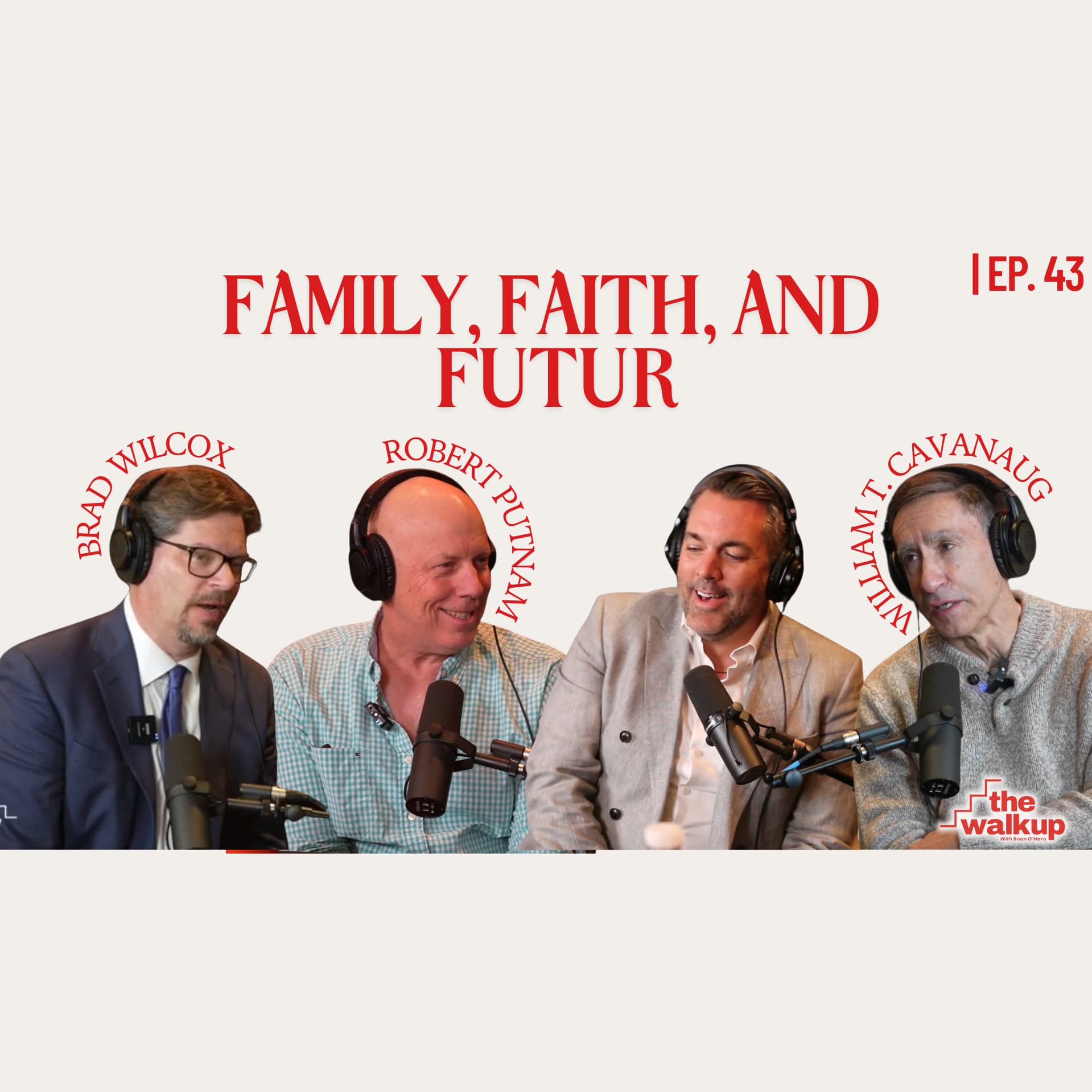
Family, Faith, and Future (Brad Wilcox, Robert Putnam, & William T. Cavanaugh) | Ep. 43
Recorded at New York Encounter 2025, sociologist Brad Wilcox (University of Virginia), political scientist Robert Putnam (Harvard), and theologian William T. Cavanaugh (DePaul) explore the intersection of religion, relationships, and renewal in modern society.
The conversation spans shifting trends in marriage and family, the revival of spiritual interest among Gen Z, and alternative models of economy that prioritize community over consumption. A rich dialogue on what’s fracturing us—and what can bring us back together.
Transcript
Read the full transcriptAuto-generated · 7,257 words
Dr. Brad Wilcox, thank you for being here, for being at the New York Encounter. Great to be here. So, you had a small topic today, just the demographic crisis, why have children, why aren't people seeking marriage anymore, but why is it important to, what is it you found intriguing about being at this particular venue for, why the New York Encounter?
Yeah, I was surprised. I really didn't know anything about the New York Encounter, and just to kind of come in here this morning and just sort of see this big venue with tons of young adults, especially, you know, in New York, coming to an event that's, you know, a bit more family and faith-oriented, it's always a surprise, a pleasant surprise, especially here in Manhattan. So, I was just kind of pleasantly surprised this morning when I came into the venue, saw a lot was happening.
It's a big And yet, you all managed to get a lot of young people here to kind of hear the message. And probably you know, like, I'm a sociologist. One of the things we've been seeing over the generations, right, is that the kind of share of Americans who are religious has been going down from, you know, the greatest to the boomers to Gen X, et cetera, to millennials.
But now we're seeing with Gen Zers, the most recent kind of young adult generation, there's an uptick in religiosity, right? And so, it does kind of, I think, make me. I wonder if maybe we are kind of at the beginning end of a resurgence in American religious life, and so events like New York Encounter would offer a kind of empirical example of how, again, we are seeing a kind of upsurge.
In religious identity and attendance among young adults in America today. Well, one of the things I've noticed, so you asked before we started, you know, if I'm here in the city, and I've been in the city for 12 years, I live in... Hell's Kitchen, and by definition, if you have friendships in New York, you're going to find yourself the minority of being the religious person. And I mentioned it before that I've been working on this television show where the premise is an atheist in dialogue with myself, a practicing Catholic.
And what I was most intrigued and encouraged by was The interest level from those we spoke to was much higher in the skeptic, agnostic, N-O-N-E's. There's a spiritual curiosity and a hunger that's out there. Now, I do think that there's sometimes a rejection of a formal religiosity at first, and so maybe that's a slightly older generation than the Gen Z folks.
Anecdotal at best, but there is definitely a hunger out there for meaningfulness that needs some way to be fed, and whether that has been this surge of podcasts for having long-form conversations or at least a long-form dialogue, what is your sense of that? Is there also just a broader interest in spirituality and hunger for deeper meaning?
Yeah, no, I think a lot of people have kind of hit bottom, or they recognize the culture has hit bottom, and that kind of a lot of our current pursuits are leading us in the wrong direction. You know, I mentioned today in my remarks that we've seen kind of expressions of happiness in America, you know, hit record lows in recent years. And so, you know, I think there's just some share of the young adult population who's just like, you know what, things aren't working right now for me personally.
For our society, I need to find something that is more meaningful, and they begin to recognize that community is important, that religion has a unique understanding and appreciation of the role that tradition plays in our lives, and that rituals are, we know sociologically, are incredibly valuable as well in people's lives, and also, maybe, too, that I might find a wife or a husband and start a family, and they also implicitly know, too, that people who are Again, whether we are religious or not, we are not perfect by any stretch, right?
But just by being surrounded by people who are trying to be good spouses and trying to be good parents, I think we're often, well, I know empirically, we're more likely to succeed at marriage and family life. So, I think that's part of the package for a lot of young adults, too. My church, for instance, in Charlottesville, Virginia, is a university parish, St. Thomas Aquinas, totally anemic place when we got there in 2001, not that many families, just wasn't a lot going on.
But over the years, there's been some more dynamic priests coming in, and then there's been, I think, just people kind of gravitating, you know, looking for a place to park their marriage, park their young family, you know, get a fresh start, get a new start. And so, we've just seen an explosion in the number of young families at our parish. I think it's, again, one sign of, like, you know, a turn towards both the sacred and a turn towards...
Family among a minority, but I think potentially a growing minority of young adults in the U.S. One of the things I see, so some of the folks I know in the artistic space, the cultural spaces, who are, I mean, I will hang out amongst those in their 30s, 40s, and 50s that are professionally very successful in the creative fields. I would say 90% are unmarried or divorced, very few have children, and there is this sense that they have had what we would refer to as Aquinas' replacements for God.
But yet, the idea of religiosity was, well, I am sure it is not there. It is everywhere, but there. And maybe a generation younger is now saying, I am willing to give this a shot, the more chaotic the world seems. And I don't know that the impact of the extension of adolescence, right?
College seems to be this opportunity to just extend your adolescence until you're 22, 23, and you talk about traditions. Where do people learn how to date? I mean, I've gone on dates with young women, whether they would have been in their early to mid-20s, or late 20s, or even early 30s, who had never been on a real date before. And I think to myself, well, why is this kind of... Well, I'm the youngest of four. My two older brothers, I would have watched them date.
I would have watched my parents. I had a model for it, so I didn't have to learn. But you get college, which is a hookup culture. There's no formality, and it's not like they all of a sudden magically learn how to date when they get into their professional lives.
Yeah, so, I mean, I think what we have seen, Gene Twenge has done a lot of work on this in psychology, is just, you know, with the introduction of the smartphone and social media people, you know, they're just distracted more, and I think also sometimes to their expectations of what a romantic partner, you know, whatever it should look like or be like, are maybe sometimes unrealistic. And so, there's a way in which the kind of technology that's emerged has made, I think, dating more difficult and challenging.
That's just kind of, in some ways, We are building, though, on a broader set of cultural shifts with the sexual revolution and the family revolutions of the 60s and 70s, which kind of basically… We have eviscerated a whole set of customs around dating, and sex, and marriage, and family formation that helped. They weren't perfect. We all know that, right? But they kind of gave people a sort of script about how to do all this. And as that script has kind of withered on the vine, and then we've had these newer technologies make it even kind of harder to sort of make your way through the dating world, we are finding just an incredibly large number of people.
Many of whom are attractive and seemingly well-situated for dating tell us, you know, I was just at an event at a college in South Carolina this week, sitting next to a young woman who, attractive, seems to have her act together, and again, she's never dated anyone.
What is going on? Isn't that something you don't have to teach? Isn't that biology, you know? No, I think you do have to teach. And again, it looks very different across time and space, but most cultures have given their young adults a kind of script. And again, in 19th century America, Upper-middle-class families, middle-class families would have had men come calling to the home, and that was sort of superintended often by the mom and the young adult woman, so it was different than what we would see now, but there were a set of customs that kind of gave people a roadmap about how to go from being single.
To eventually being successfully married, and we don't have that kind of common roadmap, and we need to rebuild that, you know, sort of a newer kind of basically courtship, you know, model for the 21st century to help people. Yeah, and it's tricky because I'm starting to see this shift where there is more of a hunger and a yearning for these meaningful relationships in the form of marriage and children, of course, but I almost feel like we're going to look back and there's going to be a A lost generation or two that were, and this is the most frustrating part for me, because they did everything they were told to do.
And they're in their 30s, 40s, 50s, and maybe beyond, and isolated, lonely, passed up potential marriageable options in years past. And they did exactly what the culture told them to do, and I think that is the thing that is most profoundly saddening.
I mean, I am a married guy myself, so I am not an exception to the rule. And then you introduce the dating apps, and it is an interesting situation where you have this tyranny of choice, where almost nobody is happy with the dating app situation, yet they don't really see another alternative.
But it is the same thing you have been speaking to about this isolation. This technological use where we're really just two individuals trying to find each other through this digital medium, and yet I don't know that people feel they see another way outside of using these apps.
Well, I do see like at UVA, for instance, again, and I know a lot of students are involved in Catholic and Evangelical student ministries, and they do actually have a pretty healthy dating culture there. And part of it is just they're being encouraged. You know, they're being encouraged by their leadership, you know, whether it's the priest, the pastor, the, you know, the college minister, you know, to date. They're having dances. They're kind of, they're being very deliberate about, you know, encouraging people to be active in this because they know there's a problem and they're trying to help them, you know, navigate this new reality.
So, I think there are places where people are kind of getting some cultural help, but there are not enough of those, you know, institutions obviously out there. And we need to think about new ways, too, to help people who are more secular kind of realize that they can kind of enter into a courtship culture. But certainly one of the things that I would say to young men is you've got to start the process by asking someone out on a date. And you may fail, you know, with that person, but, you know, if you've got something going for you, then, you know, chances are over time you'll find someone who's interested in reciprocating, and then something happens that's beautiful and powerful.
Well, but there used to be that. The risk factor, right? I mean, you had to call the young lady's home. Who knows who would answer, right? Is Mary there? And now, you just slip into somebody's DMs. The risk factor is so much lower, and so men are not taught to be kind of what men are supposed to do, being bold and courageous and willing to learn how to get turned down, which is part of courtship, right? Right. Obviously, again, with the technology, the downside is sort of sliding to someone's DMs or just whatever, or just being in some kind of group chat, is that, you know, men don't have to make their intentions very clear.
And again, what I'm encouraging guys to do is, I don't mind if you do it, you know, text or find, but deliberately say, you know, I'd like to take you on a date, or I'd like to take you out for dinner, you know, or I'd like to take you to a dance, or whatever else it may be. Just make it very clear that this is a, you know, this is a date. You know, dress nicely, and we hear women saying, like, the guy shows up and he's dressed like a slob, you know, but make an effort, dress nicely, take her somewhere nice, you know, engage her, think of some things to ask her, some questions ahead of time, you know, try to think of some things, you know, some stories about your life right now that would be worth hearing, you know, make an effort, and again, you're going to fail, either with, you know, my wife and I were kind of on and off again for three years.
Well, you know, we talked about this before we got married. With the person you end up marrying, or you're going to fail with someone you're not going to end up marrying. But, if you've got some stuff going for you, and you make an effort, and you're sincere, I think your odds of success are pretty good. I think so. So, last question. Well, first, I just want to let you know that I do know of many couples that have met here at New York Encounter, so we are providing not just intellectual and spiritual opportunities here, but romantic ones as well.
So, I follow you on Twitter, or on X, sorry, we say X now. So, you noted Elon Musk today, that he's... Potentially had his 13th child with, I forget how many women, but I just thought as a topical matter, if you could comment on that. Yeah, so I said in Twitter this morning something like, you know, I'm happy that Elon Musk loves kids, and he's been a great voice for, you know, what we call the pro-natalism kind of movement, but I'm unhappy that he doesn't seem to appreciate that kids need married parents, ideally, and, you know, and of course the other kind of implicit point I'm making on that.
What I love about his posts is that like his kids, you know, need married parents. And like, so even now, it's sort of what I would say to him, like, look, you know, if you want to have more kids, you know, get married, commit to one person and at least kind of give your kids the gift of, you know, that you have in the future. If you have more kids, a stable married home.
Yeah, so that is the point I made on Twitter, and it has gotten a lot of attention this morning. Yeah, I noted it myself on the way here. Well, listen, thank you so much for your time and for your contributions to New York Encounter. Thanks for having me on today. I appreciate it.
Rob Phelps, thank you for being here on the walk-up, and also here at the New York Encounter. Thank you very much. Unfortunately, I got to say a little bit of your presentation, because we were interviewing other guests, and it has been a very busy day, but finding God in nature, and what those patterns reveal to us, but why was it important for you to be here at the New York Encounter? How did you find out about it, and how did you come to be here on a snowy, rainy, wintry day, instead of in California, where you should have been?
Yeah, let us talk about rules of engagement first, though. Oh, great. Like, how honest do you want me to be? Oh, as blatantly honest. Okay. I don't know if you can tell. I have no pretense on this side. No, you seem like it, but I just thought I'd check, because you need to know who you're talking to. Whatever you want to take the point, it's out the window. So, what I would say is that...
I came here because of Evelyn, who's the one on the stage that did the interview. The moderator, yeah. Yes, but what I would say is that this is definitely not my usual crowd, and in fact, I would say it's, in a way, it's almost not my usual crowd, and I would say there's probably many reasons that I came, but one of them is that I think that all of us are quite in danger of walking around and living in echo chambers, and I think it's important.
To get out of them. And so, for me, when I was between, let us say, the ages of 15 or 20, I would invite every person that knocked on our door, whether it was a Jehovah's Witness, Mormons, Hare Krishna, everybody. I would invite them into the house, and I would sit and talk to them, because I wanted to hear what their take was on the big questions of a human life. Both the questions about how are you and I going to live our lives, but also what is this world that we live in?
Because I was curious about that, and I am still curious about it, and I am still puzzled about it. You don't have all the answers yet? Yeah, I don't even have close to any answers, particularly. So, what I would say is, I'll try to say gently, is that when I say it's not my usual community, at the end of the day, I would say that I'm somebody that struggles with religion, in some sense. So, I'm here to talk to people, and listen, and learn stuff, and absorb the blows, in some sense.
I feel that we are not philosophically on the same page. Well, I hope you are talking to the right guy, and not because I am unique or special in any particular way, but because, so being, in my case, a practicing Catholic, but living in New York City now for going on 13 years, you are often the minority opinion in places you have to. Be adaptable and open and have a facility in your conversations, right? To be able to be as open as possible.
And then, in addition to that, I am actually making a TV show with an atheist friend of mine. So, he is Doug Lyman, Director of Foreign Identity, Edge of Tomorrow, Mr. and Mrs. Smith. So, he is open. He's like, listen, I'm an atheist, I don't believe there's a God, but I'm open to the idea.
And so, our show is we travel around the world as this kind of weird friendship. Because one day he said to me, I don't get why we're friends. And I said, well, there's probably a lot of reasons people would feel similarly. But he's like, you're the only religious person I know. And his entire group of friends... And, yeah, getting vulnerable. I mean, we got close because his best friend, which is how I got to know him, got sick and passed away from cancer, and so as we were caring for him, this atheist and this believer for our dear friend, it kind of brought some things to the surface that I think he's been wanting to ask, and him being a creative, he doesn't want to, like, read a bunch of books.
He's like, let's go. Make a TV show. Sounds awesome. Yeah, it sounds super interesting. I would love to see what you come up with. Yeah, I mean, what I would say is that I probably fall between you guys, because to my mind, of course, I don't know either of you, so I don't know your narratives, but what I would say is that you guys are both aggressive in belief. Yeah. Like, he's aggressive. If he's truly an atheist, he's aggressive in belief, and I'm aggressive in a way in saying, I don't know.
Yeah. And that's where I leave it, you know, and I suppose I... Maybe there's a little more to it than that, which is that I somehow am not that sympathetic when people tell me that they've got the truth, and that they've got it, and I don't, and they need to fix me, or whatever. So anyway, yeah, it was a delightful... Day here, you know, I really enjoyed the session about why I have children, but I also enjoyed the one very much in the morning about our technologies and the fact that we don't know how to look each other in the eye.
You know, that is something that I see all the time at our universities. You know, it's hard for us to talk to each other, you know? Yeah, and it's been an interesting snapshot to be on this side of it, where I'm getting to see some of the talks, but then also get to talk to a lot of the speakers afterwards. So, I got to speak with Brad Wilcox, who you mentioned about why we're not having children, or Christine Rosen earlier today about technology.
And so, it's what New York Encounter, I think, has done, and a credit to the... organization community and liberation that there is very it's a very open-minded wide net there's and i think there's a confidence in that right there's not a fear exactly there's a like hey listen we don't have to align on beliefs for you to represent uh you know or be a part of this of this uh idea festival right yeah i love that so we're we're we're you know i think it's encouraging that that that All ideas are welcome, and you should have a little confidence in your own approach towards life if you are going to be threatened by anything that doesn't align.
So, then you say you are somewhere in the middle of that, after welcoming and the Hare Krishnas and everybody through your doors. Did you ever... Do you have various things that you pursued aggressively, or always stayed in kind of the, you know, I'm testing out ideas all over? No, I mean, I would say that there's two sides to that. So, first of all, I don't know if you heard, Martin, but both of us were talking about the role of mathematics in the investigation in the natural world.
And it's very hard to imagine that trying to understand the world that we occupy is not as sacred. You know, to me, that is a very sacred activity. I take it seriously every single day. When I am sitting there churning equations, I really honestly believe that I am engaged in the hard work of trying to make some meaning out of this life and this world, and have been very bad at it, but, you know, tried. As far as the part having to do with, let us call it the more spiritual pursuits, because that is also part of what you were talking about, I have done tons of reading.
I have read the The original sources in the sense of sacred books, but also many commentators, and if I were to articulate for you, again, I hope you will edit this, because then you can just ditch it if it is not of interest, but one of the things that strikes me as the most interesting of all is the accident of our births. And I have a friend, he is a Mormon, and I told him once, I said, dude, if you had been born in Saudi Arabia, you would not be a Mormon.
And he looked at me in the eye and he said he would. And that was a conversation stopper for me, because it was like, you know, if that is how far this… You would be the one Mormon? Well, he was just like, he is meant to be. And so, you know, I guess what I… I have an accident, and so do you, I guess. You know, like, we are Americans. I was born in the US. I grew up in our culture and whatever, but I go surfing in Indonesia, and I see what that life is like.
And if I had been born there, I just don't believe for a minute that I would be… Who I am today, and that kind of bothers me with respect to the spiritual questions, and the reason I say that is because that makes me think or want. To say that it doesn't matter if you're born in Indonesia, or in South Africa, or Morocco, or Israel, or Saudi Arabia, or whatever, the parts that we will all agree on are the parts that interest me the most.
The parts that are specific to a particular culture, because we're Americans, or because your roots are in Italy, or whatever, I'm not comfortable. I'm fundamentally not comfortable with that, because it doesn't have the universality. The universality of the religious experience, if you want to call it that, and the scientific experience. That is what I like about science. More or less, if you go on a surf trip in the middle of the Indian Ocean, or you go to Indonesia, even the guys working on the boats that are barefoot have cell phones, and they all use them for navigation and whatever, and there is no controversy.
There is no sense in which that is dependent on what culture you are from, what age you are, what jet. It has. Nothing to do with it. I could tell you some coordinates. I wouldn't even tell you where they are. I'd just say, here's a longitude and latitude. Meet me on December 24th of 2026 at 6 p.m.
And I'll be there, and it would work. And that's a universality. So, you know, in a way, if you're really pushing me, which you're not, but if you're really pushing me on these spiritual questions, then the thing that I'm after are what are the universal aspects of the experience of the things that we don't understand, because in some ways, that's the part of discourse that I find that...
If you like, religion is supposed to attend to. Again, I don't know anything, so I'm philosophically shallow, but that's where I've ended up. I really don't like... I do not like it also in academia. I do not like people telling me to read Moby Dick. I read Moby Dick because I want to read it, and I do not want to write a report, and there are books I have read and loved that I will not even tell you the name because I do not want to hear your opinion because I love them so much.
Do you see what I mean? Yes. I think that I have been blessed with... Universality in the religious sense, and I'll define that for you. To use an example, and using New York Encounter as a specific anecdote, so last year, I met a priest from Vishwada, India, who was giving a presentation about Human trafficking in his region, but something just struck me about him. He is a Catholic priest. I am a practicing Catholic, and there is a connection there that allows for just enough of a commonality that two months later, I was on a flight to India to learn about.
I want to see this thing for myself. Help me understand what you are doing, but we did not need. The trust level is so high because of that universality of the faith that we share, and then I get there, I come to find out, this little corner of Southeast India, Italian missionaries came there 100 plus years ago, and provided education and formation, of which, and to the low caste. This is not something that was available, education. He now speaks six, seven languages.
He studied in Louvain, all these sorts of things. And now, what does he do? He spends his entire life as a Catholic priest, catechized by Italians. He now spends his life saving Hindu girls from being trafficked to Islamic countries. That is universal. Yeah. I mean, and yet, I don't, I just, I've been spending a lot of time with him today, catching up.
He's a brother, and by most conventional means, it should take a lot longer for us to have this bond, but very quickly, not only are we bonded, but we're working on, I should say, I'm assisting him as much as I can with his very worthy endeavor, and what was really beautiful is when we went there, I brought a Byzantine Catholic priest with me. Byzantines are able to be married in that case, so he actually has seven kids.
You're going to do it. You're going to have a good number of kids. And he goes over there. We're about to leave after almost two weeks there, and my friend, Father Jason, a big guy, and he gets on his knees, and he says, I want to ask for your blessing.
Father Bosco, the Indian priest, because you have re-inspired me in what my priesthood should be about. I get too comfortable in my suburban Pittsburgh, you know, and I just thought, man, this is such a beautiful, I mean, he is a Ukrainian Byzantine priest, married priest from Pittsburgh, and an Indian priest. I was just like, this is an amazing thing to be a witness of.
I've got another taste of universality in a different sense. Yeah, I love it. You know, how can I complain about that? No, but seriously. No, it's great, man. I mean, I love it, and I'm so just, those little moments you get to see. I just got back from Columbia, very similar situations, and connecting with so many people in so many different ways. So, I think that's what they're trying to do with New York Encounter, is that take that experience and allow it to be kind of a forum for that pursuit of truth, and whatever piece of it we think we can grab onto that helps sustain us, the better, right?
Yeah. Like I said, it is very hard to complain about that. No, but seriously, I am not being sarcastic. Your anecdote is a great one, and I think that maybe a way I will put of saying perhaps what I resonate very well with it is that I think what you just told me is that all the labels became irrelevant. True. You know, like... I could have been part of it, too. In other words, it wouldn't matter that we had a different view, for example, of the Bible.
It wouldn't matter, right? We'd be engaged in, and how can I help activity? Does that make sense? Yeah, I think I actually even thought about, I brought my Colombian girlfriend with me as well. So, it was like, I was adding Colombian, Ukrainian, American, Indian, and...
The objective was Hindu girls exported to Muslim countries, so you got it all. And part of it was just enjoying great mango, and being like, man, why can't we get mango this fresh in New York? Well, I know why, because we're not getting it locally sourced as they are. But I'm just glad and excited to get to see your entire talk in full when I'm not out here, and just thanks for being a part of this. Thanks for offering your insights and honest assessment.
Thank you very much. It was a pleasure to meet you. I appreciate it. Take care. Bill Cavanaugh, good to have you here at New York Encounter. Good to be here. I got to interview your co-panelists, Christina Clamp, earlier, so I got to learn a little bit about the Mondragon, did I say it right? Yeah, sure. Okay, good. So, a little bit about the Basque region and all these things, but I'd love your take on it.
This is something that started in the 50s, correct? That's right. And I guess I got a little, I got background from her, but we didn't really have time to get into the, kind of, What are the further implications, what are the… Ripple effects, what did you say, of this movement? I got the background from her, but I'd love to have your take on kind of its impactfulness.
Yeah, I think one of the things it does is show what's possible. There's a different kind of economy that's possible, and this is kind of what, you know, the Focolari people call the economy of communion, or John Paul II would talk about the kind of universal destiny. destination of goods. There's all kinds of different ways in Catholic social thought of envisioning what a sane economy would look like, and this is one of the kind of most impactful instantiations of that. So Benedict XVI in Caritas et Veritate talks about a kind of an economy of love.
And this is one way of doing that. Our economy now is based on this kind of antagonism between owners and workers and managers, where managers try to squeeze as much value out of workers as they can for the benefit of the shareholders, the owners. And Mondragon kind of does away with that antagonism by making the workers, the owners, and the managers all at the same time. Yes, it's interesting. In a different era of my life, I was in the manufacturing sector, and we had, at one point, raised some private equity dollars.
The deal ended up not going through, not because I didn't want it to, but because it kind of fell through at the 11th hour. But, I remember... You know, you get those moments where you're like, I'm out of my depth here, I don't understand how I got into this position, and you kind of realize you're just kind of an instrument in a much bigger point, because we were what is called an unfunded sponsor, where we found the deal, but we didn't, of course, have the $100 million to do the deal ourselves.
And a bank is like, oh, well, that's actually a deal we're looking for, and we know exactly what to do with that. And at one point, I realized, wait, if this goes through, we're going to lay off a lot of people, and we're going to make extraordinary sums of money, and they were even going to pay us to sit on the board and almost, frankly, almost do nothing.
And I was like, yeah, my Catholic sensibilities were kicking in. I don't know if I really understand. So, maybe it was providential it didn't work out, but I think one of the things I struggle with is... And I am sure there has been a lot of thought on this, so I am not breaking new ground.
The progress, right, innovation is often spurred by greed, right, sometimes. Are there those that would say things like this economy of love and these communities would not be as innovative? Is there an argument to say, well, hey. It might score over a lot of people, but the net result is, I don't know, new medicines or new technologies that end up serving a lot of people. It's not good in and of itself, but it has some good results, or is there a better argument to be made that you can have both?
Yeah, I think you can have both. I mean, I think in a lot of ways, the idea that greed and self-interest are for the betterment of everybody is what in theology is called a theodicy, right? You explain the existence of evil as being really what is necessary for the most good to result, and I don't think that needs to be that way. I don't think that needs to be that way. I think it's oftentimes a kind of ideology that's meant to cover over the sort of abuses that are there.
I really don't think that you need to have greed and self-interest as the primary motivator in order to have innovation, and I think Mondragon Corporation is one result. I mean, it's one tangible place where you can point to and say, this is not the result of greed and self-interest. This is the result of people's There are people getting together saying, let us cooperate, let us work together, and it is in a multibillion-dollar corporation, and it works. So, that is an example in a corporation.
Are there times where we point to a benevolent kingdom, or are there periods where… At a governmental level, was encouraging this type of cooperation, or is it more manageable at a corporate level because of the, shall I say, more voluntary participation in the entity?
Yeah, I think Father Arisman Yarieta, who started this, he was not waiting for the government to do something. He just went out and did it. And I think there are ways that governments can either encourage or discourage this kind of cooperation, and they do all the time. I mean, I think in a lot of ways, large corporations have a thumb on the scale when it comes to What happens next to government contracts and regulations and tax laws and so on? Policy, sure.
Right. I mean, you look at the billionaires surrounding Trump at his recent inauguration, and you see who is really kind of pulling the levers, so even to get to a place where the government is . . . Less prejudicial against these kinds of enterprises, I think, would be an advantage, but there are lots of things that you can do through tax law and other kinds of regulatory laws to encourage cooperation rather than what we've got now. Pitting people against each other.
Right, yeah. How did you come to discover New York Encounter? Was it, is this your first time? Have you been here before, or communion, liberation? What is your, what is your, how did you get, become familiar with it? Yeah, I went to, I gave a talk at the Rimini, the meeting in Rimini.
It's very dramatic. It must have been a really big, nice event there in Remedy. My microphone just popped off my shirt. It's the muscles, man. Don't do that flex. Oh, you know, I try not to. You can't help it.
Yeah, so I did a talk at Remedy, I don't know, 10 years ago. I know Emanuele Colombo was one of my colleagues at DePaul. He has recently departed and moved on to Boston College, unfortunately. I did the Albacete lecture in 2019 and got to know some folks then. So, I have been an admirer of CL, but not a member for a while. Yeah, I got introduced to this through, so I moved to the city.
Going on 13 years ago, but I used to come here. Even before I was living in the city, this would be my, if you will, my annual pilgrimage. I would come here, stay with friends, because I just knew it was this kind of extended family. You would see a lot of the same faces, but also get fed with some fantastic talks and opportunities for new people. So, well, we are grateful to have you a part of the New York Encounter family, and thank you for your contributions today, and for your patience with me.
And with our puny microphones that can't keep up with your physique. Well, it's been awesome to be here, and now I'm going to go have some good food with good friends. Absolutely. Sounds great. Upstairs on the fifth floor. Thank you. Thank you so much.
All right, so Robert Putnam, you're here at New York Encounter. Why is it important for you to be, what's about this venue, this experience, this location for you to take time out of your busy schedule to be here?
My work is mostly focused on how Americans can come together in ways that will... Well, the question is, how do we heal their bodies and souls, because connecting with other people is really powerful, has a powerful effect on our life expectancy, actually. Joining one group will add, will double your life expectancy, actually, so it is a big deal.
Belonging to one club or organization will double your life expectancy. So, it is a big connection with other people, and being in a community is good for your own soul and body, but it is also good for the country, and I am a political scientist by training, and I have spent a lot of time over the last 30 or 40 years trying to understand. What has gone wrong with America and what could go better about America? And the answer to that is community.
We could be a lot better off as a community. We wouldn't be fighting each other as much. We wouldn't be going through this incredible political turmoil that we are if more people were connecting with other people in venues exactly like this Encounter venue. More than that, connecting... Under religious auspices is a crucial part of how we are going to turn the country around. I am not actually a Catholic, although I confess that Pope Francis has invited me actually to the Vatican to talk about my work.
And in fact, I really think that we need to have a kind of spiritual reawakening, a moral reawakening in America. By moral, I am not talking about sexual morals, I am talking about just... I'm not talking about sexual malls. I'm just talking about our sense that we have obligations to other people. It's as simple as that. It's the golden rule.
And religious communities, above all, the kind of religious communities represented here at this session, are exactly the kind of venue which can help turn America around. So, it's both important. The camera had a problem right there. The camera, the, America needs more people getting together like this, and we individually need more getting together like this. I think we got it. That is perfect. You are perfect. That was great. Thank you so much. My pleasure. Appreciate the time.
More from The Walkup

Against the Odds: The Samurai Lawyer (Chad Flores) | Ep. 52
Faith, Sexuality, and the Fog of War (Iris Bahr & Father Rick Riccioli) | Ep. 02
E2
Church, Conflict, and Community (Iris Bahr, Father Rick Riccioli & Rob Long) | Ep. 03
E3
Hope, Vocation, and the Global Church (Colm Flynn & Colin Nykaza) | Ep. 04
E4