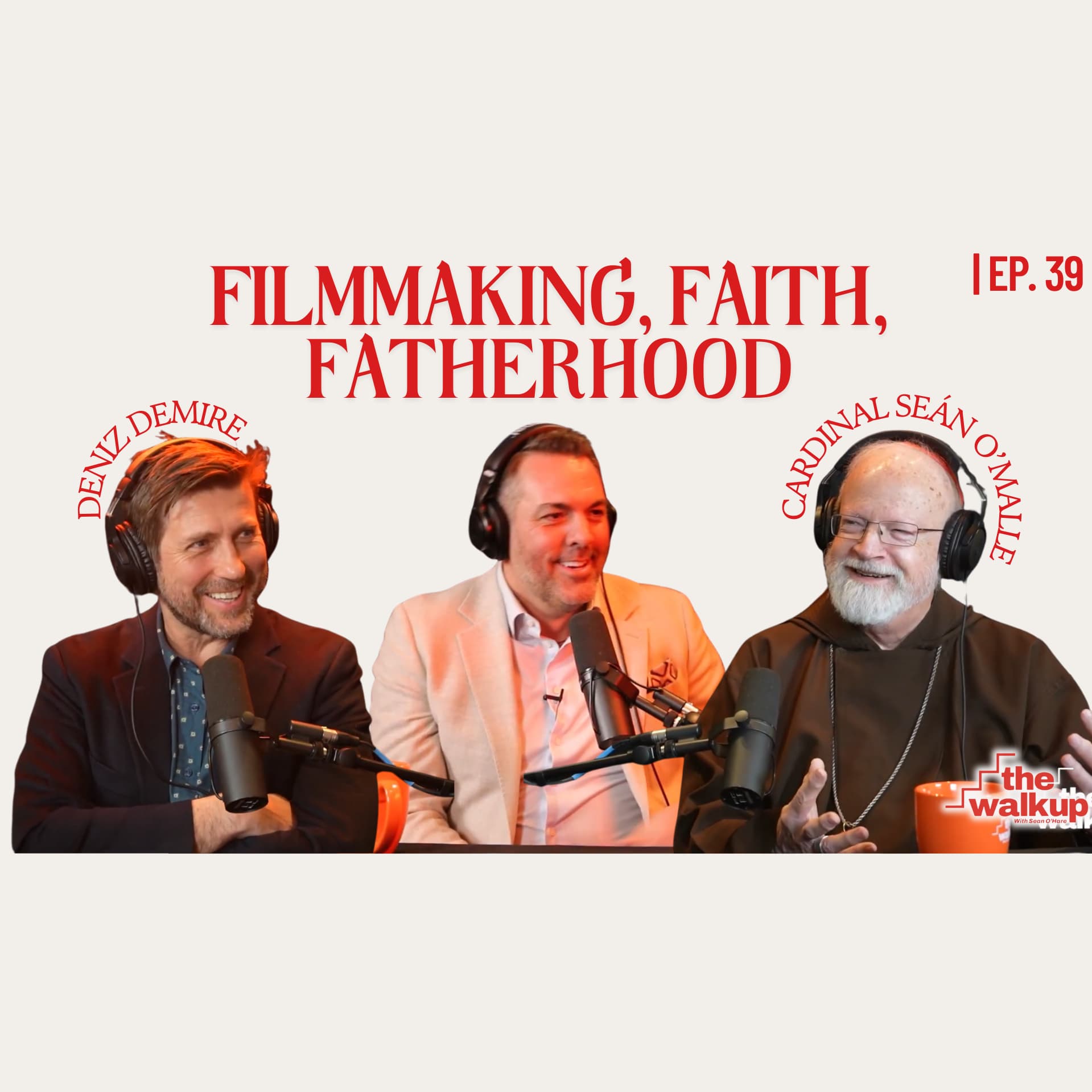
Recorded at New York Encounter, this special episode weaves together two powerful stories—one from a celebrated filmmaker, the other from a Cardinal. Deniz Demirer shares how art, family, and absurdity coexist in his work, while Cardinal Seán O’Malley reflects on decades of priesthood and the sacred responsibility of leadership. Together, their voices explore beauty, identity, and the pursuit of meaning.
Transcript
Read the full transcriptAuto-generated · 5,294 words
Well, welcome to the Walk Up Podcast here at the New York Encounter. Nice to see you, man. It has been a while. It has been a while. So, hold on one second. Olaveta, is there something you need? Okay, all right. So, Olaveta is one of the two people that runs the New York Encounter, so when she pops in, you have to acknowledge.
So, well, first of all, you come to the New York Encounter often, you're... Tell us what you're doing at the New York Encounter tonight, and then, like, why do you think this venue, this artistic expression of Catholic culture is important?
Ooh, good questions. Yeah. I had all day to think about it. Good. No, it's an important event, I think. I mean, I don't know of anything quite like it that I've ever attended with such depth. They really probe subjects. Man, very, very serious, dedicated people run this. So, yes, I've been a part of this for... Eight years, maybe. I was a speaker once, talking about cinema, and the language of cinema, and how cinema communicates.
Sort of things that are almost incommunicable, I suppose, in many ways. Experiences, experiences I had as an immigrant coming to the United States. So, they opened up the doors to me and were super friendly, and I was able to kind of always participate, either talking about my own work. And lately, more so, being kind of a voice, giving voice to Giussani's writings, introducing musical pieces, and so on and so forth. And maybe describe for people that don't know, who is Giussani?
So, you know, I still feel very new to CL, Communion and Liberation. Jasani, to me, as far as I understand, is just kind of like a visionary priest from Milan who really changed, I think, you know, he's kind of like this strange, he's like a kind of Gerard or another great thinker who kind of changes paradigms, you know?
And I think it is just his approach to this whole idea of the encounter with another human, seeing one self in another, and kind of making that connection, is probably the most profound expression of what I understand him to have written and said. How do we not isolate? How do our souls connect? How is my completeness related to your completeness? If I am not complete, you are not. Well, what I've always been struck by is that when I come to the New York Encounter, I feel like I can bring a totally non-religious person here, and they would feel like they could slowly kind of ease their way into, and was that this idea of the whole person and engaging all aspects of the senses and art forms?
Is this experience kind of trying to replicate his teachings? Yeah, I mean, okay, so again, this is from my understanding, a very new one. There are people who have been doing this for 30, 40, 50, 60 years. I don't know. For me, from what I understand, it is just a genuine, direct reflection on life.
In the way that we see and understand it to be. So, that is very specific. That is relationships with siblings and parents and spouses and children in a very intimate and direct way. What do those relationships mean? What is the struggle? What is the pain? And then, ultimately, what is the kind of mystery behind all of that that gives us hope? And, ultimately, that is a search for happiness. And that search for happiness is sort of at the bottom of it all, and that is part of what I will be talking about today in the introduction of the musical pieces.
But without that, everything becomes fragmented, demystified, and broken. If you do not acknowledge what it is that you seek, what you desire, if you do not acknowledge that and go after it, your world then becomes less formed, less...
Less total, I suppose. And, you know, you and I met when you were filming a short called Simon's Agony, which a lot of our audience knows that I lived in a former convent. They already know that I'm strange, and that's not most people's experience of New York. You used to wander the halls at night, right, with all the lights off. With my rosary, just making sure that everyone was, you know, staying in their rooms.
I mean, that was actually my first time ever seeing a film production really up close, like everything from the set design to, you know, I know you were working with a sculptor friend of ours, Christopher Aulis, about some of the scenes, and now you just finished a feature called The Allegory, correct? So, I mean, what is...
Give us a peek into the life of the filmmaker in New York City. I mean, you've got to be creative, you've got to be adaptable, right? I mean, that's a particular vocation. Yeah, so, I don't, I mean, you know, I don't know anything other than what I know. So, I haven't, you know, I'm not like a, like a big, you know, fish of any kind. I've known certain processes of, you know, I've fought really hard to maintain this vocation, to keep making films, despite the odds, despite the fact that I have a fourth kid on the way in February.
Exactly. Despite the fact that we live in a one-bedroom apartment, and it's like insane, in Brooklyn. But I can't not be a filmmaker, and I guess what does that mean? I haven't worked, I've worked on some bigger budget stuff as kind of second unit, yadda yadda, but my own personal work has always just come in these, you know, it's a new manifestation every year, it's a new manifestation every project, it's like reinventing the wheel every time. Budgets change, situations change, locations change, themes change, I change, so I work as an artist is the only way I can say it.
I don't work as a career. Like, Hollywood filmmaker, I don't know what that life is. You're not in the trade. I'm not in the trade. I mean, there's crossover, certainly, in the way that certain processes might be acted out on the set, and the way that the editing might come together. I just do what I think I know what I can do. I learned mostly from an indie filmmaker in the Bay Area named Rob Nielsen, who is like the renegade of renegades.
I mean, he ran from Hollywood. As far as he could, and just started to do very artful films of his own with a very, very personal voice and expression, that is all I know. All I know is the auteur personal voice and expression. You know, this last film, strangely enough, was probably one of the bigger budget things I have ever worked on. It was a script written by somebody else, and I had to direct it. And I had a full-on identity crisis, man.
Like, not only did I get feverish and sick on the set, The very first day. I was popping Sudafed. They were giving me Dayquil. I was like, and I was directing this movie with actors on an open stage, like, you know, better actors than I've ever worked with probably before in terms of, like, the professional, in the professional world.
It was an open stage, so directing five people and movement on an open stage and getting coverage of that with no doors, with no sort of, like, overt and open. Like, in obvious beginnings and endings, I would hope that any director would have a lot of, like, trouble with that, because you're kind of both directing a play, directing a camera, directing an actor, you know, all the actors, all at the same time, while, you know, fighting a 103.5 fever, while having an identity crisis, because you've never directed anybody else's work before.
So, how did that come together? How did you get approached to do that? I've just been working with this one writer. For a long time, and one of the very first people who I met here in New York is a Jesuit, and we've just sort of maintained a relationship and kept collaborating, and he's been an actor in my films. He was in Simon's Agony, Joe Hoover. He was the priest at the very end, young guy. Do you know Joe? I don't, but I remember him at the film.
Right. And so then he kept writing, we kept shooting little things here and there. Finally, he's like, I'm going to do what the Coen brothers did. I'm going to go back to my hometown, I'm going to get my dentist parents to get their dentist friends together, and I'm going to start fundraising. And man, this guy, we were all inspired. We were like, okay, this is possible. It's possible to keep making indie films. It's possible, man.
You just got to believe that you can do it, and you just, whatever, that sounds so cliche. Cut that, please. You got to believe that you can do it, man. You just got to believe that others can do it for you.
Well, and I know that things are constantly evolving. Distribution and where to find the right funding and everything else. More than, I think, more so in the last couple of years than it's been in the last, you know, 10 or 20.
Because it seems to be getting, in some ways, more and more opportunities. But in some ways, there's also just so many outlets. Yeah. And, you know, Netflix kind of like is the king of content and kind of... It is kind of that gravitational pull, and then I think there seems to be a lot of the other streamers trying to figure it out.
Three, four years ago, it was a great time to be looking to sell something, because every streamer was hungry for content, and now there is this consolidation going on. So, do you begin with a distribution of mind, or is it more like, hey, whatever we got to make the film, and then we will figure it out later? Yeah, I don't think with distribution of mind. I think with the art in mind.
I wish I thought with the distribution in mind, but this one, you know, I have been thinking a little bit with the distribution in mind. We want to get like a name actor in for these little scenes, which we did not shoot during principal photography. We said, let us put it aside. Let us get that name in there, that recognizable name, and then hopefully that will be enough, you know. And so, we will see. I will definitely update you as soon as, you know.
I am also editing it, which is exciting. That has been a big thrill, just kind of looking at all the footage, looking at what I perceive this chaos on set, and then saying, okay, do we have enough coverage? Did we get everything we needed? How is it going to look? And so far, it is looking so much better. I am hearing my own voice on the set, and I am like, oh, I was not out of my mind.
Saying things that made sense. When it went to me, when I would get back to the Airbnb, because we shot in New Jersey, I would fall on the bed, and I didn't have the energy to get up and plug my phone in. And the next morning, we have to do it again. I think that lasted until about Thursday. Thursday, I started to feel a little bit better. I dipped again over the weekend, but we had off. Anyway, so long story short, you know, survived.
But distribution, yeah, I don't know. I mean, I think we'll distribute this one. I think this will be, it's got enough production value. It's got enough kind of pizzazz and big enough community and a lot of donors and a lot of people that are kind of tied into it and a big enough following that I think maybe we could pull something off. There is enough of an engine that Joe, specifically as the fundraiser, and also the kind of writer of the film, and the kind of overall visionary, I would say, in terms of the production aspect of it, I believe in him.
So, tell us, and this will be part of your press tour, this is your first junket right now. This is awesome, man. Tell us about the allegory. So, The Allegory is a film, we're calling it right now an unchristian Christian film. It's about a theater company, ragtag theater company in the Midwest, in Swantown, that basically needs to save their theater. And so, they try to put on a play. But the problem is that the theater director is also in love with this woman that he's been in love with since second grade, Gertie.
And so Francis, his name is Francis, Francis is in love with Gertie, and he just cannot get over the fact that Gertie is just kind of not seeing him. But there's been something there. There's a spark there that they're both sort of skating around.
And he thinks she's kind of a churchy gal, and he's like, look, if I'm just kind of a more churchy dude, she might go for me, so if I put on this play that has these themes of Christ in them, she's going to come to the play, and she's going to be like, this is the guy for me. He's artsy, he's smart, he put on this amazing play, and I'm going to woo her. So, it's kind of like a silly, I don't want to say silly, it's more like surreal avant-garde.
The writing is very interesting. Unconventional text, which I think is so refreshing. People are just talking in these really funny, odd ways. And then this funder comes in, and the funder says, look, I'll help you save your theater company, but I don't want a single trace of Jesus, of Christ, of religion, nothing in it. So then he has to kind of navigate both, wooing. The love of his life and appealing to the funder, who you find out has this awful, tragic story that they learn about slowly as a theater company and become very sympathetic towards, and then kind of embrace him and his pain.
I mean, this guy's seen prostitutes, he's got a dead kid that killed himself, all this stuff's going on in the background, and these actors really kind of absorb his pain. And eventually put on a play, kind of representing that agony on the stage, and he sees it, and it's just very transformative, you know? Revealing. Yeah, but it's done, like, in the most unexpected way, man. I can't even tell you, like, how the final scene plays out. That's what got me about the script, is that final scene, because it's so absurdist.
Maybe absurdist is the best way to describe it. It's so absurdist that by the end, when you... I feel all the writing and all those strange situations kind of coming together in that final performance, which is improvised by the actors, channeling the pain of this man who's coming to their life. I was just like, wow, okay, I'd love to work on this.
Shakespeare in Love meets The Producers meets The Gospel. Yeah, dude, yeah, you got it. Exactly. Oh, you can feel free to steal that and use it in your press tour. You got it, man. You know, the snappy dialogue of, like, His Girl Friday. Oh, it's got that kind of... Yeah, yeah. Oh, interesting. Oh, yeah.
Oh, that's... Yeah, you don't see that dialogue anymore. I know. I know. I know. Yeah, it is almost its entire genre that has been... It is gone. Yeah, completely. I feel like maybe every now and then you see a snippet here and there in some series where they get a little creative because they have got the freedom to try stuff out, but wow, that is interesting. I know, it is a very unusual beast. And you shot everything in Jersey or a couple of different locations?
Yes. No, everything in Jersey. Okay. Tax credit. Oh, okay. God bless Jersey tax credits. I didn't produce it, so that just sounded like I should have said that. You're like, that's what I was told. That's what I was told by the producer, is that you have to worry about tax. Well, I mean, when we saw that, I mean, with LA, right, in the last 10, 20 years.
Everything was being shot in Georgia, everything was being shot in Louisiana, New Orleans for a long time, Vancouver, almost anywhere but L.A. L.A. kind of like took away, sort of gave people reason to flee shooting there. Yeah, yeah, yeah. But you have chosen to be a New York filmmaker.
Is that because the place informs your art? Is it, you love New York? I just want to get out of here, man. Oh, you want to get out of New York? No, no, I don't know. But you're not in L.A., is what I'm saying. No, I was in L.A. early on in my fledgling career, working for Bob Keane and this really pretty awesome art director. We did, like, Latin Grammys and BET Awards. I got to work on a lot of these really awesome projects and could have done all kinds of things, could have joined the Teamsters, could have kept working for him, could have, you know, whatever, but I couldn't give up the idea that I needed to make my own work.
And I also hated L.A., I mean, anyway. From L.A., I went to the Bay Area, and then that was much more my kind of job. This is, you know, early 2000s, so it had since changed a lot, of course, but. You're an early investor in Google and Facebook, and then it was his own group. Yeah, and then I've been living off of those.
Well, it's like, you know who David Cho is? Yeah, I know the name. He did a painting for the Facebook corporate offices, and instead of taking money, he took stock. That's right. I heard this story a long time ago.
That's a smart guy right there. Yeah, he did like a mural or something. And he's a very talented artist. I love his... Very, like, kind of just graffiti, but, like, with a little more depth to it, and just all in the moment. But, I know, we've got to let you go, because you've got to get on stage. Soon, soon. I'm having fun. I can just skip that. That was purely incidental. We don't want anyone to have fun here. No, okay. But, yeah, so what's it like?
Kid number four on the way. What is it like? What is that? You are going from man to man to zone defense was on the third kid. Right, right. Now, I do not know what it is now. Now, the oldest starts raising. Now, you are just getting blitzed. Because the oldest is how old? She is seven. Okay. I mean, man, family life, once it starts to settle into this groove, like... It's so unlike anything I've ever experienced. All I want to do is be with them.
My son was like, you guys, you guys, my family, it's enough. It's enough. He's five. He looked around. He's like, this is enough. And I was like, wow. He just expressed everything that I felt. If that was all my world was.
I don't know if I want to say this, because I think that is true. It feels enough. Of course, I think when you really think about it, maybe it is not. Maybe because I am doing the movie, and because I am doing all these things, and I come back to them, it feels enough. If I didn't have those things, I would probably feel insane. And there have been those phases throughout our family life, that if I am not working on a film, and I don't have a very specific project that I am...
Tapped into, I'm just like a wild man in a cage. I just feel very restless, and the moment that work starts to come and the creative outlet happens, it's like life is really good. Family life is good, work life is good.
So, I don't know what that means. Well, there's that order of love, or like, yeah, your first priority is to your spouse, obviously, and to your kids, and then from there, you know, perhaps your local community or the parish life or parochial matters, then... The wider community and your vocation, or maybe it is a Maslow's hierarchy of needs thing, right? Like the basics of family and food and shelter, and then all the way at the top is self-actualization, where we are finding that meaning and purpose, but one without the other, right?
Yeah, yeah. Because I feel it myself, man, like, you know, in terms of having it sometimes the other way, where I am like, I feel like I am getting interesting, challenging projects. And I'm like, I'm not married. I want to share this with somebody. I was in Brazil two, three years ago doing a project for, I did this thing called the Beautiful Lives Festival. It was 3,000 people for special needs. It was like bringing together leaders in Rio. And at one point, I went to this gorgeous beach with a friend of mine.
You know, kind of like, one of those, like, man, how did I get here moments, but then it was a, I'm not really sharing this with anybody. You know, it felt like beautiful and lonely all at the same time, because it was like, yeah, I'm taking a little snapshot in my head.
Yeah, I think about that, man. What does it do if I can't share that? Right, I think about that a lot more. Thinking, what if they weren't here? You know, now that they've expanded and filled up my heart so much, it's maybe even, would be even scarier and more dramatic to take that out, because you're just like, that would be a terrible.
Free fall. But I hope you find someone in there. I will pray for you. That is really what this podcast is about. It is just about getting my name idea out there. Some people do dating apps. Some people get a matchmaker. I just decided to start a podcast.
There is a line outside of available women. No, that is not. I saw some, man. I always see them with you or approaching you. So, you know, when you got the George Clooney looks, man, what are you going to do? Just get more gray. Oh, my God. Probably since I have seen you a couple of years ago. No, you look more like George Clooney now than you did five years ago. Get more gray. So, at least I have got that to point to, but yeah, it is another way of saying the wrinkles and the gray hair.
Hey, man, I know it. Fast approaching. Dude, I look in the mirror and I don't even recognize myself. Well, you look the same. I recognized you right away after somebody told me who you were. I was like, really? You look so much different and older. Yeah.
I don't know how you stay trim, man. You have four kids, and you're figuring out a way to have some work-life balance, unless you're going to tell me it's Ozempic. No, not yet, man. Not yet. No, man, they sap me. They sap me. I often give the example that I feel like a felled tree. I am just down, and all the roots are just growing into me, and they are just sapping everything left, and I am just decomposing. I got to go.
That is a great metaphor to leave with. All right, man. Well, thanks for being on the show. All right, man. Great to see you. Good luck with the performance tonight. Thank you. Cardinal Sean O'Malley, very happy to have you here. I know that you've been intimately involved with the New York Encounter for many years. So, how did that start? Were you familiar with Father Giussani's work? How did you get introduced to Giussani and to the Encounter? Well, Father... Lorenzo Albusetti was a very close friend of mine, and actually, I think before I came to the Encounter, I went to the meeting in Rimini, which I suppose is sort of the archetype for the New York Encounter, and that was quite an extraordinary...
What time frame would this have been? Well, I'm not good at times. Many, many years ago. Okay. A decade or plus. Two decades, maybe. Could be. Okay. It's a long time ago, and I was asked to give a talk. I don't even remember the topic, but, you know, and expecting that give a talk to 100 people, 200 people. There were something like 15,000 people in this.
Huge auditorium. I was completely overwhelmed. And, of course, I have come to learn that it is one of the largest cultural events in Italy every year. And, of course, similar to the New York Encounter, it brings together people from so many different aspects of society and culture and academia. So, it really is an extraordinary event that contributes a lot to the life of the church, particularly allowing young people to see how the church interacts with the rest of society.
Yeah, and I think they do such a good job of curating. So, you have accessible speakers who have their domain of expertise, but yet can connect it to a wider theme, and even if you are not an expert in whatever the topic may be, you feel like you can access it and encounter, not to be too on the nose with it.
So then, were you involved right at the start when they decided to create the New York version of this? Well, as I say, I was very close to Lorenzo Albosetti, and he talked to me a lot about this, and they started inviting me to have mass or to give talks here, and so I kind of lost track of how many years it is, but it's been for many, many years now. And so, I mean, it's probably hard to isolate.
You know, so many beautiful experiences here, but are there any things that particularly come to mind when you have memories of particular speakers or experiences here that, when you think back at the many years of the encounter, what really stands out? Well, I think one of the panels that we did with Lorenzo was...
It was a very memorable event, and I understand that it has been circulating on the internet for a long time. But certainly, coming here, the Eucharist celebrations were always a great joy to do those, and meeting with the children. To see so many children here, and so engaged in… The experience of the New York Encounter, and so many young people, it's very encouraging. So now you are Cardinal Emeritus now, yes?
Are you in a retirement role now? I am Archbishop Emeritus. Archbishop Emeritus. You are always a Cardinal, sorry. And so, is your life busier, Emeritus? Well, so far, it is pretty busy. I feel like there is this myth of being an Emeritus status that actually means, oh no, you have more free time to work on all these other projects. Exactly.
But it's been good, but very busy. I was giving a priest retreat to the clergy of Barcelona two weeks ago, and then came back for the pro-life march, and then was asked to give a dead recollection to the professors at Catholic University, and now this.
Next week, we have a meeting in Santo Domingo, and so... My brother was in the... Marlow's brother is a priest at the Diocese of Arlington, and he was in Bonica, on the border of Haiti for nine years. I visited him there many times. So, I don't know that... Of course, this movie, Conclave, has been in the news a lot. Obviously, without revealing anything, you shouldn't reveal, but like...
What is it like to participate in a conclave? It is such a monumental idea, such a unique thing of the Church. Well, I did discuss this on my blog. Oh, you did? Okay, I should have done more research. I think the film can give a false impression of what a conclave is like.
I know it's gotten all kinds of awards, and a lot of people have seen it, but my experience of a conclave was a very spiritual experience. It was like an intense retreat. First of all, beginning with the congregations, even before the conclave, began after the meetings.
After the death of the retirement of the Holy Father, we came together and talked about what are the needs of the Church, and it was interesting hearing gardeners from all over the world and their concerns for the pastoral life of the Church, and then the Conclave itself was a time of so much prayer, reflection, retreat conferences, and we were all...
So aware of the fact that millions and millions of Catholics all over the world were praying that the Holy Spirit would guide us and that we would be open to the Spirit. And then, in the moment when you vote, the Cardinal goes up and stands in front of Michelangelo's The Last Judgment, and you hold the ballot in your hand, and you're saying before God, I swear that I am voting for the person who I believe in my conscience is the one that God wants to be the Bishop of Rome and the Pope of the Catholic Church.
It's not a political backroom... Scheming and... Exactly, and it's not as though the cardinals are all anxious to be pope. I don't think that's not the case. So... It's a very different experience than the one that was portrayed, I believe, in the film. Well, in Conclave Part 2, they'll consult you. Okay.
Willis, I know you've got a limited availability, because in your emeritus status, you're still very busy. But I mentioned before, we jumped behind the microphone, that we got to be on the show. In the Holy Land, at the same time, you were leading a number of your priests from Boston, and I was with the Neo-Catechumens. We all stayed at that beautiful retreat center in Galilee.
For anybody listening who is wanting to experience the Holy Land... The Mount of the Beatitudes is a great place, yes. It doesn't get better than that. Either that is the voice of God calling us... I think so. That is probably Olivetta.
Flicking the lights. Here, she's gone. She's the one in charge. Well, it was a pleasure to see you again, and thank you for your time, and thank you for your support and leadership with the New York Encounter all these years. God bless you. Keep up the good work. Thank you very much.
More from The Walkup

Against the Odds: The Samurai Lawyer (Chad Flores) | Ep. 52
Faith, Sexuality, and the Fog of War (Iris Bahr & Father Rick Riccioli) | Ep. 02
E2
Church, Conflict, and Community (Iris Bahr, Father Rick Riccioli & Rob Long) | Ep. 03
E3
Hope, Vocation, and the Global Church (Colm Flynn & Colin Nykaza) | Ep. 04
E4