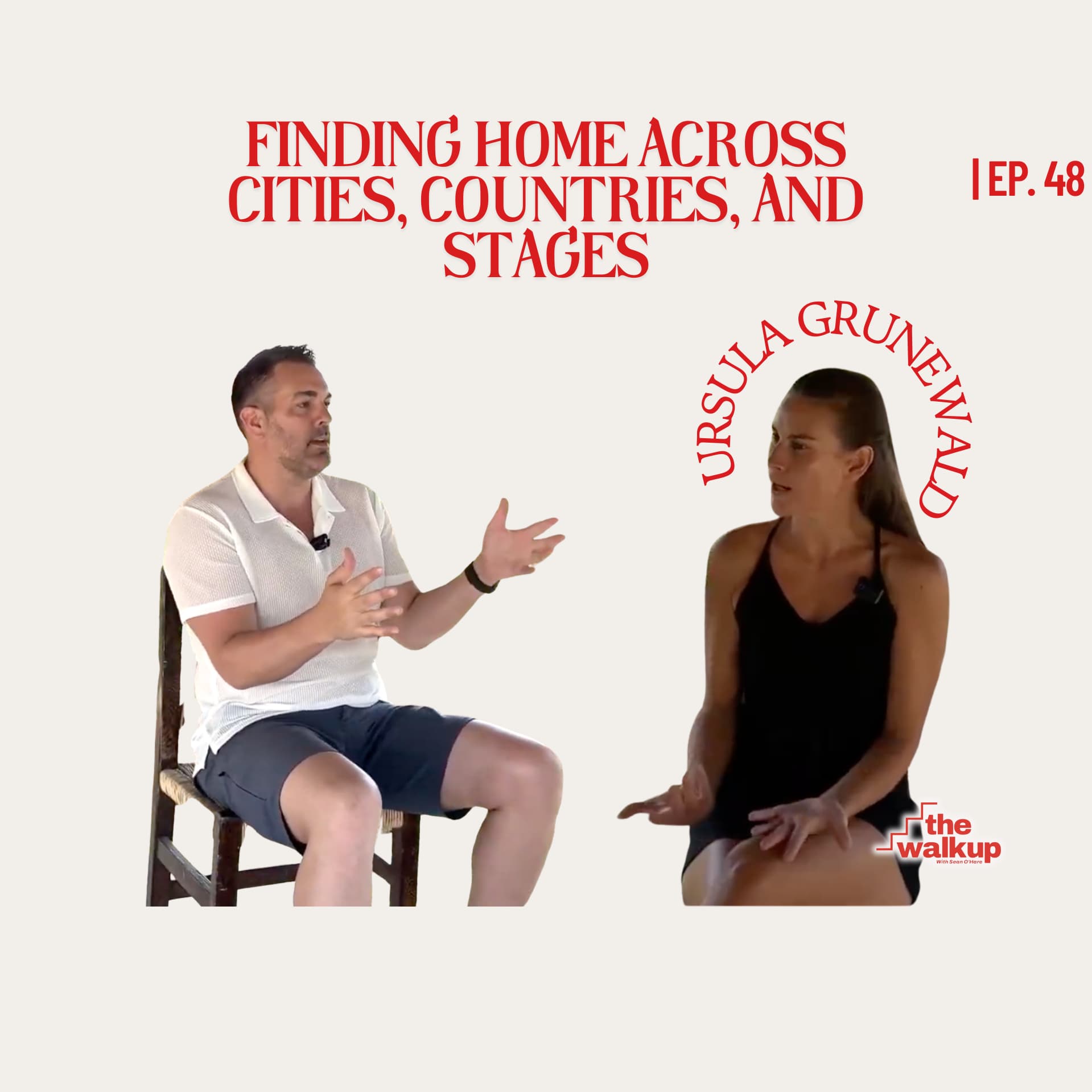
From the sun-soaked streets of Cancun to the elite stages of Cuba and the U.S., Ursula Grunewald shares her journey as a dancer, choreographer, and global performer.
She talks about training at Havana’s prestigious National Art School, touring with top Latin American artists, and finding a sense of home in the unlikeliest of places. This episode explores resilience, artistry, and the pursuit of passion across continents.
Transcript
Read the full transcriptAuto-generated · 7,904 words
All right, so, well, welcome to the Walk Up podcast. Walk? The Walk Up. Walk Up. Walk Up. Which we, so this is funny, the reason we started the podcast with that name, so I live in New York City, we have a studio in Brooklyn, so when you live in New York, and if you live in a building that doesn't have an elevator.
And you say you live on the fourth floor. When you tell people, oh, where do you live? I live in a fourth floor walk-up. Walk-up, right. Because that means no elevator. Okay. So, we are actually on a... Third floor? This might be a fourth floor walk-up, actually. Yeah, yeah, yeah. There are no elevators in Puerto. At all? I mean, maybe one or two. Yeah, no, there are no big hotels. Yeah, or not in La Punta, because I was at a hotel in Zicatela, and they said, oh, do you want to take the...
I understand that I am American, but I can still walk one floor. I live in a walk-up in Brooklyn. I can handle it. No, I don't live in Brooklyn. I have the studio in Brooklyn, but I live in, have you heard of Hell's Kitchen?
Yeah. So, that is the neighborhood. Ah, okay. So, the joke, or the joke, I don't know, the reference. So, it was an Irish neighborhood back when there was like Irish mafia and gangs. So, it was a very dangerous neighborhood, and so the idea was, well, what is worse or what is hotter than hell? The kitchen of hell, so hell's kitchen. Right. Anyway, it is a very important context for our conversation, so in case people can't figure out by your very elegant pose that you are a dancer, you have founded your own dance company here in Puerto Escondido, so I know your first name, Ursula.
Okay. And then you pronounce the last name. My last name is Grunewald. Grunewald. Grunewald. Grunewald. A D in the end is German. The meaning is a green forest, so Grunewald. You went from the green forest to the green jungle rainforest. I was born in Mexico, actually. My dad is German, but my mom is Mexican. I was born in Cancun.
And how did your dad come from Germany? How did that happen? That is a very good question. Very long story. Long story short, he came to Mexico to find adventure, I guess, and love. And a wife, yeah. Yeah, and in the end, three kids. Okay, wow. So, and where was he from in Germany? Bavaria or Berlin? Hamburg, the north. All right, okay. I say that like I know Germany very well. Yeah, yeah. I know enough to at least get into the ballpark.
So then, so you were born in Cancun. I was born in Cancun, yeah. And then how did you find yourself in Puerto? Well... Born in Cancun, then I lived in Mexico City for many years to work professionally as a dancer, and then living in Mexico City, I knew about Puerto. I came to Puerto a few times. We met some friends, actually surfers.
This is what people do here in Puerto. This is the place for surfing. I have no ability to surf, so we'll... I mean, I could learn, I'm sure. I've been on a board. I loved it, but I've been so, like, kind of, like, obsessed with my, yeah, with my skill, if you can say that, like, developing my skill that I try other things, like serve, jiu-jitsu, and I love it, but then if I have an extra hour, I'm going to put it into dance, so I haven't, I haven't.
I haven't learned how to surf yet. You would have more natural balance, I imagine, than I would. Maybe, yeah. I think the tricky part is not balance, which I also love but respect a lot, is the relationship with the ocean. So, you can be like a lot, you can have a lot of skills to be on a board, but...
It is the relationship with the waves, and the wind, and how to count the waves, the swells. Oh, I know nothing about that. Yeah, I learned a little bit with my friends, and that is how I came to Puerto. And I felt like, ever since, from the first time I was here, I felt like, huh. This feels familiar, because when I grew up in Cancun, it was like this, a little town, people walking barefoot, and just like little stores, and I went to Moringa, which is like this little organic shop in La Ponda, and I was just like, wow, amazed with all these amazing products, and it felt like home, you know?
And yeah, that is why I... In a long story short. And has it changed a lot? I get the sense that it keeps growing and growing and growing. Yeah, just now, when I was driving into La Punta, because I don't live in this area, I was like, my goodness, when are you going to stop? Like, yeah, when I come to La Punta, I just see more and more and more. It's inevitable. I've been there, you know, with it happening in Cancun, happening in Playa del Carmen, in Tulum, all that Caribbean area, the Mayan Rivera, all of that, with all the pain in my heart, to be honest, yeah, because it does change.
Yeah, it's tricky, because the secret gets out. I'm almost, I've been surprised since I've been here. I'm like, how is this not already? Yeah, massive. Because, like, I might be contributing to the problem, because I'm going to start telling people how great it is here. Maybe you want me to keep it quiet. No. We won't publish this episode, then. You might be contributing to your own demise. Do you know what? There are some things you can't control, and this is one of it.
That is true. Developing in a touristic place like Puerto, you cannot stop, we cannot stop it, so we might as well just do the right thing and develop it mindfully. Bring things to the area that can sum up and that can bring something beautiful and contribute in a good way. Yeah, and hopefully it is an opportunity for different types of communities to come together.
Our friend Faith, which is how we met, we should mention that. So, our friend Faith was performing alongside your performance, so we went to this, so it was last Friday, and it was a divas show, and the first half was dance, and then the second half was music with Faith, so she was saying there's kind of three groups in her mind of residents, or people that visit.
There is the long-term residents. There is kind of the seasonal. They stay for the winter. They stay for maybe six months, and then, of course, there is the people that are here for one week, two weeks. Yeah, tourists. Like myself, so far, just one week, but I am already planning to come back. So, let us talk about dance.
From the moment you were a child, you were dancing, or was this something you discovered slowly? Did your mother or father have an influence? Where does this come from? Yes, naturally, I think it's part of my essence. Big time, I think it's in my blood or in my purpose.
Yeah, I do remember being a child and wanting to dance these divas, right? All of these music that I grew up listening to. Yes, my mom had a big influence. She loved all these divas. And she was musical, or she was also somebody who liked to… She was actually a businesswoman. She is an entrepreneur. My dad is a music person. He had a jazz club. No way! Yeah, I grew up in a jazz club in Cancun. So, your German father had a jazz club in Cancun.
That is correct. Yeah. That is awesome. So, Faith knows this. I used to host a jazz night in New York every Friday for many years, so we have hosted over 300 shows over the years. I have no musical talent, so I have to exploit other people's talents, but I feel this kinship with your father already.
Because that's pretty amazing. My father was very talented. He is very talented, but he's not in music anymore. But he used to sing, play the piano, play the guitar. Compose his own music. And specifically to jazz or all types of music? No, kind of like classic rock, like he had these like Rolling Stones influence. Sure. Like he always used to tell me, you are, or... Rolling Stones or The Beatles? Like, you cannot be both.
So, it's an important education that you got. Yeah, very, very, yeah. I went the Rolling Stones side. Yeah, okay. So, okay, wow. So then, so you're around this musical influence. Were you at the jazz club when you were younger? All the time. Yeah, I grew up there. My father used to live in the club, so.
His house was behind, on the back, so sometimes, he was always the host, and he was always producing and getting everything ready, and the musicians and everything, but when he didn't want to be… In the front of house, he would just stay at the back of his house, and just watch everything from the top, and yeah, just like smoking a cigarette. That's cool. Yeah. How big of a space was it?
Not too big. 50 people, 100 people? Like, compare it to where you performed the other night. Más o menos. Oh, okay. More or less like that, yeah. I like the intimacy. Yes, totally. Less is more. Yeah, because we had, our first place that we hosted jazz was in the theater district, and it was small. I mean, it was like twice the size, no, three or four times the size of this, but not very big. But that meant if there was only 20 people, it still felt great, and when you had 60 people in there, it was packed.
And then we went to some bigger venues, and it just wasn't quite... There's something about a physical space. Yeah, totally. Right? Like, it just really matters. So, okay, so then you're exposed to music, you're exposed to jazz club, and then at one point, do you start, like, dancing in some sort of formal way? Yeah, I started when I was about...
13, 13, 14 years old. That's the age when I went to Cuba to study. Oh, okay. Yeah, I studied in the National Art School in Havana. Wow. So, you're in Havana at the National Art School for dance. Yes, La Escuela Nacional de Arte de La Habana. Well, we will make sure to link to them. That is amazing. So then, but you had to audition? You had to, how does that work? Yeah, kind of actually, now that you ask. I remember I was so young, I was like 13, and I went there.
The headmistress, the director. She looked at me and she was like, hmm, yeah, like up and down. She was like, yeah, okay, we can make some tests, like the captación, like they make some tests, like if you have musicality, if you understand, they see your body. But you're not going to believe this. She said, estás gorda. She said, you're fat. Yeah, I'm talking like, I was like this when I was 13 years old.
But their way of looking at the body is like a ballet institution. They have so much influence from Russia that they are like military, you know, in the dance scene or sports. So, yeah, it was like, what? It was a big trauma, but anyways, I... So, then you had to lose weight? I had to lose weight. 13 years old? Yeah, and that's when my preparation started, and she was like, come back in a year, make the test, and then if you are in the shape...
So, in shape in terms of weight, but also in terms of practice and technique, or no? That's correct. Yes, exactly. In condición física, like preparación física, which means like your body has to be like bendable, you have to be flexible, you need to have strength, you need to have like these qualities, and if you fit, because they make these tests. all over the the country. The people and the kids that go into La Escuela Nacional de Arte have to go through like a test and test like waves or of a lots of exam filters filters okay and they get selected exactly narrowing to the just like the top of the top of the country And they're getting a lot from dancers from Mexico specifically, or from all of Latin America?
No, that's another thing. I think I was, of my year, I was the only foreigner that completed, like, until graduation. Because they're really just Cubans? Yeah. I had a friend... I knew this guy whose daughter was the only American to be in the Russian ballet, and that was also a big deal, because it's very, very specific. It is a big deal. I saw two or three foreigners coming in and out during the five years I was there, but no one really got the title.
No one really finished. The cycle. I did stay. So, you're moving to Cuba at 13? 14. 14 years old. And your family is like, okay, or were they concerned? No, my mom was like, go for it. Like, she was the main supporter. When I was like, mom, I want to become a professional dancer. I know what I want in my life. I was so proud. Like, I really know, and I'm 13. And she was like, oh yeah, you want to be a dancer?
Well, you're late. In Cuba, they started three years old with ballet. If you're serious about... Sure. Let's go. Yeah, this would be like saying, I'm from… Argentina, and at 13 years old, now I want to be a professional footballer. It's like, no, no, you should have been playing since you were four years old. Four or five, yeah, that's correct. You don't decide to be messy when you're 14. Exactly, exactly. And because of everything I was talking to you now about the bending of the, like, the molding, you know, shaping of the body, the feet, the flexibility, I had to, like...
You have to catch up with everybody else. So, what was it like? You get there, and are you intimidated? Is it like, oh my gosh, I am way out of my league? Or did you feel like, oh no, I can… I can compete. It was hard. It was hard. It was very hard. It was very hard, but I was a very strange teenager. I was so committed, so disciplined. I knew I wanted to finish, so I just gave it all. It was difficult, very hard.
Dance instruction ends school as well, like normal high school? Yeah, I actually finished my high school there, but there was one year, because I was behind, that I had to stop my And I went to the ballet school in downtown, and they would give me physical preparation, like exercise and everything, and then I would go in the afternoons to my school and do all of the technique and the folklore and ballet and everything. It was from morning to evening. All in the body.
And then the education in terms of school. Was it a tutor, or was there actual classes for high school? Yeah, there were classes. Okay. Yeah. Yeah, yeah, yeah. That is great. Funny enough. How many people in the school? Oui, like big, big, big, big rooms. In your program, like with the dancers, is it 20, 30, 50, in the whole thing? I would say like 100. Oh, that is not very big. No? What did I expect? Anyway, as you see the whole idea, the whole picture of the show.
Well, I guess it is when it's very elite, right? Right. Because only 100 people could qualify. I'm talking maybe six groups. Okay, so six kind of like grade levels. Yeah, yeah, yeah. Yeah. Classes. Más o menos, sí. Six of 20, más o menos. Yeah. Yeah, okay, so. Más o menos. Right around 100. Okay, so. So, you are the only foreigners to get all the way through the program. So, now you are 18? 19? So, now what happens? The graduates of this dance school, where do they usually go?
They stay in Cuba, they go to the States, they go to Russia. Where do they go? Most of them, they go into... Well, we are going into dance companies in Cuba, different dance companies, and they actually start performing in different parts of the world, and what happened with most of the people in my generation is that they stayed outside Cuba with these trips, because that was the way, like...
Unfortunately, Cuba didn't have... The economic... Yeah, exactly, and they were... Most of them, like, see, 99% of them, they just... And you were trained in all different types of dance, or was there a particular discipline, a particular specialty? Contemporary and Cuban folklore. Cuban folklore. Yes, Cuban folklore, which includes all the Latin rumba, Afro-Cubano.
Salsa. Of course, salsa son. Okay. Interesting. So then, where was your first, which company, you joined a company? No, I, well, I came back to Mexico, and then went to live in Mexico City. Because that is where there would be lots of opportunities. Exactly, yeah. I was not going to do anything with a career like that in Cancun.
Nothing. There were no opportunities in Cancun. So, I had to go and seek opportunities to Mexico City, which was very hard, actually. It took me a few years to get into my, like, yeah, I mean, imagine being 19 in a massive city. I had to go in.
I learned the city by maps, you know, we didn't have phones then, like, we did have phones, but not with the technology we do now. Yeah, not the smartphones, yeah. Exactly, and then I had my first job working for a very important Mexican singer when I was 21, más o menos, more or less, 21, 22.
Okay, and that was just because of your persistence, or you auditioned, or how did you… Persistence, training, getting choreographers to see me, finding my own way, getting contacts, just being in the right place at the right time, and being ready. And she had, she was a performer that was traveling and doing tours, or she had like a… A main venue that she, or she mainly performed in, in Mexico City.
This actually was a Latin American singer. Okay. He's called Ricardo Montaner. Yes, he's touring all the time. Okay. So, you would be part of the tour? I was in a little tour in Mexico. Okay, gotcha. Only with him, yeah. Yeah. So, you are building these credentials, and was it what you imagined when you... No, I actually wanted to be a contemporary dancer. I entered the show business because I kind of learned in the way that this was like, if I wanted to have a nice lifestyle and make money out of dance...
I had to go in the show business, because being a contemporary dancer in Mexico wouldn't make much. Because, like, I mean, I know we have, you know, we're very lucky in New York, of course, there's so much opportunity.
But even still, I mean, you know, I've had friends that have been in New York City at the ballet, and it's very difficult. They retire at 29, 30 years old. Exactly. Because the body is just, you know, after becoming a solo dancer or a soloist. And we have contemporary dance, of course, as well.
When you were in this school for dance, was the expectation that there was contemporary dance opportunities, or you just didn't know? I didn't know. They don't, like, place you somewhere. They don't. Imagine, you're in Cuba, you're in a socialist country, in the middle of the ocean, in an island.
Like, no, there's no information at all. There's no kind of, like... Taking you with your hand. There's just people getting out of the country and escaping, and finding their own way, and with a blessing, and good luck. No, I had to find my own way, Mexico City, and like...
Yeah, you know, like swim against curiosity. I see myself like that. And now what? I wanted to be a contemporary dancer, and I had these ideas of being political and doing things with a message, but then I... I just went in, you know, show business, and then I was like, ah, I kind of like this too. Okay, all right. I love the shiny things, and I love being in big stages with lots of people. I love touring, which I started doing soon enough.
And yeah, I was like, okay, I like this too. It's fun. And what are some of the places you got to perform? Well, the U.S. That was like my biggest tour. So, eventually you go from Mexico to the U.S. with the same singer? No, others, yeah.
So, where did you get to perform? With the American Airlines in Miami. I think in L.A., I don't remember the name of the stadium, but massive stadiums in L.A., Chicago, New York, I was in Madison Square Garden. Oh, that's great. Yeah, I mean, for a...
I was a town girl from Cancun, you know, and studied in Cuba. For me, it was like incredible. Yeah, to be in Madison Square Garden. Yeah, and being paid. And that was for Latin American singers? Yeah. Latin American singer. This was, his name, he's called El Buki. We call him El Buki, Marco Antonio Solis. And I did a tour with him with Cheyenne and Marc Anthony. Ah, okay. So, we got to tour all around the U.S. That's amazing. So, how many years you were in the States traveling?
Where would home be? Was home Mexico City? Yeah, at the beginning Mexico City, and then I would say for my last years in the U.S., I moved into L.A. for a couple of years. Did any of those feel like home to you? Mexico City or L.A.? L.A., yeah. I think I had some issues with my paperwork, but I think that if I wouldn't have had that, I would have stayed forever in L.A. Yeah, I was so happy there.
Yeah, I think there are certain places, whether it's L.A. or New York, you kind of know right away. Like, this is my, for me, it's New York. I'm there, I'm like, this is me, right? As long as I can escape to... Yeah, fair enough. Me too. But, you know, there's some places that you get to be who you are, and that everybody gets it. You know what I mean? And in LA, oh my goodness, everyone is doing everything. And I'm like, in Mexico, they're like, oh no, you need to fit into this box, or this box, or this box, or this box, or this box.
You cannot be. And I learned from my time in L.A., which is very much of my personality, that you can do everything you want. Like, I got to meet dancers that were singers, that were directors and choreographers and costume designers, and yeah, like, you name it. Yeah. So, and when you say in Mexico, people try to put you into different, was it like, oh, you should... Have a more stable... You should not be traveling, or you should get married, or you should have children, and like, what was the...
100%. 100%. The story of, if you want to have a family, then you need to stop performing. You need to, like, okay, you've done that. Like, you've done that. Yeah, okay, check. Uh-huh, check. Now... Even though it took you five years of school, and training... No, no, no, no, no. Imagine all of that. Yeah, no. It's like, now you need to be...
Steal, and be the perfect wife, and cook, and this, and that, and da-da-da-da-da. Or, if you want to make money, then this is the only way you are going to make money, because this is, oh no, this is just an illusion, like being in the arts.
You know, like, unfortunately in Mexico, there are still very closed-minded people. Well, yeah, there are stereotypes, or certain... Yeah, and I think I am always fascinated by the... What I would call the vocation of the artist, right? I explain to, so we have this production company now, we're doing obviously this podcast, and some documentaries, and some other things like that, and I've been in New York almost 13 years now, and the distributors that I work with are like, how do you find all these?
Such amazing, talented people, and I was like, well, New York is just overflowing with them, and I think what I believe, and you tell me what you think, I think that the vocation of the artist, the soul of the artist, it is like a sickness. You have to perform.
I have this infection, and I have no choice but to dance, or to sing, or to whatever. I don't quite have that. I'm more comfortable being a producer and helping an artist see their vision. And so, when I say it's like a compulsion, it's like saying to somebody, oh, don't perform, or don't.
I would say it's the opposite. Don't breathe. Exactly, yeah. It's the opposite for me. If I stop dancing, I die. It's not an infection, it's what keeps me alive. It's what gives me life and joy. Yeah, it's your breath of life. It's healing for me. Like, it's my therapy, it's my exercise, it's my creativity, it's everything. But if I dare to stop dancing, then my soul starts to shrink, and then I become someone that I'm not, and take it against everybody else, you know?
Then I'm not happy. Yeah, because like, if you had... This option, okay, there is this life of performance and dance, but it has, you know, you have to travel, and there is a lot of uneven times, and not consistency in terms of schedule and travel, and over here, you could make whatever the amount of money is, I don't know, whatever the amount that makes people feel comfortable. But it's like, in an office. Exactly. Oh, no, no, no. I get, I understand, but that wouldn't...
Do you know what? And it's just a way of thinking. It's just a paradigm, because we've been told that. I agree, yeah. Because we've been told that, because I grew up with the idea that this is not going to give me this, and I need to do this to give me this, and it's not. It's just, it's actually changing the mindset in order to create abundance from a place of abundance.
Unwrap that. Abundance from a place of abundance. What do you mean by that? Because you create more of what you already have. Okay, gotcha. So, it's almost like investing in the thing that you have, like a deep well of knowledge and expertise. It's going to create a better return.
Less rational. Oh, sorry. There is a gringo over here. So, what you are saying is that X equals Y. Yeah, yeah, yeah. No. Just, like, more intuitive, you know? Like, more intuitive. Like, okay, What gives me life is going to produce more life and light and things, you know, and then you make it, and then you manifest things. It is a process because we are against all of these paradigms and mindsets, and the process to create that abundance, money, etc., I think it is a process, but we need to stay true to the...
To our calling, you know? And once we are in that abundance, everything will flow and everything will align. And you're going to get to create amazing productions and things will, you know, things will unwrap by themselves without so much. Yeah, it would be less, not less effort, but less.
Resistance. Exactly. Exactly. Now, it is interesting because, and I need to reread this, but it was a long time ago. So, Pope John Paul II wrote a letter to artists, I think in the 90s maybe, because he was an artist. He was an actor. He wrote plays. People don't know that he is a pope, right? They don't think of him, but he was an actor. He loved the stage. Who is this? Pope John Paul II. Ah, Pope. All right. Wow. But he has this whole idea of the letter to artists, and the role of artists in culture and society.
And so, what you are making me think about is this abundance idea, right? Is that, from a spiritual standpoint, almost, it is like, I guess I struggle with sometimes this, maybe the... Overly rational brain, right? On one side, and this is what moving to New York did for me, because I didn't have this real exposure to artists, and seeing this artistic process, and the flourishing of, and what that does for culture, and what it does for community, because I was Born and raised around Washington, D.C., which is more like, you know, talk about rational, right?
Like, government and, you know, my parents weren't in government, but, like, the whole, the culture around it was more about, you know, the practical and the institutional, if you will. So, part of me looks at it from a spiritual standpoint and says, well, God gave you these abilities, right? Like, why would he? He doesn't want to give you those abilities so you go work in an office, right? That's what I tell faith.
She is hiding over there. She is off-camera. I have been preaching the same thing. Talking about Spiritism, I am preaching. She is still hiding. So, there is the one part which I can see like, oh, there is this, this is a strong word, but denying the gifts, right? Then there is this other part of the practicality of like, well, that is nice, don't get me wrong, that is nice, if you can do that, but that is not always, is it a luxury, right?
Is it, I don't want to say an indulgence, but like, yeah, sure, it would be great, you know, but sometimes you don't, we don't get the luxury of being a performer. I am sure there is. Millions of people throughout the centuries who had talents and abilities, but were working on a farm to just get by, or working in a mine, or working in, you know, as a domestic servant, or as a laborer of some sort, and they had all this ability, but there was no outlet for it.
So, you could argue, like, well, it's for them that you do that, right? Because they didn't get the chance, and I might have the chance, versus kind of the... The practical side, because I struggle with it even in a much smaller way, in terms of doing this now production company work.
It, to me, felt a little bit like, eh, that is an indulgence. Like, just do something practical, like work in finance, or some stable job, or whatever. So, how do you respond to that, this, like... Hmm. Responding to the gifts that you have, but also the practicalities of the world. Wow. Small question. That's a difficult question. I wouldn't say it's luxury, but a privilege. Oh, good. More a privilege, yeah, because I would say there are many people that don't get that opportunity, right?
Especially in third world countries, like Mexico, you know. I think myself, I'm in that process of finding, you know, that balance between this practicality and my gifts, but the more I give in, into my purpose, and into my recognition of these.
Like, deeper connection, and knowing that everything is going to be okay, the more everything unfolds. And because previously you were putting up some resistance? Oh my goodness, yes. And why? Because it seems like to me you would have the most openness coming right out of school, right? Because you'd be like, oh, I'm going to go do all these things.
Because of this part of my story where I told you I was in Mexico, I was trying to feed a box, you know, like, maybe I skip a little part of my story, but yeah, there was a lot of resistance at some point, and I did doubt it, and I get that resistance.
Until today, from people questioning myself, and then even myself, I question myself. When you have this big responsibility of, you know, a team of dancers, a big production, like, I mean, big for Puerto, you know, we are not talking like… That was an elaborate production I saw the other night. Thank you so much.
I'm in New York. I see a lot of performances. That was incredible. Thank you. Well, you know, that's a lot of responsibility on my shoulders, right? And I want everything to go like a clock. So, I put a lot on myself, and then I'm like, oh.
Why? Maybe I should just be in an office, and give in, and do something practical, but then I imagine myself doing that, and I'm like, no, no, no, no. I'd rather just like, yeah, it might sound cliche, but I need to have faith. I'm not going to lose hope.
I'm going to believe in myself, and I'm going to, and I need to be strong, you know, and that was something I was thinking driving here. I was, hmm, like what I'm finding myself now, and I tell my dancers all the time, is that we need to be comfortable.
In uncomfortable places. Like, find comfort in... In discomfort. In discomfort. Right. So, learning to be resilient, and because we are dancing in high heels, it's not, you know, it hurts. It's actually painful. And we need to make it seem like it's like, you know, like we're just here doing turns and going splits and up and jump, you know, like, and doing it with grace and beauty, right?
But that is a translation for life. For life. Because it's your own attitude. Life is hard. There are many challenges in life. And then, how are you going to appear, and how are you going, what's your attitude going to be towards these things, you know? So, what have been the, because everything comes with sacrifices, right? And you can't do it without the, so what have been the sacrifices you've had to make to continue to pursue your vocation?
Well, first of all, I had to sacrifice my teenage years, but I don't think it was a sacrifice. I see teenagers these days. I have a teenager in my company, and I'm like, oh, it's been so hard, because they don't know hardship. Everything is convenient. Everything is on the screen, and I'm like, you know, it gets me like desperate, you know.
It's about, yeah, sacrifice is okay. Maybe my teenage years, maybe, but not really, because I'm proud of that. Maybe a lot of time with family. A lot of time with family. I did sacrifice a lot of time with family. I left, when I was 14, my home and never came back.
On my own? Maybe a marriage? Yeah, my partner, because he couldn't understand me, so I had to make a conscious decision. It was just feeding on the box that he wanted me to be, or being true to who I am and my essence.
With all that it takes. My shows, my classes, my craziness, my everything. That was a big sacrifice because it is hard, but I am also like… No, I'm proud of that, too. You know, so I don't know. Time with my son, I have a very, yeah, I have a toddler, a three-year-old boy, and yeah, when I go back home after rehearsals, and I see him, and maybe he's sleeping, you know, because the nanny had to stay, because I was rehearsing until late, and I see him sleeping like an angel, and I was like, oh, I wish I was.
I was here to read him a book, you know, but I was like, okay, but mommy is getting something together, you know. There was a show to be done, and now that the show happened, now I have some more free time, and I'm going to be with him all the time. So, I don't know, it's just a balance.
I mean, everything comes with trade-offs. Exactly. And if it didn't, there would be no... Flavor. Accomplishment, or yeah, satisfaction, or whatever. So then, so we're connected to Puerto, so how did you end up here, and then you, was it when you came here that you founded your own?
Dance company, or you had done that before? No, it was here. It was here. I think when I became a mother, I was like, oh, there's no time to waste. I was like, no, it has to be now. Like, you know, motherhood gives you something, and the power of giving birth, to give birth, you know, and creating life.
It expands you like no other in my experience, like nothing before. So, it just projected me to being more like... Urgency. Yeah, urgency. Like, I have no time to wait, as you said. As a dancer, professional dancer, the clock is ticking. As an athlete... The clock is ticking. So, yeah, just after I moved into Puerto and my son was six months old, I went back to the studio and founded Puerto Heels, and then last December 24, I founded my school. Yeah, finally.
So, what does that look like? So, you have students, there's a dance company part of it, in terms of performance, and then there's a school. Is that kind of the two parts? Yeah, yeah, yeah, yeah. My dream was always to mirror the system I had in Cuba, because they prepare kids.
I want young kids to become professional dancers and be ready to perform in dance companies, professional dance companies. So, now I have kids groups that I am very lucky to have, and I want to take them into that professional stage. Maybe not with the...
The military aspect of Cuba, in a more gentle way, but basically all of my dancers have been my students. Like, I formed them. Okay, so you're really, you know exactly their skills, their abilities. You've trained them in your model. Exactly. So then how are you... Obviously, this is a smaller population to pull from, so how are you finding young students, do you advertise, how do people find you? I am curious about that process. Well, most of it has been word of mouth here in Puerto.
We are a very small town. Of course, we do social media, and we do the best to promote, but the most Effective has been word of mouth. It's incredible. I have a very multicultural company of very different skills, but I have people from Germany, Canada, the US, Argentina, and the kids are kids that most of them, I would say, no, all of them.
Maybe all of them were born in Puerto, and their parents are just desperate to get them into, and because the kids these days, and they get exposed to so much TikTok, you know, dancing, they all want to dance. Yeah, you're right. Much more exposure. No, there are no dance schools. I mean, my dot, my school, is the first.
It is, okay. Interesting. Yeah, I forget about that part, that TikTok certainly, but even some of the more, you know, Disney shows that have become very popular, whether it's like High School Musical, or there's a lot more dance and performance. I was joking with Faith earlier that like, I...
I played soccer, football for you, of course, but I didn't know, the idea of performing and also being an athlete, I thought you had to choose, because there was a different identity than being on stage versus being on the soccer pitch. They are very different, in my mind, but then I didn't have those influences where the cool kids were also...
You know, performing on stage, I thought it was, for me, one route to being cool was to be the athlete. So, I feel like I didn't even give that an opportunity to flourish. So, that is great. And what are the age groups?
Well, I have the kids group is from 7 to 10, 11, more or less. Then we have a teens that goes from 12, 11, 12, to 16, maybe? 15, 16. And then, and then Porto Hills. And there, how often are they coming in? Once a week, twice a week? Depends. The kids, twice a week. And teens, twice a week. Yeah. Okay. So, what has that done for you? From where you were touring and traveling, but doing more performing. You are still performing, but for your own company, but you are doing a lot more teaching.
So, what is that like for you? I think, going back to your question about sacrifice, that is a sacrifice now. I had to sacrifice the life of a… Traveling. Of a professional dancer and being on tour, on stage, that is just intoxicating in that aspect. Yeah, I did sacrifice because I always wanted, I wanted to be, I knew I wanted to be a mom. So, I knew I didn't want to be in the city. I wanted to go to a place like this.
I kind of like, how do you say, like... Yeah, I was like, not convincing myself, but knowing that this new stage of my life was going to give me... Like, it was going to give me back in very different ways. It's going to be very fruitful. Uh-huh, exactly. And spiritually also, because being a teacher to kids and new generations, for me, is... I think it is a very big responsibility, because I am not only teaching them how to move and dance and express, but I am teaching them values of respect, unity, discipline, resilience, and respect.
Yeah, in some ways you are being... A mother to them. Like a mentor. A mentor, but you're also being a maternal figure, giving them an idea of... And love. Yeah. Love. Yeah, I've realized some kids come, like, just wanting some love and affection and understanding.
And I've told my teachers, like, we don't know what happens behind sometimes. We don't know. We don't know. So, we really have to be the space of joy and happiness and love. And, of course, we are teaching them something, but we need to gain their trust and be there for them.
I've seen that in my... Time in athletics, the same thing. You could see that certain teammates really needed a father figure, or just a teacher or a mentor to get, like you say, that. Positive feedback, like, hey, you're doing well, and you're progressing, and I'm watching, and I'm looking out for you, and I'm proud of you. I'm here.
Yeah, those are all very, very powerful. And we can't get enough of that. I'm very blessed with a great dad, but it doesn't mean I couldn't use always more encouragement from a teacher, or a coach, or a dance instructor. I never got the chance to do this, but maybe I missed my calling. This is never too late. You're evaluating me now, and you're like. You don't have the raw… Why not? No! No, no. No judgement. I am a good teacher. I can do magic.
You are like, even with this raw piece of clay, we can make something happen. Well, that is perhaps an awkward place to stop, but we will wrap things up there, because I know you have to go to spend time with your son, I assume. My son? Yeah, I need to pick him up. Well, that is very important. Well, thank you for spending time and to talk about your experiences, and giving people an idea of what it is like to be a professional dancer, and learn about your dad's jazz club, and you being in Cuba, to traveling the States and Latin America, and now here in Puerto.
What is your son's name? Pio. Pio. Okay, great. Well, and now raising a child here in this beautiful place. So, thank you for being on the program, and we will be tracking with your progress. Yes, come to Puerto. But not too many. Not too many. Not too many. Just a few. No, I hope we can be ready to receive you with something.
Beautiful. I mean, I want people coming to Puerto and see something cultural, musical, artistic, you know, and that, oh, Mexico, they don't do those things. Well, I will say, and I know I was going to wrap up, but the thing that struck me...
And I should have given you this feedback before. So, when I was there at that performance, because I was, of course, coming to support my friend Faith and see her perform, so it was a bonus to get to see your dance company, and I thought, the quality and the production value is what I see in New York, but the benefit is, because it is kind of a smaller community, You rarely get a one-hour show. It is hard to do that in New York, to get a one-hour dance performance and then a one-hour music performance, because the venues are too expensive, it is hard, you have to move people quickly, or the venues are too small.
So, it is a great combination to have that intimacy. And still very, very high quality, but more opportunity for you to perform for a longer period of time, or, and really kind of... Honestly, I felt like I was in Brooklyn or something, like in some cool, secret dance club or something. Yes, that is what we want to do more of, and we really hope we can make it. All right, well, when I come back, because I think that is definitely happening, I will have to coordinate with one of your shows.
Yes, thank you for coming to our show, and we want to do more. And thank you for being on the show. Yay! My pleasure. Thank you.
More from The Walkup

Against the Odds: The Samurai Lawyer (Chad Flores) | Ep. 52
Faith, Sexuality, and the Fog of War (Iris Bahr & Father Rick Riccioli) | Ep. 02
E2
Church, Conflict, and Community (Iris Bahr, Father Rick Riccioli & Rob Long) | Ep. 03
E3
Hope, Vocation, and the Global Church (Colm Flynn & Colin Nykaza) | Ep. 04
E4