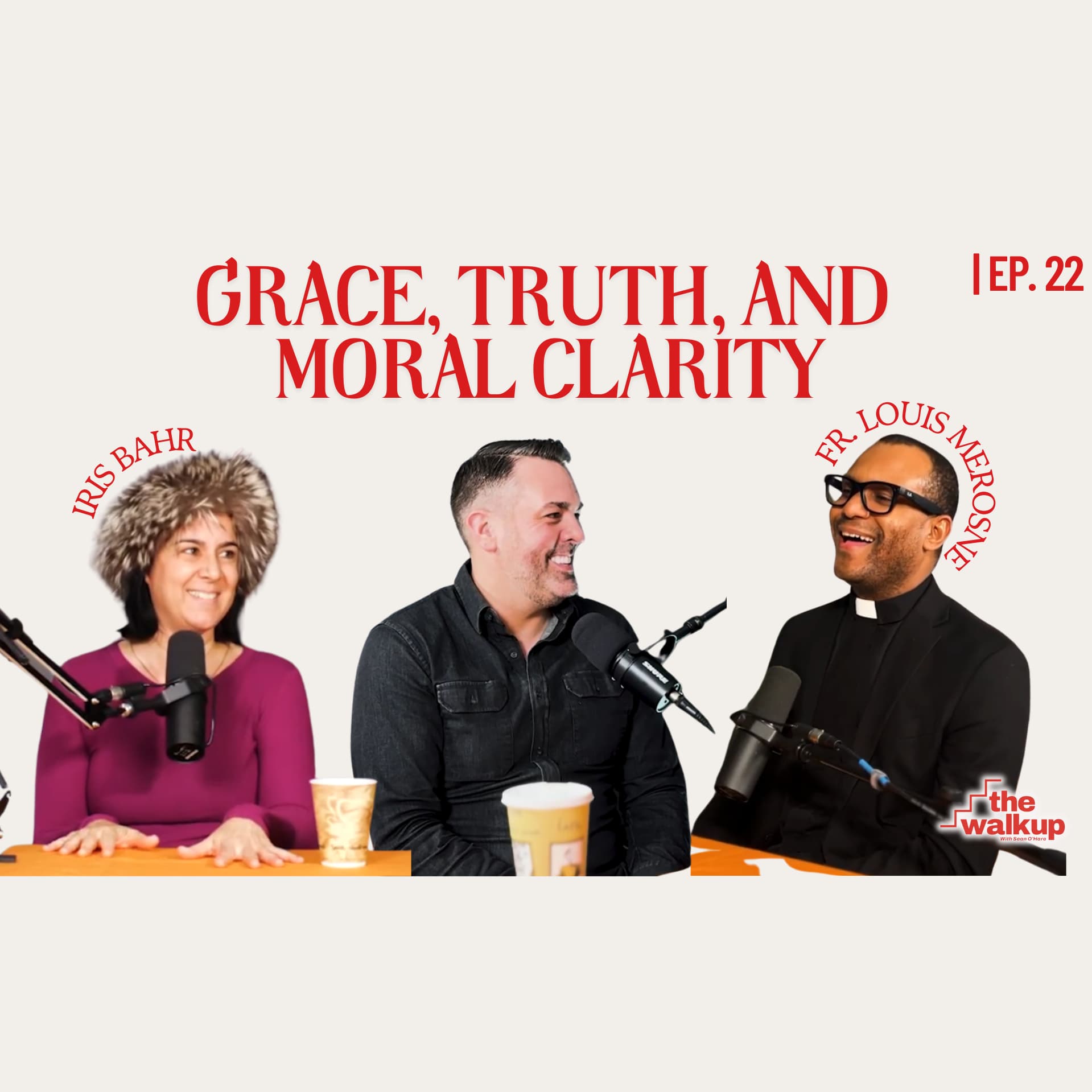
Priest and missionary Fr. Louis Merosne returns to The Walkup alongside actor and comedian Iris Bahr for a dynamic conversation on truth, goodness, and the chaos of moral relativism.
From the Catechism to comedy, the two explore how the Christian tradition addresses power, purpose, and the question of who decides right from wrong. With surprising takes on the Vatican’s wealth, maternal instincts, and sociopathy, this episode brings both gravity and levity to a world increasingly allergic to absolutes.
Transcript
Read the full transcriptAuto-generated · 12,930 words
Happy podcasting. Happy podcasting. Can I just say? Yes. You are possibly the most attractive priest I have ever met. Oh, so we are going to start there. Yeah, I am just throwing it out there. I am looking at you, you are like a fashion icon over here, right? You got the sleek blazer, you got the schmagegi here, and you got the jeans, and you got these crazy ass glasses that you say have a camera in them, which is a little creepy, but so be it.
You are the kind of person where if they have like, what was that, you remember the show Fleabag, where she falls in love with a priest? There is a show, She Falls in Love with a Priest. It is a comedy. It is a comedy. But you'd be that guy like, oh, no, we can't date him. He's the priest. He's the priest. You know what I mean? But he's so attractive. Maybe I'll make him, you know what I mean, like, let me try.
Let me try to bring him back. We know we have a term for that. You know this term, I'm sure. Is that when there's a handsome fellow who decides to enter the priesthood, the females in the church community will refer to him as Father. What a waste. Yes. And if she wins him over, they call that female chalice chipper.
Wow. Oh, I didn't know that one. FCC. I didn't know. Good old FCC. It's not the Federal Communications Commission. No, because at that point, he did not become a priest. Yes. Or maybe he became a priest and he left for that girl. Yeah, is there a percentage? The chalice is the cup that is used at the celebration of Mass that the priest uses. Okay. With the wine that is thrown into the body and blood of Jesus. That's like, oh, you're a chalice chipper.
That's terrible. I didn't know that part. It's not, I feel like women always get blamed as home wreckers or chalice chippers. You're right, you're right. I feel like. And it's wrong. It's the. The priest who's like, what have I done? Am I insane? Let's back it up. Yeah, you're right. What is the percentage? Do we know? Do we have statistics? I believe. The people that... I believe the priesthood. Yeah, that are like, well, some priests can marry, not you guys. But, right?
The... Some traditions, the Byzantine Catholics. Byzantine Catholics. Oh, so there are some Catholics. We have Catholics. So, you can kind of do a little parallel move to the Byzantine order. Not quite. Once you've already been ordained, then it's like you're kind of locked into the rites. So, the Catholic family, the Catholic Church family, has like 22 or 23 rites. Wow. They're called R-I-T-E-S. Okay. And different rites have different liturgical traditions and different disciplines. Okay. Because celibacy is a discipline. It's not a dogma.
That is unchangeable. It is a discipline that we have selected, and that has worked for almost two millennia in the Latin right of the church, which is the biggest right, so it is the one that you come across more often in the West. But we have like 20 others, like the Byzantine right, like Sean mentioned, and they have a different structure, a different set of disciplines. It is called sanity. I am kidding. Actually, well, some of them might be different. You are right.
Trying to manage a priest. How old were you when you said, I'm out? I'm in. I'm in. Oh, well, it's always hard to answer that. But I remember, at least when I was 14, it was a clear desire that I said, I want to be a priest. It was kind of in and out a little before that, but at 14, I said, oh, I want to be a priest. After that, it was a bit, you know, but not off and on.
I would say, The desire would be stronger and weaker, stronger and weaker, but always persistent, until I got ordained. And how old were you when that happened? Let's see, I was, I guess, in my 30s. In your 30s. Yes. Oh, wow. So, but until then, you had been with women, men? I don't know what... No, I've not been with men. Okay, I meant women, but you lived a life as a... As a regular person. Straight dude.
In Haiti. I still am a straight dude. Still a straight dude. Yeah. Okay, in Haiti. Actually, yeah, parts... Of my life, I was born in Haiti. When I was like 10-ish, 11-ish, I moved to the U.S., to Boston. So, I would say I grew up in Boston. Then I went to study in Steubenville, Ohio.
And then, yeah, it was a great university, which is the only reason I went out there. Yeah, yeah. And then, but after studying and then going back to Boston, trying to get my student loans, whatever, I felt called to go back to Haiti, and so I did in 2010.
Almost, yeah, 14 years ago, almost 15 years ago, I moved back to Haiti. To Port-au-Prince? No, actually, I moved to west of Port-au-Prince in the department of NIPs. NIPs is one of... It's the 10th of 10 departments that we have in the country. It's called a department like a province? Correct. Like a prefecture? Very good.
All right. Excellent. An art de smont. An art de smont. A borough. It's a borough. It's a Haitian borough. There are Haitian boroughs here in New York. That's true. We have a little Haiti in here. So, you're west in Nips?
Correct. I went back to Nips. I was born in Nips. Okay. I had left, and then I went back to Nips. Nips became a department, I think, in 2008. Oh, it is a young department. Young department, and therefore, young diocese. In Haiti, we have it set up where each department has its own diocese under the leadership of a bishop, and the bishop has several priests that assist him in running the parishes, and so we have 10 dioceses, so 10 ordinary bishops.
The Archdiocese of Port-au-Prince also has two auxiliary bishops that work with the archbishop, the head guy. Let me ask a fiscal question. Sure. The Catholic Church has a lot of money. Yes. It depends on how you look at it. But is there, like, one, is it like the Vatican has, like, the big bank account, and it disperses money to Catholic churches all over the world? Not quite. We're just keeping it at the Vatican. That's how people think of it. Okay. And so people wonder, for example, my cathedral, I pastor the cathedral of Saint Anne in my diocese, and the 2021 earthquake damaged it badly, so it's unsafe to meet in, to worship in, so we meet.
So, I was sitting under a metal pavilion behind my rectory in the garden, and so people are like, why hasn't the Vatican just repaired the church? It is not quite like that. It is not a kind of a cooperation like that with the Pope as the CEO. Yes, the Vatican has a lot of money, especially in terms of the material goods, such as the priceless art pieces. The collections, yes. The collections, et cetera.
And I think, actually, even non-Catholics would admit that, actually, that is a great service for humanity, having these things, for Michelangelo, for example, to preserve those where... The Catholic Church is sort of the stewardess of these things, so that it really is for all of humanity, because anyone can go.
Taking the beauty. Wait in line for six hours. Yes, yes, yes. Pay 50 euros, but sure. That is because the whole world comes. Yeah. Because it belongs to all of us, in that sense. But if, let us say, the church were to sell that to a particular person, then it becomes that person's private thing. You cannot tell them what to do with it. No, I get it. I get it. So, yeah. So, in that sense, each... Church. Asset rich, cash poor, I think is probably.
Right. And also, I've heard. Property. I've also heard that the Vatican kind of operates on a deficit, on a yearly deficit. It does, for the most part, yeah. I think there was. You might be able to speak more on this, actually. There was some assessment done that any major sports franchise here in the States is worth more than.
The New York Giants are worth more than the Vatican. In terms of the religious decrees, so the Pope is like the head. CEO, right? His decrees kind of go with everyone that is part of the Latin order, or any other order of the Catholic family.
All of the 23 rites, 22 rites? They all recognize the Pope as the top. But do the churches, I know obviously churches are non-profit, but are there certain fees and dues that you have to pay to the Catholic Church that ends up getting funneled to the Vatican, or is everything kind of self-contained? Is it their own little company? So, there is something called the principle of subsidiarity, which basically means that the most local should be the ones to manage the concerns of the ones closest to them.
So, our entire model is built off of a parochial system. So, I mean, the word parochial obviously means localized, right? Yes. First and foremost, the local parish takes care of the needs of the local parishioners, then the local diocese of those within the diocese, then the archdiocese, then beyond that, and so the only things that really come to Rome are not necessarily fiscal.
As much as they are kind of administrative and, what would you call it, almost pastoral. Yeah. There are some things that are, it is always voluntary. For example, every year, I think on Good Friday, there is a collection that is taken up for the church, and then, so at my church, I would take it up, I would give it over to the representative in my diocese that represents its OPM, so Pontifical Missionaire de Mission, Pontifical. Works of mission, something like that, right?
So, then he takes up what I get from my parish and from like 40 other parishes in my diocese, and he takes it and hands it over to the national representative, who hands it over to the Vatican. And so, this is our kind of gift that we give, but there is no like set fear that you must give this much. Right, otherwise you are getting ex-churched. Right, no. Okay. And then also in reverse, so in the States, obviously, we are blessed with...
More financial resources, so we have something. It's so much real estate. We have lots of real estate. We're in one right now. Yes, Sean is my real estate king. Yes. Come to him. The Jew that's like, can we hook it up? Yeah. Better than the Tiger King, I think. Yeah. Or maybe not. I don't know. Maybe. I'm still going to mess with this. You guys don't worry. Yeah, please. You just fiddle with your microphone. I do my thing. You do your thing.
There we go. Well, what I was going to say is that we also, in the States, we have something called Mission Sunday, so where we take up a collection from the parish in the States and then send them to mission territories that don't have the financial resources. So, there's kind of a little bit based off of me, but to Father's point, it's voluntary. It's voluntary. It is not like a tax, so to speak. Where did this idea of father come from, versus brother?
There are brothers, but the pastor is the father. What is that about? Yeah. Because the sisters are not mothers, the mothers are sisters. Some are called mothers, especially the head sister. Head sister is a mother, okay, but the father. The father is superior. Correct. Okay. Yeah.
So. I think... Mother Teresa. Yeah, correct. Overrated. And the Pope is called the Holy Father as well. Yeah. The Pope being called the Holy Father, I think, is especially tied to Old Testament prophecy. For example, in Isaiah 22, where there is a prophecy about...
So, the king's vizier, or representative, sort of like a prime minister over, the king would have 12 ministers under the Davidic kingdom. Those 12 ministers, one of which would be the head minister, and it is prophesied, not just prophesied, actually, that his role was that he was sort of the gatekeeper. He had the keys to the kingdom of David, and he represented David where he was as David was. And whatever word decided, whatever he decided, went. And so, what he shuts, the text says, what he shuts cannot be reopened.
What he opens cannot be shut, and then Jesus comes with his 12 apostles, and Jesus is called the son of David, and so he comes to restore the kingdom of David, and as the restorer of the kingdom of David, he He has 12. Yeah, I think so. Yeah, it's okay. So, Jesus comes, and 12 apostles, just like David had 12 ministers. One of the apostles, Peter, is sort of the head guy, who, in Matthew 16, receives the keys of the kingdom.
So, people are like, wait a minute. You're like the fulfillment of the prophecy that was there in Isaiah 22. And so, and Isaiah also prophesied that that person. Who holds that position would be called the father of Jerusalem. So, there is a sense of fatherhood. Obviously, too, because in a sense, as representing God, who fathers his people. I think that is one of the most beautiful titles of God, as his father. And so, representative of God, who fathers his people. There is also St.
Paul, who in 1 Corinthians, talks about his being a father to the Corinthians, because he gave them the gospel, which gives them a new birth. And so, we're talking about being a new creature, or being born again, in the sense of receiving a birth from on high, and so the one who gave the gospel, by which one came to this new birth, then that person is sort of a father to you. So, in that sense, and the priests are supposed to be gospel proclaimers, and they baptize the people, and in their baptism, they receive this new childhood of God.
I think that is one of the main things, actually, is that as a priest, I baptize this person who is a creature of God, certainly, whom God loves, and whom we can call a child of God in a generic sense, but in the specific theological sense, this person becomes a child of God, an adopted child of God, through baptism, where God gives him the gift of sonship, and the priest is the one who administers that sacrament. This is interesting, this idea of fathering.
Certain things. So, I look from the Jewish tradition, where the Orthodox Jews and the rabbis, they procreate like nobody's business, right? It is like nine or ten kids, you have fertility issues. Do you know what I mean? And that will bring you closer to, obviously, the idea of procreating and creating and propagating people and all that stuff.
And still being able to devote yourself to the faith, and be a rabbi, and be in the community. Yes. So, a couple of things are interesting to me. Obviously, this whole idea of monks that detach from community life, there is that too, right? But this idea of a father that is fathering, I guess, the people, but not fathering their own biological children. Correct. This thought of, is it seen as...
You are more easily devoted to God if you are not engaging in procreating or being married or dealing with children. Because for me, as a parent, the minute I had my child... Open me up in emotional and spiritual ways that did not exist before, right? This idea of something greater than me, and obviously with you, you have God that is greater than you, and you're prioritizing God, but God lives through everything and lives through children, and the act of parenting is an act of God in a way, right?
I'm assuming you believe that. Yes. So, I'm just wondering what resonated with you with this idea of... Letting go of that part of existence as a human, and what doesn't resonate with you? What is your internal conflict with that decision or lifestyle, or does it come and go in waves? Yes, you're right. It does come and go.
First of all, it's funny. This very week, or this weekend, I got another... Reaffirmation of my deep fatherhood. Because we say it, but sometimes, because we're human, we forget, but one of my children, a couple of my children, actually, were there to, like, it's like, They just needed to open my head and heart and put it in there that you are such a father, and they were reminding me of how I fathered them in life. Spiritually. Spiritually, yes, and I have never felt more like a father, and I realized, oh my gosh, I really am a father.
Because you can do, but then sometimes you forget, or you might not see the fruits immediately, but seeing a consistent accompaniment of a soul to whom I've given the gospel, and also for whom I've fought spiritually and physically, in a sense, but physically, I should say socially, etc., for their own salvation, and for their deliverance from evil, and their physical deliverance from death. You know, from persecution, from being trafficked, etc. And the way that one of these children was just holding my hand to say, Dad, you are more than a father to me.
You are more than a father than my biological father, than anyone else I know in the world. And she's like, I will never, like, you need to know that you've got a daughter, that you've got a son right here. We will never forget, and I was like, and I had tears, I was like, oh my gosh. I'm just so thankful that I can be a father that way. In a way that I might not be able to be fully.
To as many people, were I married? So, we look at marriage, natural marriage, as a really good thing, as a gift. In fact, that's the only way it could be a proper sacrifice. You don't sacrifice the bad lamb. You don't sacrifice the thing that you don't want. You sacrifice the thing that you want. And so, we want marriage, and we also believe that every single person is called to marriage, to God.
Which is the fulfillment of the greatest marriage, which brings two together in communion, a deep self-gift, mutual self-gift, where you're poured into the other, you receive the other who's poured into you, and it's a mutual giving that is ongoing. We believe that will be fulfilled mostly and completely only in God.
We also believe that in heaven, there will not be marriage like we know it now, that the institution of marriage is something to bring us over to reflect the heavenly realities, like you mentioned. So, parenting is an act of God. You're right. Spousing is an act of God, and so when you have a spouse, you represent God to that spouse in a way, and that spouse represents God to you as well in a way. So, in a sense, the marriage that we're called to have with God, which we begin to have already now, is...
Lived out through the marital act with my partner here on earth. Some of us, of you, are called To skip that stage of representation, of mediation, to go directly to the eschatological marriage, how we're going to be with God in the last days in heaven, and so we unite to him completely, solely, without that marriage being mediated by another human person, which is not a bad thing, because it's a gift from God, but we're called to go beyond that and to that marriage with God.
So, we're all called to marriage. And to full marriage in God. So, yes, I think as a man or as a woman, we have a desire for the other. It's kind of, I think, something might not be... It shows that we're working properly when we have that desire. The question is, what do we do with that desire? Some of that desire might be because it's been disordered by sin, but there is a fundamental desire towards the other. The question is, when that desire is purified, we will notice that the real aspect of it that's really human is the aspect of, I desire you because I love you, and I want your good, and I want to give myself to you.
And that's pure, and that's beautiful. And in a certain way, I can have that kind of relationship with you, and I will have that kind of relationship with you, completely, purely in heaven, where I would not want to use you, but I will want your good. I will love you not for my sake, but for your sake.
So, lust enters into the game. That lustful aspect that covers over that pure desire is what needs to be removed. So, sexual desire, for example, is not necessarily lust. Disordered sexual desire, which is a desire solely for the pleasure that I receive, is wrong and needs to be purified. But a sexual desire where I want to give myself to you and you to me in a way that we can celebrate. That in marriage, that is why marriage is the proper place for that kind of desire to be expressed fully, and the sparks can go off, and et cetera, et cetera.
So, anyway, sexual desire, I have. We all do, I believe, at least naturally speaking, but it is supposed to bring us out of ourselves for the sake of the other. And so... And that movement of getting out of myself as the other, I can live it out in my celibacy, and in fact, maybe even more fully as a celibate man, as I not only...
Follow the example of Christ himself, who was given over to the father of people like Paul, and even some Old Testament figures, what we call the Testament, I am sorry, First Testament figures, right? The original. Yes, the original. The OG. No qualms with that. The OG Testament, the covenant, I like to say.
For example, to proclaim to the world that is so focused on living here and now, and forgets what we're called to, our final vocation, my celibacy can proclaim that to them even without my saying a word. It's like, why would he choose to do that? It's not because I'm not a man. I'm a full, real man. But I can choose to forego this pleasure, this good, not just pleasure, but this good, for the sake of something even greater, and then... And so, that's a proclamation of what is to come.
Secondly, you're right, there's a practical nature to it, which is that I am physically more available to serve. So, if I'm called at 2 a.m. for a... Someone who is having trouble, spiritual trouble, or at the hospital, I am not bothering my wife, or my wife is not getting jealous because father has been giving spiritual direction to like seven women today already, and one of them is really pretty.
I don't think about that at all. It is like, oh, you were in there for like an hour with that pretty girl, kind of thing. Does she really need a good confession every week, really? Right, right, right. I don't know. Women are always, no, I don't like that. Women are fine.
I have a question. I have a few questions. My first, I forgot, I think we talked about this with Fryerick, but remind me, because I know in Judaism you're not allowed to, but is masturbation allowed? No. No. Yeah, we talked about this before. We talked about that, right? So, have you gotten to the point? Because I am sure when you, well, again, you came into this later in the game, so certain people that come in earlier that have never experienced any of that, right?
It is almost like, been there, done that, I am okay, I have it in my head, I have the sense memory of what that was. Right. Certain people that enter the priesthood, right, as virgins that have never been with anybody, that seems like a challenging thing for the mind, but the fact that you had that in your, do you know what I mean? Yes. You have experienced that, you are like, okay, it is a part of your experience that has been lived in.
Yes. Yes. You a virgin? No. No, okay, right, so you are fine. Here is a question. I am going to segue for a minute. I am going to segue. I think about Catholicism as a missionary religion, right? Christianity, yes, as opposed to Judaism, right, which we would have done a lot better if we had been coming out, handing out stuff, and we would have been more than 40 people. So, in a place like Haiti, Well, there is an indigenous population that came in, right, that obviously I am assuming a lot of people were converted, right, and became, due to missionaries.
Yes. Indigenous, though, I would not say. We had an indigenous population. Okay. But also African population that was brought over, that came in with their own belief systems and their own heritage. Right, okay. So, this is challenging for me, only because, again, I remember asking a friend years ago, You know, you're not taking away, you believe that they're destined to be part of, right, bringing them on to the correct side, the right side, but from the outside, you're thinking, but this was, they had their own belief system, and their heritage, their roots, their whatever, and suddenly they've been converted to something that stemmed from somewhere else.
So, I want to hear your thoughts on that, but I also am curious. If everyone is a creature of God, right? We're all creatures of God, no matter where we come from or our belief system, but if someone lives according to all the, I guess, is it Gospels of Jesus, okay, but does not accept Jesus as their Savior, how is that person? Because for me, it is about how are you manifesting, how are you living your life. It is not about declaring the glory of God or Jesus.
That seems like an ego-based thing. It means about how are you living according to the beliefs and tenets of what it means to be a good Christian or whatever, or manifesting God's will on that. So, I wanted to hear your thoughts on that. Because for me, all the religion, even with people that are thinking the other or it is not legitimate, but I am like, well, what is that about really? Because if it is about... Being a good person and a good Christian, to me, that is really the core.
That is the good stuff of the religion. There is a lot of stuff of institutionalized religion that is problematic, but that is the good stuff. So, I kind of wanted to hear your thoughts on that. Okay, I appreciate that. So, I think I can discern two main questions there. The first is about, you know, evangelizing cultures that already have their own beliefs, etc. Yeah. It does not seem like we are imposing something else on them. And the second thing is about, you know, what it actually means to be Christian or any other religious person.
You know, can we just kind of rip out, live out some of the core fundamental values, which might even be shared amongst many different religions, without, you know, being all radicalized and to talk about glorifying Jesus, all that stuff. Okay, so to the first, so in my town, we had a lot of difficulty. I spent about seven years paying for...
So, we had truckloads of water to be brought over to our cistern, and I paid for at least one truck a week, a water truck to come in, and most people didn't have the kind of money to be buying a truck, and so they would have to go far to try to fetch some water, etc. That's just how it was done. But then we were able to find... A way where we can actually tap water from a spring way up in the mountains, and then to bring it down through pipes down to the town where people can have water readily available to them right there.
Now, they were getting water, but... There is a better way, an easier way, in fact, and so it was good to know of that better way, to introduce them to that better way, which gives them even a fuller amount of water that will help them and their children.
It would have been greedy of us who know of this to be like, nah, let's just let them keep fetching however they're doing it, etc. I see a metaphor here. Go ahead. Yes, that is the metaphor. And so, by evangelizing, it has been compared to, another comparison is that it's a beggar.
That tells other beggars where he found bread. They say, I found it. It is not because this beggar is better, or wants to impose upon the other. Can you imagine the other saying, don't you dare tell me where to find bread. I find my own bread. I was like, all right, that is you. You could just find your own bread. I am just letting you know, though, I found it right here in this house. So, the question is, Is there really bread in this bread house, and is it actually good for you?
So, that's the fundamental question. If it is, it's greedy, it's evil not to tell the other beggars who are dying where the bread is found. So, there is a more fundamental, once that question is answered, if that bread is no better, for example, than whatever scrap that everybody else is getting, then, yeah. And there is no reason to tell about it, but if it is good and actually brings life and sustains life to the others, it is not only good to tell the others, it is a moral obligation to tell the others about it.
And I think that is the impetus for Christian evangelization, is that we really believe that we found something that is so good, that does not take away from our humanity or from our freedom, but that actually confirms our freedom and our humanity, and that also has the capacity to repair those things that are broken in us. It is obvious that we're broken, not because we're not good, but because our goodness could be even more perfected, and so there is a certain grace that we get to repair our brokenness, to perfect our humanity, and to elevate our humanity to heights beyond what we even imagined.
So, we believe we've found that fountain of life and love and happiness, and we want to share it with everybody, and so that's why it would be greedy of us Christians. Not to be sharing that with other people. And it's in that view that I think it's a good thing to tell other cultures. However.
The church also teaches that it is not good to impose that same faith on others, or to force them to receive that faith, which some missionaries did, and so it is condemned, and so I condemn it. Any missionary that tries to convert by the sword is wrong, and they will face God for that, and it is a bad representation of the gospel, and if people reject that presentation of the gospel, they are not actually rejecting Jesus Christ. So, that brings us to the second level.
The second part of your question is, you know, how do we see people who, for example, might do the good things, but don't actually believe in all that? So, we believe that Jesus, indeed, is the Son of God, who is sent for our salvation.
We believe no one can be saved without Jesus, but people can be saved without the knowledge of Jesus. So, the difference is, one is ontological, one is epistemological. The ontology is... The reality of what is, and the epistemology is how we know that which is. And so, I believe there are people who don't know Jesus who can be saved.
By the same work of grace that the Father gives us through His Son, Jesus, and even if you don't know, just like if a baby is, you know, walking off the edge, and I grab the baby real quick and bring him back, he doesn't have no idea who the heck I am.
So, the baby doesn't know the stranger that saved him, but the stranger still saved him. So, we believe even though God gives us ordinary means by which to receive the grace of salvation, underline the word ordinary, God is not bound by, enslaved by, imprisoned by. These ordinary means, God can and does act outside of these ordinary means to grab his people and bring them into salvation and relationship with him. So, people can be saved without, obviously, because the more guarantee that I can have, the easier it can be, the more effective it can be, the more I want to do that.
And so, I still proclaim the good news and offer the ordinary means so that they can receive more and more in fullness upon fullness. And so, that is why, too, because I believe, for example, that Jesus is true, I believe Catholicism is true, good, and beautiful, and one, because I believe that, it follows from that, that I don't... The moral aspects is just one aspect of Catholicism. For example, if you read our Catechism, it is divided into four pillars. First is what we believe.
The second is what we celebrate. So, the liturgy, the Mass, all the beautiful things that we do in worship of God. The third is the moral life, and then the fourth is prayer. All of which are integrated together as one full whole, and it is what fulfills The human person, most fully. So, we could say now, drop the creed, drop the liturgy and sacraments, whatever. Drop prayer. Coincidentally, I almost left one finger up. That wouldn't be good for the podcast. We could drop all those and be left with the morals alone.
First of all. It is hard to live the moral life. I think we would all agree. That is why we're given the strength to live the moral life through the grace that we receive in the sacraments. So, we need that third one. But also, how do we know what is moral? For example, you talked about masturbation earlier.
Well, who says if it's wrong or not? Who says IVF, is it wrong or not? Homosexual acts, wrong or not? Who says? And so, before we can talk about, well, let's just do the good things, well, what is good in the first place? And who gets to decide? The story from Genesis, which we share, tells us of Adam and Eve, who were given everything to eat from all the trees except for one, the tree of the knowledge of good and evil.
Guys, just don't touch that one. And they touched it, and then they died spiritually that very day. Now, some interpret that to mean, and I actually believe that it is not as if God was never going to give them that.
Because you'll notice the serpent tempted them by saying, if you eat this, you will be like God. And he doesn't want that. So, God is jealous. He doesn't want that. So, he's like, yeah, you're right. We want to be like God. But they forgot that a few verses earlier, God already made them in his image and likeness. They were already like God, but that was a gift, not something seized. And I do believe that God was going to give them even more than that which was in that tree of the knowledge of good and evil.
Another interesting fact is that there were two trees in the middle of the garden, the tree of the knowledge of good and evil, and the tree of life. They were not prohibited from the tree of life. And so... It seems that they forewent, or foregoed, forewent, I don't know, whatever. The tree of light. They chose one of them. They chose the other goat. The foregoed, didn't do it, didn't eat it, didn't touch it. And they chose the one of knowledge, and some interpret that as them, they're wanting to be the arbiters of good and evil.
Like, we're the ones who decide what is good and evil. So, good and evil, or morality, becomes subjective, it becomes relative to each person. Of course, that only brings chaos, because moral relativism only brings chaos, because then you don't actually get anything good. Because if it's dependent on the particular subject, then who's to say that I'm wrong when I choose to rob you? It's my morality. In my morality, it's good to rob people who are bad or whatever, who I don't like, because that helps society in a certain way.
Okay, that sounds like it could have some reason, some logic to it, but no, I can't do it. It's objectively wrong for me to rob you, etc. There are more things like that. So, morality, it's like, who says what is good or right? And that's why I think the creed, or what we believe is also important, and who says it. And then the last pillar of prayer, in relating to that divinity, it seems proper, because otherwise, we don't want to just be freeloaders.
Like, when my dad gives me something, I don't just want him to just put money in my bank account every month, and I never say hello. Thank you, Dad. I appreciate what you did, kind of thing. I want to have a relationship with my... Gift giver before I just seize the gifts and have a relationship only with the gifts that I have received. So, that is where the fourth part of our life comes together. So, I do not think it is enough to just live out what we think are the moral code, is the moral code, because then that presupposes other things, such as the knowledge of the moral code, the ability to live out the moral code with the grace of God in the sacraments, etc., and also having a relationship with Him in prayer.
That was a long-winded way of answering that question. What he's saying is it's all integrated. Right, thank you. It's hard to separate. And if you recall, when we were here with Fry Rick, by the way, you guys were the celebrity returning tournament of champion guests. This is your fourth appearance. Yes. Probably fourth, I think, somewhere around there. Maybe.
So, I'm not to say our other guests haven't been wonderful, but I'm just saying you guys have come back repeatedly. But Fry Rick, I think you didn't pose this exact question, but the question was more along the lines of, if it turned out the Gospels were just a collection of wisdom. Right, he'd be like, I'm out. And he said, it's not the seven habits of highly effective people. It's a relationship. Yes. And I think that, and I'll admit as a practicing Catholic who hopes to inspire others in their faith as well, I forget sometimes that we're not doing a good job proclaiming it about a relationship, not about a list of codes and practices and so forth.
I know that it often gets I don't want to say interpret it that way, but those are kind of the takeaways people have is, well, you're allowed to do this, you're not allowed to do that. Of course, that's how we're going to initially interact with it, but my, whereas when I go to prayer, that My relationship is fortunately one of which I'm having a dialogue in those moments of prayer, and getting affirmation, or getting the spiritual nourishment of things I'm grappling with in my own life, and getting, as Father pointed out, those four pillars are constantly complementing one another.
So, I have a theological question. Well, I want to say one thing, though. I want to respond to that, because I think that one thing that I've... Always had an issue with, and I think I brought this up with Ryrick as well, is that I believe, I think there's value.
In doing something good, not because you think you are going to get rewarded later, right? Correct. Like, I am doing good for the sake of good. Even if it brings harm upon me, this is what I am doing. Yes. Now, I get what you are saying in terms of society and human nature, that if we all just try to establish our own moral code, it might be self-serving, or we might have different ideas of what that moral code is, right? If I am robbing you because you are rich or you are a big pharma, then I think I am okay.
I do think that it is tricky, and nothing is black and white, and I think... Thou shalt not kill. There is a slew of things that we can argue over, right? Yes. But, I also think that, at the end of the day, if people are following moral code against their intuition or inclination, because God said so, or this is what they believe, they are going to have internal conflict. They are either going to not be able to sustain it anyway, and they are going to not feel authentic.
Inside. When anyone's living against their true nature, right? If you're a criminal in your true nature, and you're living according to that, but it's not there, it's not going to last. Right. And so, I think the struggle has been... In the world, et cetera, and again, there's even a lot of people with bad moral code in the church, right? I mean, humans, there are a lot of bad people. It doesn't matter who you belong to, right? And there's corruption, and there's abuse, and there's in any world.
And so, I think that it's... I don't want to say, I'm not making a judgment, but there's naivete there, thinking that if we have these moral, you know, we're living according to this, and we espouse this, people are going to follow that, maybe out of fear, which will help order, or the desire to be rewarded, but the minute it's not coming from the inside, I think the ability to really sustain that, or live according to that, it's not happening, and we can see that in the world.
I think that it's... You know, people will corrupt it, or look at Islam, and people will corrupt what other people think is the real Islam, and say, no, people are bastardizing, you know, this is not this. Right. Or Christianity, you talked about the missionaries, the crusaders, or anything. I mean, we have, you know, corruption amongst the Jews. Like, there's no shortage of any of that. So, at the end of the day, I think, and some people argue that it's about power and control.
I mean, there's many arguments. But I feel like whenever I do something that is not really coming from my inside, because I am supposed to or not supposed to, it feels jarring, and you do not feel like you are living according to your true being. So, I think that, can you be trained? I do not know. I mean, can people's feelings change, and can they be taught or indoctrinated, and maybe make them feel differently, and it is a muscle? Maybe it is a muscle.
You know, if someone has bad inclinations, but they are slowly taught to, or they are... But being scared into something, I think, never works. I think that corrupts the soul. Yes. Afraid of doing bad because you're going to go to hell. I don't think that's ever a good way to go about it. Correct. Yeah.
And I think certain people, I hate to say it and be cynical, but certain people are kind of rotten at the core. And I don't know if you can be saved. You know, I think you're... I don't know. It's tricky. So, that's just kind of my thought. I think it's a beautiful sentiment, and I think it's wonderful, but I don't think it really captures the true nature of human nature. I don't know about Adam and Eve. I mean, again, it's like, did they want to be the arbiters of good and evil, or did curiosity kill the cat?
You know, I feel like ignorance is never bliss, and I feel like if I don't understand something or know something, it's going to drive me crazy. And the minute I can encounter the truth, But just having life but not knowing, that would drive me. So, constantly questioning, I think, is good, and that is a big part, I think, of Judaism, is questioning, and every rule and everything is discussed a bazillion times, which also makes it really like, well, if it is that much of a discussion argument, then how do we know what is right or wrong?
There are so many rules in Judaism, right? It is rules, rules, rules, and you cannot do this on the Sabbath, and you have to do this, and you have to go here, and there. And they're arguing, you can do that, and that, and that, and I'm like, well, if they're arguing, it's a bunch of dudes, then who knows what's right, you know? I just shot a movie.
With a musician who became Orthodox later in life. I think he is in his 50s or 60s now. Orthodox Jew? What is that? Orthodox Jew. Yeah, he became a Hasidic Jew. And we talked about this. We talked about how I have certain friends, because you know, the Sabbath, if you are really observing the Sabbath, it is very restrictive. Extremely. You cannot even carry certain things in the area around or walk. And certain people that I know that are religious, I do not want to say that, they are religious and observant, they make a little bit of their own rules.
They go, I believe, I do what works for me. And I do this, I'll listen to music, and I don't think turning a light is a big deal, but I won't drive, and I won't spend money. And he believes, he's like, well, it's a slippery slope. You're either all in or all out, right? Yes, yes. The minute you start chipping away... How do I feel about that? I don't know. I get his point, but again, he's of a certain belief system, and a certain this, and so they have their own rules, and at the end of the day, we all make our own rules, and some of us think our rules are better, and some people think they're closer to Jesus than, right?
I mean, look at all the splintered sects, right? They're doing the right thing, and what would Jesus think, really, or what would God think, and be like, well, I created all of you, and you're making a big, fat mess. That's how I really see it, right? I mean, at the end of the day, what's dividing, and what's... And what's uniting? And I think that as society today, I mean, I feel like all these divisions, they really, they don't work for us.
I think they work against us. That's all. I appreciate that very much. Thank you for sharing all that. And it does seem like, one thing I appreciate especially is the idea of, and I see your, you are, what's the word, pushing back on like, forcing people to do things against their true nature.
And that is not going to bring about good. And secondly, just doing something out of fear is not going to be sustainable. And I really appreciate those, and would actually agree. And so, yeah, absolutely. Those are great points.
There is another point coming. Oh, I know, but you are wrong. No, no, but. Just continuing the same thought. Well, let me ask you this. When a mom has to get up like... Five times in the middle of the night with a newborn. Yeah.
There's a part of that mom that's like, I guess I have to do this, because if I don't, the baby's going to die. But there's another part, though. I do not want to do this. So, in a sense, she's acting against herself.
No, I don't agree with that statement. I think you can, the maternal instinct to take care of your offspring, that's the core. The manifestations of that, the stuff that you like about it or don't like about it, but the core drive is not, let me harm my baby. That's not the core drive. All the other stuff, the schmutz that comes out of it is different. But I think that... You know, people that lie, let's say, okay?
Is lying wrong? That is a whole other discussion. I believe that lying is wrong. I have a personal peeve even for white lies. I prefer always being told the truth. But, there are certain arguments where it gets muddy. Lying will help someone, do you know what I mean? Not cause them pain, and don't share a hard truth that might devastate them. So, then it gets a little, but if someone is a pathological liar, and you just say to them, lying is wrong, and they're going to say to them, I won't lie.
I don't, you know what I mean? I don't think that's sustainable, because they're, now why is that core? What is that core personality trait? Is it a coping mechanism? We can go into psychoanalysis until, you know, maybe they need to work stuff out, but do certain people, again, this is a bigger question, and this is more about nature versus nurture, and genetics, and certain people that have mental illness, or certain people that are sociopaths. Are people born sociopaths, or are people sociopaths because they were abused?
I don't know, but if someone's a sociopath and has no concern or compassion for other humans, Is telling them if you're going to commit a crime, you're going to go to hell. Again, are those people not salvageable? I don't know. You tell me. Have you dealt with people? Are they? I think everybody is salvageable. In terms of their changing their way of being? Yes, I don't think anybody is beyond salvation, unless they choose not to reach salvation. Okay. But, this is really interesting.
So, thank you for clarifying that, because that's a great point about there are surface level... Tendencies that we have that are not actually according to our deeper nature. Yes, yes. So, the mom has a deeper nature than the whole, well, I'm not going to do this anymore because I don't want to wake up five times a night or ten times a night, etc. Yeah, I'm out. I'm done. And that's really awesome.
The question would be, how do we access that deeper nature of man, by man and mankind? Yeah. How do we know? And so, there is a whole field called natural law, which is not necessarily laws that are not religious. It just means the laws according to our nature as human beings. Frank Sheed wrote a little book called A Map of Life, in which he argues that a lot of people talk about going to help people.
To really help people, it's important to know what people are for. If you don't know what they're made for, you might actually be hurting them without knowing it. For example, you might be, by the way, that's me, that's me. Oh, that's your crazy glasses, it's so creepy. They're spy glasses. Oh my God, he's got spy glasses, they have a camera, he's shooting. He's watching a TV show right now.
He's not even talking to us. No one is actually going to be a bit more advanced, but where was I? I got ADHD. Freak Sheed. That's okay. Freak Sheed, Map of Life. Yes. And I have a point that I don't want to forget, because I have dementia. Go ahead. There we go. So, he's like, well, what are people made for? Once you know what they're made for, then you can better help them obtain that goal, rather than just a quick fix in the here and now.
And so, I think it's a great question to ask, how do we access? So, the reason I brought up the idea of what are we made for? That would seem to be tied to our nature, our true human nature. So, it also seems that if the mom can have the fundamental desire to Care for the offspring, and yet be so disposed against it in certain times. And we'd say a good mom is the one who actually wins over that other temptation.
And a bad mom might be one who's like, I don't care. I'm just going to leave you to cry all night, and then when I feel like it, I can give you the food. Right? And so, okay, so then what is that underlying nature? And who gets to say what it is? Because if I say what it is, it could just be my imposing my own views of human nature on you. That is why, for example, I... When we were talking to Doug about this, it's like the colonizers who went to Africa to get the slaves to bring over, some of them might have thought that it was okay to do, because they're like, okay, maybe they're not fully human, because they look different, and they act different, they speak different.
Maybe they're closer to, I don't know, some of them might think they're chimpanzees or something. And so, it's better for humanity overall. That we can develop these new lands. And so, many of them, they had no conscience issues enslaving us. And yet... So, if they got to make laws for humanity, it would include slavery. But it's like, but that's wrong, and you can't impose that on me. But also, they might just say to me, well, who are you to tell us what's good and what's not good?
Are you the arbiter of human nature? I'm not. So, is there an arbiter of human nature? And so, that goes back to the question is, are we created or are we self-made? If we're self-made, then we decide. What, who we are, what we are. If we're created, then we can't not go back to the creator to say, who are we? What are we here for? And I think that's the place of revelation, is that God can say, yes, you're my child.
This is why I made you, and this is how your nature actually works, because we can all agree that. We don't completely know ourselves fully anyway, or even fully our nature. We know some things. We can intuit certain things, but we realize that we're still a deep mystery, and that's the beauty of it. So, you're a deep mystery. I'm a deep mystery as well, and I can appreciate that. And so, we can have the one who made us to be like, this is what you're for.
The last thing I will say is this. You're right. In Catholic theology, we make a distinction between attrition and contrition. Attrition is when you repent of a sin that you've done because of fear. The contrition, or perfect contrition, we should say, rather than an imperfect contrition, the perfect contrition is one where you're motivated by love. Oh, no, because I love. And so, it's the one who says to mom, mom, I just got to let you know, I messed up, I disobeyed, but knowing how much you love me, that I really shouldn't have done that, I disappointed even myself, and I'm really sorry.
Maybe you should tell my son. Can we get that down? Can we get that over there? That is an example of a perfect contrition. Yes. An imperfect contrition is like, oh, dang it, mom is going to whip my butt. Yeah, but that is usually what happens. Really sorry, mom, really sorry. Yeah, yeah, yeah. So, that will be imperfect contrition. Sure. There is just some value to it, because it might still change the behavior, but perfect contrition, motivated out of love, that is what we want to go for.
And the final thing is this, we believe that we are made for happiness. God made us for happiness, and every choice we make is motivated by happiness. The reason I do this, you might think, okay, no, so I work. What do you work? I want to make money. Okay, well, why do you want to make money? To get things. Why do you want to get things? To make my life better. Why do you want to have better? To get health insurance.
Why do you want health insurance? Eventually, you're going to get to the point of, I just want to be happy. Happy, not in the sense of quick fix, but in the sense of total fulfillment. Yeah. We believe that God made us that way, and when he reveals himself and his laws, we'll believe it's for the sake of our happiness.
Like, you want to be happy because you're made for it, but you're making certain choices that will actually not bring you to happiness. Here is the path to happiness. You don't have to follow it, but if you choose otherwise, you will not be happy. It's not necessarily as an imposed external thing, but rather... We follow the law of God because it is according to our nature. So, God's law, we believe, actually is not in contradiction to, but it's the one that more promotes, protects, perfects our human nature.
So, we go back to your own statement. It should be according to our deeper nature, and all I would add is that, yes, and we can understand our deeper nature better by going back. Right. No, look, I think it is all very beautiful. I think this question, it is a question I grapple with. You know, we have such little understanding of the human brain, and generational trauma, and how... You know, I dealt with being from Israel and dealing with October 7th and the atrocities and the, you know, and people say things.
Did you have anyone you're connected to personally? Yeah, I mean, everybody in Israel is connected somehow, and it's ongoing. But, you know, you think about this idea of evil. When people say, these people are evil, or people that are capable of these atrocities, or you think about Nazi Germany, or you think about any sort of genocide, and this idea of, are humans inherently good, and just get corrupted by circumstance, by certain societies, by certain belief systems that they are indoctrinated into?
And these are questions, or how, you know, because we are all so genetically, we all are the same species, you know, we are all the same, and so, and is one, you know, society or people superior to the other? No, but then you say, how are certain people capable of certain things, how are certain individuals capable of certain things, and these are questions that I grapple with, because I, people always like to think, oh, we are better than the other, right?
And I, I wonder, okay, if I was born under certain circumstances. Me, and in certain doctrinations, would I end up behaving the exact same way that these people are behaving? Would I be capable of this? Would I be capable of that? And so, we are constantly looking to brand ourselves as better than the other, even in religion. This is the chosen, and this is the chosen, and we know better than these guys do, and people that believe in Hinduism, and people that believe, you know, it is like.
Again, when I talk about unity versus separation, the minute one group thinks we know better, or one group thinks we are the chosen, or one thing you have access to, God's true nature and creation, and Jesus is the messenger, let me help you, let me bring you on in, and other people are like, well, initially, obviously, the initial reaction is like, well, why do you know better? Right. So then, you have other ways of getting into. The hearts and minds, right, which can be contested or applauded.
I think there's good things, and I think there's like iffy things, like in anything, but I think that that question is a challenging one, and again, I don't know enough about, to be perfectly honest, about how Jewish rabbinical scholars, in terms of like, God gives us a choice, right, so we have a choice. God doesn't say, it's not a deterministic, right, like I put good and evil so you can choose, and you can grow, and you can... If it was all good, and we were all wonderful, then what was the point?
What is the whole point of life? I don't know. If you have an answer, please tell me, but it can't just be that we're trying to live in according to someone's nature, and then go to heaven. I feel like it's not enough for me.
Are you on Tinder? What's happening? No. No, maybe he got a message. Maybe Bumble popped up. I don't know. No, you just reminded me of a quote, of a particular quote. Okay. This is French. I better get the English. Okay, but say it in French first. I like it. Well, while you're looking that up, it makes me think of, because, yeah, we have this idea of that.
Certain religions are reserved for certain people, and I think the radical idea of Christianity in the first century was that it was a cosmopolitan religion, meaning it was available to all. And that was part of its appeal in the early stages was that, you know, the...
The slave, which there were tons of slaves, obviously, in the first century, was that salvation was available to them, too. That it was slave or free, Jew or Gentile, male or female, everyone was, it was not reserved. Right. And that was kind of Christianity's, like, secret weapon or special sauce or whatever you want to call it, was for it to be able to expand, was because it was this... Cosmopolitan religion. It didn't require any... I mean, the big discussion, of course, with St.
Paul at one point was to be... because all the early Christians were Jews, right? And so all the men would have been circumcised. And this big question of, did a... A newly baptized Christian, did they also need to go back and become circumcised? Right, become Jewish first, and then become Christian. Yeah, they need to go through the rabbinical process first, and eventually decided that no, that baptism was all that was required. But we are ready for your French. Yeah, so I will do the English.
But thank you again for sharing your thoughts. I think they are beautiful. The question of, you know, why are we here kind of thing, or are humans born good or bad? I think that is a really good question that we should all think about. The way I would answer that, and then I will read this, is I believe God made us good. God made humanity good. God made man and woman good, because everything God creates is good. God is a good God.
There is no evil in God, and one of the good things that we are given is freedom, and using freedom, we can say yes to God or no to God. He gives that capacity to us, so the capacity, we have the capacity to do evil in as much as we have the capacity to say no to God. To say no to God or to disconnect from God is to disconnect from being itself. God is not just a being amongst many beings, but his being itself, and so his happiness itself, his joy, his love itself.
And so, to disconnect from God, which you are allowed to do, you have the freedom to do, He gives that freedom, is to disconnect from happiness, from joy, from life, and from goodness, from being. And so, we are moving more and more into disintegration, if you will, and therefore, we are moving against our own very nature, because our nature is connected to the nature of God.
So, but we fell into sin by choosing. Not God, or choosing away from God. And so, even though... God, and so because we fall into sin, we do not have the ability to bring ourselves back, because we've offended the all-holy God, to whom we owed everything already. And now we owe not just everything, but we have a further debt of sin against God. And so we were unable to save ourselves. And so God says, well, I can save you, and I will save you.
Didn't have to, but I choose to save you. And that's the good news of Jesus coming as God's son, not to impose, but to be served. Excuse me, to serve. He said, I didn't come to be served, but to serve, etc., etc., and in serving us, to bring us back into relationship with God, and therefore, back to the fullness of our nature, and so we can become new creatures transformed by the very love of God to be able to be disciples, so that as children of God, we can live out his gospel.
So, the very first paragraph of the Catechism of the Catholic Church reads, God, infinitely perfect and blessed in himself, in a plan of sheer goodness, freely... created man to make him share in his blessed life. For this reason, so to the question, why are we here? For this reason, at every time and in every place, God draws close to man. He calls man to seek him, to know him, to love him with all his strength. He calls together all men scattered and divided by sin into the unity of his family, the church.
To accomplish this, when the fullness of time had come, God sent his son as redeemer and savior. In his Son, and through him, he invites men to become, in the Holy Spirit, his adopted children, and thus heirs of his blessed life.
So, it's a good little paragraph to ponder. It's nifty. It is nifty. The catechism, we got a paragraph here. Yeah, yeah, yeah. Paragraph of the day. I do think, this is interesting, I don't know in terms of the mystical.
I feel like God would essentially have to contain both good and evil, and I feel like that has to have both parts, even to God, I think. In order for there to be good, there has to be evil, otherwise the good can't be manifest. So, I don't know, and I feel like if God created us in his image, and we are inherently both good and evil, that evil urge, or whatever the biblical term is, yetzer hara. The evil, there is the drive, right?
The good drive and the evil drive. The concupiscence, we would call it. Yeah, then that is part of God, too. So, I feel like, again, I think any time we try and make something perfection, we are doomed to fail, and I see the dichotomy of any entity is what is important. I think God is imperfect, and God makes mistakes. I mean, again, that is the whole point, I think. And as opposed to having this perfect thing to aspire to, having a God that is relatable, and having...
The fallibility and the mistakes, and I think that, I'm sure there's instances in the Old Testament where that comes into play also. I don't know if in the New Testament, but in terms of like, you're right, I'm sorry, my bad. You know what I mean? Even when God says that, I think is crucial, and I think that what would be most productive in terms of living society in a... In a wholesome, leaning towards good and moral code, is helping people get in touch with their Deeper selves, not with an outside structure, but just in terms of looking inward and self-exploration.
I think everybody is capable of that to different extents. Some people are more introspective than others, are more in touch with others, and I think that having that framework of good and evil and the church and community does make life easier in terms of less to think about. You know what I mean? I always think about grief. I think about grief and how grief is so much more tragic when you are not a religious person. There really is no explanation to the pain and the horror, right?
There's so much pain and needless suffering and childhood illness and innocent creatures suffering, and people that are religious are like, we can't understand God's will, and there's a reason. There's a framework there that immediately kind of takes some of the pain away, right? And I think that's the power of it. If you believe in it, great. If you don't, it kind of sucks for you, because you're like, why? And how could there be a God when there's this evil? And people that have been through horrendous atrocities sometimes believe more in God, sometimes believe less, right?
I think that depends how they cope with it. They'd be like, I can't believe in God that would allow such horrors to happen, or you're like, I guess I don't understand. That makes it easier for me. So, whatever, pick your poison. But I don't know in terms of the church, in terms of...
This is just tips for you, Father, when you go back to Haiti, just as someone who's coming in on the side, to teach introspection and, like you said, get more in touch with... All that inner core, if you do believe the inner core is good, getting more in touch with that and getting the self-sabotage out and the coping mechanisms out and all the dysfunctional behaviors that we engage in because of pain or because of fear, but stuff we are not dealing with.
To me, that, as a spiritual leader, is the productive. You know what I mean? Because too many times, I feel like any spiritual leader, they end up putting a lot of the outside, the external stuff out. Yeah. You know, I teach public speaking, and people are always afraid to speak. And I never say to them, don't pace, don't this, don't move your hands, because that doesn't help. That's putting an external shell on something, and it's not dealing with where it's coming from.
And so, the biggest thing I tell them is, how do you want to make the other person feel? And how do you get the attention off yourself? Just get the attention off yourself. You are a vessel for your message, and if you have a message and you're not thinking about yourself, you're saying, how can I affect that? This other person. You know what I mean? And then suddenly, all the other stuff. Three quick things. The first is, I just remembered this from what you said earlier, I think we could all understand the importance of parental guidance and parental control for a child, for example, that wants to control the content that the child gets on his cell phone, etc.
Yeah. Because there is certain information that might not be bad in itself, but that the child is not ready for. I think we can make a similar argument that God was not trying to keep knowledge. Out from Adam and Eve, but rather saying, you're just made, and I want to grow you until the fullness of knowledge, which we believe we've got even more than what was supposed to be reserved in the tree of knowledge of good and evil. So that's one.
The second is, you mentioned two things that seem to be at odds, one of which is that we ought to be trying to get the contradiction in ourselves out or the self-sabotage out, because that shouldn't coexist with our deeper nature. And I think that's very intuitive.
Intuitive of you, and I think by analogy, we can use that to understand why in God there couldn't be any evil, because evil is self-sabotage. That would be self-sabotage of God if God were to contain evil, and I believe goodness is strong enough that it will destroy evil. Goodness does not need evil in order to manifest. Rather, it defeats evil and brings itself in. Evil is the lack of goodness. It is the absence of goodness by definition.
And so, that is why God can be wholly perfect, and we don't have to fear that, because that perfection is available to us from Him. He wants to make us fully ourselves, not against ourselves. Well, oh, shoot. No, I have to go. I've got to pick up my son. Oh, you've got to be a good parent. Yeah, I could leave him there and self-sabotage.
I've got to put my second pair of pants on. Go ahead. All right, well, things have gotten serious now that Arisa's put on her sweater. Yes, yes. Now we can talk. We've established that she has maternal obligations to pick up her son. So, before we leave, Father, if you would send us off with prayer.
Keep this conversation going. And also, I just want to thank you, Sean, for inviting me, and to meet this wonderful lady, Iris. It's such a pleasure to meet you. Likewise. And you're delightful. Thank you. Delightful to listen to, and to share ideas with. Thank you for that opportunity. I'm honored to have met you today. Oh, thank you. Yeah, I really, and I mean that. So, we can pray. I started, if any of you would like to close, you want to close the prayer?
Sure, yeah. Oh, God. That is my prayer. You just started. Oh, God. There it is. Well, thank you for letting me sit at a table with Catholics and having festive conversation and ask questions, even if they are awkward. Oh, there is the alarm. Thank you for allowing me to be a mother, and a good one, and a really fantastic mother, if I do say so myself. I get quite astounded by my own skills, but it is a joy to be here, and I always enjoy engaging in ideas and existential questions and angst, and thank you, Father Lewis, for also being delightful, and for revealing technological advancements in the world of Ray-Ban that I was not aware of, and for Sean for being a mensch.
That is a Yiddish term. I hope you know what it is. Mensch is a good person, because I think that in today's world... It's not easy being good, so people that power through, and I feel like Sean is intuitively a good person. I don't think he's good because he has to be or because he's scoring points, and for me, that's really, really important. I value and feel blessed to have you in my life. I just wanted to say that, and it was lovely meeting you, and I do look forward to continuing this conversation. Thank you. Thank you. Amen.
More from The Walkup

Against the Odds: The Samurai Lawyer (Chad Flores) | Ep. 52
Faith, Sexuality, and the Fog of War (Iris Bahr & Father Rick Riccioli) | Ep. 02
E2
Church, Conflict, and Community (Iris Bahr, Father Rick Riccioli & Rob Long) | Ep. 03
E3
Hope, Vocation, and the Global Church (Colm Flynn & Colin Nykaza) | Ep. 04
E4