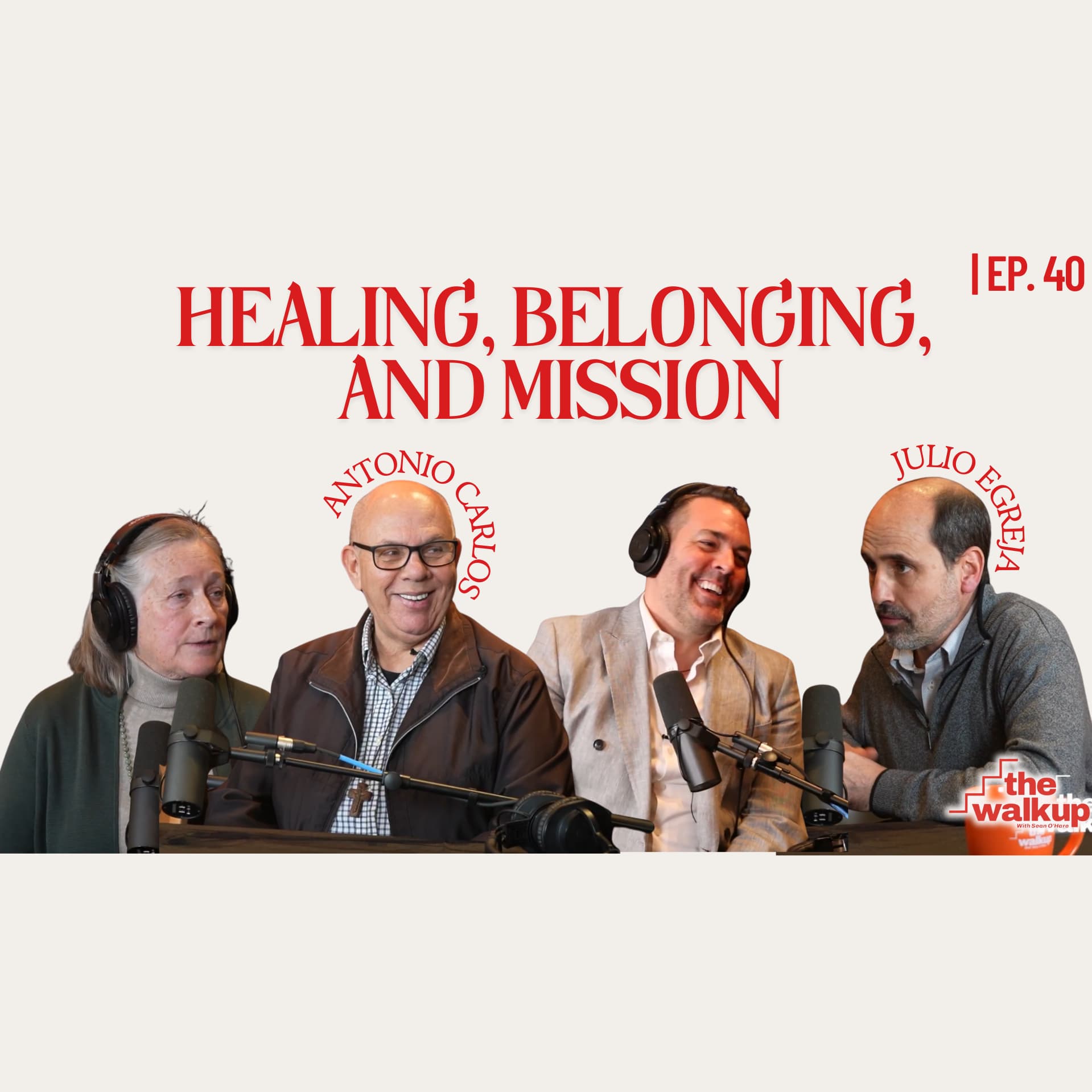
Healing, Belonging, and Mission (Julio Egrejas & Antonio Carlos Tavares de Mello) | Ep. 40
Live from New York Encounter, we speak with two guests devoted to the dignity of the most vulnerable: Julio Egrejas, CEO of Betânia Serviços Solidários, and Antonio Carlos Tavares de Mello, founder of the Jesus Child Community in Brazil.
Julio shares how Catholic nonprofits can thrive through strategic volunteer and fundraising initiatives, while Antonio describes his journey building a home for abandoned children with disabilities. From the streets of Rio to the heart of Petrópolis, their stories embody healing, belonging, and mission.
Transcript
Read the full transcriptAuto-generated · 4,037 words
Thank you for joining us here, and we're excited to learn about this very, very unique charitable project here in Brazil. So, first, I should mention... I've been to Brazil myself twice. I was in Rio de Janeiro, very briefly in Sao Paulo, and then Paraty. Ah, Paraty, perto de Sao Paulo. Beautiful. Oh, it was gorgeous.
Yeah, I was trying to get that even closer to you. Yes, sure. Just to make sure that if you have to lean in, just as close as you can do it. So, I was in, so there is an interesting overlap to some of your ministry. So, I had been to Rio de Janeiro to host something called Night to Shine. Oh, we do know him. Tim. Night to shine. Oh, night to shine. Yeah, he is about to do work with us next month.
He will be in Petropolis, where we live, and he will work with the Jesus Child community. That is a miracle. March 21st? Okay, you have to tell me about this, because I was the one who introduced the Thibaut Foundation to...
To Brazil. So, how did you guys connect with the Tibo Foundation through the NYC show? Through someone in Scotland. What is the name of the guy in Scotland? Emmett. Emmett. Through Emmett. Yeah, so I had met Emmett, and brought him... He put Emmett in contact, and he brought the team to Brazil. Oh, I see. Wow. Okay, so tell me this story. So, Emmett... Who helps Nights to Shine from Scotland, but all over the world, then connected you with the TiVo Foundation?
Yes, that's right. Okay, so tell everyone about this amazing ministry. So, first of all, introduce our main guest here. Okay, so Antonio, he is Brazilian. As he was 23, he heard a calling from God to start a beautiful ministry with children that have been through abortion, survivors of abortion, and to offer them the most precious thing that was taken from them, a family. Because not only were they suffered abortion, but also they were abandoned by their parents, unfortunately. So, the Jesus Child Community takes in and cares for...
The Jesus Child Community. That is the community Antonio de Mello started 35 years ago. He is the founder of this community, and they care for children who have been aborted unsuccessfully, and now have some different and various disabilities. So, let us define that for people first, because our audience is not just Catholic, not just religious, but So, they might hear this term, abortion survivor, but I don't understand what that means. So, walk us through, like, how you define what that situation is.
That means that they have suffered attempted failed abortions, so they did not come through, right? So, she or he survived. And, unfortunately, mom and dad tried to kill them through various means. And many of these kids, because they came to this world with many disabilities, were them afterwards abandoned by their families. And so, how did you come to learn about...
These children. How do you know these children? Did you work in the medical field? Was there some way of you knowing? Because this is a very particular knowledge. Brazil is very big, it is a large country, but the community is very known, in terms of not only Catholic environment, but also in many other environments.
After 35 years in doing these ministries, they are pretty known. So, in the whole society, also specifically in the juridical environment, they are well-known. Nevertheless, we are not an institution, we are not a hospital, we are a family. So, this is something very unique, so people know about this.
That's why Tony says... Not only to give them care, food, and health insurance, but especially a family. That was the main goal. Yeah, and this is a hard job to do, right? Some of these children were found in a dumpster.
Children whose mother left them at a hospital and never came back. That is the sad part of the story, but today we see the beautiful part of the story, because they all live together in this beautiful place in Brazil.
I imagine that you didn't already have a large home ready to receive these children. Yeah, well, pretty much was the same size as this room we are right now. The first four kids and him in a space like this one.
And many said at the beginning, that's not going to work. But the most important thing for me is to be their dad. That is the biggest treasure, the biggest reward, I could expect. And today, we are pretty much in every corner of the world.
We've been to the UN, we've been to March for Life in Washington, we've been to Austria and Germany last year. A lot of podcasts like this one, we've been... And this is a story that touches people very deeply.
And it has also become a movie, a documentary. Human Life. Human Life, made by a Brazilian, they are featured. Yeah, it was made in Italy, but already launched here in the United States. Yeah, it's a story about the 10 biggest pro-lifers in the world.
But our story went through, and now it's known elsewhere. Because you have shared with the audience the number of children that you've adopted over the years. Yes, absolutely. And all the story behind every kid, every child has its own story. Because the total number you said was 47? 47 are today in Petropolis, in Rio de Janeiro, but we have to count on also those who died already. So, it will be around 62 children.
So, it is a reality that... And so, this is a reality that touches our heart and brings us joy. Yeah, it's life speaking to us, very clearly and loud. And the idea behind our community is to be a pro-life community, but in a very concrete way. We know that there's a lot of people speaking about this, but sometimes not as concrete as we are. The Jesus Child community believes that it's time to make a difference and more deep impact through concrete actions, like this one.
And to be here at this event, and with you guys in this podcast, it's very important to show our life to the United States. Yeah, and the important part of all this is that we have just started, we have just set up our donor program, which is called the Magi, and that is very interesting because the Jesus Child community's name, Jesus Child, it is because they always believe that every kid is Jesus Child again, who has been abandoned and rejected by the world.
So, they are Jesus' child, therefore, their donors should be the Magi, the first donors to Jesus' child. This is a reality that we have chosen, not to belong to anyone, but to belong to the world, so that the world can help us. Oh, the important thing is to say that we have no links whatsoever with any government or any state. We are a private institution of the church, and therefore we live only out of donations. Today, we live in a big house, a very big place, isn't it?
Our place in Petropolis Rio de Janeiro is a beautiful place. In Petrópolis. In Petrópolis. It's a big place. We have a chapel in there. We have a school for our children. We have a football, soccer field there. So legally, you're a charity that's able to, like, it's like an orphanage? Like, what is the legal arrangement? So the legal, in terms of canon law, the law of the church, we are an association of the faithful. A public association of the faithful. But in a civil law, In the United States, we managed to create the incorporation.
We are now a 501c3 non-profit organization in the U.S. Oh, great. That is very helpful in terms of tax deduction. Of course. So, yeah, we are proud to say and happy to say that we already have that here in the United States.
I don't know if it would be useful or interesting to listen to. Some of the stories he has of any of the children. Absolutely. Absolutely, yeah. Or maybe you have a question. Oh, no, no, the stories would be fantastic. Absolutely. He would like to hear one of the stories of the children. We have today, before, a boy...
So, Jeanne. Jeanne is one of our children. His mother tried to kill him, unfortunately, more than 30 times. So, she took pills, she hit herself, she tried by any sort of means to kill her baby, unfortunately. So, the story is that this mother, she had an adultery with someone, and she tried to conceal that she was pregnant.
Yeah, so she tried to conceal this baby from her husband. So, but when she could not hide it anymore, she went to the hospital, and due to all the pills she took, all the injuries that she inflicted on her baby, he was born with no brains, anencephalus. That's the name in Portuguese. I don't know if that exists in English. Anencephalus. So, like as in brain damage? No brain activity. No brain activity. Ah, okay.
So, once she got to the hospital, she delivered the baby, and she immediately started screaming, he's not mine, I don't want him. So, I will leave him here at the hospital. I don't want you guys to call me Algar. She just left. Then the hospital managed to find and get in touch with Tonio, with the community.
So, they called me, and I went there to the hospital to meet him. So, when I got there, he was in a room, a very beautiful baby, alone, abandoned. He was two months old. And many couples went there to adopt. And they didn't want him because the doctors would say, oh, unfortunately, he is blind, he is mute, he will never walk, he has no brain activity, so no one wanted him.
And also, the doctor said he will not live longer. They gave him only two months of life. So, no one wanted him. He is really cute, but I don't want him. But that was not my case. I picked him up, and I put him inside my shirt, and I told him, now you were born inside of me. I have no uterus, but I have a heart. So, you were born in my heart.
So, I took him home. But now, as a miracle, he's 13. 13? I gave him two months, and he's 13. And he's the only boy of his kind in the world. With 13 years old, we don't have any news of anyone like him.
He's in a home care unit inside our house. When he was seven, he began to hear. No sign that he would hear people around him. But when he was seven, he started giving signs that he was following. We were invited specifically to talk about him to the UN, to talk about John. To show the world that abortion, no matter what, or when, and who, it's not okay.
And we are also against euthanasia. Because Gian, to us, for us, he's a proof, a living proof that abortion and euthanasia are a bad thing. What makes him continue to live is love, and that is our mission in the world, provide life for those who have been abandoned, give a home to those who have lost their home, to see behind all this.
To see in every child a human being, and to understand that there, there is a whole person, a loved son of God. Have there ever been any opportunities? Where you've had the chance to meet the mother later on, has there ever been an opportunity where she, maybe, had a chance for reconciliation?
We once met a mother. Camila's mother, we met her 12 years later, and she confessed, yeah, I'm sorry, but I tried to kill her, and many, many times, and I bring this shame inside of me, but now that I know that she has a I feel forgiven by my family today. I feel that I'm forgiven by her. I forgave by her, and she left. But also, we also have another story, David's mother.
David was at the hospital because he choked on a piece of bread. I met him when he was five. But when he was 15, he went to the hospital. And due to this problem that he had, this choking problem, he had a cerebral death, and his mother met him at the hospital under this. But this mother was very cruel. Unfortunately, this mother was very cruel.
She said, I tried to kill him, and I wished he was dead. I took a lot of pills to kill him. And I also tried to beat him, but he did not die. He managed to live. Now I'm here, and I would like... To ask for forgiveness.
But he is not listening, so I... Nevertheless, I am here to ask for forgiveness. And David, unfortunately, died two days later. Yeah, so I was mentioning that I originally got to Brazil. He has been working with the Knights for Shine team for 11 years now, and I've gotten to help expand it into, we're now in 60 countries, and I've helped to be part of that expansion.
But then in 20, I think it was 20, 21, 22, we had this idea for, could we do a larger event that brings together leaders from all different parts of the disability community? In 2022, the team came up with the idea of creating an even bigger event that would bring together people connected to the world of people with disabilities. So, we hosted in, it was one week before the Night to Shine in 2022, we called it the Beautiful Lives Festival. It was in 2022, a week before the Night to Shine.
So, we hosted it next to the Olympic... football stadium we say soccer the football where exactly was that it was there's like that pavilion in Rio yeah in Rio okay I suppose you can hear those movies you know it's does Olympia and then we had Ramiro came to the night to shine with his daughter who has down syndrome okay the goal the 94 World Cup champion okay He brought his daughter, who had a disability, to this meeting. Look how beautiful it is.
We tried to find Tim, but we couldn't. Here, we tried to reach, to get in touch with him while we were here, but we... Oh, with Tim Tebow. With Tim Tebow, yeah. Oh, yeah, yeah. They just returned from Thailand. They just returned from Thailand. Ah, they were in Thailand. Yeah, they were in Thailand. They went to Thailand this year first. They went to the United States.
They are back in the U.S., yeah. They are back in the U.S. now. Yeah, they went... They always go to a different region of the world for the Night to Shine each year. In this Night to Shine, they go to different places in the world, right? Ah, yes, yes.
And we could try to have a better contact with him, but we'll talk to you later. How long will you be in the States? We'll stay until the 21st, February. Well, I'm going to be visiting the Thiba Foundation at the end of the month. He's going to visit the Thiba Foundation at the end of this month. So we can talk after this to whatever you'd like to meet for me to communicate to them. I'm going to see them.
I think on the 27th, down in Florida. On the 27th, in Florida, he will be with him. Where does he stay? In Florida. Florida. Yeah, so, well, I think this is very providential that we met. I think it is very providential that we have met.
Very, I think. Absolutely, yes. I am sure. Always through our Irish friend who lives in Scotland, who connected you to Brazil, and you are here at the New York Encounter. That is the question that brought you back to Brazil, that brought you to the United States, that brought you... Yeah. These things happen so often in the Catholic community, you almost come to expect it.
And they do happen, yeah. And the more you can do to help the Jesus Child community, we thank you so, so much. Yeah, I'll try to make this... And then, you know, my original goal was to do the Beautiful Lives Festival each year. After we get off the, finish the interview, I'll show you the photos from our festival and maybe there's a way to.
He is going to try to resurrect this festival, which only took place in 2022, so he is going to show us some pictures to see if we can do something about it. And maybe any other contact that you might have here in New York with media or Catholic groups? Well, so the EWTN is here, you know, the Catholic channel. They are here. The EWTN is here. He is saying that it is here. So, that might be a good segment for them.
So, we'll talk about that. But, yeah, well, thank you for your witness and for your beautiful work. Thank you. And you brought two friends here with us? Yeah, two of his children. Two of his children, yeah. Alex and Felipe.
They are both blind, unfortunately. They are Torrio's sons. They have been with Antonio since the beginning. Antonio met Felipe when he was two, and Alex when he was one. Antonio taught Felipe how to walk, and they do speak, but they can't see. So, yeah, they are a sign, a testimony, a living testimony of what this community can do for people.
Absolutely. Well, thank you guys so much for joining us. We'll look at this as an opportunity to continue to spread this mission. And if I may, one of our main goals is that the community, since last year, they were having help from the PayPal Foundation in Philadelphia. But of course, they cannot give every year, right? So, they give for four years, and we are really grateful. But now, we needed to start something. New, and that's our donor program, the Magi donor program.
So if people go to jesuschildcommunity.org and they press the donate button, they will see this program. It's a beautiful program. Once you become a Magi, you will receive a lot of videos, newsletter from the community, all in English, to give people a sense of belonging so they can follow this star and become a Magi and help the Jesus child. JesusChildCommunity.org. Okay, great. Well, thank you guys so much, and I look forward to continuing our conversation off-camera. Absolutely. Yeah, after this. Thank you so much.
Okay, bye. Tell us about the Mondragon. The Mondragon Cooperatives. Okay, tell us about that. So, the Mondragon Cooperatives are based in the Basque region of Spain in the northeast. Well, not east, but north. The northern part of Spain, up against the Pyrenees, on the Cantabrian coast. They've been there since 1956. They developed out of the Spanish Civil War, and under the leadership of Father Arizmendi Arrieta, who was... Active in the partisan fighting against the Franco regime, but then, because he was a man of the cloth, was sent to Mondragon to be a pastoral minister to youth in a community that was just devastated by the Civil War.
Tuberculosis was rampant, and a lot of men were either in exile or were in prison. And he worked there for how many years? So, the first efforts in the community were a soccer field for youth and a TB clinic, but then by 56, they had a group of young men, five men, who started the first cooperative, and it was a great story because people would put cans around the community to put donations in for starting up. The acquisition of the business, and they started with a small workshop, and it has grown today to 81 cooperatives, 70,000 people employed in the cooperatives, and they are ranked first in the BASC business rankings.
They have 12 R&D firms, a university. It is a wonderful story about how when people pull together, work together, and use their resources to… Well, the Nordic countries have been very successful. Their performance ranks with the Nordic countries. In terms of quality of life? Yes, happiness, indices, all of that. I did some research back after the Great Recession in 2008, and they were doing extremely well despite the recession.
And mine has a St. Don Bosco vibe to it, you know, helping with young kids to start with sports programs and grew from there. Yes, absolutely. Although I always find it funny about Don Bosco was his... So much of his biography is just dealing with church bureaucracy, and you're like, oh, so some things never change. Oh, yeah. Yeah, and he was very good at figuring out how to deal with the bureaucracy of a dictatorship. When the Franco government tried to crack down on the cooperatives, he very astutely went off to Madrid to talk to church officials to get Franco to back off.
At the time that he was doing this work, you know, you couldn't hold public meetings, but nobody could stop you from having a meeting in the church. Okay, so it was literally a safe space. It was a safe space. He could do study groups with the youth, and the young people who really stood out as being natural leaders, he arranged for them to advance their education through a program in Zaragoza, and in doing so, they got the skills they needed to run more complex businesses over time.
So then, how did you get... Introduce or connect it here to the Encounter. One of my friends and colleagues who works for Mondragon in their university, he and I met back in 1998. He and I had both gone to Mondragon to do our dissertation field work, and I got access to the group because I asked to study what was going on with managers.
And he asked to study the group in terms of labor, and that made the group leaders a little nervous as to what he might be trying to do, so he did a field work based in the community, and then met what became his wife and stayed there and has lived there since.
Basically, I was invited in by the Director of Public Relations, whose father had been the first BASC president, and the relationship with him ended up opening all sorts of doors for me. I was able to interview three of the five founders and to learn a lot from them about the early years and the ways in which they were able to overcome things, and in the end, I interviewed 50 people. Well, there are people within the management teams of about a fourth of the cooperatives, so...
And then, the encounter said, you've got to come tell this story. Yeah, so they basically, Patrick Tomasi reached out to me, and he said, Fred Freundlich said that, you know something about the cooperatives, could you come talk to us? And I said, yeah, sure, I'd love to talk about the co-ops. That's great. Well, I wish we had... We have a lot more time to chat, but we've got so many amazing speakers, and they're good at doing a lot of things in the encounter, but they haven't figured out how to multiply time.
Right. Or create multiples of us. I mean, we're by location, though, right? Bill needs to get going. Well, you and I, we'll find another time to chat. Yeah, all right. It's a pleasure to meet you. Likewise. Thank you.
More from The Walkup

Against the Odds: The Samurai Lawyer (Chad Flores) | Ep. 52
Faith, Sexuality, and the Fog of War (Iris Bahr & Father Rick Riccioli) | Ep. 02
E2
Church, Conflict, and Community (Iris Bahr, Father Rick Riccioli & Rob Long) | Ep. 03
E3
Hope, Vocation, and the Global Church (Colm Flynn & Colin Nykaza) | Ep. 04
E4