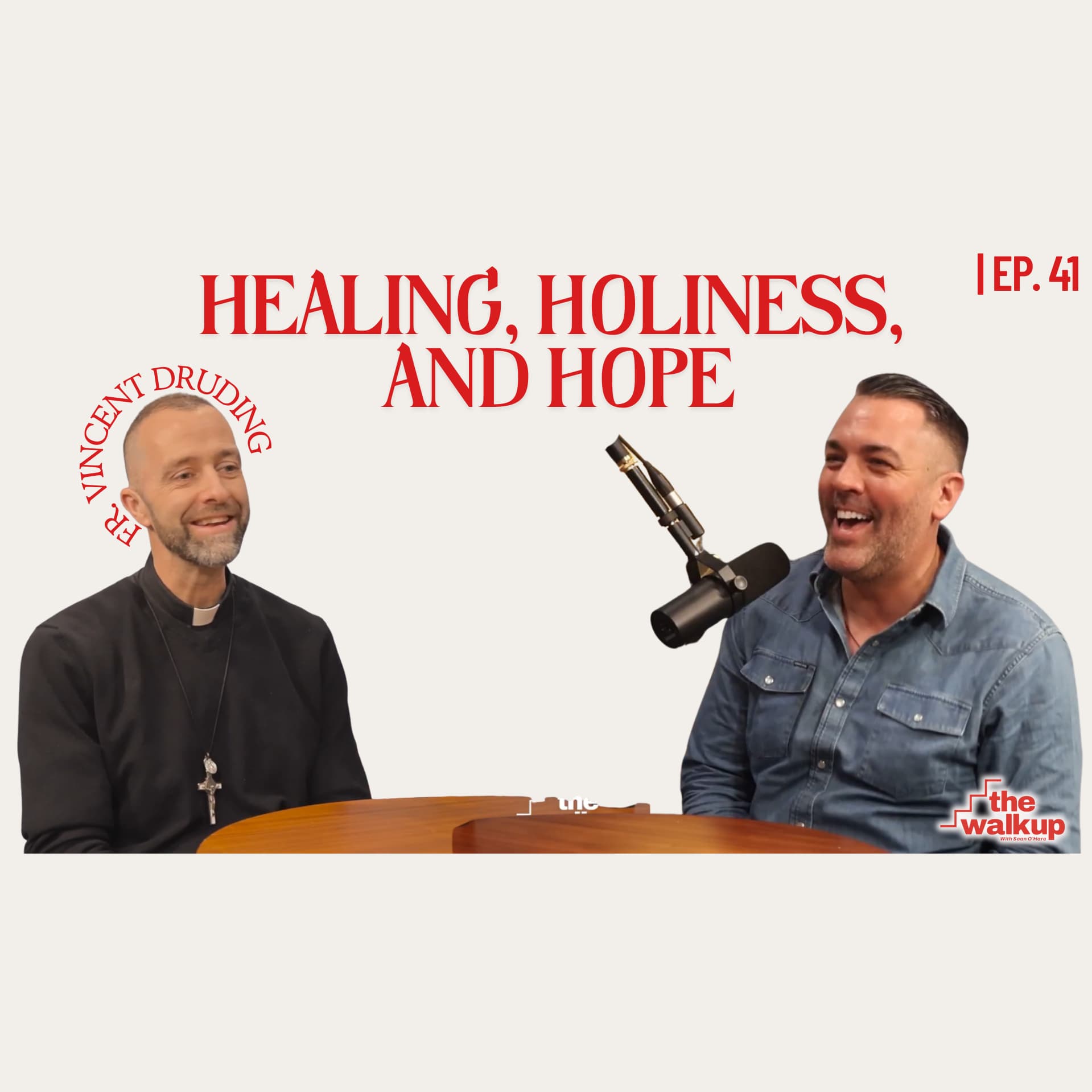
This conversation with Fr. Vincent Druding dives into his calling to serve the poor and spiritually afflicted.
Fr. Vincent shares his journey from inner-city ministry to founding the Franciscan Sisters of the Pure Heart, a new religious community rooted in healing, purity, and spiritual deliverance. From exorcism to community building, this episode explores the real-life struggles and deep joys found in radical faith.
Transcript
Read the full transcriptAuto-generated · 13,147 words
Father Vincent Druding, welcome to the Walk Up Podcast. Happy to have you here, and before we get started, I know you've got an exciting pilgrimage coming up, and I wanted to let people know about it, so tell us about this trip to Italy you're doing in the steps of St. Francis. Well, thanks, Sean. Appreciate being here. Yeah, so in October 23rd to November 1st in this year of the Jubilee of Hope, we're going to be going with two or six tourists organizing a trip in the footsteps of St.
Francis. So, it'll go from Rome to Assisi. But when we get to Alverna, we are going to walk for about five days, kind of like they do in the El Camino in Spain. So, we are going to walk about five days to make it to Assisi. So, I am looking forward to that.
It is coming at a real important time in my own life and vocation, which I know we are going to talk about a little bit later, particularly this call from St. Francis. But a great woman called Geisavino, she is a great therapist called Mindful Heart Counseling, and I have known her for many years. She is filled with the Holy Spirit. She is connected with the Franciscan Sisters of the Eucharist in Connecticut, and they have houses in Rome and Assisi, and she is a third-order Franciscan, so she is really the energy behind it.
I am just going to go and pray and walk along the way, and hopefully lead with Mass and the spiritual part of the pilgrimage. I am really looking forward to it. How many folks will be on the trip? Is it 10? Is it 100? How many people would be there? It probably can be somewhere between 20 and 30. Of course, listeners are welcome to sign up for it. They can go to the 206. And look up that pilgrimage with my name and Assisi.
But I'm not sure the actual limit, but I think it's usually around 20 to 30 that we'll come. So, you got Assisi. What are any other highlights on the tour that you've been before, I assume? You know, this will be my first time to Assisi. I've been to Rome. I've been to Italy on other occasions. But I've never done a walking pilgrimage, and I've never been to Assisi.
They're going to really kind of track where... St. Francis, some of his important stops along the way, some from Mount Avernus, which is where he received the stigmata. For listeners that may not know, that is the wounds of Jesus when he was praying, and a seraph angel on a crucifix appeared to him when he was fasting in prayer, and he received the five wounds of Christ in his hands, in his side, and his feet. And so that is a really important visiting site and shrine for those who are followers of the Lord.
I appreciate Franciscan spirituality. So, that is going to be the starting point of the walking part. So, we are going to walk from there for five days to different points of interest for the life of St. Francis until we arrive at Assisi and wrap it up on November 1st, All Saints Day. That is awesome. Well, I am sure it will be a great trip for everyone involved and lots of graces, especially in this, as you mentioned, this jubilee year of hope.
So, speaking of St. Francis, I… I think sometimes, for those that are Catholic, of course, we know that name quite well, St. Francis of Assisi, but even those that aren't Catholic, we hear, I think we know kind of anecdotally about this figure. Sometimes he has an association with nature. Sometimes it is obviously serving the poor, but maybe kind of give us an overall idea of what is the… Life of St. Francis, but also the Franciscan spirituality. What does that mean broadly, but also in your life?
Sure. Well, yeah, I mean, St. Francis, 13th century, he was the son of a merchant, super wealthy man, and he led the life of kind of like a young, kind of hip, you know, partier. He was very popular. He had great personality. 13th century hipster. It could be kind of in that direction, but he's also a knight, so he's kind of a... The papal states back there, and there was always little battles and things, but he went off on battle, and he was coming back.
At one point, he was on a horse, and he saw a leper, and of course, in those days, there was no cure for leprosy, and he just felt compelled to get off his horse, go to the leper, and place money in his hand, and then he embraced the leper, and he got back on his horse, and when he turned around, the leper had disappeared, and he had a sense that this was Christ, this was Jesus. ...who had appeared to him in the form of a leper, and then he felt very inspired, and he wanted to go beyond that and just go to the place where the lepers had gathered and to give charity and love and really the presence of Christ to the leper colony, and so this was like a big step in his life that began a process of transformation.
Famously, one day, he was praying in the chapel of St. Damiano there in Assisi, and before that cross, crucifix, he heard the Lord say, Francis, rebuild my church. And the chapel was kind of dilapidated, so he thought it was to put the stones back in place, but of course, the Lord had something much greater than just to repair that country chapel, and so eventually, he felt this inspiration to want to go and serve the poor, and one day, his father was frustrated with him, and he just renounced his inheritance.
He renounced his life in the world, literally took off everything, ran into the woods, put on what was kind of like a burlap sack. Probably familiar with the brown Franciscan robe, tied a cord around it, and he just began to go literally into nature, and to live, and pray, and sing, and live for the Lord wholeheartedly, like Jesus said, take nothing for the journey, to live in great poverty, and that he would go beg for bread, and beg for food for the poor, and his life became such an inspiration to many in his time, that other guys came and followed him, and so they started this little band of those that began to live a radical life of the gospel, Following the counsels of poverty, chastity, and obedience.
And eventually, the Holy Father gave him approval for this little order, and he started the Franciscan order. The first Franciscans began, and then by the time he died, about 5,000 men had given their life to follow the Lord in the spirit of St. Francis. And St. Claire was just taken by him. She was young. She was, I think, 17 when she heard him preach and decided to run away. She was also of an aristocratic family and went in the middle of the night.
Francis and another of the friars, Francis cut her hair in a chapel, and that was her way of renouncing the world, and she started the Poor Clares, and by the time Francis died, there would be about 1,200 Poor Clares, and so that movement has really spread around the world. It changed the history of Western civilization, the history of the church. He is kind of considered by many to be kind of like one of the most Christ-like figures in all of history, and so his witness continues to inspire down to this age.
Here in New York, So, famously, we have the Franciscan Friars of the Renewal, a great group of brothers and priests, and their sister group, the Franciscan Sisters of the Renewal, which you might be familiar with some of the listeners here in New York, but also they spread around the country.
And in my own life, I was blessed about four years ago. I received just what I would call a real grace praying, and it was really in response to a meeting we had in Zoom with Cardinal Dolan. You might remember during COVID, everybody was meeting on Zoom, including the priests and the deacons of the Archdiocese of New York. In 2020, in the summer, Cardinal met with us, and he said, guys, I'm really sorry to reveal and let you know we lament that we had to close 22 Catholic schools.
And as someone who was at a parish in Peekskill, Assumption Church, when a Catholic school closed, it is like a funeral on steroids. I mean, it is just, it is brutal. Everybody, the teachers, the children, the parents, the alumni, ourselves, priests, were weeping, and just, it is terrible to have a school close, but for inability to pay the bills, really. I mean, when there is low enrollment, and these days, like in poor areas, like inner city, for example, I am in the South Bronx at Holy Cross Church, We are blessed to have a Catholic school that did survive what was a close call with staying open and surviving.
By God's grace, we are able to continue. It is a true light for our area, our community, and neighborhood. It is amazing. We have an amazing principal. I call him Father. He was in seminary when he was younger. Ernie Zalamea. He is not a priest. He is married. Wonderful man. And it is just like a light in our area where kids are really catching the fire. Of the love of Christ. But when Cardinal Dolan gave us that meeting on Zoom, I had dinner that night with Bishop Peter Byrne, who is one of the auxiliary bishops of the Archdiocese of New York, and he is now in Staten Island, but he was in the Bronx, and he stayed at Holy Cross at the time.
And I said, you know, one of the reasons that the school is closed is because there was just an absolute collapse of religious life for religious women. Since Vatican II until the current times, the numbers are something like... Right. About 138,000 sisters were sisters active in the United States around the close of Vatican II in 1965, and up until recent times, the number had reduced by about 100,000. Now, tens of thousands had left, and then there has just been an absolute lack of vocations.
So, we talk about the crisis of spiritual fatherhood, and there is a crisis of vocations priesthood, and there is, but there is also a tremendous crisis of spiritual motherhood. And that, the Lord put heavy on my heart. I had said to Bishop Byrne, you know, why can't we get the National Dominicans out here in New York? That is a great source of renewal of the Church, the National Dominican Sisters. We are flowing with vocations, yeah. Unbelievable. They were getting, at some point, 20-plus young women joining them, and also Mary Mother of the Eucharist up in Michigan as well, which was a break off the National Dominicans.
And it is just a great source of renewal, but their priorities are the Midwest and the South of the United States. I had known that there were some gestures to see if they might be able to come to the Archdiocese, but that is okay. That has not been their call so far. And then I said, kind of rhetorically, to Bishop Byrne, I was like, why can't we just raise up our own?
And I went to prayer, and I got a very powerful grace, and it was just like, you know, sometimes you pray, and it is as if the Lord is just delivering a message to you. And that is how I experienced that, and I started to write. And what it was, it was... A new community of religious sisters called the Franciscan Sisters of the Pure Heart to be spiritual mothers to the spiritual orphans of our time, and especially to help cultivate purity of heart among children, youth, and young adults, and a kind of a culture of purity, joyful, evangelical praise of the Lord, and also to heal the wounded hearts.
In my work in Healing and Liberation Ministry, I have seen thousands of cases of children and young people whose hearts are broken, and so much anxiety and fear. There's suicidal ideation and depression, gender confusion, just all kinds of problems that so many young people go through, and the numbers after COVID were just kind of going through the roof of depression, anxiety, and suicidal ideation, and so it just became overwhelming, and there has to be some kind of response, and of course, you know, it's great to start a great ministry.
It's great to start maybe a new movement or even a school, but what What the Lord put on my heart was a religious community, because they have structure. They can multiply themselves. They can go beyond just one local area, and that is just what was on my heart, so I was just trying to respond to that grace, and also, we have been blessed.
...at Holy Cross Church to have sort of a place in which we can kind of test out the ministry of joyful praise and worship with young people, catechetical formation. Many listeners might be familiar with the theology of the body of St. John Paul II, but breaking that down into sort of like a version that is accessible to little minds and little hearts, and from really K through and above, we know that... Exposure to pornography is like, in many places, 7, 8, 9, 10 years old, and so the corruption of innocence of young people has become more widespread and at a younger and more tender age than ever before, and so I really believe the evil one has just been extraordinarily successful at corrupting younger minds at a younger age, especially through the phone and technology, and so the Lord put on my heart just a need to work towards creating a response to that, and so...
Well, that is sort of a connection. We started talking about St. Francis, but the idea was to start that community. We began that four years ago with just kind of gathering a group of like-minded people who might be interested, young women that were discerning the vocations, and by God's grace, we have been able, with the blessing of Cardinal Dolan, to establish a community called the Franciscan Sisters of the Pure Heart, and it is like an acorn. It is just a little seed, but that is the mustard seed principle of the Lord.
In the kingdom of God, we often start as a seed, but we are blessed to have Sister Michelotta, who is up in Connecticut, being formed by the Franciscan Sisters of the Eucharist, and getting ready for a discernment retreat, and it looks like there is a group who are interested in joining, and so that is where we are right now. Yes, I think a lot of people... Outside of the Catholic tradition, they hear about religious orders more expressed as Franciscan or Dominican or Jesuit.
I don't think there's fully—it's hard to understand from the outside perspective what is a religious order, right? Like, why is it necessary? Aren't we—don't we have the parochial churches? Don't we have our structure already in place? If you were to explain to somebody what is the need, so to speak, for a weather disorder to spring up and then eventually find its scalability, if you will, or find its role in society, how do you explain that to people?
Good question. You know, the gospel recently was the rich young man, and he was a good man. He was a good Jewish young man who had followed the commandments, but he wanted more. He said, what must I do to be perfect? And the Lord says, you know, if you wish to be perfect, go sell what you have, give to the poor, and come follow me. And then it says, he went away sad. Because he was still attached, and so from the beginning, from the Lord's ministry, there has been this call to give everything up for Jesus, and it is from the Lord.
It is dominical, if you might say, and so there has been this stirring in hearts throughout the generations from the time of the Lord until now to want to live those evangelical counsels, which are poverty, chastity, and obedience. Those are what the church identifies as the three evangelical counsels. Well, Bishop Barron gave a great talk at the Eucharistic Congress this summer, that all baptized people are called to live the evangelical councils in their states of life. The Church has identified that not all are called to live a radical life of total self-gift, which is what we see in the religious orders, which maybe I will explain a little bit more on that.
That some are called for marriage. Even St. Paul will say, you know, I wish that you could be like me, but if it is burning, I do not say it is a sin to marry. But, you know, his sense of the coming of the Lord and the need for the kingdom of God, the availability of souls to preach, to teach, to go out and serve, there is just more availability when you give yourself wholeheartedly, body and soul to Christ, but not all are called to that.
So, as we know, we have vocations, right? Called to marriage. Some are called to live a single life and even a consecrated single life, and others are called to religious life. Fundamentally, that is priesthood and then consecrated brothers and sisters that live. A religious life that live in community, so they can live the fraternal life of love, and they can take many different forms. From the most radical version, you might say, are the hermits and the hermitesses. You might have heard of the desert fathers.
Those were the ones that went out in St. Anthony of the desert, and they went out and they lived in caves, and then, you know, many listeners might be familiar with St. Benedict, who, in the time of, you know, the fourth century, felt his call to go out and to start a monastery. ...and called others around him to live a monastic life, and wrote a rule called the Rule of St. Benedict, which became a real source of preservation of faith and culture in Western civilization for about a thousand years, and obviously still goes on, but during the Dark Ages.
And then there's been others, like St. Francis. Usually, what the Lord does is that he raises up what's called a new charism. A charism... You know, charism simply means a gift of the Holy Spirit. They are gifts. It comes from the Greek word charis, and gift, and all are meant to operate and live in the gifts of the Holy Spirit, but there are particular gifts that are called for a time and a place and a circumstance. For example, you might say that St.
Francis was responding to a call to serve the poor, which will be with us, as Jesus said, the poor will be with us until the end of the ages. So, that call, like Mother Teresa, When she left the Loretto sisters, she was teaching the upper-class Brahmin young women of Calcutta, and when she would go out of the walls of the walled school, she would see the people dying literally in the streets of Calcutta, little naked babies running around and people with leprosy, and it just overwhelmed her, so she just put on a sari, left, and started to teach the ABCs and feed the little kids who were poor in the streets, and then her students saw this inspiring Example of Christ-like radical love, and they followed her, and that was the genesis at the beginning of the MCs, the Missionaries of Charity, and that is a charism to serve the poorest, a wholehearted service to the poorest of the poor, and so religious orders are essentially, they have to be called from God.
A charism is given to a founder or foundress to live an aspect of the life of Christ or an aspect of the gospel to its full. St. Dominic was responding to the... There was heretical teaching. The Albigensians in Spain were teaching false belief, and so we got called to be an itinerant preacher and to call together other men like himself to do that. St. Ignatius of Loyola, we know the famous story. He was hit by a cannonball. He was recovering and reading these novels about adventure tales and love stories and the lives of the saints, and we read the lives of the saints.
This burning love would stay in him and stir in him, and he wanted to do something great for the Lord, for the greater glory of God. God to go to the ends of the earth to preach Christ, and so the missions and the education of minds, and so there is the Jesuits. So, we could go on, but the idea is God has called from the beginning individuals to form communal life, to respond to a particular need in the church that serves the church, which will eventually also serve society, and those form rules of life.
There are statutes or rules of life about how they want to live their life in communion. To live those particular counsels of poverty, chastity, and obedience, and sometimes there is a particular extra vow that some will take, and we are so grateful for the pioneers of religious life, those that said yes, and then others will come and follow and say, I want to live life like that. I am inspired by that particular charism, that expression of Christ's love of the gospel, and I feel called to be a teacher.
And so, maybe a young woman will be called to be a Dominican sister because she wants to teach, but she really wants to give her life wholeheartedly to Christ, and that is how that works. And then, there is some logistics involved, or structure involved, in terms of, we still, what we have in the church, we have this freedom or flexibility, shall you say, to...
To follow the inspiration of the Holy Spirit, but then we also, we have a diocese, we have bishops, we have, so just give people a glimpse of what that process looks like to eventually go from, okay, I've got this organic kind of following that's just developed naturally. Okay, now it's a going concern, and then eventually you have to go through kind of the formal process of becoming a religious order. That's right, and I should say just, you know, the Franciscan Sisters of the Pure Heart, we are not an official religious order.
We are still... Operating as a ministry, with aspiring for that, if God blesses it, and it is His desire. But all must work through the obedience of the Church. Jesus set up, when He said, Peter, you are the rock, and I will build my Church. So, He set up a structure. And so, likewise, as a priest of the Archdiocese, I work within a structure. I have one to whom I have obedience, which is Cardinal Dolan. It is the local ordinary.
Immediately when there was this inspiration, since Bishop Byrne was living with us, I went to him, and then eventually when we started having gatherings to invite others to consider if they were called to this charism, I told Bishop Byrne, I want to reach out to Cardinal Dolan, and he affirmed I should do that. So we did that. Cardinal Dolan assigned the vicar for religious, which was at the time Sister Catherine at the time of the Archdiocese of New York, to sort of vet the process.
Regular check-ins with her, myself and Bishop Byrne, about what is happening in the process of calling others to this inspiration, and eventually, after several meetings, she said, it is time for you to meet with Cardinal. So, Bishop Byrne and I met with Cardinal and presented him the idea, and he gave just a beautiful father's blessing. He said, you know, it inspires me that as a church, we have to go out into the deep, in Latin, Ducan Altum, to put out into the deep.
That is where the big catch was for Peter. And so, as a church, we have to go out into the deep, in Latin, Ducan Altum, to put out into the deep, in Latin, Ducan Altum, to put out into the deep. We are not meant to just maintain the status quo. We are called to go out and seek the lost. We are called to go out into the deep, and that is where the big catch is. Anyway, he was inspired to share that with us, and he blessed the process of continuing to discern it.
So, we started a house of discernment. From the house of discernment, there emerged those that were interested in being… Formed in a more formal way. A great bishop, an auxiliary bishop of Chicago, Bishop Robert Lombardo, he is actually a Franciscan friar at the Renewal, gave me some counsels on, if you are going to start, you just have to use resources in your own backyard. So, we are blessed, the Sisters of Life, we are blessed to give us some counsel, and what they call postulants, or the beginnings of religious life is called postulancy, would be formed there a little bit with the sisters in a couple of their classes.
Father Ignatius Schweitzer, who is a professor at the seminary and also the spiritual director of the seminarians, he was blessed to allow us to be in one of his classes, our postulants. So, we created a little formation program.
And then the next step from postulancy is called novitiate. So, we were so blessed that the Franciscan Sisters of the Eucharist, which is an existing group, They're up in Meriden, Connecticut. We're willing to receive two postulants that we had this past September to give more formal religious life formation.
Doing all this with Cardinal's Blessing and in regular check-ins with, now it's Sister Joan Curtin is the Vicar for Religious of the Archdiocese. So, it's a slow process, and we did have to write statutes or a rule of life, and so we've done that.
And then it's essentially casting a net, and that's what we're doing through these discernment retreats. We'll have one in April. 21st to the 23rd, if any young woman is interested in this charism, she is welcome to contact Holy Cross Church or Sister Macalata regarding the retreat that we are going to have, and there has been an interest in this particular charism, and so we are hopeful then that new ones will come, and then that is how, once you have like a little core group, the next step is to ask His Eminence or the local ordinary to give us approval to become what is called a private association of the faithful, and that is a canonical designation that orders must become first before.
then becoming what's called a diocesan right Institute and that's a longer process you have to have essentially 40 members of a community before you can become that and then once you're a diocesan right if that continues to get to grow and progress you can apply for what's called pontifical status and that's if you have a hundred or more members and you have obviously the approval of your local ordinary and that's where the Vatican Has a particular dicastery in charge of deciding which groups will get pontifical status, so they can operate kind of independently of the local ordinary, and now they're up and running and can go all over the world?
Yeah, I think people are often surprised how much structure, how much intentionality, formality, whatever term you want to use, there is. And part of this is just that over centuries, the Church has developed this. These processes, this wisdom, and I think, ultimately, it is allowing for the Holy Spirit to demonstrate. The veracity of the community, right? I mean, it's almost, sometimes it can feel like, you know, when you read the lives of the saints, sometimes it can feel like, man, they just kept putting obstacles in the way of these founders.
Like, man, clearly this person was, you know, a saint. Well, you know, it's clear in the moment, right? You want to make sure that they're, if it's a... It is a legitimate calling from God. It will be a calling from God in a year. That is right. We do not need to be impulsive about these things. That is right. The Church tends to work through her wisdom, progressive and slowly, precisely because there is a wisdom in vetting to make sure that this is of God and not just a creative impulse of somebody who was inspired one day.
And so, the Church also, we are safe. When we operate under obedience to our hierarchy. So, like in religious life, one of the vows is obedience to your rightful superior, and there is a safety in that. It does not mean every superior is going to be a saint, or actually, the only exception to that rule is if you are ever asked to do something immoral or sinful, you do not do it, but there is a safety in obedience.
There is a great bishop who was retired once told me, he said, son, grace follows obedience, you know, so. And it is just such a simple, easy principle in the spiritual life, simple, easy principle of the gospel. You know, he learned suffering through obedience, St. Paul says about Jesus Christ, and it was in obedience to his Father that our salvation and redemption was won. It was obedience to the Holy Spirit and the promptings that Our Lady said yes. And so when we follow the Lord in obedience and we follow our...
And vetting of a new community religious order. So, there's safety in working within the structures of the archdiocese, the Vicar for Religious, who works at the pleasure of the Cardinal. And so, we're blessed to have, you know, an opening there and to have the blessing so far. So, we're just going to continue to proceed with that blessing.
Obedience, not a virtue usually talked about in Western civilization, I don't think. Well, you know. Well, I mean, if you were to say. The virtue of obedience. We could probably have a whole podcast just about that. Wait, that's a virtue, right? I mean, that is not something that the Western, independent American mind really necessarily thinks about. Well, okay, I mean, we could get into this if you'd like, but I mean, if you want to get into the gifts of the Holy Spirit, I mean, if you want to transition.
Yeah. So, all external obedience to the Lord, to the commandments, to proper authority, it's all training. For internal obedience. So, the life of the soul, now, I mean, it is something, obviously, which applies to every single baptized Christian or every listener, is that we are all meant to be in one-on-one union with the Lord, and that is learned, it is not an automatic. That is learned through developing an interior life, an interior...
Like, mindset that is in total docility to the Lord. So, when the Holy Spirit speaks, we listen. When the Holy Spirit speaks, not only do we listen, we act. And so, and then there's a process of discerning, so we can understand when He speaks and how He speaks, but the Word of God often is so crystal clear, and so much of sanctity, which is making souls God-like or holy, is about putting our will, our intellect in complete union with the Word of God, who is Christ, and with Christ and the Holy Spirit.
So, If I can habituate, see, virtue grows like muscles. You go to the gym, you work out for six months, you're stronger. You start running, you run for six months, you can run longer. And the same thing in the spiritual life, the practice of asceticism, essentially, it's exercise. It's exercise of the virtues, and they can grow. And so, if we can practice obedience to rightful authority and to the Word of God, and it becomes a habit of mind and a habit of soul, what will happen is it can start to become automatic, and that's when the good stuff happens.
That's when the interesting... That is when the Holy Spirit can start doing what he wants to do. It is in there, and that is when the Holy Spirit can manifest in so many different ways, and that is the exciting stuff. All of this stuff, people kind of think, oh, Lent, what a drag. No, just the opposite. Oh, Lent, training for freedom, training so I can be on fire for the Holy Spirit, training so I can bring the power of God wherever I go, so he can have full access to me, so my intellect can be like the creative juices that can flow, not just me, but it is the Holy Spirit.
So, my will is oriented to the good always, and that is how we defeat sin, Satan, death, and darkness. And so, all of these practices are really to set hearts on fire, to make saints. And then, with the Franciscan Sisters of the Pure Heart, you mentioned before that this is every charism is a response to a need in the church, right? Yeah. And the need that you were feeling in your ministry, in your priesthood, was particularly for those struggling with... Purity with oppression in those areas, and I wonder if you could speak to that particular, about how, I mean, that is a term that we just went from obedience to now oppression.
These are terms we do not think about very often, but they are real. This is, people are dealing with a lot of spiritual oppression, so if you could just speak to that, and then how that connects to the development of the Franciscan Sisters of the Pure Heart. Well, sure. I mean, so about... About 15 and a half years ago, I started to get involved in the ministry of healing and liberation, and it is really when I got baptized in the Holy Spirit, and you might say, well, what is baptism in the Holy Spirit?
And that is a good question. That is okay. You are already a priest. What the heck? Are you going to get baptized already? That is right. That is right. So, I mean, maybe just a little story on how that happened. So, obviously, when we are baptized, you are only baptized once, right? And that is sufficient. And our nature changes. Christ is in. Original sin is gone. We are part of the church. We go through life.
But it doesn't mean that our growth in grace stops at baptism. Obviously, that's why we continue with the sacraments and with the life of God and the life of obedience, as we talked about, to the Word of God. But even after ordination, I was blessed that a priest called Father Bill Halbing, who was in New Jersey, he was at St. Antoninus, which is a charismatic parish in the Newark area, and he came to Holy Cross, where I was, excuse me, Our Lady of Angels Parish, which was my first parish after I was ordained, and he gave a...
A conference, and like a little retreat to a Filipino group in our parish, and I knew Father Bill, because Father Bill one time came to the seminary when we were there, and I had known about him. He taught on scripture, but he was also a charismatic priest. He was filled with the power of the Holy Spirit. He had so many experiences of healing and miracles that would happen in his ministry, and he was known for that, and he was humble, but he was on fire, and so I was like, He sat at our table at lunch, and I was just like, I want to talk to this guy, and he was saying, he says, you know, one of the reasons why there's not a lot of miracles in the church in current times, and we said, which is why, and he said, and he kind of looked around, he says, you know, a lot of the brothers don't believe.
It was a strong statement, and that stayed with me. As a young guy, like in formation, I was like, huh. And it is true. When they say they do not believe, meaning what? How do you reconcile somebody who has decided to give their life to becoming a priest, giving up married life or professional career, and yet they do not believe? It is a good question, and I cannot speak for Father Bill, but my take on what he was trying to say is that many priests and people that are ordained or for ministry or consecrated, They may lack fullness of faith that what Jesus says is true, that you will do the things that I did and greater things still, in John 14.
And so, Father Bill is a real believer. If you read the Acts of the Apostles, you look around and you see, you know, Peter comes in and he says, you know, silver and gold I have not, but what I have in the name of Jesus Christ of Nazareth, get up. And he gets up. They expelled demons. They healed people. They raised the dead. And why isn't that happening? And so, Father Bill's point was like, it takes faith. It takes living faith.
Actually, what Jesus said is true, and so do the brethren, do the ordained actually believe that they have what Christ gave them by virtue of their ordination? Are they living their priesthood to the full? That was the question I think he was placing, or the question that he placed in my heart, and I think it is a question that we need to wrestle with as clergy, and if there is any priest watching, or will watch this, I urge all the ordained to ask God to give them the grace to live their priesthood to the full.
I see that all the time as a priest, and since I got, well, I will go back to the story. So, Father Bill, I will give you an example. And I can mention Bishop Joseph Espia, who is a friend who also got baptized in the Holy Spirit about nine, ten years ago, and he said it changed his life. He said for the first time, he was already a priest, for the first time in his life, he felt the love of the Father.
He experienced himself as loved by the Father. He was already a priest, and he came up since a teenager. And things started to happen immediately in his priesthood before he was ordained a bishop. And he was ordained a bishop, and he came up since a teenager. After he was baptized in the Holy Spirit. Now, baptism of the Holy Spirit, maybe that word in Spanish, I like it, is efusion, effusion of the Holy Spirit. It is basically like a stirring up of what is already in there.
It is kind of like one example they give is like, you know, if you put in the sediment of Kool-Aid to the bottom of a jar of water, it is there, you have water and Kool-Aid, but until you put a spoon and stir it up, it does not integrate into the water. So, many times, you know, people receive gifts, but they come in seminal form. You know, like in baptism, we are given the gifts of the Holy Spirit. At confirmation, they are meant to be stirred up.
But many times, they're actually sterile. They're not actually active, and so it takes actually cultivating what's already there, living a life of sanctity, living a life of grace for the gifts of the Holy Spirit to become activated, and there is such a thing as what we call like an effusion or a baptism of the Holy Spirit, which is sort of an outpouring of the Holy Spirit into the soul of someone to stir up and to activate what is already there or to make more active.
And sometimes specific charisms of the Holy Spirit are given at that time. In my own case, that day, Fr. Bill, at lunch at the conference, said, hey, it was myself, and you may know Fr. Enrique Salva, now Monsignor Enrique Salva. He is the rector of the cathedral. He was there as a deacon. I was just newly ordained as a priest, and there was a seminarian.
And he said, have you guys ever been baptized in the Holy Spirit? And I said, no. He said, would you like to be? I said, okay. And I said, well, don't you have to prepare for that? He's like, you went to seminary for five years. You're prepared. He said, kneel down. So, then he had us kneel there, and he had the community that was there on the retreat to come around, and they just started to pray, and then he laid his hands over us in the air and began to call on the Holy Spirit to come down and just fill us, and he just said this.
It was extensive. I don't remember word for word. I just remember getting up from the prayer, as I had to go after he finished, and I had to run and offer Mass in the church, and I remember stepping into the pulpit to preach, and all of a sudden, it was like something else, which was the Holy Spirit, inside of me, like literally moving me, like gesture, like words, and it was not me. It was something using me and my brain and my mouth, but it was something else happening.
And I sat down, and I said, that was interesting. So, that was immediately upon being back. And shortly after that, within a day or two, I was in the parking lot of Our Lady of Angels, and a guy came, big guy, street guy, looked kind of like a guy, maybe homeless, and he was coming in my direction. He was disturbed, and he was kind of grunting, and he was coming right to me. And the two of us were alone in the parking lot, and I just greeted him.
I said, do you want to pray? He's like. And he said, yeah. Right. So, I remember he was tall. He was, I don't know, like 6'5", or something. So, I just, like, I started my hands over his head. I just started to pray. I was like, Jesus, in the name of Jesus. And all of a sudden, he just went, bam, and he slammed to the ground. But he wasn't resting in the Spirit, as we call it. He was down. He was, like, thrashing and flailing, and he was fighting.
And I just instinctually said, in the name of Jesus, be gone. In the name of Jesus, get out. And I went into some kind of, like, liberation prayer, just... invented it on the spot and all of a sudden he's just like ah and he just like like he was like whoa whoa he's like something just came out of my back and he was like and like his face was normal and he was just like whoa and then we just kind of like I get in peace and he went on his way and That was the first instance, and that would just happen, I think, a day and a half after that baptism in the Spirit, and I went around with a group called Loco Pro Cristo in Spanish.
It is crazy for Christ. We had this group. They would go into houses when people were troubled or going through problems. That was our group, and they used to ask me. So, I learned, really, I became a charismatic with the Dominicans in the Bronx, okay? So, people from the Dominican Republic, for short, Dominicans, and there was a group in there, and these people would go around into people's homes, and they would pray the rosary, read the Word of God, They would start praising God, and they would praise God like full throttle, like they just started praising, and they would break into song, and when I tell you the power of the Holy Spirit broke out in those apartments, the people would be crying.
There would be people that would be healing. They would be embracing, forgiving each other. It was like, it was unbelievable, and I was just like a new, I'm a white guy from the Midwest. I'm like, I hardly spoke any Spanish, and I'm like, these guys have something, like I want to learn from them, and so you learn by doing. You learn by osmosis, like apprenticing, so I just went around with them, and I just, and they were just like, of course, I was a priest, so they asked me to start doing stuff.
And things started to happen, and so we were brought into situations where there were these demonic oppressions of people, there were demons manifesting in people, and so, not to go on too long about this topic, and so we just started praying, and there were just big liberations happening, and they were dramatic, and it was quite kind of like, I didn't know what I was doing. I just was doing what my instincts told me to do, and praying with faith, and there was people vomiting, and stuff coming out, and then suddenly, like, They were getting liberated, and this happened enough that I went to my spiritual director, Fr.
Don Haggerty, and I was like, I need some help. I don't know what I'm doing. So, he had me come, and we had a meeting with Cardinal Dolan. Who connected me with Father Dennis McManus, who, it turns out, Dennis McManus was staying in New York at the time, and he is a trainer of exorcists. He is an exorcist himself, a trainer. And so, he just started, I used to kind of apprentice with him, and he just kind of showed me the ropes, and I would give him questions when I would run into a situation, I would ask him about it.
And that is kind of how I began that ministry, and that was about 15 years ago. And then, since then, it is kind of a long story, but I have just seen thousands. Of cases, of situations, of people who have been oppressed. Why am I saying all that in relation to your question about purity of heart? And here is the answer. So, by the way, I had the blessing to go to the Leo XIII Institute to be trained as an exorcist, and in there, just a phenomenal institute.
It is a two-year program, and it has really helped the Church of the United States form exorcists, and even those that are not going to be active serving. I am not serving as the active exorcist of the Archdiocese. I just got formed in that. I have had to serve in situations of exorcism, major riot, and other things, but primarily, my point is, 99% of people who suffer some kind of demonic oppression, obsession, vexation, and infestation of a place, or just demonic temptation, which we are all subject to, 99% of them do not need an exorcist.
And that is really a burning desire of my heart, is to share that with other priests, to live their priesthood to the full, to say, guys... All you've got to do is pray with faith and conviction. It's not that complicated. The Lord ordained us with this charism.
23% of Jesus' public ministry was exorcism. So, if you have Christ... Really? According to Father Chad Ripperger, I'm just quoting a statistic he quoted. That's wild. And so, if you have this already within you, use it. That's my point. And by the way, let's just get things straight. 90% of people getting healed of demonic oppression is getting a regular diet of the sacraments.
Regular use of the sacraments of communion, going to confession often and frequent, praying the rosary daily, living by the word of God, and a disciplined life of prayer. That takes care of pretty much 90% of demonic issues out there, and I am sure Ripperger and Kyle Clement, who run Libra Cristo, would agree with everything I just said. In fact, they created what is called a protocol, which anybody who calls them and says, hey, I think I am possessed, they just put them on this 90-day protocol, and it takes care of the majority of situations.
And what is the protocol? It is basically a disciplined life of prayer, mental prayer, and sacramental living, and essentially, that is what it is. So, of course, that is what most of us as priests should be doing with our priesthood all day long, is helping people get connected to the sacraments. However, there are people who have had direct encounters with the occult, and those that work in Hispanic ministry, I happen to be one of them, it is just widespread. And I told Cardinal Dolan, I said, my estimate is… Between 60% to 70% of our immigrant community have probably had, with themselves or one member of their family, a direct encounter with the occult at some point, either in their home country or here, and we've got to deal with that.
And that often requires an actual renunciation of the compromises or commitments or alliances that they made with Satan and demons by going to get their palms read, by going to get their cards read, by going to get what they call a bagno or limpia. And so, that's been done. You can confess it. And you ought to, and you must do that. However, but it also, I've seen by field work, by 15 years of experience, when somebody then says, by the authority of my baptism, the Father, the Son, and the Holy Spirit, I command you, Spirit of Santeria, and you, Spirit of abortion, you, Spirit of suicide, get out, go to the foot of the cross.
And there is an actual reality that changes in that person and in the spirit world, that is the world of demons. There is a literal... What change that happens in the person when they pray that with faith and conviction in grace, and then the priest is given the authority over sin and Satan and demons, and the priest confirms what the person already did. So, when people come to me and they ask for these prayers, I let them know, I was like, you are going to be the one to do this.
I will affirm it, and I will do what I ought to do as a priest, but I am not going to be at your side tomorrow night when you are having a nightmare, when you wake up and you feel like something is pulling at your leg. So, I teach people how to do that on their own. I teach people, I fortify them with the power of their baptism, live to the full, so they themselves can do it. And then, of course, as priest, I'll do it too.
And when the two work together, when there's a real believer and there's a priest with a real belief, the Lord manifests and the Holy Spirit manifests. And by the way, When you witness the Holy Spirit manifest over and against Satan and demons so many times, it strengthens your faith that the Holy Spirit is real, and that everything we're doing as Catholics is real. I remember the first time I had one of these big cases of liberation, where there was a huge manifestation of demonic liberation.
Well, it was also a manifestation of the Holy Spirit. The Holy Spirit is the one coming in that's actually doing the work of exercising the demon and driving it out. And I was like, wow, if that's real. Then that means what I just did this morning at the Eucharist, that is really real. That is really Jesus, which we know, but nevertheless, it confirms that. It means when we say, I baptize you in the name of the Father, the Son, and the Holy Spirit, that is actually Jesus coming in.
That is a really original sin going out. When I say, I absolve you from your sins in the name of the Father, the Son, and the Holy Spirit, that those sins are really being obliterated from your soul. It is to say, when you see the Holy Spirit manifest, it is a confirmation that all that we are doing is affirmed and true and real.
And how do you, I mean, because I have experienced that in retreats that I have gone on, or that you have led, and with the worship and the program, or the worship that you have Jesus and Zion, I have experienced it, so I believe, I have had confirmation in terms of my own experience, but also watching others go through that, but how do you explain this to somebody who is like listening to this and going, Oh, yeah, sure. I got my palm read, and then all of a sudden demons are in my body, and I'm oppressed, and, you know, like, how do we make that seem like that spiritual reality is actually...
going on here in 21st century, you know, New York City? Well, you know, I mean, for those that might be familiar with C.S. Lewis and the Screwtape Letters, I mean, it's one of the most effective methods of the enemy is to make himself seem as if he doesn't exist and is not real. So, I mean, it's just a common part of spiritual warfare that it's Satan's preference to not be discovered. And so, any dabbling into the occult, okay, and let's just be clear, this is not saying anybody who once got their palms right, once went to a psychic, is fully possessed.
No. No, not. The three ports of entry that must be dealt with in the spiritual life in order to kind of keep at bay all that is evil, right? I mean, the world, the flesh, and the devil. But when people carry personal trauma, when they've lived in perpetual mortal sin, and then when they have direct involvement in the occult, it tends to be a bad mix that can lead to demonic oppression or obsession. Notice I'm not saying possession. Possession can happen if those things are at a greater scale and more profound and deeper.
That's maybe a topic for another podcast, but just in general, and then, by the way, every baptized Christian will experience demonic temptation. This is temptations that are more than just the normal. It's just, my desire is to sort of de-escalate the fear factor around this topic, and just say, this is just the normal part of being a Christian. You say that you're our Father, you're saying a liberation prayer. Deliver us from evil, right?
And every baptism is an exorcism. And so, it shouldn't be some spooky category that people are freaked out by. It's just the fact that those of us who believe in Jesus Christ believe in an immaterial world, and in the immaterial world exists God, exists angels, exists demons, and exists souls. That's the immaterial world. So, there's not just bad energy and good energy. There are demons, and there is grace, and there is angels, there is the Holy Spirit. And so, when one As the scripture says, the gods are the pagans or demons, so when one starts to go give their will over, so we have to recognize that there is a protection in grace, and as practicing exorcists will teach, one mortal sin can justify possession, actually.
It is just that 99% of the time, God is protecting the soul, protecting the body from being possessed, but nevertheless, the point is, sin is dangerous. I think we have lost, as St. John Paul II said, we have lost the sense of sin. It's sort of desensitized to the effects of sin. Sin is a power lurking within and lurking without. It actually has destructive power on the soul, and I think people take it too lightly. So, to come back to your question, yes, here in the 21st century, each and every one of us are going to experience demonic temptation at some point of our life if we're serious about following Christ, and that's not to be afraid of that.
If you're only the one who can throw you into Gehenna, no. When we walk, like St. Paul, we walk with Absolute confidence in Christ, but be in Christ. Where we should have holy fear is when we step out of grace, when we step out of the protection of the church, when we step into mortal sin, fear. Be afraid. Be afraid, because now you have exposed yourself, and you are vulnerable to more extraordinary demonic influence, which we can call oppression and obsession, and it happens all the time.
I have seen in my ministry for 15 years, thousands upon thousands of souls, but because they got themselves into some deep mortal sin. ...started living in that way for an extended period of time, dabbled in the occult in one way or the other. They find themselves, they can come back and make a confession, but grace builds on nature. The nature of the person, that is the minds, the emotion, the history of how we think, our thinking patterns, those things change slowly.
That takes, you have to re, like actually, what does St. Paul say, renew your minds in Christ. It requires building new habits of mind. And so, sometimes, when somebody out there... Opens themselves up, goes to, you don't know who you're going to. Go to the wrong psychic, you go to the wrong, you know, in Spanish we call brujo or santero. And when, just by opening themselves up to that, they're essentially making an invitation for a demon to come into their life.
And demons can lay dormant, by the way. I mean, they're eternal creatures. It's nothing for them to wait 20 years to manifest. They may have come in when someone's 15, and they went and they played the Ouija board, and they got freaked out by it, but they never confessed that. So, unconfessed mortal sin is like poison for the soul.
And so, it is like the hook through which a demonic element or demonic presence can continue to manifest or bother someone in their life. So, when they confess the mortal sin, and then they take their baptismal authority, and they say, in Jesus' name, I command you, Spirit, and then name it what it is. Some people are harassed by thoughts of suicide. Some people are harassed by lust. They have porn addiction, and they cannot get rid of it, even despite their best efforts.
Some people are harassed by just an anger. And by the way, I said at the top of the hour here with Gay Savino. I work closely with mental health therapists. Most people that come in that are oppressed or troubled, they are going to also need good faith-based therapy. I am very picky. I only really send to Catholic therapists, just because I have learned to trust that we have the same anthropology of the human person, and the ones that I trust. So, there are a couple that I, Gay Savino is one of them, that I will send to, because many people have to heal the emotions, and heal the mind, and heal the heart, which is a long process.
Just like anything, like you have surgery, you are not running a marathon the next day, so sometimes there is a need for a dramatic entry and a dramatic confession, or sort of like a lifetime confession, or removing big things that are in there. I consider it like mortal sin, like tumors. Get them out, and once you get those out, now the person has the grace to deal with the long process of healing, of the inner healing, which could take years. And so, but along the way, as long as there is an open wound, sometimes if...
If they had invited a spirit into their life, they can kind of bother them in that area of the open wound. It is kind of like in the medical model, like if you have a gash in your arm, like if you take good care of that and you put Neosporin and you clean it out and you bandage it, and it heals and there is a scar. But if you do not take care of it and bacteria get in, it infects the area, then sometimes the infection gets in the blood and they can have sepsis and the whole system is infected because it was an uncared for wound.
A lot of unhealed inner wounds and unconfessed brutal mortal sins can become unhealed wounds and unconfessed brutal mortal sins can become Areas in which bacteria, with the demonic element, can get in and start to infect the person, if you want to think of it in that kind of medical terms, analogously.
And so, the liberation process is sort of like to clean out the bacteria, you know, so that the wound can then heal. And the surgery is kind of like confessions, like removing the cancer, removing the tumors, and so that the person can now fill what has left with the grace of God through the sacraments, through scripture, and through life of charity. And then, how did these experiences lead to... Franciscan Sisters of the Pure Heart. Yeah. So, doing this ministry for so many years, I realized that underneath so many people's oppressions was some deeper lack, some sin against purity.
Honestly, I have seen that. So many times. That somebody back early in their life, they started getting addicted to porn, they started being promiscuous, they started fornicating, they started committing adultery, they've been violated. I've seen so much sexual abuse. And so, somewhere underneath it all, and maybe now they're just depressed and anxious and suicidal, but there's other stuff deeper that has to be brought up and dealt with. And so, what I recognize is that the enemy is super astute, and so he violates...
Things most sacred. So, the priesthood. We saw that from, you know, the scandal of the priest scandal. Just, yeah, if you can corrupt what is sacred, you can do great damage. So then, what else? Family life, you know. So, that has been completely violent and corrupted over the last, I think, 70 years. We have seen just a destruction of family life, but also then purity and sexuality. And it is obviously there has been a direct targeting by the enemy. So, he has been extraordinarily successful.
I think, I think. He's really kind of like underneath our nose, gotten over on us. When you have the pornography addiction and the level of promiscuity is as high as it's ever been around the world. This is not just germane to United States culture. This is all around the world, all around the world. And what does St. Paul say? You know, these people will not enter the kingdom of God. I don't worship those adulterers, fornicators. It's like, it's pretty strong the way that God considers.
The sacredness of human sexuality, and we have lost that. And so, there has been, I think, a really structured campaign to desacralize sexuality and to target children at a younger and younger age. So, in doing this ministry for so long, what I discovered is, I think, you know, when you think about all these different spiritualities, Franciscan, Dominican, Carmelite, Benedictine, I found a kind of a simple method to what I would describe holiness, and that is purity of heart. Jesus says in Matthew 5, 8, Blessed are the pure of heart, they shall see God.
And as I discover that, the most beautiful heart in the history of the Church is the heart of the Blessed Mother. So, there is no heart more beautiful, there is no heart more pure, there is no heart more in union with Christ than that. So, St. Louis de Montfort's refrain, Mary, let me borrow your heart with which you love Jesus and the others, I have loved that for years, and since I did my consecration many years ago, it sort of expanded that.
So, why stop with her heart? Why not borrow all the other qualities that are beautiful of Our Lady? And so, the idea of Why is Mary's heart so beautiful, and why is she such a threat to Satan and demons, and why could he never get over on her? Because there's nothing that admits of sin inside of her heart. So, her heart is totally pure. So, that's the goal. That's the goal. If you want to be safe, if you want to be sanctified, if you want to be protected from the enemy, have your heart become like Our Lady's heart.
Of course, like Christ's heart, right? But what's unique about her is that she's a human. She was not divine. That Marian spirituality and Eucharistic spirituality combined for the idea of purity of heart to see God, not just in the next life in the beatific vision, but right now in the innocent. So, only the pure heart can pick up maybe an innocent little child and somehow have a sense of the presence of God. So, when a heart is pure in the beauty of a sunset over the ocean, can recognize the splendor of God.
When a heart is pure in the eyes of the poor, the leper on the street, or the homeless man, they can see beyond. On the physical and see into the presence of the Lord is there. So, we should all aspire to purity of heart. To me, it is like this simple and beautiful spirituality. If you can just keep that on the forefront of your mind and your soul, purity of heart. And when we are pure of heart, then what is the other beauty of that?
Well, who is the spouse of the Holy Spirit? Our Blessed Mother Mary. Right? So, spouse of the Holy Spirit, what does that mean? It means all the gifts and fruits of the Holy Spirit are active and generated in her heart. So, you talk about a charismatic. Our Lady is the most full-on charismatic that there ever was, because she has all the charisms, and their fullest potential, and all the fruits, and their fullest potential. So, for those listeners, those who want to have a life, well then, seek to have a pure heart, and you can also have a life of the Spirit that's on fire.
So, your hope with Franciscan Sisters of the Pure Heart is to, for lack of a better description, you've diagnosed through your ministry, you've come to understand that there is consistent wound that is affecting so many in purity, against purity, and then by working through the inspiration of the Holy Spirit to then hopefully form a religious order where you can have An army, so to speak, of those ministering to those that are suffering. Is that a way of putting it? Yeah. I mean, and to be concrete about it.
Thank you. Yeah, I think that is more or less like a summary. The idea is... When you work with children or young people, you can't just say, no, no, no, no, no, right? I mean, that just doesn't work. You have to say, oh, yes, over here, yes, yes, yes, yes, and so to create, so the vision I received is to work with artists and musicians, people that work in video technology, people that work in all forms of human expression, and to sort of have a communion with the lady that work in those fields, to unite, to create, like the vision is the creation of a vision, and to create, like the vision is the creation of a vision, and to create, like Culture of purity.
Not just teaching kids the catechism. Not at all. It is actually to have a ministry that is based on an encuentro, as we say in Spanish, an encounter with Christ that sets the heart on fire, that then naturally aspires to the good, the true, and the beautiful. You might know of Jimmy Mitchell. He created a website called Love Good. It is a ministry. It is basically curated art, music, and video production that is in line with those transcendentals, the good, the true, and the beautiful.
Kind of breaking that down at the child level. So, yeah, we can't stop kids from ever using their phone. We can't stop kids from using a tablet or an iPad, but what you can do, if you can get their hearts on fire when they're young, and hopefully gear them in the direction of virtue, is like, hey, there's really good content out there to help them get attracted to what is good and true and beautiful, and then meet them at that level and teach them why.
Why pay the cost of closing your ears and your eyes to the evil that's out there? It is going to be all around you. You are going to hear it when you are walking through the streets. You are going to be tempted to want to watch it on your phone. I am not just talking about straight-up pornography. I am talking about music that is just corrupt. I am talking about videos that are corrupt. I am talking about all forms of darkness.
This is a simple principle of spiritual life. You want to be holy. You want your soul to be on fire. Look to the light. Don't look into the darkness. So, it is kind of teaching young people to look to the light in all forms of human expression. In all forms that we know that Creation is good. It was made good. It became corrupt through original sin, but Christ came to redeem it. So, thank God there has been a new flourishing of the creatives, of musicians and artists.
So, that is kind of like what we do, just to break it down and make it real concrete. So, we have this ministry. We have kind of like beta tested it, or kind of like did a little workshop over at Holy Cross with the apostates for FSPH. FSPH is an abbreviation for Franciscan Sisters of Pure Heart. Myself and some others. So, when we work with kids, what we do is we have tons of fun. We do icebreakers that are laughing and having an empty night.
Then we do praise and worship music, and you can open up kids to praise and worship pretty easily, especially in the South Bronx. Those kids, they've got to end them. You just have to write musicians. So, now we're praising God, right? Then we give the Word, and then we do some kind of activity, so it's tactile, it's interactive. Then after that, we'll go upstairs to the church, because this will be like in the Lord's Church, and then we'll bring them up into the sanctuary.
You've got to bring people close to Jesus. And we do, like, a Eucharistic adoration for about 30 minutes, but we do it in such a way that's, like, it's so natural and normal. I want to tell you, Sean, we have kids from kindergarten and up that are before the Lord, up close, in a big number, hands up, praising Jesus, singing praise and worship. And then we'll do, like, a quieter meditation with them, or we'll leave them on a guided meditation, where we'll close their eyes and imagine Jesus, and we'll leave them on a guided meditation.
And you can't believe the respect. The response is, they'll come back and be like, I saw Jesus, and he told me this. And so, like, these little hearts are catching it, and they're getting it. That's all you can do. We can't be there to control them 24-7, but what we can do is give them an encounter with Jesus, let them know there's a joyful expression that's enjoyable, joyful.
Full-on Catholic, but absolutely, and they're dancing, and they're singing, and they're loving it, and then afterward, they're kind of like a buzz. They're kind of like, I would call it high on Christ, and they love it, and so we believe we've found something in an expression of the faith that is attractive to young people, and that's working, and I could go on. I could tell you all these other fruits that have come out of this, but so we want that to go beyond Holy Cross School or Holy Cross Church.
The idea is, imagine. Imagine a church that has been so downtrodden, and so kind of depressed, and so kind of beat up for so long. Well, what we have experienced with this, which is like a little mini version of Jesus and Zion. I know we have not talked about that yet. Feel free if you want to get into that, but kind of breaking that down in the level that appeals to the young heart. And so, it is not about just protecting the innocence of the hearts that are still pure, but it is about healing the little wounded hearts.
There are tons of little wounded hearts, and we are seeing so much healing, so much. And it is bearing fruit. So, the vision is to multiply that. If there were enough people that were attracted for that, whether it is women, for the women, and if God wills it, to start a men's group as well.
I am open to that, and that particularly take this charism out there. If it is what it is meant to be, it should give the church vocations to the priesthood and religious life. Because why? Because when the young heart, and now we walk with them through middle school, through high school, until they are settled as a young adult. When the young heart has been purified or is open, it tends to be able to hear the Word of God. And the vocation is Christ.
It is not that God is not calling. It is that with the earbuds and the music, they are obstacles. Sin is the obstacle, and the distraction is the obstacle. But if they can be raised up in a culture of pure heartedness and joyful evangelical expression of our faith as Catholics, what will happen is their hearts get, they're more docile, they're more open, and so the seed can get in, and God's voice can get in, and God is calling. He's calling, and I have faith and I have confidence in Jesus.
I'm going to declare that this ministry, which God willing become a community, will produce vocations for the church. That's my desire, is really my call within a cause to make the bride beautiful. The bride of Christ is meant to be beautiful. What's more beautiful? When the soul is pure, the bride is shining, and when younger hearts are willing to give their lives for this great mission of Christ, I think the bride can be beautiful after a period when the bride has been marked and hurt, and so she is meant to be beautiful.
That is my hope. Well, I mean, I think you've laid out the, I mean, I've known about this for a while, but I haven't kind of seen the, or had the full vision described from kind of the diagnosis of the need all the way to how this can scale. So, it's beautiful, and we talked about being in New York City, and one of the practical realities of being in New York City is you park your car, and then you have to pay the meter.
So, we're right at, you've got two minutes before you've got to pay the meter. I should probably run and pay my meter. So, we'll wrap up here, but thank you so much for sharing. You know, your heart, your priesthood. I pray that the tour, the pilgrimage in Italy is successful and fruitful, and the same with Holy Cross in the Bronx, and the same with Jesus and Zion, and Franciscan Sisters of the Pure Heart. So, thank you for being here, and thank you for sharing your ministry with us.
Thanks, Sean, and you know, just for any listener, if they want to follow jesusandzion.com, they can follow us there. Franciscan Sisters, we're working on a website for that, actually, currently, but there's a little page there in the Holy... website, and of course, you know, 206 Tours has a website for the pilgrimage, but I just appreciate the opportunity to be here, and thanks, and God bless you. Thank you.
More from The Walkup

Against the Odds: The Samurai Lawyer (Chad Flores) | Ep. 52
Faith, Sexuality, and the Fog of War (Iris Bahr & Father Rick Riccioli) | Ep. 02
E2
Church, Conflict, and Community (Iris Bahr, Father Rick Riccioli & Rob Long) | Ep. 03
E3
Hope, Vocation, and the Global Church (Colm Flynn & Colin Nykaza) | Ep. 04
E4