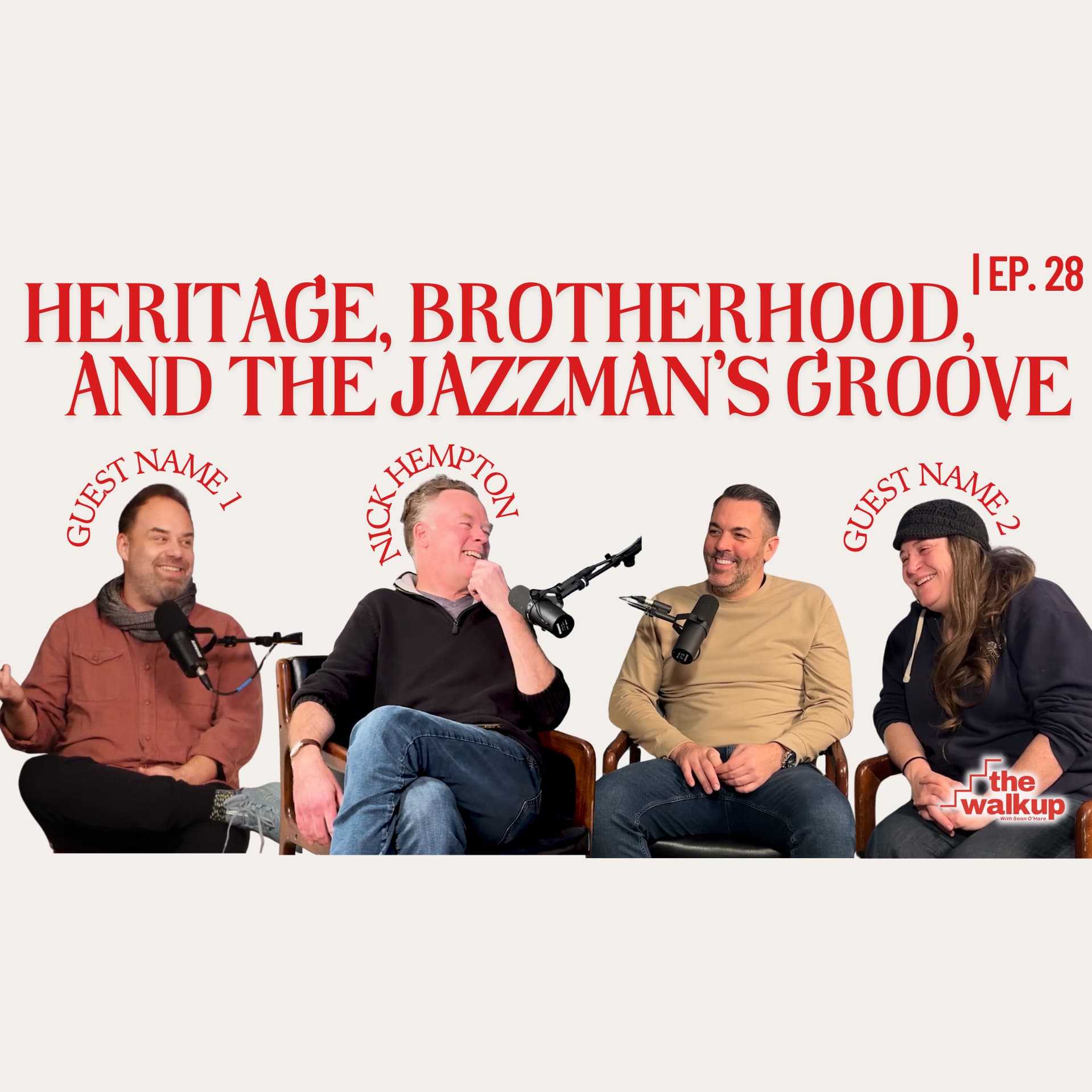
Heritage, Brotherhood, and the Jazzman’s Groove (Nick Hempton and Friends) | Ep. 28
Saxophonist Nick Hempton has toured the globe bringing “big fat grooves and strong melodies” to audiences from NYC to Sydney to Shanghai.
In this episode of The Walkup, Nick and his jazz collaborators open up about the legacy of the genre, the culture of jam sessions, the healing power of brotherhood, and the personal journeys that shaped their musical voices. From paying tribute to trumpet great Marcus Belgrave to decoding the unique language of jazz, this conversation riffs on heritage, improvisation, and how music forms community. Whether you’re a jazz head or a curious listener, this one swings.
Transcript
Read the full transcriptAuto-generated · 9,167 words
All right, well, Nick Hampton, you're back, but this time for your own selfish purposes. Own selfish purposes, yes. So, you're our second guest to have come to both podcast locations. So, this is the, we call this the walk-up studio. I think I know why, yes. You've experienced the walk-up. I thought it would be fun to start a podcast immediately after walking those four flights of stairs. Everybody's, great to be here. And it really is the fourth. Flight. The third one is fine.
It is not the last one. We want people to go through a metaphorical and physical transformation, but we are not here to talk about me, which has really not been... It is the first time for everything, I suppose. Yeah, that has not really been the basis of our friendship, is me not talking about myself. But in this case, we are here to discuss the launch of a To Be Named Later podcast. Yeah, we have a working title of the New York Jazz Podcast.
It is descriptive, if not exciting. I mean, it will give you an idea of what we are talking about. Descriptive and not exciting. That is the alternative title as well, yeah. So, the idea is, I have been on the New York jazz scene for 25 years. I know a lot of musicians, but not that well. Our experience is usually in the middle of the night.
I don't know, while in breaks on gigs or whatever, we don't really get to talk to each other that much, so there's a lot I want to know about what other people's musical lives are like. And also, particularly, what I'm trying to get our guests to do is talk about somebody they're connected to in some way, like a teacher or a mentor or an influence or another musician that they feel has been important to them.
Just because I feel like as generations go by and the originators of the music have passed on, the personal connections between musicians seem to be getting less and less. And I want to sort of highlight how important that is for jazz music. And it's becoming less and less because there's not as much of a jazz social environment? Just the way society has changed, as the internet and social media has taken the place a lot of...
Actual personal connections. I mean, it used to be, back in the day, the jam session was where musicians did everything. That is where you got to know each other. That is where you learned the music. That is where you made connections with each other. That is where you got jobs. It is not really the same way anymore. People are now connecting on social media or through schools, because jazz education has been such a big thing lately, that now people's connections are formed at school or online, and not really on that one-to-one basis that it used to be.
You know, there used to be, you would learn at the feet of a master, and they would show you not only music, but also life and how to run your business and how to run, you know, your personal life. It was a big part of that. And I just want to sort of make sure that people know how important that is. Well, I think there's a... A legacy component to this as well. I'm trying to remember. You might remember the musician, but I was at a gig with you one time, and I'm not going to remember this saxophonist's name.
Just watching the reverence everyone had for him, and he could only at this point sit to perform, and in fact, I did not even notice he was performing, because he was just sitting there, and then all of a sudden, he pulled out the sax, and he started playing, and there was just this, it was really cool to see both the musicians and the crowd just.
I have so much respect and awe for this giant in the industry, of which, of course, I can't remember his name now, but... But, yeah, it's like the originators have, even in my time, the originators of music were around and have disappeared. They've all passed on at this point. There's very few people who are around at the beginning of jazz anymore, and they can't really play anymore if they're still with us, and... Now, I mean, the connection idea, and we are going to talk to Greg Glassman today, who learned from somebody, who learned from somebody, and that connection goes through the generations, but that is the real connection.
We used to be, I mean, only recently we had an alto player called Lou Donaldson passed away a few months ago at the age of 98, and he was playing well into his 90s, and he was around right at the beginning. I mean, friends with Charlie Parker, friends with Louis Armstrong, you know, he was there, and that's that real connection to the very beginnings of this music. And we can't get that anymore, which is okay. It's just supposed to work out that way, but the...
The continuation is really important, I think. Well, and as is often said, it is one of the truly American art forms, right? That is right. And so there is a... There is a legacy, not just in the personal, you know, artistic development of each of these musicians, but also the art form as a whole. Right. And New York being the hub of it. I mean, of course, New Orleans and other places have had a depth of that history as well, but for really the last, what?
50, 60 years, it has really been New York, right? Yeah, I mean, I would say longer than 100 years, probably. I mean, the music came from New Orleans, but very quickly came north, and New York and Chicago and places like Kansas City and St. Louis were hubs, and everything ended up in New York, and it is still, I mean, jazz music is obviously everywhere, I mean, all around the world, but everybody still comes here to it. To get as close to the origins of it as they can.
Well, I mean, I have been influenced by it. I mean, I never… Yeah, you are part of the jazz scene now. I mean, you have been presenting jazz concerts for 10 years or something now. Yeah, 10 years of doing jazz concerts. I guess that makes me part of the scene. Yeah, we had a… As we described on our podcast together, how we met, but… But… I always thought it was great to have our first business meeting at 2 a.m. at Smalls.
Of course, yeah. In the basement of one of the premier jazz clubs in the world. Absolutely. Not a bad place to do it, but it has taken us, we have done from, let us see, we were in Times Square, then we were in, we have been in East Village, we have been in Upper East Side, we have been in Chelsea, and now we are going to be doing a jazz festival here in Brooklyn. Yeah. So, yeah, we are getting all over town.
Yeah, I guess. Queens is next. Watch out. Here we come. Yeah, that might take a while. Well, I am looking forward to hearing your discussion with Greg and with Darcy today, and may the podcast to be named officially later be wildly successful. Thank you. We have got some ideas for the future. We are not going to have any live music on this one, but I think that is something we have got up our sleeve for the future. We can get some cats in here playing and talking about what they are doing.
Hopefully, that will eventuate. Well, as the old saying goes, my podcast studio is your podcast studio. I'll treat it as though it's yours. I'll have it. Looking forward to it. Thanks, man. Welcome to what is tentatively titled... The New York Jazz Podcast. What do you think?
It's to the point. It's got some pizzazz, doesn't it? Yeah, it's to the point. Hiya, Nick. Hiya, Darcy. My name is Nick Hampton. I'm a saxophone player in New York City. Darcy, I don't know how to introduce you.
Yeah, me either. I'm Darcy Burke. I am a former jazz club bartender. Currently... Exploring other options. Right on. And we are going to talk to musicians on the jazz scene, people that you and I know, and in a situation that we don't normally get to do it, because... Our conversations, yours and mine, and also the conversations with our guests, are usually at 2 o'clock in the morning. Over drinks.
Slurring, and not really a lot of information getting passed on. So, this is a chance to get to know some people. Absolutely, and I'm going to do my best to not share too many secrets and possibly get sued. Oh, that's not what you're here for. No, I want all the dirt. Come on. You know the middle of the night stuff. That nobody else knows.
It's true. Yeah, so that's going to be it. So, save the space for that. All right, we've got Greg Glassman today. He's going to be a great guest, I think. Absolutely. All right, let's do it. Cool. I had one of those great New York nights the other night when I saw you.
I did Pete Bernstein at the Vanguard, then walked down the street and saw you at Smalls. It was great. Yeah. It doesn't always work out that way. Yeah. Yeah, it was very cool. Did you guys attend the memorial slash concert? Yeah. I watched it online. Yeah, I figured. It was a hard thing to go to. I didn't want to. I'm glad I did, actually, because this actually made me think about what we're doing today. It was like the community feeling in that room was really great.
That room was packed. Everyone was there, and it was very warm. It was a sad occasion, of course, but it was nice to see everybody there. Yeah, and plus Anthony's dad, wearing a classic Tony hat. That was so great. I mean, he gave a really, it was a very emotional, but very brave and very wonderful speech. Yeah, that was crazy.
Are we on right now? Oh, yeah. What's happening? Oh, we're moving on? I don't know. Oh, we've started. When you and I had a meeting about this, Darcy, Darcy and I met for a business meeting at the only sensible place to meet for a business meeting, which was Nancy Whiskey Bar in Tribeca.
You know it. No, I don't know it. Oh, you should. It is beautiful. Inside, everything is slightly off kilter, and you feel like you are inside of a pirate ship. It is beautiful. Everything is wooden and slanting. Yeah, and kind of broken, and they have the meanest bartenders, which I love.
My favorite, I think I told you this, Nick, he does not work there anymore. He was this older guy. Every time he came in, he worked days. He was in that stage of his bartending career, and he was old, had a beard, always had a sweater that was a little moth-ridden, and he would slam the bottles down every time he poured a drink, and I was sitting there one day with my brother watching a football game.
And this group of women of a certain age that were bridge and tunnel, shall we say, and they'd been out for a while, came in, and they were busting his balls, like ordering the most ridiculous drinks that you would not expect to get there, like Jolly Rancher shots, like shit like that. And he finally got them all sorted with vodka cranberries, and then one of them asked him for a water, and he was so frustrated, he just filled up a pint glass with ice.
And put it in front of her, and she was like, I asked for a water, and he just looked at her and said, wait. Wait. I love it, and we miss places like that. There's not as many as there used to be around New York City. When you find one, you latch on to it.
Yeah. Heavy business meetings there. Yes, but yes, we did, we talked about what we were... We did, and I think, like, what I was going to say is, when you and I met, I had a very vague idea about what this was going to be, and it's only slightly less vague now, but like a bunch of things happened between then and now, like Anthony Pinciotti's memorial, and seeing you at Smalls.
Made me sort of clarify a little bit what this could be about, and then I asked you to come up with the idea of being a connections to other musicians. Instead of having a musician come there and tell me at length about their process, talk about your connections to other musicians in the scene or whatever. And I said, can you come up with somebody who's been an influence to you? And I guess my thought had been you would come up with Louis Armstrong or...
Dizzy Gillespie or somebody, you know, one of the greats of the music, but you immediately went to somebody you had a personal connection with, and you said, you know, Clark Terry is somebody that you knew and worked with.
And Marcus Belgrave, somebody that you knew and worked with, who I don't know that much about, but it made me think that's really what I would like this to be about. It's actual personal connections within the jazz community that go back through time. As we move away from that, and there's fewer and fewer of the originators around, the connections are important, and I think people forget about that. Yeah, yeah.
Yeah, I mean, and we, I feel like I have bridged a strange time because that first generation of people, they were my mentors, and they're all... Basically, dead now. Right, and we have seen them go. We have watched that change, and so we know from experience the difference of the vibe in a room like Smalls at three in the morning when there are physical, when there are links to that generation.
In the bodies of these human beings, right? In the room, people act different, people play different, and yeah, I mean, I used to think, oh, if I could only have heard Fats Navarro live, Charlie Parker live, you know, but now I just feel so lucky that I got to catch what we did, you know? I know what it was like to get scared by the presence of these people, you know?
And we're lucky. I mean, like you say, we are kind of lucky to be the age we are, because we did get to see that. I remember playing at Showman's up in Harlem and opening my eyes in the middle of the solo, and there's Lou Donaldson sitting at the front of the bar, judging me as hard as anybody's ever been judged before. It was terrifying, but it was great, man, and imagine not having to experience that.
Do you, because both of you have... played those later sets leading into a jam session do you feel like you are that for some of the younger it's funny do you think about that so like i i mean i don't really have like a simple answer to it like i um i don't feel Old, I feel young, and I think I feel younger now than I did 10 years ago.
I also, you know, it's like, I'm not the type of person who's going to just like. I'm not trying to give myself this mantle. I'm not going to say, yeah, now I'm the shit. That's not how I feel. But slowly, this sense of responsibility does creep in. I recognize that these people are all no longer alive or in the room. Right? And so, you know, I also don't, I'm not trying to be self-effacing.
It's just like, now, this is what we got, so I better, you know, do my part. That's sort of how I feel. Okay, I just, over the years, working behind the bar at Smalls, like for those late night jam sessions, I remember specifically seeing Roy Hargrove, and he very much stepped into that role. Like, he would...
Guide people, slap them around when needed, and to the point where it was annoying when we were trying to close the club, he would be holding court over by the piano, and just watching him really engaging with that younger generation. But, I mean, that was something he...
He enjoyed it, clearly. He's a great example, though. I hadn't thought about that, but really, those, I mean, you and I were both there for those late nights at 5 o'clock in the morning, trying to get everybody out, and I think at the time, I didn't really appreciate it, because all I was thinking about is, well, we have to close this club, we're both working, but he, you're right, really stepped into that role, which generations before him have done, and you and I are now at...
The age, I mean, we're older than he was when he left, so at some point, I guess we have to step into that role, but it doesn't feel right, does it? I never think of myself in that position. Yeah, it's pretty complex. I mean, when I think about Roy in that environment, I mean, one thing I think about is... There's a trumpet player spirit, I would say, that is a little bit distinct. Not every trumpet player is like this. Other people are like this, but there is, like, something to, you know, the trumpet, it's so difficult, you have to maintain it daily in this way that's, like, pretty Hardcore.
And I think it's because of that, like, you want to, like, there's this background feeling all the time over your shoulder, like, I got to get some playing in today, right? And so that is part of the motivation. That's part of why Roy is there. That's part of why trumpet players have this thing sometimes. And you mentioned Marcus, Marcus Belgrave is like, my favorite trumpet player that I ever. I got to hear, and we became very close, and I followed him around.
He let me stay at his house and sit on his gigs, and I learned a lot of music from him, and I just loved. He was sort of out of the Dizzy Gillespie school of trumpet playing in the sense that He is just like a musician first. The ears are out of control. He is playing all these in-between crunchy notes as part of his beautiful melodies all the time, and it is just like this depth of harmonic knowledge, and his voice on the trumpet, I would say, is just like something that I was instantly captivated with, but when he would come to town, I would go to bed at 7 in the morning, because this, like, whatever he was at the time, like, late 70s.
...year-old man would come to New York, and he didn't know any way to be in New York except to be out all night, and we'd always go eat Gray's Papaya Hot Dogs, and I would be so tired when he visited, because I would be out all night with this old... And his wife actually got mad at me once. He said, don't you know how old he is? I said, I'm not the one... But yeah, I think there's a... Spirit of, like, being in the room with the community, and there's a little bit of flavor that is uniquely trumpet player, I would say.
I can see that as I'm running through the trumpet players I know in my head. I'm like, there is a little something. There's a similarity of personality, too. Like, when you pick an instrument, I think, or when an instrument picks you, there are certain parts of your personality that lead you to a certain instrument, I think. Yeah. I mean, certainly, like horn players, whatever it is, if it is egotism or whatever, we do where we are out front, and that is where we feel natural.
You know, a bass player is a person who likes to be in a supporting role. I think, you know, elements of personality influence what you end up doing, and maybe it makes you a leader as well. I mean, you look at a lot of... I mean, if you think about all the trumpet player teachers who have been there through the generations, it really seems to be a leader position. You show people into the next generation. They lead people through. Yeah. I also think, like, trumpet players, you can't, with a trumpet, you can't press down the right buttons for a G and have a G come out, right?
It's a combination of... Air and the right buttons. So, because of that, you have to hear everything you're playing in your mind like a singer would, and so that is also why a lot of trumpet players are good singers. I was just going to say that. There's a shocking number that also sing. Do you sing? I mean, I can sing. You can sing?
Oh, my favorite musician is the one who can sing and doesn't. Yeah, I'm never... I never feel compelled to be one of these people that gets up and scats their solo instead of plays until there is someone scatting.
Who isn't marvelous, and then I want to show them. I want to show them up. Is Mickey Yamanaka in everybody's mind? Sorry, Mickey, we love you. We love you, Mickey. Never change. Never change. And to all of her haters out there, you never change either. Exactly.
Are you kidding? Have you never seen her emails? Oh, no, I haven't. Oh, yeah. Oh, yeah. That's a whole other... Podcast. We'll get her in here, and we'll read them out to her. I'm sorry, tell me about Marcus, and how you met him, and where you first encountered him. So...
I went to Oberlin College, and there was a teacher there named Donald Walden, who was one of the great tenor saxophone players of all time, and he's from Detroit, and he was actually Barry Harris' first student when they, I believe, were both in high school. Wow.
And I learned Barry's whole method from Donald originally, and... Did you go to Barry's classes as well? I did when I got to New York, but not regularly. And yeah, it's like I was Donald's student, and so I felt like I was already Barry's student when I... Yeah, right. And incidentally, he told me that Barry thought of his whole concept of the half-step rules and the scale in a dream, and I have no reason not to believe him. Yeah, right.
But anyway, yeah, so... Marcus spent most of his life in Detroit after a certain, like, from his 20s, late 20s, early 30s, until he died in his 80s. He was like a diplomat in Detroit. I mean, when I went to his memorial service, and all the local politicians were there, and it's like everyone in the city of Detroit knew Marcus. And Donald was like... Less well-known, but very well-known in Detroit. And Marcus was coming to do something at the college, and Donald said, you better.
Pay attention to this guy. Like, you are not going to believe how good he plays. And this is somebody who never gives compliments to anyone at all. And so, I was like, okay. So, and then I heard him play. He came and did a concert with a big band, and I could not believe it. It was just magical. It is like I had never heard this instrument that I already loved sound like this. And you are how old at this age?
You are in college. I am 19. Okay. Yeah. And I've been playing for many years at this point. Yeah, my personal arc was like, I started piano when I was really little. I had, I think, a talent for music. I could hear a lot of music, but the trumpet was torture for me. Technically, like, until I was already a professional for like 10 years. Well, I mean, it sounds like it's torture for people throughout their whole lives. Yeah, I mean, thankfully, it's not anymore.
I can pick it up. I wake up and I can play it now. But yeah, it was like many, many years of like... Torture on the instrument. Did you have music in the family? Did you have jazz in your family? So, my mother, we had a piano in my house because of my mother. She sang. As a young, single woman in New York, she went around to piano bars and sang. No kidding. Yeah, but that was it.
Did she have a go-to song? Stormy Weather. Yeah, right on. Yeah, yeah, yeah. So, you know, I was like... You know, 13, you know, plunking out the courts, stormy weather, my mother sings at dinner parties, you know. Yeah, right.
But, yeah, I basically heard Marcus... I never heard a trumpet sound like that. It is how I want it to be. It is the closest thing to what I want it to play like. Once I met him, I stayed in touch, and I would go to Detroit. It is a three-hour drive from where I was in college. I would stay with him for the weekend. I still have random shorts of his in my closet, like clothes that I borrowed because I did not have clothes.
And he would let me stay over and... He also ran these, I was not a part of this, but he was a mentor to Jerry Allen, Bob Hurst, Kareem Riggins, Kenny Garrett, all the Detroit youngsters at the time would go to his house, and what I heard was they would play music for 24 hours.
They would stay at his house, play music all day and all night, and then go home. Wild, man. Yeah. But he was, you know, Dizzy said he was his favorite trumpet player. Charles Mingus said, if I could get Marcus Belgrave, you know, if I could afford Marcus Belgrave, I'd have the best band in New York. Wow, man. So, it's not just me that knows things about him.
But I have to admit to being fairly ignorant about Marcus Belgrade, but I mean, the holes in my jazz knowledge are massive. But I was listening this morning, actually, as I was having my coffee, thinking I should check something out.
First thing I realized was, I know this sound so well. I know this guy so well. I've heard him on so many records. I've heard so many solos that I know, and didn't really put the two together. And the other thing was, I heard you straight away. I was going to say, when I...
I feel like I knew your playing better than I would know Marcus Belgrave's playing, but I put the records on and I go, I can absolutely hear where you're coming from. Yeah, I mean, I think of myself as often just copying without trying. No, I don't mean copying, but the influence is there. Yeah, it's a very special, unique... You know, the thing about being less well-known, too, it makes me... Like, if you were involved in this music...
And the community. Like, you know that if you go to any small city in the United States, especially like a majority black city, There will be someone who you've never heard of who is an all-time great that never left Cleveland, never left Cincinnati or whatever, and could play with the best of them. And some of them did. I remember there was this bass player in Cleveland, Lamar Gaines, who played with Bird.
And he never left Cleveland, but anyway, like Marcus, you know, I think it's a... I think it's a great lesson in general to just, like, check in with how people find out about things, and, you know, we live, there was a time when you had to be sort of well-known to get a record made, and now we live in a time when there's, like, more music put into the ether every day than the whole 1960s or something like that. And so, yeah, like, we, the jazz musicians should know.
That you don't have to have heard of someone for them to knock your socks off musically. I think that is an important thing to remember, because, I mean, that is part of what we are talking about here, is these connections to somebody that you know from your hometown, or somebody who is a big influence that maybe other people don't know so much about. Yeah, I mean, so Marcus, but his career, he played with Ray Charles, the soloist with Ray Charles for a long time.
And that is where I first was aware of him, because Ray Charles was my entry point to jazz, and so that is why that stuff is so familiar. We were talking earlier about that Fathead Newman record. Yeah. And I know that so well, and never really thought about the Sidemen, I'm sorry to say. It was Ray on piano, and it was Fathead, and I just used to love that record. And as a kid, that was what I was listening to, but I didn't realize who I was listening to.
And, yeah. But, yeah, I mean, just to close back, he was... Like, very jolly, and very open, and I miss, like, I feel like I have grown up a lot in the last 10 years, and I really wish he was around to, like, talk. I would love to talk, we could talk about the outest shit, and it would be so great. So, I would just love to be able to, like, talk with him about the stuff that's going on in the world, about...
Art and music now, I would really love it, but I could talk to him about anything, and yeah, I mean, including, I sometimes, I would talk to Marcus and Clark Terry, who is my other, like, sort of elder mentor.
I went through, like, one awful, like, divorce-style breakup, and I remember, like, these were the people I was talking with about it. I remember thinking, like, it was, there was something comforting about talking to men who had been through a lot, and anyway, so, you know, I remember calling Clark Terry at three in the morning because I knew he'd be up. Yeah, right. Like, talking, you know, getting a pep talk. That's beautiful, man, yeah.
I mean, that's, just to jump in, like, that talking to men who had been through something, that's something that I've always observed from the sideline, and I think it's part of the fact that you guys are artists, so you perhaps are a little bit more in touch with the emotional thing, but I've noticed that A lot of the musicians, like the men, they are able to forge those bonds with each other, and able to be raw emotionally. I mean, not always mature, but raw emotionally.
I think that's true. Maybe a connection that wouldn't be able to be made between men in other circumstances. I think that's possible as well, yeah. I mean, I've seen a lot of you guys cry. Yeah, it's true, isn't it? Yeah, yeah. It was, you know...
When we were talking about the memorial for Anthony Pinciotti earlier, and I actually had something stick with me from that day, which was the use of the word jazz, right? Because, you know, I can get nerdy, and I find the way words are used, and the cultural significance, and people fighting for or against. Language changes. I think it's all really interesting, and we know that there's been a movement to nix the word jazz, and I think that argument has a lot to it, and it has a lot of integrity, and it's interesting.
But, you know, so Spike got up there, and he said... Like, our, something like our, it was, whatever he said, it was something to mean, like, our community of jazz people, right? Like, this club, this network, this community, and I'm somebody who, like, I honestly have never, like, I've felt totally at home all the time in these communities. I've felt like sometimes I stand up for a principle, and I'm sort of extricated, and sometimes I... Anyway, and I'm probably bringing a lot of insecurity to it.
I feel less that way now. But he said, let's just say he said, the jazz people. He said something like that. And I was thinking, That word is carrying so much weight there that everyone in the room knows exactly what he meant, and it was the opposite of a dirty word, right? It was a togetherness word, and it's sort of like no other word would have done that work, right? And it makes me think a little bit about how people talk about the word black.
It struck me as the same exact thing. I've met so many modern people. Who are sort of like black people who are like over this word and this concept. They're like ready to not be, you know, to some people it feels racist to not use the word black, and for some people it feels racist to use the word black. And I get it, right? And so, anyway, it made me feel the same way about this word jazz, because when Spike used it, It was the perfect word, and we all felt tingly, you know, because we knew Anthony, because he was a hanger, right, because it's like all this stuff in that word that we know, right, that other people don't know, right?
Anyway. No, that... Really resonates with me, because I am not a musician. I've been a bartender at jazz clubs for over a decade, so I spend a lot of time with you guys, but there is obviously a boundary that I don't cross, because I'm not on the bandstand, but the word jazz people, or the phrase, also applies to me.
Because it is, like, it's not just who's performing, it's... The people who come out and hang, the audience members, some of them we love, some of them we hate, the staff. It's an extended family, isn't it? Yeah, it is. There may be a core family there, but the family spreads out quite a long way.
Yeah, and again, as someone who's not entirely in the scene, I've still managed to feel a part of it, which I think is a really beautiful... Yeah, I think it's a great way of describing it, too. Yeah, yeah. I mean, it's, I guess, you know, like a community, maybe you don't know it's there until you really need it, and then it's there. Yeah, but we did notice it the other night. I mean, if you didn't know there was a strong jazz community in New York, you found it the other night.
I mean, the church was packed. Yeah, it was a great gig, guys. I was curious about... Like, you talk about having a personal relationship with Marcus and with Clark. What about advice that you got from them about life in general or business or how you, as a mentor, like, what did you take away from those guys? Right.
Well, it's funny you say the word business. I feel like... Well, Clark was a master businessman, from what I know. I mean, yeah, there's a lot. I, I... Still feel, like, so clueless with the business. Well, this shit is changing so fast. Yeah, like, I don't, anyway, I don't know what to do with recorded music right now. Like, I am aware that I can press a button and release it, but I want something, you know, more exciting to happen, and I'm not sure what that should be.
So, I remember Marcus telling me something. So, I wish I had gotten more advice, right? But I do remember this thing. As soon as you said business, it popped in my head. Marcus told me once, he said, you can sell anything. You just have to figure out what to say about it. And his point was like, you can sell...
Being anti-consumerist, right? Like, you can sell being shy. You can sell being, you know, that was his point. His point, like, and not that he was saying, I am shy. The point is, like, you can sell creativity, you can sell not being like that, right?
Right. You just need to learn how to say it. So, I haven't learned how to say it, I don't think, but hopefully I'm getting better at it slowly. Yeah, I mean, that idea of selling something, because people need something to attach to what you're doing. They need a name for something, you need an idea behind something, and you can actually give them something different. We're trying to give people something good. I mean, that's what it comes down to.
No jazz musician is really trying to rip off his audience. We've got something genuine that we really wanted to show you, and that's really all we're ever trying to do to make records or... Go on tours, play gigs. Really, we just got something we would like to share with you, but selling it is the hard part, and so you need to put something around it, give it a name, and then once you've done it, you just do what you were planning to do anyway, I think.
Years ago, I was taking a stand-up comedy writing class, and one of the things that the teacher told us is the first thing you have to do when you go out on stage is address the... First thing the audience notices about you. So, if you are, if you are obviously gay, or you're a woman, you're short, you're fat, like whatever, like get that out of the way, and then make it part of your brand going forward. So, for me, I'm short, and the microphone would always be way too high.
So, I would take a moment, adjust it. Get a little laugh, and then move forward from there, which I think is... It's packaging. It's packaging, and it can be a little gross and feels dirty sometimes, but if you want to get to your actual point, like your set or your music, you have to address that first and give them... Something to expect.
And maybe takes that out of their mind as well. Oh, yeah, yeah. If you didn't say anything about it, they're kind of thinking about that. Oh, look at this girl. She's short. But if you deal with it straight away, let's get rid of that, and now we can get to work. Get to the actual thing you want to communicate to them.
I mean, I think trying to see yourself, even for a moment, as others see you, I mean, that is heavy. Concept. I'm wildly uncomfortable right now, because I know there are cameras. I'm not going to lie. I literally don't know what to do with my hands. None of us wants to be here, does he?
Damn it, Nick. Yeah, but I mean, running a business, but also a personal life, I mean, I guess that's... Getting back to what you were talking about before, is at some point, there are younger musicians who we're going to have to talk to about this. Yeah. And I feel the same way as you, a little bit still lost at sea, because, like, if you don't mind me asking, how old are you, Greg? 47. Okay, so I'm 49, and we came up, I think...
Coming up just before the internet, I was not using it as I learned to play jazz, it wasn't around, and I didn't have a computer until I was 30, and certainly social media took me a long time to get into, and people who came up maybe 10 years after us, that's central to their lives. But to me... I'd say more like 15. 15? Because I'm 40. Okay. And we didn't have a computer. Like, I straddle that line of like... When did Facebook come in in your life?
In college. But I was one of the first groups of people that was on it because I went to school in Boston. Okay. And obviously, it originated there. And it was just colleges at that point. And they added the Boston schools. And I remember watching.
Pretty much month by month as it expanded to my network of friends and other colleges, and then they let the old people on. Now it's a cesspool. It's only old, angry people, yeah. That's still, I feel, something that I don't really care about. I feel uncomfortable with social media as a concept, and it's something that's changing fast, and it's very difficult to keep track of what's going on, and for the most part, I ignore it. I put stuff up there because I feel it does help in a way, but it's not about making music, and it's not about...
I don't know. It's not really about the business, but it's become an integral part of what we do. We know that club owners and festival owners are looking at the numbers of Instagram followers that people have before they book them, which is absolute bullshit, and it doesn't help ticket sales. It doesn't help anything, but it's part of our life now. Yeah, I mean, again, I think there's so many things to say about it, and I, like... One of them is, I am trying to be like less polarized in my own mind, and just like sort of like say to myself, well, sometimes you got to work for a living.
And so I'm going to have to do some things that I despise doing, right? So that's one voice, right? Another voice that is ever-present is like, this sucks, and it is... Culturally at odds with what I call jazz, what I call the music art that we do. It's at cultural odds. It's the same way I feel about the jazz education business in general. When you're an artist, you are supposed to find a master that speaks to you, like Marcus was for me.
You're supposed to seek them out. And they're not guaranteed to even talk to you, and you might have to put some effort, but the effort doesn't feel like effort because you are captivated by what they're doing. Right. And it's not like you're learning to paint, right? You want to paint like that person. You want to be able to have a stroke like them, or whatever it is. So, you know, this model of higher education where you're paying increasingly, like, insanely large...
...money to go to a school, and your family has the expectation that when you leave school, you're going to have a job where you get this money back. It was an investment, right? And there's an expectation while you're in school that you're going to get... You're going to become a good one of whatever this thing is, right? And that's just not how it works at all, right? There's not a set of information that if you consume it, you will be good, right?
That's not how it works. It's like this indescribable mishmash of like personality and craziness and like countercultural and, you know, it's very American in a particular version of that. We're in America. So, you know, I don't think it fits, but I get it. It's the desperate situation, like supply and demand situation that art and music is in, in general, that snowballs and creates these. Like, the jazz education business is so big compared to the jazz performing business. The jazz business, yeah.
So, that just smells like a Ponzi scheme, but I get it. Like, everyone needs to pay their rent, so many of our friends... I mean, I teach, too. I'm thankfully not teaching too much right now, but I'm sure I will again.
But, like, it makes sense. People want stability. I want stability. Like, it's a way to get some stability. Sure. And so, it all makes, I get the incentives, right? Well, you can't judge the musicians for going to teach at these places. I think we have to look at the higher-ups to look at people who are actually doing something nefarious, but it's... No, no. I actually don't think there's necessarily anything nefarious going on anywhere. It's just incentives, right? Yeah. But the fact is that there's a lot of people, like...
If we just do it that way, the thing that we know will die, right? It's not kept alive. Higher education jazz programs in general. Of course, there are exceptions, but the point is, it's like student seeks master. It's in that realm, and the higher education flips it, and so parents, I understand the motivation of the parents, too. They want their child to have this document that helps them with their career in life. They're paying all this money. They think that they should get something in exchange for it.
Out of it, yeah. I get it. And there's sort of something about your playing style or what comes out of you. Like, a student finding teacher, right, you find a musician who kind of lights you up, and you go, this is the sound that really...
Turns me on, and I want to go find that person. I'm going to follow them around all the clubs. I'm going to follow them to sit outside their house until they talk to me. As opposed to going to school where you are told this is what you should like, or everybody gets pretty much the same information, maybe Albert Isler was the guy who was going to drive me crazy, and I want to go find out about that. I am probably not going to find out that much about him at school, or somebody that not that many people have heard of, like you were talking about earlier, like the small town guy who maybe we do not know that much about.
That is the sound I love. I am going to go find out that. Well, if you have ever been at Smalls on Monday night when Ari... Honig is playing. There is a lineup of little drummer boys that come every week. We always would joke, like, it's soda pop night. Right. Because they were underage, and just would line up along the edge of the stage, right behind his drum set, and...
And they found him. I mean, obviously, he is fashionable, and people are told that he is great, but he is also great, and people are going to find him. Yeah, and he always plays the pipe next to the drum set, which I always loved. It is a crowd pleaser.
For real. So, getting back to it, that is going to be, you know, that's going to be you. People are going to come and find you, and do you find that? Do you get, like, people come up to you at gigs, young trumpet players? Do you have fanboys?
Well, like, it's like sort of recent that I've been doing this regular Smalls thing, and so because it's been regular, it's felt like there's been a vibe developing about Me at these. So, there are people who come every time, and many of them have said, many people say to me in particular that they really appreciate how I run the session, that I stick around, and that I organize it and try to make music out of it. I feel...
Like, I get, I mean, I also, I'm the age I am, and I want to go home, and I don't, there was like years and years where I'd be there anyway, and now it's not like that anymore. So, I want to go home and go to sleep, but it does seem just like it's in my blood or whatever. I learned.
From experience, from being around these other people, what a jam session is, what's supposed to happen, what's supposed to not happen. And so, yeah, so I've been getting some love from the community, from the younger cats, I would say, in particular about, like, putting care and attention into the session. It's vital, because I've seen...
Some of those sessions where no one is in charge, and the inmates are running the asylum, and it is a descent into absolute madness. I mean, I also get that, like, so what you might expect at a Jazz Jam session, even in New York City, in 2025, is quite different than what you would expect when I'm, you know, like, let's say 1998 or whatever, when I was first. I guess I was first hanging out when I was 96, when I was taking time off college, when several people would be sleeping there.
Right. I mean, this is the jam session that would go until 10 in the morning. Yeah, yeah. That was the 24-hour club at that point. But... You know, so I get that it is all different, and I mean, I cannot look a student in the eyes with a straight face and say, okay, before you come to New York, you have got to know these 500 tunes, or else you are going to get laughed off the bandstand or something. Something that would have been said to me.
I do not believe that is true anymore. The reason you learn all the things you are, is because you are in love with the music. Sure, there's some gigs still left. Most of them are probably in New York, where you have to know this repertoire, but the people playing at jazz festivals, most of them don't know tunes, I would say, at this point. Yeah, that's true. I have feelings about this. I do think that it's really important that you know a lot of standards.
I do, too. I just think it is a musical motivation. Absolutely. Not a gig. Not because you're going to get shamed for not knowing. Right, right. But anyway, the jam session to me is the heart pumping of the jazz.
Development. And these things, what it's about, it's about learning how to hear. It's about being on your alert and ready for things. And a thing that I often am sharing with these younger musicians, it's like, People go on autopilot because they don't have experience, and they're scared of missing a chord change or whatever. They're thinking about their own. They're just all in their own mind, and they might not even notice that I'm cueing an unexpected vamp at the end of a song.
So, if I'm saying something besides with my instrument these days, it's usually something like that. And again, the people who taught me... ...would have cursed me out and made me feel as low as possible, right? And like, that's not good. I don't want to treat people like that. And at the same time, it worked on me and not some other people. So, it's like this, I'm glad the world is nicer and that people aren't getting... I also think a lot of those people, they were venting their own unresolved psychological issues on us, right?
So, it's not simple. It's not one thing or the other, but... I do sort of feel like if there is... In jazz, there must be the jam session, right? I agree with that, and I come down and see what you do, and I appreciate what you do, because a lot, like we were talking about, a lot of musicians will run that late show and then split, and then the jam session is just up to anybody, and the standard goes very low, and the expectations are lower.
And then, inevitably, Tony Hewitt runs it. Well, exactly. We might leave it on the topic of Tony Hewitt. It seems logical, and I know... Greg, you have left your child at home with nothing but a drawer full of knives to play with. Yeah, yeah.
Plug something before you go. You got anything you want to tell us about? I do not know when this is going to go out, by the way, so do not plug a gig for next week, because it might not be out. Okay, yeah. I mean, I will say that my life has gone from a lot of traveling to very little traveling right now. I am sure it will change again.
I love being home. I love being in New York, and if local gigs paid double what they pay, I think I would not feel... Yeah, you wouldn't complain, would you? Well, I think I would be happy with my life as is. So, basically, I'm just playing a lot at the little clubs around...
Around town. And you're doing the late night at Smalls on Saturdays, correct? Yeah. Like every other-ish? Me and Stacey Dillard share it. Trade off, okay. And I'm not sure, I think the schedule might be changing coming up, but yeah, Smalls and- In the mix. Do you have a website that you update?
I mostly just put it on Instagram. I have a website that has been out of commission for a while, and it is on my list. What is your Instagram handle? It is GlassDogNYC. Greg, thanks for hanging out with us. Oh, it is a pleasure to have you guys. I think we have really covered a lot of territory there. We will have to get you back. Thanks, man. Awesome. All right.
More from The Walkup

Against the Odds: The Samurai Lawyer (Chad Flores) | Ep. 52
Faith, Sexuality, and the Fog of War (Iris Bahr & Father Rick Riccioli) | Ep. 02
E2
Church, Conflict, and Community (Iris Bahr, Father Rick Riccioli & Rob Long) | Ep. 03
E3
Hope, Vocation, and the Global Church (Colm Flynn & Colin Nykaza) | Ep. 04
E4