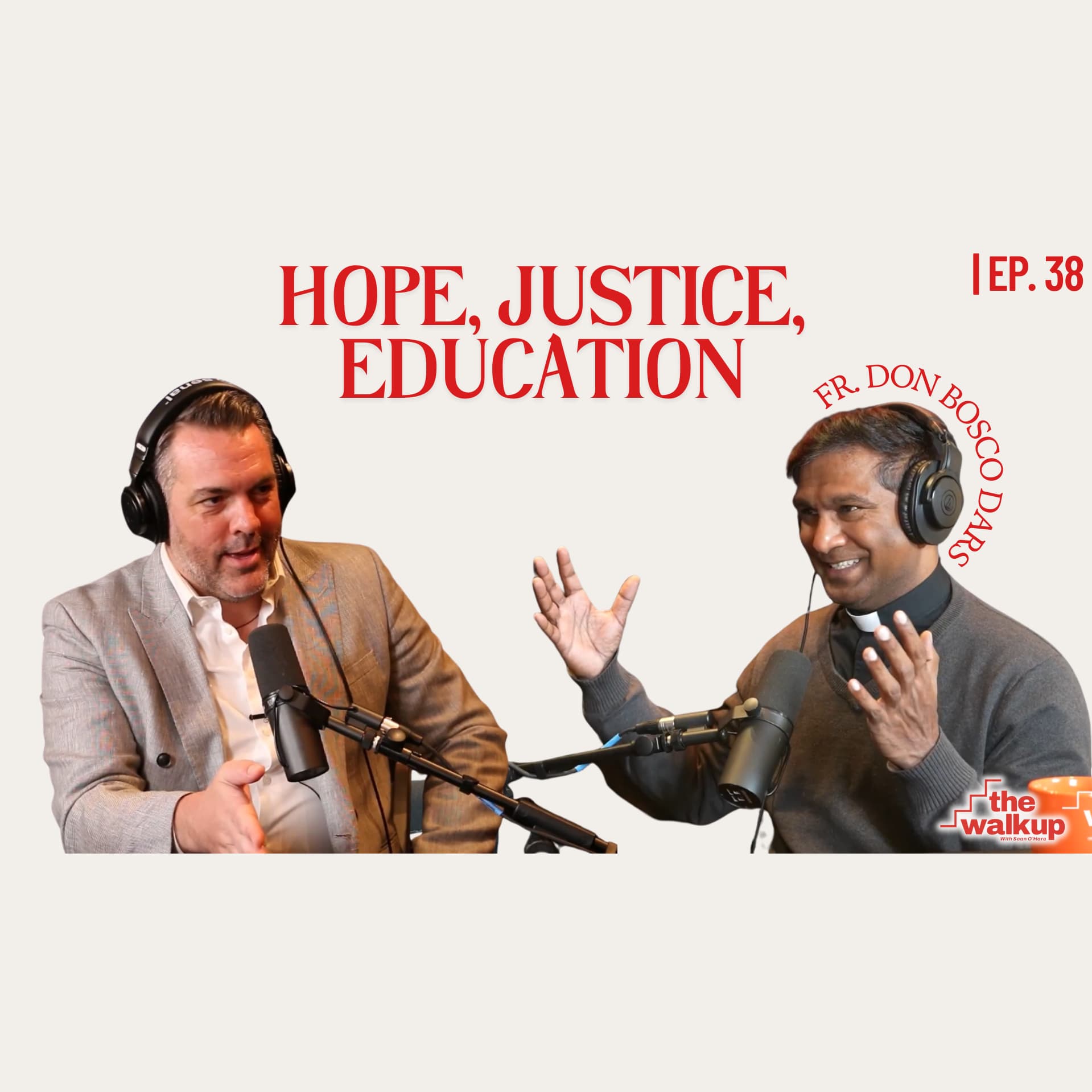
In this powerful episode recorded at the New York Encounter, we sit down with Fr. Don Bosco Darsi, a priest in Vijayawada, India, and the founder of Talitha Cumi Unnati—an organization working to end trafficking and uplift girls through education. Fr. Darsi shares heartbreaking realities and the transformative hope at the center of his mission. His story is a moving example of how memory and hope shape not only lives, but entire communities.
Transcript
Read the full transcriptAuto-generated · 6,707 words
Great to see you again, back here from Vijayawada, India. Wonderful. I am happy to reconnect with you, and also participate in New York Encounter, which brings a lot of people together, and we share ideas, and we also plan activities to impact other people.
Yeah, so you spoke here last year, right? And if it weren't for that, you and I would not have met. And if it were not for us meeting, I wouldn't have... You have gone to India. Yes. So, I got to go for two weeks this past May. I guess it was May. Yeah. And my life has been transformed by that experience. So, our audience has heard about Talitha Kumi before. Yes. But what is the... Give us an update. Since we spoke to you, I think this was in June or so when you were here.
It is now February. So, it has been another six or seven months. What has been happening in Viswata? What has happened? I am glad to know that your life has transformed a lot. Also, you have transformed. You have been an agent of transformation in Vijayawada. Before you came, our goal of reaching out or impacting was 200 girls, and now we have expanded it to 1,000 girls. So, this year, our slogan is, Involve, 100. Inspire, 1,000. Impact, 10,000. Okay, so, anyway, involve, 100.
100. Inspire. Inspire, 1,000. Impact. Impact, 1,000. 10,000. 10,000. Okay. Yeah, and this has been happening, and thanks to you, because you have set the platform, and you have connected us to people, given us ideas, and you... You came to the villages, and the vicariates, and the diocesan meetings, and you created a kind of atmosphere where now we begin to realize it is possible.
Well, that's great. Well, I'm flattered. I think Father Jason Sharon played a big role, and so we're, you know, I think that's what this idea of encounter is all about, right? I mean, the whole point, for some reason, I know this sounds maybe...
Simplistic, but for some reason, I've known this conference for so many years, and you know when you just get used to hearing a term, oh, New York Encounter, New York Encounter. I'm like, oh, no, no, Encounter. We have this encounter. This has to be in person. This is about bringing people together from all different disciplines, from all parts of the world. We have this encounter, which allows for us to experience one another, and then hopefully move towards some action, some partnership, or what have you.
It didn't click with me until this time for some reason. Yes, the word encounter is so rich. It's full of possibilities. Networking. We encounter people, and we also network. I chose to come here because it's a place of networking.
And New York is for networking. And back home, I have these 10,000 people whose voice I represent, and we're going to rewrite the future of 10,000. So, this is doable. This is also creating hope. In this jubilee year of hope, hope is happening. Hope is being created.
Yeah, no, and there is a… In God's wisdom, this need for a jubilee year of hope. Again, it could sound kind of, oh, hope, sure. We use that word all the time, but the virtue of hope, right, at a time where we really need that idea of the expectation of what God can do in our lives.
And so, take us through some of the programs. I know we talked a little bit about last time, but as you have expanded from 200 to 1,000, what have some of those programs looked like? Okay, I would like to connect it to the Jubilee Year of Hope, where all of us are invited to be pilgrims, pilgrims of hope.
And what happened the last few months with our Kali Takmi girls is they have become pilgrims of hope for other girls. So, before, they were receiving support and help, and now they have become channels of support to others. So, there is a huge network of these 10,000 girls, and from time to time, we have activities, for instance, like... Night to Shine, and Gunadala Festival, where one and a half million people in three days came to the shrine which you visited, where our TCU office is located.
Is this where I broke the coconut? Yes. Okay. I was making sure. And I was very impressed with myself that I broke it on the first try. Yeah, yeah, yeah. I'm not above small acts of masculinity. I get so few opportunities, Father. Yeah, yeah. No, no, no. You are inculturated. You have adapted so many Indian forms of spirituality, breaking coconut. Absolutely. I really did cherish that trip, and I remember that one of the unique aspects of what you were cultivating and developing there is that...
Recognizing that in this very difficult topic of human trafficking, sexual trafficking, labor trafficking, and since it is women and young women and girls who are the most vulnerable, that you recognize... In your own humility, that maybe I'm not the best person to approach them, right? And to say, the messenger should really be their peer, somebody that is also a young woman who can speak to them. So, that I think is, that takes a recognition of the messenger is most vital. You're absolutely right.
You know, women understand women better. And they become channels of empowerment in a way that men are not equipped to do. So, these hundred leaders are people who are actively involved in the rural areas, in the parish settings.
They are the game changers. They are the catalysts that actually impact change. What we have actually moved is, from being small, we have expanded. There is also a growth of interest. For instance, many... Single mothers are saying, okay, we want to be involved, because we understand the need of education, need of protection, we understand what trafficking and abuse is all about, because as single mothers, they go through sociological pressures, and they are vulnerable. So, vulnerability is... We are all understood in a different way in the light of dignitas infinita.
So, all, no matter who you are, we all are created with dignity, with infinite dignity. So, we are trying to promote the value of dignity and justice, joy, and also respect. Women need to be respected. Yeah, and I know that that can be trickier in different countries where the culture is more male-dominated.
And I think what I'm always struck by when I think about Encounter, and we were talking about masculinity there for a bit, is that we... We can have different ideas of what masculinity can be, and even paternalism, right? How to be a father.
I mean, my call to paternalism is, you know, hopefully to a marriage and a family one day. Yours is as a spiritual father, and what I find most striking about the paternal nature of things is we... We see here in encounter in Vijayawada, India, you had Italian missionary fathers, spiritual fathers, who came 100 years ago to that region of India, provided catechesis, of which you and other brothers became priests, who now act as fathers in that spiritual fatherhood towards primarily these young girls and women, but respecting their dignity as fathers.
Females who require equal dignity, but then in your own masculinity, you say, well, it's best that I empower them to be the leaders in their own communities. And I just, that, I don't know what that, that, that, that.
The ecosystem that God provides, from Italy to India, and then, of course, we shot down this before to Ohio, so I have to share this story quickly. Exactly, yeah. So, I was talking to, I don't know if I told you this entire story, so a friend of mine who is from Malta. Yeah.
He now lives in the States. He was visiting my office. His best friend is Father Rob Gallia. Oh. Who is a very famous priest in Australia. Australia. He visited India already thrice. So, yeah, so this is what I came to find out. As my friend Mark says, oh, yeah, I help Father Rob with his various charities and non-profits and ministries, and he shows me like a brochure with all of the projects, and I said, He said, yeah, it is this group called Salitha Kumi.
I said, yeah, I was there like two months ago. God connection. And he says, oh, could you... So, you want to connect with the church in Ohio. And I said, oh, I didn't know about this. There's a church in Ohio that's helping. That's great. So, I speak with Father Bob. Not to be confused with Father Rob. Father Bob and I are talking. After an hour, I said, where are you based? And he said, Brunswick, Ohio. And I said, I was in Brunswick one week ago, visiting the grave of my best friend who died a year ago.
And he said, oh, Jeff? I said, you know Jeff? He said, no. I did his funeral in Ohio, so we had two funerals, one here in New York, and then one in Ohio. I gave the eulogy. I was too exhausted emotionally to also go to Ohio for the second funeral, and he said, oh, you gave the eulogy. I said, yeah, how did you know? He said, oh, we played it. We recorded it, and we played it over the microphone.
At the funeral in Ohio. So, I thought, wow. So, are you ready for this? Jeff is the one who told me about the New York Encounter. I used to visit him, go to the New York Encounter, stay at his apartment, where I met you, which brought me to India. Then, my friend from Malta to Australia to Brunswick, Ohio, back to Japan. This is amazing. This is God connection. This is a real encounter.
I mean, come on. You cannot even imagine those kind of things. Yeah. Hold on one second. I need to make sure that we're... Emma, was the... Emma, was there, was he wanting to have somebody come in? 1215, okay, great, all right. All right, so we have even more time. In my life, the phrase, the cardinal will be here at 1215 to sit down with you, that has never been said. No one ever says the cardinal will see you at 1215, but Father Bosco is more important.
So, anyway, so to return to that idea of... Of the paternal nature of things, you hosted the Night to Shine. People have heard me speak about it before, but just to remind people, so this Night to Shine is a... What we call an American-style prom, but a celebration of those with disabilities, with special needs, and we take it all over the world. It is always on the same day, the Friday before Valentine's Day, every year.
The only downside to it is because it happens on the same day, I can only be in one place, but we are now in, believe it or not. 60 countries. Wow. 800 locations. Amazing. 400,000 people participating. Fantastic. So, I've been very privileged to go to host and impersonate Colombia, Ghana, Rome, Paris.
Where else? Mexico, Peru, and hopefully soon in India. But tell us your experience. You brought it to Vijayawada. What was that like? Yeah. Thank you, first of all, for connecting us to Tim Tebow Foundation and Night to Shine initiative. Their vulnerability is somehow looked down in Indian culture.
If you are physically challenged, mentally challenged, people with disabilities, they are not counted in the society. You know, in India, we have this caste system, the hierarchy of human beings. So, these people with disabilities, they are at the lowest strata of the society simply because they do not perform.
Profitable, so to say. But this has given a huge opportunity for these vulnerable people. We organized a program for physically handicapped people. And we brought in mentally challenged people, also blind children, and deaf and dumb children, so it was a huge moment of encounter, you know? So, they encounter their dignity.
...and vulnerability in a very optimistic, positive way. This was only first of its kind in our place, so we hope to do it regularly and also do it in a big way next year. You will probably understand, when you visited this Mother Teresa home, Sishubavan, where children... With disabilities, both physical and mental disabilities, they are the most precious beings you could ever meet. There is a lot of smile, there is joy. They don't have any malice in their heart.
People of purity, I would say. So, we could encounter actually that purity, that genuine joy, and there is no egoism, selfishness. They are ready to share. So, this is actually impacting 10,000. So, when all our Thalitakami girls see this, and we have also... We decided to, every alternate to Friday, we will do an outreach activity. Okay, we will visit these people, and maybe we take some small little things that will make them happy. For example, ice cream, or a little cookie, or maybe a small little card.
So, this is to that home, that disability home? Yes. Yes, yes, yes. And we have, actually, we connected three disability homes. Oh, okay. I visited the one with the missionaries of charity. Yeah, there are other two. One are completely blind children, you know, but they're amazing. They have such incredible talents to sing and to, you know, to dance, and then also deaf and dumb children.
So, we brought them together, and then we're going to integrate them part of our program. As you said, from last year to now, how we have grown, this is another area we have grown. We have opened doors for these people with disabilities, thanks to Night to Shine. Well, and I think this is one of the things that I'm very...
What I'm optimistic about is that, you know, a lot of times we talk about the downsides to technologies and communications where we can become very self-obsessed, right? We're looking at our smartphones and focused on our own appearances or not connecting, not encountering, right? Yeah, yeah, yeah. But then there are the incredible opportunities, right? So, I mean, because of technology, right? You and I met in person, but then we were able to have Zoom, WhatsApp. We can communicate these things, we can send funding to the other part of the world, but more importantly, and I think you remember this experience with Father Jason, that Father Jason, being an American-based priest, who is a very hard-working, very dedicated priest, and yet he encountered something in India that re-inspired his priesthood.
And that was a very powerful moment for me, because I thought… This is what we need. We need to be reinfected sometimes with that inspiration, and this is why the beauty of the church is that we are brothers. We met here briefly. That was not for me to get on a plane on the other side of the world, and you welcomed me and my friends as family, and we continue this friendship, and then we get to share all of the different gifts that we have to offer, right?
Yeah. And I think that is where an opportunity exists, is that what I want, is I want as many people to get to know you, to get to know Toledo Kumi, to get to know those communities, because that will help to break us out of our own isolation, and where we have to find that prudence where, okay, we use technology, but it has to lead to encounter. Yes. Yes. It can't stay in a digital environment. We have to eventually have an incarnational experience.
Yeah, I like the word incarnational experience, and yeah, you're actually, you know, translating technology into a transformative tool, okay? Technology is good. We humans have always used tools. If you don't use one tool, we use other tool, you know? But, which is the best tool that you can use, you know? But, if our work is confined to, if our personality is confined to just that tool, then you are reducing your personality. But, if that tool can become a channel of transformation.
So, Thalita Akum is a channel of transformation. Think of what you have done already in Vijayawada. Giving hope. For example, this little girl, Sindhu, she has created so much impact through her paintings, and when the flood came, that was a thing that gave hope to people, that they can overcome, they can arise. So, the whole...
The vision of Tali Takhtam arises towards something higher and nobler, Unnati. So, that makes so much meaning to these girls who lost everything. For example, during hurricanes and floods. Well, let's talk about that, because that's different since we last spoke. Yeah, yeah, yeah, yeah.
Help people understand what happened with this flood, how unique it was, a 100-year flood, and the impact that it had. So, just define that for people first. Yeah, Vijayawada is located in a fairly good geographical area. It is not that close to the sea, but River Krishna runs in the middle of the city. And what happened was the weather department did not warn the people, so there were rains for almost 10 days, heavy rains, and the canals and the rivers overflew, the dam broke, and the rainwater, so we didn't have proper system to channelize water.
So, in about a few hours, water level increased. For instance, that was a Sunday, and when people came to Mass, there was no water, but when the Mass was over, water was already knee-deep. Wow. In just an hour. Just an hour. So, people had to rush home, and then they didn't even have time to take their personal belongings. So, they either have to run away or... Go to the first floor, second floor, but the water came to the second floor. Many churches were completely destroyed.
Children and young people, they lost their books, their personal belongings, but most of it they lost their hope. So, we are now in the process of building hope. Hope building, if you would say. So, this jubilee of hope, or pilgrims of hope, makes so much sense to these people who lost hope. And for our Talitakum girls, they already have no hope, and this is another disadvantageous situation where they are hoping to build hope, and that hope also is shattered.
So, now we have to rebuild everything and organize activities. Where did people go during this flood, and then after? Have some of them been permanently dislocated? Yes. About 45% of the whole city was underwater. The government tried to evacuate as many as possible. It was already too late, so they had to send in boats to check people. And you stayed in the bishop's house, and water came to the first floor, and then other churches that you visited were completely underwater.
So, this was the situation, for example, in New York. You're used to snow, and you know how to deal with snow. But other places, like India, if you have snow, all of a sudden, we are not prepared to blow the snow and then clear the roads. So, like that, this was totally, totally unprepared, and people didn't know what to do, where to go. Government did their best, but what to do? The dangerous thing was... Calamity of viruses and other things. We also had snakes and scorpions around that time, and it was such a dangerous thing.
People really experienced a kind of mini-hell around that time. Yeah, because you don't even think about that. You know, things like snakes and scorpions that are normally on the ground, you know how to look out for them, are now floating. They are now in... Yeah, quite dangerous. At your head level. Scary, scary. There are snakes everywhere. Wow, of course. Wow. And so then, the situation is slowly rebuilding. Yeah. It is a process. Where has the government played a factor going forward, and then also the church?
How is the church trying to... Government did a lot, I should say, from the international communities and the national government. They provided the immediate supplies for about three, four months, and then afterwards, they didn't follow up. The church has done an incredible job of not just providing immediate flood relief kits, but then... We have a lot of hope happening now. We visit schools, we visit villages, we bring young people together, children together, play with them, and also the mentally and physically challenged people.
They were so scared because their place was completely underwater. And they have to be airlifted, and thanks to government, they arranged that. And some of the nuns, we almost thought we lost three nuns, Sister Suguna and their community members, you met them. So, water was up to neck deep. And they couldn't take some elderly sisters. They don't know how to swim. So, luckily, we were able to send in boats, and two of them were airlifted. This was such a dangerous area that people lost everything, but now is the time of hope happening, rebuilding hope.
Right, and you were telling me, when we spoke, just after the flood, just communications, right? How do you charge your, because phones become very important, of course. Yes, yes, yes. How do you charge your phone when everything is under water? No communication for a couple of weeks.
First thing government also did was supplying chargers and also phone bank, you know, to recharge. But what was more important at that time was, rather than connecting to the people from elsewhere, connecting to people, those who are in a similar situation, those who are struggling. Two, three parish priests, they remained with... They did not move out, and they were in the first floor, and the second floor, the water came, it was stinking, and they could not move, and also, government was aid-dropping food, but you can't eat, because it falls in the water, which is so bad.
Oh, yeah, because it's mixed with septic and all sorts of other dangerous things. Yeah, although there was food provided, but you can't eat, and that was... So, because the packages were not sealed in such a way that... They were sealed, but, you know, where they are, you just have to pick from a place which is, you know... Yeah, and if it gets soaked with dangerous fluid. Yeah, and our Thalitakami girls, for example, even when they are able to, you know, eat something or drink something...
They didn't do it because they had to use sanitation and toilet facilities which are not available. And one of our TCU homes, wall, big wall, Luckily, it fell on the other side, not on the girls. So, these are the girls that you have met them with Father Jayraj in that place. So, there were 150 girls there, and they were trying to protect themselves on the first floor, and suddenly, water level increased so high, the wall fell on the other side, and three buffaloes, which were giving them milk.
...died instantly, and they saw that, and that was another trauma, and it could have fallen this way, you know. Right, wow. Yeah, so traumatic. How does it impact you as a priest when you're seeing your people, you know, they're suffering, there's only so much you can do, right?
But then, how does it... How does it make you reflect on your own call to the priesthood in these moments? Thank you for asking that. I mean, special moments like this, vulnerable moments like this, where you grow in your priestly vocation of compassion, of showing enormous love that Jesus showed when he saw these crowds.
His heart was moved with pity, compassion. He felt for them. So, that was the feeling when I saw these people struggling, and people in need, and so many people asking for help, support. Your resources are limited, and we can't help everybody. So, we embraced vulnerability and found meaning out of it. So, our dependence on God increased enormously, and material things are not going to solve the problems.
Money is not going to solve the problems, but it is our faith, our courage, and also our encounter, networking with other people, and I learned a lot of lessons around this time. So, what, I mean, I think there are people that would say, you're saying your faith and reliance on God, Peru, I think there would be those that would say, Isn't this proof there is no God? These natural disasters happen, people are suffering, these are people that are already suffering already, even when there is not a flood.
How do you explain that to people, that somehow this increases your faith? All right. Realistically speaking, this is not God-made. This is human-made, because they would have actually dealt with the situation very well, but the government came in.
At the last moment and it's all because we do not have proper Channel to Yeah, we would say the levees and you know the kind of like I said the channels. Yeah. Yeah They could have handled the the increased rain, but they yeah. Yeah. Yeah. Yeah. Yeah, so definitely I mean another thing is people really I mean like They were not blaming God, or they didn't question the existence of God. In fact, actually, they thanked God because they were protected, or they were saved, even at this time.
They were like pregnant women who delivered their babies there in the water, and they could not be taken to the hospital. They are very grateful. I mean, even in such situation, God protected them. Or, for example, these snakes, you know, running around, and they were not bitten by snakes. And then, yeah, it is different. I mean, like, if you understand the Indian culture, it is different from American culture. For example, right now, there is a huge... Hindu pilgrimage in India. Already, over 500 million people were there the last few days.
500 million? Yes, and more people are going to. This is all to the same location? No, no, no. All throughout the country? It's in the north of India. No, one location where it's called Kumbh Mela. Of course, there is a stampede, so many people died, and it happens once in 12 years.
It is called Kumbh Mela, Maha Kumbh Mela. So, people believe that if they take a dip in Ganges, their sins are washed, and they receive Nirvana, they attain Nirvana. So, everybody, including our Prime Minister, went there. So, it is a Hindu festival. Already, they were expecting only like...
2 to 300 million people, and this year, it has already reached 500 million. And they say only China and India has more population than the people who came there. I mean, like, all the other countries are, their population is less. So, to bring so many people in one place together is not easy.
Where do people, they're sleeping, they bring you? No, they just come and go, come and go, come and go, come and go. I mean, no way to sleep there. But what I want to tell you here is people...
People look at these natural calamities in a different way, and they become more dependent on God. They also grow with the philosophy of… Everything is vanity, vanity of vanities, or everything is maya. The philosophy of maya from India, it is like karma, maya, so everything is illusion, you know. So, you may have a lot of money, but it can be washed away when there is flood, and also gold and other things. Yeah, but this going to the Ganges River, it is a wiping clean of all sins.
I mean, that sounds Christian to me, but I know that it's not. So, how do you explain that to a Christian audience? What is the theological or religious implication there? Yeah. We have so many cultural practices in India, which can be connected to Christian theology. For example, as you said, breaking the coconut, you know. So, you... So, you break the best fruit, the purest of all the fruits, and give half to God and take, it's a kind of taking blessing, God's blessing, take it home, okay?
So, you offer something to God and you receive something from God. And this whole ceremony of purification, where you go into the river, Jesus went to River Jordan. Okay, to be baptized by John the Baptist. This is a baptismal reference. Yeah, yeah, yeah. So, theologically, I think every religious tradition has this practice of purification. So, there are different forms of purification. So, through water, and also through fire, and through meditation, through yoga, and other practices. So, particularly this The practice of going to Holy River.
You can see in the Old Testament and also in the New Testament and all the pilgrim centers now we have, if you go to Lourdes. So, you go to a place where people want to take a dip. So, it's...
It may not have scientific dimensions attached to it, but when it comes to faith, and people have experienced healing, transformation, or it's just a kind of renewal. You become renewed. So, people are willing to take any, any odds, opportunities to go there. I know it's 500 million people in a few days. It's a lot, it's a lot. Yeah, I understand. Yeah, yeah, yeah. All right, well, so while you're here in the States, you're also going to be teaching in Alabama, so how did that opportunity come up?
So, because of my moral theology background, I have a PhD in ethics. And people don't want ethics. People don't want to be told what is right and wrong. Nevertheless, you know, seminaries still teach ethics, or also medical schools, medical ethics, and engineering schools, engineering ethics. So, there is opportunity to teach ethics.
So, wherever the opportunity arises, I take it, for example, for seminarians, for deacons, also for laypeople, and we have so many dimensions of moral theology, fundamental ethics, sexual ethics, medical ethics, and now. Hopefully, soon, it will be AI ethics, artificial intelligence. What are the ethical implications? I know the Vatican has already been having conferences about this, and it's coming fast. I was actually following the Paris summit, AI summit, and many people are actually talking about ethical aspects. What are ethics involved in this artificial intelligence?
Everything is going to be dictated by AI. Our life is going to be so different. For example, the value of humans, the interconnectivity, and how do we take care of the vulnerable. Again, coming to people with disabilities. So, when AI completely takes over, disabled people will not have any role.
Yeah, I can do a better job, you know, and productivity, and people will be turned into products and, you know, as means than as ends. So, a lot is going to change. So, my area of, you know, ethics or moral theology, I think, has a lot to offer.
No, I think it is more important now than ever. I remember I was in Haiti to work on a… We had a project there with the Bishop's Conference, and this was two and a half years ago, maybe, and the ChatGBT and OpenAI was just starting to come around, and we were having lunch in Port-au-Prince, and we were speaking about ChatGBT, and I said, how does it work? So I just put in, you know...
Summarize the crisis in Haiti and suggestions for solutions. And it spat out. I've been doing my own research for weeks before these meetings in Haiti. So, I knew a decent amount, and I am looking through, and I am like, that is pretty accurate. Oh, my goodness.
So, it is more accurate than what you are actually doing, or what you can come up with. Yeah, but AI can't help the children in Vizuada, or the poor in Haiti, or limit the gang violence that is happening there in Port-au-Prince. So, we are still... Certainly, the incarnational experience. I am going to trademark that one, the incarnational experience. Yeah, that is wonderful. Come on the Walk Up podcast and have an incarnational experience. Oh, wonderful, wonderful. That might be a little too theological for people.
No, actually, what we are offering to Thalitakumi girls is that incarnational experience. You know, their dreams are shattered, and if you take the story of Thalitakumi, the girl is dead. That is cool. You know, so, but Jesus brings her back, you know, back to life. So, that is incarnational experience, giving her hope and to arise, and particularly, I like what Jesus said, you know, after lifting her up, bringing her back to life, give her something to eat.
Yeah, very practical. Very practical, maybe. She has not eaten when she is dead, you know. Her belly might be a little empty at that point. Give her something to eat. So, So, through the Thalitakam program, what we are also doing is giving something to eat, you know, small, small things, small books, and we have given flood relief kits to the girls, and then also girl dignity kits. They lack dignity. Give them some dignity. They lack respect. Give them some respect. They have no opportunities.
Give them opportunities. Just before coming here, I had a conversation with one of the sisters working with us. She feels the need to open more homes like this, but they are full of risk and a lot of technicalities and legal aspects involved. It's not easy, and there are not so many people doing There is a lot of this work out there, like Mother Teresa. Very few Mother Tresas in the world.
That's a high standard. But there is a lot that can be done, you know? I was struck by how many religious sisters you do have in Bijawada. In fact, you and I were able to work together to bring some sisters to the States. Exactly.
We already brought four, and some eight or nine more are… Oh, is that how many it's going to be now? Oh, I didn't realize that. Yeah, four have come already. And then it's going to be up to… Eight more preparing. Yeah, and they want more, because there are few people or sisters who are doing this, because we have 950 religious sisters in our diocese, and they are angels, and they're an army of angels. They are, absolutely. Well, but probably because of, you know, political situation right now, all our schools, Catholic schools closed, and the buildings empty, many of these sisters, who are very active in the Ministry of Education, suddenly, they're...
Available, they don't have their primary work to do. Yeah, so we are engaging them. For example, the thousand girls that we support... Each of them has a mentor who is a religious sister. So, there is a lot happening there. Sisterhood, accompaniment.
I don't know if you remember acronym, AMEN. I do, yeah. Yeah. But define it for everyone. Accompaniment. M for mentoring. E for education. N for network. AMEN. So. From the time you came, we have expanded in accompaniment. We are accompanying the girls who are struggling because of human trafficking, girls who are dropouts, girls who are flood victims, and… Girls with disabilities, and then we are mentoring them where we need it more personal, and the religious sisters are stepping in and then stepping up to be the mentors.
And then, of course, what do we do with them? Education. Skill training, formal, non-formal education, and of course, whatever we do, we are connecting people, networking. As I said, we men, we are not equipped to deal with things related to women, so we are creating a platform that they...
Absolutely. It is a beautiful and the true idea of equity, that we are finding ways to use the talents and abilities that everyone has. And then in this case, even because there is such a beautiful response to the call of religious life amongst women in Vijayawada, In God's economy, we can, okay, we have an oversupply here in Ujuwara, and then here in the States, we have some homes that are working with human trafficking and others that need that support. You know, a lot of times people ask, they're always confused what it is I do, because I'm involved in various things.
I don't think I'm going to put on my LinkedIn that I'm a broker of religious sisters, but a nun broker, I don't know. No, no, no. I like... In particular terms that you are using, Sean, you said in God's economy. Yes. So, the way God looks at things is different. I mean, richness is seen from Indian perspective different. For example, you might have maybe capitalist or materialistic understanding of economics.
But look at these 950 religious sisters, young, vibrant, full of possibilities, enthusiasm, and you have actually created a channel, first for mentoring, you, Father Bob, and all people involved with TCU here in the United States, because if you look to the history, the contribution religious nuns have done.
In education, healthcare, social work, like here you have Mother Cabrini, in India, Mother Teresa, Bakhita in Africa, and Europe, Centuries of Childhood, so many, so many women have contributed immensely for humanity. And their efforts should not go unnoticed. So, we are trying to encourage religious sisters and, you know, give them an opportunity that they can evangelize and reach out to vulnerable girls. I do not know if you watched the movie Cabrini. I did, of course. Okay, so in the beginning, you see when Sister Cabrini came from Italy to New York, you know.
In a desperate state. Yeah, desperate state, and what she did was. You know, she went to those places where nobody else would go. Right. So, religious nuns have a special, I would say, special ability or… A charism. A charism.
Today's gospel, I had this crazy thought, okay, where Jesus fed 5,000 people. I was actually reinterpreting it as if perhaps there was Mother Mary who actually commanded Jesus, come on, you have to feed these people. She would have noticed.
Because just like at the wedding of Cana, where she said, no, you've got to work this miracle, I mean, you have to, you know. Do whatever he tells you. Yes. She's the one who alerts him to the wine, though. Exactly. Maybe she sent this small little boy, you know, that's the boy, or Peter. She said. You guys got to take care of these people, and women can understand what's the human need. See the need, and it will be more preventable. Well, I think that's a great way to wrap.
Unfortunately, we have another guest coming, but I would talk to you all day. But I'll get to see you throughout the weekend. Thank you so much. This is wonderful. I get to meet so many incredible people online. Thank you for patiently listening to me. Please pray. Please pray for Thalitakam, because we are already impacting so many people, transforming so many lives, and rewriting the future. I would say rewriting the karma, if you will, of so many of these vulnerable girls. And, Sean?
You are creating hope, hope happening, and we are all pilgrims of hope, and we accompany each other in hope happening. And that is true of the year of hope. Well, God bless you, Father, and we will continue to see you throughout the weekend of the encounter. Yeah, thank you so much.
More from The Walkup

Against the Odds: The Samurai Lawyer (Chad Flores) | Ep. 52
Faith, Sexuality, and the Fog of War (Iris Bahr & Father Rick Riccioli) | Ep. 02
E2
Church, Conflict, and Community (Iris Bahr, Father Rick Riccioli & Rob Long) | Ep. 03
E3
Hope, Vocation, and the Global Church (Colm Flynn & Colin Nykaza) | Ep. 04
E4