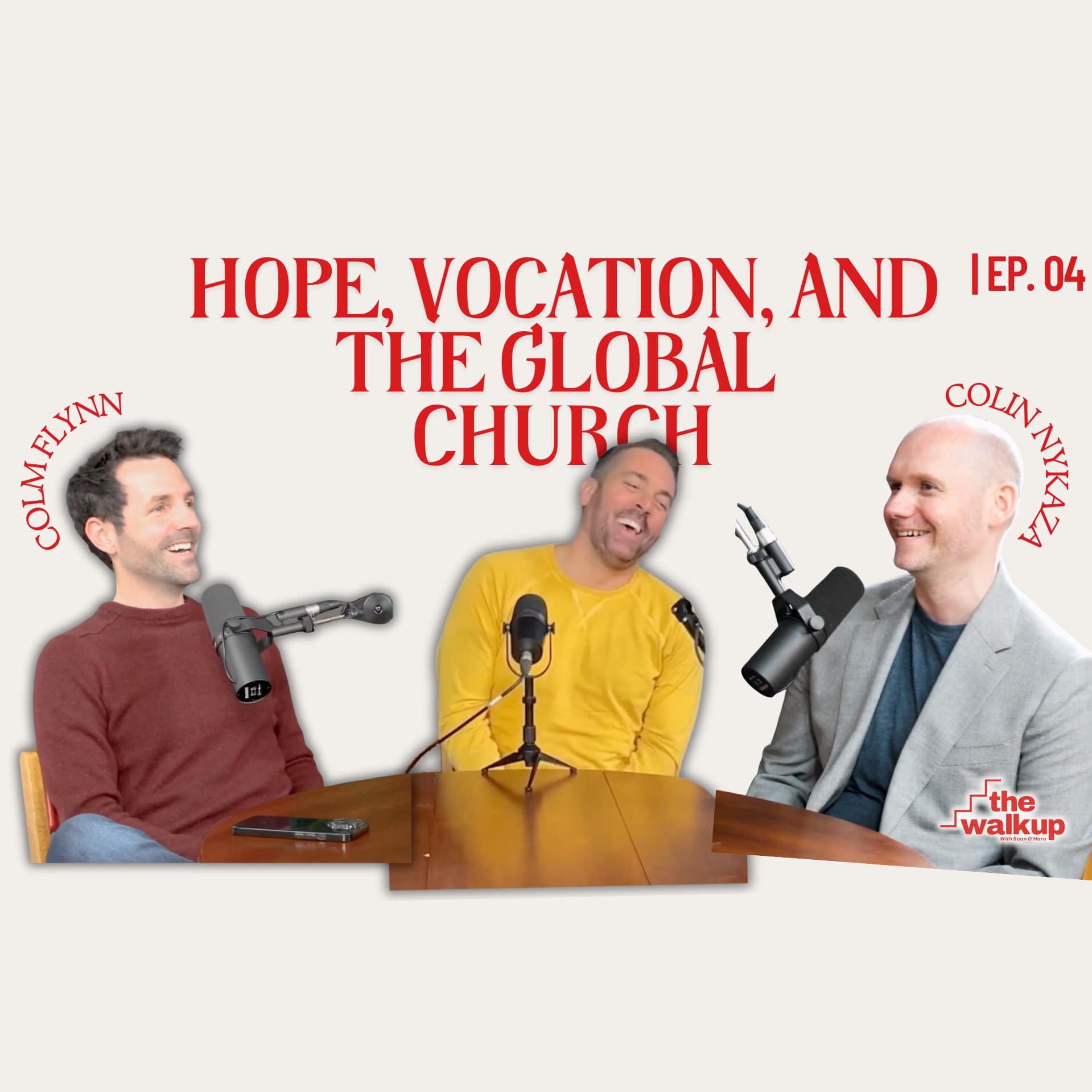
In this episode of The Walkup, Sean O’Hare is joined by Colm Flynn, Vatican correspondent for EWTN, and Colin Nykaza, Director of Outreach at St. Patrick’s Cathedral in New York City.
Together, they explore the Church’s response to suffering, the power of courageous service, and the enduring relevance of vocations in a fast-moving world. From Colm’s global reporting on the Pope and human rights, to Colin’s work on the ground with young adults and parish outreach, this conversation bridges Rome and NYC—offering insight, inspiration, and a deeply human look at faith in action.
Subscribe on YouTube: @TheWalkupPodcast Follow on Instagram: @thewalkuppodcast
Transcript
Read the full transcriptAuto-generated · 14,593 words
There is a phenomenon happening, and we all know, is that people are getting married later and later in life. You know, our parents' generation, it was more about they would get confirmed, and then they would go to college, and then they would get married. And there wasn't necessarily this in-between zone between college and marriage. But now, there is like 10, 20, maybe for some people, 30 years of this period of time. So, all of a sudden, the church has recognized that we have got to start reaching out to these young adults.
We were doing a program for EWTN, a month-long stay in South Korea. ...profile of the church, and we filmed homeless shelters and all these different places around Seoul, the capital, and we went and filmed on the border with North Korea, and then someone told me, you know, there's a group of sisters that have never talked to you, but they help.
Women whose children are coming out of North Korea. Welcome to the Walk Up podcast, where we explore the intersection of faith and culture. My name is Sean O'Hare. On today's episode, we have Colm Flynn, Vatican correspondent, and Colin Nakaza, Director of Outreach at St. Patrick's Cathedral. And we talk about Colm's experience globetrotting with Pope Francis and Colin's experience serving the poor close to home here in New York City. I hope you enjoy. Welcome. Thanks, guys, for agreeing to sit down, and just first for clarification, call in.
Yeah, and what an intro, by the way. Thank you for that. That was a great intro, wasn't it? That was an amazing intro. First names only here. We're very informal. We didn't see the intro. A bit of behind the curtain. It's recorded afterwards, but I'm sure it was a great intro. Oh, I haven't done it yet, so you're trusting me a lot.
So, this podcast is generally around the idea of... Living in New York City as a Catholic, what do I encounter on a regular basis is I encounter being a minority opinion amongst most of my friends and acquaintances. No. And so, I don't know. It's crazy. I don't know if you know this, but New York City... A bit secular, maybe not the bastion of Christianity.
I never noticed. But this is the first time so far we're having a conversation amongst those that have had similar experiences of being kind of the believing minority. So, I think maybe just give people a little context. Maybe you can start first, just kind of your journey. You did live here in New York for a couple of years. You've been in Rome. You've traveled a lot. You've traveled a lot, bud. That's the feds coming for me right now, so I've got to go.
I've got to get out of here. That's how you know we're in New York, folks. Yeah. Five years. I was here for five years. Four or five years. 2016 to 2020, 21, yeah. And then what brought you to Rome?
EWTN, the Global Catholic Television Network, I had been working with them for a while, freelance, producing programs here in the US, back in my home country of Ireland, and in different parts of the world, and that work kept ramping up and intensifying, and eventually they said, hey, we had a reporter covering the Vatican and the papacy, but they've left and went to another network, can you come and take the job in Rome? So I thought about it, and I went over, and I've been in Rome for four years now.
And what's the... What was the biggest surprise of going from what you perceived covering the Vatican day-to-day versus the actual reality of it? Well, when I took the job, I thought, would there be enough news to talk about something every day, or would there be enough stories?
And it is just incredible, from the people who are coming to visit the Holy Father on a daily basis, the heads of state, ministers, even celebrities. There are so many people. When they come to Italy, they want to go and meet the Pope. And it is just a testament to how important still the Holy See and the Vatican is, and Pope Francis, you know, we talk a lot about soft power, not just hard power, and you see that, yeah, the Vatican is so respected right across the world.
And then all the people that you meet, the cardinals and the bishops, and it is never a dull moment. No, I was struck by that. I had the chance, I remember the first time I went to Rome in a professional capacity, so to speak, I was invited to participate in the... Pontifical Council for Social Communications. I did not know what a Pontifical Council was as of yet, but I think what I was struck by was the unifying, if I want to use that word, or the ability for the Vatican to uniquely aggregate people from all walks of life, and from the corporate sector to those concerned with poverty.
There's really, outside of that, I guess the UN would be the closest thing, but it's the only place that can really be a clearinghouse for all that. In a few weeks, they're having a meeting of artists and people who are comedians, who are artists, who are musicians, meeting the Pope. Recently, I interviewed Al Kelly, the former CEO and the chairman of Visa, the Visa Corporation. He had just come back from a meeting with Pope Francis, him and other business people. So, you're right, you see this huge mix.
My friends would always joke, it's just... You're going to go over there and be covering stories of bishops and priests. It is everybody from every walk of life who is walking through the Vatican on a daily basis. Yeah, and I think there's a part of that that's very, as a Catholic, I'm like, yeah, that's great that everyone wants to go there. There's a validation part of it, but sometimes you worry, like, they're just using it to get a validation that maybe they don't necessarily have the right intentions in mind.
Like, oh, I got to meet with the Pope. I almost like a... Check the box, like status symbol, right? Did you get to meet Sylvester Stallone? I know he was there. That was big news. Did you see the footage? Yeah. When he was sparring with Pope Francis? It was incredible footage. But you see, before that, Whoopi Goldberg went and met the Pope, and the Pope said something like, oh, thank you for your gift to the world of comedy. So, sometimes you do look at it, and you see, wow, I am so glad that person got to meet the Holy Father.
What a well-deserved. Honor for them. And then there's other times where you look and say, who's checking these resumes, or who's making these decisions? But as a reporter, people always say to me when I'm on different shows, what do you think of this meeting or that meeting? And I say, look, the meeting happened, I played no part in it, and I report on it. And we never know what's said, because they're private meetings. We just see the Pope, we see a little bit of footage, Vatican TV will film the person as they're going in, and then normally afterwards when they're shaking hands or exchanging gifts.
But what goes on in those private meetings, we do not know. It is not like the Pope saying, like, Whoopi, love you on The View. Great stuff. Yeah, yeah. By the way, this meeting was before the recent View episode.
Which one? There is a big controversy now at the moment about a really, a piece of the view that people are saying was really anti-Catholic in the last week. Oh, I don't know. Can't even keep up. Can't keep up, guys. But, well, the predecessor of Pope Francis and Pope Benedict before him, Pope John Paul II, called New York the capital of the world.
Colin's had a unique purview to being in a Catholic leadership position for now 12 plus years. So, maybe just give a little background on how you came to the city, how you got involved in the work of the Archdiocese, and then what you're doing now at the Cathedral.
So, for many years, I spent in seminary for the Bridgeport Diocese in Connecticut. It's actually a total of seven years. I was in for four, left for two, went back in for three. The two years I left, I started speaking with Generation Life in Philadelphia and working with the Theology Body Institute.
And Ascension Press, and that kind of is the first experience of getting involved more in a young adult activity, because it was mostly people that age, went back into seminary. I felt God and Mary call me out, and so at that point, I was just really wanting to work for the church in some capacity, and was interviewed for the family life office here in the archdiocese, and the position that I was going for, they really weren't interested. This was right when the young adult coordinator was just leaving the diocese, and they were like, would you be open to this?
And that is how I kind of got plugged into the young adult ministry in a helicopter view. But at that time, I mean... Give people a perspective of like... What young adult outreach looked like at the archdiocese, but also, more broadly speaking, as a going concern at any diocese across the country. Yeah, I mean, so, there is a phenomenon happening, and we all know, is that people are getting married later and later in life. You know, our parents' generation, it was more about they would get confirmed, and then they would go to college, and then they would get married.
And there wasn't necessarily this in-between zone. Between college and marriage, but now there's like 10, 20, maybe for some people 30 years of this period of time, so all of a sudden the church has recognized that we've got to start reaching out to these young adults. It's not the normal of just, because usually when you get married, you're part of the church, and then you get involved in the church activities. That's not necessarily happening. So, especially with John Paul II saying, you know, Manhattan itself, the capital of the world, recognizing that we have, not only is it the capital of the world, But we also have the most transitional period, like most transition that is happening when it comes to people who are moving here and moving back out.
And so, in the Catholic faith, we recognize that we are not only influencing the Archdiocese of New York itself, just the people here. We are recognizing that if we can capture these people, get them in counter-Christ over the next two to three years, these are the young professionals who are moving to Chicago and to L.A. and to all across the country, and if not the world. So, we look like we are not only forming young adults here in the city, but we are forming young adults who are going to be influencing the entire world.
And so, that is why there is such a big emphasis on forming an office, forming a program to really help these young adults encounter Christ and grow in that relationship. Yeah, I think it is a relatively new, I don't know if you want to call it a phenomenon, but a demographic reality that... Yeah, for a long time, you would have a youth ministry office, right? There was an understanding of catering to those maybe under 20, 25 or something, but this idea of an extended period of an unmarried period of life is something that the church has to adjust to, and it was our dear friend Jeff Smith who was the one who went to the Archdiocese and said, half of New York City Are young adults.
That is half your population here are young adults that are coming into the city in their 20s, in their 30s, and in this very, very important time of their lives where they are. Now, out of college, starting to make some money and starting to form very strong opinions about how they're going to live the rest of their lives, we're kind of leaving it open to, we hope they happen to walk into a parish and hope they happen to form a good relationship with the parish community and grow in their faith without anything that was specifically targeted for them.
And with no foundation as well, because as you say, it's a transitional period when people are here. For most people, I think it's like a third of New Yorkers are from somewhere else and they're here to... Focus on one thing, normally, is to build their career, to come here, to kind of super start their career, and then go back to where they are from. But when you don't have that foundation, you know, you are looking for it in so many different places, and if they haven't got that strong faith, and their family is not there, or their friends they grew up with who could put them straight, their real friends, all that is gone.
I experienced that too when I lived here, and it took a while to kick in. You are like, what is missing? There is something wrong, and then you realize. The sense of belonging in the city. It is so big, the machine is so huge, and there are so many people, and you just feel like such a small part of it. It is hard to feel grounded and rooted.
It is the most lonely populated place in the world. We are all together like sardines in the subway, but we are all looking at our phones or completely focused on something else. And even when I lived in an apartment here, you have housemates that are coming. They don't even stay for a long period of time. Everything is changing, everything in the city.
Yeah, and what is interesting, too, is that you are also, often most of the people that are here are, what I would say, are more socially engaged and socially capable than your average, right, because you have to have a certain personality to survive in the city. So, there is an appetite, but it kind of... We necessitated this formation of a young adult office, a young adult outreach to be able to cater in what I would say is kind of like a para-parochial model, right?
For those that are listening that are not as familiar with kind of the parochial model, but we have everything in the church is organized geographically. We have diocese, and archdiocese are those that are basically in large metropolitan areas, and then every diocese is separated by parishes, and every parish has a pastor who is... In charge of not only the souls in his own church, but actually every soul geographically there, whether they're Catholic or atheist or whatever they may be, but I think the opportunity in New York was that you needed something that was flexible, that could support local young adult communities, but also have these kind of...
So, I mean, we came up with a whole category system, and so I will give you like a helicopter view of how we did outreach, and a lot of what you are going to be hearing came from a lot of trial and error, came from a lot of prayer, but also came from a lot of conversations with you, Sean, with Jeff Smith, our dear friend, and also recognizing the Archdiocese of New York is very unique compared to others.
We've got this challenge where, like I was in the young adult office, I was entrusted to all the 20 and 30-year-olds for the diocese. Now, it's the second biggest archdiocese in the country. We've got Manhattan, which is the capital of the world, right? And then we've got, you know, Sullivan County, Ulster County, it's like farmland up there. Dramatically different approaches of how, so how am I supposed to, like, find a system to be able to reach that 25-year-old who grew up living on a farm versus the 25-year-old who...
Who has just moved in here from London or wherever across the country or world? So, we kind of try to come up with broader themes to fix that problem, like how we can really reach them. So, first, we had a program system.
Basically, or let me say the two pillars. It was like connect with God and connect with each other. So, first and foremost, recognizing our main job is to help young adults encounter Jesus Christ, grow in relationship with him, really encounter him, make saints, get disciples, get people to heaven. So, we have a lot to get to, and we have a lot to get to, and we have a lot to get to. Always having that in that focus. Recognizing young adults, everyone is looking for community, they are significant in other, so basically connecting with each other.
So, setting up all of these opportunities for like-minded individuals, especially if you think you come to the city like this, you think you might be very alone in the Catholic faith, and you are not. There are a lot of amazing people here, all religions, of course, but there are tons of Catholics here, so getting them connected. So, with that, we developed a program system, first called the Love and Life Encountered Program. And the You Did It To Me Apostolic Volunteer Program, based, Mother Teresa would say, you know, you could put the gospel in the palm of your hand, you know, based when Jesus says, whatever you've done to the least of my brethren, you've done unto me.
And she would make a fist. And the idea with this, I like explaining it with a biblical analogy. You guys are all familiar, obviously, when Jesus said to Peter, Peter, you're the rock, I'll build this church. Now, interestingly enough, according to tradition, when that conversation was going, Jesus and Peter were actually standing on a massive rock. And there's a huge pit that's in the bottom of that rock, and in that pit is the beginning, biggest spring that goes into the Jordan River.
So, a lot of people consider that spot, where traditionally that conversation took place, as the beginning of the Jordan River, which is very interesting, because you've got the book of Revelation, like the river of life flowing from the Lamb of God, right? And so, in that river, obviously, we have the Sea of Galilee, and we've got the Dead Sea, all right? Now, the Sea of Galilee, I don't know if you guys have been, it's beautiful, Sea of Galilee, beautiful, a lot of life in it, a lot of life around it, but Dead sea, literally dead.
No life in it, no life around it. Now, it's the same river, so it's interesting scientifically speaking. Why is it that the Sea of Galilee is filled with life and the Dead Sea is dead? It's because the Sea of Galilee receives of the Jordan River, but it also gives of the Jordan River. The Dead Sea just receives. There's no outlet. So, just like a great analogy for love, like if you're navel-gazing, if it's all about you, self-centeredness, you're spiritually dead. But if you receive love and then give of yourself, then it...
Absolute life is exploded. So, we try to set up these opportunities to help transform this culture of death by giving all these opportunities of young adults encountering God's life and love, and then setting up all these opportunities to give of themselves. So, we just figured that just, I mean, this is even working with science, and we know this, how it works with love. So, the way to be able to form more of a culture of life and life-giving aspect by just setting up those things.
And then very briefly, with that, we did a category system. And like how to reach young adults. And the challenge was, again, doing events up in a farm country versus Manhattan has to look different, but this helped us kind of like to pinpoint how to do it. So, first, we'd have the disciple category. And so, the office is split up into different regions. So, there would be a coordinator up in the upper counties, a coordinator in the mid counties, and then a coordinator in Manhattan, Staten Island.
And what I asked my coordinators to do is they'd do a certain type of event each. Each month in each category. So, first is the disciple. It is all sacramental. Young adult masses, adoration, confession. Give them the sacraments, right? So, each one was obligated to, or in charge to, have some type of sacramental experience. The second was the friend category, and this is where you would learn anything about the faith. So, Theodion Taps, book clubs, Bible studies, the Love Responsible summer series that New York did for many years.
Whenever you are learning something about the faith. So, they were in charge of Not only having a sacramental thing, but make sure they're getting fed something with some type of talk, or some type of knowledge of the faith. Then there was the acquaintance category, and this was all of our homeless outreachers, or basically Corpsel Works of Mercy. Everything from homeless outreach, to nursing home ministry, to prison ministry, to any way that young adults are giving each other. And it's also our big church-themed parties.
We looked at that, because people who are maybe not that close to God, they will serve still, right? So, we're looking to catch them at a certain, wherever they're at in their journey. And so, we would have a big New Year's Eve party. We'd have a mass in Times Square at St. Malachy's, the Actors Chapel. We'd have a nice mass, and then A party downstairs, open bar DJ type thing. The cops will let us see the ball drop. We'd come back in, right?
And so, we would hijack all the holidays that people were doing anyway. New Year's Eve, St. Patrick's Day, Halloween All Saints. And the last is the secret category, and this is where it's anything, but the people don't even know Catholics are running it. So, we're doing jazz nights, and we're going to Mets games, Yankee games. And the idea is that twofold. One, when you catch someone there, you get their information, you invite them to the next level.
And then also, within minutes of a young adult who came into the city, I know exactly what to invite them in. If I get a guy coming in who's coming in from Steubenville on fire, I'm going to be like, hey, come to the Young Adult Mass. If some kid's coming in from Penn State, and he's like, you know, I'm still not really sure where I'm at in my journey, I'm not going to invite him to the Young Adult Mass or Confession, I'm going to invite him to the Jazz Night, and then love them where they're at, and then lead them to the next level.
I must be a hopeless case, because Colin didn't invite me to squat when I was five years on jazz nights, and the ball dropped. I didn't get invited to any of that. That sounds amazing. Did you get on an email list? I don't understand. Where were you? I did actually think about that when we first met. I sent an email, and I think they responded saying, never contact us again, and that was it. You were on a watch list. Yeah, I was on a watch list.
No, I was traveling so much. When I moved to New York, then we were constantly traveling, covering stories. So, you were never here at the same time every week. But it's funny, when you were saying there about the true joy and fulfillment comes from giving, not only taking. Yesterday, we were in Hawthorne in Connecticut, filming with the Dominican sisters, who look after the poor, who have uncurable cancer. And in one of the interviews, I asked one of the young sisters, you know, why?
This is tough. You know, these people are not getting better. They are going to die. And it's a full-on hospital ward where they're dealing with... bodily fluids and they're dealing with death and they're dealing with such severe sickness and she said we are just giving what we've received and it makes you um incredibly happy and i thought that was amazing when she said that so it was funny that you mentioned that there yeah and what's what's your experience when you're traveling around you're seeing a About a broader view of the church is almost anybody gets an opportunity to see, right?
So, we are talking about our experiences here in New York, in the States, but how has having the opportunity to see the global church shaped or informed how you view, I don't know, the state of things? Yeah, I think if young people had the perspective that I am able to have because of traveling with EWTN and making programs, I think they would be flocking to the church. Because even my friends back in Ireland who say, well, you know, I mean, we've...
We had a good priest in school, but all those bad priests and nuns that you read about, yes, it's terrible that they're there, but when you actually travel around the world, I mean, you pick the country or the part of the world, and you just see the same thing again and again, which is what I've seen, where people are suffering, where people are in need, where people have nothing. Thank God the church is there helping them, and that's with schools. You don't have to look far.
I mean, look here. Like I mentioned, the Dominican Sisters, these are poor people from the streets. ...who have this horrible cancer, do not have money to hire a full-time carer, and these nuns will take them in. They refuse to take money from their families, even. The head, the mother, told me that when families sometimes send them donations, they send them back. They have a strict policy. We do not take money from the families of those we're caring for. They won't take Medicare.
They won't take any money from the government. They want to be independent. They have a policy of one sister with each patient. Buy their bed. 24-7, if they need anything. And how many are they taking care of? The number is, I think, under 50. They used to have more. That's still a lot. It's still a lot in this facility here, and they have a few facilities in the country. They used to have more, and the lady who was the mother there, a beautiful woman, she was telling me that it is bittersweet, because as the vocations have dropped, they had to make tough decisions.
Do we keep open these hospitals and maybe hire more secular people? They do have some male nurses and doctors working in the male wards. Where the nuns can't work as fully as the female ones, but she said, we made the decision to close them to keep it that one-on-one care that their foundress, Rose Hawthorne, wanted.
But again, you go to, so that's for the elderly who are dying from cancer, and some who are not that elderly, but even young children who are born with the most severe disabilities here in New York, they all want to get into the Elizabeth Seton Children's Hospital. I think it's near Yonkers. Again, an incredible facility. A run by, there's two nuns still on the board, partially funded by the Catholic Church, which just gives the most amazing care for people with special needs.
I mean, two years ago, we went to South Sudan, and we went to a leprosy colony. You think it's just biblical, people with leprosy. In parts of the world today, we went to this village. They're not allowed to stay in the towns or the cities because they still seem to be unclean and contagious.
They're put in the middle of nowhere, left to die by the government. We went there and filmed, and I interviewed this lay missionary woman, and I asked her, what happened before the church came in and was funding this treatment for them? She said, it's like this, Colm. They get weaker and weaker, the skin rots, and we saw the missing hands and the feet. In the past, they would have had to have done their own operations in the village of just amputating arms and legs.
And in the middle of the night, the hyenas would smell the rotting flesh, and they would take the weakest, and that was it. That was it. This is happening today in the world, right now, as we sit here. We went to Mongolia, and last year, when the Pope went, we filmed in orphanages in Mongolia. Huge neighborhoods where 80% of the people have HIV in South Africa. The Catholic Church is helping. We're going to Kenya next week, then Uganda the week after.
I mean... We went to Belarus. I filmed our own family trying to adopt a little boy once in Belarus. Christian brothers are helping in these orphanages that were affected by the radioactive fallout from Chernobyl. Gosh. You pick any part of the world and these stories that are never covered. You'll never read about them. So, I think if people really knew the depth and the scale of what the church does for people...
I mean, it sounds like I'm doing propaganda for the church. I'm just telling you as I see it from traveling around. Yeah, what's happening. Yeah, this is what's happening. I don't know how they wouldn't flock to try and be part of the church to help people, yeah. No, it's true. I mean, I think I've been fortunate. And by the way, they don't do it for the things that we all do things for today. You know, we do things because we want to get a salary.
Well, they're all, you know, not bad things. We want good careers. I came here because I wanted to make money and to have a good job, and, you know, it's kind of, it's all about you. I tell people all the time I get paid to be Catholic, basically. Yeah, and so do I, and it's a great blessing, and it's a really privileged position to be in, to be able to tell these stories. But you meet these nuns, and they're not doing...
It's so countercultural. They're not doing it for money. They're not doing it for fame. We often have to really convince them to go on camera and tell their story, and they're not doing it for Instagram followers. When I first moved to New York, I remember I was so taken aback by when you meet people. They say, hey, nice to meet you. Call him, yeah. What do you do? But really, they're saying, what can you do to help me? Is what you do important enough that I'm going to keep talking to you?
And once they were like, you know what, you're like this weird Irish TV guy, they're like, next. And now it's like, hey, are you on, when I meet people and they say, what do you do? You work in TV? Are you on Instagram? How many followers do you have? That's now the benchmark of, you know, how important are you? Because what do you do, your career, now it's how many followers do you have?
And you meet these people who... What can you do for me? What can you do for me? Can you share my stuff? Can you help me grow my following? But again, you meet these priests and nuns and brothers who are helping people quietly.
Not for followers, not for money, not for fame. It's an incredible thing to see, to witness in today's world. Yeah, and I think that the incarnational nature of things, right? That word's come up a couple times in discussions I've had with, you know, believers and non-believers on this podcast, is that to be Catholic is to be incarnational, which is, you know, a strange vernacular to use, but what we mean by that is we're in the dirt and in the blood and in the physicality of things.
We're not, this is not simply a spiritual mental exercise that we sort of attend some liturgical. You know, service on Sundays, and then we go back to being just regular guy or girl in the culture, and when you see these extraordinary acts, I mean, it is what you were talking about before, which is the four-category system of seeker, acquaintance, friend, disciple. I think it is a good reminder for Catholics that we are not meant to be nice people. That is a good thing to be, but the church is meant to be.
A saint-making factory. It's meant to make extraordinary Christ-like followers, and the ultimate end of that... To be completely like Christ is to then do these extraordinary things, and often then, of course, they don't want the credit, because that would run counter to the idea of serving for the sake of the other.
And I've been in those, and I've been fortunate as well to travel and see a lot of these places where I was in Ukraine. In the last 18 months, I've been to Ukraine. Haiti twice, going to India in a few weeks, I was in Colombia, Ghana, and each one of these places, the universality of the church, right? Like, yes, I don't have the same background or ethnicity of the people that I'm working with, but because we share the same faith, there's like an understood language there, and a trust.
And what I've been working with different... Organizations over the years, whether it's special needs or now doing some anti-human trafficking efforts, they'll be like, how do you know all these people? And I'm like, I don't actually. It's just that all I need is one contact in a country, and I can find the priest or the nun or the Catholic organization, and they'll treat me like family. They'll take care of everything because there's this explicit understanding that we belong to this.
To this calling that kind of transcends language or culture or... And I would say as well, I think in today's culture, particularly young people, the assumed simplicity and naivety of... When nuns, let's say, when they see a little old nun on the street with her habit, they think, well, what kind of life has she lived? I remember once in the Vatican. Poor repressed lady. Yeah, but a repressed lady, hasn't experienced much. Someone introduced me to a nun, Sister Imelda Poole once, a small little nun at the Vatican.
She was over giving a talk, and then I said, what are you here talking about? She was talking about, with the Mary Louetta Ward sisters, their fight against human trafficking, and I was talking to her about it, and I couldn't believe it, and I said, can we come? And do a report, and she said, I'm based in Albania, in Tirana, the capital. Come. And we went and we filmed her going into the villages in the mountains where you have these dangerous gangs in Albania.
I wouldn't do it, you know. We were scared going there, and I certainly wouldn't. I'm too selfish to devote my life to that, if I'm being honest about it. Yet this person, quietly, humbly, was there taking on these gangs in the Albania mountains. And then we interviewed some of the 16 and 17-year-old girls. ...that she had helped save, her and the other sisters. When we went to South Korea once, I remember, again, the problem of they don't want the publicity, they don't want the glory that goes with it.
We were doing a program for EWTN, a month-long stay in South Korea, a profile of the church, and we filmed homeless shelters and all these different places around Seoul, the capital, and we went and filmed on the border with North Korea, and then someone told me, you know, there's a group of sisters that have never talked to you. But they help.
Women whose children are coming out of North Korea, and we got a hold of them, and we convinced them to allow us to come to their place in South Korea, in Seoul, where they had converted these two apartments. We couldn't show the outside, because it was just so private, and inside, they got two homes, two apartments. They converted into a small, unofficial orphanage for children, and the mother told me, in her habit, that there are these gangs in North Korea, and when women want to escape when life is so bad, They make deals with these gangs, and they say, okay, we'll smuggle you out of the country, but it's going to cost you $20,000.
And they say, we haven't got that money. And they'll say, it's okay, we'll make a deal with you. Come with us through China, through Beijing. You can pay off that debt by working in the sex industry for a year or two, and then we'll bring you on to South Korea, and you'll have a new life and new freedom. So, they make that deal with the gangs, but often these women are bringing children with them. So, these nuns... These little nuns and habits go to Beijing, meet these gangs, and they toughen up, and they say, listen, you've made the deal with the mother.
We know we can't change that, but forgive us the kids. We want to take the children so they're safe, and they're not in those brothels or that environment. They keep the kids for a year or two in South Korea, tell them that their mother is working abroad, that she really loves them, and that she's going to be there. They educate them, they feed them, and then they reunite them with their parents when they come with her. Isn't that incredible? It's incredible.
And I asked the nun, what do you think of what these women do? And she said, we meet them. Obviously, it's a very emotional meeting. When we have to take the children, we don't judge them. They are very happy that they know the child is going to be cared for. They say, we don't know what it is like to have to make that decision, how difficult and bad things can be. And they want a better future for their children so badly, they are willing to make this deal, to go through this for a few years in China.
It is just, again, an incredible story. Catholic nuns who are doing this. And there are some in Sudan as well, right? That were getting, I think they were... Involving themselves in the... The child soldiers trying to literally put themselves in between these gangs and child soldiers, and it's just that level of faith and that level of confidence and courage is just like, I mean, I've had this conversation a few times so far on this podcast about this suspicion, and I'd be curious as to your guys' perspective on it.
There's this suspicion that, oh, you're doing the good work. Because you're trying to convert that, like it's a bait and switch or something. Yeah, there's an agenda behind it. Yeah, I mean, this goes into the notion of colonialism was all about this agenda to that agenda, and I've done my best to explain that there's people with plenty of flaws that made lots of mistakes along the way, but it's an invitation. It's not a transaction. It's not like, well, I'll feed you, but I want this, right?
Or I'll educate you. But I want you to profess Jesus Christ, because... For us, it has to be authentic, right? There is no merit in forced conversion, right? When we were yesterday with the Dominican sisters in Hawthorne, I said, how many are Catholic? They said, some are Catholic, some are non-believers. There are atheists come in, and some die non-believers still. In the Elizabeth Seton Children's Hospital, we saw Jewish children there. They said, we bring them in. We don't ask. We are here to help anyone.
Yeah, it's the first step, is to... Demonstrate that love. You'll know them by their love, right? And so, that's why I think the other part of it is like you were talking about in terms of the receiving and then giving, right? It's really easy in the city to get comfortable with just kind of feeding yourself, right? Feeding your ego, feeding your bank account, feeding whatever your status, and it's really easy to get into this self-contained. You know, world where everything is just kind of there for your amusement, but what have you seen now in your new role with the cathedral, and maybe describe what you're doing there as to try to emulate that model of giving and receiving?
So, now I am the Director of Vandalization and Service Outreach at the Cathedral, so a lot of it is technical stuff of like helping with running the lectures. St. Patrick's Cathedral, it has got eight Masses a day. It is basically a little diocese in itself. The amount of stuff that goes through there is unbelievable. Yeah, you can say that again. I am joking. A lot of stuff these days. I am joking, sorry.
So, there is like 60, 70 lectures. We have got 60, 70. Extra minutes, like the Holy Communion, and a lot of volunteers, so a lot of my job is kind of keeping them organized, making sure, and these volunteers are the lifeblood of the church and of the cathedral, like there's so much going on, we need help to help, you know, make it happen. So, but also with that, with the evangelization purposes, I've kind of taken that category system and brought it into the cathedral, where I'm trying to set up events monthly, where not, now, obviously now is evangelization, so not just young adults.
I do run the young adult group there, but it is really for everybody, like the stuff that we are doing. So, obviously, sacraments are taken care of. You can go there, I mean, again, eight masses a day, and it is great for work crowd because there is three in the morning, three in the afternoon, and then depending on the way it works throughout the night, and then there is adoration basically from 1 to 5.30 every day or 6 o'clock every day, confession opportunities all the time.
So, the... Sacraments, the priests are taking care of that. What I'm trying to do is to bring in more stuff, so we've had more speakers and stuff, because the cathedral is a stage, and we want to take advantage of that. People, musicians, and Catholic speakers want to just come and say they've given a talk at the cathedral or in Manhattan. So, we try to use that to our advantage, and we've had some awesome speakers already. We had Father Chad Ripperger a couple months ago.
Awesome talk, 1,500 people, great talk on spiritual warfare, and topics that are not always comfortable to talk about, so we try to bring in the best speakers out there. We've got this guy, Bill Donahue, coming in June to talk about gender identity and sexuality, the theology of the body, Catholic teaching, and what these issues are. So, I'm trying to start a monthly series with that. And on top of that, and that's also the aspect of they're being fed, we're bringing in different prayer services, we started a Flame of Love Holy Hour.
We started doing, every Monday, we have the Sacred School of Music based here in the city, an amazing choir. They're leading Vespers, like solemn Vespers, basically every single Monday. Things like that, there's these little additions that are going to help feed the community to really encounter God. And then, we've got to help them give themselves, so we do homeless outreaches every single month. We're going to be doing prison ministry coming up. We teamed up with City Relief. I don't know if they're a great organization here in the city.
They not only are helping, you know, a lot of the homeless around here, there's a lot of reasons for homeless out there. There's addiction, there's mental health, there's all sorts of things, and a lot of it, people don't realize, is that a lot of people are just like one step away from not being homeless. Maybe they just need an ID, maybe they need a lawyer, they just need to get past this one thing. So, what City Relief does is that they don't only provide the meal and the clothing, but they have social workers on site, lawyers on site, to like help them hopefully get to that next stage, which we, I really appreciate, because You know, when we do our homeless outreaches, it is mostly like, yeah, we gather, we get our adults in a room, we hand out pizza, we hand out, you know, clothing, and that is good, you know, and it is just like, and people are giving themselves, but, you know, they get that slice of pizza, and they got their pair of socks, and they are still where they are at.
City Relief, we can get them connected to them now to help them get off the street, if they really do want to get off the street. So, all these, so that is kind of like the idea of the cathedral, similar to the category system. Yeah, and I think from the four-category system, the idea of the seeker had always been that You want to give people what they're already craving, right? So, whether they're cradle Catholic or somebody who's never encountered any sort of church community of any kind, you have to start with what they're already craving at a human level, and what we're all craving is friendship and community and being understood.
What I've learned is that that hunger is sometimes even stronger, or often stronger, amongst the non-believers, or those that either have walked away from some faith formation in the past, or just never been exposed to it. What I'm always struck by, and I think it's probably been Colin's experience as well, and I'd be curious for you when you're traveling around, also from when you were in New York, I find that the... When I talk with somebody, or they find out that I'm Catholic, or they find out that I'm working on this TV show about a skeptic and a believer in conversation, they're like, oh.
You are somebody who actually has some interest in this. Here are the 100 questions I have had that I have never asked anybody, because either I got stuck in my own head about it, I am scared to ask, I am not really going to approach a priest or a rabbi or an imam or whatever, as a lot of my friends and I have talked about it, it is kind of like you run through these You have existential questions in your head, and you kind of come up with some canon, if you will, as to how the world works, but you have never actually said them out loud.
And so, I was just on a friend's boat last week, and just because people know that I am Catholic… I wish I had friends at both. I need to get friends at both. Have you got a boat? No? Okay. Hashtag, you know. Column needs a friend with a boat. That is my new podcast. This is my Manhattan lifestyle problems. I was on my friend's, I was in my friend's private jet last week, and I said to him, this cigar, but I said, yeah.
I was like, but this cognac, seriously, is this only 15 years? Yeah. Isn't it great being Catholic as we touch down in Miami? I do worry about that sometimes, about being what I call an aristocratic Catholic, you know, where you're just like, you get to... Invited to interesting things, and there's always a nice whiskey there, and of course, everyone's always focused on the real estate in New York. They're always like, oh, the church has all this real estate, and I'm like, well, I mean, that's what happens when you build something 150 years ago, and you don't sell.
But just to kind of return to that question, have you encountered that as well, when people find out what you do as a profession, and they're like, oh. Oh, yeah, super curious. I want to know all these things that I've never asked anybody. Yeah, because it's so different, and, you know, when I started, maybe I was a bit shy or nervous about saying to people, because you don't know how they'll perceive you or what their perceptions will be, but now I just say it proudly, and when I go to this coffee shop every morning in Rome, so I work on my laptop there, and then people from all over the world tour.
Tourists, they come and they sit down next to me, and then they'll ask, what do you do? And I say, well, I'm a TV reporter, and I cover the Vatican, primarily in Pope Francis, and then wider Catholic issues. And they're fascinating. And then every time this big conversation ensues, and I've noticed that when people come to Rome, no matter what they believe, they're vindicated. Because if they're really strong-believing Catholic, they come and they see the Vatican, and they say, look at this, look at St.
Peter's. We're on the winning team. I was right. If they think the church is corrupt and terrible and all about money, they come and they look and they go, I was right. Look at all the gold and the art. And if they're in between and agnostic, they just look and go, wow, this is beautiful. Everyone wins when they come to Rome. But the thing is, everyone's got an opinion on it. So, whether someone might say to me, I saw that interview you did with Jordan Peterson, and I thought it was great because he spoke about this, or someone will say, I saw that, and I, it's just, this is a fairy tale, the faith, or someone will say, I don't know if I believe or not, but everyone is interested, and everybody, they want to talk about it.
So, I would say, I always say when I give talks to schools or whatever, don't be afraid to say you're Catholic, and then I think people hold back because, you know, they might get asked the tough questions, which I get asked too, but what do you think of this, and what about... You know, I've got a friend who's like this, and what would you say to them? And I say, look, I'm not a theologian. I'm not a biblical scholar. I'm just the guy who goes around and covers the church, which is 100% true.
So, don't be afraid to defer questions and say, I don't really know the answer, but, you know, this is what I really feel and what I believe, and it's something that I can't explain. Because we live in a world where you have to have answers for everything. There was a great African cardinal at the last Eucharistic Congress in Hungary, and... My colleague, Matthew Bunsen, interviewed him and was talking about the Eucharist, and he said, do I understand, and could I explain to you how it works?
He said, no, Cardinal, I forget his name, could not understand or explain it, but I believe. And he goes, that is the difference, and I thought it was just a great answer. He said, I can't understand it, I can't explain it, but I believe it and I really feel it, and that's enough for me.
Yeah. No, I think it's... And people respect you more. You'll probably find this as well, and maybe you too. They might not, you know, when I'm finished having a conversation with them in that coffee shop, they might go away still disagreeing with me, but I think you always see that they admire. It's like, he's got something I don't, or, you know, he's happy, he's joyful, and that's why we should be joyful about this too. And that's what I think too. I always find that people...
Often, I remember having a fight with one guy once. It got pretty heated, and at the end, he said, oh, will you be here again tomorrow? Because I think I'm coming back. He wanted to hang out more, and I said, yeah, buddy, I'll be here. We'll do part two. And he said, no, I don't want to talk to you about that again, but we'll see you here tomorrow. So, people do like talking about it, yeah. And I had a conversation at a bar after too many Negronis, and we ended up doing some deep, pretty intense conversation.
I kind of forgot about it right afterwards, because this happens to me all the time. I want your life, by the way, Sean. I'm at a bar, drinking the best. I'm with my friends, both. I'm just having, I'm making a TV show here, and I'm having a good time.
Next question. No, God's good. We wanted to start this podcast, turns out. I've got a good friend that's already developed this studio, and we've got friends to manage all the audio and video. You can't see this now because it's... But the guy in the control room, it's like he's in a boat in the control room. That's how they roll around here. He's floating in the control room.
Well, I mean, you obviously, you know, when people, I've seen you, when people ask you, what do you do, you're saying, oh, I have, you know, an outreach for the archdiocese, or now with the cathedral, but like, what are the negative reactions you get to that sometimes? So, it's interesting where I've learned along the way, especially when I was in seminary, because obviously that's an open door, like, what do you do when I'm in seminary? Oh, you're like studying to be a priest?
They go, whoo! You know, and it's funny, with my Connecticut friends, who I, you know, I'm blessed to still be very close with many of them. Third grade. And I realized, like, early on, it was more like, all right, my buddy's a lawyer, my buddy's a dentist, my buddy's a cop, calls into religion. It was just a category to them. It was just like, oh, that's just your field, if you will. Not understanding, necessarily. And I learned, like, you know, being early on in my Catholic faith, when you're more, you're immaturely on fire, in a sense, that I was trying to almost, like, shove the Catholic faith down.
I was, like, trying to really get them to understand this, and I realized that was getting me nowhere. And it was like, if anything, it was turning them away. So, I basically just stopped, and this has been beautiful to watch, where over the years, like, leave in and out of seminary, they're like, because they always respected what I did, and they love me for who I am, but then they're like, now we're in our 40s, like, real life is coming now, like, right?
They've got kids, I've got friends, sadly, who've got cancer right now, and it's just like, I'm realizing, I'm so thankful that I just backed off, and just was their friends, I continued drinking with them, and... Having cigars with them and doing whatever, and sometimes we'd get into conversations here and there, but nothing too crazy. But now, all of a sudden, a lot of them are coming to me with questions, especially the ones who are sick.
And so, not much negativity, obviously. What I've experienced also is most people, now obviously, especially here in Manhattan. You're going to get some negativity. There's people who hate the Catholic faith and hate God and hate the fact that you want anything to do with that. I think most people that we encounter just have never encountered God. They just haven't experienced God's love, so they're just kind of like whatever about it. Obviously, there's hot topic issues that they might fight for, but when it comes to it, and just recently, we just got all this like new like St.
Patrick's Cathedral swag, if you will. So, we've got these jackets, we've got these hoodies and t-shirts, and honestly, like I've been wearing the jacket around and You know, to be honest, I've been kind of hesitant at times. I'm like, you know, I'm just a wide-open, like, St. Patrick's Cathedral, and I'm just like, because people, you do definitely get looks. Is it a green jacket? Does it look like you won the Masters?
That would be nice. We went with the black. But just the other day, it was like, and I'm always curious, like, how people are going to respond. And like this, like, this, what is it, Starbucks, this girl was like, do you work at St. Patrick's Cathedral? And at first, I was like, oh boy, where is this going? And right away, she was like, oh, I was baptized there. I was an altar server there. She's like, that's so cool, and she started asking all these questions, so it's interesting that I face more positive reactions than negative, depending on the situation, and it's like everything Calvin and you just said.
I think it's same for as if Assisi says, preach the gospel when necessary, use words. What my friends are noticing is that I'm joyful, I'm happy. I've had two heart surgeries in the last year and a half. Basically, you almost died through an open-heart surgery. I was there for one of them, yeah. Yeah, really? I did not know that. Nothing like watching your friend get, you know, the... You had a heart attack? So, basically, I was born with a bicuspid aortic valve, all things not being equal during COVID.
I don't go back to the cardiologist for a long time. It turns out I'm getting a heart failure. My heart's working at 30%, had no clue what was going on. It was... Anyway, so I had open-heart surgery. But what I'm saying is that with my friends watching this and seeing how I'm getting through it, Joyfully, and like, obviously I had moments of fear, and human like anybody else, but like, the faith got me through it, like through a very difficult suffering.
And so, that is what my friends are paying attention to, more than if I was just up there being like, you got to love Jesus, and this is why, and they are just seeing me live my life, and it is really powerful, just to watch the... That is amazing, wow. No, the fact that we have a theology... Uh, around suffering, I think is often the thing that changes people's aperture towards the faith, is like, okay, I can get how, okay, this makes you feel good, okay, it's got community, oh, you guys have nice art and nice buildings, and But to have an approach and see the value in suffering, that it has purpose.
I mean, obviously, there are people that reject it, but I have seen a lot of growth when people are going through suffering in their own lives, or to your point, when they see you going through suffering and how you are managing it. And that is like the proof in the pudding, right? You have got to find out if you really believe this thing or not.
Things are really bad, and it's not that we need to avoid it or shove it away. Somehow allowing it to wash over you, and to then embrace it, and see if you can allow God to transform that experience for the good. I am not saying I am great at it, but it is definitely something that I can see the potency of it, and that I think there are these inflection points in life, and some of them are happy, like, I am getting married, so I am reconsidering how I approach life.
I just have my first kid. What kind of world do I want my child to grow up in? Oftentimes, sickness or death, but have you had those kind of experiences as well? I hear it again and again over the past 10, maybe 15 years, covering Catholic stories all over the world. Before EWTN, I was covering some stories for RTE, the Irish broadcaster. Just a few days ago, I was in Stratford in Connecticut doing a story for the BBC, for BBC World Service that will be broadcast in a few weeks, where I interviewed a man.
Father Peter Adamski, and he is now a priest, but he used to be one of the top executives at Johnson & Johnson, the big pharmaceutical company, and he was married, he had a couple of houses, and then his wife at 60 was diagnosed, no, 40-something, she had her first diagnosis of cancer, they beat it, more cancer came back, and more, but then the worst one was when she was diagnosed with early-onset Alzheimer's, and it was just, it was one of those interviews where I was sitting with him, and, you know, you're...
Just trying not to cry the whole way through it. He just told it so vividly about getting the diagnosis from the doctor, him and his wife, they fell in love when they got married when they were 19, 20, and then being outside in the street and looking at each other and knowing, okay, what we had planned and envisaged of us growing old and stooped over together, that's now, we know that's not going to happen, and it's a long goodbye, and he watched her fade away, and he had to bring her home from hospice.
And he told me that he was there by her bed, stroking her hair, thanking her for the life he had given, she had shared with him, for giving him a son, and he said, one of the last things I said to her was, you know, I'm thinking something, I'm thinking crazy, I'm going to become a priest. And her last word to him was, I think you should do it, and she died. And he, then at 65, became a priest, he's up in Stratford in Connecticut, and just an incredible story, he spoke about that.
I was asking him, well, why would this all-loving, great God do this, put you through such pain and suffering? And he said, look what he did on the cross. Just, I hear that all the time. The people who are in the depths of despair, like things that we can't imagine. Well, you can. You've had your brush with death, and I ask, what got you through this? And they say, my faith in God, my belief in Jesus. And, you know, you hear that once, and you say, okay, that worked for them.
You hear it twice, you go, oh. You hear it three, four times, and what a coincidence. But I've been hearing it again and again. And you never know how you're going to respond until you're in the situation. And you see, this is where grace kicks in.
This is real stuff. This is not imaginary. But that is the thing. When you first hear it, you think, okay, maybe they are just saying it because it sounds good, and it sounds spiritually heroic, and then you hear it again and again, and you go, no, this is real. This is real for so many people. Well, I think we witnessed with our friend Jeff, who passed away seven and a half months ago, to see the grace working through, because he wasn't perfect, we are not perfect, but watching him.
Continually, just slowly open himself up to the graces that could work through him, and then find peace, and find acceptance, and find reconciliation. But you can see it just slowly opening, and slowly opening, and that's... That is transformational grace. That is sanctifying grace. That is not something that... And it is not easy. Especially to people who don't believe, and they have got a child who is sick, a child with no wrongdoing of their own. You try and look at the parents and say, oh, well, look, it is part of God's plan.
How do you explain that? I don't know. It is tough. You can understand why people then reject the notion of a living God. And that is why, paradoxically, that is why we need to be present in those moments, right? It is like you were just saying before about the Dominican nuns, right?
They wanted to have this one-on-one encounter with each person that's going towards their inevitable end, because these are all incurable conditions, right? But the idea that the dignity of each human life is such that this isn't about, like, what we're going to take care of the Visa CEO person or whatever.
We're going to take care of the people that explicitly can't pay us back, and in fact, even if they do try to pay us, we're not going to take their money. I mean, it's so... Foreign to the contemporary notion of what has value. Yes. And I think that's always been the calling of being a Christian, but maybe in times, especially in the Western world and being so...
So steeped in comfort and luxury and all these sorts of things. I mean, you're talking about wearing a jacket and getting a lot of questions. I think about that as like, you know, our priests and our nuns, right? Oh, for sure. They got a target on there every time they walk out the door.
We've got the CFRs, and people think they're Jedi Knights, you know. Although those guys look menacing. You wouldn't mess with those guys. You know, I wouldn't go up and challenge those. But peace, yeah, I talked to a lot of priests about that, walking around wearing the collars. Particularly over in Europe as well. I think maybe in the States, there is still more of an openness to faith and religion and Christianity, but I think now in some European cities, you know, I remember speaking to a priest in Vienna.
He was like, I do not walk around Vienna with my collar. You know, and then you have other priests who say, no, no, that is exactly when you should walk around with your collar to be that witness. I was in Colombia. This was in Bogota. I went to this holy hour and young group, and then we went out to... To dinner afterwards, and one of the priests was like, I really want to stay, but staying longer meant he would miss his ride back to wherever he was going, and he's like, ah, it's all right, I'll just take the bus, you know, and he's like, because you never know, who could I meet on a bus?
He was so excited to, like, meet a troubled soul that might need, and he's like, you know, almost like proclaiming, you know, putting his collar out there. Then he got his phone stolen, and he was like, ah, that's what you get, that's what you get. In Colombia, for sure. I should have got that last right on.
So, any exciting... You said there is some travel coming up. Yeah, I am here in New York, and then next week, DC, to do some interviews. Then the week after, we will be in Nairobi, in Kenya, and then the week after that, in Kampala.
I hope it is Kampala in Uganda, and then in the summer, Argentina, go to El Salvador. The Pope has got an incredible trip coming up later in the year. I think it is the longest papal journey of his papacy now. He is going to East Timor, he is going to Papua New Guinea, he is going to Singapore, and I forget where else, Indonesia. So, we have to go to all those places as well. So, my job is to go before him, like we did in Mongolia and different countries, and look at the Catholic Church and say, why is the Pope coming here?
What is the church like? Who are the main players, and what are the issues affecting it? Yeah, I think that is a good thing to help people contextualize. I mean, the traveling papacy is a relatively new one because of just having the means of travel, right? But, you know, Pope John Paul II was the first. Yeah, before that, I mean, the Pope didn't come to you. You came to the Pope. Right. And then with Pope John Paul II… That all changed, yeah.
Yeah, at the start of 24-hour news as well. I mean, television, think about it, in the 80s, when you had new networks that were broadcasting, they needed content. Here you had this… Young, charismatic, good-looking Pope as well for television, and he was going around, he'd kiss the ground, his hands in the air, and the travelling, travelling non-stop. It was just incredible for the papacy. But, like, when the Pope was going... For example, you went to Mongolia, not a big Catholic population in Mongolia, to my knowledge.
A lot of horse milk. Don't drink the horse milk. If I had a nickel for every time. Yeah, I should put a public advisory at the start of this podcast. Horse milk will be mentioned, but do not drink the horse milk. You won't be right for days. That's going to be the clip. Do not eat the horse milk. I hope I'm not oversharing. Ask my cameraman, Patrick. He drank the horse milk. He's still recovering, yeah. And it's warm, and the thing is, so we went and we filmed with these indigenous people, and I mean, you're out, the closest toilet is like 600 miles in some direction, and they come in, and they have very little, but they're such beautiful people, and you go into their little hut, which is their home, and we are these guests coming into their home with the cameras and all that, so you've got to be polite, you've got to be respectful, and they bring over this boat.
I mean, you see the horse walking into the hut. The horse is there, and it's still warm. It's warm horse milk, and you drink it, and they nod and smile, and they go gesture, take some more, because you have to do the face like, this is delicious. This is the most delicious thing I've ever tasted in my life, and they're saying, well, you'll want some more then, and I go, well, of course I will, and next thing you're like, is that distant thunder I can hear?
Is there thunder rolling over the hills? And you're like, no, that is my stomach, and this is all being recorded in 4K. And, yeah, we are not paid enough, you know? Sorry, what was the question, Mongolia? Great time. Beautiful country, beautiful country, beautiful people. No, but what is it? When people are like, why is the Pope going to these places that don't even have a large Catholic population? Or how do you help people understand the Pope as a global figure, right?
Yeah, and it has been his priority since becoming Pope in 2013. His first went to Lampedusa, the island, to see where the immigrants were dying in the sea. He has just always been there, the Holy Father, for those on the margins and those on the peripheries. Even, you know, in terms of Europe, going to places like Estonia and Lithuania and Latvia, where it is under, it is a point of a percent of Catholics. Mongolia, it is 0.01% or something are Catholic.
But, you know, strategically, it is in between Russia and China, two countries that the Holy See and the Vatican and the Catholic Church have complex relationships with, particularly China, of course, at the moment. And even the Pope flying through Chinese airspace, I mean, that was a pretty extraordinary thing. To get there, he had to fly through Chinese airspace. And what his protocol is that when the Pope flies over a country or through their airspace, he'll send a telegram to the president or the prime minister or the leader wishing them well.
So, he sent Xi Jinping a message wishing goodwill to all the people in China. And then the next day, they responded and said, now, on the other hand, many... Their story was, or the rumors were, that many Catholic bishops were refused, they were denied to go to Mongolia to see the Pope, so you've got that too. And when we saw the Chinese Catholics there, whenever we put the camera near them, they covered their faces, they rolled up their flags, they all had glasses on, they were, you could feel the fear that they did not want to be seen to be there greeting the Pope.
One young guy I interviewed, and he said, no, I'm not afraid, and I said, are you sure? And he said, yeah, no, no, it's fine, and he spoke about coming down on his own. But he did mention that a lot of people had told him not to go. Look, it is better off if you do not go. You just stay here.
Well, maybe to start to wrap things up, just... So, we're three, speaking of unmarried, right? Three unmarried guys. That sounds very desperate when you put it that way. Ladies, they have a boche, and it's a big boche. This guy travels all around the world. This guy's got a nice war coat he wears around the city. I fly commercial. I'm no good to you. This guy's got a boche, okay?
And we're all, you know, you guys are more formally engaged with the church here, but from a media perspective, you're working directly for the church. Says the guy who lived in a church. Yeah, I lived in a church. I don't work for them.
I just take advantage of the nice real estate. There's nobody in any official church capacity that wants me working for them. But just thinking about the vocational paths you've gone on, I imagine you wouldn't have... Let's see how he wraps this up now. Nicely. This is going to be scary. How is he going to tie this together?
You wouldn't have imagined this being, I mean, like when you were starting out in media, was this, in news, was this like? Is there anywhere in your possibility that it would also overlap with your faith as well? No, I never imagined that. I had different ambitions and dreams, and actually, when I was 16 or 17 and still in secondary school, high school, I kept annoying my local radio station to give me a job, and they kept saying no, but I kept going back and saying, just give me a job, and eventually, they caved and said, okay, even though you're still in school, you can come and do a week of work experience, and I went.
And on my first day, the news broke that Pope John Paul II passed away, and my first job ever in broadcasting... 2005? 2005, March 2005. I think it was March, and my first job was they put a microphone in my hand, and they said, go out into the street and ask people, what are your memories of Pope John Paul II? And I did that, and you know, you're kind of getting over your inhibitions, you just have to go and talk to people on the street for the radio, but I remember thinking this is, you know, exciting in a way that I get to be part of Mark.
I was talking this little piece of history in a small part of Ireland for the local radio station. And the Poor Clares have a little convent near the radio station. So, I just went and knocked on the door. But they're cloistered. And they said, what do you want? And I said, I'm from Clarefam. I'm here. Can you do a piece for them? I thought I was going on 60 Minutes or something. And they said, yes. And I did a nice little interview.
And the radio station said, well, that was good initiative. He went to the Poor Clares and he asked them and he got something different. But I never imagined that I would end up, all these years later, working at the Vatican, covering it. It's kind of, yeah, it's an amazing thing, and in a very privileged position. With EWTN, I grew up, my dad had, we had three or four channels, the state television channels, RT1, 2. We didn't have all the cool kids at cable, watching MTV.
We had just the Irish channels, and then my dad got a satellite, and everything was blocked, except for EWTN. Intentionally? Intentionally. It was like, everything is blocked. It was just tuned to EWTN, and so that was our extra fifth channel that we could watch.
I have a brother and a sister. Okay, and just kind of a cradle Catholic family? Yeah, Catholic family. I was an altar server. My uncle, my dad, there was 14 children in his family. Two passed away when they were young. This kind of happened in those days, but one went on to become a priest, a missionary in Angola for 30 years. He's a spirit and a Holy Ghost father. He's now in a parish in Scotland. And then I had an aunt who passed away this year.
She was a sister of service in Canada, doing prison work and out with them. Really, in the wilderness in Canada. So, yeah, you see that witness. But just grew up around the church, and you'd have, you know, I think that's so important now, to just have young people familiar with priests and nuns at a young age. They would be over at the house, meeting my parents and all that, and just felt comfortable around it. Yeah, I remember, I was just reminded, the diocese I grew up in, the Diocese of Arlington, just outside D.C.
The normal talk around the table was when there was the new priest assignments, and the new priest assignments were just announced this week at Arlington, and I still would check, like, oh, so-and-so. It is like looking at the wire of who got traded in a sports team or something. Like, oh, so he is a free agent. He got traded with him, whatever. Of course, I do not know the names anymore, because I have been gone from that diocese for a while.
I used to know every single priest and where they got transferred. That is true. And I texted my mom. I said, I happen to see the… Where a good priest friend of ours got transferred. So, I texted her, and it was two minutes after it hit the wire. She was like, Sean, get outside and play. Go, quick. And she's like, oh yeah, I already had the inside information on this.
I knew this a week ago. I'm like, oh, of course, we're way inside on the church gossip. But what about you? So, obviously, your vocational path has been through the seminary, but then finding a place in... In New York City, which you never imagined doing, and now at the cathedral, as we say, is America's parish. Similar to what you have experienced, I never in a million years thought I would be able to get paid for living my faith, and that is basically what is happening.
It is such a privileged position, because I would be doing this stuff anyway, and where I can do it in a situation that is very influential, and have fun in the city. It was almost kind of surreal when I first got the young adult position. I was like, really?
Just be Catholic and go to these parties and run these parties, and this is my job? I almost felt guilty, like I was doing something wrong. But no, and it has been such a beautiful journey. So, yeah, never in a million years had I thought I would be, A, living in Manhattan, working at St. Patrick's Cathedral, arguably the most influential cathedral in the world.
But I also recognize it as a huge opportunity, but a huge responsibility. I mean... There is 1.5 million people that walk through that church just in the month of December alone. Wow. Because everyone goes and sees the tree, and then they go see the creche. And so, I feel the responsibility of, like, right, how can we help capture these people and encounter God without the cathedral just being a museum? So, we got to get creative, and that is what I hope to do.
Right. I am not going to answer my own question. I am just going to skip past it. You are going to ask it. That is a podcast. You are going to ask yourself the question. Do you want me to ask the question? I will ask it. Hang on. We will make it natural.
Sean, did you ever imagine in a million years that you would be here doing this? Well, I have always... It was always ending up here with lights and a podcast. No, I have been... The media thing has been something I... I've been slowly trying to open myself up to, so I had this opportunity of this TV show developed over the last two years, and I really looked at it like, kind of like, oh, if it happens, it happens. If it doesn't, it doesn't.
But I think that was a lot of me just having that insecurity about, one, an imposter syndrome of like, well, I'm not a... TV producer, actor, I've never done any of this, who am I? And a lot of that was because I lived in this former convent, which we turned into an artist community, so I've been fortunate to be around a lot of artists, and I have a great reverence for art, and artists and that, especially the technical side of it, like the 10,000 hour rule of these musicians.
I mean, I think my brother kind of ruined me on ever becoming a musician, because My oldest brother is a priest of the Diocese of Arlington, but he is also a very talented saxophonist, and I would see him practicing hours and hours and hours, and I was like, oh, hell no. I am not doing that. I am not, shall we say, one for discipline, I think, in hard work.
I am not a big fan. And so, I was like, I will just play soccer, where I can just kind of screw around and score a goal every now and then. So, when it came to this... The media side of things, I'm like, I really don't feel like I'm in the category of somebody that has put in the time or the effort. So, I think it was like imposter syndrome, and then also I think there's a part that thinks like, well, if I don't put a lot of effort into it.
I can't get disappointed, right, if it doesn't work out. And then, once I realized that, when we got to the point of working with NBC, that it still had a few more months in development, what can we do in the meantime? And there always been a podcast in the back of my mind, like maybe that would be something, but I never really knew what would I talk about.
I think it makes the most sense to do something that is organic, and organically, what do I do every day of my life in New York is I kind of try to live a good Catholic life amongst a very secular environment, and I love facilitating conversations around that because I think at the end of the day, everyone is hungering for a relationship with God, to grow in their faith, to grow in their knowledge of themselves, and so having an environment like this where New York City just brings the most fascinating people.
What I always say about New York is the great thing is you can just stay in one place, and people just come. I mean, you're a perfect example. I mean, the last time I saw you was in Lisbon, and statistically speaking, more likely you'll just be in New York soon enough that I can just stand still, and you'll be here. So, yeah, I'm just trying to embrace it a little bit more and be more open to maybe this is something God's opening up for me, and at least I won't have...
It won't be for a lack of at least trying. Wait, you mean like just when I'm passing through? I mean, you're not covering the flights and the hotels? Yeah, yeah. If you could talk to our... What's the budget? Yeah, we've got a team for that over there, yeah. Accounts, yeah? I'll talk to you after. Yeah, you got the donations that the Dominicans turned down, I accepted. Okay. That's how we're funding this operation. Well, thanks to Colin and Colum for... No last names here. We'll keep it completely anonymous. But, yeah. Appreciate it. Until next time. Thank you, guys. Thanks for having me.
More from The Walkup

Against the Odds: The Samurai Lawyer (Chad Flores) | Ep. 52
Faith, Sexuality, and the Fog of War (Iris Bahr & Father Rick Riccioli) | Ep. 02
E2
Church, Conflict, and Community (Iris Bahr, Father Rick Riccioli & Rob Long) | Ep. 03
E3
Tech, Justice, and the Fight Against Trafficking (Kim Thompson) | Ep. 05
E5