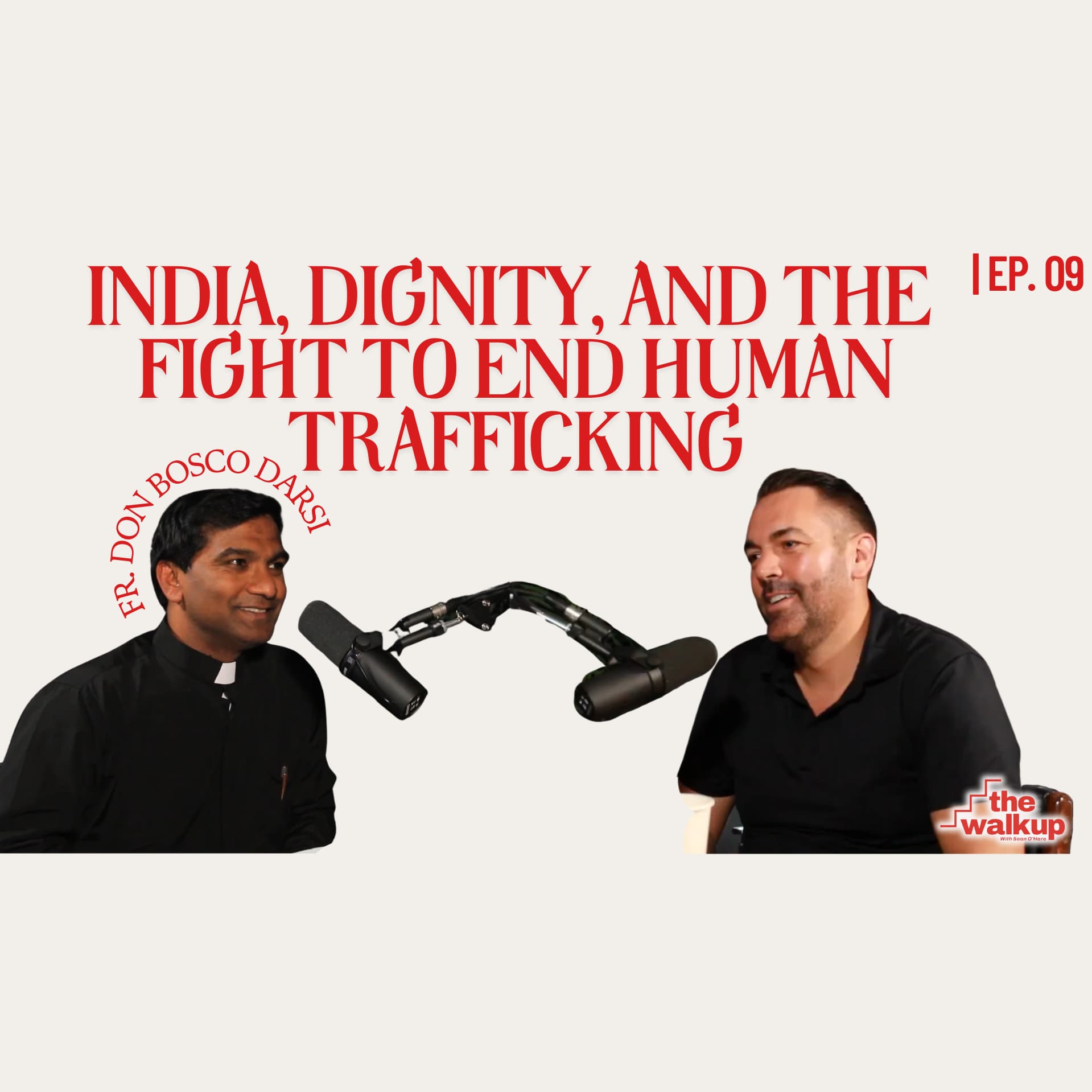
India, Dignity, and the Fight to End Human Trafficking (Father Don Bosco Darsi) | Ep. 09
Father Don Bosco Darsi joins The Walkup from Vijayawada, India, where he leads Talitha Cumi Unnati—a grassroots organization fighting human trafficking and empowering vulnerable girls through education and dignity-based outreach.
In this episode, we explore the intersection of Indian Christianity, economic mobility, subsidiarity, and joy—how one priest’s work in rural villages and orphanages becomes a blueprint for global hope. From confronting caste-based oppression to championing healing through faith, Fr. Bosco invites us into a vision of the Church that is vibrant, liberating, and profoundly joyful.
Transcript
Read the full transcriptAuto-generated · 10,656 words
Okay, well, welcome to the Walk Up podcast. It is a privilege to have you here. So, for everyone who is joining us, this is Father Don Bosco Darcy of the Diocese of Bijawada and founder of Talitha Kumi Unnati. Welcome.
Thank you so much, Sean. I am so honored and privileged to be here at this podcast with you, the Walk Up with Sean O'Hare. This is really an honor. Yeah, well, we're happy to have you, and I think it's important for everyone to know how we met, and this is coming off a recent visit of mine to India. So, back in, it was February, right? Yes, last February, and I would say it's because of the destiny. I'm destined to meet you.
It's not a coincidence. I think this is really to impact. The lives of so many, so many vulnerable people, especially the dropout girls, the trafficked girls, and the marginalized, needy, helpless girls. Yeah, so you were in New York back in February to speak at a conference to raise awareness about human trafficking that is going on in your region, in the state of Andhra Pradesh, in the diocese of Vijayawada. And as you say, destiny, or as we say as... As Christians, divine providence perhaps brought us together.
So, I actually hadn't attended that conference for a few years. Of course, COVID had interrupted it, but I was often traveling when that conference was going on, but I'd always gone for years and years, and I was so happy to go, and five minutes after I walked in the door, I see my friend, Ree. Right. And she says, oh, please, please come meet my friend, Father Bosco. So, we met briefly. We spoke for a few minutes, and you said, you know, please, could you come to my talk tomorrow morning?
And as you may, my friends will know, I am not a morning person. So, but for you, I made the exception. Thank you. Thank you so much. It is the divine providence. Yeah. So, I got up early for you on a Sunday morning, or no, a Saturday morning. And, you know, and you have a very compassionate, very accessible, gentle way about you. But, when I saw you speak about these girls, when I saw you speak about the situation of human trafficking in Andhra Pradesh, you are not gentle.
You are passionate, and you are determined. And that is what made me want to learn more. And so, after the conference, we spoke several times. I like to tell people, like... We met for five minutes, and then yada, yada, I ended up in India, but once it became clear to me what you were working on, and how critical the need was, how important the demand was for this project, and seeing you as a leader, I said, well, if there is a way that I can be helpful.
I'd love to do it. I've been very fortunate over the years to work with a lot of different projects. I've gone to Haiti and Colombia, Ghana, Ukraine, you name it. I've had the chance to go a lot of places and see where the church is operating, where there's humanitarian need.
But the thing that's, I think there are characteristics that have to be present. Yeah. One is, obviously, a genuine need. Yes. Two is, you have to have a capable entrepreneurial leader like yourself. Exactly, yeah. And then you need to have, it can't just be you, you need to have the support. Yeah.
You need to have a team around you. And so, when I learned more about Talitha Kumi, which will... We'll get into more detail. I said, well, I want to meet the team. And then when I told people that I was going to be going, they wanted to come too. So, we traveled with our friend, Fr. Jason Cherone from Pittsburgh.
It was a Byzantine priest, and then my girlfriend Alejandra came as well. She added so much joy to the whole trip because all the girls were coming to her, and she had this beautiful sari and hana. Oh, she brought in so much joy to these girls. Yeah, I was often in the position of making sure that I was taking the pictures for all the people that wanted to take pictures. pictures with her. She was a celebrity indeed. She was a celebrity, yeah.
They wanted pictures with Alejandra first, and then with Father Jason because he is a priest, and not so much me, the third guy. But let's just give some context first. So I think that for a lot of people, this topic of human trafficking is... Is either it is very abstract, it can be very overwhelming when they hear about what really is going on, but I think we should put some definitions around it first. So, if you could just describe how you came to be aware of the fact that there is human trafficking.
Going on in your region, and how it is defined, and how it actually plays out day-to-day. Yeah, thank you so much for asking me this question. As you rightly said, I am gentle and calm, a very cool guy, but when it comes to this issue of human trafficking, I am bold, I am courageous, I am passionate, because I want people to know how urgent it is, and we have to do something.
Human trafficking is everywhere, not just in India. There are 11 countries where human trafficking is very predominant, and India and Bangladesh, they are on top two. And Andhra Pradesh is number two after Maharashtra in India, where human traffic is prevalent. And from our region, every year, over 4,000 girls are taken to the Middle East. Promising good job and better life, but once they go there, things are not as rosy or as positive as they thought it would be.
Let me tell you a little more about my background. After being ordained, I was in charge of young people. Well, let us start before that. So, you were ordained a priest, but that is, so how did, first of all, how did Christianity or how did Catholicism get to Andhra Pradesh, and then how did you decide to enter the seminary? I mean, that is got to be an interesting story right there. Yeah, we are first-generation Christians, both from my father's side and from other side.
My grandparents are not Christians, so it is my parents who were converted, and I also became a Catholic, and I used to go to church every single day. I was a very good boy. Every day? Okay, every Sunday here is considered pretty good, but every day, all right. Every day, and the priest... I said, oh yeah, you got priest material in you. Why don't you try? I didn't even know what priesthood was, but I joined the seminary when I was 13.
13. Very young, you know, quite young. Well, I was still in high school, but I understood what exactly priesthood was only later when I was studying theology, but I loved it. I was so convinced of my vocation, and I want to do something. So, while I was in the seminary itself, I would always go out to meet the poor people, spend time with children. We opened a night school for these little kids whose parents are migrants, and they were from another state, completely illiterate, utter poverty, and these children had nothing, no proper food, no proper shelter.
So, what we would do from the seminary is, every evening go out. and spend some time with them, play with them, and with much difficulty, we got permission to bring them into the seminary every weekend. Really? Yeah. So, that was actually the beginning of, you know, my special concern for the poor, for the children, and as my name, Don Bosco, would remind of Saint Don Bosco, who worked with young people and the vulnerable children.
So, I spent a lot of time with these young children. When you brought them into the seminary, it was like you would have a meal for them, and a program where they would spend the day there. Yeah, every Saturday, we would bring them, and play with them, and prepare a meal, and for Christmas, we did some fundraising, and I used to work back then in the library, just to make some money, to be able to provide ice cream.
You know, children would love ice cream. And probably for many of them, that's their first ice cream. And that's the best or the most nutritious meal they could have in that week. And I saw the joy in their eyes, especially the girls who...
Would often end up in human trafficking, and I saw one girl, she was just six years old, and she fell in the small little canal, and she was drowned. And we went and picked her up, and you know, they were not Christians, so we buried her. And it was really a heart-moving moment where I felt a special. connection to the children and young people. I wanted to care for them. So, the seed actually was put in then, and then we organized several events for children and young people, and evidently, my bishop, after ordination, he put me in charge of young people.
I was the youth chaplain of the diocese. Okay, because you were ordained in what year? Mm-hmm. It was in 2008. 2008, okay. So then, and I assume your parents were very excited about you becoming a priest, yes? Yeah, yeah, yeah. And you got to study not just in India, but also in Belgium, yeah? Yeah, yes, yes, yes. And you spent some time in Belgium also doing some work with a very different situation, right? You are dealing with kind of a post-Christian environment where they have beautiful churches, but they are empty.
Mm-hmm. And in India, you have simple churches, but they are full. Yeah, yeah, exactly, and the people are so happy, and all children and young people, women would come, and churches are full, and wherever I went as youth chaplain, I saw hundreds and thousands of people, as you yourself have noticed it when you were in India, but you're right, and when I went to Belgium, churches were empty, and there was actually a thousand-year-old church which was closed, and with some young people, We reopened the church, and we went to the city hall and asked for a special permission to use the church.
They said, okay, you can keep it if you get 50 young people. In six months. So, in six months, we went around, and we evangelized, we brought in so many young people. Did you give them ice cream, too?
Yes, yes, yes. Spiritual ice cream. Also, beer. Yeah, in Belgium, beer is what works. Belgium waffles, chocolates, and beer. We actually first started, you know, theology on tap. Yeah. So, it was in a bar. Yeah, yeah, yeah. Theology on Tap is a very successful program here in the States, so that's... I didn't realize it was in Belgium, too. That's great. With some American students and a priest friend of mine, who is a Glenmary missionary. So, we both, we started actually a kind of, you know, Theology on Tap, but we felt we need to, you know, have a...
We can come to Mass and have some spiritual events, and you won't believe, within six months, we had more than 120 young people from 46 nationalities. So, that church is still active, and it's called St. Quentin's, a thousand-year-old church. We reopened, and now that's the most attended. I have that feeling in New York a lot of times, because we have a lot of churches in Manhattan and Brooklyn. We are here in Brooklyn right now, in the Diocese of New York, which does not include...
Brooklyn. Brooklyn is a separate diocese. In the Diocese of New York, we have 296 churches. That is down from maybe 350, but we have a lot of churches that are beautiful, but not very full. And I always feel like it is not... It is not that people are not seeking God. It is not that they are not starving for a relationship with God. It is that we have a maintenance mentality, and we need to have an apostolic mentality again.
And in fact, I will share this now, because I want to make sure that I do not forget. So, when we were... In India, together, as we discussed, it was myself and Father Jason and Alejandro, but Alejandro had already left, and it was now Father Jason, Sharon, and myself with you.
And on the last day, Father Jason asked, he said, before we leave, I need to ask for your blessing. Yeah. He said, because you have... ...reinvigorated my priesthood, and we both know that Father Jason is a very dedicated apostolic priest, and for him to say that being in India, being with you, with the fellow priests, reinvigorated his priesthood, I was so struck by that, one, by Father Jason's humility to ask for... For your blessing, and also to admit that he has room to grow in his own priesthood.
But then also, it was... It made me realize what we need in the West, I think, is for many centuries, primarily missionaries that were coming from Europe, for the most part, were going to South America, to India, to Southeast Asia, to Africa, bringing the gospel, which was a beautiful...
Three, four hundred years of bringing Christ to different parts of the world, and now I feel like it is those parts of the world that need to infect the West with this sense of apostolic zeal again, because I feel like we have lost our enthusiasm and our zeal. And that interaction between you and Father Jason was kind of a microcosm of that, that like the experience... We need that urgency, that sense of every soul matters at every moment, that it is not...
Christianity here can be a little too safe. Let us just put it that way. It is very comfortable here. Yeah, yeah, yeah. So, I just wanted to share that with you, that it was... That is one of the most... Poignant moments that I share with people about my visit to India. We have Mother Teresa, who actually is the face of Christianity's...
There is a concern for the poor, and we have St. Francis Xavier, who was a missionary who went to the Far East, and we also have St. Thomas the Apostle, who came to India. With all this rich traditional Eastern spirituality, we have something different from what the West. So, we have Eastern Jesus, Eastern spirituality, where faith is more expressive, and it is also tangible. People want to touch, people want to see, people want, for instance, you have noticed in a Marian shrine at our place, you know, people break coconuts.
Right, right. I got to break a coconut. I did it on the first try, I'd just like to point out. Yeah, yeah, yeah. So, you offer one piece to God and take the other one home. It's considered as a blessing. And, you know, we also offer a lot of incense and candles.
And people walk up to the hill, sometimes on their knees. Right. So, faith is very expensive. Impressive. A full-body experience. Yeah, yeah, yeah. Yeah, so maybe talk about shrines, because that was one, if I were to point to something that is distinctive about the faith in India versus the faith in the West, is, well, I will just say the States, because you do see more of that in Latin America with shrines, but nothing like in India.
So, explain to an American audience, like, why are shrines such a prolific thing in Indian Christianity? Yeah. Well, we have a lot of influence from Hindus, also Muslims, and Buddhists and Jains. They have huge places of worship where thousands and millions of people gather. So, this shrine in our diocese, which is called Our Lady of Gunadala, on 9th, 10th, 11th of February, we have one and a half million people. Wow. And every weekend, we have about 20,000 people, and most of them are not Christians, you know?
So, people are searching, searching for something deeper. So, that is a million and a half is in Vijayawada? Yeah, in Vijayawada, in three days. Give people some context, though, because in India... 3% of the population is Christian, and that would be 2% or so would be Catholic, and yet you are getting a million and a half people.
To show up to this feast day and to the shrine. Yeah, about 90% of them would be non-Christians. Wow, that is interesting. Yeah. So, what do you think motivates them? Hindus and Muslims, yeah. So, they want to, you know... Meet God or receive some blessing, and in general, Indians are tolerant. They're peace-loving people. So, for them, Jesus is...
Like any other deity or an avatar Hindus would believe in. So, occasionally, they would come to a Christian church or a Christian pilgrim center and maybe break coconut and go. Also, you know, many women come there praying for, you know, children. If they're not married, they want to get married. If they get married, if they are married, they want to have children, so there are special kind of pious practices, you know. So, you see all kinds of Indian Hindu practices of religion there.
So, it is a pilgrim center, not just for Catholics or Christians, but for everyone. So, now you get this assignment, you discover your vocation to the priesthood. You are ordained, and the bishop assigned to you as kind of youth chaplain, so you have this heart for young people, but then when does your eye turn towards trafficking and these vulnerable women? When does that become something that you are more aware of, and something you decide to dedicate your life towards? Yeah, as I have already explained, so it actually was implanted in my mind and heart when I was in the seminary.
Taking care of these street children and vulnerable girls. But then it became more pronounced when I was doing youth ministry, because I went to every single parish and covered most of the villages, and I have seen that people are very, very poor. Especially girls, they are dropouts of high school. Once they are dropouts, they are vulnerable. They are marginalized, exploited, abused, and some of them trafficked. In our region, we have a huge problem of early marriage, or forced marriages. Girls are forced to marry against their will at the age of 15, 16, very young.
Girls, you know, so before they are 20, they are already... Mothers with two children, and sometimes husbands do not take care of the family, so the whole burden falls on women. I have seen so much of it, but it was during my doctoral studies, I studied moral theology, where Catholic social teachings is one of the topics that I dealt with, and now I teach that topic in different seminaries.
You talk about solidarity, you talk about justice, also subsidiarity and compassion to the poor, taking care of the poor, but most importantly, what touched me was the aspect of dignity, because these people think that they do not have dignity. It is their Karma to be born that way, you know, because if you understand the caste system in India, these people come from the lowest.
Yeah, so let us define that first, because that was an education for me. I mean, I have certainly heard that, you know, you understand the idea of a caste system, and then even in the Middle Ages, we had some form of that in Europe. But define for people, what is a caste system, particularly in India, and then what does it mean to be? Yeah. Simply put, in one word, I would say it's one form of human trafficking. Okay. Okay. It's a form of slavery for centuries, for thousands of years, you know.
In America, you would understand how the white supremacy... Prevalent for a long time, and, you know, the colored people are not considered equals, and there was a kind of slavery, but this exclusion existed in India for centuries. So, if you do not belong to the top class or middle class, then you are not included in the society.
And just to find for us, I know there's the head, the shoulders, the waist. So, how does that work? Yeah, in Christianity, you believe in the myth of God creating humans from nothing. From the dust, yeah. From the dust. But God creates people in his own image and likeness. Correct. Genesis 1, verse 26. But here, in Hinduism, there is a myth that goes, which explains the origin of humanity, how God created Brahman. He creates people, the first class or the top class or the Brahmins, from his head, and the second class from his shoulders, third from his waist, and the fourth from his foot.
Then there is a fifth class. Yeah. So, this is actually, it is a very good system. The ethical order follows it. Also, the... The professions or the jobs in the society are based on these castes. So, there is no problem. Initially, there was a harmony because everyone has their job and their prescribed place in the society. But when there is intermarriage, the children that are born are considered outcasts. Also, there is a myth that says God also created the fifth class from under his foot, and they are the most vulnerable, exploited.
For a long time, they are not considered part of the society, and they are even treated as subhumans. So, this is a plight of these people, and if you are born in that caste, it is considered as... As a curse, as a bad fruit of your karma, and if you are born as a woman or a girl in that caste, it is considered as a double curse. So, first you are born as an outcast, and then you are born as a woman, which is, you know.
So, neurologically, you tend to think this is your fate. God has created you. You are not wanted. You are not a person of worth. And then, you don't have self-worth. And it's girls from this community who are the most vulnerable.
So, to contrast it with the States, or in the West generally, we think of economic mobility as normal, right? I mean, again, there was a feudal system in Europe for a long time, but it certainly, post-capitalism, you could rise from dirt poor to a billionaire.
If there's the opportunities come about to make that happen, and in fact, we almost celebrate it, too. We really celebrate when somebody has this incredible rise from modest beginnings to become very successful, but what I found interesting was that you were saying to me that because of the idea of karma, that if you are born into Whatever caste you're born into, that you're supposed to stay there, and so if you were to help somebody from the lower caste rise up, that would actually be disturbing, not just their karma, but yours as well.
Yeah, yeah. So, there's a disincentive, so to speak, to allow for that mobility. Yeah. One can never change or climb up the ladder, you know, change one's position in the society, maybe in the next life, but there is economic prosperity, maybe because of their hard work, and now through education, but, you know, When you were in India, one bishop said, if you are born into high caste, you are born with a lot of self-worth, self-confidence. But if you are born into low caste, there is so much of baggage.
That is coming with you, which says you're not a person of worth, and you have to work hard to be confident and to feel worthy of yourself. However... There are some people who try to, you know, excel well and come up in life, but the larger majority are neurologically, you know, ingrained to think that it's your karma.
So, your future is already written. You can't do anything more. That's why this recent study that we have made, it's called Rewrite in the Future, an adolescent girl's study. So, we have already carried out a previous study, which is a girl child technical study, where we went to 100 villages with MSW students. And they made a survey which shows that girls from 14, 15, 16-year-olds are dropouts, and they are vulnerable, they are marginalized, and they are victims of human trafficking.
And this is the second study which shows what we could do for them. First of all, show them a way that they can rewrite their own future. And talitakumi is all about this, helping them to rewrite their future, to arise, and also unnati. Unnati is a Sanskrit word. It has also Latin connection, like ultimum or ultimate, something higher and nobler. So, these girls have to arise.
To something which is higher and nobler, and that is possible through education. And I think that something that we take for granted in the West, one, is that idea of economic mobility. The second is that the... The belief that every person has equal dignity, regardless of their station in life, regardless of their circumstances, regardless of what they were born into, that we all have equal dignity. And that, I think, is something that has been so fully adopted by Western civilization wonderfully.
However, I think we sometimes forget how radical that idea was, right? I mean, in Roman times, the idea, you are going around saying every person is equal dignity. I do not think a lot of Roman senators felt that way. I mean, there was slavery was commonplace. And so, it is something that wonderfully is considered a normative thing, but we forget that it is a radical idea that Christianity introduced.
You know, slave or free, man or woman, everyone was equal, and that was like a mind-blowing idea at the time, but I think what is interesting about that is that with that, as you mentioned moral theology as your background, once you have that as part of your theology, And this is where faith and works comes, right? Once you have this belief about the nature of the human person as a distinct, beautiful... Because a gift of God, the works have to follow.
We cannot just say, oh, well, everyone has equal dignity, but I am going to ignore people that are poor, that are sick, that are in prison. And people with disabilities. Or who have disabilities. We have to do something. Yeah, both physical and mental disabilities, they are also persons of worth. They have inherent dignity.
So, we are dealing with several layers of indignity. So, inherent dignity, ontologically, they are people of dignity, no matter who they are, which cause they are born into. Also, there is social dignity. So, when society denies you dignity because of your birth, because of your status in the society, that is not correct. That is injustice. And there is also...
Moral dignity. So, I think, for me, this whole issue of human trafficking, it is a morality issue, because you treat the other person as a... As a thing, or as an object, yeah. And also, you are so egoistic, so selfish that you don't care for the other. You don't respect the other. You don't, actually, India has a beautiful tradition, you know, we all say namaste, you know. So, namaste, actually, is a beautiful expression of Recognizing dignity in the other, because when I say namaste, or when I bow down like this, I'm actually recognizing God who is in you, and showing tremendous respect to you.
But in some areas, or some places, this is only for those who are, you know, educated, or economically affluent, or high-caste people. But you don't even care for the low-cost people, and sometimes you treat them less than, you know, animals, which is not correct. So, it's a matter of justice.
That's why I'm so passionate about it. It's not charity. No, it's not charity work or risking one or two here. Yeah, it's justice. You know, they have to live and they have to be treated with respect. And when some girls are, you know, trafficked, be it labor trafficking, sex trafficking, organ trafficking, and beggary, you know, that's also another prevalent trafficking. And UN has...
Named forced marriages or early marriages also is another form of trafficking. So anything that is forced against the will of the person is trafficking. So let's get into some kind of the details, which I know are not pleasant to speak about. But you reminded me of, I got a little theological training in my high school, and I remember that... Right, that people are ends, they are not means. Yeah, exactly. And so, we can never use a person as a means to our own end.
They are only ends in and of themselves of equal dignity, right? So, that is why you cannot buy and sell people. You cannot traffic them. You cannot use them only for your own, you know, economic gain or sexual pleasure. That is a crime, a crime against humanity. Yeah. Crime against humanity, and in this document from the Dicastery of Faith and Morals, we have this declaration. It is called Dignitas Infinita. Infinite dignity. So, no matter who you are, you are a person with dignity.
This is the core of the work that we do. Tell these girls, you are a person of worth. You have dignity. You have to stand up, so you can arise. It is not just the theological background, but it is also a sociological issue. It is a matter of justice, and Psalm 82, verse 3 and 4, talks about taking care of the fatherless.
So, in a way, this modern slavery, which has captured these... Victims are vulnerable people, innocent children. It's a crime against humanity. And this calls also for to act in conscience. So, if you have a conscience that is formed, you automatically, you got to do something. You have to rise and act. And that's what you are doing, and that's what I'm trying to do. And, yeah, divine providence brought us together. And we are creating a kind of network, a network of hope.
And this year, I'm glad to inform you that we have a network of 10,000 girls. Okay, we do want to help a few girls here and there, but we want the girls to help themselves. Of course, yeah, and that is part of dignity as well, right, is that, of course, we need to help people when they are at their lowest point, but then knowing that they have the ability to eventually provide for themselves, and I know that is what you are doing at Talitha Kumi with job skills training, education, but let us walk through the kind of...
The practical implications. So, if you have, let us say, you have a 14-year-old girl, and let us just kind of remind people where in India you are. So, Andhra Pradesh, which is in the southeast. Southeast, yeah, and Vijayawada. It is a capital of our new state, and it has a very, very... Good history and a lot of potential, so many education institutions, but unfortunately, in the rural area, there is a culture of silence. People don't want to talk about it. It's a negative, it's a taboo thing.
That's why sometimes I would like to, you know, talk more about human dignity than human trafficking. Sure, sure. Because people tend to, you know... Think negatively, or it is something, a topic of taboo, but focusing on dignity to those people who are denied dignity, that is breaking the cycle of poverty. Also, breaking the culture of silence, and there is so much of indifference to this issue. So, what I am trying to do is, I am trying to be the voice of these vulnerable girls, and also creating this network.
A strong network of hope where they can be their own liberators or saviors. The process is slower. But I'm definitely convinced, I'm hopeful, that eventually, after some time, maybe it might take a couple of years, if all these 10,000 are, you know, filled with self-confidence, that they're people of worth, and they have human dignity, infinite dignity, that's the game-changer. Yeah, and that's the campaign that you and I are working on, the 10,000 Saved, which will... Yeah, yeah. We'll define here shortly, but let's talk first about how women find themselves, these girls and young women find themselves in a vulnerable position.
Yeah, yeah. So, usually between the ages of 14 and 17, there's a number of reasons for economic plight, right? So, either their parents are not in a position to continue their education, so they're looking at... A potentially forced marriage, because that would provide some economic stability, but that is not really choice.
And then, if you could speak about how, I think a lot of Americans or those in the West are like, how does this actually happen? How does someone get trafficked sexually or labor trafficking? How does this actually happen?
I will tell you a story of a girl named... I am not using the actual name. Of course. Divya, to protect her identity. She is 16-year-old, and she never went to school. She is an orphan, and her aunt took care of her, but she could not provide for her dowry, which is a prevalent practice in our area at the time of wedding. So, what she did was… Yeah, yeah. Contribution from the woman to the man's family. Yeah, yeah, yeah. A dowry, okay.
And if you don't have a dowry, it's very difficult to get married. So, at this point, you know, she was just a caretaker, and she was a poor widow. She couldn't take care of this girl. So, another woman comes and says, you know, she has a job in a nearby town.
So, she takes her there, and eventually... She forces her into, you know, sex trafficking, and she's forced to attract men from highway, and she wouldn't be given food if she doesn't bring in 20 men every day. Okay. So, at some point, she was so traumatized. 20 men a day. Yeah.
That she's kind of... Recruiting into these prostitution centers. So, recently, somebody informed us we could rescue and then put her in a safe shelter home where she can have a different life. And now she learned to trade, to stitch.
She is in a safer place, and she feels that she is valuable. And also, you're providing... Yeah. Trauma care for psychological counseling, and then I know that you said that a number of the girls go to the Middle East, so I think, again, for a lot of Westerners, how does that happen? How does somebody go to the Middle East and then all of a sudden realize, wait a second, now I am being trafficked. I do not even understand what is happening.
I thought I was coming for a job. Yeah, in this document, Dignitas Infinita, Pope Francis talks about, you know, Poverty, war, and human trafficking. All these three are connected. You know, there is migration because of, you know, better work conditions or better salaries, you know. So, within India, there is a lot of migration from one state to the other. But also, if you have to get a good job, you need a certain education or university degree. But if you don't have education, you take a job that is, you know, offered to you, and then you're underpaid, and most of the time, these girls that are dropouts, they have to go to work in the fields as agricultural laborers or as domestic workers, you know.
So, there is an offer, you know, for you to work abroad. So, abroad. It's not America, but other places where it's not just labor trafficking, many other things, you know. And a lot of times when they arrive, they...
Passport or any sort of documentation is taken from them, so they don't have the ability to then leave, and then whether it's labor trafficking, it might say, listen, we might have told you this was going to be 40, 50 hours a week. It's actually going to be 80 hours a week, and yeah, you're a domestic servant, but oh, by the way, if the husband of the family wants to Make that relationship also have a sexual component. You really don't have any choice.
Yeah. Yeah, one thing is you're in a vulnerable situation. Anything can happen to you. That's why the longer they are in school or college, the better it is for them. So, in the process, they have education. They also have a certificate, which will allow them to get a job, but more importantly, they grow in confidence, self-worth. As a woman, they can understand themselves, and they can rewrite their own future, and also, we try to focus also on happiness, you know, happiness and health, because some of them think, oh, it's their fate, and they don't have any happy moments in their life.
That's why, you know. You saw in India when you were there, you know, ice creams. Right, right. So, when they get ice cream, it makes them feel happy. Or maybe small little games or animation or, you know, we try to create those little moments of happiness.
And certainly they are happy when they are in school. than when they're at work. And they're in a safer environment than in a vulnerable situation. So this is what we are trying to create, an opportunity for them, you know, to have a better life. Yeah, so education is key. So for those that are vulnerable to being in a trafficking situation, the more education they have, certainly.
English speaking, training, things like that provides more economic opportunity, and then for those that are fortunately post-trafficked, there is a need for psychological counseling and healing, but then also job skills. So, I know, for example, when we visited one of the schools, they had just received their certificate that day for learning how to stitch and to become...
I think, I don't know what we call it here on the stage, but kind of clothing manufacturing. Yeah, yeah, yeah. I think seamstress is an old word. I don't think we use that word anymore. But, and you could see the joy in the... And the dignity of like, I did this, I trained for this, and now I can help provide for myself, and then what you are trying to do, and this is why we have 10,000, is because when I first met you, I said, well, what is the project you are working on?
And you said, well, we have 127 Catholic schools in Vijayawada diocese that have been closed, and so we want to convert them to centers for these. If they need a place to live. Yeah. If they need a place to live. Or if they need a place to learn. Some skill or, you know, some small little profession. Maybe tailoring. Recently, also, you know, I keep getting some new ideas and thoughts. Maybe our viewers will like it. Maybe you can also, you know, come up with some ideas.
You know, why not make milkshakes? Yeah, sure. Why not have. Or sell ice cream, you know. So, because that gives them. A kind of... Self-worth, you know, they are valuable, and there is some sort of little profit that they get by doing this, and we are constantly thinking how best we can make their life better. So, this is one way to use, to provide them a platform, and to use every single opportunity to make them feel that they are people of worth.
You know, this is very, very important. So, labor dignity leads to human dignity. Okay. And there are also so many. We want to physically disable people, mentally challenged people whom we want to focus, and also tell them that you can also have a job. You can also have a different life, you know?
Well, yeah, one of the other most... There were so many great stories coming out of my visit to India, but certainly visiting the orphanage for disabled children was just one of the most beautiful and powerful experiences. And I think, so we went down there, our friend Father Kumar is very involved with the orphanage there, and it is run by Mother Teresa's nuns, the missionaries of charity.
And I think it's hard to convey to people sometimes, like… How much joy these experiences have. I think if I described to someone, oh, we are going to visit this home for disabled children, they would think, oh, that is going to be so sad, right? They have physical disabilities that, of course, are very severe, things that can be difficult to see, right?
And some have, of course, some emotional, psychological disabilities, intellectual disabilities. But... It just tells you about dignity, which is that when these nuns, who are the mothers to these children, there is such joy that radiates from that place, that after Alejandro and I went there the first time, we said, can we come back tomorrow? We want to come back again, because our hearts were just exploding with joy.
So, I think that the idea of dignity is applied universally, and I think we think there are certain communities that, well, they are disabled, we will put them over here in some home or some hospital or something, and we do not have to think about it anymore, or the homeless, the same thing. But in this case, the church not only Because we have this theology for how we believe and understand the idea of justice. We then have to act on it.
So, maybe if you can explain, because the reason we got to 10,000 as a number is because when you told me, oh, we have 127 empty schools, and I said, well, If you filled all of them, how many would it be? And you said 10,000 girls. Yeah, yeah. And I said, whoa, 10,000. I said, would you have any problem filling that? And you said, that is not going to be a problem. That is how big the need is. Yeah, yeah. That you are going to have no problem filling 10,000 girls into these schools.
So, maybe if you could just describe, why are these schools empty, and then how would we go about filling them? Yeah. First of all, I would really like to... I appreciate you for, you know, visiting these places, especially this, it's called Sishubawan, run by Mother Teresa Sisters, where... With disabled children, and with both mental and physical disabilities, I would actually, I still remember that memory is very fresh. You are holding on to this little, you know, child with disability, and holding, there is such a communication of joy, you know?
And I would say that is a kind of, that is an ocean of joy. It is. So. If you just go there, you want to spend time, and you want to come back again, you know, when the world is so busy, and you have anxiety, depression, so that is a place where you can go and, you know, recharge yourself, and be filled with joy. So, what we are trying to offer in these places, these schools that are closed.
By the way, we have over 100 schools in our diocese, which used to be... Places of learning, and for various reasons, in our state, these schools were closed, and now we have these huge spaces empty. One of them is our Thalithakmi office, where at one time, more than 1,000 children were there on that campus, and now the whole campus, the whole building is empty. Yeah, I saw it, yeah. Yeah.
So, we are trying to, you know, make use of this available space. And also, furnish them as places of joy, places of learning, places of new skills. Our hope is that, you know, these become center where girls can excel in their talents. For example, if they want to sing, if they want to dance, and some of them Just want to come and put Hannah, how Alexandra liked, you know, to have Hannah.
So there is a lot of hope there. So when I discussed with you this program of turning these abandoned schools into places of... Animation and safety and also providing new life opportunity for them to have a new life, a second chance in their life. I think this is crucial, and it's very, very important, and all our viewers would be very much motivated to take this course forward because there is something concretely happening there. And number 10,000 is so clear, and we can impact these lives, and it's often not financial support.
It's social encouragement, moral support, accompaniment, and our work, if you would like to understand, we would like to use the word acronym AMEN. Mm-hmm. A stands for accompaniment. Accompanying these most vulnerable in whatever way, you know, each one needs a different kind of accompaniment. So, we have these religious nuns who are available to accompany these girls. We also have our staff members you have seen, but girls can accompany their own friends or younger girls. And second one is mentoring. So, we have so many opportunities of mentoring, leadership, and where they can also, you know, show their skills and talents like you saw Sindhu.
And her brother, Praveen, you know, they are very innovative and creative. And the third is education. Education for empowerment. And the fourth one is networking. Amen. Networking. And that is what I am so fascinated about you. You have this strong networks, wider network, and I am so inspired. And I want to grow in this, you know, I call it a ministry or a network of hope. So, we are creating. A network of hope among all these 10,000 girls.
So, sometimes it's only through moral support, sometimes maybe through a podcast or YouTube, or maybe sometimes just, you know, praying for them. Yeah, and I think... So much of this is about, you have to raise awareness, and I think that is a term that gets thrown around a lot, but the bottom line is that there are lots of different needs around the world. Yeah. And I always look at it as kind of like a free market in the sense that you use storytelling to make people aware of what is going on, and if it speaks to their heart and it makes them feel like, I really feel like that is something I want to contribute to or pray for or what have you, they can, at least now, are aware that they can do it.
So, the way that we met, I learned, I become aware, I am like, okay, well, let us try to see if we can. Can you speak about how, because I think it is an interesting model you developed about how you find the girls that are in need, right? Because there is a sensitivity always about, because I think some people that might be not skeptical, but a little suspicious of how these things work, say, what do a bunch of priests know about this?
What do men really understand about what these vulnerable girls are going through? But you address that by the program that you develop. Yeah, you're right. As men, we don't understand the concerns of the girls, and their issues, their problems, but women understand better. That's why we have these religious nuns in every parish or village, where they know what's going on. It's actually our bishop who was so touched by this terrible incident, where one day... An 18-year-old girl, she... After getting married, she was very brutally treated by the husband and in-laws, and they were torturing her regularly, every single day, to bring in more dowry.
And so she went home and asked her parents, you know, in-laws are torturing me, my husband is after me to get more dowry, and the parents said, no, we can't give anymore. We have only this small little hut. Where can we live if we sell this and give it to them? So, the girl comes back. But the in-laws and husband is even more terribly abusive. And something happened that night. And the next day morning, she did not get up. They either killed her or she committed suicide.
But the whole village was silent about it. It was only the religious nuns. Who went and complained to the police, but the police would not file a complaint because of the political influence and so many other factors involved.
In the end, this poor girl, a teenage girl who is married, nobody is on her side. So, this is a matter of justice. So, it is religious nuns who are actually very involved in this cause. So, it's through their intervention we select the 10 most vulnerable girls. Orphans, dropouts with single mothers, or people who have no economic support to continue their education. So, we have over 100 parishes.
From every parish, we take the most vulnerable girls, 10 from every parish. So, that way, we have 1,000. We have their data, we have their information, what they are studying, and their contact, their photographs, and all this, but each of these girls should form a small group of 10 other girls. We call it girl parliament, where they come twice a month and discuss their problems.
But solutions also come from themselves, you know, because when they discuss problems, maybe some of them say, oh, this is the solution. So, slowly, slowly, they... Support each other, help each other. So, this network of 10,000 is a clear evidence that eventually they will come out of this cycle of poverty and this culture of exploitation. And also, this cycle of silence will be broken.
And hopefully, they will arise, arise and arise to the ultimate, you know, to a better life, you know. So, we are actually, you know, showing them there is other way, there is a better way, and it is in their hands.
They can figure it out. They can help themselves to come out of their vulnerable situation. Yeah, and so it's very much a... Applying the principle of subsidiarity, right? So, we believe as Catholics that there is a principle of subsidiarity, that those that are most local should be the ones that should manage things and only goes higher as needed, right? And so, what our parish is, our parochial model, is by nature a principle of subsidiarity. So, we have 100 parishes. Out from those 100 parishes… 10 girls each, so now 1,000 girls that are then networking directly and building relationships directly with the most vulnerable girls, and then ideally, 127 schools can then be filled with those girls as centers for learning, for trauma care, and job skills training, and hope, like you said.
Yeah, this isn't ... And that can have a ... transformative effect, and I think what I had mentioned to you early on, and what I've mentioned to others as I've gotten involved with this project is, it's very, very rare that you have a critical need, you already have physical plant in the form of buildings in these schools, you already have qualified personnel in these religious sisters that have been Working with these girls and also working in schools, that all you really need is the money to then fill them, and that is rare.
It is urgent. I mean, we cannot wait for a few months or one year, because then we will have newer... Victims. Right. So, then we have to take care of those victims. What about these victims now? So, we cannot wait too long. So, as many as possible, show them a safe place, or put them in schools, and provide them opportunities, and that is a game changer. And how, so we were talking about those that are vulnerable to being trafficked. For those that have already been overseas.
Mm-hmm. Or even locally, as you say, migrant work, they might go to the state nearby. Yeah, yeah. How is it that you identify them, and then how do you go about going through a healing process with them? Yeah. Actually, government has a certain system. It is called Childline. So, if you identify any... Victims, so you can go and inform them. But unfortunately, because the government is not able to fund this chain of protecting the vulnerable students or children, so from last April, they completely stopped this child line.
So, there used to be a referral program, effectively, and now that is no longer there. Yeah, that is no longer. So, many, as you have seen, Mother Teresa sisters or other sisters are seen as the places that these girls can go to. Gotcha. Yeah. So, at least they have a safer environment. For instance, you have seen this place called Prajwala, where...
Girls who are trafficked are young mothers with little children, you know, so they have nowhere to go, and probably it's not safe for them to come back from there. So, they're kept there as long as possible, because they have regular care, and also food and shelter, and they can also learn some trade, some skill, you know, to make them feel valuable. And... So, some are used to coming through the government, some know how to find the sisters, and then otherwise you have your trained groups of 10 girls at each parish to go out and find them.
And I think this is, we were talking about network before, right? And I think this is one thing that sometimes I think is underappreciated when it comes to the Catholic Church, is that Even in a place that... So, like India, while we did have St. Thomas' influence as an early disciple, it is not a traditionally Christian country, of course, and yet, because of Italian missionaries who came 100 years ago, they built schools, they developed seminaries, eventually leading to your vocation, so now when we are confronting this topic of human trafficking, look at the infrastructure.
You have religious sisters, you have schools, you have priests, you have parishes. So now, all of that infrastructure, that organization, that network, can be applied towards this particular problem, whereas I've talked to a lot of nonprofits who are wanting to combat human trafficking, which is wonderful.
But if they are coming into a new country, how do you know who to trust? Who do we communicate with? How do we have a physical space to operate from? So, the church is kind of uniquely suited to address these issues. Exactly. In our diocese alone, we have over 900 religious nuns. Yeah, that was crazy to me. So, 100 parishes, you have about 250 priests? Yeah, yeah. 900 nuns. 900. So, the nuns are the backbone of the Diocese of Yishawada. Yes, yes, yes, yes, yes.
Yeah, and sometimes, you know, probably their services are underutilized, okay? They have so much potential. I mean, look at the United States, what religious nuns have contributed in terms of education, parochial schools, orphanages, hospitals, social work. Mother Cabrini. Yeah, of course, right here in New York City. Yeah, yeah. So, what I would say is this is a great potential, a treasure.
We could, you know, put to optimum use, so that most number of girls can be cared for. Yeah, whether you are Catholic or not, non-Catholic, you got to accept that the network that church has, it's incredible. And all the buildings, or, you know, for instance, now I came to New York. And I don't know anybody here, and you brought me to this place, and this is networking, and this is possible through Catholic Church, but using this network, why I say this is, we have to...
We very positively use this network because the other network is stronger. The network that denies... The network that's trying to traffic girls. Well, because they have economic incentives. Exactly, exactly. There's immediate financial gain or what have you. Sound of freedom would tell you how strong that network is.
And they're willing to commit violence to protect it. Yeah, yeah, exactly. Which obviously we're never... I would never think of that, but it is strong because of the financial and also of the enforcement through violence, if necessary. Yeah, I would like to term it as, you know...
Negative network and positive network. When the negative network is so strong and so impactful and effective, what happens to this positive network? And we also have to probably learn from them, because in the end, we want to restore dignity. We want to recognize the infinite dignity these people have. And if this network is helping you, build it up. Create this network of hope. In fact, what Mother Cabrini did was the same. She created an empire of hope, a network of hope.
And I think we need this collaboration, networking, cooperation, if you would say correspondence. Between all these non-profits or organizations or people of goodwill or people of good conscience who are inspired or who are motivated to do some good, to help these vulnerable people.
We got to do it. And are you ever concerned about retribution? Are you ever concerned that those that are involved in trafficking, that have economic incentives, are you ever concerned that they would attack or do something in retribution against the nuns or against yourself?
Yeah, sure. A classic example in India would be now, for instance, Mother Teresa, some view her work negatively. Right. Because she tried to, you know, bring people out of poverty or rewrite their future. Another classic example we have is about Rani Maria, Sister Rani Maria. So, she was out in the villages, educating the poor and empowering them, and at some point, the rich people came and stabbed her. In the middle of the road, she is in the process of canonization. She was a martyr.
Yeah, yeah. She was killed because she was on the side of the poor. So, yeah, the persecution that happens now in some parts of India. Or, another example, a Jesuit, his name is Father Stan Swamy, who died in prison. Well, many people have doubts how he died. He was a human rights advocate. He was the voice of these landless tribals who were unjustly put in prison, and he was trying to, you know, bring them out of prison, and in the end, he was imprisoned, and he died in prison.
So, there is a lot of... Danger involved, retribution, and you never know what would happen. We have courage. We have hope, you know. So, if you're not courageous enough, I mean, you can't achieve any good action. So, I would, no matter what, I would take the side of the poor and side of these vulnerable girls and do everything I could do to ensure that they have a better future.
Well, that's probably a good place to wrap up. I mean, we'll be continuing to work on the 10,000 Saved campaign. We'll make sure that everyone who's listening and watching has an opportunity to support. What we have discussed here is really the core of the Christian mission, right? You form the intellect, and then you form the will, right? So, the intellect is to know the good, to understand theology and philosophy and morality and all the things that lead to justice and treating people with equity, but then you have to form the will and the desire to want to do something about it, not just...
It's nice to know these things, but it's another thing to then act on it, and in this case... act on it knowing that it may even risk your own life yeah yeah but the the cause is too great not to be willing to to offer yourself in your in your gifts and your talents but maybe even yeah your life as well yeah um if your conscience is formed um strongly you will definitely be a whistleblower You will wise out wherever there is injustice, and certainly there are so many homeless, so many poor.
For example, now what is happening with the war victims, you know, you got to take care of them, but this particular moral issue of vulnerability or injustice, it needs... An immediate action, okay? And we got to roll our sleeves and, you know, be on their side. You're a strong man. And certainly, if there is injustice or if there is...
If there is a wrong thing happening in front of your eyes, you will certainly, you know, react. Act upon it. Act upon it, yeah. Sure. So, that is why we say... Rise and act. So, these girls have to rise and act. So, I would also invite our viewers to rise and act, and to rewrite the future of these vulnerable girls, and yeah, it's not just financial help, but that would... That'll be a good thing to do, because there is so much need, and we don't have enough resources.
So, that's also, you know, resource mobilization is another important thing in our work. So, networking, also resource mobilization. And any ideas and thoughts? I'll be very, very glad, because you are rewriting future of not just one girl. Many girls, not just one generation, but many generations to come, and this is a work of justice.
It is, and it's the work of what we're called to as Christians, but as we talked about, it's for all. This is not just, we owe it to all those women there because of this injustice that exists to try to correct that. So, we will be continuing to keep everyone updated, and we will provide links to Leith Akumi, and thank you for being on the podcast. Thank you so much. As I said in the beginning, it is a great honor. I feel incredibly grateful to you for inviting me to New York, the center of the world, and if you get to New York, and if you are heard in New York, the whole...
The whole world hears you, and thank you for providing me this opportunity, this platform, and I dedicate it to all the vulnerable girls, especially those fatherless girls, or those who have no opportunity, those whose life is in a terrible situation because of poverty, or whose... So, we are in this together. Absolutely. Well, thank you, and I look forward to my next trip to India. Thank you. Welcome. Welcome again.
More from The Walkup

Against the Odds: The Samurai Lawyer (Chad Flores) | Ep. 52
Faith, Sexuality, and the Fog of War (Iris Bahr & Father Rick Riccioli) | Ep. 02
E2
Church, Conflict, and Community (Iris Bahr, Father Rick Riccioli & Rob Long) | Ep. 03
E3
Hope, Vocation, and the Global Church (Colm Flynn & Colin Nykaza) | Ep. 04
E4