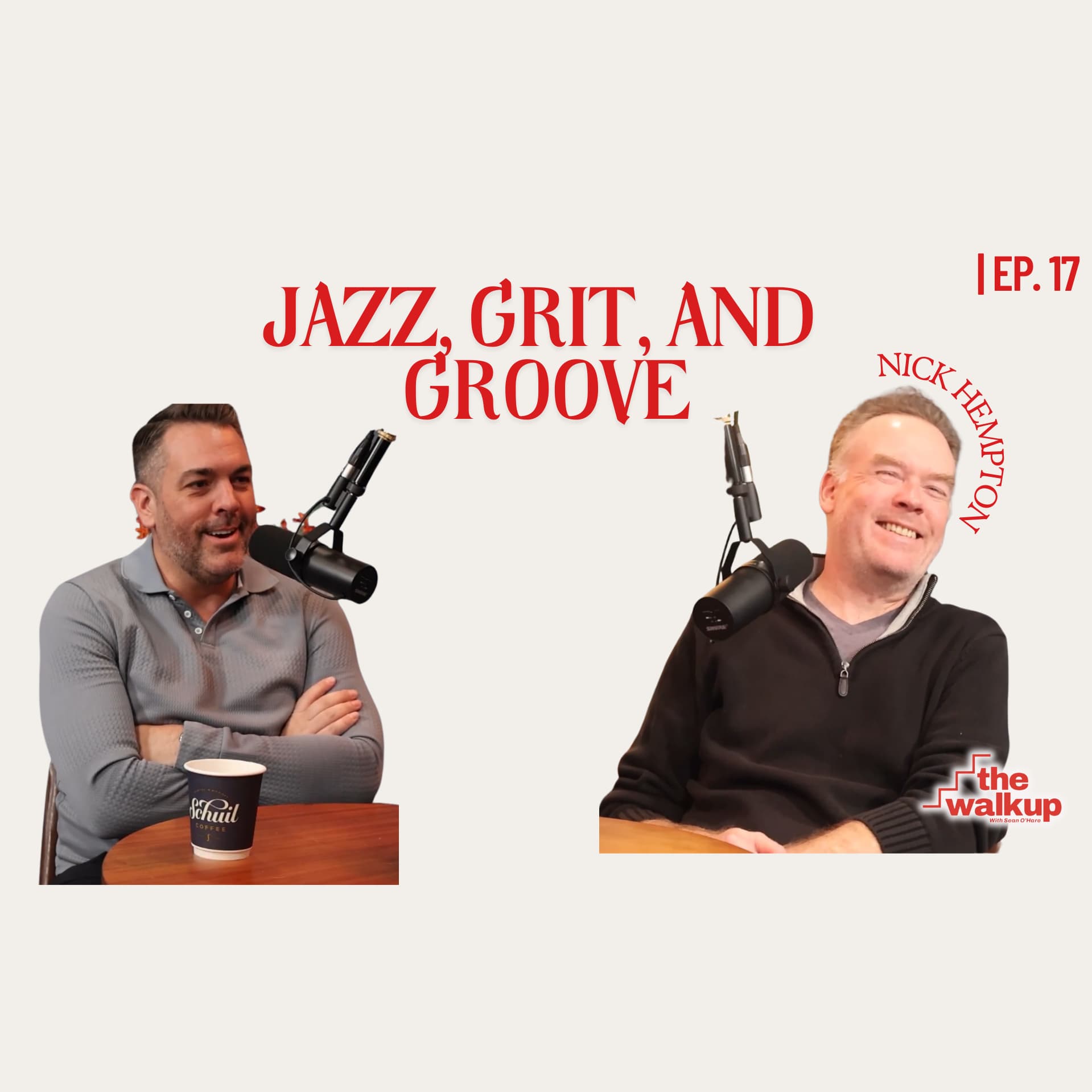
What does it take to become a world-traveling jazz saxophonist with a sound that grooves as hard as it swings?
In this episode of The Walkup, Sean sits down with Nick Hempton – Australian-born, NYC-based jazz artist – to talk about life on and off the bandstand. From Sydney’s jam sessions to Harlem’s late nights, Nick opens up about learning jazz the hard way, his mission to connect with audiences, and how uncertainty can be a creative asset. They also explore the state of jazz today, the power of musical mentorship, and why rhythm still reigns supreme.
Transcript
Read the full transcriptAuto-generated · 16,380 words
Nick Hempton, welcome to the Walkout Podcast. What a pleasure to be here. Thank you. This is what everyone's been waiting for, is the Nick Hempton unauthorized, unfiltered... I assume every episode leading up to this was just a lead-up to this. Just a prelude, and so this is where we find ourselves in full bloom.
So, we'll give the audience a little context. So, you and I met in 2015. If you recall. I'm sure there was kind of a before and after. Sure, before and after Sean in my life, yeah. I've told parts of this story in other podcasts, but we met through your friend David, who was in Paris at the time. He's in France most of the time, but not always. Yeah, he's Australian. He and I know each other from Australia, but he's lived in France for...
20 years or something like that. Okay. And I think he lives in the south of France because I go and play with him sometimes. He lives in the area of Bordeaux, but I think travels up to Paris all the time and plays there. And you met him there, yeah? I did, yeah. I was dating a lovely jazz singer who you met because she performed several times here in the city, Noémie.
And so I was visiting her in Paris and we went to, is it Les Cabots de la... De la Huchette. Huchette. Yes. But it was kind of a rainy night, Monday night, Tuesday night. It was not a huge crowd, and I had started to think about doing some sort of jazz night in New York, and I just kind of felt like, well, you know, this fellow David, I could maybe pick his brain. I know he speaks English, which is the number one thing for friends in Paris.
I look for them to not be French. That is what I love most about it. Rule of thumb in general. So, yeah, so I chatted him up between sets. First, I did it because I wanted to see if he would let Noemi sing. Okay. What she was happy to do, she was, she had to be coaxed into it.
She was like, no, I haven't rehearsed, and I don't know, and so she ended up just doing scat. And I remember it was a really interesting moment. For me, because I don't think I had heard her sing. In person, but she was at a jazz conservatory, though, in Paris, so I assumed, okay, she must be pretty good, right?
That's very brave of you. I'm sorry to cut in. I've never dated a girl before I've heard her sing. That's just... You'd be a real deal-breaker there. I mean, I like to be entertained, and I like live performance.
And so, it was an interesting moment, because I said, hey, do you know, is there any chance she could perform? And he's like, yeah, absolutely. So, on the next set, he's like, do we have any singers out there? And she looked at me, and she's like, you didn't talk. I was like, oh, I had no idea this was going to happen.
And she wouldn't go up. Next song, he's like, you sure we don't have any singers out there? And so she's kind of like, you know, kicking me under the table. Eventually, she goes up. And what was a great moment was, like, she starts singing Scat. Maybe you can explain to the audience what that is, for those that don't know.
And he kind of does one of those double takes where he's like, oh, she's good. Yeah, right. So, yeah, maybe explain what scat is, because I don't want to confuse people. Oh, okay, this is something invented by Louis Armstrong, really. The story is he was recording a song, and he had the lyrics on a piece of paper in front of him, and dropped them, and had to make up the lyrics as he went along. This is the possibly apocryphal story of the beginning of scat singing, but it's effectively singing melodies and making up...
The sort of nonsense syllable sounds. Exactly. Everybody has heard it, but yeah, that is where it comes from, apparently. That is going to make a YouTube short right there, my friend, that little explanation of scat. It has another meaning, too, but we won't go into that. Yeah, that is true.
So, yeah, but when I talked with what I found out to be your friend, David, I said, listen, I have been thinking about starting this. Jazz night in New York, you know, do you have any thoughts or ideas? And as you know, I was doing it just to impress Noemi.
The few things that I've accomplished in my life are in a vain attempt to impress women. I think that's true for most men. Without that, civilizations have been built. And so, he's like, oh, you should call my friend Nick. He lives there. And so, we got in touch, and I met you at... I was at Smalls Jazz Club, and I went with my dear friend Jeff, and we met you after your gig, which was, you know, I've never had a business meeting after midnight.
I can imagine, yeah. Especially in a funky... Yeah, and also, that was my first time, I've been to Smalls many times before, but I'd never been there for kind of the open jam session that happens late at night.
I think we probably did, that night we would have done a later show, maybe with my band we would have done like a 10.30 and a midnight show, and then there's a jam session after that. So, Smalls these days is open until 3 or 4 in the morning, and usually the late band will finish at... So, you have a jam session, 12 or 1, and then basically the stage is opened up to musicians who want to take part in a jam session.
So, there is nothing prepared. Musicians of varying levels will get up and try to play with each other and work out what tunes that everybody knows and find some kind of common ground, common language to work with. And it is one of the foundations of jazz music, really. The jam session is how.
Traditionally, how you're trained to play. For younger musicians who don't have opportunities to play with, say, older, more experienced players, can go to a jam session and play with... Good players play at a higher level than they used to and sort of get their asses kicked a little bit, and that is part of the learning process. So, that has always been a thing. So, it is almost like the pick-up basketball court. You know, you get up there. Yeah, exactly like that.
You can tell you are out of your league, but you want to at least... And if they let you up there, I mean, that is a real kind of rite of passage. If you are allowed onto that stage and you are good enough to take part in this jam session, well, that is a big... Step in your progress, and then that's really the way you learn to play. Yeah, I will say that's one of the things that I would presume is unique about jazz, that there is this, I've always been struck by this openness to letting others participate, even, I mean, hopefully there's some level of skill that you presume people have.
I've only had one experience where it turned out badly. You weren't there for it. It was, it was, oh no, you were there for it. If there's a bad jam session around, I was probably there, yeah. No, no, it was when I had a vocalist, and she was awful, just dreadful, and I had trusted my friend who recommended her, like, she was so excited about the gig, and as we normally did, I would be like, all right, we're going to have somebody play, you know, sing one or two songs, whatever, and I forget who.
Yeah, I don't think you were there, and there was a very curmudgeonly experienced musician there, and he kind of came up to me, he's like, are you effing serious right now? Right. And I was like, honestly, dude, this has never backfired on me before. This was at the Red Room. Oh, I see, okay. Wow. But otherwise, I've always been, I don't know, I find it very...
I don't know what the right word is. Well, it's such a community, communal music. Jazz has to be created with people who don't know each other, never met each other, and have to have some kind of common knowledge, because I play around the world all over the place, and I'm always playing with new musicians, never met before, don't speak the same language, don't know anything about each other, but we'll get on the stage and immediately connect. Personally, I prefer not to really chat and hang out before a gig.
Like, if I go to France and play with a band of new musicians I've never played with before, the French love to hang out and have a long dinner before the gig and get nice and relaxed and sleepy.
Personally, I don't like that. I don't like getting to know people too well before the gig. I like to get up there, and to me, after we've played an hour of music together, I know these people better than I could ever know them.
The conversations, and by listening to a musician and how they react to somebody, and what kind of, I know what their experience has been, I know what, if we've had similar upbringings or similar influences, and I know much more about them than I would have by chatting to them for that long, to me. And I love that. That's the communal element. We've got to create something, we've got to make something out of nothing, basically. We have to get up there on the stage for an hour with people I've never met before, and we have to make a show out of it.
But you are suggesting that you learn a lot about a person by how they play. So, personality-wise, I mean, you feel like after you play with them an hour, you are like, all right, I have a good idea who this person is. I know you and I, when we go to the bar after this gig, we will either get along or we won't. Like, we have definite lines of communication are open now because we have played together. And, you know, it is kind of a...
I mean, I don't really know how to describe it, but there are... You know by the way a musician plays and where they're listening, whether they're a kind of a giving, an open-minded person, or if they're kind of selfish and playing for themselves, you know, you can hear by the vocabulary that they're coming up with when they play, what their background has been, what their, you know, what their influence has been, what music they've listened to. You really get to know a lot about them, and it's really, it is kind of an emotional experience in that you do open yourself up.
to the people around you when you're playing. Like, you can't really be closed down, otherwise you don't play well. So, you've got to be sort of emotionally open on a stage, and there's a lot of give and take. You're listening to each other, you're responding to each other, reacting. It's, to me, a great way of getting to know somebody.
Yeah, so I think you know I play soccer still a couple times a week here in the city, and played my whole life. It is funny, because while I do connect with people on the pitch while we are playing, in some ways, or I would say it is more often in soccer, it is the opposite.
If I get to know them off the field, I play harder for them, or I communicate better with them. And also, I would say, more often than not... A guy's personality on the soccer field doesn't necessarily suggest how he is. I mean, that is true as well. He might just be a jerk on the field, because he's got to be a jerk on the field. Yeah, right. You know, like, if you've got to be a defender, and you've got to knock somebody over to, you know, to succeed, you do what you've got to do.
It doesn't mean that guy's a jerk in real life, necessarily. Now, sometimes it is, but more often than not, it's more like, you know, I've got my personality on the field, and that's where, like, the animalistic side comes out. And I would say that is true in music as well, and there are people that I get along with very well on stage and not particularly well off stage. Not that I dislike them, it's just that we don't really connect personally, but musically, we get along great.
So, it is maybe just different levels of communication. So then, as a way of contextualizing things, I think it's interesting that you and I met, we talked about... Doing a jazz night together, we've, kind of the culture of jazz is kind of this community where, like, we've never had a contract, and yet we've... We've had many successful nights of music, haven't we? We have done, you know, we've done over 300.
No kidding. Yeah. We had our 300th, I think, early into when we started over at the Red Room. So, we started at... Cello in Times Square. We went from there to, I think the next one was, was it 1803 in Flatiron?
Where is that? Basement, lounge, and then we did East Village, Red Row. Oh, no, no. In between that was the one in the Upper East Side. There was that restaurant called Le Colonial? Le Colonial, yeah. No longer there, unfortunately, but yeah, beautiful space.
Yeah, Le Colonial was probably, actually, yeah, it was Cello, then Le Colonial, then 1803, then the Red Room. And these were jazz shows? We would do, what, once a week for a while. The cello, we were doing it once a week. We were doing it every Friday night for probably two, three years. And it was a real sort of nice community event, wasn't it? We had often loads of people from different walks of life getting together. It was really nice, actually.
Good energy in those gigs, I thought. Yeah, it was the right, that space had an intimacy to it, just the right... The right amount of, you know, like people that wanted to be close to the performance, and then, for me, the best moments were always when this kind of spontaneous, where people would just kind of be drawn in, even if they were really just there on the periphery for socializing. Sometimes there was just this, something would click, and then everyone would sort of turn, and I remember a couple times, but I remember one time in particular that you just...
You just start playing, you just start walking through the crowd, and we got some great photos of that. Well, those are the great moments for us as well, while we're playing. Like, you know, you can't make it happen, so at some point, you know, you're in a noisy room, people are socializing and drinking, having a good time, but if you can get to something happening where everything is clicking with the band, it does usually, I mean, often leads to that kind of reaction.
People will sort of, you'll just hear things start to slow down and quieten down, and then people start looking over. And then you realize you've connected with people, and that's why we started doing it in the first place.
So, that's really a good feeling when you can make that happen. Yeah, and I think when I started, so my friend Jeff and Colin were the two collaborators with me, and I remember when we... When we were thinking about it, I said, we've got to do it every week. And they were both like, whoa, that sounds ambitious. And I just was just a big believer in... The consistency, because if it is like, oh, we are every second and fourth, people cannot remember that.
Absolutely, I agree with that totally. And you are like, you basically have to market it all over again every time. People have to check their emails, whatever, but if they just know it is there. And you have to be able to deal with some slow nights as well. You are going to do it every week, some of them are going to be slow. You know, so you just, you have to, it is a long game. You have to look at it, look at the big picture.
Well, and I, what I loved about it was. You know, I think a lot of people would think, oh my gosh, that is a big obligation every Friday night. I looked at it the other way. It was like, I stayed in one place. Everyone knew where I was going to be every Friday night, so they would just come to me. It was fantastic. I sat more or less in the same area. I mean, I had a lot of friends that just knew I would be there, so they would drop by.
They would bring friends, and so I was meeting friends of friends. I made more kind of like connections and friendships by not moving. Yeah. If I was physically being in the same spot every Friday night, then I would have if I had hopped around town. Sure. I think it is a great thing that there is not that much of it around New York these days. I don't think everybody wants to have something new going on or something different, and to find that steady...
The show, or steady gig, or just steady event that happens once a week, everybody knows that it is there. People are not going to go every week, they are going to go once a month, or once every two months, but it is there, and you find new people that way.
Yeah, and I think there is something about that. I use the word institutional, but I mean that in the sense of like, not necessarily in the physical space, but in the recurring nature of it. Friday night became an institution because people knew it was there.
And what I really appreciated was that when people would say that this kind of became almost like an extended living room for them, right? Friday night's a, you know, if you've had a hard week with work, you're in that spot where you're like, I don't necessarily have the energy to go out.
For the evening, but I also don't want to just go home and do nothing, and so they felt comfortable and cozy to be able to come there. They could hang out. They knew they'd always know at least five or ten people. It's like a cheers or something like that, isn't it? It's like having a bar or a place or something that is there all the time, and you know the people, and it is a sort of home away from home thing.
I think that's a really great thing to set up. Yeah, and of course, now you've got me thinking I've got to... We've got to restart it. We've got to do it again. Well, you mentioned Smalls before, where you and I met, and that's one of the main reasons that place is so successful.
I mean, it's a jazz club that's been running since the 90s. They were closed for a couple of years in the middle there, but it's been every night, and I think these days it's 365. A year. You know, they don't close for any holidays. It's always there, and it's always open until three o'clock or whatever, so you know that it's there, and there will be live music from, you know, six in the evening until three in the morning. It's always there, and I think that's why it's a success.
Yeah, and like I said, you have to be willing to put up with some slow times and whatever else, and yeah, because, I mean, you've got a Friday night in... In February, it is sleeting out, but you are still there, right?
But that is when people need it. There are a handful of places that I knew. When hurricanes were in New York, we had Irene and Sandy and that kind of thing. Everything shut down, but there were a couple of places that I knew would stay open no matter what. Smalls was open every night during that. They had candles and a battery-operated light stuck to the walls and whatever.
And another couple of restaurants I used to work at were there for the community. You know, it is like... People need somewhere to go. They've got no lights in their house. They need to go somewhere. So, there are a handful of places that will go that extra mile.
Well, and that's also what, in an ideal... Well, in an ideal sense, that is what New York should be, or it has been, and has the potential always for being. I will admit, I seem to notice it a little bit more outside of Manhattan more often these days, but that sense of community that, hey, we are all drawn together from all over the world, from all different backgrounds, but we all can meet in this place, and that is what I really enjoyed about.
When people would walk in the door, and the way that first venue we had, Cello, was interesting. People came down the stairs, and there was kind of a landing there, and as people do, they kind of scan, is this, do I want to be here, or is this the vibe? And so, I would often be in... The sight line of that landing, so when I would see somebody do that, kind of confused, like I am like, I got to run over.
Right, welcome. Like, hey, where are you from? And I just, oh, and I would find the one point of connection. I would be like, oh, you should meet so-and-so. They are from St. Louis or whatever, or they also love, you know, whatever, hobby or something.
And for me, that was always like a New York moment of like, you walk into a place, you didn't know anybody. And, like, the best thing for me was looking over two hours later, and that person's laughing, enjoying themselves, making new friends, and just like, all right, that is what has always separated New York, for me, from other places, is a, you know, of course, there's always this cliche that New Yorkers are rude, and that's quite the opposite. Yeah, that's not right.
Communities not necessarily connected geographically, but there were, you know, it was a series of close-knit communities, and you would, people would come and go and be introduced to these by somebody they just meet on the street or meet in their favorite bar or whatever. And I think that was, I mean, you were particularly good at that in bringing people together and finding, you know, common elements and, you know. And I think that was part of the reason that worked so well.
Yeah, I mean, it was a connection of different overlapping communities, right? And that, as long as you just had enough people that knew each other in the room, that gives a certain energy, but then the spontaneity of new people coming through. And, I mean, we had people that met there that got married, met people that became best friends, people that became business partners, people that, you know, that are, I mean, I don't know that I'm. A month goes by where somebody doesn't ask me, hey, when are we getting jazzed up?
What happened to Charlie? I was going to say, all this happened despite the fact that you had live jazz there, so it was really amazing. Well, but jazz is a particularly social... I don't know if it's the improvisational element of it, if the rat-a-tat-tat component, like whatever it is, seems to encourage conversation.
Well, yeah. Sometimes that's not always the best thing. Right, for the performer. Yeah, I mean, it depends what situation you're in. Like, in the kind of events that you and I were doing, it was perfect for it, because what we wanted was a room full of people getting to know each other and having a good time, and jazz was part of the atmosphere, which I love to do. Like, I was talking to you where I played last night, the Rum House, Bar in Midtown.
It's a noisy... As a band, we're stuck in the corner, and we're part of the atmosphere, and I kind of like it. A lot of jazz musicians don't like that kind of thing. They're a bit more precious about their art than I am. I'm happy to be part of a party. That's the best thing I can possibly do. I love that. I don't need to be on a concert hall in front of a silent audience. As long as it's people having a good time and engaging with what everybody else is doing.
Just shouting at each other about something completely different, that can be annoying, but usually at cello, we had such a warm atmosphere in there that I felt as the music was almost part of the conversation. People are engaging with us, engaging with each other.
There are some rooms that I play now where, as you say, jazz is conducive to conversation, and it is not the best thing. Sometimes, if you are really, I don't know, the acoustics in the room are bad, and you can hear every word that people are saying, there are certain rooms where people are just chatty, and it is kind of rude. But if it is a party atmosphere, that can be great, and I think jazz is good for that. And also, like we are talking about a New York-specific thing, jazz is everywhere now, obviously, but there is no more New York sound than live jazz, I don't think.
So, if we had people who had never been to town before, or they are new to the neighborhood, it is a welcoming sound when you come in. You feel like, I am here. Yeah, and it also, there's something about the, I don't know if the brand is the right word, but the way people perceive it is, I was sending my brother, I think, on the podcast, T and I did together, since he's a jazz musician as well, that I told him that when I travel, a lot of times the jazz club kind of signals to me.
A neighborhood that I probably want to spend time. Yeah, right. You know, like I was in Istanbul, I was in Warsaw, I was in Rome. Like, if you find the jazz club, the likelihood of that's going to be in a hub where there's going to be other interesting things going on. Yeah, that's a very good point, yeah.
So, just like, you know, I'm Catholic, where I can go and find a church anywhere, right, and I feel comfortable. If I find it from a cultural standpoint, if I find a jazz club, I'm like, I'm going to be pretty at home. Yeah, something familiar here, and yeah. Yeah, and even the vibe, like there is a universality to the vibe. I mean, obviously, each of its got its own expression, but I, yeah, the best way I can say it is like I felt at home just chilling at a jazz bar in Istanbul.
Yeah, that is a good, I am kind of glad to hear that. I mean, like when you travel somewhere else, if you find that jazz club, it is going to be. It's going to be familiar and also interesting, and something is going to be going on that is worthwhile spending your time there, and it will be probably an interesting part of town as well. Yeah, and I think it just attracts a certain personality type, right? Or even the attendees have a certain openness, usually, to conversation, so there's a culture that I think kind of surrounds, more often than not, whereas if you went to a different art form, there would be a...
More of a closed off, like, oh, you have to get it, or you don't, you're not one of us, or... It's funny you say that, because jazz has that reputation of being sort of elitist or difficult to get into. Oh, really? Yeah. Oh, that's not my... I mean, there's... Well, I'm glad to hear, I mean, certainly the way I play and the type of jazz that I play, I really try to make that not a thing. Like, my... I'm really playing to bring the room into me.
You know, like, I'm playing for the people in front of me. But there is, I mean, there is some very difficult jazz. Difficult to listen to. I mean, it's very complex, and it can be, some people find it exclusionary, but not the way I play. I don't like to, that's not really part of what I do. Well, how much do you think of that as getting into your... Your origin story, such as it is. I mean, do you think that comes from an Australian background?
I mean, there's a non-elitist component to Australian culture, no? Absolutely, yes. I mean, famously egalitarian, I guess, the Australian community. But I'm not sure if that's... What it was, or the reason that I got into it. I mean, the style of music, the style of jazz that I like, is kind of welcoming. I mean, my favorite musicians have always been the players who, I don't want to say play for the crowd, because it sounds like pandering, but playing in a way that is intended to bring people in, to foster a community within that room.
So, I'm not... There's a certain type of jazz musician who you feel like they're playing regardless of who's around them. It's a very isolating thing. They're playing basically within the stage, and the audience is invited to observe it.
And that is not really the way I think about it. And I don't think it is really the Australian thing. I think it is the style of music that I have always liked. I think that kind of jazz is for that reason.
So then, tell us about where music started for you. Was it at an early age? You always knew music was always an interest of yours, or how did that develop? So, I come from a family of musicians. Both parents and my brother are all classical musicians.
So, I grew up playing classical piano and clarinet, a bit of violin when I was very young, and exclusively classical music. There was no, in my whole childhood, there's never been a note of music that was not classical music in my house. That's just what my parents love, and it's not that they dislike.
Jazz or any other form of music, they're just not really interested in it. So, there was exclusively classical music, and I have no idea where I found jazz. I remember telling my father when I was about nine years old, I'm going to be a jazz musician when I grow up. And he said, do you know what that is? I said, well, not really, but I know this is for me.
And I feel like there must have been some, I think there was a band that came to my grade school, you know, when I was about that age. I don't really remember much about it, but I remember seeing trumpets and saxophones on a stage, and it really made an impact on me. And then, at the age of about 15, a friend of my dad's had a saxophone in his basement, and he said, here, have this. And it was all over after that.
Not until 15, did you? Right. That is very late. Yeah. I mean, I didn't know what jazz was. Because there was nobody around to tell me what it was, so I would go and find radio stations that would have a little bit. There wasn't much of it on Australian radio at that time, so I would find little radio shows that would play some jazz. And then, yeah, at 15, I got this saxophone, and it was...
It was a beautiful instrument. It had never been played before, hadn't been played in years and years, but it was operational, and I just started going and hanging out in jazz clubs, and I would take it down and attempt to play this music that I had no idea about. And fortunately, people were supportive. I guess I had enough, I don't know, I made a nice enough sound that people were okay with me getting up and attempting to play at jam sessions.
Because you had played trumpet or something, or clarinet, I guess. Clarinet, yeah. So, there's definitely a connection. I knew how the instrument worked, and I was basically learning how to play these melodies, which I didn't really know anything about.
And then I found somebody, one of the older players, who agreed to give me some lessons, and that kind of led on to me just being obsessed with it. And there were jazz clubs in your area? In Sydney, at that point, there were... Quite a number of them. I believe now there is maybe only one, but we are talking early 90s. I guess there were quite a handful of jazz clubs, and you could go out and there were jam sessions regularly, and there were a lot of good musicians.
So, yeah, it was sort of a fertile scene, and I got to know the right people. But I stopped. I mean, as soon as I got that saxophone, I stopped doing everything else. I stopped going to classes. School was essentially finished for me at that point.
I was enrolled almost to the end, but eventually the school and I came to an agreement. You are not here at all. Why don't you scram? We came to an agreement. They gave you a diploma as part of the agreement? No, I don't think that ever came up. All right, okay.
So, yeah. And your parents felt how... They were furious, yeah. That led to some very tense times, because classical musicians and also... University lecturers, and certainly education is a big part of my family's background, so for me to tell them I'm leaving, I'm quitting, I'm just going to play jazz music, they were baffled, and I feel bad for them because they really were lost. They didn't know how to deal with this. Yeah, and I would just be out at clubs every night.
Sometimes, there would be a call. Nick, you have to come to the kitchen and take a phone call. I think your mother is on the phone. And I would answer the phone, hello, and I would just hit click.
Oh, they were so mad at me. I just wanted to make sure they knew where I was. Oh, they wanted to make sure you were alive. Reminds me of those scenes from Almost Famous, do you remember that? No. Where he's on the road with the rock band, and his mom keeps calling, and he's always out late with the band, and she's getting more and more frustrated. And the same thing, you've got to get your diploma and whatever else. Right, right, right.
So then, how did you then get to the States? Well, I just, I mean, at that point, I just started working. Like, I was... Any gig that I could possibly get, I was working in cafes and restaurants and whatever, to whatever little gigs were available, and it just picked up. I was practicing all day. I was practicing six, eight hours a day, often just like long notes for hours and hours and hours, just trying to get a tone right and working on.
I mean, this is what I was doing instead of going to classes. I would find the music room and study Charlie Parker and Dizzy Gillespie and Louis Armstrong and all of the greats, and I would just sort of learn that music. And the gigs sort of started to come in.
Play with certain people at a jam session. Oh, come and meet me tomorrow. I've got this little gig in the afternoon, and I would make no money, or I'd play for coffees or whatever. And it picked up, and that's how it's supposed to work. You know, your name spreads. And I got to the point where I knew that New York was the place. Like, it's less like that now, but...
Sort of 30 years ago, when I'm starting to think about coming over here, New York was really mecca for jazz musicians. It was the place to be. So, I knew this is where I had to be. And at that point, I got a job on cruise ships. When I was about 19, I started working on cruise ships, which was an awful experience, and if you ever have the opportunity to go on a cruise ship, I would say run the opposite direction.
To go on one or to work on one? Either way. I love cruises. Okay, well, maybe it's just for performers. It's particularly bad. I don't know. Go spend six months on one, and then we'll talk. Well, six months, yeah, that's what I'm talking about. I'm there for six days, and, you know, there's an all-you-can-eat buffet. I can see you. Right. And you know me, my socializing. It's like, talk about Mecca. For me, it's just like a bunch of people, they're trapped in a boat.
They have to talk to you. That's true. There's no escape. Nice things. But, yeah, I mean, it does become a floating prison after a while. I mean, you can't, you've explored everywhere. You can't really go and do anything.
Some people will love it. It was not for me, but it was a good way to save up some money, and so I would do a contract and then come to New York. The first time was in 1996. I did a four-month contract and then saved the money up and then came to New York for about six weeks and spent it all, went back and did it again, and that was the way I would save up the bread to come over here.
And then I made a few trips, and then in 2004, I won the green card lottery and came over and moved, and that was the big move. So, you say, more so back then than now, that New York was mecca. That's my feeling of it, yeah. So, what's changed?
A lot of things have changed. A lot in the field of jazz education, meaning that everywhere in the world now has a jazz program at their school, at their university. I go to Asia fairly often. Last time I was in Bangkok, I did a master class at a university, and they said there are three universities in Bangkok that have master's programs in jazz performance, which is kind of amazing. For a country that doesn't really have much to do with jazz, Thailand is not a great...
Jazz Capital, but it is a big thing. Everywhere around the world has huge jazz education programs, and that music has spread enormously since that time. So, it is now, I still think the best jazz is in New York by a long shot, but I am biased.
There's lots of jazz everywhere now. So, you're just saying it's more diffuse now, it's more, it's spread, as opposed to it being heavily concentrated in New York, the interest and the talent have spread? Is that? Yeah. I mean, yeah. I mean, it is.
An American music, right? This is such an American music, but it doesn't really feel that way anymore. Like, everywhere in the world has come up or developed their own way of playing it now. So, if you go to Iceland, you're going to have a really different experience than you would going to Italy or something, you know?
It's developed into a worldwide music. Yeah, Icelandic jazz is on our next... Oh, sure, yeah, we've got a whole special on that, I'm sure. It's a four-episode special, actually. Yeah, that's interesting, because I remember you and I having a conversation at one point about where, you know, in the 50s and 60s, there would have been a great jazz club in every American city. Right.
And that's... Isn't that funny? Like, I do feel like, as it's become more international, it's become less popular in the U.S. I certainly find, when I'm trying to put together tours, it's easier to tour Europe than it is to tour America.
Yeah, it's fascinating, because when I see your tour dates, I'm always like, man, you're over in Europe, you're over in Asia, that seems like a lot of work, but you're saying that there's a greater... There's a greater interest there, a higher demand, so to speak? Kind of. I mean, geography has to have something to do with it. I mean, first of all, let's count out Asia entirely, because it's a stupid place to tour. Like, there's not... Nobody else does it, for good reason.
There is really not much interest in jazz music in Asia. I just love the travel. I also love the idea of bringing music to people who wouldn't hear it. That was one of the things I used to love about cello, is we would get people down in the audience who had never heard jazz before, and this is my opportunity to give them something good that they wouldn't have heard before. And Asia is like that as well. Jazz evangelism. In a way, yeah.
I mean, I don't try to make it. It is too self-important, but if I go to Beijing and play for a room full of people, a large percentage of them have never heard this music before, and maybe a couple of them will go, wow, I like this. I am going to go listen to it when I get home.
John the Baptist of jazz. I have to start promoting myself. But yeah, but Europe, also geographically, it's a smaller space and easier to travel around, and the cities are closer to one another, and a lot of them have clubs. But if I want to go into the Midwest, you know, there's jazz clubs around, but I don't know, there's not. As many as there used to be. Like, each city will have one, whereas each city used to have dozens.
Yeah, I mean, for my brother, when he caught the jazz bug, there were a few. I mean, D.C. is never known as particularly culturally rich. It's gotten a lot better, but I remember him going to a club called Blues Alley. I don't know if it's still around. Is it?
As a teenager, you know, going up there, and we would, my parents and I would go there to watch them play. Skinny little kid up there, you know, playing with, I remember, I remember, yeah, this is just like a different world that we, that we walked into. Yeah, yeah.
But there's a, I know that there are, you said that there are jazz musicians that are a little bit more. I would say self-indulgent, but a little bit more about the performance and the kind of craft, and there is a little bit of elitism to it, but I would say that more often than not, I am struck by the, there is a humility in jazz musicians more than most art forms, I feel like. I am very happy to hear you say that.
I don't always have that experience in dealing with other jazz musicians. But, you know, jazz music, it's a microcosm of society, isn't it, as any kind of... Art form is going to be, there's all sorts of people from all walks of life doing it, so you're going to find all sorts of personalities. And yeah, it is a bit cliquish. You know, you find the people who play a certain style of music will hang out together, and maybe there's personality traits within each style of jazz that you're finding.
Maybe there's certain types of music that are more conducive to a sort of Modest or welcoming kind of person? I don't know. I couldn't tell you. But there are certain types of music that people think of it as high art, which I don't want to argue with. It can be or it can't be. I'm not sure. But some people who view their music that way do see it as a performance music that is supposed to be enjoyed from a distance.
I mean, I don't want to generalize, but you do get, I mean, European jazz can be a little bit that way, as opposed to American jazz. And I do like the welcoming aspect of American jazz. Yeah, I guess maybe because jazz by nature, as we talked about before, is collaborative. There has to be, you can't... You can't really do it alone, whereas if you're a pop musician, if you're a vocalist, you can kind of just get a band, and they're really kind of a service provider, almost like a vendor.
Sure. Obviously, a certain skill level has to be there, but it's really about that. ...person with the microphone. Yeah. And so that can create a certain stratification, if you will. And obviously, you've got elitism in terms of getting to a certain level in jazz where there would be kind of a separation. But I remember when Noemi was visiting, we went to the 92nd Street Y, and there was some...
I am not going to remember. I think his first name was George, but she was in awe. Like, oh my gosh, I get to meet this. And he was, I think he was in his 80s or 90s at this point. And so, he had performed there at the 92nd Street Y. I happened to run into somebody that I was friends with that worked in the 92nd Street Y. So, she led us into the kind of like.
Reception with the performers afterwards, but there was no prima donna element to the thing. It was none of that, and she was in awe of him, but there was no sense of like, oh my gosh. He was very accessible, happy to chat. So, that has been overly generalized, and maybe because my... Most of my experience of jazz musicians is through my brother and through you, so maybe that's, I'm overly... Maybe, but also you're seeing it as an audience member, and your perspective is going to be different to mine, and it's interesting.
It's hard for me to know what it comes across on the other side of the stage, how people view it, so I find that encouraging, actually. Well, I think there's a humility built into it because of... You know, when you're gigging on a regular basis, there's oftentimes the not most glamorous setup, right? Sure. So, if you're, I mean, one of the things that I enjoy being able to play this small role is, I think I mentioned it before, but because I I saw how hard my brother worked at his craft, at learning the saxophone, and the hours and hours and hours and hours of practicing, so much so that it completely turned me off to ever pursuing music, because I'm like, all right, I know I'm not, I don't have that level of discipline, so let's just call it now.
That there's something about... I want an audience to appreciate the talent that is in front of them, appreciate the hard work, the amount of time it takes to do what you do, and your fellow musicians, what it takes.
If I can create a stage or get an audience, like, that's, I can't do what you do. I can't, and I'm, it's, and as I said, I was never clearly willing to put in the work to even try to find out, but the, I guess the producer in me or the connector in me is like, to give artists and give musicians an opportunity to perform and to be appreciated is like a gift for me, just to be able to like. I can't participate in the art form, even though I can't perform myself, but I can facilitate the… But it's a vital role.
I mean, we… It's one of the big challenges, actually, is finding audiences. You know, we can play the best music you like, but to get people into a room and listen to you is one of the major challenges. So… You know, that's integral, what you're doing, is in making a show successful, and you talked about, like, having an audience to appreciate what the musicians are doing. Part of, I think, is, part of the fun is almost for them not to realize the work that's gone into it.
Like, if you can fill this room with people, and then we get up, and it looks like we're just having a walk in the park. That's great. I don't want it to look difficult. It's supposed to look easy and fun. We are up there having the time of our lives, so it's supposed to look that way as well. That's a part of the communal thing as well. We're up there having fun. The worst thing is when I look out and I see an audience with arms crossed just kind of staring at me, and you get that more and more these days.
This may be segwaying into a different topic. As generations go by, people's connection with jazz music is more distanced. It's not as much of a part of everybody's life as it used to be. So now I find, if I'm playing, there's several venues in town where this happens a lot. I look at it, and I'm seeing a room of 20s and early 30s, and they just stare at you like you've got three heads. I've never seen... A person blowing this metal thing and sound coming out of it before.
It's just so unfamiliar to so many people. But why are they there? Well, that's the thing, because jazz and cocktails are such a thing. They go together, and for a night out, I think people go, well, this is something new. We haven't tried it before. Let's go to this cocktail bar where they have fancy craft cocktails, and they have...
Oysters and whatever, and there's jazz at the same time, and maybe we'll go try something new. So, I mean, I applaud them for coming and trying something new. And these are the rooms where, as we were saying before, an opportunity to play for people who might not have heard this before. But there's also, a lot of my energy now goes into almost teaching people how to have fun. Because they sit there and they go, I don't know what this is. I don't know how I'm supposed to react to this.
Is this a work of art that I'm supposed to enjoy silently, or is this a party where I'm supposed to get up and dance on the tables? I don't know. I have no frame of reference to this. So, usually every show now takes...
Two or three tunes to get people relaxed and go, well, this is okay to enjoy yourself. You can smile, you can laugh, you can pat your feet, you can clap your hands, you can whistle, you can be involved. We're having fun, you should be having fun as well. And I think that, I mean, it's harder work now, because so much of my energy goes into bringing people into the experience.
But when they get there, it's great, and I feel like we got them. Like halfway through a show, we got them, and I feel like that's worked on, and now these people will, next time they hear jazz, they'll be familiar with it. Well, I think as an audience, I know that my friend Jeff and Colin and I tried to, I must say, set the example, but there is a...
What's the word I want to use? There's an education for the audience as well. For example, It's applauding after a solo, right? Like, you start to cue people in, oh, oh, this is, okay, this is a different part of the performance. It's not the end of the song, but it's this thing in between, and they each kind of take their time to kind of do a solo. It's confusing for people, I understand. People never, you don't, in other forms of music, you don't clap in the middle of a song, you know, you wait till the end.
Right. And the clapping after a solo is just... Part of what happens is not necessary. I mean, if you don't like it, you don't have to clap for it, but it is traditionally what happens, and yeah, that's something that, like I said, I don't want to teach them to do it because you don't have to clap. I don't expect it, but it's what's done, and now I will.
At these places I'm talking about, I'll finish a solo, and I'll go and bow at the front of the stage, just to go, this is okay. This is appropriate now to say, yeah, thanks, I like that. And people are awkward about it, and it's a very uncomfortable thing for me to do, but I do feel like that's opening it up. I've done this little bit, he was a little solo, now I'm going to hand it over to the guitar player, he's going to do his bit, and just sort of teaching them this is how it works.
We're going one at a time, everyone's going to have their little feature. And if you like it, you can applaud at the end of it. Yeah, and I think we would try to kind of clap early, kind of teaching the audience, this is how you do it, right? Yeah.
And I think it's an interesting ecosystem, so to speak, of how the interaction of audience, the artist, the community. There's this little... Paper, I read sometime that talked about the four parties to art, that there's the artist, there's the audience, there's the critic, and there's the patron.
But they shouldn't be these kind of siloed. Right. There's this notion of the... The artist, you know, off on their own, you know, creating their art, when really there should be this collaboration between the patron and the critic, you know, just getting feedback from, okay, how do people are receiving this, and then, of course, the audience and how they're engaging with it. So, I think that... I try to take that role seriously as, like, the audience.
It's funny you should say that, because I haven't really thought about those four elements of it, and I think, I mean, we're talking about relating to an audience, and I think that's the missing element in jazz at the moment. Like, the other three are kind of working well together.
You've got, you know, musicians and critics and patrons. That's... Well, there is a lot of backscratching going on there. Everybody is kind of working together in a way, but I do feel like the actual person in the audience is being neglected a little bit in jazz these days, and that is where you and I have tried to... I mean, without having this discussion before, I think you and I have had the same idea about this, is that is what we are trying to do.
We are trying to connect the musicians and the audience together. And you said neglected, meaning because they have not been enculturated, they have not been... They haven't had the opportunity to develop as an audience for this particular art form, or how are they being collected? That's a particular word. I guess, from the beginning, there's less and less jazz education in high schools. We mentioned colleges.
In my opinion, much too much jazz education in colleges, but in high school, there's not very much of it. There's a few touring organizations that will take bands to high schools, but that's where it has to start, or even grade school. People have to see live jazz to get any foundation for the future, and I don't think most people do.
Also, going back to some musicians being somewhat exclusive about their music, don't really take the audience into consideration as well. So, I think audiences are being neglected by some of the musicians as well. Well, it was interesting when you and I had performances during COVID, when we were able to have this outdoor venue, and obviously there were lots of restrictions, but we were able to make it work.
There was a gratitude, I think, between the audience and the performers in a way that... I had never seen that before. Yeah, because it was just this release. People needed, I mean, they needed live music, they needed community, they needed, the musicians needed to perform. It was like a cathartic experience. I mean, and I think...
You probably had seen that, or I explained it to you, or shared with you. I could have doubled the amount of tickets, and there was so much demand because there were just so few places performing, and we were lucky because we had that outdoor venue.
I mean, I could have, you know, I was not going to exploit people, but I was able to keep raising the prices, which I was happy to do, because then I could pay the performers. Yeah, I mean, we needed that, too.
But, you know, around that time, I would play in the park, as well. You know, I would play in Central Park or in Prospect Park, and the usual experience when you play outdoors is people moving away from you. But we would play in the park, and people would just swarm. Like, the live jazz was so desperate to have some kind of connection with other people. You know, it was still social distancing, but people would come and get as close as they could, and they really wanted to have some kind of, I don't know, some kind of experience.
Everyone was so closed off at that point, stuck in their houses, so people were really desperate for it. I mean, obviously, we don't want another... Global pandemic, but it was a pretty, like, I loved those. It was very rewarding, wasn't it? The venue itself, too, because we ended up bringing in a nice stage, and, you know, it was outdoors, but we also had, we had kind of an enclosed courtyard, if you will, which made the sound kind of. I'm so glad we got to do that.
Around that time, musicians really didn't know what to do with themselves, and a lot of musicians were doing online streaming, which a lot of people still are doing, but you and I talked about that at the time, that really, it's not what the music is about. The music is about... A bunch of people together experiencing something together. Online streaming is a great thing, and I'm glad that it exists, but it's no replacement for being in a room or in an area surrounded by other people who are all experiencing the same thing.
And sound waves, you know, it's like if I'm playing a saxophone into a microphone going over the internet to you, it's different than me sitting in front of you and making air vibrate in your direction, and you hear it. You know, right in front of you. That's a great connection for me between people. Yeah, and I'm always fascinated by the kind of sociological, the watching an audience, watching a room of strangers, or, you know, some people know each other, but watching the room develop throughout the evening.
You know, again, because I've had the privilege of being in the audience of your, you know, 300 plus shows with you, I, you can kind of, there's a certain, you can anticipate certain things, like, all right, this is, all right, now I can see people getting loose, now this person's tapping their foot, okay, things have, the energy's shifted in the room. Oh, wow, people are, they're socializing in a different way that they weren't. It's fun to watch the waves, isn't it?
Like, it just changes throughout the night. Yeah, I agree. Yeah, and I just, I love that, what music can do in facility, because if I put on a Bluetooth speaker, it's just not going to be the same, right? Exactly right. And so... That is fun for us as well, yeah. Sorry to interrupt, but watching the room change throughout the evening is fun for us on stage as well, because that influences what material we are going to play, or how we are going to do it.
Clearly, the room needs a bit of energy now, or they are ready for us to slow down and play something sentimental or whatever. You watch the waves move out of the room and see the changes throughout the night. That is really fun as well. Yeah, and... I don't mean this in a manipulative way, obviously, but watching that the audience is, it's imperceptible to them. Sure. Right? Like, now, you have a sense of kind of like. Not pulling the strings, but kind of, you know.
Yeah, but I don't think even it's not necessarily negative that it's manipulative. It's not in a bad way. It is we're trying to make a successful night and a good night for people, and if we can do something that's going to move it in a certain direction, I think that's fine. That's kind of what we're there for. Yeah, and it's really taught me, too, a lot about physical spaces.
How people behave in them, how they interact, how they move through a room, you know, like when we've tried different venues, or when we start a new venue, I now have much more of a, sometimes I can anticipate how people are going to move through a room or sit or stand or, you know, interact, but a lot of times I kind of go, well, let me just go watch.
For a while, and then see, what can I do to facilitate things a little bit easier? Can we remove these tables? Can we give you more room around the stage? I mean, even the small things, I noticed, like in our first venue at Cello, you're a taller guy, so you're able to be seen even from a distance, but... When we added even just a small stage, it was only maybe 18 inches off the ground, it signals to the audience, this is important.
Right. We built a stage. Makes a focal point, doesn't it? You know, if you can have good lighting, right? I mean, nothing's, and this is like very, I can be very... I get very finicky about these things. I get very frustrated when I go to a venue, and I'm like, do you have any respect for the artists? Do you care? I was at this music bar recently, and it's meant to be, they're having music six, seven nights a week, and yet they put the band right next to the front door.
You almost, I mean, the spacing is such that I effectively have to kind of sidestep the guitarist to whoever, whatever musician happens to be there. The acoustics are dreadful. I'm like, why have a music, why have a bar intended for music and then not build the space?
Yeah, it's funny. I think very little thought often goes into presenting music. If it is recorded music, like if you see a new restaurant opening up and you listen to what they have, like they have put all their energy and thought and time into, you know, tables and chairs and knives and forks, but the music will just be a very last minute thing. They will just, whatever is on Spotify, we will put that on. You know, it is an important part of a bar or restaurant's atmosphere.
And the live music thing as well. I think they think, well, let's put a band on, they'll bring some people in, and that's about as far as they go. Shove them in a corner. Yeah. Somehow that's magically going to bring an audience. Yeah, it's really interesting why people don't, and I do think this goes into the broader.
Topic of just kind of the art of socializing, the art of, I mean, as you know, I also did a lot of these kind of elaborate dinner parties, because I had that, I was lucky to have this big space to host people for a while, and I began to get very, I love to experiment with, if I can.
Can I turn the dial a little bit this way, a little bit that way? Can I maximize the interaction for people a little bit more? For example, in that former convent that I lived in, we had so much space that I learned with the dinner parties, there was almost like an unveiling throughout the evening. It was a stage. It was a performance.
And in particular, that way, you're not making it, you want it to be imperceptible, right? So, like, one thing I learned was when people arrived at this former convent, of course, they're fascinated. So, their instinct was to start wandering around, and I realized, oh, we're missing this initial opportunity for people to connect. Because what I want is when people sit down for dinner, I don't want their, I want the...
The comfort level between everybody has increased, because these are unnecessary people. The whole point is for people to connect, so I actually started closing the door that led to the hallway, because I wanted to keep people in the same cocktail area, which sounds very, again, manipulative, but I read this book called The Art of Gathering, which it said, One of the chapters or sections was, don't be a chill host.
It was like, don't be like, well, you know, whatever you want to do. Like, you're going to come over for a birthday party. What are you going to do? Ah, we'll just have some cake. Right, right, right, right. Well, that's actually disrespectful to the people.
The way you look at it is like, they're going to spend the next two, three, four hours with you, whatever it is. You actually owe them to be. Curating the evening, not just saying, well, I'm just going to hang out and see what happens.
You think you're being relaxed, and actually what you're doing is kind of saying your time isn't very valuable. Right, right, right. And the word host is the important one. The host is a thing. You're there to host. But I think that art form, if we can call it that, but the...
In this case, the art of the dinner party, or in our case, the art of a jazz performance that encourages a certain social atmosphere. I think each of these things, to your point, like, okay, we have a restaurant, we're just going to throw some band in there. Like, well, okay, have you actually thought through this experience? And I used to like to see you do it, like, I remember mostly at Red Room you're doing this, trying to move. I mean, the peripheral things that I would not have thought of.
Just making the space more conducive to socializing or hearing the band or whatever, you would move tables around or you would find, you know, here is the blocked entryway, let us open this up or whatever, just to make the room.
Flow better, which is great. I found that really interesting, because I would not do that. Yeah, because Red Room, what I like about Red Room was they have great stage, good lighting for the band. Lighting almost a little too bright, honestly, sometimes, for the performers. So, I like that it says, hey, the performers are important.
The thing that frustrated me was there were too many tables, and you couldn't really navigate, and it's up on the third floor, kind of a narrow entrance. And so, what would happen is if... They didn't clear out the entrance. People get bottlenecked, and so you'd have people who wanted to come in. Right. They'd think it was too packed, but actually, there's plenty of seating elsewhere, and that crushes me when I see people who clearly want to be inside, but are like, ah, I don't know.
You just remove that little bit of a barrier, and then they're in. And Cello, we experimented with so many setups, because in the... As you know, for the audience, Cicello is an Italian restaurant that had a lower level that was really just used for pre-theater dinner crowds. It was right in the Broadway theater district, and so they didn't really use the lower level after dinner, but I would get there a half hour, hour ahead of time, pick up. Move all these tables, get them out, because we're not looking for a seated dinner, we're looking to make it feel like a jazz club.
And so, experimenting with like, oh, actually the high top tables are great, because high top tables, there's no fixed seating, you can let people, they can put their drink down, but they're still engaged. Yeah, people tend to come and go on those things a bit more too, like they move around.
Yeah, and it was just like a much better environment, and it was all... Lessons for me about what makes, again, it's imperceptible, but for the most part, for most patrons or audience, is that they can't express necessarily why they're not comfortable. Right.
It was always very satisfying for me if we could figure out a little bit, some ways to make it just a little bit more inviting. Yeah, sure. And then they're captured, and then they can appreciate the performance. And like I said, two hours later, they're now really engaged, or they made some new friends, or whatever. That's a win for me. Yeah, and that should be everybody working together on this.
The band, or whatever kind of entertainment you have, and the hospitality side of it, and making the room work together, I mean, that should all work together. It rarely does. I do think that's kind of an afterthought for a lot of businesses around here, is the actual effectiveness of the room, how it's going to bring people together. I think people don't really think about that. It's everything. I mean, I remember Cello, I mean, they were very good to us for a long time, but then every now and then there would be...
Hey, we're not making enough money with the drinks, and I'm like, well, you could get out from behind the bar, because people are listening to the music. They'd happily buy another drink, but they want to keep listening. If you come to them, they'll buy another round, but if you insist on staying behind the bar, okay, you're not going to get as big of a bar fare as you'd like.
Unless you run into that problem with a lot of places who start live music. As a solution, you know, they think, well, we've got a problem. Our problem is we don't have enough customers. Let's bring a band that will bring more customers, but they're not willing to do anything else to make that.
People operate smoothly. You know, they just stick a band on, and magically it is going to happen. No, you have got to put a band on, you have got to make the room feel right, you have got to change the way your staff interacts with people. You know, like you are saying, people are not going to get up and go to the bar, but come around to them, come and talk to them, and like you would welcome them into the room, that is a part of it as well.
You need people working together on that. Yeah, and I am not sure... Why that is not intuitive? Was it more so when you first arrived? No, I don't think so. That has always been the way. Especially in New York, you know what the scene is like with restaurants. They come and go so fast, and so many places don't succeed, and it is no secret, really. It is because they don't really know what they are doing. So many people open up places without having experience working in restaurants.
They don't have the right people working around them, and they just don't know what they're doing, and I think a lot of places open up a music venue or even a restaurant with some live music as something in the corner without really planning it out, and they don't really know what they're doing. Is it any different in Europe? No, I wouldn't think. Well, I mean, in the sense that restaurants operate differently in Europe.
I would say in France and Italy, it is such a communal thing more than it is here, maybe. I wouldn't be able to speak. And what about the bigger, like, Blue Note, places where it's like, you know, Village Vanguard, it's more of this, hey, you're coming in for a particular performance at a particular time, you're sometimes expected to also get dinner. So, it's not a cheap evening. I mean, you're not getting out for less than $100 a person, probably.
The vibe there is, how do you compare those? to the ones that are no cover charge or minimal cover charge, and people are able to access it. I think they both have their advantages and disadvantages. I mean, it's a very different way of performing if you're in a room with people who are there to see you. You know, if I play in a room...
I mean, certainly when I travel, that is mostly what I do, is playing in jazz clubs, which are, you know, seated clubs where you come to listen to the band. And it is just a different, it is a different sort of skill set, and a different, I mean, that is a lot of... Putting on a show. Like, I was in Chicago this past weekend playing at a club called Winters, which is a really great jazz club, and it seats a hundred or so people, and it's a jazz club.
You sit down and listen to a 75-minute show, and my job then becomes a performer in a wider sense than in just the corner of a bar. I then, from the beginning to the end, the audience is going to be quiet and listening to me, so I've got to entertain them musically, but also, you know, I've got to speak to them, I've got to welcome them to the event, I've got to, you know, it's a whole show then. So, it's a different skill set, but rewarding in a different way.
And in that regard, I mean... You have Nick Hempton, the saxophonist, then sometimes Nick Hempton Band, where you're also the kind of curating. So, sometimes you're with other people's bands, sometimes your own band. Help kind of like people understand how those things develop, but are there only certain people that are comfortable kind of curating their own gigs? Okay, so we have... Two positions you can take when you're playing jazz. One is leader, and one is what we call sideman. I mean, it's still called sideman.
And basically, I'm mostly a band leader, just because some people, I just have the personality for it. I like to bring groups of musicians together, and I don't know, I quite like talking on a microphone, I like entertaining a crowd, I kind of like being out the front.
And so, I really enjoy that part of it. The other side is being a side man, which is somebody else's band leader. I mean, there's always got to be a band leader, and so I do as much of that as I can, too, because I love, there's a lot less pressure for me if I'm turning up and playing somebody else's band. I don't have to worry about... Song selection, or getting paid, or talking to the crowd, or whatever, that's somebody else's job.
So, that's a more relaxing experience, I guess. But yeah, they're the two parts of it. And most people slip into one or the other. They're more comfortable in a supporting role, or they like leading things. And when you're traveling, you're often going, and there's local musicians you end up playing with, is often how it plays out? Yeah, and usually, the majority of my touring, I will be a band leader, so I'll go around.
Say, if I... If I go to France, I will go from town to town as a band leader and play with local musicians. Ideally, I would love to travel with a New York band. It would be great, but I can't afford to do that. Like, it's very expensive. So, generally, I will travel by myself and play with the best musicians I can find in each town, and I'll be the band leader, and, you know, we'll have a little rehearsal, whatever, but I will kind of curate that evening.
But, at the same time, there will be Off nights in every tour, like you can't put a tour seven nights a week for three weeks, so there will be nights where I don't have something, and then sometimes I'll be connected with a local musician who will want me as a side man. So, on that off night, I'll go and play as somebody else's saxophone player.
Another band, I mean, you're, what? 25, 30 years into this? I don't know. How long have you been a professional? Yeah, 30 years now. So, have there been times where it's like, hey, this isn't going to happen, or you're like, hey, this is a vocation. This is who I am, and no matter what happens, I'm... I would say that...
That conversation happens daily. Okay. Yeah, I mean, if I wake up in the morning and look at my calendar for the rest of the month, sometimes I think, well, I've got to find something else to do. Okay. Because it's very much a hand-to-mouth existence. I don't, I'm one of the few musicians I know who doesn't do something else. Like, I don't really teach, I don't...
I don't really have another job. All I do is play. So, New York gigs often book a couple of days out. Right, right. You can't book your calendar months in advance. Right. I mean, you can. If I've got a tour, I'll block out those dates, and I'll book a tour. But for New York dates, I can look at my calendar and go, well, this week, I don't have anything to do. And then that afternoon, I'll get three calls, and then the next day, I'll get a couple more, and that'll fill up my week.
But that moment of... Uncertainty and leading into occasional panic is real. I mean, I do often think, I'm not going to make it this month. So, it's part of the fun, isn't it? And is it because you're infected with the jazz sickness? I can't. Personally, first of all, I can't do anything else. That's the only thing I've ever done. So, I kind of...
I mean, putting your eggs in one basket is totally what I've done, and I have to go and make this work, because I've got no real alternative. But also, it is, not to get too self-important about it, but it is kind of a calling and a vocation, and I do think this is what I'm here for.
I feel like going out and playing music for people is something that I'm able to do that not everybody else is able to do, and I sort of have a responsibility to keep doing it. I have to go and play music for people, and whatever life experience I've had and I'm able to share that with people, I do think it's an obligation. And what does your family think about it, look, 30 years? Oh, I guess they're slowly coming to terms with it.
I think my mother still thinks I'm going to get some other kind of job one day. But no, they're encouraging. They don't really understand why or what I do, but... I think they're resigned to it at this point. But you said that they're musicians as well. Yeah, so to some level, they know what I'm going through, and they know why I'm doing it.
I mean, when I was born, my parents were both in England, you know, just playing music all the time. My dad was an opera singer, my mother was a pianist, so they were working. In Europe, when I was born, and then sort of came back to Australia, and in a way, got straighter jobs. Like, my dad remained a performer for years after I was born, but then went into academia, as my mother did as well. But they understand why I'm doing it.
That's definitely common ground. And teaching, to you, has just never been appealing, or what's the... I am not quite sure what to say about that. From time to time, I will get a student who will come up to me. Some of them will say, well, I want to learn from you. I like the way you play, and this is somebody who is really serious about it. We will get together, and the great lessons in jazz, like I have had one great teacher in my life back in Sydney, and these lessons, often jazz lessons you will find are not the way you would expect.
If you have a music lesson off, and you turn off for half an hour, or you turn off for an hour, and you have your lesson, and you pay your money, and you go home, and you practice, and you come back next week, the lessons that often you will find in jazz, in the way that it used to be, particularly, these days now, jazz, I am rambling a little bit, but jazz education happens in school, as opposed to learning from your elders, which used to be the way it happened.
And I would go around to this. I was in a fabulous piano player's house in Sydney, and I'd get there at 11 in the morning, and we'd start playing and working on stuff, and I'd be there until 5 or 6 at night, and we'd play, then we'd go and listen to a record, and then we'd go and watch a jazz video, and then, I don't know, somebody else would come around, and we'd play together, and then, I don't know, it would just be hours, and I would get to the end and try to pay him, and he wouldn't take any money, because it's part of, you know...
That is another kind of obligation. Even though it is enjoyable and really rewarding for both parties, this is part of the job. You extend your knowledge to a younger musician to keep the ball rolling, to keep this music progressing, and these days, because jazz education happens in school so much more than it does on a personal level, I used to get young musicians coming up to me and saying, I don't want to pick my brain, or let's get together and play.
It doesn't really happen anymore. I don't get young musicians saying, I want to learn from you. Maybe they don't like my playing, whatever, but it just doesn't happen as much anymore. And it's sad, because I would like... The number of times it has happened, as I said, very rewarding for me as well to get a younger musician in. It makes me think about things differently.
To have to explain what I am doing in ways that a younger musician will understand makes my brain work in slightly different ways, and I examine what I do in ways that I wouldn't normally do it, because it becomes second nature to me. A lot of my playing, I don't really think about it anymore, and to have it, to explain it to somebody else. Is great for me, so I actually do enjoy teaching if I can find somebody who's really into it.
I'm not particularly interested in being in a room with somebody whose parents are forcing them to be there and don't really care. But even academia, like at the university level? Well, first of all, I do have a lack of qualifications to get me into that world. Oh, you have to get, like, you have to have certain degrees for that? I mean, everybody's got doctorates in jazz music these days. I mean, it's really, it's become run by the education industry. I'm not going to get into a rant about that, but I really...
I'm a holdout of the old ways of doing things. I mean, we were talking about jam sessions earlier. When I came to New York for the first time in 1996, that small jam session, that club would open at 10 p.m., and the jam session would start at about 2 a.m. and go until 8 a.m. That club was open until 8 in the morning every night.
And that was huge. That jam session was massive. Everybody used to go to it. Now, jam sessions you find are just new to town people often. They come and they meet some new people and they don't come anymore. And I think that is a real shame. I think music is such a communal music. I mean, jazz music is such a communal style of music.
Traditionally, a passing on from elder to younger musician is vital to me, so I do try to keep that alive. I do try to hang out at jam sessions. If I can give a younger musician any knowledge that I might have, I do like to do that. I don't really support the jazz school.
Industry. So, I'm not involved in it. Huh. So, yeah, effectively, an apprenticeship model is really more the, yeah. And that whole thing has changed, too. Like, I was thinking the other day, like, I rarely play at a venue for more than one night in a row. Maybe you'll get two, but it used to be.
A venue would book a band for a week. You would play a week. And, I mean, in some markets, like if you were outside the major cities, you would play a week, and they would go, well, it's a good week, stay and play another week. And that used to be a band would really form. A band would play together every night, every night, every night. And, you know, the information is passed on to one another that way.
That doesn't exist anymore, either. So, like, the working band is not, unless you're really at the highest echelons, I mean, if you're Wynton Marsalis, you have a working band, but very few of us have that these days, a band that you play with every night. So, I mean, the school system has changed a lot of the way jazz works. So then, I mean, to the degree you can be this audacious, what, I mean...
Fifty years from now, what does jazz look like? Oh, I have no idea. I mean, it's scary to look at what it's going to be like next year. I really don't know. I mean, with technology changing so much, and certainly income streams changing a lot for musicians.
I was just reading something today about the amount of AI-generated music on your streaming services is taking money out of musicians' pockets in a big way, and that is only going to get worse as we go ahead. So, I do think musicians...
Our strategies are going to have to change a lot in the coming years. I don't know what it's going to look like. I mean, we are heading to the point where live music is really the only way. Recorded music is now unreliable and so flooded with such... Crap, that you really, the live experience is becoming the only thing that we can do that nobody else can do. Right. Like, nobody can replace that, what we've been talking about all day today, that experience of being in a room with somebody blowing an instrument in front of you.
I don't see that ever being replaced. Everything else is being replaced, like the way we release music. I've got a new CD out. It's insane that we keep doing this. I mean, we haven't come up with a better way of releasing music now, so we still make CDs. I just got a delivery of 100 CDs that I have to sell now. Who buys those things? I mean, nobody has a player anymore, but we... I mean, we're still desperately trying to find a way to make a little bit of extra bread that's not just live touring, because that's really, I mean, that's getting harder and harder as well.
I don't know, 50 years? I have no idea. It's changing so quickly all the time. Well, I mentioned to you that my brother, who's a jazz saxophonist, but also happens to be a Catholic priest, he was on the podcast recently talking about kind of... Theology and jazz and where they might overlap, in his opinion, but as you mentioned the in-person experience, I think of a conversation I had with a pastor, evangelical pastor, a friend of mine, who was talking about when COVID, and all of a sudden, he was trying to do his Service or preaching, you know, via live stream, it was just like, I don't know how to build a community this way, you know, and he was happy to know that in the Catholic tradition, we were still celebrating the liturgy in person, even if there weren't a lot of people there, and we were live streaming it or whatever on top of that, but that there's something about that.
The in-person experience that can't, you know, can't be replaced. And there's a, there's a communal Dare I say, liturgical experience to it, but there's something that has to happen in the incarnational reality. It's not just, I consume it on my iPhone, and you consume it on your Bluetooth speaker. It has to be in person. And I mentioned before, sometimes looking at a crowd who I don't think has seen jazz before, but also a big part of it is a lot of people's experience with the world is on the screen these days, like the idea of anybody doing.
Something in front of you in real life is a bit weird for people now, I think, and it got a lot worse in COVID, and I think a lot of that has hung on. People really started living a lot more online than they are in real life.
People stay at home a lot and watch screens and live stream stuff, which is great. I'm glad it exists. A lot of clubs have live streaming music, and it brings in people who couldn't normally get there. It's great.
That, like I say, those vibrating airwaves in front of you, you can't beat that. Well, and also, the live streaming, I mean, much like live streaming a Christian liturgy. These are people that already have experience in person who are only consuming it by a live stream because they can't be there in person. They're already part of the community, so to speak, or they're already bought in. You're not going to get converts if you want to use that term. Sure, right.
It's like, oh, man, I love jazz. How did you fall in love with it? Why? God, there's a live stream. You know, like, I don't think that's going to happen. I mean, it's possible. I mean, I guess... Yeah, I wonder. I mean, I guess it's possible, too, but I agree with you. That's not... It's like reading the music or something. It's not what it's all about. It's not, I don't know, getting that real visceral experience of being surrounded by other people experiencing something live at the same time.
It's irreplaceable. Well, I know you're not looking for this title, but Jazz Evangelist, I feel like, is your… I'm going to put it on my business card straight. Well, that's a good place to wrap up. I mean, it's been a… I never… I don't know if I told you this, but like previous to my move to New York, and then previous to our starting these Jazz Nights almost 10 years ago now, I had never hosted a… Or produced anything artistic in my entire life, and fast forward in 300 plus shows, plus I've had the opportunity to do lots of other artistic events, and now doing podcasting, which is obviously another form of media and entertainment, so I guess what I'm saying is it all started with you, and so you're to credit or to blame for what people...
And also my mate Dave that you met in Paris, who will never let me forget. That he is responsible for all these things. Oh, is that true? I won't tell him 300 shows. He'll start charging me for it.
Yeah, I realized when I was, because I would make a Facebook event page, which even that's changed, right? I mean, that was the right way to do things a couple of years ago. But I was, yeah, I was putting together a Facebook event page, and I don't know if there was a number on it, or if I just saw the date, and I was like, let me just count them up. And it was, yeah, it was over 300.
So, well, here's hopefully 300 more. Yeah, and then we'll find places to do this. Can we mention this jazz festival that we're working on? Yeah. So, I think we don't have a set date for it. I don't even know when this podcast is going to come out, but sometime in May, we're looking at doing a one-day Saturday jazz festival in Brooklyn.
I think it's going to be called the New York City Soul Jazz Festival. It's going to be great. I was going to ask if we had a name. Okay, New York City Soul Jazz Festival. Soul Jazz. I mean, basically, I market the kind of music that I play as soul jazz. It has a lot of...
I don't know, it was a big, it was a 60s style music, really, with hammered organs and drums and guitar, and it's a style of music that I love, and I think it's sort of underrepresented in the jazz landscape these days, and I think it's the kind of music that I've always played at our shows. Well, and I think it's been building up to this, I mean, between the kind of evening jazz...
Events that are at a bar or a venue, then we have done outdoor during COVID. We also have done some other larger events. So, now, it kind of seems like the next step is a festival. Yeah. And then, hopefully, this will become a recurring thing. We keep building on it year over year. So, well, I look forward to doing that together, and hopefully, 300 more shows. Man, I look forward to it, too. It is going to be great. Well, thanks for being here. Man, thanks for having me. That was great.
More from The Walkup

Against the Odds: The Samurai Lawyer (Chad Flores) | Ep. 52
Faith, Sexuality, and the Fog of War (Iris Bahr & Father Rick Riccioli) | Ep. 02
E2
Church, Conflict, and Community (Iris Bahr, Father Rick Riccioli & Rob Long) | Ep. 03
E3
Hope, Vocation, and the Global Church (Colm Flynn & Colin Nykaza) | Ep. 04
E4