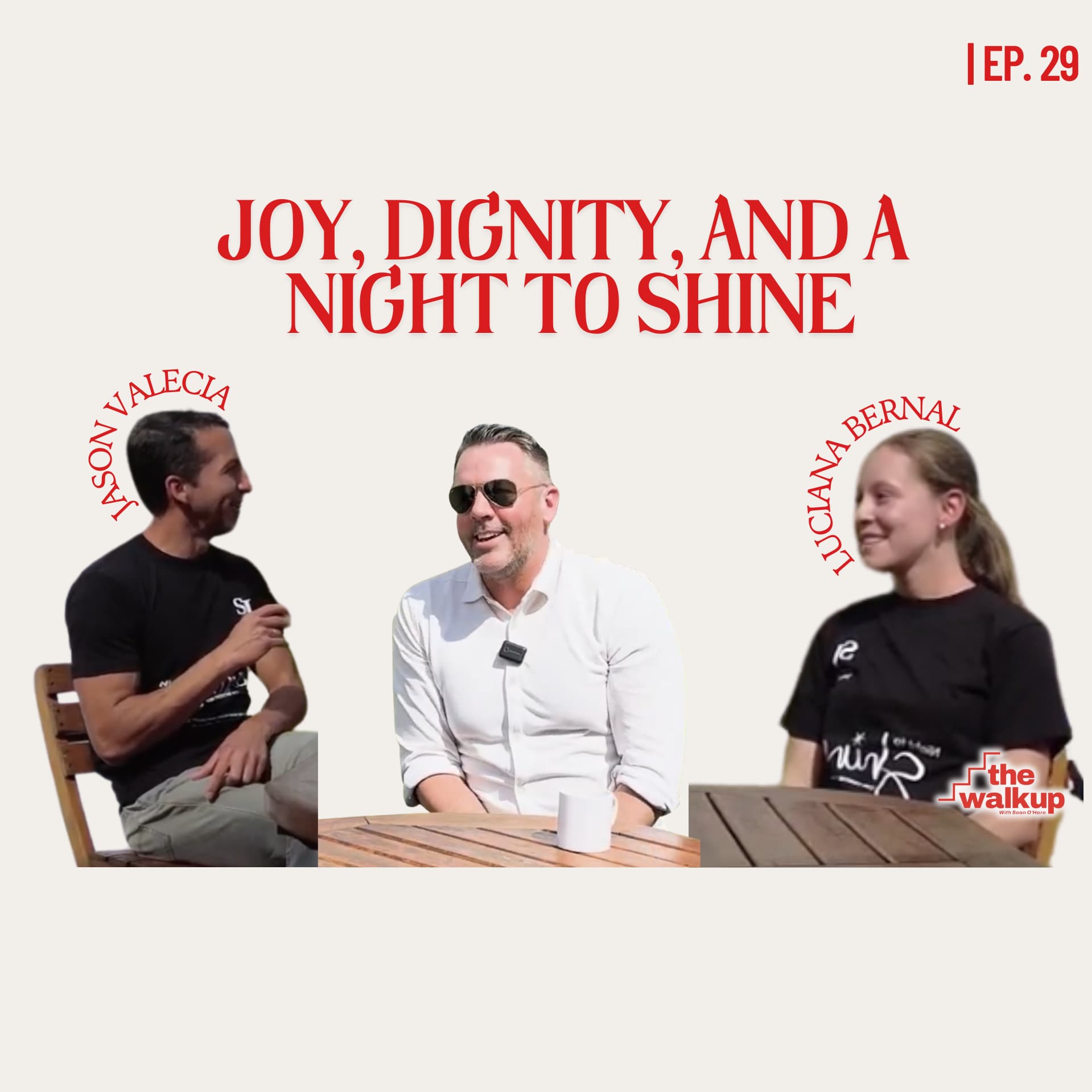
Recorded on location at the unforgettable Night to Shine event hosted by the Tim Tebow Foundation, this episode of The Walkup features heartfelt conversations with Jason Valecia and Luciana Bernal.
Night to Shine is a worldwide prom night experience centered on God’s love, honoring the beauty, dignity, and worth of individuals with special needs. Jason and Luciana share their powerful stories of faith, inclusion, and celebration—and the life-changing impact of a single night where every guest is crowned king or queen.
Transcript
Read the full transcriptAuto-generated · 5,055 words
All right, well, welcome to the WACA Podcast International. We're here in beautiful Colombia, and I'm here for the annual Night to Shine with the Tim Tebow Foundation. But while we're here, we're going to be interviewing some amazing leaders in the charitable space and all over the country. We'll be in Bogota and Medellin, so we look forward to taking you with us and showing you all that we're experiencing here in Colombia. So, we're here in Cajica. We're at San... Colegio San Jose.
And we're here because this is the third year of the Noche Para Brillar, the Night to Shine of the Tim Tebow Foundation. So, I have with me today, I have Jason, and I have Lou, or Luciana. We'll see which one I remember. But these are two people that have been amazing volunteers with this program the last three years, and so I thought, with the Night to Shine, only, what, two days?
Yeah. Friday. Two days. Two days, yeah. Today is Wednesday, and Friday will be the Night to Shine. And for our audience that doesn't know about the Night to Shine... I'll explain what it is from the global perspective, but I would love for you to share your experience with it locally. So, the Nights of Shine started in, I guess, 2014, and so we're now on our 11th year. So, the idea was we wanted to celebrate people with disabilities and communicate to them that they're...
Not just are they loved, but we want them to be celebrated and to be brought into the center of our communities. Not pushed aside, not isolated. And so, the Tim Teba Foundation started this program, and then in the second year, they decided to expand it internationally. And so, I try to use my contacts, whatever they may be, to find amazing leaders in different countries. And so, I was connected to Father Alberto, who we will meet later, and he brought this program to San Jose.
And so, now this is your third year. So, I'm curious, how did you, we'll start with Jason, how did you find out about the Night to Shine, and what made you want to be involved? Well, when I heard about Night to Shine, it was through Miguel and Bibiana, the organizing. Yeah, we should say that Miguel and Bibiana are the hosts, the extraordinaire. They're amazing. What they do, nobody else can do it. We have an injury on the soccer field. Oh, no, he made a miraculous recovery.
He'll survive. So, they do an amazing job. They do. The love they put into it is amazing. So, we're close. We're friends. So, I wanted to help the first time. I told him, what do I need to do? What do you need me to do? So, I started there, and it is amazing the love that you see in that moment, given to those kids, to those guests. It is amazing. So, what appealed to you about it? Because, I mean, I know that you're being friends with Miguel and Bibiana, and that they have a son with Down syndrome, but had you had much experience with...
People with disabilities before? No, I know. I did not. I did not, but what caught my attention is those are people that they're not inclusive, so we need to include them. We need to give them love, and that's a great opportunity to do so. The other thing is we think that we're going to give them love, and when we go, we open heart.
They also give us things. We get a lot of healing in our heart. As volunteers, so much healing. When we go with an open heart and give them love and share God's love with them, it is amazing. So, maybe take people through, what are the roles and responsibilities as being one of the lead volunteers? What are all the things that are involved with putting on this prom for those with disabilities?
Well, the first thing is the logistics of everything, organizing, put each room, the main room, there's other rooms set up for the process, catering, then we have the... We have the red carpet arrival. Red carpet, yes. The welcome, we cheer.
We make them feel welcome, which is a great part, and from the start, they feel the love. When the red carpet, when the guests arrive, they feel the love a lot. And have you noticed, because you're involved with the school here as a parent, what is your role, connection with the school? Parent. Just a parent, okay. Yes. So, have you noticed an impact or a change in how... What the Night to Shine has done with the way that the students and the school community are experiencing?
Yes, yes. There has been a lot of change. Look at the students, Lucy here, present, being involved, and how much they enjoy that, and all the love the students give. It is great, great, great seeing that, all that change. And as a parent, I mean, I imagine it is communicating things that... You want to communicate as a parent about loving everyone, regardless of their position, but what is it like as a parent to see how the community comes together and how the students are impacted?
How much willingness everybody is willing to give and to help. I remember the first year, we were asking people, do you want to volunteer? Now, everybody wants to volunteer. Now, this is the third year. Over the limit of volunteers. Yeah, because usually we have, how many guests this year? How many guests with special needs? I think 70? 80. 80? It's an approximate to 80.
Between 70 and 80, I believe. And then you probably have... Twice as many as volunteers. Volunteers. Over 80, yes, volunteers. So, well, it is great. And then last year, of course, we had it in a very big venue. We had it the first year, and now the third year here at San Jose. Correct. But last year, we had it in, that one was in Chia. Yeah, that's correct. It's between, what is that? Between Cajica and Chia. It's like between, in the road, in between.
It was a nice place. It's before the Chia. I mean, like, what is Chia? It's a little bit before, because Chia starts from the, I'm not sure how to say it in English. Sorry. Yeah, yeah. So, the geographic boundaries are very important. So, then, and how did you work to identify?
Guests with special needs that you could invite. How did you find them? There are foundations that they have them, local government as well, making calls. We have parents that call and invite the special guests through foundations or local government, local agencies. And I imagine after the first year, the...
As we say, the word of mouth travels, and people learn, and now they're saying, oh, you have to come to this thing next year. It does. It is easier now, because the first year, it was hard to find, and we had to do more calls, more calls. Now, it is easier.
So, my first one was in, I guess, 2015, I guess, in New York City. In Times Square, at a church in Times Square, and I had never done anything with special needs before. I had never hosted any party like this, and so I didn't know how I was going to find, you know, the volunteers or find the special guests, but God provides, but also, like, I was surprised there were so many people.
I thought for sure that the first year I would have to lean on a lot of people that go to church, but instead, a lot of people in New York, these are people that don't go to church, but they wanted to volunteer at this. And for me, after I went to that first Night to Shine, I was... I was hooked. I was like, all right, I have to be involved going forward. And very thankfully, Tim Tebow and the president of the foundation, Eric Dellenbach, at the time, said, hey, maybe you can help us as we grow internationally.
And so people ask, how do you find these people, find these organizations? How do you find a great place like San Jose? And, you know, you just call your friends and see who knows people in different countries, and my friend Alejandro and Enrique are very well connected in South America, so they recommended Father Alberto, and he immediately said yes. I didn't even have to explain too much. He said, yeah, we will do it.
Talk a little bit about his leadership, Father Alberto, as a pastor, as a priest, and as a leader. Well, on my side, he is a great leader. What he says, he works on it. He is consistent on his preaching to what he teaches here in the school, which is...
Which is great. I think he's a great leader, and I think Luciana can speak better on that, that she's here all day. Pass the mic. Well, I have been here ever since Father Alberto became the director, because I entered the school, there was another director, and later he became the... The principal of the school, yeah. So... Because the school has been here how many years? Like 17, I think. Oh, okay. Yeah. It looks brand new. The buildings have, like, ever since he became a director, they have built new buildings, like the infrastructure of the school has changed a lot, and the education that they are giving us has also, like, improved, right?
And... When he became the director, something that actually changed a lot, and like with my friends, was the thing that impulsed us to be in Night to Shine, was that our school became inclusive. So, it was before. Yeah, yeah.
And since I entered school, I have a classmate. That has a disability, but since he became the director, the things changed, and it became even more noticeable, this part, and with my friends, we have always liked that, and we like to see how the people...
They live with different, like, needs. Yeah, sure. Or, like, I'm not sure to say needs, but with different conditions. And how they live the best potential of their lives, right? And that some kind of disability is not, like, something that should limit you. And I think that's something that school has teaching, like, teaching, sorry. Yeah, no problem. Has ditched me. Yeah. And especially Father Albert. Alberto has been the one that has taught us that, you know. Yeah. I'm sorry, I'm kind of nervous.
No, no, you're fine. So, that's interesting. So, when Father Alberto became the director, he encouraged more inclusivity, and so you might have had only a few classmates before with a special need, but now... There's more? We can see it all around the school, right? In my classroom, there has always been one. But as time passes by, I can see even more kids, and they're just in a community, and we are all a community. It's not like some kids and the rest.
No, it's like us as a community. A family, almost. A family. In the classroom, we are like all family at the end. And you could be different, you could be this person, you could be the other person, and it doesn't matter. We're all a community. And more important is like... We help them, they help us, we help each other, and we support each other.
And, well, going more Tonight is Shine, that was something that impulsed us with two of my friends to go Tonight is Shine, because we said, like, yeah, we live this every day, because we go to school five days a week, like most part of the year.
So, like, also going Night to Shine was the chance to give this opportunity to kids that maybe haven't had it in their whole life, right? So, it was like, okay, let's go. It could be cool. It's a party, and we could help kids, and, you know, it's a chance. And when we went, it was like, wow, this is something amazing. The kids are incredible. The, like, the environment is so good, and we love it. And I have been. The three years I have been assisting to Night to Shine, I have volunteered, and it's just an amazing experience.
That is one night, but maybe it could mean the whole world to them. Of course, yeah. And tell how old you are and what year you are in. I don't know what your grades are, I don't know how it works here. I'm Luciana Bernal, and I'm in 12th grade. The last grade. I'm soon to graduate. I will be graduating in four months. And, yeah, please look at that. I'm 17 years old. Okay. So, you've been volunteering on this since you were, I guess, 15?
Yeah. So, tell me about what it was like. Did you notice a... Was there a difference amongst your classmates in this experience when they had the chance to volunteer? Was there a change in them, or something that you noticed different in the way that they acted?
Well, it's not a difference, but you're focused on different things, right? Because in your daily base, you're a different person, because you don't, like maybe where you're doing certain activities, you have different purposes. But once in Night to Shine, we had the purpose to volunteer, to help, and to...
Take out the most of that night, right? So, during that night, it was like we were not focused on partying, maybe, if we go to a party. We were not focused on, okay, let's talk, no? But we were focused on being with the special guests, like helping, what do you need? I'm here, let's dance, come on, let's go. You know, it was like this change that we normally wouldn't have, because we were focused on different things, right? Well, that is a good point.
I forget. It has been a little while since I have been in high school. But I forget, of course, you go to a party, and you are worried about how you look, you are worried about talking to your friends, and maybe trying to impress some other people, but you are saying, here is a party, but it was not about us. It was about the people that we are trying to celebrate and to serve.
And were there any, what was your role? Were you a buddy, or organizing the decorations? What is your role in the Night to Shine? In Night to Shine, we actually, the first year, we were dividing. Like, you will be in this room, you will handle this, you will work with that. But, like, I think that something that I have a lot about Night to Shine is that, at the end, we help with the organization.
We help, we are all, but we are all in the red carpet. All shear, and well, there are people with their special, with their special. Oh, if it's too loud. Like, no, with their special. Like, tasks. So, they're, like, giving the shirts, saying welcome, come here, but most of us are in the red carpet, and all of us are in the, like, in the party itself. So, that's something I like, because we all have, like, different roles in the organization at the beginning, so we are all involved in the organization at the end.
Of course, Viviana and Miguel are the ones that make it all. They're the boss. They are the ones we should think about this, but they make all like the background organization, but on the day, we help, we organize this, there are some people like I handle the moving of the chairs, the thing, like we all help giving the food, like we are all the waiters, you could say like that.
At the end, we were all with the special guests and the moment of the party itself, so we could all have experience with them. So, what is your... If you had to say, what is your favorite part of the night? There is the red carpet, there is the crowning, there is dancing, there is the personal interactions with the guests. What would be your favorite part? I think that I could say the red carpet, because you could see the emotions.
Each guest itself, like, individually, they feel in the moment, because some of them cry, some of them are so happy, so you can see, like, their reaction to new things, and the party, because you can see, like, also their real selves. I think that you could see, like... A part that is so natural of human beings, that is, like, their emotions. They're happy. I haven't seen anyone, like, cry during the, like, from sadness during the party, but they're all really happy, and it's so, like, a fun time to be with them, interact with them while you dance.
You could say, come on, let's go, and you could, it's just two moments just full of emotions that Maybe you, on a daily basis, will not be able to see. We're going to make you the advertisement for the volunteers going on. We'll make you the advertisement.
So, do you notice, has it changed the way that, has it made you more comfortable? I mean, obviously, you're already inclusive here at San Jose, but... I will just speak for myself. When I first did the Nights of Shine, I didn't have really any experience with people with special needs. There was one when I was in high school on my football team. We say soccer, but a football team.
There was one, our coach, his little brother has Down syndrome, and he would always be there on the sidelines with us, and he would cheer with us, but that was really my only experience, and then when I agreed to organize, I said, oh, I better, I guess I'm just going to have to figure it out as I go, and there's this moment of like, there's a little fear, and a little, I don't know if I'm making them feel uncomfortable, or I'm not sure.
But now I got over that fear very, not easily, but now it makes me, like, where I could see somebody. You know, with a disability, and be much more able to approach them. Okay, like, you know, for me, it's a little bit easier, let's say, because I'm used to it sometimes, right? And, well, at the end, I have always been taught that we are all the same, no matter what. So, that has always been, like, something that I keep in mind.
We are all humans with a dignity, so that's something I always have in my mind. So. For this, that, or whatever person I'm talking with, I should talk to them the same way. Of course, the formalities and all change, but we are all persons, right? Okay, but with the people with disabilities, I have...
I think an easier approach, because I have contact with them. But in Night to Shine, I was nervous to have contact with them, because I'm used to certain people, right? Yeah, and it's a quiet atmosphere, but here it's a big party, you don't know how people will react.
There are differences. People from different environments, that was the thing that I was nervous with, because I said, maybe I could treat the people every day some way, because I know them, because I have interacted with them. Like before, right? But at Night to Shine, I didn't know anything about them, and they were new people for me, so I was nervous to interact with them, but they have always told us before, like, okay, be calm, you treat them as normal people, as normal persons, right?
And you talk to them with neutrality, and if they don't, like, natural, and if they don't answer, you will, like, okay, talk to their guardian, maybe? But if not, you can talk to them. You should direct to them. So, I was like, okay, call them, you talk to them, and most of them, they always try to talk back to me, right? So, it was an easier interaction with them, because they were not like, you talk to them and they laugh. No, they always talk back to you, and they asked, and they were excited.
And I think, and you learn to adjust, right? So, some people, it is better to communicate quietly. Some people, it is better to communicate with touch, because maybe they are not as able to use their words, right? But it is that very human moment of trying to… To find a way to communicate, you know? To understand, like, one another. Like, to understand. It's really, at the beginning, it was weird, right? Because sometimes you don't, like, completely understand the other at the beginning because...
Of many reasons, but in the end, you find a way of communicating, and that is actually a human thing that I really like, because we could not even talk the same language, we could have different problems, but in the end, we will always find a way to communicate. Maybe signs, maybe movements, but at the end, we will always find a way to communicate with each other. Yeah, I've been very fortunate to host Nights of Shine, or be involved with the Nights of Shine.
Many countries now, Peru, Mexico, Brazil, Colombia, Rome, Paris, Ghana. Like 56 countries, right? Well, they're in 60 countries, but I'm not able, because they're on the same day, I can only go to one each year. I'm not Santa Claus or Padre Pio. I can't buy locates. But what I found is there's a universal, because you say, oh, we can't even speak the same language. And for me, exactly. I mean, when I was in Brazil, I don't speak Portuguese. I only speak a little bit of Spanish when I'm here.
But it is a universal language, right? And so, what I love to see about Nights to Shine is that there is a universal experience, but then there is also something that is more specific to the culture. So, maybe, Jason, if you can speak to, like, what does it mean, like, from a Colombian perspective, from, like, how people receive those with disabilities, whether it is through the church or through the community? I mean, different countries. Some countries look at people with disabilities, and then it is...
They are discarded. How does the country see, would you say, those with disabilities? Well, lately it has been more. They were set aside a little bit, years. It has been better. Lately it has been better. We see a lot of foundations, a lot of churches that have special programs to include. People with special needs. So, it's getting better. It's getting better. But a few years ago, they were set aside. And what do you think changed? Was it just the overall, you know, people have become more aware?
What is it that's changed? I think people like Father Alberto. That they really teach God's love the way it should be. So, I think not only him, but others, same way. I think that is what changed. So, the mindset in the community is changing.
So, Dan, tell me about last year. Of course, we were very privileged to have Tim Tebow himself here with his lovely wife and some of the... The foundation, staff members, and also some very generous donors that help support. So, I am always curious because when we get outside of the states, I always wonder, do people know who Tim Tebow is?
Did you know? I do. You did, okay. You did not, okay. I do. I used to follow football a little bit when I was in the U.S., so I knew who he was. But yeah, no, most of them here probably don't know who he is, because here in Colombia, football is not very well known. Yeah, American football, we should say. American football, right, not soccer. Real football. Correct. No, it's funny, when I was in Peru, Tim was supposed to be there, but there was a problem with the travel, and so they had already planned for him to be there, and so then the Knights of Shine comes, and it was just me, and I think...
People are taking all these photos with me, and I say, oh, no, no, no soy Tim Tebow. I'm not Tim Tebow. And I think after a while, they're like, I don't care. It's fine. You took the fame for a little bit. I want to be famous for a little bit. I never smiled so many pictures in my life, but it was only because they thought I was somebody else. So, I'll ask both of you to wrap up. What is it that You hope people, you know, experience, for those that haven't had the chance, what would you tell them, you know, to be involved in the Night to Shine as a parent, and then for you as a student and as a volunteer?
As a parent, go with open heart. Go with open heart, share all the love, because that person, that people, that person with special needs. It might be one of your kids, or it is somebody else's kid, so go spread love. God's love, with open heart, and enjoy the time.
Yeah, and I think that, you know, we have a, especially, we all are guilty of it, I think, but in the States in particular, there is this... The idea of, well, we are going to have, you know, one child or two children, and they will be perfect, and we plan for all these things, right?
But what working with, and then we think if things aren't perfect somehow, it is outside of God's plan or something, right? And I have never met... Particularly with those with Down syndrome, I've never met a family where what most people in the world might think of as a burden, having a child with a disability, or in this case, Down syndrome, but I've never met a family where that child isn't the center of the family, isn't the absolute gravitational pull of the family.
And it makes everybody love each other more. It is such a gift. But we have to have that at first experience. And I think for me, the Nights of Shine, and I want to hear from you, is that introduction. It gets us over that initial discomfort or fear. Because if you haven't been around, you know, Individuals with a special need, then maybe you don't know how to act, and you're worried you're going to make them feel uncomfortable.
And I think the brilliance of the Nights of Shine is that it's this accessible event for volunteers. It's like an introduction to this space. I think if I said, oh, would you like to volunteer at a... A hospital for people with physical disabilities, that might be a lot for people right away, but if they, hey, come to a party, that doesn't sound so bad, but then when they get there, they end up learning something much deeper, right? Yeah, yeah. So, what would you say if you were to encourage somebody to volunteer, how would you do that?
That is an experience out of the ordinary. Like, normally, we can go to parties. And find people with disabilities in another place. Like, normally to people, like, we will not relate both terms, but that night is, like, that point where we can relate both, because you can go there and experience so much new things. So, there are so many new experiences that you will never, never, never see in an everyday life, right? You see... Emotions, easy, I am not sure how to say, because, like, I think it cannot be even explained with words.
It is something, like, amazing. Yeah, I would say, in using fancy theological speak, I would say it is, so the Catholic faith is... Particularly incarnational, meaning it is not something of just the mind or just the spirit. We live in the world and through people. That is why God became man. He needed to show us God incarnate in the world, and so we are an incarnational people.
We need that physical engagement. We need to be with one another in the present, in the same way we have it, of course, in the Catholic tradition and in the Eucharist, right? We, I think, try to reflect that in the love that we show to other people, right?
I think I know what I need to say for volunteers to encourage you to go to Night to Shine. If you want an experience full of love, full of joy, and full of such amazing things, you need to go to Night to Shine.
Because that night is full of all of those things, all of those good things. Good vibes, just only good vibes, and you can see like the true, true, true self of people that you maybe will not get to know normally. You get to know all of these people much deeper, know sometimes their experience, sometimes their lifestyle, and yeah, that's maybe. I think you did a perfect job there. So, well, thank you for all of the years you guys have been volunteering, and good luck to you after high school.
I don't know what you're planning after high school, but we wish you all the best. So, thank you both for all of your effort with Nights to Shine, and thank you for joining us here on the podcast. Thank you, Sean. Thank you.
More from The Walkup

Against the Odds: The Samurai Lawyer (Chad Flores) | Ep. 52
Faith, Sexuality, and the Fog of War (Iris Bahr & Father Rick Riccioli) | Ep. 02
E2
Church, Conflict, and Community (Iris Bahr, Father Rick Riccioli & Rob Long) | Ep. 03
E3
Hope, Vocation, and the Global Church (Colm Flynn & Colin Nykaza) | Ep. 04
E4