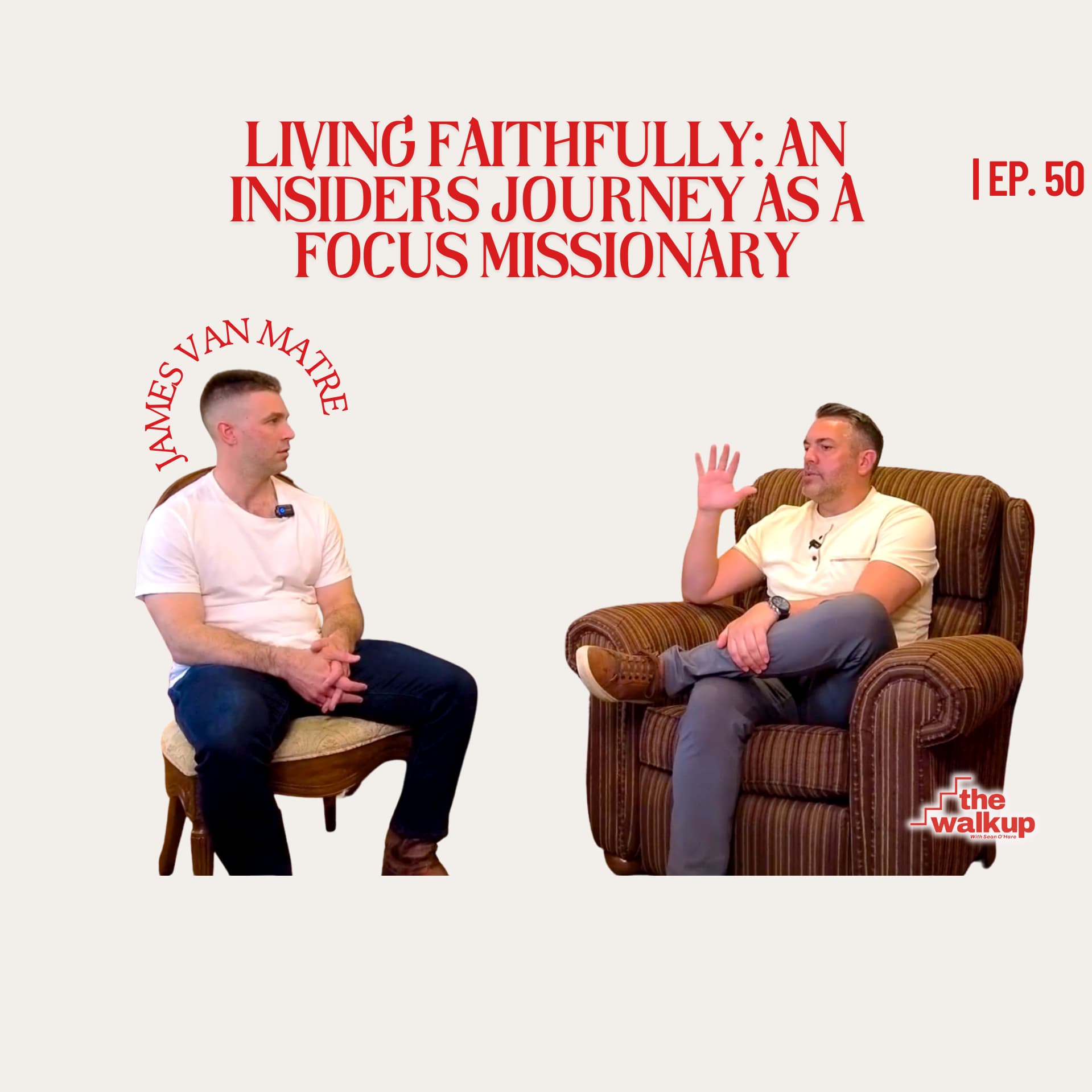
Living Faithfully: An Insider’s Journey as a FOCUS Missionary (James Van Matre) | Ep. 50
In this episode, we sit down with James Van Mieter to explore his 11-year journey with FOCUS (Fellowship of Catholic University Students).
From his first mission trip in the Yucatan Peninsula to evangelizing on college campuses across the U.S. and serving internationally, James shares the joys, challenges, and spiritual growth that come with living fully for Christ. We dive into what it really means to be a missionary, the realities of fundraising, mentorship, and leadership, and how even casual connections—like joining a club volleyball team—can shape lives in unexpected ways.
Whether you’re curious about campus ministry, Catholic mission work, or living intentionally for your faith, this conversation offers an authentic look at one man’s calling and the long-lasting impact of discipleship.
Transcript
Read the full transcriptAuto-generated · 18,250 words
Welcome to the Walk Up podcast. I am not normally in such a dominant position, but I swear this was just the furniture that was available. It is not because I am trying to look more regal. Not that I am complaining, but we are here in Houston, James Van Meter.
A good friend of our friend in common, Anna, connected us, and I said, give me interesting people to meet in Houston, and you were the first person she thought of, so a lot of expectations here. So, there are a couple of things I wanted to get into. I think the first, so our audience is kind of a mix of people, faith background, not faith background, so I always like to make sure that we never... Assume people know Catholic lingo and things like that.
So, I thought it would be really interesting to start off talking about your experience as a focused missionary. A Catholic crowd will know what that means, but a lot of people won't know what that means. So, maybe take us through what is focus, what does it mean to be a focused missionary, and then we can get into what your experiences were like in that world. Yeah, right on. Well, first off, because I no longer am employed by focus, I didn't have to sign the dotted line.
You know, saying what I could and couldn't say about being a Focus missionary. But, no, Focus is great. Oh, so this is going to be an expose on Focus. I know, right? I think I have to get special permission from HR to say, you know, hey, you're doing this formal interview, you can't just say whatever you want. No, no, they're not that intense. Litigious, yeah. But, Focus stands for the Fellowship of Catholic University Students.
It was started a couple decades ago, and the idea was just to bring Jesus Christ to college campuses, particularly with Catholic faith. So, you might be familiar with a Protestant or Christian version, so to speak, that is called CRU, Campus Crusade for Christ. So, the founder of Focus was actually really impacted by the presence of CRU at his alma mater, and that was really life-changing, and then he had this moment where he realized... There's not a Catholic equivalent, like, anywhere in the country, right?
So, then Focus is born, and then the whole idea is just to go reach out to college students when they're at this really, really pivotal point in life. They're trying to decide who they're going to be. There are all kinds of crazy worldly influences, and so what better time to meet a person who loves you, cares about you, and introduces you to the person who's going to change your life forever. That's Jesus, right? That is the idea. So, focused missionaries serve on college campuses for the most part.
They do some other things, too, and you can go corporate and work at the headquarters. They call it the support center, not headquarters, but you can go to Denver to do that, and they have some international campuses, but basically, the idea is that you are living life alongside college students while trying to build up a friendship and introduce them to the person of Jesus.
Yeah, and... And in particular, the missionaries are young, right, because you want to be relatable to college students. So, the majority of Focus missionaries are in their early to mid-20s, yeah? Yeah, for sure. So, when did you get involved? Right after college, or when did you get introduced to Focus? Yes, sir. So, Focus came to my campus when I was a junior. And this is where? Where were you in school? Oh, I was at UT, the University of Texas at Austin, yeah.
And I always really liked the missionaries. They sent some really cool missionaries to UT, you know, because we were a big campus, and I thought we were going to get a big focus program there. And it is very funny, because I was at first, like most people who end up really loving focus, I started out as a focus hater. It is just kind of how it goes. You know, you are like, who are these guys kind of showing up and trying to shake things up, but I always had a deep respect for the missionaries.
And so, when I was invited to do a mission trip, my... Senior year, so the following year, I was like, sure, I don't have anything going on, spring break, that's meaningful, and not debaucherous, because at that point, I was like, yeah, maybe doing a debaucherous spring break is not the best way to live my faith, let's say, right? So, I was like, yeah, I'll do a mission trip, and the mission trip was really amazing, man. I mean, it was very life-changing.
We served this little village outside of somewhere in the Yucatan Peninsula. And it really impacted me, and to love the people there, to serve them in a particular capacity, to use my Spanish, because I was a Spanish major, and to basically use the language to kind of bridge some gaps, and I just experienced a really profound encounter with God, and a ton of people on the mission trip did as well, and so after that experience, I was like, okay, I think that, you know, my heart had warmed up a lot to the idea of serving in some kind of capacity with the church.
Specifically, as a focused missionary, because that experience had been so powerful to me. So, originally, my thought was, I will do a two-year deal, like Peace Corps, or go help the poor in some random country and speak Spanish. I was looking to do it with some kind of Catholic group, but the formation of Focus and the intentional spirituality was what really hooked me. I knew that was something that I was hungry for, and it is something that I tasted while on the mission trip.
Because Focus does such a great job of not just serving the poor, kind of do-gooding, right, in whatever country you are doing the mission trip in, but also really inviting the students into a much deeper and profound relationship with God and his church and the community that you are there with. So, that really hooked me. And so, I said yes, and then I became a Focus missionary right after that spring break trip. A couple of months later, I was doing Focus.
So, then, because at this point, you are... Your faith is strong, you're cradle Catholic, where were you at in your faith formation at the time you encountered Focus? Yeah, so I was, thanks be to God, God had really found me, I think, my freshman year, right after my freshman year of college. I did like a bunch of the kind of normal party thing. And it was after my freshman year that I actually had the opportunity to staff at a Life Team camp.
I am not sure if you are familiar with Life Team. Sure, yeah. Based in Georgia, called Covecrest. And that is really where I owe my conversion. I am forever indebted to Life Team for my conversion. Because I just had one of the most powerful experiences of prayer with God, in something called Eucharistic Adoration, which is basically the host at Mass. They put in this really beautiful kind of glass thingy, and then you are praying, and it is in a church, is the idea.
But it really moves me. I really felt like God speak to me, and He was really... I experienced Him as like my father, because I did not really have much of a dad, and I experienced God as a father, really in the most profound way for the first time, and that really wrecked me. So, that set me on a trajectory, like I felt like I really knew God, like I had an intellectual ascent to God.
Like, in high school, because I had done that camp before as a teenager, but staffing it and then having this particular prayer experience really rocked me. And so, at that point, I was like, okay, no turning back. I don't need to engage in some kind of, like, party life. Like, God is my fulfillment. I'm going to do something to serve him. But I wasn't, again, super open to the idea of doing focus, because I was like, oh, well, I'll do something else, whatever, you know.
But that is when I really started, I think, walking with God and having a legit relationship, because I had all the externals before, I guess, that turning point, but I was not really in a relationship. You were pursuing a relationship with Him. You were just kind of, yeah, He is there. You go to church. Yeah. It is nice, but it was not actually, you were not in an intentional pursuit of developing a deeper relationship with God. Yeah, yeah. And then, because, I mean, it is a big sacrifice.
To be a missionary, right? I mean, because it's usually a minimum two-year? Minimum two years. So, minimum two-year commitment, and then you're assigned to a university, right? Yeah. So, you go to some training, I assume, some sort of... So, training at that time was five weeks. Actually, I was there with Anna, because we both graduated from UT the same year, and then did Focus together. Nice. So, our friendship goes way back. But yeah, you commit to some place for two years.
Well, to Focus, because they can move you after the first year. Okay. You kind of go wherever you're sent, and that's like one of the cool radical pieces as well, is like you're just open to go on wherever in the country.
Yeah, so then, okay, so you got to orientate, or training in Denver, I assume. Well, actually, they change the location depending on where the missionaries... Where they can house a couple hundred people for a summer, which is typically some kind of dormitory on a college campus. So, at the time, it was Ave Maria, Florida.
Oh, sure. Yeah, I have been to Ave Maria University, Ave Maria, Florida, yeah. It is like, what is that movie where it is like this whole village, and they are all in on it, but this one dude does not. Oh, Truman Show. There we go, Truman Show. Yeah, it has got some Truman Show vibes. Yeah, Truman Show vibes, yeah, for sure. Yeah, or like, what is the other thing?
Right. Stepford Wives, everything is perfect. The lawns are all exactly the same. But obviously, a lot of fruit has come out of that university and that place. For sure. Well, we always joke that we kept the bar in business, because there is one pub. The five weeks we were there for the summer, we were like, yeah, you are welcome for all the revenue for the whole year.
What does your family think when you're like, hey, I want to be, you know, because you're a graduate from college and you're about to, like, you know, presumably start a career or maybe go to grad school, I don't know, but what did your family think about your decision to become, to give two years away?
And in fact, you have to raise your own money on top of it, right? Yeah, you have to fundraise. Lots of pros and cons with that. The older I've gotten, the more I've just determined, man, everything's pros and cons. You're just choosing different things. You're saying yes to certain things and no to others, right? But yeah, they were relatively supportive, which I was surprised by. I think that a lot of other people who do focus or any other kind of missionary activity, they have a lot harder time.
Which is unfortunate. I mean, it is like, you would think, well, we always make this joke of like, what we used to, is like, yeah, if a Mormon missionary can give up two years for something that isn't like the truth, right, like capital T truth, like obviously there is some, they are kind of quasi-Christian, right, is the idea. But, you know, for like, this is like the Catholic Church, why couldn't a young person give two years, right? It just makes sense, right?
Sure. It is like, why not? If they can do it, so can we, because we have, you know, a lot more reason to, right? Yeah, and so, yeah, they were relatively supportive. I think my stepdad had some reservations. I think most of the time, it is the dads who are like, how are you supposed to make money? They are like, oh, well, God will just provide it. They are like, yeah, sure, but I think we all kind of live in a practical atheism where we are like, yeah, yeah, God will provide, but I really have to do all these things.
But I need a backup plan. I want to actually trust him, yeah. Yeah, and granted, you have got to put in the work, and so, yeah, but I think they responded relatively well. Yeah, it was actually when I, at one point, I did discern the priesthood during my first couple years as a focused missionary, and that was where there was a lot more resistance, right?
Interesting. Yeah, you can do this focused thing, but we don't need you to sell out so much for that, because that's kind of intense. What about our grandchildren? That sort of thing. Because you have siblings? Yes, sir. I just call you sir because I am a southern kid. Yeah, no worries. It is not because I deserve any respect, don't worry. Yeah, you just got to pardon. The automatic manners just come up, you know, when you are like a Texan. But yeah, I have four siblings.
Okay, gotcha. Well, so they got some other options for offspring. Yeah, that is right. They are taken care of. My oldest brother is a priest, so I have... Oh, no way. Yeah, so I have ... Wow. I have always envied that, because I am like, man, this means every vacation, you just get to have Mass, and other ... Oh, we are super spoiled. I mean, yeah. Man, that is cool. I have private Mass with my brother all the time, and my dad passed away two years ago now, but when we were with him towards the end, I mean, my brother was celebrating Mass every single day in his bedroom, and even towards the end, he could not receive the Eucharist, but my brother would ...
You know, a drop of the precious blood on his tongue. Whoa, that's crazy. You know, it's like a very St. Joseph-type death, you know, with my mom, his wife of 53 years, and then his son, who's a priest. I mean, it doesn't get much better than that. Yeah, that's amazing. If you're going to look for a peaceful death. But, yeah, no, I highly recommend, if you can get a brother who's a priest, it's super awesome. Upper heart.
So, but... Okay, so they are kind of resistant, and then the fundraising side, explain to people how that works, just so they know what the structure is. Yeah, so basically, you get a little bit of a boot camp training in a certain kind of baptism in reality, where it would be like, all the money and resources in the world are God's. And so, you're not really asking people to give up or give away their money, although obviously, like, you are. But it's deeper than that, or you could even say it's like a higher order than that.
It's like God has orchestrated and ordained everything, and so really what you're doing is asking for people to participate in what God is doing, right? And inviting them to share their resources that God's given them with you. It's kind of like you're all one family, right? And you're just trying to identify, does this person feel called to support me in this particular mission? And now, obviously, you're taking a risk, you're putting yourself out there. I think as Americans, we tend to worship money in a lot of ways, right?
It's a bit of an idol, and I'm speaking to myself, too. Like, I'm preaching to myself as well. It's certainly been an idol in my life in many ways, but you're just inviting people to kind of give up that idol and give it to you to actually foster a good work in the church, right? Actually bringing people into the fold, because one of the stats that we quoted often within Focus is that I think it's something like a staggering 80% of kiddos who go from, you know, 18 to 23, they go through college, they're not going to practice.
Yeah, I mean, it is clearly a precipitous drop. It's sort of the cliff. Now, I've been learning that it's even getting earlier. Oh, it's getting earlier. Yeah, because that could be pretty outdated. It could be like a couple decades old. Like, now it's like 13, 14 years old. It's really when they start to drift, but then really, obviously, once you're outside of the...
The home, and maybe if you were going to Mass with the family, and then you are on your own at college, that is when it really solidifies. My brother, being a priest, is always working on, okay, when do we really need to make sure that we, like, when are we losing people? And more and more, it is 13, 14 years old. Wow. But anyway, so then you go often to, obviously, friends and family, but then sometimes you get to talk, you go to different churches, and they get to...
Give you a spot to talk after Mass? Potentially. You can always reach out to a pastor. It is typically more effective when you actually have a relationship, right? You are not just there for the money. You ask to speak, you know, after Mass. Yeah, it is your home parish. Yeah, your home parish. But, I mean, also a prophet is not without honor, right? Except in his own native place. So, depending, right? It depends, I guess, on your relationship. But, you know, and of course, if you are a convert, that may be a little bit harder, right?
Like, if you are a Protestant convert and you go back, you try to go to your home church, like there isn't one. There is a huge... Not a lot of Protestant churches funding Catholic missionaries. Not a lot. That is a strange one. I had a lot of really generous coaches and teachers who were all Protestant men, but they were super generous towards me. Actually, in some ways, I was really surprised by that. Because, like, you know, these long-time Catholic families were like, they wouldn't even want to return my phone call, right?
But, you know, when you give the parish talk, you're hoping to actually get contact with people, right? You're not just trying to have a basket go around for a second collection. You really want to build a relationship. And so, getting contact information, really having some kind of meaningful chat with people after Mass, refusing to take any kind of immediate handout, so to speak, following up with that person, meeting at their home, meeting them for dinner, taking them out to coffee, and really sharing what you're doing.
What they're investing in is actually really going to change lives for forever. Like, those people that you minister to will somehow have a seat in heaven because of your, yes, because of your generosity. And it's not like God couldn't save them without you, but he set it up in such a way to where more of your people are saved depending on the cooperation of other people. It's kind of wild that he would entrust that kind of mission to humanity, but he has.
Yes, and I think the message always connects because of the… One of the statistics we were just talking about before is that everyone knows. If you are a parent or a grandparent, the likelihood that you know somebody within your own family that lost their faith either during or shortly after college, it hits home a little bit, I think. Yeah. So then, you guys had to raise, was it like half your salary? No, the whole thing. The whole thing. Okay. Yeah. The whole thing.
Okay. That is no joke. Yeah, the whole thing. So, now your stepdad is like, let me get this straight. Not only are you not going to make a lot of money, you've got to raise the money that you're making? Yeah, for sure.
So, you said that you have pros and cons. Are there conflicts or things that felt uncomfortable for you? That's a good, quick question. So, maybe pros and cons is like, you know, I'm not currently working for, you know, I spent 11 years serving as a focus machine, and there were a lot of gifts around that time. And I think one of the gifts that's... It is hard to admit it, because it is such a grind sometimes through the fundraising gig, but when you fundraise, you recognize how much you are just dependent on God for everything.
True. I imagine it is something, not exactly the same, but kind of like a mendicant friar. If you are begging for alms, just for you to exist, there is something really sobering about that, that just puts you completely dependent on reality.
Versus if I have my cushy... Not to call anyone out, but like, I have a cushy corporate job, or I'm just a corporate drone, or slave, or whatever. It's like, the man's paying you, and you're putting in the hours, you're doing the work, you're getting a paycheck. And it's really easy to be like, God's no part of that. I'm doing all this. I'm making it happen, right? And so, to come face-to-face with your own dependency, I think, is a really good thing.
But then, of course, you kind of get tired of asking for money, to be honest. You know, certainly I did, right? Well, 11 years of it, yeah. Yeah. Because the entire time, you're raising money each year to do that.
So, I am sure that like year three, people are like, okay, year seven, they are like, all right, buddy. All right, yeah, exactly. Enough with the... Well, you know what I mean. Yeah, like how much more, you know, and I think it depends on how people view it. It is like, well, how much, you know, you could view it as like, why are you still wanting a handout? You should just get a real job like the rest of us and work hard.
But I think that is also a total, it is just, it is not a good perspective on reality. It is like, if we really think the most important thing is heaven, then why wouldn't we support... A job, like being a focused missionary, or any other kind of missionary activity, that its explicit purpose is to get people to be in heaven for forever, right? I think it is just that we value temporal things. And, you know, I also think there is something to be said.
I did not rise the crazy ranks of focus, right? I did not get a focused wife, so to speak, right, where I was having this missionary family. And I do think that there is a certain buy-in that supporters can have if it is like, I am in this for the long game, I am moving up the natural kind of hierarchy structure of non-profit life, you know, will you partner with me in this or will you partner with me in this? You know, until whenever.
Until whenever God calls me out. I think there is a certain bind that people see, because they understand. They are like, oh yeah, you totally need people in higher leadership and non-profit. That just makes sense. And so, if you are kind of headed in that direction, we want to support that. Versus, you know, I was going part-time, I was getting a second degree. I mean, yeah, people can kind of be like, okay, dude, we don't just want to keep giving you money, right?
Gotcha. So then, because how big is focus? The number of campuses they're on. Do you have a sense? Gosh, I think it was around, I could be butchering this, basically 200. Okay. Even if it is a ballpark, because people in IDA, it is not 20 campuses, it is not 50, 200. That is a lot. And all in the States, or you were international at some point, right? I had served internationally, but not at a college campus. Oh, I see. But yes, we do have a few international campuses in Europe, and I think they have now expanded into Mexico.
Okay, gotcha. It is funny, I keep doing this thing where I am like, we and they. Still part of the Focus family. Yeah, yeah. For life. And then, so then, what was your first assignment? Tulane University. Tulane, okay. And how do they decide where people go, or is that disclosed? Oh, they make trades. I'm just kidding. I'm kind of not kidding. I think it's like fantasy football, where it's like you have your people that are hired in your region, and you're like, I want this guy, you know, I'll trade you this guy for that guy.
I mean, no one's disclosed it to me, and I don't think Focus would. That's just my sense. They make them after me if I share that. I think it's one of those funny things where it's like, it's probably very human, right?
Because it is so human, it is actually all the more divine, because it kind of hides the divine action, so to speak. Yeah, I have heard some holy people talk about it that way. I think it is the same with priest assignments and things like that. There has to be a human element to it.
So, you started at Tulane, so now you are in Party Town, New Orleans. That is right. Right, so that is an interesting place to evangelize. And Tulane's... It's a state school or private school? Private school. Private school, and how big is that? 10,000? Small-ish. Well, actually, yeah, with... With grad students, it might be about that size. I think when I was there at the time, it was like 7,000 to 8,000 undergrad. So, 8,000.
Okay. So, then what was that like when you're like, all right, now I'm like for real doing this? And to help people understand like, okay, how does one evangelize on a college campus? And you're not a student. So, you're not at Tulane, yet you're assigned to Tulane. Like, how does one go about doing that when you're like? You are just on campus? How does that work? Yeah, great question. Yeah, that is so good. I mean, I think that is a lot of the first whole years of being a missionary.
You are like, I have no idea what I am doing, because I am not a student, and how is this supposed to work, and everyone is going to think that I am weird. So, the whole first year is just to kind of get over that. But, to answer your question more practically, I think it has to do with getting involved in as many things as you can, and trying to meet as many people as you can. Sowing seeds with as many groups, organizations, students, you know.
As they're out there. A lot of it, honestly, is just trying to build friendship, right? So, if I do something that someone else enjoys, there's going to be something, right? Like, you were telling me that you play soccer before. Yeah, go play soccer, right? Any group that will accept me, right? Maybe even try to sneakily not voice to everybody, like, I'm not a college student. I'm actually here. Before you invite me to this thing, I want to disclose that I am.
Because, yeah, you look college-age because you're one year removed at that point. Exactly. A thousand percent. Okay. And also, you'll strike up random conversations with people on campus, and so we call this barehanding, which you can do a flavor of barehanding, which is like the street preacher who's like, hey, everybody, listen up. This is what reality is. You're going to hell if you blah, blah, blah, blah, right? And so, most people are pretty turned off by that, although I think there can be some really interesting conversations that get sparked.
But in my experience as a focused missionary, it'd be more like, hey, just trying to meet some new people on campus. Just curious if we could ask you. You know, we would do things like, we just want to get a spiritual survey for the campus. We work out of the Catholic Center. We're just curious to hear people's thoughts about spirituality at Tulane. And they're like, oh, okay, sure. I could give you a couple minutes, right? Now, I don't know if that's changed since COVID.
Maybe there's even more stranger danger and like, don't talk to me. But in general, if you bring out anything that's like a magnet to college students, so like spike ball, throwing a frisbee around, like people will just be interested and they'll just kind of want to talk to you. And so, from those relationships that you build, ideally, a few of the people will want to meet up with you for coffee or for a beer if they're of age or to play this sport.
But I guess the easiest kind of lowest hanging fruit is you just find the kids that are at the Newman Center. That are already kind of wanting to get involved, and that is where a lot of, I think, the mission starts, but then it is trying to help the kids at the Newman Center leave the Newman Center, go outside the Newman Center, not just stick to their little bubble and kind of divide their faith life so much with their other life.
So, just to give an example, so at Tulane, I, my second year, I joined the club volleyball team, which is actually a very casual team, so it's not like, was that an amazing, of like a volleyball player, and they would often practice co-ed, just to give you an idea of like, that's not that competitive, right? But in playing on the club volleyball team, I met a guy who was a fallen away Catholic, right? And so, and there was a lot of other work that had to happen to get this man to know and love Jesus, but long story short, he ends up Coming to my Bible study, but he is the only one who shows up to that Bible study that I started, which is not that uncommon.
We do this meditation on the gospel, where I basically was like, yeah, Jesus asks his disciples, who do you say that I am? So, okay, you know, sophomore, freshman kid, like, what do you think? Like, who do you say that Jesus is? He is like, literally no one has asked me that question, and I do not know the answer. I was like, cool, sounds like something to think about, you know.
He ended up not really being involved that semester. I kept seeing him at the club team, but he was kind of dodgy. A couple years later, a guy that I had mentored had taken him on in mentorship, and then lo and behold, after he graduates, becomes a focus missionary, then later discerns to become a Dominican priest, and is currently in formation. Oh, wow. So, you just never know. It is like, and all it started with was just, I played club volleyball, and I happened to meet some guy on the team who happened to be Catholic, right?
Wow. So, just, and that is really simple, but it is like, sometimes that long game is really what you are there for. Like, I may not even see it. I did not see it while I was there. But just the fact that I was some kind of presence, right? Yeah. Well, that is cool. So, you are at Tulane then for two years? Two years. And then, at that point, you are like, I want to stick with this thing, or how did you decide?
Because at that point, you have done your commitment. Yeah. And so, then they are talking about like, hey, do you want to… Do you want to keep doing this, or how did the decision come to extend it beyond two years? Yeah, good question. So, a lot of it, I mean, you just have a spirit director, and you talk about it. In some ways, there is an argument to be made that your first year is, in some ways, the best, because you are not having this anxiety of figuring out what is next.
You know that you gave God two years, you are just going to full send it, right? But in the second year, all the questions come, like, are you staying, are you leaving? And the anxiety really peaks. Like, December, January, that's when the annual focus conference happens. So, for me, actually, I was planning on leaving staff because I was discerning a call to the priesthood. Gotcha. And I was planning to enter a particular religious order. It ended up not being God's path for me, but whenever that didn't work out, it was really obvious that...
To stay in focus, because I loved the mission, I really wanted to develop myself as a leader, focus has really excellent formation, and they even encourage you, too, saying, like, yeah, I mean, if you enjoyed these first couple of years, like, allow us to pour into you, see what God could have for you, like, you could make this much more of a career, right, if you really wanted. And then, so then you decided to re-up, and then you're... At that point, you commit to another, it is always another two years?
No, after the first two years, it is just you are going year to year. Okay, gotcha. And you are encouraged to think more long term, right? Like, if you want to be, let us say, I mean, sometimes they will say you have to do this role for at least two years, but obviously, it is like an at-will thing. So, people do leave, or they do not follow through on their commitments, but that is just also true of human nature with anything else, right?
Yeah, and we should mention that, I wanted to clarify this before, is that Focus is working in concert with the diocese that they are in, right? A thousand percent. So, effectively, the way the church works almost always is that if you have a new apostolate or ministry or something, and you want to go to a, hey, we want to go to...
Tulane, well, that is in the Archdiocese of New Orleans, so therefore, you would have to go through the Archbishop to say, hey, we would like to bring this ministry there. He then has to discern and say, yeah, we would very much welcome you here, and there is a process by which they invite, formally invite, focus to be a part of that diocese, which is why you are like, At the Newman Center, or at the Campus Ministry Center, or whatever is there, right?
Totally. Yeah, I should mention that I was, I'm sorry, I grew up around Focus. I grew up... Aware of focus, because my mom worked at George Mason University as the secretary at the campus ministry, the Catholic campus ministry, for 25 years.
So, focus was pretty early in their development was at George Mason, because George Mason was in a very solid diocese, the Arlington Diocese, and George Mason is... I'm probably 20,000 people. I mean, there's a large commuter element, but it's a large campus, and they eventually got their own.
Their own church built, and their own, and they had, I think, eight Focus Missionaries? It was a lot. It was a big operation. Very big team. So, I was aware of Focus, mainly through my mom's, they were effectively co-workers of hers, right? And she loves them, and loved having them around, and it was great to have, you know, obviously you want as many capable leaders around when you've got a big operation like they had, and they've had, oh my gosh, I don't know how many priests and nuns have come out of there.
Probably a dozen. Oh, there is a lot. Definitely encourages, I mean, following Jesus just will naturally encourage religious discernment. Yeah, yeah. I mean, in George Mason, they were just cranking him out. But anyway, so then you re-up, and then where do they assign you next?
Well, at that point, you, like after the first year, you have a lot more. Say where you go, kind of. Let us say if you want to become a team director, which means you lead a particular campus, then they may have certain options for where you can and can't go, because it is like, if someone is the team director at UT Austin, like that is where I went, you can't just be like, well, I want to be the team director there.
It is like, all right, buddy, well, we already have somebody. It kind of is based on need, right? There may be certain geographic places or parts of the country that need more or less need or whatever, but you try to work in tandem with the leadership to figure out what is a good placement for you. But at that point, because it was June, and I had already stepped down from being the team director at Tulane, the most natural fit was to go to Denver to work for the main offices.
And I had wanted to work for the International Missions Department because of my own story, like I had shared, having such a profound experience on a FOCUS mission trip was really awesome. And I was also, I should have, I should have, I mean, I say should have, I think it's important to clarify, and FOCUS has, I think, done a really good job about this over time, is that...
If I'm just a missionary at a college campus, it's not a bad thing. It's very good, because I can reach out, I can have these awesome stories where students come to Jesus. It's amazing. However, it's even better if I can empower the men that I am leading, or if I'm a female, the women that I'm leading, to go and do the same for their peers. To not just be a recipient, but to also be able to be a leader in their own community, in their own right.
Who can also do that for somebody else? Because they don't just want the leadership to end with me. And so, that is something that I think Focus has done a great job of getting more clarity over time, of like, I am not just here to evangelize you, I am also here for the people that will know and love Jesus because of the way that you are going to lead them. Who are going to lead them, who are going to lead them, who are going to lead them, right?
Yeah. Yeah, so then, so you go from Tulane to headquarters, and then you are there for how long? Oh yeah, for a couple of years, and at that point, we had done a kind of hybrid thing where I don't have a hybrid, but just kind of an experiment where I was asked to serve in Mexico City for six months, like the spring semester-ish into the summer. Where I was basically hosting a lot of focus mission trips in conjunction with a third-party host called Hope of the Poor, where they just had already taken on a ton of focus missions, and they were wanting to take on more, but then we didn't have enough.
That person didn't have enough ground support, so to speak, to bring in more mission trips. And so, one of the roles of someone who works in the focus missions department is to help organize and coordinate these short-term missions, right? But it's even better if you can have somebody who understands focus, understands the partner apostolate, to be on the ground. For like a midterm, kind of long-term type situation. So, while I was assigned, I guess, so to speak, or while I was working for Focus Missions in Denver, it involved a six-month stint in Mexico, and then a six-month stint in Peru.
With a different partner apostolate. Actually, they were working with the Sotolets, the Christian Life Movement. Yeah, I'm sure, yeah. With a really awesome consecrated lay brother. So, those were really amazing experiences. And you were in Lima, or where were you? Yeah, so in Lima. And in Mexico, it was Mexico City. Yeah, that was really amazing, and I speak fluent Spanish, and so it was really easy for me to kind of facilitate the trips, you know, have us do really good work on the ground.
You know, in Mexico City, we were mostly working with street kids and the homeless, trying to reintegrate them back into society, and then Lima, Peru was a lot of short-term construction projects to basically make people's lives better in the slums. Gotcha, gotcha. So, that was really powerful. So, three years total, you know, in and out of Denver, loosely based in Denver, kind of, but then living part of the time in Latin America. Yeah. Because you end up being involved with Focus for how many years?
Eleven. Eleven. So then, okay, what are the other years then? Yeah, that is a good question. So, five or six more years left. So, one challenging thing about being a missionary, I mean, it is very good that you get to make a gift to yourself, but I was like, I am basically living as a perpetual bachelor. I am never settling anywhere. I am not setting any roots. I am always moving, which, again, happy to serve God, but I have got to figure out something longer term.
And so, I felt God put on my heart this desire to... Enter into the counseling slash psychology world, to basically give some kind of talk therapy to somebody, because I was seeing the needs of these college students when I was first serving, right? Of course, my own story has involved some counseling, but man, like these dudes coming to me with so many psychological issues, I was like, gosh, I think I would really love to be an answer to that in some way.
So, anyway. A few years into Focus, I'm like, okay, I need a longer term thing. I can't just keep saying one more year, one more year, one more year, right? I want to have a vision for my life, and it's not going to be going to discern the priesthood, which I'd done for a couple years. And so, I was like, well, I've had this consistent desire to serve people, work as a counselor, so I probably should get a degree, right? Because that's how you can do counseling, is by having this degree.
And so... After my three years with Focus Missions, I then committed to basically serving at the University of North Texas, which had a Focus presence, and I was working on my master's at the time from that school as well. So, I was like part-time missionary with Focus, evangelizing, doing all the things, right, with my team and the students, but then, you know, I would take a class or two a semester, right, and then, you know, have my studies and do whatever.
Oh, is that? Okay, so it's nice. So, I did that for three years. Yeah. And then I did a remote, then I did a couple more, basically three more years of like different remote positions within Focus, because I ended up not finishing at UNT. There were some really intense ideological things that went down. I'm not really sure if there's space or bandwidth to get into that right now. But basically, I transferred to a Catholic program to finish up my counseling degree.
It is called Divine Mercy University. It was awesome. Oh, this is in Maryland, right? Yeah. Well, Virginia. Now, they moved. They used to be in Maryland. Yes, they moved to Sterling, Virginia. So, it is right by Dulles Airport.
Yeah, I would like to get into that. I mean, that is a... Interesting topic, because I know that I am aware of, because it used to be called something else before it was Divine Mercy. IPS. Yes, Institute of Psychological Sciences. That is right.
So, I have been aware of it, and I am trying to remember, oh, it was because a donor, a philanthropist I used to work with, was a supporter. And I remember him telling me, he is like, oh yeah, it is a... Big problem is that a lot of the psychological sciences, a lot of the way that they're teaching counseling or psychology or psychiatry or whatever, can kind of run counter or be at odds sometimes with the approach the church has about that.
About the anthropology of the human person. 100%. So, eventually, okay, so you are running into this, were there particular conflict points that were just like, or were you sensing it early on, like, wait a second, I think. Yeah, the thing was, I had sensed it relatively early on, and the advice and counsel that I received, from very good people, and I do not think it was necessarily bad or wrong, it was just, keep your head down, get your degree, and then just get the heck out of there.
Yeah. Full send it, and then you can do whatever you want, and there is a certain compromising of one's integrity that I think can happen, but I also get it, but it was also like, even though I tried to kind of comply in a lot of ways, it was like, it kind of just stuck out, right? I think for a lot of... It is unfortunate, but for a lot of these counseling programs or anything that is in higher ed that is very far left ideology, I am not even saying having leftist opinion or just something that happens to be on the political left.
I mean buying into an ideology. I am the patriarchy incarnate. I am undesirable, number one. You are a straight, white, Christian dude. It is like you do not belong in what we are trying to create here. You are really the problem. Every problem that is out there is really to you. Yeah, exactly. And of course, I met some great people, and I am grateful for the time that I spent at North Texas. And in a certain sense, I really got to be with the students because I was doing college life alongside them.
But I think part of the counsel that I received to just keep my head down and plow through, because I had considered whether or not should I do a secular kind of public university for a counseling program? Should I go the Catholic?
You know, program-only route, like, and I thought, okay, well, I just want to do it in person, then I can be a missionary, where I'm also being a student, that should be really great, makes a lot of sense, I don't want to just learn online, because, you know, DMU is mostly a remote program. But then the joke was on me, because it was during COVID. And so my school got shut down anyway, I was learning classes online, and then this is shortly after the, and to come back to, like, the, why I got the counsel I received to just do a secular school and just get out of there, because it should be fine.
The Supreme Court decision and all the wokeism stuff that started sweeping college campuses. This was right when I started. So, like, the gap between 2013 when I got my bachelor's and 2018 when I started the master's was insane. In half a decade, the whole climate of, like, I feel like university had changed. And it had already gone, like, a really intense direction towards, like, leftist ideology. So, then, and from a psychological sciences, I mean, I think, I mean.
Everyone kind of generally agrees, hey, therapy is a good thing, counseling is a good thing, this is good for us to have the capacity to kind of process our experiences, our emotions, how we can improve, and so forth, right?
I'm speaking at this from a lot of ignorance, so you set me straight, but I look at the... The church, as obviously we have a framework, a moral framework, a theological and philosophical tradition, and because of the sacrament of confession, we have been, shall we say, in the business of therapy for a long time, right? It is therapy with absolution. Now, granted, a little different because the sacrament of confession is there primarily for the… Forgiveness is in if it turns out that the priest happens to be a great...
counselor and gives good counsel good advice that's almost not to say a bonus but it's not like core to the equation right yeah the most important thing is that you're confessing your sins with yeah with earnest you know uh with like sorrow and that he in persona Christi and in the place of Christ is providing absolution for those for those sins um And then therapy, or counseling, or psychological sciences, when does that become kind of what it is today? Is it Freud?
Is it before that? I feel like you have kind of the secular mindset of therapy versus a more Christian or more faith-based perspective, and I imagine... There are lots of places where they are at odds, I would imagine.
Yeah, that is such a huge question. So, if you could just wrap up the entire history of psychology, that would be great. So, I am certainly no expert, but I will shoot from the hip on this, just based on what I observed and just my thinking at this point, which is likely to change as I learn more things.
But I think there's this idea of it's just therapeutic to talk to somebody about all your problems, right? There's something very naturally relaxing about that, and it's easier to do if the person that I talk to Is it safe in the sense that they're not going to go tell somebody else? They're not going to, you know, I don't just tell my wife, and then she tells you, your mother-in-law, right? Oh, my God. So, there's something that just feels good about that, right?
There's just something therapeutic about getting to vent. True. And so, is a counselor just someone that you vent to? I mean, a lot of people are kind of like, yeah. But there's a little more science or, I guess, professionalism around it. And so, I don't know the exact origins, let's say, of Freud, but... Obviously, finding out that, oh yeah, when people have these problems and they have someone to talk to, and there is this framework developed, which is very hotly contested now, but this framework around different developmental stages where different difficult things happened resulted in particular stuck points or trauma or whatever where this person was unable to thrive, right?
And then it manifests in the present, even though they are an adult, with all of these symptoms, right? Maybe they're labeled as borderline, or they're anxiety, depression, or they're not functioning sexually, or insert whatever the symptom happens to be, and so we want to go back in this kind of therapeutic modality. Where's the origin? Where's the source? Where are the stuck points? And then out of that, you kind of get this idea of attachment theory. So, we needed to properly attach to primary caregiver.
If mom wasn't available, she didn't love us the way that she needed, it's going to be a little more difficult to attach as an adult to a romantic partner, right? And so, that's why there are all these relationship issues.
There are these different waves throughout kind of the psychological tradition, which is, I guess, like a relatively new science that kind of comes out of medicine, right, and out of medical model of we're seeing these problems in these people. What's the origins, and how can we maybe heal or restore those, recognizing that just being able to talk to someone can be really restorative, right, can be really helpful. And then the Catholic Church, at least, well, one way that I've come to understand it from listening to people like Bob Schutz, Restore the Glory.
A lot of the ministry stuff, you know, Divine Mercy University, is that we are healed through relationship, right? So, it is the relationship with your therapist that happens to be one of the most impactful figures or one of the biggest measures of whether or not therapy is effective, whether or not clients determine therapy is effective, which seems to make sense, right? Because if we are wounded through people, people are kind of the path also to healing, right? Safe people, people that lead you to God, people that you are the face of God for them, right?
And so, a lot of people experience therapy in that way, and so that is kind of a different... Wave of counseling, where you've kind of got this Carl Rogers, Rogerian, you know, unconditional positive regard, really honor the person in front of you. So, now we're moving from like, you know, 1900s, kind of like 1950s, 60s, and then... You know, there's this huge wave of cognitive therapy, where it's not just the fact that the person has to love and affirm you as their therapist.
They need to help you figure out what's distorted, right? It isn't just the relationship that's going to help you out. It's figuring out what's wrong with your brain, and why you think the way that you think. So, there's this big cognitive movement. There are also different movements, like around behaviorism, where it's like, The soul doesn't matter. It's just all about behavior, behavior, right? And I guess, yeah, where does that lead to today? I'm obviously kind of just grossly generalizing, just to jump to, I guess, maybe, and there's some family modalities as well, which I actually really lean very intense, like family modality.
I think that's really a big deal, but that's maybe a talk for a little bit later. I don't know if I know what that means. What is family modality? So, the issues and problems that we experience in present more have to do with family of origin, and not so much because of the different difficult things in childhood or... In my brain, or these symptoms, it is actually the issues that I am facing now have to do with my own family of origin, and how issues are passed through generations.
So, even, like, not just parents, but grandparents? Oh, yeah. That is interesting, because I have explored this a little bit, because I was using these... There are a lot of prayer books that talk more about deliverance, prayers, and deliverance, and what is the other word I am looking for? Just healing, you know, ministry, stuff like that. And I saw in there a number of prayers talking about generational ties, and even like using the word curses and things like that, and I was like, initially like, I'm uncomfortable with that, because as a Catholic, I was like, wait, I thought in Scripture, when there's like, oh, this child was born with this, who was crippled, what sin did his mother commit?
And obviously, Jesus condemns that, and I was like, wait, I thought we were like... Because everyone kind of starts from, not from scratch, but from their own origin story, so to speak. So, I'm going to give you my interpretation of how I've gotten comfortable with it, and then you tell me how wildly off-base I am or not. No, no, no. So, my sense of it is that...
Because I had complete confidence in the author of this book, so I'm like, all right, let me try to understand where this is coming from. So, the way that I started to wrap my brain around it was like, there is, let's just use, let's say this is the fullness of love, right? And obviously, God is the...
Is love itself, and the best experience that we can have is love of God, and hopefully one day in heaven as well, but that we all get, we're all imperfect, so therefore, when we're our family, the experience we have of love is going to be some slice of that. Fullness of love is going to be, a slice of the pie is going to be gone to some degree. Now, some families have a small slice, some have three or four slices, some might have a big gap of the fullness of love that they might have inherited from their parents and their grandparents.
So, if you have some... Abuse, or alcoholism, or whatever, and your great-grandparents never really communicated physical touch, or emotional security, or whatever. That gets handed to that generation, and that generation... ...has their own imperfections, and that got handed down, so that maybe by the time it gets to three or four generations, there's a lot of slices of the pie that are gone in that fullness of love. So, it's not that there's like ... that's how my ... it helped me to visualize that, that it's not, oh, your great-great-grandfather did this thing, sinned in this particular way, and therefore, you're paying for it today.
It was that ... It made it so the generation after them didn't know how to communicate that part of love, because they never received it. So, it's like, if I don't receive this idea of how to love my siblings or my children, I end up passing that on to my kids, and if they haven't received it, or if they don't complete the circle, maybe through healing ministry or through psychological counseling or whatever else, the likelihood is they're going to keep... Passing that on.
Is that at all in the ballpark of accurate? Because that's how I... I mean, it sounds sound to me, right? One question I guess I'd have is sometimes, what about a family that tends to do better over time? Well, yeah, and obviously it can go both ways. It can go both ways, right. And I think that would be a really interesting point. Yeah, it's not like always shrinking. Yeah, exactly. Right, right, right. Yeah, but I mean, that does make a lot of sense to me.
I think I could get behind that argument. Because I think about it like with my... My parents both came from alcoholic families, and my dad never drank, and my mom will have a glass of wine here or there. So, now, how much did they consciously think, wait, Our parents struggle with alcohol, so therefore, we're not going to drink at all or very little, and so they handed a healthy relationship with alcohol to us, as opposed to the unhealthy relationship that they were given from their parents, right?
So, to your point, they improved, right? So, we got a better example of how to love yourself and maybe not use alcohol as a... Crotch or alcohol as a vehicle that can lead to other bad behavior or whatever else, right? So, I 100% agree that you can improve it. It is just that whatever gaps are there, because there are going to be gaps, because we are imperfect, get passed along. Oh, for sure. Right, because every generation is kind of, in a lot of ways, a reaction to the one before it.
I mean, we talk about this in literature, right? Realism comes from the romanticism, and then before romanticism, I don't know what there was, but then in reaction to realism, there is some other literary form, right? So, everything tends to be just, well, this is how things were done, and this is how I want to do it now. You hear people say this all the time in their language of like, well, this is how I was parented, so I'm sure as heck not going to do X, Y, or Z.
I was spanked, I'm not going to spank, or I wasn't spanked, now I am going to. Yeah, exactly. So, the one question that I tend to have, and this is, I guess, bridging a little into the work that I do with people, is how thoughtful... Is that sense that you've taken, or how much is just based on reacting to whatever you went through, right? That seems to be unresolved, or it's a little bit sensitive, or touchy. And just to land the plane on what the, because the question you asked earlier about where about, like, kind of where is therapy today in conjunction with, like, the Catholic Church.
So, that is like a whole, there is like a whole family movement within, like, the therapy world, right, which one could go down and I really subscribe to. But then you have got, I think, and I do not know exactly how it happens, but then where you land today is this idea of unconditional affirmation of whatever the person says is wrong with them. Right. And that is where it is like, man, how do you be a counselor who is supposed to be this objective force, or any therapist, be a psychologist, or social worker, or LMFT, licensed parish and family therapist.
How do you have any kind of sense of where the person is supposed to go if there is nothing objective about it, right? It is just whatever the person wants to be sick with, whatever the person says is wrong, and you are just a bobblehead. And that was a lot of my experience in grad school. Which I think, not at Divine Mercy University, but just in general, a secular program, because in Catholic anthropology land, it's like, well, no, you know what it's going to make for somebody's good, and you're working as much as you can to help orient that person towards the good.
Versus like, well, if this person says they want to be a cat, you've got to affirm that. You've just got to nod and smile and say, yep, I can see why you want to be a cat, and stop it at there, right? Versus finding a way to kind of direct. Because if there is no objective truth, then you could just allow them to keep. And is there a, how much does the incentive model, because I always think it is.
These are cliche anecdotes, but you find out some person that you, let us just say, do not necessarily think of as wildly emotionally, or particularly emotionally healthy, and you find out they are in therapy twice a week. You are like, wait, you are going twice a week? Yeah. And this is where you are at? And then you start wondering, wait, is it because the therapist is telling you everything you did is right? Yeah, you are right, your mom is horrible, or your partner is the worst.
Yeah, it is unconditional validation, right? And it is like, how is twice a week? Getting you here, and then I started asking myself, as a guy with a business background, Are you economically incentivized to keep their, you know, perpetuating this kind of cycle? Oh, yeah. Oh, a thousand percent. Because why solve the problem if they're paying $200 an hour? I don't know what these things cost. Oh, yeah. Oh, no, you're around the ballpark, yeah. So, gosh, I do get really strong, I get very strong feelings about this because there's a lot of bad therapy out there.
I mean, there's a lot of bad therapists out there. You can make the argument that in any field, there's going to be good and bad everything. Sure. And that's, I think, one of the arguments that I make. You know, people, they throw up their hands about... The sex scandals in the Catholic Church. I am like, look, dude, there are good and bad people everywhere, and it does suck, and it is more scandalous that it is a priest, but at the end of the day, that is also just humanity, dude.
So, again, the point being, it should not shock, it should not color your whole perspective that, oh my gosh, there were a couple of priests who did bad things, so therefore, the whole Catholic Church is canceled. It is like, okay, yeah, there are a few bad therapists, probably more than there should be, but it does not mean you cancel all of therapy, right, because there is a lot of good. But I would say that, and this is, it is funny, because my stepdad, he killed kind of...
He asks in a very indirect way, but I know what he's getting at is he's like, are your clients making progress, and are you kind of trying to launch them, right? Because he's worried, like, okay, well, you just get incentivized if they keep coming back, and so it's really a gut check question, man. I mean, am I working in such a way where this person no longer needs me? And I think there can be a lot of therapeutic models where it's just so much enabling, where it's like, you really aren't ready to kind of get out there on your own, you know?
You should keep coming with me because I'm a safe person for you. Yeah, of course. You just keep collecting a paycheck, right? Yeah. I mean, that sucks, but, I mean, no one else is there to see it. It's like just a one-to-one relationship, you know? It's like dating apps. It's like, do any of these secular dating apps actually want you to get married? No. Why would they want you to get married? Because you stay on the app, and presumably, you know, like the, you get married, who's the next customer?
So, like, why would you? So, in theory, it would be like, if you're a good counselor, and this is what I strive to be, and like, this is how I, I mean, I feel like I'm. Hopefully, being guided by this, and hopefully my friends, who are also other professionals, will call me out if they see that I'm airing, but it's like, yeah, I tell clients up front, I want to work, and I want you to know that I'm trying to work myself out of a job, and so I want there to be a place where you don't have to keep coming back to come see me.
Like, therapy's meant to last for a season, right? And it could be, you do a lot of really great work for a season, and then you can launch, and maybe you'll come back because some new things come up, right? Yeah. Maybe you're a first-time parent. Maybe you go through a terrible divorce. Whatever happens. And yeah, sure, you can come back. But it's not this total, indefinite, kind of parasitic relationship where I'm just collecting your money. Yeah, and I've experienced it myself, because I'd never done therapy before, but then my spiritual director, we were talking about some stuff after my dad passed away, and he was like, and then he was like, well, I think there's some stuff you really need to work on that I, quite frankly, just don't have the time to work with you on, and it should be somebody who's a licensed therapist or whatever.
Yeah. So, it started as... Grief counseling, but then, it was good, I built that relationship, because then, unfortunately, my best friend passed away from cancer. Oh, man. So, that was, thank goodness that I already had that relationship with her, with the therapist, because then, and this is something that I imagine would not happen in the secular environment, maybe, I don't know, I'm not sure, but...
So, she knew that my friend Jeff was sick, and we've been talking about it, obviously, and then when she found out that he died, I forget even how she found out, but she called me, like, proactively. Oh, wow. I was, like, checking in, how are you, what's going on. So, like, that's probably, like, a boundary issue, I imagine, in, like, you know, kind of a mainstream therapy, but obviously, that was very helpful for me, and then the fact that we use the same language.
Because she is a Catholic therapist. Right, so she understands your worldview, your vision, your values. Yeah, and she is like, all right, we could use the, we had a common language about prayer, about suffering, about the purpose of suffering, about the value of offering things up, about praying for his soul, praying for, so having that, not to say that a qualified professional.
Non-faith-based therapists couldn't have been helpful, but we couldn't go that extra level that, for me, was very helpful. Now, obviously, not everybody, you know, if they don't have a practicing faith where they've got that language, right, they might not be able to tap into that. But, yeah, I'm curious about it because the...
Because it seems like there are incentive models, and also that can be at odds, but also just the, if we are not agreed about the purpose of life, the value of the human person, it is really hard to, then we are going through therapy, if we are not agreed on the end goal. Like, a silly example, I worked on this summit for higher education years and years ago. And I said, you know, they had this long study about, you know, data and demographics and this, and, you know, all this data they collected about what's going on in higher education.
And I said, you know, I noticed that nowhere in here did you define what the purpose of an education is for. So, I said, I'm a little confused, but I don't know what an education is. How do I know if we're getting closer or further away? Is the purpose of education to become a good citizen? Is it to become a well-rounded human being? Is it to become a moral person? Or is it just socioeconomic growth? That's fine if that's what it is.
If we don't name it, so like in the therapy example, it's like, You know, you and I can both say, well, what is the purpose of human life? Well, to know, love, and serve God in order to be happy with Him in the next. So, we are on the same page about that. That is a pretty big, that is an important foundation, right? So, now… Now, we just enter into the details of the messiness of humanity, but if you're doing the messiness of humanity, we don't agree on what the purpose of life is, right?
Is the purpose of life just to kind of like indulge yourself until you die? Is it to, well, take care of your family, but don't worry about poor people, or what? Don't get crazy. So, I'm just curious about what was your sense when you were at? In North Texas, what would they say the purpose, what would we try to do for your clients, or for your patients? Patients, I guess you call them patients. Well, patients or clients, depending on your... Depending on what you believe, and what kind of model you are working out of, you know, wellness model versus medical model, the place or setting of where you are seeing this person to offer therapeutic services.
Well, I imagine psychology different than, probably psychiatry would probably more think of them as patients, because there might be, there is the ability to prescribe drugs. Absolutely. That is a whole other topic we could get into. A lot around that as well. Yeah, just here is a pill man, and I will go away. That would be fun, yeah. That would be fun. Yeah, gosh. Okay, so, I want to make sure that I stay on task. So, I was just saying, yeah, North Texas, what were you, what would you think they were pitching as, like, the purpose of life?
It wasn't really talked about. Okay, so just like technique, but not... Yeah, the idea is that forming a really intense therapeutic bond with someone is naturally healing, which I think in a lot of ways it is, right? And so, it's a naturally having this place where you can... Lean into becoming yourself, let's say, more of yourself, because you feel safe enough to do so with your therapist. That's when... Transformation happens, and so you are more self-accepting, you build more self-awareness, because someone is kind of like a mirror, holding up to you whatever it is that you are experiencing internally.
True. However, they do point out that there is a natural guiding process that happens within counseling, even if it is non-directive, and I think this is really important, because a lot of people think that counseling is just giving you advice, or any kind of therapy. Like, counselors just give you advice, and you pay them to give you advice, like, why would I go, because I can just get advice from anybody. But I think a good counselor is really hesitant and wary and leery of giving advice, right?
It is more about that this person is helping you discover who you are, and asking the right questions to get you to think about who you really are, and to maybe view your experiences or things about your life in a different light, so you can start to ask those questions to yourself, and not just automatically react. So, I think North Texas hinted on that just a little bit, but then where it gets lost is in this idea of, well, if the client wants, and this is, I guess, just a problem with therapy in general, is there is this deference, like, well, the therapeutic goals of counseling, or whatever the client tells you the therapeutic goals are, right?
And that is kind of in your... In your license, in your board, of like, the treatment plan is whatever the client says it is, right? It's like going to an oncologist and the cancer patient telling them what they think the treatment should be.
A thousand percent. I think we should go with chemo, and this, how about I be the oncologist, and you be the patient. And it does bring up this interesting point, where it's like, if we're moving towards this unconditional validation, or affirmation, or whatever the client says, right? What happens when your values conflict? And so, what?
What the kind of more woke or kind of leftist type ideology would say is, well, because your values, so for example, my values being conservative or Christian or whatever is in the majority, those values have a history of being oppressive, not letting people flourish, trying to control others, neocolonialism, and so if you happen to have those values working with a client who has differing values, you are automatically oppressing them. Basically. So, you have to adopt their worldview. Exactly. So, you have to kind of hold them, and then you are never supposed to impose, which is true.
It does not make sense for me to impose my values. Does God ever impose his values on you? What do you think? I don't think so. No, no, he invites. He invites. Right, exactly. He invites. So, we have to choose. Is God imposing? Like, no. Like, I mean, yes, his law is demanding, and it's rigorous, and like, it is a tough life, but like, there's so many rewards for it, right? But God can't ever make you do anything that you don't want to do, right?
It's your freedom. And there's a mystery in that, because it's like, you can't even pray without God giving you the grace to like, want to pray, but that's for theologians, right? But there's this idea of like, yeah, you have free choice. And so, But there's an assumption that if you happen to hold values that are conservative, right, or more traditional, whatever, you're automatically imposing them. And that's why I thought DMU was so refreshing, because it's like, you can hold your values and be your values and have your own person, right?
And if the client happens to have, let's say, different values, like this client comes in, wants to get an abortion, and wants your help affirming that decision. This client comes in, wants you to validate them getting into a same-sex relationship. There are people pushing for boards to say, you have to agree with whatever the client says you want to do. Right? That is not true in the state of Texas, by the way. At least, not the last time I checked, to my knowledge.
So, I actually recently had a conversation with a prospective client. Where I was like, hey, I understand that one of your orientations for counseling, at least what you described to me, seems to be this particular end. That's in conflict with what I believe, and I'm not saying that we can't work together, but I am saying if something that you're wanting from me in this therapeutic relationship is for me to affirm that that's what you want, it's not something I can offer you, right?
I can ask questions. I can kind of, you know, again, help you grow in some self-awareness, but I just want to let you know from the outset, that's not something I can give you or do for you, right? And I think a counselor has every right, any... Well, but I mean, you're talking about therapeutic. I mean, if we use a clear example, if a client says, oh, I'm considering gender reassignment surgery for my 14-year-old or my 12-year-old, we can objectively say that.
Affirming that is going to lead to harm, and in that case, irreparable harm to their child, so you really can't be affirming it because you'd be affirming something you categorically know will cause more pain and more suffering, so how could you, in good, not even just in good, that's like, again, using the oncologist example, that would be like an oncologist knowingly prescribing stuff that's not going to help with the cancer treatment. Right, like that's almost like the Hippocratic Oath.
Yeah, it's like the do no harm, right, which counseling and kind of psychology worlds, like they do tend to adopt, right? For me, the idea would be, it comes back to a little bit of what I was saying of like, you're wanting something from me that I can't give. Like, let's say if the person comes, like the potential client, they want me to be affirming. I'm like, that's something I can offer you, right? I'm not opposed to working with you, like to give you help in other arenas of your life, or to see other arenas of your life are impacted by this particular, let's say you're...
And I would think that, and again, this is maybe a bit of a hot take, I don't think I'm delusional for thinking it, is that I think God is similar. Like, God has his law, he has his standards, he's like, look, this is what it means to follow me. Like, I can't tell you, obviously. Don't have your child reassigned. That's going to be horrible for you, but I'm going to love you and accept you, and if you choose to do that, that's on you.
I'm not encouraging it, right? But it doesn't mean that God cares or loves or validates me as a person any less, and I think it's something like that. That's at least, that's been, again, the little bit of the experience that I've had where I have, I kind of take a position, let's say, right? These are my values, and I'm not trying to impose them on you, bro, but like, this is what I can and can't do for you, man. And I think God, in a lot of ways, respects our freedom like that, right?
Obviously, he's a lot more loving about it. I don't know if that resonates. Yeah, no, I think so. Because the person could say, okay, well, oncologist, you're not going to help me. I'm going to go to somebody else who will refer me. Yeah, okay. But it's not sweat. Yeah, God's like, okay, well, I'm not going to chase you. A rich man can walk away. This is life that I have to offer you. If you don't want it, I mean, doors are open.
Yeah, but again, because it's defining the good, right? And when we have an idea of what the good is, and the pursuit of that good, we have to... Do things that are, when we can clearly see that this is not pursuing your own good, and it would be harmful to you, then we have our obligation, right? And I think you were talking about before about like, oh, you can just talk to a friend, what do you need to go to a therapist, if it's just about being affirming, right?
Well, I mean, you all, if you don't share similar values with a friend. You're only going to go so far in what you talk about, right? I have a wide-ranging collection of friends living in New York City. Friends that are priests, and friends that are devout Catholics, and friends that are, you know, as atheists and non-believing as possible, but I am not going to talk to them about, you know, my struggles in my prayer life or something, because they are going to be like, I have no idea what you are talking about.
Right? So, clearly, I have to share a certain amount of values to be able to go to a deeper level, and not just talking to be heard. Right? Yeah, that is therapeutic to some degree, but they really cannot give much counsel. Even as a friend, if they don't have some alignment of values. So, then will you be then what's considered a faith-based counselor, or how will you approach your kind of public, or your shingle? Right, that's a good question. I mean, I would say I market or talk about myself as being faith-based, but I'll work with basically anybody.
Okay. And part of the way that I've also come to understand this is that I think it's really good if people are working from bad to better. Right, so I'm for whatever is in this person that I can also recognize as an objective good, based on my own value system, which I believe is in line with the truth. Like, let's say, if a couple is cohabitating, I'm all for them moving from cohabitation to some kind of actual marriage, even if it's just legal.
Ideally, it's in the church, but there are degrees and variations, right? So, let's say it's a man who struggles with same-sex attraction. If that's moving from not acting out as frequently, not consuming as much, you know... Gay pornography. I'm like, I'm for that, right? I'm on the side of what's helping that become better. Yeah, you're not saying you're not aligned with my values all the way, so therefore I can't see you. I think that's the nuance or difference in one way that I've tried to come to think about it, right?
Because it's not the case that, again, I think God, and God will work with whatever we give him. That's one way that I try to view it. And also, like, what's my place, right? And to be honest, as a counselor, and this is just what I think in general, like, it's not a counselor's place to tell you what to do or not to do. The idea is at that point. That person is helping you to discover what you ought to do based on what you think and believe, right?
So, the second that I'm like, well, you should do this, or you should do that, I think counseling is a little bit different from the gift of counsel, which is confusing, but just as counseling is developed as like a profession and what somebody does, right, as a counselor or mental health professional or therapist or whatever. But there's a lot of therapy out there that's like, oh, no, you tell the client what to do. You give them the playbook and you whatever, and again, I just think that breeds dependency, right?
Well, if you just keep coming to me every week because I tell you what to do, and I tell you what values you should have, it's like, how are you ever going to discover that on your own, right? Yeah, no, it is a tricky balance, I imagine, because especially if you're in a situation where, which I imagine you would find yourself in regularly, where you can clearly see, this is what you should do, but I can't tell you to do that.
But do I know that that person should do that? Oh, okay, so you're at a level of balance. Okay. Depending, right? Like, yeah, I know you shouldn't get gender reassignment surgery, but is my telling you, don't go do that, helping you actually grow as a person to make the decision for yourself? Right, right. You're just dependent on me as an authority telling you what to do, and it's wrong, right? It's almost like, again, I had this idea about helping people build and discover their own autonomy to make their decisions, and yeah, I'm here to help you discover what that is.
Obviously, if it's a friendship, it's going to be a little bit different, but the nature of a professional relationship is just, it's a certain camp, right? I mean, I would imagine you'd be like a spiritual director not telling you. Well, based on all these things you told me, you need to go apply to this order. Go, go, do it, obey me, right? A good spiritual director is going to help you discover that that is the decision that God wants you to make.
Well, and also, like, we were talking about the family modalities and kind of the origin side of it. So, I want to do this thing, or this client is mentioning that they want to do something that... Yeah, it's evil. It's evil, right? Or, it's just not healthy, whatever. It doesn't necessarily need to be extreme. The approach of the therapeutic model is like, well, let's get to the, okay, why do you want to do that? Yes. So, what's motivating this desire? Oh, I want to, you know, whatever it is.
Okay, is this. Let's go back, because this has to do with, and you're not saying this explicitly, but as the therapist, you're thinking, all right, well, this probably has to do with his relationship with his mom, and this is about some abandonment thing, so I need to start dropping opportunities for that discovery process of like, oh, wait, I'm not doing this because I really want to move to Timbuktu and live some, like, you know, like off the grid lifestyle, I'm, I'm actually fleeing some pain that's going on right in my own home.
And that's what I need to address. Not, not embrace, you know, some, you know, radical decision that I may end up regretting. Um, so, um, yeah, no, I, I, I, this is fascinating because like, yeah, therapy has been so, uh, what's the word?
I would say mainstream. That is not the right word, but it has been much more accepted as something we talk about. Yeah, popularized even. I mean, I am comfortable saying that I see a Catholic therapist from time to time. To your point before, I needed it intensely for a period of time because of grief. I needed that. I don't need it.
As much as our eyes frequently now, because she helped me through that very difficult period, and I'm able, to your point, she gave me the tool set to be able to manage it, but it's not something where she wasn't looking to keep me as a client for the sake of it. She was helping me through this period. She knew that I needed it, and then we'd check in every now and then, right? But I'm thinking of my dad's generation, right?
One, to have considered therapy, and then two, to admit it would have been like, are you freaking kidding me? Because that is weakness that, I don't know, like considered kind of like a not masculine thing, I guess, maybe is how my dad's generation would have looked at it.
But, so, I would just be curious who your take is. Besides those factors, why has it become so, is it because we live in a therapeutic culture? Is it because people are, they don't have the support systems, and they need professional, right? Because maybe a lot of these things could have been managed more at friends and family level before, but now that we have more isolation and more, is it? Part of hyper-individualism of Western culture, right? That we all are in our own little box, and we've got to manage it on our own, as opposed to we're part of a community or a culture or whatever.
I threw like 10 things there at you once, but I'm just curious. It is interesting how much more accepted it is now, but I think it introduces these other things, which are, okay, well, what kind of therapists are you?
What do we agree on? What the good is? And then, from our shared Catholic context, it is like, we have kind of been in the business for a long time, but it was more an extension of the confessional. Sure, sure. But even philosophy, theology, all those things are dealing with the ideas of the psychology and...
And emotional framework God gave us, right? And He wants us to be happy, He wants us to grow, and wants us to grow closer to Him. So, yeah, it is an interesting time to be in this. Field, right? Because I feel like there is, okay, it got more accepted, but wait a second. What are the parameters we are thinking of? What are we doing here? Yeah.
I do not know which of those things you would like to respond to. Gosh, that was, I mean, dude, I think you laid it out. It seems like you have quite a bit of thinking around this already, which I am. I had not thought, I had not said any of these out loud until now, so we will see. Well, I mean, you hit on a few different things, and I may try to hone in on one or two that would just maybe be a little bit more varied or from my own experience, but I think the individualization is a huge part of it.
People are just lonely, and it is nice to have someone to talk to. It is just therapeutic to know that this person is safe, and you can go to them. Few, you know, not as great of kinship or family ties, right? So, the people that I know in my life, or the lack of friendship, or community, or camaraderie means that I'm just more isolated, and so, therefore, disposes me to want to pay a professional to have someone to talk to, right?
So, I think those things are part of it. I think one could argue that there's an acknowledgement of different or more challenging types of stressors in conjunction with having less community. So, if you take the isolation of COVID, Lockdown, people being on screens more, right? It's even more isolating. People aren't getting out as much, so that's breeding, again, a certain loneliness, but also kind of the social media, you know, and some, so concept creep, this idea of, like, a problem, like, that kind of just becomes encompassed to mean a bunch more things.
I'm stealing that from Jonathan Haidt's book. Oh, yeah, he's great. Yeah, yeah, yeah. This idea of, like, okay, so trauma now means, like, a billion and one different things, right? And the more that people see it, the more they think they have it, type. Right. Yeah, so let us begin. So, what happens next? Well, the first thing we are going to discuss is the social contagion. So, what happens next? So, the social contagion is a big part of this whole thing, and now it encompasses a whole lot more than it actually really intended to mean.
And so, with social media, you are also seeing the explosion of these different disorders that weren't really a thing, but because there is, gosh, I am forgetting what this term is, but the social contagion, right, where you are seeing all this stuff much more online. Comparison. Yeah. So, the comparison to social media, of course, like with young adolescent girls or boys retreating into video games, which are very consuming, but then you also just have like a whole... Kind of like a detachment where you're living...
In this kind of like fake or unreal environment. Or exposure to stuff that you wouldn't really see in your town, dude. Like, if you think back pre-industrial era, like, what's the number they throw out about the number of people that you can really ever actually know? Like, at one given point, I think it's like 160, right? Like your village, right? You can't really ever know that more than that number of people. But you're exposed to all these personalities on social media who have these different problems, and all of a sudden, oh my gosh, I have those problems too, because so-and-so over in Germany has them.
Like, they... They notice that there is this one form of Tourette's that is basically all these adolescents on TikTok imitating this German dude, who had this Tourette's syndrome and went very public with it, right? So, there is a lot of really weird imitation that happens, and it seems to encourage this whole, like, well, I have a mental health struggle, too. So, that would maybe be, I guess, some of the negative aspects around why people are seeking more counseling or therapy or whatever.
But then I would also want to frame it in a different way, which is, I guess, maybe more of the positive of, like... Human, okay, I'm going to try to make this point. So, John Paul II had this vision for forming pastors, which I think is just true for humanity in general. Are you familiar with it? It's the idea of the formation pyramid.
We say that grace builds on nature, right? So, your humanity is kind of the basis, and then your spiritual life is meant to be built on top of that, right? So, how do I know that I have to have a good humanity first? Well, because God gave me parents, right? And God loves me, and then through my parents taking care of me. It would be irresponsible for parents to be like, oh, you know, God will take care of my infant. It is like, no, like, the mom is the food, like, for the infant.
Like, she needs to be there, right? Obviously, you know, if you cannot breastfeed, you can get formula. It is fine. But the idea is that, like, You have this humanity, and it's integrated or disintegrated to a certain extent, right, based on your experiences of life, how you were parented, right? So, that's like your human formation, and then you have the spiritual formation, right? Loving God, serving God, actually having a prayer life, stuff like that. Okay, and grace builds on nature, right?
So, our nature matters. I think about psychological wounds, or emotional wounds, or relational wounds, as being like a break in your humanity, right? And that's where therapy, psychological science, that's where it really Flourishes and thrives, and that is why I would say it is not necessarily an extension of the confessional, because the confessional addresses the spiritual piece while maybe dipping into some of the, okay, sounds like this pornography issue is an addiction. Addiction is more of a human thing, right? So, that is why you are going to get referred to a counselor, psychologist, etc.
That is helpful. So, this is one way I have come to understand this paradigm that I find really helpful, right? You have people that are like, oh my gosh, I don't know my humanity, or my humanity is really fractured, really fragmented because of this trauma, or these wounds, or these sins, or whatever, and so I want to get clear on what's my story, how did I come to believe these things about myself, think this way about the world, and then actually, when I have a more integrated humanity, like it's more solid, it allows more grace to flow in.
It's kind of like, if my humanity is like this vessel, right, and they're a bunch of shards, If grace is flowing in like water, all of it is going to keep leaking out, but if I heal those shards, if my humanity can receive better from God, then grace is just going to flood in a lot more. So, I view my role and work as a counselor as something more like, we are going after healing and integrating your humanity, and we may touch into some spiritual stuff, but that is actually more for your healing retreat, some ministry, go to your priest for confession, get the sacraments.
Bob shoots, be healed. That is how I have come to see it. I do not know if you are familiar with that. I am familiar with Bob. I have listened to some of his book on tape, but that is very helpful. I do not know why I had not heard of that kind of model from John Paul II, but I think that helps to identify the core need for the… Healing your humanity, and then, obviously, the spiritual is taking it to kind of the next level, but obviously, we are both physical and spiritual beings.
Body, mind, soul. And so, that helps, okay, put it in context of like, okay, that is why at a natural level, we need therapy, whether they are faith-based or not. Right. Right, but even better if you are oriented towards the, overall, the greatest good, which is... You know, happiness with God, but it does not mean that we cannot address the foundational things. So, in your case, if you do not share the same values as one of your clients, fine, we can just work on the humanity stuff.
We can go a little bit further, too, if you want, which is what I have appreciated about my therapist. Oh, a thousand percent. So, okay, that I think is a helpful way of, and I appreciate you clarifying my... Very kind of simplistic view of the confessional as the original therapy.
No, I think it is very therapeutic, right? You have a good confessor, but it is probably because that confessor is taking your humanity into account, right? Of course. Being really tender, being really compassionate, loving, some of the basic stuff. I have always just looked at it as they are getting a lot of reps, and so they are hearing a lot of the... A lot of the same things. Now, they are hearing a lot of data points coming at them, right? Okay, so, wow, I am hearing a lot of things about, let us say, like, use pornography as an example.
Like, oh, a lot of people are confessing that, and maybe there is more addiction going on here. So, it almost, and this will be the last question, but we will see if it spins out to a much broader topic, but it almost seems to me that there is more addiction going on here.
There is this important opportunity, or maybe even necessary relationship between the therapeutic, professional therapeutic world and the priesthood. So, where you can have values aligned, it is almost like, listen, here is not, of course, the priest would never reveal what is happening individually in the confessional, but Could it make sense where, you know, priests writ large are saying, hey, there are some trends going on in the confessional that you guys should probably start talking about these kind of topics, because we are seeing them on the triage side.
You might want to get to the source of it. When you are dealing with the humanity side, on the spiritual side, we are hearing a lot of things about... You know, whatever, addictions or struggles in this. It almost seems like there is a natural partnership. Obviously, the seal of the confessional provides some. It is not like they are going to be like, okay, that was the third one about porn addiction this week, and then he is handing you a report of all the stuff that he is hearing.
But does that make sense? Why the relationship I have with my spiritual director? Handing me over to a therapist was like, hey, he's addressing the spiritual, he doesn't have time, or maybe even the expertise to do more of the humanity side, so he hands me off to... to uh refers me directly to somebody who shares the values and then that kind of completes the the pyramid if it will oh yeah like i think there's so much compatibility around that like tons of opportunity for collaboration i don't know how much like a counselor would have to like work with a priest around that i think it's Probably something more relational, right?
Where it is just like, oh, hey, I know a guy, right? Like, you experienced, right? Or, hey, we are going to have this counselor come in, or this psychologist, or this LMFT or social worker come in and give a talk about, you know, XYZ thing, right? Or for a priest just to recognize, like, where the limits are, and then probably for a mental health professional, recognize where his limits are, too, right? So, for example, like, I think scrupulosity is a super straightforward one, where There is definitely something with someone's psychology or humanity that is happening, right?
What is it about this person and their upbringing that makes them so anxious about offending God and have all these fears, right? So, sure, you can bring it to confessional, but there is something deeper happening there. When I say deeper, it almost sounds like I am saying that the spiritual life does not matter, but I think there is a difference between saying that your psychology and humanity is more foundational. That is not to say that it is more important, right? It is more, but it is what you know, right?
It is what you live out of. It is like, God designed the family in such a way to where those first several years, and even beyond that, are extremely formative. Yeah, that's crazy. Right, so living out of those patterns, right, and that showing up as an adult in the confessional, that's when it's great for a priest to know, hey, that sounds like a really intense emotional pattern that you developed in your family of origin as a child. So, it would be great if you could talk to a counselor and figure out your story around that, right, and why you keep kind of returning to the same thing, keep bringing the same sin over.
Obviously, there's a healing aspect to the sacrament. And it could be really, you know, coupled, I think, with this great work that people hopefully do in therapy. And then for a counselor, it would be something like, hey, have you considered, right, seeking some spiritual support or talking to your pastor about this particular issue, right? Or do you have a spiritual director? So, for example, like, people are like, hey, I want to discern this big move. I'm like, that's not what I do, right?
That's something you've got to find a spiritual director for. Yeah, yeah, yeah. And I think you're helping me kind of... I recognize that there is a great partnership between, in this case, my spiritual director and this therapist, and in fact, in the Archdiocese of New York, I don't know if this is maybe the case of other dioceses, what they offer is that if it is a referral from the priest to this...
This counseling group, that your first couple sessions are free. Whoa, okay. It was kind of subsidized, so taking away that, like, I don't know, I can't afford it, I'm not sure, and we'll just, it's something like the first five sessions or something, six sessions, are, oh no, they weren't free, they were like, but very cheap, to where you're almost removing anybody's concern about...
I do not know if this is something I can do, and it is not one free session. It is five or six. So, at least, if you get five or six sessions with somebody, that is enough to at least address what is going on, and then they can make a conscious, informed decision as to whether they want to pay to keep going or whatever. Have you seen that model other places? Are you aware of that? Actually, I have not. That is the first I have heard of it.
Okay. So, I did not know if that was unique to the Archdiocese. Of New York, or this priest in this counseling group? I don't know. But, I mean, I've referred several people to them, and it's been helpful for them as well. I'm glad to hear that.
So, yeah. So, maybe that's a topic for another day, but I think maybe that's a model that we, if that's not necessarily happening on a large scale, we're getting our... Well, Anna's baby is telling us that the interview is over. She wants some attention. She's done. Yeah, yeah, yeah.
Well, thanks for taking the time, Anna. I think this will be educational for people to see your journey, but also it's a good primer, I think, for people to see what is therapy, what is counseling, what is the psychological sciences, because I think we have a lot of tropes and anecdotes about it. But to have just seen it within the framework of the Christian worldview, and why it matters, and why it is complementary to the spiritual life, I think is valuable for people. Yeah, right on. Thank you. Anyway. It has been great to chat with you, man. Thanks for being here. Yeah.
More from The Walkup

Against the Odds: The Samurai Lawyer (Chad Flores) | Ep. 52
Faith, Sexuality, and the Fog of War (Iris Bahr & Father Rick Riccioli) | Ep. 02
E2
Church, Conflict, and Community (Iris Bahr, Father Rick Riccioli & Rob Long) | Ep. 03
E3
Hope, Vocation, and the Global Church (Colm Flynn & Colin Nykaza) | Ep. 04
E4