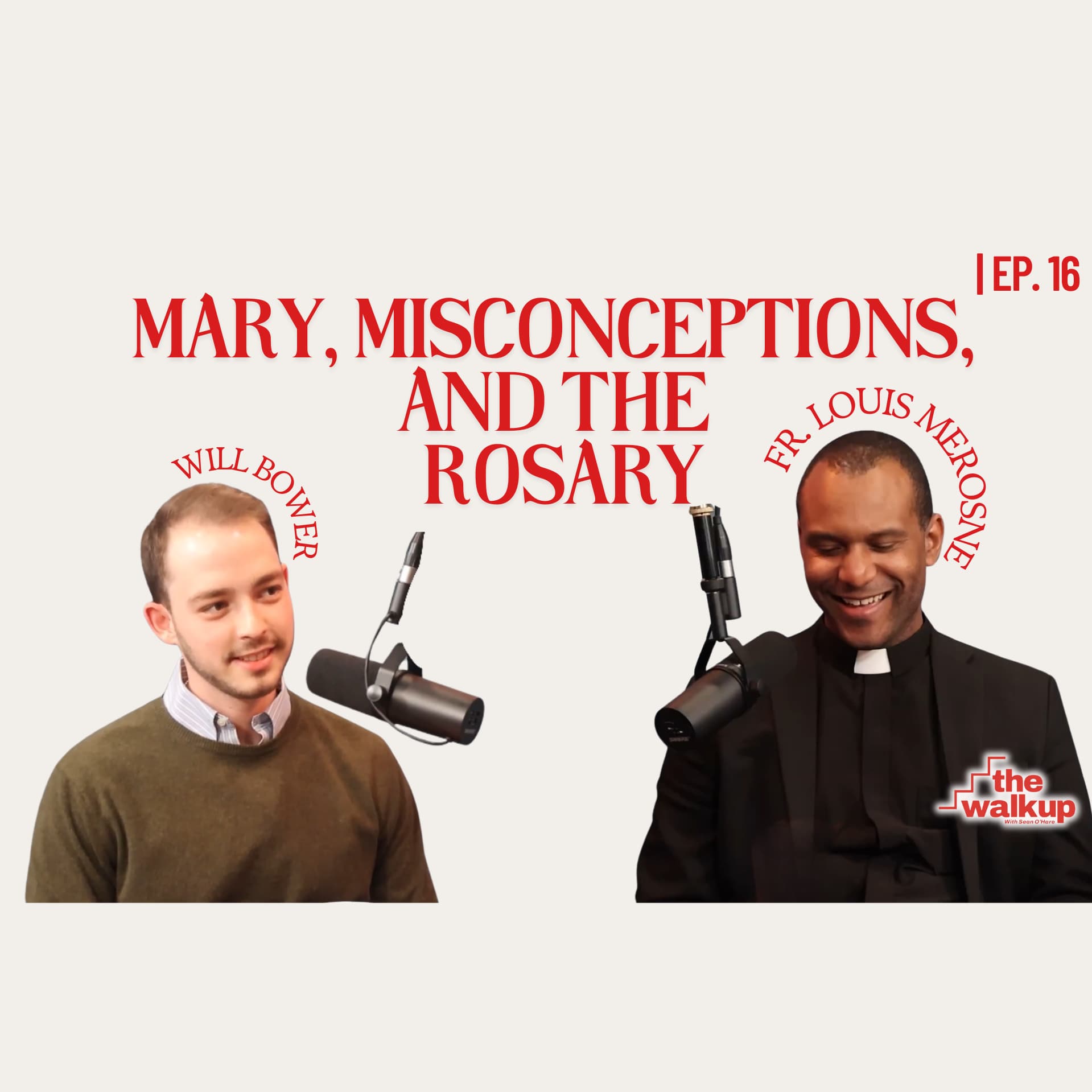
In this episode of The Walkup, guest host Will Bower sits down with returning guest Father Louis Merosne, Haitian priest and founder of Mission of the Beloved, for a personal and powerful conversation on devotion to Mary, the Rosary, and the journey of faith.
Together they explore the beauty of Catholicism from both intellectual and intimate angles—wrestling with misconceptions, family expectations, and the tender power of consecration. Plus, Fr. Louis shares stories of grace from his life and work in Haiti.
Transcript
Read the full transcriptAuto-generated · 14,467 words
All right. Yes, why don't we pray? Yes. Father, the Son, and the Holy Spirit, praise and glory to you, Father. Thank you for this opportunity to be together, to give glory to you in our speech and our thoughts for the sake of the salvation of souls. We ask that you be with us, Father, that you forgive us of our sins, of our lack of love, especially love for you, love for neighbor, love for your truth, for your word. Thank you.
For sending your spirit upon us to guide us in this conversation, again, that it may glorify you, that it may glorify your name, Father, just like Jesus prayed for, and we pray through his name, who lives and reigns with you in the Holy Spirit, God, forever and ever. Amen. Amen. In the name of the Father, and of the Son, and of the Holy Spirit. Amen. Oh, happy feast day of St. Cecilia. Yes.
And, Sean, could you make sure a hard stop a little before 4.30? Yeah, I guess you, more than an hour and a half, I imagine, would be good there. Great. Okay, perfect. Well, we also need to start a little earlier, because you need to, like... I think we might, if we stop early enough, we can download everything and not, we don't have to take the SD card, so. Okay.
Well, Father Lewis? Will. Welcome back. Glad to be back. It's good to have you on the Walk Up podcast again. Unfortunately, Sean did not make the cut. I love that, actually. Now, I love Sean, but it is funny that Sean couldn't make it to his own podcast. I know. It's unfortunate. Yes, it is. But I think we'll survive. It's probably good because, you know, he brings the talent, like he says, and he'll probably take away all the attention to himself again.
Exactly. Exactly. We need you to be prioritized here. I don't know about that. See, that's why I'm in all blacks, is to basically hide. True. So, Will, what's going on? How have things been? It's been, what, two months, maybe, since our last podcast together?
Well, I don't know what it's going to be in terms of the line of a podcast, but last time we spoke was about two months ago, and it was cool. And unfortunately, Sean had to cut us off early. Yes.
But, yeah, did you have a chance to mull over some of the things we talked about? I know you had more. To say, to reflect on, or to ask about, and I would love to hear more. So, what is new with you?
Well, big changes have happened. I have decided to convert. Praise the Lord Jesus Christ. Yes, and our conversation played a big part in that. Wow, praise God. You were a huge influence, and I think your intellectual... Prowess and clearly your understanding of the theology behind a lot of the doctrine of the Catholic Church wholeheartedly convinced me in my mind that these things were true.
And so I've really... Just been diving deep the past couple months into the church, into the church fathers, reading the lives of the saints, going to Mass with Sean, and experiencing the liturgy. Things have really blossomed, and it's been beautiful, extraordinary. Oh, you've been doing all the right things. I'd love to hear some of the things you've been learning. Yes. I'm excited, yeah. What are some of the things you're most excited about?
I think prayer. And it is funny, because that is something in my Protestant life that was very active, but prayer is so much different now. It is a much different experience. It is not only invoking the intercession of the saints, but developing a special relationship with our mother has been life-changing, through the rosary specifically. Yes. And I... I've always heard the rosary was a weapon, but I did not expect it to be this powerful. Amen. Isn't that something? Well, tell us a bit more about that, about the maternal role of Mary in your life, that new role.
What does it mean, and what does it feel like to discover that you've got a mother in heaven? Yes. Well, it feels incredible, and I think it's something I haven't even entirely unpacked yet. But it is very much different than the love of Christ. I think I expected that it would feel the exact same, but the love of Christ is sometimes overwhelming to a point of exhaustion. His love is so infinite that...
Sometimes it's, I understand why angels had to say, do not be afraid. It's sometimes terrifying, it's overwhelming, but of course, it's ultimate love, and it is an incredible experience. The difference I've seen with praying the rosary and specifically trying to develop a relationship with Mary has been a tenderness, a sweetness, a...
A true motherly love that almost feels like a warm embrace and a whisper of guidance, like a mother would have. Christ is more bold in his words to me, but she is tender and sweet and loving and able to give me feedback or guide me towards Christ without...
Yanking me in, pointing me in the right direction. That is fantastic. That is beautiful. When the Lord on the cross said to John, Behold your mother, and then to Mary, Behold your son, right? It was not because Jesus was insufficient for John or for Mary.
But he had a purpose in doing that, and then the scripture said that from that day on, John took her into his own, and so he received her. He received the gift from the Lord. And so, that idea of Mary being a gift and not... A competition to the Lord. What has that been like for you? Because I imagine that could have been one of the difficulties in your transition, is to see how is Mary not being in competition with the Lord, taking away his glory, his light.
Is Jesus not sufficient for you? How would you see that? That is such a great question, because I think it touches on so many points of my Protestant background, of hearing my whole life, well, It's Christ alone. There can't be competition. There can't be someone else you're developing a relationship with, and I've not experienced any sort of competition. My relationship with Mary has been supplementary in so many incredible ways to my relationship with Christ. In the end, she's always leading me towards Christ.
Come to me, Will, and, you know, we'll have our own little thing and Christ won't be a part of it. It's all because of Christ. Amen. And I feel that. I can feel it even right now. Amen. I feel chills. It's, Christ gave her a purpose.
And I have wholeheartedly experienced that. And I can say any Protestants out there who are confused or. Questioning these things that this is not a competition. She is always pointing to Christ, and she will point you to Christ in the most gentle and loving way, more than any mother on earth could do. This is fantastic. One thing I sometimes feel for my Protestant brothers and sisters, and I mean that when I call them brothers and sisters, because that is how the church...
Mother Church gives these brothers and sisters to us, and so a Catholic is not allowed to not see brothers and sisters. It is, you know, you are bound to see, because baptism and faith in Christ are the bonds that bring us together, even though we have an imperfect communion, right? Which also means that I love my brothers and sisters, and part of loving is to also... Take pity on my brothers and sisters when I realize there is a poverty that they have.
One of the poverties, I think, is this absence of the motherly presence of Mary that I really feel Jesus wills for us, his children on earth, his sons and his brothers and sisters on earth. Now that you have had this maternal role in your life, do you have a sense of, oh wow, I really kind of was lacking, I was missing that, even though you might not even have known that you were missing that until you discovered that. So, in your own life, what was that experience for you?
And then secondly, How do you feel about those brothers and sisters who do not yet experience that maternal love? I think the word poverty is a great word here, because I do think Protestants are missing out. There is a fullness. It is the fullness of truth. And in discovering relationships with the saints and with Mary, There's a whole new depth that is unlocked, and not for our own gain, but for Christ's glory, that we understand their influence, and their purpose, and their guidance, and we use that to glorify God in the world.
Amen. And in no way has it detracted from my faith. It has been completely complimentary. I think any, like all of my Protestant friends, I would tell them, just try it out. Here is a rosary. Just start praying the rosary. See what happens.
And I think many would discover that there is something real here. There is something valuable here. Amen. And I do think, in a way, before I was impoverished, I was lacking. Something. I had the truth, but it was like I was seeing the faith through curtains that were not drawn yet. Light entered the room. It filled the room. I could see, but when those curtains were drawn back, all the color, all the glory of the room was discovered, and in that, it makes me so much more interested in the faith, just as a...
Not to in no way diminish the faith here, but almost as a hobby, like diving into church history, and you realize, wow, there is such a depth and richness here that I have not discovered, that I have been deprived of. Wow. And, I mean, what is beautiful about it is that my whole lifetime, I could not even discover or decipher all the mysteries that are here. Right.
That's what's so beautiful. Yes, and I'm sure there will always be mysteries. In fact, there must be. God is mystery, even though he is also revealed, but mystery does not mean unknown. It just means that it is so big, so infinite, that you will never finish knowing it. You will never have exhausted the truth in that mystery, but that you will continue to dive into that mystery, which is the joy. You know, when you're experiencing something good, you just don't want it to end.
Well, it is kind of like that, except in God. So, in finite things, you might find that, okay, the more you experience it, the more you're like, oh, I don't really want it anymore. Like a good burger, the first bite is like, mmm, and then the second bite is still good, but when you get to like the tenth bite, it's like, oh, yeah, it's good.
Right. It's diminishing. The pleasure is diminishing. Whereas, in the mystery of God, the pleasure is not diminishing, but it's increasing. And then you're like, wait, but there's more? Yes, there's more of this goodness and more intense, and you keep diving until I feel it's like you're going to get to the point of explosion, but you never explode except God explodes in you. Wow. It's the mystery of God, right? It's just an ongoing bliss. That's why heaven is so awesome, but also...
That is why Paul would say something like, you know, no eyes have seen, no ears have heard. Like, we cannot imagine what it actually will be like. We know it will be exciting, amazing, beyond imagination. But I think, yeah, the infinite goodness of God, and therefore satisfaction for us as well. So, there will be mysteries. Now, would you say that discovering the Catholic faith and all the things that come with it, like...
The communion of saints, the Eucharist, etc. If we are sticking to Mary and the saints, would you say that instead of diminishing your faith or compromising your faith, that it has amplified your faith in Christ? 100%. And I think it goes far beyond Mary and the saints as well. I mean, experiencing the beauty of the Mass. Yeah.
My first couple of times in Mass, I was brought to tears every time, simply because it was revelation right there, and it was almost as if my whole life I had been studying the Bible, and it was as if the whole Bible connected here in the Mass. It was all here, present, and I was so overwhelmed with this truth.
It was almost like, I could only, almost like being blind and seeing again. Yes. Just standing here and saying, wow, the incense, the prayers of the saints rising up, the tabernacle, the new tabernacle. Yes. And seeing the Eucharist for the first time, and the second I saw the Eucharist, I said, I can't deny this anymore. Amen. I can't, and it's...
It's the Word of God, and it's absolutely amplified every aspect of my faith in Christ. Praise the Lord. And I think part of that is being new to all this, which I pray that my... You know, zeal for these things, you know, I am sure there will be rough patches in the future, and I do feel there is some spiritual attack going on the past couple of months, which is how I know I am seeing the truth. Right, and so I have been very encouraged, actually, by some of the fights I have been having.
Of course. Because, you know, I prayed, God, confirm this is the truth for me. I am just going to open up and see what you have to offer. Yeah. The devil confirmed it for me, almost. Like, he used the devil, you know? Yeah, actually, I am going to pause on that one, but I want to get to that point about the spiritual attacks, the difficulties that maybe you have experienced, having made this decision and going through this transition.
But continuing on the Eucharist, you mentioned a couple of bombs that I do not want to forget. On the one hand, you said it feels like it is Revelation right there. I am guessing you meant the book of Revelation. The book of Revelation. Yeah, that is being… The Lord has opened up to you, revealed you, which is what Revelation is. It is the unavailing, of course. And so, the Lord is unveiling Himself.
There are some others that have experienced that same thing, and they've expressed it in a similar way. I'm not sure if you're familiar with Scott Hahn and his Rome Street Home. Have you been able to read that book? I haven't read that, but I've heard of it. I recommend it, Rome Street Home. He and his wife, Kimberly Hahn, wrote that together. Secondly, he also wrote The Lamb Supper. Have you read that one? I have not. Okay. Well, I think you might be… I'm pleasantly surprised as to the connection between your experience and his, and the Lamb's Supper is basically showing how the Mass is the key to understand the Book of Revelation.
You don't really understand the Book of Revelation. It's not just about open newspaper clips and finding out what's going on in Russia today. You're like, oh, is this prophecy being fulfilled? Like, bro, you're missing the whole point, actually. It's so liturgical, the Book of Revelation, that without the liturgy, it's hard to understand it. Because everything, you've got the altar, the incense, you've got the Eucharist, you've got the lamb that is pierced, and why does he still have the wounds on him if he's resurrected?
Maybe it's the high priest interceding for us, maybe it's the sacrifice that's ongoing. Well, the sacrifice is done, but Christ continually presenting himself as the slain lamb before his father, and so there is this intercessory ministry. Christ in heaven. That's happening currently, and that is being presented to us in the Mass, in which we get to participate. It's not a second sacrifice. The one and done sacrifice presented to God in heaven, and we are able to enter into it in a window of time through every Eucharist that we celebrate here.
Having said that... The fact that you said that you feel like your eyes are opened when you go to the Eucharist, when you go to the Mass, have you paused to think about the experience of the disciples on the road to Emmaus?
You know, I haven't. Okay, well, let us have fun with that. Yeah. So, on Easter Sunday, Jesus rose from the dead, and there are the two disciples that were on their way to Emmaus from Jerusalem, and Jesus comes next to them.
They felt something, right? They realized something is happening here, and they said that afterwards. They're like, why aren't our hearts burning? When they were walking with Christ, and he was teaching them. What was he teaching them? The Word. He was basically doing a Bible study with them of the Old Testament, and showing how Christ had to fulfill the Old Testament. And they're like, this is amazing. They're experiencing that.
And then, Christ pretends he's leaving when he gets to Emmaus, and they're like, ah, come on in with us. It's getting late. So, they go in, and do you remember what happened? It's that Christ offered to break bread with them, which is, of course, a euphemism for the celebration of the Eucharist. The breaking of the bread, the fraction of the bread.
So, it was at that moment. When Christ broke the bread. In fact, if you look at Luke 24, where that scene is being described, you will notice the exact same language that was used in Luke 22, I believe, in the Last Supper. The exact same word. So, the Last Supper on Thursday, Holy Thursday, was the first time the Mass was celebrated. On Easter Sunday, In Emmaus, that would be the second time, he took the bread, he broke it, he gave thanks, he took the bread, broke it, and gave it to the disciples, and then those same phrases are used in both places, showing that, oh, that is the same thing going on.
And then when he broke the bread, then their eyes were opened, and they saw Jesus. They were like, oh! Though he was walking with them, in the Word, explaining the Word, doing a Bible study, it was nice. Their hearts were burning, they felt something, but their eyes were not open until the Eucharist.
And so, it is not shocking. That you felt this revelation, this discovery in the mass, because you are like, oh, wow. So, the Bible comes alive for you. Exactly. That is the best way to put it. That is exactly what happened to the disciples to Emmaus, on the road to Emmaus, is that the Bible came alive finally, even though, again, they studied, they have studied all their life.
And then Jesus himself was teaching them, but it wasn't sufficient until the breaking of the bread of the Eucharist. Then they saw. So, I think it's a powerful analogy to what's happening to you is that it's not taken away from the word, but rather it is revealing the word. In such an incarnational manner, which is what the Lord wants for us in the first place. So, I am really excited about the Mass, how you are experiencing it. Tell us some more of your experience with the Mass and some things that you find in it that are pleasant or surprising or comforting or even confusing.
Yeah, I think... I would be lying if I said the art and the beauty of it all wasn't very attractive to me as well, and I think God speaks to us through that beauty. I agree. And it's something in my Protestant upbringing that wasn't emphasized enough, that, you know, what if the church was incredibly attractive and beautiful?
What if it wasn't just stripped of… Everything to isolate the truth. Yes. What if it all complemented each other? And that has been one of the most powerful things for me, I think, is sitting inside of Mass and just taking in all of the beauty, the incense especially, is huge to me. I mean, it centers your mind.
Sometimes when there's music, we just talked about music earlier. There's a grounding nature to it. I agree. And I think, obviously, us Protestants had music. Yes. We've taken music very far in some cases. Right. But this is different. It's a prayerful, quiet-natured music that, you know, we talked about Gregorian chants in the last podcast as well, and it's prayerful, and it's intentional.
And I think something, the richness of the history, and seeing that in the architecture, how it all points to the heavens, the, you know, when there's pillars that you see, and you think, well, they have a utilitarian function of holding up the roof, but they're also drawing my eyes upward. That's right. And making me think about heavenly things. Yeah, amen. And that, even though it's a kind of a I think a shallow viewpoint to emphasize, or the art and the material aspect of it is incredibly attractive, besides all the theological mystery and how profound it all is.
Wow. I agree. It is almost as if... God did not make a mistake. It is not an accident that we have five senses. Right. We are human, and God reveals himself to us according to the mode of our humanity, if you will.
Our sense of smell, our sense of sight, our sense of hearing, our sense of touch, our sense of taste, it all comes alive in the Eucharist, in the worship of God, and I think that is proper, because we are humans that worship with our full humanity.
God does not want us to throw away our humanity. We are not in heaven yet. No, well, but even in heaven, here it is. Grace does not eliminate nature, and our nature is human. The supernatural nature that we've come to partake of is precisely that. It's supernatural. It's above our own nature. It does not come to destroy our nature.
In fact... That's where Gnosticism and things like that came from. Correct. Exactly. The Incarnation is proof that our humanity is sacred. It's beautiful. It's not just an accident, or it's not just a consequence of sin. No. We had perfect humanity before the fall. The fall wanted to destroy our humanity, but couldn't destroy our humanity. And so, God protected our humanity, even though we had fallen. But we were broken in our humanity. So, grace comes to repair the brokenness in our humanity, to perfect our humanity.
As we see in Jesus, in Our Lady, too, we see a perfect humanity being lived. They're like, oh, so that's what it means to be human. And then, finally, God elevates our humanity and allows it to participate in His divinity without confusing the two, without making some kind of admixture of the two, but rather to really connect the two in a way that preserves, heals, perfect, and elevate our... We're not going to be just spirits or souls that are divinized, and then we throw away the humanity, because then that would mean we are not fully human persons.
The human person is essentially body and soul. In essence, and that is why the souls that are in heaven right now, and Hebrews 12 speaks, in verse 23, speaks of the spirits of the just that have been made perfect.
In the heaven of Jerusalem that we have approached since our reconciliation with God being justified, we now have approached heaven, we are connected to heaven, and to those in heaven, including the spirits that have gone before us. So, their spirits are in heaven, but we still need the resurrection.
Because the body needs to be glorified so that the souls can be reconnected to the bodies, and we can live a fully human life in God as it was meant to be. Of course, as a glorified humanity, we'll be able to do more than we're able to do now. Probably like we see in the humanity of Jesus after the resurrection, he was able to walk through walls without breaking the wall or his body, and things like that. And so, I look forward to that.
Amplified or glorified humanity that we have, but even now, you see, grace has come to us, and in our humanity, in our senses, our senses are good things. They have been disordered. They have been mistaken because of the fall, but that is what grace does, is to make reparations of that, and then to perfect that, and to elevate that into a higher realm. What do you think of that? Yeah, I think it is something great to think about because...
I think so many of us, we like to think of the soul as separate from the body, and it is tempting to think the flesh is evil. Gnosticism was an attractive heresy to many, but our senses are all utilized in incredible ways to glorify God and to draw us nearer to him.
I have experienced that with the rosary. Even the feeling of the beads, you know, not only does it keep your focus on the prayer and knowing where you are, but the feeling of touching something and the act of going from bead to bead in and of itself is an act of praise and glory. Even if it is simple, like smelling the incense. That is right. It is glory. It is. And I think we forget the simple things like that. I agree.
And these things are not meant to replace God. They mediate a sense of God. And God wants it that way. He gives it that way. Even the incarnation, God could have chosen to do otherwise. He could have. He could have forgiven humanity by saying, I forgive you.
You really could have. I know there are some theologians that try to argue that it was necessary that Christ had to die on the cross, etc. I understand. Where they're going with that, because to preserve God's justice, etc. But it's not unjust for God to say, I forgive you.
Yet, he chose this incarnational manner to come to us, I think it's because we are human. And it's fitting that we are saved by a God-man, by the divine and a human, because, of course, only the divine can save us. But also, to do it in such a human way is so fitting. Right? Jesus literally took on body and flesh, and guess what? When he accomplished his mission in the ascension, he didn't say, okay, now time to get out of my envelope and drop the bag of humanity.
No, he went into heaven with his body and soul. His human body and soul. So, right now, there is the human body and soul of Jesus in heaven, also the human body and soul of Our Lady, and so these, at least these two, and some would argue Elijah as well, and maybe even Enoch, etc., might be in heaven with their bodies and souls, in a different dimension, if you will, because I don't understand how it is that body and soul can be in heaven, but where?
Right, is heaven a place? Right, exactly. I think it's... The way I think Jimmy Akin has explained it is more like a different dimension that we are not used to, that we don't necessarily have experience with. We can't even really comprehend it as humans. Correct, and I'm okay with that. Yeah. You know, if I tried to explain cameras to a baby in the womb, you know, like if a baby were able to understand, for example, it's like, how do you explain that to a baby in the womb?
Yeah, yeah. It's like they've never experienced anything like that. The only thing they know. Is the darkness of the womb, the comforting nurturing of mom in the womb, they hear voices, they hear sound, certainly, but they don't see anything but that, and there's nothing you can compare it to. Hey, it's like the, there's nothing, no, there's no likeness, if you will. And so, too, with heaven, even the eternal bliss of it, we're made for happiness. But yeah, so. Going back to the flesh and to the body, sometimes scripture uses the word flesh to mean the sinful nature, right, but not necessarily the body as we have.
The desire to eat isn't bad. It's not bad at all. Of course not. But concupiscence... Concupiscence is bad in as much as it leads us to desire bad things and to do bad things, but in itself, concupiscence is not a sin, of course, just like temptation is not a sin, but the response to temptation, if we give in to it, then we sin.
So, to concupiscence is that underlying weakness, that underlying leaning towards the evil or the ease with which we are able to do evil. That is a consequence of the fall. Adam and Eve didn't have that before the fall, but since the fall, because grace has, they've removed grace, they've rejected the grace of God, the supernatural grace, they've had this broken humanity, this poverty with which they are born, and also their children, their seeds, if you will, are born with that same concupiscence.
As a consequence of original sin, which is the lack of being born without original justice, without sanctifying grace. And so, we have that it's easier for us to do evil because of concupiscence that is in us, but the body is good and beautiful. It's sacred. God made it. God doesn't make mistakes, and then we know God wants to redeem it, to bring it to heaven, so that we're in heaven together with our body. We'll be fleshed people. The flesh is not bad, but when we speak of the flesh as a negative thing, we mean the aspect of our human experience that opposes God and his kingdom.
And so, it is important to remember that, because you are right, we can easily fall into this Manichaeism, this hatred for matter, but God made matter. Right. God became matter. God gives us matter in the Eucharist, etc. These things, again, they're not meant to replace God. They're meant to reveal God. They're meant to mediate God, in a sense. And every good thing is a gift of God. Folks, you ought to be thankful. Right. That's why the saints and Mary, they're not things in competition with God, but they reveal God to us.
That's why God gives them to us. He literally gave Mary, like, here is your mother. And we're like, no, don't you dare. We don't want that. By the way, John Paul II gave an audience on October 1, 1997 on the Mediatrix, Mary being the Mediatrix.
It's so beautiful to show how Jesus, of course, is the unique mediator. In many ways, he's the only God-man, and therefore there's no mediator like Jesus. But he calls all of us to be mediators, to do mediation. And we all do it. Every time we experience something good, that good thing mediates God's goodness to us. Right? Now, when it is wrong is when I take that mediated thing, and that's the goodness. To say that's the source. But if through that goodness, I'm able to get back to the source of goodness, God himself, and realize that he is the ultimate, then I'm properly using and receiving the gifts of God.
And so, that thing is not in competition. It's not parallel to God, but it's subsequent to, it flows from the goodness of God and prints us back to the goodness of God. So, to Mary, the apostles, the saints, you, me.
And John Paul II showed how Mary, being mediatrix, is, if you were to, it would be like a small M in comparison to Jesus' big M, because it falls from, it's nothing without the mediation of Jesus. It is dependent on the mediation of Jesus. It's inferior to the mediation of Jesus, and therefore, it's not next to the mediation of Jesus, but below the mediation of Jesus. When you realize that, you're like...
It is like, I can enjoy everything. There is such freedom in that. There is so much freedom in being able to take in everything as a gift. Yes. That reveals to us, mediates to us the goodness of God. Obviously, God can do things directly, immediately, if you will, but he chooses, because of our humanity, to give things to us according to the mode of our humanity, and so we can receive all things as gifts, as long as we point it back to God and realize that he is the source and the ultimate, and there is nothing like him in that sense.
So, yes, we are all mediators. Scripture calls Moses a mediator. And when you pray for somebody, you intercede for somebody, you are mediating, because you are in between God and the person, which is what to mediate means, to be in between, right? And so, I love that kind of freedom. It makes so much sense of everything, and to the point where we don't have to be like...
It's God or mother or parent or father. No, it's God. It's God through father and mother. It's God through Mary and the saints. Yeah. Without saying that these things are necessary because God could immediately come, and he does immediately come to us, but we can enjoy him in all of his creatures. Praise God for that. Yeah. And that's what Catholicism does, I think. Yes. It's so good at explaining. Very deep theological messages in a simple way that humans can grasp. Amen.
And I think that is what the Mass is, the revelation of deep theological truth that, you know, for centuries, Christians did not have to go study the church fathers. Amen. They could not, but yet they understood the truth regardless because these things were revealed. Maybe not so obviously, but subconsciously, through their senses, and I think that is something we miss, post-enlightenment humanness, you know, lines of thinking where we think no reason is the only way, and very much a Protestant.
I think the result of Protestantism is, no, I have to intellectually understand this truth. Right. Nothing else can speak to me, and you can understand truth without reading a book. Yes. There are... There are many ways to discern truth, and I think that is what makes Catholicism so beautiful. 100%. My grandpa, I don't think he went beyond the sixth grade yet, so holy. He understood. There was this intuition of the truth in him that was beautiful.
And by the way, the truth... The beauty and the goodness, you're right, these must go together, because in God, they're united. They're one thing revealed in different manners. So, God is truth, beauty, and goodness. We call these the transcendentals.
They are infinite in God. God is not just beautiful, but he is beauty. He's not just good, but he is goodness. He's not just true, but he's truth. Things are true only insofar as they participate in God's... Truth, and they reveal God's truth. They're good insofar as they participate in God's goodness. They're beautiful insofar as they participate in God's beauty. And so, yeah, all of these come together, and my grandpa, like I said, he knew the truth probably better than I do.
And there are people who can't read, but that's the beauty of God. To the degree that we understand the capacity of that person who can't even read, to know God even more than we do, it's to that degree that we have come to understand who God really is. Yes, yes. It's often Lowly people who have not, who maybe they grew up in an impoverished area, or they don't have access to educational resources, that God speaks through the most, and it is typically those that our mother reveals herself to, and it makes you wonder, maybe we got something wrong along the way, maybe our pride.
And our arrogance led us to believe that we can figure these things out through our own intellect. Right. There are many things we can see with our intellect. As long as we properly contextualize our intellect, to realize that it is a gift of God, and that revelation and reason, they go together.
And reason is, fallen reason, that is the thing, is that man must realize that, yes, there is power to his reason, but that we have fallen, and therefore we have a darkened intellect, and a weakened will, and disordered passions. That is why we need grace to help. There are certain things we could figure out with our reason alone, but that with grace and with revelation, it is like, oh my gosh, of course, you see it so much more clearly, and with so much more ease, you see.
But it must never be separated from revelation and God being the source. It emphasizes the need for faith and for grace. And that is one of the main things that led me to Catholicism. I think probably about a week before we first met, I had read a quote from Dr. Martin Luther King. And he said, even reason is darkened by sin. Yes. And... That is what kind of sent me down this whole path, and not that I think Protestants believe that their reason is somehow purified.
Everyone's well aware that humans have a fallen nature, but there's an arrogance in saying that, no, I myself can interpret what this means, and everyone can do this because of... Their supreme intellectual abilities. Which is, yeah. And it is almost an idol, like making your intellect and reason an idol in some capacity. Right. And I do not want to say this to disparage any of our Protestant brothers and sisters. Right. But I guess I am still Protestant, technically.
I'm so far gone at this point. I'm seeing it from... I'm in limbo right now. Right, right. But it's... not to disparage them, but I do think there is a... There might be a level of arrogance, and I wanted to ask you if you are familiar with the writer John Eldredge. I am not. He is a… Oh, I think I might have heard of him, actually. He wrote a book called Wild at Heart. That is where I heard it, yes. Very famous for that.
Very famous Protestant writer and a great evangelist, but he mentioned in one of his books… I think someone, or maybe it was his podcast, someone asked, why don't we see miracles in the West? And he mentioned a veil of disbelief. Wow. And I have been thinking about this, and I started to wonder, is Protestantism this veil? Because when I started looking into Catholicism, there are miracles happening every day in the West. Yes. And is it? Maybe this veil of, I mean, there is some tendency in some Protestant denominations to deny the mystical.
I mean, that started with the denial of the Eucharist. Wow. And you see, well, we cannot explain that. Right. So, and I do not see it in Scripture. Right. Therefore, it is not true. Right. And it makes me wonder, is the enemy using that now almost as a blinder? Wow, very interesting. To veil miracles from... The Western world that is dominated by Protestantism in a lot of ways, and I wonder what you have seen in Haiti.
Oh, yeah. In Haiti, people are very mystical. Yeah, they are naturally mystical. Do you think it is part of our nature? I think so. Yes, I do think it is part of our nature. I think our spirits are built, are programmed in such a way to see God. In fact, that is in the Catechism of the Catholic Church, the UCAT, actually, which is the catechism. Especially tailored for youth. I think the very first question talks about how God made us for himself, and how he made us to seek for him.
And so, we will always seek for God. Every man will seek for God, and there is a connection. And I think Haitians, there is a bit more quietness, I think, in Haiti, even in their poverty. That they are able to connect. For most Haitians, it is unthinkable to say that there is no God. How do you explain reality? What? You know what I mean? So, I think it is natural for them.
And they are pretty mystical. Whether you're Catholic, you're Protestant, whether you are a voodoo practitioner, everybody has an experience of the mystical and of the power of God and of leaning on God. And I think poverty helps with that, actually. When you realize that you're not self-sufficient, you're like, oh, okay, I need to depend on someone else, and I need to depend on God. And I think that is a gift, to tell you the truth. It is. Not that I want people to be in misery, not at all, but the gift is the consequence of being in that poverty.
It's the realization that God is God, and I'm not, and I need him. We need to know that. That's why fasting is so important. Very, very important, yeah. And so, I think that's all really good. In terms of, like, I, too, for example, I've seen I think it's so comforting to know that I don't have to be the arbiter of truth.
Right. My gosh. It's a burden. It's a huge burden. I've listened to a couple of really big shots go at it with each other. I listened to a debate on... What was the subject? I forget what the theological subject was. And these scholars, both of which have doctorates in theology, in Greek. It was a scriptural debate. And I'm listening to those guys, realizing, no matter how smart you guys are, first of all, there's always going to be someone smarter.
And, you could exhaust the Greek, exhaust the Hebrew, and you will come out with different interpretations. How the heck do you know for certain that you have gotten the truth? Right. Knowing that, our intellect is darkened a bit, and therefore, you're prone to make mistakes. And I realize, oh my gosh. And also, It is obvious that God does not expect everyone to have to get seven doctorates in the different fields to be able to understand the New Testament, its culture, the Old Testament, and all the idioms, and all the...
It's written on our hearts. Yes, and there is a way that God can directly touch upon us, but also to realize that we are poor, and that we wait to receive from mom. The gift, the meal, the food that is made for us, and that when mom gives us, you know, the grains that we don't like, we eat it anyway because mom knows it's best for us. It's good for us, and there's a way that we'll always be children, if you will.
In fact, we must be childlike to be fed by God. The more we think of ourselves as We're grown-ups in terms of understanding and faith, and the more we're prone to make mistakes, the more we realize that we need to receive with humility and realize that, no, I'm not the arbiter of truth. I think the closer we get to the truth.
Yes. That's such a good point. I mean, what a huge burden to bear to have to be the one that discovers truth. And I witnessed this. Throughout my years in college of church hopping, figuring out, okay, well, I do not necessarily agree with this one, I do not agree with this one, I do not agree with this one, and eventually I got to the point of saying, how does anyone know if they are right or not? Because some of these people were teaching outright heresy, and condoning a lot of sin.
Even in Scripture, it is completely outlawed, but they hold this authority, saying, no, we are a church, and someone told us they disagreed, so we went and started our other church, and now we are going to tell everyone we are Christians. And they say it with conviction. Yes, which is terrifying. Very terrifying. I am of the nature where… I like to give people the benefit of the doubt, and so when someone speaks with a certain level of conviction, I naturally want to believe that they have a proportionate level of certainty in the truth that comes with that conviction, and yet I have realized, no, not necessarily.
Some of the most foolish people speak with the most conviction. Exactly. Passion and conviction are not necessarily signs of truthfulness. There is a, but our society, I think, wants conviction. They want certainty. So, they want a photo of that person who is very charismatic in that sense to say that, no, I'm right, I'm right, but you're so wrong.
But he looks right, he sounds right, because of his conviction. And then to know that, no, that is not how we find truth. Truth is Christ. And I am thankful that Christ also knew that we would need his church. He left us the Holy Spirit and his church.
To guide us into all truth. And he who hears you, hears me, he said. So, he left us the authorities, just like the Ethiopian eunuch. I think we see that, the power of the Spirit and the presence of the church guiding him in the truth, because the Holy Spirit saw the man struggling to understand Isaiah.
And the Holy Spirit assured his proper interpretation, but not necessarily to just some, you know, unembodied manner. The Holy Spirit inspired Philip to come to the eunuch. To explain to him the truth, which I find riveting. It's like, Holy Spirit, you wrote Scripture. You're the inspirer of Scripture. You could have just breathed on the eunuch. He would have understood everything. Right.
Why go through the trouble of inspiring Philip, who wasn't even around? He had to be disappeared into. Jesus disappeared, and then it reappeared into the life of the eunuch to explain to him, and then to baptize him. So, it is word and sacrament, as we see. It is always the model in the early church. Word and sacrament, word and sacrament, word and sacrament. Jesus taught the word, and then he celebrated the sacrament of the Eucharist. The eunuch was taught the scriptures, and then he received the sacrament of baptism.
A Pentecost, the Holy Spirit came, the apostles, they preached the word, and then the sacrament of baptism was received, etc., etc. Paul preaching, and the sacrament of confirmation being laid upon the others. There is always word in sacrament, word in sacrament, word in sacrament, always. The physical, the tangible is always present, because sacrament is so important.
But yeah, I found it amazing that the Holy Spirit would do that. If the Holy Spirit saw the necessity to use the human authorities in the church, who am I to be like, no, I don't need that? Right, exactly.
Yeah, I don't need that. No, if the church was good enough for the Holy Spirit. Then the church is good enough for me. I need the church. I need the interpretation of the church. There is a lot of peace in that. A lot of peace in that. And so, yeah, I praise God for that. Now, Will, I am curious to know, maybe if you could give us a little sort of background.
Where do you come from in terms of faith? And then, you mentioned this a little bit, maybe you could touch upon it a little bit. What sparked the interest in the Catholic Church? And then eventually, I want to get to the idea of what difficulties you might be going through.
Yeah, so I grew up in a Presbyterian household, primarily. We eventually ended up going to a Baptist church at some point, but for the most part, Presbyterian. My parents very much encouraged us in the faith, and I can thank them for... Where I am today. I mean, when I exited, you know, when I left the nest, it was only then that I realized, wow, if my parents had raised me differently, I could be completely lost.
I'm still kind of lost in a way. I mean, we're all finding our way, but thank God they taught me the truth. Yes. And that, I think, with all of that and my siblings. We are all very deep believers because of our upbringing, and not just that. I think we really question the things we believe. Well, is this true? Why do I believe this is true? We have to outline these things and explain why we believe what we believe, and I think ultimately it was that.
Sort of skepticism that led me to the Catholic Church, and when I told my parents that I was converting, which was received better than I expected. Oh, wow. I have heard some stories of families completely distancing themselves from their children who convert. My family was very accepting, and there was maybe a little... Hint of disappointment, but... Understandable. Yeah, absolutely. That is what they know. Yeah, you want your kids to believe the same things you do. Of course. And it is funny, my dad said, well, I heard you are converting to Catholicism.
Why don't you think more about that? Because we don't believe that. I just kind of laughed. I was like, I assure you, I've thought a lot about it. This is no small, frivolous decision I'm making. Yeah, of course.
Regardless, I thank God that it went well, and they are accepting of it, and I truly believe that if they experienced, and if they saw and heard the same things that I have seen here, they would come to the same exact conclusion. That is beautiful. What about your siblings? How many siblings do you have, by the way? So, I am a triplet. I have two brothers and a younger sister. That is fantastic. Yes. So, an interesting family dynamic.
You know, especially for my sister, being, you know, three guys the same age, and, you know, she's just, she has to deal with that. Wow, yeah, and she's younger? She's younger, yeah. Are you guys identical? No, we're fraternal. We look very different. Our personalities are very different, and my parents made sure that. We each had our distinct personalities that we weren't lumped together with. Right, right, right, right. So, very grateful for that. That's great. I guess that could be both a blessing and a curse for your sister.
I really don't pity her. Every day, I'm like, we could have included her more and not poked fun. Yeah. We were always a team, and it is hard when you have a younger sister who is on the outskirts of that.
But I am sure, too, there are times when you guys just kind of babied her. Oh, absolutely. And, of course, if there were to be any situation where she would need to be defended, you guys would be the first to be out there. That is awesome.
So, how did they take it? They were more accepting than my parents, for sure, and a little bit of curiosity there. You know, one of my brothers says, I dated a Catholic girl, and we were in high school at the time, and my parents were very discouraging of that, and we don't believe what they believe, you know, refuting everything that he was coming home. Sure. She brought me to Mass, and there was holy water, and they were like, whoa, whoa, whoa, slow down.
And so, there's clearly a seed of curiosity there. Certainly. I think they don't have the same investment that my parents had in me, so they're very much like, yeah, you do what you do, and I'm sure you've thought about it a lot, and we trust your decision. That's awesome. So, yeah, I'm very optimistic, and I'm just so grateful that...
There were no hard feelings or things like that. That is wonderful. That is really good. What about friends from college, maybe, that might have walked with you, journeyed with you in faith? What has been that experience with some of your closest friends?
It has been accepting, the same. I do think it is because there is this lack of... Investment, and I think also because they know that I did not take this decision lightly, and I did make it relatively quickly, but it was also because for years I've been struggling with these things. Of course. And specifically the issue of transubstantiation, I've always been like, you know, I don't know why I don't believe that, and I couldn't really come up with a convincing answer against it.
Right. And so I made the decision relatively quickly. Some. I think I've viewed it as a little bit rash, but I really have discerned this process for years, and I told my mom that I think I've always been Catholic, to a certain extent. Yeah.
I've always had an issue with some of the doctrines that we were taught growing up, and even at my classical Christian school, they were very much, they were teaching us about the Reformation, and... It was clearly from a Protestant bias, and even then, I was sitting there like, something doesn't sit right in me, but I did, obviously, still bought into it for years because, well, I was in that community, and the biblical evidence was sufficient for me, and that my Protestant brain was like, okay, there's scripture.
I trust it. Yes. And so, everyone in my life has been very accepting, especially my girlfriend, who grew up Catholic, and she grew up culturally Catholic in the way that they practiced, but it wasn't really ever explained to her why they did the things that they did, and why do we go to Mass? It was a lot of, well, we go because we have to. Right.
So, it has been incredible getting to experience this Catholicism with her, and getting to guide her in our long distance right now, but getting to call her and say, hey, I went to Mass today, and this is what it was like, and here is what I am experiencing. And in that same way, she is growing in her faith alongside me.
And I feel it has brought us so close because we are growing at the same rate, almost, because she grew up in that cultural Catholic environment that was not grounded in the deep theological truth. I don't—or— I guess it was more, yeah, it was just cultural, going through the motions. Yeah, of course. Yeah, I understand that very well. Unfortunately, that is a big problem that we have. Yeah, all Christians do. I think Catholicism gets blamed for it a lot. Right, that is true.
That is what my parents would always say. Yeah. Well, there are so many Protestants who just go through the motions as well. Yeah, you are right. It is funny, the late Bishop Fulton Sheen said something like, there are so many Protestants who go through the motions as well.
There is not a hundred people who hate the Catholic Church, but there are millions who hate what they wrongly perceive to be the Catholic Church. So, even, for example, when your parents would say something like, We don't believe what they believe. I'm pretty certain that most people who say that don't actually know what we believe. Yes, that's exactly right. That's what I discovered. Right. And it's why I don't hold them at fault. Exactly. Because I realized, oh.
What they were saying, they just didn't know what was actually true. Exactly. If what they thought we believed was what we actually believed, then they would be right to oppose it, in many cases. But, yeah. If the Eucharist was, if it was only a piece of bread, then we are idolaters. Correct, correct. And they're right to say so. And you mentioned, you know, you were like... You didn't know how to shake transubstantiation, really. That's not any fault of your own, because for the first, like, thousand years of church history, no prominent theologian ever denied the real presence of Jesus in the Eucharist.
A thousand years. Right. That's like... And any who did were burned, right? Well, they just didn't deny it. That just wasn't the question. I remember when my friend, one of my heroes, Dr. William Lane Craig... I love him. I love him, too. He had a Sunday school class, if you will. I think it's called Defenders.
And he was teaching about different theories of the Eucharist. I think there was a Catholic in there who asked the question of, you know, don't you find it a bit scary, even, that for the first 1,100 years of church history, not one person denied the real presence?
And Craig's response was very telling and very funny. And he goes, ah, no, I think there was somebody in the 9th century who did. Okay, fine. So, 9 centuries! Yeah. Nobody, like, really, he goes, I guess I just have to say that as a Protestant, I believe in Sola Scriptura, and I have to see it in Scripture, and since I don't, therefore, I don't believe it, even though all Christians for 900 years from the time of the apostles on believe the exact same thing, that Jesus was really present in the Eucharist, even, of course, the Reformers, like Martin Luther.
He believed in the real presence. He had consubstantiation rather than transubstantiation. Calvin believed in some form of the real presence of Jesus, spiritual presence, I think you call it. And it is amazing how, yeah, and there is a reason why God gave us the Eucharist.
And it is a sacrament of sacraments, and it is not a mistake that at the breaking of the bread, the eyes are open. Yeah. So, what are some of the difficulties you have experienced as you make this transition as a candidate? Because, of course, the church will see you as a candidate because you have been baptized. So, you are not a catechumen. The catechumens are those who are getting ready for baptism, confirmation in the Eucharist. But, because you have been baptized, the church accepts Trinitarian baptism from other faiths, as long as it was with the proper intention and matter and formula, of course.
So, the church puts you as a brother, of course. Now, you are a candidate getting ready to be fully received, to enter into a full communion with the church. You have experienced some difficulties. What are some of those?
Yeah, I wanted to touch on this, to talk about spiritual warfare and kind of the mystical things we were talking about. Right. It's 100% real, and I think I've experienced it now more than I ever have in my life, I think because I'm approaching the truth. Right. And, boy, does the enemy not want me to get near to the truth. Right. And I've noticed it comes a lot in the form of doubt, and it's not that I doubt anything that I've learned in the past couple months, but ultimately doubting myself and doubting, well, am I...
Am I just a sheep, blindly following this narrative that I'm being exposed to? It's these thoughts that I know are from the enemy, because they're doubting the very essence of myself. It's not wrong to doubt our intellect, like we just talked about. It is darkened.
But this transformation has... Far superseded the intellectual. Wow, amen. And so, when these thoughts appear in my brain of, like, you don't know what you're doing. This is... You know, this isn't what you were taught growing up. These types of thoughts, and I notice them a lot when I begin to pray, and for the past couple weeks, it's been, I haven't been able to finish a rosary. It's been, I don't know, my mind just, it was very easy at the beginning.
Right. And once I had memorized it all, I was like, yes, I can do it. I can get in this rhythm, and I would feel so much peace, and now it is a real struggle. It is so difficult, and I do not know if that is an issue of my own discipline, or if that is some sort of spiritual attack. I am quite certain it is the latter, because I have done it before, but now it is… Oh, it's so difficult, and such evil thoughts enter my mind when I try and pick up that rosary.
Thank you for sharing that, for being vulnerable with me and with everyone who's listening. I think it's... Natural, what you're going through. First of all, we're built like that, even on the natural level, where self-preservation is like, are you sure you want to do this? Because our family has been safe for I don't know how many years, I don't know how many generations with this particular path, and now you're going somewhere else. What if you die? What if you cease to exist?
Or something like that. So, our self-preservation... It is not always the... It is not motivated by truth, necessarily. It is motivated by survival. But Christ asks us to die to ourselves in order to find ourselves. So, it is okay to oppose some of the basic...
There are impulses that want to preserve the self, preserve what we're used to, and so it's natural to feel that. Secondly, yeah, I would not be surprised if this were spiritual warfare as well. Let me give you a little example. There's a young lady that we were praying with back home, and she was...
Showing signs of spiritual attack, demonic attack. What kind of signs? So, she would go into these trances, very strong, almost superhuman strength, and it would take several of us to hold her down. And she was tiny, and I was like, come on.
And so... Screaming, being repulsed by sacred items, sacramentals, yeah. So, this wasn't just attack, it could have been possession? It could have been possession, correct. And she was like, not herself, it was like something else speaking in her, and then afterward, when she would come to herself, she wouldn't know what the heck happened, right? And so...
So, as we're praying with her, there's a phrase that she could not say. She couldn't say something like, Mary is my mother. She would say different things, and then when we get to that phrase, this is one of those we would test to see if this were her, or if this was some other presence. She, of course, would have no issues saying, Mary is my mother. She's a good Catholic girl. But then, whenever that presence was around, she couldn't say that Mary is my mother.
Wow. And then one of the final things that helped to deliver her completely is, as we were praying, we felt inspired to sing a beautiful song about Our Lady, which is inspired by Revelation 12, about the woman and the dragon, etc. And so, we would sing that with joy. The moment we started singing that, she would just scream like this was too much. And she said, she called us evil for inflicting so much pain on it, because we're praising Our Lady Mary, and so, and obviously, whatever was on her did not want her to approach Our Lady, to approach the Lord, to approach anything sacred.
It wanted to keep her far from those things, and so eventually. It even said something like, you know, she's breaking my leg, and it was funny because prior to that, if we started praying, she would try to get up and run, but after that... When she tried to run, she would take a couple steps, and then would fall because she felt her leg was broken. She said, the woman is here, and she just broke my legs, and I can't, you know, she broke my other leg.
Yeah, pretty crazy stuff. And this was in Haiti? This was in Haiti. And this poor girl has been delivered. And so, in other words, I am not surprised. The enemy does not like our lady, and the Lord prophesied that from the very beginning. Genesis 3, 3.16, where the port of Evangelium, the first gospel, where though God pronounced the curses...
For the fall, but also gave us hope for restoration in a new couple, a new mother and child that would come, and that would undo what Adam and Eve did, and that would do what Adam and Eve couldn't do or didn't do, and in the new Adam and the new Eve, it is obvious that Christ is the new Adam, and it is also obvious that Mary is the new Eve, and he promised that, you know, the devil would try to attack them, but he would...
Put enmity between the woman and the devil, and the serpent. And we saw that same woman and the ancient serpent in Revelation 12, which is the dragon now, and scripture specifically says the ancient serpent. So, we noticed the old serpent that was trying to fight the woman.
And couldn't win. And so, I'd like to tell people, you know, what team do you want to be in? Did you notice in Revelation 12 that this woman, first of all, would come right after verse 19 of chapter 11 of Revelation, which is the last verse before chapter 12. And of course, in the original text, there was no chapter divisions, and so it's one flowing text. And so, in 1119, John sees the Ark of the Covenant, and then he switches to talk about the woman.
That's on the cloud. It's like, wait, wait, tell me about the ark, because everybody would want to know where the ark is. It was hidden for years, and it's like, wait, you saw the ark? Tell us. And he's like, but he starts talking about this woman. Well, of course, that's because the woman is the ark of the new covenant, and so this woman is attacked by the devil, but this woman is in the team of the child who is born, who is to rule over the nations, which is obviously Jesus, and whoever this woman is, we know at least one of the interpretations is that it must be the mother of Jesus, which is Mary.
And so, the serpent tries to attack the ancient serpent and the dragon. Even when it tries to send water against her to flood her away, even the earth opened up its mouth to swallow the water to protect the woman. So, it looks like, and this woman, we see, is surrounded by creation.
So, she is standing on the moon, clothed with the sun, with the stars, serving as a crown for her, recognizing her queenship as the queen mother of the king, because, of course, Jesus being the new David, the son of David, that has come to restore the kingdom of David. Well, in the kingdom of David, the queen was not the wife of the king, because he had way too many wives, like Solomon, but rather the queen would be the mother of the king.
Which is the Gabira, the queen mother, and she played an important role. We saw the honor that the king gave to the queen mother in 1 Kings 2.19, the only person before whom he would bow, and then the person for whom he said to put a throne next to him for her to sit in 1 Kings 2.19. Jesus is the new son of David, the new Solomon, with his mother. He is the king, therefore, Mary is the queen mother. And we see...
She is a queen. She is with a crown. And so, creation, both in the heavens and on the earth, honor her. We see the angels protecting her. We see the earth protecting her, but we see the devil against her, making war against her, and according to verse 17 of the same chapter, 12.
He goes to attack her offsprings, which are those who keep the commandments of Christ. And so, it is like, what team do you want to be in? The ones attacking this woman, or the ones honoring this woman? Because she is in the same team as her son.
So, spiritual warfare is real, and I know the enemy does not want you to get close to our lady. To the Eucharist, to our Lord at all. And so, I do think you have interpreted it correctly to say, okay, these are signs that are actually on the right path.
And obviously, the Lord wants you to use your brain, wants you to use your intellect, as you pray for the power of the Holy Spirit to come to teach you how to pray. We don't know how to pray. And so, you call on the Holy Spirit to teach you how to pray, and for the Lord to enlighten you into all truth.
Well, this may seem kind of weird to say, but I feel in many ways I am thankful for the enemy. Yeah. Which, I do not know if that is awful to say, but because he tells me where the truth is, in a way. Yeah. Because he is all lies. Correct.
And… He is the father of lies. That is right. I do not know. It is almost like his tricks do not work, because… If everything he says is a lie, then— Amen. I mean, obviously, I'm still sinning every day, so he's working, and I'm buying some of it. Right. But in some ways, also, he's leading me towards Christ, which—or he's not, but— Right. Well, that is the power of Christ, is that even our enemies can be used for our good.
That is the power, that is the omnipotence of God and His goodness at the same time. It also reveals His beauty, like how awesome that is, that the enemy, as it tries to throw himself against us across our path, the Lord uses that as steps to get us higher and higher and closer to Him.
So, yeah, we're thankful. Augustine spoke of sin as felix culpa, or happy fault, not because the fault itself is good, but because of the gifts that God gives us because of that fault. Because of this sin, we get Christ.
Our Savior, which far surpasses whatever we had beforehand, and you will get to hear that on Easter Vigil, by the way, or Happy Fault, as you hear the proclamation, the Easter proclamation, as it is called. I hope it is sung beautifully wherever you go to church, wherever you go to Mass on Easter Vigil, and I highly recommend you go to Easter Vigil. You could also go on Sunday morning, of course, but the vigil, you got to attend an Easter Vigil. Okay, I will.
Sean, I'm sure. Let you know where to go, or as the most beautiful church to go to, to experience the fullness, and get ready, by the way. Sleep beforehand, because it is going to be a long Mass, and you are going to hear seven readings from the beginning that retells salvation history. Oh, wow. That brings you up to the fulfillment in Christ Jesus, in His resurrection. Oh, it is the big deal. That is beautiful. Oh, it is something. And we typically have baptisms, typically adult baptisms.
I do at my cathedral. In fact, I've done some full immersion baptism, actually, on each individual, and it shocks some people, because people... I didn't think that, you know, Catholics only do baptism by pouring. Then I realized that, no, actually, we have a whole tradition of pouring and doing immersion with baptism. Yeah. I didn't know that. Yeah. Is that a cultural thing? Or are you seeing that in America as well? Yes. In fact, that's where I've seen it. That's where I saw it first.
I went to Steubenville, the Franciscan University of Steubenville. Every Easter vigil, we do... Full immersion baptism for any college student that wants to be baptized, that wants to become a Christian, become Catholic, and so we have full immersion, and that is why I first saw it, and I decided to look it up, and then I realized that catechism, actually, in two places, speaks of immersion as the fuller sign of the meaning of baptism, but also, at the same time, it says that from The days of old, we've always had baptism by pouring, because that also is significant.
That signifies, you see, the pouring of the Holy Spirit upon us, because Jesus says that we'll be baptized in the Holy Spirit, but the way that the baptism of the Holy Spirit is done on Pentecost, in three different places in the Acts of the Apostles, is by the pouring of the Spirit, or the Spirit that was poured upon us, and that's considered a baptism. An immersion in the Spirit happens through pouring. But the... Going down into the water represents something else, which is being buried in Christ Jesus, but these things are not opposed to one another.
They are complementary. That is the beauty of Catholicism. We love the both and. Yes, that is what I have noticed. Yes, we love the both and. Both body and soul, both reason and faith, there's place for it all. Of course, we do not like contradiction, and so it's not both in contradiction, it's both in truth, in different sides of the same truth.
Yeah. Did you have any, is there anything you're... Learning in your candidacy, if you will, as you go and get ready for full reception into the church, are there some things that have surprised you, or some things maybe to the, oh, you know what, I have a question about that, that maybe we could discuss together?
Well, I would say just about everything has surprised me. Okay. So, yeah, that would take hours to unpack, and most of the theological questions that we brought up, I researched them more, asked another priest who is helping me and teaching me and instructing me, and he had also confirmed everything you said, and so those theological issues have been...
I guess resolved in some capacity, if not completely resolved. Yeah. It is, I do think, I do have a problem with Our Blessed Mother in an intellectual capacity of fully adopting. It is almost like my heart has adopted her, but my mind has not. Interesting. I do not know if that makes sense. I have heard some people have the opposite problem.
Intellectually, they are like, yes, I know this is true, but then experientially, they are like, I just cannot bring myself to do anything about it. Ah, okay. No, that would make sense. That seems much more natural. I don't know why I'm experiencing it the other way, and maybe it's a little bit of both. Well, each person is different. A person's specificity. And so, yeah, it could be a little bit of both as well. And I think that, I actually, I grew up Catholic.
But I had an issue. Really? When I was in college, and I just, I felt that I was distant from Mary, and I was like, I am not supposed to be, but I studied all the apologetics questions on Mary, and I would defend Mary, but then I said, why don't I have a deeper relationship with her? So, you know what I did? I asked her. I asked, Mary, can you please mother me, and help me be your son?
That was my prayer, and that changed my life. What happened? What was the result? There was a natural tenderness that was developing in my heart towards her, and that led me to do what is called a consecration to Jesus through Mary. Yes, my girlfriend and I are doing that right now. Oh, wow. It actually ends today. Oh, that is perfect. Yes, yeah. Fantastic. The consecration, I find, is fantastic because it is an intentional giving over of my heart. All of my heart to Our Lady forever, and I think she just took over, and I love her so much that it became a natural thing.
It is not something to force. It is something to recognize and then to ask her. That is what I did, and so I find that it helped me a lot to get closer to her. And then praying the rosary, I think it is also powerful. By the way, I would like to recommend this. It is good when you can pray the rosary with someone.
For a couple of reasons. One, it is accountability. You will get to the end most of the time. When alone, you will get both distracted, and maybe you might fall asleep, or you might have these questions like, oh, I don't know if I like, but if you are praying with somebody, it is like, okay, we are going to finish this. We set apart this 15 minutes, we are going to pray the rosary, and that is it. And it also helps you keep you on track.
For me, at least, I think I have ADHD, and so when I start something, I am like. Like, I'm in the fifth Hail Mary, and somehow I ended up somewhere in… Thought space. And like 50 minutes later, I'm like, oh, I'm still on my fifth bead of the first decade, and I got to get back to it. So, doing it alone can be difficult. Okay.
I also have it like on my phone, so I can pray it along with some, if I don't have a... Do you have a YouTube video or something? Yeah, there's YouTube videos. The YouTube music has like some rosaries, like all the different mysteries, or a podcast. I found like a little podcast. So, you can find it anywhere and everywhere.
I actually had a question about the mysteries. Sure. Are you required to meditate on the mysteries every time you pray the rosary? I would say that is the heart of the rosary. Okay, that is what I have heard. The heart of the rosary is having Our Lady next to you. Mary is meditating on her son, and the mysteries and those that are connected to him. So, the rosary is really not as much a prayer to Mary as it is a prayer with Mary, meditating on the mysteries of the Lord.
And so, for example, the first joyful mystery is the Annunciation. Mary is next to you and helping you. Live out that mystery of the angel Gabriel coming to Mary and then telling her the truth. So, you are mulling over Scripture and the Gospel.
Then you have got the visitation, which is, again, just Scripture. And you are seeing Mary running to Elizabeth with the Holy Spirit on her, and John the Baptist dancing, etc. The third mystery is the birth of Jesus, the Nativity. You are contemplating Jesus being born.
And Mary is showing you, that is my son. She is next to you, and this is my son, this is what happened. And so, that is the beauty of it. The repetition is helpful in that you become, you almost don't have to.
Be a slave unto trying to remember what to say. It comes naturally, and it frees your mind to enter into the imagination, to enter into the meditation and the contemplation of those deeper truths. So what does that pondering look like for you? I think sometimes I just think of the Annunciation. I'm like, okay, Gabriel says this to Mary, and then I don't know how to... Dive deeper into that. How do you do that? Okay, so I think imagination is pretty powerful there.
There are a couple of ways to do it. One is the imagination, is to say, you might close your eyes, and to see yourself in the room. With Gabriel speaking to Mary, and letting it play out in your mind, here, a miracle of grace. It is not going to be done perfectly, depending on your level of attention and mental discipline, if you will, but that is all right. The important thing is to do it.
By the way, I also highly recommend a little document that John Paul II wrote on the Rosary, and actually in it, it does not just give you some theology behind it, but also some practical... There's advices to people who are praying the rosary to make the best out of it, and so I highly recommend it. What is it called? John Paul II. I forgot the title of it, but if you just look up John Paul II on the Holy Rosary, you'll find the document.
So, yeah, it's imagining yourself there. By the way, that's also a principle with Lectio Divina, a way of reading scripture, of mulling it over. You read it, and then you imagine yourself there in the scene itself. Wow, okay. I've never heard that before. Oh, my gosh, yeah, bro. Yeah, welcome to the new world of eating Scripture, praying Scripture, not just reading Scripture. The Liturgy of the Hours is another way of praying Scripture.
Just know that there is so much more that you will get to. I am so excited to witness it all. Absolutely. And with the Rosary, yeah, so it is meditating on these mysteries is to see yourself in there.
Remembering that Our Lady is next to you, and she is pointing it out to you. Secondly, there is something called a scriptural rosary, which you can also get it to play for you, and some people find it helpful, others find it actually distracting.
The scriptural rosary can be done in two ways. One, for each mystery, there is like a scripture that can be read, since you are meditating on the scripture, on the gospel. So, at the beginning of the mystery, you proclaim the mystery, and then you read a scripture that goes along with it. Okay. That is to help put your mind where that mystery is happening.
Another way to do it is even more complicated, is that before each Hail Mary, you read a verse. There is a verse that is read. Now, it is nice when it is done for you, so that you are not trying to look down, reading a verse, and then looking back up, but the idea is that with each Hail Mary, it keeps you in the truth of the mystery, but that could be one way to keep your mind on the word. Some people find it a little distracting or a little… And it's like an interruption each time, whereas closing your eyes and just letting your lips say the Hail Mary, letting your fingers go in through, you don't have to count, so that your mind can be with Mary in that scene that you are contemplating right there, can be helpful.
And I guess an in-between might be to read the passage right before the decade, and then allowing your mind to continue pondering that decade, that mystery throughout the decade. Okay. Yeah. Oh, that's so helpful. I will definitely... Be trying those tips now, and read that article by JP2. Yes, there's a couple things you're going to read by JP2. One is on mediation, Mary Mediatrix from October 1st, 1997, and then one on the Holy Rosary. I also recommended for you Scott Hahn and Kimberly Hahn's book called Rome's Sweet Home, and also his book called The Lamb's Supper.
And finally, actually, there's a third book of his that I would recommend called The Fourth Cup, and it's showing how what began in the upper room on Holy Thursday was completed on the cross. On Good Friday, how is there one sacrifice to show the... The uniqueness of the sacrifice of Christ that is in the Mass. It is called the Fourth Cup.
And I am really excited for you, Will, and you can count on my prayers for you in this transition. Absolutely, and I am there for you. Reach out anytime, and you can count on my prayers. And maybe it would be fitting if we could conclude with Hail Mary. Yes. All right. Hail Mary, full of grace, the Lord is with thee. Blessed art thou among women. And blessed is the fruit of thy womb, Jesus. Holy Mary, Mother of God, pray for us sinners, now and at the hour of our death.
Amen. And may Almighty God bless you and all those who are listening, in the name of the Father, and of the Son, and of the Holy Spirit. Amen. Amen. Thank you so much, Father Lewis. My pleasure. God bless you. God bless you.
More from The Walkup

Against the Odds: The Samurai Lawyer (Chad Flores) | Ep. 52
Faith, Sexuality, and the Fog of War (Iris Bahr & Father Rick Riccioli) | Ep. 02
E2
Church, Conflict, and Community (Iris Bahr, Father Rick Riccioli & Rob Long) | Ep. 03
E3
Hope, Vocation, and the Global Church (Colm Flynn & Colin Nykaza) | Ep. 04
E4