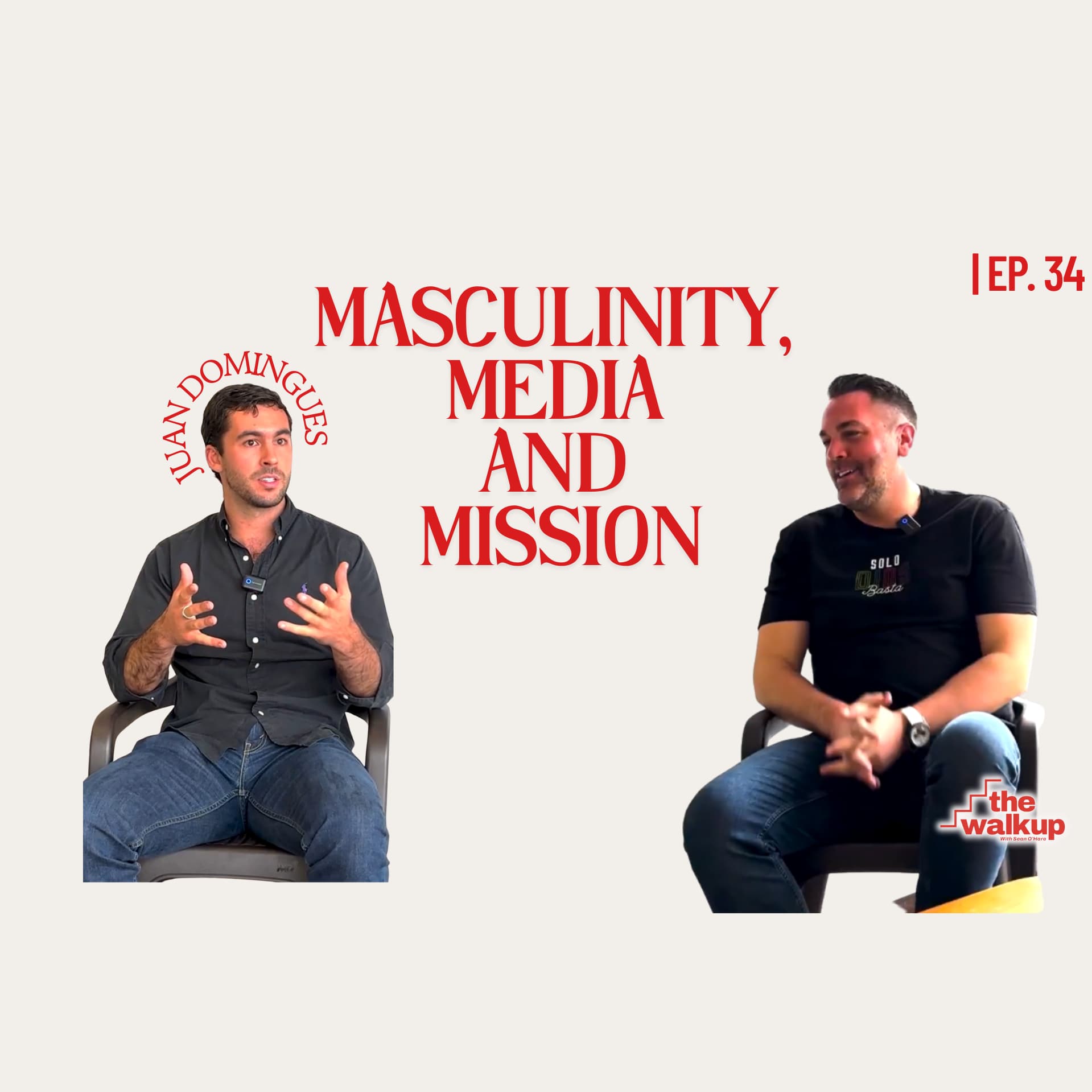
Juan Dominguez is the founder of Simple Men, a blog and creative platform that invites men into a life of faith, purpose, and responsibility.
In this conversation, Juan reflects on what it means to grow as a man—not in reaction to culture, but in pursuit of virtue. From spiritual fatherhood to social media, martial arts to modern dating, Juan shares the habits and practices that help him stay grounded in a noisy world.
Transcript
Read the full transcriptAuto-generated · 13,329 words
But first, just kind of your background. Where are you from? Where did you grow up? Thanks, Shams. Thanks for the invitation. I am also very excited to be here and share a little bit about the Catholics in Bogota with you in Colombia.
Like you said, a shame that we could not be in the terrace, but welcome to Bogota. It is just every day here that it rains. So, yeah, just to tell you a little bit about myself. I am born in Cali, Colombia, but moved here to Bogota when I was four years old. With my family, I have an older brother and an even older sister, and we've been Catholic all of our lives. My parents are very devout Catholics. We went to church every Sunday, since I can remember.
But just to get a little bit into my personal process, I guess. In college, I went through a bit of a rebellious phase, you could say. I went to college here in Bogota as well, at the Universidad de los Andes, which is a very good university here.
And I guess, you know, like any immature college student, I just got drawn away from the faith and into things of the world. Nothing too bad, and I always... Like, had my faith in the back of my mind a little bit, you know? I never openly stated or said that I was an atheist or anything like that, but I wasn't a practicing Catholic by any means.
And then, yeah, I graduated college. I studied business and management with a minor in journalism. I started working in a startup in the financial sector, and just as a side project, I've always liked to write. And when I was working at this startup... I started to write about self-improvement for men, and it was the topic of all the things that I was writing, because I saw during my time in college, and also when I started to work, that there was, I don't know, I felt like there was something that my generation wasn't getting a little bit.
Always, and I include myself because I was part of this problem, we were always complaining, always, you know, finding people to blame. No one was taking responsibility. No one had any concrete plans as to how they wanted to build their own lives. So, I just saw a generation that seemed lost, and I felt that I had found some answers.
So, I wanted to share that, right? So, that is how the blog was born. The blog is called Simple Man Blog, and it was born four years ago. And you decided to do it in English from the start, or was it bilingual? No, from the start, and the reason is just simply that I have always liked to read in English, so I felt more comfortable writing in English as well, and also to reach a broader audience, I decided to do it in English.
And so, these kind of symptoms that you're seeing in a sort of a lack of masculinity, I'm sure there's lots of different sources of that. We see it in the university, we see it in our culture, now we have this term of toxic masculinity, right? Did you sense that in a particular way in any one source, or is it a combination of factors? I think it was just a combination of factors. I couldn't pinpoint just one thing. I think all the things you mentioned are definitely part of it, but I think there's also like a big part of it is this culture of self-indulgence and of...
I would call it unrestrained freedom, or misunderstood freedom, in the sense that people now, like it's a culture of individualism that's gotten to the extreme, where people believe that, or idolize the self and the individual pursuit of pleasure and satisfaction, right? So, I think it's just an overall cultural shift or a lot of cultural influences that end up leading to this place we're at right now, basically, where we, like, and everyone says this all the time, like, there's no real men left, you know.
We see it in the younger generations. They're not growing up. They're entitled. And, like, to be very clear, I include myself in every description that I make because I'm part of the problem. I'm part of the generation that I'm talking about. But, as you say, the blog was born precisely because I felt I could offer some helpful advice, and through it also help myself find the right path and the right way forward.
Yeah, I'm a little older than Neil, and we'll not figure out exactly what the age difference is, but I was remarking to somebody the other day that... I remember in my elementary school, you would get the school directory, like the list of all the people in your class, and their contact information, and then the phone number, you know, if you needed to contact them, right? And it would have all of that information, and it would say mother's name, father's name. And I distinctly remember that there was only one person that didn't have a father's name.
Because they were divorced, and I guess he was not really somebody the mother wanted, you know, the school contacting or something like that. And that was almost a scandal, right? Like, not that we, it was a judgment, of course, but it was just like the idea that somebody didn't have a mom and a dad. And, of course, now we know that the...
The figures there are shockingly high of single moms and fatherlessness, and how much do you think is, I mean, I would imagine it has to start there, because you have to have the model of a father, a model of a masculine figure to even know where to begin, and if so many of our peers are absent, Father figures, where do they even begin to look for the model? Yeah, 100%, and not even just in the cases where the father is fully absent, but also in the cases where the father is present, but not a good role model for masculinity.
And that can be, like, there's a wide variety of ways that you can be a man without being a proper role for masculinity, right? Yeah, and I think... I think that is even more prevalent now. Of course, there is a lot of divorce, a lot of absent fathers, but I think as, I don't know what to ascribe it to, but as we progress to this culture of, again, this individualistic culture of freedom, sexual liberation, of it is all about me and my wants and my wishes.
You're just seeing a lot of role models that aren't leading their kids, especially their boys, in the right direction, I think. I think it's definitely a problem that starts with the family, and with having, again, strong, present fathers in the households, because otherwise kids are going to cling to any model of masculinity they see, however flawed it is, if they don't have that figure that they can...
try to imitate or emulate other homes which should be the father which should be in turn trying to be a reflection of christ for the home right and i mean is there a definition you you look to or certain characteristics that you would ascribe to masculinity that if somebody is looking at this and saying okay well tell me what what authentic masculinity looks like i mean that's i love the question because that That is the question that I was sort of trying to answer through my writing, and also for myself, and that is fundamentally the question that brought me back to my faith, and because you ask this question, and you start looking for answers, right?
And you see, for example, Not to name any names, but ex-guru online, masculinity guru, that preaches that masculinity is all about having money and women, right, and sexual encounters with as many women as possible. Or you see this other one that is just focused on saying that masculinity is about being kind to people, right? And these are all these definitions that are missing.
Something at the core, there's not enough, there's not enough to describe or to tell us what a man should be. And then, as you go through this process, or as I went through this process, I naturally came to the conclusion that the only real masculinity that there is, is Jesus Christ, and that the only man that fully can show what a man should be, and that ideal of a man, is him, right?
And that is how I came back to my faith as well, by seeing, like, okay, I could try to follow this guru, or this personality, or this celebrity, but they will always be flawed, because all of them are human. They will be flawed in some ways. They will have good things and bad things. So, the only truly, like, perfect model of masculinity that we could follow is the model of Christ. And it's interesting, because you can take snapshots.
Of the Gospels at different points, right? And you could see Christ as incredibly tender. You can see him as having righteous anger. You can see him scolding his own disciples, right? Stay awake, pray. But then he is also forgiving and loving. And then, of course, Most masculine of acts to give your life for the sake of the Church. I think we have seen this extension of adolescence. I have ascribed it to a couple of things, and I would be curious if you see it differently in Colombia or Latin America more broadly.
One of the things that's happened in the States is that over the last 30, 40 years, going to college, going to university has been kind of, I would say, commoditized, where it's just, we made it very easy for everyone to go to college, which is fine, nothing wrong with that, but it had, I don't know if, this is not the sole reason for this, but it created an opportunity to extend adolescence. To where my parents, probably more so, maybe more your grandparents, because I am the youngest in my family, so my parents were born in the 40s, you know.
There was an expectation that you were a man by 17. And in fact, of course, we know that, I mean, my grandfather would have been in World War II at that age. And my dad almost would have been in Vietnam.
The timing didn't quite align for him to be drafted. And so, we haven't had that situation, we don't have the draft anymore, where these very explicit opportunities for masculinity. But now, it seems like, well, we've just extended the idea of when you're supposed to become an adult till 21, 22, 23, and really, well, I'll give you a few years after that. So, now it's 27.
And so, now we are seeing that men don't really mature until their early 30s, maybe women the same except they are now in their early 20s. My mom was married at 19, you know, that was kind of normal back then. And so, I think the other additional factor, again, I am just speaking about the states because that is what I know, is that I think college, especially since a lot of colleges… If it is a four-year, you're not going to somewhere local, you're not living at home, you're living on campus, it's really just an opportunity for a lot of bad habits.
So, if you just kind of take the trajectory, let's say a young man never has a particularly good role model, whether he has a good relationship with his father or not. Never got good role models outside of that, and uncles, or coaches, or teachers, or whatever.
Then he goes to college, and there is really just four years of encouragement of kind of bad behavior, drinking, and sexual conquest, and so forth. And then you get out into the professional world. When is it that you unlearn these habits? I think the habits are pretty well formed by that point.
And then when you're in your professional life, there's a lot more isolation. In college, yes, there's a lot of bad behaviors, but at least you can kind of see what are they doing, what's this person doing, and so you have something to compare yourself to. When you're then in the professional world, you're living in an apartment or living with just a few friends or something, and communities get smaller, and your sense of identity and your inputs on how to be shaped become less and less.
So, I guess saying all of that, I am not surprised that there is a hunger for formation, for knowledge about this, because as opposed to this negative view we have of people searching for this masculinity and trying to reclaim certain things, it is when they never had it in the first place.
It goes effectively back to identity, right? Where does that identity get formed? And if you're encouraged to be an adolescent for a long period of time, it's not like you one day wake up when you're 25 and go, oh, now I know how to be a good man. Yeah, absolutely. I think what happens, and you said it perfectly, is You wake up at 25, or at 30, or at 35, and then you realize you have no idea what you are doing, you have no purpose in life, you have no idea how you should behave as a man, and we see, we could say that is sort of a mid-life crisis, and why it is so prevalent.
It is because, as you said, we are postponing growing up. Until a crazy point, when you're just getting older, and at that point, it comes crashing down on you, that you're just still a child, that you have no idea how to, or no model as to how you should behave. And I think it also has to do a lot with how easy it is to now avoid all responsibility.
For a long, long time, you know? I mean, I would say even after you graduate from college, there are ways that you could just get by without working, you know? You could live from handouts from the government, you could live from charitable family members, like, there's no, there's very many incentives for you to never take any responsibility, not only financially and professionally, but also personally.
Same thing that happens in college, you know, same thing that happens due to, well, the sexual revolution and everything. It's all an encouragement of never taking any responsibility, and it's impossible to grow up into a man if you don't take on that responsibility.
And when the world won't provide you, because of how society functions nowadays, with opportunities to challenge yourself. And to own up to that responsibility, you have to sort of do it on your own, and make that decision on your own, and that's not easy, because it... It forces you to go against everything that everyone else is doing, right? It forces you to take a completely different path than the path you see most people taking. So, I think that also has to do with it, the fact that, for example, as you well mentioned the examples of your parents, grandparents, and my own as well, we didn't have the World Wars in Colombia, but we did have a lot of problems in Colombia that meant that you sort of needed to Grow up.
You had to. You had to be responsible, you had to learn how to provide for your family, and you were faced with tough situations that forced you to grow up. Nowadays, the world is safer, it's more comfortable, we have access to so many fleeting pleasures, so many things that bring us momentary satisfaction, that for you too, Take on that responsibility, like I said, you need to take that voluntary step, which is super challenging, and I guess that's why we see most people never doing it.
You know, I had an interesting experience last summer, or yeah. I was in Ukraine. I was there kind of on a charitable project. So, of course, the war is going on there, and I had the invitation to visit it, and I felt a little strange about it at first. I'm like, am I being like a tourist through wartime? That seems kind of inappropriate. But there was some legitimate... Charitable needs that a donor was interested in contributing, and so he wanted somebody to do an assessment of what is going on.
And it turns out I have a good friend who has been there since the war started. He just, by coincidence, he was there as a journalist. Okay. Sorry, is he American? He is American, yeah. He was there as a journalist, just to visit. He was speaking at the...
Ukrainian Catholic University, and then the war started. And so, he stayed. He is now there, it is going to be three years now, right? So, I got a very rare opportunity, because you just say, life is safe, right?
And I should point out, I didn't tell my mom I was going until afterwards. I called my brother, as I mentioned to you, my oldest brother is a priest, and I said, listen, I might be going to Ukraine. Should I tell mom, or no? He's like, eh, you tell her afterwards. When you're there, yeah.
So, it's quite a process to get in, because you can't fly directly in unless you're... Part of military, or something with defense, right? So, you have to fly to Poland, and then drive to the border, and then, in my case, I walked across, because it is quicker to walk, because if you have a car, they have to inspect everything, of course. And so, they arranged for one driver to take me to the border.
And then I walked through, and they were definitely confused. They were like, so what are you doing here? I'm like, just doing some charity work, and they're like, all right, man, go ahead. Good luck. I was like, kind of like, hey, I don't know, I wouldn't do that, but, and then a different guy picked me up on the other side of.
Of the border, and he was a former Special Forces, and yeah, so I went to Lviv first, which is kind of the westernmost city, western both geographically, but also culturally, also the most Catholic in terms of a big city, because the more western side is more Catholic, the eastern side is more Orthodox. And at that time, I don't know how it's changed since, but...
At that time, the curfews were earlier in the eastern side, more like 10 p.m., 9 p.m. In Lviv, it was more like, I think, 11 p.m. or midnight. And so I met my friend, and he is kind of explaining to me everything he is doing, because he is reporting on the war every day.
Every moment was like full, because there's this sense of urgency. I mean, during the day, there's people out, and everyone's talking to each other, everyone's connecting. At night, they are drinking beer, and we are singing songs, but everyone knows somebody who has died, and there was this different sense of urgency, like everything was meaningful, everything was important, everything had purpose, because it was clarity, right? There was clarity about what role I play in this, and I got to visit, I met some women who were making, there are these nets that you put over.
Well, I think that we are going to have to be very careful with the equipment to make a camouflage. So, they were playing that role in helping the war effort. And then I met guys who were showing me weaponry that had landed very close to their home that had it gone off the right way, they would have died.
And it is just like, again, from a very safe kind of existence in the States, to be meeting every person who is engaged in the war effort in some way, and then we got to Kyiv, or Kyiv, however people pronounce it, and that was a little more lockdown.
And then, finally, to Kharkiv, even further east, I got to meet the Archbishop of Kharkiv for the Byzantine community there, and there's people lined up for hundreds of people deep for food and clothing and things like that, and this priest was just, such peace about him, even though he was in the midst of chaos, he was completely, you know, understood his mission and had clarity. So, all of that to say is that When people ask, like, oh, my gosh, you went to Ukraine, like, what was that like?
And I said, I feel bad saying it was a great time. I felt alive. I've never felt that alive. I mean, you're getting notices on your phone, okay, incoming missile alerts, you know. In fact, the few days after I left Lviv, they got hit.
Well, they don't get hit with missiles very often, but they got hit with one. And it was in a place that I had been the day before. But I felt more like a man. I felt alive and things mattered. And I almost didn't want to leave. Because I'm like, this feels more important and more... I'm not doing anything. I wasn't involved, obviously, the way that the Ukrainians are. But even just to be around that urgency.
Now, I will say, my friend has been there ever since the war started, and I can tell it also gets you a little, you know, yeah, all that time having that urgency can be exhausting, and then you saw the prayer life. I mean, people's prayer life was so intense, like all this devotion, seeing the Virgin Mary everywhere, and people praying, and, you know, they would say you find, Find God in the foxhole, you know, and so I was only on the periphery, of course, but yeah, it was just, it felt more alive and felt more important than, well, let me just go back to my office when I get home, you know, and felt like, what am I doing here, you know?
No, I get that. I mean. I understand why it is a bit difficult to say, you know, like, I like this, but I guess it forces you to detach from a lot of things and just focus on the essentials, which are the things that truly bring you purpose and bring you life, right? The people that you are with, the specific job, mission that you have to do, and the appreciation, it also surely makes you more grateful to be alive.
Whereas, normally, we're just so entangled in so many things, you know, so many attachments, so many distractions, that you just end up forgetting why it's so important to be grateful and forgetting your role here, right? You're just caught up in the latest Netflix TV show, or in your Instagram account, or in your social media, or in any amount of worthless stuff that makes you forget. The important stuff, and I think being in such a place gives you that perspective back, and a phrase came to mind, I'm sure you've heard this, it's very popular online, that I guess perfectly encapsulates or explains what we've been saying, and that is the The hard times create strong men, strong men create good times, good times create weak men, and weak men create hard times, right?
So, there is something that is not that easy to describe that makes hard times... Like, men are made in difficult times, in struggle, right? You become a man in overcoming tough situations, and when times are so good as they are, you know, because right now, of course not for everyone, but for us in civilized society, it's usually very abundant, you know, we have job opportunities, we have food available, we have entertainment, we have social relationships.
So, when that is the case, then it's very easy to just, you know, give yourself up to those attachments, to those things, and forget that you need that sacrifice, you need that struggle to move forward as a man. So then, how, it seems like an audacious challenge. We've laid out all of these liabilities, if you will, or all the reasons that... Men are not feeling inspired to, or encouraged to, to fulfill their masculinity, and then you recognizing that, going through your own journey, and then saying, I want to try to have a forum by which people can have this sort of conversation.
So, how is it you go about trying to decide on the content, on the articles, on the topics? That seems like a pretty bold challenge to take up. It is. Let me just give the curriculum of man, you know. I mean, it is. It is difficult, and it is not easy to come up with new ideas for Instagram posts, for blog articles, which I post twice a week.
I think, I mean, I have to give it to the Holy Spirit for the most part, honestly, to be able to keep being inspired and coming up with new ideas, but I would say also that most of it, or a lot of it, is just paying attention, you know, to... The day-to-day situations that we all experience, that I experience in my relationships with my friends, in what I talk with my parents, in what I see on the news, in what I see online, you know, like there is so much information and so many things that you can draw inspiration from, that, well, that combined with the action of the Holy Spirit in helping you, in inspiring you, in helping you come up with new things.
It ends up becoming a completely endless source of things that you could talk about, you know, because they're just, if we take it to the most fundamental thing, what we should be trying to do as men is to imitate Christ, right? But the figure of Christ is such a complex figure, I mean, that That it just gives you so many things to talk about. You can talk about the tenderness, the kindness, you can talk about the righteous anger, you can talk about how much he stood behind his values, you know?
Like, there is just an ocean of things that you can learn and try to communicate that can help a man better imitate or emulate Christ. And what is, if somebody approaches your blog, but they are not a person of faith? You are taking that inspiration of the model of Christ into your content, but if I'm a non-Christian, am I able to access in the same way? Yes, absolutely.
While the blog is explicitly Christian, right, it's not specifically Catholic, because, as I said, my process also went through a little bit of a Protestant phase, and I also just want to talk to Christians in general, at least for now.
The approach is very practical still, you know, like it's things that serve, because at the end of the day... All the advice I'm giving, while it's based on faith, it's useful for anyone, right? And for anyone that wants to improve their lives. What we're trying to do, as we imitate Christ, is to make of our lives the best thing possible that we can, right? And that will be useful for anyone. And my approach is always very practical, you know, very much what I try to do is...
Provide my readers with specific tools or strategies or mindset reframes or things that they can apply in their lives, day-to-day lives, so it's not very... Theological. Some articles are a bit more theological and maybe not so applicable and practical. But for the most part, it is very applicable. And I do have a lot of atheists that follow me, even Muslims that follow me, because they find in the content stuff that is valuable regardless of the faith you practice.
What's been a very popular blog post and what's been a very controversial one? That's a great question as well. So, the most popular one is... One that is called, I titled it, This is Making You Effeminate, where I talked about three attachments that most modern men have that are making them effeminate.
Effeminacy, understood as St. Thomas describes it, which is sort of this spiritual softness or this inability to do the hard things that are required from you. Because of a disordered attachment to pleasure, right? Which I think describes most modern men very well, right? We are effeminate in a way because we're hooked on to multiple pleasures and sources of dopamine that keep us from doing the hard things that we need to do to move forward in life, right?
But not to say that, so to clarify, so effeminate in the sense that we're not fulfilling masculinity, not to say that feminine qualities are bad. No, I mean, that's a good clarification, because effeminacy has nothing to do with femininity.
It's it has been like many people understand it like that, but it's it's not like that, you know effeminacy is a vice Femininity is a virtue and for women. So it's two completely separate topics, right? So that one was a very successful post and the attachments I can share them that I mentioned were keeping the modern effeminate were one an attachment to Celebrity like drama and like Fictional figures, I guess. So, for example, many, many men are deeply attached to, for example, superhero movies, or celebrity gossip and celebrity drama, and they follow it like their life depended on it.
So, that was one. Another one was, of course, pornography and sexual immorality. That is a very sad and... Sad addiction that most men or many men have that just keeps them down and keeps them from doing or for pursuing virtue properly, and I'm actually forgetting the last one, but those are the two main ones. That was a big one. I think, yeah, the topic is, when I was listening to some interview, one of the most popular ones. I think it was Sean Ryan, is his name, to interview an exorcist, who was saying, this is one of the more, the opportunities for evil are just so great because of the communications.
You know, before there was some barriers to access, right? You had to, before the internet, you had to... When you buy a magazine, you had to go to a strip club. There was at least a shame, even in the act of acquiring or accessing, you know, kind of pornographic material, and now it is accessible to anybody, anytime, almost anywhere. So, and the ability to scale that, and what we are seeing now with With OnlyFans, I read, what was the number? So, there is this shocking, at least I felt it to be a shocking number.
So, in the States, we have 17,000 Catholic parishes in the 50 States, and they average about $600,000 in... Collections. So, it was like $10.2 billion a year. I was like, wow, that's a lot of money, right? And the church has been in the States, not since its founding, but got its feet underneath it probably in the early 1800s or something like that. OnlyFans has been around eight years, seven years, and it's already at $6.6 billion.
And it was just, whoa. And now, the opening up this potential of just, quote unquote, the average girl can decide to create an account. You don't need to move to LA and find a pornographic industry. The porn industry is your phone.
And it's just, you know, I wonder, I don't know how you feel about this, but I was, I remember when I was very, when I was in middle school, I don't know, middle school for us is like 12, 13, 14 years old. I don't know if you guys are, I don't know, primary, secondary. Primary and high school. That's it, okay. And I remember saying to this priest, because he was explaining.
All the different sins and stuff, and I couldn't, of course, articulate it well back then, but what I was trying to say was, I was basically trying to say, does God grade on a curve? Because, like, does he get that, like, whoa, it's a lot harder now than I think it's been before?
I'm sure every generation has its challenges, of course, but yeah, there's some serious, I mean, you combine these factors of lack of male role models, lack of, you know, a lot of fatherlessness, and then the increase of these opportunities to fall.
Adolescents being extended access to pornography, low expectations, and we don't expect much from men, and yet at the same time, you're seeing this, there's a, I talked to some young men who are, because of that toxic masculinity phrase, They do not really know exactly how they are supposed to act. Do I open the door? Do I pay for dinner? I know girls that if a guy arrived with flowers on the first date, they would be like, whoa, what is wrong with this guy?
It's crazy. This is aggressive, you know? And you're like, that would have been standard for my parents' generation, right? So, it's a combination of both factors, like the lowering of expectations and the increase of these temptations at the same time.
And I can see a lot of guys in their 20s just, I don't know, I'm not really sure what I'm supposed to do. Like, I don't think a lot of them were ever learned how to go on a date.
Right. I'm old enough to where I was watching my older brothers, and I watched them, how they treated their girlfriend, or they took a girl on a date. So, I had a model in my head. I saw the way my dad treated my mom. So, it was kind of too late for me. I already had it locked in, right? But by the time you get to college, there's no real taking a girl on a date. You just kind of hang out.
Now, you just slip into their DMs or whatever, and then there's... It's like some sort of potentially romantic relationship and then at some point you decide whether you actually like each other. Right? I mean, the whole thing is backwards. It's flipped around completely, yeah.
You know? And so, I don't know. I mean, how do you even try to address that in your form? That's a great question and a great point. And I was actually going to mention this because I think, honestly, I think one of the biggest... One of the things that can solve most of these problems is chastity. And chastity, men starting to be chased. I do believe that, for the most part, men are the ones that allow the cultural trends to set, and then women tend to follow them.
And I think that is precisely one of the problems. One of the problems is... Sexual revolution, you know, sex has become sort of this social thing that people think has no other consequence other than just, you know, it's pleasure, it's for fun, nothing happens, and that's it, right? And that's precisely why it's backwards, you know?
As you said, there's no dating, there's no getting a girl for hours, because you're just trying to sleep with her first, and then maybe you see if you end up liking her, right? And women are okay with that now. Well, many women are okay with that now, which is sad, you know? It's bad for them, it's bad for the men. So, I think, and I can share a little bit of my own testimony, I think chastity, because I wasn't always chaste, you know, I went through a period where I wasn't.
But since I've been... It is just very, like, things get organized again, in the sense that, okay, you want to be with a woman, you have to first get to know her, you know, you need to first talk to her, you need to first spend time with her, see if you like her, see if she likes you, and then, and only then, after... After making the commitment to her, you get to have sex with her, right? It's not the other way around.
It's not sex first, and then I see if I get a commitment. And that chastity, I think it's just so great, because it allows you to filter out, both for men and women, those people that you would only be interested in for sex, right? If I'm not chaste, let's say, and I go on a date with an attractive girl.
I will be finding a thousand ways to justify going on a second date, just because I know I can get access to her sexually, right? Whereas, if I know I'm chaste, and all she has to offer me, or all that interests me about her is her sexuality, then I won't be spending time and effort continuing to date her, right? And because I know that... If I want to be with her physically, I need to marry her, and I'm not going to do that, right?
So, just don't waste all that time. And for women, I think, if men start being chased, then women will start recognizing this and being aware that they need to also pursue virtue. And offer more value than just sex, right? Because what happens nowadays is all these only fans, girls, you know, all they have to offer in the way of being attractive to men is their bodies. And, well, then what's the incentive to develop virtue, right? For both sides, if all that you can offer is that.
So, I think chastity just sort of aligns the incentives very well. Of course, protects your purity, protects the purity of the other people you would be sleeping with otherwise. So, I think that's a first step, you know, to reject, and I actually wrote an article about this, which was very successful as well, about how you should be rejecting all forms of casual sex first, and committing to chastity.
And then, I think, honestly, that these social problems in society will start to get better, at least, for our generation. I think sexual immorality is one of the bigger problems that we are facing, especially in my generation and younger ones.
Yeah, well, I think it causes all sorts of, I would say, channel confusion, right? Because when... There's a disorder or a lack of order in the proper steps to things. There's confusion there, and for guys, I mean, I live in New York City, right? I mean, there's lots of opportunities to go on dates every moment.
And there is even a sense of anonymity, because you could go on a date with a girl and never see her again, right? Whereas, when we think of dating for most of human history, we didn't travel nearly as much as we used to. We didn't relocate for jobs or relocate for education. That wasn't really an option, right?
So, I would imagine that... When somebody was courting, when a guy was courting a young lady, his reputation is known, right? I mean, I would think, you know, the families and families, friends of families all around that community, if this guy's a jerk, everyone knows it, right? He's known, right? So, that lack of anonymity is a benefit, right? And now, I don't really, I think, Despite the fact that we have, obviously, the ability to, through social media, to find people quite easily, right?
Here we are, we're able to connect through friends we've never met until today. I'm in, you know, in Colombia, right? That's a miracle of technology, but yet, at the same time, we don't really know people in our own spaces, especially when they're, you know, highly populated areas. And so, I guess the... The challenge is like, it's kind of like being, like we say, being catechized in the church, but most people were never catechized or under-catechized, so now we need to re-catechize.
So, it's a reintroduction of the basics, except now we have more wounds, more challenges, more of our own sinfulness. To bring to the equation, which makes it more complicated. Not only that, but there's just not, like, what's promoted is not virtue, but sin, right? Like, widely in the mainstream. So, going back to your example, it's like the reputation of this guy that was a jerk maybe before would be known, right? But nowadays, that doesn't even matter because nobody is...
Judging, right? Based on that. In fact, men see men that sleep with a lot of women as idols, and girls are now, you know, you see this with the whole, I'm a slut, whatever, you know, like, it's sin posturing as virtue. So, people don't even see sin as sin, and they think that they should be pursuing it.
So, that is also backwards, you know? Even if we had that, where we have maybe smaller communities and societies where everyone knows each other, if you are saying that what is virtuous is to be sitting around and sleeping around with a bunch of people, then… That doesn't even fix the problem, right? So, the conversation needs to start with us calling sin for what it is, and being very outspoken, I think, with what's sinful and what's not, and with what virtue actually is, which in this case would be chastity, the ability to control your urges, to control yourself, to sacrifice maybe that pleasure for the sake of the person that you're going to marry eventually and spend the rest of your time with.
And for the sake of protecting your purity and the purity of others, you know, this is something that for me was very, very eye-opening in sort of making that decision to become chaste, and that was, I'm not the only one that's being harmed, you know, it's the women that I'm with, you know, I'm destroying their purity, and that's just something that, if you're a moral person, that should resonate with you, and you should be If you understand that, you should know that it's not the right way.
So, I think it needs to start with being very clear about, okay, you know, this is not acceptable behavior. It's sinful because of this, because it damages people, because it damages you, it damages your soul, and virtue is virtue, right, not sin.
And do you think that when you're seeing the promiscuity... Are these distorted, I mean, I think people pursue the good, right? Whether they have a well-formed idea of the good is a different story, right? So, I think the conquest.
Of the man, right, is a flawed view of masculinity, and perhaps the girl on OnlyFans is a flawed view of femininity. I am getting attention for those things, but it is just the most narrow definition, right, that to be male and to be female is so much more than that. Actually, when I had the...
In the podcast earlier with Father Alberto, I was asking him about his paternal, his fatherhood, because he was celebrating Mass, and then the school is several hundred students, and he has been there for many years. So, I watched his interactions with the students, and it was very much like a father. I mean, the little kids run up and hugging his legs, and he was joking with one of the older students in a very knowing way, like, clearly you know this person since she was 10 years old, and you've seen her.
You know, grow intellectually and socially and emotionally. And when I asked him that question, I said, well, what is it like in your fatherhood as a celibate, right, to be around, to see these children of yours? And he was almost on the verge of tears. I mean, just like how much he loves being a spiritual father.
And how there is an intimacy there that is, of course, in cooperation with their parents and all of those things, but that our paternal instincts, while most directly will be played out with having our own children, or raising our own children, we are still called to be fathers regardless. We are called to be fathers to our society, to protect, to defend. To steward, right? And so, I think there is this, such a flawed idea of, we have narrowed it down to simply sexual acts, you know, and I think it is frustrating too, because does that mean when you get older, you know, in your marriage, that, oh well.
You know, I guess there's not as much sexual prowess, so I guess our marriage is done, right? Like, if a marriage is just about performative activities, right, you know, that's such a narrow view, and God forbid, you know, somebody's in an accident, they're in a wheelchair, do they stop being A mother or a father or a husband or a wife? No, I mean, their identity is not simply their sexual nature. Absolutely, and I think it just, as a society and as a culture, we just assign way too much importance to sex, you know?
And to, yeah, to sexuality in the sense that, of course, it's important, but it's just as many urges that we have. It's something that should be arranged and organized and appreciated under very specific circumstances, right? But for some reason, with sex, the society has decided we should be giving it. All our attention, and we should be freely enjoying it whenever we want, you know. With food, we know that that would be... What's the word? The capital sin for when you eat.
Oh, for gluttony. Gluttony, thank you. And for everything else, you know you shouldn't over-consume it and over-indulge in it, but for sex, it's as if nothing mattered there, right? So, I think it's just this idea, and it's so funny, but when you talk with chastity, with people that are outside of the faith and maybe haven't been confronted by these ideas, they brush it off as something impossible. For them, it's impossible. It's like... This is just something that everyone does. Everyone watches pornography.
Everyone engages in casual sex. What is this you are talking about? That is not possible, because sex has become their idol, and their sexual urges have become the thing that rules them, and to maybe offer a more sympathetic viewpoint. Because I'm also part of this generation, right? It's very difficult, and even without, like, you don't have to be on OnlyFans or on pornographic sites, you just open social media, and you're instantly bombarded with softcore pornography of all kinds, you know? Women posting...
Practically nude pictures, you know, with bikinis that are this big, and even if you don't voluntarily follow that, the explore page shows you that, you know, you see just all over the place, so it's very difficult to completely separate yourself from that, and to be able to liberate yourself from that at the end, because it is an addiction, it is something that holds you back and grips you.
So, just to offer sort of a more sympathetic viewpoint in the sense that I'm not criticizing our men or the men of my generation for falling into that, because it's very difficult not to. So, we were talking about popular posts, but one of the controversial, well, where do you get pushback from?
Comments, or what do people find difficult for you, the topics you get into? Chastity is a big one, mostly on my Instagram page. Those posts usually go viral and get a lot of comments all over the place. Political topics, as always, I wrote a post trying to be very nuanced about, for example, Donald Trump and his election, and that also brought in some controversy.
And I remember specifically one that I wrote in Halloween, talking about how Halloween was not a Christian holiday, because I saw many people saying that it was, and many people didn't like it. But in my opinion, and from what I've researched, Halloween is, or at least how it's now conceived and experienced, it's definitely not something that we Catholics should be participating in, in the way it's like. Conceived in the mainstream. So, that was also very controversial. But honestly, it's mostly chastity, and that just goes to show how deeply ingrained this belief that you should be unchaste and engaging in lustful behavior all the time is for most people, because those are usually the most controversial ones.
Yeah, and I think what's really difficult is that since... These sexual relationships are happening younger and younger and younger. I mean, it really does shape and form your own identity, right? And to where you think that is how I should be loved, or that is what I deserve, or those sorts of things. And so, it is really difficult, because I have been around… You know, priests that have healing ministries, and so often, those types of sins, but a lot of times, things weren't their fault.
Things that were introduced to it at far too young of an age to have any sort of concept or way to contextualize what is going on, and then you change the way you view your own self, right? And then you maybe go out seeking.
Validation of that. Or, you know, the repudiation of it. It could go either way. So, when you look at social media platforms, your blog, I mean, just on a more broader context, like, we live in this kind of amazing time, right? Like, somebody like you can say, I think this is a topic I want to get into. I can start writing about it. You've got thousands of... We have a lot of subscribers and people that you're talking to on a regular basis.
How do you view the opportunities for, whether you want to say it's evangelization or it's just formation or at least dialogue? That's a thing that didn't exist for our parents, right? Absolutely. To maybe say something a bit more hopeful, because I feel like maybe we've said some stuff that don't look too hopeful, but I am very hopeful, because I see, precisely because I have a project in this sphere, you know, I see a lot of hunger from young men.
That are honestly trying to improve themselves, that are honestly seeking truth and virtue, right? So, I don't know if it's just me, but I'm noticing a strong pushback, like a cultural pushback, and I feel like the pendulum is swinging from those times where degeneracy and sin were openly promoted to a place where it's more...
Men are starting to recognize that that's not giving them purpose, that's not giving them any fulfillment, and they need to find something different, something deeper, and many of them are finding the Christian faith, which is awesome, right? And I'm very, very happy for that. But maybe to answer your question, I think, well, I think we all have a responsibility to evangelize at a certain degree, depending on our means and our capabilities.
I think sin and bad things can replicate very quickly online, but so can good things, and I think we do have a responsibility, if we're going to be on social media, to try and also promote what's good and what's virtuous, and I think we can all do that.
Not only, well, people like me that, thankfully, I have managed to build a solid, big account, but also, you know, everyday people that are just online, scrolling through. We all have sort of a responsibility to share things that are virtuous and that lead people to light instead. And the internet and social media, thankfully, allows for that. I think it's a great tool if you use it properly. It's a terrible thing if you don't use it properly. But I think it requires that mindset switch of, okay, I'm done consuming content just passively, and I'm actually going to use this tool to bring some good into the world.
Yeah, I think the opportunity for developing your own curriculum, so to speak, is available in a way it never was before. I mean, honestly, I never imagined that... On the one hand, we have shorter and shorter and shorter attention spans, shorter form content, 30 seconds, 60 seconds, 15 second videos, but at the same time, you are seeing podcasts one hour, two hours, three hours, so there are all ranges of opportunities, and even within that, with podcasts, you use the short form.
Content to kind of get people interested to then hopefully consume the longer form of conversation, but I have to wonder that there is this desire for this curriculum, this desire for this formation. If people are willing to go choose their own adventure and dive deep into a topic for hours and hours and hours, it is all available. There are no gatekeepers.
But I think we used to have gatekeepers, or there just wasn't the availability of it was the production costs were too high, or the distribution costs were too high, and now there is no barrier to entry, and anybody can get out there. Now, it is up to you to kind of navigate that and find the right spokespeople, but it is… It's incredible that we're almost a fully democratized approach to content.
Yes, but I would say that one problem that arises is that it's not fully balanced in the sense that the content that is pushed the most by the algorithm isn't necessarily the quality content. Sensationalist. Sensationalist, or like the controversial content, or the, you know, but I agree with what you're saying, definitely, and I think it's a good thing altogether. I think it's a net positive, but I do think it's a tool we all need to learn how to use, but without going as far as anything else, you know, like just business-wise, it's a great opportunity for For people that want to have their own businesses, or they want to make some extra money, like I do this full-time now, and it's just, when I think about it, it's just amazing that I get to write for a living.
How difficult was it earlier to write for a living, you know? So, I just think it's a great moment to be in, but it's a very pivotal moment in which we If we are called to evangelize, to create something, we need to make sure that what we're creating is actually promoting light and good and truth, right? Instead of what maybe the algorithm wants you to promote, which is not the virtual stuff. So, what about, we're talking all about online things, right?
What about... Offline, right? Because ultimately, we are incarnational people. We relate in person, in the flesh, and so it is good to develop the mind and develop the ideas, but ultimately, we need to be in the world. So, do you refer your subscribers to opportunities for in-person engagement? I know there are things like...
Exodus 90, and there are programs for men to kind of challenge them, but I'm curious how that plays into things. Not yet. I mean, not directly through my blog, but I do agree completely that this cannot remain online, right? It's not enough. You have to take it to the real world.
The way I've tried to do it is, like I mentioned, with this men's group that I'm starting, because I do think that the... Well, I think that the advice or the connections that you can build online only go so far, and it is a blessing and a curse of sorts to have such a big audience, because there are people from all over the place, so it is difficult to connect in person. I did do Exodus, and I recommended it to my audience, but I guess the general thought that I have with that is that you should definitely try to...
Replicate some of the things you are building online in person, and bring it to the real world. You don't have to go too far to do a lot of good. You surely have a lot of people in your life that you should be helping and could be helping, so you cannot just fall for how alluring it is to do it online because it is such a big audience. And remember to also Like, be that same person and bring that same goodness into the world, in your personal life, with the people that you interact with, because, yeah, I mean, at the end of the day, that's definitely more important, right?
Well, yeah, I think we ultimately need to be known, right? And I think sometimes there can be a temptation to, we consume all this information and... And then maybe not put it into action. I mean, I go through that with myself, even on retreat. I go on a retreat, and it's a silent retreat, maybe, so you're not actually talking with the other men on the retreat. And you make all these resolutions, right? And then if I don't put them into action, it's not that that time was wasted, of course, because there's a beautiful, you know, Growth and prayer and communication with God, but it is like, if you get all these ideas, but then you don't, or you are kind of like just absorbing and absorbing, and yeah, I will get around to doing something about that, right?
I mean, the Exodus 90, for our audience that does not know about it, you might be better to explain it than me, but 90 days, then they do it twice a year, I think. I think they do multiple challenges, but I believe Exodus is one time per year. Oh, it's just one time per year. I do think that. I might be wrong. And the idea, I think, was that 90 days is usually when habits change, right? And during that 90 days, there's kind of like a prayer side, a physical side, and then community.
Those are the three. Maybe I don't remember all of them. There are a lot of ascetic practices that you are called to do, and disciplines. I remember most of them, you know. But for 90 days, you are not supposed to eat any sweets, nor drink anything sweet. You are supposed to go to the gym, or do exercise three times per week minimum, pray every morning and every night, do one hour of prayer every day.
No alcohol. No alcohol, no unnecessary purchases, no eating in between meals, so it is a lot of stuff. Cold showers, I remember that one. Cold showers, and a weekly fraternity meeting, like you said, that is the community part of it, so the idea is that you do it with some friends, and it is a great challenge. Like you were saying, you know, and I was actually talking to a friend about this the other day, how sometimes you should stop consuming even good content and even good stuff because it just ends up overwhelming you, and you sort of trick yourself into thinking that you're taking action and moving forward just because you're consuming content, when in reality, unless you put it into practice and take action, you're not doing anything, right?
So, there needs to be like a voluntary effort to... To say, okay, I know what I need to know for now, I'll take action, I'll take practical steps, I'll actually move forward, and then maybe I'll consume a little bit more of something that is meaningful, important, and then I'll take action again, but you cannot fall into this cycle of thinking that just because you're, I don't know, listening to every podcast, reading every book, you're moving forward, because... That just gets you sold for, but what really gets you moving is taking that action, in my opinion.
Yeah, it's like being, I don't know the perfect analogy, but just like being like a supporter, and you're cheering, and you're like, yeah, I agree with you, or almost like watching a sport on TV, as opposed to participating in a sport. I have to be careful, because I... I love American football, but I'm still playing the real football myself a couple of times a week.
You mean soccer? Yeah, soccer. And for me, I noticed that what sports does... Well, the first thing that has always been there for me for my whole life, which is great, is I did it because I enjoyed it, and my brothers played, and so I just, when you're the youngest, you just kind of do what they do, but I realized, so why am I still playing twice a week now, you know? And there's something about, there's that camaraderie, the male bonding that happens there.
Like a shared mission, right? Like literally a goal. We have this goal to accomplish this thing. Because I often think, like, so this time of year I play indoor soccer because it's cold in New York. You can get to a point in the game where maybe you're down one or two goals, and there's only a few minutes left, and you're trying to, you know, there's a moment where you're thinking, how much do I want to kill myself to win this game that means nothing?
I mean, it doesn't actually, yeah, maybe we get a trophy, but we have no fans. We have a few fans sometimes, but it's like, but yeah, you convince yourself at that moment, you get fired up, and you see people there fighting, and like, I mean, I was just playing this game on Monday.
And a couple of the players on the other team are guys that I've played with, and so it was interesting watching these guys who are normally teammates, but then the game started. We weren't friends during the game. Then afterwards, it was healthy. We all shook hands afterwards, but I didn't play very well, and I was in a bad mood.
So, you need that kind of shared mission, right? And so, I don't know what I would do. My nightmare is that I would get injured one time, and then I can't play anymore. But there's a guy on our team that he kind of is the coach, and he's much older.
And he kind of organizes the whole team and everything like that. And he just wants to get on the field for like three minutes. That's all he wants, you know? Because he still needs to feel that. Even though he knows he's not good anymore. He's not confused. He knows he can't keep up. But he needs that rush, you know? It's not quite like being in Ukraine. I want to be careful.
Yeah, so, I mean, are there things you encourage, even if you're not organizing them yourself, but if you're saying, hey, guys, this is things you should be looking to do in your life actively. Yeah, in that sense, I do 100%, and I always sort of preach taking action as the main thing, and funny that you mentioned the sports thing, because one thing that I repeat over and over again is... Well, I'm a big fan of martial arts. I train jiu-jitsu. I've been training for five years now, and for me, it's been very important as well, not only because it sharpens you as a man, you know, that competition, and especially when it's fighting, right, when it's that.
I always say that it's super telling when you... When you have the respect of the people at your martial arts gym, because what happens is that many people Try to join or attempt to join, and then they quit after one week, two weeks, whatever.
So, the guys that are the ones that have been training for a long time, they know not to be very close to the people that just joined, because they will be gone in two weeks, right? So, it feels like a rite of passage when they finally accept you, because you've been putting in the work, you've earned the respect by nothing but discipline, commitment, perseverance.
And martial arts just teaches you so much humility that it's crazy. For sure. So, yeah, getting submitted and choked out four times a day, every day for six months, then you do learn some humility. So, I encourage martial arts a lot. Of course, I encourage...
Building or trying to, yeah, if you cannot find one, trying to build a group of just men that you can do. Manly things with, you know, go on adventures, do sports with, just talk with them. Because I also think that a big part of the problem, the crisis of masculinity, is that we've done away with spaces exclusively for men. I remember the controversy with the Boy Scouts and how they were accepting girls, and people didn't see why that was an issue.
And it's just, as men, we need to have a place where we can develop as men. Side by side, without the men, without the presence of women, because when women are introduced in the group, the dynamic changes, you know? Naturally, you will try to be attractive to them, you know? So, it just changes. You need to have that space. I'm less interested in my friends when there's women around, yeah. That's just how it is, right? So, yeah, I also encourage that, to sort of build or find that group, that brotherhood that you can...
Learn how to be a man with, and grow, and do manly stuff with, because that is what I found in martial arts, for example. It just forges you as a man a lot to do those kind of stuff, to do difficult, challenging things with your friends, with your male friends. And what about mentors? Because I think if people are lacking good male role models, they might be saying, well, okay, we are going to hang out with my friends. But if we're all lacking formation, it's like the blind leading the blind here, right?
I mean, of course, there's good bonding that happens, and if you can really find that vulnerability if you're willing to be vulnerable and share with your friends. I've been very lucky in my life with older brothers and coaches and spiritual directors and priests and things like that, so I've fortunately never lacked for kind of an older...
Older mentor, but I don't know if I've embraced being a mentor myself sometimes, but I'm curious, like, is there, that has to be a gap for people, right? Yeah. And they want to, because... I will say that in the workplace, maybe guys are somewhat better at it than maybe even women are. A lot of times, guys are a little bit better, older men are better at saying, stop doing that, don't dress that way, don't do this, don't act that way in the workplace, or whatever.
But even that, that's in a professional context, not necessarily in a paternal one. So, yeah, I'm curious. You know, how you see people trying to find mentors. Yeah, I think that's definitely important. Similarly to you, I've been very blessed with my dad. He's still a great role model. My older brother as well. Even the people that, like, you know, the teachers that I've had, like, I've been blessed with that. But I think if you haven't, you should be able, hopefully, to find that in the church.
In your local priest, you know, I know there is a crisis in the church because there are not too many priests. There is a difficulty there, but I think that should be the father figure that you should be able to have as a mentor if you don't have your father, an older brother, someone who can guide you spiritually and personally.
So, yeah, I think you should be able to find that within the church. For many as well, it is a sports coach, you know, that ends up being that father figure, but if nothing, if you cannot find it, I think, well, I think, interestingly enough, you can find it in yourself in trying to become that figure for someone else and for others, right? I think if everything else fails and you cannot find that figure, You can learn the lessons, or you can make it a point to develop yourself into someone who can be that figure for someone else, by reading books, by learning about historical figures, by getting to know Jesus personally, by seeing and paying attention to other men.
And I think that gives you, like, that's also what I always say to those young men that maybe don't have that guidance, is try to become the person that can guide others, and you will naturally find that guidance in yourself somehow.
No, I agree. I have... Five God children, and of course, when I'm around them, I'm much more aware of what I'm saying and how I'm acting, and I'm like, oh, I have to set a good example. So, in some ways, it might be things I know that I'm not doing, right? And maybe, to your point, you would discover things, wait, wait, why wouldn't I?
Do this in front of them, or say this sort of thing, or describe a woman that way, or describe, or avoid a challenge, or avoid something difficult. It forces you to kind of reflect, like, how am I doing, right? Yeah, it seems like there would be ways to get involved with. Yeah, with coaching, with teaching, with volunteering, it is something where you are put into that role model situation, and yeah, I mean, there are fraternal organizations, I mean, the church has, in the States, the Knights of Columbus, but I agree with you that there has been fewer and fewer fraternal organizations of late.
It is made to seem as if it is exclusionary, when really it is just saying we just want to have our own fraternity. I hate to use the word safe space, but it is a safe space. I mean, yeah, I get you.
But yeah, I have always been lucky with good friendships. But I will say that there is still a shift there from, you get good friendships, and then there is the ones where you choose to be actually vulnerable, and I think that is what I liked about Exodus 90, was this emphasis on that, because we don't think of vulnerability as manly, right? To say, I am failing, to say that I am like... So, I've been a part of some fraternal organizations or business organizations, and I had a lot of mentors, but I would never ask them for the real advice, because I didn't want to show weakness.
I didn't want to admit that I was failing, like when I was not performing at my job or performing with my business. I had this wealth of mentors, and instead of just saying, hey, man, I'm scared. I think I screwed this thing up, and I'm really in a jam. Can you help me out? Instead, I would nibble around the edges and still keep projecting strength, because I think that's what I thought you're supposed to do, is project strength, as opposed to an authentic masculinity.
Understanding of self and being willing to admit faults and ask for help, which is, I don't know, how do you approach that? Because I think men often see that as weakness, right? I think it's a delicate topic of sorts, because I believe that message of men being able to be vulnerable has sort of been twisted into... An extreme where it's no longer productive, where it's like men should cry whenever they feel like it. Men should, you know, be always... Make excuses.
Yeah, and be always expressing their emotions, and if you don't feel like it, don't worry, you don't have to do it, you know. So, it ends up becoming this childish giving in to your emotions and letting them control you. But, like, I do think you need, as a man, to be able to... No, like recognize when you're failing, when you're struggling, and be able to seek the necessary help. But I do think that it's, like I said, it's, for example, now in my articles, I talk more about the message of showing and being sort of that emotion, showing that emotional stability for the people around you, because I feel like we've been ...fed the message of being vulnerable too much.
I believe that's, like, at least what I have heard for most of my life is, in college, in school, it's like, no, men should be able to cry, men should cry, men should cry. And that ends up becoming this wrong version of vulnerability that is just, like I said, childish and emotional.
And what I was missing, and what I think many are missing, is the contrary message that is, yes, it's okay to feel that way, it's okay to have those feelings, but you still have a responsibility, as a man, to lead your people with emotional stability, to be the rock that they can hang on to when times are tough, when times are challenging. You are here to serve them. And you cannot serve them if you're being controlled by your emotions and crying all the time, right?
So, it's just sort of finding that middle ground between, okay, it's not about denying your emotions, it's not about never feeling anything. I'm actually quite a sensitive man, but it's about putting something above that, you know? It's putting your mission and your commitment to service to the people that depend on you and that look up to you over that. Of course, there is no shame in feeling overwhelmed. There is no shame in sometimes needing a shoulder to support you, right?
But we should be promoting that, but under the message that men do have a role, and that role requires emotional strength, it requires emotional stability, because you cannot be sort of... I mean, just to use an example, you know, like if things are going terribly, and then you see your dad breaking down, and crying, and just being a mess, then you are going to be completely confused. Things are going to get worse, right? It's different when things are going bad, and your dad very stoically handles the situation, or like brings peace and order to a difficult situation, right?
And I think that's the role of a man, to bring that order, bring that tranquility and that peace, even at times of emotional turmoil. So, it's sort of finding that middle ground and that line, where yes, you can be vulnerable with the right people at the right times.
But you need to remember that you always, like, you have a role to serve and a mission to accomplish here, and being emotional or, like, letting your emotions control you won't serve you for that. Yeah, Irish Catholics, so we didn't really do emotions, so I'm still learning that one.
Like, if I would ask my dad, you know, how do you feel about something, he'd be like... What's that? I don't understand the question. What is that? And forget to go to my grandparents' level. They're like, I know I feel I want to have another beer after you said that.
That's how I feel right about now. So, there is, I think, an emotional... There is a lot of stuntedness, very suppressed for a long time in certain cultures. So, it is interesting. You might be coming at it from a different experience. But to be clear, I think it can go too far the other way. Like you said.
Under the guise of emotional stability, many men have been, for example, very cold with their children, you know, like, it's finding that middle ground. And again, precisely going back to what we spoke about at the beginning is, you find that in Jesus. You find that in him, in his model.
So, yeah, I think it's finding that perfect center that he shows. What is it? Between tenderness and strength. It's funny, because Will and I were joking when we were at the... The Catholic school earlier today, and we were just there for a few hours. There was more hugging and physical touch in those two hours than you would see in two years at an Irish Catholic school.
I mean, it is an ultra-cultural thing that you have to do. No, absolutely. A big part of it is just a more comfortable level with physical touch. We are very different. I think I saw my parents sit on the same couch once. That was exciting. Maybe there was that one time they held hands. Yeah, I'm not like, you think I'm exaggerating, I'm not. Well, this has been great. What would you hope that, like, so exclusively you want people, you want men to be finding your blog, correct?
Lately, more women are coming to my blog, which is interesting, yeah, but most of my audience, like 95% is men, and I think... Like, I write specifically for men, and I think they are the ones that are going to get the most out of my content, so yeah. Okay, so it's like occasionally I read Cosmopolitan, just to see what the other side is thinking. Exactly, exactly.
But, so really, you encourage people to find your, and tell us the exact name of the website again? Yeah, so you can find me on Instagram as SimpleMenBlog. And then you can find me, my website is on Substack, and it's simpleman.substack.com. Oh, okay. And that's it. That's where the blog is. Oh, that's right. I remember when I went to it. Okay. Well, thanks for joining us. Thanks for putting up with the different set design that we had. Of course, it stopped raining, and now we could have been outside in the gorgeous weather, but we're glad to be here in Bogota and to have you on the show.
It's a pleasure, Sean. Thank you for the invitation, and it was Bogota's fault, so no worry. It was perfect. Thank you for having me. Thank you.
More from The Walkup

Against the Odds: The Samurai Lawyer (Chad Flores) | Ep. 52
Faith, Sexuality, and the Fog of War (Iris Bahr & Father Rick Riccioli) | Ep. 02
E2
Church, Conflict, and Community (Iris Bahr, Father Rick Riccioli & Rob Long) | Ep. 03
E3
Hope, Vocation, and the Global Church (Colm Flynn & Colin Nykaza) | Ep. 04
E4