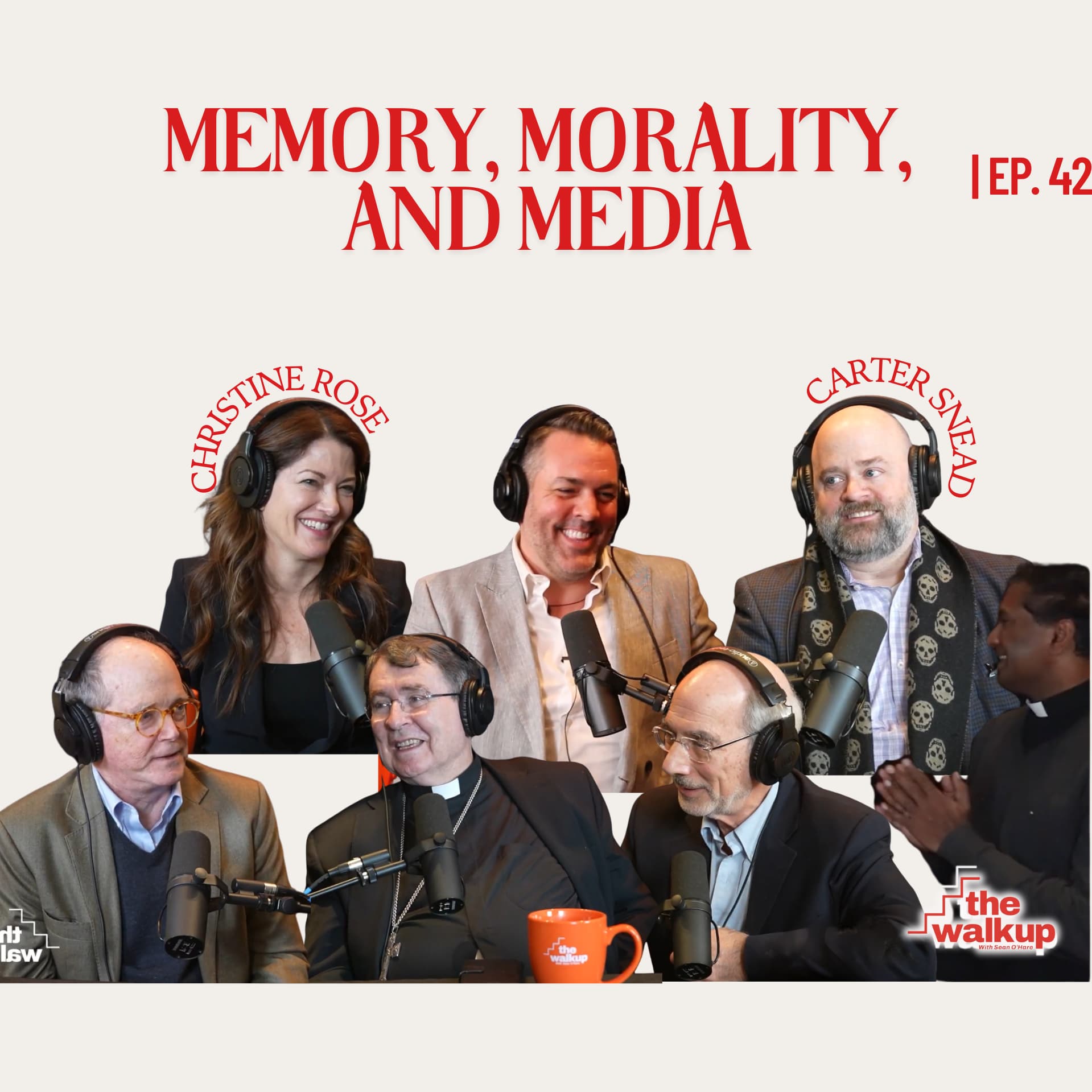
At New York Encounter 2025, we sat down with two guests working at the intersection of ethics, technology, and public life.
Carter Snead, professor of law at Notre Dame and one of the world’s foremost experts in public bioethics, shares reflections on the moral obligations embedded in our laws and systems. Christine Rosen, cultural commentator and senior fellow at the American Enterprise Institute, explores how memory and experience are shaped—and often distorted—by our digital age. This episode probes what it means to be human, and how memory, tradition, and moral clarity might guide us through cultural confusion.
Transcript
Read the full transcriptAuto-generated · 7,571 words
Carter Sneed, you're here at New York Encounter. I am. So, tell us, why is it important to be here? What is New York Encounter? You've been here before. So, this is my first time, but I'm well familiar with it. So, I, for 12 years, directed the DeNicola Center for Ethics and Culture. Indeed. And we would host a similar interdisciplinary gathering of friends and took a lot of inspiration from what we knew about New York Encounter and the meeting in Rimini, and there are very few places like this.
In the world, where people, normal people, lay people, can come and hear interesting conversations framed in a human way that resonates with them, that is not like super highfalutin experts talking in a language or about a topic that normal people don't understand. I think you are falutin, man. Don't say you are not falutin. I am medium falutin. I may not be highfalutin, but in any event... The scarf alone is falutin. Now, this takes it to a different level. That is an important accoutrement of the whole package.
But, in any event... The Encounter is a very special gathering place, a locus of community and friends and thinking and talking and interaction that is really indispensable. There's nothing like it, and I'm just so grateful to the organizers and the people that make it possible, and it's such an honor to be here. Well, I mean, you can hear it, like, as we're talking. You've got the buzz in the background. Yeah, you can hear it. I always say it is one of the places you could bring literally anybody, and they could kind of ease their way into the framework by which the encounter tries to present the ideas of humanity and spirituality.
I agree, and the spirit, again, I keep using this word over and over again, is friendship. It is a kind of spiritual friendship, intellectual friendship, gathering of people, new friends and old friends. Even that panel itself, I was able to be with my friend, Christine Rosen, who I have not seen for 20 years, but still a great friend, and we have so much in common, so many friends in common, and my very dear friend, Paolo, and then, I don't know, it has a kind of feel of like a family reunion is what this place feels like.
No, I've been coming for eight or ten years. I mean, a little, obviously, interruption like everybody else during COVID, and yeah, it has the family reunion vibe to it. People I see every year at the Encounter, and it's allowed me this opportunity for building friendships, but also growing in your own intellectual formation or curiosity or what have you. So, just to build quickly off what you talked about today, I mean, one of the most striking things was talking about that White House experience and that eminent doctor, whoever he was, saying that it was the...
Freedom, or to have legacy of disease-free children or something? Exactly. No, no, the word children didn't appear in the sentence. The purpose of genetic screening and IVF is to help parents realize their dream of a disease-free legacy. The word children does not even appear in the sentence. Whatever they may be. They could be bots. They're part of the legacy. They're a piece of the legacy, but they're not themselves important.
Worthy of... Concern. Yeah, so, I mean, are we trending? Do you see things bending back at some point here? I mean, you've been at the center of it, at the Nicholas Center, and now... Yeah, I think so. I mean, I think places like the New York Encounter, little places where people live in a fully human way, in which encounter with the other person, the genuine encounter of two embodied souls, you know, creates that beautiful spark. I think that I'm hopeful. I'm an optimistic person.
I do, because the problem... The distorting aspects that we were all talking about on stage are inhuman, and that can only last so long. I mean, nature and human nature will reassert itself, it seems to me, and hopefully we'll do it in a way that's less violent and disruptive than nature sometimes does. Now, I know you were at the Nicholas Center, you said, for 12 years. Ethics and Culture, yeah. Update everybody what's on your palate these days. Well, I'm grateful to hold an endowed chair at the University of Notre Dame.
I'm the Charles E. Rice Professor of Law, and so I teach in the law school, and I teach in the political science department, but right now, I'm on sabbatical. I'm working on a new book that's due to Harvard University Press by, yikes, December 31st of this year. So, we're working on a new book, expanding on some of the themes of the first book, and expanding on some of the themes that we talked about today. Nine months, man. Come on. It's easy.
Babies are born in that period of time. A lot of gestation. Exactly. Exactly. Well, we will have to have you back on when you have got the book, and we can be part of your press junket. Oh, perfect. I love it. Thanks for coming on. Great to see you.
Christine Rosen, pleasure to have you here. First of all, I have to admit. Big fan. I listen to commentary at least two or three times a week. That's great. Oh, I'm glad to hear it. So, the in-person experience is much better than even your lovely voice on podcast. Thank you. But you're there five days a week. Yes. That switched during COVID, yeah? Yes. We used to be twice a week, and then we went to five days a week. I now get one day off because we added Seth Mandel to the lineup, so we all each get at least one day off.
So, I'm on Monday, Tuesday, Thursday, Friday most weeks, but it's great. And what's the setup with that? Is it everyone's on a Zoom? Yeah, we do. And you've got your own mics at home? I have a whole little corner of a room that's like a mini podcast studio, and it started, we went daily during COVID because we were all just going a little crazy like everyone else was. Shut up inside of our homes, and we would just call and talk to each other, see what was going on.
I live in Washington, D.C. My other colleagues were in New York. I don't think I realized you were in D.C. Yeah, I'm based in D.C., so it was a way for all of us to just check in with each other, and we started recording it, we threw it out there, and our listeners loved it, because they were going through similar things, so it was a real community. No, it was great for me. I was in a similar situation where I needed to kind of have that feeling of friendship, or checking in with, how are we all feeling about this?
Right. The world, time was a flat circle, no one really, one day into the next. No, I remember going, I was living in Hudson Yards, and I remember going to the grocery store. It was like a Navy SEAL operation. You had to get gloves and things in it. Belly crawl into the produce aisle, yeah.
And then hand signals. But the funny thing is, New York City grocery stores, they are so narrow. At some point, you are going to have to pass somebody, and so the jig was up. Right. So, now, you have spoken here previously. So, we were trying to figure out how long ago it was. It was more than 10 years ago, actually. But it was much smaller then, but still had the same sort of energy and enthusiasm about asking these really big questions that I think a lot of people at the back of their minds have in mind all the time, but you can never all get together and kind of hear people come in and debate and discussion.
It is lovely to see so much enthusiasm. Yeah, and so I'm curious, especially since this is primarily from Communion and Liberation, an Italian Catholic organization, lay-led, and commentary coming from a Jewish perspective, so I hate this term, but I'm going to use it anyways, inter-religious dialogue. Yes, thank you.
I feel bad. There should be a special sound effect when that term is invoked, right? The more you know. Exactly, the rainbow. Oh, boy. We're the same generation, I guess. Yeah, the rainbow. It has some other connotations as well. Yes, they've taken the rainbow from us, but yeah. There's the rainbow, and then what's the rainbow flag with the extra triangle that's intersexual? Yeah, I don't approve. It's getting too confusing, both literally and figuratively and symbolically, so yes. Well, we're back to two genitals now.
You didn't hear? We're back to two genitals? I know, I know. The world is back to an understandable place then. Wow, it's as if we were ever multiple genitals. So yeah, I'm curious just from that perspective. You know, there's a place for open dialogue. This is where you're coming from.
Judaeo-Christian worldview, this is Judaeo-Christian worldview, but obviously a lot of common ground. So, how do you see that coming from that perspective and the importance of the encounter? So, one of the things that I think encounter does really well is, as I said, ask those big questions. But what is often missing from these debates is anyone can come in and have an argument with anyone else, regardless of their background. And this is where I think, among faith traditions, there is often a lot of siloing of these very important questions.
Think about... You know, how we use technology, or as my wonderful friend Carter talked about on our panel today, about bioethical issues. Like, how do we decide, should we be allowed to choose traits in our children? Each religious tradition is having these debates, but they're not always talking to each other. And that's where I think getting a lot of people in a big room to listen to multiple perspectives and then discuss it, that's more valuable than we believe. I mean, I think that one of the conceits of the internet age is that, oh, well, I can just go online and see what this rabbi or that priest or this minister thinks about it.
But no one actually does that. There is too much content. You could. It is too hard to find. You could, but you would have to actually be a very dedicated and intrepid person if you are just curious about a question. So, what I think the encounter does is bring together lots of people, throw them in a room together, and say, discuss. And that should not be underestimated in this day and age. What I like about it, too, is there is intentional...
What breaks between to allow for the, let's talk about what we just heard, let's make some new friends, let's jump on an impromptu podcast. Why not? You know, why not? It was here. Now, tell us about your new book. I was, I'll be honest, I was, as you were in our very elaborate green room, which is six feet away, I was like, let's see if she checks her phone when she's sitting there. Oh, yeah, no, I don't even have it. You didn't?
I don't know where I left it. You don't even have it on you. This is great. No, I don't. So, you are. I'm living the dream, living the values. You're in the moment. You're not. Part of the loneliness epidemic. So, yeah. So, tell us about your new book. So, in September, I published a book called The Extinction of Experience, Being Human in a Disembodied World. It is a very portentous title, deliberately chosen to get people to think about their everyday experiences of being human in a world where we can do so much on our phones.
It sounds simplistic, but what I found, I have studied technology and human behavior for more than 20 years, and we have a lot of big issues. We have issues about surveillance and privacy and regulation, but we were missing the day-to-day. One of the speakers later today, or tomorrow, I think, is Sherry Turkle from MIT. She's been studying how humans interact and change their behavior around technology for decades. She's wonderful. Everyone should go listen to her. But I was curious about how it alters our expectations for each other.
So, when I get on a crowded bus, am I a less patient and more annoyed person around my fellow human beings? Because most of the time, I can tune them out, By staring at my phone, I think there's now a growing body of evidence that says, yes, we are less patient, we are less thoughtful, we are less empathetic, and this leads to a larger society that can't get along, can't figure out thorny political issues, and that is just generally anxious and angry too much of the time.
Yeah, I think in some ways we're lucky in New York, as similar in D.C., but one of the realities of New York is you are confronted, you have to interact with people. Now, I will say, I'll share something that just happened on the subway on the way here this morning. I was, you know, checking Twitter, or X. Shame on you. I know. And there was a disabled gentleman who was, at least whether he was homeless or not, but had a cup that was there for asking for money.
And, you know, I kind of just did my best to accommodate him, and he was looking to find out which door to get out of the subway. But because I was looking at my phone, I didn't have enough reflection, and five seconds after he left, I thought... I could have invited him to the encounter. He would have had a warm place to be, interact with people, and I know this environment would embrace somebody in his condition, but because I had been distracted up until the moment I was forced to interact with him, the moment was passed.
So, I'll find a priest later and confess, but I completely agree, and I don't know, I almost feel like This is not to rag on the suburbs or something, but I feel like sometimes the suburbs, it is easier to isolate yourself. Yes, I think that is true. I visit my family in Greenville, South Carolina. Shout out Greenville. I said Greenville. Greenville. It is not Greenville. When someone says Greenville, you know they are not from the South. It is like saying Lancaster or something.
I mean, I am from Florida, and we are not the South either. We are its own weird thing. But yeah, it is Greenville. Is this Florida, man? It has got its own... Florida, man, is real. I grew up with... Florida Man. Yeah, I mean, I have a friend who's a professional alligator wrestler, so when people laugh at that, I'm like, no, that's Florida. This is, we are this weird. Did you see the Apple show with... I started to watch it, but I have to say, I kind of had, I had to stop because I've lived it.
Oh, no, the Vince Vaughn is great, yeah, but very Miami, very Miami. Oh, you're talking about when it literally says Florida Man. There is one called Florida Man. Yeah, that one I avoided. Yeah, no, the Vince Vaughn. But it definitely gets the mental space a lot of Floridians inhabit. He was great. Yeah, it was fun. Well, Bill Lawrence, the producer, was fantastic.
Bad moment. Oh, I was saying the isolation part was like, yeah, I love visiting my family, but I feel like I... I go to a house, and we hang out isolated there. I get into a car to go to another place, to get into a garage, to get into a house. Not once in my, my siblings living there for like 20 years. The phrase, the other day, my neighbor and I.
I have never heard that phrase. So, there are two things. One, people know the names of Instagram influencers more than they know the names of their neighbors, and if you think about the third spaces that need... What is that? She has another interview. Okay, great. We can wrap up. Yep, no problem.
You're very in demand. We're talking too much, but we need these third spaces, right? Malls are dying, retail is dying. We actually do need to cultivate third spaces where people from all walks of life can come hang out without having to mediate that. Yeah, and not in a digital environment in real life, like we're having now. Exactly. Face-to-face. Well, you're in very high demand. People are looking to sign your books and such. So, pleasure to meet you in person. Thank you.
Yes, likewise. And I just want to let you know that my vocabulary increases. By one new word every time I listen to commentary. Excellent. I didn't know what sophomoric meant. Still don't, but I hear a lot. We should give out a thesaurus with every episode.
Pleasure to meet you. Thank you for being here. Thanks so much. Well, James Davidson Hunter, thank you for being here, and thank you for being a part of the New York Encounter. My pleasure. You and I met briefly. You were giving some remarks at the Union League Club about your book, and I remember reading that essay, To Change the World, and just being profoundly struck by it, and then the book as well. So, now you went from To Change the World to...
Maybe the first one should have been how we got here, and then how to change the world. I mean, on this topic, it started with culture wars, the struggle to define America, and then this really, the Democracy and Solidarity book is the bookend to that, 30-some years later. And to change the world was...
Born out of frustration, but in a way, it was a very personal reflection, obviously intended for a wide audience, but it was a personal reflection on how I, as a Christian believer, I think we should be responding to the... So, they are tied together. They are woven together.
Yeah, and I remember the strength of loose ties being such a powerful metaphor, and the examples you used throughout history to demonstrate that, whether it was Martin Luther or William Wilberforce and others. Yeah. Do you see figures like that today?
Well, the argument there was that the key actor in history is not the hero, it is not the saint, it is not the genius, it is the network, and networks can be loose or they can be dense. Networks always have to be horizontal as well as vertical among peers, but also intergenerational.
And networks are at their strongest when they're supported by other dense networks of leaders from other spheres, and yeah, there's a lot of networking going on. The question is, is there a common purpose? Are people coming together, not only in mind and heart, but with the resources that they have under their... At their disposal, to work toward common ends, and that I am not seeing.
Yeah, I think there's a greater need for discernment and curation, right? Because data is not a problem anymore, right? Platforms and communication means are not a problem anymore. Now, it's about defining what it is you believe, and what the niche is that you think you can do to impact the world. Right. And I think... I mean, I experience it in my very micro places each day, but I think there is a beauty in that vocational discernment of where exactly is my moment.
I was interviewing somebody earlier who is an Indian priest from the lower caste, catechized by Italian missionaries, and now he spends his time trying to help young girls and women. From being trafficked to Muslim countries, and you just think, okay, he has found his niche. I mean, this is a guy, and he is so passionate about doing everything he can to impact that. So, how do you see the New York Encounter specifically as a forum? Why is it important? What has your experience been of it in terms of facilitating these kind of conversations we are talking about?
Well, look, this is a kind of ideas festival, and you have got this really interesting, diverse, talented group of speakers and of... It's a type of booths that present material. It's an opportunity for strangers to become friends and for friendships to become deeper. And I think in these kinds of encounters, things that you don't predict can come into being. And there's a kind of serendipity that... Can produce lifelong friendships and lifelong shared commitments that wouldn't happen if we were just staying home.
So, this is a kind of cauldron. I don't mean that in a kind of tense and conflictual way, but it is this jumble or melange of ideas and of moral passions that... Can produce unexpected and very positive results. Well, you have added a few new things to our vocabulary here in terms of describing the… The Encounter, an ideas festival, a melange, and a cauldron. So, if you were looking to win the award for the best attributes... I'd probably take out cauldron, but anyway, melange, certainly, and...
Melange, yeah, anytime you get a little... something that's also French in nature. Well, listen, we're very grateful for you participating in the Eric Encounter and contributing. Your ideas and your wisdom into that Melange, into that Ideas Festival, and we'll give the Aspen crew a run for their money when it comes to ideas. Should always, absolutely. Well, thank you for being here. You're welcome.
Professor Kahn, thank you for being here and being a part of New York Encounter. So, first of all, how did you come to learn about the Encounter and this fantastic Ideas Festival? About... A year ago, out of the blue, I was invited to the Rimini meeting through an Italian journalist who is involved with the Rimini meeting, who was a long-time reader and expositor of my work.
So, I had never heard of it. I had never heard of community liberation. I think of myself as a secular Jew with a deep interest in American political theology, and here I was invited to Rimini. I said, well, this sounds curious. I talked to some people, and every one of them said, oh, you must go. You must go. Oh, good. So, I went, and I had a lot of fun, and I felt. I felt at home, and I felt it was a sympathetic community, and I felt people were interested in what I had to say, and I learned then that there is such a thing as the New York Encounter, and sure enough, six months later, an invitation came from the New York Encounter.
I had never been here before, and it is very impressive. I can't… Remember, really, another gathering of so many young people interested in serious contemplation of what's going on in their lives. It's very striking, and I think a little different from my impression of Remedy, which was...
There are lots more people. It is a much bigger event, but not quite slanted so much at young people. The dominant factor I see here is kind of college-age students, people in their 20s, and I thought they were a little bit older. A little bit older, more families, so I am very impressed.
Such a thing can't even exist in the modern age. No, I had a similar thought to that this morning. I'm listening to the talk at 9.30, and I'm seeing people in their 20s with notebooks out. Well, first of all, they're using a thing called a pen and paper. It was extraordinary.
I didn't know that they knew how to use that anymore. And this is what a Saturday morning didn't look like, my Saturday morning in my 20s. But I'm glad to know that there are those here, and you can hear, even in the background here, the energy, and people are eager to connect, and I think what New York Encounter really does an excellent job of is this mixing together of finding people such as yourself that have a take on the world and expertise and an openness to sharing that, but then we need to go to discuss it afterwards, right, and have ways to have a...
A continuing conversation. It is nice that, you know, I assume many of these people come back year after year, and they make friends, and they carry on the conversation. No, in fact, I have been living in the city for 12 years now, but for many years previous to that, I would pilgrimage, if you will, from, I lived in the D.C. area, come up to New York specifically for this event. And so, I would make this, it was like a family reunion, and in fact, I was getting texts.
During this week, are you going? Are you going? Will I see you there? So, it does have this kind of family reunion effect, and then I am curious, and I don't necessarily love this term, but it is when we have inter-religious dialogue, right? But you say, oh, you know, I didn't know about this Comunio Liberazione, Italian, you know, kind of lay Catholic group, and then here you are. You find yourself here from a Jewish perspective. How does that... What confluence strikes you now that you have had the chance to address the audience?
Well, I was struck by it at Rimini already. One of the major participants at Rimini for many years has been Joe Wyler. Joe Wyler is a law professor who is deeply interested in religion, and deeply religious, Jewish. Studies. Jewish text, Jewish biblical text. And here he is, sitting with a Catholic priest, and they're arguing about, you know, interpretation of a biblical passage. I thought, this is great. And here, I go upstairs to the fifth floor, it's where the exhibits are, and there's a large exhibit on Hannah Arendt.
This may be, you know, organized by a lay Catholic community, but it is obviously open to people of all different faiths, beliefs, no beliefs, and, you know, I am struck a little bit more by the religiosity of this event, but only for the following reason. When I was at Rimini...
It was all in Italian, except for the things I was interested in, whether it provided a translator or, you know, I would be speaking or somebody else would be speaking in English. And here, I am getting the whole, you know. And so, I see more of the, you know, the religious orientation, but I have to say when, you know, when the session begins, there is a kind of a slideshow of sayings that people should be thinking about. And they are all the things that I think.
So, I don't see the religious identity as particularly exclusionary. Well, I think I had the unique opportunity to work with the Vatican Library for a few years, and so one of the things that I would describe to people, because of course, what is in there, you know, the secret archives and the library, and what I would tell people, well, there is a lot of things that are in there, and so I would say, well, there is a lot of things Because they would go, oh, it is all religious books.
It is all Catholic. No, no, no, no. It is knowledge of the human person. It is knowledge of our natural world. I saw these extraordinary books of drawings of effectively kind of like, here is all the animals we think we know exist. Some of them, they were a little bit off, but there was Aztec, there was Greek and Roman, of course, their largest collection of 19th century photography in the world. And you think, well, why does the Catholic Church have this?
Wouldn't it be just canon and catechetical resources? But there is this deep understanding or belief in the Church's history, its pedagogy. All of knowledge is, in part, given to us by God, this curiosity, and maybe some places in the Greek tradition got it pretty close without the incarnation, without the idea of monotheism, but there are some pretty deep ideas of truth there, and we should learn from them.
We have that very distinctly going from Plato and Aristotle to, in this case, Thomas Aquinas, right? Right. But anyway, I love that the encounter just embraces that fully, that we're all here on a journey, and we're all just trying to figure out things as we go along.
And so, what is it you hope to absorb for the rest of the day? Are you here for the rest of the day, or what is your schedule looking like? I'm here for the weekend. Great. I'll attend things eclectically, I would say. My background is in philosophy and law, but I have a deep interest in science, and sometimes I regret that I wasn't.
an astronomer or something uh and and there are scientists on the schedule i want to hear them you know and so you know i i think you know the the deepest puzzles of faith are questions of you know how we reconcile belief in the human spirit whatever your religion or no religion with you know what we're learning about the material universe and i'm curious to hear i'm always curious to hear from the scientists so So, I am sure that will be my particular focus.
I might go to some of the other things as well. I guess somebody is going to talk on Hannah Arendt. She is one of my favorite political philosophers. So, I will look around and see what else looks interesting.
Great. You might be curious to know that Tom actually developed a TV show right now for NBC with my good friend Doug Lyman, who comes from a Jewish family. Yeah. So, Tom Cruise has a different background. You know, secular for sure. He is the director of things like The Bourne Identity, Edge of Tomorrow, Mr. and Mrs. Smith. He has got a new $100 million-plus movie with Tom Cruise he is filming coming up soon. But our show is the two of us, an odd couple friendship, traveling the world, talking about God.
And so, I come at it from a, you know, traditional Catholic background. He comes at it from more of a Upper East Side, you know, a secular Jewish background. But we have just such, what I love is, when we originally explored the show, we thought it was us behind the scenes.
It's kind of a feature documentary, and then we realized, no, the show is about a skeptic and a believer just exploring all these things, and I learned so much from him because he'll attack things at a completely different angle than I would ever anticipate, and my best experiences are when I put him in front of a Catholic nun. He's always just perplexed by them in general, and they have these wonderful interactions, and I just get to sit back and watch and laugh, but hopefully we'll be in.
Full production for the whole series here soon enough to share it with you. Yeah, you should share that with me. I would be very curious to watch some of it and see what I think. Yeah, we have got the pilot, so I can share that with you for sure.
I was hoping to bring Doug, actually, to have him speak here to talk about why does an A-list Hollywood director want to spend part of his time exploring religion with his weird Catholic friends. I love that. That is a great idea. Well, good. Well, we'll get that over to you, and then I'm just grateful for you being a part of the New York Encounter, and for sharing your gifts with us, and hopefully you'll get to absorb from some of the amazing speakers that are here throughout your visit.
Looking forward to it. All right. Thank you very much. Your Eminence, thank you for... Thank you for joining us, and I know that you're just coming off of celebrating Mass here for the New York Encounter, and you gave a beautiful homily. So, I would love for you to speak about that, about Encounter, and about what you discussed today at the homily. Well, you know, of course, a homily...
My homily was connected with the event we are celebrating. It's very important that a homily helps us to understand what's going on in our life. It should never be disconnected with the reality, and especially our reality. We are, in a very humble way, we are helping the communication of God to the people.
This is the role of the Church. And we are members of the church, are doing that. So, you know, the New York Encounter is an annual event convocated by some friends, you know, who are members of Communion and Liberation. You know, it is a movement created by Monsignor Giussani more than 50 years ago, and which is spread all over the world.
And Monsignor Giussani has been able, you know, he was... Tremendous educator, evangelizer, and realized that people needed really to understand what is the meaning of the encounter with Jesus. Yeah, and I think Giussani's life's work of bringing the humanities and the whole person into the idea of the gospel message.
So, we have a very diverse audience, and so I think it's helpful. I'm aware of what a papal nuncio is, but a lot of people won't be. So, maybe just describe for people, what is a papal nuncio, and what are the responsibilities?
Well, you know, I am a priest. Then I become a bishop, and I happen to be a cardinal now, because the Pope chose me more than one year ago. So, a few years ago, nearly 50 years ago, I was asked to reach the service of the Holy See, the Pope, and I had a kind of special training for that. I went to Rome. And eventually, I was admitted to the diplomatic service of the Holy See. So, we are being sent by the Holy Father, you know, to represent him in the various countries of the world.
Our job is to represent him for the Catholic Church and for the government, you know? It is a kind of dual presence in the same person. So, I've been there for nearly 50 years. I've been in nine countries, and about 30 years ago, I was, after having been in several countries, I was elected Archbishop, and I became the nuncio in Haiti. I've spent time in Haiti. Yes, exactly. So, I spent four years in Haiti.
Do you know Bishop Dumas? Yes, of course. Our dear friend, and unfortunately he was injured. Oh yes, I know him. Actually, if he listens to us now, I greet him, because he is a wonderful person. Very passionate. Yes, he was not a bishop when I was there, but he became the director of the seminary of Port-au-Prince. We are very much... Related, you know, in some way. So, I spent four and a half years there. Then I became a nuncio in Uganda for eight years.
Later, I was sent to Mexico for nine years. And now, I've been nuncio in the United States for nearly nine years. Nine years. So, it's, you know, so what a nuncio is, we represent the Pope, so whatever the Pope asks us to do, we keep it, we help the Church to be related to the Holy Father, because the Church is incarnated into the human reality, you know, in the culture, in the history of the countries, but it's always one. So, we have to be one and diverse, you know?
And we are kind of in between, you know, kind of a mediation role. And we have our friend here, Father Bosco. Yes. I hear from Vijayawada, India, and as you learned, I had the chance to visit him earlier or last year for two weeks and learn of his amazing mission with Talitha Kumi. This topic of human trafficking, I'll admit... That I was very naive in the scope and the scale of the problem and of the suffering of primarily young girls and women, but also men as well.
How does the Church try to address something like this, and what role can it play in assisting people like Fr. Bosco, but also... Governmental organizations or policy when it comes to combating this terrible horror of trafficking. Well, you know, this is the problem. This is the evil amidst Satan, his presence in the human reality.
And, you know, a lot of people take the advantage. Of the difficulties of the world today. And human trafficking is precisely that. Behind, there is always money. Well, trafficking, that's what it means, you know. I think there are a lot of people who actually use everything to get more money, to enrich themselves. So, they use the drug, they use everything, but they also use people. Actually, they use people to traffic drugs, but they also sell people, you know. Yeah, actually, the buying and selling of human beings.
Exactly. And you know, they are taking advantage of all the difficulties of the world, especially poverty. Human trafficking is a lot of people living in extreme poverty. Most of the migrants, refugees, they are poor people. You don't go home to another country just for the sake of going. So, these poor people, they are being exploited by others, and so the phenomenon of exploitation. So, the church is there. I think the church is always on the side of the people. You should never remember that.
And this is why I love my church. My church is... It has always been and will be always. At times, people don't like it. They would prefer to resolve the problem in their own way. But we are not supposed to... Actually, we respect the politicians, we respect the organisers of society.
But we are there, because whenever there is a need, this is the story of the Good Samaritan and the Gospel. So, the Church is, as followers of Jesus, we are Good Samaritans. So, we are there, and we help. There are many, many organizations related to the Church, but also sometimes NGOs, but we are there, and we contribute, and we try our best. And it's interesting you say that The church is going to be there, and regardless, because I think of the situation in Vijayawada, India, and I think of our friend Bishop Dumas, he is in Ansovo.
Yes. Ansovo, Miragwan. Oh yeah, you know the whole, of course. I was trying to impress you that I actually remembered the name. I will impress you. So, yeah, I actually had dinner with Bishop Dumas in his cathedral, and I shared this story real quickly. We were having dinner with Bishop Dumas, and there's 20, 25 people, this long table, and we're having this beautiful dinner, and then at one point he says, And now, we play Jenga, and you know this game where the blocks, and you have to push, and so the whole table takes a turn, and sometimes it comes crashing down, and everyone is cheering and excited, and then he says, okay, and now we dance.
And I am like, this is not normally what you get to see at a cathedral, or at a cathedral rectory. So, I think of... The terrible violence in Haiti, and I think of the girls and young women being trafficked from India.
A lot of NGOs, they leave. You know, it's unsafe for them. But Fr. Bosco stays. Bishop Dumas stayed and was even a victim of probably an attack. We don't know for sure, but very likely. It's very sad. This is the role of the church. We don't get to leave. This is a vocation, and we stay no matter what. I mean, where Fr. Bosco is.
What I'm struck by is it's 1%, 2% of the population is Catholic, and yet he stays there and serves, oftentimes, Hindu women. Now, these are not Christian women, right? But the call of the church is not just to help other Catholics.
I am inspired when I see that level of service, and it is the side that people do not see about the church. I have always said that if people got to see the church that I have been privileged to see, they would fall in love. It is impossible not to. So, how do we get that message out more?
The power of the Church is the witness of your Christians. That's it. Otherwise, if we are not witnessing... It means nothing. You know, we don't convince people by arguments, ideas. We convince people by the power of our witness, but also we believe that it's not just us. God is present, and God is pushing us to do things.
So, the Spirit is present, actually. I think it is a big mystery. Yeah, yeah. My brother, actually, he served in the, my older brother that is a priest of the Diocese of Arlington, he served on the border of Haiti. He was on the Dominican Republic side.
And the life of the missionary, the life of the priest that is called to, not just the priesthood, but also the mission territory, or in the case of Fr. Bosco. sometimes you just you're born in a mission territory this is just what you sign up for you know so it's the the the call of the church to be everywhere where the weakness the with the weak and the impoverished are it's just something that We don't think to advertise it. It's done because it's supposed to be done, but we'll try to tell Father Bosco's story as much as we can so people know.
So, what challenges do you see in the church here in the States? I mean, I know there's lots of challenges with vocations, there's challenges with, you know. With diocese, you know, closing churches and things like that, but what are your hopes for the future of the church here in the States? Well, you know, a lot of hope, of course. I think the story of the church is always in a new beginning, you know.
That's the story of this encounter today, you know. There is a big future. Because the power of the Church is the power of the Christians believing in it. Even today, it is a new beginning, so we are launching. I think it is important for the Church to be very attentive to the challenges of the time.
There is a need to evangelize. The time is changing. We cannot rest. We cannot maintain the status quo. We have to. To go further, to go out, to encounter people. It's a new venture. Absolutely. Well, that last question for you, you mentioned the word encounter. Father Bosco is encountering these women in their journey.
Bishop de Maas encountering his people in Haiti. What is the importance of the New York encounter? Why is it important for you to be here? I think the New York encounter is a moment, which is an interesting one. We have many moments in the church like that. It is not the only one.
But, you know, it plays its role. It helps people who belong to the movement to reinforce their faith, their knowledge, their awareness of the situation, and to keep hope. That is what the life of the church is all about. We maintain… We maintain the church alive through the practice of the faith.
Yeah, and I think the encounter does that job. Demonstrating the different facets of the church. We have the artistic, the intellectual, the spiritual. Of course, the community. You hear the buzzing. You hear the conversations going on in the background. This is the church, and we are Italian, and French, and Indian, and from all over. This is the church. It is a kind of attraction. It is beautiful. It exists. Yeah, absolutely. Well, you have been very generous with your time. We will continue to pray for the mission of the Church all over the world and for more encounter. Thank you. God bless you. God bless you. Thank you.
More from The Walkup

Against the Odds: The Samurai Lawyer (Chad Flores) | Ep. 52
Faith, Sexuality, and the Fog of War (Iris Bahr & Father Rick Riccioli) | Ep. 02
E2
Church, Conflict, and Community (Iris Bahr, Father Rick Riccioli & Rob Long) | Ep. 03
E3
Hope, Vocation, and the Global Church (Colm Flynn & Colin Nykaza) | Ep. 04
E4