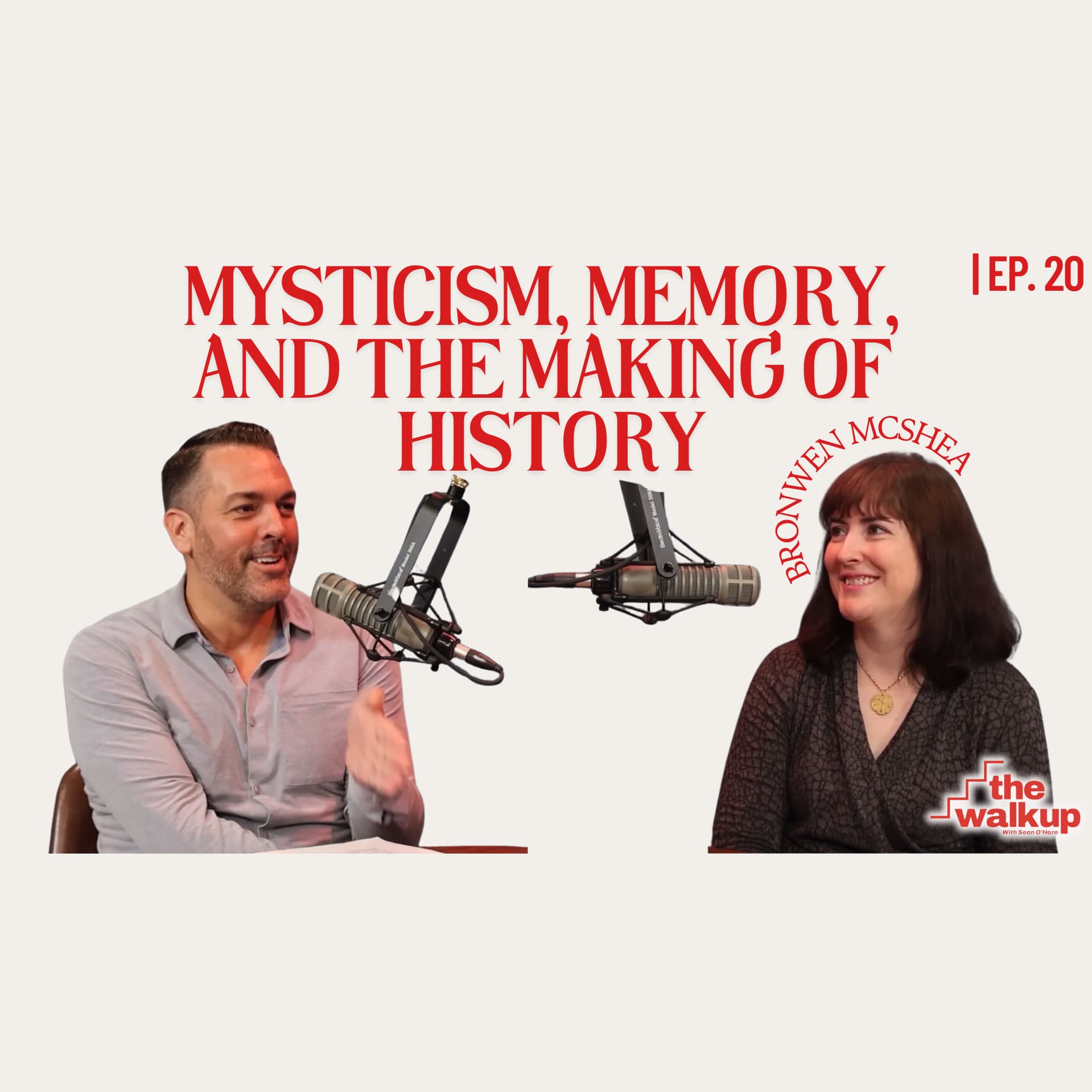
Historian, author, and artist Bronwen McShea joins The Walkup for a sweeping conversation on women in the Church, mysticism, biography, and the hidden forces that shape historical memory.
A Yale and Harvard-trained scholar, McShea reflects on her research process, spiritual imagination, and what makes a good story stick. From Fatima to 17th-century France, saints to skeptics, this episode explores faith as both a subject of history and a source of it.
Transcript
Read the full transcriptAuto-generated · 13,799 words
Welcome to the Walkout Podcast. Thank you. Thank you for joining us here, and I've got a lot of things I want to get into. We want to talk about your book, Women of the Church, and some of your other books as well, but the first things first, we want to get to know you, and so when people learn that you're... You're an author, but you're also a historian by trade, and so how does one become an historian? And it's an historian, not a historian?
Well, people argue about this, and I've had people correct me when I'm just as right as they are, because I think the dictionary says both. I think in standard American English, a historian is preferred. Really? When you speak, you say an historian. It just, to me, sounds better, but it depends how you say historian.
Anyway, but that is neither here nor there. We like being very precise here. Yes, so do I, but I have had enough people try to correct me on a point that actually can't be corrected, because they are both correct.
It is like champing at the bit and chomping at the bit have now both been accepted? I think so. Even though it is technically champing, I think. This is a 50-50 thing, whereas the Oxford comma is not. The Oxford comma must always be present.
Oh. Okay. Well, funny enough, that is what I ask every one of our guests is, are you an Oxford comma person or not? That gets me upset, the Oxford comma, if it is missing. So, frankly, to be a historian, look what I just said, a historian, you have to, I would say, writing good quality history books or doing historical study or research makes you a historian. I mean, most people.
Who do this get doctorates in the field, but there have been excellent historians over time without doctorates. I myself got a doctorate in early modern European history at Yale University, and I always had an inclination toward history. I thought I would become a lawyer, though, and make money, but instead I chose to follow my heart, and so I went to graduate school.
I didn't really call myself a historian until my first book was on its way. It felt a little bit pretentious to call myself that, but once I had a book out there, I was working on a second. I like that phrase because it helps me kind of engage with wider audiences, too.
I don't always like to call myself a history professor, number one, because I'm not always teaching. Some years I am, some years I'm not. So, yeah, I mean, there's all different ways that I could explain how one gets trained as a historian, but... There's not like a historian's guild that calls you up and says, congratulations, you've made it into the club. Not really, although, yeah, I mean, there's academic guilds in terms of hiring and all that, but that's...
I mean, people refer to popular historians versus academic historians, and that is a legitimate distinction. I am actually trying to bridge both those worlds with my work, which is a pursuit in and of itself. And I feel like there is at times a little, I don't want to say a controversy about these things, but since there is not a precise status of what makes one a historian or not.
I imagine part of it has to do with how well footnoted you are and how you actually source everything. So, when you're going through a project, like whether it's this book or the one on the Duchess in France, do you have to know French to be able to do these? I mean, because how does one… You should. I mean, so you refer to my… I have a book. It's a biography of a French Duchess, 17th century Duchess, the niece of Cardinal Richelieu, called La Duchesse, Pegasus Book.
So, if anyone's interested, but that, it was the first, it is the first modern scholarly biography of a major French figure of the 17th century. There was one other book that came out about her in the 19th century in French, which had footnotes, but very light compared to a standard history book today, and when you're When you're trying to argue, including to the French people, that there's a really important person they should have a book about, it's really good to document, to show all the sources, and you definitely need to know French to wade through 17th century French documents in archives and libraries.
How different is 17th century French from modern French? It's surprisingly similar in many ways, especially this duchess was part of the Richelieu family. They're Parisian courtly elites, so Richelieu himself is famous for trying to kick-start the standardization of French through the Académie Française that he founded, so a lot of the standard norms of French start to get cemented in the 17th century in this very period, so you have a variety of... There are certainly different ways of writing French and speaking French at this time, wider than is true today.
But the types of people I was reading and sources I was consulting were fairly easy to get through. Some of the spellings are different. It wasn't like trying to read Shakespearean English or something? No, there is less of a gap, much less of a gap. The closest would be, so...
He was, il était, they would say il était, with O-I-T, and so it sort of looks strange to the eye, but if you're mainly reading, you get used to that pretty quickly. The downside of this is when you're... Learning French, in part, as a scholar, like I'm learning 17th century French as I was learning French when I was a student, and so my first few times in Paris, I'd be trying to speak about, you know, I went to lunch, I did that, and I would occasionally use 17th century isms with French friends, and I have one Parisian friend.
Thou art headed to lunch. She's a very dear friend at this point, and she likes to, you know, if I'm at a party with her friends, she'll bring that up as like a parlor joke, something to make fun of me for, so. But it's quite close to today's French, yeah. Interesting. So then, when you're researching someone who hasn't had the amount of extensive research done to date, I imagine what you create in your research, you're... Building, effectively, kind of a portfolio, and it's almost, you were talking before about maybe becoming a lawyer instead, and it's like you're building precedent, almost, right?
You know what, yes, because, and it's important, and I was fortunate to have, I wanted this book because it's a biography to be published by a trade press, not a university press, so I went with Pegasus Books, and I like them in part because they're very friendly to lots of footnotes, and a solid bibliography. So, I was able to. To bring kind of the full scholarly apparatus into that book that I would have with the university press, I might have added some more kind of quotes in the original and some footnotes in an academic press version, but for that project in particular, it was very important to show every archive, every kind of source I consulted, and even occasionally in the narrative to let the reader in on what I'm doing with the source, and that's kind of for any specialist reading the book.
If, you know, say I get something a bit wrong, or there's a source I missed, you know, despite looking for many years for everything I could find, that they don't have to kind of start from scratch. So, that's kind of the base of sources, and I depended on the 1879 biography of her as a base of initial sources, too. Some of the archival collections had changed, so that was kind of fun trying to figure out. Where those sources were. Or even in a few cases, if they even existed, if he made a few sources up.
So, that was fun. Oh. So, there was fake news back in the 19th century. Scandal. Yeah. So. The good Alfred de Bono-Avenant. He was a very well-meaning historian, but I had to correct him on a few points. It was a narrative license, I guess. You know, and then, but I mean, are you living in Paris where you have to do this? I mean, what is the commitment? Well, it partly depends. So, my first book also was a French history book. I wrote about the Jesuit missionaries who went from France to North America in the 17th and 18th centuries.
I wrote about the Jesuit missionaries who went from France to North America in the 17th century. And a lot of the original sources of that mission, there are edited volumes, and there's been a lot of work in sort of creating print versions of many of the original sources. So, in addition, a lot of the archival sources, I didn't necessarily, unless there was a question of maybe...
Like a really, you know, specific question that you want to make sure the printed version is the same as the original sources. I didn't have to go. To as many archival collections as for the second book, which is, I am doing that archival legwork for the first time. So, for the first book, I spent a few summers in Paris, also one in Rome, to visit the Jesuit archives. But for the second book, I spent a number of summers and also shorter trips in the autumn, in the middle of a semester, if I had time.
And I would go back, sort of targeted visits. So, I never lived in Paris longer than six weeks at a time, but I did that a number of times, and then from Paris, you travel to other places. And so, these, because these are not, very few are digital, digitized, correct?
Well, many of the sources I consulted are actually early printed books where there are references, so many of them are digitized now. With the first book on the Jesuits, some of the sources that are digitized now were not when I was first working on that, so that is an interesting difference. I had to go to the French National Library, Bibliothèque National in Paris, to see books that just a few years later were all digitized on Google Books. So, but a lot of the sources have never been digitized, and my collection of photographs are some of the only.
Yeah, it's funny. Will, my unfortunate intern, he got a very strange request. I'm sure when he started interning for me, he never thought that he'd be given this particular task. So, a Brazilian friend of mine asked, he has a priest friend who's doing a biography on some obscure saint, I don't remember who it is, and the only copy... And the copy of the particular book he's looking for is in the New York Public Library at Bryant Park, and he's like, could you please, can you help us?
Can we scan it? So, I email the library, and they say, basically, it's too delicate. We can't scan it. Oh, yeah. Scanning, yeah. So, then the guy in Brazil says, okay, but what if you went there, and you just took a picture of each page, and I was like.
I feel like this is something I'm going to ask my intern to do, and you can pay him to do that. Honestly, I've had to do that for so many sources. Really? Like at the Archive National, the National Archives in Paris.
You know, you think these 17th century sources, some of which had signatures of, like, St. Vincent de Paul and Louise de Mariac on them, and my duchess, and people in the Richelieu administration, political administration of King Louis XIII. It's like a really cool 17th century baseball card right there. Like, you think these sources would be really, I mean, they are well protected, but as an American going into this, we don't have things that old generally here, right? You expect a different packaging.
So, they'll just bring these big gray boxes out with, like, a canvas, like, ribbon, almost like a belt, and you open the belt and open the box, and there's, like, a pile of, like, browned papers. It's like papyrus or something. And, like, they're cataloged. Like, there's a catalog, but a lot of the cataloging is brief, and over the many, you know, decades, people have just been putting the basics. So, some of it is not even fully cataloged. So.
I found many more sources related to the Duchess of Aguillon, who I wrote about, that are actually in the computer system, just by... Standing up and flipping these pages with my hands, no gloves needed, and you're allowed to take photos, but standing over and photographing, it's kind of back-breaking after a while, you know? Yeah. So, there's different ways, and different archives and libraries have different standards for what you can photograph and how many, whether you have to pay, whether you don't have to pay.
I find working in France, in general, quite... Pleasant. That is one reason I decided to stick out doing French history after the first experience, because I am not the biggest fan of the French Revolution and centralization, but one of the benefits of it was they centralized a lot of the old regime sources, so a lot of things have been well centralized and preserved and national. A lot of guillotine, but you know. For a long time. I mean, you know, I am not going to.
The good news is. The bad news is they chopped off a lot of heads. The good news is they centralized all the documentation of that. Yeah, although sometimes the revolution caused disruption, so some of the sources connected to this duchess were not in the location they would originally have been, because some member of a noble family ran away with them to a friend's castle somewhere. So, they show up in parts of France that they are not necessarily expected to be. Well, we forget.
That, you know, how valuable the written word was, because we just have this notion that, you know, okay, well, there was Gutenberg and the printing press, and that was, you know, hundreds of years ago, so everything that's available is basically on Google, and it's not, and a lot of these things haven't been scanned and haven't been digitized, but the most valuable things that a noble family might have had was their... Their library, and that had to be preserved, because that's the one copy we have of this, whether it was fiction or non-fiction, this might have been the only copy, and so I learned this, I probably haven't mentioned to you that I worked with the Vatican Apostolic Library for a couple years, not because I have any scholarly...
Particularly credentials, but I was learning about, maybe you probably know about it, I think it's Queen, is it Kristina of Sweden? Yes, yes. And I met with the Swedish ambassador when I was there, because when she was fleeing Sweden...
She hid, I think, at the Vatican, and she brought her library with her, because that was her prized possessions, and I learned, after working with the Vatican Library, that the library is a library of libraries. It is a collection of, okay, here's Queen Christina's, here's this royal family, this noble family from Italy.
And when I met with the Swedish ambassador, he said, oh, yes, we were very grateful to the church for having protected Queen Christina, but also her collection. Since that time, or I should say more in modern times, they've continued to support financially the library for preservation. That's quite interesting. Yeah. Queen Christina lived, she was a contemporary of the Duchess of Aguilón. I was going to ask. Okay, that's interesting. Yeah, I mean, I don't know her exact birth year, but I think the Duchess of Aguilón would have been a bit older than her.
Yeah, that is interesting. Actually, the French National Collections originally were royal collections, too. Same with museums. The Louvre Museum, a number of the paintings of the original collection were actually donated by Cardinal Richelieu to the crown when he died. So, some of the foundations of the great French art museums. Richelieu is known as one of the first, if not the first, major private art collector.
In Europe, sometimes he would acquire things. I talk about this in the book about the Duchess. He would acquire things occasionally when his enemies would lose their jobs or lose their lives. Suddenly, you would have a nice Michelangelo statue suddenly in the Richelieu Collection. And that had belonged to some noble family that he had laid the law down on. The lesson was, don't have a really nice art collection, because you might lose your life. Yeah, so building an art collection in those days was not, you know.
Yeah, it was tied up with some of the conflicts of the various families and countries, so... Well, yeah, when I was working with the Vatican Library, I learned all of these, so much incredible history, but that, one, that there's collections there that, of course, haven't been digitized.
Because in large part, because they're too fragile, they have to be restored before they can be digitized. But to kind of reinforce your point earlier about they're used to having all these old collections, and we think anything 100 years old should be put in a temperature-controlled environment.
We're going through some of the archives, and this is just kind of dusty, dirty hallway. And, oh, there's a, oh, yeah, there's a. A Gutenberg Bible, there is a whatever, and there was this guy cleaning one of the books, one of the manuscripts, I should say, illuminated manuscripts, which are like, oh, my gosh, gorgeous, and he just has a vacuum.
He has a vacuum. Oh, my gosh. Well, that is amazing. I will say, so one of the things I learned in this line of work, so. All these collections, like even in the French National Archives, there are sources that are too fragile to see, and those have been put on microfilm, so you consult them. And so, that was my least favorite thing, photographing microfilm images. You know, so it is like reverse black and white.
So, they definitely don't treat all the sources this way, but one of the interesting things I learned, especially with the printers who printed for the royal family, the paper, the quality of the books was regulated. It was so excellent that one reason our researchers are allowed to just flip through these old books or papers is because the They haven't decomposed. They're just really excellent quality books and paper, and some of the more modern sources sometimes are more fragile because they're mass-produced and they're not as— They just don't last as long.
The wear and tear is worse sometimes from modern sources than some of these kind of higher level 17th century sources. So, they know which kinds of books and papers they have in their collection, and which the plebs, the PhD plebs, touch, and which need to be looked at in more controlled settings.
Well, and it's funny, too. People don't know the history of the... The church, and also, as you say, royal families that would have been the only ones that could kind of house and preserve these works, but there is a, when I was working with the Vatican Library, I'm learning.
Oh, this was the greatest collection of human knowledge for about 400 years. This was Google, this was Amazon, and then in your hero stories, oh, they chained the books to desks. I'm like, yeah, because there was one copy, and you don't check the books out when there's one manuscript. I have news for you. When I was a grad student at Yale, I had a fellowship at the Beinecke Library there. They had like...
They had former security guards, like former cops as security guards, to make sure people didn't steal valuable books and manuscripts. There's one copy. Yeah, we were in this sort of research space. The researchers, we jokingly called it the panopticon, because the library staff and the security could see everyone in this glassed-in room in the center. But there are many, many examples of people trying, including grad students or people who want to, not at Yale per se, but there have been cases over the years of people trying to steal things.
So, yeah, I have no... It's not surprising at all that they would put chains on things in the old days in the Vatican. Yeah, nowadays, you know, it's a standard process. You have to be an academic to prove what you're there to study and so forth.
But it's just incredible. I mean, you're very unique privilege, obviously, to be able to see these things. taking me through the collections and i'm seeing um obviously illuminated manuscripts of of scripture but then are you know i'm seeing um uh things like astronomy astrology yes um biology zoology there's books where they're like basically these are all the animals we know about in the world and some of them are like he They'd heard about dragons. They weren't sure if they were true or not, but they were like, I think there might be dragons.
Create a dragon category. They didn't know, and so it's just wild. And then I'm seeing Aztec manuscripts, and then, speaking of French, beautiful. french fashion designers from like the 18th century amazing yeah like beautiful yeah of of different you know um designs and and bought gowns and dresses and so forth and then the largest collection of 19th century photography in the world you know it's like things you wouldn't even think about sure And they're just still in the early stages, and that's just the library.
The archives are a separate thing. I learned. This is so Vatican, so Italian, so Roman. So, when you are the head of the Vatican Apostolic Library, Exactly. What is the word for library? Bibliotheca. Bibliotheca, yes. You are both the head of the library and the archives. They are two separate entities. Yes. But almost always the same person is in charge. So, that means you get two different offices.
Even though you are the same guy. So, one time I went with this archbishop. It does not surprise me. I have been to Rome. I have actually been, not the Vatican archives, but the Vatican library. That is a place where I had to really prove my worth more than any other place I've had to do.
I was representing a philanthropist, so they welcomed me in. Oh, please, you're going to give us money? But, yeah, one day we met with them in the Tower of the Four Winds, which is like where they developed the Gregorian calendar. Okay.
And then the next time it was next to one of Constantine's... Bibles, which is with ivory cover. Oh, wow, amazing. There's like three in the world. Yeah. The church has two of them, and they're basically of immeasurable value. Yeah, yeah, wow. Fourth century or whatever. Oh, my gosh, yeah.
Actually, was the archbishop from, actually, he was from Paris. Okay. This was kind of, he wasn't a cardinal, which was rare. Usually, they're almost always cardinals, but he was, I can't remember his name right now. This is. Eight, ten years ago. But, yeah, incredible, incredible privilege, and just knowing that the church looks at it like, of course we want to know everything about God's creation. There's not this tension between scholarly pursuits or science and God. In fact, they're... Yeah, and many of the popes were incredible patrons of science.
I mean, the one story everyone talks about is the Galileo affair, where he's kind of silenced for a while, but the popes were actually behind his research initially, and there's so many examples of popes. I'm sponsoring the research, including, I mentioned in my book, Women of the Church, the first female PhDs in science were Italian women, late 17th, early 18th century, and sort of popes were.
They protected women like that, like they were interested in encouraging scientific investigation, and so, yeah, I think the history of the knowledge collection and patronizing of learning of the Vatican, it has been written about by many people, but I think the full extent of it is not remotely known to.
Most ordinary people out there. So, we have a Vatican Observatory, which is one of the first in the world built to observe the cosmos. So, that is an interesting question. Why do you think, I mean, outside of just… Modernism and a general kind of skepticism of the church's role in the world, is it just narratives that got built to give a counterclaim? Well, this actually gets to my whole sense of why I do what I do for a living.
That is exactly why I asked it. It is sort of, I mean, there are various reasons sort of external to... The Catholic world, we can point to, that make us defensive about this. I actually feel that we need to do our own history more and better. I don't think we prioritize.
The study of the history of the church in all its variety and all its... We have long-standing histories of theology, history of ecclesiastical politics, histories of some missions, maybe not others, histories of church-state conflicts, but I think the field of history of Catholicism is kind of a fairly... It is not new, but people have only been using that phrase, history of Catholicism, for a few decades now. Really? I didn't realize that. Like John O'Malley, S.J., who just passed away, was a good mentor to me, and various other scholars, like senior scholars who helped train me, are part of that world.
And I think some of it is starting to filter into kind of popular. Catholic education, but even a lot of our Catholic schools don't, I don't feel like they prioritize history and historical investigation and kind of new historical writing as much as they could be doing. And so, I mean, there's, I don't want to blame that entirely for this, but I feel like there's There is room for Catholics to be telling the story in new and fresh ways to each other.
Yeah, I think I was spoiled because I went to a high school that the woman who founded my high school, her husband, and she founded Christendom College. Yes. So, they were both historians. Yes. And so, my history book... When I went to religion class, we were taught from the book she wrote, called Christ the King, Lord of History. So, literally, I was getting the good stuff. Yeah, I know a couple people at Christendom. It is a good place. I have a friend who teaches history there, actually.
Yeah, they value history there. Yeah, I mean, it is not... I'm not a historian of science or a historian of knowledge collection, and there are plenty of, there are a lot of excellent specialized scholarly books that connect to what we're talking about. The question is how much of that then gets filtered into textbook level or more introductory level readings for freshmen in college or high school students or in the Catholic world broadly beyond academia.
There is a lot of work to do there. But even just the broader narrative of this kind of clashing between knowledge or science and the church, it is like somehow there is no sense of where did the university system come from? If we are so opposed to knowledge, why was the church investing in… I guess people would say, oh, for propaganda or something.
Yeah, no, no, it's a shame. I mean, it's, again, simply look again at the history of not just the papacy, but also royal academies and Catholic countries encouraging, like France. A lot of original research was promoted by Catholic governments, and there are, I think.
Sorry, I'm blanking. You're going to have to edit this part out. No worries. What was I going to say? Well, just the history of the church investing in the university system, in Skylark. Oh, I know what I was going to say. Okay, so we have that, and that's important for that story to be told fully and properly. But there was a kind of defensive posture that many Catholic leaders took in the 19th century, the reaction against modernism, reaction against...
In the field of history in particular, there is a real break that happens. Some of the kind of modernist theologians, church historians, biblical scholarship, there starts to be a real bifurcation, and some of that went in directions, not always for purely scholarly reasons, that departed with...
With Catholic teaching, you know, about the supernatural, or this, this, or that, and the church in that era, for various reasons, partly because it was under political siege in many places, I mean, the Jesuits, the great kind of scholars of the church, were getting kicked out of countries, their properties were getting seized, right? In various countries, they had to leave and start over again in new places. So, some of the infrastructure gets very It kind of turned over, sometimes violently in some places in the 19th century, and so there's a rupture there, and I feel like this is a long-standing problem.
In recovering from this period, many Catholic scholars... They stayed in theology, of course, philosophy, and various faculties where they were safer and could keep teaching, but they are not necessarily going into advanced historical research and teaching in the new universities of the 19th century and the 20th century that, in many cases, are governed.
No longer by church officials, but by a range of secular authorities that don't always have the church's interests in mind, right? So, it's a complicated history, and I feel like, yeah, you can't blame one group or another, but the study of history helps you see that it's not just a kind of battle of ideas.
The story of the Catholic infrastructure is part of this. The story of wars, the story of social and economic upheaval, and a lot of the talent of the church is going into an industrial era, into the Catholic social movement to make sure all these working class and really impoverished people are getting taken care of.
Anyway, I could go on and on about it. It hits on your book about the Jesuits and the Age of Empires that as globalization begins, the church becomes more… More and more decentralized, which is one of the benefits of the church that has the ability to have a decentralized structure in the parochial model and diocesan structures that still have, of course, have Rome. But it's not as if at those times you could be documenting, digitizing, and sending it back to some central location.
The Jesuits did their best in that time. I mean, they were the most... They sort of taught the church, in some ways, how to have a centralized knowledge collection system. There are some historians who have studied this. Luke Klossy is one. Also, a German historian, Markus Friedrich, is really good on this era.
But, yeah, this sort of... And also, it is not... I mean, the story of the missions, and one of the things I... What really hit home in my first book, Apostles of Empire, the Jesuits in New France, is there is a perception among Catholics today that, you know, popes and cardinals and bishops were sending missionaries out.
The actual sending out of missionaries for a long time was done by Catholic monarchs, elite. Not philanthropists, they wouldn't have used that word. Someone like the Duchess of Aguillon would fund missions. Patrons, yeah. It was basically a patronage network, sometimes involving high-level church officials to approve this or that mission in a certain territory, depending on who had jurisdiction.
But very often, it was the secular authorities and secular elites who were the driving force behind the missions, and so there's sometimes competition. Partition for, like, reports about what is going on are not all going to the same place. Some are going to the French crown, others are going to the Spanish crown, others are going to the Vatican, Propaganda Fide, or the bishop and parish. So, the sources themselves get diffused depending on who the boss is at the time. Yeah, no, that makes sense.
I think also in modern times or contemporary times, we have this notion that... Missionaries, that there's kind of this, what's the word I want to use, almost like a transactional model of like, hey, we're going to help, you know, convert or else sort of thing, as opposed to what I think and I hope are genuine desires to want to spread.
The gospel and what we believe to be the fullness of truth, but how, in your research and obviously a lot of the interviews that you have done about that book, what are the critiques that you hear often about the missionary age, especially as it is connected to empire? I mean, well, I mean, it is the standard kind of bright lights critique is that The missionaries kind of came in advance of kind of European guns and desires to conquer, and that Christianity is used as a way of kind of pacifying.
Oh, setting the stage for... Like pacifying. Groups that convert to kind of submit to colonial authority, or that it's an imposition of European culture on other cultures, and there's a lot of validity in some of the ways this is described by historians in certain contexts. I think that very critique is actually what, I mean, I got all different versions of that in graduate school as I was reading Jesuit missionary sources for the first time, and I... There's kind of a defensive Catholic way of talking about that, where you try to separate the missionaries from these colonial projects, and say, you know, any instance where you have a missionary criticizing the crown of Spain or the encomienda system, or like you're looking for every instance of the missionaries kind of trying to separate themselves and trying to kind of reconvert the colonial project, at least in a different direction.
And that in and of itself can become very distorting on our side. What I wanted to do when I looked at the Jesuits in colonial Canada, they are interesting because they had this reputation as being especially separate from a kind of imperial project of the French. They were kind of an exceptional...
So, the French, in general, in this context, colonial Canada, the Great Lakes region, were seen as, you know, forging ties of trade, just friendly relationships and not conquering Native American groups in the same way that the Spanish and Portuguese did, partly because they didn't have the manpower, and so the mission was sort of seen as a bit of an exception in this general narrative.
I read in the sources, and I was initially shocked, but then I was not shocked to see Some of the most fervent Jesuits who would go deep into the woodlands in North America, very far from French authority and kind of dialogue for years with local people and winning conversions through conversation and in this very humane way, would sometimes then, a couple years later, be back in Paris or somewhere else, maybe in colonial Quebec.
Urging the French to send more troops and manpower, because we need, because the big problem here is the Iroquois Five Nations. They are dominating the other groups that we're trying to communicate with, and we need to conquer these Iroquois. We need to turn them into Christians, and then, so the Jesuits themselves, I call them apostles of empire, because They saw, and you have to kind of get into the pre-modern mindset, they did not see secular French empire as something very distinct from the march of the progress of Catholicism.
They saw these two as… Integrated. They should work hand in hand, and when you try to describe this, I mean, you set yourself up for the criticism that somehow you favor this colonial project, which… You know, I try to be detached. I'm just interested in telling the story, and I would argue with my book that you can't understand even some of the Native American activities and perspectives going on here, apart from the Jesuit sources, which are some of the only sources we have to access them, and historians have sort of gotten these Jesuits wrong on both sides of this.
Of this discussion. Catholics trying to defend them against the colonial critique, right? And also people just saying it is all about power, and it is not really about Christianity. It is about something else. It is like a bait and switch, or something. Yeah, and so, to me, the sort of way out of this deadlock is to actually understand how did the missionaries themselves see what they are doing.
Interestingly, some of them would use crusade language. It is uncomfortable to talk about it in a PC academic context, but they would refer to the Iroquois as the Turk of North America because they were the strongest. kind of empire that the French had, the real rival that the French had, and they would use language trying to rev up the king of France to kind of, you know, the glory of your name will ring down through the centuries if you, you know, look back to your ancestor, Saint Louis IX, and let's not have a crusade to the east, let's have one to the west, right?
And so this crusade rhetoric among French missionaries who are supposed to be exceptionally peaceful in their approach, It was a bit alarming, so I wrote about that, and I wrote about all sorts of other things, too. There was a very strong social charitable dimension to the mission. They were interested in recruiting lay people, women, nuns, others into the mission setting to start hospitals, ministries, too. The sick and the dying, schools, and these missionaries have often been described as kind of not interested in that, as sort of being very otherworldly in their focus, and kind of having almost like an apocalyptic mentality.
But everything I saw, they were very, very rooted with this elite. A set of elites in Paris, including the Duchess of Aguillon, that is how I discovered her, who were close to St. Vincent de Paul and various other kind of socially oriented, reform-minded clergy and nuns and laypeople who were trying to kind of alleviate poverty. And there are striking passages in these 17th century sources saying, how can we expect these people to take the time to learn about...
God, as we want them to, if they are spending more than half their day just trying to survive. And so, like it was sort of, it is like a social, social gospels there. You have to feed the belly before you can feed the soul. Yeah, and there is much more of an awareness and a consciousness of this, and almost like a sense of, a sudden new awareness of how many...
I mean, there are some kind of material advantages that Europeans in general have, and they're almost embarrassed about it going out there. So, it's just striking to see that in the 17th century because some of this, I had been set up by some of the scholarship I had been reading to, sometimes based on other mission contexts, sometimes based on modern biases about the early modern era, that that kind of language.
Also, language in favor of, like, free markets, almost. And before Adam Smith, you know, advocating French trade and commerce will help kind of bring the light of, you know, a new dawn will come. Like, these strikingly mystical passages about economy. I'm like, this is strange among these Jesuits. So, that's what fascinated me about them, that they were saying things in terms that were not supposed to be in the 17th century.
At the same time that they sound very, very pre-modern, calling for crusades and things like that. So, the 17th century just really interests me for that reason. A really changed point in history. Yeah, there is so much going on there. Would you argue that a lot of this, obviously the Jesuits being at the leading edge of a lot of this transition and globalization, but as we are talking about… Scholarship, university system, missionaries, medicine, you know, social doctrine. Would you argue, and maybe theologians and historians make this argument about the church, that since we have this holistic approach to the human person, right, that there is, we're not.
Just soul, we're not just body, we're both. We need, and so therefore, studying the body, studying how the world works, studying how nature works, is all part of it. Right. And so, as that becomes more refined and understood, okay, well, we should have a university system. Yes. Okay, this makes sense. Right. We'll start the hospitals. Right, right. Okay, this makes sense. We'll have social doctrine. And so, it's not, you know, like...
It's not like when... When Christ rose from the dead, and on Pentecost, he's like, oh, by the way, here's the next 2,000 years of how it's going to work. So, in 500 years, you're going to have the monastic system, and then we're going to add the university model, and then here's the scientific method. It's like it slowly builds. Then we'll have the new evangelization.
Because none of that will have worked as well as it should have. We're going to have a bunch of church scandals, just to make sure to pepper that in for you. So, I mean, is that how, I guess the question would be, is that how church scholars see it, and how do secular scholars see that? Yeah, it really depends on the scholar and their sensitivity to how.
Catholic belief, number one, what it is, and how it's driving different actors in different time periods. And there's different, there's strong emphases in Catholic teaching in different periods. Sometimes you can kind of see the way it's affecting kind of this worldly, I'd say as a Catholic or secular activity. That, I think this is one of the issues I had at first Harvard, then Yale.
I was sort of encouraged by various people, including occasionally Catholic people advising me, you know, to keep the Catholic, my Catholic beliefs kind of below the surface, keep them to myself, try not to be open about it. Because it would be better for your academic career? Because you wouldn't be taking this seriously? Partly for that, but, well, I bring this up.
I mean, you do sprinkle everybody with holy water when you meet them. No, no, no. It's a little much. No, no, no. I'm trying to, how do I describe this? I don't want to kind of misrepresent the advice.
That somehow, somehow if I put a book out about Jesuit missionaries in North America, and I was openly Catholic, and not, or like too many people understood that I actually more or less. I believe the same things as these 17th century Jesuits. I mean, I'm not advocating crusades. I don't want to do that. But, like, on the fundamentals about, you know, the incarnation, the resurrection, all the central points of the creed, like, we believe the same thing. And I just, I just, it didn't make sense to me.
I wanted to turn that to my advantage and say, okay, and I say this in the book in a way. You know, some scholars who are more secular, they are learning, they are fascinated by Catholicism, and they are partly teaching themselves about what it is through the study of history, and those are sometimes the best scholars because they are kind of looking at it from the outside, not even necessarily... Strong sense of what it means to be a believing Christian, but they are fundamentally fascinated by it, and they see the historical influence of it, and by looking at real Christians in action in a certain time period, it is a way of really trying to understand what this is, right?
So, you will have excellent scholarship will emerge out of people who take that approach. At the same time, sometimes you will have, you know, someone who doesn't maybe... Understand how strongly these beliefs kind of shape our behavior, or there is a dynamic relationship, at least, with our behaviors and our beliefs.
They will conclude a study about missionaries saying, wow, a lot of what they are doing is motivated by this belief in saving souls for heaven. You know, like kind of a… Whoa, crazy idea. So, I don't mean to make fun of that, but I say in Apostles of Empire… Their beliefs about these things, that is the starting point when you are doing Catholic history, right? Then what? Okay, they believe in saving souls. How does that actually affect how they look at everything else?
What institutions they build because of that. And so, as a Catholic historian who kind of sympathizes with... Fellow Catholics in all time periods, even ones who are doing things I don't always approve of, you can sort of acknowledge that, okay, this is the starting point with these people, because looking at my own time, I know that is the starting point for Catholics here. I am friends with Jesuit priests today. I know a lot of Jesuits, and the way they go about their work, their teaching, etc.
Certain things are so fundamentally what they believe that they are not consciously thinking about it all the time, right? No, it is a baseline, and it is so integrated. But it is interesting, like somehow, not somehow, but in the age of the kind of American empire, so to speak, the idea of making the world safe for democracy or spreading, which is, I guess, somewhat moralistic, but it is like... But there are a lot of consequences to that, and I don't want to say that we're comfortable with it, but if that were somehow an evangelistic mindset, that would be, whoa, that's crazy, but you can go into Iraq and Afghanistan and try to change thousands of years of culture and introduce democracy and say, hey, we're doing ...
That is a missionary mentality. For sure, I think that is. There is no question, and I think Americans in particular, when they get behind something like that, it may be secularized, but it is a strong, it is coming from centuries of a kind of Christian missionary impulse, evangelizing impulse. But applied to a kind of secular.
Yeah, well, even some of the, I mean, some of the international, you know, secular philanthropic organizations kind of have a, I mean, there's a lot of critiques of some of this as kind of a neo-colonial kind of mode, right? Yeah, colonialism by a different means. Yeah, or like people going in to say now...
Maybe traditional societies that have recently embraced Catholicism, say, and they are being told by secular people how to live their lives. It is kind of a reverse missionary impulse, right? Oh, for sure. No, it is fascinating. I try not to comment too much on contemporary events. Yeah, yeah, yeah. That is where I get in trouble, because I start speaking off the cuff, and yeah, it is not, I have no PhD training in critiquing contemporary organizations. I am certainly less qualified than you, but I get where people are coming from.
I think there is this general idea that, like, hey, you know. Religion had its place, and the good news is now we have science, and now we have true knowledge. First of all, the church was never afraid of science, in fact, was funding it and patronizing it and pursuing it, but second of all, the idea that they have to be at odds, that there's one source of truth, and there's either the rational or the spiritual, but again, body and spirit, they're integrated, and I don't know, I feel like there is not a tipping point, necessarily, but kind of an undercurrent of dissatisfaction with Those solutions that the world is offering, that a purely scientific, materialistic solution is less than satisfying, and I think there's a wide...
A wider sense, and we're seeing this through the mediums that we have, like podcasts, where you have a lot more voices out there that are able to express their critiques or their questions, or they're searching about foundational first principles, because they're saying, well, I got all the stuff. I got technology, and I've got modern conveniences, but I'm still... Frickin' lost and miserable and searching. Maybe there's something more, and I think I've been surprised by a lot of my... Non-religious friends, I always thought that the more mystical aspects of Catholicism were some stuff that I would keep to myself, because it's like, I don't want to freak you guys out, but we believe in miracles and saints and, you know, all these, and we have...
And we talk to dead people. We talk to, yeah, we have visions, and there's, you know... They don't talk back, usually. I don't know, sometimes. But I find that actually people are actually more drawn to that. Yes, exactly. Give me something that is bold and different, and I don't want to say non-rational, but radical in the sense of you are telling me there is something more, that there is not simply just what we can see in front of us and understand that there is something deeper.
As you and I would probably believe, or come from, is that we believe that that's the aching of the human heart, is something deeper and more profound, and that's implanted in us to discover through that journey of relationship with God. But what these... People that you write about through history, that was the starting point for them. Well, now that I'm starting from that idea of the integrated human person, and as I'm encountering new peoples on the other side of the world, or new technologies, or scientific discoveries, or political structures, you're bringing that into it.
But ideally with an open mind, ideally with... With some boundaries, though, and boundaries meaning, well, we know we can't treat people, the human person, this way, no matter, you know, so we have some safeguards, so to speak, and hopefully over time we add wisdom to that, and we get more reps, so to speak, and that, I think, is something that we haven't done a good job articulating either in the churches, that inherited wisdom is Is a over and over tested thesis, right?
Like, this is what we believe about the human person, and that the sins of David and Bathsheba are no different from our temptations today, but I can hand you all of the theological, historical, philosophical underpinnings about how we came to that.
Right. Belief as opposed to only a handful of sources, and I think that is what is fascinating. The human person is endlessly fascinating in his ability to keep screwing up, but we have got more data to bring to bear, hopefully, and that we are applying it in ways that others can benefit from it.
Yeah, and I think, so... I keep plugging the study of history, but... I'm sold. No worries. So, in Catholicism, we have this very robust tradition of saints' lives, stories of saints who went through all different sorts of things. So, we have also models of how people dealt with particular problems, how they faced challenges, how they sometimes failed, and how they then, you know, tried...
History, in a way, if you broaden out, I don't do, I mean, I cover many saints in some of my books, but I put them, like, in the full picture of all these other Catholics. There are, you know, you have the famous Jesuit martyrs in North America who go in and literally lose their lives in the process.
But most of the Jesuits of that mission survived. Some of them really missed the good wine and food of Paris when they were there, and they talk about it more than you want them to. That's actually, it was those Jesuits that kind of really drew me in. I was like, that would be me. The guy who's complaining that he has to drink water. The saving souls thing is nice and all, but a Bordeaux right now. This is Paul Lejeune. I like to make fun of him.
He was Mission Superior for a long time. He finally gets sent back to Paris to be the development officer, basically, for the mission, so he gets to devote his life to the mission in Paris, like hanging out. Anyway, so he was sort of my favorite missionary. He is one of the major characters, but he put his time in, and he goes back. But why do I say this?
When you study the history of Catholicism and the history of Catholics as they really were in real time, people who were friends with canonized saints, you start to see sides of even those canonized saints that are surprising, right?
And you start to see, where am I going with this? There is a similarity to ourselves that I think, with the eyes of Catholic faith, you can sort of see this, because if you believe in certain things about the human being, the way we are drawn to sin, the way we are also drawn to overcoming that, and yearn for God, our hearts are restless until they rest in God, Augustine is my favorite, you start to see that problem.
In reality, it's historical reality, right? And as a historian, I'm not going to, when I talk about, say, a mystical experience that's driving a figure like some of the women and women of the church, where many of them are mystics, and I don't, as a historian, I'm careful to say things like, she experienced a mystical vision, because it's not my job as a historian to try to prove.
To a skeptical reader, whether that really happened in the way Catholics understand it, or whether it was something, that is not my job, right? As a Catholic, I believe if the Church says that the visions of Teresa of Avila were real, I accept that, but I use sort of careful language.
That neither undermines that, but also I try not to alienate a reader who is not comfortable with that yet, right? And so, that is something I have learned over time. Hopefully, I am doing it effectively, but those very things will fascinate non-Catholics, especially about, say, the history of...
You know, cloistered nuns in Spain, you know, like that, it is things like that that sometimes are what are drawing people into this, the study of this, and they want to understand, you know, you see entire lives change, go a totally different direction than circumstances were setting them up to go, and how do we explain that? Can we fully explain it from a secular vantage point? John Henry Newman is another favorite of mine, and he wrote on the development of Christian doctrine, and he has a great quote in there, which I am going to mess up, because I am going to paraphrase it.
He defends history as It's extremely important for understanding what Christianity is in the world. He says it's public property, and to know what it is, you have to seek it in the world and hear the world's witness of it, and I love that quote. But at the very same time, he says history in and of itself doesn't actually, can't prove anything doctrinally. It just gives you basically data. He just uses that word, and like the historian per se cannot Kind of prove things in this absolute sense.
It cannot lead someone to, like, true deep conviction about reality. That is not, like, history is kind of a tool for, like, you know, our search for meaning, like metaphysics, philosophy. The supernatural encounters with God and things like that, that is sort of above history, but history can be part of that. So, it is almost hard to talk about it, but it is, yeah, I don't even know where I am going with this. There are so many different ways, directions we can go with this.
Well, maybe a good pivot to this book. So, in another, I mean, we are talking about things that are... Maybe not controversial is the right word, but there are strong opinions on many sides about what is happening throughout the church's history, talking about the apostolic age, or the monastic age, or then the more colonial and missionary age, and the Jesuits going to the four corners.
Of the globe, and... And other orders. I talk about the Jesuits a lot, but then they get, you know, the Franciscans, Augustinians, the Dominicans, they were all out there, too. And they were learning languages, and they were dialoguing with people. Absolutely, yeah. The Jesuits just wrote about themselves doing this more than any other order wrote about themselves. Yeah, the Salesians, you know, the Salesians did a great work a little later. Anyway. But, yeah, so, I mean, obviously, another topic that's evergreen in contemporary...
Culture is the role of women in the church, right? And, of course, we have the classical critiques or perspective that, okay, women, they're not given a role, there's a suppression of that, and I'm sure there's plenty of evidence of it, but then there's, at the same time, a... Perhaps an under-documented or under-appreciated role of women in the church in ways that maybe haven't been written about as much, and obviously you're addressing that. So, how did you come to decide to write this book?
Well, this book grew out of, in a way, it grew out of the biography of the Duchess of Aguillon that I wrote, La Duchesse, Pegasus Books. I was fascinated by the 17th century. Catholic woman, because I should explain, she was the niece of Cardinal Richelieu. He raised her up as his heiress. He had a nephew who he wanted to kind of give his legacy to, but the nephew was a disaster. This was her brother. She just proved herself. She basically was sort of his right hand in courtly politics.
She inherited, he was one of the wealthiest men in Europe. She inherits his legacy and does a tremendous amount of Service for the church, number one, but she is involved in politics, economics, art and culture, patronizing learning. I mean, she was just this powerhouse of a figure, and she is a devout Catholic duchess. She helped make the career of people like Vincent de Paul possible. How is it?
We don't know about it. That we don't know about her. That it took this girl from upstate New York with an Irish surname to stumble across her in French sources in grad school. How is it? And not only did she do all those things, but it was a given. She was a peer of France. She was one of the highest-ranking nobles in France. That allowed her. She had input in the selection of bishops as a laywoman. Who was a duchess in her own right, and a peer of France.
That is an exceptional role for a woman. Do you know any lay person today who can choose a bishop, male or female, right? And there are other women like her, and lay men, and various figures in Catholic history.
It is not just about power of choosing bishops. I do not mean to highlight that for that reason, but women had roles in the history of the church that do not fit our kind of neat formulas about what lay versus clergy should be doing, what women versus men and different time periods should be doing, and if her story was buried, how many other stories are still buried?
And her story also made me start to look at more well-known and lesser-known stories of women saints, blessed, and others. It gave me a different, like, lens looking at that, and I was asked to teach a course on the history of women in Catholicism by the Augustan Institute. The last four years, I was teaching for the Augustan Institute, and so I developed a course for them, and this book grew out of that course because we kind of realized there was something here.
And they have a series, What Every Catholic Should Know, and I thought, in dialogue with them and Ignatius Press, we decided I'm kind of in this, not a unique position, but an unusual position. I have training as a historian. I believe in such things as saints, but I also think Catholics should know more than just female saints. They should know about... Blesseds, even there are historically important Catholic women who are not necessarily holy, who are really important for the history of the Church, like Maria Theresa of Austria, one of the most powerful Catholic laypeople in the history of the Church, in a way, and she was involved with the...
...efforts to suppress the Jesuits. She's a key figure in ecclesiastical politics and Catholic global affairs in general in the 18th century, and most ordinary Catholics couldn't tell you anything about her, except that maybe she's the mother of Marie Antoinette, right, who gets her head cut off.
So, I wanted to do a book that was not traditional lives of the saints, but a history of the church through the stories of... Important women that help us see the history of the church in a different way. That was a long answer to your question. So, I try to cover a range of women, canonized, beatified, never canonized.
That kind of help us see the time periods of the Church's history in a new way, based on what women were doing, all sorts of things they were up to. So then, what did you discover in your research in terms of why these stories aren't told? Is it simply, is it...
Is the church too oriented towards clergy, and is there chauvinism going on? I mean, there's some, and I don't want to say there's not. It partly stems from the similar issue I brought up earlier, the history of Catholicism versus church history. The field of church history developed as a branch of theology, and many of the foundations of church history.
As we know, in the 19th century, especially early 20th, were pursued by, very often, clergymen or religious who were tasked by their order or by their diocese. They needed to write the... To basically chronicle the story of this or that group, and also the history of theology, and so theologians for most of the church's history are credentialed clergymen.
Women couldn't go to universities, typically, until modern times. Laymen didn't necessarily become theologians until the 19th, 20th century. Right, yeah, the most well-educated were often priests. So, it's both a woman issue and a lay issue. It's less, to me, a question of chauvinism, although, of course, there's always some of that toward women or lay people, than it is the precedents that were set, the foundations of church history.
It's going through a correction, coming from different fields of history, per se, like the history of Catholicism. As I described it, partly grew out of early modern Reformation era history, and an awareness that, okay, a lot of universities have a study of the Reformation period. It's very focused on Protestant movements, and then suddenly there's an awareness of Catholic reform, and that often ties us into the history of...
Social, economic, political matters, and historians, historians, not church historians, are doing some of this work, right? And so, there's different areas where the history of Catholics are being kind of filled out, fleshed out, and there's intersection with traditional church histories.
I just think there is a greater awareness now, and I am part of the group of scholars doing this, that the Church's history needs to be revised a bit to actually represent women and the laity broadly, more fully. Going back to Newman, he said, you know, the clergy...
I am paraphrasing him again. The clergy would look pretty ridiculous without the 99% of the church that is the lay people, right? They kind of exist for them, right? So, the church herself is primarily lay people and half women, right? And so, the history of the church, I am not saying we should seek full representation in every book about the church that is written, but I think... More histories of the church and Catholicism can be done this way, but it takes training, and it takes care, and it takes respect for the older traditions.
You don't want to go into this wanting to just be an iconoclast, like topple the old traditions. There is a tremendously valuable source material and understanding of what the church is and who the clergy have been in these older sources. So, some of the work that is done is done in an iconoclastic mode. Yeah, like I said, I might have had a slightly different experience than most because, as I mentioned, my high school was founded by this extraordinary woman who was a… A powerhouse historian in her own right.
In fact, the 50th anniversary of the high school, my high school that she founded, is coming up in actually just a few weeks, and an incredible testament of what that school has done, both academically, but also produced. Hundreds of vocations, I mean, through its history, and in a tiny little school, and it shows what one lay Catholic woman with a heck of a lot of determination and not a lot of money could accomplish, and we didn't have, shall we say, amenities at the school.
There was no heat. Okay, wow. Actually, you would have an exam. Everything was handwritten, right? And you would have somebody's old exam from like last year. It was not related to that thing, and you'd have to cross it out and then turn the page. Oh, my gosh. That's how much she saved. She wanted to use both sides of every page because they wanted to make sure we could stretch every... Because she wanted to make the school as low cost as possible so anybody could attend.
I mean, when I went there, it was... $2,200 a year, which is incredible to think about, and meanwhile, the contemporary, the other Catholic schools out there were probably $7,000, $8,000, $10,000, and in fact, if a student couldn't pay, we didn't have custodial staff.
Families who couldn't afford- Oh, wow. Oh, my gosh. I mean, the humility of that, and the witness of, we're so all in for this school, and this mission, and education, and formation, that, I mean, what that instilled in you of like, wait, so my friend's family actually cleans the school? Because that's how they pay for tuition. Like, wow, that's a beautiful witness of both.
Their family, of course, that is doing that, but also that we would open that possibility up and have the wherewithal and the humility to say that is not above or below any of us to do that sort of thing.
But also, it was integrated in a way that was also, if we had, there was a... A major crisis, somebody was ill, or somebody went into the hospital, or a child was born with severe disabilities that might not survive a couple of hours or a couple of days.
School's canceled, we're going to go pray, because there was that level of belief that we could. As a community, pray and impact this, and the amount of miracles that came out of that place. Wow. You know, I was, the friend that I'm doing this TV program with, who's a skeptic, to say the least, he was asking me one time when we were in Fatima, and he's like, do you really believe? Mary can help this, you know, she's up in the sky, and I said, listen, it's too late for me.
Like, I've seen too many things. I've seen too much. I can't go back. Like, I would be denying my own evidence of there are things that have happened that I've seen people be healed. I've seen miracles happen. It's too late for me. So, I guess what I'm saying is I've had an extraordinary experience of a woman in the church that's created a 50-year legacy, and not to mention the hundreds of Beautiful families that have resulted from people that have met there and gotten married and so forth.
So then, how did you, what was, was there a particular criteria as to how you chose the women in this book? Well, I mean, there are certain figures that had to be in there, the four women doctors of the church. Hildegard, Catherine Sienna, Teresa of Avila, Teresa of Lisieux, and I wanted to give them.
So, there are six chapters, and there are a lot of subsections. Just define for people a doctor of the church. Sorry, a doctor of the church, there are 30-plus people at this point, only four women. A doctor of the church is a saint who has usually written a lot or kind of taught the church on a particular matter.
At such an important level that they're raised as kind of a teacher of the church, so doctor in the Latin sense of a teacher. Not a medical doctor. Teacher of the church, and it's partly because women were not, it actually grew out of a kind of university lingo. It's kind of like the PhDs of the saints, you know, it was almost the mentality, excuse me, I think of the...
The doctor of theologies of our church, and so women were not in universities and not getting degrees, so someone like Teresa of Avila was incredibly significant to a lot of people, but it actually really didn't occur to church authorities to raise someone like her as a doctor of the church until women were actually getting doctorates in universities, right? So, it's a 20th century phenomenon, and there's several others, Edith Stein, Gertrude the Great, that are kind of... Being considered. So, they're all represented.
Going back to my rubric of, like, historically important Catholic women, there are certain... Female Catholic monarchs who just had to be in here, Isabel of Spain, Maria Therese of Austria, Irene of Athens. I don't know that name. She was the Byzantine empress who called herself emperor while her son was sidelined because he was siding with the iconoclasts. She helped call together the Second Council of Nicaea.
I never heard this as a child, that a woman was involved calling together one of the early ecumenical councils of the church. She did not play around. She was a tough lady, as they say. So, figures like that are in there. I also picked women that, as I said, kind of help illustrate time period. Joan of Arc, one of the most famous women in history, has to be in there. But there are a lot of lesser-known medieval saints or early modern women, say, like Catholic female responses to the Protestant Reformation, say.
You have convents of nuns in Geneva and other places that kind of… Get into it with authorities, right? And so, I mentioned some people that I learned through my historical training whose names are not known to people generally, but they help illustrate what the church more broadly is going through at the time. And so, I have a mix of kind of well-known famous people and lesser known.
people that helped me push the narrative of key points in the church's history. So, that was my general rubric. It was hard in certain sections to narrow it down, because there's a lot of people I left out. I did actually count, because this thing started happening at parties where, you know, people were hearing, oh, you have a book coming out, Ignatius, Women of the Church.
Did you mention St. Hildegardus? Like some obscure 10th or 11th saint? Is she in your book? I love her. Not in there, I'm sorry. These are not the questions that typically come up at Manhattan parties. No, no, but in the Catholic world, you know, you're very educated. I have a lot of very well-educated friends, and this happened enough times. It's just several people asking if, like, a favorite obscure saint was in the book.
That I just, I went home one night, and I literally just page by page counted. There are over 365 different women and groups of women that I mentioned in the book, so I was like ready next time someone asked me. I'm like, she's not in there, but 365 other women and groups are in there. One for every day of the year. Actually, yeah, by accident.
So, there's a lot in there. Some of them, I only get a paragraph, and that was hard, because the manuscript was actually twice as large as this book, but it's for a book series, so the What Every Catholic Should Know series, and I was allotted 60,000 words, and that is, I think, at the moment, the largest in the series, because they didn't want, like, this one, like, overweight looking book. That looks so different, yeah, yeah. That looks, but the book, honestly, could be at least twice as long, and so.
So, some painful decisions were made, and, you know, occasionally, I regret here and there not having included this or that person, because it was too late by the time it was going to press. I just couldn't change it. So, yeah. And just for the reference before, explain what an ecumenical council is that was called. Oh, yes. So, yeah, if you could define for us, what is an ecumenical council? So, an ecumenical council, council in the early days called together by the emperors, the Roman emperors and the...
And the Pope, of all the bishops, basically, there were local councils, meetings of bishops and clergy, and sometimes lay people to discuss conflicts over, like a disagreement about a teaching, how to understand Christ's relationship to the Father or something, or conflict over religious images, the use of images.
Certain practices, and so you have local councils, synods, meetings to kind of discuss and hammer things out and try to come to consensus. An ecumenical council developed is when all the bishops and other representatives of the church representing all the parts of the Christian world came together to iron out some key differences. So, the first one is the Council of Nicaea.
Fourth century? Yes. I should know this part. Called by Constantine the Great, he was not even actually a Christian yet, fully. His mother was, but he, so we have an emperor who is not even Christian, kind of making sure that one of the most defining councils of kind of defining points of the Christian creed are kind of universally agreed to by. Yeah, it kind of goes back to what I was joking about before, that like Christ didn't hand over a manual for everything.
It's these things slowly build over time, and okay, we need to have clarifications about, okay, what exactly have we... Which has been tradition, but we need to now codify it, so it is easy for other people to follow, and also, there need to be clarifications, because maybe we are having a disagreement about this, that, or the other. So, there has been how many, do you know how many ecumenical councils there has been?
I feel like I should know. I want to say 21. That sounds right. I am one every 100 years. Vatican II, I believe, is the 21st. We'd have to go back. The first seven are very important because they are the councils that both the Western churches and the Eastern churches that end up, there's a schism, right, in Christianity that they all adhere to. So, the first seven, the churches that are not in communion with the Roman Catholic Church or the Eastern Rite churches in communion with Rome.
Like the Russian Orthodox Church and the Greek Orthodox, they hold to those early councils, too. So, the first councils are very important because they unite East and West on various points. Yeah, and I think it can be confusing for people because there is kind of this, at the beginning, there is really just the... The Catholic Church, and then there is a schism with the Orthodox in 1054, I think, somewhere around there, and then obviously the Protestant Reformation, and now to where we have, when people think of Christianity, it is a larger portfolio, so to speak, if you are looking at it from the outside, but these councils serve to kind of create the The body of understanding and canon, well, becomes canon.
And in many cases, to prevent schism. I mean, there are early schisms that are happening at the local level, and the councils are being called together partly to heal this or to prevent it from getting worse. So, yeah, so they have a kind of, they have different functions, both defining doctrine and also...
Reconciling the different bishops and their churches to each other in practice, as well as belief, and to kind of foster fellowship, fraternity, in like a juridical way. The emperor's role was key, because in the Roman Empire... He was the lawgiver for people generally, so it was important for the early bishops and clergy of the church to have the authority of law because the churches didn't have their own legal system, like internal legal system, like the code of canon law we talk about in the Catholic world.
So, you actually, in a way, you needed that secular authority to make it law for the church because they would not have understood the idea of an internal law of the church that had binding... Power apart from kind of public law-giving authority. Does that make sense? Yeah, because, again, we always think these things are kind of like...
The way we have things now was always, and of course, communications are such that everything is handwritten, takes weeks or months to get places, or even basic communications. So, coming together was really like, so what have you guys been doing for the last hundred years over in that region of the world? Yeah, yeah. Oh, okay, interesting. Yeah, yeah. Let's chat about it and see if we can find a... A solution. Yeah, and not to just jump in, some of the local councils, like early medieval councils, those are fun sources to look at, because you'll have, you know, these people gathering together with, like, a Germanic king kind of presiding nearby with the bishops, and they'll be like, okay, we have agreed.
It is not a Christian thing to do to, like... Like, kill your rival king down the street if he, like, looks at your wife the wrong way. So, it's like, okay, I mean, I'm exaggerating, but there are some statements in some of the local synods that are pretty funny.
Like, the bar was pretty low for some of these local church councils. Anyway. So, to begin to wrap up, what is it you hope people are taking away from when they read this book? Well, with Women of the Church, I... I dedicated the book to my sisters-in-law, two sisters-in-law, my sister and my nieces, who were quite young, and I want, especially female readers, but male readers, too, I want them to understand that the history of Catholic women sort of is the history of the Church, as much as the history of Catholic men is.
Usually, when we do women's history, it's sort of over here, or it tends to kind of... There's a sense of kind of rivalry between men and women, or like rivalry for power and things like that, that sort of dominates some of the histories of women's history discussions, and I want readers to see. That even though women, in some ways, not always fairly have been sort of shut out of the historical narrative, doesn't mean that they weren't actually at the heart of what was going on in many time periods, and that even some church leaders saw them that way in their time, and it was only later that they were kind of written out of the story or never written into the story.
And so, I just want people to understand that Catholic history partly is the history of Catholic women. Gotcha. And so... Well, I think that is a perfect encapsulation. Well, thank you for the time and the discussion today, and we will certainly be promoting this book, but also your other books as well, and hope to have you back again. Thank you so much. I appreciate it. This was fun.
More from The Walkup

Against the Odds: The Samurai Lawyer (Chad Flores) | Ep. 52
Faith, Sexuality, and the Fog of War (Iris Bahr & Father Rick Riccioli) | Ep. 02
E2
Church, Conflict, and Community (Iris Bahr, Father Rick Riccioli & Rob Long) | Ep. 03
E3
Hope, Vocation, and the Global Church (Colm Flynn & Colin Nykaza) | Ep. 04
E4