Paintings, Politics, and the Power of Memory (Richard Brookhiser & Dony MacManus) | Ep. 10
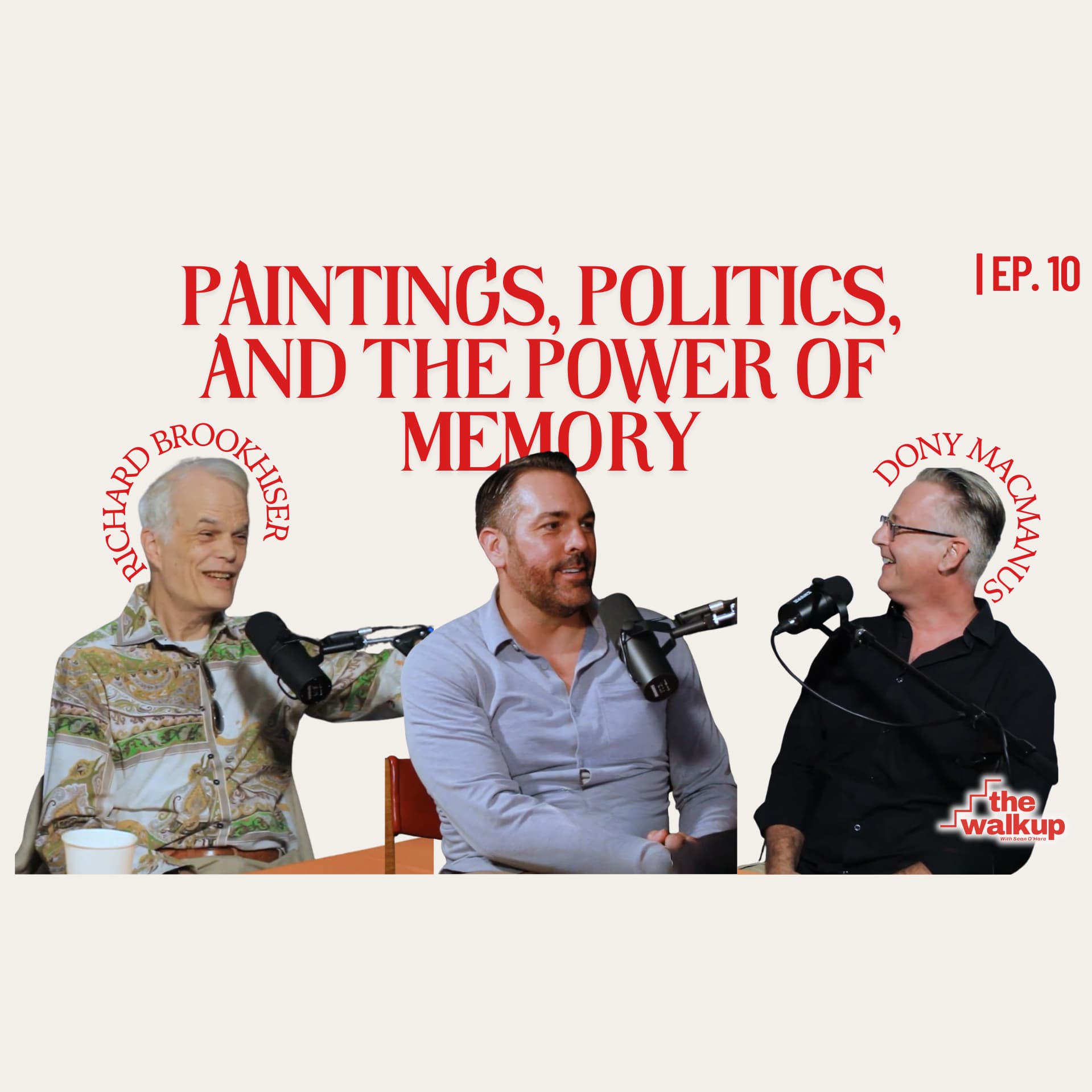
What does art remember that politics forgets? In this episode of The Walkup, host Sean O’Hare is joined by Richard Brookhiser, historian and senior editor at National Review, and Dony MacManus, sculptor, painter, and founder of the Sacred Art School in Florence.
Together, they explore the symbolic force of historic paintings, the shifting meaning of revolutions, and whether the artist or the statesman has the greater legacy. The conversation is a spirited meditation on tradition, truth, and what it means to form a nation—and a soul.
Transcript
Read the full transcriptAuto-generated · 10,751 words
Well, welcome to the podcast, and I have been really excited about this particular conversation because we try to connect people from different perspectives, different experiences, and we have an acclaimed author and an acclaimed sculptor and painter, and we found an incredible intersection for that, which is the subject of your latest book, which is John Trumbull.
Why don't we begin with why John Trumbull? Well, John Trumbull was a veteran of the Revolutionary War. He had the rank of colonel. He was very well connected. His father was governor of the state, last colonial governor, first. Post-independence governor. John himself knew everybody. He was on Washington's staff briefly. He was on Horatio Gaetz's staff. He came to know Franklin, Adams, Hamilton. He lived with Jefferson in Paris for a while when Jefferson was minister to France. But he— He wanted to tell the story of the American Revolution in paint.
Now, when he was learning how to paint, one of his masters was Benjamin West, who was an American who had moved to England, became George III's history painter. And as you know, Americans in those days, if you wanted to learn how to paint, you could not do it in the United States. You had to go to Europe, Italy, France.
London. So, he goes to London. He apprenticed himself to West, and West had made an innovation in history painting. He had done a painting of the death of General Wolfe at Quebec in the French and Indian War, and this was one of the key British victories that broke the French Empire in North America. A big painting, very dramatic, blockbuster. Everyone loved it. But he made the decision to depict everyone in it in their actual uniforms, contemporary uniforms.
And there was some question about whether you should do this. Sir Joshua Reynolds, who was an acquaintance and rival of West's, he said, no, no, no, that's too distracting. You want people more in classical garb because you want to focus on the nobility of their actions. You don't want to be looking at details of their clothing. West goes in the opposite direction, and according to West, when the painting was done, Reynolds came over to look at it and sat in front of it for half an hour.
said I withdraw my objections West has succeeded here so that was an innovation and Trumbull was there to learn that from his teacher but his innovation was that he didn't want to just do single scenes or portraits of You know, people who participated in the revolution. He decided, I want to do a series of paintings that will tell the story, and he started this in 1785.
He did two paintings, rather quickly, of early battles, both American defeats, Bunker Hill on Quebec, and it was 45 years before he finished this series of paintings. There were many distractions and lapses and so on and so forth. Don't know. I thought your works take a long time. Oh, yeah. That's hugely ambitious.
Well, you know, and one problem is how do you get paid doing this? You know, big, big problem. One recourse that 18th century painters had was prints. Right. You know, you would find an engraver to do a print of your painting or paintings, then you had to sell a subscription.
Yes, you paid the engraver up front, and then you had to get the subscriptions up front also. Well, and this was, he found an engraver, but he found the subscriptions were not coming in. Trumbull didn't have a big email list? Well, he had the best email list, because he knew everybody. He got members of Congress, the president.
Influencers, if you will. Influencers. The influencers of their day. You bet, but... You know, it wasn't working for him, so that was the first distraction, and then there were many, you know, many others in his private life for all sorts of reasons, but he persists, and after 45 years, he's left us a series of eight paintings that go from the Battle of Bunker Hill in The summer of 1775, and they end in December 1783 with George Washington returning his commission to Congress.
So, he has eight paintings, two defeats, two victories. Two surrenders and two political paintings, and that is his story of the American Revolution. Why I was writing this was I saw them when I was an undergraduate. I went to Yale College, class of 77, and Yale owns them all. I didn't know that Yale owned them. I was just in the art gallery, but I saw, you know, here's this room and a wall like an iconostasis. I mean, they were all displayed on this wall as Trumbull had.
hung them years earlier. He had made an arrangement with Yale when he was an old man. If you give me an annuity, I'll leave you all my paintings, and you'll let me design a gallery to hang them and display them. Yale was happy to make this deal because no college in America had an art gallery at that time. This was the first.
And the original gallery is long gone. It's been moved over the years, but that's why Yale had them. I saw them when I was an undergraduate. I didn't understand everything that was going on in them, but they got my attention. I mean, that's the first thing a painting has to do, right? It has to get your attention. And they were like a trailer of a movie, almost. You know, here are these scenes. Dramatic.
A lot going on, a lot of death and destruction, but also triumph, and then these two political scenes, which were calmer and very different. And those paintings were one of the reasons why I ended up writing historical biographies.
You know, I started with George Washington in 1996. I did Hamilton before he was cool. Well, you are a song and dance man too, though, so let us not sell yourself short. By the way, I try to be the best dressed person on our podcast, and so I am. I am both admiring and a little jealous of your style.
Oh, well, thanks. I am the second best dressed, because artists always go with all black. They want their art to speak for themselves, not their outfits. But that is a big statement for you to say that it is what inspired you to become a historical biographer. That is a big point. It got my attention. It got my attention, and it drew my attention to... Well, to the revolution, and to George Washington, who was, you know, we're talking about the 70s, and at that point, everybody knew who he was, he was admired, and so on, but...
He was a little, I think, dim in our recollection. This has changed since then, as a result of- Dim at the time, because the emphasis was on, what, FDR and different figures? No, Jefferson, I would say. Okay, in terms of the founders. Yes. Okay. You know, Jefferson was still riding high. You know, he was about to have a fall because of race and because of Sally Hemings. Sure, sure. Not that he's gone. Not that he's gone. These people never go away, but it's like a stock market.
You know, the value can change over the years. But, so Washington figures heavily in these Trumbull paintings. He's in four of them. And so that got my attention, and then as I continued to write these biographies, and then I decided, well, let us circle back and do the historian, because that is what Trumbull thought of himself as. He called himself a historiographer. Yeah, I think primarily he is a historiographer. I would agree with you totally. Yes, there's a lot to unpack in what you've just introduced with Trumbull.
So, there are a couple different themes I'd love to kind of pull out there and let Donny extrapolate a bit. One is the role of the artist in, in this case, particularly the founding of the United States. Second, the role that art plays in politics, whether historiography, whether propaganda, right? The influence that can have, because we think of the Declaration of Independence, effectively, the scene that we have is Trumbull's, right? Yes. And had he depicted it a different way, we would have a different image of it.
Right. That is very powerful. Right, right. And then something else I would love to unpack is how the founders saw the role of art, right? I mean, you have spoken about how he had a tough time getting paid for his work, and so there might have been a lack of... There was a lot of emphasis at that time in the States to value art the way that it might have been valued in the world of French Revolution. Ironically, he ends up on the back of the $2 bill.
Right. So, those are a lot of prints he finally got. That's right. He finally got his prints. He got a good engraver. And then the last piece, and before I let Donny speak, because he's looked at Trumbull's work, he's seen it in person. And so… Also, Dhoni comes at this as an Irishman, right? So, there is an outsider's perspective, both as an artist observing things, but also as somebody not born or raised in the States, to see how we view our artists, our historiographer of the revolution.
So, I have given you a lot to unpack there, but you have got 30 seconds. I would be very much a regional person coming from Ireland. Ironically, I had to come to the United States in New York Academy in 1999. Turn of the century, to study European art, because Europe is too busy deconstructing itself.
So, at least there were people here that valued the tradition of painting and sculpture that would be able to pass it on. So, that is why I came to the United States first. So, I can understand a little bit Trumbull's situation, where he is coming from a regional, kind of parochial background, and he goes to Europe to study the great masters, because he has contact with people like Reynolds, who is the founder of the Royal Academy, which is based. Exactly. And then, he's also a friend of David's, who influenced Jerome, influenced David, to Ingres and Jerome, who founded the École des Beaux-Arts in Paris.
So, I can understand where he's coming from. Like, he's, what he has achieved is phenomenal, if you think about it, coming from From a village in Connecticut to basically illustrating the foundation of the United States, and most people would understand the foundation of the United States primarily through his paintings, like even an established historian like yourself came to it through his paintings. So, he has a phenomenal...
So, he may not be David, he may not be Benjamin West, but his contribution to historical painting is phenomenal. Yes, I think two of his paintings are lodged in the American mind. The Declaration and Bunker Hill. You know, those are the ones that get reproduced in the textbooks.
You know, you just see them. You don't know anything about Trumbull, but you know those paintings, you know those images. And of course, it is Jefferson who suggests that he does the Declaration. Of course. A little self-interest. And then he happens to be the most prominent figure. He is the tallest. The red vest. Yes, he is wearing red. He is the only one in the room who is wearing red, so obviously he is doing a little self-promotion for himself. But it is also that...
That painting, we cannot read the words on the piece of paper that Jefferson is presenting to John Hancock, but the painting tells us some things about the kind of country that these people want to set up. One thing it tells us is they're all civilians. I mean, this is happening in wartime, and there are military trophies hanging on the back of the room, but no one is here in uniform. This isn't a military government. These are all civilian people. The other thing is, they're all peers.
No one is wearing emblems of rank. Chains of orthos, or diadems, or crowns, or robes, or anything. They're wearing, you know, good... Wealthy men, middle-class men, good clothes, and they are all dressed the same. A bit like the Dutch tradition. Yeah, well, and there are some very wealthy men in that painting. Robert Morris is there, Charles Carroll of Maryland, the only Catholic signer. When he signed, someone said, there go a few millions. They didn't go. I mean, he survived. And then there was Josiah Bartlett, who is a farmer and a doctor from New Hampshire, but they all look approximately the same, so there is no nobility here.
And the other thing is, they have all deliberated. You mentioned David. This scene is not the oath of the tennis court, which is very impassioned, dramatic, they are all saluting. These men have had their discussions, probably arguments, but they have come to a conclusion, and okay, now here it is. Now we are going to get it done. Which speaks of a more rational revolution, that the American Revolution was a much more rational revolution, and the French Revolution was a very bloody revolution.
It kind of opens up that whole—you can see very clearly— Even the depictions of the revolution very clearly illustrate the difference in the revolutions. Did the founders have a sense of needing to artistically represent the founding? I mean, the fact that he was having trouble getting paid or getting commissions or what have you, is that the typical idea of, we think, well...
Americans kind of, later on, once we've got more wealth and we cared more about patronizing the arts, but there's patronizing the arts, and there's also documenting this historical revolution that's happening. Do they have a sense of the importance of that? Well, Trumbull did get...
The political elite to subscribe. His subscription was disappointing to him, but Washington signed up for four sets of the Prince, and Hamilton signed up for two, and Jefferson signed up for two, and congressmen did. So, as individuals, they were eager to support it. But congress, as a whole, was not going to give him a subvention. And Edmund Burke advised him, when he was still in England, he said, look, You're from a new country. You should study architecture, because before there are going to be paintings, you've got to have buildings to hang the paintings in.
You've got to have public buildings, which will require decoration, but they have to come first. Some empty walls. Right, exactly. And this is indeed what happened, because when the deal was made to have the Capitol finally on this Potomac site, which was just a swamp when the agreement was made. Then they said, all right, we're going to have a building for Congress, and we're going to have a residence for the president. So, those things were planned very early, and it took years for these.
To be built. Then the British burned them all in the War of 1812, so they had to be rebuilt. But so, that was the first thing that the U.S. government paid for, and it was only, you know, decades after Trumbull first had his idea when the Capitol was being rebuilt, and then he thinks, ah, here's my chance to decorate a public space, and he gets very involved with the architecture.
He wants to make sure that the rotunda is going to be both grand and simple. He doesn't want anything that will swallow the paintings up, and he works very closely with the architects, and he gets what he wants.
Yeah, it is very impressive. I was there last Sunday. Very impressive, yeah. So, yeah, Donnie actually lives in the D.C. area, so he is not far from being able to see those works. So, how do you see it from an artistic perspective? I mean...
His importance as a as a historiographer, but certainly compared to the way that European cultures see their way of depicting their triumphs or their their, you know, military exploits. And how do you see the contrast between how our revolutionary our revolution was depicted versus how other triumphs are shown in Europe? Well, I suppose Europe is a much older.
Continent, and with regard to artistic depictions and so on, so they would have established that very clearly through their traditions, and also through their academic structure, so the academies, like, for instance, you were talking about Reynolds there, the founder of the Royal Academy.
And what they did is basically synthesized the Renaissance and made it into almost like a formula, an artistic formula, which could be adapted to anything. But you have to remember, at that time, historical painting was a very elevated status, because you had sacred art, you had historical painting, you had landscapes, portraits, then landscapes, and then still life. So, there was a very clear hierarchy. And he was extremely ambitious as a young man coming from a village in Connecticut to become an historical painter, and thank God he did, because it gave us access to the history which we would never have had before.
So, he was coming into it with, obviously, almost self-taught. He would spend a little bit of time with Benjamin West as well, and so he established, he got some apprenticeship to study with, and that helped him form his grammar, but he wouldn't be as accomplished as those artists.
We look at Sargent as probably one of the most successful painters that came out of the country, and again, but he was a son of Philadelphia aristocracy and born in Florence. He spent very little time here, but a phenomenal painter. So, he wouldn't have the same flash and style as some of these other artists, but he was certainly an historian deep down, and of course, he was... If you think about the context, he's coming from a small town. He's involved in the establishment of a new country.
I mean, the army only five years before were just farmers straight from the farm. I mean, that's how raw things were. So, I mean, so that is where he was participating in a very raw beginning of a nation. So, and I think, in a way, it is kind of appropriate that his work and his style and his His accomplishment of his artistic grammar would be at the same level as the country was, and I think it's kind of interesting to see it in that context.
I mean, he wasn't Benjamin West, but Benjamin West was painting for the King of England, which is a much more established country. So, being a little bit more raw in his style and in his delivery kind of is appropriate to a country that's just finding its feet. Did he have... Were there contemporaries that were competing for trying to be in this role of historiography? Oh, sure. There was Charles Wilson Peale. It seemed like every big town in America by the end of the 18th century can support one painter.
You know, Peale and his sons. Some things haven't changed. Peale and his sons were Philadelphia. Gilbert Stewart, whom Trumbull met in West's studio in London, is Boston. And then, so Trumbull, after he finishes his European studies, he picks New York as where he is going to put himself.
And make his career. We were talking about money. If you couldn't sell subscriptions, then you had to do portraits. Portraits were the other way for a painter to make money, and Trumbull is conflicted about portraiture. He is very keen to get accurate portraits of the people he's putting in his historical paintings. He goes up and down the East Coast trying to get signers of the Declaration. Someone's dead, he paints the sun. Or he looks for a painting of that person. I did think about that.
So many figures in the Declaration of Independence painting, I am thinking, are these what these guys actually look like? Oh, yes. Those are all actual images, either from life or from a son or from copying another painting. In Bunker Hill, the British officers are all real.
Now, Lord Howe would not pose for him. But Benjamin West did him the favor of painting Howe's face in on Bunker Hill, and you can see the flesh tone is darker, because West's palette for painting white faces was just a little darker than Trumbull's, but that is how he got West in there. So, and the French officers and the surrender at Yorktown, he picked them all up in Paris. On the other hand, when he's... Painting portraits to make money, very often he cranks them out, because he feels, this is vanity.
I want to be painting, I really want to be painting history, but this is just, Mr. Big Bucks wants me to paint him, so I paint him. And some of those portraits do work. I mean, sometimes he gets engaged, and he makes a very interesting portrait, but a lot of them, as I said, are kind of cranked out.
So, what about historiography today? So, you have got a friend that has got a World War I… A Sabin Howard, yeah. …invailing here shortly, and then you are working on a piece for the Naval Academy. Yeah. Well, several pieces. So, maybe if you could just describe where you see this in a contemporary setting. Well, I mean, it is a phenomenal… It is a privilege to have an opportunity to do a memorial, a war memorial, and Sabin is pulling off this amazing World War I memorial, which will be unveiled exactly in a month's time.
To have the opportunity to try and encapsulate a vision of... let's say a part of the military to communicate what their values are the sacrifices they've made it's it's a really beautiful opportunity to enter into that world because i have no military background whatsoever maybe just describe what it is you're doing for the naval academy uh it's essentially it's it's it's a six seven foot figures in bronze uh representing the the marines The question is, what happens next?
Seals, all the different disciplines, the six main disciplines, and each figure, I got each of, one of each of these disciplines to pose for it, and pose all together, so that they express the most impactful, in the most impactful way, what their role is in the army. So, they take different poses that will communicate that. So, you end up getting six at once to pose? Yeah, all at once. So, you can contextualize the composition. I don't think he, Trumbull, had this opportunity to get all these figures in together, because it is very convenient.
Also, this is a sculpture, so it is really important to get the spatial relationship. In the middle, we have a flag, the American flag. So, the six figures have their back to the flag. They are defending the flag.
And so, that is the whole concept, and they are working in unison to defend the country, essentially. So, it is a phenomenal… There is an opportunity to enter into that world and dialogue with the military figures and understand where they are coming from. I think Sabin had a very similar experience. He works directly with the soldiers, and you will see the work that he is producing is amazing. This is the World War I. Yes, going up beside the White House.
Well, Trumbull had been in the war himself, so he had seen people shot, killed, he had been shot at himself, and it is important to note that he begins with two defeats, so he is not doing Propaganda. Yeah. Triumphant, yeah. You know, he is saying, this is hard. This is hard stuff. He is telling the story. He is telling the story, and sometimes you lose. Even in the victories, there are, as Princeton is one of the victories, and there is General Mercer being bayoneted.
There is an artilleryman being bayoneted at his gun. Washington is in the back, riding to the rescue. It's sort of the time sequence of the picture is like the earliest things that happened are in the front, and then the later things are in the back, although they seem to be simultaneous. So, even in this important victory… There's a lot of death and dying, and he's not going to conceal that. One of his stupider critics in his own lifetime said, well, you know, he painted these two defeats.
You know, what's the big deal about that? They're just dying men. You know, why didn't we get victories? Well, you know, grow up, critic. Wars, revolutions are not easy. And then, what about, would there have been an encouragement from those that were commissioning to say, hey, we want to show these more triumphant things, or how much direction did the patrons have over?
No direction over his paintings. I mean, he conceives the series himself, and it changed over time. Some of his prospectuses had more canvases than he got around to doing. You know, the eight we have were the ones that he finally.
Decided to do and actually did. He does have a conversation with President Madison about which of these images will he reproduce at life size to hang in the rotunda, because he prefers to work small. The paintings at Yale are like two feet tall and three feet wide. Now, tell me this as an artist. He had sight in only one eye. He had an accident as a boy. Would that affect your relation to scale in painting? Yeah, it would make things a lot trickier.
For a large work? Yeah, because depth perception relies on two eyes. So, if you think about that, that is pretty phenomenal what he has pulled off with one eye. Well, so, yeah, right. So, he prefers to work small, but... You know, the rotunda, you can't do that. They'd be swallowed up. And he has a discussion with Madison, what are you going to do? Madison even suggests Bunker Hill, and Trumbull says, no, no, I want two surrenders, and I want my two political paintings, I want the Declaration, and then I also want, at the end of the war...
Washington returning his commission to Congress. He hasn't painted that small yet, so he does that one first large, and then he does the small version. And Madison, and Trumbull says, I think this is one of the noblest acts, political acts in history, and Madison agrees. And when you see those two paintings together, either in the Rotunda or at Yale, they're like a parenthesis.
Right, they're both sessions of Congress. Jefferson is handing a piece of paper to our right. Washington is handing a piece of paper to our left. He's handing it to the President of Congress. This is his commission. The war was over. The British had gone home. He wrote to Congress, said, what do you want me to do? They said, we're in Annapolis. Come here. Give us your commission. So, there he is.
One difference between this and the Declaration is half the men in the resignation are in uniform. Now we got the military guys, and with just a little tweaking, this could be Cromwell dismissing Parliament, or Napoleon telling the Directory, you know, you're out of here. This could be, all right, you guys have been talking, we've been fighting and dying.
Now, the serious people are going to run things, but not this general. This general is not doing that. Behind him is a chair. Chairs can be thrown. Very symbolic, yeah. And this chair is empty. Not going to sit in it. And on that chair is a cloak. Cloaks. Kings and emperors wear cloaks. Not going to put that cloak on. And that is in there to show what he is not doing. He is not choosing to try to be a king. He is not going to do that.
Congress wants the commission back. It was theirs all along. No problem. This is yours. You gave it to me for a time. Now I am returning it to you, and my job is done. I am going to go home. And then, up in the gallery is his wife.
Trumbull stuck Martha Washington up there. She wasn't actually in Annapolis. She was back at Mount Vernon waiting for him to come home. There were women there in the room when this actually happened, and this is the only painting that has women, and I think that's the symbol of what you want to have after a revolution. Get back to normal. Normal life. Yeah, yeah. You know, and if you don't get that, then your revolution...
Failed. And there are also two girls on the floor of Congress. They are the daughters of Charles Carroll. So, that is normal life that now we can have. And I'm always fascinated by those choices that artists make, right? I think what I find sometimes frustrating about contemporary art is we can look back at a piece like Trumbull's, or we can look at Renaissance era, or even medieval things, we can see, oh, that cloak or that empty chair was put there, and then we can pretty much surmise why that was done if we don't necessarily have the artist's direct explanation of it.
And I feel like nowadays, when you ask an artist, what does this mean? They're like, well, I don't know, what does it mean to you? I don't want to tell you, right, because it might devalue the art if I remove the mystery, right? But these things, the symbolism is put in there for very, very specific purposes. So, how do you see when you look at Trumbull's art, and then how do you make those decisions as an artist when it comes to what you're putting in a painting or in a sculpture, the symbolism?
Because you only have a limited... Canvas, or a limited amount of clay to be able to sculpt or depict something, so you have to choose things that have depth and symbolism. Essentially, for me, personally, it comes from the transcendentals, truth, goodness, and beauty. So, they are intrinsically linked. So, you are trying to tell a story, you are trying to penetrate a truth.
So, what actually happened? So, historically, what actually happened? If that is your objective, then you want to communicate that objective. So, if, for instance, the cloak on the chair is Trumbull using a grammar which people are familiar with, the symbolism or the set of accounts. Everyone would have known that, and he assumes his audience would know that. Exactly, and his objective is to communicate and participate and to serve.
I think we have lost that in contemporary art. Well, first of all, there is the culture of relativism, which has deconstructed any form of access or any belief in a truth. So, if you don't believe a common truth, something that we can share, like the history of the United States, is a common truth that we should... I think that is probably what was going on over the last few years, the destruction of these statues, is a denial of our history, and there is obviously a very strong power that is trying to destroy our history, because if you can destroy your history, you can destroy your identity, and that means you can reconstruct in your own likeness.
So, that is the sholure e koagola, the baphomet symbol, to melt down and reconstruct. Well, that happened in the French Revolution as well, right? Exactly. All revolutions. It goes right back to even further than that, but the French Revolution was the same ideals of the Russian Revolution, and then the resurgence of Marxism today is kind of similar.
Participation in that tradition. So, I think one of the important things of history is to remember, memory is intrinsically linked with identity. So, a guy like Trumbull is serving memory. So that we have an identity, and that identity is very important for us to be who we are, and being is essentially, we're human beings. So, we're not human doings, we're human beings, and we need to understand who we are, have a memory, so as to be who we are. So, that's a very important contribution that he has made, and I try to do that in my own work.
Well, first of all, I founded the Irish Academy of Figurative Art to basically bring back the discipline of artistic production, which is drawing, painting, sculpture, anatomy, all that basic grammar that has been lost through the rejection of, through post-modernism, the rejection of the techniques.
So, that is a grammar in which you can use to penetrate the truth. So, if I am going to do your portrait, I need to know bone structure, muscle structure, drapery. So, as to enter into your reality, and dialogue with that reality in a grammar, which I can use to process, and then reproduce in a canvas, a painting, or a sculpture.
And that artwork is the result of our relationship. So, the more articulate you are, the more I can manifest Sean in that work, and that is what makes that work beautiful, because in that work you see. Sean. Okay, so that is the responsibility of the artist. And then, of course, I brought that into the sacred art after that in Florence. So, because to me, sacred art is the synthesis of any culture. So, if you want to understand Aztec culture, you want to understand Greek culture, you go to the sacred, and that is the synthesis.
It's like a drop of Indian ink that penetrates the whole. A glass of water, as it were, penetrates the whole culture. So, that is why I like to do sacred art, also. Yeah, I mean, Richard had the chance to walk through just a brief glimpse of the church that happens to be next door to where we record, and I forget that...
So much is communicated in the architecture and the art of a church, and it is passed on in different, of course, expressions of it through different periods of time, but have the nave as a certain expression, the sanctuary as a certain expression, the idea of the coming together of heaven and earth through the altar, and that we kind of ascend up the steps to the altar.
Trumbull designed one church. Did he, really? First Congregational Church in Lebanon. Not that Lebanon. No, Lebanon, Connecticut. His hometown. Just to be clear. His hometown. Based a bit on St. Martin in the Fields, which became kind of a prototype of Protestant churches worldwide, and it is a very, very simple design and interior, but when I went to look at it, the minister was showing me around, and he said, you know, I had to measure the sanctuary for COVID compliance, and I found that the dimensions Equal 1776.
That is right. Interesting. He had not known it before? He had not known it before. This was not like folklore handed down? No, but he discovered that by measuring. That's interesting. Yeah, so the symbols are embedded in there, yeah. Right, so I don't know, maybe this was known and lost at some point, I don't know. The church was destroyed in 1938 by a hurricane. It was this terrible hurricane that slammed New England, but they rebuilt it as, you know, as Trumbull had done it, so.
I guess he wasn't a believer in the separation of church and state then, I guess. Well, numbers had a much deeper significance in that time. To us, it is just a means of calculation, but numbers have had sacred significance. So, for instance, the dimensions of the Sistine Chapel are the same dimensions of the Ark of the Covenant. Well, the Noah's Ark, the same dimensions. Or the cubits. Exactly. So, it is all deeply significant. So, that is no accident. I mean, that is deeply significant.
He sees the founding of this country as a very sacred event. Interesting. And then, how do we see, kind of, The historiography today, right? I mean, the mediums are shifting. I mean, I became first familiar with you by seeing you on camera, on documentaries, right? We prefer that your biography of Hamilton be the way that people discover Alexander Hamilton, but it might be more through the musical.
Oh, I like the musical. You do? Okay. The musical gets a lot right. Oh, that is great. It gets a lot right. You know, one thing is the word count. Only Gilbert and Sullivan patter songs have as many words as that musical did, because it's sort of rap. It's Broadway rap, but it's rap, so lots of words. Sure. You get a lot out there. When I saw it, I saw it before it went to Broadway, and I was impressed. Yeah, he's put a lot in.
Now, of course, he's taken shortcuts and so on. So does Trumbull. You know, we have to realize that his paintings, although they are historical and he worked very hard to get things accurate, they are not photographs. No. So, for instance, the Declaration, those men were never in that room at the same time, not all of them. But he wants them there. He wants all the signers. He wants John Dickinson, who wouldn't sign.
You know, because he wants to tell a story. He wants to give you the context of this moment, which he's showing, you know, Jefferson handing the thing over, but he wants to give the context also. Yeah, and, I mean, documentaries do that as well, right? I mean, we can't tell the entire story of things, unless, well, Ken Burns tries to with 18-hour documentaries, but, you know, I mean, we look back and we think of what are people's impressions of... The Vietnam War might be some combination of Apocalypse Now and Platoon and Full Metal Jacket, you know.
There was another musical about the revolution, 1776. Oh, of course, yeah. You know, and more honest about slavery than Hamilton. Yeah. Remember that song about the triangle trade that Edward Rutledge sings? I mean, that makes everybody, you know, gives chills to everybody in the audience, but it's like right out there. Yeah, yeah. Yeah, my brother actually played.
As I said, my oldest brother is a Catholic priest, but when they... They did musicals at the seminary. You have to choose musicals that are, there's only going to be men in them for the most part. So, 1776 worked out well. I think my brother played John Adams, I'm pretty sure. But yeah, I think there's maybe one or two women that show up in 1776, so you have to get one or two volunteers from the community that aren't seminarians. But, I don't know, how do you see that?
From a, as the mediums have shifted, right? I mean, would John Trumbull be, would he be a filmmaker today? Would he be a sculptor? Would he be, you know, you go where the work is, right? Sometimes, would he write a musical? Are we losing some of that? What is the significance in how we convey these things, or is it just the mediums change, and you have more to choose from now because you have got more content? Well, I think it is a bit more, like, I mean, for him, he learned from his sisters.
They were painters. So, he kind of absorbed it, and it became his grammar. So, essentially... An artist finds his medium and he communicates. So, for me, form is my primary medium. And then, once you start to become more and more articulate within that grammar, it passes out your speech.
So, I would be much more comfortable communicating to a painting or a sculpture than orally. So, for him, art was his passion, and the beauty of it is that he... He can touch you with his work because it is his passion. He is not using it as propaganda.
He is deeply involved, and he loves the people he is painting. He has tremendous respect for them, and you can see it in the work. So, there are beautiful aspects to it. So, in that context, I am not sure if he would have used another medium. Maybe he would have still been a painter and just been not recognized. But maybe, you know, What is American about it, in the sense of how we, when I think of, for example, with the abolition of the slave trade in Britain, there was the famous image of the slave in chains that became this coin.
Am I not your brother? Yes, exactly, and that became incredibly powerful imagery that helped. communicate the reality of what it is we're trying to to abolish that was used not as not after the fact after it had already been abolished but but to kind of educate and inform and here in the states though we had Common sense. We had Thomas Paine. So, is that because we were a more literate population? We were very verbal. I mean, it is partly Protestantism. Yeah, Northern European.
Very verbal. In the revolutionary period, we had more newspapers per capita than any other country in the world, more than France, absolutely. You know, France is a much more populous country, so journalism, sermons, you know, people are used to going to church and hearing long sermons. People spoke for two or three hours, and, you know, no one turned a hair at that. Yeah. People of the word. It was a Protestant country from that period, but of course the Catholics came in later on, and they are more of the image.
Yeah, and then your writing is not, obviously you have done a number of biographies and American history, but then also contemporary politics with National Review and as a speech writer as well. How did you view writing? Obviously, one is written for not looking backwards, but articulating a particular historical figure, versus writing for, say, a politician or for a contemporary commentary magazine. I think it helped my historical writing to have started with political journalism, because I knew what a deal was. I knew what a stab in the back was.
I mean, I'd seen it happen in real time. So, when it happens in the late 18th century, I know what I'm looking at. And I'm not saying that to devalue those men. They were great men. They were also politicians. You know, they did this, you know. Sometimes when you shook hands with Thomas Jefferson, you wanted to count your fingers afterwards. Or any of them. Washington was the best politician of all of them. You know, and how did he do it? Well, he used silences.
He used reticence. He used his physical presence. He wasn't eloquent, but he sure looked good, and he knew that, and he had a sense of how he was going to appear to people. He wrote a book about manners, didn't he? Well, he copied one. It was given to him probably penmanship. It was a Jesuit book of manners. But the judgments have manners.
They did, anyway. Or at least they said they did. At least they pretended to have manners. They knew enough to write them down, yeah. That is right. We like insider Catholic humor here, so, you know, a little subtle. We lose most of our audience, but, you know, we get to laugh.
But, right, so having written about, you know, Ronald Reagan and Jimmy Carter and Jack Kappen. Walter Mondale, that helps you write about Adams and Jefferson and so on, because they are politicians. They're fighting with each other. They're disputing with each other. They form a party system, and they all said, all the founders said, oh, well, parties are terrible. I would never join the party. Yeah, parties, parties, parties. And then what do they do? Well, in a few years, they set up two parties, and they're in there pitching, and it takes them a while.
This is something. I think only a few of them got, which was that these parties would persist. I think Hamilton figures it out at the end of his life. Madison does a bit, but that was sort of a late discovery that there would be these two parties, and they would go back and forth. Also, one consequence of that is if you lose, you are going to get another chance.
You know, two years, four years, six years, you are going to get another chance. But they did actually truly have a belief that there could be no parties. At first. Was that just idealism? Well, at first, and parties were bad. I mean, you know, Madison writes about factions in the Federalist Papers, but he is like a scientist dealing with germs, you know. Like, oh, these are, yeah, they exist, but they're bad. We've got to, you know, control them. And then, in a few years later, he's, like, setting up one.
You know, he's creating the ancestor of today's Democratic Party. So, that was, and, you know, the thing about parties and all the bad things you can and must say about them. Better than taking up arms every time you have a disagreement. True, true. And is that a reflection of the fact that we are, by nature, tribal, communal, we want to be around our people?
Yes, and also that people disagree. You know, they'll disagree. And so, when you're looking at these historical figures, you're not under the impression that, well, those were the good old days, before we had these factions. They were the good old days because of how serious these people were, and how idealistic so many of them were, and how they put themselves on the line. Yeah. Sacrifices. Yeah, but there is also, I would imagine, a sense of like, hey, we might have smaller differences, but right now, we have a bigger problem, which is...
It is creating a country together. We can put our smaller things aside for the moment, and then they will resurface. One thing Trumbull leaves out is loyalists. There were a lot of people who were not behind the American Revolution. I mean, everybody quotes John Adams, who said, well, a third were for it, a third were against it, and a third were indifferent.
I mean, he was just talking. He hadn't taken a poll, but he was talking about a reality, and, you know, Trumbull is very careful to depict enemies and to depict them. Sometimes well, when they deserve it. I mean, the dying Hessian officer in Trenton is very sympathetically portrayed, but he doesn't give us any loyalists. So, that's an element of the story that he left out. And, you know, part of that may have been there were few of them in Connecticut.
I mean, Connecticut was a pretty gung-ho state, although his father, someone threatened to kill him. So, there were some vehement ones, a few vehement ones. Interesting. And where did his, did his faith play a role? I mean, you mentioned he designed one church. I don't know if that was just a commission, or if it was more foundational to his artwork.
He tells a story of a bad dinner party. In the 1790s, you know, he was very close to Jefferson in the 1780s. He lived with him in Paris. He introduced Jefferson to Maria Cosway, who was one of Jefferson's affairs of the heart. And then, when he comes back to the United States, and Jefferson is back, and the first parties begin to appear, then they diverge, because Trumbull's...
The affiliation will be with the Federalists, which is the party of Washington, his idol Hamilton, some of his relatives, siblings, and so on. Jefferson is the other party, Republicans, now the Democrats. So, Jefferson is throwing this dinner and Trumbull is there, one of the guests, and this other guest, a younger Virginian congressman. is, starts in Trumbull, and he just said, well, New England and all their Puritan ideals, you know, this is ridiculous, and it didn't mean anything, and then he says, you know, the notion that there's some god who cares about what we do and will punish us in an afterlife, I can't believe that.
It's nonsensical, and so Trumbull tells this story, and the person he's really mad at is Jefferson, who he thinks is like sort of silently encouraging this guy to do something, and he's like, well, I don't know. I don't know. I don't know. I don't know. And he notes that the only person at the dinner who stuck up for him was a man named David Frank, who was an officer in the Continental Army who was a Jew from Montreal, who had joined the American cause.
And he even pointed this out to Jefferson. He's saying, hey, look, the only person in this room who's sticking up for New England Congregationalists is this Jewish man here. You know, why are you letting me be harassed by your young friend? So, he felt... He felt kind of awkward and defensive. I think he became more Anglican as he aged. He depicts like his wife, whom he adored. He shows her wearing a cross, which would be an Anglican thing, but I can't imagine a Congregationalist wearing a cross.
And, of course, the Anglicans were more in the South in the Virginia period. Right, right. Right. There were some in Connecticut, and in fact, they complained about the fact that Congregationalism was established. So, the Episcopalians and the Baptists had a sort of alliance of convenience to try and end this in Connecticut.
And then Trumbull, you know, he does religious paintings at the end of his life. He paints his wife on her deathbed. He paints the last family in the deluge, who perish in the deluge. You know, Noah's Ark is in the background, floating away, but these people are all dying. And then he does a painting of Joshua at one of the battles that he... That he wins. So, that is kind of a late life, very late life turn. Well, that is not unusual.
If you saw the Sargent show there in the National Gallery last year, Sargent in Spain, he had the same. The last gallery was a sacred art. The work he did for the... For the library in Boston, so the allegory of religion, but deeply Catholic iconography. I mean, this guy, personally, I started the tour with six of my students from Catholic University, ended up with about 50 people, including the curator of the show, who asked me, who are you? I said, are you a professor?
He said, yeah, he explained it. So, I congratulated her and got out. Everybody gave her a round of applause, but you could see very clearly, Sargent, in his later life, took faith very, very seriously. Was he Catholic? Officially, he wasn't, but you can see in his work, if you can read into his work and what he is doing, and the devotion in which he does it, like the emotion he puts into it, there is a really deep faith in there.
And then, how do you see things going forward, as from an artistic perspective, when it comes to this historiography, our ability to document through the visual arts, right? I mean, you've... Gotten a commission for the Naval Academy. Your friend has got one for World War I, but are they few and far between? Are we always going to, because America, because we have the means, will we always be looking to memorialize these things? But at the same time, we are tearing down statues over the last couple of years, right?
So, there is some question as to how it goes forward. Exactly. It depends. Unfortunately, it depends a lot on the ideology of the time. Essentially, art is just a grammar. As you were talking earlier on, architecture and art are grammars that speak.
The danger is we can lose that grammar, and modernism was part of that, just to kind of destroy any, which is essentially deconstructing the grammar of architecture and art. So, there is a danger of losing the capacity to read it.
So, Roger Scruton, I used to give some conferences with him over the years, a very interesting philosopher from England. He died a few years ago. Sir Roger Scruton, by the way, he talks about this, the danger of having an art form, but not having access to it. So, you can have a work of art, but if you don't know how to draw, then you won't be able to contemplate it deeply. So, you can have the Statue of David in France, but if you can't draw it, if you can't absorb it into your being, not just take a photograph, but actually deeply absorb it and have it transform you.
Then you are not accessing it fully, all right? So, this is a big, big problem with art education, because a lot of... Professors and chairs of art departments cannot even draw, and they will boast about it. So, this is a really big problem, because if you cannot draw, then you cannot actually initiate the artistic dialogue. So, that is a really big problem. It is like being a writer and not having full use of vocabulary and grammar. Yes, it is a very serious problem.
So, that is where we are at the moment, and that is why, when I am teaching my students, I teach them to draw first, because drawing is 90% of any painting. All right, sculpture. And the generic word for the artist, for the painter's tool, I was surprised to learn, was the pencil. Yes. In the 18th century. Not the brush. Yes, absolutely. The pencil. So, drawing is like the trunk of the tree, and then sculpture and painting are primary branches, but then they branch out into mosaic and relief and all sorts of stained glass and any artistic.
So, this is the biggest danger we have in contemporary culture. So, if, as you were talking, as your question implied, talking about the danger today, the danger today is that we have an ideology on the rise of wokeism, which is designed to destroy access to our tradition. They are the people who are taking down the sculptures and statues, so that we don't have access to our history. So, you destroy history so you can reconstruct it. And that is a very dangerous threat, and we have to resist that with everything we have.
And as an artist, the way I do that is like you point your finger, the three fingers point back at you. It is a problem. I am the problem. I am not a good enough artist. I need to be better, and I need to train in a next generation of artists so they don't lose this, so that the next generation of artists can bring this forward. We have to invest in the future.
And what about writing? How do you feel like the state is of, I mean, things have obviously, we've got... Digital books, we've got audio books, we've got, it's easier and cheaper. Right now, we're recording a podcast on video and on audio. The means of communication has multiplied, but like Tony's mentioning, the grammar starts with the written word, right, and then the ability to communicate. And you've been on camera, you've also, you've written both for publications and for, and published books, so how do you see...
I am not so gloomy. I mean, people seem to still be buying a lot of books. Look, Harry Potter conquered the world. She is having problems now because of the trans issue, but all those kids were reading those books. Not just them. I read them all. Not bad. Good stuff in there. So, I am pretty hopeful. Also, another thing that is happening is what people don't get in college, they want to get later on.
So, maybe they didn't learn about American history in college, but who is buying Ron Chernow and David McCullough and so on? Well, it is people who want to catch up and want to learn about these guys. I have always been curious about, and you are probably the exact right person to ask this question. It seems like to me, if I was president of the country tomorrow— It would seem to me that having an historian at my right hand all the time would be just a naturally A wise thing to do, right?
Like, where am I repeating history? Tell me what patterns you're seeing here. Like, I would have, you know, somebody like you or, you know, Victor Davis Hanson, somebody giving me perspective, because I feel like there's so much of it as if we're reinventing the wheel or having new problems, and really it's, you know. If by the time you reach the White House, you need a historian at your side, it's probably a little late. Yeah. No, you have to have read that yourself.
You have to have known that yourself. And also, if you're in the White House, you've gotten there for a reason, which is that you played the political game successfully, and that is an important skill that the historian can talk about but hasn't done, and you've done that. But hopefully, you have supplemented that sort of skill with… Reading about your predecessors, and we have had precedents who have done that. Teddy Roosevelt is kind of an extreme example, but he was extremely well-read.
And, you know, and more recent ones were better read than they were credited with being by their enemies at the time they were in the White House. I suppose history in itself is a grammar, and with regard to politics, politics is a grammar. So, these people are very skilled at that grammar and maneuvering into positions of power. But again, what is that? Grammar, communicating, what is the idea? The idea, what are the ideals that that grammar is projecting? So, essentially, I think, personally, I think knowing the human condition is the most important thing, because you cannot lead people if you don't know what it means to be a human being.
So, those elements are really, really crucial in order for a politician to lead appropriately, and I think Washington was a really good example of that. Even to the extent of handing over power. Like, the reluctant leader is really the one you want to have, because they are not after the power, they are after the service.
And he was lifelong fascinated by the theater. By drama. Any sort of dramatic performance from Shakespeare to a puppet show. I mean, if he was in the vicinity, he would go to see it. He wanted to see performance because he knew he was doing that. Exactly, and the Greeks. His life was that. The Greeks did the same. They teach virtue through theater.
And politics, everything. Are there any things you are looking at writing next? Oh, yeah, yeah, yeah. My next one is... About the working title is Lafayette in America, because he came here in 1824 to 5. He was 66, had a birthday when he was here, and he spent 13 months. He went to every state, and the trip is a lot of fun, just to, you know, how you got around the United States in 1824. Sometimes it wasn't very easy. He was in one steamboat that wrecked in the Ohio River.
It hit a snag. It sank in ten minutes, so they had to get him off quickly. But the real point of it is, how do you judge a revolution? Because that is what he and his hosts were all doing. It is almost 50 years. I mean, he is going to be at Bunker Hill for the 50th anniversary. Okay.
Put down your pencils. How is this? Hand in your exam books. How is this revolution going? And, you know, he is concerned to show Europeans that a small-r Republican revolution does not necessarily go the way the French one did, you know, which was very disappointing to him.
But, okay, here, look what the Americans have done. And mostly, he is very pleased with it. Slavery bothers him. And he brings it up. He brought it up to Jefferson. They were riding in a carriage together. We know this from the postillion, who was one of Jefferson's slaves, who overheard the conversation. Lafayette was saying, look, I came over here, I gave my blood, I gave my money, I gave my efforts, because you were fighting for not only independence, but for rights, and yet.
Slavery still persists in much of the republic. And Jefferson says, yes, well, it's bad. Slaves should be freed. He doesn't have any plans or specifics. The one thing he says is, you know, we should teach slaves to read.
You don't do that. We should teach them to read. But not to write, because then they might forge things. So, that's sort of the limit he bumps up against. But, you know, credit to Lafayette for, you know, pressing him on it. And what's the time difference between him and Alexis de Tocqueville in his journeys? A little earlier, and they were in touch. Okay.
Lafayette does, like, write some letters of recommendation. I mean, they weren't. They weren't closely friends or anything, but they were in touch. Tocqueville comes later. He comes, like, five or six years later. Oh, they're very close, though. Yeah, yeah.
Yeah, and Lafayette wrote about this? How did he communicate his findings? He had a secretary who accompanied him, who sent bulletins back to— In those days, liberal newspapers in France, of which there were a few, and then he wrote like a two-volume account of the whole trip that was published in France and then also in the United States. But not as well-known as we have from Tokyo. Well, no, it's a very different thing, although there are some, you know, he does like talk about institutions and, you know, the level of culture.
He gives a little history. As Tocqueville does, he talks about the Mayflower Compact, and he talks about the Virginia House of Burgesses. So, it is not at the level that Tocqueville is at, but it is also not merely a travelogue.
Well, Donnie is our new Tocqueville. He is observing American culture for us. Good luck. And then communicating it through sculpture. Good luck with that. Well, it has been a great conversation. I was really excited about this intersection between art and politics and history, and how we express our own history in the present day, and looking backwards, and then how it affects us going forward. I don't know, Donnie, any... Closing thoughts from you in terms of the discussion today? Well, I am deeply grateful for the work you do, because I think it is really important to record this information and bring it to a new generation, a new audience.
Well, I do my best. Well, thank you both for being here. Thank you. And the conversation continues through the written word and through visual arts. Thanks. Thanks.
More from The Walkup

Against the Odds: The Samurai Lawyer (Chad Flores) | Ep. 52
Faith, Sexuality, and the Fog of War (Iris Bahr & Father Rick Riccioli) | Ep. 02
E2
Church, Conflict, and Community (Iris Bahr, Father Rick Riccioli & Rob Long) | Ep. 03
E3
Hope, Vocation, and the Global Church (Colm Flynn & Colin Nykaza) | Ep. 04
E4