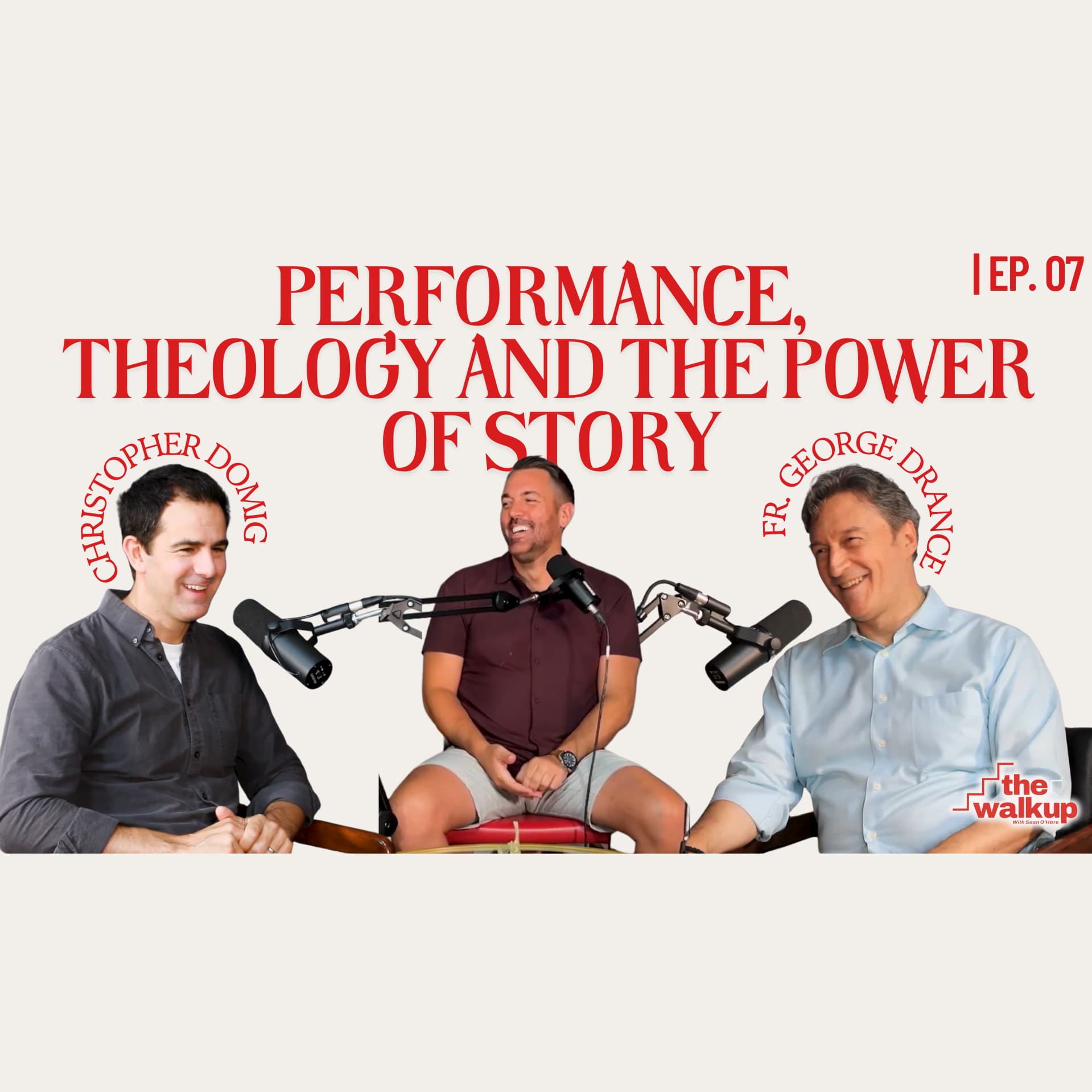
Performance, Theology, and the Power of Story (Christopher Domig & Father George Drance) | Ep. 07
What happens when theater becomes a form of prayer? In this episode of The Walkup, actor Christopher Domig (Sea Dog Theater) and Jesuit priest Fr. George Drance (Magis Theatre Company) explore the deep interplay between spirituality and the performing arts.
From the legacy of La MaMa to experiences on major sets like The Blacklist and Tuesdays with Morrie, they reflect on how creativity, faith, and vocation inform their lives and work. Whether you're a believer, skeptic, or somewhere in between, this conversation is a meditation on beauty, purpose, and the transcendent power of story.
Subscribe on YouTube: @TheWalkupPodcast Follow on Instagram: @thewalkuppodcast
Transcript
Read the full transcriptAuto-generated · 15,633 words
So, I always try to let people know how I get, I'm privileged of living in New York City, and is getting to meet people from very interesting backgrounds, and so I've gotten to know each of you over the last, I guess, Chris and you and I met probably five, six years ago, through our friend Anne, and then Father George and I met probably Ten plus years ago at St. Malachy's, the Actors Chapel. So, this is no disrespect to my other guests, but I was particularly excited about this conversation because I love the opportunity to explore a topic from different perspectives that I think can add a layer of depth, and also connecting people that I think will have a lot in common.
So, both of you are actors, both of you are... Founders of theater companies, and both come out from slightly different perspectives, but Father, you started the Magist Theater. Chris, you started the Seadog Theater. So, I thought maybe first, maybe we'll just start with kind of your journey as to finding your... Vocation as an artist, as a performer, as somebody who felt like they wanted to spend their lives creating, not only just... Being a performer, but then choosing to then create a platform by which you could bring in other performers and develop that.
So, I'm going to put Chris on the spot first. So, maybe it's wherever you want to start, whether it's like when you knew you wanted to be a performer or how it brought you to New York and developing the theater.
Yeah, well, I... Um... I have early memories. Elementary school, there were end-of-the-year plays that our elementary school would put on, and I grew up outside of Salzburg, Austria, up until and including high school, and then I came to this... That is north of 125th Street. Or no, I should say east of the East River. It is east. You have to paddle a bit to get over. I remember our homeroom teacher had her favorite. It was one of the other boys, actually a very good friend of mine who I played soccer with.
His name was Michael Grussell, and he used to be the lead in all these little end-of-the-year plays. And the fourth grade came around, and I told my mom. I have told her I want to be in the play. Why can't I? And so my mom went up to her and said, you know, Chris would really like to be in this play, and so we co-starred in the play of the... What is the story of the hare and the, is it the eagle that race?
Oh, the tortoise. Tortoise, sorry. Tortoise and the hare. The tortoise and the hare, and I was the hare. In German, it sounds different. In German, on a fourth grade level. What is it in German, the tortoise and the hare? Der Igel und der Hase, Hase und der Igel.
English is... My second language. At least I don't speak like Arnold, who has lost both languages, essentially completely. He cannot speak German or English without an accent. Funny. Anyway, that is my first memory of actually advocating for myself and being like, I want to be in a play.
But you wanted to be it because your friend was in it? No, no, no, no. Because you thought you liked the idea of this? I wanted to be in a play. What I thought at that point when I was nine or ten, I don't know. I just knew. I told my mom I really wanted to be in this play, and she advocated for me, and then there I was. So, that is sort of my first memory. Were you a performative kid?
Were you the type that entertained your family, or no? I mean, I am a firstborn. I don't know what that means in terms of performance. I did practice piano, I remember. Playing the blues. I liked presenting. Not obsessively so, but I think... I did like that aspect, clearly, from an early age. And then, fast forward, I did various plays during high school, and then I auditioned for a very prestigious acting school in Vienna when I was 18. In Europe, or I should say in the German-speaking world, they want to form you early, so you do your sort of conservatory training right out of high school.
Whereas in the States, as George and I know, and a lot of our colleagues, you do undergrad first, and then you go to grad school for acting. The most prestigious acting schools in the U.S. are grad schools. Graduate schools.
So, I didn't get in, and I didn't know what to do, and I was sort of biding my time. I ended up deciding to come to the States for college, and sort of put... So, inwardly, my acting journey on hold for a bit. I wasn't sure. I also liked philosophy and psychology, but then I ended up at Wheaton College with an amazing professor named Mark Lewis, who had been a professional actor here in the city.
Then became a professor there, and he took his faith and his work and the theater very seriously in a way that I just hadn't ever. Considered or thought about, and it sort of blew my mind open of what was underneath my desire to perform and what stories were capable of and, you know, what the great story is that we're constantly reliving and how maybe my desire to be an actor was linked to that. So, I certainly got...
I was sent back into the theater world out of Wheaton with more of a vocational calling than I had before. I went to graduate school at SMU, came to New York in 2006. I remember a graduate professor of ours at SMU.
Which is in Dallas, you know, said, so, you know, which city do you want to go to? And there's the primary cities, which are Los Angeles for film and television, New York for theater, and then there's, of course, great, I don't even want to call them secondary cities, right, but like Chicago is a great theater town, but the big cities are New York and Los Angeles. And he said, which city, he said it to all of us, which city do you prefer to be unemployed in?
Was his advice, and he didn't mean it. Flippantly or facetiously, he said, look, the life of an actor is ongoing periods of unemployment. So, when you are not working, what do you want to be surrounded by? And for me, I just thought New York. It was not a question. I want to be there. I want to be able to go to museums. I want to be able to go to a coffee shop and be most likely the only actor there.
Right, whereas in L.A., you are probably one of many, and everyone is sort of working on some film-related project. So, I came to New York in 2006, hit the pavement, did a lot of shows, worked with Columbia University, made connections, just wanted to get the experience, and, you know, did a lot of off-off Broadway and some indie films. I met my wife in 2008. There is no perfect time to have kids, so a few years later, in 2014, our daughter was born, and along this process of being an actor, and facing, of course, a lot of rejection, and then also facing the fact that I did not want to leave New York to work, nor could I afford to once we had kids.
To leave for regional theater. That I was more or less stuck in this city, but wanted to keep doing theater. And if you haven't made a name for yourself at a certain point, and you're deciding to play in the major leagues, you're like, well, good luck. There may not be a lot of work for you. So, there was certainly a period of, I would call it a depression. I mean, it's an artistic depression, but I was very... I was very out of sorts with what, on the one hand, I felt so strongly was both an ability and a, lack of a better word, vocational calling to be a theater artist here, and on the other side, the lack of opportunity.
So, I never set out to start a theater company. It was actually another theater company that existed that had an artistic change. They offered me. The role. I was very surprised and honored, and had never thought of myself as a leader in that way. But there were some... There are components to that theater company that I thought were troublesome, mostly to do with how they treated people, and my wife said, well, you know, you could start your own theater company. She still regrets sometimes having said that, because she was the one that started it with me, but it came out of a desire.
And you were able to say that every now and then. No, it was your idea. It was like, honey, you said, and she's like, I know, gnashing her teeth, but... It sort of came out of that. I knew that I wanted to be active in some way, doing work that I thought mattered here while raising a family, and that's difficult enough, but the alternative was just, for me, sort of really questioning why we were even here. At that point, my wife didn't have her second career set up yet, so we were just living in New York, raising kids, trying to pay bills.
While rejection after rejection is coming in, and at a certain point, that gets real old, and real difficult, and frustrating, and all that. And were there moments you're this close to saying, all right, I'm going to go, quote-unquote, get a normal job?
Well, I mean, the normal job was always part of my life. To pay the bills. Yeah, yeah, yeah. Let's set the record straight. I never had a year where I was just living off my... Acting. I mean, there were certain years I was traveling a lot doing regional stuff, and it was mostly that, but I think the best year I had as an actor was the third of my expenses. I was able to pay just from acting and commercial work, and that was a tremendous success.
So, I have always had the sort of day jobs, but never a job. Where you are like, I am going to do this instead of. Exactly. It was always to support the habit. But there was a point where I thought we might go to Austria, and we might move there, because it just seemed very bleak, and we had two kids. And then there was a series of serendipity circumstances, or also a provision, which I think it really was, where friends of ours in the city, who he had worked in finance and had...
Enough of that. He wanted to take his family to Florence, and he said, hey, I've got a brownstone in Gramercy. Would you like to house it for us? So, there we are, suddenly, with two little kids in Gramercy. We wanted to attend a local church. I already expressed how I had been, I fell in love with the Anglican tradition at Wheaton College. I may have fell in love with the Catholic Church, but Wheaton was like, you can go as far as you want.
As far as Anglicanism, and then, you know, there weren't many Catholic churches in Wheaton. So, anyway, I went as far liturgical as I could, fell in love with it for probably many of the same reasons that you love your denomination, and then we wanted to go to a local church. We're in Gramercy. We started attending Calvary St. George's Church. We really love it, and they offer us a space to do theater.
Independently of us attending there, and so I find a space that I think this could really be. It is a multifunctional, multi-use space, but I still remember walking into that space and thinking, this is a theater, and you ask kindly, can I use it for one event? They come and see it, and then you sort of build up trust, and eventually, we were artists-in-residence there.
And as you know, real estate in New York is, if not, I mean, it's at least half the trouble that we have when we're theater makers, because it's so expensive. Where do you do it? So, we had a space, and then we, you know, I thought long and hard about What on earth is this mission going to be? My mentor from undergrad said, you know, like, New York City doesn't really need another theater company. I said, you're absolutely right. Yeah, fair point.
So, every theater company is trying to say, how are we different than the theater company down the street? And I was going through, you know, the various identities that I carry within me, the Austrian and the... I don't know. I mean, the various things, what do I care about? And I care about many things, but ultimately, where I ended up, I think, I thought, what are the stories that I most care about? What are the stories that move me most, and what do they have in common?
And to the best of my ability, the way I could phrase it was, they're stories of alienation and reconciliation, where the alienation of the world and of the people is real, and the possibility for reconciliation. It's also real. These stories aren't always in full equilibrium. They're not always equally balanced, nor is life, but there is, both are true in a way that, again, when you read a story or read a novel or see a movie, which I started like tallying up, what are the movies, what are the books that do that to me?
I was like, that's it. I could spend the rest of my life exploring stories that are ...intention there. And so, once I had a mission, and we had a theater space, and I had a willing partner, wife, who has skills in the administrative world that I can only dream of, we were able to start this theater company. But it really came out of, to come back to your question, Sean, it came out of... Really a desire to keep doing the thing that you feel called to do, and I wanted to do it, not in isolation.
Theater is an ensemble endeavor, and so the various things came together, a space, a mission, and then we started developing plays. So, we have been doing that since 2016. Well, and just to... Follow up before pivoting to Father George's journey.
I mean, it is funny that I just did an interview with somebody who runs a sober living community and is very familiar with addiction, having gone through it himself, but he phrased things in a similar way that you did about having income to be able to feed the habit, to feed the addiction, and he talked about having jobs that help you continue to do the thing that you love or maybe that is an addiction.
What makes it that, right? Like, what makes it the difference between, I like telling a story, I like connecting people, I like exploring topics, to like, if at all possible, I want this to be my life, and you're going to have to rip it from me, or I'm going to have to be in a particularly...
What makes it a dire situation to choose to do something else? To the non-artist, to the non-performer, what makes it so non-negotiable? Wow, that is a great question, but it is the question that really every young... Actor, I mean, any young artist that is committing their life to a very difficult endeavor has to ask, and I mean, obviously, often the answer that I heard is, if you can do anything else, do it. So, really look hard at it, because it's, again, for the very, very few, there's fame and fortune that comes with it.
For most people, it's just an ongoing, in a certain way, it's a slog, and there's long periods of unemployment and rejection. You know, I don't know. I mean, for me, it's hard to explain. Once you've identified something that you really do care about, and then you find yourself tested under various circumstances, right? The things that you hope will come. The goals that you set at this age, I want to achieve this, I want this or that, all that doesn't happen, and you are still showing up, and you are still excited after, let us say, a good days of rehearsal with good people in the room.
It is so satisfying. For so many artists that I know and care about, yeah, they want the play to be a success, but the process with people, embodying other people. And the kind of nuance and the compassion that has to go along with that, of having to not play stereotypes of people, but having to really see and understand and embody another person's perspective. That is... It's hard to let go of that once you experience sort of all the different riches that go along with it, and again, there are periods where it's devastating, and you do feel like walking away, or maybe they are ultimately walking away, you know, but then you come back.
I mean, I don't know how to look back and see it. I just know that I keep showing up for it, and... And again, I know that I am still holding on to at least two ropes here, and that is the commitment to the craft, and then the commitment to the The faith that drives me to it. Those are still very much part of my journey, and of course, people are holding different things in the theater, or not everyone is holding those two ropes, and we can talk about that, and again, how much of that is a choice?
I had professors and mentors who opened up my world and my heart and my faith to something where I was like, whoa, these are the two things I'm holding. I am going to be a good steward of these two things. I am going to keep going, but not letting go of either, and so then what develops is what develops.
Well, as I mentioned, Father George and I met appropriately at… The Actors Chapel, and for, you know, people that are listening or watching that haven't heard of that, that's in the theater district. It was always meant to be a Catholic church community available to Broadway, available to actors. And I'm sure you've many times been asked this whole, like, being a priest and an actor and a performer and, like, how do those things, you know, coexist?
Before you became a priest, there was other things. As my brother's a priest, a lot of people think that... Those that are priests, they were hatched from the womb as a priest. They were wearing a little collar, and there was incense right away, but we know you were not born a priest, so what is your journey on this kind of artistic path towards finding yourself as an actor and performer? Sure. Well, I was born youngest of seven kids, and you know, there's kind of the big guys and the little guys, and so the little guys, we would kind of...
Entertain ourselves, by and large, and so my first experience of entertainment was being one of the little guys. We would just throw out an idea and kind of riff on it. It was a big time when cassette tape recorders had just come out. Yeah, that was a big deal. Yeah, it really was.
Hearing yourself back right away, I mean, that's magic. So, we would do these things where we would throw out something, and you'd do a scene, and then we would each record something and listen to them all. So, there's a lot of kind of creative stuff.
Within my family, that way, and that kind of really sparked it for me. And where were you born? Long Island. Oh, okay. So, yeah, I actually had a very thick Long Island accent before I went to college, yes. You would be calling me Sean, I think is probably what you would be calling me. Absolutely, of course. My cousins from Long Island still call me that, yeah. Sean, pass me the bowl. Yeah, it's an honor to be called such. But, yeah, so, I mean...
That was where a lot of it began, and when I was in high school, we had a group that worked with us called Creative Educational Systems, and they had a very, very different ...way of looking at what theater was, and they would always place it in the context of service, and so we got opportunities to go outside the school and perform for other groups, and we did different plays.
Godspell was probably the thing that really made me feel, wow, this is like what I want to do, this experience, this vibe, these people. And it was a lot of fun, but they would always kind of say, remember your servants, remember your servants. And I was watching PBS one summer day, and there was a documentary about Meryl Streep and Raul Julia, who had just done The Taming of the Shrew at the Delacorte with the Public Theater New York Shakespeare Festival.
And, you know, they would talk about how people hate the play, and how they say it's all about brainwashing, it's misogynistic, and, you know, there are elements in there, and there's a lot that points to that. But the way that they talked about their role, and the way that they talked about wanting to go into that, Meryl Streep said, you know, You know, why does everyone boo when Catherine says, I would do anything for you? If you say that to a baby, people don't boo.
They think that's grand. And then Raul Julia said, the ultimate satisfaction is service. And to hear that from him, after seeing how much fun they had, what great craft they had, what amazing artistry they did, I said, this is what I want to do. This is what I really want to do.
I went to Marquette University, and I got an acting scholarship, which was quite nice. So, you were performing enough in high school to then... Apply in some way for a scholarship? Was it a performing? Actually, it was by accident that I got the scholarship. It was first, I just wanted to go somewhere that was far enough from home where I felt independent and not so far, and Marquette wound up being the best place for me. It was really, really good people, met a great group of friends my freshman year that I still keep in touch with, and the theater was a very, very supportive environment.
Good instruction, really dedicated faculty, but I was there first year undeclared, but started getting roles even before the theater majors did, and so they asked me if I would consider changing my major. I knew my parents would not be very happy about that. Because you had entered with another major in mind, or still just... Well, you know... Or they just thought you would get into something more liberal arts based, or... They wanted, they wanted what every... Suburban parent wants. They want a doctor or a lawyer.
Yeah, yeah, yeah. That is what they want. But, you know, there was this kind of sense of artistry and a sense of service, both of which were really nurtured there at Marquette, I think. But after my first year, there was a scholarship that was offered, and they thought that I would be a good candidate for it.
So, they just offered it to me. It kind of made it hard. That is hard to turn down. Yeah, absolutely. Because at this point, you are paying for school. Right. Right, so that is a difference between tuition or scholarship. Exactly, and that was back in the day when you could actually put yourself through school, and I did, and that was a big help.
So, that was great, but that was kind of a first real... thought that, you know, there is something here, and, you know, why don't you do that? But as I was into it, and I was getting very, very much focused on my career, I was doing all the right things, but I was becoming a terrible person, and I recognized that, and so I, Marquette is a Jesuit school. I was working in one of the dorms as an RA, and the campus minister in was a plumber, and he was teaching students to do some of the creative work, and he had At that time was Dan Schutte, the composer who wrote a lot of the liturgical music that we use, and seeing what he did with his talent for music made me wonder if that wasn't, in fact, what the Lord was asking me to do with theater.
So, I got to know the life of St. Ignatius and the way that... Jesuit spirituality involves the totality of the person, the imagination, the spirit, the feelings, all of the things that actors use all the time, and I felt like I was home. I felt like, wow, this is really where I want to be, and after my junior year, Of college, I decided to leave school and enter the Jesuits. So, I was in the novitiate, thought I would have to leave theater behind, but in each time that I was...
And you were willing to do that. You consciously entered formation with an idea that this likely means I no longer get to eat. You enter everything at age, what was I, 20, 21, thinking that, wow, tomorrow is going to happen. That is about as far as you see, is just what is tomorrow. So, not even thinking that, but part of Jesuit spirituality is a kind of a detachment, or wherever it is that God wants.
For there to be a harvest, that's where you go. So, you know, and that was thrilling to me at the moment. You know, I found myself in different communities in the Twin Cities, where the novitiate was. I found myself teaching, but every place that I went, even like Central America and other places, I was on the Oglala Lakota Nation teaching as part of my training. What the people that I was working with What we're really interested in was my background in theater, and so my superiors saw that, and they said, well, you know, there seems to be something here.
That seems to be something that's coming back again and again, so why don't you keep thinking about that? Because it is how many years in formation? This was, by that time, that was maybe four years into formation. Two years of novitiate, one year of junior eight, and I was just going into philosophy studies. So, we take a long time, Chris.
It is usually between 10 and 15, depending on what your program is and how much you come with already. But, yeah, so, but it is great. And, wow, what a great way to steep yourself in a tradition, not only a spiritual tradition, but then also Ignatius was One of the greatest educators in Europe of his day, kind of taking the idea of Renaissance humanism that he learned from University of Paris, and then making it Christian humanism, is how do we focus on what is truly human, but how do we point to what is best about humanity as being the fulfillment of what Christ is doing in humanity, what God is doing in humanity?
Our destiny is. What is our fulfillment? And so, Ignatius really wanted that. So, to be in that tradition, I was really ready to do anything, but it kept coming back. And, you know, so at a certain point, I was given permission to get a degree after I was ordained, and they said, well, why don't you pursue theater? I had... When I was in theology, I had worked with the American Repertory Theater, and I originated a role for Paula Vogel and Anne Bogart when they were there, and I loved working with Anne.
I asked around. Anne was teaching at Columbia. I auditioned for and got into Columbia, then started working with Andre Serban, Ellen Stewart, who is the founder of La Mama, and Ellen was tremendously formative. In my life, talk about someone with a mission. Ellen was a fashion designer before she was a theater empresario, and she lived in the Lower East Side, and a lot of her friends were not able to get their work done, and who were their friends? Who were the ones who weren't able to do it?
Edward Albee, Harvey Fierstein, Ben Midler, Danny DeVito, Wally Shawn. Sam Shepard. So, all of these names that have become pillars of the American theater experience, the American entertainment community, many of them really started out at La Mama and with Ellen really fostering their career. Now, Ellen's whole philosophy is that we are all connected. She'd say we're all one person, and that was where she made her work from. She had a very strong spiritual side. A lot of people don't know this about Ellen, but she had a real mystical side.
She loved the saints. She loved really... Just how her own spirituality was able to inform her art, and she had a vision of a man who used to help her out when she was a young designer, Papa Diamond on Orchard Street. He would save interesting scraps of fabric for her, and then he knew that she could make stuff out of it, but she had a vision where back then, So, when Orchard Street was just becoming a place with shops, before that it was a place where people would congregate with push carts, and they would sell their wares from their push cart.
So, he said to her, you have to get a push cart in this vision. You're not going to push it for yourself. You're going to push it for other people, and that's really what LaMama did for all of these people that I mentioned, really kind of gave them an opportunity, gave them a way of really doing their best work.
So, for many years, I was really very, very privileged to work with her. I was introduced to her by a classmate of mine at Columbia, who is the current artistic director, Mia Yu, and she introduced us when Ellen needed someone to play in her production of Oedipus, and Mia was doing a production about the labyrinth, and so they were going on tour in 1996.
And they asked me if I would enjoy doing that, and I said, sounds amazing. At this point, you're ordained? Yes, I'm already ordained. I am still in graduate school at Columbia, so this was the summer after my first year of graduate school. I was in residence at Church of Notre Dame, 114th and Morningside, which is the parish right at Columbia. But so, doing both these things, doing both of the things that I love very much.
Really answering spiritual needs through liturgy and through the sacraments, but then also having a chance to perform, and I just had great conversations with Ellen. Seeing her sense of vocation really bolstered mine. And so, a lot of what I do now is really because of that formation with her, and kind of seeing what she's done for the lives of others, her whole way of, her aesthetic of really saying that...
She wants a kind of theater that is going to resonate with people no matter where they are from, no matter what language they speak. So, a lot of the work that we did with Ellen in those days was not even in English. It was in ancient Greek.
A synthetic language that Elizabeth Suedos worked on after doing Medea and Electra with the Great Jones Company. She branched out, and at the same time that Peter Brook was working with ancient languages in a production that he was doing with Ted Hughes called Orgast, Elizabeth was creating this language for Ellen and Andre, and they did the Trojan Women. So, I was in the Trojan Women.
Right after we did Oedipus, and it was just a really otherworldly experience of being on stage. It is like going into a time machine or a kind of a wormhole into a different universe, but it was such a complete universe and such a committed universe that it really thrilled me as a performer.
So, I still actually, we just did Trojan Women right before the pandemic with a group. We took the piece and talked to the creative team and said, well, what would it be like if we started now taking this to post-conflict regions? And so, we started in Guatemala, where they are still reeling from the civil war, where the peace accord that… They signed, I don't know how many years ago, is still referred to by the Mayan people as the so-called Peace Accord, but to have a piece of theater where people who spoke two different languages that were the cause of their conflict, to be able to work together because it was a language that nobody speaks, I mean, that was really a way in which Both sides of the conflict could work together, and in many ways, people told us, this does not happen all the time.
So, we did that in Guatemala, we did that in Cambodia, and we did that in Kosovo. Like alienation and reconciliation. Exactly. So, very, very much the same kind of feeling. If we look at what is happening in the world, and my own theater, Magis Theater Company, is kind of based on a lot of those same principles that I learned from Ellen, but it is really all about looking at the world, what is happening in the world, and what does the world need right now.
So, we do our kind of season selection. In a very spiritual way, and it drives the business people crazy because we can't give them a strategic plan. We can't give them answers because the world might change tomorrow. But the artists that we're involved with listen to what's going on. They resonate and look for resonances and say, well, you know, there's this play or there's this play, and we entertain several plays at the same time, and when energy seems to... We congregate around a certain one.
We say, okay, so we are going to deal with this, and then in all of our training, we really started as a company just to train together because there was no place that you could go outside of grad school, Columbia grad school, which was a really wacky ride. We were there when the program was changing. At first, it was very avant-garde, very experimental. We had really great teachers who were inspiring, Priscilla Smith, Nikki Volz. But then it became a little bit more mainstream, so we had professors like Marcus Stern and Kristen Linkletter.
So, just to be able to… Bridge those two worlds just because you are there at that particular time. Some classmates of mine, people who were there around the same time, we realized at a party that was in Park Slope, we said there is no place that we could go to continue that kind of training. And so I said, so why don't we do it ourselves? And around that same time, I was working with the Sisters of St. Ursula, who ran Notre Dame.
I was at the School of Manhattan. It was on the Lower East Side, but they were just moving to a new space, and Mary Dolan, the president at that time, said, well, we have this new space. Could you think of anything that you might be done in it? I said, yeah. So, we entered into an arrangement where I was an advisor to them of how to establish a theater program for the students. I was an advisor, directed their early shows. One of the plays that we wound up doing ourselves, The Great Divorce by C.S.
Lewis, was First workshopped with students, so it was a really great arrangement, but we got to use the space, this beautiful gym, you know, wooden floors, big open space, and we were able to continue our training. So, after two years of training, we said, well, you know, maybe we should start doing shows, and we did. So, we started with the Winter's Tale. Later on, we did...
The Great Divorce, but stories that really were about reconciliation, Shakespeare's Winter's Tale is all about that. It's about, you know, recognizing really when something is messed up, and the whole first half of it is showing how messed up it is, and then the whole second half is how the threads of What the Spirit will bring together, provide the opportunity for reconciliation, if we are just really attuned to that.
So, in a lot of ways, that is the kind of work that we do, is we look at what is... What needs to be heard right now, at this moment? And we continue to do that. So, I have a great group of folks. You know, there is the struggle, and the struggle is, I mean, for me, it is a little bit.
A little bit more grounded in a vocation, because now it is part of my mission. After I finished graduate school, I was missioned to teach theater at Fordham University, so that is my day job, and then to continue to be a resource to the theater community. I did not know that that would be through my own theater company. Like you say, why does New York need a new theater company, and we are constantly asking ourselves that. So, the productions that we are doing are Are works that other theatre companies are afraid to take on.
Yeah. And the work that we do is really more about developing the inner life of the artist, providing a place where artists can get together and work on training, work on exploration, research. What experimental theater is all about is really taking theatricality as an idea and saying, well, what is theatricality teaching us about life, life in general, how the human person works, but then also how Society interacts with its own time, how things that happen in the world really kind of show themselves in the fabric of a society, and so we're kind of theater geeks, and we love being theater geeks.
We take techniques that people say shouldn't go together. When I was at Columbia, Ann Bogart and Kristen Linkletter We're at loggerheads all the time, and Kristen said, if you want to do my technique, you can't do Suzuki. Her own company, Saratoga International Theater Institute, the city company, was based on her collaboration with Tadashi Suzuki, and so, you know, graduate students, we say, well, why not? You know, what is it about it? And we found, for ourselves, we found places where the techniques intersect, so reconciliation not only of persons, but also of ideas, because unfortunately, a lot of personal That kind of conflict comes because people are so entrenched in their own ideas and can't even see an idea from someone else's perspective.
I didn't know there was any ego in the theater. I'm unfamiliar. I thought this was a bastion of humility. The theater of the world. I mean, take a look around. Ego is probably about that much in the theater now, but there are other places where it's pretty, pretty pumped up. Um, that being said, um... It was a kind of a welcome challenge for us, and we continue to take different theater techniques and saying, so what is, what's the connection? What's at the base of this?
In our own theatrical research, we look at saying, what's at the core of this technique? We look at ancient techniques. We've looked at ancient Indian storytelling, something called Abhinaya, and we, the entire company, learned that. For several months, and I continued my studies in that. Right now, we are looking at melodrama.
Which is a technique that people kind of poo-poo, they dismiss it, they say, oh, that's all about fake, but at its own core, melodrama was about allowing people to feel something in an age where the Industrial Revolution was suppressing all feeling. We're all machines, we're all part of the process. Exactly. So, kind of going past the first assumption of something and allowing what's written about the theater. And what's been forged in the theater to kind of take you deeper into that human level is really something that's very, very interesting to me.
You know, you talked before about, you know, if you could do something else, do it. And, you know, what's behind that? I think a lot of times, why? We continue doing it, even though it is a struggle, even though to finance it is a struggle, even though to do what we need to do is a struggle. It is worth it. There are two ways of looking at it, and both of them are important for me. The philosopher Jacques Maritain talks about artists just being important to the world because they know things differently, and a great portion of the world knows something by reading, by writing, by working it out intellectually.
Maritain says that artists know something by making things, and it's the making of something that really gets you into it. When I did my solo performance of the Gospel of Mark, I got to know the gospel in a way that I could never have imagined. Yeah, you'd read it however many times, but performing it, becoming the character. Right. I mean, memorizing the entirety of it, but being in it, making it, making decisions about how certain things happen, having their own discoveries because of that.
You know, that's really why I think... In a strategic plan, you would say, yeah, it is too difficult. It is not worth it. Cost-benefit analysis, probably better to do something else, but there is no way. Other than making something like that, that you do that. The other thing is something that Elizabeth Suedo said to us when we were working on our thesis at Columbia, which was Bertolt Brecht's chalk circle, and we had learned all this stuff. Liz was a great friend and a wonderful colleague, and she had coached me as Jason and Medea, which we just revived a couple of months ago.
We had done… We have done over 20 shows together, actually. When she was in a bit of a conflict and needed someone to do something, she would call me. When I needed someone to do music, I would call her. But it was a really great, great collaboration. So, we are doing Chalk Circle.
Andre Serban, the director, comes in, listens to the music, and he cuts about a third of it. It's tough music. Liz's music is not easy. So, we're crestfallen. We're sitting there. Andre leaves the room, and Liz says, do you think I'm sad?
Or angry because he cut a third of my music? No, that's his job. He's a director. That's what he has to do. And then she said to us, there are certain things that are just good in and of themselves, whether they're in the show or not, whether they get cut or not. And she said, and making music is just good. It is just good. So, I know Kyle will agree with me. Hey, Kyle. So, it is that kind of thing of being the kind of quirky outsider.
Maybe, yeah, I know conventional wisdom says you have to have all of these things in order for something to be successful, but faith does not work that way. Faith actually asks you to go into places that are not comfortable. Faith asks you to go into places that are risky. Faith asks you to go into places where there will be conflict, but to trust that at the foundation of everything, there is the possibility of finding what is deepest, and what is deepest will always lead us back to God.
Well, I am interested in this kind of exploration between kind of the theatrical, the daily life, our daily lives, and then where the role of faith comes in. I am often, not just in these kind of conversations, but in most of my life, I feel like I get to be around a lot of interesting people that are experts in fields, and I try to, I am often the layman who is trying to relate it to other.
It's other people, and I remember when I was in high school, I played a lot of sports, and one of the teachers was like, oh, you should be in the play, and I'm like, but I play sports. They're like, no, we understand, but would you do it? I'm like, I didn't think you could do both. It was like, there are the theater and the jocks. I didn't really know there was, you could do both. This is before, you know, High School Musical and Glee and things that made it cool.
But I'm fascinated by it because I'm a late bloomer to the... The importance and value of art, of beauty, and that really came from a shift from growing up in the D.C. area with, obviously, a lot of focuses on kind of the practical and policy and things like that, even though my parents were not at all involved in politics or government, but just kind of in the air, to then coming to New York, where you're… So, you are meeting creative people who just, for the sake of being creative, want to create things.
And I think that, trying to connect that to spirituality. So, why is it important to create for the sake of creating, right? And story for the sake of story. I mean, we could certainly look at the life of Christ and say, well, he told parables for a reason.
Sure, but there is something more going on there, why we continue to do it, why it has been, you know, back to the Greeks, this is not a new phenomenon, but the role of the artist in the world, the role of beauty in the world, what is it that you think is, are we at a point in time where, would you say creatively we are at a...
A high point? A fallow period? Like, is there more abundance in the opportunity for anybody who wants to be creative can pursue it? There's a lot there, or now it's about, it's got to be practical and profitable, and, you know, I think about a traditional liberal arts education used to always include some level of theater and performance or writing, or I was never asked to do that, except for the one offer to be in the theater in high school. That was not part of my curriculum at all.
So, I am curious as to where you think the role of the artist is today. We will just use the States as an example, and why it is important for those to be exposed to it and participate in it.
Well, I mean, just the way that the arts integrate is really important, and, you know, I'll kind of do a short thing and then throw it to you, Chris, but the Jesuit schools in the... In the 16th, 17th centuries, at the end of the year, they would always do a kind of a big play at the end, and the Greek and Latin classes would write the script, the science classes would do all the special effects, the history classes would do the research, and so it was a way for bringing the entirety of the school together, and that was an integrating way.
So, the arts integrate in a way that nothing else does. But then, also, they excite the imagination. There is a quote from George Bernard Shaw's play. St. Joan, where she is talking about her voices, and her accusers say, your voices are from your imagination, and she says, where else does God speak to us but in our imagination?
So, I think those two things are kind of an integrative way of being and an employment of the imagination, or really, I think, why it is so important. Gosh, I mean, there are so many ways you can look at this question, but, you know, the earliest art we have are, I think, in southern France, these caves, right, of a storyteller portraying what has happened on these walls. So, we know that...
The art of art and storytelling has just been there from the beginning. What I think has changed over the history is what we associate with being an artist, like this whole idea of, you know, it was for hundreds of years, it was craftspeople.
It was craftspeople that did things, and then they were employed. If you were good, you were employed by the state, or you had donors. It was a patron system. This idea, for example, of the artistic genius being both so excellent and self-supportive is a very recent phenomenon, right?
So, you have sort of a… The creative people have always been among us. They will always be among us. How we view them has changed, and of course, if you bring a certain utilitarianism or a framework of capitalism around, like, what is it worth? I mean, you cannot blame parents at a liberal arts college. Tuition's going up, right? Up and up and up and up, so now we're, what, on average, 50 grand a year.
And they're looking at these majors, and they're like, so you're going to be an art major, or a theater major, a musical theater, whatever, in the arts, humanities, and what are the rates of employment? So, there's deep concern, of course, is apparently you're going to be $200,000 in debt, and you're going to have a theater degree.
It's truly problematic, and what we're making the calculus of like this. You will not be able to make money at it, and so then we say it's not valuable, but that's, of course, a false equation. It is, for all the reasons George mentioned, incredibly valuable, but if you can make money with it, it's a different question. We're trying to figure this thing out.
I'm presented right now with a play that we just did that was sold out for eight weeks and got a Best Off-Broadway Revival Award, and there's talk of moving it to a proper off-Broadway or possibly Broadway run, and the question of money is being raised, and I am not good enough to, or I don't have enough market cachet.
To go on in a play that I originated with my theater company. So, for eight weeks, I've been on the phone trying to keep a piece of art together that has actually been successful, financially as well as critically acclaimed, but the market pressures...
Of, but now we really want to make some serious money at it. So, you're out. Are cutting me out. So, I mean, I can talk a lot about how that makes me feel, but I'm just giving you that as an example. We're trying to commercialize art because we can't figure it out, right? A beautiful piece of a beautiful painting.
There's the level of engagement of saying, that's beautiful, and in the past, my brother's a painter in Vienna. He has bartered. Here's a painting, and in exchange, I'll have this, and that's one way of doing things. There's the whole experience of it, and then we come and see about what is it worth, and that's always very, very tricky, but it's also, of course, a necessary question, because if you are a painter or an artist, you do want to get paid for your work, but it's always Somewhat arbitrary.
I mean, I am a big fan of the patron system coming back. I mean, we have not been able to produce everything we have done on patronism alone, but we have had some arts patrons who have said, I believe in you. Right? It is often they believe in people and their vision and their calling and say, I think you are doing a great thing. I know it costs money. I know you want to pay artists. Here is money to do this.
I don't know. I hope I'm not taking this question too far off center, but I guess this, I don't think that we're anywhere where we haven't been in terms of the availability of creatives being out there in the world and wanting to create. I think that the way that the world frames what it is and what it's worth Though it does have an effect, because once you, for example, I went to a fine arts and music high school. We were all creative.
It was whether you were a writer, a dancer, or a singer, or an actor. So, the question of arts was just in the school, right? There are these schools. But if you start cutting that out of kids' education, that they don't even have an experience of it.
Well, that is problematic. I mean, fewer and fewer people go to live anything, live theater. They do not even know what they are missing. Why? Because it is not in the budget, and they cut it from schools, and we are saying, let us focus on the things that matter and that are quantifiably majors that they will make money at.
And then, you know, if you widen that lens, though, you see all so many people that go into a certain direction, have an existential crisis, because they, and I don't even mean like necessarily a religious crisis, though I think at the heart of it, it is probably one, a religious or a faith crisis, but they just, they have been, it's been such an anemic diet of just.
Facts and science and that which makes sense, that this idea of free play and creativity and improvisation and collaboration and all the things that Georgia and I know comes with just being in the room with people trying to work on something has been cut from their life. And they're like, is this it? You know, I know it's a cliche, but I mean, I've met so many people in this city who went the route of like, this is the reasonable route, and they have plenty of money.
And they're starving for anything that has the echo of just creativity. I'm not even saying they're framing. They're not even framing it as like, I need religion. They're just like, I need something that speaks to my soul, is often how they'll put it, because they'll use the word soul, right? And then it's like, I like to go to the museums, or I listen to this music, and I'm like, yeah, because you're made for that. I'm not saying that everyone has to.
We participate in it, though I also do think that how we use the word creative, you know, we're in a specialized society, so what are you? Even in the arts, we're like, are you an actor? But if you're an actor and a director, you can't be good at both, right? You have to be one. So, we're so specialized, and we use this word creative for this slice.
You know, a carpenter, a cook, I mean, I know it is the cliché, but really, these people are making things that are absolutely stunning. The act of being creative can happen in any profession, if we allow the arts to speak into that. But if you cut the arts out from the get-go, out of education, that to me is...
It's problematic. Yeah, a couple thoughts there. Well, what about the role of the church? So, I mean, each of you is... You're currently utilizing a church space. You got your start using a church space in the Lower East Side. So, there's a role that the church can play, because I remember reading this article about the four parties to art. I don't know if you've heard of this, but it's like the artist, the patron, the critic, and the audience, right? So, in that way, the church can be patron by offering space for free or for Affordability.
But is there more that the church could be doing? And I'm using the church kind of just as a broad term, right? And specifically about the creative energy, right? Because you would say that we would suggest, I think, that that creative energy is a co-creative. That activity with God, right? That creativity, that innovation comes in kind of a cooperation with the Holy Spirit and with whatever talents God has given you. So, it seems like it should be infused, and certainly the church has.
Great examples of art, right, and was some of the great direct patrons of the arts for many centuries, you know, throughout the Renaissance, but even, you know, architecture and literature and even preserving the arts, right? I mean, the monks copying down Greek and Roman things that were not religious, but were of artistic value. So, I know that is kind of a big question to throw out there, but is it at a more, I feel like most of the time these things come down to a local level, meaning a pastor that gets it, or that wants to contribute.
I mean, there is the rare things like the actor shop, which have a Somewhat of a mandate to support the arts, but outside of the, you know, the occasional pastor that's like, oh, yeah, I get this, and I'd love to support it any way I can, what is a more integrated way that the church should be involved in the arts?
Well, a lot of what Chris and I have been talking about is how there is a particularity to each piece, there is a particularity to each artist, to each artistic relationship, and I think a lot of times the church does not get credit for how much it is doing. We would not be doing this podcast. Yeah, we are in church property right now. So, things like that.
But a lot of times, people have this. The mistaken notion that the church has endless resources, and they should all be funneled to me. I don't think that's a reasonable conclusion, and I think we all have some ideas of where they could be spent. Well, and there's a desire to really do something, and yeah, if I had the resources, it would be great. But again, going back to Ellen Stewart, she would always say, someone should write a handbook on how to do something with nothing, because that's how she started.
And that is what she did, and I think that is where a lot of the most really innovative stuff happens, is when that is really... What is emerging, and where the stuff that is really being produced comes out of a struggle, and looks for an alternative way. You know, so I think the answer, or my answer to that would be, when people say the church, I don't know what they mean. You know, it's like, well, the church, it could be the wider Christianitas, it could be all of, you know.
It could be spirituality. It could be the Roman Catholic Church. It could be this building. It could be that priest. So, people use that word. We are very, very sensitive about making generalizations in other aspects of society, but this seems to be the one place where we can still make as many generalizations as we want. But what I think...
What I think we have to recognize, or as a person of faith, what I have to recognize is the church is built of living stones. I mean, Jesus tells us that, and so for what I am saying is the church is supporting it in the aspect of the living stones.
Is it going to be a commercial success? I think the problem is with our measures of success, and what we consider successful. Oscar Wilde had this cynical phrase, he knows the price of everything and the value of nothing, and that might be a place where we are right now, where so much is quantified, and the value of what we are looking for is not.
You know, am I saying that I couldn't do a lot more with a great patron? I'm completely open to that. At the same moment, I'm not going to get all sour grapes about myself for not having a revenue stream that I think I deserve. I just don't think that serves me as an artist. I don't think that serves me as a soul. I don't think it serves me as a human being. But what do I do with what I have?
Here are five loaves and two fish, but what are they for all of these people? Well, Jesus made it something, and I think that it would be great to be recognized. It would be great to have that kind of resources. We are getting to a point with my company where we have a board of directors that is Really committed to making that happen, but they're baby steps, baby steps in terms of raising what it needs. And, you know, thank God we've always been in the black.
You know, we had some tough times over the course of the last year, but, you know. I think when we talk about the church, we have a lot of notions that we need to unpack. I think the church is doing a lot. I think individual living stones in the church are doing a lot for other living stones, and that is the way I would like to put it. Could it be doing more? Sure, but does that mean with diminishing resources, the church does not have What it had at the time of the Medici's, or at the time of Michelangelo, and a lot of the money is just going elsewhere.
So, yeah, we have a lot of institutions to feed, and education, and healthcare, and there's a lot of, yeah, we're spread thin at times. Yeah, I was thinking, when you're thinking about the emphasis on kind of the socioeconomic, you know, like what is, is this profitable, is it? How do you define yourself as a professional? I remember I was involved in this summit for higher education a number of years ago with the Assistant Secretary of Education, and I had this pamphlet, or this study.
With all these statistics about where things were going with post-secondary ed, and as I am often in this role, being the layperson, where I'm like, well, I'm not an educator, I'm not a professor, I'm not anything, but I'm in this room. I said, you know, I've read the entire study. Nowhere in here do you define what an education is. So, I said, I don't know if we're, is an education about...
Is it about socioeconomic gain? Is it about becoming a good citizen? Is it about becoming a moral person? Is it about having a well-rounded education? I have no idea. So, you gave me all these statistics, but I have no clue as to whether we're getting closer or further away from the goal, because we don't define what it means to be educated. And I think for what is...
What is the value of art, right? We're trying to put an economic value on it, as opposed to a patronage model, which is, it's good for its own sake, right? And I think that's what those that are, and I'll speak for myself, having, again, being a late bloomer to the appreciation of the arts, even.
Is you're trying to assign a value, trying to understand how this thing has practical implications, and I just don't know that we do a good enough job connecting the dots about what would value beauty and art play in the world. And, obviously, the things that you're doing in your respective theater companies, you know, try to address that, but, I mean, speaking of Tuesdays with Maury, which you were referencing before, I mean, I saw it, I saw both my experience of it and the people in the room, I mean, you know, I mean, emotional reactions during the play, after the play, I mean, and yet, Even though there is a demonstration of the impact, a demonstration even of the financial success of it, there is this, well, we could kind of trade up, so to speak, and get a bigger name actor in there.
What are those conversations like? You seem like you are right at the intersection of discussing the role of beauty in art and the value calculation of how much money we can make. Well, I'm thankfully at the end of a journey that, you know, having to sort of wear both hats as artistic director and representing the company's production, and then myself as an actor. And it's, yeah, it's been very difficult, but I mean, you just summed it up well. It's really just a different value system, and they're saying, you know, it's just business.
And of course, it's not just business, because I didn't get into it. For business sake, and so you have this conflicting set of values, but I want to get back to what you asked, what the church can do, and I feel like to come back to what you said, the cornerstone embodiment, like the churches, when two or more are gathered, right, and anyone that says, we are on a journey together.
That has sort of this insight, right? Which, as brothers in the faith, we share. And if you have that, then it is just a matter of getting to know said creative person. Say, what are you excited about? You know, I have had plenty of people talk to me. They do not fully understand, or maybe even appreciate theater to the degree that I do, but they have made the time to talk to me. And they hear when they talk to me, they hear an authentic passion, I hope, and a vision for something, and they say, hey, listen, it is not territory.
I fully understand, but I would like to support you. It is not often financially. Sometimes it is, but we are in a church space. A good friend of mine... In Vancouver, was running Pacific Theater. Does that mean anything to you, Ron Reed? Sure, yeah. They did, actually. They did our production of Great Divorce there. Amazing. So, you know, Ron was an early, I've known him for 20 years, and I remember him telling me, once I lived in New York, he's like, starting a theater is easy.
Just find a church, basement. And I was like, yeah, right, Ron. Like, I'm going to walk around New York City and find a church basement. And you did. What happened? Steppenwolf started in a church. I mean. We walked into that classroom before this started, Sean, and I am thinking, what kind of play are we working on? I mean, that is what storytellers do.
They are like, is this potentially a theater space where you can gather people for an event that is increasingly, of course, an antidote to loneliness and the screen addiction that we have? Like, if you ask me about the necessity of live anything and stories, I was like... I mean, there's a few places left where, for even 90 minutes, there's enough peer pressure that you put your phones away, and we're all collectively attentive to something together.
90 minutes. I mean, you know, look at the stats. We're like, people are at 45 seconds of check, right? Yeah. How can you... We learn anything, or be part, or even have a catharsis, if this is how we are going through our world. So, you know, in my early days in New York, there was a church that I hold in high respect, theologically, and they said, we want to start an actors group. So, They gathered actors, they put it out in email, and they said, and it was a large church here in the city, and they said, brought us all together, and it's like, hey, you guys are all, or I think it was theater makers.
You're all Christians, you're all theater makers. How can we help? And you should essentially all work together. You know, I was sitting there, and I was like, well, how could you help? There's practicals. There's like, you could give out financial scholarships. I mean, shows could go up, and you could promote that, but when it came to the fact that we all needed to work together, or not that they said we needed, but they were sort of thinking, the assumption was, we have two things in common.
Doesn't that make for great collaborations? Yeah. And I mean, I didn't speak up then, but what I was thinking is, no. That's actually not enough to have great artistic collaborations. It might, right? But, I mean, some of my closest theater collaborators are not.
Christians at all. Same here. Atheists, agnostics, they believe all kinds of things, but we have a shared aesthetic and a drive that revolves around story, and we might differ ultimately why we think it matters. I have my reasons for why it matters, but I love working with them because being in the room with them, I do ultimately feel like...
Their sacred moments happen upon us, and I can't go at it directly because that rarely works, right? But it's almost hard because I feel like sometimes the church or people from within the church do want to help, and in this case, they brought us all together and they fed us, and they were hoping that somehow putting us all in the same room would be enough.
But people and Christians are as varied as people are, and I think the best way to invest in them is like you would invest in everyone else. You take them out for coffee, and you're like, what's going on? What are you passionate about, right? And if you have a sense that the person you're talking to is really following, to the best of their ability, and look, we're stumbling all the time, right? But to the best of their ability, is really has heard a call and is sort of walking in that direction.
Then it is just a question of like, well, is there anything, any resource I have that would be useful to you right now? And that might be a space, that might just be that time that you give the person, because, right, we are in a fame-obsessed society where this, the thing that you are doing right now, Sean, even you asking what is your story, is a gift.
We do it for Dustin Hoffman and Meryl Streep, right? We do it for these great actors. Oh, please tell us your story. But most people never even get that. They are never even asked, tell me, how did you fall in love with the thing that you are doing? Right? We want to have a seat at the table that says, here is when I fell in love with it. Thank you for asking me, right?
Rarely happens. So, it might be that coffee that does it for that person, that's fuel enough for them to keep going. If there's money, if there's space, that's great. And I think just a patience and a sort of a wide, wide angle view that what they create. If you're willing to attend it or feature it, it may not necessarily line up with the sort of narrow view that often we associate with what churches want to see in artists, right?
Occasionally, you'll have churches say, we're commissioning work for Lent, or we're commissioning work for Christmas, and there's some, I mean, look, art history books are full with some of the most majestic. Artwork that have to do with biblical themes. We can all agree on that, but artists will create all kinds of things, and I think the church, at times, doesn't know.
Well, again, people within the church don't quite often know what to do with that, because they are like, well, it is not a biblical theme, and it looks kind of dark, and I don't know what to do with it. I don't know what to do with it. And there I would say, well, look, if you have identified that person as being someone who is really following a journey, just... Encourage them. You don't have to understand it, but as you said, or your professor, it's a good thing to have created, and it's a journey to create, and if you stay on that journey with any artist, I guarantee you will see glimpses of the sacred, and you will see why that person is on that journey.
Yeah, two thoughts come to mind, or two stories come to mind, was the first, just to dovetail off that, where it enters into the spiritual. As I think both of you know, I've formed this friendship with the director, Doug Lyman, and through that, kind of got into this community of creatives. Now, most of them are directors, producers, more behind the camera, some actors, but there's probably 30, 40 of them that are... See each other on some regular basis. And I was at a party with them one time and one, one, one of the, and the friend group came up to me and said, you know, everyone's a little confused by you.
Right. And I said, no, I didn't, I didn't, I wasn't aware of that. Why? And they said, well, you're not an actor, so you're not trying to get cast by anybody here in any of their. You're not director or producer. You're not trying to collaborate with anybody. You don't seem to be trying to date anyone here. What is it you're doing here?
I just find you guys fascinating. I was like, you went off and joined the circus. You went off and risked. A lot of these folks have had outsized success. Some of them haven't, but I just kind of love seeing this, and I think when I reflected on it more, I'm like, It's because they're engaged in, and by and large, to put it in perspective, I'm the only person of any faith in that room.
Like, there's much less of practicing Catholic. I'm the only person of any religion. But I find them to be spiritual beings, right, because of that creative energy, and I kind of want to be around that. I can't name it. Right? I got attracted to wanting to be around that creative energy without even really being conscious of it. And that brings the second thing to mind, which is the, as you guys also know, that I got to live in this former convent for a number of years.
And at first, it was just kind of like a place for, you know, a few of us to live while they eventually were going to decide what to do with the building. What it ended up becoming was I ended up kind of being the... The manager of allowing artists to come in and use the space, because very quickly, when artists find out there is this, not empty, but a lot of ample space, and this building was 100 plus years old, it had a lot of character to it, and in the space of six years, we probably did, I don't know.
Three or four plays, two feature films, probably 10 shorts, some commercials, probably 100 concerts, probably 300 dinner parties, where I also had live musicians. So, I got to be an indirect patron, to some degree, but what I was so fascinated by was watching artists come into a space and transform it.
Because a lot of our space was pretty run down. You go up to the top floors, it is kind of scary up there. Rocking chairs moving on their own kind of situation, and layers and layers of dust. One time, the entire fifth floor was turned into 10 bedrooms that were all empty. Each one was a different...
A different artist transformed the room. Some did wood carving. Some had projected images and kind of moving pictures. Others had paintings. Others were, it was experiential. You were supposed to lay on the bed and look up and experience something. To your point, Chris, did I understand all of it? Absolutely not. And did some of it get dark? Yeah. But I would, my only thing I would say was, I was like, listen, there's A line that you can't cross, you can't do anything directly sacral, just because of the space that we're in, but otherwise, that's where the church has been a patron of the arts, and I've had this kind of working thesis for a while, which is, you know, we said that the two great...
Most apologies of the church are beauty and the saints, right? So, saints, you can't manufacture those, or you certainly should be supporting that and promoting that through formation and the sacraments and such, but we can promote beauty in a more direct way, right? And I always look at it like, well, what do artists crave? Artists crave a space to gather, perform. Curate, rehearse, and so forth. And they flock to cities. And they flock to cities because of all the reasons you came to New York to be around that energy.
And churches have, often, fungible additional spaces they can make available where those things can be developed. And I think, on a more practical level, artists create beauty. Beauty attracts. People, they want to see, they want to be around beautiful things, whether it is artistic performances, and then now we can have a conversation about what it is the church does in the world, but you want to get butts in the seats. When I curate really interesting art, that gets people to show up to create some foot traffic.
As I remember, I was working with a church that is right on the high line. And I said, how many people do you get for mass, you know, and they said, oh, about 100, 150 throughout the week, seven days a week. That is, you know, mass is Monday through Friday plus a weekend. They are on the high line. The high line gets 8 million people a year. It is like, what if you started hosting concerts? Give people any reason to know where the church is.
So, we started doing some things towards the tail end of COVID, and the neighbors were like, we thought that church was closed. We had no idea. We always wondered what happened, and I am like, this is all it took. All it took was just a little bit of open the doors, give something that is accessible, in this case, a concert or music or some theater, then they might be interested to have a conversation about the deeper things, right? But you cannot get them in the door, or you cannot give them a reason to have that.
Kind of primary conversation about beauty, you know, we kind of, you know, it is truth, beauty, and goodness, and we often forget that we need to start with beauty, then goodness, then truth. We kind of start with the truth thing, and hopefully some goodness by the witness of how we love our neighbor, and then beauty later on, but the beauty needs to be front-loaded.
I just want to say one thing that you already said, and you said in the right order, where you said people were confused why you were on set. Yeah. I love that, and I think that actually happens before you offer the resources that you have, right? This idea, and that is something that always moves me to tears, and I think it is at its center grace, but you have an encounter, and you say, like you said. Wait, you don't want to be, you're not trying to be an actor in my movie, you're not trying to, you don't have an angle, you're not trying to date me, but you're interested in me.
What on earth do you want? And you say, I'm interested in you for the sake of what? Because I think I want to know you, I want to see you. And that is so counter-cultural that it... Blows people's minds again and again and again when it happens. If you encounter someone, and we've all had those moments, where it's not transactional. Someone takes interest in you because they're trying to see you and know you. We don't know what to do with that.
We have no, there's nothing in life that says it's like that, because everything about life is quid pro pro, this for that, I'm here because you can do this, and when you show up to something, With what you just expressed, there's confusion at first, and then there's curiosity, and then usually what happens is people just share their life, because like, really? You just want to know about my story? Well, here we go. And that is, I mean, the fuel that, when I see that in stories, when I see that in life, I'm like, that.
That is one of the things that keeps me going, and that is why I wanted to just point that out, Sean, because you said it in the right order. You said that first, and then you said, and then we have these resources, but the resources are important, but what changes people is someone's desire to know them and to see them without the sort of um assumed sort of transaction that we are so used to yeah and that to me is a version of grace that like will flip all that is broken on its head or has the potential to or at least has it to sort of spin a situation that is going out of control or a person's whose life is out of control to spin in a different direction so you I just love that story.
I just wanted to point that out, that that, to me, is, yeah, that's really, really important. Well, I think it's funny when I think about artists. I just think I have a respect and an awe for the work, for the dedication, and so that, and I'm fascinated by it, and actually, I was reflecting.
Actually, if I think about my first decision to go towards the arts formally or not, it was probably my brother. My oldest brother is a Catholic priest, but is also a very talented jazz musician, saxophonist, and he is 10 years older than me, so I remember watching him.
Practice hours and hours and hours and hours. I was like, oh, hell no. I am not doing that, man. I was like, I do not have the... I'll stick with sports, where I can just kind of show up and, you know, people clap when you score a goal, and no one's clapping with the 10,000 hours of learning how to master the saxophone. So, I think that's also what draws me, is like, I can't understand it, and I'm like, it's a mystery to me, so I love just being around and...
Watching, I mean, when I was on set, I got to be on the set with Doug when he was shooting Roadhouse last year, the year before, and okay, that's not like, that's not, you know, Citizen Kane, right? But watching this massive crew.
And everyone's an expert in their thing, and yet there's no... Yes, Doug's the director, but he's not directing every single person. They all know what role they play. They know when to play it. It's like this organized madness, and that's why I say it's kind of like joining the circus. You show up to town, and everyone just knows what to do, whether it's the hair and makeup people, whether it's the special effects guy who's like... At one point, I was like...
What happened to that guy he passed out? I'm like, oh, it's actually, that was just a fake body that was there for a scene. I was so taken in by it, I thought it was a real, I'm like, oh my gosh, this poor guy.
You know, from the fight choreographer to the cinematographer who's like holding this camera and doing fight scenes, and it was just like an incredible, I think maybe what inspires me about it is just like, it's kind of seeing humanity expressed. With all of its different talents and abilities, but all, you rarely get to see that kind of all at once in front of you, right? Like in the, I don't know, business world or something, or like this camera that's facing us right now.
I don't get to see the guy who made the camera, like assemble it, or this watch. I don't get to see the guy who's got the precision to know how to like, you know. But watching the creative process, a lot of times you're kind of like, you're seeing it like. As it's made, not to say that it's like perfect or always nice to look at, because one of the things I learned about being on set, I'm like, oh, we're on take 72?
I'm like, oh my goodness gracious. I was exhausted just sitting there. I wasn't doing anything. I was just like friend of the director, which is a great place to be in, by the way. They treat you really, really well when you're just the friend of the director. But I think that's, and I don't know if And I guess what I'm also reflecting on is, like, When it comes to beauty and the arts, I'm like, had I not moved to New York, I don't know that I would have gotten this.
My mom tried, for sure. She would take us to a play every now and then, or take us to a museum. She understood that intuitively, that it was important for us, but I never felt this idea of it being promoted to me. This isn't just a thing some people do. This is something that's integrated into culture and society, and you benefited from it every day, whether you realize it or not.
The buildings and beauty and art and television and everything else. So, I think that is where a lot of this stems from. I feel like it was this thing that was somehow hidden from me in plain sight, and then coming here and meeting people like you has revealed this whole thing, and I want to share it with more people.
Yeah, I mean, it's really a privilege to be able to respond to something by creating. You know, telling people's stories. I work with a group called Yara Arts, and we just told the stories of four people who survived the siege of Mariupol, and a number of the people in the audience were people who either had family there or from that region of Ukraine, and they just came up and said, thank you, thank you for telling these stories. Thank you for kind of giving a space for these words to be spoken.
You know, I think there is, when the Jesuits talk about the formula of the Institute, it is kind of our foundational document, and it basically says that the Society of Jesus exists for the good of souls. Through preaching, public ministry, and any other ministration of the word, and they took theater, especially what Jesuit theater was in the schools, as I described it earlier, where we're trying to kind of continue in that. It is a ministration of the word, and to believe that the word is alive and active means that The word is still doing something even today.
Yeah, one last thought, and then we can wrap up. One of the things I was thinking about when you all were talking about how things get worked out, right, through rehearsal, through the creative process, it seems like it's intrinsically tied to empathy, right? Because whether you have to play a role or enter into the character, Or whether you're directing or performing. I was thinking about that as I was just in India a few weeks ago, and there's an anti-human trafficking project that we're trying to support, but I realized...
I'm now more and more convinced the storytelling is foundational to whether this can be as successful as possible on a practical level of raising money. There's just a big difference between me explaining something to somebody and showing it, right? And to your point, when I was there, and now this is a region of India that doesn't see a lot of Westerners, but even beyond that, there was something about you came to our community to learn about us. And you want to tell our story?
The gratitude of, to your point, you want to see us. I'm like, oh, they want to be seen. Okay, now that's the importance of the vehicles or the mechanisms like the camera. And I've kind of shied away from it because I'm like, I'm not a performer. It's not really my role to do that sort of thing.
And I'm slowly getting over that of like, even if it's imperfect, even if it's less than what I would want, let's just try to articulate it through whatever means we can, because we know that if it moves the heart, the more likely people are to act, whether that's through prayer, through friendship, or financially, because I was thinking about a friend of mine who's working in Sudan, and they were talking about looking at Two and a half million lives at risk to starvation and exposure in the next six months or a year with the war that's going on there, and I thought to myself, I...
I'm moved by this, but I know that in an hour, I'm going to forget this, because it was strictly an audio podcast, and I thought, I need to see their faces, and I need to hear from, I think it would just be much more shareable, and that's not to make it so practical, but it's just.
We know that if it bypasses the brain and the logical and goes to the heart, the more likely people are to act, and I think we live in a extraordinary time that we can do this in a very low-cost way, and the production costs and the distribution costs are, I would think, at almost an all-time low. I mean, what we're doing right now, if it... Got the right viral appeal. There's nothing that prevents this conversation from millions of people hearing it.
When has that really ever happened before? And that's a wild time that we live in, that a conversation between three people in a room in an old school connected to a church can reach so many people. So, that's what I think gives me a lot of hope, is that that... What type of storytelling creates those opportunities for empathy and for more people to be seen?
I love it. Well, we will end there, then, unless you guys have any capstones or any bookend you want to put on it. Please feel free. Thank you. This has been a great conversation. It has been a great conversation. Thanks, Sean. No, thank you.
More from The Walkup

Against the Odds: The Samurai Lawyer (Chad Flores) | Ep. 52
Faith, Sexuality, and the Fog of War (Iris Bahr & Father Rick Riccioli) | Ep. 02
E2
Church, Conflict, and Community (Iris Bahr, Father Rick Riccioli & Rob Long) | Ep. 03
E3
Hope, Vocation, and the Global Church (Colm Flynn & Colin Nykaza) | Ep. 04
E4