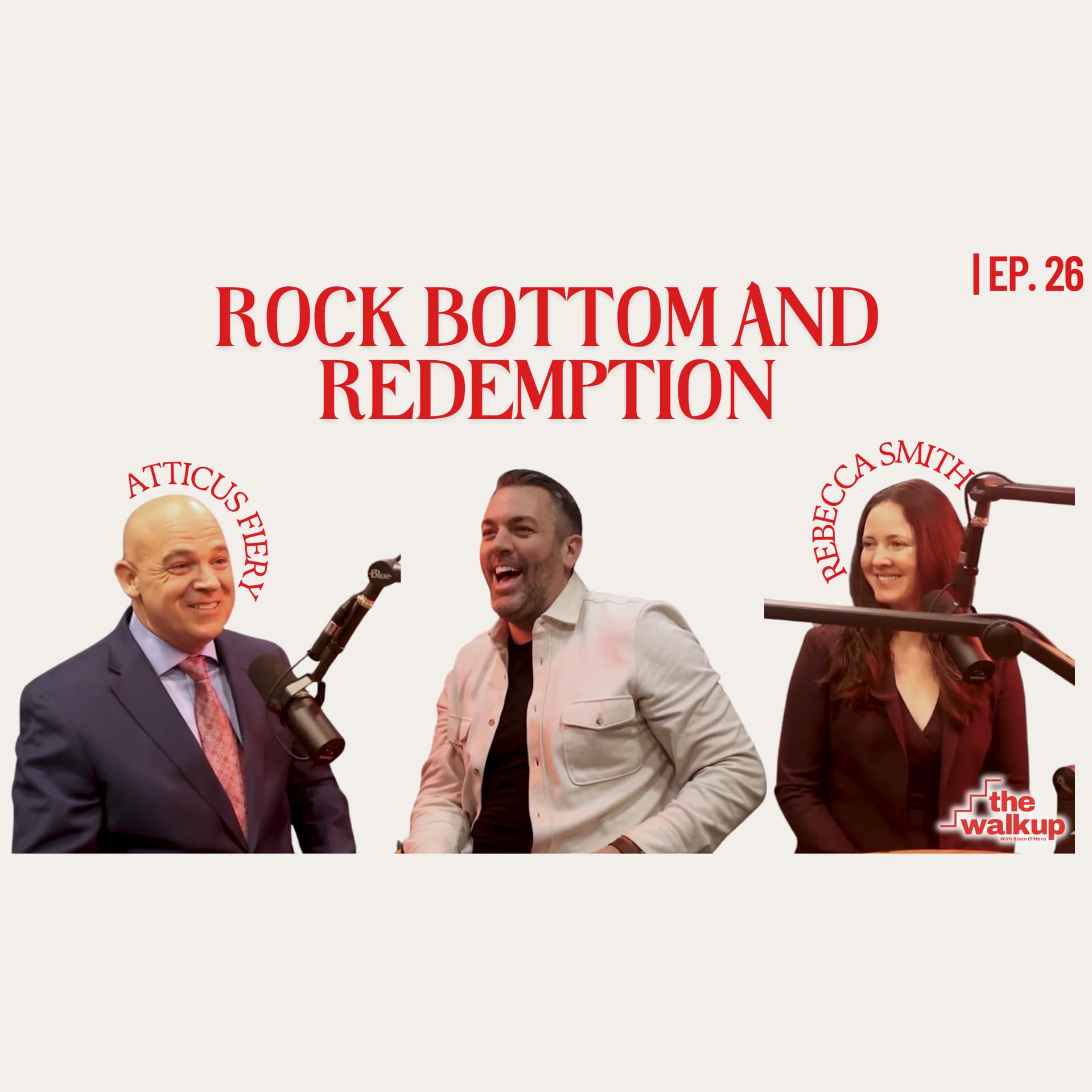
In this episode of The Walkup, Sean is joined by Atticus Firey, national leader of The Salvation Army’s Adult Rehabilitation Centers, and Rebecca Smith, a licensed social worker and strategic philanthropy expert.
Together, they offer a behind-the-scenes look at addiction recovery, spiritual renewal, and the systems that support second chances. With stories from the front lines—from confronting fentanyl to funding free childcare—they reveal how faith, grit, and radical generosity can transform entire communities.
Transcript
Read the full transcriptAuto-generated · 10,673 words
Well, welcome to the Walkout Podcast, Atticus and Rebecca. You're the first to be here with our new sign. I apologize for its blinding shine on you, but hopefully you guys have always wanted like a slightly orangey-red glow. Oh, yes. I think it matches my color perfectly. Okay. It's very Trumpian. It's also got like a little bit of like a red light district vibe, I'm just noticing. Not that I've been there, although I have.
I mean, when you're in Amsterdam, you have to at least like... See what it's like. You can't avoid it. And then I learned there that the red light is, that's how you know whether somebody's working that day, there's a red light that's on. And I didn't know that, so it turned out that the college winter break trip I was on to Amsterdam, it's possible that some of the young men on this trip might not have been there. To go to Amsterdam for educational purposes, which was complicated for our chaperones, but I am sure this is exactly how you wanted to start the conversation, but I am excited for our audience to get to know you guys, because I have had the privilege of getting to know you, Atticus, over the last couple of days, and Rebecca in the last month or two, but you guys were both with the Salvation Army, which...
Obviously, a lot of people know the name, but I've been just overwhelmed in learning all the different facets of the Salvation Army, its reach, and then Atticus, you and I got specifically connected through an addiction recovery organization called...
Came to believe recovery, which the President Tom Williams has also been on our show, so our audience can reference that, but why don't we start with some definitions. So, Rebecca, tell us, if somebody says to you, as Director of Philanthropy of the Salvation Army here in Greater New York, what is the Salvation Army, and what is it you guys do?
That is a very broad question. We do so much. We have an hour. We may need it. We do so much, and really, nobody has any idea of how great our reach is. So, the Salvation Army operates in 134 countries. We were founded in London in 1865, so we have a deep history. We moved to the United States, and in New York in particular, in the 1880s, and we started forming, like settling.
There you go. I've got it. We did not do any of those things. You settled America? That's amazing. You colonized America. We do not want to settle anything. That's great. So, it started in London, but the original impetus was...
There was a gap, right? There was something that they were recognizing needed to be done, and what was that? So, in 1865, our founder, William Booth, he was a Methodist minister, and he saw that we were not reaching, the church was not reaching the people out on the streets. He said the suffering humanity, he saw people who were poor and weren't allowed into the same church, people of different races, you know, just people who were not being reached. With the message, and so he started to go out into the streets and preach out in the streets, and that really was how we became the Salvation Army that we are today.
And what's the army part of it? Because I think people, you know, certain names you get so used to hearing, you don't even wonder where the term came from anymore, but there is an actual structure to it that has...
Commands and territories and all that sort of stuff, which is obviously added to a lot of its longevity because of the structure, but how does that portion of it? The lore I've heard is that it was a very popular structure and popular terminology back then in 1860s London was to have that military structure, and so we've maintained that over the years. We do use, for our ministers, they are given titles instead of, you know, a priest, father, you know, the different rankings.
They are lieutenant, captain, major, but it's very much representative of... Their time and their rank as an ordained minister. Well, I think we would say there is spiritual warfare going on all the time, right? So, we need an army, whether we get the titles or not. We are all soldiers, hopefully, out there in the spiritual warfare. And then, what about New York specifically?
You've got these things that are called ARCs, these adult rehab centers, which most people don't know how far the reach is in terms of free rehab that Salvation Army provides, homeless outreach. Everyone knows about the Salvation Army kettles during Christmas, but what are all the different facets of what is happening in New York? So, in New York City, we have 19 community centers. They all function as a church, all run by a minister that also provides social services to the community.
So, we're the largest provider of social services in the country, outside of the national government. That bears repeating. The largest... Non-profit provider. Non-profit provider of social services in the country. Yes. Yeah, so I think that should be a new tagline. Salvation Army, number one.
Yeah, so in greater New York, which is New York City, Long Island, and the lower half of Hudson Valley, we provided 9.8 million meals to homeless and low-income people last year. That's through our soup kitchens and then our food pantries, where families who are struggling to buy groceries, I mean, the inflation is affecting everybody, the rising price of groceries can come and get bags of staples to feed their family for the week. And so, we have those services out of almost all of our community centers, where you can just come in and say, hey, I'm hungry, and we will make sure to feed you.
We also provide so many services for the youth. We want to make sure that youth are growing up with good influences, and especially they have the same access to resources as their wealthier peers would. So, we provide free child care for parents who… We do. I didn't realize that. Okay, so if I'm a working parent, I've got to go to work, but I've got a four-year-old who's not quite in school yet. I can, there is a child care option. Yeah, so several of our locations in the city provide free child care.
We also provide free after school programming. You know, it is staffed with teachers who have lessons. They play basketball. Some of the programs have a faith aspect to them. Some of them are more associated with the school system, and so it is not included in that. It really depends on the center and the wishes of the parent to enroll their child. I found out today about the music education piece as well. You are the largest provider of music education. Again, non-profit provider of music education.
So, outside of the public school system, we are the largest provider of music education in the country. I was not provided any music education by choice, because my oldest brother is a very talented saxophonist. There are many benefits to being the youngest in the family. One of the downsides is when you see your much more disciplined, harder-working older brother practicing for hours and hours and hours at the saxophone, you're like, you know what, maybe this isn't for me. I think maybe I'll just focus on things that I'm already good at that take no practice at all.
So... So, yeah, no music education for me. A lot of our kids grow up and become music teachers. They'll get music scholarships, and they come back, and they give back to the same community that helped them. So, it's really great to see these kids. I mean, I meet adults now who are teaching. They're like, yeah, 20, 30 years ago, I was a little kid in this program. My parents signed me up. I only hear about this anecdotally, but you hear about that if there are cuts in school budgets, it is often things like music or other programs that are quote-unquote optional, but obviously the transformational effect that arts and music can have is long-lasting.
That is awesome. So, what was the biggest surprise for you, besides learning all these, the reach of Salvation Army, because you have been with them for how long? Four and a half years. Okay, so you have got to lay the land by now. So, what is one of the things that surprised you the most about now that you are in the... In the trenches, as it were. I learn something new every single day.
I cannot tell you how sometimes I'm like, wait, we provide that service? I had no idea. We should tell people about that. If only there was a podcast I could go on and share the word. We do anti-human trafficking work. Right, I just learned that today. Oh, my gosh. Yeah, that's a service that we provide in many communities across the country, where we go out and, you know, we...
Approach people that we think may be trafficked. I mean, it really looks different in each community, so I can't speak for the whole country, but here in New York, we approach women who are in the sex work trade and may be being trafficked. They're at a much higher risk, and just give them resources and know that we care about them, we love them, and if they want to leave the situation they're in, that we will be there to help them. And then homeless outreach, which we talked about as well.
You know, there is obviously a growing needing and concern around those that are suffering from mental health or mental health issues or are on the streets, and that is a very typical New Yorker, the fact that you guys are doing actual outreach to those in need and helping them get off the streets. So, what does that look like practically if you are doing homeless outreach?
Peace Village or something. What does that look like? Yeah, we have an official homeless outreach team that goes out. They have vans. They drive around in canvas neighborhoods. They walk the streets and try to build relationships with people who are living on the street so that they will come to trust them and be more likely to accept services.
So, once they agree to accept services, we can connect them with free legal aid to help them get into the shelter system and get a... So, we have appropriate accommodations there. We can help them sign up for benefits. Really, anything that they need to live a good life, we can refer them to our adult rehabilitation centers for drug and alcohol treatment.
And then, because since everyone knows about it, you have to tell us about the red kettles during Christmas. I know it's probably the thing that people know the most, but maybe add some context to that in terms of, I know it's a lot of work for the whole Salvation Army organization during the weeks leading up to Christmas. Yeah, it's an incredible amount of work, but it's also what people know us most for, that in our thrift stores.
It is the largest fundraising effort that we have as an organization. I cannot remember how much we raised last year. It was over $100 million nationwide, but it is something that people love. It has become a tradition, really, especially here in New York City. You go to Rockefeller Center, you walk down Fifth Avenue, and you are going to see those dancing bell ringers. Sometimes they will be playing their trumpet. And just bringing a little bit of Christmas joy to the streets.
That is great. So, what would be, like, for you looking forward, like, this is what I would love to see, the Salvation Army, or what people should know about it, or kind of your future casting for the organization? I would love people to know that we're this massive social service organization meeting the needs of low-income and homeless folks who are really struggling, and we're here to help and do whatever we can. Okay. Well, I'd say that's a good...
Baton pass to Atticus, because you have come out of, yes, receive it. Besides being a very well-dressed man, you are, you have kind of been on both sides of it. You have benefited from the Salvation Army and turned it into programming, and now have moved it into a leadership role, and now you are helping others. So, maybe give people an idea of how you came to interact through your personal experience with Salvation Army.
Indeed, I have seen both sides of the coin. It is interesting, because my whole life I knew about Salvation Army from the kettles, or from the homeless shelters, but I never knew that they had rehabilitation centers. I really did not have the need to know that they had rehabilitation centers, until I found myself with a monkey on my back that I could not kick, and that was called vodka.
The problem is, by the time that I actually realized I needed help, I did not think that a solution existed, because the mother of my three kids had become addicted to OxyContin for a legitimate purpose with a legitimate prescription, but her body, once that became addicted, then it was no longer a moral issue, it was a survival issue, and so to feed that habit, she was buying more and more on the street, and that was over a period of a few years where...
We basically spent as much money as needed to buy the solution. So, we flew in all of the doctors. We flew her out to all of the centers. We did all the brain scans. Every situation and scenario and solution that money could buy, we threw money at it. And unfortunately, she ended up dying of fentanyl. So, the mother of my three children passed away from addiction. So, years later, when I find myself with an addiction to vodka, Which started out as a little social, a little fun.
It was all great until it wasn't. Yeah, I need help, but where do I go get help? The help that I thought you could get failed us. And so, my mom actually introduced me to Salvation Army, and it was interesting because the day that I talked to the intake coordinator on the phone, I knew that my life had become unmanageable, but I wasn't really ready to admit or to accept that maybe I was an alcoholic.
Because, I don't know why, maybe it's just a mental thing, but the lady on the phone, she says, you know what, forget labels, Atticus. You just need to hit the reset button in life. And that just clicked with me. And Salvation Army provided me a six-month, distraction-free, safe environment.
That I could really allow the Holy Spirit to speak to me and regenerate me without all the distractions of the world and the currents of the worldly order. So, that is really how I was introduced to Salvation Army. So, I spent six months in the program. My main work therapy assignment job was a janitor.
So, I went from high-flying corporate world, early retirement, to being the janitor, cleaning up after a few hundred guys every day. Yeah, maybe give people that background, because I think of that contrast, I think we're all guilty of, at some point, of assigning a certain... We have a certain image in our mind of somebody who is struggling with addiction or finds himself homeless in need of outreach or what have you. We have this image of somebody that is clearly not somebody like me, so to speak, but you were a person of means by being a self-made, very successful businessman.
Maybe tell people through that, just to set up the contrast, it affects everybody at every socioeconomic level. So, what was your professional journey? Well, starting as a homeless person, as a teenager, one of my first jobs was selling Kirby vacuum cleaners. I don't think I knew that part. Wait, back up. Yeah, yeah.
I didn't know that you were homeless as a teenager. Yeah, yeah, homeless as a teenager on Skid Row in L.A., and I was selling Kirby vacuums for $1,200 door-to-door in South Central. So, if you know anything about South Central, and you look at me... Door-to-door, selling vacuums. You seem like a great fit. Yeah, you learn real quick. I'm sure everybody wanted to buy $1,200 vacuums. Yeah, you learn real fast how to sell. Sell your way out of some situations, if you know what I mean.
Okay. So, and that led me into car sales, and so I immediately became number one in the country for Chevrolet, and then Mercedes-Benz, and at 19 years old, I was making $450,000 a year selling cars. That was, this is what, 90s? This is back in 90.
Three. Gosh, yeah. Yeah. Adjusted for inflation, that's already great, but that's incredible. Wow. No, so I was number one for Mercedes at the largest dealership in the world, and so I wasn't one of a kind. A variety of people were making that much money. It was just a very lucrative business for us. I don't know if it still is, but ... And then from there, I got into the business world. So, a company called Meguiar's, they make car wax, tire shine, car polish, and ...
I became president of that company, and we took it from a real small mom-and-pop company in the body shops and the car washes to be the number one retail brand in the world through all the retail contracts that I negotiated with Walmart and Pep Boys and AutoZone and on and on and on, and because of that number one market share position that we secured, it attracted 3M. So, even though 3M owns Post-it Notes and Scotch Tape, they also own a variety of other business sectors, and so they bought our company, yeah.
So, you worked yourself up to become president, because you didn't found the company, but you ended up becoming president. Right. So, I was brought in as vice president of corporate development with the goal that within one year, I'd be the president, and that's what happened. So, we grew the company, and we sold the company, and at 34 years old, I found myself with a pocket full of money, an empty calendar, and no accountability to anybody for anything. And for a personality like mine, in retrospect… That wealth wasn't the solution to my problems.
It was actually the beginning of a downward spiral of moral, mental, and emotional disintegration, and over a period of time, that just became something that I couldn't shake. There wasn't enough willpower. I didn't have any strength within me to get back to be that person that I once was, and that's how I came to recovery.
So, why do you think, I mean, you mentioned that the mother of your children had gone... Through her addiction, you had the resources, because of being so successful in business, to allow her to try every medical or, you know, rehab center, or, so why do you, now that you've seen, unfortunately, you know, she succumbed to her addiction, why was it the free rehab center that connected with you once you found out? What do you think is? What was different about that experience through Salvation Army that allowed you to find recovery in a place that maybe, if you had a boutique experience, wasn't going to work for you?
That's a great question. You know, because addiction, it's easy to think that that's alcohol, or it's drugs, or it's sex, or it's food. But really, in the spiritual sense, addiction is anything that's sin. And so, everybody actually has a sin problem. A sin problem is an inward issue, and so Salvation Army, to the best of my knowledge, is the only one that is a spiritual, a faith-based program that actually works on regenerating and transforming your soul, your spirit, so that then the outward actions are more in line with what the Lord has created us to be, versus throwing money at a topical solution, much more like a Band-Aid approach.
Without the inside fixed, it doesn't matter. Like Jesus said, To the Pharisees, you can keep the outside of your cup really clean, and the inside is filthy as rags. And so, I think that the free program, the agenda is not for you to relapse and to make more profit. It is a free program with hopes that you will regenerate your soul, be saved from hell, and live a life that is abundant, doing the work that the Lord created you to do.
I think we always want to… I believe that in a technological age, and that there's got to be some silver bullet solution, there's got to be some magic thing that we can just develop, we've put enough time and energy and money into something, we can find some solution, but there's just certain things, and most things in life, that the only way to grow or to overcome something like addiction is doing the internal work, but that's a people business, right? That's not a, here's a pill to take, or here's some sort of, there's no, like, I was zempic for addiction or something, you know.
Not to say I was zempic is the perfect solution either. I remember there was a fellow that used to sleep outside the church where I was going in Hell's Kitchen, and I formed a little bit of a friendship with him.
And I'd say, hey, man, what's your story? Tell me what's going on. He had bounced around different jobs. He had lived in South Carolina for most of his life, and I had said, hey, maybe there's, what's your kind of like looking forward, maybe we can do some work here at the church or whatever. He's like, oh, man, I'm about to get a... I was hooked up with the Citi program here. I was like, oh, what does that look like? And I was going to refer him to a homeless shelter run by some Franciscan brothers that I know, and they're similarly minded, where they're going to break you down and build you back up, and there's no money involved, the place is free, but they can only house 30 guys at a time, and so I knew it might be hard to even get him in there because there's only so much capacity.
But he said, oh, no, I'm going to go to this... This program with the city. And I was like, well, how does that work? And he started telling me, and I said, would you mind if I came with you when you go to meet with the social worker? And he was like, sure, whatever. So, I showed up, and the social worker was definitely confused. No one ever brought a friend before. And so, I asked her some questions. I said, so, do you guys do drug testing here?
And she's like, no. I said, oh, so you do job placement? No. Job training? No. She's like, we just feel like if we give them a safe place to stay, that, you know, that they've had that security, everything, you know, that's the most important thing. Crazy. And I said, I just want to make sure I get this straight. You're giving people who have problems with addiction a place to live in a co-ed environment and money.
And just hoping it all works out, but you're not going to get a job, you're not going to check them for drugs, you know, make sure they're not bringing drugs into the facility, anything like that, whereas, like, I don't know how Salvation Army works with this Franciscan community when you, every day you have to be in by whatever, 6 p.m. or whatever. At that point, you're strip searched. There's no, there's no, because they don't want to take. Any chances that if you're bringing something in, it could affect everybody else, plus, you know, yourself.
And so, fast forward, I kept in touch with a social worker. This guy's name was Jimmy. She calls me, and she's like, hey, have you heard from Jimmy? And I said, no, why? I was like, I thought he was with you guys. And she said, oh, well, you know, we had to kick him out. He had assaulted a woman.
He was drunk, and I am like, well, you gave him money, and you are almost like feeding the addiction, you know? And it is almost a classic example. I understand that there is a desire from the, in this case, the city government, like, hey, let us put a lot of resources towards it, but the numbers are, I don't know, you might know the numbers more than I do, or at all, but how much money we throw at it is not.
Solving the problem, because it is about walking with somebody and building them back up. So, it is interesting, I think, for people to hear that a person of means, as you were at that time in art, but you would say, I am not going to do this expensive ride, I am going to do the hard work.
But I imagine the first, were there days you were like... Every day you wanted to quit, or was it, hey, I got to do this to get ready? How did you experience that? Because I know the first week is kind of where most people... Well, I have never journaled in my life, but somehow, starting day one, I kept a journal, and I looked back on it the other day, because I was like, I wonder what I said. Yeah, sure.
So, I read the journal, and it said, day one, and this is when I still, once in a while, use some profanity. A journal started, and it said... Holy, this day was... Moley. Moley, you know what? This day was brutal. What in the heck am I doing?
All I want is a cocktail. And I said, dot, dot, dot, but I'm going to stick it out. And then the next day, it said, oh my gosh, 5.30, wake up call. It's usually when I would go to sleep.
But, I am going to make this happen, and then every day progressively was more optimistic, and so, as I was talking to someone earlier today, there was not a loud voice or a lightning bolt, but somehow, the first day when I walked into that program, it was literally like someone was lifting a lead blanket off of my body, because leading up to that, I had gotten to such a crazy state of self-pity.
And of depression, it was a demonic, it really was a demonic lead blanket, and I was so confused because I didn't understand it, because my whole life I had overcome everything, and I was always so optimistic, and all of a sudden I was this person that I wasn't.
And right away, man, it was lifted, and somehow, I mean, not somehow, obviously, by the grace of God, the Holy Spirit regenerating, sanctifying me, gave me the ability to be joyful, even though it sucked. I mean, I'm not going to lie. I did not enjoy being a janitor, you know? I mean, yeah, it was therapeutic, and there was a lot of alone time in it, you know, with the mob and all this and that. I mean, I learned meditation, that's for sure.
But no, I think the Holy Spirit, He allowed me to go through all of that stuff so that I could be broken and really prepared for His work. So, He took all of the business experiences. He equipped me with amazing experiences and successes and talents and gifts, but then He had to prepare me and break me in order for me to use all of that. Now, for his kingdom, and saving souls rather than selling more widgets or bottles of car wax.
So then, yeah, take us through how then you decided to take a role within Salvation Army. Well, so I graduated, and I went back to Newport Beach, and I didn't really know what I was going to do. I mean, I did not want to get back into the rat race of corporate America, because I know me. I finally got to a state where my pride was smashed, my ego was deflated. If I get back into the business world, it's immediately going to puff up because, you know, I mean, I'll probably succeed, you know, and I didn't want that.
And I don't want to just be in retirement because an idle mind is a devil's workshop, and I knew what that gave me. I mean, COVID with an empty beach in our house, an empty beach because it was closed, the drink and vodka was just like a natural, obviously, so I didn't want to do nothing.
So, it was a miracle, man. Salvation Army called me a couple days later and said, hey, have you ever considered coming to work for us? I said, no, but let me pray about it. I said, what is the deal? Is that a janitor spot opening? No, but you know, I would have taken it. I really would have, man. But, no, it was intake coordinator. So, at one of the centers, they needed someone to explain and negotiate with the people that are looking for help, and to vet the right people, make sure that the program is right for them.
I said, let me pray about it. Give me three days. I prayed for about three minutes, and the Lord spoke to me. Again, not audibly, but he spoke to me. Clearly, he revealed it in my intuition, in my conscience, and he said, do it. And they're like, hey, this doesn't pay anything. It's minimum wage. I said, if I was doing something for the money, I wouldn't have taken your call. I don't care. I don't care about the money. I care about a purpose, and the Lord has told me to do this.
And so, I became intake coordinator, and shortly thereafter, the commander of our whole territory created a new position and called me up, asked me if I wanted to fill the role, and so I've been working at our headquarters for over a year. And had you been a person of faith previously? Well, that's an interesting question. I was a Christian intellectually since I was 25, and why I say intellectually is my mind, my brain did not dispute the facts about the Jesus story, so I thought I was a Christian, and I behaved like one in terms of I went to church, and I occasionally read my Bible, and occasionally read, but it wasn't.
My Christian faith went from a belief to a lifestyle, went from my head to my heart, really through the broken period of the Salvation Army. That is when I really, truly surrendered. It was no longer just head knowledge. Now, I have walked through the far. I am walking through the valleys of the shadows of death, and the Lord was right by my side. And that is when it went from the head to the heart.
What is it like when you are on the other side of that, doing this intake position? Because now you are looking at people, going, I have been there, man. That has got to be, obviously, you are in a very empathetic position, more than the person that is coming could imagine. I really don't understand what you are going through, but it has got to be a really powerful... Connection, if somebody is on the fence about whether they want to step inside the rehab facility, and you're able to help them get there because of being like, you know, I've walked through that.
So, what was that experience like, being like, hey, I've been there myself, man? Well, it was a brutal spiritual warfare. I didn't see it visually. But it was the front lines of the battle. I am opening the door. There is a person trying to get out of the grips of Satan, really, and here is me on the other side offering the help through the Lord Jesus Christ, and it was like the front lines of the battlefield, and every person, I just fell in love with every person I wanted to help.
God allowed me to see people from a spiritual perspective instead of the degraded physical form that they were in. And every day, Ephesians 6, I had to put on the full armor of God to really discern and have the power to do it, you know, have the ability to discern it and have the motivation and the strength to do it emotionally. But it is cool because now today, I have got some great friends that I helped go through the program.
So, as the intake person on the other side now, they have graduated. One of them is one of my employees. I hired one of them. So, I've got some great friendships now, you know, where I saw them at their worst, and God was able to use me, you know, only months after I was at my worst, now as an intake coordinator helping them, and so I think those bonds are going to be, because they're really spiritual bonds, I think they're going to last forever.
Yeah, and I think people examine their own lives, and whether themselves or through loved ones, I mean, there are these moments where there's the spiritual warfare that's like you really do see this kind of competing. For a soul, right? I mean, and especially with addiction, it's really drawn out in a very, maybe, dramatic way, so to speak, but it's in all of us. I mean, I think it's a term that, you know, the three of us might be more familiar or comfortable using, but that, I think, to my non...
Non-faith-based friends are the spiritual warfare. That sounds like crazy. Well, it sounds bizarre. Yeah, they think it's crazy. But, you know, like my kids, discipling them, I can remember when they had no knowledge to now when they're walking with the Lord, at some point in time, you know, you had to use some logic, and you'd be like, yeah, the things I'm telling you do sound crazy, but guess what? You're here as a person, right? Well, at some point, nine months prior, you were nothing.
Then you became something and came out of a person something? That is crazy. You know, the things that we just take for granted, an airplane flying through the sky, that is crazy, but because we are used to it.
So, the fact that the spiritual realm, which is mostly invisible, because it is not visible and tangible, it seems crazy, but there are much crazier things that we accept every day. Oh, sure. And what is the structure like? I mean, take people through like a day.
In the adult rehab center, one of the ARCs you mentioned before, waking up at 5.30 in the morning, what does the structure look like? Obviously, we talked about Salvation Army. There is a militaristic structure to things to make sure that you are keeping discipline, right? Yeah, because really the program is a behavior modification program from the inside out, right? But from day one, we do have to start disciplining the outward behaviors, and so we wake up at 5.30 in the morning.
We have to make our bed. I am still with you, by the way. I am fortunate to not struggle with addiction, but 5.30 in the morning is more likely for me. Yeah. Going to sleep at that hour than the… Right.
Imagine day one, man. You have to get up at 5.30. Go take a shower with a bunch of guys in the big communal kind of shower thing. Every day, you have to shave. We have to shave every day. Oh, interesting. Our bed has to be made.
Is it? Yeah, the Yankees, there is no official there. Oh, yeah. They changed it when Steinbrenner died, but that was like… I remember when Johnny Damon was signed from the Red Sox. To the Yankees, he had to shave his beard. That was, like, part of the deal. I wonder if they had to shave this year after us L.A. folks beat him.
They should all shave their heads, probably. I had to fight over it. Yeah, exactly. So, how about the communal side of it? I mean, I think that has got to be so powerful. Addiction, you find yourself in these kind of downward spirals, and you think, isolation, and nobody else feels what I'm feeling. I don't know who could love me or talk to me or relate to me.
The community aspect has to be incredibly powerful. Well, yeah, it's forced communal. What I told the guys in there, because most of the guys in the program came from a similar type of background. I was kind of the outlier, in a sense, but living with them for six months, we realized there is low bottom and there is high bottom, but we are all in there at rock bottom.
And so, rock bottom is a great equalizer, and being forced into community right away allowed people from all different walks of life to realize, brothers, we're in this together, man. Some may be able to pay their bills better than others. That's irrelevant. Right now, we're surviving together. And so, that forces you out of isolation. That forces you to realize that you're not just some anomaly, some weirdo, you know, that's defected. I mean, we all have defects, but it brings some commonality and some humanity to it.
You get up at 5.30, you are showering. Shaving, you are showering, you are making your bed, it has to be perfect. And then we go down to breakfast, and so breakfast is, I think it was at 6.30. And then we spend eight hours a day. Everyone has a work therapy assignment, so everyone is assigned a task to do, much like going to a job, because we want to teach people or remind them how to be disciplined, work as a team, be accountable, feel the acceptance of a team, the rewards and motivation of succeeding, the discipline of not succeeding.
So, that is like a normal job, eight hours a day, five days a week. And then in the evening, we eat dinner early at 4.30. Yep, because the reason why we eat so early is because every night, it's all programming. It's workbooks, it's counseling, it's anger management classes, it's behavior modification classes, 12-step recovery.
Well, that's a good dovetail, just to kind of connect how... Cain to Believe got into the Salvation Army ARC, so you mentioned the 12 steps, which everyone is familiar with because of AA, and there are 12 steps for lots of things, but you discovered that Cain to Believe gave you a new angle towards presenting the 12 steps, and then you really advocated for that to be implemented in the Western Territories. Just kind of walk us through that. Well, when I was in the program, they said it was a spiritual program.
Well, the extent of a spiritual program when I was there was that it was AA, 12 steps. And so, the spiritual... The conditioning of a person is everything to do with their sobriety, and so if that is the most important element of our recovery, then that should be the one that we have the most hands-on approach to, but quite frankly, it was the one that we had the most hands-off approach. So, our most important element was our weakest link, because for me to develop spiritually, I just had to have five signature cards.
To show that I went to five meetings a week to an AA community out there that had nothing, we had no, Salvation Army had no influence over, no oversight over. So, I went to these meetings and, you know, not to bag on AA or anybody, but my experience was not a spiritual experience.
You provided, you know, community and it's more of a place to go and to be heard, but not necessarily like walking through the process. Right. And so then also, when you graduate, when I was in there, you had to graduate on the fifth step. Well, there's 12 steps to a spiritual transformation, and they're all biblical. So, if it's 12 steps, why am I leaving on five? Why didn't I get the whole toolbox to reconstruct this house on day one? Why are you going to tease me with these steps over this period of time?
By the grace of God, I made it through, but a lot of people didn't. I mean, I think our graduation rate was around 30%, which is tremendously higher than the secular medical model or paid rehabs, but it's still 7 out of 10 guys and gals left. So, when I heard about Came to Believe, it only took about 5 minutes, them explaining to me the spiritual nature of the 12 steps. For me to realize, and it wasn't me realizing, the Holy Spirit revealed it to me through my intuition, there's our hole, there's the plug, let's put these two together, and now this spiritual program of the Salvation Army Adult Rehabilitation Centers is an institutionalized discipleship program called the 12 Steps.
Because Salvation Army has done this extraordinary job over 100 plus years of building... A brick-and-mortar infrastructure, which is incredibly costly, but you guys have been doing it through the revenue that comes in from the thrift stores, from donations, and so forth, and now it allows for something like when you find a new widget that works, or as we talked about before, as looking at... Salvation Army is the hardware that's already been, the infrastructure that's already been built, and something like Cane to Believe being the software that can be applied there, and now it can just be supercharged, because you guys already have the beds.
How many beds do you know? Nationwide? Oh, probably, it's between 15,000 and 20,000. Yeah, 15,000 and 20,000, and if we're getting 30%, which you said is better, much better than kind of... Market rate, so to speak, but what if that was 50%? What if it was 80% like the founders of AA were getting? But yeah, even at 50, the amount of lives that we could transform for the long haul, sustainable transformations, it just seemed like such a perfect fit. And so, yeah, we have now officially formed a territory-wide partnership with Came to Believe, and we are rolling that out as our recovery, our 12-step recovery program.
Well, I think that speaks to the broader issue. You come from a medical background and then decided to get directly on the more organizational, institutional, philanthropic side, so I am curious. What motivates you to now have taken a bigger role in a large organization like Salvation Army? I know you were in the front line, so to speak, before, but I'm curious about your motivation for being there and how you see it impacting your life. I was a social worker. I worked primarily in mental health.
I worked in urgent care centers, residential treatment programs, inpatient psych, and outpatient individual and group therapy. And through all of those experiences, all those different organizations that I worked in, the through line in each one of them was that none of the programs were funded well enough.
You know, we weren't able to keep people inpatient as long as we needed to, to really get them stable before they had to be discharged because of insurance reasons. You know, we had too many patients on a caseload to be able to really meet with people. There's been enough time with them every week. There was just always these issues of not having enough money to do the amount of care that we really wanted to, and so when I got exposed to fundraising for the first time, and I was at an event for a museum where they were raising money for a statue, I was in shock at the amount of money, the millions of dollars raised that night to buy a statue.
That night, and I saw that, and all I could think was, if I just had one of those millions of dollars, the lives that I could change. At my clinic, the impact that I could make would be so great, and I went home that night and started Googling jobs, and I didn't know what fundraising was. I had to ask. I was like, what is that job called, that person up there? Yeah, the guy who raises the money? What is that? Raises the funds?
Yeah, I had absolutely no exposure to this growing up. I did not come from a family background where we had money, and we gave. This was my very first time, and I was already practicing. I started practicing as a licensed master social worker for all of my 20s at that point, and decided to make that career change. That's a heck of a pivot. Yeah, but I was able to pivot into exactly the right field when I landed at the Salvation Army in fundraising.
Now, I'm able to raise those millions of dollars and directly impact those same lives, those people that I wanted to help in the first place. And I think it's... It speaks to the wider problem. You are talking about the lack of resources with mental health. At the triage level, so to speak, and here we are talking about how can we take this infrastructure that has already been built by Salvation Army and add whatever additional components can make it more impactful, and I think what is top of mind for a lot of people in the last five, ten years, unfortunately, is fentanyl, and you have had a very tragic direct experience of what that can do, and some may know that there has been this There was a huge lawsuit against those that were suggesting that fentanyl wasn't addictive, and then there's now been settlement monies that are now being given out to states, then delivered to addiction recovery organizations, and so I've been down in Florida, kind of seeing what might be done there, but because of that, I got to talk with some frontline people at hospitals and those dealing with Prison populations is, like, this is the front lines, and they don't have necessarily the resources, whether that means the brick and mortar, whether that means there's money, but money is only part of the equation.
They need to have the right systems and walking with people. To make sure that these extraordinary recidivism rates, I had to Google that term, by the way, and it was like, it was like one of these terms where you're like, you don't use it for anything else. It's like not a term that anybody's, it's French, you know. It made you sound super smart. Well, thank you. Recidivism rates. I used to be able to say it. Or relapse. Well, they call them frequent flyers.
Yes, they do. The medical facilities. That just shows you the heart and the intent. That's sad. And it's just, we had a meeting recently, the three of us, with somebody at a large bank who was a physician, but is now working in wealth management. You're like, why would somebody be doing that? Well, it's because those from wealthy families are also seeking solutions when it comes to health and wellness.
And she talked about how, like, as a physician in the U.S. ER, you'd want to help somebody, and when she told us that story, there was a guy who, he was a He was, as I call it, a frequent flyer, but everybody loved him. So, he would be back on a pretty regular basis with addiction problems. He had formed such a relationship with ER staff that they went to his funeral. Yeah, they had birthday cakes for him at times when he would come in.
Yeah, but that is the beautiful side of humanity, where it is a personal touch, and it is done out of love instead of for profit. Yeah, and I think what I'm realizing is that there's this... A portfolio approach or an ecosystem, it's like, it's really hard for something like addiction for any one organization to tackle all of it, right? And so, there are needs for these complementary organizations to work together. And what I've been really encouraged by with Salvation Army has been just the willingness to partner and the willingness to say, hey, we don't really care if it's our solution, let's just get it done.
And as you know, in the non-private world, There can be a scarcity mindset, where there is only so much money to go around, and so therefore, money that goes to your organization can't go to my organization, and vice versa.
I don't agree with that. I think there is an abundance mentality, which is good ideas that can help a lot of people attract. More resources and more money and more stakeholders. So, yeah, it's just good to know that there are organizations out there that are trying to tackle just at least A chunk of what something like fentanyl is doing. And maybe for those that don't understand, what is it about that, from an addictive quality, I mean, I don't know how much you know, but on the medical side, either of you, but you hear this in the news, why is this so damaging?
Right. Well, the problem with fentanyl is it's 100 times more powerful than heroin at a fraction of the cost. A hundred times more powerful than heroin. At a fraction of the cost. Heroin is already incredibly addictive. Right. Goodness. And so, not to stereotype, but most folks that are hooked on heroin aren't the million-dollar rock stars that cost isn't an issue.
Unfortunately, most people addicted to heroin are folks that are on the streets. Selling drugs to others, selling their bodies, robbing. I am not trying to stereotype, but that is the bulk. That is just the reality. And so, cost becomes a major factor in their decision.
Oh, I see. So, now they have a lower cost option. They can maintain this high. And again, at some point, it is no longer a moral issue where they are just making bad decisions. At a certain point in time, it flips to be a survival. You are chemically addicted. And so, if you are going to maintain...
If life, by giving yourself this medicine, happens to be called a drug, then the lowest cost that you can get is the best solution for you. And it was originally, it was designed as a painkiller? No, it was designed as a, yes, I'm sorry, as a painkiller, correct. Okay, but why would you ever need something that powerful? Or is this a manipulation of that? I don't know. I don't know all the details. I do know that, from what I understand, all the fentanyl is manufactured in China.
It's mixed and distributed through Mexico. The thing I never understood, though, is what a business model. You're killing all your clients. What kind of business model is that? I understand getting more bang for your buck, so to speak. Sure, sure, sure. But if it is so powerful and everyone is dying, I mean, we are losing 100,000 people a year from it. Then what kind of business model is that? Is that what it is? 100,000 people a year? To the best of my knowledge.
Yeah, I mean, more people are dying from drugs now than car wrecks, heart attacks combined. Wow, yeah. So, wait. So, after these, and excuse my ignorance, and I do not know if you know the answer to this question. I am turning this into a fentanyl expose. I do not know the answers. Well, let us get chat GPT. Yeah, exactly. Jaya, our producer, will Google it for us. But, like, there was these, it was like, I think, an $8 billion settlement, something like that, for the manufacturers of fentanyl.
I think that was for kind of manipulative marketing practices, but fentanyl can still be prescribed today? Well, so theirs was for OxyContin. Oh, theirs was for OxyContin. Okay, I didn't realize that. Sorry. Yeah, so OxyContin was the big deception. That was the one where they were saying it wasn't addictive.
Doctors and sales reps were getting paid to increase dosage, push usage. So, that was OxyContin. Oxycontin led into fentanyl, which is what happened to my wife. She didn't intentionally take fentanyl, but people were able to start cutting Oxycontin and other drugs with fentanyl, so it is a cheap cut. So, if you get a pile of something and you cut that pile in half, And you replace that half pile with something cheap, now you've got two full piles. So now, if you're selling this stuff, you just doubled your money.
If you're using this stuff, you just decreased your cost. And so, because it's such a cheap, synthetic-based painkiller, and had such high... High power is highly potent, yeah. Then people just started accidentally overdosing from it, like my ex-wife did. Okay. But is fentanyl ever a legit prescription?
Well, not a prescription, but in the hospital, I just saw a friend of mine the other day, he had a stroke. He was in the hospital, and they had to saw off the side of his head. Oh, gosh. So, I mean, his head was, I didn't even recognize it. His head was all deformed. And I looked down on his leg, because he was on and there was a fentanyl patch. I was like.
Wow, I didn't realize it. It said fentanyl. I remember patients taking fentanyl. Really? Yeah. It was patches that they'd... Prescription. Oh, okay. Incredible. But I take your point, and it sounds like we don't necessarily have the answer to the question, which is it seems like a bad business strategy to have the potential for people accidentally overdosing.
Yeah, because that is a really, really troubling part of it, because obviously, people are struggling with addiction, and they might intentionally overdose, right, because there is, effectively, it is a suicide attempt, but the fact that it is, they can have it accidentally. Most of these are unintentional deaths. That is just crazy. Yeah. That is like, I do not know, that is like smoking a cigarette and then accidentally having something else in there that you are not expecting, and it is like, wow, what is going here for?
For one thing, and I got something completely different. It's a totally different world now. That's why I tell my kids, I say, I don't condone drug use, but I understand. I mean, you know, I've done everything in the world. I said, I don't condone it, and I think that you shouldn't do it. The reason you shouldn't do it is because you're going to like it. Telling people, don't do it, it's bad for you, that's never going to stop someone. But the reality is, if you do a drug, you're probably going to like it.
That's just a fact. And then that like turns into a habit. I said, but if you ever are going to do something. Go to Amazon.com for $29, get a drug test kit. If you think you can do drugs, test it first, because as we've seen in our family, one pill laced with the wrong thing, you're dead. It's no longer back in the day where, oh, that was a bummer. No, you're dead. So, it's a totally different drug world now. And I understand that even...
Even marijuana now, because it has been legalized in a lot of different places, there is obviously more money, and it is way more potent than the quote-unquote grass. We have been smoking at Woodstock. It is nothing compared to what we have today. It is because it is modified in some way? Why is it so much more powerful? It is genetically modified, and a lot of it has synthetic elements to it, and the psychosis rates are through the roof with marijuana, where in the past it wasn't.
Because it was mild, or it's not nearly as... Yeah, I guess more natural herb, man. I don't know. Yeah, yeah, yeah. I don't know. And this isn't even talking about the vape. What's that? That one I don't understand.
In terms of what? In terms of the amount of scrutiny. I don't know if it's like this in New York, but in California, I think they're illegal. I'm not sure if they are, but basically, if you go into a vape shop... They treat it like it is contraband, like, are you a cop? So, it is just a weird, I do not know if that is like that here, but there is a big issue with vapes there. Because, you know, Juul lost like an $800 million.
In California, yeah. A huge lawsuit. So, I think the legality of vapes are kind of in the gray area right now. I think my understanding was that it was originally supposed to be a way for people to get off of smoking. Right. But it is maybe more of an entry point for... For especially younger people, because it doesn't smell, it doesn't taste bad, right? It's kind of, they get all fruity flavors, and it almost seems like you're basically almost marketing it to kids, right?
It's like you can do it anywhere, mom and dad won't smell it, and by the way, it tastes like candy. Yeah. You know, and now, and I think there's, I don't know, there's chemical elements in there as well, right? Because it can't be, it's not natural. Yeah, there's some crazy chemicals in there. Yeah. Well, this is where every conversation ends up, is always vaping. Really? No, it's not. This is the first time. This is the first time. How about we end on your wrestling career?
Yeah, well, not to be confused with the other Sean O'Hare. As Jaya mentioned, he had first Googled me. He was not at all confused that I was the same Sean O'Hare that's a professional wrestler. There's a professional wrestler and a professional golfer.
But neither of them are me. It would be great if it ... I don't think you could pull out both. I don't think you could be a professional wrestler and maintain the swing. Different physique. Slightly. I decided to go right in the middle. I'm not going to do either. Professional podcaster. Yeah, just podcaster. It doesn't require a particular physique for that. Well, do you have any questions for me that you'd like to ... You've got five more minutes. Tell us how you are the most interesting man in the world.
How am I ... Well, how am I the most interesting man in the world? I was telling you about my friend who was the most interesting man in the world in Rome, but one of the things about, like, one of my brothers, I was asking, like, wait, so why do you live in New York? You know, because he just doesn't get the city lifestyle, and it's like, you meet... There's more social capital in this small island than almost anywhere else in the world.
Everyone comes through New York. I mean, you're a perfect example. I would never have met you otherwise, and the capacity for people to interact gives you access to interestingness, right? Because you're constantly being challenged and pushed into different directions. I think I mentioned to you yesterday that I...
For many years, I hosted a jazz night on Friday nights, every Friday night for a while, and actually our lead saxophonist and band leader has been on the podcast. That's nothing, I would never in a million years have thought about doing that in my life. It was just, now, like, nothing seems out of bounds. It's like, you got an idea? Sure, let's try it. Like, why not?
There's just, like, this appetite for... For connecting, and also, you can socialize seven nights a week. A lot of other places, that's just not the culture, and in fact, it would be a little bit weird if you were socializing until 10 or 11 o'clock, and I don't know, on a Monday, you've got a problem. So, the access to interestingness is, if a little bit of rubs off on me, then I get to be a little bit interesting myself.
Well, thank you guys for being on the podcast. I do have one last question. Has anyone ever told you you look like George Clooney? I've gotten that once or twice, but now we've gotten it on camera. It's crazy, man. This is the most important thing. I'm sitting over here. I'm a little tired, so I don't know if I'm hallucinating a little bit, but I'll be like. Wait a minute, dude. Am I interviewing George Clooney here? I did not see that until just now.
It's incredible. It's uncanny. It's the orange light. Once you have it, you don't notice it, and that draws it out. Can you see it now? I can see it now. I don't know what those puzzles are called, when you stare at it long enough, and then it... Oh, yeah. Those 3D... Mind benders. Image appears. It's like the longer the orange light glows on you, the more I look like a celebrity.
But the only... The funny part was my... My girlfriend had, she had grown up in Colombia, and she's younger than me, and so somebody made that comment, and I was expecting her to be like, oh, wow, isn't that great? And she goes, the guy says, oh, he looks like George Clooney, and she goes, who? Yeah.
I was like, well, I guess he hasn't really made a big movie in like 15 years. She's like, I have no idea who that is. He's not big in Columbia. I guess she's really young. Yeah, so that's a separate podcast. Good on you.
Well, yeah. Well, thank you for being on the walk-up, and we'll certainly link to Salvation Army and Incantable Leave Recovery, and please, our gratitude for all that Salvation Army is doing and continues to do. Great. God bless. Thank you. Thank you. So, let us begin.
More from The Walkup

Against the Odds: The Samurai Lawyer (Chad Flores) | Ep. 52
Faith, Sexuality, and the Fog of War (Iris Bahr & Father Rick Riccioli) | Ep. 02
E2
Church, Conflict, and Community (Iris Bahr, Father Rick Riccioli & Rob Long) | Ep. 03
E3
Hope, Vocation, and the Global Church (Colm Flynn & Colin Nykaza) | Ep. 04
E4