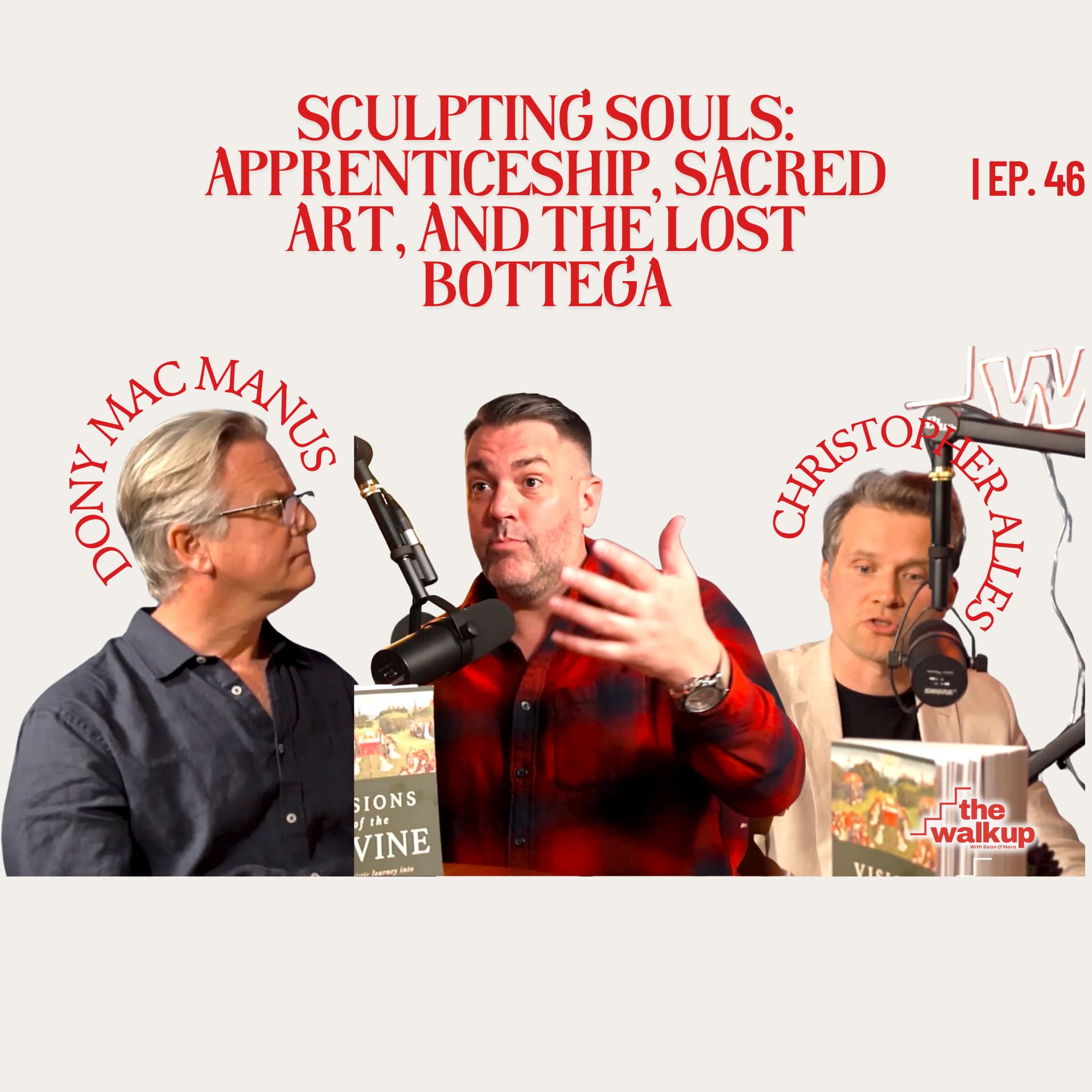
In this episode, Sean is joined by sculptors Dony Mac Manus and Christopher Alles to explore a world most people never encounter up close: the ancient, demanding, deeply spiritual craft of classical sculpture.
Chris shares how a college drawing class, a study-abroad coincidence, and an unexpected invitation led him—at just nineteen—to Florence, where he apprenticed under Dony in the historic studio of Fra Angelico. Dony recounts the origins of his mission to revive the bottega model and form artists both technically and spiritually—a vision that eventually contributed to a sacred art school and significant commissions, including a bronze altarpiece now housed in Rome.
Together, they reflect on mentorship, vocation, the Church’s role as patron, and the interior life that shapes the work of an artist.
Transcript
Read the full transcriptAuto-generated · 12,201 words
Donnie McManus, Christopher Aulis. Donnie is a three-, four-time returning champion of the Walkout Podcast, and in part, I can't remember if we ever talked about this. On camera, but that you're partly to blame for me having started a podcast in the first place over many a whiskey visiting you in the D.C. area. You were like, you should really start a podcast. I'm like, but what would I talk about? Who would I interview? And it turns out I just interview my friends, and most people don't have one sculptor friend.
I have two sculptor friends. Oh, what a loser. And they're friends with one another. So, I think we talked about this before, Tony, that the... You know, this artistic expression of sculpture is something that, in a modern context, people just don't have the opportunity to engage with. They appreciate, you know, Chris, you and I were just talking about having seen the Joan of Arc statue that's here in the Upper West Side, or we appreciate certain public works that might be there, but because of the way that the artistic development, especially in the States, has...
Perhaps waned in the last hundred years. We don't necessarily get the opportunity to meet an actual sculptor, so people have gotten to hear from Doni about his journey towards discovering this art form, but Chris, maybe you could take us into that world. How did you discover this interest and then eventually the talent, and then that led to you being in Florence and learning as an apprentice under Doni?
19 years old, that is not a normal path. No, no. And luckily, it was not a normal path because it would not have worked any other way, and I can get into that later, but I think it really began when I was taking classes in college.
I kind of wanted to figure out what direction I wanted to go in. I knew I wanted to do something creative. I was really interested in music. I was taking music theory and stuff, and I wanted to kind of get into composition, but then I was also taking an acting class.
You were focused on practical skills. Yes, right, right. But I also took a drawing class, and drawing is something that we all kind of grew up doing in our family, and it really kind of started with my oldest brother, who is a priest now, a monk, and he... I feel like had he pursued art, he probably would have been the best of us, because he was very talented growing up.
I look back at his drawings when he was younger, and I'm just blown away. And he was doing a lot of drawing, and that got all of us doing tons of drawing when we were little kids, basically. And I didn't really ever take it seriously.
And, you know, in high school or whatever, I was kind of into music. I wanted to start a rock band. That was kind of, you know, every adolescent male's classic dream. This is Portland. Yes, yeah, I grew up in Portland, Oregon, so there's a vibe. So, it would be grunge. Yeah, there's a lot of grunge going on. But when I started taking drawing classes formally, I kind of...
I rediscovered this interest and realized I had a talent for it and an aptitude, and so it was something that I just started focusing in on at that point. I kind of set aside music and acting and kind of started hammering away at that, and it was kind of a gradual thing. I mean, I was...
I had been kind of looking at different art schools to attend and how to continue with that, but it was just happenstance that a friend of mine who was going to Steubenville, she was doing a study abroad in Gomming, Austria, Helen Freiling. All right, because Steubenville University has a...
Formal relationship with Austria, right? Yeah, they have a campus there, and obviously, when you are there, you go and travel, and I guess somebody, an art history professor or something, knew you. Yeah, Healy, I think. Healy, yeah. Anyways, so, when they went to visit, when they were in Italy, and when they went to Florence, students from their study abroad, they got connected with Doni, who was living there at the time. And he showed them around, gave the tour, showed them his studio and all that stuff, and she comes back that Christmas and tells me about this Irish guy.
Who, you know, wears Converse and, you know, talks about Bono. At the time, anyway, your feelings might have changed now since about Bono, but... Not about the Converse, though. Yeah, no, no. And said, he basically gave them a pitch, if you know any artists, Catholic artists in the States, send them my way, and I...
Basically, sent Doni an email, and I guess the rest is history. What did your parents think about this? I think they were supportive. Because you were in college at the time, or you were... Yeah, I think I was in, and then I was taking a gap year to kind of figure out what I wanted to do, and this opportunity came up. When I was 19, and yeah, it just seemed like something I'd want to try, you know, and give it a shot.
And then Doni, at the time, was just starting a big project, and so it was a unique opportunity. And the reality is, like, Doni was offering something that a lot of art schools don't offer, really. Which is a deeper study of the figure and a more classical orientation, and it was an opportunity where I could essentially work with Dhoni and assist him on his project in exchange for lessons.
In anatomy, and, you know, we'd spend time drawing from the master, so it was a really golden opportunity for me. And so, I went over there initially for three months. That was the other thing, is the issue of the visa. You kind of have to figure that out, because nothing was formalized on Doni's end. And I know, Doni, you had been wanting to set up something official and a school to bring in students from across the world.
And obviously, you probably talked about that previously, but I guess I was kind of one of his original students in that regard, along with Michael Potter, I don't know if you ever met. That's right, yeah. We were kind of the two first students. When did you come over?
2009, so it was like 16 years ago. You were in San Marcos. Yes, St. Mark's, yeah, yeah. So, which was an amazing experience in and of itself, because it was Fra Angelico. They think it was Fra Angelico's studio.
And you had spent any time in Italy previous to this? No, no. Oh, okay. I hadn't been overseas at all. Wow. So, I go over there at 19. And, yeah. Landed in the Alto Angelico studio, like that. Yeah, yeah, yeah, yeah. I went over to Italy or overseas for the first time at 19 as well. But it was with those considering the priesthood.
So, I went to sit in a seminary for a week outside of Rome. We probably all know which seminary I'm talking about. And I might have shared this story before, but after the end of the week, every single person got a one-on-one meeting talking about, you know, where are they at in their discernment process, and do you want to take the next step in determining whether you want to be a priest? They never talked to me. They did not see any potential there.
But then, so, Doni, you are now developing. At that point, the school had been established, or no? Oh, no, no. That was, so that was my second. The second leg in Florence. The first leg was 2000, well, Rome was 2001, straight out of September 11, for a year and a half in Rome, and then a year and a half in Florence, up to 2003 or 2004.
And then I returned to Florence three and a half years later, after establishing the Irish Academy of Figure Art in Dublin. So, I returned about 2007 or 2008, or something like that. And it was with the intent of eventually starting a school, or...? No, no. Well, I was open to it. I'm always open to it, because essentially, my interest is not just in creating art, but creating artists.
So, it's not just forming art, but forming artists. Because the way I look at it is, I can only do so much myself. I have limited talent and limited time, but if I can get... Other artists, younger artists with more talent and more time, like Chris, then we can do a lot more. So, I was open to that. So, the reason I asked him was just to recap on memory. So, I was just back, I had just started, I was just given a studio by the Dominicans and San Marco.
We're in the Piazza Savonarola, given by Alto Angelico Studio, and when Chris arrived, I think we, I still have my stuff in the garage in Piazza Savonarola, and did we put it all together and wheel it through the streets? Do you remember that? Yeah, yeah, yeah. Yeah, that was pretty dramatic. I was actually thinking about that the other day, because Donnie got, so he had these three big panels, four by eight foot, wooden panels that are reinforced by, like, two by fours in the back.
That he was going to use the armature to hold up the clay. So, it is a big giant relief. You have three boards, and you put the clay on the boards, and that is how you support the clay.
The strategy for getting them down, I think it was at your, the space was, the garage was at where you live. Yes. Yeah, and that was about maybe a half-hour walk from the city center, and so he had this, just one of these little carts, you know, with the wheels like that big, like little tiny, and he decides to screw all three of those on, two on the side and one on top, and that is probably...
And shove the whole studio inside. And then wheel that thing. On cobble streets, through the streets of Florence. And those wheels are definitely not designed for that level. Oh, yeah, they burnt. Yeah, yeah. We burnt the rubber off them. And they probably broke, I think. They broke just at the door of the studio. Very funny watching the Italians kind of stare at us, though, you know, as they're going about their business. Not offering any advice or help. Two, like, obviously non-Italian guys wheeling this big, like, wooden structure.
The city is full of Anglo artists. Yeah, yeah. They're used to it. Yeah, yeah. Yeah, we did it better, but we don't do that anymore. It's their attitude. And that's that altarpiece that's discussed in this book, yeah? Yes, yeah. Okay, so as some of our audience would know, we had Steve Off and you together talking about his approach towards supporting the arts as a finance guy, but then he features this altarpiece. So, maybe walk us through that commission. So, I think it's on, I think I marked the page here.
Yeah, it is on page 165. That is the altarpiece there. So, this is the one we both worked on. So, it is a bronze altarpiece, and it is essentially squeezed in between the Cathedral of Orvieto and the Ghent altarpiece. So, it is a pretty nice place to be. I am the only contemporary artist in the book, which is… It's pretty nice. So, Steve, I thought I might put this on the show, so you advertise your book. So, it's basically about Visions of the Divine.
It's about finding the mass in art history. So, he's unpacking the great masters. In the context of the Mass. So, it is in the structure of the Mass. So, the introduction, the first reading, the second reading, the liturgy of the Word, and then the liturgy of the Eucharist, and he is unpacking it through the history of art, through 20 different art museums. So, it is an interesting, and of course, my own stuff. So, it is an interesting exploration, but I thought it would be really interesting, because he just sent this book to me there last week, and I thought, oh, it is just reading through it.
That is the one that myself and Chris worked on. So, I thought I might link the podcast. So, how did that commission come together? Because that piece is now in Rome. That's right, yeah. So, it's in the, what's the hospital? It's Campus Biomedico, which is a hospital on the outskirts of Rome, and it was commissioned.
It's a school, right? Like a medical school? Yeah, it's a medical school and a hospital. So, this chapel is the medical school hospital chapel. So, that was commissioned back in... Must have been... 2008 or something. 2008, yeah, what do I mean, 2008. So, it was a beautiful... Like, to do an altarpiece, as a Catholic, to do an altarpiece for Rome was a really beautiful challenge. So, I got working on that in Beato Angelico's studio.
And the Cardinal started to show a lot of interest in it, so he wanted, because six of the assistants that were working with me at that stage had already come to the faith, and they were being baptized in, and other artists that were being baptized in the Duomo. Osamu, for instance, came through the studio there. I was teaching him anatomy there. So, Osamu is fun. From Tokyo, but... Real character. Yeah, amazing character. So, after the bishop baptizing six of these students, he said, what's going on there?
I'd love to visit your studio. So, I said, come on down Saturday morning, and he came down, and he spent the first half hour talking about this altarpiece because he was really interested in that and the theological and liturgical aspects of it.
And then he spent the second half of the discussion asking me about the possibility of establishing a sacred art school in Florence, like a diocesan art school, because he wanted not just the artistic formation, but also the spiritual formation, because he saw these young artists from all over the world come to the faith through art. Was that the first time that you actually had that idea? Of a sacred art school? I had it prior to that, yeah. The reason I left Ireland was to do something with regard to sacred art in Florence.
And being given Beato Angelico's studio was like such a nudge, you know, yeah, this is what I want you to do. So, that was definitely an idea I was working on, but for the Cardinal to come in behind me was extraordinary, because that opened up the Chamber of Commerce and the Bank of Florence and all the finance.
Maybe speak to, because there's two elements here that are interesting to explore. One is, well, more than two, but the two that come to mind immediately are... The role of kind of the master and the apprentice, or the maestro, as you mentioned before, and the apprentice, that apprentice model, which has been lost in a lot of ways, and then the second is the role of the church here, right? The church as patron, and why is the, I think some of those that might not come from a faith-based background are maybe a little...
They know that there are these great works of art that the Church has been involved with throughout the centuries, but why does that seem to be unnatural for the Church, or maybe they wouldn't necessarily assign that to an institution such as that? Well, essentially, the Bottega workshop system is a Florentine. Invention.
Okay. Because all these artists initially started... Not to be confused with the bodegas here in New York. Oh, yeah. The botegas. Bottega. Bottega. They invented 24-hour delis. Exactly. Because for that, I am very grateful. The botega doesn't really affect my life, but the bodega affects my life in immense ways. When I have that 2 a.m. craving for... For a chopped cheese. I thought that was a Taco Bell.
Don't be spilling my secrets. But it was the Bottega. The Bottega started, that was like the art scene, the whole concept of the artist came from Florence, essentially from the Bottega system, so that you have all these artists in their workshops, mostly silversmiths and goldsmiths and stone carvers, who... They were very good at their craft, and because they were not only really articulate at their craft work, they also were studying philosophy and theology in the Medici ambient.
Like, Michelangelo, for instance, was introduced as a stone-carving kid at the age of 14 to the household of the Medici, Cosimo Vecchio, and under him, you had all these philosophers and theologians at the table with Michelangelo, so he is absorbing philosophy and theology as well as honing his craft, and what that gave us was a craftsperson who thinks deeply, and that, essentially, is what an artist is.
So, it is a marriage of philosophy, theology, and art. Truth, goodness, and beauty. So, that is why Florence is the birthplace of modern art, as it were. So, that is where the Bottega system comes from, and that is why I wanted to reintroduce an art formation through the Bottega system, because I saw what happened since then, is that the Bottega system was adopted by the French academic into the École des Beaux-Arts in Paris. It became a very scientific reductionist approach to art, which basically took all the technique of the Italians and the Spaniards and ripped the soul out of it.
It became very illustrative. Exactly. Illustration, basically. And not only that, but that is what happens when you take the soul out of it, because you are leaving an empty shell. So, it was only technique. And then, since then, we have had a reaction to that, which is like impressionism, post-impressionism. And modernism. And with that, we have the modern art school, which is a rejection of all the techniques of the French academics. So, what I did in Ireland was, in the Irish Academy of Figurative Art, was re-establish the discipline of the art, formed through a kind of an academic structure like the École des Beaux-Arts in Paris, reintroducing the technique, and the, as you would say, maybe Aristotelian understanding, which is like tangible.
The factual scientific reductionist aspects of artistic formation, and then once I had done that, I hoped that the students in Dublin would come through that beauty to truth, but it wasn't happening, so I knew there was something else that was needed, a missing ingredient, and that's why when I returned to Florence, I wanted to bring the spiritual into it, so that we weren't just, I wasn't just training artists to be technically proficient, but I wanted I wanted them to have an interior life that would overflow in their work, because essentially art is the overflow interior life of the artist.
So, I wanted to form the students with a spiritual life that was healthy and was in love with the world and with God. And that would overflow in their work. And that's why the sacred aspect. That's an awesome...
Responsibility, though. I mean, and obviously, you've been given good formation in your spiritual life and your artistic life, but I mean, that's a big, I would say, audacious attempt, but I mean, to say that you're going to form somebody like Chris at 19 years old, who's coming in where you could give a lot of...
The potential to influence is huge at that point, right? Yeah. I mean, at that age, you're open to anything, and we see this now on universities all the time, and certain things are really being pushed at the university level. How did you approach that from a...
From a stewardship or from a vocational standpoint? What really helps is that Chris came from a very good family. So, he had that philosophical and theological basis, and the character formation, and an artistic launching pad to work from, and I think he could explain it better.
Still was kind of an idiot back then, though, but I think back about how... Crazy 19-year-old immature, but I guess that's pretty normal. Yeah, I mean, having the launchpad of having faith in the family was a crucial element. Obviously, everybody has their own personal journey. I do think that, though, when I went over there to Italy, the faith life became a little bit more concrete than it had been before in a way that I think Could only work when you leave the family, because sometimes there's a point where you have to leave the family and start forming your own identity.
Especially, you know, I just, with everybody, I think, growing up, at some point, experiences that. And I think that had a... There is a crucial point in that with Dhoni's school, and what he was doing, and how he lived, and he was following Opus Dei's structure, and so everybody living with him, myself and Osamu, at the time, were kind of following that structure for the most part, and that kind of had this kind of concrete way of deepening your faith and making it more real.
And in the context of making things and doing things that we all like to do. So, it is not just like you are with a bunch of people who are saintly people, but you are also sharing in the common drive of what your passion is. And I think it is so easy to become isolated, to isolate those two things. Especially in the arts, because there's not a lot of people around that you can share that with, generally. Although, these days, everybody's an artist, so that's the...
Everyone's an influencer or a creative, yeah. That's what Warhol said, right? But no, but I think that that was a... It created a honing mechanism, and I think that one of your analogies, Tony, which I really always like, and I think about it a lot in my own life and in other people's lives that I see, is that when you have a direction, everybody is full of energy, potential energy, and when you have a direction and a focus, it is like being a bullet.
You can hit a target. And if you do not have a direction or structure in your life, you are going to blow off like a grenade, and energy is going to go everywhere, and it is going to be chaos, and your life will end up being kind of chaos. And I think that as much as the art was important, I think that aspect really hit home for me when I was there. Especially the first time around. I had gone a couple times.
I spent time in Italy in two separate times, but especially when I first got there, that kind of focus in the spiritual life had a major, you know, big impact on how I began to develop, just as a person, but also as an artist.
And then, so, walk me through this altar piece. So, you have this commission, you have not yet a school, but a burgeoning school, and you've got now at least one student with you, or maybe two at that point?
I think it's just me, but then there was also Michael Potter. Yeah, and then Osamu as well. Yeah, Osamu, yeah, he did help, too. So, how do you, as the... What is the process? You are being the more expert, he being an apprentice. You are building this thing together. You are setting the kind of, I would say agenda, but you are setting the tone for how you are laying this thing out, and then you are, over time, giving him more and more responsibilities.
How do you make sure that you are… Completing the work to its highest level while also giving somebody with less experience the opportunity to learn. Well, it is the same as what I am doing at the moment because the next leg of this journey is I have just established a studio near Washington D.C., Falls Church. So, I am building a three-story studio there. It will be a teaching studio, so a sculpture studio, a painting studio, and a drawing studio.
The reason I'm doing that is because I'm working on this commission for the Navy, which is six seven-foot figures. In bronze. So, I'm doing the same thing as I did with Chris. Now, I'm taking in students that I had at CUA and local students who are coming in to assist me on the project. So, I would enlarge these figures, and then if the student has no experience, I would let them work on a foot and get them to do the best they can, and then adjust it and show them where it needs to be adjusted.
So, you have students with different abilities, and you can set them at different tasks, but at the end of the day, it is my piece. I am responsible for it, so I have to do quality control, and I have to tidy up all the messes.
But if a student shows aptitude, well, then there is a chance that that student could actually not just draw time from you, but actually save you time, and that is the transition between a student and an apprentice, and then a full-blown sculptor or painter.
So, the whole thing is, I just use the opportunity of a commission to create the most beautiful work I possibly can, and form as many young, talented artists as I possibly can within that procedure, because they are not just learning technique in an academic, kind of, staid environment.
But in a real-life project, where they can come and do a site visit with me, see me deal with the client, work out the books, work out the payments system, go to the foundry, work with the foundry, and help to basically translate the work through the bronze procedure, so as to do quality control and see how that is done, so that when they get their gig, they know the whole process. Instead of just some sort of false academic training, which they just get a piece of paper.
This way, you have a whole way of working and a whole way of being. So, it can become a career. Oh, yeah. If you want. A lot of that still, too, is you're, I mean, it still always is going to be learning as you go. I mean, you never, even training in that context, you're still.
It still takes a lifetime to just kind of figure out, even the practical nuances, but as you go, I mean, it becomes more and more clear. I think the more important thing is that you actually know it can be done. Like, you have seen it, you have done it, and say, oh, I could do this. Right. But without that experience, it is very difficult to start. And Chris should... Promise right away? I mean, you could recognize his natural abilities and interest.
Oh, yeah, yeah. The other thing, we used to draw on the weekends. So, we'd go all to different churches and sculptures out in the street, and we were just drawing all weekend. And through drawing, you really develop your technique, because 90% of any artwork is drawing.
So, if he can really hone his drawing skills in, and then use anatomy, text, and models to critique his drawings, and then go back and draw again with that whole understanding. So, if you are like, let us say if you are drawing a hand, you could draw a hand.
And then you could use that drawing and analyze it with transparent paper, and then pull out the bone structure with a skeleton, and then our anatomy text, and then pull out the muscle structure with anatomy text with another transparency on top.
And then once you have done that, then you are conceiving the hand, not just perceiving it, but conceiving it. And the next time you draw it, you are drawing. Not just with perception, but with conception, and when you conceive more, you perceive more, because if you know there's muscles and bones within these joints and so on, you will start to perceive them deeper. So, this is how I'd like to teach the students to understand, essentially, the grammar, to become familiar with the grammar of anatomy, and in one word, it's incarnation.
That sums up everything I do. Oh, it is like building a house. I mean, I remember when you are growing up, and you say, where does water come from? Well, you just turn on the faucet, right? Where does the food come from? I don't know. It is in the pantry. I don't really ask where it comes from. But eventually, you are like, oh, there is a plumbing system. There is an electrical system. There is a foundation. There is something that keeps these walls and the foundation.
That is a really good analogy, because it is like drawing. Let us say I was drawing your face. I have to conceive the architecture of your head before I put the features on. It is like building a house from the door and the windows. It does not work. Well, it is like building it with just starting with the details, like the door, how cool the door handles are, when you do not have the structure. And that is what the amateur jumps in on, the details.
So, if you get an amateur to draw a face, they go straight into the eyes and the nose and the mouth, but they do not connect because they do not have the full conception. You just get the overall. Expression of the form, and express that overall thing, and then you gradually, those other things fall into place. The secret is, in art, it is from general to specific. If you think about it, it is like a camera out of focus.
And as it gradually moves into focus, so when it is out of focus, it is very diffuse, and it is just a series of shadow shapes, and then it gradually comes into focus, and that is how an artist perceives, because it gives a holistic, full understanding. Yeah, and I think, you know, using the building of a home analogy, it is really just almost like a... What we see is almost just a curtain, just like the skin is just what you immediately perceive, yet when you really understand a home, and then the home actually is part of a much larger ecosystem, right?
I mean, what's the water source? Well, like the plumbing system, like the whole water main or whatever, you know. Yeah, like I'm building a studio at the moment. I've almost paid half the money, and we haven't started building yet. Right, right. You know, that's just like that.
People are always like, what are you doing? I don't see anything. Yeah. Right? When really, it is going on underneath the surface, right? Yeah, yeah. But you are going to be a lot more thankful that you spent the time putting in the good foundation and the good plumbing and the good infrastructure, just like you are going to be, as an artist, the end result, while it might seem like, well, I am not seeing the end result of this yet, it is because, like you say, you are trying to understand the entire person.
Yeah. So now, Chris, for you, was there a moment where you felt like... All right, this is it. This is my career. This is my vocation. Was there a moment? Yeah, I think, well... Carrying that cart down, and you're like, man, this is glamorous. I just feel like I've made it now. No, it could have been around then. No, I think that what Doni said earlier about somebody who actually had the vision...
how to operate as an artist taking on commissions and to do work for the church which was a common place and you know at one time so that that was already kind of a vision for art that a lot of people don't get exposed to today most of the time people conceive of art as You become a painter, and then you paint paintings, and then you sell them in a gallery, which there is nothing wrong with that, and usually there is some kind of esoteric meaning behind your work or whatever.
Kind of hyper-intellectual or whatever, and the idea of seeing something that is very concrete and very historical and very positive, like doing work for the church, and it does not have to be for the church, it could be like the war memorials or whatever, civic monuments. Public works, yeah. Public works, which you see.
You see a lot of that around in these old towns across America, and that used to be done by kind of unknown sculptors for the most part, or not well-known sculptors, and that was just a commonplace thing, and to have that vision again about being an artist doing this kind of work for churches.
And for Civic, in this kind of more, I guess you could say more humble way, in the sense that it's kind of serving, it has a function in a way that it serves, you can still strive to be a great artist, but it's not this, it wasn't. Surrounded by this pretentious world of what art had become, which is this highly prestigious thing, and in a way, even still being an artist has prestige associated with it, but the reality that there's so many artists in the past that were We're very good.
They weren't Titian, but they were great, though, and they were competent, and they did their work, and they put their heart into it, and they did it for the church or for whatever situation. That was a vision that was a lot more hopeful and positive.
...than what this whole prestige kind of world was, and I think I really like that, and it gave you kind of a blueprint for, okay, well, I can be an artist in this way. Like, this is a much more tangible and real way to be an artist, and also, I think even the interest in doing liturgical art increased because...
Again, it used to be such a commonplace thing, because we were building churches that were beautiful and full of beautiful art, and you needed a ton of craftsmen and artisans and artists to do that, and there used to be a lot of them. And now, there really isn't that. It's kind of almost a lost art, which is what we're trying to solve, but the vision of...
Doing art in that way was so positive, and so getting yourself out of the way, and your own ego, and it gave a blueprint for anybody getting into art for how to possibly even make a living as an artist. It was very practical in a way.
Yeah, like, for example, the restoration of Notre Dame in Paris. I know I saw a 60 Minutes piece on it, but I hadn't done a deeper research on that. Was there a need for them to find artists to even do this work? I mean, I don't know if you know much about it. Yeah, it would be tricky enough to find craftspeople who had the ability to do that, but they managed, and some people actually trained through the project.
Farmers, yeah. I think it's an interesting fact also that this is something I tried to reintroduce to the studio, was that I don't like to sign my work. So, for legal purposes, I might sign it on the back, just so, because the client demands that your name is on the piece, but I try my best to not sign it, so that the glory goes to God, especially with liturgical work. So, that bronze altarpiece there, there is no signature on it.
This is a really important thing, because this is bringing everything back to God. So, that is a very important part. It is kind of a medieval idea, and of course, Michelangelo was the person who broke that mold, because he did the Pietà in St. Peter's Basilica, and no one believed that he had done it. So, that is why he snuck in and carved his name across, Michelangelo Fiorentino Fecetest. Michelangelo the Florentine made this. Right across the chest of the Virgin Mary, and he regretted that for the rest of his life.
He never signed his work after that. Show me nice lettering, though. I know, yeah. Well, I want to make sure people see it. So, that is a fair point. They were... He didn't think people would know he did it because the talent was… It was so unbelievable. He also heard… They said there were some other sculptor people… Yeah, they said an older sculptor did it. Oh, I see. He overheard a bunch of cardinals talking about the piece and saying that they thought that so-and-so did it because there's no way that… So, Michelangelo wasn't even… No one even knew who he was, and it wasn't going to be this 20-year-old kid, you know?
So, now, I've gotten to spend a lot of time with you guys. I mean, we actually, you know, lived in an artistic community for, you and I, for a brief period of time, and Chris for many years, so I got kind of an up-close, you know, view of this process. I remember you doing the kind of two-figure St. Charles Borromeo and kind of a... A penitent, or somebody who was also suffering from the plague, I think, right? I think that was kind of the vision with that, just because that was part of Borromeo's history, was that he didn't flee from the plague.
He went out and served people, and I think even worked miracles. But yeah, it was also this kind of obvious connection to confession. The prodigal son, which is all these themes are kind of interlinked. You can even see kind of how Rembrandt depicts it. I mean, it is all kind of the same gesture. So, in that, you can have multiple meanings, but they are all kind of the same meaning, though, of penance and returning and illness.
Can be, you know, a symbol of our own frailty as humanity, and Christ entering into that illness to heal us. And so that is kind of the general vision with that, and that was obviously symbolic in Borromeo's life.
So, yeah, I did that. And actually, it's just as a side piece. I was thinking about this a few days ago. I did that piece on the second floor of this old, beautiful building we're in, and I was, like, so freaked out that it was going to... Literally collapsed the floor, because it was about 2,000 pounds of clay. A ton of clay. A ton of clay, and then when they made a mold, they put another 1,500 pounds on top of it.
So, you had about a pretty big car on the second floor. I didn't realize it got there. Now, luckily, it was one of those old buildings. They had big, giant joists or beams. But I... I promised I would never take that risk ever again, and so, but it did really bother me. Well, you have filmed like a little platform, and... I dispersed the weight a little bit, but it's... Have you seen the film, The Rebel, Tony Hancock? I haven't, no, I've heard of that one.
It's really good. It captures that. He's making this sculpture on the second floor, and it just collapses right down onto the landlord's bedroom. It's brilliant. Well, it is just, I mean, we were talking about kind of the building of a home before, and craftsmen, and the restoration of Notre Dame. I mean, think about that place where we lived. That was built right around the turn of the century, a little bit after, and you could put 3,000 plus pounds on the second floor.
It did not have an impact whatsoever. I remember, like, the, I mean, the... The doors were made of oak, and the banisters, you'd think after 100 years, people pulling on the corner of the banister as they go up the stairs, it didn't even budge. It's also all that old, just as a side, that old growth wood. It just doesn't exist anymore.
Yeah. Actually, speaking, it's kind of like the analogy of how craft, in general, has disappeared. I mean, I was at a friend's house in Florida, and he just got it. You know, it's a nice house, but it was a new build, and he was kind of setting up art and pictures on the wall, and the pictures kept shifting on the wall, and everybody was wondering, like, what's going on? And the whole wall was shaking whenever anybody would shut the door. It was like one of these floating walls, and I'm like, this is really bad.
This is like paper walls, and it probably, you know, it was a nice house, but it is just like new builds. They just don't have the same level. No, and I think it was your brother who is an architect.
Was the one who pointed out, because in that great room where you guys did a lot of your big pieces, because, Dona, you designed a mosaic that ended up in a church in Wisconsin there, and so you needed a lot of big space, high walls. Not a weight issue there. No, no, no. 28 foot by 28 foot.
Light coming in, and there was that staircase. Well, we, but that room was the opposite side of the staircase, and people would see this kind of, this cylindrical-looking, shaped wood with paneling, and they'd think, what is that? Like, it almost looked like it was like a... Confessional or something. Yeah, confessional or somewhere like a tower almost, like, and I think your brother was the one who... He posited that they had master carpenters back then. There wasn't necessarily a full blueprint, which weren't necessarily every single detail, because you could kind of figure it out on site, whereas nowadays you have to have everything because no one can figure it out.
They don't know how to build. His guess was that they forgot. About the staircase, and we're like, yeah, we'll just build this gorgeous, you know, custom... Yeah, to hide the staircase. Yeah, yeah, yeah. And just, yeah, you know, and so, in other words, a mistake turns into this beautiful piece of art, where they could have just done a big... It's a little odd and funky, but that's okay, and you know, there's a lot of odd and funky things. Actually, if you go to the old...
Yeah, yeah, actually, that's a good point. I mean, a lot of these old cathedrals and stuff have really weird, funky things that, like... I think even St. Peter's, the front is slightly off-center from the piazza, so they had to... So, they had to widen one side of the entrance. I am not explaining this very well, but they mismeasured something, so the facade of St. Peter's is slightly off-center from the actual rest of the church. It might have been connected with Bernini's mess-up, because Bernini did two towers on either side.
He started on one side and started to subside, so that he lost that gig. Crock-rocking, yeah. So, innocent to chance, fire them. And then he was out of favor for quite a while, until he won back Innocent X through a commission to do the Ecstasy of St. Teresa, the famous one.
And that got him back in with the popes, because he had worked for five different popes. Like, he was dining with five different popes over the period, but Innocent X fired him for destroying the front. Well, he should have been, because he was not being a good architect. Yeah, he was an artist, and he wasn't an architect, but Borromini knew that was going to happen, but he let it happen.
And then, when he was back in Good Graces, that was when he did the cupola? No, Michelangelo did the cupola. I thought Bernini... Bernini did the baldacchino over the altar, and then the chair of Peter at the back.
Actually, if you see that with the old mass, like with the priests, with his back turned, and then you see the... you can actually immediately see how that was originally designed, because this is just this unbelievable photo of a priest celebrating Ad Orientum, and then behind it is this... Empty chair. I mean, it is implied with being held up, and it is just like this awe-inspiring. You could just see how everything was designed in that way.
Actually, even Michelangelo's Pietà was an altar piece. Absolutely. And that was designed to be, the altar was right next to, right beneath. The idea was, I have heard this anyways, I cannot cite the source, but the idea was that it was designed to be held up, and it was designed to be held up, and it was designed to be held up. Mary is essentially dropping the body of Christ onto the altar for us to consume.
Exactly. It is awesome, huh? Because he looks like he is about to fall off her lap, right? He is very teetering right on the edge. His second Pietà was the same, Michelangelo's Pietà in Florence, in the Opera del Duomo Museo. He designed it for his tomb, which would be over an altar.
The Christ figure is falling onto the altar. So, remember, this is just after the Council of Trent, so the whole emphasis on the Eucharist was very clear. And all the artists were encouraged to emphasize the real presence of the Vast Sacrament. And you can't get more real presence than Our Lady dropping the figure, or Nicodemus dropping the body onto the altar.
Also, Caravaggio did the same thing with his deposition, which was in the Chiesa Nuova. There's a copy of it now in the Chiesa Nuova in Rome, just on the right-hand side as you enter. But the original now is in the Vatican Museum. And you can see that same... A whole composition of all the figures directing down and holding Christ and then dropping him onto the altar. And just before he is dropped on the altar, the hand of Christ is pointing like this, and it is pointing to a black… um space within which doesn't make any sense it's just like this black void in the middle of the canvas but if you understand the compass the the context of this in front of an altar where the priest is saying mass ad orienta what's happening is the whole composition is leading to christ's hand and he's pointing to the eucharist wow at the consecration i mean this is mind-blowing so that's that's too bad that there's i mean it's you Good for the Vatican Museums, they have it, but it seems like it is out of context, right?
I mean, just extracting it. I guess you get a copy if it is, keep it safe or whatever. I mean, at some point, maybe these things should degrade over time, because that is what they are for. They are not, you know, they are meant to be used, in a way, in the liturgical. That is actually one of the problems of going to the museum. Like visiting orphans in a hospital. These works don't believe. A lot of them don't believe. They don't impact you.
I mean, even like when you go to, say, in New York, you go to a church like, say, St. Vincent Ferrer, which is... One of the most, the prettiest churches in the city, and the artwork is beautiful, but it is not at the same level of... I don't know, stuff you see in the Met, but it impacts you actually more, I think, than the stuff that you see in the Met, because it's in a context that makes sense. It's actually the same with liturgical music when you hear Palestrina or something in the context of the Mass.
It's matchless. It's interesting to think that that church is directly across Central Park here, and who went to the Mass there every week? Andy Warhol. He sat at the back of that church, the most beautiful church in all of Manhattan, and he contemplated this after spending the night in Studio 54. It is kind of fascinating to think that he had that appreciation, but yet he was creating these brittle boxes and all this kind of very...
Kind of pop art, very cynical works, but at the same time, he also funded the school I graduated from, the New York Academy of Art. So, he cherished the liturgy, and he cherished art, but he produced the most cynical work. And also, he kind of put the nail in the coffin in terms of like...
He began the idea that art is basically a subjective reality, that anybody, I mean, he is the one who said that everybody has 15 minutes of fame, right? And that kind of art degenerated so much from any kind of representation or, you know, that now it was just about the ideas behind it. So, now you get all these kind of crazy conceptual art, and he kind of...
...brought that along. You know, there was kind of a humor to it. I mean, there's some kind of joke about it, but you can't live in that world because, you know... And that's the kind of world that... I guess he's a very complicated character because of that, but he definitely pushed that.
You know, the highest virtue being irony, basically, for somebody who doesn't have any belief in anything. You only have to be ironic, and you can only be ironic, and everything's kind of a joke in the end. And you can never, you know, you can't really take things seriously. You know, and I feel like, actually, in my own experience, I have a little bit of that, just because of how we're raised in this world, that you, like, don't want to be too, you want to be a little ironic about things, you know, because it's just how we're kind of, you have to kind of fight against that.
at least just for me i kind of notice it creeping in sometimes i think it's important to take life seriously but not yourself seriously it's it's a very fine line you want to because life is serious but if you don't take yourself too seriously it's it's a kind of like a lubrication it kind of makes things happen it's much it's much more beautiful and open yeah well you yeah yeah but you and you also i guess like to I mean, insofar as like, I mean, obviously, when meaning take your life, taking life seriously, obviously, when you take, you do take your life, yourself seriously in the sense that you take care of yourself and you're going in a correct direction.
But I guess, you know, like you basically detach yourself, that it's not really you. And actually, this is an important thing, a realization that I Kind of connected to this regarding art I had come to, which is this, I guess I kind of had this attachment to art, and I want to make something that I think is perfect, a perfect work of art, which I don't think I'll ever do that, because you'll never be totally satisfied. But I realize that... I was taking myself too seriously in that sense, in the sense that you need to take whatever you do seriously because it's a gift given to you by God, but you don't get to dictate to God the terms of how he's going to use that.
So, you know, if he... Something crushes my hands tomorrow. I won't be able to work on it anymore. So be it. The art that I'm making is not mine. I kept thinking it was mine, and I wanted to do this thing. I wanted to do this before you take away anything from me, God. I pray He doesn't.
I want to do that. I want to get this done first, and I realize I actually had a lot of anxiety about my life because of that, and worried about problems when problems came up, whether it be health or anything else. I would want to figure that out as soon as possible and get it out of the way so I could go back to ensure that feeling that I can achieve my little goal. Because I thought that the art was mine, but it's not.
And once you kind of come to that realization that whatever you're doing, even though it's cool and it's fun, and it could be anything, it's not just art, your business you're starting, the temptation is to really make it.
Think that it is yours, but it is not yours, and that is okay. We are custodians. Yeah. We are custodians of a talent, and all we have to do is be faithful. We do not have to be successful. That is up to him.
Yeah, and then the main goal is, you know, with our vocation, in my case, Wife and children, and ultimately, the life with God. And all these other things are sort of byproducts or overflow from that. But it is an important thing that actually can be really hard to struggle with, because we kind of become attached to the things we are doing. And, yeah, I don't know, it is just something that… Well, they are kind of artistic children in a way.
So, there's a tendency to be attached to the work you're doing. Even, it's hard to let go of it sometimes, because you live with it for so long. There's a certain natural. It's good, because in a way, it's good to take whatever you're doing seriously.
And to do as best you can, and you need to do that. However, you also need to be completely detached from it, and that isn't what makes your life meaningful. It's actually your relationship with God, and your life with God. So, you have to be totally detached from it, too. In a way, it's almost like your relationships, too. You can be, you know, you obviously love your family or whatever, but you...
You have to love them in the context that God is the most important. I think somebody like Thomas More, actually, is kind of interesting. I was just listening to something about him, how he was a family man. He loved his children, and on his way to being executed, his daughter came up to him and kissed him.
um and affectionately hugged him but it wasn't so much in this um fantastical like lamenting way um it was more of they were british by the way what's that they were british yeah well but in a way that was giving knowing that he's reaching his ultimate destiny yeah like you know and that there was a certain weird maybe a sense of joy in a way um and that's what it means to actually be Attaches obviously doesn't mean that you don't love them.
No, order is really important. The order of love is the most important structure of order. God, spouse, children, friends. If you screw up that order, it can be a disaster. Yeah, and that really has a big impact also in the artistic life as well. Like your kids need to see you love your wife. Yeah. That's the best love you can give your kids, is loving your wife first.
So then, just to return to this question about artistic community, apprenticeship, you know, you had started a school in Dublin, then another one in Florence, and I know you've always wanted to start one in New York, you're now doing one in Falls Church, Virginia, but there's been this collaboration and partnership with the church in allowing you to have space to... To develop your art, to teach, to sometimes even to live, right? So, you know, I got to be a part of watching you all live in that reality, and that a lot of the works that, I mean, what would it take to get a studio in New York City where you could create a 3,000-pound piece of, you know, two-figure sculpture?
That would be, you know, you'd have to probably… It increased the size of the commission to accommodate for a lease and all these sorts of things, right? So, if you could just speak to that, where the relationship with the church as patron, not necessarily as commissioning the art, although they do sometimes, but also in making available...
What we do have sometimes is physical space to be able to allow the artist to develop their work. Well, I mean, St. Gaudens, he is the godfather of American sculpture, really. Born in Dublin, by the way. All the good ones are. But at the height of his career, he had four large studios in operation in the city, in Manhattan. Really? Four large studios.
Like, that just shows you how things have changed since then. So, and Daniel Chester French, who is just a little younger than him. He had a studio in town, and also in Cornish, New Hampshire. So, there is Massachusetts. So, the times have changed a lot since then, because artists had a lot more prestige, like real artists, people who actually... Now, those are all being filled with fancy flats that people... Exactly, yeah. So, it is really important, I think, for the church to recognize that it...
The way I look at everything is that when I point my finger, three fingers are pointing back at me, I see in the church, my church, the Catholic church, there is a big problem in that we have dropped the ball we have got to art for over 100 years, and this has kind of really caused so many problems in the church because art and architecture Are like languages, and they speak, and if we don't understand the language of liturgy, if priests don't understand it, and they're not teaching it to the artists and architects, then there's going to be a huge crisis in art and architecture in the church.
So, to sculpt liturgically, to paint liturgically, to make liturgical architecture, you have to think liturgically, and that means really steeping yourself in that, and that means a lot of the clergy have to understand it so as to pass it on. So, I think that is really where the main problem is, and if we do not support young artists, form them.
Theologically, philosophically, liturgically, and artistically, we will not have... These artists who can serve the church. So, for instance, if you want an altarpiece that is going to feed the congregation for centuries going forward, well, that means that the artists need to steep themselves in the liturgy, and steep themselves in the interior life and deep love of Christ, so that overflows in their work, so that that work will feed the congregation going forward. Just as a priest needs to pray, To create great homiletics and to teach, so artists need to pray so as to create liturgical art that will bring people to Christ.
I also think that, and kind of to that point, though, a lot of that, a bunch of the theological stuff comes in through collaboration between theologians and artists, or priests who have that. Because, I mean, let us be honest, the artist, for the most part, is focusing on the problems of art, like how to make something, how to do the thing, and what is art, basically.
And it is helpful to have that connection between somebody who is in the world of theology and understanding that, and then it creates a… In the ideal situation, and you could even see that in the past, this kind of collaboration between priests or theologian and artist coming up with these deeper and more profound things. I mean, I think of Michelangelo and Julius, Pope Julius, and also just kind of a more practical thing.
I think people kind of, you need to understand that this is a lot of work, that like in terms of going to the space question, especially with sculpture, and we like sculpture here. I mean, in the church in America, they like sculpture, and if you want things that are done really well, it takes a lot of time. And you need a lot of space, and these are all things that are very hard to come by today, and so that just kind of expands the vision of what the operation is involved, because it is very easy to go and purchase something from a catalog that is mass-produced from wherever.
But it's just not going to have that same quality, or original idea, or anything, and something that's kind of an original concept of something that you know. You might even have the effect of having kind of regional looks, you know, the way things look has a regional feel, and that's what we love about Europe, and the variety.
And all these things, but all this stuff takes a lot of work and a lot of effort. Yeah, and you're talking about time and space. It's very important. Also, faith and culture are things that I decided to invest in from the very start, because they're the most repudiated aspects of contemporary culture, is faith and culture. So, if we invest in that, and build a career on that, then... There is going to be such a vacuum of faith and culture that we have today, and that, I think, is why the work I am doing is appreciated by people of faith and culture, because they have found something that is missing.
And once people realize that there is a void of faith and culture, and they know where to get it, that is where the real dynamic happens. Yeah, I think of... The Dominicans at St. Joseph's in Grandridge Village, they wanted to build an adoration chapel, and I remember having, excuse me.
I've had conversations with the previous pastor, and of course, I'm more practically oriented, so I'm like, you know, you could just take this corner of the church, and like, you could just throw up two walls, bing, bang, boom, you get the monstrance out of the Eucharist, you're ready to go, man.
Because I was just like, let's just get, you know, let's get adoration going where we can have it available 24 hours. Thankfully, they didn't listen to me, and years later now, the pastor, Father Boniface, He put some real serious time and effort and money.
I am sure there was an easier way or a cheaper way. I know the architect who worked on that, too. Oh, you do? Yeah. But you were just talking about how it is a reflection of the culture, and I was just now reflecting on, because he put the time and effort and resources into that chapel, You have a, it's a bit of a time stamp, right? Because we're having, that's where this artist, this community, this place, Greenwich Village, he decided to focus on divine mercy.
There's a beautiful image of Christ with his heart open in divine mercy, which is a Newer devotion of the last, you know, 100 years, right? Mosaic. Yeah, mosaic as well, yeah. So, we get this glimpse, and it's a reflection of the influences of the time, but I go there. I'm very encouraged.
I mean, the amount of young people coming in from NYU, that place is regularly filled. I haven't been. Well, we can go today when we're down at our party in West Village. Well, also, another thing, too, I mean, just kind of connected to this is that, you know, you're talking about putting time and effort and money into things.
I was always trying to figure out this problem, because we talk about the faith of the, you know, ultimately, at the end of the day, the church is not a building, but it is not exactly true, because the church is a building, and there is a physical reality. I think what people are trying to get at is that you're... Your context matters. So, like, if you're a priest in Siberia, in the Soviet Union, you're going to have a very simple little chapel.
It's going to be like a shack, and that's an extension of your interior, the maximum of what you are capable of. But if you're in a different context, and, you know, you live in a wealthy area, or you have means, the... The manifestation of your interior life will spill out into the physical world, and we are supposed to give the best to God. Do we always do it? No, but all other aspects will flow from that. So, if we are in a position, in an area where...
If we have means, then the churches should be beautiful, because they should manifest that. And that is the kind of distinction, because we have this divide where it is like, well, it is all interior. And that is kind of like, I guess, kind of maybe Protestantism kind of goes in that direction, where it is this internal thing.
Or the Catholics say, well, no, there is this exterior reality, but it is not all exterior, because you have the Episcopalians that are all exterior. They have great, beautiful churches and nice music, but they don't believe anything. It has to be incarnate.
The faith has to be incarnate. We are all our Episcopalian listeners. The faith has to be incarnate. It has to manifest itself in reality. Especially Catholicism, it is a faith of smells and bells. I mean, it is an incarnate faith. Everything is tangible.
It is experiential. We experience it through our bodies. So, that is really, really important. And for that reason... You know, if your Tabernacle costs less than your Alexius or your Ferrari outside, there is a problem. It means you are prioritizing the comfort of your ass over the Tabernacle. The problem is, though, there is this idea, though, that simplicity and all these things is the goal. And it is like, and people, that you do not want to bring in those other things because, but everybody… Has a comfortable home and a nice thing, but then when it comes to liturgy or, yeah, the liturgy of the church, they simplify things and dumb it down, basically, because of an ideological thing that says, well, what matters is your interior encounter, and all this stuff is just sort of like, I guess, sort of like a vague window dressing to that.
Well, if you read Sacrosanctum Concilium, which is the part of the Vatican II that deals with the liturgy, it says noble simplicity, not just simplicity, noble simplicity. What is noble? Who are the nobility? That is a very high level of culture, so it is noble simplicity. It is very important. Well, I think it is always ironic that...
At the end of the day, people kind of vote with their feet, or they vote with their vacation dollars. They always end up going to these beautiful churches and beautiful towns and classical architecture, and what they are saying is, this is what I want to spend my time and my money on and travel towards. Because they want to be. You go to Europe to be, and you come to the States to do.
That is my experience. I do not mean to be rude. America is a great place to get things done. Europe is a great place to be. That is where you go there to study. That is where you go there for vacation. They could do a little bit more. They could do an awful lot more, and I am speaking as a European.
That is why I am here. We could be a little bit more in America. We could. Yeah, we are practical to a fault at some times. Well, I want to wrap up here shortly, but I think. You know, we have had the fortune of being here in New York where we, you know, a lot of the churches were built, you know, 100 plus years ago, so we have got those places to go to, and then there is something about that confluence, right, of art and commerce and social capital that New York provides, but a lot of cities provide, right?
Even if they are smaller cities or, you know, Little places throughout Europe or Central and South America, there is something. I mean, I tried here for a number of years to establish the school. But if the earth isn't ready for it, there's no point in throwing pearls to swine. So, I found fertile soil in northern Virginia. I think it's probably because there's a very strong Catholic intellectual tradition there, very good families, very good schools. I think that's why it's taking root there.
So, I think I'll start there. You also did change your approach, which was that you were basically building it yourself. Yeah. And I think that I always thought was... Just the right approach when you would just focus on your own work and your own studio, and you don't necessarily need to work with an already established institution, because for whatever reason, it just doesn't seem to flower in the way that you want it to. And I think what you're doing now is just building your own studio, and the students are coming, and that's actually always the way it was.
The students would come when you were just doing your thing, and not, you know. It was most fruitful. That is where the most artistic, the best art came from, the personal studio, and the best students and the more people who came to the faith came through the studio, not from the schools. Less control, too. You don't really know. You are just doing your thing, and then things just happen. I think that is a really big part of it. You don't control people.
School calendar. Well, we have got to get applications in. Well, that is a big problem, because it becomes a slave to itself. It is chasing students, and it is chasing them. If you have a studio, and you are just doing your thing, and you are doing it really at the highest level possible, and you take in those students who are really hungry, who are prepared to cross the Atlantic to join you, okay, this guy is serious. And if you did not cross the Atlantic and take that risk, you probably would not have learned as much.
Well, I think it is giving people a glimpse of what it is like in the life of the sculptor, and I appreciate you being back for the, I think, the fourth time, and we will hopefully have you back many more times. Chris, I am not so sure about you, but if you come back, bring your cute kids. You should have a pulley that just falls down. I appreciate you guys coming from your studios to ours. Humble podcast studio here. So, thanks for joining us. Thank you for having us.
More from The Walkup

Against the Odds: The Samurai Lawyer (Chad Flores) | Ep. 52
Faith, Sexuality, and the Fog of War (Iris Bahr & Father Rick Riccioli) | Ep. 02
E2
Church, Conflict, and Community (Iris Bahr, Father Rick Riccioli & Rob Long) | Ep. 03
E3
Hope, Vocation, and the Global Church (Colm Flynn & Colin Nykaza) | Ep. 04
E4