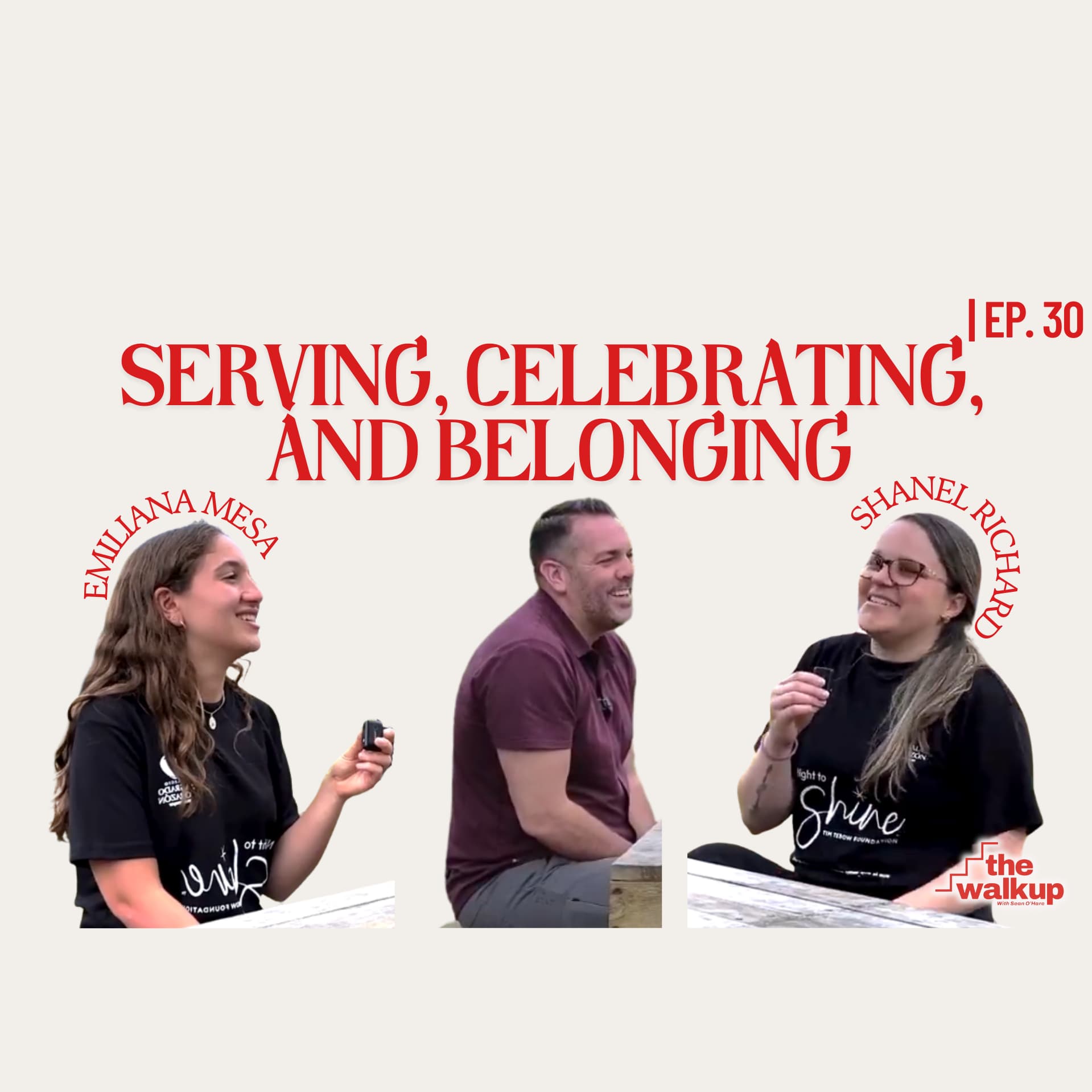
In The Walkup's second episode recorded at Night to Shine—an international prom experience honoring individuals with special needs—we sit down with Shanel Richard and Emiliana Mesa.
From leadership to friendship, advocacy to inclusion, their stories reflect the power of radical hospitality and what happens when a community comes together to celebrate every individual as royalty.
Transcript
Read the full transcriptAuto-generated · 2,858 words
Well, I'm happy to be here in Medellin, Colombia, at the Colegio Sagrada Corazon Montemayor. I'm sure my pronunciation was perfect. So, we're here because of Night to Shine. So, as those that have been watching our podcast know that I've been involved with this for going on 11 years now, and I've gotten to travel all over the world. I'm very lucky to do that. And last year, I was in Bogota, and then this year, we had the opportunity to expand into Medellin.
So, we've never been to Medellin. This is the first time. You're not going to be able to speak about it from experience, just from the anticipation. So, we are one hour and 15 minutes away from the start. So, tell me, how did you decide to get involved? So, Chanel and Emmy. So, we'll start with you, Chanel. What made you want to get involved and volunteer?
Okay, first. I have a son, and he got some disability. Oh, he does, okay. Yes, he's two years old, and I always wanted something like that for him, to be important for the society, and to be... Or to have the opportunity to shine, like it's your night, you're going to have fun, you're going to have a crown because you're the king of the night, and I always want something like this for my son, so I think that it's a beautiful occasion, and we can celebrate all the people.
So, I think it's a great opportunity. Do we know how many guests with special needs we will have tonight? I think they told us about 70. Oh, that's great. Fantastic. And do you know where they were able to invite people from? All different foundations or schools? How did they invite them? I think they found people in different foundations. And myself, I shared the invitation with the physicist of my son, so she knows a lot of people with some disabilities, so I told her that she could.
Invite them if they want to be part of this. Because there's not other programs like this that you've seen before? No. For me, it's my first time, and I think it's very great. Great. Well, we'll try to make sure we exceed your expectations.
I hope so. And what is your... Do you work here at the school? Yes, I'm a psychologist. I work at the... In the CAP. I don't know how to say it in English. It's like... Like the medical office? No, it's a center where we got some children with...
Oh, who have different needs. Yes. Ah, okay. So, they need some extra attention. Yes. So, I work there, and I'm with the middle school. Okay, and I just learned there's 700 students at this school. More or less, yes. It starts in preschool and goes all the way up to high school. Yes. And I noticed that that's a common thing here in Colombia. In the States, it's rare. We really separate all of the schools. I like this more. It feels like it makes more sense.
I think you should, I don't know, I wonder if it makes, psychologically, you could tell me. I wonder if, you know, when you're in your teenage years, and you're getting rebellious, I think there's something good when you still get to see what you were like maybe a few years ago, or when you see a little preschooler, and it maybe keeps your... Keeps you in balance, no? That's it. That's true. I feel like I would act out more. If I'm only around other high schoolers, I feel like I would try to compete against them, but if I could still, you know, see the whole age group, I feel like it would be more, yeah, I would have more of a sense of where I came from.
It's more like they're acting like a family, a big family. So, you have little brothers and older ones, and it's very nice. Yeah, I think that's what it is, a family. And then, of course, it's being... You have a Catholic school, you also have the family with the priest, and the community in prayer, and having that kind of idea of a family as well. That is true. I saw the chapel here. Yes. Are there Masses every day, or sometimes a few times a week?
No, always the first Friday of the month. So, today, we had the first Mass. of the February month. Yep, okay, gotcha. And then otherwise, how is kind of the spirituality incorporated into the school? In all the grades, they are having a religion, and sometimes some of the groups went, how do you say, .
Yeah. So, some grades usually go to, like, a shared activity with, like, both groups from the grade, and it is just a little bit more for, like, them to get to know themselves and God at the same time. Okay. Well, that is great. Yeah. And now, how did you find out about Night to Shine?
So, I am a member of the school's, like, leadership group, I guess you'd say, and our, like, the big leader, our head, he came to us and he told us, like, we're having this event, we would love if you could, like, go, and I was really interested because I'd never heard of, like, such thing before.
So, I just jumped right in, and I honestly, I love helping people, and just like being with people in general. I also want to be a psychologist. Ah, okay. Yeah, so. This is not fair. Two psychologists against one. Against me, this is not, I'm not a psychologist. It's not two versus one, it's two versus.
Less than one. Yeah, try not to psychoanalyze too much. Don't worry. So, but what was, like, what did you think when you heard about this kind of prom for people with special needs? Well, I thought at the beginning, I was like, this is really, like, not common at all, because I'd never heard of it or, like, anything similar to it.
And I think it's a great opportunity for a lot of people to come together and help each other, not only us helping them feel special, but also themselves knowing more people like that, finding friends that are like... It's just, it makes your life, like, a little easier, like, when you have friends that you can talk to, and, like, people you really know. So, I think it's a great opportunity, and I just, that's how it came to be. And what preparations have you been making with your leadership team for tonight?
So, we've made about, I'd say, maybe 50%, like, 50% of the posters. Oh, you have an hour before you make the other 50%? Oh, no, your team just did half of them. Yes. Oh, I thought you were saying you only have half of them done. I was like, we could stop the interview now. We did 50%. We did 50%, and then, like, so, or, like, we just did the signs and stuff like that, because we also wanted to put, like, our little, like, touch into it.
Sure. So, it is like a little grain of sand. Yeah, you're going to, it's a really amazing experience with the red carpet, when people arrive, you know, the signs, and it's just, you know, these individuals that are, you know, I was in Peru when I did this. I was there twice, but one time, this is a small town in the north of Peru, and...
We got to deliver the invitations personally to the guests, and so we went to this family's home. So, it was like the cousin, he has Down syndrome, he was probably like, I don't know, maybe 18, 20 years old, and so we invited him, and we explained, hey, we have this party, there's going to be dancing, and he's like, he already started dancing right there, he's like, I can't wait, and then his It was the grandmother who was taking care of him, and she was very emotional, and so we were talking with her, and I said, oh, you know, like, has he never gotten invited to a party like this?
And she said, he's never been invited to a party ever. This is the first time he's ever invited to any party. And it was just like, you know, like, obviously, we wish that weren't the case, but, and then in this situation, as a small town, so the whole community came together. I mean, the police officers were helping to take people, because they didn't have a ramp. So, that's okay. We'll just pick everyone up who needs to, who's in a wheelchair.
You know, this would not work in the States. The insurance would not allow these things, but they didn't care there, and then his little cousin, she was maybe four years old, and she was very suspicious of me, which I think you can appreciate your understanding why already, and so I said, oh, you know, she... Why doesn't, you know, she smiles. No sonrisa. She says, oh, she doesn't smile because her mother has a mental illness, and she abandoned the family, and of course, I felt terrible, and I said, oh, is she going to come to the party, to the Night to Shine?
And as you know, we try to keep it to like 14 years of age and up. And the grandmother said, oh, no, I didn't think she was invited, because, you know, it's only... And I said, no, no, she can come as my date. So, she got all dressed up, she had these, like, pretty bows in her hair, and not surprisingly, she was like, the smiles were there. She was all, it was just like, and kind of like you were talking about before with, like, you know, acting like a family, right?
This allows for an opportunity for everyone to come together, you know. So, what are your hopes for other, what is the disability type that your son has? It's a rare condition. For now, I think there's only 16 people around the world with the disease.
Well, that's very rare. Yes. It's a study about some gene, and the gene is TAF1. Okay. It's very new. I think they found it in 2015. It takes the kid longer to walk, to sit, or something like that. It's more physically.
But if you see him, he doesn't have some physical sort of indicators. No, he got two years old, but he doesn't walk. He's kind of capable to sit down, but not for too long, and if someone is... Right over him. Okay. But he's going to kindergarten. He has some friends, and that's the situation. Yeah. So then, I was... You know, I think there are different experiences that people have. Some are as the volunteers, some as the special guests, some as the parents, you know.
So, I mean, what do you imagine it will be for you tonight to see this whole community of people with being celebrated? I think it is amazing. I hope that it will be like this because, like you said before, it is not something that you see often.
With the guy with Down syndrome, that he never been invited to a party, so I think it's a wonderful occasion to them to be celebrated and to be the king of the night. So, I hope that we can be able to enjoy as the same as we saw on the video they shared to us, and I think that only see them smile.
And what is your experience, Ben, and other parents of children with disabilities, what is it like in Colombia overall? Is it very supportive? Is it hard to find the right resources? Is there an embrace of special needs? It is kind of complicated, I think.
We don't know. We don't know. Any other family with the condition of my child. But it is a chromosome. Yes. It's all about genetics and stuff that I really don't understand. Do you know the Jerome Lejeune Foundation? No. Okay, so they're in Paris, but they also are in the States now. Okay. But they are the number one research in the world for Down syndrome and all chromosome disorders. Okay. So, I will connect you with them. Oh, thank you. There might be, they're the largest amount of research.
They've been around 30 years. Okay. So, Jerome Lejeune was the geneticist. Who discovered the Down syndrome gene, like, in the 60s. And so, he was, like, the top scientist in France, and he won, like, these big awards, like, he would have won the Nobel Prize, things like this. But, unfortunately...
People used the ability to diagnose Down syndrome to be able to identify in the womb when the mom is pregnant to be able to abort the child, and he is like, no, this is not the reason to do this, and he is very pro-life, and so he started this foundation to help support the Down syndrome and other chromosomes, and there is another Person I know, I won't mention his name because I don't know if he's comfortable with me sharing. He's a very influential man in the States, and his daughter, who's now 18, she has trisomy, trisomy 23, trisomy, I don't remember, but it's also very, very rare.
Not as rare as what it sounds like your son has, but let's make sure to connect on that because I'd be happy to. Because we have been trying to contact some investigators in the UK, and someone in Valencia, Spain, but it is very difficult. The families here are very supportive, but... In health condition, it's more complicated because my son needs a special carrier, and it takes like one year to have it. He needs other things that takes a lot of time.
Sometimes it's complicated. And there's support from the healthcare system? I mean, you can get these things? Yes, but we have to wait. It's very complicated because it's very rare. It costs a lot. Yes, it takes very long. So, you're here at work, so you have family to help take care of him during the day? Yes, thank God I have my mother, my father, and my father-in-law, and my mother-in-law. So, they take care of him Monday, Tuesday, and Wednesday, and the rest of the week is at the kindergarten.
Okay, and what is his name? Elias. Elias? Yes. Okay. Like Elijah. Elijah. Eli. Yes. All right. Well, we will try to find some resources for him. So, we will see if this is a final question or not. You never know how long I will talk.
What do you hope is the result for your friends? When you first heard about it, were your other friends like, what is this thing? Because it is very new, it is something unique. Did you have to try to convince your friends to get involved? Well, not really, because my main friend group consisted of seven people, and then... Four of those are in the same group as I am, the leadership group, so we all went, like, right in, but the other, like, people who weren't, it's just, they weren't able to come, but they also think that it's, like, a great opportunity, and it's, like, a great, like, initiative, but honestly, I think that they made me want to come even more.
Because I get to be with the people that I love, also loving more people, and I think that is amazing. That is great. So, you said somebody in your group told you about it, but they showed you a video?
There wasn't a presentation from the school or something? No. Not really. They just kind of, like, told us a little down on the low, because we got the news, like, way before the rest of the people were. Ah, okay. You're in the VIP group. Got it, got it. Yes. Oh, I see. So, we got the inside information, and then, like, we immediately said yes, and then we opened up, like, inscriptions for, like, the rest of the school. Okay, great. All right.
Well, then, well, I think you guys are going to be fantastic leaders and volunteers. I'm going to, I'll just follow your lead when I'm here. I've been so lucky to do this. So many different countries, and of course, every one is a little different, but then there is also a universal component to it as well, that there is a joy that just kind of is expressed when you have. People coming together to celebrate those with special needs. So, well, thank you for taking the time to talk with me, and I am looking forward to an incredible night to shine in one hour. So are we. All right. Thanks, guys.
More from The Walkup

Against the Odds: The Samurai Lawyer (Chad Flores) | Ep. 52
Faith, Sexuality, and the Fog of War (Iris Bahr & Father Rick Riccioli) | Ep. 02
E2
Church, Conflict, and Community (Iris Bahr, Father Rick Riccioli & Rob Long) | Ep. 03
E3
Hope, Vocation, and the Global Church (Colm Flynn & Colin Nykaza) | Ep. 04
E4