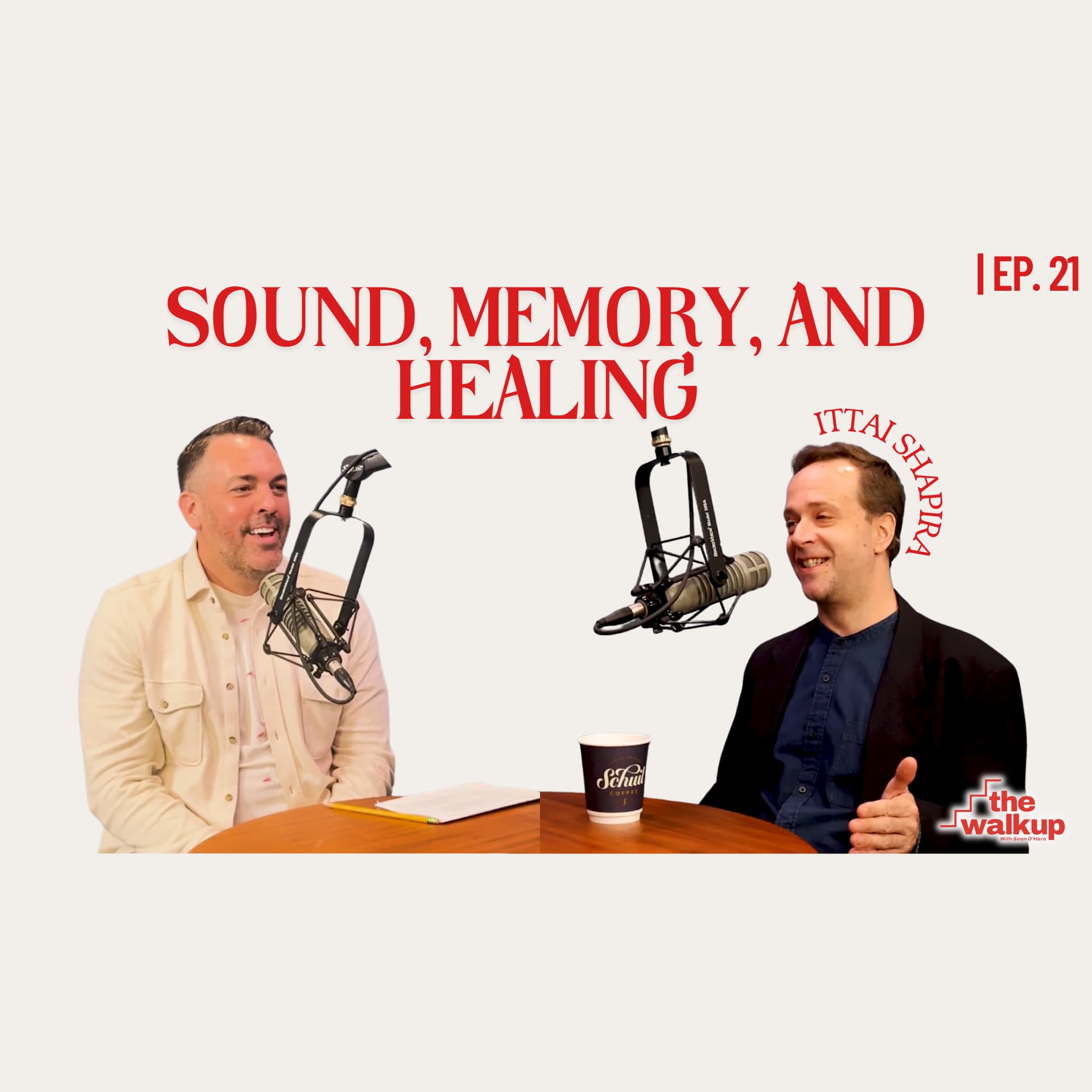
Violinist and composer Ittai Shapira joins The Walkup to explore the deep interconnection between music, memory, and healing.
From his early studies in Israel to a critically acclaimed Carnegie Hall debut and a lifelong commitment to commissioning new works, Shapira shares the personal and collective narratives that have shaped his career. He discusses his collaborations with composers, performances for film and theater, and his groundbreaking work in music therapy — using sound to help audiences and patients alike process trauma and rediscover identity.
Transcript
Read the full transcriptAuto-generated · 11,904 words
So, Itaz Shapira, thank you very much for joining us, and we're here to talk about music and healing. So, I thought we'd start with music, and then we moved into healing and composition. So, why don't you tell us first, like, how did you get your start in music? Was this always a part of you since you were born, or how did you find yourself on a journey to become a professional musician?
Well, my parents did listen to a lot of music. I had a friend in kindergarten who played violin, so I liked it, and I wanted to do it also. But I think my mom was worried about a little boy scratching away in the house, so she kept pushing for piano, and after about three years in the negotiations, I said I could take one violin lesson and one piano lesson, and then I get to choose, so I chose the violin.
And what was it, you think, about the violin versus the piano or other instruments that appealed to you? You know, I mean, now, I love all instruments, but at the time, I think it was just, I really liked the sound.
It's one of those things you can't really, you can't describe why something appeals to you, because how old are you at this time? When I heard it, I was five. I started playing when I was like eight and a half, which...
Years later, when I went to Juilliard Pre-College, I learned that it was extremely late. Everybody started at three. But your parents played music in the house, but they themselves were musicians, or no? No. My dad took some violin lessons as a child, but they were not musicians. Interesting. So, just a personal passion of yours, and then, I don't know, my oldest brother is a... Talented musician, primarily in saxophone, but I remember watching him rehearse and practice and practice and practice, and I was like, oh, heck no.
I am not doing this. I just saw the amount of discipline it took and the hours of work. So, I mean, what about that part of it, the amount of discipline it takes and the amount of effort to really master an instrument like that?
So, when I first started, it really was just for fun, and I enjoyed it, and I continued all the sort of normal activities. I always like to joke around and say, I have a belt, and I want a...
The second prize in the judo competition in Israel. Okay. Yeah, but I was eight years old, so it really doesn't mean much. You've won more judo competitions, or you've placed in judo competitions more than me, so that's... Right, so soccer practice, school, everything was sort of, I would say, pretty typical until I was 12. And when I was 12, I auditioned for the person who was probably the most well-known violin teacher at the time, and she was in her 80s.
And she said to me, You have to make a decision now. If you want to be a professional violinist, you study with me, and if you don't, it's okay. You just go study with someone else. So, I would say that was the day that I already knew I wanted to do, but that's when I really started practicing.
I would say at least four hours a day, and doing competitions, and everything was centered around that. And you grew up in Israel? Yeah. From all the way through childhood? When did you come to the States? For most of my childhood, my father is an academic, so we spent a couple of years in the United States growing up, but I was in Israel until I was 15, which was when that teacher passed away, and there was no one on that level for me to study with.
So, my father came to New York for a year for a sabbatical. We joined him, the rest of the family, and I started Juilliard pre-college. And here I am, decades later. We just stayed. Still in New York, right? I always say, the great thing about New York is the world comes to you here, right? You don't have to, you can still travel the world, but everyone at some point ends up in New York. Do you think that your childhood in Israel shaped your music, or shaped how you pursued violin or composition?
I would say definitely the violin, because when I was growing up, it was certainly a prevalent part of society, and there was a tradition. A lot of the old generation came from Europe, and my teacher was particularly influential. I was her last student, and I'd say about 20 years ago, I started a foundation with my colleague, Haggai Shaham, who plays in one of the clips.
And we named a foundation after her because we realized just how much she's really, how responsible she was for the Israeli school of violin playing. And I think it was also a very good preparation for... For Juilliard and New York and the international scene, because she was very, very demanding.
I think if she had a teaching position today in the United States, she would be fired. For being too demanding. Yeah, but I think it really prepared me. Did she make you do push-ups in between rehearsals? I guess, exactly.
So, I think that my transition here was actually a lot easier. ...than it could have been, and a lot easier than I think most people have experienced, because everything seemed simple after that. Comparatively. So, she made Juilliard seem...
Not easy, but simpler than it would have been had you been brought up in the States. That is quite a compliment. I am sorry, what was her name? Ilona Fajer. So, you named your foundation after her. Exactly. And now to jump ahead, I just want to mention that when I started Music and Healing, or even before I started Music and Healing, she was an amazing example of what healing...
...is, and how music can help that, because she was a Holocaust survivor. She lost everything when she came to Israel in her late 40s, and she completely rebuilt, and it genuinely gave her strength and a purpose and a focus, and I was one of the younger students. She never spoke about it to me, but I learned later on. I learned a lot, and I think...
That she was such a role model that even before I got into developing music for healing purposes, that must have been in the back of my mind to a degree. Well, I mean, and yeah, not to jump ahead, but this seems like a good interface with one of your works, the Sephardic Journeys, this exploration of diaspora and migration.
Because where did your teacher, where did she grow up? Hungary. She was in Hungary, okay. And then, she obviously finds herself in Israel after the war, so what was her journey like to get from Hungary and find a new life there in Israel? Well, I mean, she didn't talk much about the journey.
I learned later on from her. Great-granddaughter, whom I met in Cambridge later on when I gave a lecture, and she filled me in with some information. She ended up in a... A tiny, tiny city outside of Tel Aviv, living in a tiny, tiny apartment, and it has since, the city has blossomed, and the mayor of, it is called Holon, which literally means little sand, he was voted one of the top ten mayors in the world about ten years ago. So, that place has really, really blossomed, but it was a very humble rebirth, in a way.
Yeah, for sure. And so, maybe just take us through that, the Sephardic journeys. I mean, was she in your mind at all when you were developing this, or this is experiences from other friends and family, how you developed this work? Right. So, I mean, I would say to this day, when I have an idea for a new composition, I do my best to ignore it.
Because it's so consuming. It just completely takes over everything I do. So, when I have an idea for a melody or a topic that I'm interested in, I don't write it down. And if it keeps coming back again and again and again to a point where...
My sanity is to be considered, then I write it down, and I kind of see what can happen with it. And the starting point always seems very disparate, so there is usually some kind of a story I am interested in, some kind of a melody that I hear, and as I write more, I usually find a connection. And when that connection is strong enough, then I kind of really dive in deep. And the Sephardic journeys... It was a result of reading a book about neuroscience, oddly enough, and there is a section in there about the philosopher Spinoza, and about his being excommunicated by the Sephardic community, and having grew up in Israel in my generation, there was still...
A fair amount of, I wouldn't say separation, but the Sephardic culture was not as integrated as it is today, and I always thought of them as by far more versatile than the Europeans and more laid back, and that completely changed things for me, so I just wanted to learn more about it, and for quite a while, I avoided it. But when I finally did dive into it, I wrote it in a way that starts like a prayer, essentially an interfaith prayer, and slowly it develops to a series of dances that cover a very very vast area geographically for all you know all the countries that they were expelled from and migrated to and the the common theme was that they uh always had to um adjust and um acclimate but they always managed to maintain their identity so that was something that was very interested in so the healing aspect of that piece for me started with uh i wanted to write Music for xenophobia management, but then it became movement rehab, anxiety and depression, breathing exercises during COVID.
It went in a lot of different directions. And this idea of prayer, I am kind of fascinated by. So, when you say it starts kind of as a prayer, is that because to you it comes across that way, because it has an explicit spiritual dimension, or because music, in a lot of ways, has kind of a spirituality intertwined? Expound upon that for me. So, I am not religious.
I am interested in religion, but I did not grow up in a religious household, and the particular prayer that I sort of was hearing was sort of, it meant to depict a prayer in Cordoba, where the Muslims and Jews had a very sort of Amicable and integrated existence, to a point where it is almost difficult to ascertain what is what.
And there is a Judeo-Arabic dialect as well in some countries, so that was essentially the starting point. And then when I wanted to trace what happened after that, particularly after the... And to this day, I learned a lot of interesting things, because growing up in Israel, you just kind of take these things for granted, right? Everyone is, at the time, was second generation, and we never really asked where they were from or what their history was. We just kind of saw them as Israelis, and that was it.
Right, right. And so, but the... The prayerful aspect, is it because it's meditative? Is it because it calls to mind something outside of ourselves? What aspect of it brings a spirituality or a prayerfulness to you? Yes, but I would say that...
And now that I think about it, I'd say a lot of my compositions start with sort of a statement. So, it has a little bit of, I would like to think, maybe a quality of an orator. Okay. So, it's sung, but there's a little bit of sort of essentially of a statement of what the piece, what the journey is going to be about. Interesting. And for you, as you're composing something, you mentioned there's this, it just kind of starts appearing in your head, or the melody, and I think, is it similar for...
For other composers that you know, is it that process, or they're more about writing it down first and playing with it, or, I mean, I think that there's these elements where it's like, it's just a gift, you know, there's these, like, where does that come from, that all of a sudden you've got this melody in your head and you can't get it out?
I mean, it is a great question. Where does creativity come from? Yeah, if you could just answer that for me, that would be great. I think every composer works differently. I did hear, by the way, that the Beatles did not write down melodies at first.
But I would say that one of the things I am still the most interested in is memory. Right. And I think that if we really just don't remember something, then it's either something to stay away from, or it's something that's just not that important. So, a lot of times, if I would have a melody...
Maybe you've had a drink at a bar, and I think, oh, this is really cool. And then if I get home and I don't remember it, then it really wasn't that good. Okay, so it has to kind of withstand a certain... Exactly, exactly. Huh. Yeah. That's a lot of trust you have in your... More mistrust. Yeah, right?
Oh, right, right. You're mistrusting it, so it has to prove itself to you, almost. Yeah, I think it has to be significant. You know, I'm just remembering... My very first conversation with Salman Rushdie, whom I ended up working with a few years later, was I asked him, when you write a book, do later chapters always have to be connected to the beginning in some way?
And he said that in order for a creation to be successful and meaningful. It has to have sufficient imagination. And I thought, wow, that is just so much better than how I would put it. He is a writer. In fairness, he is a writer. So, I think the imagination has to be sufficient.
Yeah, it is interesting. I come from a Catholic tradition, and the... A lot of times when there's, you want to start a new religious order or a new ministry or a new outreach, there's often a very lengthy process, and part of that is this mistrust of saying, well, if it's really You know, in our case, led by the Holy Spirit, so to speak. You can wait a few years. So, like, most people would be surprised or shocked to learn that Mother Teresa, for example, she wanted to start her...
Her ministry to serve the poorest of the poor. Now, you would think, if somebody says, I really want to serve poor people, you would say, well, go, have at it. Please do it. But she was already a nun. So, this was an additional, she called it the call within a call. She already knew she wanted to be a religious sister and dedicate her life to serving others, but then she saw this particular need to serve the poorest of the poor. She was, I think, teaching at the time.
And so, but the church, we have a very formal process by which you have to make a kind of a An appeal to the bishop, he considers your appeal, then there is a whole process by which you start a new religious institution.
And so, I think she was waiting for a reply from the bishop for one letter for like three years. He is just like, well, I will consider it. And then three years later, he finally just replied to her letter.
But the idea is that if this is really God's will, if this is really inspired by... By the Holy Spirit, then waiting a couple of years is not going to diminish your enthusiasm for it, right? And so, she eventually went ahead and started what became the Missionaries of Charity, which are now all over the world.
And that happened another time. There was this well-known film, which of course, now that I say well-known, I can't remember the – I think it was called Into the Silence. It was all about this – they wanted these filmmakers. I wanted to follow or go into this monastery and see what the lives of the monks were like, but they've been living the same way for a thousand years, right? They don't have phones or computers or whatever else, so they wrote a letter from the filmmakers and said, we would like to film.
Here's how we would do it. Here's why we would do it. We think it would be very interesting for people to see what the life of a monk is like. And they said, okay, thank you very much for your letter. We will take it into prayerful consideration.
Ten years later, they sent a reply, and they said, okay, we have prayed about it, and yeah, we would like for you to come. Make this film. And honestly, it might have been more than 10 years. It might have been like 15 or 20. And in the filmmaking business, it is a good thing those guys were still in the filmmaking business. 10 to 15 years later, you might be on to something else by that point. But it ended up being this gorgeous.
Gorgeous film where they, I mean, it is, in fact, into great silence because you're just watching their lives, you know, watching them in silence pray, in silence work, in silence write, in silence, you know, mend their garments and things like that.
And so, there's something about patience, right, or something about letting an idea prove itself to you over time. I mean. So, discernment is not one of my better qualities. I am more of a, you know, ready-fire aim kind of guy. I am trying to be a little bit better at really going on. Is this something I am supposed to be doing, or am I just excited about it for right now?
So, you have stayed true to that, though, or have you found at times you did it the other way, where you responded to something quickly and found out, okay, this wasn't … This wasn't the idea I thought it was.
So, I would say the first phase is waiting, and then usually if I have five or six ideas, then hopefully some of them are contrasting enough, then I see how they work with each other, against each other, then I know I had something. And then I go through what I call my very brief.
Jackson Pollock phase, where I just sort of write and write and write and write. I'm sort of like a man. And then the hard work starts. So, that's when really sort of this patience and more discipline has to occur.
Because then it really is not so different than practicing the violin, and I am listening to what you are saying now with great interest, because I did not grow up in a religious household, but practicing an instrument, practicing the violin, and I think listening to music in a certain way.
It has a lot of commonalities, right? So, you need to have patience and concentration and respect, and I think once one has that, the spiritual experience, the pleasure, the healing is enhanced, right? So, it's not just some... I mean, yes, it could be a very beautifully random thing, but at the same time, if we're sort of, I don't want to say conditioned, but maybe primed to create or listen or learn a certain way, then I think it's more meaningful.
Yeah, and I think... There's something about that level of patience, whether you're talking about, in your case, allowing music to, and through practice, through discipline, to reveal itself, right? And I think if I compare it to prayer or to my own prayer life, as I've gotten more, I hope, more mature in my prayer life, I think I've— In previous times, I would go to prayer with a kind of like, I need an answer now. What's, you know, I've got this problem, you know, God kind of as wish granter, you know, a version of Santa Claus or something, right?
As opposed to now, I'm trying to do a better job of. Of allowing that prayerfulness to kind of wash over me and reveal it, kind of like how a stone over time gets rounded down and the hard edges get softened, and not going in with as many of kind of a wish list, but more of a, hopefully I can.
Allow God to reveal something about myself that he wants me to see, as opposed to, you know, in the Our Father prayer, we say, you know, thy will be done, but a lot of times we really mean, my will be done.
I mean, I say that, but really, I really want this thing, and I've been pivoting my prayer, I think, of late in a much more... A cognizant way to be like, I really want to mean that. I want to mean thy will. I want to mean that even if it's something that's revealed to me that's difficult or humbling or embarrassing or something that I've got to change, that I'm not going to be resistant to that, especially when it's something that means.
You're not going to get the answer right away. The thing is not going to get fixed. And I think that's kind of an interesting segue into what you spent a lot of your, what I would say, vocation. I mean, I think you found your vocation, your work of life in connecting music and healing, especially those that have been through trauma. And I think it's one of the things with… With trauma that, I mean, you would know much better than me because you've been engaged in this for a long time, but trying to seek out quick answers we know is not necessarily the route, but there's a lot of, I think we do a good job of knowing, the mind can do a good job of suppressing or compartmentalizing.
And I would imagine prayer, much like music, much like this kind of washing over you, can hopefully help reveal. But I am intrigued by this intersection of music and healing, because I think there are a lot of wounded people out there, a lot of trauma. We have all been through stuff, and if music is something that people can access to be able to open up those...
Those channels, it's a very powerful tool, so I'd love to learn how you came about doing this. Well, I mean, I would say it started with my own personal experience. I was attacked by a gang many, many years ago.
Did not have any of the symptoms that I was told I was going to have. I had no nightmares. I was able to go on tour a few days after the attack. How old were you at the time? I was in my early 30s. Okay. This was in New York. Yeah.
So, as a result of this attack, I did not remember what happened. I had brief zapping headaches on my cheekbones that were accompanied by a very consistent sequence of notes, and it happened every few hours for 18 months. Whoa. So, at a certain point, I thought, well...
It would be nice to get rid of this. Sure. So, I just jotted it down, and I saw myself on ice, and I never go ice skating, so I couldn't figure out what it was in the beginning, and then I realized, oh, that's the moment I woke up.
From the attack. And then more sounds came, and I wrote them down, and eventually I was able to piece together most of what happened, and the headache completely went away. Oh, wow. So, I wanted to know why that happened. Sure. So, I started to read some books about neuroscience.
I've gotten in touch with a very well-known neuroscientist, Joseph Ledoux, who's the head of the... NYU Emotional Brain Center, amongst many other institutions, and is particularly well-known for his research on, well, what used to be called fear. He doesn't like that. It's an organism set response, set of responses to danger. Sure.
And he also has a band called the Amygdaloids. He's very interested in music. So, we became friends, and I was able to get a lot of interesting information. But I thought, okay, that was kind of a quirky personal experience, and it's nice to have it behind me, and I thought that was it.
And I didn't write anything, and then the Sephardic Journeys was my next piece. And at that point, I was giving lectures. Particularly about music and memory, how music can be used to improve our memory and improve our performance.
And before I knew it, I was asked to give a lot of lectures about a lot of different topics that were not my expertise. So, I started to feel a little ridiculous. And they were all at top institutions. It was an honor, but it didn't feel genuine.
So, Dr. Ledoux introduced me to a woman named Connie Tamina, who was the co-founder of Oliver Sacks. The Institute for Music and Neurologic Function, and I played for patients, and I kind of followed what the music therapists were doing, and I mean, I have seen really just incredible things happen. For one, this woman that one of the patients I played for was screaming at the beginning of the session, and then she told me to do a few... Rhythmic exercises to sort of play a few rhythmic patterns, and then after 20 minutes, she kind of quieted down.
We did some melodic things, and by the, and I don't know, I'm not even sure why, I ended up playing a Celtic dance for her, and she was. Sort of dancing in a chair, and by the end of the hour, she said that she knows that her pain will always come back, but for now, it has been unlifted, and it was a pretty incredible experience to see, considering that she was unable to speak at the beginning of the session, and of course, the question I had in my mind was, well, what is she going to be like tomorrow?
Sure, yeah, it was just a temporary… And then, how do you compare sessions? So, I realized that in order for me to be helpful… I should stick to what I know and try to give it to the experts, and that is when I started essentially developing my own music and tailoring and retailing it for different therapies.
A, because I thought it would be more genuine if I did that from the get-go, when I have an idea, and B, I would never want to butcher someone else's music without their permission, if that was not their intention for that purpose.
So, it is how I started, but then it sort of became the format. So, it kind of connects various... Angles of what I do, right? So, I'm still essentially a performer and a composer who works with experts towards, well, hopefully towards healing of all sorts outside the concert hall.
So then – so if I understand correctly, you're taking your original compositions, working with experts. I assume neuroscientists is – Neuroscientists, psychiatrists, also PTs. I mean, let's say most areas of medicine, but also educators. Okay. And then are they – Okay. Is deploying, for lack of a better term, your compositions, your works into their therapy and seeing how, from a kind of scientific method, how it can be applied, or is it part of a treatment plan, or how does it get kind of lived out?
Yes, to all. Okay. So, basically... What I do is not really considered to be music therapy. Music therapists get very upset when they hear about what I do, so I call it integrated therapy through music. And they get upset. Why? Because they don't... Music therapy is, you know, again, something that requires a lot of... Time and patience, and there's lots of books written about the topic, and you get a degree, and there's protocol to follow.
What I do is, I mean, I speak to music therapists, and I have a lot of friends who are wonderful music therapists, but the idea is that I give music that I hope can be useful in just about any setting.
And that is why I tailor and re-tailor it to whatever is needed. So, quite often, the process with, let us call it the practitioners or the expert, is dynamic. I tell them about a general idea that I have, and here are the general melodies, and then they explain to me what they are doing, and I try to complement that in musical terms. And again, ultimately, the goal is...
You know, what is called in neuroscience, memory reconsolidation. So, it is quite often just viewing a challenge or a trauma in a different light, having gone through a certain process. So, the exposure to music or the act of listening.
By those that are dealing with the trauma, I don't want to call them patients, I don't know what the right terminology is, but... Users. Users, yeah. These participants, and they're able to then... Is access, so is there an unveiling as well of, I mean, if you've, let's kind of take it through a process. You've had some sort of trauma that are oftentimes we compartmentalize. We figure out how to suppress it so we don't have to deal with a terrible nature of what, reality of what happened, right?
But it's not gone. Is it a process by which the... This integrated music allows for the unveiling of it and dealing with it, or you say it's a recalibration of memory. So, can I help? Let me understand the...
I would say the life cycle, but the steps in the process. Right. So, I formed a small non-profit for this purpose. It is called Sound Potential, and the idea is the potential that sound has and the potential of being sound, and we have sort of artists and scientists and educators involved. It is sort of like a think tank.
And the idea is to provide a guided experience. Okay. So, you know, the very first person I was working with was a psychiatrist who had three failed back surgeries, so she was ready to try anything. Sure. And I sort of very carefully prepared melodies that I thought would be conducive to very subtle movements because, you know, I'm not a...
I'm not a doctor, so I… But you weren't going to have her do Celtic dance, I imagine. Exactly. And it was very sequential in that the changes were very subtle. So, the idea is that she would sort of hold on to the original melody and notice these small changes, move with them, and then after a certain cycle, realize, oh, this is what it was, and over time, for it to alleviate the pain. Basically. And when I did that...
And I spent a lot of time preparing for it. She said, oh, this reminds me of my prom, and this reminds me of this, and this reminds me of that. And I thought, oh, no, what a waste of time. I must have done it completely wrong.
But then, she lived in Florida, so I developed a series of videos for her. I had a singer sing simplified versions of the melodies, and then I had an osteopath suggest movements. So, all that was in a... Video is a guided experience, and it turns out she did it for six months, multiple times a week, and she said it helped her greatly, and even after she wasn't really experiencing pain, she continued to do it. So then, I was asked to do it in all kinds of scenarios, so she also had her PT was working on it with her.
And the, you know, maybe the more extreme contrast to that is I have been developing music for the healthcare workers at Weill Cornell. Okay. These are mainly a community that has worked with... COVID patients. Sure. So, a lot of stress, a lot of trauma. Exactly. Experiencing a lot of trauma, and this time, it is being done for a clinical trial. So, it will be measured and sort of... You know, they finish one phase, you're going on to another phase. It was compared to a literature intervention, and now they want just music.
And they just asked me to come up with music in the same melodies, but in different genres. So, I already had some bluegrass, but now they want pop and heavy metal. So, it will be interesting to develop that. Yeah, so that's an interesting question, because... Yeah.
Do you think that the classical form of music has a more, I don't want to say healing properties, but using instrumentation in a classical way as opposed to in a pop or, you know, something that's a little bit, nowadays we have so much music that's created, you know, on our computers.
Is there something about classical composition and performance that neuroscientists would say have certain healing properties or open up? You know, pathways to being open to healing? Well, I think, you know, contemporary classical music is essentially no different than any other genres, because, I mean, like in the 60s, there was a composer who wrote a piece for 12 helicopters.
There are pieces that require people to jump in the pool. You know, there's four minutes and 33 seconds of silence. So, I mean, these all fall within quote-unquote classical. The only difference between classical and other genres, I would say that stayed, is the length of the development of material.
Right, so let us say in jazz, you have a lot of improvisation, but the timing of it is usually very structured. Yeah, there is a lot of practice that goes into that improvisation. You have ragas that can go on for hours, but that is mainly improvisatory.
So, in terms of developing the ideas, I would say that the sort of most... I don't want to use the word complex, but the most lengthy is classical, but I would say that is the only difference that remained, because a lot of, especially the younger classical composers today, they do write a combination of live instruments and electronic. Pieces require DJs, so I would say the difference is a lot smaller than it would have been. I would say that I tend to be more conservative in my compositions in that way.
Not always, but I take the principle, I guess it is a combination of my own experience of practicing and writing, and the idea is essentially to keep focused. And to try to remember, no matter what the goal of the therapy is. Because to me, if you remember something, it means you have learned it. And if you do not remember something, it means you have not learned it. It does not mean you will not later. You just have not learned it yet.
And then with the… As you're working with specialists, so in particular, I'm curious about psychologists who are obviously treating their patients or working with them through some trauma, right? So, when I imagine these things are working in a complementary nature, right? So, again, getting back to kind of the sequence, for lack of a better term, music as part of that.
That treatment plan, right? Because it was interesting that you mentioned that when you play those compositions for that one woman, she was reminded of her prom. I assume she wasn't listening to, her prom didn't feature Mozart and Bach. Right. But it's interesting that it would bring out, you know, certain memories.
Are the psychologists looking at it like, music can be used as part of treatment to then unlock memories or to process them more healthy, and then they can kind of do the work. Okay, hey, we've now discovered you've suppressed this thing, this experience, and now we want to work on it almost like...
I imagine almost like the way the melody is popping to your head, and then you have to do the work afterwards, right, when you're really hammering it out. Is that a sequence, or how does it kind of... So, I mean, at least from the reports I got, some of them use it as part of the session, and then they talk about it and see the reaction. And some of them then later on just say, let's do it at home. Right, so it's any combination, and I think the very basic principle is that you'll probably read a lot about how there's evidence that music increases dopamine flow, and there's evidence that music unlocks memories, and it can help with...
Cortisol, and it can do this, and it can do that, and some even say that if you find the right frequency, it can kill cancer cells. Some say that they found the sequence of the hum of the universe. I think there is no end to the material that is out there, but the bottom line is, I mean, the simple basic principle is that The activity of listening to music connects more brain areas than just about any.
And we all know that anecdotally, but to then have science behind it is fascinating. Right, so the question is, then, how do you connect it? So, when I started to do this, I was obsessed with, oh, how do I fix that part of the brain, and how do I fix this problem? So, I was reading and reading and reading and reading and speaking to experts, and I developed my music hoping to reach that.
And then, over time, I realized, you know, what a ridiculous goal. Because no brain area is healed completely unless it connects with others, just like none of us are healed unless we connect with others. Yeah. Well, because it seems like, because I mean, so much a part of trauma is to, you know, identifying where it's coming from, then kind of understanding what happened, but there's an element of forgiveness, whether forgiving yourself or having to forgive somebody else, right, whether they're alive or dead, for that matter.
And, I mean, are we, where are we in this process? Is this like a brand new field? Is this... It's certainly not a brand new field. The first person who is considered to be a music therapist is also the person who invented the alcohol compound.
You know, centuries and centuries ago. Well, those two things can go together. There is a lot of healing with alcohol. Or maybe the source of the trauma, and then... You know, shamans in many, many different cultures have been using music.
Maybe they didn't quite call it that, but, you know, for centuries. I think there is a lot, a lot of growing evidence. Right, and also, I think it's also the reality of the health system, that it's completely overload, that there's more addiction than ever, and people are just open to trying new things, which I think is wonderful.
Yeah, and I think, obviously, we need kind of all the help we get, and I guess, yeah, when I think about my own Catholic tradition, I mean... Chants, you know, polyphony, classical music, of course. I mean, a lot of compositions were made, you know, for liturgy, for worship, and they even, we have, in a more contemporary sense, you have what we refer to as like praise and worship music, where there's often a lot of repetition involved, which you notice that's very helpful and kind of, because you can start to, not tune out, but you kind of get used to the rhythms, right?
And they even... You know, we have the rosary, right? And people are like, that must be very repetitive. Well, actually, I think that is part of the point. There is one physical part of it, that you are holding something, in this case a rosary, but then the repetition of the same prayer over and over and over almost allows you to... You have got that down, so you can start to go into a deeper meditation? Right. It is also familiarity. Yeah. I mean, I am thinking about what you are saying, and I also provide musical for educational purposes, so this is not just for hospital.
And quite often, I find that people do not want to know about certain things. It is hard for them to grapple with certain topics. And if you just put it in a different context… That opens it up, makes it a little bit easier. And one of the projects, which I think is a good example, is the one that my... My friend and I, the visual artist, Alexander Klingspor, did with Salman Rushdie.
So, the music that I developed from that piece is for PTSD management, because the main character in the book of Midnight Children is a veteran with PTSD. But, the style... ...in which Salman Rushdie writes is a magical realism. So, the idea there is to learn about, you know, a very, very difficult topic of war through a veteran who sort of speaks in fantasy, and in it, there's a very, very harsh reality. And I think it's a way to get a lot of people...
interested and think about in a different way and experience it differently. So they don't just think about the, so you don't just get resistance or stereotypes when the topic comes up. Interesting. Yeah, and had there been resistance, I mean, in the contemporary sense of combining Kind of psychological treatment along with music. Has there been resistance from the more traditional sides of psychology and psychiatry, or is it, hey, we... We'll welcome any opportunities that are available to help our patients or users.
Right. I mean, I wouldn't say they welcome any opportunity. There's a lot of discussions and a lot of conversations, and of course, in hospital settings, it has to fit their protocol and legal issues and all that. But I would say there's a lot of interest, for sure, for sure. And I've also, over time, provided some music for... Youth orchestras, choirs, so they literally just learn about a topic in the middle of or beginning or end of rehearsal, right?
Climate change, women's rights, interfaith, you know. You know, it's usually these are topics that, of course, I think should interest all of us, but usually... I, when I get to a point of really writing a piece, yes, I'd like to think I'm going through some kind of a journey of self-discovery, but really, I'm influenced by someone that's close to me, that is interested in something I don't quite understand and I want to know more about. So, I learn about them. And usually, by then, I was like, how could I not think about this sooner?
And I'm so glad I went through this, and what can I do to help others? Well, that brings up, you have a lot of varied cultural inspirations for your music as well. You mentioned the blues, Korean, Celtic music tradition.
So, is that where it stems from, this kind of curiosity of where people come from, and also musical traditions? Yes, so it is usually, I like to learn about something new. And I like to think about how it connects to something I do know. So, in my dream world, the format of a concerto, meaning a work for a solo instrument and orchestra, is very roughly speaking about half an hour long, sometimes less, sometimes more. So, I usually take two conflicting ideas.
Or two disparate ideas and try to connect them. So, in my fantasy world, in my piece, it resolves within half an hour. It doesn't quite work like that in the real world, but usually when I want to write another piece, I think about something completely new.
And part of that is when you're taking two different traditions. Yeah, or two different elements. And by... Smashing them together or connecting them, hopefully something new kind of results from it. Exactly. That is the idea. And again, a good place to be in New York because you can get exposure about anything.
And, I mean, what is your sense of kind of the – there is always a concern about – Young people not being as interested in classical music or in instrumentation as much as we might have been in our childhood and certainly before that.
How is it that you and your peers see the future of classical music when it comes to the interest from those in a younger generation? I think there is definitely less exposure in schools, which is really, I think, sad, because there is so much that can be learned from just playing an instrument, even for those who do not necessarily want to become professional at it. Coordination, memory, listening, etc. I think once there is exposure...
There's a lot of interest, and, you know, one example that was an amazing reminder of this is I, you know, most of the big cities where I go, the hall buses in gets either to the rehearsal or for some activity, you know, and it's always a pleasure, and certainly for me, ever since I'm...
I've had my own son. I enjoy it even more. But one time, we played in Oklahoma. And, you know, there is a quote-unquote standard concert in the evening, and then the contract said the next morning we had to go play some school. And the van that picked us up was, you know, the cushions were completely torn, and the person that picked us up said, oh, don't worry, you know, the kids tend to rip things sometimes.
And I thought, oh, you know, where are we going? And it was... An unbelievable experience, because we played a music that was not easy to listen to, even for professional musicians. They knew everything about instruments and how they're played and how they're practiced. And they listened to the challenging music just with as much curiosity as the more standard pieces. And when it was over, they just didn't want us to leave. I mean, I really had to sort of like... I apologize.
I run to not miss my flight. But it was an incredible example of how they had the exposure, they had dedicated teachers and staff, and it made a big difference. I think the greatest example, of course, is El Sistema in Venezuela.
There's a whole system of orchestras and schools that are involved, and it's amazing what it's done for the people that are involved. I do think there's a—this thing is kind of ebb and flow to some degree, but I think there is this desire for the more tangible and physical and in-person experiences, and we're reaching kind of a— There is a limit in our ability to just only consume things digitally and on our own. Exactly. I mean, I think the pendulum is going to have to swing, to swing back a little bit.
Well, if it encourages you, I think I mentioned when we spoke on Zoom before this, was that a friend of mine launched a... Little concert series, and this was just, I guess, two weeks ago, maybe, and had over 400 people listening to a, I don't know, to an orchestra, and all the musicians were probably 35 and under, and all the, and the majority of the attendees were probably 30, 35 and under, and so I don't know that I would have. I anticipated that, you know, on a Thursday night, this would be like, it was like the cool place to be.
Everyone got dressed up, and I would suspect the majority of them don't have a... You know, a long exposure to classical music, but you make it an experience, and now you've just given people this gift of connecting in, you know, around beautiful music, around a beautiful experience. And then there was, of course, an after party that went till the wee hours, but just, you know, an important element as well. But I do think that we, the pendulum is swinging back. I mean, I will say, when I played...
For example, in Belgrade, Brazil, Costa Rica, the audience is noticeably younger, much, much younger. I would say most of the audience, I would say, is in their... 20s and 30s, and they're genuinely excited about it. You don't have to sort of coax them in. You don't have to explain to them because they have it in schools, and I think that's really where it should start, right? And then people can always choose. I want this. I don't want this. So, you'd say that internationally, you're seeing more of an emphasis on...
Not so much internationally. I would say it's Eastern Europe and Latin America. Okay. There's certainly places in Europe, and I think also, I would say since the pandemic, it seems to me like orchestras are taking more... There's a lot of responsibility and active interest in reaching to the audiences in their city.
I think before that, they could have thought, oh, this is international. There's no real reason for an orchestra in Cincinnati to be different than an orchestra in Oslo. Right. I think now orchestras are really grappling with this, as they should, for sure.
But I think that, you know, it's... If the right connection and the right context is in place, then people usually do like it. I learned when I started to curate programs, I mean, now I just call myself a nerd.
When I was younger, I was just a classical nerd. Okay. You were just a nerd writ large. Yeah. So, I met a lot of people who were outside of my field, who were kind of interested, but they didn't know much. And, you know, the only way I could really explain to them was through what I did because of my limited experience at the time. And it was kind of amazing how many people were interested. And, of course, then I was able to learn from them about what they want.
What they want to see and hear more of, or less, and I really love that process. And so, why would you say, or what's your guess as to why Eastern Europe and Latin America are where there's a surge of interest or popularity of classical music? I think they just have more exposure in schools.
It is the setting. They all have it in schools. They grow up with it. They know about it. And so, maybe the question is, why do you think these schools in these countries are promoting it? Or encouraging it at a... Because, I mean, here, it feels like, you know, the cliché is that, you know, when there's limited funding, the first thing that gets cut is music programs. Right, which is a shame. Have you heard of... I mean, one example is Turnaround Arts.
No, I'm not familiar. So, I mean, it's a kind of a method. Right. And they have it in a number of cities, but they had it in New Orleans. I mean, I've seen a video, which was incredible. They learn everything through singing. They learn history through singing. They learn math through singing. And the students' grades have shot up significantly after this. They were able to show it again and again.
I hope that happens in more places. Yeah, it would be good. I mean, I think, yeah, I think of my own, I went to a very small high school that didn't have a lot of, we didn't have a lot of, I don't think we had a science lab or a... So, we had to go to like a public park for like our soccer games because we didn't have enough resources for that. We sort of had a band going on, but I didn't have a lot of exposure to the arts.
I'm kind of a late bloomer in that regard, to the degree I've bloomed at all. And I remember really thinking that there was... You know, you could be kind of in theater and the arts, or you played sports, and I didn't know that you could do both.
So, I remember one of my high school teachers was like, oh, you should be in the play, and I was like. But I play soccer and basketball. To me, they weren't compatible. None of the jocks played when the theater, and none of the theater guys were on the sports teams. And it's a shame, because I didn't think about it in those ways.
Older siblings hadn't done anything creatively, except for my brother that played saxophone, and I decided that was too hard for me. Years ago, I worked with a choreographer, Bill T. Jones. Okay. He's amazing. And I asked him, how did you get into it?
How did you get into this? And he said he was a really good track and field. He was sort of groomed to be an athlete. And at one point, he got exposed to dance, and he said he liked that better because it was physical, but not as competitive in that way. Of course, it's competitive in other ways. Yeah, yeah. No, I wish I had had that exposure.
But I'm curious, too. So, we have the resources, so to speak, to promote classical music at a young age or in schools, yet we don't seem to do it, but then there's Latin America and Eastern Europe. Do you think that there's an interest in it because it's, I would say, High art, because I'm not to classify things, but I would think we would put more in the higher art category. Is that the appeal for these regions of the world, or is it just the traditions in those countries?
I think it's tradition. I think it's, I mean, I'm not... I'm not necessarily going to start that conversation, but in those cases, it's government-funded. Ah, okay. Right? So, I'm not saying it has to be the same here, and I don't know that they would always call it classical, necessarily. You know, they have bands, they just have exposure to it, and if they're going to learn how to read music, the basis of that is classical. They can then veer off to any genre from there.
Yeah. No, that's true. And even my brother lived in the... Domenico Republic, for a little while, I love playing there, and you could go to any small town, and then bring out the djembe, and they're playing the drums, and they're singing, and I'm like, did you guys rehearse ahead of time? Everyone just knew, you could just jump in, right? I think of my own Irish roots, like the singing, and storytelling, and playing the fiddle, and Irish music is really this kind of collective The experience that you would have just grown up around it all the time, it would be natural for you to pick up one of the instruments or learn how to sing or what have you.
That is a great bar. If you see a movie that you like, or go to a restaurant that you like, or just buy anything that you like, think of it as just cutting out the music completely. A culture is essentially identified by its...
It is folk music. And, you know, most classical music is actually based on folk music. It is just a different way of developing it. So, I think these stories of different cultures, you just mentioned, you know, Irish versus Eastern European versus indigenous or whatever, it gives you a real... A real flavor, and when I, again, was doing a lot of research, because every time I dive into a different culture, I really want to know everything about it, and over time, I was shocked to find out that certain rhythmic patterns and scales They overlap a lot, and then every country sort of says, oh, that's ours.
But really what makes the difference is the tiny details, which is like the spices. Yeah, yeah. Just like we eat a lot of food that's actually the same, but the way it's spiced and the way it's prepared is what makes it unique to this or that culture. Yeah, you mentioned at the end the indigenous aspects to it. Sometimes it's the access to certain type of materials that make certain type of instruments, right? Right. Or I think of the Irish, it's like, what are the Irish oftentimes known as storytellers and musicians and poets?
It's like, well, you know, it's… Damp, and you want to sit around a fire and wear a sweater and drink some beer and tell some stories. I am sure if the weather were 20 degrees warmer in Ireland, I do not think we would have as many poets.
Or they would be writing about different things. Yeah. It is funny how geography and materials, where I think about ... When I was in Peru, a lot of amazing Peruvian chefs, for example, that come from Lima or come from Peru, and I asked them, why is that? And they said, well, we've got... Access to the sea, so we've got seafood, but we've also got the mountains, so we get spices, so it's allowed us to have a lot of creativity in our cuisine because we had all these things, right?
And we forget how much geography can really have an influence on how we're shaped, whether it's food or music or... Right, and then again, the fact that people migrate. I mean, think about in the very, very old days, countries were basically separated by mountains, so it wasn't so easy. Right, unless you start a war. But over time, people really, you know, they sort of go everywhere, and they bring themselves to their new place, and then they integrate to their new place.
So, music is a fascinating documentary of that. So, I just wanted to add to our earlier part of the conversation, is that I also don't think that healing is just for the sick. I think healing is for all of us. Healing is a chance to improve and to expand. So, yes, I spent a lot of time developing and tailoring music for certain therapeutic purposes, but I also enjoy developing it for people who are just curious and want to learn and grow.
So, yeah, I think you're right. I mean, healing is for everyone. One, because everyone's experienced some level of, you know, there's degrees of trauma, of course, or suffering and things like that. No, but nobody is exempt from that. Yeah, that's kind of the, I think that's an interesting aspect of our nature is that we're both, would love to.
We believe that we can live a life, you know, absent of any suffering, and yet at the same time, I think all of us would recognize you can't escape it, you know, and I was actually, when we were, I was here with a Jewish comedian friend, and we were talking about You know, why Jews and Catholics oftentimes tend to be the late-night TV hosts or, you know, the comedians, and he's like, well, you know, we were talking about knowing how to process suffering and find humor in it, right?
There's something about Judaism and Catholicism that have this kind of, like, A theology for suffering, that it's not to be embraced in a, like we're seeking it out, but to understand that it can be formative, understand that it can be something that we can transform from, and that it doesn't need to define us, but at the same time, we... It's not avoidable, right?
So, I like that idea that healing is for everyone. That might be the caption for the episode. So, yeah. So, where would you like to see your, this, I call it a vocational path, this thing that you're really embracing as this...
What is the thing that you can uniquely bring into the world? Where would you like to see it go in the next five years, ten years, as you are working with professionals and neuroscientists and philosophers? What would be the dream scenario for years down the road?
I would certainly like to do more of it, and quite often people ask me, do you have data? So, now that is being done. But really, to me, the ultimate test is whether people want to do it again.
Right, so I'm very humbled that just about every organization I work with asks me to develop more material. I do enjoy meeting a lot of new people through these adventures. It's how I met my wife. But one thing I'm sort of... I don't know. What I'm looking at now is I'm speaking to a few apps.
Oh, okay, yeah. Because I don't think it's a replacement, but I think it's an important thing to be a part of today, and to sort of just have that quote-unquote instrument for use and dissemination. So, that's not something I was necessarily thinking about in the... Well, I make it sound like I have been doing it for 50 years. I have only been doing it for a few years, but it is certainly something I am thinking about, and again, a way to connect my various hats.
Well, it is interesting because you have seen the popularity of these kind of mindfulness apps, meditation apps. In fact, I met … I met somebody last week with something called Hallow, which is a prayer app, and he had developed it because he had kind of grown up Catholic but had not been practicing for a long time. And as he started to rediscover his faith, was looking at, oh, there's got to be meditation apps for...
For Catholics, he was like, nope, there isn't one, so that is why he created it, and they have been very, very successful, and they are also blending some celebrities that you can do guided meditations with. So, if you ever want to pray with Mark Wahlberg, you can do that. If you are like, man, that was on my bucket list, there it is. But these resources are, you know.
Available in different ways that weren't when you and I were growing up, right? I mean, to be able to have a mindfulness app or meditation or, in this case, what would you, would it be a music healing app? What would you think to, how would it be designed or developed in your mind?
I mean, music healing, yes, but ultimately, I actually like to have it be available for whatever setting. So, just my mindset is, I mean, I will check out the Halo app, of course, but if I was able to have a conversation with them and say, hey, we have rum and jello, but we think this kind of music might enhance the experience, or they have all kinds of things that we're already trying, but this might add a little something, you know, that's really what I'm interested in.
And I think it just comes from the overall impulse that, you know, I really think just music connects people. Yeah, and I think, you know, because you see this even in a very, I would say rudimentary way, but in a very...
Technocratic way, on Spotify, you could see where it will say, if you're wanting to feel happy music, you want kind of meditative music, or you want to dance, so it's kind of creating emotions and things like that. But it would be interesting to pair that with maybe more specific psychological, you know, because I find myself sometimes, too, where I'm like, all right, I'm off right now. Why am I feeling off? Is it my environment? Is it... I listen to podcasts kind of all the time, so sometimes I'm like, I realize maybe I'm listening too much and I haven't given myself any quiet, right?
Or is it the temperature, or is it this, that, or the other? Could you imagine it being something like that where you're looking at kind of symptoms or causes or things that are environmental that would then allow you to apply a particular composition to it?
Yes, definitely. But again, a balance has to be kept, because as you said earlier, people are looking for a quick fix, and it is not about the quick fix. Going back to what you said about... Prayer. I think that the idea of, it's funny, we connect on that, but you have to essentially disconnect from that, and really kind of either meditate or reflect or have a routine as one option, or just go the opposite way. I think it could be, and should be, malleable.
You know, I was listening to a podcast recently, and they were talking about prayer, but also like the idea of getting outside of yourself, right? That there's two different ways to do that, broadly speaking. There's kind of escapism, which is, you know, obviously can take on forms of drugs and alcohol or even... Just, you know, try to separate yourself from reality, whereas mindfulness, meditation, prayerfulness is hopefully something that is still getting outside of yourself, but maintaining your own identity, right, and trying to elevate or try to heal or try to transcend that as opposed to escape, right?
So, while they are both trying to Get outside of yourself. One maintains your identity as you are going through it, and the other one, you are trying to just leave it all behind, right? And perhaps that is an interesting juxtaposition, is sometimes when we are dealing with suffering or trauma, we can choose escapism for obvious reasons, and we are trying to not feel or not to deal with something that is...
That's been traumatic and caused a lot of suffering, or doing the work and a longer road of mindfulness, meditation, using music and healing and prayer to maintain yourself through it, which is a little scarier to some degree, but you've got this tool to be able to help you. kind of heal through that process as opposed to, well, I'm just going to escape the world and not think about it for a while. Right. Well, I'm thinking about what you're saying, and I'm in touch with various...
People who code VR. Okay. And I spoke to someone who was quite involved with it, and she said that it was interesting when they first introduced the idea, right? And it's kind of amazing what they can do these days. Oh, yeah.
Ultimately, people really learn the most. When the VR was a combination of reality and virtual reality, not just virtual. Okay. Right? So, in a way, they still kept, it wasn't escapism. There was an element of fantasy to it, but there was still sort of a core of reality to it. Right? And in a way... And how did they make it more... Is it more rooted in reality? Is it through the settings? Is it through, like, instead of you're not a bird flying through the air, you're still a human being, or things like that?
Like, how do they make it more rooted? I think they were grappling with it, right? They were just sort of toying around with both the timing and the visual information. So, I think that is a work in progress.
This is a random aside. Speaking of the sports and arts side of things, there is the… There's new VR technology that's being used for quarterbacks, because quarterbacks have to process tons of information, but if you're the quarterback and you have three or four wide receivers and everything else, to get reps, well, you have to get like 10 other people there, right? But if they can create it in a VR setting, that person can run through all the playbook in their minds hundreds and hundreds of times and not have to have guys running 15-yard outs and whatever, and everyone's exhausted, right?
And it was interesting that this quarterback, Jaden Daniels, has been crediting the fact that he does this VR, that he does like several hours a day, so he is basically getting hundreds of reps instead of dozens of each play because he is letting it play out, and I imagine that is much more rooted in reality because it is going to look exactly like the football field. It is going to have to be instructive at all. Now, we just need to recreate life like a playbook on a football field, and then we will be all set.
Well, I look forward to your app in the future. I am not going to be the one developing it. Nobody wants that. Well, just like as you learned when we were setting up here, I am not the one who can set up the tech side of things for the podcast. We all need help.
Well, it has been a wonderful conversation. Thank you so much. It has been an honor for me. Thank you for taking the time, and we will certainly link to all of your… Your resources and your albums and letting people know about your work. So, where can people find more about your works or what resources they can go to check out more about what you've done?
So, for my performances and compositions, it is just my own website. It is www.etyshapira.com, and for the music and healing, it is soundpotential.org. Soundpotential.org, and then E-T-I-T-T-A-I-S-H. A-P-I-R-A. That's right. .com. Okay, great. All right, well, thank you. Thank you.
More from The Walkup

Against the Odds: The Samurai Lawyer (Chad Flores) | Ep. 52
Faith, Sexuality, and the Fog of War (Iris Bahr & Father Rick Riccioli) | Ep. 02
E2
Church, Conflict, and Community (Iris Bahr, Father Rick Riccioli & Rob Long) | Ep. 03
E3
Hope, Vocation, and the Global Church (Colm Flynn & Colin Nykaza) | Ep. 04
E4