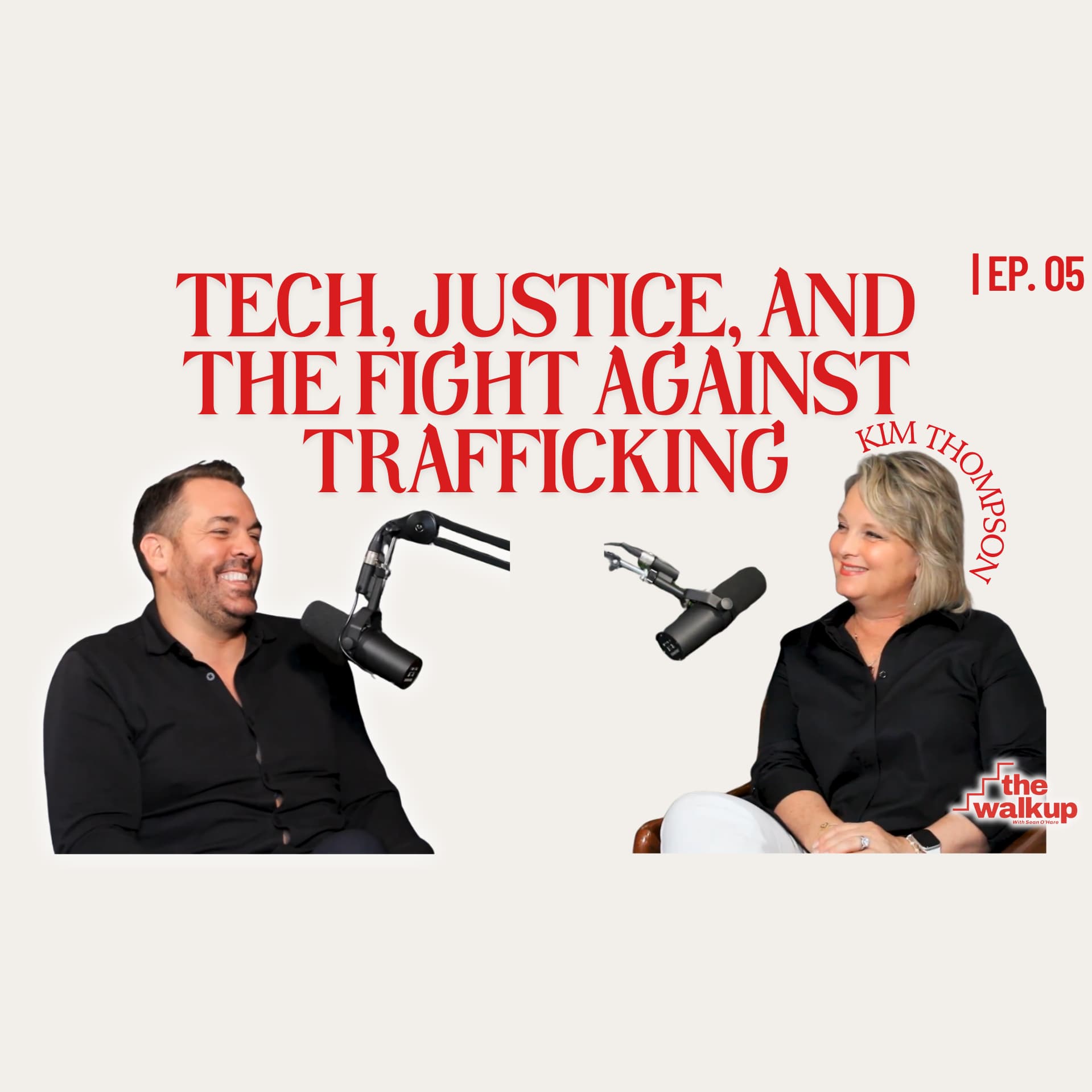
In this episode of The Walkup, Sean O’Hare sits down with Kimberly Thompson, a development leader and anti-trafficking advocate with decades of experience at A21, the Human Trafficking Institute, and beyond.
Together, they unpack the dark intersection of technology and human exploitation—from fake job scams to the way digital platforms fuel trafficking at scale. But this isn’t just about the problem. It’s about the people fighting it. Kim shares stories of game-changers and grassroots efforts across the globe, reminding us that systemic change is possible. Whether you’re new to the issue or already in the fight, this conversation offers clarity, challenge, and hope.
Subscribe on YouTube: @TheWalkupPodcast Follow on Instagram: @thewalkuppodcast
Transcript
Read the full transcriptAuto-generated · 11,357 words
Well, welcome to the Walk Up Podcast. Thank you. So, we are here to talk about human trafficking, not a comfortable subject by any means, but an important one. So, why don't we just start off with... What is human trafficking? Sure. So, human trafficking is when someone, it could be a man, woman, or child, is forced into doing things that they don't want to do, and the force comes through force, fraud, or coercion. So, they're forced into something that they can't get out of.
Someone is preying on their vulnerabilities, and because of that, they're trapped in a situation they don't want to be in. And I feel like we, like I've heard about... Human trafficking more in the last, I don't know, five years than probably I had heard about it ever before. Is that because... There's more awareness. Is it because we've got better definitions around it? Like, why is it that it's now more in the kind of public consciousness than it has been, perhaps, previously?
Sure. I do think that there's more awareness around the issue of human trafficking, but it's also a growing number, right? So, as we define what human trafficking is and what falls into those categories, that number continues to grow. So, there's 49.6 million people in the world right now that are trapped in human trafficking.
That's more slaves in that area than we had even in the transatlantic slave period. So, as people are more aware of the issue, there's more light shone on this dark space. I think people are just keenly more in tuned about what's going on around them.
So, I mean, that's an important, I mean, use the word slavery, right? It is. I think. I think the average person would think to themselves, we're done with that. We ended slavery. Yay, humanity. And yet, you're saying there's more people enslaved than there were during the transatlantic slave trade. So, how do we have this kind of cognitive dissonance, if you will, right?
People think that slavery is no longer with us, and yet, we are now at a time where it is more prevalent than it ever has been before. Well, I think part of that is because we did all the things that you just referenced. So, in the transatlantic slave period, there were laws put into place that made slavery illegal. So, then we are thinking, okay, well, this is something that we see. It is in broad daylight. We think of it being people who are African American, and that is not necessarily true anymore.
I mean, it... It covers every spectrum of people, every gender, and every population, and it happens in every country, and it has for years. But again, if you go back to the awareness that's presented because of what we know and understand now, and also how we deal with issues around social justice, I think more people are cognitive of the fact that this is not right. This is something that, well, it's not only not right, but it's incredibly wrong. And what do we do about it to stop it and make a difference?
So, I think it's… It is awareness, human awareness, and things being brought to light that people are more intentional about sharing that, even though it's an incredibly dark space. I think people don't like to go there because it's dark. They don't like to hear about it. It's a very difficult topic, and it leaves people feeling hopeless. So, as we go further into the conversation, we're going to talk about the hope that's on the other side of the darkness because of organizations like A21 who are really fighting to change.
The trajectory of what trafficking looks like in the future. Well, I think part of this is around definitions, right? We think of slavery as a very particular type of slavery where people were confined to certain geographic areas, whereas nowadays, not nowadays, but the different types of slavery, whether it be in sex, in labor, with children, there's different ways that we... That coercion is used for those victims, and what role has technology played in this? Oh, gosh. It just makes so many more people so much more vulnerable.
So, I even look at my grandchildren. So, my children are all grown now, but even I talk to my kids constantly about the accessibility to technology that they're giving my grandchildren because we know that traffickers prey on those people and those spaces.
So, they couldn't access them before. Exactly. And COVID changed that, because COVID took trafficking from a venue-based model to a more hidden model, where there is more online exploitation and less, you know, we are going to meet you in a hotel and there is going to be a trade of money for sex or whatever that may look like. And actually, we think that there is probably more labor trafficking that takes place than sex trafficking, but it is more hidden. So, we are seeing it in restaurants.
We're seeing it in hotels. We're seeing it in domestic servitude. We're seeing it on farms, especially out west. Trafficking happens in all areas and across all industries. The thing that I think people become more or more sensitive to is the sex trafficking. Sure. And, of course, that happens with men, women, children. But the vulnerabilities that traffickers prey on, so homelessness, drug addiction.
Foster care programs, any time a family or a person has things and needs that are not met, whether it's a home or food, shelter, safety for their families, people looking for a better way of life and better financial circumstances, those are where traffickers come in and really prey on those populations. With our children, it's really the accessibility that's given to them through... Technology, where a trafficker can pose as someone else. So, we talk often about the fact that most people know their trafficker.
People are not in the U.S. anyway. People are not just kidnapped off the street. But sometimes, I think I am talking to somebody other than who I am really talking to. So, for example, 821 has... We'll get into this, but we have several different avenues in which we fight human trafficking, but one of those is REACH. And through REACH, we want to create prevention awareness and education materials so that we can educate people on trafficking, what it is, what it looks like, so that they know how to protect themselves.
So, one of the things that's been created, and it's been 12 years in the making as a curriculum, that we provide for schools to teach in the classroom. So, we've just launched this as a pilot program in Florida, Michigan, and the Texas area. And in one of the schools where we were working, we had five students come forward and say, we think this is happening to us, and this is because of the curriculum they were being presented with and being taught.
This was because of the videos that they were watching that showed exploitation and explained what that meant and how traffickers were recruiting people into this space. So, when the student went to the teacher and said, This is happening to me. I think I may be in the middle of this. They immediately called in law enforcement. Law enforcement got involved, and that afternoon, they arrested the potential trafficker that was communicating with the child, but instead of that being another 14 or 15-year-old that she thinks she's communicating with, it was actually a 42-year-old man.
So, it's somebody that's posing as someone different that's actually... And technology allows you to conceal... You, you know, your identity, effectively. Right. You can pretend to be someone that you're not. But talk about the marketplace, so to speak. So, like, you know, when we think about, you know, drugs, for example, right? You know, the, we know that if, if there weren't buyers for drugs, there wouldn't be suppliers for drugs, and therefore, there wouldn't be all of the complications that come with the drug war and with, you know, violence that goes on around it.
But, unfortunately, people are going to want to. You know, consume drugs, right? So, there's a market for it. So, what is the marketplace? So, you're talking about sex and labor primarily, right? I think there's the awareness of, like, why is there such a demand for this, right? And I think the first time my eyes were opened was, and this is obviously a terrible reality to kind of focus on, but When it comes to sex trafficking, a woman who is, or unfortunately sometimes even a child, who can be trafficked, can have a customer, so to speak, several times a day.
That is a lot more valuable than drugs. And so, when you start to think about it... As these victims as products, or as those that can be serviced, that is where the marketplace can begin, right? So, maybe give us some context about, like, why is there such a big marketplace for this? Right. Well, I think it starts with the fact that trafficking is a crime of economics. So, it is a low-risk, high-reward. So, when a trafficker can take a victim and see them as a commodity, something that is a crime of economics, They can sell over and over and over again.
So, you sell a drug once, you're done. The drug's no longer in your hand. An individual that you have control over because you have forced or created a position of coercion where you're forcing them to do something, you can sell them over and over and over again. We've even seen situations where some of our victims are forced to work. Well, and I should say, let me correct that. We have survivors that we're working with that when they tell their story, they have been forced to work.
You know, as many as 16 to 20 times a day with different customers. So, that trafficker is selling that person over and over and over. And if there's no one that's watching or paying attention, no one reporting what they're seeing, then there's no one to stop the crime. It is the crime that takes place in plain sight. So, it's hidden in plain sight. Hidden in plain sight. That's what's so... What's the word?
I mean, troubling is the first word that comes to mind, but that... So, for example, I was in Colombia for a project with the Tim Tebow Foundation in Bogota, but then I was like, well, I am already in Colombia, I want to see other cities, so I went to Medellin and I went to Cartagena, and the friends in Colombia were like, just be aware that prostitution is very prevalent in Cartagena. Your idea of what prostitution is versus what it actually looks like.
Now, in this case, because my eyes have been open to it, I realized that, okay, maybe this young girl or young woman who's coming up to talk to me in the... Town Square, who I think is just, you know, flirting, wait, that might actually be somebody who has been trafficked and now has a pimp, or whatever the terminology is, and saying, you've got to go find customers, right? And it's something that's in plain sight. I'm just on my way to go to a restaurant and think that there's some girl that just wants to chat me up, but there's actually a whole system behind that.
Right. So, I had the privilege of traveling to see our team in Thessaloniki, Greece, a few months ago, and as I toured around the city, and they took me to the areas that were most prevalent for human trafficking. So, prostitution is legal with certain guidelines that are in place by the laws in the country, but at the same time, there are people there that we know are victims of trafficking, and they're being watched by their trafficker, and there's consequences if they're being watched by their traffickers.
They're not doing the things that they're being forced or coerced to do. So, when you talk about a market, yes, there are the so-called johns that are the purchasers of this, but if it wasn't available, would the johns still do that? Right. I don't have an answer to that question, but I know that if we can reduce the prevalence of trafficking, and we can make vulnerable people aware of how this happens, why it happens, what they need to be alerted to and aware of, and we can share that information more broadly, then we can protect people.
And it costs a whole lot less money to protect them, both from a cost perspective and a dollar, as well as the ability to overcome and restore that life after it's been traumatized through the process of human trafficking.
Then it would if we have to do it on the backside. So, we want to make sure that we're able to reach vulnerable people ahead of time. We're able to educate parents on how they can put safeguards in place to protect their children. We can make teachers, healthcare workers, aware of what it looks like, so when they see it, it's no longer an unseen issue, or something that is right in front of them, but they just didn't know. Yeah, because I would say, like, oh, what role would I have to play in, you know, calling and identifying?
You know, something that might be a victim of human trafficking, because like, well, I'm not going to, I'm not hiring a prostitute or going to some, you know, shady location where these things might happen. Meanwhile, I was made aware that, and speaking of technology, that...
The dating apps, they're now using that as a front end, so you think you're talking to some girl who just, you know, you're on vacation, you want to, like, you know, go on a date, and you think there's some, you know, some girl wants to go on a date with you. It turns out, oh, no, that's actually a very low-cost way to basically, to advertise, and then at some point, whatever that, I don't know, when they reveal, or, hey, by the way, I'm actually an escort, or I'm actually, you know, looking for, if you're looking for a good time, or whatever the, however they...
Right, but it is being promoted through an app that you don't even recognize as there. Yeah, so like those kind of, and I hope these apps are doing. There is a job in trying to report that and make sure it does not go anywhere, but before we go further into where enforcement comes in, awareness, the thing that I was at a big blind spot to was the labor side, because I think, again, we think of slavery in the form of labor.
We're thinking of people that are working hard labor in a very specific geographic location, and we don't think about them as... Somebody who is in a call center, or somebody you might receive an unsolicited call from about buying some product or service. You just think that is somebody who has got a job in some call center in a foreign country. So, give us some definition around what labor trafficking really looks like. So, what you are really referring to in that situation is a scamming center.
And so, we have seen situations. And I won't be specific, but we've seen situations where people are really recruited into a false job. So, something that is advertised as being one thing, it looks like a real job. They go through a real interview process. Maybe they go to a different country to serve in that role because they're going to make more money. So, they're vulnerable. Maybe their job has been eliminated because of COVID or because of whatever the situation is, but they need more money for their family.
So, they go through this interview process. They may be educated. They may be um, uh... From different sectors or markets that are professional, but when they go into this specific job after they are recruited, and they go through an interview process, and they think it is substantial, they get there, their passports are taken, their identification is taken, their money is taken, maybe their phones are taken, and all of a sudden, they are forced to do things that they were not prepared for on the recruiting side.
So, whether it is scamming you for your money, scamming you for an insurance, or I think some of the ones I get sometimes are social security. We have got an upgrade for this. And that is not to say that there are not people who are really doing that legitimate job, but the ones that are in these scamming centers, they are being forced to do this against their will, not being paid for it, and there are consequences for not performing and doing the things that they have been told that they have to do.
And those consequences are very negative. Huge economic incentive there. Yes, exactly. So, we are talking about a person can make hundreds, if not thousands of calls a day. Right. Right, I do not know what the margin is on getting one successful scam. I do not know. But I imagine it is considerable relative to the... Quote, unquote, cost of the acquisition of the labor, right? Right, but the other labor experience is like if you're in some type of domestic servitude where someone has you in their home, and they're not paying you, but the expectation is that you're cooking, you're cleaning, you're babysitting, but you can't leave.
You're not free to go and do what you want to do. You're being forced to stay there because maybe they hold your passport, or they're not paying you a fair wage. So, those are the types of things that we see, even here in the U.S., as well as... Agricultural settings, where people are forcing people to work, but they're working really long hours. The market value for their time is not appropriate for the hours and the time that they're spending, and again, they don't have the ability to leave and do something else or walk out of that situation because of the coercion that could be created through threats of violence, violence to themselves or their family.
So, that's all part of the traffic. Well, I think, as you mentioned before, it gets overwhelming for people when they start to learn what this is, and it gets pretty dark, and I think what I was struck by, too, was... The layers, I mean, when you are talking about the economic incentives, you are getting into, you know, gangs, mafia, maybe law enforcement in on it, maybe, you know, there is a lot of different economic incentives. I do not know if I told you this story, but when I was in Verona, did I tell you this story?
No, I do not think so. Okay, so I was in Verona, Italy, as one is. As one does. I was invited to Fair Verona. To meet my Juliet. No, I was there to speak about special needs. It was like a three-day conference, but my portion was on the first day, and so I knew the organizers of the conference, and I said, hey, listen, I'm just sitting around now. If you want me to, like, I can help out, you know, at the conference.
Like, if you want me to, you guys were nice enough to fly me in, I'm happy to chip in. And they said, oh, cool, yeah, can you... Pick up somebody from the airport for us, one of the speakers. I was like, yeah, sure, you know, no problem. Happy to do that. It is Alietz's priest coming in from Rome. He is going to be speaking tomorrow.
I pick him up from the airport. I was like, sure, man. So, they pull up one of those Mercedes, like the Vans, the big, tall, skinny ones. Yeah. Stick shift, which I hadn't driven stick shift in a while. And, of course, the stick's like this tall, and I'm like, you know. He's like, okay. And he parks it on a hill, which was very generous. So, I have a translator, Italian translator, which is another story. That was like our second date. We met in Mexico, but our second date was in Verona.
Okay. That is a story for another podcast, but she was my translator. And so, we get to the airport, and they said, oh, you know, he will have some security with him. And I said, oh, okay, interesting. The priest with security?
So, we get there and arrive to the airport. There was already a security guy there, and very Italian, like black leather jacket. He comes up to me and goes, you are the driver, huh? And I said, yeah, sure, I'm the driver today. And he's like, ah, okay, you have a gun?
I said, no, I didn't bring my gun with me. I apologize. He's like, okay, it's okay. I have a gun. I was like, well, I'm happy for you. That's wonderful. And so, I was like, this is the point where I'm realizing maybe there's a little bit more going on than I had anticipated.
So, this priest arrives, and just kind of like the most amiable-looking fellow, he has two more security guys with him. Turns out, this guy is doing anti-human trafficking efforts in Rome. The mafia wants him dead, and so he has to travel with multiple security guards everywhere he goes. They put one security guy in the front seat with me, or in the passenger seat, and I have my Google Maps out. I have never driven in Italy. I have not driven stick in like 10 years.
And you do not have a gun. And I do not have a gun. I was not packing heat. And I'm like, all I did was say, do you need me to volunteer at the conference? This is all I asked. I didn't ask to go on a spy mission. I get shot. And he's like, okay, we'll start driving. He's like, I have the Google Maps. And he goes, no Google. I am Google. I was like, okay. It's because we came up to an underpass, and he's like, no.
Because he's worried about getting blocked in on either side, where then some, I don't know, mafia hitman can take us out. I've never driven with my hands a 10 and 2 in my entire life, but I was like, I'm going to follow all the rules. So, what does that tell you about the value and the money involved in human trafficking? Oh, my gosh. If they're that concerned about protecting someone because they're fighting the problem, they're fighting the crime. Well, because you're messing up their industry.
Income. And so, it was just like, I had no idea that this... I was like, oh, that's nice. He does some anti-human trafficking. That's a nice little thing for that priest to do, not realizing that makes him a target. Right. I mean, that was incredibly eye-opening, and that lets you know, too, you're getting involved. It's like if this guy was trying to stop their drug trade, they would want to take him out, right? Or guns, or anything else. So, now, help us understand kind of the layers of who can be involved in this.
You've got, there's government, there's law enforcement on both the plus and minus side, right? Right. So, how do you guys try to attack this? Yeah, so we do partner with Homeland Security, with the FBI, with local police and law enforcement, federal police and law enforcement. So, I mean, we will partner as A21 with anyone who wants to do good work alongside us. The things that are really important to us is that the work that we're doing is victim-centered and trauma-informed, because first and foremost, we want to make sure that we're providing the best care to the survivors of human trafficking that come into our care.
So, we do operations with law enforcement, meaning that we're coming along beside them. We're not busting down doors. That's not a safe thing for survivors or victims that are in this trafficking situation. So, we stay in our lane to educate and equip and to partner with those organizations. That have the right and authority to be in those countries doing that work, but we're alongside them helping to facilitate the aftermath of that. We take tips in our hotlines, and we can dive more into all the different elements of A21, but we have hotlines.
We're receiving reports. We do awareness events that just do just that, bring awareness to the communities where we're serving, and really across the globe. But you talked about I'm going to go, you asked the question, like, okay, so what can I do? So, just in the last couple of years, this is our 10th year for Walk for Freedom, and Walk for Freedom is what we understand to be the largest awareness event in the anti-trafficking space in the world. And so, in India.
There was a walk, and a man noticed two children in a window of an apartment, condominium, townhome, whatever it was, and something didn't look right, and so he reported that to local law enforcement, and it turned out that those two children were in domestic servitude to that family, and they were able to get them out of that situation.
The adage of, if you see something, say something. If you see something, report something. Even if you have to do it multiple times. We just had a big case in one of the countries where we were working that 52 victims were removed from trafficking because one woman saw something over and over and over, and she was able to report what she was seeing and then continue to call back in with additional updates. And because of that, law enforcement was able to Basically, do a raid and get those victims out and bring them into 821's aftercare.
So, it's super important that we as a society are both aware of what's going on in the problem, but we also know how we can be responsive to it. It's the same way with... We were just meeting with an organization the other day, so they have technicians that go into homes. What better place to see what is taking place because you are able to actually go into places that no one else may be able to go because your light stopped working, or your refrigerator is not working, or your telephone is not working, or whatever the technical aspect of your home that is not working properly.
As a technician, you get to go in. So, if we can go in and train technicians on what to look for and how to report things that they see. It gives us insight into places that otherwise no one would be, but when you're on the streets here in New York, there's opportunities that you see something that just doesn't look right.
I was with an organization earlier this week, and I asked them, I said, are you seeing forced begging in the city? And they said, yes, we are. Forced begging? Yeah, forced begging is a type of trafficking. So, it comes in all different shapes or forms, but remember, when someone is being forced to do something, and they're using, well, It sounds like a double word there, but when someone is having to do something, that they're being forced, coerced, or, well, forced, what was the other word I used, Sean?
I'm losing it. Force, fraud, or coercion. To do something that they don't want to do, that is a form of human trafficking. So, just being aware. So, 821 has amazing... Well, like, what do I do? I report it to the... What am I doing? You can call the local police. You can call the 800 number for the human trafficking hotline.
And all of these resources, there's a plethora of those. You can take a one-on-one... But I'm not putting myself in harm's way because I'm using a third party, effectively. Yeah. We don't ever advise people to go in and try to stop something themselves. That is probably not safe. You don't really know what you're up against. So, if you've got a priest that's being protected by six different security guys in whatever, where did you say you were in Italy? Verona. So, you can imagine, you don't want to put yourself in harm's way.
You're probably going to hurt yourself and potentially the victim. So, we would really encourage you to call law enforcement. Oh, yeah, when I dropped him off, the security guy goes, okay, we'll see you tomorrow. I was like, oh, no, no, no, no, no, no. We are getting somebody else to drive. I'm going to take a different volunteer position on the team. Yeah, I was like, I thought maybe I'd check people in at the front desk. Or something at the conference? I didn't think I was going to be asked to, you know, I was like, but you know what, listen, if you're going to go, that's a way to go.
Well, you know. I'm Catholic. We believe in martyrdom. We're big fans. We're big fans of martyrdom. Okay, I'll remember that if I ever need protection, Sean. I'm coming to you. Well, every time I go somewhere, I had the discussion with my oldest brother, who's a priest. I'm like, do I tell mom? Or not, that I'm going to this place. And sometimes he'll say, yeah, it's okay, or why don't you tell her afterwards? So, I went to Ukraine last summer, and... I was in Lviv, and then Kiev, and then Kharkiv, and I wanted to go all the way to the front line, to the Zaborizhia, because a friend of mine was working with some special forces that were removing landmines, and I was like, yes, I want to go there.
My driver was not, as he was disinclined, he says, he's like, I have daughter, I have family. I was like, I feel like what you're saying is you don't want to go to the front line. I was like, okay. Fine. Makes sense. Well, as a mother of five boys, I think you should always tell us, because then we can pray for you when you're putting yourself in harm's way intentionally. I'm consulting the priest and the family, okay? So, I mean, well, that brings up India.
So, as you know, I'm now leaving for India in seven days. Right. So, I met this This priest that was presenting at a conference here in New York maybe three or four months ago, and he explained how he is trying to expand the young women and girls that he is helping in his area in Southeast India called Andhra Pradesh, and he is helping about 450 girls right now, but that region, that state, the Catholic schools have been closed down, so he has got 127.
Empty schools. So, he's got an opportunity. So, that's not good news to have schools that are not functioning, but he's looking at it like, well, I could convert those schools to centers for both trauma care for those that have been trafficked, and then also education and prevention for those that hopefully can avoid trafficking. So, I said, I was like, oh, that's great, Father. Like, what do you, you have 400 now. How many could you help if you fill that all 127 of these, converted them from schools to residences?
Residences, and he's like. 10,000. I said, 10,000 girls? I was like, okay. And then when he told me how modest his current budget was, I said, well, how about we go there first, and I'll kind of, you know, learn with you. So, this is kind of how I get involved in projects, is I just meet somebody that sounds interesting, and then I just figure, why don't I just go see it for myself. Right. So, I'm going to go there and try to learn, and so an A21 has been very helpful, because I said, listen, I don't know anything about this space.
I don't pretend to be an expert. Despite my secret spy mission in Verona, I don't really know anything about human trafficking, but I always look at these things as a providential, like, there's some reason I met this priest, there's some reason that there's an opportunity, and if I can play a small role in it.
Great. So, you have offered very generously to bring A21's resources to bear, so maybe help people understand what you guys are doing with this. Well, I love that conversation when you told me that you were going to India, and you were going to go for two weeks. I am like, oh, wow. So, what is your involvement with human trafficking? You go, I do not know. I do not have any. I do not know anything about human trafficking. That is right. Well, we should really talk about that.
So, it was fun to get to connect you with our Global Director of Aftercare, who is a licensed psychologist. So, we have a question from Rihanna Dubois, and she is an amazing individual, and she oversees all the aftercare that we do around the globe. So, to have her involved in that conversation, so what we have talked about, just so everybody is kind of up to speed, is that 821 is going to do some consulting with you all and the priest, and then do some training with the nuns that will actually be providing the care for the survivors of human trafficking that are coming into what will be the, I guess, aftercare facility that is currently the converted schools.
Yeah. But I think that is such an amazing opportunity. A21 is really looking to expand our work and our mission, and we want to do that by doing three things. So, we want to expand our current locations to add a couple of additional countries. So, I don't know if we have said this yet, but basically, A21 serves across six continents and 21 countries doing our work in reach, rescue, and restore.
As a result of that, and part of our mission to expand over the next couple of years, it gives us an opportunity to go deeper where we currently are, but also to look at some additional locations, too. And then we really want to create a global human trafficking hotline, so that is somewhere that we can literally connect all the countries in the world together, so when tips are coming in on human trafficking, when resources are needed, we can deploy those things that we already have.
Where we already have relationships, where we don't have relationships, but we have connections with police departments or so forth, and then we can just move those tips or resources out as things are being reported. But then the third thing that applies to India specifically is we want to create a partnership of frontline workers. So, they're literally people that are on the front lines. So, like your priest who says, hey, I've got potentially 10,000 beds. I know nothing about human trafficking, but I've got a real heart to do something in this space.
So, A21 may not be in a position that we can launch a branch of our work in India right now, but we can partner with you, and we can partner with the priest that's there to say, hey, let us help you train your individuals that are going to be doing this work. Let's help you create a community-based model that we're already working from, that we know works, and we know is effective, and then you can deploy that same model and do the work really well, so that you're putting your survivors on a trajectory for success and restoration in their own life.
So, I'm super excited that we've gotten re-involved with you, and that she's going to be able to do some training with the folks that are on the ground there in India, and I'm super excited to see what you're going to learn when you're there, and how 821 is going to be able to continue to partner with you. Yeah, it's going to be a steep learning curve, but hopefully one that can get evened out a little bit, but I think, yeah, they have a huge challenge.
It's rare in the sense that they have, usually you don't already have physical plan. Right. And personnel in the form of nuns. Right. However, these need to be converted from schools into residences and education centers and trauma care facilities, right? And in addition to that, you have nuns that thought they were going to be teaching in schools. Now, they need to be trained on trauma care. And then the other part of this of building a community that can be reporting on the front lines.
I know it gets layered in India as well because you have elements of the caste system that are still present. And so, there's kind of... There's sociological elements that require some sensitivity as well, but the scale of it, I think, was shocking to me, and then I only recently found out about organ harvesting. I was like, I'm sorry, what? There's organ harvesting? That sounds like a Brave New World science fiction situation. That couldn't possibly really be happening, right? I mean, in our day and age, that could not possibly really be happening.
Yeah. But it is. Yeah, this priest told me, he was like, he's like, yeah, they'll, they'll, people offer free, oh, free checkups, you know, or, or, or whatever, going into a poor community and say, oh, it turns out you need to have your kidney removed. And they're like, okay, well, they don't necessarily know any better or can't, can't afford to go out and get a quote unquote, a second opinion. And I say, no, this kidney's getting removed from somebody's body. Or, or I also found out, like, they'll say, oh, you need to get your tonsils out.
But, oh, while we're there. They ended up taking out something else you didn't ask for. It's just like, I mean, this is next level stuff, but it tells you that when there's a marketplace, right, which technology and transportation allows for, we can get that kidney or whatever else there might be removing from somebody's body to a more economically prosperous part of the world, and there's a buyer. Right. Which is shocking. Same thing is true if, you know, sometimes victims of trafficking are forced to have sex and get pregnant.
And then the baby's taken. That's another thing that happens in this disgusting, horrific crime scene. It's really something that you feel like is, I mean, it's absolutely horrendous. How could these things be happening in our day and age, and with the knowledge and information that we have? But it does. And again, hidden in plain sight. So, how do you then, because yeah, I'm sure people are hearing this for the first time, the scale of things, and like I experienced the first time I heard these things, you get overwhelmed.
Right. It's sad. It's frustrating. It's, I mean, you get angry when you realize the scale of these things. So, then why are you, you could be doing a lot of things, but why choose to do this where you're putting yourself into something that can feel like kind of a spiral of just awful human behavior, right? You're seeing kind of the worst of what humans can do.
What gives you hope? What makes you want to be involved in this kind of work? Right. So, let me just share a little bit of my own personal story. So, quite a few years ago, back in my younger days, I was involved... You are still very much in your younger days. Yes, aren't I, though? I am not feeling that right now.
I was involved with a Christian camp and conference center in Texas, and I... Anything that was negative or difficult that had to do with Child Protective Services came through my door, and I was usually the one that dealt with Child Protective Services.
And one Thursday afternoon, one of our counselors came in and she said, I've got a camper that I really think needs to see you. And I said, okay, what's going on? She said, I'm not really sure, but I think it's really bad. Well, have you gone through all the right channels, and all the other people that they're supposed to see before they get to me? And she said, no, I think you just need to talk to her. And so, she brings this young lady in my office, and we sit down, and she was inconsolable.
And just cried and cried and cried. I think it was for about two hours. And I sat on the floor. I did all the things that I knew to do to eliminate the dominant effect where, you know, I'm sitting next to her. I'm looking down on her. So, I'm sitting down on the floor. I'm looking up, saying, hey, I'm just here to support you. You tell me what you need, and when you're ready to talk, I'm ready to listen. But we're just going to sit here and let you do what you need to do right now.
And after about two hours, she shared with me that her father was raping her. And then he was allowing other men in the complex to have sex with her, too, and he was taking money for that. And this was, I had never heard the word human trafficking.
I just knew that it was despicable, and I was mortified, I was horrified, I was, any word you can think of that was bad. I just couldn't believe that this was happening to this 12-year-old little girl. And you're in a community, yeah, not on the other side of the world. It was happening in Houston, Texas.
But we were north of Houston in a small town, but she had come from Houston to come to summer camp, and I called CPS immediately. I used all the buzzwords. She is in grave and imminent danger. She does not need to be returned to this family. Something needs to be done before her father comes in on Saturday morning to pick her up. They assured me. That that would be taken care of. They would send someone out the next day. They would be back in contact with me, but he would not pick her up from camp, and on Saturday morning, he walked into camp to pick her up.
Oh. I felt so hopeless. Sure. Like, what in the world am I going to do? How can I protect her? And so, my instinct as a mom, as a female, as someone who cares about children, was to say, well, she's not going home with him. I'm just going to go down and get her, and I'm going to leave with her. And my husband at the time said, no, you can't do that. That's kidnapping. That's kidnapping, yeah. Right. And I said, well, I don't have any other options.
If you can come up with a better solution. So... The sheriff happened to be a friend. I called him, and I said, hey, this is what's going on. This is what's taking place. I said, I'm just going to go get her and leave. And he said, you can't do that. That's kidnapping. I said, okay, I understand that. I've already been told that. I get that, but do you have a better option for me? And he said, if you can get her to tell you she doesn't want to go, then I can intervene.
Like, she's 12. This is a man that's raping her. She's terrified. Sure. I couldn't even, I mean, it took me two hours to even get her to stop crying to be able to communicate with me. How am I going to get her to tell me she doesn't want to go when he's standing there?
But I tried, and with tears rolling down her face, and she said, I can't. I can't do that. I was sick, literally. I mean, even today. However many years ago that was, I was sick. So, on Monday morning, we got the FBI involved, and by Wednesday, she was out. I have no idea what happened to her, other than I know that her father was taken to jail. I don't know how long he stayed there, and she was put with another member of the family.
But because I wasn't related, I have no recourse in following up or finding out what was going on. Fast forward several years. I wound up at Fuller Theological Seminary as the Vice President of Development, and through the course of those seven and a half years, I learned so much about social justice. I was exposed to people who were doing amazing things around the world to protect people who were vulnerable, and I learned about human trafficking in that space. And I had a friend, his name is Matt Russell.
He is a pastor in the Houston area, and he was an adjunct professor for Fuller. And we were having a conversation one day, and I'm really not sure what I said, but there was some conversation about recovery and prostitution, and whatever I said was probably not appropriate, and I don't know what it was at this point. And he said, hey, on Thursday afternoon, I'm going to be with a group of prostitutes in the Third Ward of Houston, and I'm a chaplain for them.
I'd love for you to come. I'm a chaplain for prostitutes. I said, Matt, I don't get this. What does this mean? Okay. And he said, yeah, I'll sit with them, and just help, listen, whatever I need to do. Where they're currently...
They have been removed. Well, they've just been court-ordered. They've been removed from the street. Oh, I see. It's not like he was going to where they're like, is anyone putting himself really in harm's way? No, but it was in the third ward, but it was a house that they were assigned to, so this was court-ordered, but he was there as the chaplain. Oh, like a shelter almost. Okay, got it. So, I said, Matt, what would I possibly offer a group of prostitutes?
I don't know anything about this. The most humbling thing that anyone, I think, has ever said to me, he looked at me and he said, oh, you don't have anything to offer them. It's what they'll offer you. I said, okay, I'll go.
And so, I went about three or four times, and I sat with these women in this house. I held their babies. I looked at the artwork and the pictures that they were drawing. I listened to their stories and just had one-on-one conversations before and after their group time, and I learned that they were not prostitutes by choice. They were being trafficked. They were in those situations because at some point, they were vulnerable. Someone preyed on those vulnerabilities, and because of the preying on the vulnerabilities, they had been forced or coerced into situations that they didn't want to be in, and they didn't have a way out, and then they were treated as the criminals.
Because they're participating in illegal activity, but being forced to do it. Right. So, they were in a situation that they were forced to be in, but they were paying the consequences for someone else. It's like being a child soldier. It's like nobody chooses to be. Right. Exactly. So, anyway, that was incredibly enlightening. And from that, I went back to my dear friend, who was the president of Florida at the time, Mark Labberton, and I said, My next gig is going to be in the anti-trafficking space because I want to make a difference there.
So, 20 years ago, dealing with a child at summer camp who was 12 when I first heard about human trafficking and didn't even have a definition for it, I didn't have a definition for it, to today. And being passionate about this space, because I believe that there's hope to end this problem if we can bring awareness and education and prevention to the space and restore the lives that have literally been stolen by the traffickers who were abusing and taking advantage of people with vulnerabilities.
Because had you, when you met that young girl, had something like a resource to be able to call, you would have been able to short-circuit. The solution. Instead, fortunately, you were able to do it because of personal relationships, you know, with the sheriff, but not everybody has those things, right? Right, right. So, where were we 30 years ago with awareness of human trafficking and resources, and where are we today, and does that suggest that we're making a dent?
In a way that wasn't possible 10, 20 years ago, or are we also competing against the scale of the growth of it at the same time? Well, the scale is definitely an issue. I mean, because I think, and I probably shouldn't say this on the air since I'm not positive, but I think it was in 2017 or 2018, the reported number of trafficking victims around the world were 24.9 million, and as of this past year, they're 49.6. So, you see the scale.
Now, the definition grows as well, like what all is included in that space, right? But we do see that we're making a dent, because when we can report it, we can get victims out of that situation to cross the line to be a survivor and to have their life restored, then that makes a difference. So, 821 just celebrated their 2,000th survivor coming into our care. Now, we've had over 4,000 who have actually been recovered, because reports have been made, and we've been able to help.
And the rescue of those individuals that are coming out or the recovery out of, recovering out of those spaces. So, I do think that we're making a dent. I think the thing that we've got to do a better job of, which is one of the reasons I love this conversation with you, and even the relationships that we're forming as we talk to people about the work in the space, is that we need to collaboratively think about how we do this. There are over 2,100 anti-trafficking organizations around the globe.
How can we pool our resources? How can we pool the knowledge and experience that we have to do a better job, which is why A21 is so committed to this frontline network? That we can give away the models that we've developed that have been so successful, and that we see real restoration coming into the lives of people, so that we can help them from everything from the reach that we're doing in prevention awareness and education, to what we're doing in the recovery space, and how we partner and partner well with other organizations.
And then restoration, too, where we use that community-based model. So, even what you are doing in India, when you have got nuns that have been trained to be educators, Then they can teach life skills. What life skills are needed in that space to help these women and men and children to be restored to a full and life that's fulfilling for them? So, what can we do to help equip and understand what's going to be needed in that life skills space so that they can do what they need to do?
Some will not be educated. The nuns can then educate because that's what they are. That's what they do. They're educators, but you have to deal with the trauma, and so the counseling and support services as they manage those Yeah, because, I mean, there's an ecosystem element to this, right? Like you said, you guys can't be everywhere. It's impossible, but where you've got frontline workers, so to speak, they don't necessarily have the best practices that have been tried over and over in different regions or different places in the world.
Okay, so let us make them available, and then maybe some of that needs to be translated into different languages, right? We already do. All those sorts of things. Yes, absolutely. And so, on the flip side, when it comes to communication and technology, there are things that we can do that were not available before, but it is obviously on both sides of the equation.
Because I think when you think about... trying to reduce something uh this this type of harm there's what what reduces the the chances it happened it seems like it's enforcement which means fear right so those that are are are perpetrators those that are that are uh are trafficking uh you know women and children and and men as well they have to be fearful that they might get right um they might get caught The economic incentive seems like they're always going to be there.
Let me ask that question. Are there ways to interrupt the economic value? Sure. So, if we can change the trajectory of the situation. So, if you're a trafficker, and all of a sudden, the risk of being caught and prosecuted, and having to pay restitution to your victims, losing your own freedom. Oh, that's part of the... Absolutely. You don't just go to jail. You have to...
Jail plus restitution. That is something that has been on the rise, where judges are actually awarding restitution to victims. Just in the states? Other parts of the world. Yeah, I don't know that that's happening in other parts of the world yet, but I don't know that for sure. That'd be something I'd have to check on and get back to you, but I know in the U.S. it's happening. So, if you could lose your own freedom and go to jail, if you could potentially lose your own resources because you're going to pay restitution to your victims and not have a business to continue, so we're changing the risk factor for the trafficker, and in doing so, it makes a difference.
So, if it is no longer a low-risk, high-reward, but it's a high-risk... Lower reward than, or even a high-risk, high reward. And this is where it gets dark as well, unfortunately, but how often are you seeing, whether it's law enforcement or government entities, who are, shall we say, more than happy to look the other way? Are you seeing that more often than people would imagine, or is that something we don't want to talk about?
No, with the organizations that we're working with, I mean, they want to make a difference in this space. So, I don't think that we necessarily see it in our work. I know it happens. I mean, right. I mean, it's not something that's new, but in the places that we partner.
We are partnering with people who really want to make a difference in this space. So, 821 specifically is not seeing that. So, we have very trusted and great partners in the countries where we work, and in the U.S. where we're doing collaborative efforts with operations. So, we're excited about those partnerships and what it means. We can't do it without those partnerships, and hopefully, they feel better about doing it with us because we do a good job alongside them, and that's a step that That they don't have to do in the caring for the victims that are being removed from those situations.
So, I think in our space, and I don't want to downplay it, yes, it does happen, and it happens around the world. It's reported on all the time. Oh, I mean, it's just human nature. Just like with drugs, you have law enforcement and government that look at the direction. Because, again, money. Money is the factor. Money is the driver.
But in the relationships that A21 has, those have become very trusted relationships where we're really able to partner and do excellent work together. So, what are the... Obviously, you are trying to scale operations, but where do you see the efforts in the anti-human trafficking space going in the next five or ten years? Is it more organizations like H21? What are going to be the inflection points in terms of being more successful? Is it simply more education, more resources, more frontline workers, all of it?
Or are there certain elements where you are like, the key is going to be X. Find those kind of things. That is going to be a game changer. I will say for A21 specifically, it is going to be resources. So, we have produced great...
Great products, if you will. I mean, we're not selling them, but they're great products for people to utilize. So, if you go to our website, a21.org, and you go to our resource page, you can find a plethora of resources that can be downloaded for free that you can use. You can use them with educating your children. You can use them in your classroom. You can use, well, maybe not if it's not approved by your system, but you can use it in your neighborhood or with Community outreach stuff, you can just educate yourself.
We even have a trafficking one-on-one webinar that you can take that's totally free. You just go online and do it, that will educate you on what we can do. We've got digital safety guidelines. We've got employment safety guidelines. So, all these things are available. So, it's great to be able to deploy them, but we need to deploy more of them so that we can educate more people, right? Not just a few. So, that's one. The other thing is we need more resources to do more work, and that's financial.
So, yes, there are opportunities to volunteer. We do not have people volunteering with survivors. That is not something that we can do. But there are ways that you can volunteer with A21, whether you are hosting a Walk for Freedom, or you are hosting an awareness event in your community, or you are gathering a group of people to come and learn more about the work that we are doing. But the financial resources are huge. So, as we launch these new initiatives in the upcoming year, and we just talked about those, expanding our current work, establishing...
The Global Human Trafficking Hotline, and also creating the partnership of Frontline Partners, or the network of Frontline Partners, sorry. There's got to be resources to do that, and to deploy those things into all the places that we want to work. So, in our case, it's financial resources. And what about, are you seeing, are there incentives for, I mean, obviously in the States, we've got resources, right?
Are you seeing governments at a state, local, and federal level saying, okay, this is a problem, it's something that we're more aware of now, and so we're going to put resources into it, either through law enforcement or with local partners like 821? Is that starting to shift, and are we seeing it in places outside of the states? I mean, is there, I guess what I'm trying to get at is like, If I am a government official... What's the case as to why I should divert a certain amount of resources or make the case for a budget line item to go towards anti-trafficking resources?
What's the upside? The upside should be, I assume, there's violence, there's a whole ripple effect, but I guess make the case as to why the government should be spending more money on it. Well, I mean, this may sound oversimplified, but... If you're a government official, and you have a trafficking problem in your community, and you don't know what to do about it, then 821 would be a great resource in person for you, or organization for you to call, because you need help to address the issue.
So, when governments see that they have a problem, and they want to do something about it, and they're not currently able to be successful in that space, then you want to bring in an expert, right? We get into the technicalities of this, but the U.S. State Department has a Trafficking in Persons Report, and in the Trafficking in Persons Report, every country in the world is ranked according to the success of their anti-trafficking work. So, almost every country in the world has an anti-trafficking law.
It is the enforcement of that law and the effectiveness of that enforcement as to whether or not traffickers are actually being arrested and prosecuted, and if victims are being identified and removed from the situations of exploitation. So, as countries are being ranked. It impacts the funding that they get. So, if you're on a watch list, then sanctions could be filed against you, and you could have some of your funding from the U.S. cut. So, organizations like A21 can come in with expertise to help you increase.
That's an incentive. That's a lot of incentives. So, it can help you increase the ranking that you have with the State Department. So, yes, that is an incentive. But I think here in the U.S., I mean, like I said, we work with the FBI, we work with Homeland Security, and they're excited to have our participation. And for us to come along beside them. So, we have a reputation of doing good work and being a good partner, and I think that's really important.
We want to have trusted relationships with the organizations that we partner with, whether it's government or whether it's other NGOs. So, we can't do this alone. This is a global problem with a much larger impact than one organization can do. So, Christine Kane, one of our co-founders, says, no one can do everything, but everyone can do something. And so, that's you, and it's me. Whether I'm working full-time for 821, or you're hosting a podcast that you're bringing awareness to the issue around human trafficking, or if I'm sitting somewhere listening to this, and I'm trying to figure out what organization I want to invest in because I want to make a difference in the world, and I have additional resources that I can invest somewhere, this is a place to do it.
Because we value human life. We value our children. We value freedom. Therefore, we need to value the work this organization is doing globally. Do you think we have the right definitions around it? I mean, do we need to start saying slavery? Is that more powerful? Do people get it more? Yeah. I use this interchangeably. I was just recently in New York speaking, and someone came up to me, and I had used the word interchangeably in my presentation, whether it's, you know.
Modern-day slavery or human trafficking, and the man walked up to me and he said, when you say slavery, that lands differently with me than it does when you say human trafficking. He said, we live in New York, horns are always blowing, we have the subway, we have the bus, we have cars. Trafficking is a versatile term. Right. He said, so it feels like just something that's routine, but when you say slavery, it tugs at my heart. So, I think we have to say it in a way that people understand.
And we're not trying to sensationalize the issue. It doesn't need to be sensationalized. It's horrible. The stories that I could tell you about victims, they're horrible. So, it's not something that we have to sensationalize. But if slavery lands in a place that It makes people feel more compelled to respond, then we ought to use slavery. Yeah, I just feel like we get caught up in the technical jargon of it. It is also just a lot to say. Anti-human trafficking is a mouthful.
I even notice when I am just saying to people, I am going to be going to India, oh, why? It is a while just to get it out. But modern day slavery, I think... Well, it's going to be an arresting term right away, and then people go, what do you mean by that, right? Right. Because, yeah, human trafficking can make it sound like it's like a commodity or something, you know, like, well, you know, you've got gold and, you know, and agriculture, and, you know, sometimes it's in humans.
Right. So, I do wonder about that, and, you know, language matters. It does. And I don't know how human trafficking, how that term translates into different languages. I feel like slavery has been around a long time, unfortunately, so I am sure every language has a term that is jarring for that, whereas I do not know that human trafficking always translates. I have a colleague that says, it is slavery. There is nothing modern about it. It has been going on this way for years, and that also resonates with me.
Yeah, and I think that first mental leap, not mental leap, but gap in understanding of like, okay, first of all, Slavery is still with us. I need to lay down that premise. Here is the form it takes, and then here is what we can do about it. Here is how we are trying to address it, and here is what role you can play in it. Well, I think you have certainly educated me a little bit more. It is good that I should know a little bit more about what I am going to be leaving in seven days for Andhra Pradesh in India.
So, we will continue to work with H1N1 to hopefully go from helping. From 450 girls to 10,000, and make it a big success story. Absolutely. Well, there is so much that needs to be done, and there is so much that can be done. And again, just like Chris says, no one can do everything, but everyone can do something. And so, hopefully, this will motivate and inspire some of the listeners that you have, and people that are watching, to say, hey, I want to do something.
I want to make a difference in this space, because I have kids, I have grandkids, or just because I care. And I want to do something to help people who really don't have a voice to help themselves. Well, thank you for coming on, and appreciate all the work that 8021 is doing, and will continue to do in the years to come. Yeah, and good luck on your trip. Well, thank you.
More from The Walkup

Against the Odds: The Samurai Lawyer (Chad Flores) | Ep. 52
Faith, Sexuality, and the Fog of War (Iris Bahr & Father Rick Riccioli) | Ep. 02
E2
Church, Conflict, and Community (Iris Bahr, Father Rick Riccioli & Rob Long) | Ep. 03
E3
Hope, Vocation, and the Global Church (Colm Flynn & Colin Nykaza) | Ep. 04
E4