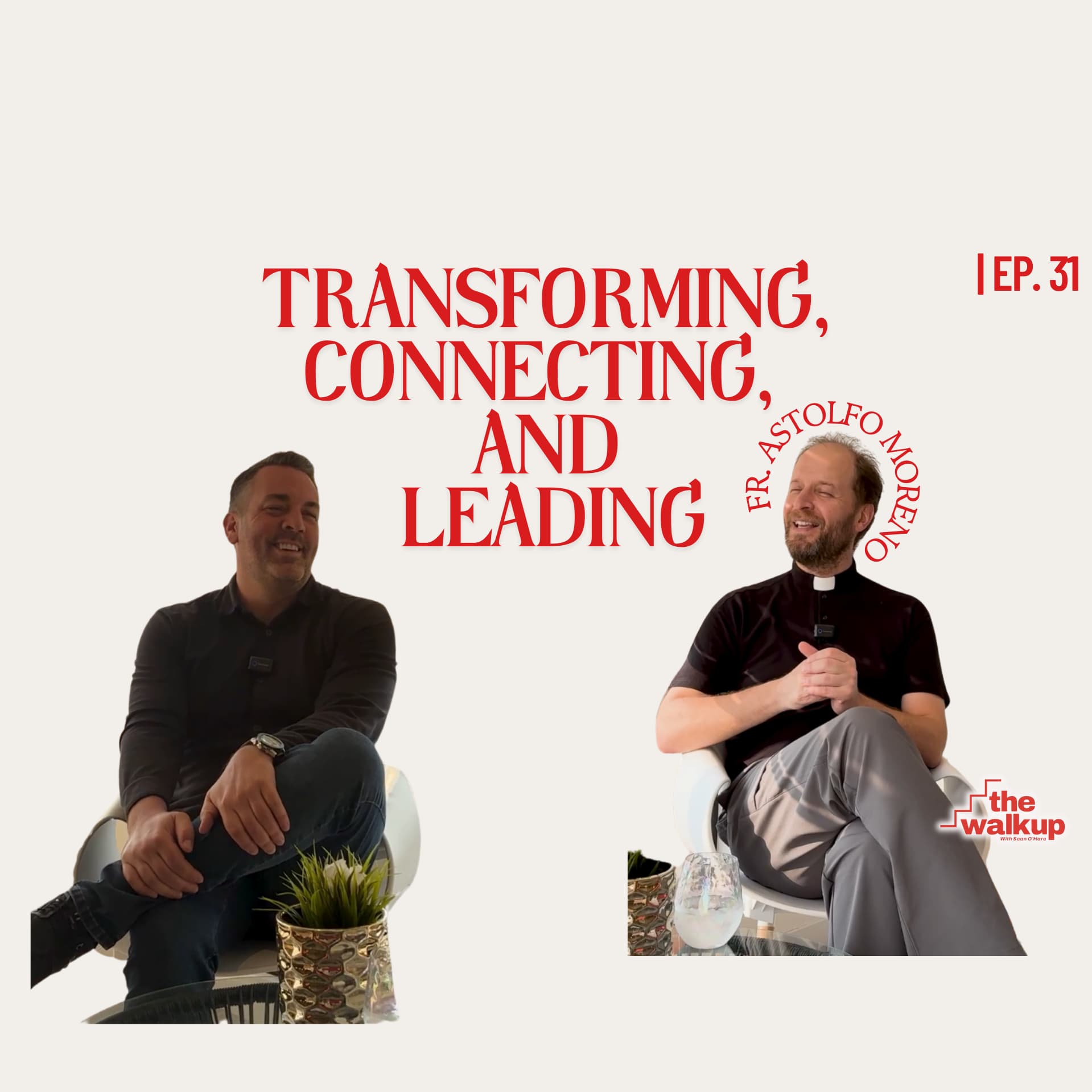
Fr. Astolfo Moreno, Director of Aid to the Church in Need Colombia, joins The Walkup to share stories from the front lines of faith under fire.
From combating human trafficking to championing global solidarity, Fr. Moreno offers a compelling window into the work of the Church in some of the world’s most persecuted regions. This wide-ranging conversation explores spiritual resilience, the role of priests in the digital age, and how love and leadership can move mountains.
Transcript
Read the full transcriptAuto-generated · 8,141 words
Right, well, yeah, so we're rolling. So, welcome to the Waka podcast. Again, in Colombia, in Bogota, we're adjusting for weather. We wanted to do it on the roof, but it was raining earlier. Yes. I don't actually know. I think now the weather, of course, is good, but I'm learning in Bogota, you never know when it's going to rain. Yes, yes, of course, and usually we have sun in the mornings and some rain in the evenings, but... Sometimes, it is the other way around, so yes, you never know.
So, we are adjusting, but Father Astolfo Moreno. Yes. Okay. Well, it is great to have you, and thank you for being here. So, I am fascinated by your biography, and the first of your projects that I wanted to discuss was the aid to the church in need, which I don't know how many people are familiar with. I'm not familiar with this. I happen to know about it because when I worked on a project in Rome, one of the main leaders had been involved with Aid to the Church in Need in Europe.
I don't remember if it was in France. He was French, but I don't remember if he was involved in France or maybe... Because the headquarters is Rome, or no? It is Germany, near Frankfurt, yes. I thought so, because it started originally in Germany, correct? Yes. Actually, the history of our Pontifical Foundation is very interesting. Back in 1947, Pope Pius XII initiated a collect to help the germans that were fired let's say from the countries of the east eastern europe once the russians Well, Germany took Eastern Europe.
We say the Iron Curtain. The Iron Curtain, yes. So, many German people, originally German, were fired from these areas back to Germany, but Germany was destroyed absolutely after the war. So, it was like a very challenging initiative because, you know... Germans were like Nazis, but actually, they were seen like Nazis by the whole people, but actually, they weren't all of them Nazis. So, Pope Pius XII...
I asked a monastery in Belgium to select a priest to do this, I don't know, a collect to... Yeah, to put together some... Some money. Some resources. Yes, some resources, okay. So, they elected a priest called Wernfried von Stratton, and he started... That's an awesome name. Yes, a very German name. So, he started this thing, and he went through the villages, collecting mainly... So, what happens next is that we have a lot to get to, and I think it matters. Well, that is a fair point.
Right, but consider the other side of it. Exactly. So, what happens next is that we have a lot of There are worse things you can be called than the bacon priest. Everyone loves bacon, so that can't be a bad thing. Yes, of course. It's better than the broccoli. But the beautiful thing is that he started in the Netherlands, in a very little village. He asked the pastor of the parish about Telling the people to help the Germans, but Nazis, the first country they invaded was Netherlands, so the pastor told him, if you come here to ask money for the Germans, you are not going to receive anything from here.
And this priest, Father Berenfried, thought, okay, but Pope, the church asked me to do that, so I'm going to do that. If I don't have any success, it's okay. So, at the end of the Mass, he directed to the congregation.
And he told them what the Pope had asked him, and at the end, a widow, a very old woman, came to him and said to him, Nazis killed my husband and my son. But I am a woman of faith, so I'm going to give you some money, and this was the first help he received.
It's like the woman in the gospel, the widow's mite. Yes, and I think it's very evangelical because... This is the way you can forgive your enemies. That's wonderful. And he started to do this, and the charity grew a lot, and after the years, he didn't only help the Germans, but as well many countries. Right now, the charity is connected to the Vatican, and it belongs to the, let's say, the structure of the Vatican. Because after this founder's death, Pope Benedict changed the structure of the foundation, and we are now helping in 140 countries all over the world, and we do this work.
We have three main goals. We promote prayer, and we... We try to inform, to let people know about the situation of persecution and need, and then we, as well, invite people to help, to give money, to... To help our projects, we have partners in these countries, for example, missionaries that need a vehicle to go to very far parts of the mission, or to help to rebuild churches or monasteries. Our goal is absolutely pastoral. That is the way we do things, and you know, here in Colombia, we are a third world country.
A poor country, but as well, we have many Catholics here. So, the decision of the charity is, well, okay, maybe you are not going to collect many high amounts of money here, but in the long term, when, because, you know.
Catholics and faith in countries like in Europe is not growing. So, in the long term, we are going to take, let us say, the responsibility to continue the job. And that is more or less the history of our foundation. And I think there is always a mystery to people about how does the Vatican... So, what happens next is that we have this work, and they have this project, in this case, the Aid to the Church in Need. So, it is under the guidance of the Pope.
So, it is a pontifical foundation. Any time you hear that term, pontifical, that is our clue that it is to do with the Pope, pontifical university, pontifical mission, pontifical foundation. And then... I think a lot of times people don't realize, they think of the church, and they think, oh, you know, St. Peter's Basilica, you know, St. Patrick's Cathedral, and lots of property and assets and art, but really the church is, a lot of its activity is what you described, right?
The small communities that don't have the resources, but still, we need to help. I know that when my brother was in the Dominican Republic for nine years, he was on the border of Haiti, but he was part of a diocese in the States. So, there is this, what we call a sister parish, a partnership there. And so, even though The churches in the Dominican Republic and the other churches in the States, we are all part of the same family. So, what are the responsibilities and the projects you have here in Colombia with Aid to the Church in Need?
So, our headquarters are placed in Germany, and we are like a very... In Germany, they decide... Where to give help? Because they have the whole perspective of the world and the different countries. They have like 50 people in the projects department. It means 50 people full-time thinking about where to go, where to help, which programs to accept.
So, here in Colombia, we don't decide what programs to help, but we try to raise funds on one hand, and I think it's a very interesting goal because we are used to receive help in this country. We are used to send up a project and to say to other countries, please help us. But this foundation is like helping to change the mentality, the mindset, the mentality, and okay, we need help, but we can as well help. And actually, the amount of money we are receiving here in this country is enough to help and to support different programs.
So, we realize, okay, we can do that. We are capable to support other people, and that's very, you know, you feel very, very good when you feel we do things on our own. We don't need, we need help, but we can do things that way. It gives dignity. Dignity, I think that's, yes, that's very interesting. And the average amount of money we receive from people here is like $12 a month. It's a very small amount, but we have many people, and when we go to...
To reach our benefactors, we do some meetings, for example, retreats or some activities with them. We realize that many of them are old people and not rich people, and that's beautiful, like this first old woman that started the foundation. And I think this happens...
As well, in different countries, as well in America or in Europe, we have some big donors, but the majority of our benefactors are very average people. Okay, we used to go to parishes and to do some pastoral activities, like, for example, Red Week. Once a year, we dedicate one week to promote activities among groups of women or men or children to raise the awareness about persecution, for example. And that's very... Very important, because I think the main organization, Catholic organization, that is saying things and very precise and clear things about persecution is our foundation.
Actually, we publish every two years. The religious freedom report, that is very important, for example, doing advocacy in organizations like the United Nations or the European Union, because in countries, for example, last year, we had here a witness of our faith, a Catholic Pakistani man. What is Pakistani? I don't know that term. Yes, excuse me, because I invented it. From Pakistan. Oh, Pakistani. I thought maybe it was a local term. No, no, from Pakistan.
Islamabad. Islamabad is the capital city of Pakistan, and he told us that the majority of Catholic people there, in a country with 99% of Muslim population, they are like very poor countryside people, spread mainly in the western part of the country. If you imagine, for example, India.
You have here Bangladesh, and then Pakistan, and Pakistan is placed among Afghanistan, and Iran, and China, and in this corner, very far corner, very poor corner, there are many Christians, poor people, spread among this atmosphere, and they suffer a lot, because they suffer, for example, Little girls, like 12 years old or something like that, are many times kidnapped by extremist people of other religions, mainly Muslim, and these girls suffer a lot. Their parents used to try to send them away from the country to protect them, to save them.
For example, they have the blasphemy law in Pakistan. It means, if anybody accuses you to have said something against the book or against the prophet, they can just judge you, but judge you, it's a word, they can just act against you without any legal process, and you can suffer. For example, he Somebody told us about the story of his sister. She was accused of blasphemy just because somebody placed a page of the book below the Quran, but they threw the page in front of the door of his house, and then somebody told...
She said, oh, she threw the page, so it was like an accusation, and the whole village was like very angry against them, and they suffered a lot. She was put in prison for eight years, isolated. Eight years? Eight years. She cannot, she couldn't see even...
Her son and her husband, her children, for eight years. The only thing, the only way he could change things was he went to Europe, to the Netherlands, and started to speak about his situation, and there were some measures that the government took against that. So, many times we don't know about persecution. For example, many people can say, can see. Vatican and many paintings and cultural works, but the real church is there, is here. For example, last month, I went to a very little village of this country in the Pacific coast.
...called Guapi. Why I went here? I went there because a bomb exploded last 2nd November of 2024. What happened? The guerrillas We're trying to fight or to do something against the police station, and they sent like a car with explosives, but the thing was that the explosives, they went off.
Some, like, five minutes before the planned schedule, so the explosion happened right in front of the church, and the church, the house of the bishop, the house of the courier with the offices was completely destroyed. And that's the kind of things that happen here. We are here in Bogota. It's like a chaotic city, but it's like a city. You see more or less something. We are working, but in this very country, we have many situations that are very difficult things. We are mostly Catholic, but the church here...
Has many struggles and fights and difficulties. So, in my opinion, that's the real church. That's the real church. The old women, the children, the priests, the nuns that are trying to spread the gospel, and that's beautiful, because that's the real thing. The Vatican is not even the one percent of the amount of people that... That is living the Catholic faith, and I think every country has different challenges. I think the church in America, church here, and that's... This foundation is very important because we can know, get to know the real church, the real people that's living real faith.
Because even for us, a person who lives, who used to live here in Bogota, we don't have... There is enough awareness about what is happening in this very country, in very far parts of our country. So, it is amazing. I think I am very committed and very happy to have the opportunity, because for me it is a grace. I don't know why, but at the end, the Lord gave me the opportunity to serve the church in this charity, and I think it is very interesting.
and activity and opportunity to to show different things yeah i um i've gotten that opportunity and i i often say that um that i'm very lucky to see the all the tentacles of the church in different ways and you know beginning with my brother being in a missionary assignment to i got i got to be i've been to Haiti for some mission work to India. And so I'm very privileged to see these parts of the church that most people don't get to see because those communities, it's not like they have TV news crews, you know, telling their story.
And oftentimes, it doesn't even occur to To the priest, or to the nun, or to the bishop, or to the lay people to promote themselves. They just do it because it is what the church calls us to do. I had a friend who worked with the Vatican Bank. He unfortunately passed away a few years ago, but I remember he told me he was very close with Pope Benedict.
I guess that Pope Benedict had visited Cuba, which of course is a very complicated, a lot of Catholics, but a lot of oppression, and he, this is from what my friend told me, so I don't want to, I don't know the facts, of course, but he said, Benedict told him that he had just gone to Cuba, and they need resources, they need money.
To build a seminary, but underground. You can't publicize it. So, he told my friend, you need to figure out how to get money to Cuba so they can educate more priests. But, it's a very delicate political situation, so...
You figure it out. It's like, oh, okay, I'm going to get money there. You know, you can't just wire, send a bank transfer. Like, it's very complicated, right? So, the church deals with these things of culture, of diplomacy, of basic needs, you know. It's very complex. It's not just, oh, well, we... We celebrate Mass, and we baptize, and it is a fully integrated human experience, because we cannot ignore, oh, this part of the world is too poor. If it was a business, we would move.
We would say, well, there is no profit here. Let us get out. I always say to people that if you were to think of the church and all of its… It's parishes, it's schools, hospitals, it's like having a retail location, having a business location in every part of the world. I mean, Coca-Cola is everywhere, but the church is in places where Coca-Cola is not. Yes. Right? Because there are places where there's no money to be made.
You can't buy a Coca-Cola. You know, it reminds me of a couple of things. First of all, you just said we are a pontifical foundation. This word, pontifical, comes from a Latin word, pontifex. Pontifex means a bridge, a bridge. I didn't know that. A puente in Spanish, ponte, pontifex.
Because, yes, the church is like a bridge between the earth and God, let's say. And the way we understand ourselves in our foundation is something like that, because we are a bridge. Actually, our logo is like a vertical line, and then an arrow crossing this line. And originally, it means the message of the gospel that comes from the... You can go to the west and go to the east, you know, because these origins. That's how it started. Yes. Right now, we understand that as a bridge between our benefactors, the people who pray for persecuted and needed church, and our project partners, let's say the nuns, the priests, the catechists, the missionaries, we help.
So, these are the two ends of this bridge, and benefactors give Money and prayers, but our project partners give us wealth to us. Let's say their life stories, their witness, their testimony that enriches us to live in a better way. So, first of all, this idea of being a bridge, it's very interesting and very important. I think what you are doing and what we are trying to do is to build these bridges between people. People that maybe have prejudices against the church, or against some religious ideas, and open doors, open windows, like Pope Francis used to say, to try to connect people, to show the other face of the lives of the others.
And that is the first thing. And as you said, secondly, actually in this country, When I went to Guapi, for me, even being a Colombian, and from here, it's very surprising to realize that you go, for example, there, they don't have roads.
They just can go from one place to the other by boat, little boats, and it is very expensive because you have to get the gasoline and the oil to the motors there, and life there is amazingly expensive. It is very much more expensive than here in Bogota, because there is no infrastructure, but you go in these boats from one village to the other, and you realize that in some of them, they don't have anything, they don't have a hospital. They don't have a school.
They don't have a police station. So, many of these little towns are dominated by these guerrilla groups, and you go there, and you think, this is my country? Okay, this is very different from the city. And so, the institutions of the country, like security, like education, are not present there, but the church. That is the amazing thing. You find a priest, maybe a couple of nuns helping very poor people there, and you know that not even, for example, comparing the church with a multinational like Coca-Cola, but you can see that the presence of the church had helped many people to survive during the years.
The history of our country shows us that many of these towns started with slave Afro people that went there to flee from the difficulties of slavery and all of that, and then the Church has tried to be with them and to help them.
Maybe doing sometimes mistakes, of course, but the spirit of the church, when I see people like your brother, because I'm a priest, but I'm here in the city, and more or less the life here is quiet, but when you go there and you see that not even priests or nuns have They don't have pure water to drink, don't have electricity, don't have many things, and they stay there because they go there because they have very deep convictions. You start to see church in a very different way and to love her, the church, very deeply.
That's my experience. No, and it's been mine as well. I always feel that if others got to experience the church that I've been fortunate to experience, they would fall in love. It's impossible not to fall in love. I mean, when I was in India with my friend Father Bosco, and the elements of the global church, of the... Of dealing with all strata of society, these priests in southeastern India were educated by a religious order from Italy. They came from Italy, and they provided education and formation.
Eventually, some of the men became priests. They studied it in Europe, learned multiple languages, and came back, and now this priest, in this case, is spending his life, you know, he's got advanced degrees, and he speaks seven languages, but he goes back home to these very small villages, and is helping, yes, Christians, but majority Hindu women, trying to help them.
So, they do not get trafficked to the Middle East for sex trafficking or labor trafficking, and it's mind-blowing. I mean, there's an incredible complexity there, right? I mean, the amount of things that had to happen for this priest to have the resources, and spiritually, and educationally, and now to then... Give it back. He could go to Europe and live a comfortable life. So, you speak about a bridge before when we talk about Pontifex. Another bridge is what we are doing now with communications.
And this is the beautiful part of the church as well. We were speaking before we started recording that. Really, just we have one friend in common. This one friend, Felipe, says, I would like you to meet my friend Padre Ostafo, and that was it. You said, okay. You agreed without even knowing who I was, because that is kind of the trust that is implied with the church. And now we have this new means. It used to cost a lot of money to record.
With cameras or audio equipment, now it's quite economical. And so, you have really embraced these types of communication mediums, Instagram and YouTube. So, how did that start for you, and why do you think it is important for... Why is a priest on Instagram? Why is a priest on YouTube? You are not doing TikTok dances, or maybe you are, I don't know. Not yet. We have a rehearsal after this, but yeah, why choose this path? I think it has been really a journey.
I think every time we have a new step in this world of social media, and I think I understand things better than before, and I think myself, I've changed a lot. Being a priest, I'm like 50 years old right now, I'm not the same person like… Ten years ago. So, I think it's very related, my personal and my spiritual path, and my relation with social media and with these memes. It all started like… Let's say 10 years ago, because my grandmother used to say to me, I'd like to listen to your homilies.
And I thought, okay, that's my grandmother. She loves me. Everything I say, she likes. So, it's okay. And I like to make her happy. And I started to record in a USB memory. Memory drive. Thumb drive. With this. Yes, with this journalist recorder. I started with that, and then it was a little bit difficult, so I started to upload some of this content, and my mother downloaded it at home.
And then, I realized that if I had a YouTube channel, it was easier for her. And then, I started to share my content. It was mainly a homily, a daily homily, not more than that. The thing started to grow, to grow, to grow, and then, in 1920, the pandemic comes, and the whole...
The whole thing changed, so people couldn't come to the church to listen to the Mass, so I started to broadcast the Holy Mass, and I started to work with ACN, this foundation, and I started to produce some content.
For our benefactors, like spiritual content, like consecration to the Sacred Heart of Jesus, and things like that, and actually, I think a friend of mine told me, you are not like really an influencer, you are just a priest that have... That has social media, that's all. But I started to understand that, yes, actually, it's not just a collateral or things that is there, and I'm not very committed to that, but just is there because it can help my people. No, I understand that I have something to say.
Because before, I thought it was like, how to say that? I'm trying to be a protagonist of the whole thing. So, as a priest, you used to say, no, no, no. It's very antithetical. It feels unnatural for a priest. Yes, in some ways. But actually, it isn't, I think. If you do that, if you are very clear about what you are doing. I think you have something to say. Indeed, I was elected from God to be a priest, and that's not my choice.
It was his choice. So, if I understand myself in that perspective, I think it's okay. For example, this year, I'm starting a new platform, and I'm trying just to share. The things that have helped me during these years, and for example, because I do different things. I work for ACN, but actually, I don't come from a Catholic family. My family is a family from this country, but we didn't practice the faith at all.
Suddenly, like 30 years ago, in 1991, we listened about the apparitions of Our Lady in Medjugorje. So, our whole life, the family life, changed from this moment. Just from listening to... A guy from Colombia that... So, we visited Medjugorje, came back here, and shared with us... And I always forget, Medjugorje is in... Bosnia, Herzegovina. Bosnia, that's right. Yes. It's actually not yet approved, totally approved by the church, but... It's getting closer. It's going, but for us... This was our starting point to get closer to the church, and two years after this starting point, I started to think about becoming a priest, and I finished my studies, and I went to the seminary.
Medjugorje, for me, is very important. Our Lady, I'm very close to this spirituality, so ACN, Medjugorje, and I like to promote pilgrimages. Some years ago, a friend of mine invited me to go to Holy Land, and we started to promote pilgrimages to Holy Land, to Medjugorje, to Marian and Catholic shrines, and I've seen how this experience of going to a different place changed, really, the lives of many people, so I like to do that, and I try to share this whole, like, very eclectical or different...
There are different topics in one platform. And it's very interesting for me. It's amazing to be here with you saying something, sharing things about life and about God and everything. So, it's like a journey. It's an experience for me to do that. And what would you say, if there is a priest, or a religious sister, or a faith leader of any kind, right, who might have, feel like they can share something about their experience, how would you encourage them to say, no, this is a communication platform that is something that you can be comfortable with?
How would you? I guess, how would you sell, though, on it? Oh, yes. I think that many times, I'm very a fan of Pope Francis, I know that's my opinion, because I think that many times, I think in the Catholic Church, but as well in other institutions, let's say, okay, for example, You are a priest?
Okay, maybe I can say this in this way. Have you listened about Carlo Acutis? Carlo Acutis, this very, the teenager, new holy teenager. He's like a patron saint of communications. So, he used to say, we were born to be originals, not photocopies, something like that. Okay, and I think this is a very inspiring That is an inspiring sentence, even for me, because if I'm a priest, I can think, okay, I am like, I have some, I have to be like, I cannot say.
I have to be, are you going to edit that? Okay, because I can say, I am like a product of a production line, so priests have to be this way or that way, and we all have to be the same thing, and we used to dress like that, and a priest, and I think that's not true. We are before that, before becoming a priest. Before having a role in the church or in the family, we are originals. I am a Stolfo.
This very name is very rare, even in this country. I have a specific family, a specific DNA. I am a specific person, and as that, I am... I have something to say, original, and having the awareness of that, and being proud of that, I don't want to be like a pop star. No, I think we all have something to say.
The Christ we share is the Christ we experience, the Christ we live, not just some sentences or ideas. Repeating some prayers. Yes, and in the measure we are aware of our originality, and we dare to be ourselves in the right way. I think we can say many things, and we are all different, and the richness of the diversity of the humanity, even in the church, is amazing. So, that is the reason I encourage people to say something if they feel in their hearts that they have something to say.
Why not? Yeah, and I think that, especially the vocation of the priest, It should be very clear that the intention is not to draw attention to yourself. It's because you have a community, you have oftentimes a parish, you have pastoral responsibilities. You already are...
Communicating to your flock, to your sheep, right? Whether it is one parish, or aid to the church in need, or a mission, we have a story, and we have the story of the gospel, but we also, as you say, we have our own story to communicate, and there are those that we wish to share that with, and in some ways, you could argue that the priest is the original ...content creator. Going back to the Sermon on the Mount, we had Christ telling a story to the crowd to help them to understand His nature, right, and to understand the gospel, and for 2,000 years, we've been growing the church and having this parochial model where we have...
The priest telling the story of the gospel to his people, and now we just have different means, right? We have cameras, and podcasts, and YouTube, and everything else, but the principle is the same, no? Yes, and I think that, for example, saying that being in social media is just about drawing attention to yourself, it is a very simplistic way to say that, because...
You know, drawing attention to yourself that it happens, it's kind of a burden, because I'm becoming like very, well, I don't know, we're very known, or at least known in the church of this country, and it's difficult to go to a place and Realizing that every people, everyone knows who you are, and is trying to say something, it's like, oh my god, I have to, I need to breathe, I need to be quiet, and drawing attention to yourself, it's sometimes like a sacrifice, because you don't have time for yourself, it's not easy, so it's not just about being in...
In Instagram or in social media, because many times, I don't even look at the content I... Publish. I just do that. People see that. I don't know what happens. I don't even so many times answer the commentaries, because I don't have time. Some people help me to do that. So, it's not just being there like a pop star. It's not like that. And the amount of work this kind of ministry has. It's enormous. It's a lot of work. Actually, I'm thinking I have to hire a couple of persons, because I need help with content, with edition, and many things.
So, it's not just turning on your phone and saying, hello, I am here. There are many things behind that. Yeah, I've been learning that myself. All of this. And I, you know, I agree. And I think that what we're learning is that it's almost impossible, I think, for the desire of the overall laity, whether they be Christian or atheist or Muslim or whatever, the hunger.
For God, the hunger for truth, the hunger for a relationship with God is almost inexhaustible, right? And so, what you're saying is that when you open yourself up through this communications platform, you're getting a lot of demand, because there's people who are, they are... Lonely, or they need answers, or they're confused, or they're wounded. And so, it's really just a demonstration of how much need there is. And I know that, and believe me, I have a particular compassion and sensitivity.
To the priesthood, because I have so many priest friends and my brother being a priest. I know that it's very stressful. If you are willing, if you're willing to be a hardworking priest, people will come. I mean, they will never stop. Yes. So, I can understand a priest or a faith leader being apprehensive or nervous about opening up this potential flood. Of activity, right? But at the same time, if the need is there, it almost feels like, I don't want to say a mandate, I don't want to say it's a requirement, but at the least, we should have an openness to it.
Now, perhaps the details need to be... Yes, of course, yes. Arranged. Okay, I need people to help me with the comments and the production and this. Fine. But it's just like the parish, right? The priest doesn't do everything at the parish. Yes, yes. Hopefully not, right? You work with very capable lay people who can do a lot for you. And there's certain parts the priesthood, only the priest can do, right? Yeah. I can't hear confessions. Yes, of course. I can't celebrate Mass.
So, as much as we can. Shall we say, unburden the priest with administrative roles? Great. Yeah, but at the end of the day, I think at the gospel, this passage when Jesus tried to bring his disciples to have a little rest. And they go in a boat, and people realize they are going to another place, and they follow him through the shore, the beach, and they reach them at the point they wanted to rest, no? So, and the Lord just wanted to be with his disciples for a couple hours, I don't know how many times.
And then people were there, and people were in need, sick people, wounded people, and the compassion of the Lord was there. So, at the end of the day, yes, we try to do the best we can, but the gospel is fulfilled there.
We need to live every time compassion, and we try to rest, we try to delegate, we try to do our thing, but at the end, this little chaos that Jesus experienced is the same thing we live, and I think at the end it's wonderful, because it's about love, it's about giving your life, and I think that's... That's why living this Christian faith is worth it, I think. Yeah, and I think what we see beautifully is that so often God provides the necessary grace, the necessary energy, the necessary patience, and not dissimilar to...
The mother or the father who, you don't think you have the energy to get up when your child is sick at three in the morning, or they need to be changed, and then you're, I don't really want to do this, right? But you find the strength, right? And it's, I mean, we see this so often with mothers, of course, and fathers too, but mothers have this seemingly inexhaustible Well, first of all, I would like to say thank you to all of you who have been with us today, and thank you to all of you who have been with us today, and thank you to all of you who have been with us today, And I have that compassion for them, and then I see that somehow God gives them an additional energy, but the most important is the prayer life, right?
Because if they are not going to the prayer life to fill their own reservoir, their own tank, they can deplete themselves, and that is where you see this danger where... A priest or a faith leader, everyone wants their attention, and they have to go away to pray, right? If you don't do that, then you'll empty yourself out, and then there are the temptations, right? Yes. And then you're vulnerable. Of course. There's so much temptation because you have to take care of yourself.
It's like they say when you're in the airplane. If the oxygen mask falls, you have to put it on yourself first, because if you try to help the other person, and you both pass out, you have to help yourself first so that you can help others, right? And it is going back to the well in prayer life, and I see that in so many priests that I respect. They will never...
How do you allow themselves to not spend, whether it is daily mass or a holy hour or their liturgy of the hours or whatever it may be, so how do you refill your tank? I think what you said is absolutely core, it is important, it is the main thing. You remind me of the Gospel as well, because for me it is very inspiring when I read that the Lord chose his disciples to be with him, and then he sent them to announce the good news.
The first reason, the first calling was to be with Him, and of course, I do agree with you, and I think, actually, before coming here, I was speaking to my spiritual director and having confession. I used to do that once a week or once a couple of weeks, and I think that is the main thing for me, to go to receive the grace of God, the absolution, the forgiveness. The forgiveness, and then, and I think it's not easy, because being realistic, it's not easy, but I think for me, waking up early in the morning, and saving this time to be with the Lord, to pray, some time.
In a quiet atmosphere, for me, that's the main thing. And then, the rest of the day, the amount of different and unexpected things you have to face is enormous, and that's, for me, the main thing. Pray in the morning, and then… And the other thing is being close to other priests, you know, because community, fraternity, is very helping. I realize that I'm a priest since 23 years, so during this quite long path, I've realized that it's very important to be close to other priests.
That is the way I try to fill my tank. I think you are the same as my brother. I think he was ordained in 2002. Were you in 2002? 2001, December. December the 1st, 2001. Quite the same thing. Very close, yeah. He was June 2002. So, I guess coming up on, it will be 23 years. This June. So, before we wrap up, I'm curious about, I want people to learn more about the church in Colombia. Now, of course, I know that it's a big country, big differences between cities and more rural areas and things like this, but we know that this is a majority Catholic country.
What is the percentage Catholic, do you know? Right now, I think there are different founts, but I think it's like 80%. Okay, so 85%. And the total population of Colombia is? 50 million. 50 million. So, 50 million and 80%, so 40 million Catholics. Okay, so that is a lot. Interesting, in the States, we are 350 million, and I think… 80 million Catholics, something like this. So, twice the amount of Catholics of Colombia. Yeah, but we are a much bigger country, and we have a lot of Colombian Catholics in the States.
So, I mean, what can you say about the state of the Church's Growing, is staying the same? I know that there are a lot of movements, a lot of different movements, kind of post-Vatican II lay movements that are seeing a lot of success, but I would just be curious as to your overall assessment of the Church. Okay.
As far as I can understand that, I think we are a developing church. For example, when I was there in the Pacific Coast, in this place I mentioned, 25 years ago, they shifted, they changed from, they were ruled by a religious order. You know, the church... All over the world, it grows and develops in different steps. For example, territories start… It used to start as a missionary territory, and then, for example, when the church is developing, and you have some people baptized, and many, some institutions, this missionary territory changed, and is like autonomous in some way.
And so, this territory in the Pacific Coast just becomes autonomous, let us say. It was not anymore called a vicariate, but changed to a diocese 25 years ago. The name vicariate means it depends on the missionary work of the church, and then diocese is like, okay, there is a local church.
More or less developed. So, for example, there. And then you get a bishop. 25 years ago, they didn't have like native priests. Only priests from outside the area. Yes, and then they have like almost 30 priests. From this vicarious, but they are black priests. They belong to these territories. So, that's amazing to see that, because the church actually develops and starts to, and we have a couple or three of these kind of territories in this country. There are, as well, other...
Places like Bogota, the church here in Bogota started like 500 years ago, and we are like 600 or more priests. We have like 400 parishes. This is another thing, very different. But in the same country, we have these missionary territories that are developing, and these urban areas with very old churches, let's say, very old. Compared to the States, that's much older, yes. Okay, that's more or less a geographic site. And then, I think we have very big challenges, for example, with...
Protestant groups or other groups that are not Catholic. Challenges, I think, but on the other side, I think we have many people that are coming to the church. Many people. My parish, for example. I just received a parish.
Fifteen days ago, I just was appointed pastor of a new church here close to this place, and I'm amazed. We have, for example, every Sunday, seven services, seven masses, every mass with I'm not exaggerating, with 300 people or 400 people, so let's say every Sunday, like 2,500 or more people attending Mass in this parish, and we have parishes, we have new movements, yes, ruled by lay people, but very, very... Orthodox. Very orthodox, that's the word. And as well with... Young people, children, and I think, I have hope here, because I think the mentality has changed.
We are not like thinking we have to be like closed, being like... With prejudices against other religious groups, we just know in this secular world that we have to announce the Gospel, and we are more open and more...
We have more clarity about our goal, and I think the expectations of the church are good, but we have challenges as well. For example, vocations. Vocations here in the city are not very much. The local seminary, we have like 20 seminarians for a city with 5 million people. It's not okay, so... I think the mentality, we struggle with the mentality of the world. I think this secular mentality that affects developed countries like the United States, we have the same thing here.
For example, the amount of new children that were born last year. It descended like 10% from the other people. Oh, so the birth rate is actually... The birth rate. That's the thing. And you know that the mentality of people has difficulties to get married, to think about having children, because the mentality of, I think, of fear. We are all, we have fear about the climate change, about war. About economy, about many things, and people think maybe better, I don't do anything, I just be, I just, and I try to travel maybe and don't do anything else, and we have struggles, of course, but I think the Lord is with us, and I think our perspective is hopeful, I think.
Well, it's a good encapsulation. Because it's hard to, because of course, there's so much variability from area to area. And you have a different challenge here or a different evolution in the sense that It's a majority Catholic country that's getting, in some ways, more secularized, right? And in the States, we've always been a more religious people than I think most realize, but Catholicism has always been the minority, but it's the largest of the Christian community.
But you can't differentiate the Catholics sometimes. Meaning, the polls would say Catholics are the same as just the average American in terms of what they believe, or how they act, and their morals. We are not really standing apart from. Well, we are seeing in the States growth in certain religious communities, more in the South, but then we have a lot of empty churches.
We have bankruptcies of dioceses, and we have to sell property and sell churches to keep things together. So, I mean, such is always the challenge of the church, I think. And I think we have this, in the West generally, this new challenge and this new opportunity of moving from this...
So, it's a new maintenance model to a new apostolic model, except the original apostles were trying to convert and spread the gospel to people that had never heard of Christianity. Now, our challenge is to try to articulate Catholicism and Christianity to people that are already absorbed in it, or at least think they believe they know what the church is. And so, or even sometimes evangelizing to... To people that will grow up in the Catholic Church. We still have to re-evangelize. So, well, thank you for your time, and if you would be so generous as to conclude things in prayer, I think that would be very appropriate.
Of course. Thank you for having me, and okay, let us say a prayer in the name of the Father, and of the Son, and of the Holy Spirit. i give you thanks lord for this moment for this conversation for this dialogue for this mutual enrichment and i i ask you lord the grace for our listeners our reviewers for our viewers to to receive your love in this moment i give you thanks for the ministry that sean is doing help him please lord ...and his team, and bring us the grace to do your will every time, in the name of the Father, and of the Son, and of the Holy Spirit. Amen. Perfect. Perfect ending. Okay.
More from The Walkup

Against the Odds: The Samurai Lawyer (Chad Flores) | Ep. 52
Faith, Sexuality, and the Fog of War (Iris Bahr & Father Rick Riccioli) | Ep. 02
E2
Church, Conflict, and Community (Iris Bahr, Father Rick Riccioli & Rob Long) | Ep. 03
E3
Hope, Vocation, and the Global Church (Colm Flynn & Colin Nykaza) | Ep. 04
E4