How Growing Up Was Stolen From Gen Z | The Deep
Transcript
Read the full transcriptAuto-generated · 3,162 words
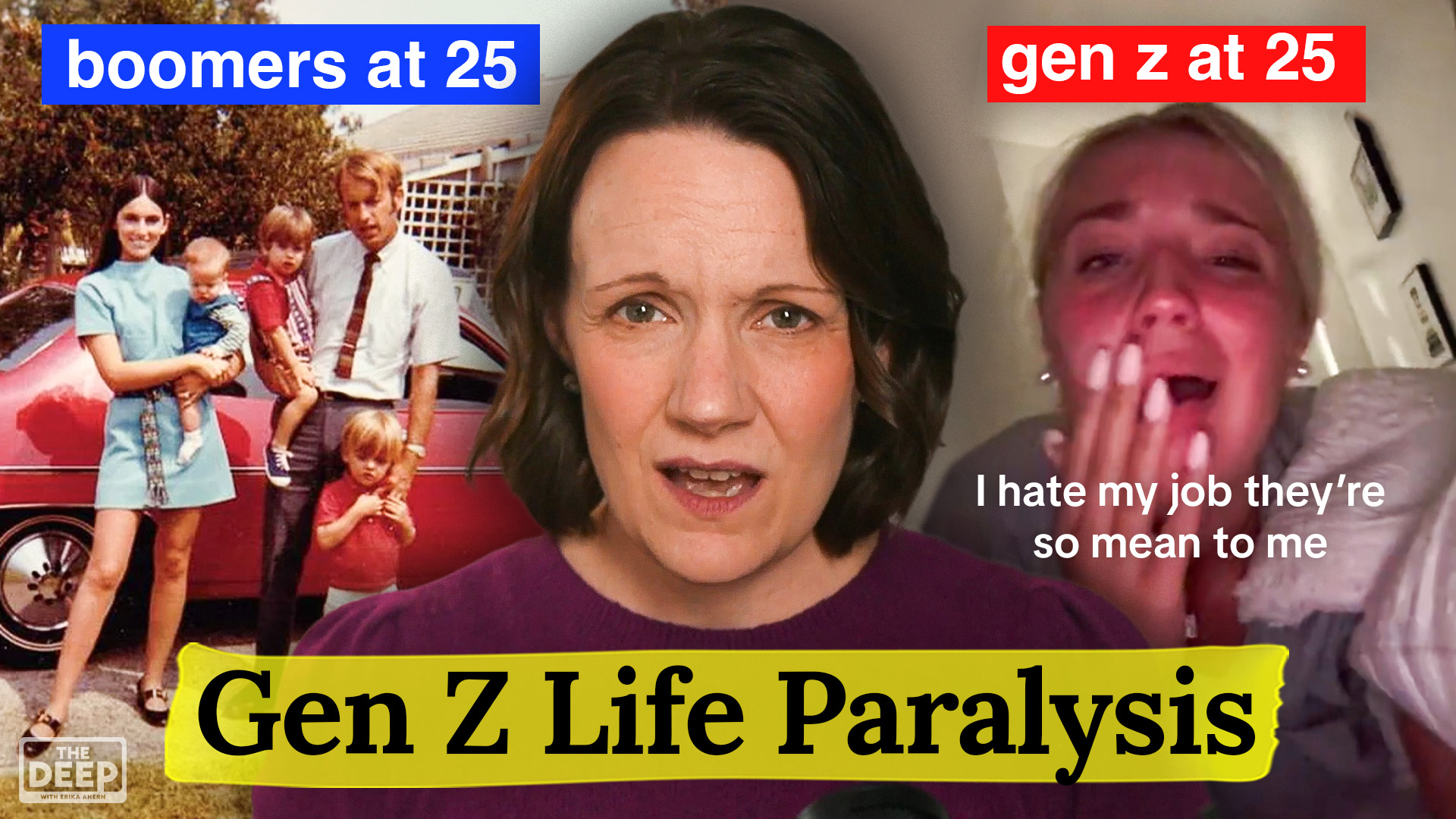
The average American boomer got married at 22, had kids by 25, and bought a house before 30. They stayed in jobs for 8 or even 10 years on average. Millennials pushed those milestones back by about 5 years. But Gen Z? By the time they turn 45, one in three will have never married. And today, American adults ages 20 to 35 Plan to have an average of 1.8 children. In other words, they aren't even planning to replace themselves. The typical first-time homebuyer today is 40 years old.
Not only is Gen Z not reaching basic adult milestones that, until a few years ago, were taken for granted, they also just don't value the things that we used to see as cornerstones of a flourishing human life. The percentage of Americans who say values like having children, religion, and community involvement are very important to them has plummeted since 1998. What used to be understood as fundamental to the good life, marriage, stability, family, is now just a lifestyle choice for rich people.
So, will Gen Z delay adulting forever? Is it a personal failure, or is something else? What is going on? Psychologist Jeffrey Arnett gave us the phrase, perhaps a euphemism, emerging adulthood to define this Gen Z phenomenon. He wrote, entering adulthood is no longer as definite and clear-cut as getting married. On the contrary, the road to young adulthood is circuitous, and the end of it usually does not come until the late 20s. In other words, 29 is the new 19. Emerging adulthood seems like a win-win freedom fest.
You aren't tied down until you're sure. You get to test drive different careers and potential spouses. You can travel or get another degree, and for some people, it turns out that way. But for many, it's also a time of prolonged rootlessness, uncertainty, and stress, and they largely blame the economy. More than half of Gen Zers, 55%, and Millennials, 52%, say they are delaying major life decisions such as marriage, starting a family, or creating their own business due to their financial situation.
Compared with their parents and grandparents, Gen Z spends more years in the gig economy, trying out various jobs, and carrying debt. They change workplaces every 12 to 15 years. 54% report daily or weekly browsing for their next role. It's not necessarily out of disloyalty, but tracks with the emerging adulthood view of your 20s and early 30s. It's a time to build broad skills, gain as many experiences as possible, and find financial stability. The strategy isn't paying off, and it's certainly not helping with Gen Z's most common complaint about the economy, housing costs.
No one raising kids in the 1990s saw this coming. In 1985, the median home cost approximately 3.6 times the median annual income, or about $87,000. The median home price in the United States today is more than $420,000. Americans need an annual income of roughly $102,000 to $107,000 to afford that. In today's market. But the U.S. census data shows that Gen Z workers earn far less than that. Their median income is roughly $45,000 annually. It's no wonder that, while 90% of Gen Z say they want to own a home, a staggering 79% say they've been priced out of the American dream.
In addition to the wild housing market, many Zoomers were sold on a story that to get ahead, they needed to go to a four-year college and get a graduate degree. To make it in America, 25% of Americans ages 18 to 29 years old took on an average of $24,000 in federal student loan debt. Zoomers are more likely to carry student debt than adults in any other age group. Economics is never divorced from psychological and spiritual causes and effects. Nature cannot deny itself, and we are creatures composed of both body and soul.
The skyrocketing cost of college education carried with it another cost, no less devastating than crushing student loan debt. Education became a consumer-oriented industry. Kids who borrowed and paid were always right. And the universities increasingly catered to their customers' whims at the expense of their formation. See my video on the Great Inflation Crisis for more on that. The result? As one Zoomer substacker put it, an entire generation has arrived at adulthood, having passed through every institutional environment designed to produce capable, emotionally developed humans, and emerged with the credentials and the vocabulary and the skills required to create the world's greatest, most powerful, and the most powerful And almost none of the interior substance those things were supposed to represent.
Interior substance is what makes life worth living, hardship worth suffering, and risks like marriage and bearing children worth taking. It also might justify a life of student loan debt. But the majority of Gen Z didn't even get that. Between housing costs and entering the job market already burdened with crushing debt, Gen Zers can be confident. That they will need to combine salaries with a spouse or partner if they ever hope to go debt-free and land in their own house. And it's daunting, but all this seems solvable, right?
If Gen Z is failing to adult, we can just address affordability, and the homes will sell, the wedding bells will ring again, and babies will be welcomed. As one conservative think tank suggested, the goal is simply a system. Where hard work reliably leads to ownership, security, and family building. Restoring affordability is key to unlocking the American dream for the next generation, the very promise previous generations experienced, and the one Gen Z still hopes to see restored. I am totally here for that.
As the boomer generation dies out, Gen X and millennials should take up that baton and work hard to make marriage, family, and stability Financially viable for all Americans. Lots of good work is being done in this area, but economic stress is not the only wound Gen Z is carrying around. Previous generations have suffered enormous hardships and still carried on with marrying, reproducing, building, and preserving.
So, why not Gen Z? Did the DNA soup just magically produce an entire generation of sterile snowflakes? Financial anxiety alone can't explain Gen Z's perpetual adolescence. At some point in the 2000s, America started going through a tech revolution so sweeping that it changed our brains, our relationships, and the trajectory of entire lives. That revolution hit a post-Christian society that had largely rejected the traditional communities and moral guardrails that in the past have helped humans navigate societal upheaval. Gen Z's formative years were shaped by constant surveillance, unprecedented digital connectivity, instant gratification, and unlimited exposure to the profits of catastrophe.
Millennials and Gen Xers were raised with significant freedom. We were the generation of latchkey kids who rode bikes, hung out in parks, and heard, come home when it gets dark. For better or for worse. Gen Z, by contrast, came of age during the height of helicopter parenting. Concerned about safety, academic success, and future opportunities, parents became more involved in every aspect of their children's lives. The upside? Parents, especially dads, are spending more time than ever with their children. Childhood is safer than ever.
The number of children under 13 is the highest in the world. The number of children under 13 is the highest in the world. killed as pedestrians has fallen by more than 90% since the mid-1970s. Car seat laws have cut crash fatalities in half. In 1982, 212 American kids were abducted and murdered by strangers. In 2025, only about 100 kids were abducted, and 90% of them returned home safely. In terms of physical security, it's a great time to grow up in America.
But we might have gone too far. Parents are also white-knuckling their way through their kids' lives with an unprecedented intensity. By 2012, they could track their kids' location through smartphones. Schedules are managed, conflicts are mediated, and both physical and emotional risks are minimized.
To top it all off, social media ensured that every mistake, awkward moment, and unpopular opinion could be documented. Monetized and shared. The consequences are complicated for both the parents and the kids. Anxiety, depression, and self-harm grew right up alongside supervision. It turns out helicopter parenting comes with a psychological toll. When adults remove every obstacle, children can inadvertently learn the opposite lesson, that taking risks And making long-term commitments is dangerous. Keep your options open. Monitor your emotions. In that environment, independence is delayed and anxiety increases.
Information overload made possible by the same smartphones made things worse. For me, bad news arrived once a week on the PBS Friday NewsHour. For Gen Z, crises arrive every minute. School shootings, terrorist attacks, political unrest, economic crashes, pandemics, wars, and Greta Thunberg stream continuously through phones that are rarely more than a few inches away. Apocalyptic language is the cash cow of the online world. Climate change is described as an existential threat. Political elections are framed as battles for the soul of democracy.
A teenager scrolling through TikTok or Instagram could be forgiven for concluding that civilization is perpetually on the brink of collapse. Then, just as many members of Gen Z were entering adolescence or young adulthood, the collapse seemed to arrive. The COVID-19 pandemic interrupted school, sports, friendships, graduations, first jobs, and countless ordinary human experiences. that we had taken for granted. The pandemic intensified anxiety, loneliness, and uncertainty, and drove millions of teens into full-on digital addiction. Taken individually, any one of these factors—surveillance, apocalyptic narratives, and global pandemic—would be troubling.
Taken together, they handed Gen Z some, to put it mildly, unique psychological Challenges. Psychologists are increasingly diagnosing Zoomers with compassion fatigue, the frustrated desire to relieve suffering. The phenomenon is commonly associated with nurses caring for the wounded and dying in wartime. Few Gen Zers have seen combat, but they've all been subject to a digital firehose of human suffering that they are powerless to address. They are expected to be treated differently, and they are expected to be treated differently, and they are expected And they, in many cases, expect themselves to care about everything, all the time.
The most common outcome is a sort of impassive detachment from your surroundings, the Gen Z stare, learned helplessness. Layered on top of emotional exhaustion are shocking levels of anxiety. 84% of Gen Zers believe mental health is a crisis in the United States, and they are over it. 80% more likely to report dealing with anxiety or depression compared to older generations.
Nearly half of Gen Z adults report frequent anxiety symptoms, and more than a third have experienced an anxiety disorder. Social media, economic uncertainty, academic pressure, and the lingering effects of the pandemic all contribute to a pervasive sense that life is unstable and dangerous. Anxiety, in turn, is connected to decision paralysis.
Young TikTokers joke that they cannot choose a restaurant, a girlfriend, a career path, or even what to watch on Netflix. The joke is funny, but in a sad sort of way. Unprecedented material wealth has given us an overwhelming number of options in almost every area of our lives. From streaming music to dating apps, everything is swipe right. You're paralyzed by choice, and the twin fears that you might choose the wrong thing, and at the same time, miss out on something better.
When every decision feels high stakes, and every mistake feels permanent, many young adults stop believing in trying to be heroes, or just trying to be adults. It's funny when you can't pick one brand of mustard out of 17 options. It's devastating when you can't decide whether you're sexually attracted to men or women or both or something else. Sexual identity questions so central to adult milestones like marriage and children plague Gen Z. While peak woke may be past us, the fact remains that the number of adults identifying as LGBTQ plus increased by over 60% between 2012 and 2020.
And 2021. Of the Zoomers born between 1997 and 2002, 21% identify as LGBTQ+. In that fluid state of sexual identity, getting married and having babies is not your top priority, nor is it even a milestone you're thinking about. You're not even thinking about milestones. The journey is the destination. Gen Z has been launched on the journey of life. And told they can be whatever they want to be. You've got time. Don't settle. You might join the heterosexual majority, or you might join the homosexual minority.
You might be a furry, or you could just create your own identity. A family of one. And as a group, Gen Z doesn't see that as entirely problematic. Only 54% of Zoomers think marriage is needed to create strong families, and only 45% agreed. That society is better off when more people are married. That's not just a psychological disorder, and it's certainly not a function of market fluctuations or global pandemics. Gen Z was not loved. The sense that they lived in a benign universe with a loving God, a benign government by the people and for the people, or had parents whose primary mission was their well-being was missing.
They were born at the apex of secularism. As the Soviet propaganda poster put it, we've inspected the sky inside and out. No gods or angels were found. Long before Gen Z or boomers or the greatest generation, Western intellectuals and spiritual leaders had abandoned religion for spirituality and morality for values. Gen Z's parents and grandparents thought of themselves as good people. They tried to be good parents. To be kind, they tried to teach their kids the Ten Commandments, at least the last seven of them.
But as study after study shows, the link between actual religious belief and American values snapped sometime in the late 1960s and shriveled into the late 2010s. For about 15 years, precisely when the first Zoomers were kids, the rise of the nuns and the freefall of Christian affiliation. was the top headline in every news agency's religion section. Gen Z kids were educated and formed not for virtue or wisdom, but for radical freedom to choose their own truth, their own identity, and their own values.
There were very few who loved them enough to tell them there is one truth. They are beloved children of God, and that true justice is found in obeying his commandments. They were set adrift by rootless mentors. It was actually an American Quaker in 1944 who coined the phrase that I think best describes Gen Z, cut flower civilization. E. Elton Trueblood wrote in The Predicament of Modern Man, beautiful as cut flowers may be, and much as we may use our ingenuity to keep them looking fresh for a while, they will eventually die.
And they die because they are severed from their sustaining roots. We handed Gen Z a smartphone, a debt economy, and a handful of dying flowers. Boomers, and to some extent Gen X, inherited clear expectations about marriage, work, faith, and family. But the reality is, these values had already been severed from their roots in objective truth, goodness, and God himself. By the time millennials and Gen Z came of age, the we've always done it this way line didn't work anymore. If God is dead, to paraphrase Dostoevsky, everything is permissible.
Let the decision paralysis and extended adolescence commence. That is why America's Gen Z can look like the luckiest generation in human history, but at the same time be the most depressed and anxious. Technology, travel, and modern medicine are wonderful things, but they cannot defend human beings against an empty soul. But there is hope. Gen Z might be looking for love in all the wrong places, but a growing number, against all the odds, have found love in the right place. Secularism is in retreat.
The share of Americans who are non-religious has dropped for the third year in a row. Atheists and agnostics are down to 5% each. We're looking at a return to 2014 levels of religiosity. History is not a straight line. It acts more like a pendulum, and Gen Z seems to be swinging back toward faith. So, where are we? Today, two entirely contradictory things appear to be true. First, Gen Z is the least religious generation in U.S. history. 44% of 18-29 year olds are religiously unaffiliated, the highest percentage of any age group compared with a national average of 29%.
Second, Gen Z is going to church more than any other generation. The 45% of Zoomers who do identify as Christians participate in Sunday services more than their elders. 18 to 29-year-old Catholics are by far the most engaged. These young Catholics ...are more likely than any other age group to attend Mass daily, weekly, or monthly, are far more likely to engage in parish activities beyond Mass, and are more likely to go to confession regularly, to engage in Eucharistic adoration, to attend social events, and more.
Surveys show that young men today are more likely to prioritize marriage and children than status or wealth. Gen Z men are moving in a more conservative direction politically and a more religious direction spiritually. They're beginning to question everything we handed them—smartphones, surveillance, self-actualization, and secularism. Some of this shift may be driven by nostalgia. Some may be driven by exhaustion. It's also a natural rediscovery of truths that earlier generations took for granted. The family matters more than the market. The work that sustains a household matters more than the work that inflates a quarterly earnings report.
Human flourishing cannot be measured solely by GDP, consumption, or economic growth. This is the heart of Catholic social teaching. Pope Leo has repeatedly said, the economy exists for the human person, not the other way around. Authentic progress is not measured simply by wealth, but by whether people are growing spiritually, socially, culturally, and materially. In an age of revolution, he says, when human dignity is threatened by new forms of dehumanization, ours is the pressing duty to remain profoundly human. Gen Z isn't different from any of us in this respect.
We are all seeking ways to be profoundly human in a changing world. And adulting doesn't have to be scary, and it should not be put off because of fear. Adulthood is not merely about paying bills, climbing a career ladder, or accumulating experiences. It is accepting responsibility for something greater than yourself. It is putting down roots and learning to sacrifice. It's building a family, a community, a life ordered toward love. The good news is that many young people are beginning to see that.
The only thing left to do is grow up. If you liked this episode, be sure to subscribe to LOOPcast. We bring you a new episode of The Deep every Thursday at 4 p.m. Eastern.