What Happens When America Stops Having Children?
America is about to face a demographic disaster. What happens when the world’s most powerful country stops replacing itself? Erika walks you through what depopulation means for our future… and what might actually reverse the decline.
Transcript
Read the full transcriptAuto-generated · 3,120 words
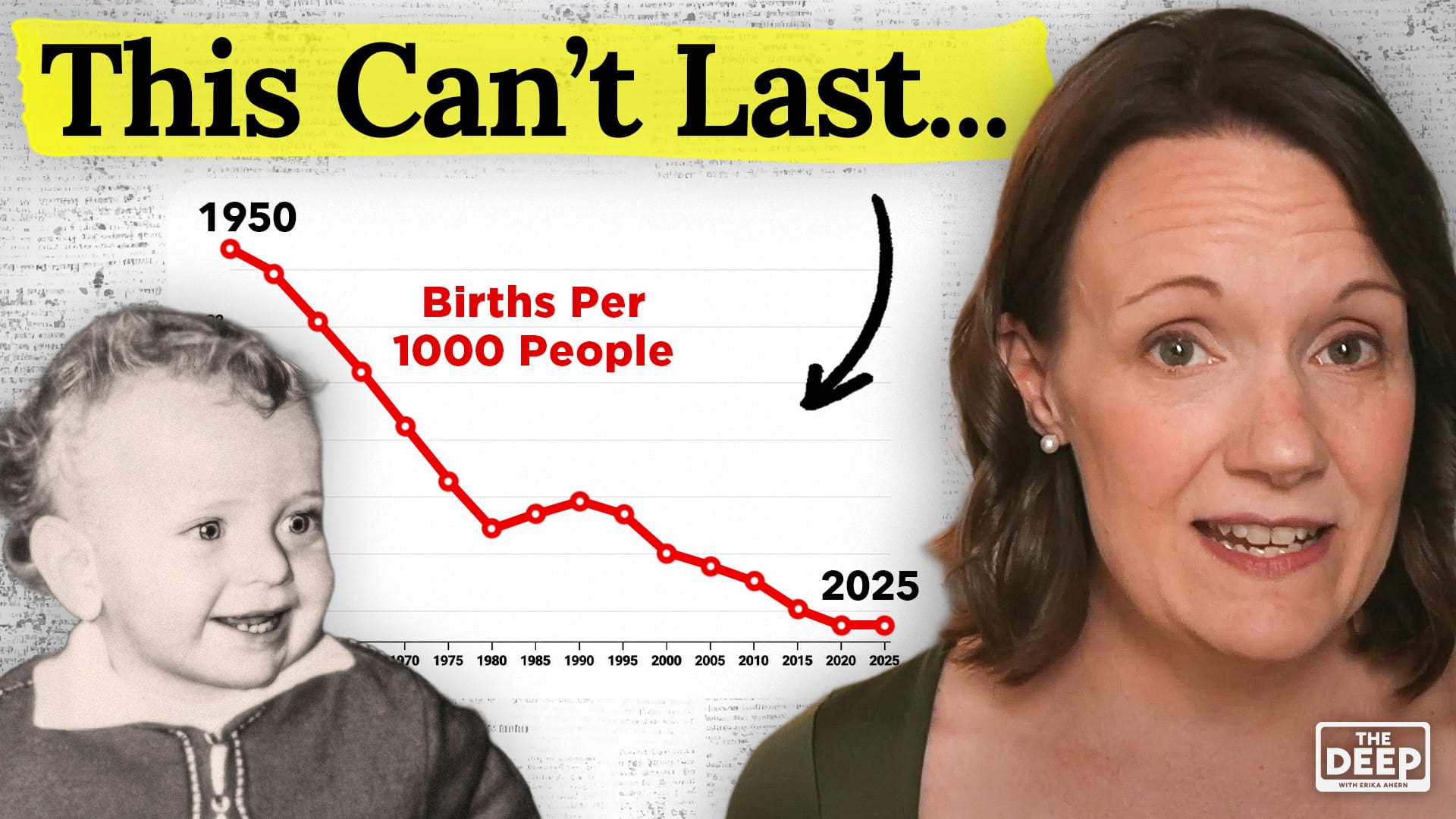
I just found a shocking statistic. In 1900, children made up about 40% of America's population, but today, that's just 24%. School mergers are an annual occurrence in both rural and urban areas. It turns out American fertility has been declining for nearly 200 years, with the birth rate eventually falling below replacement in 1973. That's over 1.5% of the country's population, and that's just over 1.5% of the country's population. 50 years of not replacing ourselves, and in 2028, natural deaths will actually outpace natural births.
We talk about falling birth rates almost like we talk about inflation or interest rates. It just feels like another statistic. But no modern civilization has really ever attempted what we are about to do, maintain an advanced economy While choosing not to replace the people who keep it going. Will a shrinking nation mean bigger pieces of the pie for everyone? How will depopulation change our daily lives, our cities, our landscapes? And is there anything we can do to reverse course? It turns out we don't have to imagine what happens next, because we already have previews.
Making babies is as American as making apple pie. In the late 1600s, American women averaged somewhere between 5.5 and 7.5 children each, substantially higher than England's three to six children per woman. In 1775, the American population was doubling every 20 years, not because of immigration, primarily because Americans were having babies. Since the Revolution, roughly 140 million people have immigrated to the United States. During that same period, at least 550 million Americans have been born here. So, births, not immigration, built America.
Today, that has completely reversed. The Census Bureau has projected that without mass immigration, America's population decline would have already begun. Even with current immigration levels, we're only delaying depopulation by about 30 years. Regardless of immigration, beginning around 2030, annual deaths will exceed annual births among Americans born here. If you simply count warm bodies, America still looks like it's growing, but if you look at the rate of population change instead, the picture becomes much more alarming. Even with moderate immigration, the United States is projected to peak at roughly 370 million people around 2080 before beginning our long decline.
Most Americans alive today will begin to experience the effects of depopulation during our own lifetimes. So, what does that actually look like? You don't have to fly halfway around the world to find out. We've already watched pieces of this story unfold right here in America. Journalist Peter Santanello, who has one of my favorite YouTube channels, recently traveled through the Rust Belt, stopping in Braddock, Pennsylvania. Braddock sits in Pennsylvania's Mon Valley. It's an old steel town, and home to the very first of Andrew Carnegie's 1,679 public libraries.
At its peak in 1920, more than 20,800 people lived there. The 2020 census? Counted just 1,700 residents. That's a population decline of almost 92%. It began gradually during the 1930s. Then came the collapse of the American steel industry in the 1970s and 80s. Between 1980 and 1983, roughly 95,000 manufacturing jobs were lost in and around the Pittsburgh area. Young families packed up and left. Then, the crack cocaine and opioid epidemics devastated many of the young people who remained, making an already bad situation dramatically worse.
City tax revenue collapsed, making it difficult to maintain roads, parks, utilities, and public services. Fire and police departments struggled with staffing and funding. Neighborhood schools closed or consolidated because there simply weren't enough students. Property values plummeted, and as a result, whole neighborhoods of homes became worth less than the cost of maintaining them. The abandoned houses were demolished, leaving vacant lots scattered throughout the community. Traditional grocery stores gradually disappeared, and Braddock became what economists call a food desert, where residents had little access to full-service supermarkets.
Church congregations shrank, and many churches merged. Others closed their doors. So, what happens next? Small businesses, from diners to hardware stores that once depended on steel workers, slowly disappeared as well. Braddock and the entire Mon Valley became one of America's best-known examples of post-industrial decline alongside places like Youngstown, Cleveland, Detroit, and Buffalo. Shrinking cities aren't limited to the Rust Belt, which failed to adapt to shifts in the economy. Depopulation is also happening in California. ...and along the Middle Mississippi River, and in thousands of rural communities across the country.
The Mon Valley emptied because the jobs disappeared. People flee California for lower housing costs or taxes. But depopulation from a fertility crisis is almost the reverse. The economy looks great on paper. All the numbers are green. We still need workers. Unemployment rates are historically low, and we're importing workers from around the world. We're not running out of work. We're running out of people. Now, some economists and think tank directors hail depopulation as a net benefit for humanity. Fewer people mean a bigger piece of the pie for everyone else, and more equality for women.
Growth is out, degrowth is in. But every major economic model assumes a positive relationship between population and long-term economic growth. We often think of people primarily as mouths to feed. Another drain on our resources. But every person is also a producer. Economists have talked about the Japanese miracle and the German miracle. The fact that after their defeat in World War II, these nations, with the investment of the United States, managed to leap from total devastation in 1945 to be economic leaders in the 1990s.
And that didn't happen because they had physical capital. As Thomas Sowell explains, it was the human capital. This is not a new thing, although we talk about the German miracle and Japanese miracle. John Stuart Mill in the middle of the 19th century pointed out that countries do often have almost miraculous recoveries from devastations of war. He argued that the physical capital is going to wear out anyway.
And it's going to have to be replaced anyway. And what really matters is, do they have the human capital to replace the physical capital? Conversely, you may have all sorts of transfer programs in which vast amounts of physical capital change hands, either because of foreign aid programs or because of confiscations, nationalizations of foreign enterprises, and so forth. And yet, if the people who acquire this capital don't have the human capital to maintain it and reproduce it, it's only a matter of time before it begins to rust, to wear out.
Needs spare parts, etc. And you've had a one-shot confiscation, but it really hasn't done anything in the long run. Every human person will consume housing, education, health care, and food. But each human person could also become an inventor. They will be a taxpayer, a builder, or a nurse, a future entrepreneur. Human beings are the ultimate form of capital, the necessary drivers of a flourishing society. The Rust Belt couldn't support its human capital, so it lost its producers, creating a vicious cycle of decline.
But we actually have a better preview of what's coming. We have countries that, while at the top of their economic game, stopped replacing their workforces. If America is just now entering this era, Japan and South Korea and some European countries are about 20 to 30 years farther down that road. So, let's see what that actually looks like. Japan's population has now been declining for more than a decade. In 1950, the average Japanese woman would give birth to 3.43 children in her lifetime.
Today, that's just 1.38 kids, which is actually a bump up from 1.1 kids just 10 years ago. In 2025, Japan's population had fallen to 123 million, a decline of 3.1 million people, or 2.5% since the 2020 census, and roughly 5 million people below its peak population. That marked Japan's largest five-year population decline on record. This wasn't an economic upheaval or a plague. The decline was what demographers call natural. So, what does that feel like for your average Japanese citizen today? Schools have merged, hospitals have fewer nurses and longer wait times.
Many rural communities have steadily lost businesses and local services as younger generations move to Tokyo or other major metropolitan areas. Some of them have ceased to exist altogether. Japan now has approximately 9 million abandoned homes. Entire villages have effectively been left behind, and the population is aging. Adult diapers now outsell baby diapers. The economy has been turned on its head. Older people generally consume far more public resources while producing less economic output. And it's a preview for America, where the baby boomer generation gets a lot of flack for sitting on enormous amounts of wealth.
In reality, though, Not all of them are rich, not even close. In fact, the bottom half of boomer households owns just 2% of total boomer wealth. The median household income for Americans over 65, including their Social Security, is only $47,620 per year, the lowest of any age group, and they depend almost entirely on Social Security and Medicare. As a result, today, Americans spend roughly 40% of all federal tax dollars on Americans over 65. By 2029, that figure is projected to reach about 50%.
We struck a generational bargain when we adopted a welfare state. The younger producers would take care of the older retirees. And in turn, we trusted that when we were old, the next generation would take our place and provide for us. Except we aren't making a next generation. Now, of course, we will adapt. That is what humans do when we're not making babies. Artificial intelligence will improve. Robots will become more capable. Automation will replace some jobs entirely. Technology can soften the blow, especially for the rich, but it can't eliminate the underlying problem.
Who will care for an aging population? How does a free market survive? with a shrinking pool of workers and consumers. How could a socialist system survive when fewer workers are supporting more non-workers? Businesses, nursing homes, and public services increasingly rely on robotics, artificial intelligence, and automation to compensate for labor shortages. Dancing robots have been developed to care for the elderly. Japan rolled out a baby robot designed to, quote, invoke an emotional connection For couples without children and the elderly who never got a grandchild to hold.
But a robot is a parody of a human baby, and we are right to feel repulsed by these little wobbling humanoids. They seem like the last desperate gasp of a society that has sterilized itself into oblivion and too late realized, we gave up something far more precious than the almighty dollar. We gave up on love. A viral 2024 essay on the unspoken grief of never becoming a grandparent offered a poignant insight into a reality that many boomers have realized too late what matters most.
They raised kids who don't want kids. One aging dad said, quote, I think we both would have loved to pay that gift of unconditional love and guidance back in spades if we were grandparents. But not to be. Beyond economic collapse, a world without children eventually becomes a world without hope. The book and film adaptation of Children of Men captured that reality vividly. Despair has a way of feeding itself. Young adults are already reporting record levels of loneliness, anxiety, and depression, and many of them actually cite this as reasons for not having kids.
Babies and children help us to imagine a better future, and raising a family gives us a reason to produce. Children give meaning to economic struggle. So, what are we going to do? Whenever economists and policymakers gather to discuss population decline, someone inevitably raises the obvious solution. What about immigration? Immigration certainly helps, but it does not solve the underlying problem. It only delays it. Because below-replacement birth rates aren't unique to the United States and Europe and Japan. They're actually becoming the norm almost everywhere.
China and parts of the Middle East and even Africa are also depopulating. The world population is projected to peak in the next 50 years and then shrink, beginning its own long decline. So, migration can redistribute people, but it can't create new generations. Another common proposal sounds even simpler. Just pay people to have babies. Maybe the problem is just financial. Now, certainly raising children is expensive. Ask me how I know. So, perhaps all we need are bigger tax credits or larger baby bonuses.
Many countries have already tried exactly that. Italy and Hungary, France and Poland. In 2006, Vladimir Putin announced that the government would pay mothers over $9,000 to have a sex. Russia continues to depopulate. The ladies were not convinced. Last year, The Guardian profiled a little girl named Lara Bussi Trabucco. She was the first baby born in her Italian village in almost 30 years. Her hometown, Pagliara dei Marci, has become so empty that cats now outnumber people. Italy's fertility rate fell to just 1.18 children per woman.
in 2024, one of the lowest in Europe. Parents there can receive a 1,000 euro baby bonus, along with monthly child support payments worth roughly $400. But many rural communities have already lost their maternity wards and closed their schools. There's almost nowhere left to spend the baby bonus. That's one reason I don't think these conversations should become ideological. Better family policy is a good thing. A generous child allowance? Great, I will take it. A meaningful baby bonus? Awesome. Those are all worthwhile ideas.
I just don't think they explain why people ultimately decide to have children. Money alone cannot solve the problem. Why? Because wealth cuts both ways. As your living standards improve across the developing world, virtually everyone actually began having fewer children. When families no longer need six or seven children to help keep the farm running or just to survive, they naturally begin investing more resources in those fewer children, so each child costs more, and at some point the scale tips, and people enjoy their own creature comfort so much that they become disinclined to spend time and money on more children.
It turns out that the wealthier you are, The higher the opportunity cost to you of having children early, in your 20s or 30s, or even at all, the wealthier you become, the more costly it becomes for you personally to interrupt your education or your career during your childbearing years. How hard it is for a rich man to enter the kingdom of heaven. Or to welcome a child. Now, I want to find a way to help fix this, because having seven kids of my own, I want more people to break the generational silos that we live in and see the joy of a life shared with children and grandchildren.
And eventually, I realized that I had been asking the wrong question. For that, I have economist Dr. Catherine Pakalok to thank. Here's how she framed it. For most of human history, children weren't really optional. They were simply the natural result of men and women doing what men and women do. Today, that is no longer true. Technology has made conception increasingly optional, relatively easy to avoid, and relatively safe to temporarily postpone. For the first time in human history, the next generation has become optional for almost every particular couple on earth.
And it turns out optional things, especially challenging optional things, only happen when we believe they're worth sacrificing for. So, if we're looking for solutions, the most important question is not, why aren't people having children? It's, why are some people still choosing to have large families? What makes certain couples swim against every cultural, economic, and social current? To answer that, Pakaluk interviewed a diverse cast of women with college degrees who had five or more children. Some were religious, and some weren't. Some lived in cities.
Others lived in rural communities. She interviewed professionals and stay-at-home moms, Democrats and Republicans, progressives and conservatives. But one shared conviction appeared again and again. There were a few women who had said, well, I felt really called to just have as many as I could. That was very... Small portion of my sample. These were people who had a very particular belief about the desirability of children, that children were worth wanting.
Worth making sacrifices for. Among the most important things you could organize your life around, right? So, you plan to have your children. You plan in advance to be the sort of person who can be open to the next child. Because why? Because such great worth attached to having a child. Children are a blessing. They're not merely an expense. They're not merely a sacrifice. Not just another lifestyle option competing with vacations or promotions. There's something worth planning for, and in fact, they're the foundational good for a man and a woman, a couple, a family, and a community.
The Institute for Family Studies found something else in its 2026 report. It explains why some couples have more kids than others, and that is peer culture. Young adults surrounded by supportive friends who value marriage and family Desire nearly a full additional child on average, compared with their peers whose social circles don't. Supportive friendships and, oddly enough, celebrity babies also increase couples' intentions to have another child by roughly 10 percentage points. In other words, culture matters more than finances. The people around us matter, and the assumptions that we absorb.
As a woman, I can say most of us grew up on girlboss Disney princesses, and we had every encouragement to delay marriage, delay children, all in favor of the economic triumph that, ironically, is shriveling for want of children. We thought we had to be extraordinary, but the culture didn't tell us what G.K. Chesterton, himself sadly childless, knew. The most extraordinary thing in the world is an ordinary man. and an ordinary woman and their ordinary children. I hope more couples come to see what Catherine Pakaluk's mothers saw, that children aren't obstacles to the good life.
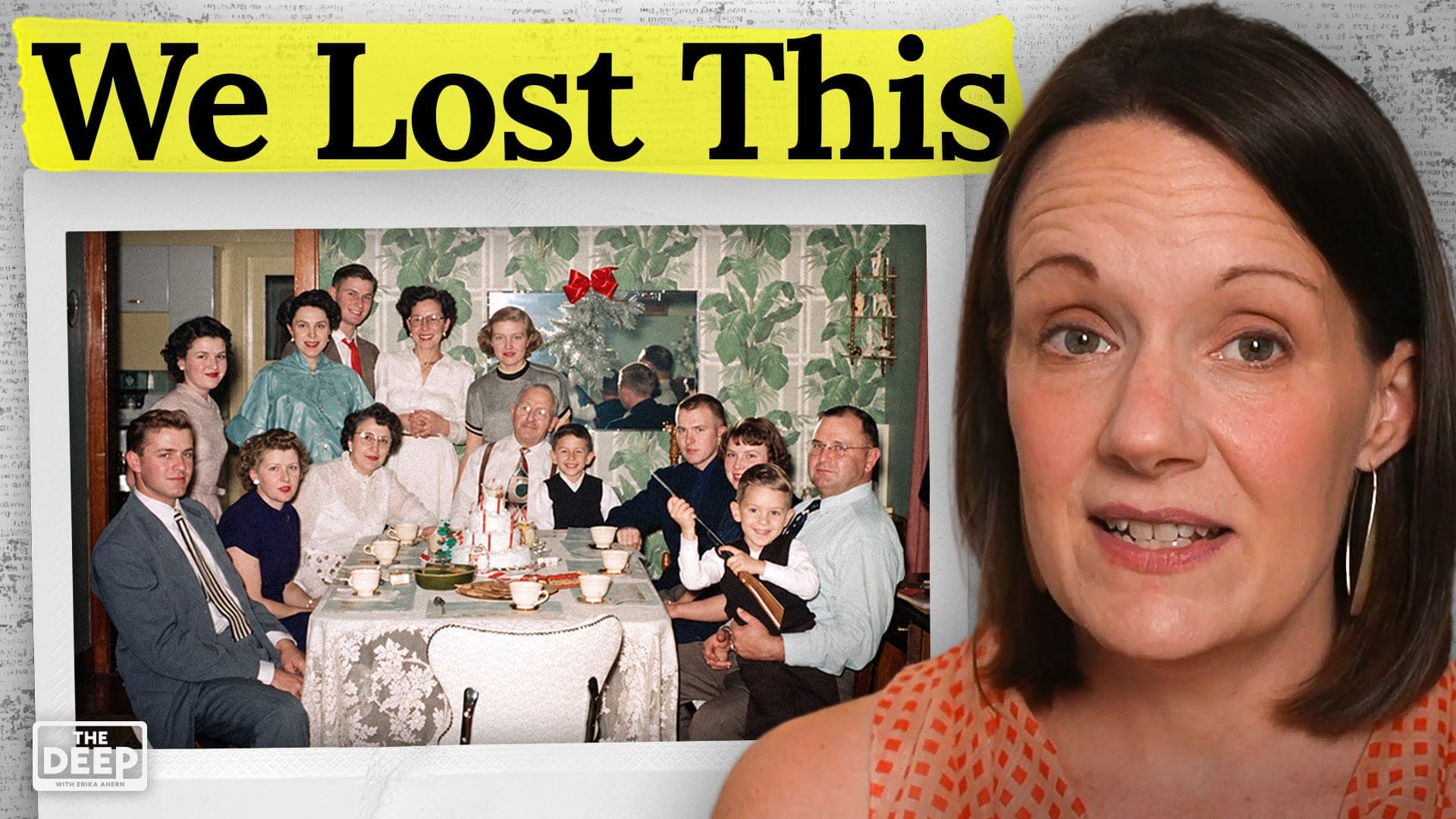
They are the good life. Because the alternative isn't just smaller families or more Mexican vacations. It's smaller towns, smaller churches, empty schools, and empty Thanksgiving tables. Entire countries quietly fading away. By choice. And we already know what that world looks like. We've seen it in Braddock. We're watching it in Japan and Italy. The only question left is whether we will decide that the next generation is worth making. If you liked this episode, be sure to subscribe to The LOOPcast. We bring you a new episode of The Deep every Thursday at 4 p.m. Eastern.