Faith, Family, Farming
Farmers are the unsung, unseen heroes of the American table. Visit two family farms that differ in size but operate on the same principles of stewardship and service.
Transcript
Read the full transcriptAuto-generated · 2,510 words
We live in a world of easy. Cold air on demand. Shelves lined with color. Milk, fruit, greens. It's all just there. But every bite, every sip in that refrigerator traces back to someone who woke up before the sun, working through heat and dust, and long days most of us never see. We don't think about it. We just expect it to be there.
Well, out here in north central Texas, two very different farms carry that. Unseen work. One smaller, hands in the soil, growing food close to home, sold face-to-face. The other bigger, steel, scale, and a steady rhythm, where even the quiet strength of dairy cows helps feed people far beyond the fence line. Different size, different pace, but the same heartbeat. Faith. Family. Hard work. It's a calling to provide for tables they'll never sit at, and refrigerators they'll never open.
It's quiet, essential work. The kind that keeps America moving. I don't think everybody's American dream is the same. Having the land that you can work, I mean, you feel pride in what you've grown. It's a way of life. My parents both grew up on farms, and I started working early. I've just known since I was probably in grade school that I wanted to be a farmer.
You feel good about growing produce for people that are going to eat it. It's going to make them healthier. And I do think the people that we sell to in the Wichita Falls area really appreciate what we do.
The farm came up for sale right before we got married, and then we just gradually started adding vegetables to the farm. We grow broccoli, five varieties of greens, hydroponic lettuce, spinach, cucumbers, onions, multiple varieties of potatoes, black-eyed peas, green beans, cabbage, squash, 10 or 12 varieties of peppers, cantaloupe, watermelon, carrots. We grow beets, turnips, rutabaga. I mean, if you can grow it in our North Texas area.
We're trying to grow it. The more variety we offer, the better. We're really doing it more for our customers. We try to give them as much variety as possible. The end goal, we make enough to live on, and that's really what we're after.
We plant something and, you know, there's risk and everything. So we have casinos just right across the river from us, but we don't ever go to them because Jimmy doesn't need to because he gets to gamble every day on the farm.
I always had a passion for animals. Farm life was just something that was in my blood. Our agricultural family dates back to 1890. My folks moved to Luxembourg, a little bitty country in the heart of Europe, and started farming. That's where I was born. That's where I grew up. Luxembourg was really too small for agriculture, so decided to look to the United States of America, and we decided to make this our home.
When we started, we milked about 50 cows, and the dairy today has grown to a little over 5,000 cows. When I went off to college, I wasn't really sure I wanted to come back to the dairy farm. I started to miss it, being in the city or being in town. I started missing it out here.
There's four of us brothers now. All four of us have come back to being part of the family business. My wife gets to work in the business with me. She does all of our office, finance. Kids get to spend time running around on the farm. Love the cows, love the animals, so I love what I do.
This is the carousel, or the milking parlor, where we milk the cows. The cows come on, we're sanitizing their teeths, we're wiping them clean. We put the milking machine on that sucks the milk out, similar to like a calf sucks the milk out, and then when it notices there's no more milk coming, it'll automatically come off, we'll put another sanitizer, and the cows walk back to their pens. This whole process takes about five minutes. We process our own milk today in returnable glass bottles.
I really was fascinated with processing and systems and how things are built. You know, it's really cool to tell people that their milk goes from cow to grocery shelf within 24 hours from the cow being fed and milked. From our facility, we then take it and we pasteurize it and bottle it, and then it has to go through quality standards. And then from there, it gets shipped, put on a truck, and delivered to the grocery store.
We pride ourselves to provide one of the most wholesome products out there on the shelf, and we will continue to do that, and we're proud of that. It's a really rewarding experience to come back and be part of the family operation.
My parents have taken a lot of risks to be able to grow it so that it would sustain four families, and I'm just very thankful for that. So, we have a fertilizer tank that has 500 gallons in it, all the food, everything the lettuce needs, and that's what we're going to grow in these pipes. The water comes in through these tubes into the pipes and just recirculates through the whole greenhouse. At some point, this whole lettuce house, every pipe will be full of something growing in different stages.
So, this is a greenhouse that we use to start our little plants, which we start all our own plants. We don't buy any plants. We just buy the seeds. It's not always comfortable. It's cold, it's hot, it's windy, and it doesn't really matter because you still have to go out and do it. I mean, we, all summer, pick all day long in the heat, but you just know it has to be done. I can tell you that farmers, in general, are a very resilient breed of people.
Farming teaches you, if you don't really want to do something, if you don't do it, it's going to cost you. That is the thing about farming that people don't realize. It's, you know, six days a week from daylight to dark. It's not fun getting up in the middle of the night when it's cold, and all the little plants are going to freeze.
Little heaters run out of fuel in about three hours. I don't like getting out of bed. It goes away immediately. I don't think about that. The DARE products don't just show up in the grocery stores. It starts with a cow and a process and the love for those animals.
If you really look at everything we've built, and that's all about animal welfare, cows love monotony, and our role is to make the cow's day exactly like yesterday. We want to make sure their beds are comfortable. We want to make sure that their alleyways are clean. We want to make sure that they have food at the same time. They get milked at exactly the same time every day. We have the fans on the end wall that are sucking the air out, and when they suck the air out, we keep a nice continuous breeze through here.
It also keeps the flies out. Then we have these fans over the beds where the cows lay to keep them really comfortable when they're laying down. We have left skylights in to get lots of natural light in. It's state-of-the-art. We realize how valuable these cows are, how much they help us, and so we feel like, yeah, we need to give back. If we take care of them, they keep taking care of us.
They'll make a lot of milk, they'll make good quality milk, but it's also just the right thing to do. You just see that they're happy, they're laying, they're comfortable, they're chewing their food, they're just chill. And that's, it just makes you happy.
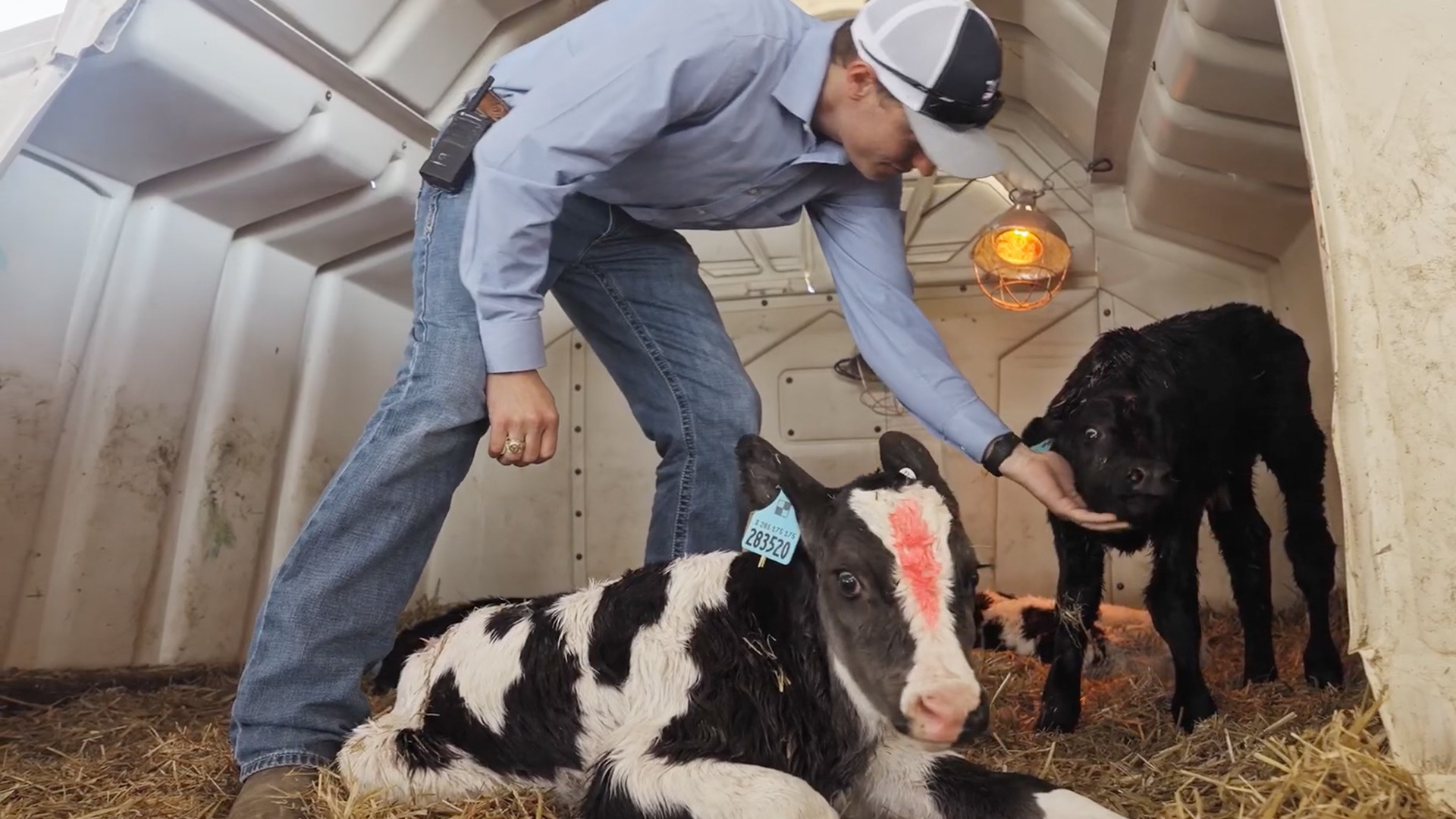
After the cow gives birth, we'll leave the calf with the mom for about the first 30 minutes, so that she can lick the calf dry. Then we'll bring the calf into here, where they will have heat lamps and such. They're not set up right now because it's really hot today. But we'll have heat lamps and keep the calves warm, and they've got their nice straw bedding.
Sustainability for us is a very, very important topic. We work with resources that are bestowed on us. We work with the land. We work with Mother Nature. We work with the water. These are resources that we are responsible for.
We've captured the methane gas to reduce our greenhouse gas impact, solar panels up on top of the roof, water usage. We use the water three, four, five times before its final destination. We give back to the Earth what we take out of it. Our goal is to leave this place a better place for the next generation.
The number one battle of farming is the weather. You can do everything right. You can plant it at the right time. You can water it, but you can still have, you know, a high wind, hail, or freeze, and all of that will affect that crop. Too much rain, not enough rain. Too much heat, not enough sunshine to grow your crops.
We've watched a lot of tornadoes. I was in the tornado in 1979. It took our house, everything around it, everything. We had a big storm. The greenhouse literally bent the greenhouse in itself to the ground. I had thousands of pounds of green tomatoes, and they were beautiful, and I just lost all of them.
We know already today that we're short of meat here in this country because we had severe drought in the West. We know that older farmers are going out of business, and the young farmers don't want to take over. Now, we don't have enough cattle in this country. That's why beef is so high, and that's not a fix. That's going to happen overnight. If we look at milk, shelf life of milk is 21 days after pasteurization. If something would happen to the national cow herd, some kind of a disease that we couldn't cure, we would just run out of milk.
In 21 days. One year of drought during the summer would create price shocks to the market. A following year of drought would be catastrophic. Food security is national security, which is very important. There is environmental regulations that are overburdensome. A lot of these rules and regulations are made somewhere in Washington or the capital of every state. Every day, we have to record the temperature outside. We have to look at the elevation of the lagoon. Six elements that we have to record every day, not a single one.
Makes sense. I wish these people out of these cubicles that make these decisions would come to the farm, put their boots on, and let's go to work one day, and let's explain them what we're really doing, so that they realize that some of these rules and regulations are overburdensome.
We turn to God a lot. You're praying for rain, or you're praying that the 70-mile-an-hour winds don't blow your greenhouses away. That's where your faith is so important. I don't think you could do this without it. We're planting corn right now and hoping that God gives us some rain at the right time that we can get our corn in the ground, and then we get some, you know, fertile rains that really help us be able to grow some great crops and good feed for our cows.
Every Sunday when I go to church, I always pray, keep our team happy, healthy, and keep the cows healthy, and help us to get better at taking care of these cows. We wonder, you know, how people, if you don't believe in God, how you could even do it, because you just have to have Him.
On the farm, you learn that there are struggles, there is suffering, and if you don't have faith, then I don't know how you get through it. You learn that everything is possible, and that miracles really can happen. Faith, family, farming, it's a calling.
Somehow, it always works out. The community out here is very tight, very good. The neighbors definitely all help each other, keep an eye out. So, that is going to pick up the pecans. That's a harvester. He lets us use his equipment to pick up, so everybody is very generous.
When we moved out here, I've had a few of them tell me, I didn't know what Catholics were moving in out here. But they were very helpful for me. There's a lot that I didn't know, and they were so generous with it. I had a lot of questions.
My American dream is making enough money to live on, to help others. You know, the end goal just isn't how much is in your bank account or how big your house is. You've got to make money, but it's not, for me anyway, it is not the most important thing. Farming helps you see what's important and what's not important.
Don't you know we're living in the good old days? It's really wonderful when you can go to church, and your children are in church, and your grandchildren in church. We have four generations going to Mass. That made my dad feel like when he could be in Mass and have all his family with him, that was the best gift he could ever get.
You know, there is something that ties it all together. It goes from generation to generation. Why has farming been the oldest profession in the world? Because from father to son to grandson, it just keeps going. I feel like my children have made me a better person. I don't know if you feel that way, but I do feel like... I feel like my children have made me a better person. I don't know if you feel that way, You're just called to be a better person for them.
That's the perfect American dream. I hope that that legacy will continue. America has been good to us. It was in 2014. We became American citizen, and that was a very proud moment for us. What we've achieved here in America, we never could have dreamed of in Europe.
The United States is still a country where freedom is what this country stands for. We wave the American flag right in front of our business, and we're proud of that. The body is falling apart, and the doctor asked me what I was going to do.
Are they going to die on the farm? We're going to keep farming. I didn't think that was a good answer, but just oh well. I don't think you could be in a better place.