Saving Soldiers
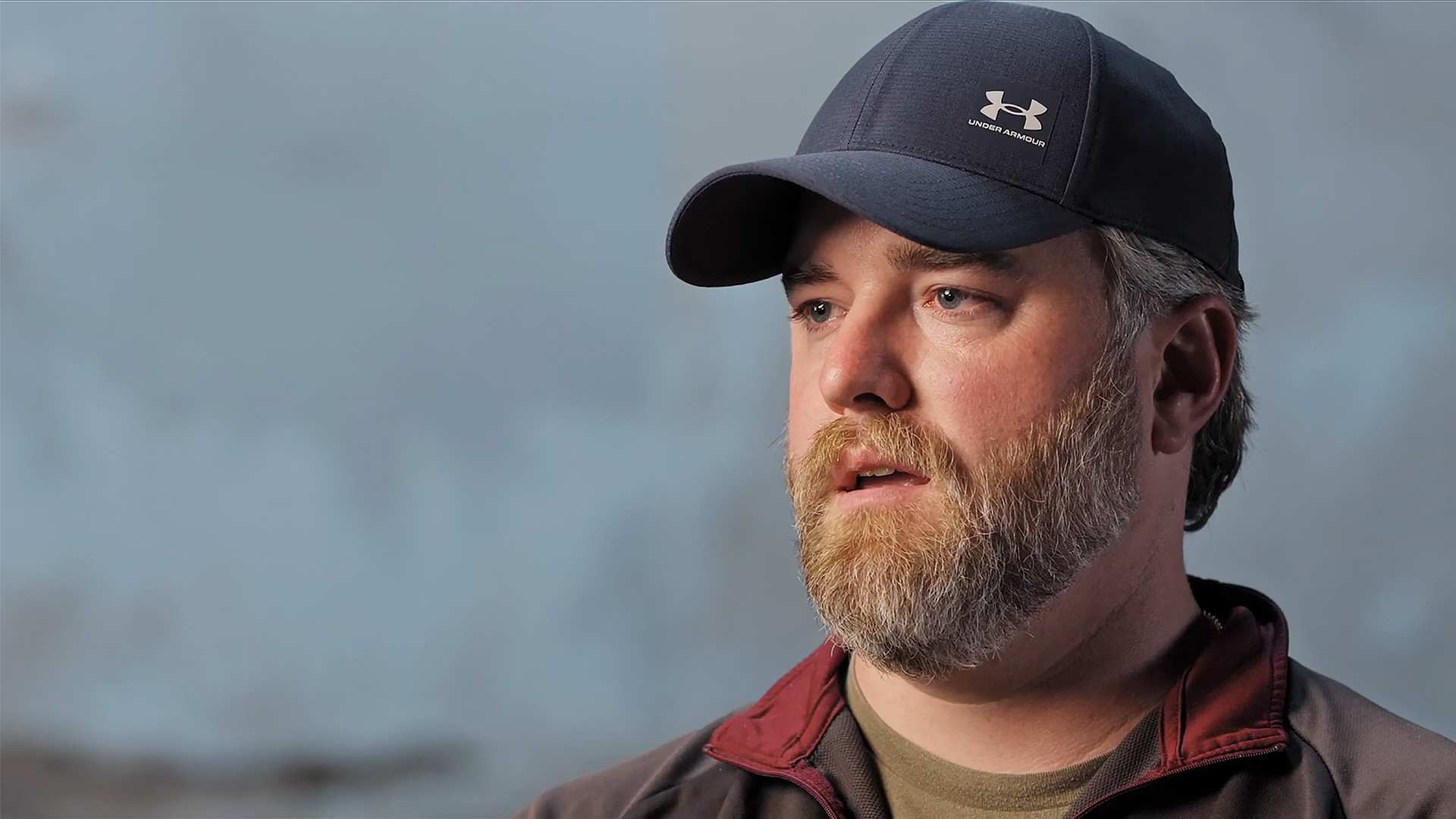
Journey to the frontlines of a forgotten mental health crisis raging within America's warriors with U.S. Marine Corps veteran Cole Lyle in a brand new episode of 'Forgotten USA'. Learn how Kaya, Lyle's service dog, was enlisted to support Lyle in his own mental fight against PTSD, and how service dogs everywhere are saving veterans from their final battle waged when they return home.
Transcript
Read the full transcriptAuto-generated · 2,286 words
Of course, Canada, Texas. I took an interest in service at a very young age. For some reason, naturally interested in military history. Then when I was in sixth grade, 9-11 happened, and that interest in service was amplified. My mom told me, when you turn 18, you're going to get a job, join the military, or go to school, but you're not staying in my house.
So, I joined the Marine Corps, and largely because my brother-in-law was in the Marine Corps, served in the Battle of Fallujah. And I think it was just my natural respect for him that led me to the Marine Corps. And then, of course, the Marine Corps has the best marketing department of all four branches.
Joined in 2008, shipped out to boot camp two weeks after high school graduation, got activated to deploy to Afghanistan in 2010. 2010 and 2011 were President Obama's peak surge period, so when the surge happened in Afghanistan, largely it was made up of Marines in South Helmand, and it was a pretty kinetic time period.
I was trained as a wrecker operator. When things would get blown up, We would be tasked with going out and recovering the vehicles and bringing them back. So that was a fairly dangerous job. Really where my veteran advocate story begins is taking over some responsibilities at the Bastion Trauma Center, the hospital in Helmand Province, working on a lot of local nationals, Marines, Royal Marines.
All manner of injuries, some that were too far gone to be saved. When I got back, I realized that it had kind of affected me. It took me a while and a bunch of therapy to figure out specifically why.
It's really difficult for veterans because you've got to balance the active duty stuff, and then you go home and you're expected to leave this close-knit organization of people you serve with, and then go back into the civilian world where people don't really understand what you went through.
When it rains, it pours, right? I got out, and I kind of lost all that support system, and in some bit of denial with what I was struggling with from Afghanistan. Struggling with post-traumatic stress, was going through a pretty nasty divorce, didn't have a job, wasn't in school yet. Suicide factors, right? Financial stress, relationship stress, was about that close to becoming a veteran suicide statistic one night.
Luckily, a Marine intervened, and if not, I wouldn't be here. I was drinking a lot that night, and the next morning, I can't really explain it logically. I should have been hungover, but I wasn't, and I was thinking very clearly, and I call it divine intervention. My mindset shifted from I was drinking a lot that night, and if not, I wouldn't be here. I have nothing to, I have the opportunity to do anything. I latched on to a verse from 2 Timothy 1.7, which is, For God does not give us a spirit of fear and timidity, but of power, love, and self-discipline.
So, I kind of locked myself in a room for a while with a notepad, and I said, I am just not going to leave the room until I figure it out. Call it foolish of me, but at the time, I said I want to, as a former instrument of United States foreign policy, I wanted to go in and help shape it.
But at the time, I still had to deal with the issues from post-traumatic stress and some of the struggles from divorce and things like that, and the pills that I had been taking, the SSRIs, just really didn't help, and I think exacerbated a lot of those issues. You know, they tell you don't quit those things cold turkey, but I, you know, flushed them down the toilet and stopped them and ended up... Figuring out through a friend of mine that a service dog was an option for veterans for this specific thing.
Reached out to a friend of mine who had a litter of German Shepherds. Reached out to another friend of mine who was a dog trainer. He was in the Marine Corps with me. He said, I can work with this one, this one, this one, and this one based on their temperaments at such a young age.
And Kaya, the German Shepherd that I ended up getting, was the only female, and she was trained to help with symptoms of post-traumatic stress, specifically waking me up from nightmares. If I had met her in my own room, stopping anxiety attacks. If she could tell I was getting stressed, she would jump up into my face and lick my face. To break the snowball effect of that anger-depression or whatever it was. That was a very quick process. I saw results from that I had not seen, that I obviously had not seen from pills and therapy.
Frankly, if you do find yourself at that point. Where you've got a gun in your mouth, you look down at this dog, and you say, you know, I can't leave the dog. Who's going to take care of it?
People would come up and ask, hey, you know, why do you have a service dog? And it gave me the opportunity to tell them about, you know, veterans with post-traumatic stress, and pills exacerbate those symptoms, and service dogs really, really help.
One of those people happened to be Tom Tillis, a senator from North Carolina. He's a huge dog lover. He invited me to his office, and he asked, you know, so what do you think we should do about this problem? And my response was like, well, you're the policymaker. You tell me, right? Like, I didn't know anything about D.C. You're a senator. He gave me the idea that if he was willing to listen, other people on the Hill might be willing to listen, too, and do something about this problem.
So, I kind of drafted a one-pager thing about, you know, this is the problem in the veteran community, this is why the current strategy to fix it isn't working, and this is why service dogs affect positive change, and I went around to people that I had met on Capitol Hill, and I said, hey, maybe would your boss be interested? Doing some legislation on this, and the first person who really jumped on the idea was then-Congressman DeSantis. Those who risk their lives for this country deserve the absolute best care upon their return, and time is of the essence.
I have introduced the Puppies Assisting Wounded Service Members Act of 2016. Since starting this quest, more and more of the veteran community have come forward pleading, in fact, begging. To use what voice I have in this chamber and in the halls of Congress to give you all this message. Service dogs will save lives.
At this time, though, I had also applied to Texas A&M, so I was working with the congressman to turn that white paper into an actual piece of legislation as I was in school. Probably at least two or three times a month, I would fly to D.C. and meet with members of Congress.
And I remember there was one congresswoman's office I walked into. She said, you don't even have to try to pitch me. I've already read the bill. I'll co-sponsor it. And she said, can I just cuddle with your dog for five or ten minutes? And, you know, you're not supposed to pet service dogs, right? But when I'm talking with members of Congress about supporting this bill, I'm like, I'll bend the rules a little bit. Like, sure, you can cuddle. So she passed out on this congresswoman's lap for a solid.
Five minutes or so. She had been walking all over the hill that day, too, so she was tired. I ended up graduating from Texas A&M. Kai actually walked the stage with me in a cap and gown. Then I went to go work in the Congressional Affairs Office at VA, and then... the afghanistan withdrawal happened chaos erupted today in kabul as the taliban swiftly seized control desperate afghan civilians flooded the tarmac clinging to departing planes while the biden administration suicide bombing at kabul airport killed 13 u.s service members and dozens which brought up a lot of difficult memories for not only me but Other Afghan veterans, other veterans of Iraq, and even Vietnam veterans who felt a similar betrayal.
I was the only one in my former unit that had worked in D.C. I had people left and right calling me and saying, like, how are we letting this happen? And three of them happened to actually be suicidal.
While all this is happening, August 26th of 2021, the PAWS Act, which I had spent years of my life advocating for, finally passed. So, it was a very diamond in a rough spot during the Afghanistan withdrawal. So, fast forward a year, I'm working in the veteran nonprofit space on suicide prevention. Everything's going, you know, pretty well, and Kaia gets sick.
And found out that she had had a late stage sarcoma and removed a growth on her leg and thought that we had gotten it all, but then she deteriorated after her surgery pretty quickly. So, I had to make that decision and took her.
On her last flight from D.C. down to Texas, at this point, she had been on over 300 flights, going around the country with me, advocating for the PAWS Act, you know, going back and forth from A&M to D.C. I didn't know this, but a friend of mine that works for Southwest tipped off the pilots.
Kaya is a German Shepherd service dog. She was the inspiration for the PAWS Act. It is a federal law that allows the VA to find service dogs for veterans with post-traumatic stress. Lobby for the PAWS Act to travel in a colt. Kaya has flown on Southwest over 250 times. Sadly, Kaya was recently diagnosed with an untreatable cancer, so we have the solemn honor of taking her on what will be her last flight.
On behalf of Southwest Airlines. Ended up taking her down to Texas A&M, where we had spent so much time together. She couldn't walk, and I had her in the back of a truck, and I opened up that back window that was behind us.
And when we drove into College Station, that was the only time on that entire three and a half hour trip that she stood up. She just remembered the scent. She remembered where she was. It was the first time, and I think the only time I saw her smile on that entire trip.
And then the next day was a Saturday. The assistant dean of the small animal clinic showed up on a Saturday to be the one to put her down, and that was, when I say one of the most difficult moments of my life, that was tough, just because we had built such a bond, and she had helped me overcome.
So much of my personal issues, but in my mind, I didn't want her to be in pain and I didn't want her to be in pain and suffer after all the pain and suffering that she had stopped. They asked me. I wanted to do an autopsy, and I said, yeah. And they called me, and they said, I honestly don't know how she survived as long as she did, because the cancer had spread everywhere.
She had just learned to live with her condition, and it was normal for her. And in some ways, I felt like... That was a lot of veterans, too. They just deal with, and it's normal for them, and they just learn to live with it.
Her last flight got like 300 million views. It was insane. I was getting messages from people in Dubai and Australia and the UK and people that never even had service dogs but had dogs and could resonate with how powerful the connection was. Veterans that had reached out and said that our story had inspired them to get their own service dog, and if they didn't, they would have killed themselves.
We did interviews on, you know, CNN, Fox, ABC Nightly News. Everybody would ask, like, do you plan on getting another service dog? I wasn't in a place, like, I needed to mourn. So, about a year later, I ended up reaching out to the breeder to get little Clementine, who is just a bundle of joy and energy. Come here. Oh, you were sleeping?
Big sleepy girl. I couldn't bring myself to get another German Shepherd after Kaya, and Goldens just seem, they're just such happy dogs, and, you know, they shed a lot. I mean, she's kind of chill right now because she's been running around. They're smart, they're high energy, they're very trainable, and I mean, look at this face. They're just so cute. They're just, like, how can you, how can you not love that face?
She's not going to be a service dog, because thanks to Kaya, I don't feel like I need another one. But I plan on having her trained as a therapy dog, so that I can take her into VA hospitals over holidays, and be there for veterans who don't have friends or family that are visiting them, so that she can bring them the same kind of joy that she's now bringing me.