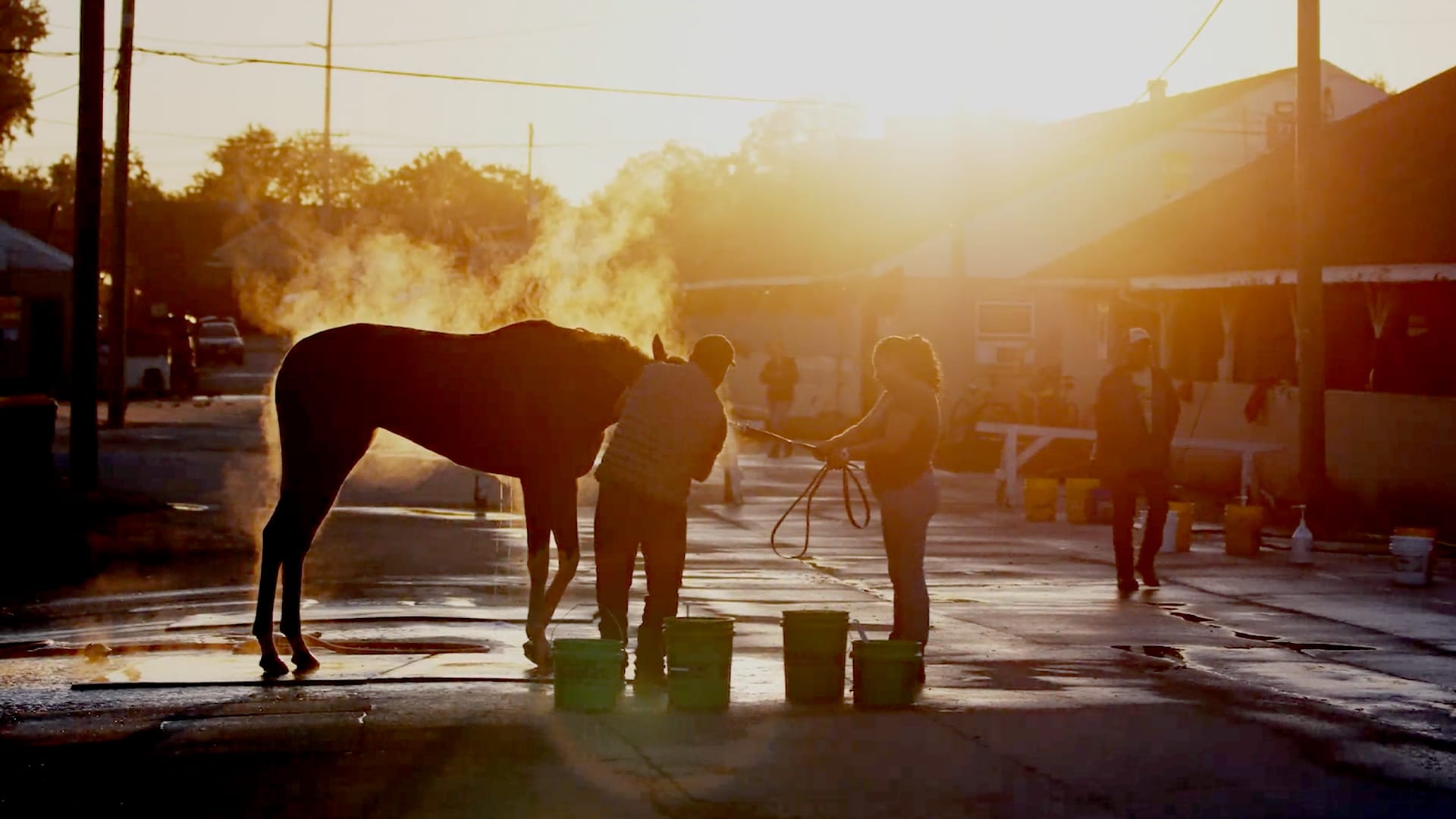
The Backside of the Track
Just a stone’s throw from the track on which a legendary race is run, a close-knit community of nearly 1,000 people works seven days a week to care for the horses at the heart of the most exciting two minutes in the world of sports.
Transcript
Read the full transcriptAuto-generated · 2,022 words
Since 1875, Churchill Downs has run the Kentucky Derby every single year, longer than any other sporting event in America. The world knows its front side, the twin spires, the grandstand, and the most exciting two minutes in sports. In 2026, nearly 20 million people watched the race, and bettors wagered $225 million on those two minutes. But across the track, closed to the public, is another world, where nearly a thousand people care for the horses, starting at 4 a.m., seven days a week.
In the world of horse racing, they're known as the backside workers. The backbone of the horsing industry is these workers. And who are these workers? Basically, they are the hot walkers, who take horses from the paddock to their track and back to the barns. You have the groomsmen, who basically take care of the horses. They feed them, they groom them, they water them down. Then you have the exercise jockeys and the jockeys themselves. So, that is basically the backside workers.
There's so many moving parts, and there's so many people. There's so much that's required to put on these events and these races. I think it's really sweet when people who come for the races get to see a glimpse of what the backside looks like. Without the hot walkers and the grooms and the stable hands, you know, none of it would happen.
All the wonderful glitz and glamour that people see in the TV, this is where action really happens. These jockeys and these horses, they're athletes. The backside workers, they get here around 4, 4.30, very, very early in the morning, and they basically get the horse prepared. We have a lot of really hardworking people back here, and they come to work seven days a week without break. A lot of them do not have days off. Some of them have one day off. The majority don't.
Horses need to be taken care of. The hot walkers lead horses from the barns to the paddock and out into the track, and then they release it. So, what happens next is that the horse is brought to the outriders, and they're very, very vital in making sure the horse stays calm. Once the horse does the breezing or does a workout, then they take the horse, once they leave the track, and lead them back to the barn, and they basically wash them down.
They cool them down, they brush them, make sure they're nice and clean. These individuals have a disconnectivity with the horses. There is a bond. There is a unique relationship to observe and to see. When I introduced myself as a chaplain at Churchill Downs, many people only imagine that I'm probably the chaplain at the front side where people are there watching the races. Many people do not know that there is an area where the stables are, where people also live. There are dorms, hundreds of people who live at Churchill Downs.
We are the chaplains for them. A lot of them come from their home countries, mostly seeking to provide for their families. The majority come from Mexico and Guatemala. We also have people from Honduras, El Salvador, Panama, Chile, Argentina. A lot of them start in California, or in New York, or in Florida.
Some of them start here in Kentucky, and then they make their way here based on the movement of the horses and their They basically come to find work. They love the horsing industry. They go from track to track finding work in order to provide care and love for these horses.
They know their value in that way, but I think a lot of people don't know their value. So, I think that is another thing that we get to do is instill dignity and remind them that they are important. You have value. You matter. You actually are the engine of this industry.
We have a chapel here in the stable area, a nice facility where we provide a weekly service. Where people can come and connect with God. A lot of people don't know this exists, and to go through and see... The chaplains work as much as they do. We actually serve the whole racetrack population, anybody involved in horse racing. But most of all, what we do is we meet the spiritual and physical needs of the backside workers. We are a ministry of presence.
Just building relationships, we are where the people are. Bienvenidos. ¿Cómo se sienten? Pasen por favor. Pancake. Tenemos huevo. Y el chocolate no lo agarraste. I'm trying to let everybody know that we have our breakfast at the chapel. While they are working, we are inviting them to come over here because we are serving them. They are coming and they are, you know, getting some breakfast and we can connect with them. Our first mission is trying to do true connection with all those people and connecting with God at the same time.
We also spend time with the jockeys before the races. We have a time to pray for them, for safety. The horse and stream can be very dangerous. Some of these workers, the hot workers, they can get kicked. See, we had a bad accident here on the track a couple weeks ago. Our chaplains were right there. They went to visit them in the hospital. They visited their families.
There are many single men, and they're coming here to work so they can provide for their families back home in their country of origin. A lot of people are struggling emotionally because they've left country, family, language, culture, and come to a completely new place. If they don't have any support, they're going to find ways to fill that emptiness, sometimes alcohol. Sometimes alcohol, sometimes drugs. People have found the chapel here, where they find community, they find a family, they find faith. This is a community.
This is a very close-knit family. We are here for them, and we are here for praying. We are here for help with transportation or something with doctor appointment. We want them to understand that they're valued, that God cares for them, that God loves them. And how following Jesus makes a difference.
Every single Monday, 6-15, we start with a dinner for everybody, and then we start our service at 7 p.m. And we can share the gospel, we can connect with them, and this is an amazing time serving people over here, and show them. About God's love. We are here for everything and everybody. It's our call.
We are going to meet the people where they are, and if they need physical needs, we're going to try to meet those needs. Our clothes closet is a culmination of a lot of volunteers that receive clothes. We categorize them. We have shoes. We have boots, pants, pullovers. We provide a very vital service to them. Everybody has a need, so we get to meet those physical needs, and in so doing, build relationships that help us to be able to introduce them to Jesus and get to meet spiritual needs as well.
At least a third of our back side workers are women. We have a lot of single moms. We connect them to resources. We have a lot of ladies separated from their children, from their families, and so that's really hard. So, just walking alongside them in that.
The rates of abuse, domestic abuse, the rates of alcoholism, the rates of suicide, all of those things are amplified in this population, and so I would say that one thing that we provide is emotional care, just walking with people, so when they're working through something hard, they don't have to do it alone.
It was a meeting that we had in my boss' office. It was the first time I saw her. I saw her and said, Jesus, they're going to kill me. I thought the situation would lead me to that, I was very nervous. However, she told me that she was going to be my translator. It was the first time I saw her. That they were there to support me. Melanie took my hand and told me, You are not alone. And at that moment, for me, it was something very beautiful.
An emotion that still haunts me. Hey, you're not alone. Like, I'm here, and then we're here, so we can be your family, essentially, in this new place. And so, I think walking alongside people, you know, it extends a hand to them, and in so doing, it extends, like, you know, it's an extension of life.
everything that is done here, how they support us, the word. It has been a lot of growth. I feel totally different. I feel that I have a family, that I no longer feel alone. Our ladies have hard lives. We all live really hard things sometimes. And I think just being able to be present. We've had deaths of spouses who were young, too young to die. We've had, we have jockeys who've been injured, all those things. It's an opportunity to show them, yeah, the love of Christ, and it's just normal.
Honestly, it's a normal Christianity. It's not extra, and so I just get to do it here. We have Mass in Spanish on Sunday afternoons at 4.30 p.m., and it is the community Mass. We gather together in great numbers.
We gathered first to pray. I had a group who wanted to start October with the Rosary, so before Mass, they were praying the Rosary. The image of Our Lady of Guadalupe usually lives over at Churchill Downs, and was brought over on Thursday so that we could process over.
But the whole community really joyfully gets involved in this particular celebration. And with that procession, it's a perfect example of the joy of this people. Part of the culture is a love of procession, of taking the faith out to the streets, of having those visible, tangible signs of faith.
Getting to a place, and then just the explosion of music, and food, and family time together, and both the image of Our Lady of Guadalupe, and prayer candles, and rosaries, and then you've got the band playing, and people dancing, and having a good time. In Spanish, we say it this way, fe, familia, fiesta. So, faith, family, and everybody knows the word fiesta.
That is a beautiful part of the culture, and I think one of those great additions to who we are as Americans, as a people who come from many different places, and yet here in this place, we become one, that great melting pot of who we are as Americans. It is a beautiful, emblematic picture of what we become together.
It is such a diversity of stories of the decision that people make to leave their country of origin, to leave... Their home culture and build a life somewhere else for so many the need to move is based on real pressures economic pressures political pressures real dangers that people face The vast majority of the people who we work with are good people in search of a better life a new opportunity It's so important to listen to people's stories.
Y la capellanía ha hecho un muy buen trabajo en sentir ese refugio para todos, incluyendo a Mami. Yeah, we have different last names. We come from different backgrounds. The faces might change, but the experiences and the challenges and the joy and the sorrow, it's all the same. La capellanía nos hace sentir en familia, nos hace sentir en casa. God has played a significant role with our chaplains in terms of being in the... We want to shine the light of Jesus in whatever...
We are in a race, making sure we fulfill his will, because one day we'll be called home. We want to make sure that we promote and claim his word, and to help out his children. That's what we're here to do.