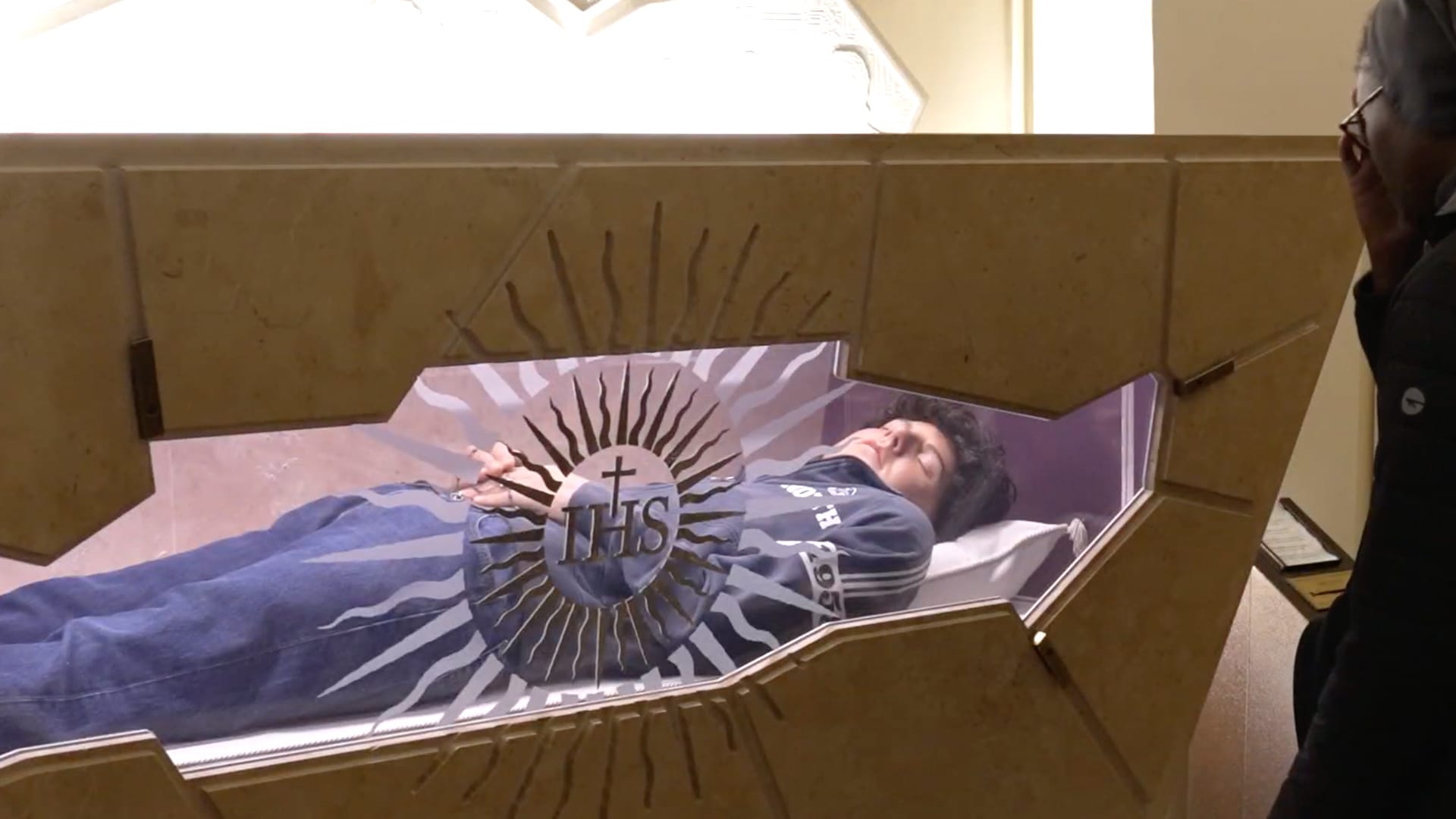
Carlo Acutis: Through His Mother's Eyes
Delve into the life of St. Carlo Acutis—his dedication to Christ, his love for the Eucharist, his charitable heart, his inspiring presence, and more—from the unique perspective of his mother, Antonia.
Transcript
Read the full transcriptAuto-generated · 2,169 words
When you open the door of your heart to Jesus, your ordinary life becomes extraordinary because Jesus transfigured our life. And the merit of Carlo was to... Open the door of his heart to Jesus. He used to do everything through Jesus and for Jesus.
So, also, the minimum things of the daily life, like to play, to study, is always the force on God, the heart projected towards God. So, his life became a continuous prayer. And he had a very strong mystical life. He did his first Holy Communion when he was seven years old. In that occasion, he wrote, to be always united with God, this is my life program.
And since then, he started to go to Mass each day, to do Eucharistic adoration each day, to pray the Rosary. Each day, the Bible, because for him, the Bible was the compass, in order to, that had to guide him towards the infinite, that is the goal of each one of us.
This is the way why Carlo used to call the Eucharist my highway to heaven. And when we take the Eucharist, these pieces of the bread remain in us more or less 15 minutes. In that precious moment, God... Transfigure us. Carlo used to say that each time we do the Holy Eucharist, we are not anymore the same person. It's clear that the more we open the heart to Jesus, the more he will fulfill us with graces.
But Jesus really transforms us, reinforces our force of will, because believing in the future means to have a stable attitude of the will to the goodness. And we need the force of Jesus in order to face the temptation, also to face the wounds of the original sin we have, each one of us has, that inclinate us to the evil. So, Jesus helps us. It is the medicine of our heart, like St. Ignatius of Antioch used to say, that is a pharmacomedicine of immortality, the Eucharist.
Really, it is the most powerful thing we have. When they do exorcisms, and with the host, David became very angry, and also the Eucharist is really the most supernatural thing we have in the world. Carlo is contradicting his time, because he was a pioneer, for example, because he started to do these very short phrases, you know, not me, but God. All are born original, but many die as photocopies, you know. It was his way of preaching, like tweets, and now the name is X, but anyway, it was very straight, very, it arrives in the center of the things.
It says everything, and of course, he was using the internet. It was a computer programmer, it was a catechist, and today the problem is the lack of faith. This exhibition was done because Carlo used to say that there are queues in front of a concert, in front of a football match, but he couldn't see these queues in front of the tabernacle that is the Jerusalem with us. How many Jerusalem we have in the world? Million. Million of tabernacle. We don't need, Carlo used to say, we don't need to go to Jerusalem.
We have the Jerusalem under our house in the nearest church. So, it's important to be aware about this. ...the presence of God. And this exhibition, he did it because he teaches catechism for five years, and he realized that people didn't understand the importance of the Eucharist. And so, he said, I will do this exhibition with photos, with all the paintings, the documents, in order to try to alert people of the importance of the Eucharist. And if you think that the last Eucharistic miracle that was...
Proof, the congregation of the faith, that is the highest organ of the Vatican, is a miracle that happened in Lenica, 2013, in which an host became a chair, a flesh. This miracle was a proof from the scientists as well, because they are inexplicable. And this miracle, Jesus, in the third millennium, is continuing giving us signs of this type. What does it mean? That he recalls us to the importance of the Eucharist, and Carlo is an Eucharistic saint. He reminds us that it is important to trust this church, to trust the sacrament.
To understand that the sacraments are the sign that the Holy Trinity falls to give us the grace, and through the sacraments, we receive the salvation, the grace. We have to have an eye always on this gift that the Church gives us, and Carlo reminds the basic things of our faith.
Also, the personality he had, you know, he was attractive, he was very joyful, very nice, very generous, he helped everybody, and he was very involved in charity works, like helping the beggar in the street, helping the people with handicaps, the elders, and also teaching catechism for five years, all these charity works, and also helping through internet, building websites for the church, for the Jesuit, for many things. So, of course, he was the first one who used to say, what is the goal of winning thousands of battles if I'm not able to win myself with my corrupt passions?
Carlo used to put himself notes. Did I do the good things I could do today, or did I miss it? Definitely, I was in the situation of most of the people. I was growing in a family. I was baptized because everybody do this, but my parents were not practicant. I was living in the center of Rome, and around my house, there were only Catholic schools. So, this is the reason why I was sent in a Catholic school. And why, while I was in this Catholic school, I did the first Holy Communion, and that was my first communion.
Then I did the Confirmation, that was the second communion. But then I got married, and Carlo was born. I was very ignorant, and Carlo was very anticipating everything. Also, three months, first word, five months, he already was able to speak.
And also, two years and a half, three years and a half, he was prostitutionally pious. He wanted to enter inside the church. We had to go to the park instead. I used to say, Carlo, let's hurry. We have to go. But he wanted to stay in front. It was a tract. And, of course, this... I had a sort of changement in my life, a conversion, even if I say that I will finish programming the purgatory, the conversion, but anyway, at least I started to believe.
Why? Because my father died of an heart attack suddenly. He was only 57 years old, and Carlo, after a few months, told me that he saw grandfather that was in the purgatory. He appeared to him, said, I'm in the purgatory, I need prayers. And Carlo... Of course, I started to pray for the grandfather, but I was very worried, too. And I had the chance to meet a very special priest that was also our spiritual director, Father Elio Carraio, that followed us, also followed Carlo until the end of the life of Carlo.
Even if he was very old, he died after Carlo, he died in 2010. And Father Carraio, the first time he saw me, He said to me, you have a special son. He will be very important for the church. You will see he has a mission. I didn't understand at that time, and then he confessed me, and he had the gift of the discernment of the Spirit, and he told me all my sins, and he told me to study theology because I was so ignorant, and I started my path, and through Carlo, I understood.
I did the discovery of my life. Because I understood that in the Black Sacrament, there is the real presence of God. Before, I was like a Protestant. I thought that the Black Sacrament was only a symbol. Instead, with Carlo, and I started my path with Carlo, because when Carlo did the first Holy Communion, we started to go to Mass together each day, to do the Eucharistic Adoration each day, to pray the Rosary, the Bible. So, I'm not a saint, but... I try to follow the example of Carlo, hoping that in the future, maybe I will improve a little bit.
Carlo didn't have the stigmata, the vision. I mean, he had some special fears, but he was very ordinary. He didn't put too much importance to these things. He was projecting in daily life, in the basis of the life, because this was, and it was very essential also in his faith, very Christological, Jesus, the Virgin Mary. He didn't have so many devotions, but especially the Holy Mass each day, the Eucharistic adoration, and the rosary, and the liturgy. Sometimes he used to do either the compieta or the hours, you know, the lodi, laude.
But when he had more time, because of course when he was going to school, he didn't have so much time, but the daily meeting with Jesus in the Blessed Sacrament. It was the center of his life, and when we used to do some trips and time abroad, the first worries of Carlo was to find the nearest church to our hotel, not to lose the mass or the moment of prayer with Jesus.
Carlo was not scared about that. He thought that life is, that death is the true path, the passage to the true life. He used to say that from caterpillar, we will become butterfly. And he used to say, when you ask Carlos something, you know, what would you like to do when you will be older, he used to say, let's worry about the present moment. He had the sense of the caducity of time. He was aware that, and he did a video two months before to die, in which he predicted his death.
He said, he looked at the sky with a smile, he said, when I will be, I will weigh 70 kilos, I am destined to death. Looking at the sky, like, you know, and this is what his attitude with that.
When, at the beginning, this fulminous leukemia hide was hidden behind a normal flu. Most of the class of Carlo were ill, so nobody thought that he had the leukemia. And in that occasion, he said, I offer my sufferance for the Pope, for the Church, not to go to pulmonary, but... We had to go straight away to paradise, to heaven, and in fact, after a few days, one morning, let's say two days after, he woke up and he couldn't move, so we were very worried, and the old pediatric of Carlo said, suggested to bring him in the hospital, and we both, and while we were in front of the hospital, Carlo said to us, from here, I want...
Come out alive, but don't worry, I will give you many signs. And he never complained during the conference. He never did a lamentation, always with a smile. When the doctors were asking him, are you suffering? He always with a smile, he was saying, there are people who are suffering more than I. So, Carlo had always this, he was not scared. He used to say that we have to live each day like if it was the last day of our life. And when he was small, he was always saying that he would have died with a brain hemorrhage.
In fact, he died of a brain hemorrhage that was provoked by the leukemia. But through Carlo, I have gained, surely, the possibility of witnessing. And this is important, because God himself gave us the order to go and announce all the people the good and noble. So, it gave me the possibility also to become a little bit, like I say, like an apostle.
Of course, I'm not an apostle because I'm not holy, but it gave me this possibility to do the good things, to help people. Through the example of Carlo, the witnessing of Carlo, many people got closer to God. I found, again, their faith, and there are so many miracles, so many initiatives in the name of Carlo. So, surely, I have to do my best. I have to improve myself. I have a lot of fragilities. I'm not a saint, but I hope, with the grace of God, with the grace also, and the possession of my son, to be able in future to win what is wrong with me, because everybody has a dust, you know, inside, and we have to...
Clean, all the life is a washing of the dust. We have to purify ourselves, but I hope really to be able to always be an instrument, an instrument through which I give the witnessing, I try to make Carlo known as he was, not distorted.